International Journal of Innovative Technology and Exploring Engineering (IJITEE) ISSN: 2278-3075, Volume-8 Issue-6S, April 2019
Abstract: Cloud computing has rapidly turned out to be a standout among the hugest fields because of its transformative administrations gave a model of registering in the IT business as well as in the software and hardware industry. Providing security is noteworthy as the cloud information is put away and got to in a remote server with the assistance of a cloud specialist organization. This system thought of expanding adaptability, versatility and dependability; while diminishing the operational and bolsters cost. We proposed a new analogy called as optimal. Optimal comprises of encryption, information proprietors, and deduplication. Translation of efficient storage and security for all data is very crucial part for cloud computing. We majorly concerned about Interruption, memory efficient, discovery, and anticipation are performed in this framework. This paper describes about memory efficiency and calculation of data and effective storage the data. The data are finally stored in cloud server. To ensure data confidentiality the data is stored in encryption format.
Keywords: De-duplication, Cloud computing.
I.
INTRODUCTION
The ascent in the use of cloud computing has lowered the cost of activity, versatility and simpler access has prepared for more extensive utilization of distributed storage administrations. Cloud storage administrations cause client to anchor its information from neighborhood risk just as enhance convenience. A similar idea additionally helps in imparting information to various clients and work on same venture all the while. This prompts a noteworthy issue among Cloud Service Provider (CSP) of same information getting transferred to their capacity servers. Number of clients store their valuable data in cloud. This outcomes in loss of capacity memory and make access to clients slower. Therefore, so as to make distributed storage increasingly productive information deduplication was proposed by Zheng Yan, et al [1]. Proposed deduplication dependent on possession test and intermediary re-encryption. This framework utilized an additional outside framework that guarantees information proprietor's check and makes cloud specialist co-op as an intermediary between the two. It included suppositions that the outer party will stay free from any arrangement with some other client or CSP itself.
Revised Manuscript Received on April 12, 2019.
K. Ravindranath, Associate Professor, Department of CSE, Koneru Lakshmaiah Education Foundation, Guntur, AP, India
Y. Sai Vinay Balaji, B.Tech Student, Department of CSE, Koneru Lakshmaiah Education Foundation, Guntur, AP, India
B. Mohan Manoj Kumar, B.Tech Student, Department of CSE, Koneru Lakshmaiah Education Foundation, Guntur, AP, India
Ch. Havisha Chowdary, B.Tech Student, Department of CSE, Koneru Lakshmaiah Education Foundation, Guntur, AP, India
This exceptionally raises the season of transferring an information and in this way can't be conveyed for Big Data purposes. The proposed framework, let client transfers its information which gets encoded on his machine as a shrouded procedure and after that get exchanged to CSP's server. This evacuates outsider contribution and aides in less demanding procedure stream between the two gatherings included. Storage capacity requirements for reinforcement applications, as in [2].
It has likewise demonstrated space sparing of up to 68% in standard document frameworks [3]. The new framework will likewise give access of information by clients who need to see the record by enabling information proprietors to affirm their demand utilizing an anchored One Time Password like administration on mail. This will guarantee information proprietor security and their information uprightness while enhancing information sharing among people. Known partners or clients. Current modern arrangements have accomplished deduplication at the expense of additional assets or by complex process. In this paper, it is proposed a straightforward information stream display which keeps the engineering of our framework extremely basic and yet it doesn't trade off on speed and honesty of the two information and information proprietors.
II. LITERATURE SURVEY
Fast and secure laptop backups with encrypted de-duplication
Various people right now store far reaching measures of individual and corporate data on workstations or home PCs. These consistently have poor or unpredictable accessibility and are powerless against thievery or gear frustration. Customary support courses of action are not suitable to this condition, and fortification schedules are once in a while lacking. This paper delineates a computation which misuses the data which is customary between customers to fabricate the speed of fortifications and decline the limit essentials. This estimation reinforces client end per customer encryption which is indispensable for private individual data.
Message-locked encryption and secure deduplication
We formalize another cryptographic unrefined, Message-Locked Encryption (MLE), where the key under which encryption and deciphering are performed is itself gotten from the message. MLE gives a way to deal with achieve secure deduplication as the moulded data is in a secure storage. This confers the data in a secure and reliable way to approach data.
An Efficient Cloud Storage Management
Optimal With Deduplication
Deduplication i.e (space-successful secure re-appropriated limit), a target at present-centered by different disseminated stockpiling providers. We give definitions both to the security and for a kind of reliability that we call name consistency. In perspective on this foundation, we make both feasible and theoretical duties. On the convenient side, we give ROM security examinations of a trademark gathering of MLE plans that consolidates passed on plans. On the speculative side, the test is standard model plans, and we make relationship with deterministic encryption, hash limits secure on related data sources and the precedent then-remove perspective to pass on schemes under different assumptions and for different classes of message sources. Our work shows that MLE is rough of both practical.
Security proofs for character based distinguishing proof and mark plans.
This paper gives either security confirmations or ambushes for innumerable based ID and imprint plans described either unequivocally or surely in existing composition. Concealed these is a framework that from one perspective elucidates how these plans are induced and after that again engages isolated security examinations, accordingly understanding, streamline, and tie together past work. We moreover research an ordinary tales improvement that explicitly yields identity based conspicuous evidence and imprint plans without sporadic prophets.
A reverse deduplication stockpiling framework advanced for peruses to most recent Reinforcements
Deduplication is known to successfully dispose of copies, yet it presents discontinuity that debases perused execution. We propose RevDedup, a deduplication framework that improves peruses to the most recent reinforcements of virtual machine (VM) pictures utilizing reverse deduplication. Interestingly with customary deduplication that expels copies from new information, RevDedup expels copies from old information, in this manner moving fracture to old information while keeping the format of new information as consecutive as would be prudent. We assess our RevDedup model utilizing a 12-week range of true VM picture previews of 160 clients. We demonstrate that RevDedup accomplishes high deduplication effectiveness, high reinforcement throughput, and high perused throughput.
Secure deduplication with efficient and reliable convergent key management
Data deduplication is a technique for murdering duplicate copies of data and has been extensively used in disseminated stockpiling to diminish extra space and exchange information transmission. Promising, everything considered, a developing test is to perform secure deduplication in disseminated stockpiling. Though joined encryption has been extensively gotten for secure deduplication, a fundamental issue of making centered.
III. PROBLEM STATEMENT
Current modern industrialization of Cloud Service Providers like Dropbox, Google Drive, Mozy,[5] and other nearby Cloud Service Provider will render deduplication by
sparing just a single duplicate of record transferred. Be that as it may, this may not work if information proprietors scramble their information utilizing diverse encryption. This will prompt diverse figure content bringing about diminished productivity of information deduplication. DeDuplication being the major perspective in it, this methodology can't isolate in a chronological order information. a) Data assurance and security are the new systems that proposed an arrangement to scramble the data at the Data Owner machine itself. Thus, the data that is being transmitted to CSP will be encoded. This confers us with two vital central focuses over the past strategies used viz
1) Data Owners are ensured with any data robbery that may occur in the midst of transmission of data from Data owner machine to CSP's servers.
2) CSP has less risk as they are not the person who is scrambling that just assigned clients can get to the data. This will help them in redirecting aggressors. The data set away in the cloud will be open just if they are enlisted as proprietors of the information. This procedure will be dealt with by information right concede way. Deduplication has demonstrated to accomplish staggering expense investment funds, e.g., diminishing up to 90-95% . A module which will test the mentioning client to demonstrate its proprietorship as asserted. Here there are just two performers engaged with the situation. One will be a gathering of clients who have the information. They have been named as information proprietors. The other performing artist is CSP. This is numerous to one connection as there will be numerous information holders will's identity transferring and downloading information to and from CSP individually. The key used to encode the information will be put away with the end goal that it is additionally not noticeable to the client. The key will be safely put into utilization at whatever point the information holder needs to transfer any information to the servers of CSP. Information sharing is an essential part of any CSP. It gives its clients leeway as the Data proprietor doesn't need to independently send the document to the assigned clients. Rather, they can transfer it to their cloud and enable different clients to download it from that point. This usage needs uncommon security game plan so as to enable just real clients to download the document. It is proposed that the information clients get themselves enlisted so as to get to the CSP's interface. There it can request the required document from the proprietor. The proprietor gives or rejects client demand. In the event that the information proprietor has permitted the information client will get an entrance key. This will guarantee That the data is more reliable and stored in an encrypted format. The encryption is done in an ECG algorithm and had done different encryption from his side. If data holder is already encrypting data using his personal encryption, then that information would result in the age of various cipher text not resist for similar information. Information clients and CSP impart through the protected channel with one another.
International Journal of Innovative Technology and Exploring Engineering (IJITEE) ISSN: 2278-3075, Volume-8 Issue-6S, April 2019
Information robbery won't be an issue here as the information is encoded amid sequence. Subsequently, it diminishes the risk of CSP with regards to protection issues.
IV. IMPLEMENTATION
Modules
Cloud Service Provider Data Users Module Private Cloud Module Secure Deduplication System
Modules Descripton
Cloud Service Provider
In this module, we make a Cloud Service Provider module. This is a component that gives data that amasses organization out in the open cloud. The S-CSP gives the data redistributing organization and stores data to assist the customers. To diminish the limit cost, the S-CSP sheds the limit of redundant data by methods for deduplication and keeps just one of a kind information. In this paper, we accept that S-CSP is constantly on the web and has plentiful capacity limit and calculation control.
Data Users Module
A customer is a component that requirements to redistribute data amassing to the S-CSP and access the data later. In a limit system supporting deduplication, the customer just exchanges standout data yet does not exchange any duplicate data to save the exchange transmission limit, which may be controlled by a comparative customer or different customers. In the affirmed deduplication system, each customer is issued a course of action of advantages in the setup of the structure. Each record is guaranteed with the joined encryption key and advantage keys to comprehend the endorsed deduplication with differential advantages.
Private Cloud Module
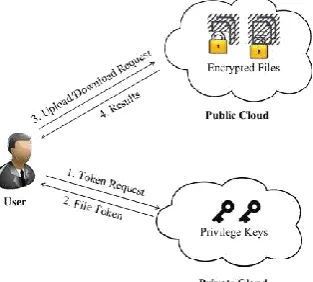
Contrasted and the regular deduplication working in passed on preparing, this is another part presented for engaging client's guaranteed use of cloud advantage. Specifically, since the getting ready resources at data client/proprietor side are limited and the comprehensive network cloud isn't completely trusted in the long run, a private cloud can give information client/proprietor with an execution condition and foundation functioning as an interface among client and people when all is said in done cloud. The private keys for the focal points are overseen by the private cloud, who answers the record token mentioning from the clients. The interface offered by the private cloud empowers the customer to submit records and request to be and once the information is encoded and after that the information is sent to the CSP server and deduplication is performed. At that point, the data is securely stored and prepared independently.
Secure DE duplication System
In the safe structure, We consider several sorts of security we require to ensure, that is exceptional of copy check token: There are two sorts of foes, that is, outside foe and inside adversary. As appeared as seeks after, the outside foe
can be seen as an inside foe with no favorable position. In case a client has advantage p, it necessitates that the foe can't make, in addition, yield an authentic copy token with some other preferred standpoint p′ on any record F, where p does not encourage p′. In addition, it besides requires that if the enemy does not make an interest of the token with its own one of a kind profit by the private cloud server, it can't shape and yield a critical copy token with p on any F that has been tended.
V. SYSTEM ARCHITECTURE
Fig. 1 private and public cloud Documents on the database.
Fig. 2 Flowchart
Security investigation The proposed plans execute a safe way to deal with information DE duplication. CSP doesn't approach the plain content whenever as the document is getting encoded from the Data Owner side. The CSP registers Hash estimation of figure content. CSP and Users while working, without conspiracy ensures that information is never traded off at the distributed storage. The information is being scrambled before coming to CSP. In this way, CSP won't have the capacity to know the genuine. Information in 'm'. This is guaranteed as client won't impart the genuine information to the CSP utilizing the CSP interface will give the machine.
VI. EXPERIMENTAL RESULTS
[image:4.595.92.249.53.194.2]The result is obtained by scaling up deduplication of data and hence the data is finally stored in an encrypted format. Finally, the data is stored in the database.
Fig. 3 User login page of project
Fig. 4 File storage in database
The proposed record keeps running with two interest checks in the setting of combining and bundle exploring self-governing. We will propose the past as the hash calculation.
VII.CONCLUSION
The structure for data deduplication could be moved to various stages, for instance, mobile phones, Personal Computers (PCs, etc. This system cloud is used in other web organizations, for storage. The proposed system can use a further encryption methods and deduplication to play out this storage. Beside these, the proposed structure has the going with included versatility. Future work incorporates testing with more secure encryption and hash calculation. This Cloud Service Provider database where file tables are put away is an alternative that could be investigated for the framework. This implementation is used for deduplication, security and evicts duplicated data. We hope this optimal concept makes client data confidentially.
REFERENCES
1. Zheng yan, Wenxiu Ding, Xi Xun Yu, Haiqi Zhu, ET ALand Robert H. Deng. Deduplication on Encrypted Big Data in Cloud. IEEE Computer Society.
2. Opendedup.http://opendup.org
3. D.T. Meyer and W.J. Bolosky. 2012. A study of Practical Deduplication. ACM Transactions on Storage. 7(4): 1-20, doi:10:1145/2078861.2078864 Deduplication. Proceedings of USENIX Conference on File and Storae Technologies. pp. 183-198.
4. L.J. Gao. 2015. Game Theoretic Analysis on Acceptance of a Cloud Data Access Control Scheme Based on Reputation. Master thesis, Xidian University.
5. Mozy. Mozy: A File-Storage and Sharing Service: http://mozy.com 6. Z.Sun, J.Shen and J.M. Yong. 2011. DeDu: Buiding a Duplication
Storage System over Cloud Computing. Proceedings of Cloud Computer Supported Cooperative Work in Design. pp.348-355, doi:10.109/CSCWD.2011.5960097.
7. J. Li, Y.K. Li, X.F. Chen, P.P.C. Lee, and W.J. Lou. 2015. A Hybrid Cloud Approach for Secure Authorized Deduplication. IEEE
Transactions on HPCC/CSS/ICESS. pp. 802-809,
doi:10.1109/HPCC.2014.134.
8. J. Paulo and J. Pereira. 2014. A Survey and Classification of Storage Deduplication Systems. ACM Computing Surveys. 47(1): 1-30, 2014, doi:10.1109/HPCC.2014.134.
9. Yadlapati, A., Kakarla, H.K. An Advanced AXI Protocol Verification using Verilog HDL (2015) Wulfenia, 22 (4), pp. 307-314.
[image:4.595.51.290.579.728.2]International Journal of Innovative Technology and Exploring Engineering (IJITEE) ISSN: 2278-3075, Volume-8 Issue-6S, April 2019
11. M. Fu, D. Feng, Y. Hua, X.B. He, Z.N. Chen, W. Xia, F.T. Huang and Q. Liu. 2014. Accelerating Restore and Garbage Collection in Deduplication-Based Backup Systems via Exploiting Historical Information. Proceedings of USENIX Annual Technical Conference. pp. 181-192.
12. M. Kaczmarczyk, M. Barczynski, W. Kilian, and C. Dubnicki. 2012. Reducing Impact of Data Fragmentation Caused by In-Line Deduplication. Proceedings of the 5th Annual International Systems
and Storage Conference. pp. 15: 1-15: 12,
doi:10.1145/2367589.2367600.
13. M. Lillibridge, K. Eshghi, and D. Bhagwat. 2013. Improving Restore Speed for Backup Systems that Use Inline Chunk-Based
14. Z. Yan, X.Y. Li, M.J. Wang, and A.V. Vasilakos. 2015. Flexible Data Access Control Based on Trust and Reputation in Cloud Computing. IEEE Transactions on Cloud Computing.
15. C. Yang, J. Ren, and J.F. Ma. 2013. Provable Ownership of File in Deduplication Cloud Storage. IEEE Global Communications Conference. pp.695-700,2013.
16. Bindu Bhargavi, K., Hari Kishore, K. Low Power Bist on Memory Interface Logic (2015) International Journal of Applied Engineering Research, 10 (8), pp. 21079-21090.
17. Charan, N.S., Kishore, K.H. Recognization of delay faults in cluster based FPGA using BIST (2016) Indian Journal of Science and Technology, 9 (28).
18. Hari Kishore, K., Aswin Kumar, C.V.R.N., Vijay Srinivas, T., Govardhan, G.V., Pavan Kumar, C.N., Venkatesh, R.V. Design and analysis of high efficient UART on spartan-6 and virtex-7 devices (2015) International Journal of Applied Engineering Research, 10 (9), pp. 23043-23052.
19. Kante, S., Kakarla, H.K., Yadlapati, A. Design and verification of AMBA AHB-lite protocol using Verilog HDL (2016) International Journal of Engineering and Technology, 8 (2), pp. 734-741.
20. Bandlamoodi, S., Hari Kishore, K. An FPGA implementation of phase-locked loop (PLL) with self-healing VCO (2015) International Journal of Applied Engineering Research, 10 (14), pp. 34137-34139.
21. Murali, A., Hari Kishore, K., Rama Krishna, C.P., Kumar, S., Trinadha Rao, A. Integrating the reconfigurable devices using slow-changing key technique to achieve high performance (2017) Proceedings - 7th IEEE International Advanced Computing Conference, IACC 2017, art. no. 7976849, pp. 530-534.
22. A. Surendar, K. H. Kishore, M. Kavitha, A. Z. Ibatova, V. Samavatian “Effects of Thermo-Mechanical Fatigue and Low Cycle Fatigue Interaction on Performance of Solder Joints” IEEE Transactions on Device and Materials Reliability, P-ISSN: 1530-4388, E-ISSN: 1558-2574, Vol No: 18, Issue No: 4, Page No: 606-612, December-2018. 23. N Bala Dastagiri K Hari Kishore “A 14-bit 10kS/s Power Efficient
65nm SAR ADC for Cardiac Implantable Medical Devices” International Journal of Engineering and Technology (UAE), ISSN No: 2227-524X, Vol No: 7, Issue No: 2.8, Page No: 34-39, March 2018. 24. N Bala Dastagiri, Kakarla Hari Kishore "Reduction of Kickback Noise
in Latched Comparators for Cardiac IMDs” Indian Journal of Science and Technology, ISSN No: 0974-6846, Vol No.9, Issue No.43, Page: 1-6, November 2016.
25. N Bala Dastagiri, K Hari Kishore "Analysis of Low Power Low Kickback Noise in Dynamic Comparators in Pacemakers” Indian Journal of Science and Technology, ISSN No: 0974-6846, Vol No.9, Issue No.44, page: 1-4, November 2016.
26. Meka Bharadwaj, Hari Kishore "Enhanced Launch-Off-Capture Testing Using BIST Designs” Journal of Engineering and Applied Sciences, ISSN No: 1816-949X, Vol No.12, Issue No.3, page: 636-643, April 2017.
27. Dr. Seetaiah Kilaru, Hari Kishore K, Sravani T, Anvesh Chowdary L, Balaji T “Review and Analysis of Promising Technologies with Respect to fifth Generation Networks”, 2014 First International Conference on Networks and Soft Computing,ISSN:978-1-4799-3486-7/14,pp.248-251,August 2014.
28. P Bala Gopal, K Hari Kishore, R.R Kalyan Venkatesh, P Harinath Mandalapu “An FPGA Implementation of On Chip UART Testing with BIST Techniques”, International Journal of Applied Engineering Research, ISSN 0973-4562, Volume 10, Number 14 , pp. 34047-34051, August 2015.