promoting access to White Rose research papers
Universities of Leeds, Sheffield and York
http://eprints.whiterose.ac.uk/
White Rose Research Online URL for this paper:
http://eprints.whiterose.ac.uk/4542/
Published paper
Harmandas, V., Sanderson, M. and Dunlop, M.D. (1997)
Image retrieval by
hypertext links.
In: Proceedings of the 20th Annual International ACM SIGIR
Conference on Research and Development in Information Retrieval, July 27 - 31,
1997, Philadelphia, USA. ACM , New York, USA, pp. 296-303.
Image retrieval by hypertext links
[image:2.595.385.491.192.274.2]V. Harmandas, M. Sanderson, and M.D. Dunlop
{harmandv | sanderson | mark}@dcs.gla.ac.uk
Computing Science, University of Glasgow
Glasgow G12 8QQ, Scotland.
Abstract
This paper presents a model for retrieval of images from a large World Wide Web based collection. Rather than considering com-plex visual recognition algorithms, the model presented is based on combining evidence of the text content and hypertext structure of the Web. The paper shows that certain types of query are amply served by this form of representation. It also presents a novel means of gathering relevance judgements.
1 Introduction
Although there have been several approaches to combining
hyper-text networks with information retrieval (IR) engines ([Agosti 96], [Frisse 88], [Croft 93], [Dunlop 93], & [Frei 92]), there has been little exploitation or testing of these techniques on the World Wide
Web (or Web). This paper exploits the linked nature of the Web to
provide access to images based on an existing model developed for image retrieval from other hypermedia collections. The paper ini-tially develops the model of retrieval and then presents the results of a series of experiments with a large Web based collection.
2 The model
Dunlop [Dunlop 91] introduced a model for retrieval of documents
by context (as defined by a hypermedia/hypertext) when content based retrieval was not possible (e.g. for non-textual nodes). Hypermedia links are used to calculate an approximation to the content of a non-textual node by using clustering techniques; this approximation, or representation, is then treated as the document's content for use by the retrieval system. This section gives an over-view of this model, describes how it is extended to work with Web based collections and describes the main limitations of the model.
2.1 Basic model
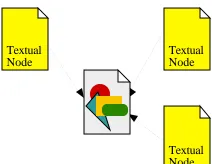
In a hypermedia collection, links can be used to calculate represen-tations for non-textual nodes that permit direct retrieval of these nodes by textual query. The textual nodes linked to a non-textual node can be considered as forming a cluster, see Figure 1. Cluster description techniques can then be applied, in order to calculate a representation and establish the overall content of the documents forming the cluster. This representation can be subsequently assigned to the non-textual node, giving it a retrieval content equal to the combined content of the nodes connected to it.
The representation of a non-textual node can be calculated by
con-sidering each linked document L as a standard N-dimensional
vec-tor, where N is the number of index terms in the document base.
The centroid in the N-dimensional space of the points representing
the documents in the cluster can then be calculated using the
fol-lowing formula [Dunlop 93]: The formula defines a level one
cut-off, where only the immediate neighbours of a non-textual node in the hypermedia network are considered. Such nodes are said to be connected to the non-textual node by a one step link.
where
i ranges between 1 and N;
Wdi= cluster based weight of term i of document d;
Li= the weight of term i in the document L;
Cd= cluster of documents linked to, and from, document d.
To test the validity of the approach, two experiments were carried
out using the CACM collection [Dunlop 93]: containing text
docu-ments with citation information that, in effect, forms a hypertext structure between some of the documents. The experiments ini-tially calculated the representation of each document by traditional statistical analysis of the words in the document and then a second representation for each document based on the cluster technique using the text of documents citing, and cited by, it. The first exper-iment showed that the cluster technique assigned representations were considerably closer to the original representations than repre-sentations based on randomly generated citations (23% similarity as opposed to 4%). The second experiment showed that citation-based cluster representations provided approximately 70% of the retrieval effectiveness of directly indexing each record’s content. These results confirmed that these representations are of suitable quality for use in retrieval (particularly when no content informa-tion is available). Later, Savoy [Savoy 96] presented results that showed that the CACM collection’s citation structure could be
Figure 1. A non-textual node linked to by textual nodes.
Textual Node
Textual Node Textual Node
W
diL
iL
∑
∈CdC
dused to improve the retrieval of textual nodes by partly including text from linked documents.
Although the results obtained from these experiments are encour-aging, nonetheless they were based on a pseudo-hypertext network. It can be argued that the citations and the links in a hypermedia document base share some properties. For example, they are both the result of some judgement on the relatedness of the documents, and there is no single definition of the relationships between the two connected nodes. However, citation links constitute only one type of link that can be encountered in real hypermedia, other types being, for example, structural, relational, etc. Section 2.2 discusses a Web specific version of the algorithms that the experiments pre-sented in this paper are based on.
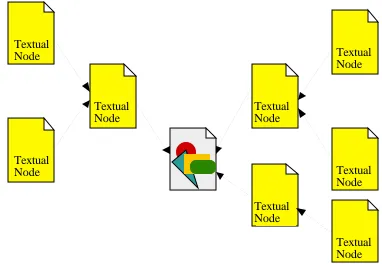
The algorithm described above can be extended so as to take into account not only the immediate neighbours of a node in the hyper-media network, but also all nodes that can be reached from the node by following at most two links (a two step link), and thus con-sider more of the context of the node (e.g. to include all the textual documents shown in Figure 2). This results in the following level
two cut-off formula:
where
i ranges between 1 and N;
Wdi= cluster based weight of term i of document d;
Cd= cluster of documents linked to, and from, document d;
k is a constant, 0≤k≤1, defining the relative strength of the more remote neighbours;
.
The model described above presupposes a hypermedia network, which will provide the textual and non-textual interconnected nodes. Dunlop already implemented this model using a hyperme-dia version of the British Highway Code. His experiments concen-trated on evaluation of the model’s utility when combined with
browsing, rather than on its retrieval effectiveness. This paper investigates the use of the model on the Web. There are two major reasons supporting this decision:
•
The Web is a real hypermedia network, and currently the onlyhypermedia structure used by millions of users;
•
its diversity in information, variety of media, and complexity ofinterconnections make it an ideal test bed to verify the validity of the model.
2.2 Web specialisations
Given a hypermedia collection consisting of textual and non-tex-tual nodes interconnected via links, the steps required to provide the non-textual nodes with a representation are as follows:
•
Firstly, all the non-textual nodes in the collection are identified;•
for each of these non-textual nodes, all the textual nodes that are linked to them, by means of one and two step links (nodes that are reached from the current node via one or two hypertext links respectively), are also identified;•
the content of these nodes is used to form a new node, which isthe representation of the non-textual node;
•
finally, the collection of representations is indexed, using stand-ard IR techniques (including stemming, stop word removal, and term weighting).With this index, the documents corresponding to the non-textual nodes can be retrieved in the same fashion as any standard text document. It is the task of the retrieval system's interface to associ-ate the documents retrieved with their corresponding non-textual nodes and present them to the user. Although the model is designed to be general enough to permit its application on any type of media (e.g. images, sound, and video), this paper concentrates on images for two reasons:
•
the Web has an abundance of images, and thus, creating animage collection would be relatively straightforward and the results would be of widespread applicability;
•
secondly, focusing on a single media avoids possibleperform-ance differences between media interfering with results.
[image:3.595.75.266.280.412.2]The first stage of indexing a Web collection is to identify the docu-ments in the collection and their links. A Web crawler/robot [Cheong 95] was used to scan a set of image collections and store, for each image, the text of pages linked to that image via one and two step links.
Next an approach to extracting the text from nodes to create suita-ble representations must be developed. During this development of the model presented earlier for Web use, two specific issues con-cerning the Web structure became evident: some pieces of text within a page may be more important for indexing than others, and some images retrieved by a simple application of the model are unlikely to be valid search results. The following sub-sections deal with these Web specialisations of the Dunlop model (presented in Section 2.1).
Figure 2. A non-textual node and the nodes accessible from it by one and two step links.
Textual Node
Textual Node Textual Node Textual
Node Textual Node
Textual Node Textual Node Textual Node
W
diL
iL∈Cd
∑
C
d---
k
L
iL
∑
∈C'dC'
d---+
=
C'd Ci–Cd–d i∈
∪
Cd2.2.1 Extracting suitable text
A Web page is the result of viewing an HTML document using a
Web browser and typically consists of formatted text, images, fill-out forms, tables, anchors to other parts of the same document, and
links to other HTML documents1
. Images are referenced in a page via a URL link and are displayed in one of two ways: either as in-line images displayed in the page, or via a link to an image file.
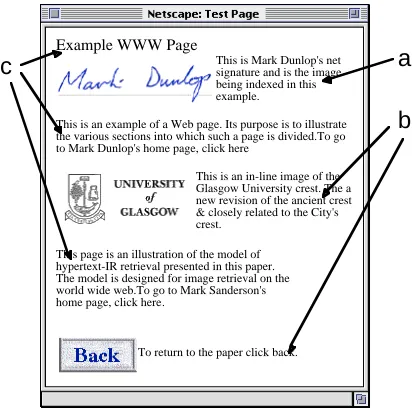
At the initial phase of the model implementation, a decision was made to split the text of a page into independent sections according to its position in respect to the URL link to an image. Text adjacent to the link was thought to form a more accurate representation than the text of the whole page, as it is usually the practice that an image is briefly explained by means of a caption. Figure 3 shows an
example HTML page where the image of the signature is to be indexed by the surrounding text. The text is broken up into three sections:
•
image caption (a): the caption of the image being indexed. Defined as the text after the image’s URL until the end of the paragraph (i.e. indicated by ‘<p>’ or ‘<br>’ tags) or until a link to another image is encountered;•
neighbouring image captions (b): the captions of other imageswithin the page;
•
one step link text (c): the text of the page, excluding thatcon-tained in sections (a) and (b).
In addition, there is one extra section defined:
•
two step link text (d): the full text of all pages connected viatwo-step links to the image or image file: in this example, the text of all documents linked to the page in Figure 3.
Splitting document texts according to these definitions yields, for each of the images in the collection, a text document consisting of
1. A detailed description of the HTML language and be found in
December and Ginsburg [December 95].
the four sections described, thus producing a pure text collection representing the images referenced in the Web collection.
[image:4.595.317.555.211.313.2] [image:4.595.70.279.214.418.2]This hypothesis on text segmentation and the quality of automatic segmentation schemes required testing together with the main hypothesis of the representation method. To achieve this, the col-lection was indexed and matched to queries using SMART v11.0 [Buckley 85] with the results presented in Section 3.3.
2.2.2 Removing unsuitable images
It is usually the case that the images referenced in a page are semantically related to the textual content of that page, with the exception of functional images (see Figure 4 shows examples of
such images):
•
images denoting that the page is new or under construction;•
images that are used as paragraph separators, indicators of listelements;
•
navigational buttons, used to help the user navigate to the next,previous, or home page, or even to the top or bottom of the same page;
•
icons used to enhance the presentation of the page and/or makeit more readable.
Although functional images are used to give structural and naviga-tional information to the reader, there is no direct way of prevent-ing a system from retrievprevent-ing these images as relevant to a query as HTML does not distinguish them from other images. However, it was decided that a way should be found to eliminate, or at least, reduce the possibility that these images are retrieved, since they are unlikely to be the legitimate results of a user’s search. One clue is that these images tend to be linked with more pages than non-func-tional images, since these images are usually naviganon-func-tional or reada-bility enhancement images that can be found in many pages. Furthermore, since the set of pages forming a collection are part of a specific network, it is highly probable that the same images are shared by these pages, primarily for reasons of presentation uni-formity. Figures 5 & 6 show the number of images (expressed as a percentage) that have a particular number of links to them. Meas-urements were made over a number of Web sites for around 2,500 images. From these figures it can be seen that functional images are always linked to by more than two pages, with almost half of them being linked to by more than five. Non-functional images, are linked to by only one page over 90% of the time.
A reasonable way, therefore, to reduce the possibility of functional images being retrieved, was to weight them inversely to the number of pages linking to them and let the system retrieve them, Figure 3. Example HTML page with sections indicated.
This is an example of a Web page. Its purpose is to illustrate the various sections into which such a page is divided.To go to Mark Dunlop's home page, click here
This is an in-line image of the Glasgow University crest. The a new revision of the ancient crest & closely related to the City's crest.
This page is an illustration of the model of hypertext-IR retrieval presented in this paper. The model is designed for image retrieval on the world wide web.To go to Mark Sanderson's home page, click here.
This is Mark Dunlop's net signature and is the image being indexed in this example.
To return to the paper click back.
Example WWW Page
a
b
c
Figure 4. Example functional images.
Bullets
Navigational buttons
Paragraph separator
but with a low relevance score. The application of this weighting function on the images retrieved was found to push most of the functional images down the ranking list without significantly affecting the position of other images.
2.3 Limitations of the model
Dunlop presents some limitations of his model that are mainly con-nected with the quality and quantity of the links available in a given document base. He restricts his model to document bases that have “a reasonable ratio of indexable (i.e. textual) to non-indexable nodes” and recommends at least two links per image. Moreover, the model benefits from an increased number of links (as long as the number of nodes used to calculate a cluster repre-sentative remains a small subset of the collection) but appears to degrade smoothly (so long as some links are available). The impli-cations of the low link levels shown in Figure 5 are addressed in Section 3. As will be seen, these limitations affected the choice of Web sites to use for experimentation.
Another limitation expressed by Dunlop is imposed by the quality of the links. If the links are to very similar nodes, then the
repre-sentations will more precisely describe the content of the cluster. Conversely, if the links are to loosely related nodes, then the cluster representative calculations will yield a less accurate description of the non-textual node, and thus the retrieval effectiveness will decrease. Clearly this translates directly to Web-based collections and will be a critical factor in the experimental results presented in this paper.
2.4 Existing web based image searchers
Recently, some of the commercial Web search engines, such as
Lycos [Lycos] and Hotbot [Inktomi], started supporting image
retrieval using a form of text based representation. Presumably for commercial reasons, it is not possible to find how these representa-tions were generated or how effective the retrieval methods were. A short investigation was undertaken to discover the general form of the representations used. This was done through the submission of queries to these systems and the examination of the pages retrieved.
From the investigation, it would appear that Lycos represents images by a small amount of text, often only a few words. This representation appears to severely limit the range of images retrieved for a particular query. Hotbot’s representation of an image on a Web page is all the text on that page. It is believed that there is no further sophistication to this representation, but within the confines of the investigation, it was not possible to determine this for certain2
.
Additionally, there is the WebSeer retrieval system by Frankel et. al. [Frankel 96] which uses a combination of surrounding text and image analysis techniques to form a representation of an image. Surrounding HTML text is broken up into sections, though the sec-tion definisec-tions used are different from those described in Section 2.2.1. It would appear that no experiments have been con-ducted to measure the retrieval effectiveness of the system. Instead, most effort has been concentrated on the building and test-ing of the image analysis techniques:
•
determining if an image is a photograph or not;•
if an image is in colour or in black and white;•
locating faces within an image.3 Experimental design
In order to evaluate the effectiveness of an IR system based on the Dunlop model, a test collection was created. Sparck Jones and Van Rijsbergen [Sparck Jones 76] suggest that the ideal collection should:
•
be large, i.e. contain no less than 2,000 documents (in somecases, even 10,000 documents could be needed), while queries should be more than 250;
•
exhibit on the one hand variety with respect to content, type,source, etc., and on the other homogeneity.
[image:5.595.93.258.61.238.2]2. This investigation was carried out in early 1997, it is of course possible that the methods used by these search engines have subsequently changed.
Figure 5. Percentage of non-functional images that have a particular number of links to them.
Figure 6. Percentage of functional images that have a particular number of links to them.
0 25 50 75 100
No. of images (%)
1 2 3 4 5 6
No. of links
0 25 50 75 100
No. of images (%)
1 2 3 4 5 6
[image:5.595.94.257.284.462.2]This section describes the process of building the collection and then the results of various experiments with the collection.
3.1 Document gathering
The Web is a good source of documents that hold to the require-ments of Sparck Jones and Van Rijsbergen. It consists of a large number of autonomous ‘Web sites’ that are disparate when com-pared. Most, however, can be categorised into genres: homogene-ous groups of sites that cover the same general topic. It was decided to select one particular genre and use sites belonging to that genre as a document collection. It was decided to use sites belonging to the genre of on-line art galleries. There are four main reasons that justified this decision:
•
first, the Web hosts a broad variety of art sites, in the form ofeither on-line exhibitions, or virtual galleries;
•
secondly, these sites are usually populated by many images(their number ranges from 100 to 1,500), therefore, the goal of creating a collection of no less than 2,000 documents could be achieved without the collection being fragmented into too many independent sub collections.
•
most of these sites have large portions of text associated withthe images, either in the same page, or in neighbouring pages, therefore, each image could be adequately represented in terms of the model developed in Section 2;
•
finally, it was anticipated that it would be fairly easy to find sub-jects with suitable knowledge and interest to query an art-related collection.The image collection was created out the pages of seven unrelated Web art gallery sites, containing art from the renaissance to the 20th
century. In total, the collection was composed of 2,583 images and 6.5Mb of HTML text. The selection of the Web sites was based on three criteria derived jointly from the criteria of Sparck Jones and Van Rijsbergen and the limitations expressed by Dunlop:
•
each of them should contain more than 100 images;•
the overlapping of images between the collections should beminimal;
•
they should have an extensive hypertext structure, therefore,collections containing a large number of images in only one or two pages, were excluded.
Obviously these criteria introduce a bias into the collection with respect to ‘normal’ Web sites, it was felt that this was justified as the main objective of the experiments was to show whether or not the representation of images using this model would work at all.
3.2 The queries and relevance assessments
The second task towards the creation of a test collection was the assembly of the queries and the identification of all images relevant to each query. Queries were provided by four people: two post-graduate students of Art History, and two students in other disci-plines, but with a interest in art and a broad knowledge of art-related subjects. The four were informed of the type of the collec-tion and the kind of images that it contained (i.e. the kind of artistic movements that the sub collections covered), and were then asked to form queries that they would actually submit to a retrieval sys-tem, should they have a real information need relating to the
col-lection’s content. The queries obtained in this way were then processed, so that, first, they did not have the same subject, and second, they were not clearly out of context. This process yielded a set of 14 queries, shown in Figure 7.
Undeniably the size of the query sample is small and far from satis-fies the requirements of an ideal test collection. However as already stated, the purpose of this work was to establish the valid-ity of the Dunlop model for this type of collection, with a view to conducting more detailed experiments later. Therefore, it was decided this number of queries was satisfactory for these initial purposes.
3.2.1 Relevance assessments
The relevance assessments for each query were made by the person that generated that query. Rather than manually assess all images in the collection for relevance, the structure of the Web sites was used to guide the assessor in choosing a sub-set of images to assess. For example, if a query was about the Early Renaissance, then the assessor would look for relevant images in pages that were classified under only this or similar titles. It was decided that this targeting approach was valid as the creation of the hypertext struc-ture within the Web sites had involved manual decisions about where in this structure images should be placed. In effect these decisions were a form of relevance assessment on the images in relation to the categories embodied within the structure. By focus-ing on potentially relevant images, the time taken to make the rele-vance judgements was significantly reduced. Clearly, this exploitation of the Web sites’ structure would only be of use for queries that reflected the classifications contained in the structures. Fortunately, this was the case for the queries generated for these experiments.
The relevance assessors identified a total of 307 relevant images for the 14 queries, on average, 22 images per query.
3.3 The experiments
As was outlined in Section 2.2.1 the representation of each image is by four text sections:
•
the image caption: a;Figure 7. Queries used in retrieval experiments.
1 Pop art of the 1960s
2 Dutch baroque
3 European baroque
4 Lucian Freud
5 American paintings of the 1930s
6 Landscapes by Monet, Manet, and Sisley
7 Caravaggio
8 Wassily Kandinsky
9 Goya around 1795
10 German gothic
11 Raphael’s major syntheses from 1506 to 1508
12 Mondrian Piet and Purism
13 Matisse
•
captions of other images in the text: b;•
body text of documents with a one step link to the image(with-out sections a and b): c;
•
text of documents with two step links to the image: d.3.3.1 Measuring the utility of the sections
The initial experiment involved measuring the retrieval effective-ness of the IR system in four different configurations: each time using just one of the identified text sections in isolation. A graph showing the results of this experiment is shown in Figure 8. As can
be seen, effectiveness is highest for images represented by section a and by section d: the image caption text and the ‘two step link’ text respectively. Perhaps surprisingly, representation by the text of other image captions on the HTML page (section b) also pro-duces relatively high effectiveness in contrast to use of the body text of the HTML document (section c) which has the lowest utility in terms of effectiveness. Reasons for this result are not clear, one possibility is that the HTML pages indexed in this collection con-sisted of almost nothing but image captions and therefore, there was little text identified as section c.
3.3.2 Finding the best combination of sections
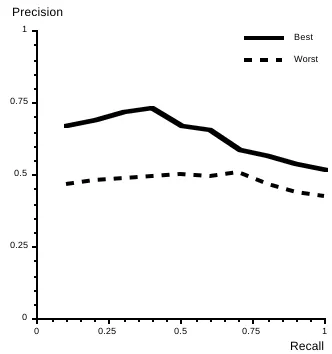
For these experiments, the sections were assigned weights that reflected their significance in the representation of an image. Measurement of the retrieval effectiveness of the IR system using all possible combinations of section weights, ranging between one and four, was performed. The 256 sets of recall/precision (RP) fig-ures resulting from these experiments were each reduced to a sin-gle figure using fmax: a statistic based on the e measure taken from Van Rijsbergen [Van Rijsbergen 79] and defined by Sanderson [Sanderson 96]. Not unsurprisingly, the best combination of tion weights reflected the results of Section 3.3.1: emphasising sec-tions a and d resulted in the highest effectiveness and emphasising sections b and c resulted in the lowest. Figure 9 shows retrieval effectiveness resulting from the best and worst section weight assignments found: the best was in assigning the weights 4, 1, 1, 3 to sections a, b, c, d respectively; the worst was in assigning 1, 2, 4, 1.
3.3.3 The shape of the R/P graphs
Through out these experiments, it was noted that the RP figures were somewhat unusual when compared to other IR experiments. It is generally the case that a RP graph displays a monotonically decreasing line. In these experiments, the lines decrease less than might be expected and on occasion increase at higher recall levels. It is believed there are two reasons for this.
•
The R/P graph resulting from an individual query is most oftenan uneven line quite unlike that derived from the results of a large number of queries. Because of the small number of que-ries generated for this collection, the unevenness of individual queries may not have been averaged out.
•
Upon analysis of the R/P figures of individual queries, it wasfound that for many of the queries all relevant images were retrieved near the top of the document ranking. In other words, for the IR system, the collection contained a high number of easy queries. It is this aspect of the queries that explains the ‘flatness’ of the R/P graphs.
The only way to change this situation, will be to generate more queries for the collection. Despite these concerns, however, it is believed that the results presented here do provide a good indica-tion of the relative utility (in terms of retrieval effectiveness) of the different text sections used to represent the images.
3.4 Experiments with other types of query
The queries used in the retrieval effectiveness experiments were all concerned with artists or art movements, and from the experiments it would appear that the representation of the images worked well for these queries. Some additional ad hoc tests were performed to examine what other types of query could be best served by this rep-resentation. Those that worked well were as follows:
•
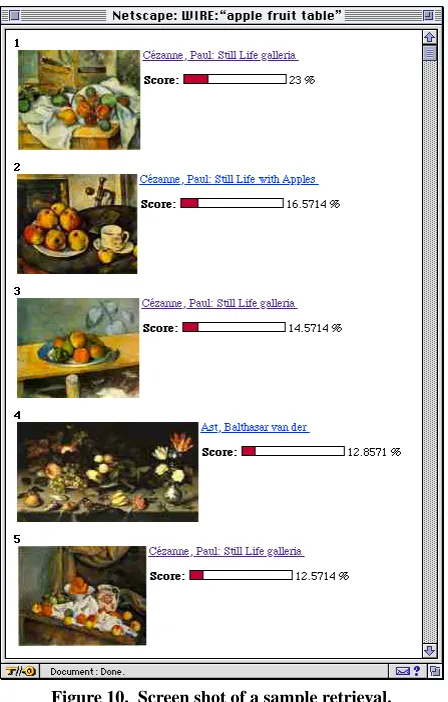
queries for images containing certain objects, for exampleimages containing a mountain; or apple, fruit, and a table (see Figure 10);
[image:7.595.353.519.60.237.2]•
queries for types of images such as a street scene or a still life; Figure 8. Results of four experiments to discover theutility of representing images by each of the four types of text section.
0 0.25 0.5 0.75 1
Precision
0 0.25 0.5 0.75 1
Recall
d c b a
Figure 9. Comparison of the worst and best assignments of weights to the four text sections.
0 0.25 0.5 0.75 1
Precision
0 0.25 0.5 0.75 1
Recall
[image:7.595.88.253.207.383.2]•
queries for a particular painting, for example “The Scream by Munch”.Those that did not work were:
•
abstract queries for images conveying a certain emotion orintent;
•
queries on the superficial aspects of images, for example imagesof a certain size or those that contain an amount of a certain col-our.
4 Conclusions and future work
In this paper an existing retrieval model (from [Dunlop 93]) for representing images by their surrounding text was successfully applied to a collection of ‘art gallery’ Web sites. The retrieval effectiveness of this model was measured by constructing a test collection of approximately 2,500 images. One contribution of this work was the use of a technique to aid the process of gathering rel-evance judgements: this traditionally time consuming process was significantly speeded up by exploiting the existing hypertext struc-ture of Web sites to target areas of those sites that might contain images relevant to a query.
The main contribution of this work was to show through experi-mentation that the Dunlop model could be used as an effective means of representing images for a number of query types. This,
despite that fact that the text used in the representation was not written explicitly for the purposes of retrieval. The representation of an image was composed of sections each of which was assigned a weight that indicated that section’s significance in a retrieval. Through experimentation, it was found that by weighting higher the image caption section and the two step link section, retrieval effectiveness could be improved.
In future work for this project, it is planned that the collection will be expanded and a more diverse set of queries be generated. Dun-lop also proposed a number of extensions to his model and these could be examined. One possible avenue of investigation would be to consider the direction of the links when calculating the represen-tation. For example, in the case of bi-directional links, links in one direction could be ignored, links from and to the node could be considered as equal, or the one direction of links could be weighted over the other.
Ultimately, the aim of this work is to integrate the text based repre-sentations used here with content based reprerepre-sentations. For exam-ple the recent work of Fleck, Forsyth and Bregler [Fleck 96], whose retrieval system analyses the content of images to locate images of people in a particular state. By integrating the two repre-sentation schemes into a single retrieval system, it would be hoped that a wider range of query types could be supported and retrievals from those queries be of a greater accuracy.
5 Acknowledgements
The work of this thesis was carried out by Vassilis Harmandas as partial fulfilment of his M.Sc. in Advanced Information Systems (AIS) at the Department of Computing Science at the University of Glasgow. It was funded by the Alexander S. Onassis Public Bene-fit Foundation. Supervision of the project was by Mark Sanderson and Mark Dunlop. Thanks are due to Evi Athanasekou, Kalliopi Koundouri, Irene Marinos, and Nina Papadoulaki whose relevance judgements and queries made the experiments possible.
6 References
Agosti 96
Agosti M., and Smeaton A. (1996). Information Retrieval and Hypertext. Kluwer Academic Publishers, The Nether-lands.
Buckley 85
Buckley C. (1985). Implementation of the SMART Infor-mation Retrieval system. Department of Computer Sci-ence, Cornell University, TR 85-686.
Cheong 95
Cheong F.C. (1995). Internet agents: Spiders, wanderers, brokers, and bots. Macmillan Publishing, USA.
Croft 93
Croft W.B., and Turtle H.R. (1993). Retrieval strategies for hypertext. Information Processing & Management, 29(3), pp. 313-324.
December 95
[image:8.595.63.287.57.408.2]December J., and Ginsburg M. (1995). HTML & CGI Unleashed. Sams Publishing, Indianapolis.
Dunlop 91
Dunlop M.D. (1991). Multimedia Information Retrieval, Ph.D. Thesis. Computing Science Department, University of Glasgow, Report 1991/R21.
Dunlop 93
Dunlop M.D., and Van Rijsbergen C.J. (1993). Hyperme-dia and free text retrieval. Information Processing & Man-agement, 29(3), pp. 287-298.
Inktomi
Inktomi Corp., HotBot™ Search, http://www.hotbot.com/.
Fleck 96
Fleck M., Forsyth D., and Bregler C. (1996). Finding Naked People, Proceedings of 1996 European Conference on Computer Vision, Volume II, pp. 592-602.
Frankel 96
Frankel C., Swain M. J., and Athitsos V. (1996). WebSeer: An Image Search Engine for the World Wide Web, Univer-sity of Chicago Technical Report TR-96-14.
Frei 92
Frei H.P., and Stieger D. (1992). Making use of hypertext links when retrieving information. Proceedings ACM-ECHT’92, Milan, Italy, pp. 102-111.
Frisse 88
Frisse M.E. (1988). Searching for information in a hyper-text medical handbook. Communications of the ACM, 31(7), pp. 880-886.
Lycos
Lycos Inc., Lycos™ Search, http://www.lycos.com/.
Van Rijsbergen 79
Van Rijsbergen C.J. (1979). Information retrieval (second edition), in London: Butterworths.
Sanderson 96
Sanderson M. (1996). Word Sense Disambiguation and Information Retrieval. PhD Thesis, Technical Report (TR-1997-7) of the Department of Computing Science at the University of Glasgow, Glasgow G12 8QQ, UK.
Savoy 96
Savoy J. (1996). An extended vector-processing scheme for searching information in hypertext systems. Informa-tion Processing & Management, 32(2), pp. 155-170.
Sparck Jones 76