2008
Peasant communities, the first link of the
commodity chain of vicuña fiber
Liliana L. Lay Lisung
Iowa State University
Follow this and additional works at:https://lib.dr.iastate.edu/rtd
Part of theAgricultural and Resource Economics Commons,Agricultural Economics Commons,
Art and Materials Conservation Commons,International Law Commons,International Relations Commons,Other Engineering Science and Materials Commons,Polymer and Organic Materials Commons, and theSociology Commons
This Thesis is brought to you for free and open access by the Iowa State University Capstones, Theses and Dissertations at Iowa State University Digital Repository. It has been accepted for inclusion in Retrospective Theses and Dissertations by an authorized administrator of Iowa State University Digital Repository. For more information, please [email protected].
Recommended Citation
Lay Lisung, Liliana L., "Peasant communities, the first link of the commodity chain of vicuña fiber" (2008).Retrospective Theses and Dissertations. 15352.
Peasant communities, the first link of the commodity chain of vicuña fiber
by
Liliana L. Lay Lisung
A thesis submitted to the graduate faculty
in partial fulfillment of the requirements for the degree of
MASTER OF SCIENCE
Major: Interdisciplinary Graduate Studies (International Development Studies)
Program of Study Committee: Cornelia B. Flora, Major Professor
Patricia Hamm Susan Torntore
Iowa State University
Ames, Iowa
2008
1453175
2008
UMI Microform
Copyright
All rights reserved. This microform edition is protected against unauthorized copying under Title 17, United States Code.
ProQuest Information and Learning Company 300 North Zeeb Road
P.O. Box 1346 Ann Arbor, MI 48106-1346
Table of Contents
LIST OF DIAGRAMS... iv
LIST OF TABLES...v
GLOSSARY ... vi
ABSTRACT...x
1 INTRODUCTION ...1
2 FRAMEWORK...5
Theoretical conceptual models ...5
3 METHODOLOGY ...11
4 BACKGROUND ...15
Vicuña overview ...15
Historical legislation for conservation and sustainable use ...19
5 COMMODITY CHAIN OF VICUÑA FIBER...28
The commodity: Vicuña fiber...28
Price and Competition...30
Formal Commodity chain ...34
Peruvian Government ...34
Peasant Communities...39
Chaccu...54
SNV National Vicuña Society ...62
CAPCA& Agrarian Bank ...64
Business: ALMAR Alfonso Martinez ...67
Informal Commodity chain...77
Poaching and Black Market ...77
6 THE GLOBAL COMMODITY CHAIN OF VICUÑA FIBER AND ITS IMPACTS IN PERUVIAN PEASANT COMMUNITIES...81
Formalization and Legislation ...81
Intermediaries ...88
Textile manufacturing companies and the world economic system ...92
7 COSTS AND ADDED VALUES: WHY PEASANTS OBTAIN THE LOWEST PROFIT...98
APPENDIX A. INTERNATIONAL AND PERUVIAN POLICIES ...115
APPENDIX B. GRAPHICS AND TABLES...132
APPENDIX C. CCUSCSS AND MEMBERS ...146
APPENDIX D. CAMPAIGNS OF COMMODITY CHAIN OF VICUÑA FIBER ...148
APPENDIX E. PROPOSAL FOR PROVINCES OF LIMA ...149
LIST OF DIAGRAMS
Diagram 4-1. CONACS Organization ... 36
Diagram 4-2. Organization of Peasant Communities Selling at the International Level... 42
Diagram 4-3. Organization of Peasant Communities Selling at the National Level ... 43
Diagram 4-4. Organization of Peasant Communities Selling at All Levels ... 43
Diagram 4-5. Processing camelids fiber ... 44
Diagram 4-6. Organization of Peasant Communities for Selling Vicuña Fiber ... 46
Diagram 4-7. Previous Commercialization System... 62
Diagram 4-8. System of the Agrarian Bank for Selling Vicuña Fiber... 66
Diagram 4-9. Alpaca Commodity Chain ... 70
Diagram 4-10. Camelids Commercialization System... 72
Diagram 4-11. Exchange Relation of the Act ... 73
LIST OFTABLES
GLOSSARY
“Cardado”: English word: Carding: process by which fibers are opened, cleaned, and straightened in preparation for spinning. The fingers were first used, then a tool of wood or bone shaped like a hand, then two flat pieces of wood (cards) covered with skin set with thorns or teeth.
“Crianza”: English word: Breeding: generally refers to the act of biological reproduction and birthing and caring for young animals.
Camelid: Members of the biological family Camelidae. This species lives in the High Andean Mountains.
“Centro de descerdado”: This center is the facility where vicuña fleece is cleaned; dirt, thick and larger hair, and debris from the ground are pull out. The fleece cleaning center should provide women with tools such as special coat (aprons), covers for the face nose and mouth, and protective eyeglasses.In addition, the fleece cleaning center should provide white, big tables very well illuminated, white light onto the tables, and scales for weighing. Peasant communities have different system that they implement in the fleece cleaning center.
“Centro de Acopio”: It is the place where vicuña fiber is collected, stored, and dispatched to another place before the fiber is sold. Generally, peasant communities use the fleece cleaning center as “centro de acopio” as well.
CITES: Convention on International Trade in Endangeres Species of Wild Fauna and Flora.
“CONACS Consejo Nacional de Camelidos Sudamericanos”: National Counsel of South American Camelids.
“Confección”: English word: Construction of a garment: This is the process which transforms textile fabrics into ready-made products.
Dehairer machine.
This machine dramatically cuts down on processing time and therefore impacts the processing cost. However, the fiber loss is usually around 50%. Moreover, short fiber is difficult to spin, especially into higher quality yarns on the worsted system.
“Escojo”: English word: Sorting:
“Esquilar”: English word: To shear: the process of removing the fiber from a vicuña.
“Esquilado”: English word: Shearing: It is the noun for the process of removing the fiber from a vicuña.
FAO: Food and Agriculture Organization from the United Nations
Fleece: The complete layer of hair from a vicuña.
GTZ: German Agency for Cooperation.
Guard hair: Larger and thick hairs from the fleece
“Hilado”: English word: Spinning: is the process of creating yarn (or thread, rope, cable) from various raw fiber materials. The fibers may be of animal, vegetable or synthetic origin. In spinning, separate fibers are twisted together to bind them into a long, stronger yarn. Characteristics of the yarn vary based on the material used, fiber length and alignment, quantity of fiber used and degree of twist.
“INIA Instituto Nacional de Investigacion Agraria”: National Institute for Agrarian Research.
IUCN: International Union for the Conservation of Nature and Natural Resources.
“Lavado”: English word: Scouring: washing to remove loose chemicals and drying to produce a finished fabric or garment.
“Peinado”: English word: Combing: the combing process that follows carding in the
preparation of fibers for spinning. It lays the fibers parallel and removes noils (short fibers). The modern combing machine is a specialized carding machine. Combing produces a fine sliver suitable for drawing out and spinning into strong, smooth yarn.
“PROMPERU Comisión de Promoción del Perú para la Exportación y el Turismo”. It includes the Ex Comission for promotion and exports (PROMPEX) and the Ex Comission for promotion of Peru (PROMPERÚ).
“PROMPEX: Peruvian Export Promotion Agency.
“PRONAMACHCS Programa Nacional de Manejo de Cuencas Hidrograficas y
Conservacion de Suelos”. English National Program for Watershed Management and Soil Conservation. Currently is being absorbed by SIERRA EXPORTADORA.
“Puna”: is a type of montane grassland that occurs in the central part of the high Andes, including the Altiplano. Puna is one of the eight physiographic regions of Peru.
Repopulation of vicuñas: Take vicuñas from their current habitat to another location where the environment is positive for raising this species.
“SENASA Servicio Nacional de Sanidad Agraria”: National Service for Plant and Animal Health.
“SIERRA EXPORTADORA”: A national Program that began its activities on November 24, 2006. It is a decentralized public agency (OPD), attached to the PCM, and develops its activities in all regions of the country, which has mountain areas, improving the quality of life of the native inhabitants. Sierra export organizes and coordinates the resources and efforts that the public sector runs in the rural area of the mountain.
Specimen: CITES named “specimen” for one individual from one species.
Teasing (to tease): Women from Lucanas have this method of pulling the individual fibers apart with their fingers to align them and let some of the larger pieces of dirt, grass, and any other type of waste fall out.
“Tejido a doble punto”: English word: Knitting is a craft by which thread or yarn may be turned into cloth. Knitting consists of loops called stitches pulled through each other. The active stitches are held on a needle until another loop can be passed through them. Knitting may be done by hand or by machine.
“Teñido”: English word: Dyeing: is the process of imparting colour to a textile material in loose fibre, yarn, cloth or garment form by treatment with a dye. Normally vicuña fiber is not dyed.
The International Agreement for Conservation, Management, and Handling of the Vicuña was subscribed in 1969, La Paz; by Peru and Bolivia. Later Argentina (1971), Chile (1973), and Ecuador (1979) subscribed it.
TLC Agreement with Peru: (Tratado de Libre Comercio con Peru – Free Trade Agreement with Peru).
ABSTRACT
Vicuña fiber has a high value in the textile and fashion industry and is seen on the runways of
the most selective and luxurious clothing designers in Europe. However, the vicuña fiber
process and commodity chain are little known. This thesis presents the commodity chain of
vicuña fiber and the positive and negative impacts that vicuña fiber commercialization
generates in Peruvian peasant communities. The research, based on in-depth interviews and
document analysis, studies the development of this buyer-driven chain, the social actors’
roles, and the policies and legislation implemented to preserve vicuña species. In respond to
consumption demands, the marketing departments of transnational core companies create
added value with the final product. As a result, Peruvian peasants face different obstacles and
benefits in order to sell their fiber within the formal and informal value chains; while they
CHAPTER 1 INTRODUCTION
Vicuña fiber is relatively scarce and has an enormous value in the textile and fashion sector
and is seen on the most important runways of selective and expensive clothing designers in
Europe. However, there is little knowledge of vicuña fiber processing and its commodity
chain. The commodity chain of vicuña fiber starts in the Altiplano region, where poverty is
extreme. The quality and its scarcity of the fiber are important features of the expensive
price. Vicuña fiber is a difficult product to obtain in large quantities because of the nature of
the species; the long period of gestation (11 months) with only one offspring, along with, the
small quantity of sheared fiber per vicuña (200 grams/vicuña approximately) create a small
offer and scarcity. In addition, the population of vicuña has diminished from the population
of two million vicuña during the Empire of the Incas. Vicuñas have suffered extreme
poaching and became an endangered species in the past century, because as the finest fiber in
the world, those who sold the raw material to processers got a relatively high return.
This study presents the result of field research based on depth interviews with people who are
involved in the commodity chain of vicuña fiber, including directors and officers of
governmental entities, plus leaders and supervisors of peasant communities. The visits,
observations, and depth interviews were conducted in Lima and Ayacucho Departments
between April 2007 and June 2007, while the entire research project was developed between
February 2007 and December 2007.
There are two major reasons why the study was conducted in Peru. First, Peru has the highest
population of vicuñas in the world. Vicuña is a wild animal that lives in the Peruvian High
Andean region (Puna or Altiplano) and shares that territory with different peasant
communities. According to the census of 2000 by CONACS (National Counsel of South
American Camelids), Peru has 118,678 animals, which are distributed from Central Sierra to
South Sierra. Ayacucho has the largest vicuña population (34.03%). These Peruvian peasant
Second, with authorization of the CITES international regulations (Convention on
International Trade in Endangered Species of Wild Fauna and Flora), Peru started the official
commercialization of vicuña fiber, being the pioneer country that formally trades this product
internationally. Commercialization of vicuña fiber not only involves processing and
distribution to the fashion and textile industry but also involves the social and political
context, including international and national legislation and policies to protect the species
and regulate the sustainable trade of vicuña fiber. Under Peruvian legislation, peasant
communities are the first beneficiaries of the vicuña and its sub-products. The profit obtained
from the trade of vicuña fiber as a raw material should benefit Peruvian peasant communities
who have the custody of the vicuñas that inhabit in the community’s territories. Moreover,
peasant communities are responsible for caring the species.
According to CITES (Convention on International Trade in Endangered Species of Wild
Fauna and Flora), after the implementation of rigorous restrictions at national and
international levels, the vicuña passed from Appendix I (includes species threatened with
extinction and whose trade is permitted only in exceptional situations) to Appendix II
(includes species not necessarily endangered but whose trade must be controlled in order to
avoid utilization incompatible with their survival). Since 1996, Peru has developed
regulations that allow peasant communities to use vicuña fiber in a sustainable manner, such
as shearing the fiber from live animals. Peasant communities can only use this benefit with
vicuña that inhabit their territory. Moreover, peasant communities must follow certain laws
and regulations, and peasants are required to organize in officially recognized committees in
order to commercialize the fiber overseas.
Given the responsibilities given to peasant communities: protection of vicuña habitat,
protection of vicuña from predators and poachers, and maintaining animal health, what are
the benefits received from the commodity chain of vicuña fiber. While the Peruvian State, the
market, and the civil society joined together, beginning in the 1990s, to formalize the value
chain and increase the income of peasant communities as well as to guarantee the qualities of
of formalizing the sale of vicuña fiber has had a positive result on peasant communities,
although some communities can generate more profit than others because of the number of
vicuñas that inhabit in the community’s territory.
This study also provides an analysis of the problematic of the uneven development and
uneven profit between the periphery and core countries. The commodity chain of vicuña
fiber, from the production to the consumption, is a perfect example of the inequality within
the world economic system. These peasant communities obtain a small profit compare to the
overseas retailers. Name-brand fashion companies and international retails drive the
commodity chain of vicuña fiber, offering sumptuous and extravagant garments as luxury
articles at prices that are unattainable for most people. When top models exhibit expensive
coats of vicuña, probably people do not imagine that there are more than 500 peasants and
their communities behind the fabric. However, the profit that peasant communities obtain is
insignificant compared to the profit of major designers such as Ermenegildo Zegna and
Giorgio Armani, who show these luxury garments on the European runways.
In the global capitalist economy, peasant communities form the first link of the commodity
chain of vicuña fiber, however, they still have less profit compare to the international
brand-name companies and retails. The difference on profit between peasant communities/raw
material producers and the subsequent stages/buyer-driven of the chain could be a response
of the influence of globalization, the liberalization of trade, the consumer demand, the higher
price for higher quality of the product, and environmental issues. For instance, within the
commodity chain of vicuña fiber, aspects in the last stages, such as the style and finalization
of the garments, the marketing and distribution processes have more significance and impact
in the final price than the peasant producers who provide the raw material and the labor
force. Finally, the complex and dynamics of the markets make a strong interdependence
among the links of the commodity chain of vicuña fiber.
Therefore, the main focus of this research is to provide responses regarding the commodity
the theorical framework and insights from previous studies regarding commodity chains
within the world economic system. This section illustrates the legislative work of
governments and international organization to preserve the vicuña species, hoping to protect
by encouraging the commercialization of its fiber. Section 3 explains the methodology used
during the field work. The section 4 answers and explains the following research questions:
What is the commodity chain of vicuña fiber? What are its links, its production process, and
the type of commodity chain: formal and informal? Section 5 presents the positive and
negative impacts of participation in the commodity chain on peasant communities within a
local, national, and international context. Section 6 presents and evaluates reasons regarding
to why peasant communities profit so little compared to the final links of the commodity
chain, such as core international textile companies, major designers, and name-brand fashion
CHAPTER 2
THEORETICAL FRAMEWORK
Theorical Conceptual Models
Academic literature was examined in order to analyze the commodity chain of vicuña fiber
within the world system. My research was interdisciplinary in that I examined literature in
the fields of Sociology, Political Science and Textile and Clothing. I found a few articles
related to the vicuña fiber commodity chain, mostly related to its environmental impacts and
management of vicuña and its fiber. I reviewed literature on other commodity chains,
including coffee and alpaca fiber and its sub-products. I hypothesized those commodities
could have similarities in the product characteristics and in the production process of vicuña
fiber. I examined literature related to inequality in the world, World Economic System
Theory and Dependency Theory and the concepts of individualism and globalization. These
theories and concepts help explain the impact that the vicuña fiber commodity chain has in
Peruvian peasant communities. I employed interdisciplinary tools in my analysis of the
vicuña fiber commodity chain. I applied concepts and tools from sociology, political
sciences, and textile and clothing. These disciplines and literature enabled me to understand
and analyze the needs and requirements at both ends of the vicuña fiber commodity chain.
There are few specific studies regarding vicuña fiber and its commodity chain. Most people
who use vicuña garments do not know all the processes that the vicuña fiber is exposed
overseas. To start with the analysis of the commodity chain of vicuña fiber, I examined the
general concept of commodity chain. A commodity chain, as defined by Hopkins and
Wallerstein, is “a network of labor and production processes whose end result is a finished
commodity” (1986, p.159). According to Jackson (2006, p.6), while other terms have been
developed or changed in the academic literature, the concept of commodity chain has
continued in use extensively. According to Fine and Leopold, the interest in food
consumption has brought together political economists, political scientists and sociologists to
study the politics, sociology and spatiality of food consumption (In Jackson 2006, p.4). The
material, and after several stages of transformation, the product is sold to the final consumer.
According to Gereffi (1994, p.2), each link in a commodity chain, after its raw material form,
acquires value and organizes inputs, labor power, transportation, distribution, and
consumption. The term commodity chain is used to name and gather all the elements and/or
actors that contribute directly to obtain the final product. The commodity chain concept is
related to concept of value chain, as Tallec and Bockel explain in their work for FAO in
2005.
The value chain describes the full range of activities required to bring a product or service from its conception, through the different phases of production, delivery to final consumers…Production per se is only one of a number of value links. There are ranges of activities within each link of the chain. Although often depicted as a vertical chain, intra-chain linkages are most often of a two-way nature –for example, specialized design agencies not only influence the nature of the production process and marketing, but also are in turn influenced by the constraints in these downstream links in the chain (2005, p.2).
A commodity chain is classified as a global commodity chain when the stages of production
and the selling point are located in different countries. According to Gereffi (1994), the study
of the Global Commodity Chain (GCC) originated from political economy analysis includes
World System Theory from Wallerstein (1974, 1980, and 1989) and Dependency Theory
(advocated by Prebisch R. in 1950 and further developed by Paul Baran) as concepts to
understand development and underdevelopment in the world. GCC concept and functions
provide a framework to examine the political economy between core and periphery countries
within the international trading system. This trade system includes buyers mostly from the
core nations and producers mostly from the periphery nations. According to Wallerstein
(1974), the interrelation between core (developed countries) and periphery societies
(developing countries) causes inequality and dependency within the world economic system.
GCC analysis aims to study the increasing economic integration of international production
and marketing chains. In addition, GCC analysis helps to analyze the path of the commodity
and the impact of the globalization in the peasant communities. According to Gereffi (2003,
p.3), the GCC concept was developed to understand the impact of globalization within the
industrial commodity chains such as garments, footwear, automobiles, and technology. For
instance, “Globalization elements in the food processing and distribution are changing
conditions in the agro-food sector and influencing also agrarian markets” (Blazkova 2002, p.
293).
GCC analysis helps identify the dominant actor or actors which drive the chain. As said by
Gereffi (2003, p. 2) “the global value chain framework will be outlined, with emphasis on the
structure and dynamics of buyer-driven chains”. Some characteristics within the buyer-driven
chains are the abundant labor force with low wages from the periphery countries and the
coordinated process by transnational brand-name companies and international retails located
in the core countries. The buyers’ companies establish a strategic contact with factories
overseas. According to Mace, the profits of the buyer-driven commodity chains are
concentrated in the activities of research, design, sales, marketing, and financial services”
(Mace 1998, p.11). Gereffi and Korzeniewicz (Gereffi 2003, p.3 and in Mace 1998, p.11)
concluded from their footwear study that core activities such as marketing and retail end of
the commodity chain, have the highest profit. According to Gereffi, consumption determines
the origin and the way by which production is developed within the buyer-driven commodity
chains (Gereffi, 1994, p.99; in Mace 1998, p.11). The apparel and textile industry chain is
characterized as a buyer-driven commodity chain; therefore, the commodity chain of vicuña
fiber is a buyer-driven chain. The airplane industry is a producer-driven commodity chain
that is characterized by the significant role of the producers. Gereffi concluded “in
producer-driven value chains, large, usually transnational, manufactures play the central roles in
coordinating production networks (including their backward and forward linkages). This is
typical of capital (and technology) intensive industries sucha as automobiles, aircraft,
computers, semiconductors and heavy machinery … the producer-driven chains obtain the
profit from large sale, volume, and technology advances (Gereffi 2003, p. 3). Moreover,
Gereffi affirms “…in the producer-driven the manufacturersare the key economic agents both
material and somponent suppliers, and forward linkages into distribution and retailing. The
lead firms in producer-driven chains usually belong to international oligopolies” (Gereffi
2003, p. 3).
As I presented above, in the last decades, the textile and fashion commodity chains have
changed significantly because of globalization, technological progress in production, and
new ways for trading. The vicuña fiber is not an exception, in the last two decades, the
functions and conditions that the commodity chain of vicuña fiber and its market
development has changed; not only because the impact of the economic revolution and
globalization but also because the legislation provided by governments and CITES
(Convention on International Trade in Endangered Species of Wild Fauna and Flora) for this
wild species has improved the international vicuña trade. The commodity chain of vicuña
fiber is characterized as a global commodity chain because the product (raw material) is
produced and transformed for the periphery nations and mostly consumed by the core nations
within the world economic system.
Therefore, this study aims us to know and understand in detail the development of the
commodity chain of vicuña fiber, the progress of each link to another, the role of the
involved actors, and the policies and legislation implemented at national and international
level in order to preserve vicuña species. For instance, the global commodity chain of vicuña
fiber in Peru involves the State, peasant communities who are the producers, intermediaries,
associations, Agrobanco (the financial entity), research institutions, academic institutions,
transnational brand-named manufactory companies, worldwide known fashion designers, and
international retails. As the vicuña fiber is under several restrictions by law (at national and
international level); if vicuña fiber is sold without complying with all the requirements, the
sellers could go to jail for a felony. Moreover, this type of felony could start with stealing or
poaching vicuñas and end with selling vicuña fiber on the black market. As a result, the
Furthermore, this paper presents the comparison between selling vicuña fiber within the
formal economy or within the informal economy. Over history, transactions started with
informal exchanges. With time, the economic world established rules and requirements for
transactions in order to organize product quality and enable businesses grow. Those written
rules and standards created a “formal economy” used for impersonal selling products, buying
articles, and making profits in the marketplace. The formal economy principles of licensing,
formal standards, and official enforcement are used not only in commerce but also at the
professional and educational level. On the other hand, informality has emerged more in
developing countries than in developed countries because of the difficulty of following the
capitalist system. In addition, informality is a result of poverty, global inequality,
globalization, underdevelopment, privatization, and migration, among other aspects. As a
result, Formal Economy is composed by “firms that provide employment and are subject to
governmental monitoring” (Flora 2008, p. 93, 110), while according to Portes (1994);
Informal Economy concept is defined as a process of income generation that is unregulated
by the institutions of society, in a legal and social environment in which similar activities are
regulated.
Moreover, it is important to mention that the study of the informal economy has been
difficult to define and analyze because of the irregularity of its activities. For instance, the
location and the characteristic of an informal enterprise could change depending on the
campaign and the day. According to De Soto (1989), an informal economy is a new trend or
pattern that is not only growing in developing countries, but also that it is here to stay.
Without a doubt, the informal economy exists and is a resource for the poor to survive and to
reach basic needs. The informal economy expansion has been developed gradually because
of the combination of necessity for survival and creativity to develop and recognize any
possible business. However, the popular perception of informality is defined depending on
the personal experience. The development of countries, poverty, and wealth of societies will
define those differences. In addition, the informal economy is present in goods and services.
controlled 90% of public buses (not counting taxi services); this category managed more than
$ 620 million (Portes: 1993, 33-60).
Another aspect occurs when an entrepreneur tries to trade without following any regulation.
This transaction is belonged to an informal business and it is connected to illegality. It must
be mentioned that illegality is different from criminality. The term “criminality” infers to
operate illegally and commercialize illegal goods or illegal services such as drugs; it is also
called “black market”. Since vicuña species is protected by national and internationally
legislation, the commercialization of vicuña fiber without following regulations is classified
as black market of vicuña fiber. However, it is important to define that informality is not
always synonymous to illegality. According to Chen (2005), there must be a distinction
between illegal processes or arrangements and illegal goods or services. According to Daza,
in industrialized countries, informality is equivalent to illegality, while in developing
CHAPTER 3
METHODOLOGY
The research is based on primary and secondary sources. The primary sources are visits,
interviews, observations, and revision of primary documents which mostly were in Spanish.
The secondary sources are scholarly literature from sociology, political sciences, and textile
and clothing disciplines; the literature was presented in English and Spanish languages.
To accomplish the objectives and to answer the research questions of the study, the
investigation was developed between February 2007 and December 2007, field work was
undertaken between April 2007 and June 2007 in the city of Lima and in the provinces of
Ayacucho, Peru. The majority of governmental entities, offices of intermediaries, and
research institutions are located in Lima; while most of vicuña’s population and the most
successful Peruvian peasant communities that commerce vicuña fiber are in Ayacucho.
My field work included visits to peasant communities and related entities, in-depth
interviews, witnessing transactions between seller and buyer, and observing processes from
the first point of production to the last point before selling overseas; activities such as
management, production, transformation, distribution, and selling of vicuña fiber to
international and national companies. I visited the support entities and communities and
interviewed the essential people in the communities and organizations to find, analyze, and
build the connection among the links within the commodity chain of vicuña fiber. Each link
or agent of the commodity chain before the vicuña fiber is distributed overseas was visited
(two peasant communities were visited as an examples). After the vicuña fiber is sold to
international companies, I analyzed literature related to the topic.
In-Site observations
I visited each agent and observed the entire process in order to understand not only the
connections between links but also to identify the agents, their roles and functions in the
quality requirements. The plan of visits included governmental entities such as CONACS,
INRENA, Ministry of Agriculture, Palace of Government, PROMPEX, and PROMPERU
entities which develop and state legislation. In the academic and research institutions, I
visited the National Agrarian University La Molina, INIA, INIAE, IEP, INEI. The mentioned
institutions improve the species and influence the commercialization of vicuña fiber through
their research. I visited the National Reserve of Pampas Galeras, this reserve is important
because it has and cares a great number of vicuña population; moreover, I observed the
environment, the vicuña behavior, and the organization of vicuña while the CONACS
officials implement the process of caring and custody of the species. I also visited two
Peruvian peasant communities in the Ayacucho Department: San Juan de Lucanas and San
Cristobal. I visited facilities where most of the process is done. These two communities are
examples of good management of vicuña and of success in the vicuña fiber commodity
chain. I also visited facilities of the intermediaries such as SNV, ALMAR. Finally, I visited
the National Financial Entity Agrobanco and the ALL ALPACA retail located in the
Miraflores District.
In-depth interviews
I conducted 26 in-depth interviews. The interviews were designed to understand the negative
and positive impacts of the commodity chain of vicuña fiber on peasant communities. The
interviewed persons -officers, directors, and leaders of communities- belong to different
entities; therefore, each interview was unique. The main focus of each interview was to know
the links of the commodity chain of vicuña fiber and its impact in Peruvian peasant
communities. In the interviews, the respondents provided multiple and complementary
answers. In addition, depending on the research process, some of the directors and officers
from governmental entities such as CONACS, INRENA, INIA, Agrobanco, PROMPERU,
PROMPEX, were interviewed more than once in order to obtain further information. Some
of these public entities have an important role in the decision-making for the development of
legislation for the commercialization of vicuña fiber. Some other entities influence the
commercialization by internationally promoting vicuña fiber, the tourism of Chaccu (process
The in-depth interviewees were asked open-ended; however, when the person interviewed
has some difficulties in answering and unfocused from the theme, some options were
provided to start the discussion and to continue with the topic. This type of open-ended
interviews allowed obtaining important and interesting information, new information that
was not found in the reviewed literature. In addition, the interviewees voluntarily provided
further information about the vicuña fiber commodity chain, the entire process, needs, and
problems that Peruvian peasant communities have in commercialization.
In the beginning of the research, the information that interviewed officers from public entities
provided were general and without details. As a snowball, those interviews provided
information that informed the next steps and the next links for visits and interviews.
Additional appointments for more interviews were arranged in order to obtain further and
complementary information from the governmental entities’ officers. I interviewed as many
people (even same people) as it was necessary in order to obtain complete information
regarding the links and the process of the commodity chain of vicuña fiber. By the end of the
research, the obtained information was significant and complete. The key officer for my
research belongs to CONACS entity, Eng. Tuppia. Engineer Tuppia put me in contact with
peasant communities and intermediaries. At the community locations, I asked permission
from the leader of the community or the director of the intermediary to observe the facility
and the process. In addition, interviews with leaders and directors took place in the same
visits. Leaders and directors of the communities always were very open in showing their
facilities and explaining the process of production. Leaders from the peasant communities
encourage peasants to provide testimony and to give complementary information.
The essential factor for obtaining significant information, especially regarding the specific
role of peasants and the details of the process, was being accompanied and recommended by
CONACS Director and officers. This factor facilitated opening peasant facilities; in addition,
the peasants open to provide detailed information. I selected people and their entities
Interviewees were selected according to their role and functions within their entities or
communities. The place that interviewed people, entities, or communities occupy within the
vicuña fiber commodity chain is an important factor for being interviewed. Interviewees
were able to provide information on each movement carried out within the vicuña fiber
commodity chain. I selected directors, leaders, officers, supervisors, and workers responsible
for and involved in the process. Since the workers did not provide information without
supervisor’s permission; I interviewed fewer of them. The length of the interview and visits
was depended on the person, the information that they could provide us, and the time they
could dedicate us. This period could fluctuate from 30 minutes to 3 or 4 hours (if the visit
was to peasant communities). Most of the visits, observations, and interviews were recorded.
The methodology described above has some limits, such as the sample size. It is small
because I only selected people from the links of the vicuña fiber commodity chain in Peru.
The interviewees were selected purposively, not randomly, based on who has better
knowledge and exposure in the process of vicuña fiber. Since the research is based on
in-depth interviews, I used qualitative instead of statistical or quantitative analysis.
Even with the small sample and, the qualitative method, my research has advantages, such as
primary data collection of detailed and significant information. By using an iteractive process
of interviews and analysis, I was able to clarify each detail of the process. By recording the
interviews and observations, I was able to verify my initial responses by re-listening to the
responses as necessary.
Examination of legal documents and primary sources
Finally, primary documents in Spanish were analyzed. These documents were obtained from
entities related to the vicuña and its fiber trade. Governmental entities as CONACS,
PROMPEX, PROMPERU, Ministry of Agriculture, INRENA, SIERRA EXPORTADORA,
Agrobanco, and INEI provide data and important legal documents. Peasant Communities
was endangered CITES and the goverments of Latin America provide international
regulations and law decrees. In these days, international organizations and governments
continue developing regulations not only to conserve vicuña species but also to allow and
promote the commercialization of vicuña fiber. Therefore, my research is also based on the
analysis of law decrees developed from Peruvian government since 1974 and the analysis of
international regulations developed in by CITES Convention on International Trade in
CHAPTER 4
VICUÑA BACKGROUND
Vicuña Overview
The vicuña is a wild, graceful, sociable, gregarious, and territorial animal. It cannot be
domesticated, because vicuña get stressed easily, which can be fatal. This is one of the
reasons for that CITES considers vicuña a wild species. Vicuña is the smallest camelid
(members of the biological family camelidae). An adult vicuña weighs between 33 to 55 kg;
is between 1.25 to 1.50 meters long; with a height to the withers: 0.75 to 1.00 m. (Ministry of
Agriculture, Peru, 2007). Its hooves have very smooth pads (Almohadilladas Plantares) that
prevent soil erosion. Likewise, it can reach a speed of up to 45 kilometers per hour (Ministry
of Agriculture, Peru, 2007). The period of gestation of a vicuña is eleven months, after which
she gives birth to a single offspring. The main period for births is between the February and
April. According to CONACS, 80% of births are on sunny days and during the morning
hours. This helps the new specimen (CITES named “specimen” for one individual from one
species) dry off. Vicuñas are born during rainy period (February-March), but these rains fall
in the afternoon hours. Vicuña, like the other camelids, cannot lick its offspring, so these
newborn vicuñas need to be dried by their environment (PROMPEX, 2006).
Vicuña is an animal greatly appreciated because the characteristics of its fiber. The cinnamon
color of the fleece on the back and lateral portion of the body, along the neck and the back
portion of the head are of very high quality. This fiber is very prized in the textile and fashion
sector. The hair from the chest, belly, internal part of the legs, and the underparts of the head
are whiter and worthless. Vicuña is considered a Peruvian flagship product and national
resource. Because of the quality of its fiber, vicuña represents the existence of wildlife wealth
in Peruvian territory.
Vicuña shares its habitat with other animals, which in some cases are vicuña predators. On
the open plain of the “Puna” it is not easy to hide from enemies such as puma and foxes that
dogs under control to avoid vicuña’s predation). The condor eats dead vicuñas; therefore, it is
not a danger for vicuña species. Nature provided vicuña with characteristics to defend itself
from its predictors. The vicuña’s long neck lets it spot its enemies from long distances and
its mimetic cinnamon color lets the vicuña blend into the Puna landscape.
Vicuñas are distributed from central to southern South America, although the vicuña’s
distribution is restricted to certain biogeographic provinces: “Puneña,” “prepuneña,” and
“highland” (altoandina). The vicuña is perfectly adapted to the conditions of the highlands
region and has evolved characteristics to prevail in this environment. Vicuña inhabits in the
Ecosystem “Altoandino de la Puna” from 3,500 up to the 5,200 meters above sea level. Due
to a smaller content of oxygen in the air (hypoxia) because of the altitude of the area (la
puna), vicuña blood has near 14 million red cells per milliliter or “hematocitos” by mm3,
which allows vicuña to utilize what little oxygen is present. The red cells contain
hemoglobin that transports oxygen from the lungs to the cells. The greater the content of
hemoglobin, the greater the efficiency in collecting and transporting oxygen (PROMPEX,
2006). The average temperature in this region is between 6ºC and 8ºC, and its rainfall is
between 400 mm and 700 mm per year. The vicuña prefers high meadows (INCAE. Brenes,
E., September, 2001).
Wild camelids, the vicuña and guanaco, today are distributed in patches, the result of
poaching and the deterioration of their natural environment (Ministry of Agriculture, Peru,
2007). Vicuñas live in the following countries: Peru, Chile, Argentina, Bolivia, and now also
in Ecuador. Vicuña was extinguished in Ecuador shortly after the conquest, but it was
reintroduced and repopulated at the end of the 20th century with animals from Peru and
Chile. It is difficult to find updated statistics regarding the population growth of these
camelids, because vicuñas as a wild species are not in only one location. Taking into
consideration the statistical information from diverse sources and years, it is estimated a
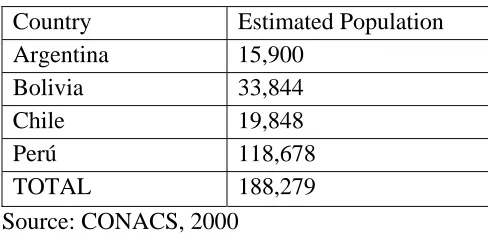
population of 188,279 animals, of which 118,678 are found in Peru (Census of vicuñas
2000), 33,844 in Bolivia (Census of vicuñas 1996), 19,848 in Chile (Census of vicuñas
Moreover, comparing the total population of camelids (7,809,479), vicuñas are 2%
(160,700), guanacos are 7.3% (571,200), llamas are 42.2% (3,300,000), and the alpacas are
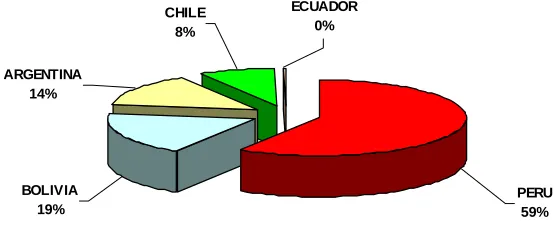
48% (3,750,000) of the total. For comparison of vicuña population by country see tables 4, 5,
6, and graphic 1. (Appendix B. Table and graphics: South America Population of Andean
Camelids 2000, Distribution of Vicuña by country 2000, Distribution of Vicuña by country
2002, and graphic 1 Distribution of Vicuña by country 2002). According to PROMPEX,
vicuña population could increase from 11% to 18%, depending on protection from predators
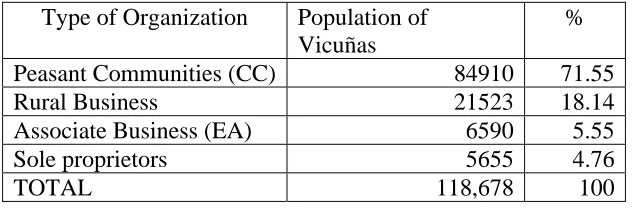
and poaching and the conditions of pastures. According to the census of 2000 by CONACS,
the vicuña population in Peru is 118,678 animals distributed mostly from Central Sierra to
South Sierra of Puno and Tacna, both Departments of Peru. The majority of vicuña
population is found in Ayacucho (34.03%), following by Puno (15.26%), Lima (14.91%),
Junín (9.61%), Apurimac (8.44%) and Huancavelica (7.37%), (CONACS, 2000). For
comparison vicuña population see tables 7, and graphic 2, 3 4. (Appendix B. Table and
graphics: National Population of Vicuñas Census 2000, Evolution of National Vicuñas
Population1980-2001, Graphic of National Population of Vicuñas Census 2000, Vicuña
Population Projected in Peru by 2010).
Most of the time, vicuña eat pasture, preferring zones rich in pasture with water. Vicuña eat
short grass (“gramíneas cortas”), herbaceous plants, and some succulent plants. Vicuña prefer
a special pasture called “Ichu” and rarely eat “hard” pastures (see description and photo
below). Occasionally they lop off “Tola” (CONACS, July, 2006).
Photo: By the author Short grass “ichu”
The pastures in the “Puna” are hard with “sílice” (element in pasture: silica) that requires the
use of incisors. The grazing method of vicuña is not to pull pasture like cows, horses, or
sheep do. Vicuña cuts pasture with their incisors. To counteract this use, the incisors grow
continually until vicuña is almost 5 years old. This tooth growth is controlled by their
and the incisors begin to get smaller. When old animals do not have long enough incisors to
graze; they get weak and die. Andean camelids take advantage of the lean pastures from the
“Puna” with greater efficiency than the foreign animal species. In the case of alpaca, its
digestion of pasture is 22% more efficient to ovine’s digestion (PROMPEX, 2006).
Vicuña research has discovered two possible subspecies:
A. Vicugna vicugna vicugna has a greater size and lighter color than the second
subspecies and is found south of 18º latitude. Most of that population is in Argentina.
B. Vicugna vicugna mensalis is brown, the typical cinnamon color; it has white hair in
the chest and is found north of 18º latitude. Most of that population is in Peru and
Bolivia.
A tentative geographic limit between the two vicuñas subspecies has been determined. The
approximate line that divides the territory between these two subspecies is the southern
latitude18º. Although, research on distribution and boundaries has not finished, it is
considered that all vicuñas from Peru, those from north Altiplano, central and south Bolivian
Altiplano, and Tarapacá Region in Chile belong to the Northern Subspecies. On the other
hand, all the vicuñas from Argentina, the Antofagasta and Atacama Regions in Chile are
Southern Subspecies (Ministry of Agriculture, Peru, 2007).
The social organization of the vicuña has the same pattern as the guanaco’s. However, vicuña
are more sedentary and territorial than guanaco. Vicuña organization is classified into three
groups:
A. Family groups constituted by a male (jaiñachu) and an average of 5 to 6 females. The
young vicuñas are expelled from the family group when they are around 8 to 9
months of age; thus the crossing among vicuña that are relatives by blood is
controlled. The females are integrated into other family groups, and males form
groups of single males called “tropillas”.
B. The second group is called “tropillas”. This group is composed of male adolescents
and those vicuñas that do not belong to any family groups. When these male vicuñas
arrive at adulthood (three years old), they fight with an adult male in order to take his
C. The third group is called “macho solitario” (lone male), that are generally the male
adults that lost their family group after fighting with a younger male.
Family group Tropillas juveniles Macho solitario
Historical legislation for conservation and sustainable use (international and national)
Four decades ago in Peru, vicuña was perhaps the most valuable species of the country and
was also an endangered species. This was the result of indiscriminate hunting by
unscrupulous people. The Peruvian State saw that the vicuña population was reduced to only
five thousand specimens in the world. According to PROMPEX, during the Inca Empire
there were an estimated 2 million vicuñas. However, in the 1960s, after big fashion
companies discovered the attributes of vicuña fiber, the vicuña population started to
diminish. Bands of poachers killed vicuñas for their precious fiber. In 1964, only 5,000
specimens were alive in Peru. It caused alarm in the Peruvian State and in the international
society. Consequently, the Peruvian State, represented by the Ministry of Agriculture,
together with Peasant Communities of Lucanas created the Pampas Galeras Reserve.
According to CONACS, the vicuña environment is the “Puna” region that includes the
Andean regions in Argentina, Bolivia, Chile, Ecuador, and Peru. The majority of the
population of vicuñas is in Peru and Bolivia. Therefore, since these two countries have
witnessed the exploitation of the species, they decided to join efforts and signed, in 1969, the
International Agreement for Conservation and Handling of the Vicuña in La Paz, Bolivia.
Later Argentina (1971), Chile (1973), and Ecuador (1979) also signed the agreement. On
December 20th, 1979, the five countries ratified the agreement that sets forth the prohibition
embryos, frozen semen, etc. (Llovet, A. 2003). The Agreement for Conservation and
Handling of the Vicuña regulates any procedures regarding this species. The agreement
declared Peru as fully responsible for the handling of vicuña as a wild species, because Peru
has the majority of the vicuña population in the region. The conservation programs that were
applied resulted in an increase of the vicuña population, and the Andean plains were
repopulated. This was achieved with the aid of the peasants of the regions where the vicuñas
lived.
International market, states, and civil society entities also took measures and actions in order
to contain the excessive exploitation of vicuña. In the 1970s, the Convention on International
Trade in Endangered Species of Wild Fauna and Flora, CITES, supported by United Nations,
approved the agreement that regulates and supervises the international trade of wild fauna
products. The export of vicuñas - the animal - was forbidden, and they could only be moved
from their habitat for research purposes. The agreement was signed on December 3rd, 1973,
in Washington DC. The Peruvian government signed the agreement one year later, on
December 30th, 1974, in Berne, Switzerland; and became a member of CITES (Decree Law
N˚ 21080). The Convention is the entity that supervises the international commerce in vicuña
fiber, allowing its trade to those countries that have accredited populations. It must follow
regulations according to what is listed in Appendix II (threatened), but not in Appendix I
(endangered). By 2005, Peru and Bolivia were the only vicuña-producing countries that
could engage in international trade of vicuña fiber (Appendix II).
The German Agency for Cooperation (GTZ) provided financial support for vicuña protection
between 1973 and 1980. By 1977, Pampas Galeras Reserve (75,000 ha.) had 20,000 vicuñas.
In 1981, Peru had 75,000 vicuñas. The fast recovery of vicuña, a species that was
endangered, was a great success in the world.
In 1987, the 6th Conference of the Parts of the Convention on the International Trade of
Threatened Species of Wild Fauna and Flora, CITES (Ottawa, Canada) provided the
transform and to market internationally fabrics made industrially with sheared fiber of live
vicuñas. Vicuña fiber could be traded under two basic conditions: first, the animal must be
sheared alive, second, the product label should include the logo and the end of the fabric
must said “VICUÑANDESPERU” or “VICUÑANDESPERU-ARTESANIA (depending on
the country of origin of the fabric or product). In November, 1994, in Fort Lauderdale,
Florida, the 9th CITES Convention modified the vicuña regulations for international trade.
The sheared fiber from live vicuñas could be commercialized only with the identification
logo and registered brand “VICUÑANDESPERU”. By 1995, Peru and the other subscribing
countries of the Agreement for the Conservation and Management of the Vicuña began to
negotiate for the agreement signed at the 10th Conference of the Parts of CITES (Zimbabwe,
1997), which authorized the transformation and international commercialization of vicuña
fiber, as ‘weavings form and sanctuaries’ crafts. As a consequence, the convention
reclassified vicuña from Appendix I, which indicated that vicuña is an endangered species–
to Appendix II, as a species threatened or vulnerable. Appendix II includes species that are
no longer found to be endangered, but whose commerce must be controlled in order to avoid
an incompatible use with its survival, as was the vicuña case. Therefore, since June, 1997,
Harare , Zimbabwe, the 10th Convention allowed the member countries of the Vicuña
Convention also to trade in luxury handicrafts and knitted articles made of wool sheared from
live vicuñas from Appendix II populations, and to replace the words
"VICUÑANDES-CHILE" and "VICUÑANDES-PERU" by the words "VICUÑA-COUNTRY OF ORIGIN".
Thus, under strict regulations, Peru can internationally market vicuña wool and its
sub-products. In 1997, the FAO declared vicuña as a vulnerable species. Previously, the
International Union for the Conservation of Nature and Natural Resources (IUCN) had
declared vicuña as a species in danger of extinction (Franklin, 1974 cited by Villalba, 1996).
Afterwards, vicuña was included in the 2007 Red List of Threatened Species Lower Risk.
Despite the achievements in the international framework, United States of America has not
issued a law that adjusts its local legislation, which dates from 1973 to the CITES
conventions. In the United States, the internal norm to eliminate the present restrictions for
Toscano, 2002). The Peruvian State also has been developing legislation for the
commercialization of vicuña fiber at the national level. The role of the Government of Peru is
one of the most important in the commodity chain of vicuña fiber. Even though the Peruvian
government gave custody of vicuña to the peasant communities; the vicuña still is property of
the State. Therefore, the State, first, has to create laws in order to provide the best
environment that protects this species. Second, the government has to develop legislation for
a sustainable use that all peasant communities must implement homogeneously, equally, and
consistently in order to alleviate their poverty. The Peruvian Government has increased its
participation in the promotion of the product. As part of the strategy for selling vicuña fiber,
the Peruvian Government promotes vicuña fiber at the international level. Through the time
the Peruvian State has developed and improved the legislation for the production and
commercialization of vicuña fiber from Peru and it must be accomplished by all actors of the
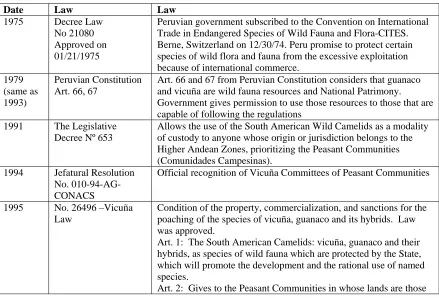
commodity chain. Following, I present chronologically the legislation decreed by the
[image:35.612.101.540.418.716.2]Peruvian State:
Table 2-1 Peruvian laws regarding vicuña species
Date Law Law
1975 Decree Law
No 21080 Approved on 01/21/1975
Peruvian government subscribed to the Convention on International Trade in Endangered Species of Wild Fauna and Flora-CITES. Berne, Switzerland on 12/30/74. Peru promise to protect certain species of wild flora and fauna from the excessive exploitation because of international commerce.
1979 (same as 1993)
Peruvian Constitution Art. 66, 67
Art. 66 and 67 from Peruvian Constitution considers that guanaco and vicuña are wild fauna resources and National Patrimony. Government gives permission to use those resources to those that are capable of following the regulations
1991 The Legislative
Decree Nº 653
Allows the use of the South American Wild Camelids as a modality of custody to anyone whose origin or jurisdiction belongs to the Higher Andean Zones, prioritizing the Peasant Communities (Comunidades Campesinas).
1994 Jefatural Resolution
No. 010-94-AG-CONACS
Official recognition of Vicuña Committees of Peasant Communities
1995
No. 26496 –Vicuña Law
Condition of the property, commercialization, and sanctions for the poaching of the species of vicuña, guanaco and its hybrids. Law was approved.
Art. 1: The South American Camelids: vicuña, guanaco and their hybrids, as species of wild fauna which are protected by the State, which will promote the development and the rational use of named species.
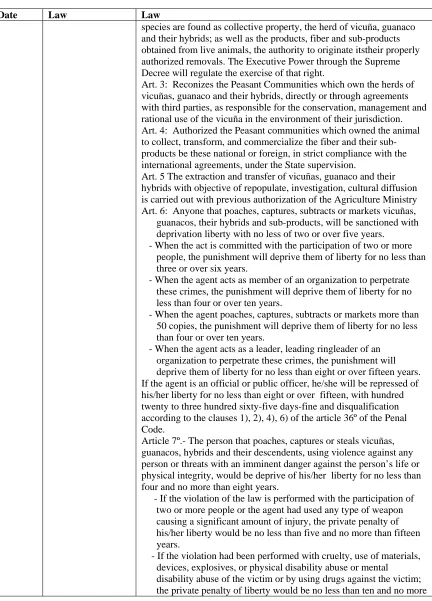
Table 2-1 Peruvian laws regarding vicuña species (continued)
Date Law Law
species are found as collective property, the herd of vicuña, guanaco and their hybrids; as well as the products, fiber and sub-products obtained from live animals, the authority to originate itstheir properly authorized removals. The Executive Power through the Supreme Decree will regulate the exercise of that right.
Art. 3: Reconizes the Peasant Communities which own the herds of vicuñas, guanaco and their hybrids, directly or through agreements with third parties, as responsible for the conservation, management and rational use of the vicuña in the environment of their jurisdiction. Art. 4: Authorized the Peasant communities which owned the animal to collect, transform, and commercialize the fiber and their sub-products be these national or foreign, in strict compliance with the international agreements, under the State supervision.
Art. 5 The extraction and transfer of vicuñas, guanaco and their hybrids with objective of repopulate, investigation, cultural diffusion is carried out with previous authorization of the Agriculture Ministry Art. 6: Anyone that poaches, captures, subtracts or markets vicuñas,
guanacos, their hybrids and sub-products, will be sanctioned with deprivation liberty with no less of two or over five years.
- When the act is committed with the participation of two or more people, the punishment will deprive them of liberty for no less than three or over six years.
- When the agent acts as member of an organization to perpetrate these crimes, the punishment will deprive them of liberty for no less than four or over ten years.
- When the agent poaches, captures, subtracts or markets more than 50 copies, the punishment will deprive them of liberty for no less than four or over ten years.
- When the agent acts as a leader, leading ringleader of an organization to perpetrate these crimes, the punishment will deprive them of liberty for no less than eight or over fifteen years. If the agent is an official or public officer, he/she will be repressed of his/her liberty for no less than eight or over fifteen, with hundred twenty to three hundred sixty-five days-fine and disqualification according to the clauses 1), 2), 4), 6) of the article 36º of the Penal Code.
Article 7º.- The person that poaches, captures or steals vicuñas, guanacos, hybrids and their descendents, using violence against any person or threats with an imminent danger against the person’s life or physical integrity, would be deprive of his/her liberty for no less than four and no more than eight years.
- If the violation of the law is performed with the participation of two or more people or the agent had used any type of weapon causing a significant amount of injury, the private penalty of his/her liberty would be no less than five and no more than fifteen years.
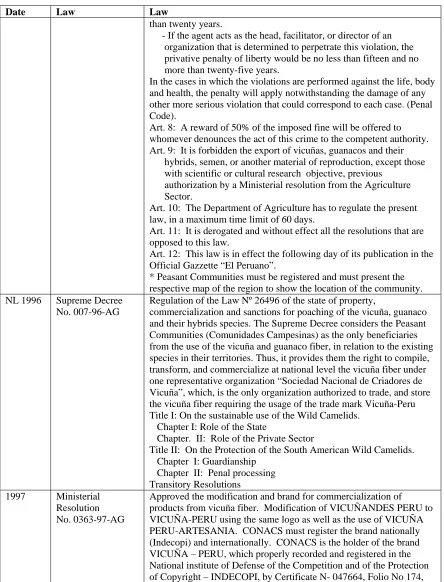
Table 2-1 Peruvian laws regarding vicuña species (continued)
Date Law Law
than twenty years.
- If the agent acts as the head, facilitator, or director of an organization that is determined to perpetrate this violation, the privative penalty of liberty would be no less than fifteen and no more than twenty-five years.
In the cases in which the violations are performed against the life, body and health, the penalty will apply notwithstanding the damage of any other more serious violation that could correspond to each case. (Penal Code).
Art. 8: A reward of 50% of the imposed fine will be offered to whomever denounces the act of this crime to the competent authority. Art. 9: It is forbidden the export of vicuñas, guanacos and their
hybrids, semen, or another material of reproduction, except those with scientific or cultural research objective, previous
authorization by a Ministerial resolution from the Agriculture Sector.
Art. 10: The Department of Agriculture has to regulate the present law, in a maximum time limit of 60 days.
Art. 11: It is derogated and without effect all the resolutions that are opposed to this law.
Art. 12: This law is in effect the following day of its publication in the Official Gazzette “El Peruano”.
* Peasant Communities must be registered and must present the respective map of the region to show the location of the community. NL 1996 Supreme Decree
No. 007-96-AG
Regulation of the Law Nº 26496 of the state of property,
commercialization and sanctions for poaching of the vicuña, guanaco and their hybrids species. The Supreme Decree considers the Peasant Communities (Comunidades Campesinas) as the only beneficiaries from the use of the vicuña and guanaco fiber, in relation to the existing species in their territories. Thus, it provides them the right to compile, transform, and commercialize at national level the vicuña fiber under one representative organization “Sociedad Nacional de Criadores de Vicuña”, which, is the only organization authorized to trade, and store the vicuña fiber requiring the usage of the trade mark Vicuña-Peru Title I: On the sustainable use of the Wild Camelids.
Chapter I: Role of the State
Chapter. II: Role of the Private Sector
Title II: On the Protection of the South American Wild Camelids. Chapter I: Guardianship
Chapter II: Penal processing Transitory Resolutions 1997 Ministerial Resolution No. 0363-97-AG
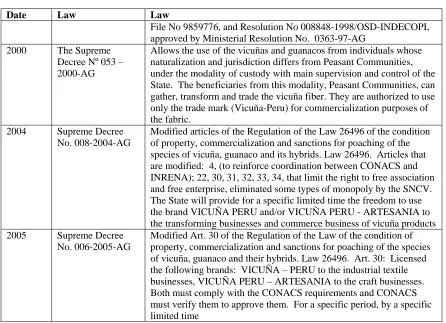
Table 2-1 Peruvian laws regarding vicuña species (continued)
Date Law Law
File No 9859776, and Resolution No 008848-1998/OSD-INDECOPI, approved by Ministerial Resolution No. 0363-97-AG
2000 The Supreme
Decree Nº 053 – 2000-AG
Allows the use of the vicuñas and guanacos from individuals whose naturalization and jurisdiction differs from Peasant Communities, under the modality of custody with main supervision and control of the State. The beneficiaries from this modality, Peasant Communities, can gather, transform and trade the vicuña fiber. They are authorized to use only the trade mark (Vicuña-Peru) for commercialization purposes of the fabric.
2004 Supreme Decree
No. 008-2004-AG
Modified articles of the Regulation of the Law 26496 of the condition of property, commercialization and sanctions for poaching of the species of vicuña, guanaco and its hybrids. Law 26496. Articles that are modified: 4, (to reinforce coordination between CONACS and INRENA); 22, 30, 31, 32, 33, 34, that limit the right to free association and free enterprise, eliminated some types of monopoly by the SNCV. The State will provide for a specific limited time the freedom to use the brand VICUÑA PERU and/or VICUÑA PERU - ARTESANIA to the transforming businesses and commerce business of vicuña products
2005 Supreme Decree
No. 006-2005-AG
Modified Art. 30 of the Regulation of the Law of the condition of property, commercialization and sanctions for poaching of the species of vicuña, guanaco and their hybrids. Law 26496. Art. 30: Licensed the following brands: VICUÑA – PERU to the industrial textile businesses, VICUÑA PERU – ARTESANIA to the craft businesses. Both must comply with the CONACS requirements and CONACS must verify them to approve them. For a specific period, by a specific limited time
Source: Interview with CONACS 4/18/07, Ministry of Agriculture (1994-2007)
As illustrated above, in 1975 the State began to protect vicuña species and in 1995 began to
regulate and control vicuña commercialization. The State provided peasant communities the
custody and benefit of the vicuña resource and gave them the responsibility to continue the
increase in the vicuña population.The Peruvian government also develops program for
conservation and repopulation of the vicuñas species; those programs are implemented by
CONACS, the public entity responsible of the conservation and repopulation of vicuña. For
conservation, CONACS provides information, education, and training to peasant
communities and peasant communities’ members during the year, so communities can resist
any problem of poaching or attacks from natural predators. CONACS is encouraged by the
Ministry of Agriculture to enlarge the number of vicuña at national level. The strategy of
location. The peasant communities from the receiving area are responsible for maintaining
and caring those vicuñas, in order to benefit from the production of vicuña fiber.
There are several steps in repopulations. First, CONACS studies different zones in order to
provide the vicuña with an appropriate habitat. Second, CONACS must select the type of
animal for repopulation. The animal has to have specific characteristics as being adult or
young vicuña, no babies; the proportion is 80/20, 80% of males and 20% of females. Third,
the transportation to the new site requires a big truck, water, and pasture for the entire
journey. A veterinarian should go with the specimens because vicuñas are very easily
stressed and could die during the trip. Fifth, since peasant communities are the beneficiaries,
the peasant community that receives specimens for repopulation has to pay an amount per
animal to the peasant community from where the specimens are originated. Most of the time,
the contract explains that amount is for each specimen. For instance, Cajamarca communities
plan to repopulate more areas, and they could pay as much as US$ 1000 for each specimen
from Peasant Community of “San Juan de Lucanas” (Interview with CONACS 5/9/07 Lima,
Peru). For the investment be worth it, those vicuñas must be sheared at least four times and
be able to reproduce more vicuñas. Peasant communities sign a contract which establishes
the price.
Peasant Communities are supported by diverse non governmental organizations (NGOs).
NGOs not only help provide environmental protection and finance resources to purchase
tools and devices for the production and harvesting processes, but they also provide
education, health, and aid in the implementation of new projects to help insure that Peasant
Communities achieve successful commerce. For instance, SOS FAIM, a European
Organization, has two local offices in Peru and Bolivia. These two offices developed their
Regional Program called Support for the Economic Initiatives and the Organization of the
Association of Rural Producers. The financing comes from the European Commission. It
provides the 75% (3,925,834 €) of the total amount of 5,234,445 €; peasant communities