promoting access to White Rose research papers
White Rose Research Online
Universities of Leeds, Sheffield and York
http://eprints.whiterose.ac.uk/
This is an author produced version of a paper published inInternational Journal of Heat and Fluid Flow.
White Rose Research Online URL for this paper: http://eprints.whiterose.ac.uk/9117/
Published paper
Tomlinson, R.A., Pugh, D. and Beck, S.B.M. (2006) Experiment and modelling of birefringent flows using commercial CFD code. International Journal of Heat and Fluid Flow, 27 (6). pp. 1054-1060.
Experiment and Modelling of Birefringent flows using
Commercial CFD code
R.A. Tomlinson, D. Pugh, and S.B.M. Beck
Department of Mechanical Engineering,
The University of Sheffield, Mappin Street, Sheffield, S1 3JD, UK.
Keywords: Birefringent flows, Computer modelling, Experiments, Shear rate
Abstract
It is well known that certain fluids are birefringent and when flows are viewed in polarised
light interference fringes are observed. The fringes are caused by a phase shift in the light
passing through the fluid and are proportional to the integral of the maximum shear strains
in the fluid. In order to understand what is happening within the flow and overcome the
difficulties due to this integration of analysing three dimensional flows, additional
computational or experimental information is needed.
In this work, a commercially available computer code (Fluent) is used for the first time to
model the flows. The flow data are then exported to a spreadsheet where the shear rates are
integrated across the field and then banded for graphical output. The results from this are
then compared to results generated from birefringent flow experiments and the agreement is
found to be good since the modelled fringes show the same patterns as those in the
experiment. This novel use of computational and experimental techniques together will
Currently, there are still a lot of empirical variables involved in fitting the computational
fringes to the experiment, but the results of this preliminary study show that this is a
promising approach to this type of problem.
1. Introduction
The photoelastic effect is that property of transparent materials which causes them to
become birefringent or doubly refracting when deformed. In their free state, materials such
as glass, plastics and fluids are isotropic to the passage of light; light traversing them is
affected only by the normal elementary laws of optics. When deformed however, these
materials behave like most transparent crystals, in that they have distinct optical axes and
transmit light with different velocities along the planes of principal strain. When a ray of
light passes through a birefringent material under strain, it is split into two components
appropriate to the principal strains at any point; each ray then passes through the material at
a velocity which is proportional to the magnitude of the principal strain with which it is
associated, i.e. the material behaves as if it has two refractive indices, hence the term
birefringent. When the light exiting the material is viewed through a polarizing plate,
interference fringes can be observed. These fringes are caused by the phase shift in the light
that has passed through the material and are proportional to the maximum shear strain in the
material. Using birefringence to study strain in solid materials is well established and is
termed photoelasticity. The practical use of birefringence effects in fluids is still in its
infancy but it has already been used by Sun et al. (1999) for examining blood flow in
models of cardiovascular systems. As polymer melts are themselves birefringent, this is one
Maxwell (1872) and Mach (1873) first observed the phenomenon of flow birefringence
in the 1870’s. Early investigations into flow birefringence centred mainly on finding a
suitable fluid that could be used and which would produce sufficient fringes. Quantitative
studies of flow birefringence did not begin until the 1950’s. Theories produced to explain
the phenomena of flow birefringence have centred mainly around two areas:
1) stretching and orientation of long chain polymers.
2) deformation or orientation of suspended macromolecules or colloidal particles.
The fluids tested as part of this research fall into the second of these categories. Until the
work of Rosenberg (1952) the accepted theory was that birefringence in fluids was due to
the orientation of the molecules, but then he suggested that the birefringent effect was due
to deformation of the molecules rather than their orientation. This implies that the
interference fringes are related to the maximum shear stress in the fluid, τmax, and not the
streamlines as previously assumed. Therefore the effect is governed by the stress optical
law which can be found in Dally and Riley (1991)[:
cd Nλ
τmax =
2 (1)
where N is the order of the fringe observed, c is the stress optical constant, d is the length of
the light path in the fluid and λ is the wavelength of the light.
This phenomenon therefore only occurs in birefringent fluids which are subject to shear
magnitude of these shear stresses. This means that as the stress varies within the fluid, the
optical phase difference also changes. So the total birefringent effect along the light path is
clearly the integral of the magnitude and direction of the shear stresses of the fluid,
τ
, = dy du
µ
τ
(2)where
µ
is the viscosity and du/dy is the change in velocity, perpendicular to the velocitydirection.
This fact is particularly important for real, three dimensional flow, because a shear occurs at
the walls giving additional fringes due to the integrating effect. A review of integrated
birefringence in both solids and fluids up to 1998 can be found in Cen et al. (1998). In order
to understand what is happening within the flow and overcome this integrating effect, either
additional experimental or computational techniques must be used augment the information
available. Aben and Puro (1997) have investigated the use of optical tomography for 3-D
flow, but this method is intensive both in terms of storage and processing requirements.
Laser Doppler Anemometry (LDA) techniques have been used in conjunction with
birefringence to analyse two and three dimensional flows in non-Newtonian fluids by
Davidson et al. (1993). The same pair of techniques were used by Subramanian and Picot
(1996) to determine the stress optical coefficient using a convergent channel. Their flows
were slow, and thus the non-Newtonian effects were very pronounced.
Various workers have use a variety of methods to model and validate birefringence. These
tend to be made more difficult by the fact that most birefringent fluids tend to be
experimental finite element method to simulate these flows. The looked at instabilities in
lid driven cavities. However, they ignored the third dimension in this work. The pompom
method is a recent technique used to model 3-D fluid flow in polymer melts. The extended
form was used by Verbeeten et al. (2004) to model this type of birefringent flow, but the
authors’ main concerns were related to the convergence of the solution. Clemuer et al.
(2004) used the double converted form along with a Mueller Matrix method to describe the
birefringent effect to allow comparison of their results with experiment.
A different approach to the modelling was published by Li et al. (2000) who used their own
computational fluid dynamics (CFD) techniques to model and validate birefringence results.
Other work by the group incorporates shear thinning, and is mostly concerned with the
rheology of the flow.
The objective of the current research was to develop an alternative, simpler method for
modelling the birefringent effect. It uses a commercial CFD code (Fluent) and converts
flow fields into shear fields by post processing using a spreadsheet. By summing these
calculated shears, it is possible to compare these results to experimental ones. Two different
types of flows were investigated, an expanding circular jet and a cavity. The former gave a
three dimensional shear flow in the direction of the light and the latter was designed to give
a two dimensional effect. This use of a well validated CFD code means that future research
2. Experimental Work
2.1 Optical Apparatus
All the experiments in this investigation used a circular polariscope (Figure 1). The light
source was capable of producing both white and monochromatic light and was placed
behind a frosted glass screen to diffuse the light and ensure the light intensity was uniform
over the full field, reducing the glare. The light passed through the first polariser and a
quarter wave plate, then through the flow channel under investigation, through a second
quarter wave plate, and polariser (known as the analyser). The birefringent effect of the
fluid was captured using a digital video camera from which individual frames could be
acquired for analysis. The entire apparatus was surrounded by blackout curtains to remove
the background light. This not only made the fringes easier to see but also prevented
reflections from the waveplates that would cause the camera problems in focusing. Details
on photoelastic analysis can be found in the excellent book by Dally and Riley (1991).
2.2 Expanding Circular Jet
When a relatively fast moving flow of fluid in a small pipe enters a larger volume, it forms
a jet and there is high shear between the fast and slow moving fluids. This, along with a
certain amount of entrainment, causes the flow to slow down and expand. This flow
phenomenon is known as an expanding jet. It was decided to use this for the initial
birefringent flow experiments as the high shear rates involved would maximise the fringes.
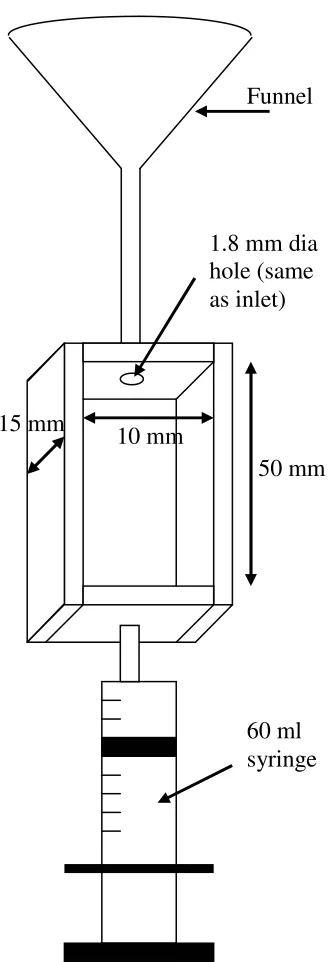
The flow channel for the expanding jet consisted of a 10ml syringe which forced the fluid
through a 1.8 mm circular hole into a 10 mm by 15 mm rectangular channel 50 mm long.
(Figure 2) . The channel was constructed of a PMMA frame with two glass walls through
which the fluid could be viewed (see Figure 1). The glass was of negligible integrated
birefringence and therefore did not affect the observed effects from the fluid. The channel
was positioned between the two quarter waveplates and was orientated so the syringe forced
the fluid vertically upwards. The camera was focused so that the entire channel was visible.
Since part of the syringe was in the frame of the camera, the flow rate of the fluid could be
calculated by taking the volume change over a number of frames, each of 0.04 s duration.
The fluid chosen for the experiment was hydroxypropyl cellulose (HPC) at 12%
concentration by weight. When the fluid was propelled into the channel, it expanded rapidly
in the form of a circular jet. This caused flow separation and high shear stresses within the
fluid and images of the birefringent effect were recorded in both light and dark field
arrangements, as shown in Figure 3.
The rate at which the syringe needed to be depressed to produce good fringe patterns was
very rapid and hence the fringes were only visible for about six frames (approximately 0.25
seconds). This made the accurate calculation of the velocity of the fluid difficult, but it was
approximately 10 ms-1. The rapid depression rate also meant that in the dark field
arrangement the light intensity suddenly increased and then decreased, reducing the quality
of the pictures. The solution also had small air bubbles forced into it by the high flow rate,
and the solution needed to be left to settle between runs to remove these. Ideally the fluid
would be continuously pumped, but due to the viscosity of the fluid, a positive
displacement pump would be needed and was not available.
Strong fringe patterns were observed in the expanding jet and in the case of the dark field
the order of the fringes for comparison with the computational model. Although the jet
experiment produced strong fringe patterns, the analysis of these fringes alone is difficult as
the nature of the flow is three-dimensional and the fringes that are seen are due to the
integral of the shear stresses through the sample. Hence the images in Figure 3 do not look
like a classical jet but have a bifurcated appearance. The perceived difference between the
expected and actual fringe pattern is a possible reason why commercial CFD codes have not
been used previously in this field.
The concentration of the HPC was lowered in 1% increments to 6%. Here fringes were still
visible but of lower order than before. The maximum fringe order observed varied with the
concentration of the solution reducing from a maximum of 1.5 fringes to 0.5 fringes with
the 12% and 6 % concentrations respectively. This observation may be explained by the fact
that the viscosity and therefore shear stress reduce with concentration, thus lowering the
fringe order.
2.3 Two-Dimensional Flow in a Cavity
A second channel was designed to approximate two-dimensional flow as shown in Figure 4.
This channel had a rectangular cross section with a large thickness to width ratio which
ensured that the path of the light would be relatively long without the volume of the channel
becoming too large. This was important, as the length of the light path, d, directly affects
the number of fringes produced (see equation (1)). A backward facing step was included in
the channel to produce the high shear stresses. The fluid was forced into the channel from a
60 ml syringe with a short length of copper pipe inserted into the end of it, via 6 mm tubing
into a 75 mm long duct 3 mm high and 18 mm thick. This allowed the velocity profile to
into a chamber 50 mm long. The duct then reduced back to the same dimensions as the inlet
and another 6 mm tube was used at the outlet. This tube led to a vertical funnel which was
used both as a reservoir and a filling mechanism. The sudden expansion of the fluid after
the step caused flow separation and hence high shear stresses in the fluid. The shear stresses
and thus the fringes in the birefringent fluid occurred directly after the step, so the camera
was focussed on this area.
This channel was also constructed with glass walls either side which were held in place by
grooves in a PMMA frame. The end sections of the channel were secured by the use of
screws. This channel was placed between the two quarter waveplates (Figure 1) so that the
glass sides were parallel to them. The syringe was clamped vertically with the outlet facing
downwards which helped to prevent air bubbles entering the channel during the
experiments as the air in the syringe would automatically rise to the top.
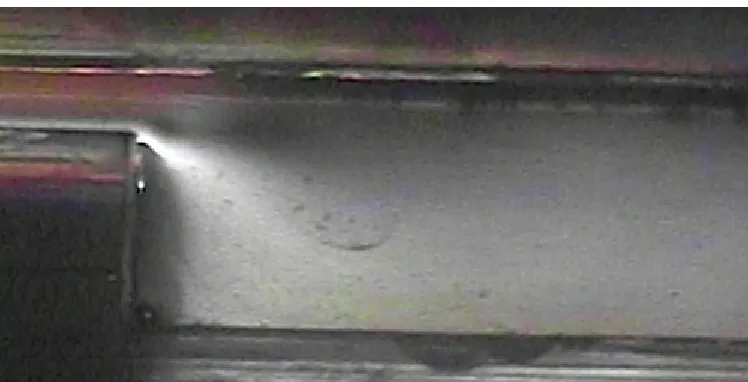
The initial experiments for flow in the cavity used a 12% concentration of HPC. This was
then reduced in 1% increments down to 7% (Figure 5 shows the fringes observed in the
channel with a concentration of 7%). For each concentration the flow rate and image of the
birefringent fringes were recorded. The flow rate was calculated by recording on the
soundtrack of the video camera when the fluid had reached certain levels. High
concentrations of HPC, with high fluid viscosity, produced low fluid flow rates and could
only be timed over 5-20ml. Once the concentration reached 7%, the viscosity had dropped
sufficiently for the fluid to be timed over the entire 60 cc volume of the syringe.
It had been expected that due to the higher flow rates at lower viscosities, the fringe order
expanding jet. However it was noticed that the fringe order was increasing rather than
decreasing. The HPC was diluted further in increments of 0.5% down to 4%.
3. Computational Modelling
All the modelling work to produce the velocity fields used the CFD package FLUENT4.
The computational grid models were created in Pre-BFC and after convergence, velocity
components were imported into a spreadsheet. The velocity boundary conditions and fluid
properties were obtained from the experimental work described above. Once in the
spreadsheet the velocities were transformed from u, v and w components into velocity
magnitudes using Pythagoras’ theorem.
The shear stress, τ, at each point requires the differential of the velocity magnitude and
these were found for every node using upwind differencing in the z direction (in the
direction of the light path - see Figure 4) It is appreciated that any method of producing the
partial differentials could be used.
1 1 − − − − ≈ ∂ ∂ i i i i y y u u y u (3)
where i is the element and i-1 is the previous element with respect to the light path.
A two dimensional projection of these results was produced by summing these results in the
z direction which gave values proportional to the optical phase shifts. A surface plot of
these was produced, and when correctly banded, could be compared with the experimental
To make the CFD calculations easier, the fluid was treated as Newtonian. It was also
assumed that flow birefringence obeys the stress optic law, equation (1) and that indices of
refraction that are related to the shear stress are the sole cause of the birefringent effect.
3.1 Modelling of Expanding Jet
The domain for the model of the expanding jet was 20×60×12 cells. In order to reduce the
computational time, only one quarter of the channel was modelled and symmetry cells were
used in both directions perpendicular to the flow. To increase the information in the inlet,
the concentration of cells was doubled in the inlet half of the channel so that there were 40
cells were in the first half and only 20 in the second half.
Two flow situations were modelled, using 6% and 12% solutions of HPC. As can be seen in
Figure 6, after processing the data, the 6% solution gave a good agreement with the
experimental observations. In this figure, the experimental and computational data are
shown as mirror images on either side of the centre line with the flow going from left to
right. The 12% solution of HPC however produced inferior results, as the modelled fringes
produced did not appear to spread out at the entrance to the channel. This was thought to be
due to the non-Newtonian nature of the fluid as was borne out from the experimental
observations that fringes were “frozen” into the fluid at the end of the step experiments.
Although probably present at higher concentrations, this effect was first noticed at 10%
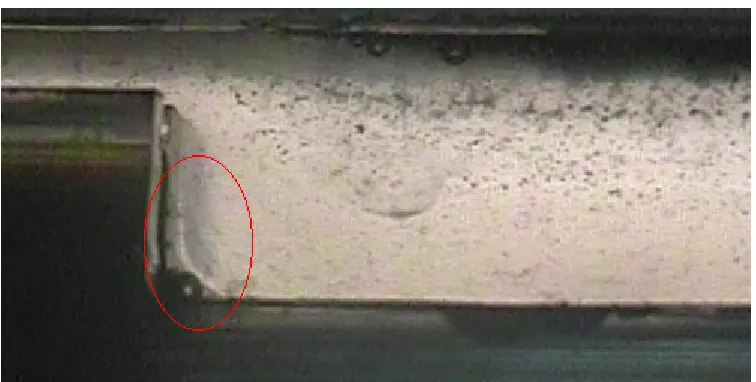
concentration. At the base of the step, a permanent fringe was observed after drawing the
fluid into the syringe (Figure 7). Very faint fringes were also noticed after experiments
where stronger fringes had been present during flow. Unfortunately these fringes were too
faint for the camera to pick up. These stress frozen fringes indicate that the solution is
non-Newtonian feature of the fluid1. An additional issue of this non-Newtonian flow was that
the Reynolds number was not entirely correct. The initial assumption for the computational
model was that the fluid was Newtonian with a viscosity measured at a relatively low rate
of shear. The actual viscosity was lower than this value, as shown in Figure 8. It was
therefore decided to repeat the computational model with the viscosity lowered from
1.6 kg m-1 s-1 to 0.74 kg m-1 s-1. At this value, the fringe pattern of the jet was seen to
bifurcate as observed during the experiments (Figure 9). This value was used for all the
analysis using 12% HPC solutions. As the computational model is seen to agree well with
the experimental results, this implies that the approach taken to process the results is an
acceptable one for these preliminary studies.
3.2 Modelling of the Cavity
The grid for the cavity consisted of 100×11×13 cells. As the channel had a single line of
symmetry down the centre in the direction of flow this was mimicked in the computational
grid by placing a surface of symmetry cells in the centre of the channel. This helped to
reduce the computation time as well as the amount of data that needed processing. To
improve the data produced by FLUENT4 the number of cells was increased for the
expansion, and also in the inlet duct to ensure the flow was fully developed. Care needed to
be taken at this stage as weighting of the cells incorrectly could give poor results and cause
problems in the analysis. Refinement of the grid was considered in the z direction around
1
Establishing the non-Newtonian stress deformation law for this fluid was a task beyond
the centre of the channel for the inlet and outlet but this was not done, as it would have
caused difficulties with the differencing due to the variation in the grid size.
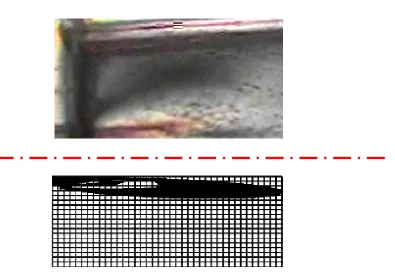
The computation was carried out with 5% and 10% concentrations of HPC. Once again, a
correction was made to account for the effective viscosity for the higher concentration. The
fringe patterns have been banded to approximate the fringes observed experimentally and
are shown, along with the equivalent experimental results in Figures 10 (5% concentration)
and 11 (10% concentration). The flow in this case goes from left to right. Although these
data are not as clear as those from the expanding jet, a close resemblance can be seen in the
fringe patterns. This figure shows that that the computational results can correctly predict
the area of greatest shear and hence highest fringe order.
This is particularly clear when one examines the first, white, fringe from the experiment. In
the case of the 5% concentration , the flow goes parallel to the top, and the maximum shear
occurs as the high speed jet goes over the step which is shown in Figure 10. The same
comparison can be applied to the 10% results, except in this case the areas go down from
the step at about 35° from horizontal. This is because the greater viscosity will cause the jet
to become attached to the wall.
4. Discussion
The aims of this work were to show that the birefringent analysis could be applied
successfully to fluid flow and that it was possible to use minor modifications of
commercially available CFD software to model the fields which had been produced
experimentally. In both of the geometries tested, the simple approach taken by the authors
It has been shown that after processing, the salient features of both the two and three
dimensional flow experiments can be identified and explained. This is particularly so in the
case of the expanding jet where the fringes do not actually appear as expected due to the
integral effect of the birefringence through the channel which gives the appearance of the
flow splitting into two jets. That the modelling shows the same effect, both supports the
validity of the modelling method and explains the experimental result.
Although the fringes at high concentrations are clearly visible, more fringes would be
desirable. As the flow rate is close to transition to turbulent, higher flow rates are
impossible as the linear birefringent effect only works in laminar flow; an increased cross
section of the flow channel would be a good method of achieving this.
The non-Newtonian nature of the fluid has been noted and to a certain extent accounted for
by linearising its value at the operating condition. From the data obtained using the
expanding jetand CFD, at a flow rate of 10 m s-1 and 12% concentrations the viscosity was
found to be out by a factor of two. To obtain more correct results, a full shear rate against
viscosity calibration of the fluid and also the use of the non-Newtonian flow model in
FLUENT would have to be implemented.
In this work, the contribution of the shear stresses lying in the plane of the light ray was
considered to be equal to that of the shear stresses perpendicular to it. This is unlikely
actually to be the case and investigation into this area should be considered.
Other methods of increasing the order of the fringes produced could be examined for
further investigations. Alternative solvents for HPC could be used to improve the fringes as
the fringe order. These work by reflecting the light back through the channel a number of
times, increasing the path length of the light.
It is fully appreciated that the work shown here is still in its early stages. For example, the
viscosity and fringe constants required to make the experiment and theory agree have to be
chosen by the operator. Undoubtedly these could be selected on a more rigorous basis. The
fluid should also be optically calibrated to enable the bands to be automatically selected.
Finally, it would be relatively straightforward to implement both the non-Newtonian flow
and shear rate calculations directly within the latest versions of many CFD packages,
making processing the results a far easier task.
5. Conclusions
This work has shown that the use of hydroxypropyl cellulose (HPC) in investigating flow
birefringence produces results that can lead to quantitative analysis of the flow fields. It also
illustrates that increased flow rates have a marked effect on the fringe order.
The cavity experiments combined with CFD of the same geometry show that calibration of
the fringe data from HPC is possible. The agreement between the experimental and
computational results illustrates that what is happening in the flow is understood, making
the two-dimensional calibration possible.
The expanding jetused has demonstrated that three dimensional analysis of flow using flow
birefringence is possible even though the results from the experiment may not appear to
show an expanding jet. In this case computational analysis can be also used to calibrate the
fluid optically. To analyse this form of flow from the birefringence results, more work is
These results present a simple way forward in the modelling of birefringent flows as
standard CFD codes can be used to extract flow fields which can then easily be integrated
and scaled. Overall the method shows great promise and, as it is a full field method where
time varying flow phenomena can be analysed, it will provide a valuable element in the
fluid mechanic’s toolbox.
References
Aben, H., and Puro, A., 1997, Photoelastic tomography for three-dimensional flow birefringence studies, Inverse Problems, 13, 215-221.
Cen, M., Hickman, L.J, Tomlinson, R.A., and Patterson, E.A., 1998, Integrated birefringence applied to solids and fluids - a review, Proceedings of 11th International Conference on Experimental Mechanics, Oxford, August 1998, 507-512.
Clemeur, N., Rutgers, R.P.G., and Debbaut, B., 2004, Numerical evaluation of three-dimensional effects in planar flow birefringence, Journal of Non-Newtonian Fluid Mechanics, 123, 105-120.
Dally, J.W., and Riley, W.F., 1991, Experimental Stress Analysis, McGraw-Hill, Inc.
Davidson, D.L, Graessley, W.W., and Schowalter, W.R., 1993, Velocity and stress fields of polymeric liquids flowing in a periodically constricted channel. 1. Experimental methods and straight channel validations, Journal of Non-Newtonian Fluid Mechanics, 49, (2-3), 317-344.
Grillet, A.M., Shaqfeh, E.S.G , and Khomami, B., 2000, Observations of elastic instabilities in lid-driven cavity flow, 94, 15-35.
Li, J.M., Burghardt, W.R., Yang, B., 2000, and Khomami, B, Birefringence and
computational studies of a polystyrene Boger fluid in axisymmetric stagnation flow, Journal of Non-Newtonian Fluid Mechanics, 91, (2-3), 189-220.
Mach, E., 1873, Optische-akustische Versuche, Clava, Prague.
Martyn, M.T., Groves, D.J., and Coates, P.D., 2000, In process measurement of apparent extensional viscosity of low density polyethylene melts using flow visualisation, Plastics Rubber and Composites, 29, (1), 14-22.
Maxwell, J.C., 1872, Double Refraction of Viscous Fluid Motion, Proc. Roy. Soc.,(London), A22, 46.
Rosenberg, B., 1952, Navy Dept., David W. Taylor Model Basin Report No. 617.
Subramanian, R., and Picot, J.J.C., 1996, A rheo-optical analysis of converging wedge flow for estimation of stress-optical coefficient, Polymer Engineering and Science, 36, (9), 1196-1202.
Sun, Y.D., Sun, Y.F., Sun, Y., Xu, X.Y., Collins, M.W., 1999, Visualisation of dynamic flow birefringence of cardiovascular models, Optics and Laser Technology, 31, 103-112.
Figure 1. Experimental arrangement of the circular polariscope where: L = Light source; P = Polariser; Q = Quarter wave plate; A = Analyser
P
Q
Flow channel
Digital video
camera
1.8 mm dia hole (same as inlet)
50 mm 10 mm
15 mm
[image:20.612.221.386.57.538.2]60 ml syringe Funnel
a) b)
Figure 3. Showing the birefringent fringes due to the 12% HPC acting as an expanding
25 150
75
50 8
Light path through the thickness (18 mm) of the channel
3 Outlet
[image:22.612.79.392.95.203.2]3 Inlet 18
Figure 4. Cross sectional diagram of the cavity.
Figure 5. Showing the fringe pattern observed the cavity using 7% concentration of HPC in a
[image:22.612.119.493.331.522.2]Figure 6. Experimental and Computational fringe patterns from the expanding jet experiment
using 6% HPC
[image:23.612.118.496.419.610.2]Newtonian
Plastic
Reduced Viscosity
Point at which viscosity readings were taken
Shear rate du/dy
S
h
ea
r
st
re
ss
[image:24.612.144.458.88.239.2]τ
Figure 8. Expected (Newtonian) and real (Plastic) relationship
[image:24.612.85.480.320.599.2]Figure 10. Banded FLUENT4 Data used to Predict Fringe Patterns for 5% HPC and
Experimental Results for 5% HPC
Area of
Figure 11. Banded FLUENT4 Data used to Predict Fringe Patterns for 10% HPC