ADVANCES IN
NEWORK AND
IFIP
-
The International Federation for Information Processing IFIP was founded in 1960 under the auspices of UNESCO, following the First World Computer Congress held in Paris the previous year. Anumbrella organization for societies working in information processing, IFIP's aim is two-fold: to support information processing within its member countries and to encourage technology transfer to developing nations. As its mission statement clearly states,IFIP's mission is to be the leading, truly international, apolitical organization which encourages and assists in the development, exploitation and application of information technology for the benefit of all people.
IFIP is a non-profitmaking organization, run almost solely by 2500volunteers. It operates through a number of technical committees, which organize events and publications. IFIP's events range from an international congress to local seminars, but the most important are:
The IFIP World Computer Congress, held every second year; open conferences;
working conferences.
The flagship event is the IFIP World Computer Congress, at which both invited and contributed papers are presented. Contributed papers are rigorously refereed and the rejection rate is high.
As with the Congress, participation in the open conferences is open to all and papers may be invited or submitted. Again, submitted papers are stringently refereed.
The working conferences are structured differently. They are usually run by a working group and attendance is small and by invitation only. Their purpose is to create an atmosphere conducive to innovation and development. Refereeing is less rigorous and papers are subjected to extensive group discussion.
Publications arising from IFIP events vary. The papers presented at the IFIP World Computer Congress and at open conferences are published as conference proceedings, while the results of the working conferences are often published as collections of sel ected and edited papers.
ADVANCES IN
N E T W O R K
AND
D ISTRI B UTE D
SYSTEMS SECURITY
IFIP TC11
WG11.4First Annual Working Conference on Network Security November 26-27, 2001, Leuven, Belgium
Edited by
Bart De Decker
Katholieke Universiteit Leuven, DistriNet Belgium
Frank Piessens
Katholieke Universiteit Leuven, DistriNet Belgium
Jan Smits
Technische Universiteit Eindhoven The Netherlands
ElsVan Herreweghen
IBMResearch Laboratory, Zurich Switzerland
eBook ISBN: 0-306-46958-8 Print ISBN: 0-792-37558-0
©2002 Kluwer Academic Publishers
New York, Boston, Dordrecht, London, Moscow
All rights reserved
No part of this eBook may be reproduced or transmitted in any form or by any means, electronic, mechanical, recording, or otherwise, without written consent from the Publisher
Created in the United States of America
Visit Kluwer Online at: http://www.kluweronline.com
CONTENTS
Preface
Acknowledgements
Part One
-
Reviewed
Papers
1
2
3
4 56
7
89
10
11
A
Role-Based Specification of the SET Payment
Transaction Protocol
Hideki Sakurada, Yasuyuki Tsukada
Information Security:
Mutual Authentication in
E-Commerce
S. H. Von Solms,
M.
V. Kisimov
Software-Based Receipt-Freeness in On-Line Elections
Emmanouil Magkos,
Vassilios Chrissikopoulos,
Nikos Alexandris
ID-Based Structured Multisignature Schemes
Chih- Y i n Lin, Tzong- Chen
Wu,
Jing- Jang Hwang
Probabilistic Relations for the Solitaire Keystream
Generator
Marina Pudovkina
Hazard Analysis for Security Protocol Requirements
Nathalie Foster, Jeremy Jacob
Securing
RMI
Communication
Vincent Naessens, Bart Vanhaute, Bart De Decker
Secure Java Development With UML
J a n Jürjens
Security Through Aspect-Oriented Programming
Bart De
Win,
Bart Vanhaute, Bart De Decker
Extending
a Campus Network with Remote Bubbles
using IPsec
Aurélien Bonnet, Marc Lobelle
Combining World Wide Web and Wireless Security
Joris Claessens, Bart Preneel, Joos Vandewalle
vi
12
On Mobile Agent Based Transactions in Moderately 173
Hostile Environments
Niklas Borselius, Chris J. Mitchell, Aaron Wilson
System
Christopher Krügel, Thomas Toth,
Engin
Kirda
13
SPARTA, A Mobile Agent Based Intrusion Detection 187
Part Two
-
Invited Papers
1 Shell’s Trust
Domain
Infrastructure
Security
201
Certification
Pieter van Dijken
PREFACE
The first Annual Working Conference of WG11.4 of the Inter-
national Federation for Information Processing (IFIP), focuses on
various state-of-the-art concepts in the field
of
Network and
Dis-
tributed Systems Security.
Our society is rapidly evolving and irreversibly set on
a course
governed by electronic interactions. We have seen the birth of e-
mail in the early seventies, and are now facing new challenging
applications such as e-commerce, e-government,
. . .
.
The more our
society relies on electronic forms
of
communication, the more the
security of these communication networks is essential for its well-
functioning. As
a consequence, research on methods and techniques
to improve network security is of paramount importance.
This Working Conference brings together researchers and prac-
tioners of various disciplines, organisations and countries, to discuss
the latest developments in security protocols, secure software engin-
eering, mobile agent security, e-commerce security and security for
distributed computing
.
We are also pleased to have attracted two international speakers
to present two case studies, one dealing with Belgium’s intention to
replace the identity card
ofits citizens by
anelectronic version, and
the other discussing the implications of the security certification in
a
multinational corporation.
This Working Conference should also be considered as the kick-
off
activity of WG11.4, the aims of which can be summarized as
follows:
rn
to promote research on technical measures for securing com-
puter networks, including both hardware- and software-based
techniques.
v i i i
=
to promote education in the application of security techniques,
and to promote general awareness about security problems in
the broad field of information technology.
Researchers and practioners who want to get involved in this
Working Group, are kindly requested to contact the chairman.
More information on the workings of WG11.4 is available from the
official IFIP-website:
h t t p ://www
.
if
i p .
a t .org/.
Finally, we wish to express our gratitude to all those who have
contributed to this conference in one way or another. We are grate-
ful to the international referee board who reviewed all the papers
and to the authors and invited speakers, whose contributions were
essential to the success of the conference. We would also like to
thank the participants whose presence and interest, together with
the changing imperatives of society, will prove a driving force for
future conferences to come.
ACKNOWLEDGEMENTS
Organised by:
K.U.Leuven, Dept. of Computer Science, DistriNet
IFIP/TC-11 Working Group 11.4 (Network Security)
Supported by:
Scientific Research Network on "Foundations of Software
Evolution", and as such, partially financed by the Fund for
Scientific Research
-
Flanders (Belgium)
Financially Supported
by:
IBM
Research
Telindus
Ubizen
Utimaco Safeware Belgium
Programme Committee:
Bart De Decker, (chair), K.U.Leuven, Belgium
Jan M. Smits, (co-chair), T.U.Eindhoven, The Netherlands
Els Van Herreweghen, (co-chair), IBM Research Lab, Zurich,
Switzerland
William
J
Caelli, Queensland Univ.
of
Technology, Australia
Herve Debar, France Telecom
R&D,
France
Serge Demeyer, Univ.
of
Antwerp, Belgium
Yves Deswarte, LAAS-CNRS, Toulouse, France
Jan Eloff, Rand Afrikaans Univ., South Africa
Dimitris Gritzalis, Athens Univ. of Economics &
Business, Greece
Manfred Hauswirth, Technical Univ. of Vienna, Austria
Andrew Hutchison, MGX Consulting, South Africa
Guenter Karjoth, IBM Zurich Research Lab, Switzerland
Kwok-Yan Lam, PrivyLink International Limited, Hong Kong
Marc Lobelle, UCL, Belgium
Keith Martin, Royal Holloway, Univ. of London, United Kingdom
Refik Molva, Institut Eurécom, France
X
Hartmut Pohl, Univ. of Applied Sciences Bonn-Rhein-Sieg, Koln,
Germany
Reinhard Posch, Graz Univ. of Technology, Austria
Bart Preneel, K.U.Leuven, Belgium
Kai Rannenberg, Microsoft Research Cambridge, United Kingdom
Peter Ryan, Norwegian Computing Center, Oslo, Norway
Pierangela Samarati, Univ. of Milan, Italy
Einar Snekkenes, Norsk Regnesentral, Oslo, Norway
Henk van Tilborg, T.U.Eindhoven, The Netherlands
Vijay Varadharajan, Macquarie Univ., Australia
Basie Von Solms, Rand Afrikaans Univ., South Africa
Rossouw Von Solms, Port Elizabeth Technikon, South Africa
Jozef Vyskoc, VaF, Bratislava, Slovak Republic
Tatjana Welzer, Univ. of Maribor. Slovenia
Reviewers
:Bussard, Laurent, France
Debar, Hervé, France
De Decker, Bart, Belgium
De Win, Bart, Belgium
Demeyer, Serge, Belgium
Deswarte, Yves, France
Druzovec,
M
arj an, Slovenia
Eloff, Jan, South Africa
Gritzalis, Dimitris, Greece
Hauswirth, Manfred, Austria
Hutchison, Andrew, South Africa
Karjoth, Guenter, Switzerland
Lam, Kwok-Yan, Hong Kong
Lobelle, Marc, Belgium
Martin, Keith, United Kingdom
Molva, Refik, France
Piessens, F'rank, Belgium
Pohl, Hartmut, Germany
Posch, Reinhard, Austria
Preneel, Bart, Belgium
Rannenberg, Kai, United Kingdom
xi
Schoenmakers, Berry, The Netherlands
Smits, Jan, The Netherlands
Snekkenes, Einar, Norway
Van Herreweghen,
Els,
Switzerland
Vanhaute, Bart, Belgium
van Tilborg, Henk, The Netherlands
Varadharajan, Vijay, Australia
Von
Solms,
Basie, South Africa
Von
Solms,
Rossouw, South Africa
PART
ONE
A ROLE-BASED SPECIFICATION OF
THE SET PAYMENT TRANSACTION
PROTOCOL
Hideki Sakurada
NTT Communication Science Laboratories, NTT Corporation,
3-1 Morinosato- Wakamiya, Atsugi, Kanagawa, 243-0198 Japan sakurada0theory.brl.ntt.co.jp
Yasuyuki Tsukada
NTT Communication Science Laboratories, NTT Corporation,
3-1 Morinosato- Wakamiya, Atsugi, Kanagawa, 243-0198 Japan
A b s t r a c t In this paper, we define a language for specifying security protocols concisely and unambiguously. We use this language to formally specify the protocol for payment transactions in Secure Electronic Transaction (SET), which has been developed by Visa and MasterCard.
In our language, a protocol is specified as a collection of processes. Each process expresses the role of a participant. In the role-based spe- cification, the components that a participant sees in a message can be stated explicitly. This is important in specifying protocols like that for the SET payment transactions because in such protocols some message components are encrypted and invisible to some participants.
We simplify the SET payment transaction protocol into the exchanges of six messages. Because our future goal is to formally analyze the se- curity properties that Meadows and Syverson discussed, we make the simplified protocol contain the parameters used in their security proper- ties. And we also refrain from excessive simplification. For example, we use dual signature in the payment request message as it is specified in the SET specification books, while most of the other works do not use it. Our specification can serve as a starting point for a formal analysis
of the protocol.
2 ADVANCES IN NETWORK AND DISTR. SYSTEMS SECURITY
1.
Introduction
Security protocols are used in distributed systems to protect the secrecy of messages and to identify users. It is well known that designing them is an error-prone task. The most significant issues concerning security protocols are that (1) attacks on them may succeed even without break- ing the cryptographic algorithms used and that (2) it may be difficult to make sure of the correctness of
a
small protocol that involves exchanges of only a few messages. Some examples of protocol failures are presented in (Anderson and Needham, 1995; Clark and Jacob, 1997).Formal methods can be used to analyze security protocols. With the methods, protocols are specified and their security properties are verified. Indeed, many formal methods have been developed (Meadows, 1996; Paulson, 1998; Denker
et
al.,2000)
and succeeded in finding errors in protocols or verifying their correctness (Burrows et al., 1990; Paulson, 1998). However, it is hard to apply these methods to large protocols. This is because large protocols are complex and there are no appropri- ate tools for analyzing such complex protocols. With a tool designed for small protocols, specifying complex protocols and their security proper- ties is hard. Moreover, the obtained specifications tend to be lengthy and unintuitive. To avoid these difficulties, protocols are usually simplified and the simplified protocols are verified instead.In this paper, we discuss the Secure Electronic Transaction (SET) protocol (SET Secure Electronic Transaction LLC, 1997a; SET Secure Electronic Transaction LLC, 1997b; SET Secure Electronic Transaction LLC, 1997c). In particular, we formally specify the payment transaction protocol that is a part of SET. This formal specification serves as a starting point of a formal analysis of the protocol.
A role-based specification of the SET payment transaction protocol 3
Figure 1. A typical message flow in the Needham-Schroeder shared-key protocol
participants in the protocol. This is useful for describing the specification of the SET payment transaction protocol.
The rest of this paper is organized as follows. We first define a lan- guage for specifying large security protocols concisely and unambigu- ously (Section 2). We then use it to specify the SET payment transac- tion protocol (Section 3). We finally summarize our results and mention some related works (Section 4).
2.
Protocol Specification Language
Before presenting our protocol specification language, we briefly ex- plain our design policy for it.
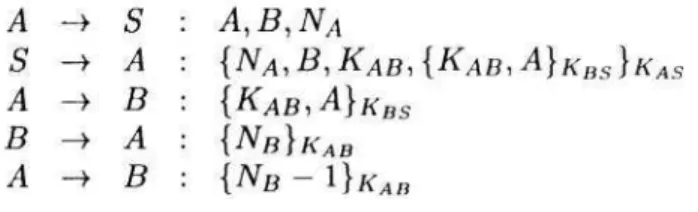
Security protocols are often explained by showing a typical message flow. For example, a typical message flow of the Needham-Schroeder shared-key protocol (Needham and Schroeder, 1978) is shown in Figure 1. The first line means that a participant
A
sends a message composed of her name, the name of the participant she wants to authenticate, and a fresh nonce (random number) to the authentication serverS .
The secondline means that S replies with message
{NA,B,
K A B , { K A B , A } K ~ ~ } K ~ ~to A . This message is obtained by encrypting N A ,
B ,
a newly generated key K A B to be shared byA
andB ,
and { K A B ,A } K ~ ~
with the key K A S .The { K A B , A } K ~ ~ is obtained by encrypting K A B and
A
with the keyK B S . A ,
B ,
and N A on the second line refer to themselves on the first line, respectively. SinceA
is assumed to know K A S and is not assumed to know K B S , she can decrypt { N A ,B ,
K A B , { K A B , A } K ~ ~ } K ~ ~ and can not decrypt {KAB,A}Kes.4 ADVANCES IN NETWORK AND DISTR. SYSTEMS SECURITY
Figure 2. The initiator role in the Needham-Schroedcr shareti-key protocol
{ K A B , A } K ~ ~ and sends it to B. Without assumptions on the knowledge of A , it is not clear whether if she knows the content { K A H , A } of the message or not,. This ambiguity may cause human-errors in specifying complex protocols that use cryptography frequently.
To avoid this problem, we specify a protocol as a collection of processes that express the roles of the participants in the protocol. To illustrate this, we show, in Figure 2, a process that are related to A’s role in the previous example. Note that we use a variable X for the encrypted component in the message from S to A. It is clear that A sends the component
X
toB
as it is.Now we define our protocol specification language. Since we assume the Dolev-Yao (Dolev and Yao, 1981) model, we define the set of mes-
sages as an algebra made from participants’ names, natural numbers (including nonces), and keys with tupling and cryptographic operations. The formal syntax of messages is as follows.
M
::=A
; participant’s nameI
K
; keyI
{ M1,.
* * 7 M n ) ; tupleI N
; natural numberI
{ M ) K ; encryption of message M using key KI
H ( M ) ; hash of message MA role-based specification of the SET payment transaction protocol 5
Since our language has variables, we define the set of t e r m s by ex- tending the previous syntax with variables.
T
.._
.._
...
I
X
; variable whose name is XBecause we usually use variables instead of concrete names, nonces, and keys, we regard A, N A , K, etc. that occur in terms as variables unless otherwise noted explicitly.
We finally define the set of processes with the following syntax. We specify a protocol as the set of processes of its participants.
; silent process
p
..-
..-
EndI
Send T P ; sending of message TI
Recv TP
; receiving of message TI
NewX
PI
I
Assert Q P ; checking of proposition Q; generating of a fresh nonce
X
Let X = T P ; binding of T to the local variable X
We don’t specify the receiver and the sender of a message in Send TP and
Recv TP, respectively because we assume that there exist intruders that can capture any message on networks and can send any message they can construct. We understand that a process of the form New
X
P binds free occurrences ofX
inP.
In other words, in a process NewX P,
the vari- ables X that occur in P refer to the newly generated nonceX.
We also understand that a process of the form RecvT
P
does pattern-matching and variable-binding. For example, a process Recv{
N, H(N)}P
accepts(2001, H(2001)}, where variable N is bound to the number 2001. The process however does not accept (2001, H(2002)}.
AssertQ
P
acts asP
if proposition Q holds, otherwise it actsas
End. The set of propositions depends on the system used for analysis. Since we use Isabelle (Paulson, 1994),a proof checker of higher-order logics, we can use any proposition in Isabelle.As an example, we specify the role of
A,
the initiator, in the Needham-Schroeder shared-key protocol in Figure 3. The process is parametrized by her nameA,
the responder’s nameB ,
and the keyK
A S.
3.
A Specification of the SET Payment
Transaction Protocol
6 ADVANCES IN NETWORK AND DISTR. SYSTEMS SECURITY
Figure 3.
shared-key protocol
The process that specifies the initiator role of the Needham-Schroeder
messages that include the parameters used in their security properties. Meadows and Syverson developed a method to describe security prop- erties flexibly and discussed the security properties that the payment transaction protocol is expected to satisfy. However, they did not spe- cify the protocol formally. Our formal specification is needed in order to verify the security properties. We also make the simplified protocol use dual signature, which is one of the characteristics of the original protocol.
Three parties, a cardholder, a merchant, and a payment gateway, are involved in a payment transaction in SET. This protocol is invoked after the cardholder has completed browsing, selection, and ordering. One of the purposes of the protocol is to securely send the payment information, which includes the account number of the payment-card of the card- holder and the amount of money that he will pay for the order, to the payment gateway.
A
typical message flow of the protocol is shown in Figure 4. We show only the six messages that our simplified protocol has. We also omit the structures of the messages in the figure. The cardholder and the mer- chant first exchange the identifiers of the transaction inPInitReq
andPInitRes
messages. The identifiers are referred to in subsequent mes- sages. The cardholder then sends the purchase request messagePReq
to the merchant. This message includes the amount of money that the cardholder will pay and her payment-card number. She keeps the num- ber secret from the merchant by encrypting a component that includes it. The merchant sends the gatewayAuthReq
message that includes the component. The gateway checks the validity of the payment-card num- ber, processes the payment, and returns the result to the merchant inA role-based specification of the SET payment transaction protocol 7
Cardholder
Merchant
Payment Gateway
PInitReq
[InitRes PReg
AuthReg AuthRes
t--
PRes
c--
Figure 4 . A typical message flow in the SET payment transaction protocol
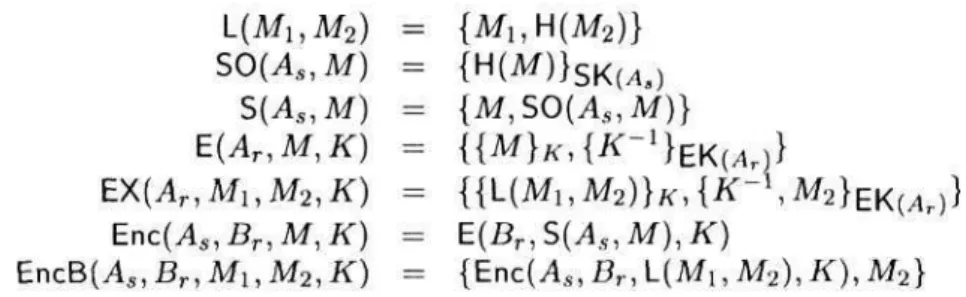
Figure 5. Operations on messages used in the SET payment transaction protocol
AuthRes
message. The merchant receives it and sends the result to the cardholder inPRes
message.Various cryptographic operations are used in SET. We define each of the operations used in our protocol as a function on the set of messages in our language. The definitions are essentially the same as what Bella et al. did in their verification of the SET cardholder registration protocol (Bella et al., 2000). We show the definitions in Figure 5 . The subscripts
8 ADVANCES IN NETWORK AND DISTR. SYSTEMS SECURITY
Cardholder(C, M , P, O D , PurchAmt, P A N , PANSecret) = New RRPIDl
New L I D c New Challc
/ /
PInitReqSend ( R R P I D 1 , L I D c , Challc}
// PInitRes
Recv S ( M , { { L I D c , L I D M , X I D } , RRPID1, Challc, ChallM}) Let TransID = { L I D c , L I D M , X I D }
New ODSalt
New R R PID 2
Let PANData = { P A N , PANSecret}
Let PIHead =
{
TransID, H ( O D ) , PurchAmt}Let OIData =
{
TransID, RRPID2, Challc, H(OD), ODSalt} Let PIData = { PIHead, PA NData}New K
Send{
{
SO(C, {H(PIData), H(OIData)}),//
PReqEX(P, L(PIHead, OIData), PANData,
K ) } ,
{
OIData, H(PIData)}}//
PResRecv ( S ( M , { DansID, RRPID2, C h a l l c } ) )
Figure 6. The cardholder process in the SET payment transaction protocol
EK
andSK
are the functions that relate each participant to his public encryption key and his public signature key, respectively.The processes of a cardholder, a merchant, and a payment gateway are shown in Figures 6, 7 and 8, respectively.
A role-based
specification
of the SETpayment transaction protocol
9Merchant(M,
C, P, OD, ODSalt, AuthReqAmt)
=//
PInitReq
Recv
{ R R P I D
1, LIDc, ChaZZc}
New
LIDM
New
XID
New
C h d M
Let
TkansID
={ L I D c ,
L I D M ,X I D }
//
PInitRes
Send S ( M , {
FransID, RRPID1, Challc, ChallM})
Let
OIData
= {TkansID, RRPID2, Challc,
H(OD), ODSalt}
Recv { { S O ( C ,
HPIData,
H(OIData)),
PIBody},
New
RRPID3
New
K1
//
AuthReq
Send EncB(
M ,
P,{
RRPID3, RansID, AuthReqAmt},
//
AuthRes
Recv Enc(P,
M , (RRPID3, lPransID, AuthAmt}, K2)
Assert
AuthReqAmt
=AuthAmt
//
PRes
Send
S ( M ,
{
RansID, RRPID2, Challc})
//
PReq
{
OIData, HPIData}}
{SO(C,
{HPIData,
H(OlData)}),
PIBody},
Ki)
Figure 7. The merchant process in SET payment transactions
Gateway(P,
C, M , ValidPANSet)
=//
AuthReq
Recv EncB( M , P,
(RRPID3, FransID, AuthReqAmt}
{ SO(C,
{
H({{RansID, HOD, PurchAmt}, PANData}),
HOIData}),
HOIData}, PANData,
K l ) } )EX(P,
{ {
RansID, HOD, PurchAmt},
Assert
PANData
EValidPANSet
Assert
PurchAmt
=AuthReqAmt
Let
AuthAmt
=AuthReqAmt
New K2
//
AuthRes
Send Enc(P, M ,
(RRPID3, DansID, AuthAmt}, K2)
10 ADVANCES IN NETWORK AND DISTR. SYSTEMS SECURITY
The second part cannot be decrypted by a merchant and should be passed to a payment gateway. The content of the third part should be read by a merchant. The first part is the signature on
{ H ( P I D a t a ) ,
H(OIData)}. A
participant who receives either of the last two parts can compute{
H(PIData),
H(OIData)}
and can check the signature.4.
Concluding Remarks
In this paper, we have defined a language for specifying security pro- tocols and have used it to formally specify the SET payment transaction protocol. In our language, a security protocol is specified
as
a collection of processes. Each process defines the role of a participant. This is useful in specifying complex protocols concisely and unambiguity.We have simplified the
SET
payment transaction protocol and have specified it formally. We aim at verifying various security properties of the protocol including those that Meadows and Syversion discussed in (Meadows and Syverson, 1998). Our specification can serve as a starting point for a formal analysis that take into account dual signature of the protocol.We have already implemented our specification language on the Isa- belle theorem prover (Paulson, 1994) and have written the specification in it. We are also developing a protocol execution model and a language to describe security properties concisely. In the execution model, a state of a participant is modeled as a process in our language and an environ- ment, a set of variable-value pairs. The environment corresponds to the data that the participant uses. For example, in a key exchange protocol, the environment of a participant may include the name of the agent that a participant will talk with and the key she will exchange. The environ- ments can also be used to describe security properties concisely. In the previous example, the agreement between the participants about the key can be expressed as coincidence between parts of the environments of participants. We plan to describe security properties that the
SET
pay- ment transaction protocol should satisfy in our language and to verify them. We further have to make clear the correspondence between the original payment transaction protocol used in actual e-commerce and the simplified version we presented in this paper.A role-based specification of the SET payment transaction protocol 11
our language can be easily translated into a collection of CSP processes and that tools for CSP can be used to verify the security.
Cervesato (Cervesato, 2001a; Cervesato, 2001b) proposed a protocol specification language, called Typed
MSR.
It is a kind of multiset re- writing system. His language also uses role-based descriptions. Protocol specifications in our language are more concise than those in his lan- guage because, in his language, predicates that correspond to the state of each participant must be explicitly written.There are some works on security analyses of the SET protocol. Lu and Smolka (Lu and Smolka, 1999) formally specified the protocol as CSP processes and verified five correctness properties of the protocol using the FDR (Formal Systems Ltd, 1998) model checker. They how- ever did not analyze dual signature and did not assume the existence of intruders in their analysis.
Meadows and Syverson (Meadows and Syverson, 1998) developed a
security specification language for their protocol analyzer (Meadows, 1996). They also discussed the security properties that the SET pay- ment transaction protocol is expected to satisfy. However, they did not give the specification of the protocol formally, and they left the actual verification of the security for future work. As far as we know , no result on the verification has been published yet. Our specification can serve as a starting point of a formal verification of security properties they discussed.
Bolignano (Bolignano, 1997) proposed a method to analyze security protocols. He took a protocol that resembles SET as an example. He has not completed the analysis of
SET
itself asfar as we know.Bella et al. (Bella et al., 2000) analyzed the cardholder registration protocol in SET. The protocol is used to exchange certificates needed in the payment transactions. They use the inductive method (Paulson, 1998) for their analysis.
Kessler and Neumann (Kessler and Neumann, 1998) defined a logic to treat the accountability of participants in electronic commerce protocols. They used their logic to analyze the accountability of a merchant in SET. They took into account dual signature, although they treated only the
PReq message.
Acknowledgments
12 ADVANCES IN NETWORK AND DISTR. SYSTEMS SECURITY
References
Anderson, R. and Needham, R. (1995). Programming satan's computer. In Computer Science Today: Recent Trends and Developments, volume 1000 of LNCS, pages
426-440.Springer-Verlag.
Bella, G., Massacci, F., Paulson, L. C., and 'Tkamontano, P. (2000). Formal veri- fication of cardholder registration in SET. In 6th European Symposium on Re- search in Computer Security (ESORICS'00), volume 1895of LNCS, pages 159-174.
Springer-Verlag.
Bolignano, D. (1997).Towards the formal verification of electronic commerce proto- cols. In 10th IEEE Computer Security Foundations Workshop, pages 133-146.
Burrows, M., Abadi, M., and Needham, R. (1990).A logic of authentication. ACM Transactions on Computer Systems, 8(1):18-36.
Cervesato, I. (2001a).Typed MSR: Syntax and examples. In Information Assurance
in Computer Networks: Methods, Models, and Architectures for Network Security
(MMM-ACNS'01), volume 2052of LNCS, pages 159-177.Springer-Verlag.
Cervesato, I. (2001b). Typed multiset rewriting specifications of security protocols. In 1s Irish Conference on the Mathematical Foundations of Computer Science and Information Technology (MFCSIT'00), ENTCS. Elsevier. To appear.
Clark, J. and Jacob, J. (1997).A survey of authentication protocol literature: Version
1 .0. Technical report, Department of Computer Science, University of York. Denker, G., Millen, J., and Rueß, H. (2000).The CAPSL integrated protocol envir-
onment. SRITechnical Report SRI-CSL-2000-02,SRI International.
Dolev, D. and Yao,A. C. (1981).On the security of public key protocols (extended abstract). In 22nd Annual Symposium on Foundations of Computer Science, pages
350-357.IEEE.
Formal Systems Ltd (1998). FDR2 user manual.
Hoare, C. A. R.(1985). Communicating Sequential Processes. Prentice Hall.
Kessler, V. and Neumann, H. (1998). A sound logic for analysing electronic com- merce protocols. In 5th European Symposium on Research i n Computer Security
(ESORICS'98), volume 1485 of LNCS, pages 345-360.Springer-Verlag.
Lu, S. and Smolka, S. (1999). Model checking SET Secure Electronic Transaction Protocol. In 7th International Symposium on Modeling, Analysis and Simulation of
Computer and Telecommunication Systems (MASCOTS'99), pages 358-365. IEEE.
Meadows, C. (1996).The NRL protocol analyzer: an overview. Journal of Logic Pro- gramming, 26( 2): 113-131.
Meadows, C. and Syverson, P. (1998). A formal specification of requirements for payment transactions in the SET protocol. In Financial Cryptography '98, volume 1465 of LNCS, pages 122-140.Springer Verlag.
Needham, R. and Schroeder, M. (1978).Using encryption for authentication in large networks of computers. Communications of the A C M , 2 1 ( 1 2 ) : 9 9 3 - 9 9 9 .
Paulson, L. C. (1994). Isabelle: A Generic Theorem Prover, volume 828of LNCS.
Springer-Verlag.
Paulson, L. C. (1998).The inductive approach to verifying cryptographic protocols.
Journal of Computer Security, 6(1):85-128.
A role-based specification of the SET payment transaction protocol 13
Schneider, S. (1997). Verifying authentication protocols with CSP. In 10th IEEE
SET Secure Electronic Transaction LLC (1997a). SET secure electronic transaction
SET Secure Electronic Transaction LLC (1997b). SET secure electronic transaction
SET Secure Electronic Transaction LLC (1997c). SET secure electronic transaction
Computer Security Foundations Workshop, pages 3-17.
book 1: Business description.
book 2: Programmer’s guide.
INFORMATION SECURITY: MUTUAL
AUTHENTICATION IN E-COMMERCE
S.H. Von Solms
Department of Computer Science Rand Afrikaans University
PO Box 524, AUCKLAND PARK, 2006 South Africa
Tel: +27 11 489-2847
Fax: +27 11 489-2138
M.V.Kisimov
Department of Computer Science Rand Afrikaans University Johannesburg, South Africa Tel + 27 11 673-0163 kisimov@yahoo. comcom
Fax + 27 1 I 673-0163
Abstract: Information Security is ever increasingly becoming an important topic when it
comes to network communications. This greatly concerns areas of electronic commerce, especially online shopping and money transfers. This paper outlines a methodology for securing electronic communication between e-Merchants and online shoppers. T h e methodology is based on a simple hierarchy of a
trusted third party and communicating hosts. The paper further explains how the new methodology avoids e-commerce pitfalls of current technologies and presents an approach for securing currently unsecured online shoppers, in the process of making them capable of performing safe and secure network transactions.
16 ADVANCES IN NETWORK AND DISTR. SYSTEMS SECURITY
1.
INTRODUCTION
In an ever-improving technological world, e-commerce is becoming an increasingly popular a tool for communication, business and analysis. Consequently the value of information being transmitted and its preservation is of high importance to its owner. This paper presents a new methodology, based on current technologies, which avoids security pitfalls to which current e-commerce standards are prone. This methodology deals with outlining a clear process for securing an average online shopper, with the necessary attributes needed for performing a safe online transaction. Further it defines an authentication process for verification of communicating parties’ identities, using a trusted third party in the form of a Certification Authority (CA). As a result this methodology provides a legal process for creating nonrepudiation of performed transactions, which can be used in verifying the origin and the occurrence of a transaction.
1.1
Outline
Section two of this document looks at background work done to improve authentication between communicating parties as well as focusing
on
current electronic commerce problems and security loopholes. Section three of the document outlines the proposed methodology, which is the main focus of this document. Finally section four serves as a logical end to the document summarizing the important points made throughout.2.
BACKGROUND AND SECURITY PROTOCOLS
Information Security: Mutual Authentication in E-Commerce 17
2.1
Customer Satisfaction
In a recently conducted study [PWC 98], statistics vital and worrying to corporations conducting business over the Internet as well as to online shoppers have emerged. The study showed that 60 percent of initiated online transactions are abandoned due to lack of online support, necessary security measures and lack of a standardised legal process for completing the online transactions. The ratio of completed to initiated transactions should be very discouraging to online merchants. Problems arising due to complex techniques and unproven technologies, often lead potential customers dropping transactions midway through and searching for different online merchants. E-Merchants, who present customers with long and extended processes for completing transactions, are usually the ones to suffer from lost business [PWC
98].
Securityis of
high concern toas
many as 58 percent of online shoppers and only fewer than 10 percent of online shoppers are not concerned with security while performing a sensitive Internet transaction.2.2
Online Digital Certificate Verification
18 ADVANCES IN NETWORK AND DISTR. SYSTEMS SECURITY
2.3
Authentication of online customers
Credit card fraud is a common occurrence for e-Merchants [PWC 98]. Reasons for fraud vary from lost credit cards, falsely generated credit information and duplicated or stolen credit cards being passed to the Merchant. Currently true authentication of the online shoppers is not always possible. Very few commercial or other products are in place, which deal with authentication of communicating parties over an open network. The latest version of the SSL protocol [SSL 96] provides for the possibility of such authentication. This however is not a prerequisite for the functionality of SSL. This leaves an opportunity for fraud on the side of a malicious online shopper. The fact that the e-Merchant cannot certainly authenticate a client, is enough for attempts at credit card fraud to be a persisting problem. Resulting statistics
[PWC
98]
show that credit verification systems are not advanced enough, resulting in false credit information being accepted as genuine. This inexorably hurts financially any e-Merchant having accepted fraudulent information as well as hurting unsuspecting people, whose credit information is in the possession of a malicious party.2.4
Security Protocol Characteristics
and
Exploits
Current e-commerce trends [PWC 98] for securing Internet transactions reveal that the SSL protocol is seen and used by e-Merchants as the more secure alternative in providing a secure channel for transmission of sensitive information between online shoppers and electronic Merchants. The set of procedures provided by SSL allow for different options for securing and authenticating communicating parties [SSL 96]. There are three different options, which the protocol supports for the purpose of authentication:
-
Anonymous communication; no authentication of any of the communicating parties.-
Server authentication; only the digital certificate of the server (e- Merchant) is transmitted to the client for authentication.Complete authentication; there is a mutual exchange of certificates between client and server.
-
The second and third option as listed above of the authentication process provide for a relatively sound structure for verification of e-Merchant (server) identification. The weakest option of the three listed is the anonymous connection between communicating parties, where no certificates are exchanged and thus no authentication
is
possible. This scenariois
Information Security: Mutual Authentication in E-Commerce 19
properly can result in unsuspecting person’s or entity’s, credit information to be transmitted to a malicious third party, pretending to be a genuine e- Merchant [SON 97].
2.5
Secure Electronic Transaction
(SET)
Based on the development of new technology such as smart cards, a new security protocols SET has emerged, whose purpose is to provide authentication and secure transactions between communicating parties [SET 97]. The main goal of SET is to allow specific cardholders and properly equipped web merchants to perform business transactions over an open and unprotected network. Such transactions, similar to
many
security payment protocols, are based on use of a set of cryptographic techniques, for the purpose of secure communication. The protocol further introducesa new
approach to digital signatures, although it does not introduce any new algorithms or technologies. This approach sees the concept of dual signatures. This is done with the purpose of encapsulating an eventual payment to a merchant directly to the client’s bank, as well with the purpose of creating an offer for goods or services to the merchant. If this offer is accepted, the merchant receives
the
full amount decided upon into his bank account, without being awareof the
customers’ credit particulars. Inthe same
breath, the bank is not aware of the types of goods or services being purchased, or of their individual cost.
This
is all possible, with the existence of specific client and merchant side certificates. These are issued by each financial institution, which issues the credit smart card to clients and is ina
relationship with the specific web merchant. The client certificate is stored on the client’s smart card, but this certificate is optional and not compulsory. This coupled with the fact that not too many individuals are in the possession of a smart card reader, or in the case where they attempt to purchase goods or services online from a different form their own computer, this protocol, will not function properly in terms of authenticating the client as required by the protocol’s functionality, thus presenting problems often encountered by web merchants. Such problems deal with trust in the funds and validity of the credit information provided,
as
well as the fact that the credit information may be valid, but stolen from its original owner.2.6
Summary
20 ADVANCES IN NETWORK AND DISTR. SYSTEMS SECURITY
measures for transmission of sensitive information, as well as lack of standardised practices for electronic transactions.
3.
PROPOSED MODEL
3.1
Introduction
The proposed model outlines solutions for the problems encountered and described in the previous section as well as adding some extra features, which improve the overall security of the model. The model presents a methodology called Trusted Third Party (TTP), for securing a totally unsecured client, willing to perform online purchases, the authentication of communicating parties during this online transaction, as well as a secure transmission of sensitive information between them in the process of completing the online purchase.
Fig 1.
3.2
Overview
Information Security: Mutual Authentication in E-Commerce 21
the desired e-Merchant's web site (step 1). At this point the Merchant's server initiates a SSL session as specified in [SSL 96], with the online shopper. Once the initial SSL handshake procedure is initiated and the Server DC is delivered to the Client, the Server requests similar DC from the Client (step 2). If the Client is not in a possession of such certificate (step 3), the SSL session with the Client is interrupted and the client is notified that he/she needs to perform certain steps in order for the transaction to be secured. If he does decide to take up these steps, the shopper is redirected to the trusted CA's web site (step 4), while his session with the Merchant remains frozen. At this point the root certificate of the trusted CA is delivered to the shopper (step 5), followed by a small application, which is too installed at the client's machine (step 6). Immediately after that a Java applet is delivered to the client (step 7), which communicates with the installed application from step 6 and generates two pairs of asymmetric keys, followed by the generation of corresponding DC. This completes the securing of the client and is followed by resumption of the frozen Merchant session. This sees a different Java applet delivered to the client (step 8) used for credit information gathering and its encryption by the client residing application, as well as its transmission to the Merchant (step 9). Steps 8 an 9 do not follow through from entity to entity. This is done with the purpose of representing multiple transmissions of data between clients and merchant, once a secure communication between the two has been established and the appropriate authentication has been performed on either side.
3.2.1 Trusted third party
22 ADVANCES IN NETWORK AND DISTR. SYSTEMS SECURITY
3.2.2
E-MerchantAn e-Merchant is an online trader, providing sale of products or services. The Merchant requires payment in terms of a specific monetary currency, in return for his product or services. In most cases this payment is in the form of credit information, which is transmitted by the client to the Merchant. In order for the e-Merchant to be authenticated, he will need to have two Digital Certificates, holding the public keys for encryption and digital signature respectively. Intuitively, the private keys for those two corresponding public keys need to be in the possession of the Merchant and nobody else. The DCs are registered with the Master CA, with an appropriate chain of trust, and listed in this Master CA’s Public Directory, if the Master CA itself has not issued them. The DCs need to be listed in the Master CA directory if not issued by the Mater CA, in order for the Master CA, serving as a point of trust, to be able to verify, the identity of the Merchant. The chain of trust to such a Digital Certificate needs to verifiable, in order for the Master CA to be able to trust its origin.
3.2.3
Online Shoppers (Clients)These are people or entities, which wish to perform online transactions, in the form of purchases, from authentic e-Merchants. In order for an online shopper to be able to provide his or her sensitive credit information to the e- Merchant, he or she will require attributes similar to the Merchant’s. These will be two pairs of public/private keys, for the purposes of digital signing of data and encryption respectively. The public key of each respective pair will need to be encapsulated in a Digital Certificate, which is either issued by the Master CA and thus signed by it, or is issued by any other CA with a verifiable chain of trust, and as with the e-Merchant scenario listed in the Master CA’s Public Certificate Directory.
3.3
Initial
Steps
Information Security: Mutual Authentication in E-Commerce 23
CRL, determining chain of trust of used certificates as well as guarantee of an existing standard for processing online transactions. Having said all that, most online shoppers are not equipped with any of the Listed minimum attributes. Shoppers are purely restricted by the use of an Internet Browser
(IB)
and their concern of security of the transaction.3.4
Obtaining the Master CA’s Root Digital Certificate.
Once the online shopper is redirected to the Master CA’s web site, the CA’s Server detects his Internet Browser’s make. That done, the shopper is further redirected (the whole process is automated) to download the Master CA’s
Root DC,
whichis
cross certified by the maker of the shopper’sInternet
Browser. This done, the shopper’s Internet Browser verifies the digital
signature of the cross
certifying third party CA (notthe Master
CA).This is
possible, because each Internet Browser comes with the root certificate of the maker of the
IB.
This coupled with the fact that the root certificate of the Master CA is cross certified by the private key of the maker of the online shopper’s IB makes this verification possible. From this point onwards the following procedures become more automated.3.4.1 The Master CA’s root certificate
Following standard asymmetric cryptography techniques, in order for
a
Digital Certificate to be generated there needs to be a public key of a publid/private key pair encapsulated
in
it. The key pairsfor
theroot
certificate of the Master CA are generated using the standard RSA algorithm
[PGP
95]. Use of other approved asymmetric algorithms can be equally as effective. The key length is of 2048 bits size. The private key of this pair is always kept with the Master CA. The public key is distributed to all known Internet Browser manufacturers, who based on it generate a Digital Certificate, which is signed with their own private key. Employing this technique the online shopper can be asserted that the received Master CA root certificate is indeed authentic and not fraudulent. Such approach can prove to be expensive, but it server to right purpose of secure transmission and identification of origin of transactions.3.5
Background process
24 ADVANCES IN NETWORK AND DISTR. SYSTEMS SECURITY
installed and run on the client’s machine. The application runs as a background process to the IB and is active throughout the whole time the client’s machine is powered on. This application brings with itself the root certificates of the major Certification Authorities from around the world. These certificates are not hard wired into the application and are exchangeable, once they expire or become compromised. The application has networking capabilities, which will be discussed in the following sections. As part of the installation process, the application gives security permission to Java applets to interact with this background process. At no time however will an applet be able to control the background process.
I
Application
1- -
- - --
---.
<-
MasterCA>
-.. __--- Fig 3.
The applet will simply be able to pass information to the process in the
form
of structured data.
3.6
Key pair generation
3.6.1 Review
The next step of the process sees the download of the application and its installation followed by continuation of the connection with the Master CA’s server. After the installation procedure of the background process is complete, the client is redirected by the CA’s server to download a Java applet.
3.6.2 Key generation and Digital Certificates
Information Security: Mutual Authentication in E-Commerce 25
them back to the applet. The applet sends this encrypted information back to the Master CA, which decodes this data and verifies the digital signature. Digital Certificates are created, encapsulating these public keys. The certificates are listed in the Master CA’s Public Directory as well as these
DCs being sent back to the applet, which together with the corresponding private keys are passed to the background process, for the purpose of storage and further use.
3.6.3 Communication between applet and background process
The communication between the applet and the background process is
possible due to the fact that the applet has security permissions to communicate with this process. Before any communication between background process and applet is performed, the application verifies the digital signature of the applet, for reconfirmation of its origin. The communication between the background process and the applet is emphasized in figure
4..
Shopper
Fig 4.
3.6.4 Summary
26 ADVANCES IN NETWORK AND DISTR. SYSTEMS SECURITY
3.7
Communication between shopper and e-Merchant
3.7.1 Download
of
Merchant appletOnce the securing of the client is complete, there is no need for the above- described procedures to be repeated ever again. The following step can be part of a resumption of a frozen session between a previously unsecured client with the e-Merchant, or as an initial step for submitting sensitive credit information by the client to the Merchant in completing the online transaction. This next step sees a Java applet downloaded from the e- Merchant’s web site to the client’s machine. The purpose of this applet is to collect sensitive credit information from the client and return it to the Merchant.
3.7.1.1 The Java applet
The Java applet is signed by the Master CA’s private key. The applet takes as an external component the Merchant’s Digital Certificate. The applet further has security permissions to communicate with the client’s background process in the same manner described above as with the communication between the applet used for key pair generation by the Master CA.
3.7.2 Merchant Authentication
Before any sensitive information is entered by the online shopper
in
the downloaded applet, the IB first verifies the digital signatureof
the applet. Following this, the applet passes the Merchant’s DC to the client’s background process. This triggers an authentication procedure by the client’s background process:-
- Verification of the chain
of trust of the Merchant’s digital certificate. Online check of the Merchant’s DC’s ID in the issuer of this DC’s CRL.
Final online procedure, involving download of the Merchant’s DC from the issuing CA’s Public Directory. Then at the client’s machine, a verification, of the main attributes of the DC, DC, of the newly downloaded certificate versus the one received from the applet is performed.
Information Security: Mutual Authentication in E- Commerce 27
In the possibility that at any authentication step yields a negative result, this would indicate an attempt for a security breach by
a
malicious party and the transaction is discontinued.3.7.3 Information encryption
Once the authentication process on the client side
is
complete the shopper is prompted to enter credit information in the downloaded applet. This information is then passed to the client’s background process, which includes the shopper’s DC and encrypts the whole package with the Merchant’s public key, signs it with his Digital Signature private key and passes it back to the applet which in tum transmits it to the online Merchant.3.7.4 Client Authentication
Once the encrypted data is received, alongside with the Client’s Digital Certificate, a chain of trust is established if possible, based on the existing trusted root certificates on the Merchant side. Following this, the certificate’s authenticity is checked in the issuing CA’s CRL as well as this certificate’s validity is checked, by downloading this certificate from the CA’s Public Directory and performing a comparison versus the certificate transmitted by the Client. If this authentication process does not run into any problems then credit card information, once decoded
is
verified using appropriate channels. This completes the transaction and the online shopper is notifiedof
the fact that his/hers transaction has been performed or not.3.7.5 Summary
28 ADVANCES IN NETWORK AND DISTR. SYSTEMS SECURITY
4.
EXTENDING THE MODEL
4.1
Weaknesses
of proposed model
The above described model serves the purpose of securing a client with the required attributes for him or her to be able to perform a secure and authenticated transaction with another party, equipped with similar attributes, in a semi transparent manner. One of the attributes referred to is a pair of Digital Certificates. These certificates are issued to every client who has applied for them using the described above model or simply on his own initiative applied for them. These two DCs have the purpose of creating a digital identity for an applicant. This digital identity is created and based upon information provided by each applicant. This varies from first name and email address to surname and place of birth. Such information can be easily falsified and thus the digital identity based on it becomes untrustworthy. Examples of such digital identities, based on unverified information are represented by most level one certificates issued by most public CAs, to the general public.
4.2
Creating Trust
It becomes clear from the previous section that verification of user identity becomes vital to the proposed model’s functionality. Such authentication of user identity can only be performed by the trusted third party and that is the Master CA. User authentication can be performed by a physical verification of the user details, into public records or relative government departments. This is assuming that the Master CA is based or has representation in each country, in which it has clients or applicants. Even if this was the case, physical verification of an applicant’s identity would take a reasonable amount of time, far beyond what would be considered seamless and transparent process for securing a client, as specified by the proposed model. This would obviously not fit easily or at all in the described scenario of previous sections and would seriously impede the theoretical and practical flow of this methodology. Based on this, the need for an institution, which can easily and quickly verify the identity of an applicant, is required. Considering
the
factthat an
applicantis
atthe
pointof
purchasinggoods or
Information Security: Mutual Authentication in E-Commerce 29
identification of applicants, based on the fact that all applicants go through a thorough identification process before being issued with appropriate purchasing attributes, such
as
chequebooks or credit cards. This verification process is already performed at the point of aclient
wanting to purchase goods or services from and E-Merchant, as he or she is in the possession of at least a credit card.The placement of trust in an issued digital identity in the form of a certificate, by the TTP, can be done by verifying that the person holding the credit- purchasing attribute is the same as the one to whom this credit attribute was issued. Such verification would confirm the identity of the applicant for a DC and thus place a great trust in the issued certificate. The trust in this certificate will be great because the process for issuing credit purchasing attributes such as credit cards, requires an extensive and thorough identification of the applicant, his or hers financial status as well as previous credit history. The above mentioned verification of credit attributes such as credit card versus the identification details of the applicant for a DC represent a simple mach of these two pieces of information in the financial issuing authority’s database. This issuing authority could be represented by a bank but does not necessarily have to be.
4.2.1
Verification details
The specific details required for an applicant to be issued with a high trust certificate, deal with specific purchasing attributes e.g. credit card number, coupled with the card owner’s name and a specific secret key. Such a key can be the pin number for this card or some secret code known only by the financial institution and the card owner. This would verify that the card is not merely stolen but it is the possession of its rightful owner. Such supply of information would be necessary for any other purchasing attribute apart from
a
credit card.4.2.2
Finalization
ofauthorization
30 ADVANCES IN NETWORK AND DISTR. SYSTEMS SECURITY
or going higher up the hierarchy a credit card issuing enterprise such as Master Card or Visa, can serve as a authenticating parties in cooperation with a TTP in the process of creation and implementation of the proposed model.
5.
CONCLUSION
This paper deals with presenting a new methodology for secure mutual authentication between two communicating parties over an open network. The process described here identifies and outlines clear steps for securing network communications and the data being transmitted in them. It takes a single point of trust in the name of a Certification Authority and with the help of small network based applications and applets constructs authentic way for identifying communicating hosts to one another via the use of asymmetric cryptography and Digital Signatures. The end result represents increased consumer confidence in a possible e-commerce environment, avoidance of current security pitfalls and potential decrease in credit card fraud.
6.
LIST
OF
SOURCES CONSULTED
[SSL
96]
[PGP 95]
[BPKIC
01]
[
DS
97]
[
SON
97]
[CTNS
00][VS
01][SET 97]
The SSL Protocol Version 3.0, November 18 1996
http://home.netsacape.com/eng/ss13/draft302.txt
The official PGP User’s Guide, P.R. Zimmermann, 1995, MIT
Press, USA
Basic Public-Key Infrastructure Characteristics, Marc Branchaud
http://home.xcert.com/-marcnarc//PKYthesis/characteristics Jan 2001
Decrypted Secrets Methods and Maxims of Cryptology, F.L. Bauer, Springer-Verlag Berlin Heidelberg, 1997
Security on the Net, Eddie Rabinovitch,
http://www.cosmoc.org/ci/public/1997/mar/internet_column,html
1997
The Concept of trust in Network Security, Entrust Technologies White Paper, August 2000, http://www.entrust.com
Outsourced Authentication Administrator’s Guide, VeriSign, January 2001. http://www.verisien.com
Information Security: Mutual Authentication in E-Commerce
[PWC
98]
Electronic Commerce/Internet Surveyhttp://www.pwcglobal.com/extweb/ncursvres.nsf

![Figure 1. SHARD analysis [10]](https://thumb-us.123doks.com/thumbv2/123dok_us/8105102.235008/93.594.95.492.88.627/figure-shard-analysis.webp)