Thesis by Claire Waller Thomas
In Partial Fulfillment of the Requirements for the degree of
Doctor of Philosophy
CALIFORNIA INSTITUTE OF TECHNOLOGY Pasadena, California
2013
2013
There are many to whom I owe thanks in the creation of this thesis. It takes a lot of people to blow up so many things—first thanks to Paul Asimow for being a pretty fantastic advisor, teacher, and mentor. He is likely the smartest person I know, but also manages to be the most patient and good-humored as well. That is a rare combination for which I am abundantly grateful. Thanks to the rest my committee: George Rossman, for academic and general life guidance; Jennifer Jackson, for an incredibly friendly and all-around pleasant demeanor, which makes me regret not throwing in a DAC chapter just for fun; and Ed Stolper, who despite having an incredibly full schedule makes time to serve on my committee and also provide both insightful and entertaining contributions to PRG each week. Thanks to the shock wave staff: Mike Long, Papo Gelle, Russ Oliver, and Oleg Fat’yanov for advice, patience, and insight as I learn from the masters of making things explode. My officemates Kristin Bergmann, Ajay Limaye, and Katie Stack are amazing people, but I can’t really thank them for helping me with my thesis as we would rarely get work done when we were all in the office at the same time. Thanks to the delightful Dodd family and the Caltech swim team for making me have a life outside of lab. Thanks to my roommates/neighbors of the past 5 years, Fay Bi and Clara O’Farrell, for being such great friends despite being only thrown together by lovely chance of the Caltech housing lottery. Thanks to my parents as I am sure raising me was unpleasant as was having to deal the with the confusion of what it is I have been doing the past 5 years,“ I thought you were a geologist.”
ABSTRACT
The equations of state (EOS) of several geologically important silicate liquids have been constrained via preheated shock wave techniques. Results on molten Fe2SiO4 (fayalite), Mg2SiO4 (forsterite), CaFeSi2O6 (hedenbergite), an equimolar mixture of CaAl2Si2O8-CaFeSi2O6 (anorthite-hedenbergite), and an equimolar mixture of
CaAl2Si2O8-CaFeSi2O6-CaMgSi2O6 (anorthite-hedenbergite-diopside) are presented. This work represents the first ever direct EOS measurements of an iron-bearing liquid or of a forsterite liquid at pressures relevant to the deep Earth (> 135 GPa). Additionally, revised EOS for molten CaMgSi2O6 (diopside), CaAl2Si2O8 (anorthite), and MgSiO3 (enstatite), which were previously determined by shock wave methods, are also presented.
The liquid EOS are incorporated into a model, which employs linear mixing of volumes to determine the density of compositionally intermediate liquids in the CaO-MgO-Al2O3-SiO2-FeO major element space. Liquid volumes are calculated for temperature and pressure conditions that are currently present at the core-mantle boundary or that may have occurred during differentiation of a fully molten mantle magma ocean.
TABLE OF CONTENTS
Acknowledgements ... iii
Abstract ... iv
Table of Contents ... vi
List of Tables and Figures ... viii
Chapter I
Introduction ... I-1 References ... I-4
Chapter II
Multi-technique equation of state for Fe2SiO4 melt and the
density of Fe-bearing silicate melts from 0-161 GPa ... II-1 Abstract ... II-2 Introduction ... II-3 Methods ... II-6 1-atm double-bob Archimedean methods ... II-6 Sink/float methods ... II-7 Shock wave methods ... II-8 Sample synthesis and preparation of preheated (1573 K) shots .. II-8 Preparation of room temperature (300 K) shots ... II-11 Experimental setup ... II-11 Results ... II-13 Density and ultrasonic results at ambient pressure ... II-14 Sink/float results ... II-14 Shock wave results ... II-14 Comparison to previous data ... II-14 Solid Hugoniot shocked to liquid / χ2 test of weighted values .... II-17 Grüneisen parameter ... II-17 Thermal equation of state fitting ... II-20 Correction and re-analysis of silicate liquids... II-26 Implications ... II-26
Mixing of oxide volumes at high pressure and temperature;
application to a magma ocean liquidus ... II-26 Buoyancy in the current temperature regime; application
to the solidus and ULVZ ... II-32 Conclusions ... II-35 Acknowledgements ... II-36 References ... II-37
Chapter III
Direct shock compression experiments on pre-molten Mg2SiO4 and progress towards a consistent high-pressure equation of state
Introduction ... III-3 Methods ... III-5 Sample preparation of preheated (2273 K) shots ... III-5 Experimental setup ... III-6 Results ... III-8 Linear Hugoniot ... III-8 Grüneisen parameter ... III-10 Thermal equation of state fitting ... III-12 Revised Equations of State for MgSiO3 and CaAl2Si2O8 liquids .. III-14 Enstatite, MgSiO3 ... III-14
Anorthite, CaAl2Si2O8 ... III-15
Discussion ... III-18 Sound speed of Mg2SiO4 liquid ... III-18 Isentropes for a full mantle magma ocean ... III-20 Evaluating the partial melt hypothesis for
Ultralow velocity zones ... III-23 Conclusions ... III-30 Acknowledgements ... III-32 References ... III-33
Chapter IV
Preheated shock liquids Hd, An-Hd-Di, An-Di: a test for linear
LIST OF TABLES AND FIGURES
Chapter II Page
Table 1: Double-bob density measurements... II-41 Table 2: Shock compression data ... II-42 Table 3: Parameters used ... II-43 Table 4: Equation of state fits for molten Fe2SiO4 ... II-43 Table 5: BM/MG fits for silicate liquid ... II-44 Table 6: Major oxide proportions for model mantle ... II-44 Figure Captions ... II-45 Figure 1: Comparison of previous sink/float and shock wave results ... II-49 Figure 2: Schematic of shock wave arrival selection ... II-50 Figure 3: Double-bob density linear fit ... II-51 Figure 4: Density-pressure diagram of sink/float results ... II-52 Figure 5: US-up preheated fayalite Hugoniot ... II-53 Figure 6: Grüneisen parameter of liquid and solid silicates ... II-54 Figure 7: P-ρ preheated fayalite Hugoniot... II-55 Figure 8: Model mantle isentropic temperature profiles ... II-56 Figure 9: Silicate liquid densities along a modern geotherm ... II-57 Figure 10: Density of liquid mixtures for ULVZ ... II-58
Chapter III Page
Table 1: Shock compression data... III-38 Table 2: Parameters used ... III-38 Table 3: Equation of state fits for molten Mg2SiO4... III-39 Table 4: Equation of state fits for molten silicate liquids ... III-39 Figure Captions ... III-40 Figure 1:Modeled sound speed parameter space ... III-43 Figure 2: US-up preheated forsterite Hugoniot ... III-44 Figure 3: Grüneisen parameter of liquid silicates ... III-45 Figure 4: P-ρ preheated fayalite Hugoniot... III-46 Figure 5: MgSiO3 Hugoniot dataset ... III-47 Figure 6: Estimates of Mg2SiO4 liquidus ... III-48 Figure 7: Silicate liquid and solid densities along a geotherm ... III-49 Figure 8: Re-modeled mantle isentropic temperature profiles ... III-50 Figure 9: Partial melting of ULVZ composition ... III-51
Chapter IV Page
Chapter I
Introduction
An equation of state (EOS) (i.e., density as a function of pressure and temperature) for silicate melts at high pressure is of primary importance for understanding processes occurring within terrestrial interiors. There has previously existed only limited knowledge of melt density and compressibility determined at low pressures (< 40 GPa) on a restricted range of
compositions. The goal of my graduate work documented by this thesis was to constrain the EOS for a number of important end-member liquids using shock wave studies and to incorporate them into an empirical, predictive model of melt density as a function of temperature, pressure and composition.
Chapter II describes the multi-technique collaboration of the University of Michigan, the University of New Mexico, and Caltech to constrain the EOS of molten Fe2SiO4 (fayalite). Shock wave experiments further extended the fayalite Hugoniot of Chen et al. [2002], which aided in resolving previously discrepant results for that study and the sink/float data set of Agee [1992]. The majority of the shock wave methods used for pre-heated experiments are described in this chapter. Subsequent chapters cover only changes made during each new set of
experiments. The equations and derivation of the model used for creating isentropes of liquid mixtures is presented in detail in this chapter and is employed throughout the rest of the thesis.
intersection of the isentrope and the experimental liquidus. This chapter also describes a melting model which employs linear mixing of liquid volumes to determine whether a partial melt and its equilibrium residue could produce an aggregate density that is comparable to that estimated by Rost et al.[2006] for a ultralow velocity zone and still maintain a low melt-residue density contrast (~1%) employed by the seismic modeling of Williams and Garnero [1996].
REFERENCES
Agee, C. B. (1992), Isothermal compression of molten Fe2SiO4, Geophys. Res. Lett., 19(11), 1169–1172.
Andrault, D., N. Bolfan-Casanova, G. L. Nigro, M. A. Bouhifd, G. Garbarino, and M. Mezouar (2011), Solidus and liquidus profiles of chondritic mantle: Implication for melting of the Earth across its history, Earth and planetary science letters, 304(1 – 2 ), 251 – 259. Asimow, P. D., and T. J. Ahrens (2010), Shock compression of liquid silicates to 125 GPa: The
anorthite-diopside join, J. Geophys. Res., 115(B10), B10209.
Chen, G. Q., T. J. Ahrens, and E. M. Stolper (2002), Shock-wave equation of state of molten and solid fayalite, Physics of The Earth and Planetary Interiors, 134(1 – 2), 35 – 52.
Fiquet, G., A. L. Auzende, J. Siebert, A. Corgne, H. Bureau, H. Ozawa, and G. Garbarino (2010), Melting of Peridotite to 140 Gigapascals, Science, 329(5998), 1516-1518.
Mosenfelder, J. L., P. D. Asimow, D. J. Frost, D. C. Rubie, and T. J. Ahrens (2009), The MgSiO3 system at high pressure: Thermodynamic properties of perovskite, postperovskite, and melt from global inversion of shock and static compression data, J. Geophys. Res., 114. Rost, S., E. J. Garnero, and Q. Williams (2006), Fine-scale ultralow-velocity zone structure from
high-frequency seismic array data, J. Geophys. Res., 111(B9), B09310.
Chapter II
Multi-technique equation of state for Fe2SiO4 melt and the density of Fe-bearing silicate melts from 0 – 161 GPa
Claire W. Thomas Qiong Liu Carl B. Agee Paul D. Asimow Rebecca A. Lange
Accepted to
ABSTRACT
New equation of state measurements on liquid Fe2SiO4 have been conducted in a collaborative, multi-technique study. The liquid density (ρ), the bulk modulus (K), and its pressure derivative (K’) were measured from 1 atm to 161 GPa using 1-atm double-bob
Archimedean, multi-anvil sink/float, and shock wave techniques. Shock compression results on initially molten Fe2SiO4 (1573 K) fitted with previous work and the ultrasonically- measured bulk sound speed (Co) in shock velocity (US)-particle velocity (up) space yields the Hugoniot: US
=1.58±0.03 up+ 2.438±0.005 km/s. Sink/float results are in agreement with shock wave and
ultrasonic data, consistent with an isothermal KT=19.4 GPa and K’=5.33 at 1500°C. Shock melting of initially solid Fe2SiO4 (300 K) confirms that the Grüneisen parameter (γ) of this liquid increases upon compression where γ= γo(ρo/ρ)q yields a q value of –1.45. Constraints on the
liquid fayalite EOS permit the calculation of isentropes for silicate liquids of general composition in the multi-component system CaO-MgO-Al2O3-SiO2-FeO at elevated
temperatures and pressures. In our model a whole-mantle magma ocean would first crystallize in the mid-lower mantle or at the base of the mantle were it composed of either peridotite or
INTRODUCTION
The formulation of an accurate equation of state (EOS) for silicate meltsat high pressure and temperature is necessary to understand fully the important role of liquids in the
differentiation and formation of terrestrial planets. The early history of the Earth may well have included one or more deep magma ocean events, perhaps extending to the core-mantle boundary (CMB) [Labrosse et al., 2007]. During crystallization of magma oceans and also during partial melting events in predominantly solid mantle environments, the formation of chemically distinct reservoirs is controlled by gravitational differentiation and therefore intimately linked to the solid and liquid EOS. In particular, the possibility of crystal-liquid density cross-overs — that is, for a given liquid and a given mineral or assemblage of minerals, a horizon above which the liquid rises but below which it sinks [Agee, 1988; Stolper et al., 1981] — implies dramatic bifurcation points in the possible paths of differentiation, leading to formation of either rising or sinking enriched reservoirs. These rising or sinking liquids will either potentially form crust or else potentially be sequestered at depth. Furthermore, changes in chemical equilibria with increasing pressure are defined by molar volume, the pressure derivative of the Gibbs free energy [Asimow and Ahrens, 2010]. Thus, accurate models of both the thermodynamic and fluid dynamic
evolution of the Earth demand a fundamental knowledge of silicate liquid volumes at extreme pressure and temperature conditions.
iron-bearing solid phases that can produce the correct drops in wave speed and increased density without partial melting. Proposed phases include ferropericlase (Fe, Mg)O [Wicks et al., 2010] and iron‐enriched post‐perovskite [Mao et al., 2006]. Thus, improved constraints on iron-bearing silicate liquid densities at elevated pressure and temperature will aid in answering whether a liquid or liquid-solid mush could be dynamically stable at the CMB and similarly what the relative buoyancy of melt and its co-existing solids would be. There are presently no published experimental constraints on the density of iron-bearing silicate liquids beyond 47 GPa [Chen et al., 2002; Miller et al., 1991a].
Silicate liquids occupy a large, multi-dimensional continuum of compositions and therefore understanding their range of behavior requires either data on a very large number of
compositions or data on a minimum set of end-member compositions and a reliable means of interpolating in composition space. At low pressure, ideal mixing of volumes has proven to be a reliable tool [Lange and Carmichael, 1987], but it remains poorly tested at high pressure
[Asimow and Ahrens, 2010]. Here we present results on a pure iron-bearing end-member, fayalite (Fe2SiO4). In the future, this will allow assessment of intermediate compositions with lower iron contents without the need for extrapolation and provide an essential tie-point for the assessment of linear mixing along iron-magnesium mixing joins.
sink/float experiments [Agee, 1992] and shock wave results [Chen et al., 2002] are in close agreement for bulk modulus (Ko) values but differ greatly on the value of the pressure derivative (K’), 10.1 (isothermal) and 5.36 (isentropic), respectively, which give very divergent predictions for density at higher pressure. Isothermal and isentropic equations of state need not be the same, but a larger K’ for the isotherm implies a negative coefficient of thermal expansion, which is contrary to expectations. The anomaly is even more apparent when the Hugoniot data at
estimated shock temperatures are compared to the extrapolated isotherm (Figure 1). For instance, at 15 GPa, the estimated shock state is at temperature (TS) 1783K and density ~4.75 g cm–3,
somewhat denser than the extrapolated isotherm at the same P and T, ~4.5 g cm–3. At 50 GPa however, the estimated Hugoniot state is at temperature 2943 K and density ~6.0 g cm–3, much denser than the extrapolated 1773 K isotherm at 50 GPa, 4.75 g cm–3, whereas one expects density to decrease with increasing temperature. This discrepancy was also noted by Ghiorso (2004), whose equation of state fitting exercise produced an internally consistent prediction of all fusion curve data and Hugoniot volume data, but underestimated the density of neutral buoyancy experiments from Agee [1992] by 1%.
METHODS
1- atm double-bob Archimedean methods
The shared starting material for the double-bob density measurements and the shockwave experiments was synthesized at the University of California, Berkeley, by Mark Rivers and contains 64.48 mol% Fe as FeO, 34.97 mol% SiO2, and 0.56 mol% Al2O3 (wet chemical analysis is reported in Rivers and Carmichael [1987]), slightly off fayalitic composition (66.66 mol% FeO, 33.33 mol% SiO2). This is the same material used for ambient ultrasonic sound speeds reported in Ai and Lange [2004].
The starting material was a brick-red powder with iron predominantly in the form of ferric iron (Fe3+). To produce a starting composition with iron as Fe2+, approximately 75 g was loaded step-wise in four batches (~18-20 g each) into a straight-wall molybdenum crucible (7.8 cm deep and 3.6 cm inner diameter) placed in a Deltech furnace at 1300°C in a reducing stream of 1%CO-99%Ar. Each batch of melt was held at 1300°C for 12 hours until all 75 grams were loaded into the crucible and reduced. The Mo crucible was then placed on a platform in the Deltech furnace such that the top 3 cm of the liquid corresponded with the isothermal hotspot in the furnace. A thermal profile from the top of the crucible down into the sample had been previously documented for a Mo crucible filled with alumina powder for each temperature of measurement. Temperature was measured at the top of the crucible with an S-type thermocouple, calibrated against the melting temperature of gold.
g was mounted on an aluminum platform above the furnace to measure the weights of the Mo bobs before and after immersion into the Fe2SiO4 liquid. By using two Mo bobs of different mass (~20 and ~7 g), but identical stem diameters (1 mm), the effect of surface tension on the stem was eliminated. The density of the liquid is calculated from the following equation:
) ( ) ( ) ( ) ( ) ( T V T V T B T B T S L S L − − =
ρ
(1)
where BL(T) and BS(T) are the buoyancy of the large and small bob, respectively, and VL(T) and VS(T) are the immersed volume of the large and small bob, respectively. The buoyancy is defined as the mass of the bob in the gas stream (corrected to vacuum) minus the mass of the bob during the immersion in the Fe2SiO4 melt. Four density measurements were made at each temperature with two different large bobs and two different small bobs. The accuracy of using Mo bobs instead of Pt bobs was tested by measuring the density of NaCl liquid at 1286 K and the result (1.445 g/cm3) closely matches that recommended by NIST [Janz, 1980] at this temperature (1.441 g/cm3).
Sink/float methods
Alm80.0Grs8.9Sps6.4Pyr4.7. Experiments were run in high purity molybdenum capsules, with run times of approximately 30 seconds at 1500°C. For further details of the experimental method, see Circone and Agee [1996].
Shock wave methods
Sample synthesis and preparation of preheated (1573 K) shots
The shared starting material used for the shock wave and double-bob experiments was reduced in a similar manner as described above in the double-bob methods section to produce a starting composition with the correct oxidation state (Fe2+). The powder was melted in a deep (3.5 cm deep, 1.7 cm inner diameter) molybdenum crucible hung on molybdenum wires in a Deltech furnace at 1300°C in a reducing gas stream of 1%CO-99%Ar. The powder was melted in short 30-45 minute runs; quenched and re-filled several times to reach the crucible’s capacity; and then left to equilibrate for 18 hours at temperature. The quenching process used was
unfortunately slow to avoid CO gas release or rapid oxidation on hot exposure to air. An extra-long ceramic hanging rod was used to push the crucible out of the hot spot to the bottom of the furnace tube to cool within the reducing atmosphere. Once the crucible was no longer glowing red (approximately 10 minutes), nitrogen was streamed for 10 minutes followed by a finishing quench in water. A combination of volume reduction on crystallization and surface tension at the crucible walls typically left a 5mm diameter triangular pit in the center, which reached nearly half way to the bottom of the crucible.
holders, so it was re-ground and hot-pressed in a piston-cylinder device at 10 kbar and 725°C using a graphite sleeve and CaF2 base plug. The maximum fO2 in our graphite sample assembly is controlled by the CCO buffer[Holloway et al., 1992; Médard et al., 2008] with a calculated log fO2 of -16 at our P-T conditions [Jakobsson and Oskarsson, 1994; Ulmer and Luth,
1991].Experimental results from Médard et al. indicate that the fO2 within graphite capsules is likely more reducing than the CCO buffer (average value: CCO-0.07; IW+1.5), therefore the amount of Fe3+introduced during this process is assumed to be negligible. The sample underwent synchronized slow decompression (1 MPa/minute) and cooling (1 K/minute) to reduce cracking during recovery, but usually the cylinder of fayalite naturally separated into rough 2–3 mm-thick disks. The hot-pressing increased the bulk density and sintered the aggregate into a machinable form; the sample disks were cored to 8 mm outer diameter. The composition was checked for carbon contamination from the graphite hot-pressing sleeve on a scanning electron microscope using energy-dispersive x-ray spectroscopy, but none was found. There were minor amounts of molybdenum contamination in the form of Fe-Mo metal oxides, but total bulk Mo content was constrained to less than 2 wt% with electron microprobe analyses. The disks were then lapped down to under-fill the volume of the molybdenum sample holder (see below) by 7-13%, such that — accounting for thermal expansion of the Mo holder [Miller et al., 1988] and the Fe2SiO4 liquid density at ambient pressure and 1300°C — a void space 1–1.5 mm-deep would remain at the top of the heated capsule. This small void space volume prevents blow out, excessive warping, or failure of the welded cap and yet remains far enough above the imaged area of the shock wave to preserve one-dimensional wave propagation.
polished to a mirror-finish with 1-micron alumina grit. For the two completed preheated shots, both caps had a thickness of 1mm, and all sample wells were 8mm in diameter and
approximately 2.5mm deep. Shot 409 had a driver plate 1mm thick, and shot 396 had a 2 mm-thick driver plate. After polishing, a line profile of the driver plate topography inside the sample well was measured with a depth gauge micrometer using a 0.7 mm flat-end tip in 0.2 mm increments along the centerline, which is aligned to the streak camera slit position.
An outside contractor (Electron Beam Engineering Inc., Anaheim, CA) electron-beam welded the caps to the sample holder wells enclosing the sample to prevent leaking during experimental heating. After bake-out at 100±3 °C, an initial circular pass of a defocused, low-power beam under 10–4 torr vacuum helps residual gases to escape; trapped volatiles could lead to bowing of the sample cap during experimental heating. Sample holders are leak-checked at room temperature in a helium bomb and additionally in a heat test chamber at 1573 K by visual inspection for escaping fayalite liquid. We note that fayalite is an especially troublesome liquid to weld into capsules due to its low melting point, high surface tension, and poor glass-forming; ten capsules were lost to bad welds in obtaining the two successful capsules that were used for our experiments.
Preparation of room temperature (300 K) shots
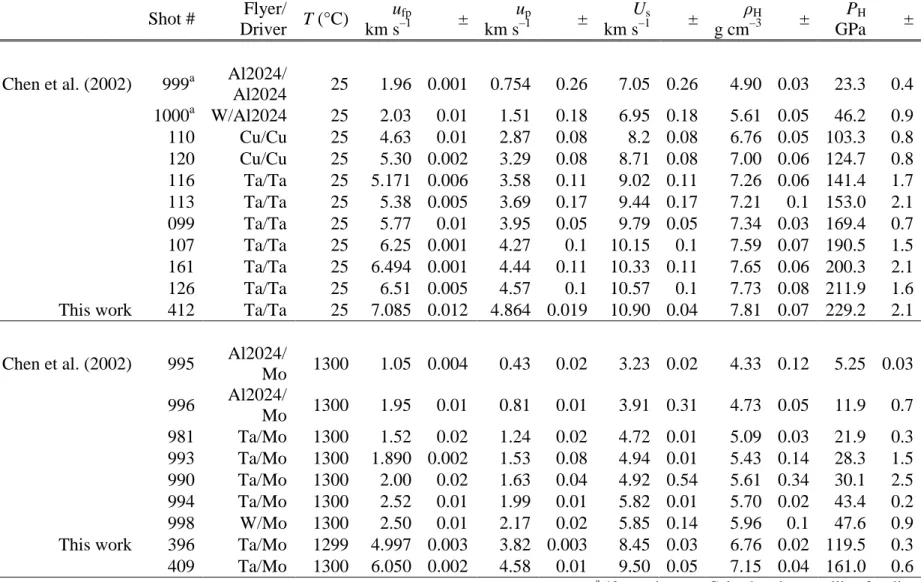
One solid room-temperature (300 K) shot was performed, extending the pressure range of previous room-temperature shocks on fayalite [Chen et al., 2002] from 212 GPa to 229 GPa. This was done to verify that the highest-pressure 300 K shots (107, 161, 126, 412; See Table 2) melted during impact, which is necessary for calculation of the liquid Grüneisen parameter (γ). Details of this calculation are in the Results section under Grüneisen parameter.
The sample used was a single crystal of fayalite synthesized by H. Takei [Takei, 1978]. The boule was cut perpendicular to the growth axis into an elliptical disk with a minimum diameter of 7.8 mm and a maximum diameter of 8.8 mm. The disk was doubly polished to 2 mm thickness (within ±0.002 mm of uniform thickness). The crystal contained some glassy
inclusions, but their estimated volume from electron backscatter images was less than 4%. The sample was directly mounted on a 0.5 mm tantalum driver plate and was not encapsulated. A series of fused quartz mirrors were glued to the down-range side of the driver plate and sample [cf. Mosenfelder et al., 2007] for recording of the shock arrival.
Experimental setup
The experimental methods used in our study for molten materials were originally
developed by Rigden et al. [1984] and refined by Rigden et al. [1988; 1989], Miller et al. [1988; 1991a], Chen et al. [1998; 2002] and Asimow et al. (2008). The experimental configuration is summarized here; for additional description, see Asimow and Ahrens [2010].
an arctangent function fit by cross-correlation to the gray scale values of each row of pixels parallel to the time axis (Figure 2c, shows only 3 pixel rows). If the correlation coefficient for the arctangent fit for a given pixel line was less than 0.95, then that pick was discarded. Discarding of pixels usually occurred in dark portions of the photo that were either poorly exposed or dark in the pre-experiment static photo due to imperfections in the polish. A few hundred points on either side usually constrain the driver cutoff (except in shot 396, see below); these picks are co-registered with the previously measured driver topography profiles and corrected for deviations from flat. Although tilt and bowing of the impactor and hence the shock front are often
approximated as parabolic [Mitchell and Nellis, 1981a], we found that fourth order polynomial fits were suitable for extrapolating the shape of the shock front within the sample (Figure 2b). Only the center 3mm portion of the sample arrival was used for the calculation of shock transit time to reduce edge effects. The iterative solutions [Rigden et al., 1988] to particle velocity (up), pressure (PH), and density (ρH) of the shock state were determined from impedance matching, the Rankine-Hugoniot equations, and the following input parameters: sample geometry; standard Hugoniot data (ρo, Co, s) for the metal flyer, driver and cover plates [Asimow et al., 2008; Mitchell and Nellis, 1981b]; and the initial density (ρo) and best-initial guess values for 1 bar bulk sound speed (Co) and Hugoniot slope s for fayalite liquid at 1300 °C. It should be noted that regardless of the initial guess for the Co and s the same resulting shock state converges after three iterations). Uncertainties in all derived parameters (US, up, PH, ρH) were obtained from the
uncertainties in the measured and standard parameters by analytical error propagation [cf. Jackson and Ahrens, 1979].
Density and ultrasonic results at ambient pressure
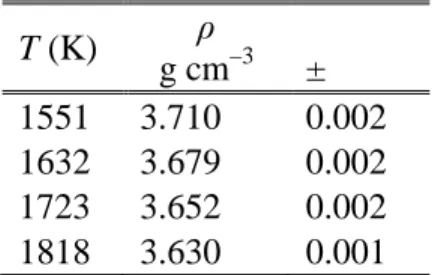
The double-bob density measurements between 1551 and 1831 K are reported in Table 1 and plotted against temperature in Figure 3. A linear equation: ρ(T) = 3699±1 – 0.30±0.01*(T -1573 K) was fit to the data. Sound speed (C) data on the same sample between 1516 and 1879 K are reported in Ai and Lange [2004] using a frequency-sweep acoustic interferometer. Those data can also be described as a linear function of temperature: C(T) = 2438±5 – 0.33±0.03*(T-1573 K) m/s.
Sink/ float results
The results from the sink/float experiments are shown in Figure 4. We observed floating of the almandine garnets at 3.5 and 4.5 GPa and floating of spessartine garnets at 4.0 GPa. We were unsuccessful in observing sinks or floats at 3.0 GPa because of marker sphere dissolution or breakdown during the run. Therefore, our new data do not bracket the fayalite liquid density. However the observed floats do give a minimum density of the liquid within the experimental pressure range 3.5-4.5 GPa, and thus the new data do not agree with the sink/float measurements of Agee [1992] requiring that the compression curve for fayalite liquid be at higher density values in the range 3.5-4.5 GPa. On the other hand, the measurements of Agee [1992] at lower pressure using ruby spheres are still consistent with the new multi-anvil measurements. Reasons for possible inconsistencies in the Agee [1992] are discussed below.
Shockwave results
Comparison to previous data
material from the same starting conditions (in this case, liquid fayalite at 1573 K and 1 bar). Empirically the Hugoniot of a well-behaved material forms a line in US-up space, given to third order in strain by US = Co + sup [Jeanloz, 1989] where the intercept Co = (KoS / ρo)1/2 is the bulk sound speed of fayalite liquid at room pressure and the slope s = (K’S + 1)/4 is related to K’S, the isentropic pressure derivative of the isentropic bulk modulus (KoS) [Ruoff, 1967].
Previous work from Chen et al. [2002] consists of 7 experiments completed on the Caltech 40-mm propellant gun. All Chen et al. data are taken from the original publication and were not re-analyzed. These data have widely varying reported uncertainties; Chen et al.’s linear regression was weighted by errors on Us only: Us = 2.63±0.02 + 1.59±0.01 up km/s.
To these data, we added two preheated shocks, extending the Hugoniot to 161 GPa. Shot 409 from this study had clear cutoffs and well-defined shock arrivals. Conversely, shot 396 had a poorly exposed driver arrival, but showed a simple, un-tilted planar shock arrival at the top hat. The driver arrival for this shot was approximated as linear and un-tilted, which introduced error in the travel time measurement but is a suitable assumption due to the flatness of the top hat. An un-weighted linear fit to all nine preheated fayalite liquid data points from Chen et al. [2002] and this study yields Us = 2.67±0.08 + 1.50±0.03 up km/s (r2= 0.996), whereas a York regression (a regression which accounts for errors in both Us and up) gives Us = 2.80±0.18 + 1.488±0.071 up km/s (MSWD = 8.9).
shock compression [Rigden et al., 1988]. Therefore, to reduce the error on the linear fit, we fixed the intercept at the ultrasonic value measured in this work. The un-weighted, constrained linear fit in US-up space yields US = 2.438±0.005 + 1.58±0.03 up km/s (r2=0.998). A weighted,
constrained fit yields poor results because the uncertainties of US reported for some of Chen et al.’s data are anomalously small. The selected slope s corresponds to a K’S value of 5.33±0.10, and overall this is in reasonable agreement with the previous work by Chen et al. [2002], which estimated K’S of 5.39±0.04. Figure 5 includes both the unconstrained and constrained linear fits to the entire data set, as well as the previous fit by Chen et al. [2002]. It is worth noting that the slopes of the new and old linear fits are very similar despite having slightly different though nominally fayalitic compositions. Thus within the errors of the experiments, our results seem to be insensitive to minor compositional differences.
“bottoming-out” or other unknown friction effects at high compressions and high temperatures produced lower pressures than expected from calibration runs. In any case, the new multi-anvil sink/float data are in good agreement with the ultrasonic and shockwave results.
Solid Hugoniot shocked to liquid / χ2 test of weighted values
Shot 412 was carried out on single crystal fayalite and is believed to have undergone a phase transition to liquid during the shock. A phase transition to liquid along the Hugoniot can often be detected by an offset in pressure-volume [Akins et al., 2004] or US-up space. To establish where in US-up space the phase transition occurs, we used a χ2 test of weighted values on linear fits to all room-temperature shock data (Table 1). The goal was to minimize the χ2 value of fitting two separate linear Hugoniots to solid and shock-melted data. Excluding shot 116, which has an anomalously low Us, the best fit (χ2= 0.0014867) occurred when shots 107, 161, 126, and 412 were calculated as liquids. The pressure limit of 190 GPa for shock melting implied by placing the boundary between shots 99 and 107 is also consistent with the melting thresholds along the Hugoniots of many iron-free silicate minerals shocked from room temperature: quartz at 120 GPa [J. A. Akins, 2002; Lyzenga, 1983], diopside at ≤144 GPa [Svendsen and Ahrens, 1990], and diopside-anorthite (Di64An36) at 133 GPa [Asimow and Ahrens, 2010] all of which have higher ambient melting temperature than that of fayalite (previous descriptions of shock melting of forsterite at 142 GPa [Mosenfelder et al., 2007] enstatite at 174 GPa [Mosenfelder et al., 2009] may not be accurate and are discussed in Chapter III). We have therefore used the four highest-pressure data points, presumed to have melted on shock, to calculate a value for the liquid Grüneisen parameter.
Grüneisen parameter
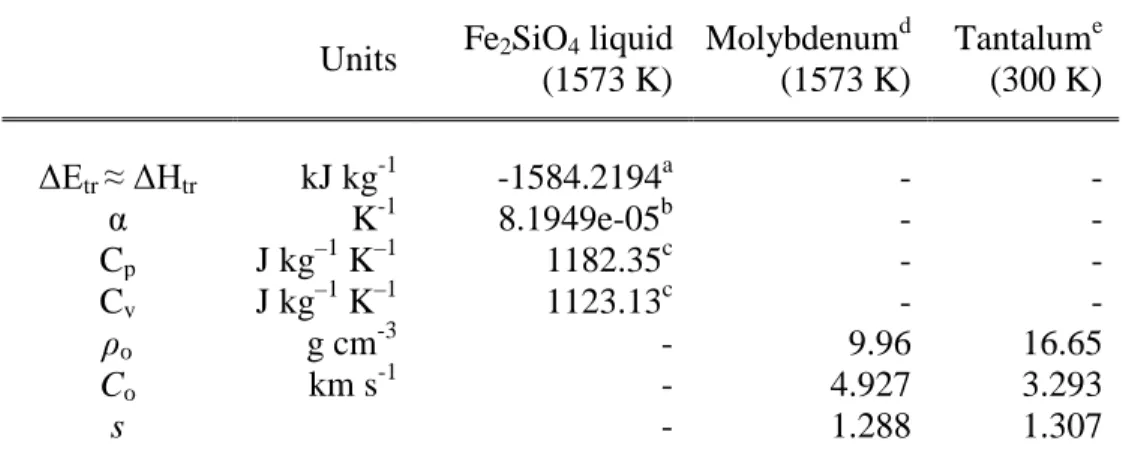
thermal pressure to the thermal energy per unit volume, where thermal pressure is defined as the increase in pressure due to heating at a constant volume. Because a solid shocked to a liquid and an initially molten sample obtain different pressures and internal energy states at equal density (ρH) upon compression, γ can be directly determined by comparison of the two Hugoniots (e.g., [Luo et al., 2002; Mosenfelder et al., 2007, Asimow & Ahrens, 2010]). We calculated the Grüneisen parameter from the following expressions; the parameter definitions and the values used are given in Table 3. By definition,
ρ ρ γ ∂ ∂ = E P 1
. (2)
The Mie-Grüneisen approximation defines γ as a function of ρ only, which simplifies the above expression to a finite difference:
E P P
E
Pth H liquid H solid
∆ − =
∆ ∆
= 1 1 ( − − )
ρ
ρ
γ
, (3)where ρis the density of interest and ΔPthand ΔE are the offsets in pressure and internal energy
between the two Hugoniot states at that density. The subscripts H-liquid and H-solid correspond to states on the Hugoniots that are both liquid in the shock state but that were initially a liquid at 1573 K and a solid at 300 K, respectively. The energy offset is calculated from
tr liquid
H solid
H E E
E
E=∆ −∆ +∆
∆ − − , (4)
where∆Etr, the transition energy, is the internal energy difference at ambient pressure
conditions and is estimated by the enthalpy difference (∆Htr) because the transition takes place
of the isobaric heat capacity (CP) and the enthalpy of fusion, and was calculated with MELTS [Ghiorso and Sack, 1995]. The internal energy change across each shock front (ΔEH) was calculated using the 3rd Rankine-Hugoniot relation,
− = ∆ H o H H P E ρ ρ 1 1
2 . (5)
There are several empirical forms for describing the density dependence of γ(ρ)
consistent with the Mie-Grüneisen assumption [Stixrude and Lithgow-Bertelloni, 2005]. We will look only at the power law form, which is both the simplest and most prevalent in the literature:
. ) / ( )
(ρ γo ρo ρ q
γ = (6)
The Grüneisen parameter at initial conditions is derived from the expressions
V T C K
ρ
α
γ
= (7)and T C C V
P = +
αγ
1 , (8)
where α is the isobaric coefficient of thermal expansion, CV is isochoric heat capacity, and CP is isobaric heat capacity.
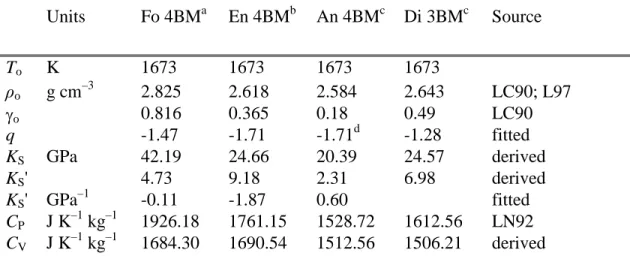
to values obtained on other silicate liquid compositions using Hugoniot offsets, such as forsterite (q = –1.47) (corrected from the Mosenfelder et al. value, see Table 5; Chapter III includes a new EOS from preheated forsterite), enstatite (q = –1.71) [Mosenfelder et al., 2009] (revised in Chapter III), and anorthite-diopside eutectic (q = –1.63) [Asimow and Ahrens, 2010]. We take this result as strong evidence that iron-bearing silicate liquids follow the same general behavior as iron-free silicate liquids, which are all described by –2.0 ≤ q≤ –1.45 for the compression range 1 ≥ρo/ρ≥ 0.49. Figure 6 shows the similarities in volume dependence of γ for liquids of
composition MgSiO3 (En), Mg2SiO4 (Fo), and Fe2SiO4 (Fa) as well as the opposite dependence displayed by mantle solids.
Negative q values for liquids have been interpreted qualitatively as a result of increasing cation coordination by analogy to structural phase changes in related solids [Stixrude and Karki, 2005] and, more recently, quantitatively in terms of liquid configurational entropy in the context of a hard-sphere model of atomic packing in liquids [Jing and Karato, 2011a]. The consistent behavior of fayalite with other liquids so far studied does not obviously resolve the question of the microscopic origin of the behavior, but it shows that the behavior does not depend very much on the major cations in the liquid.
Thermal equation of state fitting
A Hugoniot is a one-parameter curve through a P-V-E thermodynamic space of two independent variables, in this case V(P, E). However, we are generally interested in defining the behavior of liquids in regions that lie off the Hugoniot curve. In particular, at high compressions, the Hugoniot reaches temperatures and energies much higher than mantle conditions of
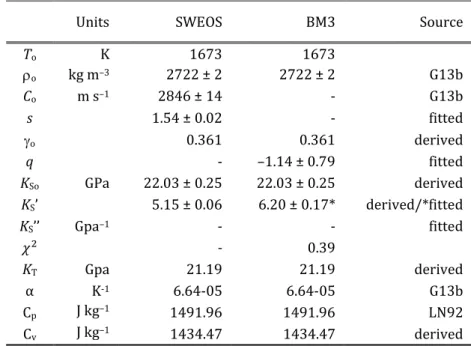
a thermal equation of state. There are several formalisms for thermal EOS; we have chosen to investigate three of them (all of which are plotted in Figure 7): (1) the shock wave equation of state (SWEOS, derived from both the constrained and unconstrained linear fit above), (2) 3rd and 4th order Birch-Murnaghan Mie-Grüneisen equation of state (3BM/MG and 4BM/MG), and (3) de Koker-Stixrude fundamental relation (dKSFR) [de Koker and Stixrude, 2009].
The SWEOS is defined by a linear Hugoniot in US – up space, transformed into pressure (P)- density (ρ) space using the first and second Rankine-Hugoniot equations [e.g., Ahrens, 1987]: p S S o H u U U − = ρ
ρ (9)
p S o H U u P =ρ
. (10)
States that lie off the Hugoniot are found using the Mie-Grüneisen thermal pressure approximation with temperature-independent γ(ρ), as calculated above (6).
The 3rd- and 4th-order Birch-Murnaghan/Mie-Grüneisen equations of state are defined by 3rd or 4th order Birch-Murnaghan isentropes centered at 1 bar and 1573K plus a Mie-Grüneisen thermal pressure approximation. Thus, total pressure P at any volume and internal energy is given by
th
S P
P
P= + . (11)
Ps is the Birch-Murnaghan isentropic pressure given to 4th order in strain by
) ) 9 143 ) 7 ' ( ' " ( 2 3 ) 4 ' ( 2 3 1 ( ) 2 1 (
3 2 2
5 f K K K K f K f f K
where f is the Eulerian finite strain parameter − = 1 2 1 3 2 o f ρ ρ
. (13)
[Birch, 1947]. The thermal pressure term (Pth) is given by
)
( S
th E E
P =
γρ
−(14)
where E is the energy of interest. The internal energy along the isentrope (ES) is found by integration of dES = –PSdV:
) ) 9 143 ) 7 ' ( ' " ( 4 3 ) 4 ' ( ( 2
9 2 3 4
f K K K K f K f K
E S S oS S S
o oS
S =
ρ
+ − + + − +(15)
For 3rd-order BM isentropic pressure and energy, K” in the previous expressions is fixed to the value that makes the 4th-order term vanish:
oS S
S
S K K K
K )/
9 143 ) 7 ' ( ' (
" =− − +
(16)
In order to infer a temperature, we need to define an isochoric heat capacity (CV). Currently no shock temperature measurements exist to constrain an expression for CV(ρ) for an iron-bearing silicate liquid, so CV was fixed at the constant value determined from constant CP at ambient pressure and 1573 K [Lange and Navrotsky, 1992]. The temperature of interest is then calculated with the equation
∫
∫
+ = E E V o o S o dE C d TT ( ) 1
ρ ρ ρ ρ ρ γ
which is composed of two parts: (1) integration along the reference isentrope to the density of interest with To = 1573 K as the foot temperature and (2) addition of the energy offset
proportional to CV.
A method for fitting shock wave data to the 3BM/MG and 4BM/MG forms is found in Asimow and Ahrens [2010]. To account for uncertainties in both pressure and volume, the function
∑
= − + − = n i i i H i i i H i i P P 1 2 * 2 * *2 ( )
ρ ρ σ ρ ρ σ ρ χ (18)
is minimized, where pressure is evaluated along the model Hugoniot at the trial density
− − − − = 1 2 1 ) ( * * * i o i i tr S i S
i P E E
P
ρ ρ γ γρ
. (19)
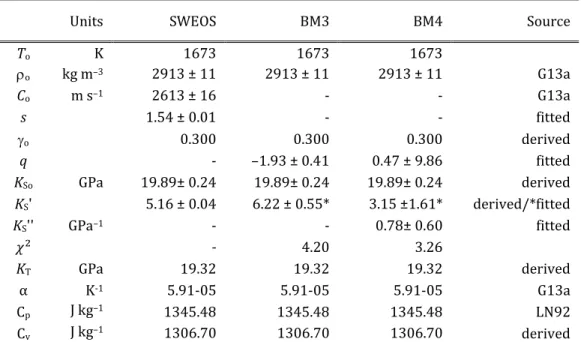
stiffness in the constrained SWEOS is likely due to being tied to the intercept and the most precise of Chen et al.’s data points—the precision of which is likely overestimated. The q value for the SWEOS is just within the stated errors of the 3BM/MG value, and the 3BM/MG reduced chi-squared value is reasonable. Additionally with little justification to implement the 4th-order fit, we recommend the 3rd-order fit for fayalite liquid.
The initially solid data are included in the fits to the 3BM/MG and 4BM/MG thermal EOS for the liquid (figure 7). The 4th-order fit recovers these data very well, but only the 3rd -order fit appears justified by the fitting statistics.
The Eulerian finite strain Birch-Murnaghan EOS has been used widely in the literature for describing the volumetric behavior of liquids [Agee, 1998; Y Ai and Lange, 2008; Asimow and Ahrens, 2010; Bottinga, 1985; Lange, 2007; Rigden et al., 1989; Suzuki et al., 1995; Tenner et al., 2007]; it has thus far proven to be adequate for fitting although it lacks any rigorous basis in theory as an EOS for liquids. The BM formalism has been criticized for its theoretical
weakness in giving unphysical interatomic potentials for high K’ materials (gases and liquids) [Hofmeister, 1993] and for singularities that occur at high temperature and low pressure
[Ghiorso, 2004]. Consequently, although the BM EOS can fit our data and allows interpolation between experimental points, it should be used only with caution for extrapolation beyond experimental constraints.
hard sphere equation of state (HSEOS) [Jing and Karato, 2011a].
The dKSFR is an extension of the finite strain description given in Birch [1952; 1978] but additionally takes into account the thermal free energy contribution and temperature
dependence of liquid properties. The thermodynamic variables are self-consistent in that they are derived from a single equation for the Helmholtz energy, and the contributions to the Helmholtz energy are separable [McQuarrie, 1984] into an ideal gas term, an excess term, and an electronic term. Recent work by Muñoz Ramo and Stixrude [in review] using first principles molecular dynamics (FPMD, GGA+U) of Fe2SiO4 liquid obtained a fit with a fourth-order expansion in finite strain and first-order expansion in the reduced temperature using the dKSFR. Their
Hugoniot, shown in Figure 7, is in good agreement with our shockwave data. However, contrary to the monotonic increase in γ with increasing pressureinferred from shock wave studies, their results show γ increasing up to a compression of ρo/ρ≈ 0.49 followed by a decrease inγ
coinciding with a change from the high-spin state of Fe.
Corrections and re-analysis of silicate liquids
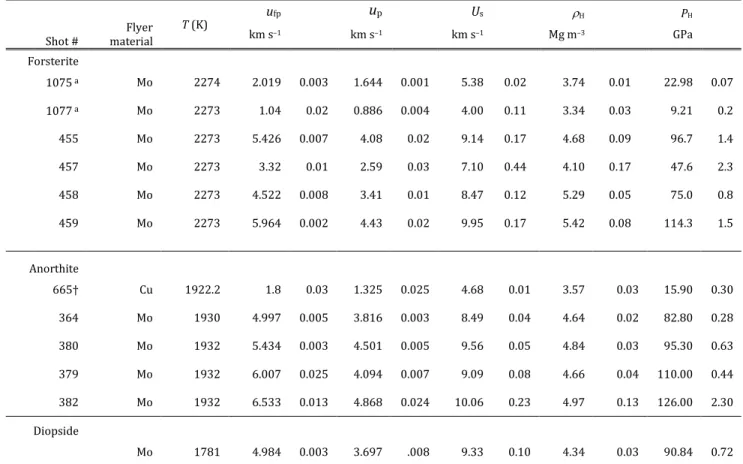
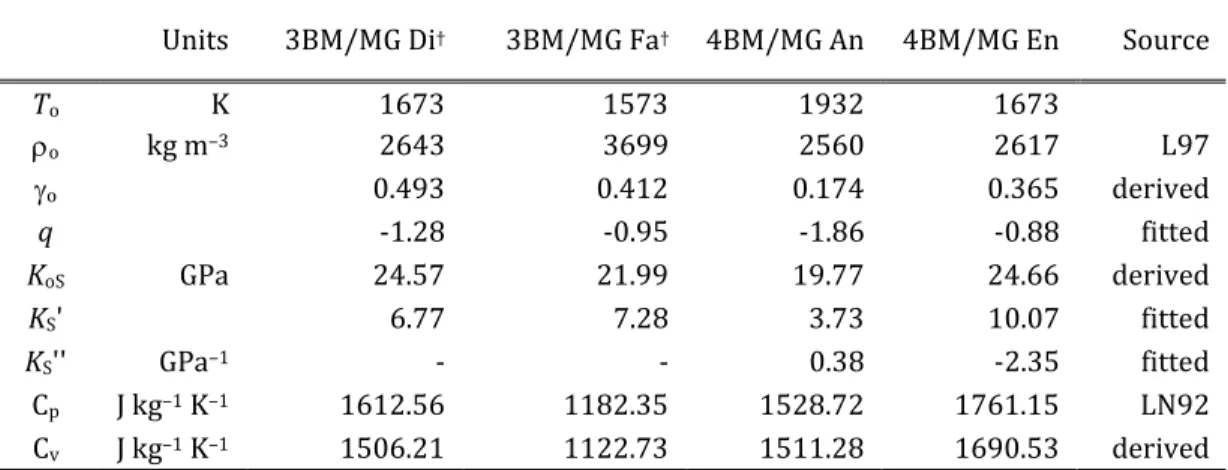
Also in this study, the anorthite and diopside liquid data of Asimow and Ahrens [2010] were re-analyzed, only sampling the center 3 mm of the arrival top hat. This was motivated by a hydro-code model of shock propagation through our capsule geometry carried out at Lawrence Livermore National Laboratory by J. Nguyen, which indicated that the outer part of the top hat arrival is influenced by edge effects. The corrected BM/MG fits are given in Table 5, and the reanalyzed data points are given in Table 1 of Chapter III. The 4th-order fit for anorthite liquid excludes 3 shots: 382, the highest pressure shot from Asimow and Ahrens [2010], due to an abnormally shaped shock arrival; and shots 663 and 672, the highest pressure shots from Rigden [1988] due to possible un-relaxed behavior upon compression. For further discussion of glass-like behavior in anorthite under some shock conditions, see Asimow and Ahrens [2010], section 4.4. The re-analysis of diopside liquid excludes 378, the lowest pressure shot from Asimow and Ahrens [2010] due to irregular and over-exposed top hat arrival.
Also presented in Table 5 is the corrected forsterite liquid γo (which previously contained a sign error), and its subsequent re-fitted 4BM parameters. The entire EOS of forsterite is revised in Chapter III.
IMPLICATIONS
Mixing of oxide volumes at high pressure and temperature; application to a magma ocean
liquidus
forsterite (Fo, Mg2SiO4) [Mosenfelder et al., 2007], enstatite (En, MgSiO3) [Mosenfelder et al., 2009], anorthite (An, CaAl2Si2O8), diopside (Di, CaMgSi2O6) [Asimow and Ahrens, 2010], and now also fayalite (Fa, Fe2SiO4). All of the EOS parameters for each of these compositions, corrected (see above) or recommended by the original authors, are given in Table 5.The revised EOS are discussed in detail in the subsequent chapter (Tables 3 and 4)
In this study we examine only one simple model of many possible scenarios for the crystallization of an early terrestrial magma ocean. Our initial condition is a well-mixed, convecting liquid composed of one of two plausible bulk silicate Earth compositions — “chondrite” or peridotite — that reaches the base of the mantle. To learn at what depth and critical potential temperature such a whole-mantle magma ocean would begin to crystallize, we used mixtures of silicate liquids in the CMASF system and calculated the intersections or tangency points between isentropes of these two liquid compositions and their respective
liquidus curves. The basis of our model is derived from an alternative definition of the Grüneisen parameter,
S T)/( ln ) ln
( ρ
γ = ∂ ∂ , (20)
published composition in Fiquet et al. [2010]. Table 6 gives the major oxide proportions for each composition as well as the normalized percent of each end-member liquid used in the model. We also were concerned with what the density contrast of our model liquid would be with its first forming solid—whether it would sink or float. As a conservative measure of where solid flotation is possible, we assumed the liquidus solid to be pure Pv (MgSiO3, magnesium
perovskite) using the EOS from Mosenfelder et al. [2009]. Mg-rich Pv was the liquidus solid in both Andrault et al. [2011] and Fiquet et al.[2010] at the pressures of interest.
We determined each CMASF model isentrope for a given potential temperature (TP) in a stepwise fashion, solving for temperature (T) at each fixed increment of pressure (P) from 0 to 140 GPa. In this calculation, each CMASF isentrope is a combination of the pure end-member isentropes of An, Di, Fo, En, and Fa; and each of the end-member isentropes is defined by its own potential temperature TiP (superscript i denotes an end-member mineral), where TiP is a separately defined value from the TP of the CMASF model isentrope. The separate TP and TiP values permit the mixture of the end-member isentropes to define a point on the final CMASF model isentrope in which the total entropy (Stot) remains a constant, such that
= +
=
∑
i mixi i
tot f S S
S constant, (21)
where f is the mole fraction (Table 6) and Siis the molar entropyfor each end-member in the model liquid. By assuming the entropy of mixing (Smix) is constant for a given liquid
composition, the potential temperature of each end-member liquid isentrope (TiP) was solved by setting the derivative of the total entropy equal to zero:
0 ln =
=
∑
∑
i i P
i P i P i i i T T C f S f
d . (22)
− = i i q i o i q i o i P i i o i P V V V V q T
T exp γ . (23)
This expression is derived from (20) by integrating
ρ ρ ρ ρ
γ ∂ =
∂T T
q o
o . (24)
and is dependent on the following three variables: (1) the temperature at each iteration along the model isentrope (T), (2) the volume of each end member at T and P (Vi), and (3) the volume of each end member at TiP and 0 GPa (ViP). These three variables are solved iteratively to satisfy equation (22) and to minimize the expression
∑
− +i
i P i
S P P
P ) ( )2
( , (25)
where PiPis the BM isentropic pressure at TiP and equals 0 GPa at the target volume ViP and PiS is the BM isentropic pressure for each end member at T. Minimization of this expression ensures that the isentropic pressure for each end member converges to the defined pressure in question and that PiPis in fact equal to 0 GPa. For Fa, we used the BM3 parameters given in Table 4; for all other end members, we used the BM parameters in Table 5. In total, 11 parameters (Tand two volumes, Vi and ViP, for each of the 5 end members) were solved iteratively for each step
increment in pressure along a model isentrope.
this further in Chapter III. Hence, despite examination of three compositions along the anorthite-diopside join, it remains unclear whether or not linear mixing of volume at high pressure is valid for most mafic to ultramafic silicate liquids. Nevertheless, given five measured compositions in a five-oxide system, the assumption of linear mixing is necessary to make progress at this time and remains consistent with data presently available. We examine this assumption in detail in
Chapter IV.
The resulting model for the Andrault et al. [2011] “chondrite” mix shows that
crystallization would begin at the base of present-day mantle (~135 GPa) with a critical adiabat of TP = 2600K (Fig 8a). Andrault et al. found Pv to be the liquidus phase at all pressures above 60 GPa; therefore we calculated the density for a first forming crystal and found it to be denser than the surrounding liquid (ρPv, 5.38 g cm–3 > ρliquid, 5.28 g cm–3). Thus a basal magma ocean similar to that described in Labrosse et al. [2007] in which a large portion of the lowermost mantle is zone-refined to concentrate incompatible elements would be unlikely as crystallization of the mantle would occur from the bottom up. A chondritic basal magma ocean is likely only able to exist within the thermal boundary layer (highest estimated outer core of 4150K) [Hernlund et al., 2005] or at the elevated basal temperatures that occurred during early Earth accretion [Canup, 2004].
into a potential present-day ULVZ, yet the sinking liquidus phase if not conducive to the dynamic formation of a basal ocean.
It is worth mentioning that the surface temperatures in both of these models could be too hot for simple, realistic magma ocean models; Andrault et al. [2011] suggest that such high foot temperatures would lead to large portions of the mantle vaporizing and rapid cooling if thermal blanketing is inefficient.
Within this exercise, the location of first crystallization is likely dominantly controlled by two factors: (1) the topology of the liquidus curve and (2) the amount of Fo end-member in the model liquid. It is unclear whether different shapes of liquidus curves stem from differing experimental techniques in the two synchrotron-based laser-heated diamond anvil studies
considered or instead if they reflect thermodynamic differences within that range of composition space. However, Fig. 8 makes clear that without a notable decrease in slope in the liquidus curve compared to the isentrope at high pressure, crystallization would always be predicted at the base of the mantle (Fig. 8b).
least SiO2 gives the largest γo, α, and KS and so the steepest isentrope, which contributes directly to the steepness of the isentrope of the mixture.
In Chapter III, we used the revised EOS of Fo, An, and En to re-model these liquid isentropes (Figure 7). The results are fairly similar, but it is important to note that the γo , α, and KS of forsterite liquids are not as large as modeled by the 1-bar data, and thus forsterite does not play such a dominant role on the steepness of the isentrope. A full discussion is given in Chapter III, section Isentropes for a full mantle magma ocean.
We can conclude from this exercise in modeling the Earth’s accretion, acknowledging the simplifying assumptions and presumed bulk compositions, that the first crystallizing solid will likely occur within the lower mantle or at the base of the mantle. This is made more likely if early earth core temperatures are assumed to be elevated above current estimates [Canup, 2004]. Although largely controlled by the chosen bulk composition, within our exercise the liquidus phase would be Pv and would sink upon formation. Whether pure Mg-Pv is a correct
approximation to the liquidus phase, as opposed to a more Fe-rich (Mg,Fe)-Pv, is unclear based on the spread of high T-P Fe partitioning values in the current literature (DFe = 0.6 to > 0.1) [Andrault et al., 2012; Nomura et al., 2011]. Regardless, since pure Pv is the least dense end-member of the (Mg, Fe)SiO3 solid-solution, greater partitioning of Fe into the solid would only further increase the density and magnitude of the already observed negative buoyancy.
Buoyancy in the current temperature regime; application to the solidus and ULVZ
correction, with a potential temperature of 1673 K and a gradient of 10 K/GPa.A pure molten fayalite composition with density of 7 gcm–3would pond at the core mantle boundary if present, as it is much denser than any likely solid assemblage at lowermost mantle conditions. However the model of a pure fayalite liquid ULVZ is inconsistent both with the density of 6.12 gcm–3 in the ULVZ inferred from seismic reflection coefficients [Rost et al., 2006] (Figure 9) and with the non-zero shear velocity of this layer. Instead, a less-dense multicomponent partial melt needs to be considered as a plausible state for the ULVZ. Assuming linear mixing of the oxide volumes calculated from the BM EOS given in Tables 4 and 5, Figure 10a displays lines of constant density within a Fa-Fo-En-Fs space (where ferrosilite (Fs) = En+ .5Fo -.5Fa). Figure 10b is the same plot, but uses the revised EOS in Chapter III Tables 3 and 4. The y-axis is Mg# (Mg# = MgO/FeO+MgO), and the x-axis is (MgO+FeO)/SiO2. The solid curves delineate compositions that are neutrally buoyant with respect to a pure Pv solid at ~135GPa (roughly the pressure at the CMB) at the given temperature conditions (3900 K–4500 K). The dashed lines indicate a
constant density of 6.12 g/cm3, which represents the estimated upper limit of a 10% density jump of an ULVZ [Rost et al., 2006] with respect to PREM [Dziewonski and Anderson, 1981]. Any liquid mixture that lies above the solid lines where Pv sinks (white in Fig. 10) is inferred to be gravitationally unstable with respect to upwards percolation into the solid mantle, and any mixture below the dashed lines is denser than has been inferred for ULVZs.
are also plotted on Figure 10. These results indicate that these liquid compositions are unlikely to be gravitationally stable at the CMB today (although peridotite liquid is denser than previously modeled Fig 10b); if residual liquids were to be derived from magma oceans of either
composition, they would need to be enriched in Fe, depleted in Si, or both during some process of re-crystallization and distillation from the original bulk mantle. The gray arrows from each composition indicate the direction of compositional evolution if Pv (MgSiO3, En) were to crystallize and be removed. It also gives a rough estimate of what the final liquid composition would need to be for Pv to be buoyant.
CONCLUSIONS
The density for Fe2SiO4 liquid as well as values for K and K’ have been constrained. Additionally, the Grüneisen parameter for Fe-bearing silicate liquids is shown to change with compression in a manner similar to non-Fe bearing liquids and the opposite to that of solids. Although the Grüneisen parameter has been measured for formulation of a thermal equation state, as with any thermal EOS formalism, there are trade-offs especially when examining states far from the Hugoniot including extrapolations in pressure beyond experimental pressures (161 GPa). Temperature estimates could be greatly improved by either shock temperature
measurements or any other off-Hugoniot temperature measurements to constrain Cv. Constraints on the end-member liquid fayalite EOS permit interpolation between CMASF silicate liquids densities, assuming linear mixing of volumes. The calculation of isentropes at elevated
temperatures and pressures for model whole-mantle magma oceans composed of peridotite and simplified “chondrite” liquid indicate crystallization initiating at the mid-lower mantle (85 GPa) and the base of the mantle, respectively. Finally, a compositional range of gravitationally stable liquids was determined to examine the likelihood of a gravitationally stable ULVZ composed of a large degree of partial melt. There exists a region of melt composition that is denser than Pv at the CMB, but neither chondrite nor peridotite is sufficiently enriched in Fe to be stable.
ACKNOWLEDGEMENTS
REFERENCES
Agee, C. B. (1988), Mass balance and phase density constraints on early differentiation of chondritic mantle, Earth and planetary science letters, 90(2), 144.
Agee, C. B. (1992), Isothermal compression of molten Fe2SiO4, Geophys. Res. Lett., 19(11), 1169–1172.
Agee, C. B. (1998), Crystal-liquid density inversions in terrestrial and lunar magmas, Physics of The Earth and Planetary Interiors, 107(1-3), 63-74.
Ahrens, T. J. (1987), 6. Shock Wave Techniques for Geophysics and Planetary Physics, in Methods in Experimental Physics, edited by G. S. Charles and L. H. Thomas, pp. 185-235, Academic Press.
Ai, Y and R. A. Lange (2004), An ultrasonic frequency sweep interferometer for liquids at high temperature: 2. Mechanical assembly, signal processing, and application, J. Geophys. Res., 109(B12204).
Ai, Y., and R. A. Lange (2008), New acoustic velocity measurements on CaO-MgO-Al2O3 SiO2 liquids: Reevaluation of the volume and compressibility of CaMgSi2O6-CaAl2Si2O8 liquids to 25 GPa, J. Geophys. Res., 113(B4), B04203.
Akins, J. A. (2002), Dynamic compression of SiO2: A new interpretation, Geophysical research letters, 29(10), 31.
Akins, J. A., S.-N. Luo, P. D. Asimow, and T. J. Ahrens (2004), Shock-induced melting of MgSiO3 perovskite and implications for melts in Earth's lowermost mantle, Geophys. Res. Lett., 31(14), L14612.
Andrault, D., N. Bolfan-Casanova, G. L. Nigro, M. A. Bouhifd, G. Garbarino, and M. Mezouar (2011), Solidus and liquidus profiles of chondritic mantle: Implication for melting of the Earth across its history, Earth and planetary science letters, 304(1-2), 251-259.
Andrault, D., S. Petitgirard, G. Lo Nigro, J.-L. Devidal, G. Veronesi, G. Garbarino, and M. Mezouar (2012), Solid-liquid iron partitioning in Earth's deep mantle, Nature, 487(7407), 354-357.
Asimow, P. D., and T. J. Ahrens (2010), Shock compression of liquid silicates to 125 GPa: The anorthite-diopside join, J. Geophys. Res., 115(B10), B10209.
Asimow, P. D., D. Sun, and T. J. Ahrens (2008), Shock compression of preheated molybdenum to 300 GPa, Physics of The Earth and Planetary Interiors, 174(1-4), 302.
Birch, F. (1947), Finite Elastic Strain of Cubic Crystals, Physical review, 71(11), 809.
Birch, F. (1952), Elasticity and constitution of the Earth's interior, J. Geophys. Res., 57(2), 227 286.
Birch, F. (1978), Finite strain isotherm and velocities for single-crystal and polycrystalline NaCl at high pressures and 300K, J. Geophys. Res., 83(B3), 1257-1268.
Bottinga, Y. (1985), On the isothermal compressibility of silicate liquids at high pressure, Earth and planetary science letters, 74(4), 350-360.
Canup, R. M. (2004), Simulations of a late lunar-forming impact, Icarus, 168(2), 433-456. Chen, G. Q., and T. J. Ahrens (Eds.) (1998), Radio frequency heating coils for shock wave
experiments, 63-71 pp., Materials Research Society Symposia Proceedings, Warrendale, PA.
Chen, G. Q., T. J. Ahrens, and E. M. Stolper (2002), Shock-wave equation of state of molten and solid fayalite, Physics of The Earth and Planetary Interiors, 134(1-2), 35-52.
crystal-liquid density inversions in the lunar mantle, Geochimica et Cosmochimica Acta, 60(14), 2709-2720.
Davis, F. A., J. A. Tangeman, T. J. Tenner, and M. M. Hirschmann (2009), The composition of KLB-1 peridotite, American Mineralogist, 94(1), 176-180.
de Koker, N., and L. Stixrude (2009), Self-consistent thermodynamic description of silicate liquids, with application to shock melting of MgO periclase and MgSiO3 perovskite, Geophysical Journal International, 178(1), 162 Erratum Ibid., doi: 110.1111/j.1365-1246X.2010.04739.x.
Dziewonski, A. M., and D. L. Anderson (1981), Preliminary reference Earth model, Physics of The Earth and Planetary Interiors, 25(4), 297-356.
Efron, B. (Ed.) (1982), The Jackknife, the Bootstrap, and Other Resampling Plans, 92 pp., Philadelphia, PA.
Fiquet, G., A. L. Auzende, J. Siebert, A. Corgne, H. Bureau, H. Ozawa, and G. Garbarino (2010), Melting of Peridotite to 140 Gigapascals, Science, 329(5998), 1516-1518. Garnero, E. J., and D. V. Helmberger (1995), A very slow basal layer underlying large-scale
low-velocity anomalies in the lower mantle beneath the Pacific: evidence from core phases, Physics of The Earth and Planetary Interiors, 91(1-3), 161-176.
Ghiorso, M. S. (2004), An equation of state for silicate melts. III. Analysis of stoichiometric liquids at elevated pressure: shock compression data, molecular dynamics simulations and mineral fusion curves, Am J Sci, 304(8-9), 752-810.
Ghiorso, M. S., and R. O. Sack (1995), Chemical mass transfer in magmatic processes IV. A revised and internally consistent thermodynamic model for the interpolation and
extrapolation of liquid-solid equilibria in magmatic systems at elevated temperatures and pressures, Contributions to Mineralogy and Petrology, 119(2), 197-212.
Hernlund, J. W., C. Thomas, and P. J. Tackley (2005), A doubling of the post-perovskite phase boundary and structure of the Earth's lowermost mantle, Nature, 434(7035), 882-886. Hofmeister, A. M. (1993), Interatomic potentials calculated from equations of state: Limitation
of finite strain to moderate K', Geophys. Res. Lett., 20(7), 635-638.
Holloway, J. R., V. Pan, and G. Gudmundsson (1992), High-pressure fluid-absent melting experiments in the presence of graphite; oxygen fugacity, ferric/ferrous ratio and dissolved CO 2, European Journal of Mineralogy, 4(1), 105-114.
Jackson, I., and T. J. Ahrens (1979), Shock wave compression of single-crystal forsterite, Journal Name: J. Geophys. Res.; (United States); Journal Volume: 84:B6, Medium: X; Size: Pages: 3039-3048.
Jakobsson, S., and N. Oskarsson (1994), The system C-O in equilibrium with graphite at high pressure and temperature: An experimental study, Geochimica et Cosmochimica Acta, 58(1), 9-17.
Janz, G. (1980), Molten Salts Data as Reference Standards for Density, Surface Tension, Viscosity, and Electrical Conductance: KNO3 and NaCl, Journal of Physical and Chemical Reference Data, 9(4), 791.
Jeanloz, R. (1989), Shock Wave Equation of State and Finite Strain Theory, J. Geophys. Res., 94.
Jing, Z., and S.-i. Karato (2011a), A new approach to the equation of state of silicate melts: An application of the theory of hard sphere mixtures, Geochim. Cosmochim. Acta.