0022-538X/10/$12.00 doi:10.1128/JVI.00915-10
Copyright © 2010, American Society for Microbiology. All Rights Reserved.
Nature, Position, and Frequency of Mutations Made in a Single Cycle
of HIV-1 Replication
䌤
†
Michael E. Abram,
1Andrea L. Ferris,
1Wei Shao,
2W. Gregory Alvord,
3and Stephen H. Hughes
1*
HIV Drug Resistance Program, National Cancer Institute at Frederick, Frederick, Maryland1; Advanced Biomedical Computing Center,SAIC-Frederick Inc., Frederick, Maryland2; and Data Management Services,
National Cancer Institute at Frederick, Frederick, Maryland3
Received 28 April 2010/Accepted 9 July 2010
There is considerable HIV-1 variation in patients. The extent of the variation is due to the high rate of viral replication, the high viral load, and the errors made during viral replication. Mutations can arise from errors made either by host DNA-dependent RNA polymerase II or by HIV-1 reverse transcriptase (RT), but the relative contributions of these two enzymes to the mutation rate are unknown. In addition, mutations in RT can
affect its fidelity, but the effect of mutations in RT on the nature of the mutations that arisein vivois poorly
understood. We have developed an efficient system, based on existing technology, to analyze the mutations that
arise in an HIV-1 vector in a single cycle of replication. AlacZ␣reporter gene is used to identify viral DNAs
that contain mutations which are analyzed by DNA sequencing. The forward mutation rate in this system is 1.4ⴛ
10ⴚ5 mutations/bp/cycle, equivalent to the retroviral average. This rate is about 3-fold lower than previously
reported for HIV-1in vivoand is much lower than what has been reported for purified HIV-1 RTin vitro. Although
the mutation rate was not affected by the orientation oflacZ␣, the sites favored for mutations (hot spots) inlacZ␣
depended on which strand oflacZ␣was present in the viral RNA. The pattern of hot spots seen inlacZ␣in vivodid
not match any of the published data obtained when purified RT was used to copylacZ␣in vitro.
Human immunodeficiency virus type 1 (HIV-1) is geneti-cally diverse both within and between infected individuals (6, 12, 66). The high rate of viral replication, the size of the viral population in individual patients (13, 25), and extensive recom-bination (28, 77) contribute to genetic variation (17, 18). How-ever, the root cause of HIV-1 diversification is mutations that arise during retroviral replication. The ability to rapidly diver-sify allows HIV-1 to evade the host’s immune system (51), alter its tropism, and develop resistance to antiretroviral drugs (31). Hence, the fidelity of replication contributes to the adaptability and fitness of the virus.
Mutations can occur at three stages of retroviral replication: (i) when viral RNA is transcribed from the provirus by host DNA-dependent RNA polymerase II (Pol II), (ii) when the single-stranded viral RNA genome is converted into double-stranded DNA (dsDNA) by viral reverse transcriptase (RT), or (iii) when the provirus is copied by the host DNA-dependent DNA polymerase when the infected cell replicates. Although the availablein vitrodata are incomplete, several groups have suggested that RT is the major cause of mutations made during HIV-1 replication (32, 46, 53, 59). RT lacks exonucleolytic proofreading activity, andin vitrostudies have suggested that it is error-prone (discussed below) (4, 30, 59, 62). The cellular DNA replication machinery has a much higher fidelity, with a mutation rate between 1⫻10⫺9and 1⫻10⫺12mutations/bp/
cycle, which implies that the host DNA polymerases make a
negligible contribution to the errors that arise during active HIV-1 replication (36, 75). Although the contribution of the errors made by host RNA Pol II to the fidelity of HIV-1 replication is not known, it could be significant (19, 32). Ex-periments with a reporter gene inserted into a retroviral long terminal repeat (LTR) have shown that approximately two-thirds of mutations occur either during RNA transcription or during first (minus)-strand viral DNA synthesis (32, 53). How-ever, these data do not differentiate between the errors made by RNA Pol II and those made by RT. Host factors can also contribute to the overall error rate of HIV-1. In the absence of HIV-1 Vif, APOBEC3G (A3G) can cause extensive G-to-A mutations by deaminating cytidines in the minus strand of the viral DNA (27). It is also possible that host DNA repair enzymes cause mutations in the newly synthesized viral DNA (7, 60).
A number of groups have measured the fidelity of HIV-1 RT in vitroby copying a DNA or an RNA template encoding a target in which mutations can easily be identified, most com-monly the ␣-complementing peptide of Escherichia coli  -galactosidase (lacZ␣). These assays have identified RT resi-dues involved in nucleotide discrimination, binding, and incor-poration (4, 9, 39, 65, 68).In vitro, HIV-1 RT has a high rate of nucleotide misincorporation, in the range of 5.9⫻10⫺4to
5.3⫻10⫺5mutations/bp/cycle (reviewed in references 61 and
69). Despite the fact that many groups have used the same mutagenic target (lacZ␣), different error rates have been re-ported, and there has been little agreement on the proportions and frequencies of the specific types of mutations RT makes (4, 8, 9, 30, 68). A part of the problem is that HIV-1 RT fidelity in vitrodepends both on the recombinant RT used and on the assay conditions (39, 48). It has also been reported that recom-binant HIV-1 RT is more error-prone than the RTs of other * Corresponding author. Mailing address: HIV Drug Resistance
Program, NCI-Frederick, P.O. Box B, Bldg. 539, Rm. 130A, Frederick, MD 21702-1201. Phone: (301) 846-1619. Fax: (301) 846-6966. E-mail: [email protected].
† Supplemental material for this article may be found at http://jvi .asm.org/.
䌤Published ahead of print on 21 July 2010.
9864
on November 8, 2019 by guest
http://jvi.asm.org/
retroviruses (1, 2, 63, 68, 70). Together, these data have led to proposals that the low fidelity of RT makes HIV-1 replication particularly error-prone (50, 59).
In vivo(cell culture) systems that include a number of the viral and host components that contribute to the fidelity of HIV-1 replication have also been developed. Using an HIV-1 vector containing alacZ␣ reporter gene, Mansky and Temin reported a mutation rate of 3.4⫻10⫺5to 4⫻10⫺5mutations/
bp/cycle (42, 46), some 10- to 20-fold lower than the rates reported for purified HIV-1 RT in vitro (9, 39, 62, 68) but within 3-fold of the retroviral average of 1.5⫻10⫺5mutations/
bp/cycle (46, 47, 54–56). To date, most of the measurements of HIV-1 fidelity in cell culture have been based solely on the frequency of phenotypic inactivation of LacZ␣; there has been relatively little information about the nature of the underlying mutations (15, 43–45). Thus, little is known about the specific-ity of the errors madein vivo(46).
We used the inactivation of alacZ␣reporter gene to identify mutants generated in a single cycle of HIV-1 replication in cultured cells; however, we also determined the nature, posi-tion, and frequency of the underlying mutations. Our HIV-1 vector was designed so that circular forms of the HIV-1 DNA can replicate as plasmids inE. coli. More than 4⫻104
inde-pendent replicated copies of the genome of an HIV-1 vector can be recovered from a single plate of infected HOS cells, a nearly 20-fold improvement (42, 46, 47, 55, 56). Individual colonies were screened for the presence of functional LacZ␣,
and mutant HIVlacZ␣DNAs were sequenced. We character-ized the mutations that arose in both the forward and reverse orientations of the lacZ␣ reporter gene. The orientation of lacZ␣affected the types and positions of mutations but not the rate, suggesting that the nature of the mutations depends on the strand present in viral RNA.
MATERIALS AND METHODS
Plasmid construction.Two different vector-based systems were used to
gen-erate virus stocks for the analysis of HIV-1 fidelity. A NotI-MluI shuttle cassette, derived from pHIV-SH (52), was modified for use in both vector systems. To eliminate redundancy and to shorten the cassette, both the Pol II promoter and
thelacOsequence were deleted, and a 477-bp sequence containinglacZ␣derived
from Litmus-29 (New England Biolabs, Ipswich, MA) was inserted in place of
lacO. The final cassette contained a zeocin resistance gene with an upstream
EM-7 promoter (EM-zeor
), alacZ␣sequence (lacZ␣), and a ColE1 origin of
replication (oriE). Two versions of the shuttle cassette were created, with the
lacZ␣sequence in opposite orientations: the forward (lacZ␣-F, LZF) and
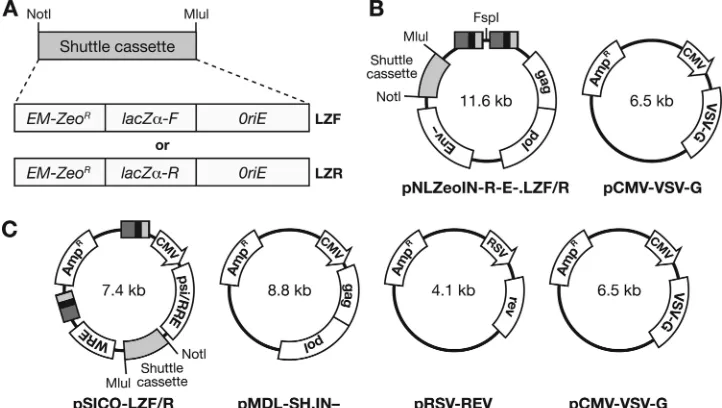
re-verse (lacZ␣-R, LZR) orientations (Fig. 1A).
The 2-vector system (Fig. 1B) included either pNLZeoIN-R-E-.LZF or pNLZeoIN-R-E-.LZR and pCMV-VSV-G (Clontech Laboratories, Mountain View, CA) to pseudotype virions with vesicular stomatitis virus G (VSV-G) envelope glycoprotein. The replication-defective HIV-1 vector used to produce viral RNA, pNLZeoIN-R-E-.LZF or pNLZeoIN-R-E-.LZR, contained deletions
invpr(R-) andenv(E-) and was derived from pHIV1-SH (52) by replacement of
the NotI-MluI shuttle cassette in thenefreading frame. To facilitate recovery of
unintegrated circular viral DNAs, an active site mutation (D116N) was also introduced into integrase (IN-) by using a QuikChange II XL site-directed mutagenesis kit (Stratagene, La Jolla, CA).
[image:2.585.111.472.70.274.2]The 4-vector system included pMDL-SH.IN-, pRSV-REV, pCMV-VSV-G,
FIG. 1. Vector-based strategies used to measure HIV-1 replication fidelity. (A) Shuttle cassette. EM-zeor, EM-7 promoter zeocin resistance gene;lacZ␣-F andlacZ␣-R,␣-complementing peptides ofE. coli-galactosidase in the forward and reverse orientations, respectively; ColE1 (oriE),E. colibacterial origin of replication. Shuttle cassettes carryinglacZ␣as a mutational target in both orientations were cloned into the indicated vectors (see below), creating the substrates for transcription by RNA Pol II, RNA packaging, reverse transcription, and circularization of unintegrated virallacZ␣DNA. (B and C) The 2-vector and 4-vector systems. The plasmids were transfected into 293T cells to produce pseudotyped HIV-1 viruses which were used to infect HOS cells. In panel B, on the left is shown the viral RNA-encoding vector plasmid for the 2-vector system. Two shaded boxes separated by an FspI site represent the HIV-1 long terminal repeats (LTRs). Retroviral genes are indicated in rectangular boxes asgag,pol, andenv. On the right is shown the VSV-G expression plasmid, which contains a CMV promoter. In the 4-vector system, shown in panel C, the viral RNA-encoding vector plasmid does not contain thegagandpolgenes, which are expressed from a second plasmid that contains a CMV promoter. The Rev protein is also expressed from a separate plasmid, but from a Rous sarcoma virus (RSV) promoter. In both the 2-vector and 4-vector systems, the viral vector plasmid has a nonviral sequence between the 3⬘LTR and the 5⬘LTR; this insert is not present in replicated viral DNAs. Both of the viral vector systems are limited to a single round of replication by an HIV-1 Env deletion. An integrase inactivating mutation, D116N, was used to increase the amount of replicated circular virallacZ␣DNA present in HOS cells infected
with these vectors. WRE, woodchuck regulatory element.
on November 8, 2019 by guest
http://jvi.asm.org/
and either pSICO-LZF or pSICO-LZR. The pMDL-SH.IN- vector, which en-codes HIV-1 Gag and Pol and contains a Rev-response element (RRE), was
derived from pMDLg/pRRE by replacing thegagandpolgenes with the
equiv-alent sequences from pHIV1-SH (52), followed by the introduction of an active site mutation (D116N) in integrase (IN-), as described above. Both the pRSV-REV and pMDLg/pRRE lentiviral vectors were obtained from Didier Trono (EPFL SV-DO, Lausanne, Switzerland) (21) through Addgene, Inc. (Cambridge, MA). The vector used to produce viral RNA, pSICO-LZF or pSICO-LZR, was derived from pSICO-XBX (74) by introduction of our shuttle cassette as a
NotI-MluI fragment and contained a chimeric 5⬘LTR with a cytomegalovirus
(CMV) promoter in place of U3 and an HIV Psi packaging/RRE RNA export signal.
Cells, transfection, and infection.HEK (human embryonic kidney) 293T and
HOS (human osteosarcoma) cells were maintained in Dulbecco’s modified Eagle medium (Invitrogen, Carlsbad, CA) supplemented with 5% (vol/vol) fetal bovine
serum, 5% (vol/vol) newborn calf serum, 100g/ml penicillin G, and 100g/ml
streptomycin (Quality Biological, Gaithersburg, MD). Recombinant virus stocks were generated by calcium phosphate-mediated cotransfection of 293T cells
seeded at 9⫻105
cells in 100-mm culture plates by using either the 2-vector- or the 4-vector-based system: (i) 2-vector system-derived viral particles were
pro-duced by cotransfection with 15g E.LZF (or
pNLZeoIN-R-E.LZR) and 4g pCMV-VSV-G, and (ii) 4-vector system-derived viral particles
were produced by cotransfection with 10g pMDL-SH.IN-, 5g pRSV-REV, 15
g pSICO-LZF (or pSICO-LZR), and 4g pCMV-VSV-G per plate.
Virus-containing culture supernatants were harvested 48 h posttransfection, clarified by
filtration through a 50-ml Steriflip 0.22-m-pore-size filter unit (Millipore,
Bil-lerica, MA), and stored at⫺80°C until use. The amount of recombinant virus was
determined using HIV-1 p24 antigen enzyme-linked immunosorbent assay kits, obtained from PerkinElmer (Boston, MA). On the day of infection, virus stocks were thawed and treated with 100 U DNase I (Invitrogen, Carlsbad, CA) plus 5
mM MgCl2for 1 h at 37°C to remove any vector DNA carried over from the
transfection. Recombinant virus equivalent to 500 ng of p24 was then added to
150-mm culture plates along with 8g/ml polybrene (Sigma-Aldrich, St. Louis,
MO), followed by the addition of 2⫻106
HOS cells per plate.
Recovery of unintegrated HIVlacZ␣DNAs.Circularized, unintegrated HIV
lacZ␣DNAs were recovered from infected HOS cells 48 h postinfection by use
of a modified Hirt extraction procedure. Briefly, trypsinized HOS cells were
resuspended in 125l of P1 buffer (50 mM Tris-HCl [pH 8.0], 10 mM EDTA,
100g/ml RNase A). Cells were lysed for 5 min at 25°C with 125l P2 buffer
(200 mM NaOH, 1% SDS), gently mixed with 175l P3 buffer (3 M potassium
acetate [pH 5.5]), and placed on ice for 5 min. Lysates were then centrifuged
(16,000⫻g, 20 min, 4°C) to separate soluble and insoluble fractions, and the
supernatants were clarified by a second centrifugation step. The supernatants were extracted with phenol-chloroform-isoamyl alcohol (25:24:1) (pH 8.1) and chloroform-isoamyl alcohol (24:1) (pH 8.1) and then adjusted to a final concen-tration of 0.3 M sodium acetate. Viral DNA was recovered by ethanol
precipi-tation and centrifugation (16,000⫻g, 60 min, 4°C, washed with 70% ethanol),
and the pellets were resuspended in 90l 10 mM Tris-Cl (pH 8.0). Any residual
vector DNA was digested with 30 U DpnI for 2 h at 37°C, and the replicated viral DNA was recovered by phenol-chloroform extraction and ethanol precipitation with 1 vol 5 M ammonium acetate.
The presence of intact and mutantlacZ␣in the recovered viral DNA was
determined by cloning the DNA directly into anE. colistrain that contained the
-complementing segment of-galactosidase. In brief, the viral DNAs were
resuspended in 6l of double-distilled water (ddH2O), and 1l was
electropo-rated into 45l of ElectroMaxE. coliDH10B bacterial cells (Invitrogen,
Carls-bad, CA) by using a BTX Electro cell manipulator 600 (Biotechnologies and
Experimental Research, Inc., San Diego, CA). RecipientE. colicells were
sub-jected to a single 7.5-ms pulse (field strength, 1.5 kV/cm; capacitance, 25F;
resistance, 186⍀) by using a 1-mm-gap E-Shot Standard electroporation cuvette
(Invitrogen, Carlsbad, CA) at room temperature. To prevent clonal expansion,
transformedE. coliwas allowed to recover for only 10 min prior to plating onto
15-cm-diameter low-salt Luria-Bertani plates containing 100 mM IPTG
(isopro-pyl--D-thiogalactopyranoside), 50 g/ml zeocin, and 250 g/ml X-Gal
(5-bromo-4-chloro-3-indolyl--D-galactopyranoside) (InVivoGen, San Diego, CA).
The colonies were allowed to grow for 24 h at 37°C, and the-galactosidase
activity was monitored by the color of the colonies: white to light blue (inactive/ reduced activity) or blue (fully active) was scored using an ECount electronic colony counter (Heathrow Scientific LLC, Vernon Hills, IL). Individual mutant colonies were inoculated into 96-well blocks containing 1.5 ml low-salt
Luria-Bertani medium containing 50g/ml zeocin and cultured for 48 to 72 h at 37°C.
Plasmid DNA was extracted using a Biorobot 3000 instrument (Qiagen,
Valen-cia, CA), and thelacZ␣coding region was sequenced (Macrogen USA Inc.,
Rockville, MD). Restriction enzyme digestion of plasmids recovered from 192 clones showed that less than 1% of the recovered plasmids were derived from vector DNA carried over from transfected 293T cells. Transformation of vector plasmid pSICO-LZF into DH10B yielded only a small fraction of white to light-blue colonies (14 out of 206,400), suggesting that the transformation and
growth of theE. colicells made an insignificant contribution to the mutations
obtained inlacZ␣.
Classification of mutations and compilation oflacZ␣mutation spectra.
Se-quenced viral DNA products encoding the entire full-length LacZ␣fusion
pro-tein (477 nucleotides [nt]) were compiled by alignment and separated from aberrant deleted products by using Sequencher v4.1.4 software (Gene Codes
Corporation, Ann Arbor, MI). Pairwise blast analysis of each recoveredlacZ␣
sequence and the reference wild-type sequence (174 nt) was conducted using the command line BLAST program blastall (http://www.ncbi.nlm.nih.gov/staff/tao /URLAPI/blastall/) installed on a Linux computer. A Perl script was written to
parse the alignment and sort thelacZ␣sequences into separate classes according
to the types of mutations detected: class 1, single nucleotide substitutions; class
2, single nucleotide frameshifts (⫹1/⫺1); class 3, multiple nucleotide
substitu-tions, including spaced singlets and doublets (cutoff of two consecutive bases); and class 4, indel (insertion/deletion) mutations, including deletions, deletions with insertions, duplications, and multiples of single nucleotide substitutions plus frameshifts (cutoff of 3 or more consecutive bases). Mutation spectra were compiled from the sequences in each mutation class to summarize the total
number, types, and positions of errors detected within the 174-ntlacZ␣target
sequence. Frameshifts and transition/transversion substitutions were tabulated for each type of mutation.
To validate the nature of class 3 multiple nucleotide substitutions, 414 nearly complete HIV-1 subtype B genomes (1 per patient) were retrieved from the Los Alamos HIV database (http://www.hiv.lanl.gov/) and compiled by alignment. Using B.FR.1983.HXB2-LAI-IIIB-BRU as a reference, a Perl script was written to assess the fraction of multiple A-to-G substitutions compared to multiple C-to-T substitutions within each sequence.
Determination of mutation frequencies and rates.In the vectors we used,
LacZ␣was expressed as part of a fusion protein derived from a 477-nt region of
Litmus-29 (New England Biolabs, Ipswich, MA). This 477-nt region was
com-prised of a regulatory region (108 nt: CAP site, promoter,lacoperator, and
ribosome binding site), the first 5 codons oflacZ␣(15 nt), a multiple cloning
site/polylinker region (180 nt), and 58 codons oflacZ␣(174 nt). Although the
actual ATG start site was upstream of the polylinker, the total length of the
mutationallacZ␣target sequence was defined as the 174 nt including the first
glycine GGA codon after the polylinker to the first TAA termination codon. This
174-nt region is consistent with thelacZ␣targets previously used to measure
HIV-1 RT fidelity (4, 9, 46). Because the polylinker region of the LacZ␣fusion
protein makes no functional contribution to LacZ␣activity, mutations detected
in this region (typically termination codons and indels) were excluded from analysis of the overall mutation rate. The mutation frequency was determined by dividing the number of mutational events by the total number of colonies screened. The mutation rate was determined by dividing the mutation frequency
by the length of thelacZ␣target (174 nt). Because some of the mutations are
silent, this strategy necessarily underestimates the actual mutation rate. A small number of mutations which did not alter the protein sequence (typically third base codon positions) was detected; these were invariably found with another mutation that did alter the protein sequence.
Comparative analysis oflacZ␣-F andlacZ␣-R mutation spectra.Data were
analyzed by log linear categorical analysis, contingency table analysis, and related
methods. The number of mutations in the 174-nt sequence oflacZ␣was detailed
in 2⫻174-cell tables for each pairwise comparison oflacZ␣mutational profiles.
These tables were further collapsed, to include only those sites that contained
nonzero counts (incidences) of mutations, to 2⫻ntables in whichnwas typically
less than 174. A likelihood-ratio chi-square (LR chi-square) test was performed to ascertain whether counts across each pair of profiles compared were homog-eneous. This provided a conservative test to determine whether a statistically significant but perhaps spurious event(s) might be present. Positions where there were frequent mutations (hot spots) were thus identified by a “search and discovery” strategy, in which contingency tables were subsequently decomposed into orthogonal components to permit a series of independent LR chi-square tests. Prospective hot spots were then subjected to global Fisher’s exact tests to determine statistical significance. Compounding type I error rates were con-trolled through use of the Bonferroni correction. To that end, minimal criterion probability levels of at least 0.01 were obtained. Statistical significance of hot spot
differences betweenlacZ␣-F andlacZ␣-R mutation spectra is reported at levels
of significance of 0.01, 0.001, and 0.0001.
on November 8, 2019 by guest
http://jvi.asm.org/
RNA secondary-structure predictions.RNA secondary-structure predictions were made using mfold v3.2 software (http://www.bioinfo.rpi.edu/applications /mfold), based on algorithms and methodologies originally published by Michael Zuker (Institute for Biomedical Computing, Washington University, St. Louis, MO) (78). Conditions were fixed by the program at 1 M NaCl and 37°C.
RESULTS
Vector-based measurement of HIV-1 replication fidelity.To
accurately assess the nature and position of errors made during viral replication, we compared two vector expression systems designed to facilitate the recovery of large numbers of repli-cated HIV-1 vector DNAs carrying a copy of alacZ␣reporter that can be expressed inE. coli(Fig. 1B and C). Both vectors contain the same shuttle cassettes (Fig. 1A) comprised of the mutational targetlacZ␣, the zeocin resistance gene (zeor) for
selection, and a bacterial origin of replication (oriE). A pair of vectors with the forward (lacZ␣-F, LZF) or reverse (lacZ␣-R, LZR) orientation of thelacZ␣ gene were prepared for each expression system to generate virus particles with complemen-tary strands oflacZ␣in their viral RNA. The 2-vector system includes the HIV-1 vector pNLZeoIN-R-E-.LZF/R (Fig. 1B), containing thelacZ␣shuttle cassette in thenefregion, and a VSV-G envelope expression plasmid. The reporter cassette is in different contexts in the 2 systems, and we wanted to ask whether this affected the nature of the mutations or the error rate. In the 4-vector system, the HIV-1 proteins are expressed from two different plasmids (pMDL-SH.IN- and pRSV-REV), and thelacZ␣RNA-expressing vector (pSICO-LZF/R) is smaller than the corresponding pNLZeoIN-R-E-.LZF/R HIV-1 vector. The smaller genome may have the advantage that it could permit RT mutants to make more complete copies of the vector DNA (Fig. 1C). Both vector systems carry out a single cycle of HIV-1 replication. The 2-vector system contains an Env deletion and is Vif⫹, while the 4-vector system does not express either Env or Vif. HIV-1 viral stocks pseudotyped with VSV-G were produced in APOBEC3G-negative 293T human kidney cells (26, 58). An inactivating mutation in integrase (D116N) was used to increase the amount of un-integrated circular viral DNA, facilitating recovery from infected HOS cells. The circular viral DNAs were electro-porated intoE. coliDH10B cells and scored for mutations in
lacZ␣by screening for white or light-blue bacterial colonies on X-Gal plates.
Recovery and analysis of phenotypic mutant HIV lacZ␣
DNAs.HOS cells were transduced with virus from either vector
system at approximately 0.2 pg p24/cell. This typically yielded a total of approximately 4⫻104E. colicolonies from a single
[image:4.585.48.542.81.193.2]15-cm plate of infected HOS cells. The 4-vector system re-quired about twice as many viral particles as the 2-vector sys-tem to produce approximately the same number of E. coli colonies (data not shown). The frequencies of LacZ␣ inacti-vation in the forward and reverse orientations were first deter-mined by counting the number of white and light-blue colonies. Of the 172,906 LZF bacterial colonies recovered from HOS cells infected with 4-vector system-derived virus, 776 (0.45%) were white or light blue (Table 1). A similar frequency (0.44%) was seen with lacZ␣ in the reverse (LZR) orientation. The frequency of LacZ␣ inactivation was slightly higher for the 2-vector system (Table 1): the forward orientation of lacZ␣ (LZF) was inactivated at a rate of 0.50% (537 out of 106,940), while the reverse orientation oflacZ␣(LZR) was inactivated at a rate of 0.77% (450 out of 58,672). Although the average levels of LacZ␣phenotypic inactivation were similar for both vector systems, only about one-half of the mutantlacZ␣DNAs could be used to determine the mutation rate in the forward or reverselacZ␣ orientation. As described in Materials and Methods, LacZ␣ was expressed as part of a fusion protein derived from a 477-nt region of Litmus-29. The C-terminal part of this fusion protein is the LacZ␣peptide (174 nt), while the N-terminal portion is derived from regulatory (105-nt) and polylinker (195-nt) regions and makes no functional contribu-tion to the activity of LacZ␣. Although the entire 477-nt se-quence of the inactivelacZ␣DNAs was aligned to the refer-ence sequrefer-ence, only the errors in the 174-nt target region were used in the fidelity analysis. Based on the number of mutations in the 174-nt lacZ␣ target region, the frequencies of lacZ␣ mutations were similar for the forward lacZ␣ orientation (0.25% versus 0.22%;P⫽0.086) and the reverselacZ␣ orien-tation (0.22% versus 0.18%;P⫽ 0.12) for both the 4-vector and 2-vector systems. These results indicated that either vector system can be used to measure HIV-1 replication fidelity and TABLE 1. Effect of the vector on LacZ␣phenotypic inactivation frequencies
Vector system
lacZ␣ orientation
Recoverya Analysisb Final interpretationc
No. of mutant colonies/ total no. of recovered
colonies
Frequency (%) of
lacZ␣inactivation
No. of aligned
lacZ␣DNAs/
no. of mutant colonies
Relative fraction (%)
No. of mutant
lacZ␣DNAs/
total no. of recovered
colonies
Frequency (%)
oflacZ␣
inactivation
4-Vector LZF 776/172,906 0.45 432/776 56 432/172,906 0.25
LZR 687/155,904 0.44 340/687 49 340/155,904 0.22
2-Vector LZF 537/106,940 0.50 232/537 43 232/106,940 0.22
LZR 450/58,672 0.77 107/450 24 107/58,672 0.18
aThe number of mutant colonies (white or light blue) was divided by the total number of colonies recovered⫻100 to determine the frequency of LacZ␣phenotypic
inactivation.
bThe number of recoveredlacZ␣DNAs that aligned with the reference sequence (477 nt) was divided by the number of mutant colonies. The number oflacZ␣DNAs
with a mutation(s) in thelacZ␣target sequence (174 nt) was divided by the number of recoveredlacZ␣DNAs that aligned with the reference sequence (477 nt).
cThe number oflacZ␣DNAs with a scorable mutation(s) in thelacZ␣target sequence (174 nt) was divided by the corrected total number of recovered colonies⫻
100 to determine the actual frequency oflacZ␣mutations.
on November 8, 2019 by guest
http://jvi.asm.org/
show that the context of the reporter cassette is not a critical factor.
Effect oflacZ␣orientation on the types ofin vivomutations.
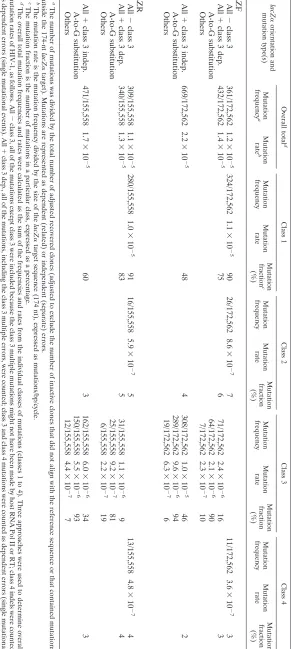
Although the integrated HIV-1 genome is double-stranded DNA, only one strand is copied into viral RNA by the host DNA-dependent RNA Pol II. This also means that RT uses different templates to synthesize the two strands of the viral DNA, the minus strand from RNA and the plus strand from DNA. Our assay does not discriminate between errors made by RNA Pol II and those made by RT. Because the mutations were recovered after one round of viral DNA synthesis by transforming a multicopy plasmid intoE. coli, the assay may preferentially detect mutations generated during minus-strand DNA synthesis compared to those made during plus-strand DNA synthesis (for a more complete explanation, see Text S1 in the supplemental material). Experiments with a spleen ne-crosis virus (SNV) vector (in which mutations were scored directly in cultured eukaryotic cells) showed that approxi-mately two-thirds of the observed mutations were generated either by Pol II or during minus-strand DNA synthesis (32, 57). We compared all of the mutations that arose in the forward and reverse orientations oflacZ␣(see Fig. 2 to 5 and Tables 2 and 3). To simplify the comparison, the data presented in the main text were all derived from the 4-vector system. Similar results were obtained using the 2-vector system (see Tables S1 and S2 and Fig. S1 to S4 in the supplemental material). As described in Materials and Methods, thelacZ␣ DNA muta-tions were divided into classes according to the types of mu-tations detected. Single nucleotide substitution errors (class 1) were the most frequent (75 to 83% of the total) (Table 2). Single nucleotide frameshifts (class 2) accounted for 5 to 6% of mutations. We found multiple nucleotide substitutions (class 3) in another 9 to 16% of mutant lacZ␣ DNA sequences, which, if they were counted independently, would have repre-sented 34 to 46% of the total mutations detected. The final type of mutations detected (class 4) were indel mutations (in-sertions, deletions, and deletions with insertions), comprising 3 to 4% oflacZ␣mutations.
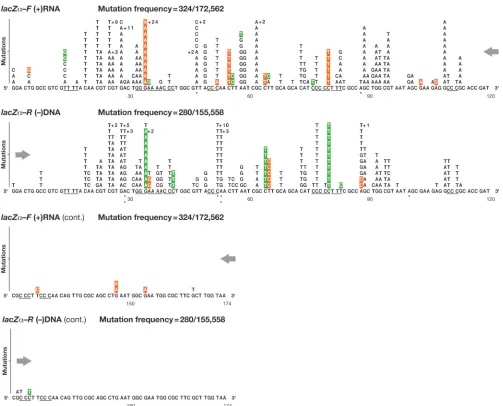
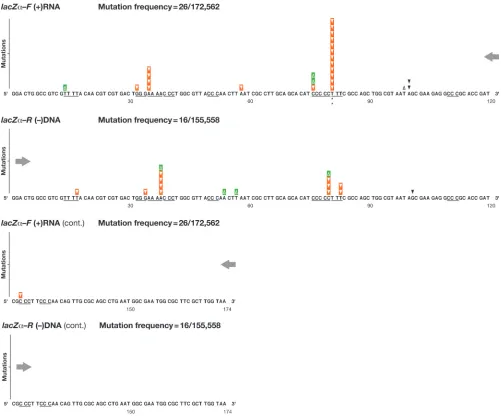
We first compared the frequencies of the specific types of errors generated in the forward and reverselacZ␣orientations (Table 3A to C). To facilitate a comparison of the errors, the inverse complements of the reverselacZ␣sequence data are presented in Fig. 2 to 5. For each class of mutation, the posi-tions of mutational hot spots were compiled, both for a par-ticularlacZ␣orientation (intragenic) and between thelacZ␣-F and lacZ␣-R orientations (intergenic), based on the relative frequency of occurrence and the sample size. Successive runs of 3 or more nucleotides are underlined in the figures (10 in total), and dinucleotide runs (29 in total) are indicated.
Effect oflacZ␣orientation on the mutations arisingin vivo.
(i) Class 1: single nucleotide substitutions.A total of 324 and
280 independent single nucleotide substitutions were detected in the forward and reverse lacZ␣ orientations, respectively. These mutations occurred at 61 and 56 positions of the 174-nt target, respectively (Fig. 2). Although there was more than one type of substitution at some locations, the overall numbers of different substitutions were similar in both orientations (LZF, 82; LZR, 81; P ⫽ 0.36). Nearly all of the single nucleotide substitutions (99%) resulted in a change in an amino acid codon within the 174-nt lacZ␣ open reading frame. Those
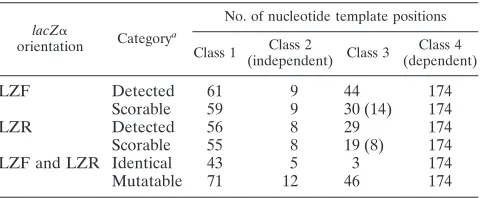
substitutions which resulted in silent changes (⬍1%) were in-variably linked to a substitution in the polylinker region (LZF, 3 of 324 at 2 sites; LZR, 1 of 280 at 1 site). Based on these data, there are at least 71 positions at which single nucleotide mu-tations can be detected and scored within the 174-nt lacZ␣ target (Table 4).
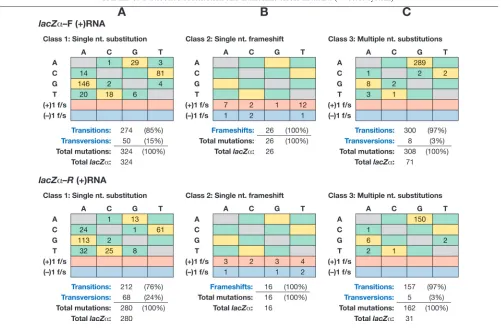
Transition mutations comprised 76 to 85% of the single nucleotide substitutions (LZF, 274 of 324; LZR, 212 of 280). The frequencies of transition and transversion substitutions differed considerably in the two lacZ␣ orientations (P ⫽ 0.0074). Consistent with genomic analyses of HIV-1 from in-fected patients (38, 71, 72), we detected twice as many G-to-A as C-to-T substitutions (Table 3A). The remaining 15 to 24% of the single nucleotide substitutions were transversions (LZF, 50 of 324; LZR, 68 of 280), primarily C to A and T to A. Although the target sequence contained nearly equal propor-tions of nucleotides (A, 36; C, 56; G, 45; T, 37), there were slightly more overall substitutions at C and G sites. Of the 61 positions in lacZ␣-F where mutations were detected, there were approximately twice as many C and G sites as A and T sites (A, 10; C, 19; G, 20; T, 12). Similar results were seen at the 56 positions where mutations were detected in the reverse lacZ␣orientation in the plus-strand nucleotide sequence (A, 7; C, 16; G, 20; T, 13).
For bothlacZ␣orientations, there was a strong preference for mutations at specific sites (Fig. 2). The majority of single nucleotide substitutions were located within a 100-nt region of lacZ␣, from positions 14 to 114 (LZF, 313 of 324; LZR, 273 of 280). This is consistent with the minimum length of lacZ␣ required for complementation (residues 3 to 41) (37). More than half of the sites within this segment were hot spots at which there were 3 or more of the same mutation (LZF, 28 of 61; LZR, 32 of 56). Only a small fraction (16 to 20%) of single nucleotide substitutions were detected near the ends of ho-mopolymeric nucleotide runs (that is, either in the last nucle-otide of a run or in the nuclenucle-otide immediately adjacent to a run) (LZF, 64 of 324; LZR, 44 of 280); the frequencies were similar for bothlacZ␣orientations (P ⫽0.20). Of the muta-tions that occurred near a run, most occurred at or near the end of runs of 3 or more nucleotides (LZF, 46 of 324; LZR, 30 of 280) in the direction of minus-strand DNA synthesis. In most cases, the mutated nucleotide could be paired with the preceding adjacent template nucleotide in thelacZ␣-F orien-tation and the succeeding adjacent template nucleotide in the lacZ␣-R orientation (P⬍0.001), suggesting that the mutations could have arisen by a slippage mechanism (see Discussion). Although the overall patterns and compilations of hot spots for the two complementarylacZ␣orientations appeared similar, there were clear intergenic differences in the hot spot posi-tions. There were 15 positions with at least a 2-fold difference in the number of substituted nucleotides: 7 sites were favored inlacZ␣-F, and 8 sites were favored inlacZ␣-R. Statistically significant differences occurred at 5 of the 15 total sites: 3 positions inlacZ␣-F and 2 positions inlacZ␣-R (see the legend for Fig. 2 for the corresponding Pvalues). These data show that the single substitution errors, and thus the majority of mutations, are affected by which strand oflacZ␣is expressed as viral RNA.
(ii) Class 2: single nucleotide frameshifts.A total of 26 and
16 independent single nucleotide frameshift mutations were
on November 8, 2019 by guest
http://jvi.asm.org/
TABLE 2. Orientation of lacZ ␣ does not af fect HIV-1 mutation rate (4-vector system) lacZ ␣ orientation and mutation type(s) Overall total d Class 1 Class 2 Class 3 Class 4 Mutation frequency a Mutation rate b Mutation frequency Mutation rate Mutation fraction c (%) Mutation frequency Mutation rate Mutation fraction (%) Mutation frequency Mutation rate Mutation fraction (%) Mutation frequency Mutation rate Mutation fraction (%) LZF All ⫺ class 3 361/172,562 1.2 ⫻ 10 ⫺ 5 324/172,562 1.1 ⫻ 10 ⫺ 5 90 26/172,562 8.6 ⫻ 10 ⫺ 7 7 11/172,562 3.6 ⫻ 10 ⫺ 7 3 All ⫹ class 3 dep. 432/172,562 1.4 ⫻ 10 ⫺ 5 75 6 71/172,562 2.4 ⫻ 10 ⫺ 6 16 3 A-to-G substitution 64/172,562 2.1 ⫻ 10 ⫺ 6 90 Others 7/172,562 2.3 ⫻ 10 ⫺ 7 10 All ⫹ class 3 indep. 669/172,562 2.2 ⫻ 10 ⫺ 5 48 4 308/172,562 1.0 ⫻ 10 ⫺ 5 46 2 A-to-G substitution 289/172,562 9.6 ⫻ 10 ⫺ 6 94 Others 19/172,562 6.3 ⫻ 10 ⫺ 7 6 LZR All ⫺ class 3 309/155,558 1.1 ⫻ 10 ⫺ 5 280/155,558 1.0 ⫻ 10 ⫺ 5 91 16/155,558 5.9 ⫻ 10 ⫺ 7 5 13/155,558 4.8 ⫻ 10 ⫺ 7 4 All ⫹ class 3 dep. 340/155,558 1.3 ⫻ 10 ⫺ 5 83 5 31/155,558 1.1 ⫻ 10 ⫺ 6 94 A-to-G substitution 25/155,558 9.2 ⫻ 10 ⫺ 7 81 Others 6/155,558 2.2 ⫻ 10 ⫺ 7 19 All ⫹ class 3 indep. 471/155,558 1.7 ⫻ 10 ⫺ 5 60 3 162/155,558 6.0 ⫻ 10 ⫺ 6 34 3 A-to-G substitution 150/155,558 5.5 ⫻ 10 ⫺ 6 93 Others 12/155,558 4.4 ⫻ 10 ⫺ 7 7 a The number of mutations was divided by the total number of adjusted recovered clones (adjusted to exclude the number of inactive clones that did not ali gn with the reference sequence or that contained mutations outside the 174-nt lacZ ␣ target). Mutations are represented as dependent (related) or independent (separate) errors. b The mutation rate is the mutation frequency divided by the size of the lacZ ␣ target sequence (174 nt), expressed as mutations/bp/cycle. c The mutation fraction is the number of mutations in a particular class, expressed as a percentage. d The overall total mutation frequencies and rates were calculated as the sum of the frequencies and rates from the individual classes of mutations (classes 1 to 4). Three approaches were used to determine overall mutation rates of HIV-1, as follows. All ⫺ class 3, all of the mutations except class 3 were included because the class 3 multiple mutations might not have been made by host RNA Pol II or RT; class 4 indels were counted as dependent errors (single mutational events). All ⫹ class 3 dep., all of the mutations, including the class 3 multiple errors, were counted; class 3 and class 4 mutations were counted as dependent errors (single mutational events). All ⫹ class 3 indep., all of the mutations were included; class 3 multiple errors were counted as independent mutations and class 4 as dependent mutations.
on November 8, 2019 by guest
http://jvi.asm.org/
[image:6.585.144.436.74.723.2]detected in the forward and reverselacZ␣orientations, respec-tively. The frequencies of insertion and deletion frameshifts were surprisingly similar in the twolacZ␣ orientations (P ⫽ 0.45). The majority were single nucleotide insertions (LZF, 22 of 26; LZR, 12 of 16) in which the inserted nucleotide could have base paired with the preceding adjacent template nucle-otide in the direction of minus-strand DNA synthesis (Table 3B and Fig. 3). While single nucleotide frameshifts appeared to have occurred at 9lacZ␣-F and 8lacZ␣-R nucleotide template positions (Table 4), a large fraction (88 to 94%) were detected in 5 nucleotide runs (LZF, 21 of 26; LZR, 13 of 16). It is not possible to be certain where in a run a frameshift mutation occurs; for convenience, they are shown at the end of the run. The relative positions of frameshifts in eitherlacZ␣ orienta-tion revealed strong intragenic site preferences for runs of A’s and T’s compared to C’s and G’s. This result is similar to a previous report based on anin vitroassay with HIV-1 RT (11). Only one run inlacZ␣-F had a significantly different number of frameshift mutations compared tolacZ␣-R (P⬍0.001).
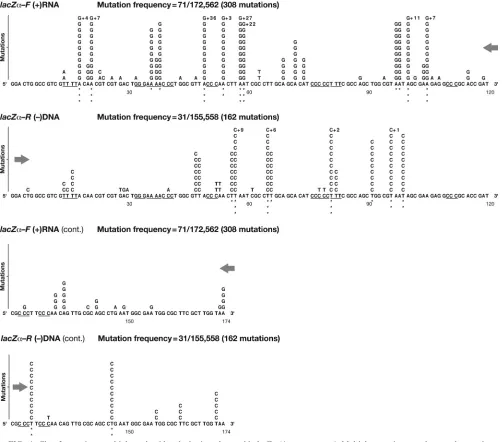
(iii) Class 3: multiple nucleotide substitutions.Despite the
relatively low overall mutation frequency, we recovered
nu-merouslacZ␣DNAs containing two or more substitution mu-tations (71lacZ␣-F and 31lacZ␣-R DNAs). A total of 308 and 162 multiple nucleotide substitutions were detected in the for-ward and reverselacZ␣orientations, at 44 and 30 nucleotide template positions, respectively (Fig. 4). Transitions accounted for nearly all multiple nucleotide substitutions in bothlacZ␣ orientations (LZF, 300 of 308; LZR, 157 of 162), a major fraction of which (94%) were A to G (LZF, 289 of 308; LZR, 150 of 162), (Table 3C). In contrast to class 1 single nucleotide substitutions, a significant proportion (32 to 52%) of the de-tected class 3 multiple nucleotide substitutions were silent changes (LZF, 100 of 308 at 14 sites; LZR, 84 of 162 at 10 sites). Nearly half of the remaining scorable class 3 substitu-tions occurred at the same posisubstitu-tions as all forms of class 1 substitutions, leaving only 14 lacZ␣-F and 8 lacZ␣-R sites unique to class 3 (Table 4).
[image:7.585.43.544.75.405.2]Indirect evidence suggests that the multiple A-to-G muta-tions were caused by a host enzyme, ADAR (see Discussion). There were up to 10 A-to-G mutations in the lacZ␣ DNA sequences (average, 6; median, 3); there were mutations in similar proportions of template adenosine residues in the two TABLE 3. Nucleotide substitution and frameshift errors inlacZ␣(4-vector system)a
aThe numbers and types of mutations in the forward and reverse orientations oflacZ␣(shown in the plus-strand nucleotide sequence) are given in the upper and
lower panels, respectively, for class 1, single nucleotide substitutions (A); class 2, single nucleotide frameshifts (B); and class 3, multiple nucleotide substitutions (C). The original wild-type plus-strand template nucleotides are given on the left side of each panel, with the corresponding substitutions along the top. Transition and
transversion substitutions are highlighted in yellow and green, respectively. Single nucleotide addition关(⫹)1 f/s兴and deletion关(⫺)1 f/s兴frameshift mutations are
highlighted along the bottom in pink and blue, respectively. The relative percentage of each type of error was determined by dividing the number of each type of
mutation by the total number of mutations detected. TotallacZ␣, total number of mutantlacZ␣DNA sequences scored.
on November 8, 2019 by guest
http://jvi.asm.org/
lacZ␣orientations (LZF, 28 of 36; LZR, 20 of 37). The posi-tions of these class 3 A-to-G mutaposi-tions had minimal overlap with the sites of class 1 A-to-G substitutions (LZF, 6 of 28 sites; LZR, 5 of 20 sites). Multiple A-to-G substitutions found in experiments withlacZ␣in both orientations revealed a strong intragenic preference for template adenosines preceded 5⬘by an adenosine or a uridine in the viral RNA (LZF, 18 of the 36 A nucleotides were preceded by an A or a C; LZR, 16 of the 37 A nucleotides were preceded by an A or a C) and for template adenosines predicted to reside within RNA second-ary structures (LZF, 20 sites; LZR, 17 sites [data not shown]). Because the mutations occurred in adenosines in the viral
RNA strand, the positions at which these substitutions oc-curred were strongly affected by the orientation oflacZ␣. Al-though there were too few A-to-G substitutions at some posi-tions, statistically significant differences in the two orientations were found at 22 of the 48 total positions (LZF, 12 of 28; LZR, 10 of 20) (see the legend for Fig. 4 for the correspondingP values). Taken together, these findings indicate that the se-quence and/or structural context of the mutational target in the viral RNA determines the specificity of the multiple A-to-G mutations.
[image:8.585.42.545.65.471.2]A minor fraction (6%) of multiple nucleotide substitutions (LZF, 19 of 308; LZR, 12 of 162) in the class 3lacZ␣DNAs FIG. 2. Class 1 mutations: single nucleotide substitutions detected in lacZ␣ (4-vector system). The numbers, types, and locations of the independent substitution errors are shown for both the forwardlacZ␣ orientation (plus-strand nucleotide sequence) and the reverselacZ␣
orientation (negative-strand nucleotide sequence). Opposing directional arrows indicate the actual sequence context and direction of minus-strand DNA synthesis during reverse transcription. The total length of thelacZ␣target sequence was defined as 174 nt, representing codons 6 to 63 from GGA to the first TAA termination codon. Single nucleotide substitution errors are shown as letters above the original wild-type template sequence, limited to 11 per position, with additional errors indicated by⫹n. Runs of 3 or more identical nucleotides are underlined. Misalignment/slippage of the primer or template strand that could result in a substitution error is highlighted in orange or green, respectively. Mutational hot spots for which there are significant differences in the forward and reverselacZ␣orientations are indicated by asterisks:*,P⬍0.01;**,P⬍0.001;***,
P⬍0.0001 (see Materials and Methods). The mutation frequency is the number oflacZ␣DNAs with a mutation(s) divided by the total number of adjusted recovered clones.
on November 8, 2019 by guest
http://jvi.asm.org/
(LZF, 7 of 71; LZR, 6 of 31) involved a variety of multiple transition and transversion mutations (Table 3C). Indirect ev-idence suggests that some of these mutations could have been caused by an error-prone polymerase and/or a host enzyme, APOBEC3G (see Discussion). In contrast to multiple A-to-G substitutions, in this subclass of multiple nucleotide substitu-tions there were only 2 changes in thelacZ␣DNA, and there was considerable overlap with the sites of the class 1 single nucleotide substitutions (LZF, 9 of 16 sites; LZR, 6 of 9 sites). About half of these multiple nucleotide substitutions were G-to-A transitions (LZF, 8 of 19; LZR, 6 of 12), and an examination of their positions in eitherlacZ␣orientation re-vealed an intragenic site preference for template guanosines proceeded 3⬘by a guanosine (LZF, 3 sites; LZR, 4 sites).
(iv) Class 4: insertions, deletions, and deletions with
inser-tions (indels).Finally, we recovered a small number oflacZ␣
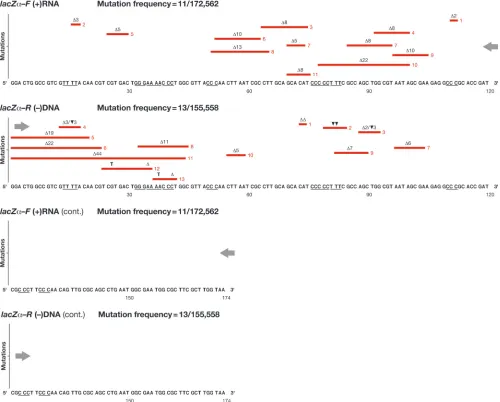
DNAs containing insertions or deletions (small or large) or deletions with insertions (11lacZ␣-F and 13lacZ␣-R DNAs). All of the indel mutations altered the reading frame oflacZ␣ (Fig. 5). Because these mutations did not localize to any spe-cific nucleotide positions, the entire 174-nt length oflacZ␣was considered scorable for class 4 mutants (Table 4).
The frequencies of indels were quite similar in the twolacZ␣ orientations (P ⫽0.54), with deletions substantially outnum-bering insertions (LZF, 10 of 11; LZR, 8 of 13). The deletions ranged from 4 to 44 nt. The insertion or deletion junction in both large and small indels typically involved a short direct repeat of 1 to 3 nt and/or a preceding run of identical nucleotides in the direction of minus-strand synthesis. A minor fraction of indels involved a deletion of 2 to 3 nt followed by an insertion of a similar length (LZF, 0 of 11; LZR, 2 of 13). Finally, twolacZ␣-R DNAs were found to contain a single nucleotide substitution and a frameshift separated by 3 to 9 nucleotides.
The orientation oflacZ␣does not affect thein vivomutation
frequency.Three separate approaches were used to determine
the overallin vivomutation rate for a single round of HIV-1 replication (Table 2). Since our measurements include only mutations that inactivatelacZ␣, these determinations under-estimate the actual mutation rate (see Discussion). We classi-fied individual errors as either related (dependent) or separate (independent) mutations. Single nucleotide changes (classes 1
and 2) and indels (class 4) were considered single mutational events. However, the multiple substitutions in class 3 were treated as either dependent or independent events, because it was unclear whether they were caused by a host enzyme that modifies the nucleic acid or by an error-prone polymerase (see Discussion). If the class 3 mutations were excluded, the overall mutation rate in the forwardlacZ␣orientation was 1.2⫻10⫺5
mutations/bp/cycle. If each class 3lacZ␣DNA sequence was counted as a single mutational event, the overall mutation rate was 1.4⫻10⫺5mutations/bp/cycle (P⫽0.013). Alternatively,
if each individual change in the class 3 mutants was counted separately, there were an additional 237 mutations (308 total), giving rise to a 1.8-fold-higher overall mutation rate of 2.2⫻ 10⫺5 mutations/bp/cycle (P⬍ 0.0001). Class 3 mutations (as
dependent or independent events) appeared to modestly in-crease the overall mutation rate, and similar inin-creases were seen in both the forward and reverselacZ␣orientations. If the multiple A-to-G substitutions of class 3 were introduced by a host enzyme (ADAR), then their relative contribution to the overall forward lacZ␣ mutation rate would be 2.1 ⫻ 10⫺6
mutations/bp/cycle (see Discussion). Whether the few remain-ing class 3 multiple nucleotide substitutions were dependent events caused by a host enzyme (for example, APOBEC3G) or independent events caused by an error-prone polymerase, their relative contribution would not have appreciably affected the final overalllacZ␣-F mutation rate of 1.4⫻ 10⫺5
muta-tions/bp/cycle. Finally, we compared the overall total mutation rates for the forward and reverse orientations of lacZ␣ and found no significant difference between 1.4⫻10⫺5mutations/
bp/cycle (lacZ␣-F) and 1.3 ⫻ 10⫺5 mutations/bp/cycle
(lacZ␣-R) (P⫽ 0.061). These results suggest that while the specific mutations are affected by which strand of lacZ␣ is expressed in viral RNA, the overall mutation rate is not.
DISCUSSION
Nature and position of mutational hot spotsin vivo.Many of
[image:9.585.44.285.89.188.2]the analyses of mutations generatedin vitroby RT have used a mutational target similar tolacZ␣-F. There have been rela-tively few cell-freein vitrostudies using an RNA template with thelacZ␣-F orientation (8, 30) and no studies using either an RNA or a DNA template equivalent to thelacZ␣-R orienta-tion. Although similarlacZ␣DNA sequences have been used as targets in multiplein vitrostudies, the patterns of reported mutations are vastly different. Furthermore, the overall muta-tion rate reported for RTin vitrois significantly higher than the overall mutation ratein vivo. Our findings extend the available in vivoobservations and provide information about the nature, position, and frequency of the mutations. Because the pub-lishedin vivodata do not provide detailed information about the spectrum of mutations, it has not been possible to consider the mechanisms by which the mutations arose (42, 46). The classes and proportions of mutations we obtained using HIV-1 lacZ␣ were consistent with results from previous reports for HIV-1 (42, 46), SNV (11, 55, 56), and bovine leukemia virus (BLV) (47). Base substitutions are the most common mutations, with transitions predominating over transversions. Although the proportions of single nucleotide frameshifts and indels have been reported to make up 10 to 25% of the total, we observed much lower fractions of 5 to 6% and 3 to 4%, respectively. We also TABLE 4. Positions inlacZ␣where mutations were
detected (4-vector system)
lacZ␣
orientation Category
a
No. of nucleotide template positions
Class 1 Class 2
(independent) Class 3
Class 4 (dependent)
LZF Detected 61 9 44 174
Scorable 59 9 30 (14) 174
LZR Detected 56 8 29 174
Scorable 55 8 19 (8) 174
LZF and LZR Identical 43 5 3 174
Mutatable 71 12 46 174
aDetected, the number of independent nucleotide template positions inlacZ␣
where mutations were detected; scorable, the number of positions where a mutation caused a change in an amino acid (the number of unique sites is shown
in parentheses); identical, the number of “scorable” positions inlacZ␣that were
identical in both orientations; mutatable, the minimal number of “scorable”
positions inlacZ␣, as determined from the combined data forlacZ␣-F and
lacZ␣-R.
on November 8, 2019 by guest
http://jvi.asm.org/
found more multiple mutations (including both G-to-A and A-to-G mutations) than were previously reported.
The mutational hot spots seenin vivodepended upon the strand oflacZ␣that was expressed in the viral RNA. Although the natures and relative frequencies of the various classes of mutations were similar in both lacZ␣ orientations, the se-quence and/or structural context of the template influenced the location of hot spots. Both single (class 1) and multiple (class 3) nucleotide substitutions are orientation dependent. Although the class 1 (single) G-to-A and C-to-T substitutions were broadly distributed, class 3 A-to-G and G-to-A substitu-tions usually occurred next to specific neighboring nucleotides. In contrast, frameshift (class 2) and indel (class 4) mutations
were much less frequent, and most were in the same nucleotide runs in bothlacZ␣orientations. This result differs fromin vitro findings, where single nucleotide frameshift deletions were much more frequent (4, 5, 8, 33, 35) and frameshift insertions did not necessarily match adjacent template nucleotides (9, 10). The pat-tern of mutational hot spots seenin vivoinlacZ␣-F orlacZ␣-R did not match any of the publishedin vitrohot spot data obtained using purified RT to copy lacZ␣ (4, 8–10, 30, 39). Although Mansky and Temin (46) reported relatively fewin vivomutations, making it difficult to unambiguously identify hot spots, their data are more similar to ours than any of thein vitrodata are.
Possible underlying mechanism(s) ofin vivomutations.The
[image:10.585.42.543.67.484.2]in vivo-based system detects the mutations made by both RT FIG. 3. Class 2 mutations: single nucleotide frameshifts detected inlacZ␣(4-vector system). Single nucleotide frameshift errors are indicated as triangles above the wild-type sequence: single nucleotide deletions (⫺1) are shown as upright triangles and single nucleotide additions (⫹1) as inverted triangles. Runs of 3 or more identical nucleotides are underlined. If a frameshift occurred within a run, its exact position within the run cannot be determined, and the deletions and additions are marked over the last nucleotide in the run in the direction of minus-strand DNA synthesis. Frameshift errors in nucleotide runs that could have arisen by a misalignment/slippage of the primer or template strand are highlighted in orange or green, respectively. Mutational hot spots for which there are significant differences in the forward and reverselacZ␣orientations are indicated by asterisks:*,P⬍0.01;**,P⬍0.001;***,P⬍0.0001 (see Materials and Methods). The mutation frequency is the number oflacZ␣
DNAs with a mutation(s) divided by the total number of adjusted recovered clones.
on November 8, 2019 by guest
http://jvi.asm.org/
and RNA Pol II but does not reveal which enzyme made any individual mutation. The underlying mechanism(s) that con-tributes to the mutations that arise during HIV-1 replication has not been established. Our data suggest that the majority of in vivo lacZ␣mutations (80 to 84% of single nucleotide sub-stitutions) arise by nucleotide misincorporation rather than by misalignment or slippage of the template primer strands at the ends of nucleotide runs (LZF, 260 of 324; LZR, 236 of 280). This result matches the findings of a study of SNV mutations (32, 56, 57) but differs from the initialin vitroreports that most of the missense errors made by HIV-1 RT are due to misalignment/slippage (4, 5, 8). The slippage model for mis-sense mutagenesis suggests that polymerization through a
[image:11.585.43.545.69.511.2]homopolymeric sequence may produce a transiently mis-aligned intermediate with an unpaired extrahelical base in ei-ther the template or the primer strand, which could result in two different outcomes. If the alignment error leads to poly-merization without realignment, a deletion or an insertion frameshift will arise in the nucleotide run if the unpaired ex-trahelical base is in the template or primer strand, respectively. If the alignment error is followed by incorporation of a single nucleotide and then realignment, the single nucleotide is often a mismatch with the template, causing a specific missense sub-stitution. Although a slippage mechanism cannot account for the majority of the missense mutations, it can account for the majority of the frameshift mutations.
FIG. 4. Class 3 mutations: multiple nucleotide substitutions detected inlacZ␣(4-vector system). Multiple mutations are shown as letters above the original wild-type template sequence, limited to 11 per position, with additional errors indicated by⫹n. Runs of 3 or more identical nucleotides are underlined. Mutational hot spots for which there are significant differences in the forward and reverselacZ␣orientations are indicated by asterisks:*,P⬍0.01;**,P⬍0.001;***,P⬍0.0001 (see Materials and Methods). The mutation frequency is the number oflacZ␣DNAs with a mutation(s) divided by the total number of adjusted recovered clones.
on November 8, 2019 by guest
http://jvi.asm.org/
Although slippage can occur anywhere in a homopolymeric run, whether the template or primer strand is the strand that slips should depend on the nature of the adjacent nucleotide at the ends of the homopolymeric run and on the interactions of the nucleic acid substrate with the polymerase. Interestingly, while 46 to 52% of all class 1 substitutions were detected near the ends of runs (LZF, 167 of 324; LZR, 128 of 280), only 34 to 38% of these mutations matched the sequence context for slippage (LZF, 64 of 167; LZR, 44 of 128). The majority of class 2 frameshift mutations were found in nucleotide runs and matched the sequence context for slippage (LZF, 20 of 26; LZR, 11 of 16). While most frameshifts reported fromin vitro assays using purified RT were template-based (deletion) slip-pages (4, 5, 11, 33), most of the events seen in vivo were primer-based (insertion) slippages. Slippage could explain the
generation of some of the indels located in nucleotide runs. However, large deletions occurred near direct repeats, and the mutant sequences suggested that the mutations arose by tem-plate switching during reverse transcription. Because the vast majority of the mutations are missense substitutions, these results strongly suggest that mostlacZ␣mutations are due to misincorporation, made either by RT or RNA Pol II or by some combination of the two.
[image:12.585.43.543.70.472.2]A significant fraction (9 to 16%) of mutant lacZ␣ DNAs contained multiple nucleotide substitutions. Based on the rel-atively low number of single mutations, this is an unexpected result. The most obvious explanation for multiple nucleotide substitutions is an error-prone polymerase or a mutagenic host editing enzyme. G-to-A hypermutations have been reported in the genomes of a number of retroviruses and can lead to FIG. 5. Class 4 mutations: insertions, deletions, and/or deletions with insertions (indels) detected inlacZ␣(4-vector system). Indel mutations (deletions, deletions with insertions, and duplications) are shown as red lines extending over the positions of the mutations, with eachlacZ␣DNA sequence numbered accordingly. The lines approximate the sizes of the indels, with the actual number of nucleotides inserted or deleted preceded by an inverted or upright triangle, respectively. Additional substitution errors within indels are shown as letters above the original wild-type template sequence. Runs of 3 or more identical nucleotides are underlined. The mutation frequency is the number oflacZ␣ DNAs with a mutation(s) divided by the total number of adjusted recovered clones.
on November 8, 2019 by guest
http://jvi.asm.org/
incomplete reverse transcription and/or the production of non-functional viral proteins (32, 72, 73). The most common change, 5⬘-GG to -GA within the viral plus-strand DNA, has been attributed to the deamination of cytidines to uridines in the viral minus-strand DNA by the host enzyme APOBEC3G (A3G) (24, 38, 41). Because the 293T producer cells used to generate HIV-1 in ourin vivo-based system have little or no APOBEC3G (26, 58), we found very few multiple G-to-A mutations. Most of the class 3 multiple nucleotide substitutions involved A-to-G transitions (94%). The small residual fraction of the multiple mutations involving G-to-A changes (6%) could have been caused by APOBEC3G. Some or all of the rare multiple transitions and transversions could have been caused by an error-prone RT or RNA polymerase II. However, we suggest that the much more common A-to-G hypermuta-tions were caused by a host adenosine deaminase that acts on RNA (ADAR). ADARs catalyze the deamination of adeno-sine to inoadeno-sine in structured or double-stranded regions of RNA, with a sequence preference for 5⬘-UA or -AA (3, 40, 67). Any A-to-I changes caused by ADAR in the viral RNA would appear as A-to-G mutations in the viral plus-strand DNA. The nature and position of most class 3 substitutions matched the sequence and structural preference of ADARs. ADAR-in-duced A-to-G and U-to-C hypermutations have been docu-mented in many negative-strand viruses (3, 14). While ADAR-induced mutations have not been directly correlated with an antiviral effect, it has been suggested that the mutations en-hance viral persistence (14) or the degradation (64) or nuclear export (76) of hyperedited dsRNA. In contrast, A-to-G hyper-mutations are not as prevalent in positive-strand RNA viruses or in retroviruses. To date, only a few Rous-associated virus type 1 (RAV-1) (22), avian leukosis virus (ALV) (23), and SNV (32) proviral sequences have been reported to contain A-to-G hypermutations that could have been caused by ADAR. Recent reports have proposed that ADARs may stim-ulate the release and the infectious potential of HIV-1 either directly, by editing adenosines in the 5⬘untranslated region (5⬘ UTR) (TAR), Rev, and Tat coding regions, or indirectly, by suppressing the proapoptotic dsRNA-dependent kinase activ-ities of protein kinase R (PKR) from acting on translation initiation factor eIF-2␣(␣subunit of eukaryotic initiation fac-tor) (16, 20, 49). Our survey of 414 HIV-1 full genomic se-quences showed that ADAR-like A-to-G hypermutations are rare. Although multiple A-to-G substitutions were detected when the HIV-1 subtype B genomic sequences were compared to a reference sequence (126 of 3,411 adenosines), the intrase-quence variation of these changes was not significant com-pared to that for multiple C-to-T substitutions (69 of 1,772 cytidines) (P ⫽ 0.76). This suggests that ADAR-induced A-to-G hypermutations are rare in the HIV-1 genomes isolated from patients. A-to-G hypermutations may lead to the gener-ation of viruses with little or no replicgener-ation capacity, which could contribute to the rarity of A-to-G hypermutations in HIV-1 genomes in patients.
Determination of an in vivo mutation rate for HIV-1 by
usinglacZ␣.Although it is widely believed that HIV-1
repli-cation is exceptionally error-prone, we show here that thein vivoforward mutation rate of HIV-1, measured by the inacti-vation of lacZ␣, is approximately 1.4 ⫻ 10⫺5 mutations/bp/
cycle. This rate is approximately 20-fold lower than thein vitro
error rate for RT measured using a DNA template (9, 10, 29, 30, 62, 68) and 17-fold lower than the rate measured using an RNA template (29, 30). Our reported mutation rate for HIV-1 in HOS cells is also about 3-fold lower than earlier reported rates in HeLa and CEM cells (42, 46) and is similar to the average rate reported for other retroviruses (1.5⫻10⫺5
mu-tations/bp/cycle) (69).
The primary advantage of using thelacZ␣-based system to study HIV-1 replication fidelity is that the nature of the mu-tations that arisein vivocan be determined. An accurate mu-tation rate depends on (i) the number of mutable positions in lacZ␣, (ii) whether mutations in both DNA strands are scored, and (iii) whether mutants with multiple changes in thelacZ␣ DNA (classes 3 and 4) are counted as having single or multiple mutations. One limitation of usinglacZ␣to determine thein vivomutation rate of HIV-1 is that silent mutations are not detected. Based on the collection of mutations generated by recombinant RTin vitro, it has been proposed that mutations can be detected in approximately 40% of the nucleotides in the promoter and coding regions oflacZ␣. The specific numbers of mutable target sites in a 280-ntlacZ␣have been reported as 113 for substitutions, 150 for frameshifts, and 280 for indels (4, 8, 34, 55, 63). These numbers could not be used to analyze the data from ourin vivoassay because only 174 nt oflacZ␣were the same in our experiments and the published data. However, we have confirmed that single nucleotide missense mutations could be detected at a minimum of 71 out of 174 nt positions (Table 4). This suggests that our measured mutation rate may be 2- to 3-fold lower than the actual overall mutation rate. The mutation rate of HIV-1 was previously determined, using dif-ferent constraints, to be 3.4⫻ 10⫺5 mutations/bp/cycle (46).
When the rate was recalculated using the 174-nt target, the mutation rate was 2.4 ⫻ 10⫺5 mutations/bp/cycle, which is
similar to our result (for details, see Text S3 and Table S3 in the supplemental material). Based on the published in vivo data and our data, HIV-1 replication is not error-prone rela-tive to that of other retroviruses. This implies that, at least in the context of the replicating virus, HIV-1 RT is not signifi-cantly more error-prone than other retroviral RTs.
ACKNOWLEDGMENTS
This study was supported by the Intramural Research Program of the National Institutes of Health, National Cancer Institute, Center for Cancer Research.
We are grateful to Dwight Nissley for helpful discussions and Teresa Burdette for editing and help in preparing the manuscript. We also thank Octavio A. Quin˜ones for helpful assistance in data preparation and statistical analyses and Al Kane for assistance in preparing publi-cation-quality figures and tables.
REFERENCES
1.Avidan, O., M. E. Meer, I. Oz, and A. Hizi.2002. The processivity and fidelity
of DNA synthesis exhibited by the reverse transcriptase of bovine leukemia
virus. Eur. J. Biochem.269:859–867.
2.Bakhanashvili, M., and A. Hizi.1993. Fidelity of DNA synthesis exhibited in
vitro by the reverse transcriptase of the lentivirus equine infectious anemia
virus. Biochemistry32:7559–7567.
3.Bass, B. L.2002. RNA editing by adenosine deaminases that act on RNA.
Annu. Rev. Biochem.71:817–846.
4.Bebenek, K., J. Abbotts, J. D. Roberts, S. H. Wilson, and T. A. Kunkel.1989.
Specificity and mechanism of error-prone replication by human
immunode-ficiency virus-1 reverse transcriptase. J. Biol. Chem.264:16948–16956.
5.Bebenek, K., J. Abbotts, S. H. Wilson, and T. A. Kunkel.1993. Error-prone
polymerization by HIV-1 reverse transcriptase. Contribution of template-primer misalignment, miscoding, and termination probability to mutational
hot spots. J. Biol. Chem.268:10324–10334.