Maria Carmen Puertas,
1Maria Jose Buzo
´n,
1Anna Artese,
2Stefano Alcaro,
2Luis Menendez-Arias,
3Carlo Federico Perno,
4Bonaventura Clotet,
1Francesca Ceccherini-Silberstein,
4† and Javier Martinez-Picado
1,5*†
irsiCaixa Foundation, Hospital Germans Trias i Pujol, Badalona, Barcelona, Spain
1; Department of Pharmacobiological Sciences,
University of Catanzaro Magna Graecia, Catanzaro, Italy
2; Centro de Biología Molecular Severo Ochoa, Consejo Superior de
Investigaciones Científicas and Universidad Auto
´noma de Madrid, Madrid, Spain
3; Department of Experimental Medicine,
University of Rome Tor Vergata, Rome, Italy
4; and Institucio
´ Catalana de Recerca i Estudis Avanc
¸ats, Barcelona, Spain
5Received 9 March 2009/Accepted 14 May 2009
A negative association between polymorphism Leu-214 and type-1 thymidine analogue mutations (TAM1)
and a positive association with a clinically favorable virological response to thymidine analogue-based
com-bination antiretroviral therapy have been described. In this study, the impact of Leu-214 on replication
capacity and resistance to zidovudine (ZDV) of viruses containing TAM1 or TAM2 was determined. Leu-214
decreased the growth rate of viruses bearing Tyr-215, as well as their resistance to ZDV. This observation was
confirmed by structural and molecular modeling data, suggesting a regulatory role for Leu-214 in the
emer-gence and phenotypic resistance of TAM1.
Human immunodeficiency virus type 1 (HIV-1) reverse
transcriptase (RT) is responsible for the conversion of the viral
single-stranded RNA genome into double-stranded DNA,
prior to host-genome integration in target cells. RT has been
widely considered a key target for combination antiretroviral
therapy. Drugs targeting this viral enzyme include nucleoside
analogues (NRTIs) and nonnucleoside RT inhibitors (NNRTIs).
One of the mechanisms contributing to decreased HIV
sus-ceptibility to NRTIs promotes the removal of the nucleoside
analogue from the terminated DNA chain (22). The
tions responsible for this effect, thymidine analogue
muta-tions (TAMs), emerge after long-term therapy with
zidovu-dine (ZDV) and/or stavuzidovu-dine (d4T) and confer resistance to
almost all clinically approved RT inhibitors. Two different
TAM patterns have been defined: TAM1, including Leu-41,
Trp-210, and Tyr-215; and TAM2, including Asn-67, Arg-70,
Phe-215, and Gln/Glu-219. TAM1 is more prevalent and
con-fers a higher degree of resistance to thymidine analogues (6, 8,
10, 12, 19, 32–34). To date, the factors driving one mutational
pattern or another remain unclear, although the genomic
back-ground of the treatment-naive viral population, host factors
such as HLA genotype (16), and stochastic effects could be
involved.
Leu-214 is a natural polymorphism in the RT coding region,
and it is present in ca. 10 to 20% of antiretroviral treatment
(ART)-naive and ART-experienced patients carrying any of
the major HIV-1 subtypes A, B, or C (3, 4; http://www.hiv.lanl
.gov/). A negative association between Leu-214 and the TAM1
pattern and a positive association with the TAM2 pattern have
been observed (29). Moreover, it has recently been
demon-strated the association of the Leu-214 with a favorable
viro-logical response to thymidine analogue-containing ART (3).
These data suggest that Leu-214 may regulate divergent
resis-tance pathways by affecting viral fitness and/or drug
suscepti-bility. However, experimental evidence supporting these
ob-servations has not yet been reported. The aim of the present
study was to compare the in vitro growth rate and relative viral
fitness of HIV-1 recombinant mutants containing the Leu-214
polymorphism in RT containing TAM1 or TAM2 patterns, in
both the absence and the presence of ZDV. A preliminary
structural analysis was also performed in order to explain the
putative role of this polymorphism in the RT replicative
ca-pacity at the molecular level.
MATERIALS AND METHODS
Site-directed mutagenesis. Phe-214 is found in the hemiplasmid p83-2 (9)
containing the 5⬘half of the genome of the proviral clone pNL4-3 (1). The
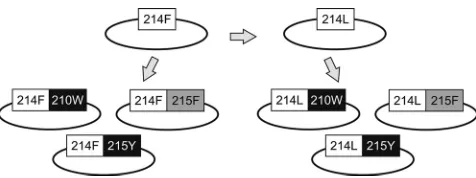
Leu-214 polymorphic variant was generated by PCR-based site-directed mu-tagenesis on nucleotide position 3189 (17) by using a QuikChange II site-directed mutagenesis kit (Stratagene). The TAMs Trp-210 (position 3178) and Phe-215 and Tyr-215 (positions 3192 to 3193) were introduced into wild-type variants containing either Phe-214 or Leu-214 by using the same procedure (Fig. 1).
Generation of a cloning vector.The recombinant vector pJM14 (21), recon-structed with an RT-coding region (including its DNA polymerase and RNase H
domains) (30), was used to create the new cloning vector pJM16⌬RT (5⬘-half of
the HIV-1 genome without RT). Briefly, the RT-coding region of reconstructed pJM14 was cut with the restriction enzymes SmaI (position 2588) and AgeI (position 3493) (Fermentas), and the resulting fragment was replaced by a polylinker.
Cloning.To avoid miscarrying mutations that could have occurred during the PCR-based mutagenesis amplification, a 908-bp fragment ranging from positions 2574 to 3482 from the newly generated mutants was amplified by PCR (Platinum
TaqHigh Fidelity; Invitrogen) using primers 2574U29-SmaI (5⬘-CCA GTA AAA
TTA AAG CCC GGG ATG GAT GG-3⬘) and 3482L31-AgeI (5⬘-TGG GTC
ATA ATA CAC TCC ATG TAC CGG TTC T-3⬘) and subsequently subcloned
into the pJM16⌬RT cloning vector using the SmaI and AgeI restriction enzymes
* Corresponding author. Mailing address: irsiCaixa Foundation,
Hospital Germans Trias i Pujol, Ctra. de Canyet s/n, 08916 Badalona,
Spain. Phone: 34 934656374. Fax: 34 934653968. E-mail: jmpicado
@irsicaixa.es.
† F.C.-S. and J.M.-P. contributed equally to this study.
䌤
Published ahead of print on 20 May 2009.
7434
on November 8, 2019 by guest
http://jvi.asm.org/
(Fermentas). Sequence integrity from positions 2500 to 3600 was confirmed on the newly generated clones (BigDye Terminator v3.1 cycle sequencing kit; Ap-plied Biosystems).
Generation of viral stocks.Infectious viral stocks from recombinant proviral clones were obtained by cotransfection with hemiplasmid p83-10 (containing the
3⬘half genome of the pNL4-3 [9]) by electroporation of MT-4 cells (NIH AIDS
Research and Reference Reagent Program). Seven days after transfection,
su-pernatants were collected and p24Gagcontent was determined by enzyme-linked
immunosorbent assay (HIV-1 p24 ELISA kit; Perkin-Elmer). Chemilumines-cence titration assays in HeLa-derived TZM-bl cells (NIH AIDS Research and Reference Reagent Program) were used to determine the mean 50% tissue
culture infective dose(s) (TCID50) of each viral stock, as previously described
(18).
Replication capacity assays.Viral replication kinetics of mutant viruses was
assayed by inoculation of 5,000 TCID50of each viral stock onto 5⫻106
periph-eral blood mononuclear cells (PBMC) mixed from two healthy donors
(multi-plicity of infection [MOI] of 0.001), previously stimulated with 3g of
phytohe-magglutinin (Sigma-Aldrich)/ml and 10 U of interleukin-2 (Roche)/ml for 3 days. Replication kinetics assays were performed in parallel, using the same PBMC donor mix in order to guarantee reliable results. After incubation for 2 h at 37°C, the cells were washed twice with phosphate-buffered saline and resuspended in RPMI (Invitrogen) medium supplemented with 20% fetal bovine serum (FBS,
Invitrogen) and interleukin-2 (10 U/ml) at a final concentration of 106
cells/ml. When indicated, ZDV (Sigma) was added to the cultures. Viral replication was
quantified by measuring HIV-1 p24Gag
antigen production in the culture super-natant for 7 days (HIV-1 p24 ELISA kit; Perkin-Elmer). Growth kinetics were
analyzed by fitting a linear model to the log-transformed p24Gag
data during the exponential growth phase by maximum-likelihood methods using GraphPad Prism 4 software.
Growth competition assays.Each pair of competing viruses was mixed at ratios
of 20:80, 50:50, and 80:20 to infect 106
MT-4 cells in 1 ml of R-10 (RPMI medium
supplemented with 10% FBS), with 1,000 TCID50(MOI of 0.001). After 2 h at
37°C, cells were washed twice with PBS, resuspended in 5 ml of R-10 medium
(2⫻105cells/ml) and cultured in six-well plates. Culture supernatants were
collected twice weekly, and 100l was used to newly infect 106
of fresh MT-4 cells. Viral RNA was extracted from culture supernatants by using the Qiamp viral RNA minikit (Qiagen). The viral RNA fragment from positions 2212 to 4120 was first amplified by one-step RT-PCR (Superscript High-Fidelity; Invitro-gen), followed by nested PCR ranging from positions 2574 to 3482. The relative proportions of the two competing variants were determined at days 7, 14, 21, and 28 based on the relative peak heights of codons 210, 214, and 215 in electro-pherograms obtained by bidirectional sequencing of the RT coding region (Big Dye Terminator v3.1 cycle sequencing kit and a 3100-Avant genetic analyzer [Applied Biosystems]).
Structural analysis.The structural analysis was performed by using the X-ray crystallographic coordinates of HIV-1 RT deposited in the Protein Data Bank (http://www.rcsb.org/PDB) with code 1N6Q (27). This structure corresponds to a HIV-1 RT complex bound to a DNA-DNA template primer, where the primer
is blocked at its 3⬘terminus with ZDV. In this Protein Data Bank entry, the
ZDV-monophosphate (ZDVMP) moiety is located at the nucleotide binding site, in the so-called “pretranslocation” complex. The starting geometries of the mutants containing Tyr-215 in combination with Leu-214 and Phe-214 were generated by making single-residue substitutions in the crystallographic struc-ture. In order to analyze the potential interactions occurring in the absence of the drug, the ZDVMP residue was replaced by deoxythymidine-monophosphate
(dTMP). The obtained structures were energy minimized, using the MMFF force field (11), a dielectric constant equal to 1, and a convergence criterion fixed at 0.5
kJ/mol䡠Å. RT residues within 30 Å from the catalytic Asp residues were free to
move, while the rest of the enzyme was kept frozen. Subsequently, the MOLINE method (2) was adopted to evaluate the interaction energies of the four com-plexes derived from the combination of both RT variants and both DNA primer
templates with 3⬘-terminus ZDVMP or dTMP. All simulations were performed
with MacroModel version 7.2 (24). The LigPlot program was used to identify the most relevant interactions between the nucleotide and p66 subunit of the RT (31).
Statistical analysis.Statistical data were estimated by using GraphPad Prism
v.4 software. A Studentttest was applied to compare data means.
RESULTS
Variations in the replication capacity.
Viral replication
ki-netics of mutant viruses was first assayed in the absence of
drug. As expected, all HIV-1 variants Phe-214 or Leu-214 in
combination with Trp-210, Tyr-215, or Phe-215 showed
de-creased replication capacity compared to the wild-type virus.
The loss of fitness was more evident in viruses with mutations
at codon 215 (Fig. 2). In fact, the role of Trp-210 in replication
capacity is controversial, with some previous studies reporting
a significant effect on viral fitness (13, 14) and others showing
limited change (5, 20).
No statistically significant difference on replication capacity
was observed between the two viruses containing Phe-214 or
Leu-214 within the wild-type background. However, pairwise
comparisons of the growth rate of viral variants that contained
Phe-214 or Leu-214 in combination with the TAM Trp-210,
Tyr-215, or Phe-215 showed that Leu-214 significantly
creases the growth rate of the Tyr-215 mutant, slightly
de-creases replication of the Trp-210 variant, and has no effect on
the Phe-215 mutant, with respect to viral variants that
con-tained Phe-214 (Fig. 2). The data also suggest that Tyr-215, the
major mutation in the TAM1 pattern, resulted in a better
fitness than the Phe-215 mutation in the Phe-214 background,
whereas no clear advantage was observed in the Leu-214
back-ground.
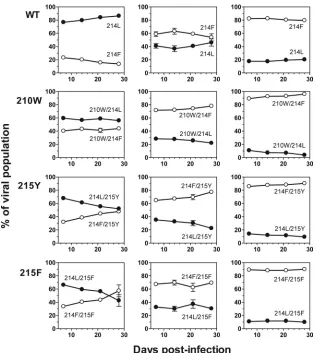
Growth competition assays were performed to assess the
previous results. Recombinant viruses with either Phe-214 or
Leu-214 in an otherwise isogenic viral backbone were
com-FIG. 1. Diagram of the viral variants generated by site-directed
mutagenesis. Briefly, the Leu-214 (214L) polymorphism was
intro-duced in the pNL4-3 background, which contained the Phe-214 (214F)
variant. Trp-210 (210W), Tyr-215 (215Y), or Phe-215 (215F) was then
combined with each of these Phe-214 and Leu-214 backgrounds.
FIG. 2. Replication kinetics assay. The slope of p24 antigen
pro-duction of each TAM-mutated virus after infection of PBMC was
compared to the slope of the corresponding wild-type virus harboring
the same 214 background (Phe-214 in gray bars and Leu-214 in black
bars). Error bars represent the standard deviations of two independent
experiments. Statistical analyses were performed by using the Student
t
test. WT, wild type.
on November 8, 2019 by guest
http://jvi.asm.org/
[image:2.585.44.282.66.155.2] [image:2.585.317.521.70.195.2]peted. A total of four different competition viral variant pairs
were established: Phe-214 versus Leu-214, Trp-210/Phe-214
versus Trp-210/Leu-214, Phe-214/Tyr-215 versus
Leu-214/Tyr-215, and Phe-214/Phe-215 versus Leu-214/Phe-215. The data
obtained from the growth competition experiments are
consis-tent with those previously obtained in the replication kinetics
assays: the clearest evidence of comparative disadvantage was
observed between the two viruses containing Tyr-215 (Fig. 3),
since Leu-214/Tyr-215 shows a 8.4%
⫾
0.8% loss of fitness
when competed with Phe-214/Tyr-215.
Susceptibility to ZDV.
The viral variants containing Phe-214
[image:3.585.135.451.66.419.2]and Leu-214 in combination with the wild-type Thr-215 or the
[image:3.585.114.472.571.688.2]FIG. 4. Replication kinetics of wild-type (WT) and Tyr-215 (215Y) HIV-1 variants in the presence of 0.02
M (A), 0.2
M (B), and 1
M
(C) ZDV. The slope of p24 antigen production in each experiment was compared to the slope of the corresponding nonmutated wild-type virus
harboring the same 214 background in the absence of drug (Phe-214 in gray bars and Leu-214 in black bars). Error bars represent the standard
deviations of two independent experiments. Statistical analyses were performed by using the Student
t
test.
FIG. 3. Growth competition assays between Phe-214 (214F) and Leu-214 (214L) in wild-type (WT), Trp-210 (210W), Tyr-215 (215Y) or
Phe-215 (215F)-mutated HIV-1 variants; the Leu-214 variant is represented with solid symbols and Phe-214 with open symbols. Each pair of viruses
was mixed at initial ratios of 20:80 (first column), 50:50 (second column) and 80:20 (third column), and the proportion of each viral variant was
determined at days 7, 14, 21, and 28. The error bars represent the standard error of two independent experiments.
on November 8, 2019 by guest
http://jvi.asm.org/
thymidine analogue-associated mutation Tyr-215 were selected
to perform replication kinetics assays in the presence of 0.02,
0.2, and 1
M ZDV. When cultured at 0.02
M ZDV, the
wild-type Thr-215 variants remained more replicative than the
Tyr-215 mutants (Fig. 4A), as expected, because the ZDV IC
50in wild-type-susceptible virus is 0.033
M (25). In contrast,
both Tyr-215 mutants—whether containing Phe-214 or
Leu-214—replicated better at 0.2
M ZDV (Fig. 4B). In these
conditions, Phe-214/Tyr-215 replicated better than Leu-214/
Tyr-215. When 1
M ZDV was used in the cell culture, the
replication advantage of Phe-214/Tyr-215 was even greater
(Fig. 4C). Our findings demonstrate that the Tyr-215 mutation
in a Phe-214 background results in better replication kinetics
and greater fitness than with Leu-214 in the absence or
pres-ence of ZDV.
Molecular modeling studies.
In order to test whether the
structural proximity of the side chains at positions 214 and 215
could explain the different levels of viral replication and
sus-ceptibility to ZDV, we built molecular models of the RT
vari-ants containing the Tyr-215 mutation in complex with a
tem-plate primer containing ZDV- or dTMP-terminated primers
and evaluated the interaction energy (
⌬
E) for the four RT
complexes. According to the theoretical models, the
calcu-lated
⌬
E of ZDVMP primer template with the RT
contain-ing Phe-214 and Tyr-215 was higher than that observed with
the enzyme containing Leu-214 and Tyr-215 (
⌬
E in kcal/
FIG. 5. Molecular modeling analysis of ZDVMP and dTMP interactions in the optimized complex of RT Phe-214/Tyr-215 (A and C) and RT
Leu-214/Tyr-215 (B and D) bound to template primers blocked at their 3
⬘
ends. The enzyme and DNA are shown, respectively, as yellow-orange
and orange diagrams; the 3
⬘
-terminal nucleotides and the RT residues involved in hydrogen bonding are represented, respectively, as green and
gray carbon sticks. Hydrogen bonds are indicated with yellow dashed lines.
on November 8, 2019 by guest
http://jvi.asm.org/
showed a favorable energetic profile, since the interaction
en-ergy for the dTMP moiety was slightly lower than for the
Leu-214/Tyr-215 combination (
⌬
E in kcal/mol,
⫺
4,836.35
ver-sus
⫺
4,830.22). Such an observation was further supported by
the higher stabilization of the dTMP due to the specific
hydro-gen bond established between the nucleotide and the p66
Ala-114 backbone only in the RT harboring the Phe-214/Tyr-215
combination (Fig. 5C and D).
DISCUSSION
In the absence of drug, Tyr-215 and Trp-210, both included
in the TAM1 pattern, confer higher replication capacities
when in combination with Phe-214, whereas the Phe-215
mu-tation, considered a TAM2, did not show any significant
ad-vantage. The impact of the Leu-214 polymorphism on viral
replication when associated with other changes in the RT
structure may explain the strong negative association observed
in NRTI-failing patients between TAM1 and Leu-214,
proba-bly by affecting the stability of the dTMP-enzyme complex by
interactions between aromatic side chains at close positions
(Fig. 5).
The proportion of patients who experienced virological
fail-ure at 48 months after starting thymidine analogue-based
com-bination ART was 16% in patients with Leu-214 and 36% in
those with Phe-214, if previously ART-naive patients, or 47%
in patients with Leu-214 and 72% in those with Phe-214, if
ART-experienced patients (3). Our results provide additional
insights into the favorable impact of Leu-214 on the virological
response to thymidine analogue-based treatments. This effect
could be due to the fact that Leu-214 somehow inhibits the
development of TAM1. It has been reported that this
muta-tional profile confers higher phenotypic resistance to NRTIs
than TAM2, thus providing a favorable effect on virological
response (6, 7, 15, 26). Moreover, our results suggest that
Leu-214 not only influences viral fitness but could also play a
direct role in drug susceptibility. Thus, viruses containing
Tyr-215 in their RT were more susceptible to ZDV in the presence
of Leu-214 than in the presence of Phe-214. Our molecular
modeling studies highlighted a favorable interaction energy of
ZDVMP primer template for the variant containing Leu-214/
Tyr-215. These data would be consistent with a higher genetic
barrier for excision of the inhibitor in the presence of a
pyro-phosphate donor. However, geometrical constraints arising
from the different conformation of the ZDVMP moiety in the
binary complex could also affect the removal of the inhibitor.
Our results also support previous reports showing that Tyr-208,
Lys-211 and Phe-214 substitutions, despite lacking a direct
effect on drug resistance per se, could increase ZDV resistance
and cross-resistance when they appear in combination with
amino acid substitutions of the TAM1 pathway (7, 23, 28).
The present study evaluates the in vitro effect of Leu-214 on
the single TAM1 Trp-210 and Tyr-215, since they showed a
highly complex, involving a larger number of mutations
clus-tering together, other TAMs, including Leu-41, Asp-44,
Asn-67, Arg-70, and Gln-219, have yet to be evaluated in vitro.
More complex approaches with diverse combinations of these
TAMs could also improve our understanding of this
associa-tion mechanism. Further modeling studies by means of
molec-ular dynamics simulations could provide interesting insights
into each mutation effect on the enzyme conformational
prop-erties and additional correlations with resistance profiles.
In conclusion, the effect of Leu-214 on the RT structure of
HIV-1 directly affects the growth rate and drug susceptibility of
drug-resistant variants containing TAM1. These results help to
explain the putative role of Leu-214 in regulating the
emer-gence of these viral variants and in enhancing the virological
response to thymidine analogue-containing ART.
ACKNOWLEDGMENTS
This study was supported by the Fundacio
´n para la Investigacio
´n y
Prevencio
´n del Sida en Espan
˜a through grant 36771/08, by the the
Spanish AIDS network Red Tema
´tica Cooperativa de Investigacio
´n en
SIDA (RD06/0006), and by grants from the Italian National Institute
of Health and the Italian Ministry of University and Scientific
Re-search. We acknowledge support from CHAIN, Collaborative HIV
and Anti-HIV Drug Resistance Network, Integrated Project no.
223131, funded by the European Commission Framework 7 Program.
REFERENCES
1.Adachi, A., H. E. Gendelman, S. Koenig, T. Folks, R. Willey, A. Rabson, and M. A. Martin.1986. Production of acquired immunodeficiency syndrome-associated retrovirus in human and nonhuman cells transfected with an
infectious molecular clone. J. Virol.59:284–291.
2.Alcaro, S., F. Gasparrini, O. Incani, S. Mecucci, D. Misiti, M. Pierini, and C. Villani.2000. A quasi-flexible automatic docking processing for studying stereoselective recognition mechanisms. Part I. Protocol Validation.
J. Comp. Chem.21:515–530.
3.Ceccherini-Silberstein, F., A. Cozzi-Lepri, L. Ruiz, A. Mocroft, A. N. Phil-lips, C. H. Olsen, J. M. Gatell, H. F. Gunthard, P. Reiss, C. F. Perno, B. Clotet, and J. D. Lundgren.2007. Impact of HIV-1 reverse transcriptase polymorphism F214L on virological response to thymidine analogue-based regimens in antiretroviral therapy (ART)-naive and ART-experienced
pa-tients. J. Infect. Dis.196:1180–1190.
4.Ceccherini-Silberstein, F., F. Gago, M. Santoro, C. Gori, V. Svicher, F. Rodriguez-Barrios, R. d’Arrigo, M. Ciccozzi, A. Bertoli, A. d’Arminio mon-forte, J. Balzarini, A. Antinori, and C. F. Perno.2005. High sequence con-servation of human immunodeficiency virus type 1 reverse transcriptase under drug pressure despite the continuous appearance of mutations. J.
Vi-rol.79:10718–10729.
5.Cong, M. E., W. Heneine, and J. G. Garcia-Lerma.2007. The fitness cost of mutations associated with human immunodeficiency virus type 1 drug
resis-tance is modulated by mutational interactions. J. Virol.81:3037–3041.
6.Cozzi-Lepri, A., L. Ruiz, C. Loveday, A. N. Phillips, B. Clotet, P. Reiss, B. Ledergerber, C. Holkmann, S. Staszewski, and J. D. Lundgren.2005. Thy-midine analogue mutation profiles: factors associated with acquiring specific profiles and their impact on the virological response to therapy. Antivir.
Ther.10:791–802.
7.De Luca, A., S. Di Giambenedetto, L. Romano, A. Gonnelli, P. Corsi, M. Baldari, M. Di Pietro, S. Menzo, D. Francisci, P. Almi, and M. Zazzi.2006. Frequency and treatment-related predictors of thymidine-analogue mutation patterns in HIV-1 isolates after unsuccessful antiretroviral therapy. J. Infect.
Dis.193:1219–1222.
8.Flandre, P., D. Descamps, V. Joly, V. Meiffredy, C. Tamalet, J. Izopet, and F. Brun-Vezinet.2004. A survival method to estimate the time to occurrence of mutations: an application to thymidine analogue mutations in
HIV-1-in-fected patients. J. Infect. Dis.189:862–870.
on November 8, 2019 by guest
http://jvi.asm.org/
9.Gibbs, J. S., D. A. Regier, and R. C. Desrosiers.1994. Construction and in vitro properties of HIV-1 mutants with deletions in “nonessential” genes.
AIDS Res. Hum. Retrovir.10:343–350.
10.Gonzales, M. J., T. D. Wu, J. Taylor, I. Belitskaya, R. Kantor, D. Israelski, S. Chou, A. R. Zolopa, W. J. Fessel, and R. W. Shafer.2003. Extended spectrum of HIV-1 reverse transcriptase mutations in patients receiving
multiple nucleoside analog inhibitors. AIDS17:791–799.
11.Halgren, T. A.1996. Merck molecular force field. I, II, III, IV, and V. J.
Comput. Chem.17:490–641.
12.Hanna, G. J., V. A. Johnson, D. R. Kuritzkes, D. D. Richman, A. J. Brown, A. V. Savara, J. D. Hazelwood, and R. T. D’Aquila.2000. Patterns of resis-tance mutations selected by treatment of human immunodeficiency virus type 1 infection with zidovudine, didanosine, and nevirapine. J. Infect. Dis.
181:904–911.
13.Harrigan, P. R., S. Bloor, and B. A. Larder.1998. Relative replicative fitness of zidovudine-resistant human immunodeficiency virus type 1 isolates in
vitro. J. Virol.72:3773–3778.
14.Harrigan, P. R., I. Kinghorn, S. Bloor, S. D. Kemp, I. Najera, A. Kohli, and B. A. Larder.1996. Significance of amino acid variation at human immuno-deficiency virus type 1 reverse transcriptase residue 210 for zidovudine
sus-ceptibility. J. Virol.70:5930–5934.
15.Japour, A. J., S. Welles, R. T. D’Aquila, V. A. Johnson, D. D. Richman, R. W. Coombs, P. S. Reichelderfer, J. O. Kahn, C. S. Crumpacker, D. R. Kuritzkes, et al.1995. Prevalence and clinical significance of zidovudine resistance mutations in human immunodeficiency virus isolated from patients after
long-term zidovudine treatment. J. Infect. Dis.171:1172–1179.
16.John, M., C. B. Moore, I. R. James, and S. A. Mallal.2005. Interactive selective pressures of HLA-restricted immune responses and antiretroviral
drugs on HIV-1. Antivir. Ther.10:551–555.
17.Korber, B. T., B. T. Foley, K. L. Kuiken, S. K. Pillai, and J. G. Sodroski.
1998. Numbering positions in HIV relative to HXB2CG, p. 102–111.InC.
Kuiken, B. Foley, B. Hahn, P. Marx, F. McCutchan, J. Mellors, S. Wolinsky, and B. Korber (ed.), HIV sequence compendium 1998. Theoretical Biology and Biophysics Group, Los Alamos, NM.
18.Li, M., F. Gao, J. R. Mascola, L. Stamatatos, V. R. Polonis, M. Koutsoukos, G. Voss, P. Goepfert, P. Gilbert, K. M. Greene, M. Bilska, D. L. Kothe, J. F. Salazar-Gonzalez, X. Wei, J. M. Decker, B. H. Hahn, and D. C. Montefiori.
2005. Human immunodeficiency virus type 1 env clones from acute and early subtype B infections for standardized assessments of vaccine-elicited
neu-tralizing antibodies. J. Virol.79:10108–10125.
19.Marcelin, A. G., C. Delaugerre, M. Wirden, P. Viegas, A. Simon, C. Katlama, and V. Calvez.2004. Thymidine analogue reverse transcriptase inhibitors resistance mutations profiles and association to other nucleoside reverse transcriptase inhibitors resistance mutations observed in the context of
vi-rological failure. J. Med. Virol.72:162–165.
20.Martinez-Picado, J., and M. A. Martinez.2008. HIV-1 reverse transcriptase inhibitor resistance mutations and fitness: a view from the clinic and ex vivo.
Virus Res.134:104–123.
21.Martinez-Picado, J., T. Wrin, S. D. Frost, B. Clotet, L. Ruiz, A. J. Brown, C. J. Petropoulos, and N. T. Parkin.2005. Phenotypic hypersusceptibility to multiple protease inhibitors and low replicative capacity in patients who are chronically infected with human immunodeficiency virus type 1. J. Virol.
79:5907–5913.
22.Meyer, P. R., S. E. Matsuura, A. G. So, and W. A. Scott.1998. Unblocking of chain-terminated primer by HIV-1 reverse transcriptase through a
nucle-otide-dependent mechanism. Proc. Natl. Acad. Sci. USA95:13471–13476.
23.Miller, M. D., N. Margot, B. Lu, L. Zhong, S. S. Chen, A. Cheng, and M. Wulfsohn.2004. Genotypic and phenotypic predictors of the magnitude of response to tenofovir disoproxil fumarate treatment in
antiretroviral-expe-rienced patients. J. Infect. Dis.189:837–846.
24.Mohamadi, F., N. G. J. Richards, W. C. Guida, R. Liskamp, M. Lipton, C. Caufield, G. Chang, T. Hendrickson, and W. C. Still.1990. MacroModel: an integrated software system for modeling organic and bioorganic molecules
using molecular mechanics. J. Comput. Chem.11:440–467.
25.Ntemgwa, M., M. A. Wainberg, M. Oliveira, D. Moisi, R. Lalonde, V. Mich-eli, and B. G. Brenner.2007. Variations in reverse transcriptase and RNase H domain mutations in human immunodeficiency virus type 1 clinical iso-lates are associated with divergent phenotypic resistance to zidovudine.
An-timicrob. Agents Chemother.51:3861–3869.
26.Rhee, S. Y., T. Liu, J. Ravela, M. J. Gonzales, and R. W. Shafer.2004. Distribution of human immunodeficiency virus type 1 protease and reverse transcriptase mutation patterns in 4,183 persons undergoing genotypic
re-sistance testing. Antimicrob. Agents Chemother.48:3122–3126.
27.Sarafianos, S. G., A. D. Clark, Jr., K. Das, S. Tuske, J. J. Birktoft, P. Ilankumaran, A. R. Ramesha, J. M. Sayer, D. M. Jerina, P. L. Boyer, S. H. Hughes, and E. Arnold.2002. Structures of HIV-1 reverse transcriptase with
pre- and posttranslocation AZTMP-terminated DNA. EMBO J.21:6614–
6624.
28.Sturmer, M., S. Staszewski, H. W. Doerr, B. Larder, S. Bloor, and K. Hertogs.2003. Correlation of phenotypic zidovudine resistance with muta-tional patterns in the reverse transcriptase of human immunodeficiency virus type 1: interpretation of established mutations and characterization of new polymorphisms at codons 208, 211, and 214. Antimicrob. Agents Chemother.
47:54–61.
29.Svicher, V., T. Sing, M. M. Santoro, F. Forbici, F. Rodriguez-Barrios, A. Bertoli, N. Beerenwinkel, M. C. Bellocchi, F. Gago, A. d’Arminio Monforte, A. Antinori, T. Lengauer, F. Ceccherini-Silberstein, and C. F. Perno.2006. Involvement of novel human immunodeficiency virus type 1 reverse transcrip-tase mutations in the regulation of resistance to nucleoside inhibitors. J.
Vi-rol.80:7186–7198.
30.Villena, C., J. G. Prado, M. C. Puertas, M. A. Martinez, B. Clotet, L. Ruiz, N. T. Parkin, L. Menendez-Arias, and J. Martinez-Picado.2007. Relative fitness and replication capacity of a multinucleoside analogue-resistant clin-ical human immunodeficiency virus type 1 isolate with a deletion of codon 69
in the reverse transcriptase coding region. J. Virol.81:4713–4721.
31.Wallace, A. C., R. A. Laskowski, and J. M. Thornton.1995. LIGPLOT: a program to generate schematic diagrams of protein-ligand interactions.
Pro-tein Eng.8:127–134.
32.Wolf, K., H. Walter, N. Beerenwinkel, W. Keulen, R. Kaiser, D. Hoffmann, T. Lengauer, J. Selbig, A. M. Vandamme, K. Korn, and B. Schmidt.2003. Tenofovir resistance and resensitization. Antimicrob. Agents Chemother.
47:3478–3484.
33.Yahi, N., C. Tamalet, C. Tourres, N. Tivoli, F. Ariasi, F. Volot, J. A. Gastaut, H. Gallais, J. Moreau, and J. Fantini.1999. Mutation patterns of the reverse transcriptase and protease genes in human immunodeficiency virus type 1-infected patients undergoing combination therapy: survey of 787
se-quences. J. Clin. Microbiol.37:4099–4106.
34.Yahi, N., C. Tamalet, C. Tourres, N. Tivoli, and J. Fantini.2000. Mutation L210W of HIV-1 reverse transcriptase in patients receiving combination therapy. Incidence, association with other mutations, and effects on the
structure of mutated reverse transcriptase. J. Biomed. Sci.7:507–513.
on November 8, 2019 by guest
http://jvi.asm.org/