Rochester Institute of Technology
RIT Scholar Works
Theses Thesis/Dissertation Collections
2001
Algorithm for MTF estimation by histogram
modeling of an edge
Brian Perry
Follow this and additional works at:http://scholarworks.rit.edu/theses
This Thesis is brought to you for free and open access by the Thesis/Dissertation Collections at RIT Scholar Works. It has been accepted for inclusion in Theses by an authorized administrator of RIT Scholar Works. For more information, please [email protected].
Recommended Citation
SIMG-503
Senior Research
Algorithm for MTF Estimation by
Histogram Modeling of an Edge
Final Report
Brian Perry
Center for Imaging Science Rochester Institute of Technology
Table of Contents
I. Abstract……… 3
II. Copyright………. 4
III. Acknowledgment………. 5
IV. Background……….. 6
V. Experimental Design and Methods……….. 8
VI. Results……….. 11
VII. Discussion and Conclusion……….. 15
I. Abstract
The Modulation Transfer Function, or MTF, is a property of an imaging system
that describes the effect that the system has on the sharpness of an object. It is an
important image quality metric that has applications in almost every major Imaging
Science application. The traditional method of determining the MTF, however, relies on
aligning an edge perpendicular to the scan line that will be used to take the measurement.
This may not always be a convenient orientation for your experiments. It is hypothesized
that there is a relationship between the histogram of the scan line (regardless of its
position) and the MTF of the system. This research project will explore this relationship
II. Copyright
Copyright © 2001
Center for Imaging Science
Rochester Institute of Technology
Rochester, NY 14623-5604
This work is copyrighted and may not be reproduced in whole or part without permission of the Center for Imaging Science at the Rochester Institute of Technology.
This report is accepted in partial fulfillment of the requirements of the course SIMG-503 Senior Research.
Title: Algorithm for MTF Estimation by Histogram Modeling of an Edge. Author: Brian Perry
Project Advisor: Dr. Jonathan Arney SIMG 503 Instructor: Anthony Vodacek
III. Acknowledgment
I want to extend a special thanks to Dr Jonathan Arney for his outstanding help
and guidance in this Research Project in his role as my Research Advisor. I would also
like to thank him for his support and guidance in my studies here at the Center for
IV. Background
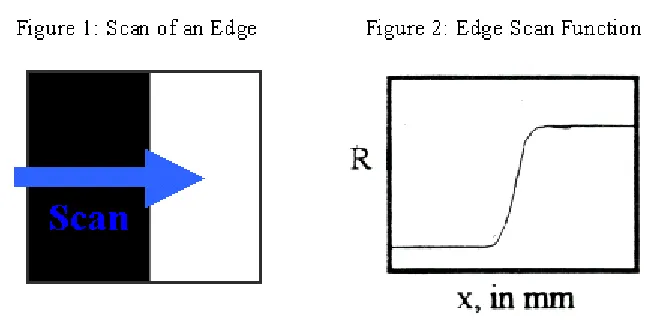
The traditional method of calculating the MTF involves taking an edge scan of an
image perpendicular to the edge as illustrated in Figure 1. The scan averages all the
pixels in the vertical direction parallel to the edge, and the result is a graph of reflectance
[image:7.612.141.464.258.424.2]versus position as shown in Figure 2.
Figure 2 is also referred to as the edge spread function. This function gives a very good
description of what the line scan looks like. In this case you can see that the edge doesn’t
appear to be an instantaneous transition, but in fact it is a gradual transition from Black
through the grays to white. This begins to give us some information about how the
imaging system treats edges.
The next step is to take the derivative of the edge scan function.
dx dR x Function Spread
Line ( )= (1)
The resultant Line Spread Function, illustrated in figure 3, gives us a function that
The line spread function is the probability density function for the location of the edge in
the output image. In an imaging system with perfect resolution, this function would be a
delta function of zero width.
The Modulation Transfer function, MTF(ω), is the line spread function
represented in the frequency domain, ω. In this new space the MTF provides us
information on what frequencies are attenuated by the imaging system. In order to get
from the Line Spread Function to the MTF you have to use a Fourier Transform function
as illustrated in equation 2.
( )
FFT{
LSF(x)}
MTFω = (2)
The value of MTF(ω) in Figure 4 is the fraction of the contrast of the image that is
attenuated by the imaging system for image features at each spatial frequency, ω. In this
particular graph the low frequencies get through with little attenuation but quickly drop
off at higher frequencies. In this way the MTF is an important tool in describing how an
V. Experimental Design and Methods
The main problem that this project was designed to solve involves finding the
MTF of images in which the edge is not perfectly perpendicular.
If the MTF were taken of these two images, one would find that the MTF of the second
image appears lower, even though both images are from the same system and therefore
must have the same MTF. The challenge is to find a technique that will produce the same
MTF regardless of the orientation of the edge. One might, for example, try to develop a
way to locate the perpendicular direction and perform a slant scan, or to adjust the image
to make the edge perpendicular to the direction of the scan. The approach taken in this
project was to abandon the scan process and to show that the edge scan function, R(x) vs
x, can be calculated directly from the gray level histogram of the image regardless of the
orientation of the edge.
Traditional wisdom in imaging science holds that the gray level histogram of an
image contains no spatial information. This, however, is not entirely true. The histogram
by itself is not sufficient to give spatial information, but with additional information
about the spatial characteristics of an image, it is often possible to extract quantitative
spatial information from the histogram. The additional information needed to constrain
The additional information is that the image is an edge. This means the gray values
increase monotonically across the image in the direction perpendicular to the edge.
Figures 5 and 6 demonstrate how the histograms of a sharp and a smooth edge
must differ. The gray levels increase in the histogram from left to right. This also
represents a monotonic spatial motion across the edge in the perfectly orthogonal scan
direction. The differences between the histograms of the sharp and soft edges is clearly
shown in Figures 5 and 6. There are far fewer mid-tone gray values in the sharp edge.
Indeed, as will be shown below, the shape of the mid-tone gray portion of the histogram
is a direct measure of the edge sharpness and the line spread function.
The histogram of an edge image can be interpreted as being proportional to the
rate of change of position with respect to the change in R.
dR dx R
Histogram( )= (3)
By integrating the Histogram we find the Cumulative Distribution Function.
∫
= = R R dR R Histogram R CDF 0 ) ( ) ( (4)The CDF(R) function is the location along the edge according to equation (5), and the
inverse of Figure 7 is the edge function, R(x) versus position, x.
) ( )
(R CDF R
x = (5)
Experimentally, we rotate Figure 7 ninety degrees clockwise and obtain the line spread
function of Figure 2. This is the line scan function for x as the scan direction that is
orthogonal to the edge. We should then be able to derive the MTF using the steps outline
VI. Results
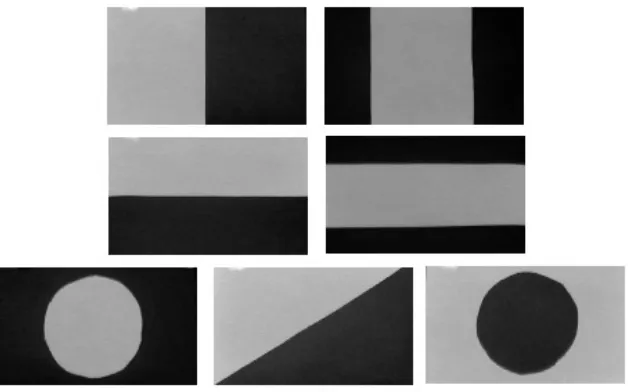
We designed 7 different geometries to test our theory. All of the images contained
approximately the same amount of light and dark space. Figure 8 shows the 7 different
targets: Single Vertical Edge, Double Vertical Edge, Single Horizontal Edge, Double
Horizontal Edge, Single Diagonal Edge, Light Circle on a Dark Background and Dark
[image:12.612.150.464.281.477.2]Circle on a light background.
Figure 8: The different test images
Figure 9 shows the results of our histogram analysis for the single vertical edge.
Our histogram method produced line (A), and line (B) was produced by the traditional
method. This shows that the histogram method produces a remarkably similar result to
the traditional edge method. We would expect this to happen considering that our theory
is based on the assumption that the image is increasing monotonically in the horizontal
Figure 9: Comparison of the histogram analysis, Line (A), with the traditional edge analysis, Line (B). Responsivity is the MTF for the traditional edge analysis, Line (B), but it is the response function F(ω) for the histogram analysis technique. The frequency
at 1/2 response is the same for both.
0 50 100 150 200
1
0 0.5
(A) (B)
Frequency ω in cycles per field of view
Responsivity ω
1/2 = 78 cy/fov
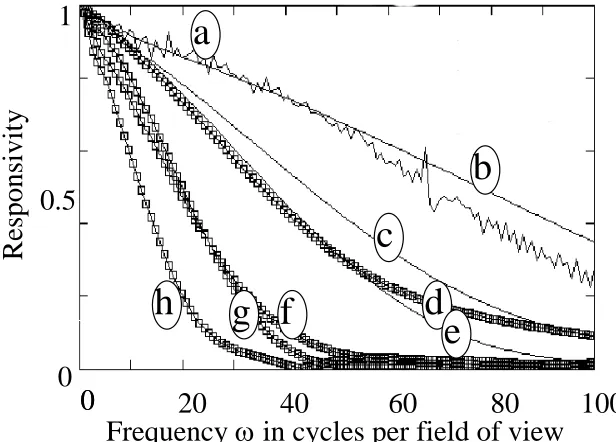
Figure 10: The MTF for the traditional edge scan technique (a), and the response functions for the histogram technique applied the images in Figure 1. Lines (b) through
(h) are respectively the single vertical, double vertical, diagonal, single horizontal, double horizontal, dark circle, and light circle.
Responsivity
1
0.5
0
0
0
20
40
60
100
[image:13.612.150.458.465.686.2]Figure 11 shows the results of the histogram analysis applied to all of the test
edges of Figure 8, and clearly the nature of the edge has a significant effect on the results
of the analysis. Figure 11 indicates that as the length of the edge increases, the response
curve shifts to lower frequency. Table I summarizes the effect of edge length on the
[image:14.612.158.453.280.438.2]wavelength (1/frequency) at a response of 0.5.
Table I: Summary of edge length and 50% wavelength (L and λ1/2 ) for the images in Figure 8.
Type of Edge
Image
Edge Length (pixels)
λ
hal f(mm)
One Vertical
374
7.0
Two Vertical
635
16.2
One Horizontal
748
15.5
Two Horizontal
1270
45.4
One Diagonal
737
12.5
Dark Circle
1000
28.9
White Circle
1000
28.9
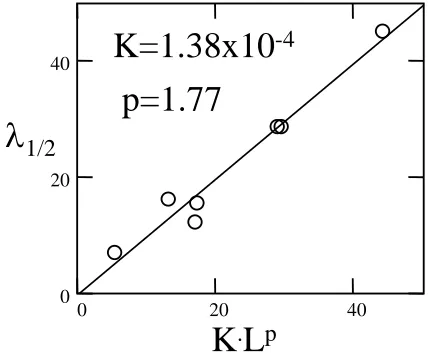
Figure 11: Wavelength at 50% response, λ1/2 , versus a power
function of the edge length, K.Lp, from the data in Table I.
0 20 40
0 20 40
λ
1/2K
.L
pK=1.38x10
-4 [image:14.612.201.415.525.704.2]Figure 11 illustrates the data in Table I. Empirically it was found that the data fit
well with equation (6) with constants K = 0.000138 and p = π .
p
K
L= ⋅(λ1/2) (6)
Using this equation, we can derive a general expression for converting the histogram
response function, F(ω), to an estimate of the MTF(ω) function. We do this by
assuming, based on experimental evidence, that F(ω) = MTF(ω) for the single vertical
edge of length Lo. Then it can be shown from equation (6) that the MTF(ω) function is
given by equation (7).
⎥ ⎥ ⎦ ⎤ ⎢ ⎢ ⎣ ⎡ ⎟ ⎠ ⎞ ⎜ ⎝ ⎛ ⋅ = P o L L F
MTF(ω) ϖ (7)
The advantage of using a test target with multiple edges is in the increased data available
for estimation of the shape of the MTF. By using equation (7), the multiple edge target
can be used with the histogram analysis technique to estimate the MTF. However, it is
important to recognize that equation (7) is an empirical expression found by fitting
experimental data. It would be very useful to derive a justification for equation (7) from
VII. Discussion and Conclusion
In this experiment we demonstrated that it is possible to arrive at the modulation
transfer function by having only a histogram and an assumption about image
composition. We know that this technique is not sensitive to small errors in the edge
orientation. We were able to derive an expression to describe the relationship between
wavelength and edge length in this set of images. Our data can be calibrated to a wide
range of edge types ranging from a single vertical edge to a circle. In addition, this
project has exposed some issues that deserve more research attention.
• The Theoretical Origin of Equation 6
We are still attempting to understand the theory that dictates equation 6. The
constant K depends on the experimental field of view and must be determined by
calibration every time the instrument is set up. It seems logical that the power p should
be a universal characteristic, and we hope that future research will help to derive the
theory that gives us the value of p.
• Noise
Experimental noise seems to manifests itself differently in this analysis, and we
still don't have a full evaluation of the effect of noise. The histogram analysis technique
assumes that gray level changes monotonically with location orthogonal to the edge.
Random fluctuations in gray level are treated experimentally as monotonic gray level
and after the location of the edge. Presumably it will be possible to correct for such
random noise by a simple slope adjustment, but further research will be needed to fully
develop this analytical technique of MTF estimation.
• What are the Boundaries of this Technique
We know already that there will be limitations to this technique. For example, if
the edges are enhanced in a way that results in a non-monotonic change in gray level with
location, this technique will incorrectly reconstruct the MTF. We need to know what
other limits may exist in this analysis.
Although a number of uncertainties remain regarding the extraction of spatial
information form the histogram, this project has demonstrated that histograms, with
limits, do have the potential of providing useful spatial information. Thus, the major
contribution of this project is to demonstrate that additional research in this area would be
VII. References
Arney, J.S and Wong, Yat-Ming, “Histogram Analysis of the Microstructure of
Halftone Images.” IS&T’s 1998 PICS Conference