THE CARING COMMODITY
Transformations in the Exchange Character of Medicine in New Zealand
(1840-1985)
A thesis presented to the Department of Geography,
Massey University in complete fulfilment of the requirements for the degree of
Master of Arts. I a i n Mi 11 Hay
A cloud does not know why it moves in just such a
direction and at such a speed
It feels an impulsion ... this is the place to go now. the reasons and the patterns
behind all clouds,
But the sky knows
and you will know too, when you lift yourself high enough
to see beyond horizons.
11
• • • the method of presentation must differ
in form from that of inquiry. The latter has to appropriate the material in detail, to analyse its different forms of development and to track down their inner connection. Only after this work has been done can the real movement be appropriately presented. If this is done successfully, if the life of the subject-matter is now reflected back in ideas then it may appear as if we have before us an a priori construction.11
Retrospective analysis of actions and interactions connected with health care makes evident their place as constituted and constitutive components of capitalist social relations. The contextually constrained activity of individuals to achieve certain ends has contributed to the production of outcomes which appear to be beyond individual control and which shape the social world. In explaining the main transformations in the character of medical services since the early days of European settlement emphasis is placed upon the multiple and differentiated emergence of various structures of relationships between, principally, doctors and patients, doctors and doctors, and those who, at various stages, have attempted to intervene in those relations.
Over the period 1840-1985, medical practice has been transformed from a service provided on a user-pays basis, to one of collective provision, and back towards the 'private• sector. In the six decades after 1840 medicine and the State became enmeshed. Some moves towards the State provision of health care services occurred. The period 1900-35 saw the supporters of both free enterprise and socialistic medicine inexorably drawn towards advocacy of some grand scheme of collective care, the character of which was extensively debated from 1935 until 1942. The outcome brought 1
free 1
provision of most medical care to those in need and also served the long term interests of capital. Since then, health care has been returning to the market. In part, the broad sweep from, and back to, commodity relations has arisen from actions to 1
solve1
The character of this thesis has been conditioned by numerous interactions. Although it would be desirable to acknowledge all of those people who helped me to produce the following pages various constraints prohibit this. There are however some individuals and groups of people who warrant special mention.
I would like to thank those who shaped my career and consciousness in my pre-Massey days, including, especially, Professor W.B. Johnston, members of the RNZAF, and Owen and Treev Harvey (boat-builders and philosophers).
Particular thanks for subsequent support and assistance are due to Professor K.W. Thomson, who saw fit to employ me, and all the other members of the Massey University Department of Geography who put up with me; to those involved in the health, academic and labour spheres of society who were subjected to frequent requests for advice and information; to Trisha Fleming who brought coherence to my typing and writing; to Karen Puklowski for the diagrams; and to my supervisor Richard Le Heron, whose patient and timely encouragement and assistance shone light in the dark.
I would also like to acknowledge my appreciation of the tolerance, advice and good-will of Dale Bailey, Mike Roche and Jane Abbiss.
ABSTRACT
ACKNOWLEDGEMENTS TABLE OF CONTENTS
LIST OF TABLES LIST OF FIGURES
LIST OF ABBREVIATIONS PROLOGUE
CHAPTER 1: SETTING OUT
TABLE OF CONTENTS
Moving from Positivism to Historical Materialism - positivism proves passe
- now let's be realistic
- things to come: historical materialism Capitalism: Conflict and Competition
Interests in Power? Circuits of Capital The State and Research
Different Artists, Different Critics, Different A Look at the Literature
This Picture
CHAPTER 2: SETTLING FOR THE STATE (c.1840-c.1900)
Page V vi vii ix Pictures X xi 1 2 2 2 3 5 5 8 10 12 13 18 24
Immigration, Integration and Imported Ideas 25 Depression and the Confirmation of Community Care 30 Keys to the Doors: Putting the Public in Hospital 39 Breaking Free: Professionalising Medical Practice 46 Plague and Problems: Public Health Arrives 51 CHAPTER 3: CLASSES AND CONFLICT. CONSOLIDATING COLLECTIVISM
(c.1900-c.1935) 57
Working Class Unity War for Freedom
'Free' Practice: Friendly Societies and Doctors as Foes
Private Hospital Licensing and Decline Rationalising Public Health and Hospitals Moving Left to Labour
CHAPTER 4: POUNDS AND PRINCIPLES: PAYING FOR CARE (c.1910-c.1935) 58 61 63 70 71 76 82
No Place for Honour: Closing Hospitals 83
Pay Wards Perhaps? 88
CHAPTER 5: DEGREES OF FREEDOM (c.1935-c.1942) 100
An Alternative Future: The Coalition Plan 103
The Antagonists and Their Champions 105
The Kurow Cure: Complete and Collective Care 108
The BMA's Battle Lines 110
Errors of Omission: The National Health
Insurance Investigation Committee 112
Stating the Case - 'Casing' the State? 114
The Brackenbury Relationships 120
Clashes of Character and Cause: Government-Doctor
Relations Collapse 122
Costs, Caucus, Constituents and other Concerns:
Facing the Public 124
Intransigence and Attrition: Doctors at Loggerheads
with Government 129
Losing the Lodges 140
CHAPTER 6: MORE MONEY MATTERS (c.1942-c.1960) 143
Labour's Gains and Losses 144
Growing Benefits - Growing Demands 146
Pushing to Private Hospitals 148
Paying the Doctor - No Token Gestures? 157 Scheduling a Change of View: The Medical Services
Committee 160
CHAPTER 7: THE CHAINS OF CHOICE (c.1960-c.1985) Public Pressures
Southern Cross Leads the Way Private Persuasions
"Hearts and Minds": Work, Unions and Insurance White and Blue: Efforts to Reorganise
Compensating for Labour CHAPTER 8: TERMINUS
Synopsis
APPENDICES
Relations with Capital The Nature of the Change What Now?
LIST OF NEW ZEALAND NATIONAL ARCHIVES CONSULTED BIBLIOGRAPHY
164
166 172 182
185
189 194
199
200 206
207
209
212
215
LIST OF TABLES
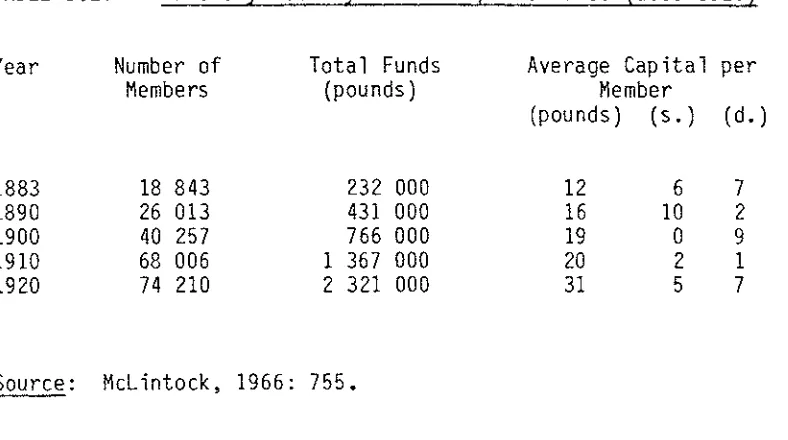
Page Table 3.1: Urbanisation (1896-1921) 59 Table 3.2: Friendly Society Membership and Funds
(1883-1920) 64
Table 3.3: Friendly Society Membership Relative
to Population (1887-1918) 64
Table 3.4: General Hospitals and Beds in
New Zealand (1905-15) 72
Table 7.1: Rural and Urban Populations as Percent
of Total Population (1956-81) 169 Table 7.2: Distribution of Population by Size of
Settlement Centres (1961-81) 169 Table 7.3: Private Hospital Beds by Hospital Type
LIST OF FIGURES
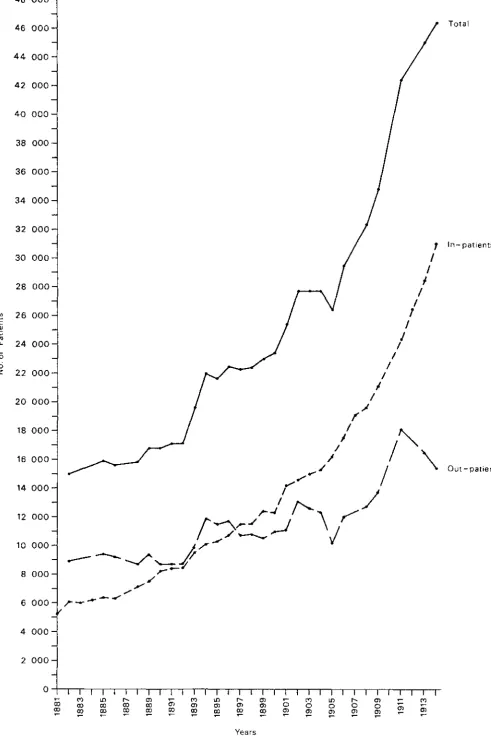
Page Figure 2.1: Hospital Patients - New Zealand
(1881-1914) 41
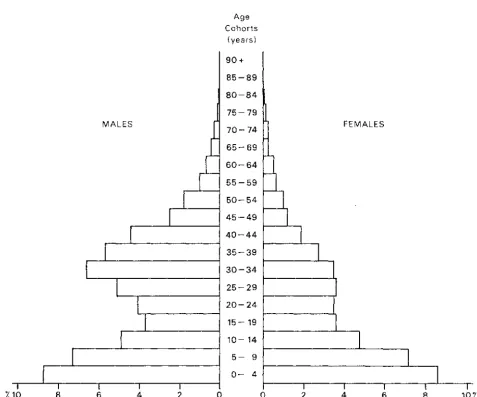
Figure 2.2: New Zealand: Age-Sex Pyramid
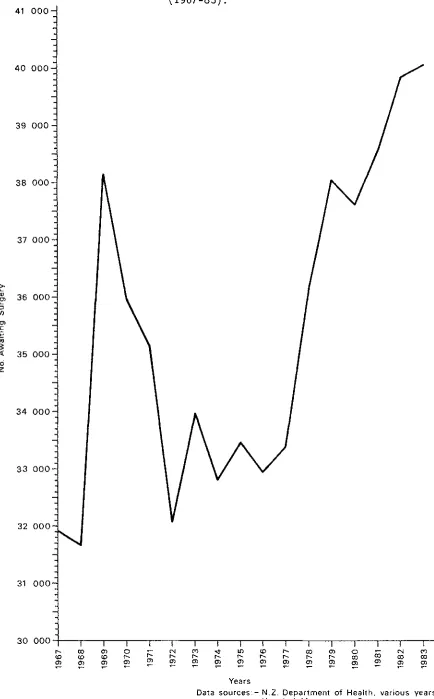
(Non-Maori Population) (1874) 44 Figure 7.1: Hospital Board Surgical Waiting Lists
(1967-83) 171
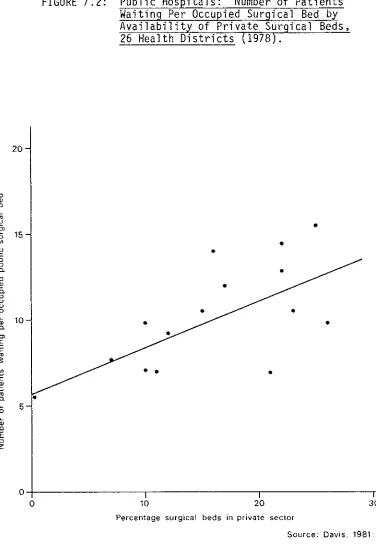
Figure 7.2: Public Hospitals: Number of Patients Waiting Per Occupied Surgical Bed By Availability Of Private Surgical Beds,
26 Health Districts (1978) 173 Figure 7.3: Southern Cross Medical Care Society:
The following abbreviations have been used throughout this thesis: ACC
AJHR BMA
BMA (N.Z. Branch)
DUG FOL
~s
IWW MANZ MP NHIC NHIIC
NZMA NZMJ PD SACHSO SOP ULP
Accident Compensation Commission until 1981. Thereafter, Accident Compensation Corporation. Appendices to the Journals of the House
of Representatives.
British Medical Association British Medical Association
(New Zealand Branch).
[Except where ambiguity is likely to arise BMA (N.Z. Branch) is shortened to BMA.J Distribution Unions' Group.
Federation of Labour.
General Medical Services Benefit. Industrial Workers of the World. Medical Association of New Zealand. Member of Parliament
National Health Insurance Committee (A Committee of the BMA (N.Z. Branch)). National Health Insurance
Investigation Committee (A Committee of Government).
New Zealand Medical Association. New Zealand Medical Journal.
New Zealand Parliamentary Debates. Special Advisory Committee on Health Services Organisation. Social Democrat Party.
PROLOGUE
SETTING
OUT
CHAPTER 1
SETTING OUT
Since 1961 the number of New Zealanders covered by private medical insurance has grown from 900 to more than one million, the latest numbers representing about one-third of the country's population (pers. comm., Medicaid Fund Society Limited; Southern Cross Medical Care Society; Mutual Health Society, Group Health Co-operative Society, January, 1985).
Whilst bringing a marked change to health care provision in New Zealand, medical insurance is not unusual throughout the world, and has become increasingly common since WWII. The Australian population has health insurance cover; insurance has been compulsory in Belgium since 1945; Brazil's Golden Cross organisation continues to show strong growth; since the passage of the Voluntary Health Insurance Act 1957 in Ireland the percentage of that country's population belonging to voluntary schemes climbed to 4.65 percent in 1962, 10 percent in 1967, and 17.5 percent in 1975 despite continued provision of the 'free' service by the state; membership of Jamaica's Blue Cross has increased by an average of about 13 percent per annum since its inception in 1956-7; 78 percent of the United States' civilian population is covered by private medical insurance; and even in Zimbabwe medical insurance continues to exist (International Federation of Voluntary Health Service Funds, 1976).
The geographic spread of health insurance is both symptomatic of, and conducive to, the progressive commodification of the relationships between the providers and recipients of medical care. It is part of long-term social relations.
MOVING FROM POSITIVISM TO HISTORICAL MATERIALISM Positivism Proves Passe
which has seen the promotion of data determined research; the assemblage of vast amounts of information which obscure the real nature of human activity (Slater, 1977:42); the illegitimate representation of 'soft ... facts' by precise numbers (Anderson, 1973:2); the dissociation of variables from their social and historical context (Pred, 1981b:6; Ferretti, 1981:3; Chouinard et al, 1984:353; Eyles and Lee, 1982:118 and 121; Slater, 1977:42; Anderson, 1973:3; Harvey, 1977a:215; Sayer, 1978:82-3; Marx cited in Sayer, 1978:82); and the related inabilities to explain underlying processes which give rise to surface social and spatial appearances (Sayer, 1978:80-1; Sayer, 1979b:1058-9 and 1063; Sayer, 1979a:35; Sayer, 1982b:119; Slater, 1977:43; Ferretti, 1981:3) or indeed to distinguish between causal and coincidental relations (Sayer, 1982b:119). Positivist research in social science has also been attacked for its production of a partial, atomistic, fragmented vision of our society (Wallerstein cited in Taylor, 1982:16; Taylor, 1982:16; Sayer, 1979b:1056; Sayer, 1979a:36; Anderson, 1973:2 and 3); its confusion of regularities with laws and explanation (Eyles and Lee, 1982:121; Sayer, 1979b:1059); the transferral of mathematical logic to social processes (Sayer,
the assumption that observation theoretically neutral, and that
1978:80; Sayer, and facts are theory merely
1979b:1060); ethically facilitates
and and the assembling of 'factual' knowledge in a deductive structure (Jessop, 1982:213; Eyles and Lee, 1982:120; Walker, 1981:6 and 8; Harvey, 1977a:213-4 and 217; Sayer, 1978:82 and 84; Sayer, 1979b:1062). The world is held to be external to the observer (Harvey, 1977a:217). Positivist thought is also seen to have various and damaging political consequences (Harvey, 1977a:240).
In efforts to purge human geography of positivist problems and to seek the 'real' causal mechanisms underpinning surface appearances a number of social scientists have accepted a 'realist'(l) view of the world, a derivative of which is historical materialism, alternatively labelled Marxism.
Now let's be 'realistic':
science is to uncover these real structures and the changes in their nature. Second, because realists believe that real structures exist, despite the fact that only effects are visible (Harvey, 1977a:227), they necessarily dissociate epistemology (the manner in which we develop knowledge) from ontology (what is considered to exist). Whilst positivist science builds knowledge upon the observable, realism seeks to know more about the observable in order to develop knowledge (Chouinard et al, 1984:358; Jessop, 1982:252). An awareness of the nature of the relationships between the people gives a fuller understanding of the surface appearance. Unlike non-realist social science, the logical constructs of which preclude the existence of unobservable metaphysical causes, realism acknowledges a relationship between structure and observable outcome.
Third, in realism, social scientific laws portray tendencies, not empirical regularities. Tendencies result from causal mechanisms but they are not always observable. If society was not an 'open' system in which innumerable possibilities of action existed it would be possible to observe a tendency as an empirical regularity.
Fourth, because society is an open system and, accordingly, causal mechanisms cannot be guaranteed to produce effects in certain forms, realist social science cannot be predictive. Instead, explanation of past events based upon theoretically informed analysis is the goal. Finally, real structures are the product of reciprocations between actions and social context (Sayer, 1982a:81). Individual actions shape the social world and that world shapes actions.
" ..• the mechanisms of the social world, which generate social activity, are themselves social products. They cannot be empirically identified as separate from the activities they generate. Social structures which cause social activity, being social products can change. These social structures are historically institutionalised pressures which constrain human choices: they are therefore more than the sum of individuals' actions at one time, but are not merely static entities since they must continually be activated by human action." (Chouinard et al, 1984:358).
to the greater whole of the society and structures which form the social context in which we live. Life and structure are inextricably enmeshed with one another. "Society produces men who produce, or create, society" (Pred, 1981b:7).
Finally, because human society is aligned into power hierarchies, it is evident that within the bounds of contextual constraints the separate actions of some key individuals, or agents, are likely to be of more consequence to the broad shape of society than those of others. The effects of significant individuals however have necessarily to be mediated by other individuals for without them the actions would have no meaning.
Things to Come: Historical Materialism
Historical materialism can be considered to be a variant of realism differing essentially in its premise that material production is the fundamental sculptor of social life (Harvey, 1977a:227; Chouinard et al, 1984:360; Peet, 1977:21; Peet, 1983:112). Realist social science has as a major task the identification of the causal mechanisms or structures which are being activated by human action (Chouinard et al, 1984:358). Historical materialists are concerned to identify how it is that individual social actions have reproduced and/or modified particular modes of production (Gough, 1979: 18-9; Chouinard et al, 1984: 338-60; Peet, 1977b:21) of which capitalism is but one (Gough, 1979:6). This necessitates an holistic view of time, place and social action. Despite an awareness of the need for holism, many historical materialist writers have abandoned consideration of historically and spatially specific situations in the quest for theory (e.g. Marx in Capital; Harvey, 1982; Taylor, 1982: Peet, 1983a). This thesis is an attempt to integrate one perception of reality with a theory of that reality.
Capitalism: Conflict and Competition
labourers, who do not own those means. Ownership of the means of production gives capitalists command over the work process, which is organised to produce profit, whilst the labour class may sell its labour power as a commodity on the market (Harvey, 1982:22; Harvey, 1978:101). It is fundamental to Marxism that if capitalists are to reproduce themselves they must continually expand the basis for profit (Harvey, 1978: 101-2). As profit is derived from the domination of labour by capital a number of forms of conflict arise. First, there is class conflict between capital and labour as capital meets resistance in its continual endeavours to extract more labour from workers. Second, there is intra-class conflict between capitalists in their competition to produce profit. These two forms of conflict and the relations between them were identified by Marx as forming the essential structure of the capitalist mode of production (Chouinard et al, 1984:359). It seems however that Marx omitted consideration of labour-labour conflict as workers struggle to sell their labour power in order to earn a living wage.
These causal relations of capitalism condition, in an interactive manner, the phenomena of the social world we see. That is:
•social phenomena may be explained with reference insofar as the phenomena are the product of the
(i.e. causal) processes which generate tendencies" al, 1984:359).
to tendencies, basic necessary (Chouinard et Thus, like other social phenomena, the character of medical practice is moulded by contradictory human relations. Medicine is not an instrument controlled by the owners of capital but instead is located in a mutually conditioning relationship with the class struggle. It is "the specific material condensation of a relationship of forces among classes and class fractions at a specific conjuncture" (Navarro, 1983a:189).
Capitalism is driven by the perpetual 1982:120; Harvey, 1988b:264; Forrest and the consequence that commodity relations
quest for profits (Harvey, Williams, 1984:1164) with
expand into non-capitalist societies or into domains of capitalist societies which previously operated on non-commodity bases (Castells cited in Forrest and Williams, 1984:1164). This is a process known as commodification.
is accompanied by:
• ... the permeation of values, of aspirations, and of belief in a normality communicated explicitly through the legal and educational systems and more subtly through the twists and turns of our day-to-day existence" (Forrest and Williams, 1984:1164). However, all of this is not to imply that the reverse process, decomDodification, cannot occur, for as will be shown later, it does. Decorrriodification in one social arena usually sees capital endeavour to expand commodity relations elsewhere. This may take form in efforts to returr. other decommodified elements of human interaction to the market, thereby recommodifying those relationships.
care. Thus, recommodification can rarely be replaced by non-commodity relations and, without struggle in the domain of the state, the labour class find it necessary to engage in exchange transactions for relations which once were existent as non-commodities. Working class antagonism towards such an outcome appears to have partly facilitated the emergence of private medical insurance in New Zealand. RecoIT1T,odification of some elements of health care has seen the development of a means to pay for care in ways compatible with patterns of labour exploitation which have evolved whilst medical care was
1
dec0Fi..modified 1 •
Interests in Power?
The expansion of commodity relations is inevitably a point of concern for the labour class which will constantly struggle, through the medium of the state, to secure the de- or non-commodification of relationships. The outcome of struggle will shape the nature of state policies with respect to commodities, for the state is the tool of neither capitalist nor worker. It is instead a non-unified force which is corrrnitted, as a result of class struggle, to the perpetuation of accumulation and legitimation and to reproducing commodity relations (Fincher and Ruddick, 1983:47). State power is the "form-determined condensation of the balance of forces in struggle" (Jessop, 1982:235). Class struggle, individual actions and state responses can only advance within socially defined bounds however. Existing structural limitations prevent the complete introduction of either commodity or non-commodity forms of relations; the characteristics of past relations shape policies and organisations such that struggle is modified; and social mechanisms may limit the options open to individuals and organisations (Fincher and Ruddick, 1983:48-9). These limitations upon actors in given situations can be subdivided into two groups (Jessop, 1982:252-3).
others. Hence, comparative and/or potential power of different agents in specific situations can be assessed in terms of the structural and conjunctural constraints impinging upon them.
Power is the production of specific effects by agents within the bounds set by structural and conjunctural constraints. Although stemming from the interaction of relevant actors in a given situation it is difficult, if not impossible, to link the outcome of such interaction to a single agent involved in power relations. Instead, it is necessary to consider the interactions of the different agents and to endeavour to analyse their various contributions to an outcome which is produced within structural and conjunctural limits. The exercise of power is not the product of any uncomplicated clash of wills but has social and material conditions of existence. Possibilities of action, and thereby power relations, are conditioned by the attitudes, abilities and patterns of thought of all significant agents (Jessop, 1982: 253-6). Furthermore, power relations are:
Lrooted in the previously becoming of individual and society, in the historically unbroken and dialectically intertwined process of individual socialisation and social reproduction and transformation which, in turn, is one with the past channeling of individual paths into and out of institutional projects at specific geographical and temporal locations, and thereby with past power relationships." (Pred, 1981:35).
In the midst of power and other social relations agents pursue interests which they hope may provide the greatest comparative advantages in the shaping of their ways of life. They seek to gain the greatest benefits or to minimise losses by acting in certain ways at given conjunctures. Hence, consideration of the interests of an agent must proceed in intimate partnership with an awareness of structural and ccnjunctural constraints and opportunities influencing that agent at thct time. It should also be borne in mind that frequently the complexity of relations in which an agent is embedded may create such conflicts that the agent has no single, non-contradictory set of interests capable of realisation. This relational mode of analysis of the p~rsuit of interests implies that:
~ ... interests ... can only be assessed in terms of the alternative outcomes in particular situations for specific subjects interpellated in a particular manner." (Jessop, 1982:257).
to deny organisations and individuals any choice of action(s) but merely to make clear the point that agents do not act in manners independent of others, or without other forms of constraint.
Circuits of Capital
In Cafital Marx explored three essential circuits of capital - the primary, the secondary, and the tertiary (Harvey, 1978:103).
In the primary circuit capitalists are involved in a perpetual competitive struggle with one another. In order to survive each capitclist must extract continually greater profit from his/her enterprise. This may be achieved by the lengthening of the working day; the division and co-operation of labour; and/or by applying machinery (fixed capital) to the work process. Because each capitalist continually seeks to achieve more profit by implementing production techniques more efficient than the norm there is a tendency for the capitclist class as a whole to overaccumulate. More capital is produced than can be usefully employed. The symptoms of overaccumulation include the overproduction of commodities. That is, a glut occurs on the market; rates of cash profit fall; productive capacity lies idle; opportunities to invest money because scarce and/or there occurs un(der)employment and/or a growing exploitation of labour power (Harvey, 1978:104; Fine cited in Forrest and Williams, 1984:1164). This surplus capital may be rechannelled(2) from the primary circuit to the secondary circuit of capital
1978:103-6; Harvey, 1982:218-9).
(Harvey,
actions of a powerful group of financiers, but more usually the State which, under certain circumstances, can be seen to act in the collective interests of all capitalists. Essential actions of the State or financiers in rechannelling lie in the creation of money values equivalent to the surplus product achieved in the primary circuit of capital and the placement of that money in circulation in say, the construction of a hydro-electric dam or a road. Thus, the State rechannels surplus primary circuit capital into the secondary circuit. This operation requires abilities to centralise surplus capital, to direct that capital into the creation of use values, and to wait often lengthy periods for a return. Although the flow of money is not matched by any immediate commodity exchange it will lead to increased employment and capital expansion in such ways that primary surpluses are used - until capitalist competitiveness recreates them (Harvey, 1978:107; Harvey, 1982:265-6 and 409; Jessop, 1982:235-6). Primary surplus capital may also move into the tertiary circuit of capital. The tertiary circuit can be said to comprise two parts. First, there is surplus capital investment in science and technology with the aim being to foster continual technological revolution in the productive process. Second, capital may be used to foster the reproduction of a co-operative labour force. This may be achieved, for example, through the provision of health care services, education facilities, and a police force. Not only do social investments improve the quality and quantity of labour power but, through a variety of means, may influence discipline and respect for authority and enhance the strength of the work ethic: that is, they act as means by which the owners of capital dominate the labour class.
The capitalist class seeks the rechannelling of capital into tertiary circulation with the proviso that gains be made. Workers on the other hand simply desire as many of the benefits capital investment in the tertiary circuit can provide. Herein lies a foundation of conflict. A similar basis for conflict lies in rechannelling capital into the secondary circuit. Although roads, hydro-electricity, and houses are of mutual benefit to labourer and capitalist the different meanings -use values - to each antagonistic group will undoubtedly lead to conflict. The nature of the outcomes of these conflicts will depend, in part, upon class struggle (Navarro 1983:189; Harvey, 1978:108). Thus: "Medicine is not a thing; it is a social relation in which class relations are the key" (Navarro, 1983:189). The battlefield in which class relations or struggle occurs tends to be the State (Harvey, 1978:108).
The State and Research:
The State is not a real and unified subject (Jessop, 1982:223; Frankel, 1983:11-9). It does not act according to coherent interests (Frankel, 1983:70). It is instead the relational arena in which capitalists and proletariat compete over the reappropriation of
surplus value (Fincher and Ruddick, 1983:46). The outcomes of that competition will shape the nature of surplus value investment in either the secondary or tertiary circuits and, in consequence, will condition the nature of society. The extent of class conflict is constituted by societal characteristics whilst those characteristics heighten or subdue inter- and intra-class antagonism.
1982:220-2). The decisions and the actions of 'officialdom' (in given official specialities) and 'people' find reason amidst a host of influences. Each person is a multifaceted individual engaged in many interdependent relations and to subdivide people into groups of discrete, economic antagonists is a simplification which ought, always, to be questioned and remembered. Social actions and relations impinge in many ways upon the economic and social character of society. To omit them from study is to make the fullest understanding of process impossible.
Different Artists, Different Critics, Different Pictures: A Look at the Literature:
Until recently, critical inquiries of the nature of the relationship between medicine and capitalism have met with limited popularity in academic circles (let alone geographic ones!) despite the fascination the topic holds for fireside conversationalists.
(Slater, 1977:48) which deny the possibility of understanding and explaining capitalist society. Atomisation of inquiry has proved to be self-reinforcing for as more is learned about segments of our world, holism seems increasingly unattainable · (Slater, 1977:49). The subdivision of knowledge is part of a misleading conception of reality which disintegrates the social whole and proves useful to rulers as a mechanism of control (Anderson, 1973:3).
Despite the fact that their works have perpetuated both the political/economic/social status quo and the subdivision of knowledge, the efforts of those writing in a positivist mode should not be completely disregarded. Their questions mirror the historical concerns of capital and their findings can be incorporated into an understanding of the actions and processes shaping society. To abandon the results of research conducted within 'conventional' philosophies would be to 'throw away the baby with the bath water'. Accordingly, in this thesis extensive use is made of the results of traditional inquiries although they are fitted into an alternative mode of analysis.
Amongst health care researchers there do exist some who make efforts to tie society with the broad span of medical services use and provision. Of these few there are three of particular note and relevance to this thesis. They are Vicente Navarro, Ian Gough and Paul Starr, whose individual approaches are discussed shortly. Each of these writers tries to explain how capitalist society and changing conceptions, use, and provision of health care, medicine, and medical practice are inextricably linked. Each transcends 'traditional', 'safe' methodologies in order to grasp and explain the root causes of actual patterns. In order to achieve this power of explanation all three have adopted historical materialist or Marxist approaches in their works. The success of their efforts have not been equal however. Although the research of Navarro and Gough is very useful, their works show evidence of a misplacement of some of the elements which they achnowledge as being fundamental to their lines of inquiry. This is an error Starr does not make.
stricken with a short-sightedness of their own.
Vicente Navarro is probably the most prolific academic writer on the subject of health and medicine under capitalism. Publishing mainly through the radical International Journal of Health Services, of which he is long-time Editor-In-Chief, he adheres to a Marxist philosophy to explore the workings of capitalism. In many of Navarro's papers the nature of medical practice and levels of health seem to be portrayed as the outcome of capitalist processes rather than the product of mutually influencing interactions between individuals and institutions (See, the examples, Navarro 1982a: 1983b). For example:
" ... in order to understand the changes in occupational health and safety we have to comprehend the changes in the labour process and in the process of capital accumulation in Sweden, as well as the changes within the Swedish state. Both are a result of the process of class struggle." (Navarro, 1983b:558).
Although Navarro has expounded the bases and nature of his Marxist philosophy (1983a) declaring an awareness that " ... medical practice is a social relation ... " (1983a:182) and that historical material st analyses must include study of:
"ideological, political type of medicine and the corresponding mode of (Navarro, 1983a:184)
and economic levels within the specific articulation of each level with the production of which it is a part." his writing seems to be characterised by the 'top-down' approach. The relationship between individuals and capital seems to be unidirectional. Individuals exist in a world of forces quite beyond their influence. Despite Navarro's proclamation of his beliefs (1983a) his intent does not altogether match his deeds. The end results are statements which tend to be laden with incompletely articulated theory and deficient in historical content. Gough (1979) follows a similar path.
" ... an approach that focuses on the links between the capitalist mode and social production ... inevitably carries the danger of unwarranted generalisation and a level of analysis too abstract to bear on the specific concerns of people working within or studying the social services. Wherever possible, concrete examples are given to illustrate the points made. Ultimately, however, one can only hope that the gains from synthesis outweigh the loss of detail in analysis." (Gough, 1979:15-6).
This abstraction of reality from historical account promotes inadequate explanation of a social reality, for the separation of individuals and their actions from the social world misrepresents the character of human society.
Gough {1983) adheres to a similar approach in "The Crisis of the British Welfare State" in which he analyses the implications for welfare states of moves towards right-wing conservatism.
Both Gough and Navarro then seem to have forgotten that 'theory' goes further in the company of historical example than either do alone. Starr (1982), by contrast, and in a masterfully written publication entitled The Social Transformation of Medicine in America presents a detailed theoretically informed historical analysis of the changing nature of medical practice in the U.S.A. since 1760. In this two book volume Starr examines the rise of medical authority, the shaping of the U.S. medical system, and the interactions between doctors, the public, the State and corporate interests.
In claims which are contrary to those made 1984; Haller, 1983;
both quite unjustified and acknowledged as being by other reviewers (e.g. Numbers, 1983; Hiatt, Ubell, 1983), Berliner (1983:671) criticises Starr for his ahistoricity and superficiality and considers that the subdivision of the volume into two books is "historically misleading and artificial" (Berliner, 1983:671). Such criticisms indicate a habit of historical determination and a failure to realise that Starr's use of two books facilitates the coherent pursuit of different strands in the irrmense web of medicine in the U.S.A.
belies extensive theoretical insight.
Although some amusing criticisms are directed at Marxist accounts of our social world (Starr, 1982:16-7 and 227-8) - "shameless red-baiting'' Berliner (1983:673) calls it - it is apparent that Starr1
s approach is that of an historical materialist. The central metaphor of Book Two is the "dialectical interpretation of history ... " (Berliner, 1983:673). In his commencement of Book One which deals essentially with the rise of medical authority and the shaping of the medical system Starr declares his premises: first, change is something which demands simultaneous structural and historical analysis. One must necessarily identify the structural relations which explain observed events and trace those patterns to the human actions which brought them about (Starr, 1982:7-8). Second, the development and shaping of any structure, relationship or organisation takes place within the bounds of broad power and social structures and may not be comprehensible by reference to superficially connected forces and influences:
"The development of medical care, like other institutions, takes place within larger fields of power and social structure. These external forces are particularly visible in the conflicts over the politics and economics of health and medical care." (Starr, 1982:8).
Third, to understand power we must comprehend and understanding of both culture and institution -dialectically related to one another.
incorporate an these being
These premises, in conjunction with Starr1
s adherence to the principles they embody, lead to a brilliant analysis of historically placed events. Starr1
s book "refracts through a single prism the larger society of which the institution [of medicine] is a part" (Bell cited in Starr, 1982:Back Cover) and in English language accounts of medicine and society is probably unsurpassed.
It could be said that this thesis trudges indelicately over a similar path to that so gracefully followed by Starr. Quite by chance, Starr1
s work and this thesis represent endeavours
emergence of similar social phenomena, obliged to make links between the general
integrated into this thesis - but not their flaws it is hoped - as are the results of positivist research, as they all provide the paints used in this portrait of the transformation of health care in New Zealand since 1840. At times paints or brushes were missing - the product perhaps of ideological, social, economic and/or other constraints -but, nevertheless, a general conglomerate portrait has been created. Of course, this is not the only picture which can emerge: another
artist at another time will paint a different portrait. But ... this picture is not mine for the past was created by others. However, the way I have recreated and depicted that past is mine alone ... but then ... the picture which you unfold in the following pages is not mine it is ours. Different artists, different critics, different pictures.
This Picture:
of capital. Aside from catering for the health needs of the ill, health services of the time facilitated the integration of the Maori population into capitalist spheres of activity and abetted the attraction of labour from countries in which the labour process was becoming increasingly mechanised.
Most other works dealing with this period of 'establishment' in New Zealand's medical history are essentially descriptive (3) or only superficially explanatory (e.g. Royal Commission on Social Security, 1972; Chilton, 1969; N.Z. Government, 1975; N.Z. Department of Health, 1969). "Settling for the State" is a departure from this pattern, Its content offers interpretation of,
the actions of individuals and organisations produced and constraining environment.
and explanations for, within their mutually
In the third chapter consideration is given to the enlarging role of the State in the provision of health care; centralising influences upon health services; and the various processes which contributed to growing demands for and acceptance of collective medicine. The experiences of the First World War altered New Zealanders' attitudes towards State involvement in health care. To encourage enlistment and,
care administration.
"Pounds and Principles: Paying for Care'' deals fundamentally with the responses of doctors, hospital boards, and the Department of Health to growing demands within the corrmunity for 'free' health care. This fourth chapter can in some ways be considered to be an examination of the 'other side of the coin' considered in Chapter 3, as the country's doctors and health administrators were, for various reasons, seeking to maintain the commodified nature of medicine against pressures favouring decommodification. In their interactions the public, the country's physicians, the Department of Health, and the hospital boards were facing problems arising essentially from public pressure for 'free' medical services in conjunction with institutional and organisational characteristics which could not accommodate that new and growing pressure. For political reasons hospital boards were compelled to provide free care for those who demanded it whilst the doctors were outraged at the consequences of this for their private incomes and practices. The interests of doctors were incompatible with the context in which they were located. The temporary solution to the conflict between doctors and hospital boards upset standards of medical practice and to some degree enhanced the appeal of 'public' hospitals to the ill and injured. The 'solution' also aggravated financial difficulties already experienced by hospital boards, doctors, and the Department of Health. In consequence, these three groups acted collaboratively in endeavours to effect a remedy for their mutual problems. Different conceptions of appropriate measures led however to a stalemate. In the end, the changing characteristics of their interrelations and of those with the public propelled the three bodies into consideration of some form of national health insurance scheme. Although pursuing different interests, doctors, hospital boards, and the Department of Health were each drawn to a consideration of some collective form of health care. Although arriving at a similar place, the path they had taken was quite different to that followed by the public.
informed with theory their description of this period in which doctors and collectivists were drawn together and into conflict over issues of 'freedom of practice, freedom of use'. "Degrees of Freedom'', the fifth chapter of this thesis, represents an endeavour to plug this academic gap. The chapter is a theoretically informed analysis of the relations between those individuals and organisations involved in the 1938-42 negotiations over the Social Security Act and provides a comprehensive, example-specific examination of the State as a relational arena. In addition, the chapter contains consideration of the pursuit of interests and the exercise of power by various agents within conjunctural and structural constraints. "Degrees of Freedom" also highlights the implications of significant individuals and their relations with others for the grander scale of human activity.
In Chapter 6, "More Money Matters", attention is directed at some of the processes which contributed to the progressive recommodification of medicine in the wake of Labour Government activity. Although medical practice had been almost completely decommodified with the passage of the Social Security Act 1938 and its various Amendments, the legally formalised relations between doctors-patients-hospitals-State mechanisms were such that changing societal characteristics over the period c.1942-60 fostered recommodification and means to facilitate further returns of doctor-patient relations to the 'market place'. For example, hospitals were subjected to mounting demands for assistance as the result of changes in the size and character of New Zealand's population; the demobilisation of soldiers; and the growing acceptability of government-subsidised or 'free' assistance. As hospitals were funded largely by a Government subject to pressures to spend in other domains, efforts were made to find means to reduce government expenditure on health care. A variety of processes such as this saw some aspects of medical practice driven rapidly back to 'free enterprise'. Despite the important implications of recommodification there has been negligible analysis of this period of New Zealand's medical past.
recent years. Although Fougere's 1974 analysis of the decay of the State provision of hospital care can be placed within positivist research, his findings clearly illustrate the intertwined and conditioning relationships between individual and society and he shows some consequences of that for the nature of our health care system. Fougere's subsequent analyses of medicine and society (e.g. 1978, 1981, 1984) are very enlightening and contribute solidly to an understanding of at least one element of New Zealand society. Most other research dealing with the events and processes of the period c.1960-c.1984 has emerged from conventional perspectives, and although contributing to more searching analyses, is characterised by superficial explanation with little or no attempt to integrate the appearances of today with long-term patterns and processes.
"The Chains of Choice" is, in part an analysis of the continuing process of recommodification in medicine and the public response to that process. Although Government assistance in health care remains sizeable, new relationships have reduced the effectiveness of that assistance. The pressure upon private medical services which has ensued has made the emergence and growth of medical insurance acceptable - even desirable - to the general public. This form of intervention between patient and doctor, patient and hospital, hospital and doctor •.. is both ·a response to, and a promoter of, the recoIT!Ii1odification of health care. Structural and conjunctural constraints have induced many people, including those amongst the labour movement who most ardently uphold State mediated medical services, to contribute to the rapid expansion of medical insurance. In the midst of these influences other factors have seen the State drawn into tight involvement with a comprehensive accident compensation scheme under the terms of which the Government is obliged to meet the costs of private and public medical expenses of injured New Zealanders. Chapter 7 examines the emergence of this system which appears to be a pronounced contradiction to other contemporary trends in the health care scene.
prov1s1on 'worthwhile', the State will compensate. This represents a distinct change of attitude from that just 40 years ago. Developments portrayed throughout the latter stages of the thesis should demonstrate how this change has emerged.
FOOTNOTES
1. •More properly, transcendental realism, to distinguish it from naive or direct realism." (Johnston, 1983:101).
2. Harvey's writings describe the transfer of capital from one circuit to another as a 11
switch11
(Harvey, 1982:219 and 265; Harvey, 1978:106).
"(re)channel11
as the
Herein 11
switch11
has been replaced by latter word does not have the same implications of sudden change, deliberate action, or a break in connection from other parts of the same system.
SETTLING
FOR THE
STATE
(c. 1840 - c.1900).
CHAPTER TWO
SETTLING FOR THE STATE (c.184O-c.19OO)
hospital care came the establishment and development of a recognised medical profession. The subsequent arrangements amongst doctors conditioned the production of health care. By about 1900 medical care production and consumption had become firmly linked and in ways which were to shape subsequent relations between doctors, patients, and the State. Interactions between these groups were also to be conditioned by the nature of the State's apparatus of health care administration. In addition to hospital management the State had become involved in the domain of public health. This involvement was minimal until a plague scare which threatened to disrupt economic activity hastened efforts to reorganise public health administration. The Ministry of Health which was formed had extensive powers to influence local community health standards. Not only did the Ministry of Health act to prevent some of the conditions likely to produce ill-health but it also served as a basis for co-ordinating interests expressed through the State.
Throughout consideration of this early period of New Zealand's health care history the actions of individuals, and the intended ends of those individuals are examined. This is accompanied by a more penetrating evaluation of the functional effects of those actions upon the circulation of capital.
Immigration, Integration and Imported Ideas
"I often look back to those days, when the district was by no means so easy for a doctor to work in as it is now; when many of the rivers were unbridged; and when the general facilities for practising medicine were practically non-existent ••.
In those days I had to do the best I could under the many adverse circumstances, and ... at times I must confess to having envied the many professional advantages that my brethren were enjoying in the towns ... " (Hl: B.107 149/-).
A voluntary sector catering for health care provision also emerged in these early days of European settlement (Fraser, 1984:56; Oliver, 1977:3; N.Z. Government, 1975:12; N.Z. Department of Health, 1969:9; Condliffe, 1959:280). This sector took shape primarily in the form of friendly societies. New Zealand's first friendly society was formed in Wellington during 1843 and in the ensuing year others were set up in Nelson and Auckland. Friendly societies rapidly gained public acceptance and by late 1850 there existed at least eleven of them in the country. All belonged to the Manchester Unity Independent Order of Oddfellows (Chilton, 1968:6). By means of subscriptions from members, friendly societies supported medical facilities for those who could not avail themselves of the limited 'charitable' State services. Lodge members also hoped that funding would come from philanthropic donations made by the wealthy. Based directly on British experience, this expectation was inappropriate in the new colonial context and, according to Fraser (1984:56), resulted in the demise of voluntary hospitals. Unlike Britain, New Zealand had few people able and willing to provide substantial financial assistance for medical services:
The first State steps towards medical services - aside from the appointment of Colonial Surgeons in 1841 (2) - came in 1846 under the direction of Governor (later Sir George) Grey. Governor Grey hoped to provide Maoris with the 'benefits• of European life - health care, financial wealth and education - and in his efforts to achieve this encouraged and arranged the subsidisation by British government of both mission school development and industrial school establishment. He also ensured that sufficient funds were available for the construction of four modest hospitals at Auckland, Wellington, Wanganui and New Plymouth (3) (N.Z. Government, 1975:12; Robb, 1940:55; Sinclair, 1980:86). These hospitals, although financed through the State, were not public hospitals in the modern sense. In accordance with the voluntary tradition of the colonial homeland, the State - as owner -took upon itself the right to nominate deserving patients. Both Maoris and Europeans were admitted although Maoris gained access without question, whilst only poor Europeans, on orders from the Colonial Secretary, were eligible for treatment (Fraser, 1984:56; N.Z. Government, 1975:13; N.Z. Department of Health, 1969:9; Sutch, 1966:45).
"By restricting European admissions to the indigent, the State merely followed the English custom of organising State hospital services on the basis of economic need rather than of social equality." (N.Z. Government, 1975:13).
This part of the cultural legacy inherited by New Zealand's British immigrants had its origins in Elizabethan Poor Law which was characterised by notions of lesser eligibility, beneficence, parsimony, and inferior service and benefit (4). Whilst an obvious stimulus promoting initial State intervention in health care in New Zealand was the compassionate attitude of Governor Grey, his actions must be considered in the context of New Zealand's first major economic crisis
(5). Capitalist relations of the time were expanding into other cultures and economies. In particular social formations, one culture, capitalism, gained ascendancy either by force or by peaceful initiative. Although Governor Grey's action in establishing welfare services for the Maori population was fundamentally motivated by humanitarian concerns it had implications for the integration of the Maori population into capitalist relations.
hinted at this process:
Indeed, Grey himself
"In the early eighteen-fifties
races were well on the way to the humanitarian goal of 'amalgamation'. The Maoris seemed to be adapting themselves to the politics of the sovereign state and to the economy of the market. He reported to the Secretary of State that 'both races already form one harmonious community, connected together by commercial and agricultural pursuits, professing the same faith, resorting to the same Courts of Justice, joining in the same public sports, standing mutually and indifferently to each other in the relation of landlord and tenant, and thus ostensibly forming one people." (Sinclair, 1980:87).
The inclusion of indigent Europeans in the health care provisions intended essentially for the Maori population was probably to assist 'economic refugees'.
Six provinces - Auckland, Taranaki, Wellington, Nelson, Canterbury and Otago - were created with the promulgation of the Constitution in 1852 and two years later Provincial Executive Councils were given jurisdiction over hospitals. Although New Zealanders never formally adopted a Poor Law, the impress of the English system was present. During the 1850s the responsibility of the provincial governments for charitable aid and relief of the poor was passed to hospitals. These responsibilities were almost inevitable in view of the nature of the health care system which aleady catered for indigent Europeans, and marked the commencement of a "New Zealand tradition of associating poor relief with medical services" (Royal Commission of Inquiry, 1972:39). In addition to these new charitable aid functions the provincial hospitals were also allowed to authorise emergency admissions, although general admissions had to be considered by the government (N.Z. Government, 1975:13). Growing State involvement in the provision of health care to New Zealand's inhabitants perturbed a Committee on the Colonial Hospital which reported to the Wellington Provincial Council in 1854. The Committee members were surprised to find that New Zealand's public hospitals were State financed and controlled (Sutch, 1966:47) and could find no reason why there had been a departure from the English example. This new 1
welfarist1
principle was judged to be the wrong model (Sutch, 1966:47):
"The committee said that 'purely charitable institutions' paid•for out of revenue and conducted by the Government tended to 'lessen the self-reliance of the people, and to foster a dependence on the public hurtful to the public morals', that public hospitals should be conducted as they were in England; it would 'teach the people how to take care of themselves'" (Sutch, 1966:84-5).
and in keeping with the laissez-faire ethic of the· time, the Committee recommended that doctors have "free access to patients who might desire to be treated by them" (Committee on the Colonial Hospital cited in Sutch, 1966:47). The pressure exerted by the Committee saw the production of new, formalised relations which made the form of user-provider interactions more enduring. To some degree the character of capitalist production was also enhanced at the provincial level by efforts to stimulate voluntary contributions to the provincial hospitals. The method adopted to achieve this end - which would reduce State expenditure required to maintain hospitals - was the promotion of local public control of hospitals. Such a step represented a reversal of traditional patterns of financing and responsibility. The English tradition of allowing the donors of money or capital a say in administration was turned on its head. It was assumed that after granting more direct administrative responsibility to the public, voluntary funding would be forthcoming. Thus, ideals of democracy were fulfilled; State expenditure was reduced; English historical legacies, though twisted, were maintained; health services were provided; and relations more functional for capitalist reproduction were perpetuated.
Meanwhile, endeavours were being made to lure British irmiigrants to New Zealand farms and other ventures. Official handbooks available in Britain advertised that New Zealand had no workhouses (Sutch, 1966:47). Workhouse-type assistance was available in New Zealand however, but in forms sufficiently alien (and misrepresented) to potential migrants that the impression that poverty did not exist in New Zealand was conveyed.
facilitated the extraction of maximum incomes by doctors under new arrangements. Doctors could obtain a fee from the State for serving the poor, that is, from those who would otherwise have been unable to afford medical services and, additionally, they could independently charge the more affluent who chose not to accept complete State-mediated charity.
By the end of the Provincial period then:
"There was ..• the nucleus of a hospital system, though the resources required to operate them (sic) were not fully assured, coming as they did from a variety of sources. Self-help, and assessments of economic need, based on the then pervasive logic of 'benevolence', which was buttressed by notions of discipline and the deserving poor, rather than explicit ideas about social equality or universalism, were the keys to the forms of medical care which developed in the early decades of the colony.11
(Fraser, 1984:56). Furthermore:
"the distinction between public and private care though ambiguous was already apparent, along with the stereotypes and stigma which
typically embroider the distinction.11
(Fraser, 1984:56).
The nascent patterns of these early years developed, in many respects, into a framework upon which subsequent developments hung. Imported concepts were transformed and became New Zealand legacies. There emerged an embryonic State sector which had a specific target population and which fostered an early but important distinction between public and private care. The early spatial pattern of health· care provision was characterised by 'private' hospital development near the goldmines and largest settlements of the South Island, and 'public' hospital establishment in North Island settlements with a large Maori population.
hea 1th care shape was
The overriding point to emerge from the consideration of in the earliest days of New Zealand settlement is that its a specific product of globally and locally expanding capitalism. The patterns and character of the emerging health care system were both constituted by processes of capitalism and constitutive of those processes.
Depression and the Confirmation of Community Care
which became operative in November of that year. Aside from Otago and Canterbury, each sustained by landsale revenues, the Provinces could not meet the costs of maintaining their own administration without Central Government assistance and in 1867 they lost their power to raise overseas loans. This drew many Provincial functions into the domain of Central Government (Mclintock, 1966:883-4). Centralisation facilitated the expression of capitalist interests on a more co-ordinated and countrywide basis. Influence exercised through the State could encourage activities especially useful to capital (e.g. justice, railways and health care)- and on 1 November 1876, after the Abolition of Provinces Act, control of all hospitals in New Zealand was assumed by Central Government (N.Z. Department of Health, 1969:9). This period, like that of about 1845, was one of financial depression for New Zealanders. Indeed, the nadir of the Depression was reached at almost the same time as the Government took responsibility for the country's hospitals.
Despite the overall administration of hospitals by Central Government, the depression period until the late 1880s was one of organisational turmoil. A variety of Bills' relating to hospitals were introduced; financing systems altered; national insurance schemes were mooted; and notable individuals made their mark upon health care enterprise. Depression bore witness to unproductive capital, whilst alerting the public to the unsatisfactory nature of health services availability. Condliffe and others have seen this period as being one of 'innovating impulse' in New Zealand's history (Royal Commission of Inquiry, 1972:40). As evidenced by legislative and administrative confusion, struggle between capital and labour was occurring in the domain of the State to resolve contradictory demands for profit and welfare.
different businessmen, and consequently found itself the primary source of finance for hospital provision in the colony. However, it had no direct control over the hospitals, as these were still run by elected committees. So, the Government provided most of the finance for hospitals but had very little say in their functioning. In consequence, after having stated in May 1877 their intention to legislate for hospitals and charitable aid, the Government (Hon. D. Reid) presented a Charitable Aid Bill on 27 July 1877. The Bill had been prepared on the basis of incomplete nationwide information; and took much of its form from the personal experience of its drafter, Hon. D. Reid, and from English and Australian reports on public charities. The Bill also reflected prevailing Cabinet opinion which emphasised voluntary charity and local control. Local control was to be allied to voluntary contributions:
"If 50 or more people each subscribed not less than 1 pound a year (or 10 pounds in one donation) to an institution, they were entitled to elect their own board of management and thus wielded considerable power.11
(Chilton, 1969:98).
Hospitals were to be funded in accordance with the provincial experience of 0tago which had seen voluntary contributions supplemented pound for pound by the provincial government (Chilton, 1969:98-108). However, parliamentary criticism of the financial basis of the Bill and its provisions for management proved severe. Eventually, Government chose to postpone a decision until more information became available, but in the following fortnight came the demise of the Atkinson government and with it the Charitable Aid Bill.