R E S E A R C H
Open Access
Effect of a short-term HAART on SIV load in
macaque tissues is dependent on time of
initiation and antiviral diffusion
Olivier Bourry
1,4,5, Abdelkrim Mannioui
1,4, Pierre Sellier
1,2,4, Camille Roucairol
3, Lucie Durand-Gasselin
3,
Nathalie Dereuddre-Bosquet
1,4, Henri Benech
3, Pierre Roques
1,4, Roger Le Grand
1,4*Abstract
Background:HIV reservoirs are rapidly established after infection, and the effect of HAART initiated very early during acute infection on HIV reservoirs remains poorly documented, particularly in tissue known to actively replicate the virus. In this context, we used the model of experimental infection of macaques with pathogenic SIV to assess in different tissues: (i) the effect of a short term HAART initiated at different stages during acute infection on viral dissemination and replication, and (ii) the local concentration of antiviral drugs.
Results:Here, we show that early treatment with AZT/3TC/IDV initiated either within 4 hours after intravenous infection of macaques with SIVmac251 (as a post exposure prophylaxis) or before viremia peak (7 days post-infection [pi]), had a strong impact on SIV production and dissemination in all tissues but did not prevent post-infection. When treatment was initiated after the viremia peak (14 days pi) or during early chronic infection (150 days pi), significant viral replication persists in the peripheral lymph nodes and the spleen of treated macaques despite a strong effect of treatment on viremia and gut associated lymphoid tissues. In these animals, the level of virus persistence in tissues was inversely correlated with local concentrations of 3TC: high concentrations of 3TC were measured in the gut whereas low concentrations were observed in the secondary lymphoid tissues. IDV, like 3TC, showed much higher concentration in the colon than in the spleen. AZT concentration was below the
quantification threshold in all tissues studied.
Conclusions:Our results suggest that limited antiviral drug diffusion in secondary lymphoid tissues may allow persistent viral replication in these tissues and could represent an obstacle to HIV prevention and eradication.
Background
The acute phase of human or simian immunodeficiency virus (HIV/SIV) infections is decisive as it is character-ized by a quick and strong decrease of T CD4+ memory cells, particularly in the gut associated lymphoid tissue (GALT), and a rapid spread of the virus in all lymphoid tissues [1,2]. In a recent study, we have shown that dur-ing acute SIV infection of macaques, the kinetics of viral dissemination and replication differ between the differ-ent lymphoid tissues. Following the peak of viremia, viral DNA and RNA persist at high levels in the second-ary lymphoid tissues (spleen and lymph nodes), whereas
they rapidly decrease in the blood and the gut [3]. Therefore, this study reinforces the need to explore not only the blood, but also the different lymphoid tissues when assessing strategies aimed at reducing SIV/HIV reservoirs.
HAART initiated very early during infection could prevent the loss of CD4+ T cells from the gut and may delay the onset of the disease [4]. While HIV reservoirs are also set up during acute infection, few studies have focused on the effect of early HAART on tissue viral replication and reservoirs.
Because of the difficulty to obtain tissue samples from HIV infected patients, the macaque models are particu-larly useful for the exploration of viral dissemination and replication in the different body compartments, especially during the early phases of infection [5]. In the * Correspondence: [email protected]
1CEA, Division of Immuno-Virology, DSV/iMETI, Fontenay-aux-Roses, France
Full list of author information is available at the end of the article
present study, we explored the effect of a short term HAART initiated at different stages during SIV acute infection on the viral burden in the main lymphoid tis-sues, including the gut. Different quantitative approaches were used, including total SIV-DNA to eval-uate viral dissemination and SIV-RNA to assess viral replication and production. As 2LTR SIV-DNA circles have been suggested to accumulate in recently infected target cells [6], we also explored the value of their quan-tification as an additional method to assess the impact of treatment on viral dissemination.
We show that the Zidovudine (AZT)/Lamivudine (3TC) and Indinavir (IDV) combination could effi-ciently reduce viral dissemination and replication in all tissues when treatment was initiated before the peak of viremia. Surprisingly, when the same treatment was started after the viremia peak, the effect of treatment was stronger in the gut than in the secondary lym-phoid tissues; this is likely due to the very heteroge-neous tissue diffusion of several of the antiretroviral drugs.
Results
A short term HAART initiated during early chronic SIV infection reduces plasma viral load but has a weak effect on secondary lymphoid tissues
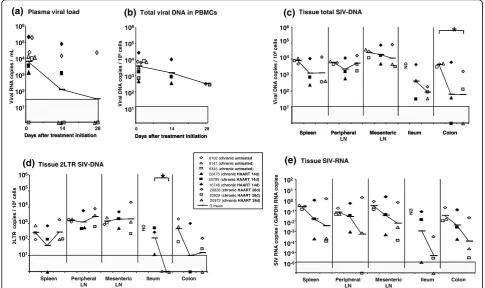
In a first step, to validate our HAART treatment in the SIV macaque model, we assessed the effect of the AZT/ 3TC/IDV combination in chronically infected animals. Six macaques infected with SIVmac251 were treated with AZT/3TC/IDV twice a day after viral set point (from day 150 pi). To determine the kinetics of viral load decrease in different tissues, three of these animals were killed at day 14 (chronic HAART 14d) and the other three at day 28 (chronic HAART 28d) after the onset of treatment. Three untreated animals at the same stage of infection were used as controls (chronic untreated). Among the HAART treated animals, one (#20929) had undetectable PVL at the initiation of ther-apy (day 0), but was nevertheless included in the analy-sis since cell-associated viral load (CVL) in PBMC evolved within the same range of the other treated macaques.
We confirmed that in macaques chronically infected with SIV, four weeks of HAART result in a decrease of plasma viral load (PVL) similar to that observed in HIV-infected patients receiving similar treatment [7]. As early as day 14 of treatment, the PVL was reduced by 1.7 × log10 in geometric (G) mean, and three of these animals had decreased PVL below detection threshold (60 vRNA copies/ml) (Figure 1a). After 28 days of ther-apy, only one macaque (#20828) had persistent viremia which was slightly reduced when compared to day 0 (-0.9 × log10).
We then explored viral dissemination and replication in PBMC, spleen, lymph nodes (LN) and the gut to assess whether the decrease in plasma viral load reflects similar dynamics in the other tissues. As previously observed in patients infected with HIV, SIV-DNA in PBMC was only slightly reduced by treatment, with G mean reductions of 0.4 × log10 and 1.1 × log10 after 14 and 28 days of treatment, respectively (Figure 1b). Inter-estingly, the level of SIV-DNA was not significantly reduced in the lymph nodes and spleen of treated ani-mals (Figure 1c). We surmised that the limited effect of treatment in these tissues could be explained by the lim-ited diffusion of antivirals in these compartments and/or the inefficiency of the drug on long-lived infected cells. In contrast, treatment had a strong effect in the diges-tive tract with a G mean reduction of 1.8 × log10 in colon (p = 0.049 at day 28). This tissue has predomi-nantly short-lived CD4+ T cells facilitating the effect of HAART [8]. Also, the antivirals may diffuse better in these tissues.
We then measured levels of 2LTR SIV-DNA, as a marker of recently infected cells as previously suggested [6]. In untreated animals, we detected 2LTR SIV-DNA in all the tissues studied. In macaques treated with HAART for 28 days, levels of 2LTR SIV-DNA were sig-nificantly reduced (p = 0.04) in the ileum when com-pared to animals receiving only 14 days of HAART. On the contrary, the antiviral treatment had no effect on the 2LTR SIV-DNA levels in the LN and the spleen. Although the value of 2LTR viral DNA circles is still controversial, our result suggests that treatment prob-ably affects efficiently the tissues with a predominance of new infections (Figure 1d).
Finally, we measured SIV-RNA levels to assess the production of SIV. Under treatment there is a significant (p = 0.03) decrease of SIV-RNA levels if we consider all compartments; but due to the limited number of ani-mals in each group, the effect was not significant for each tissue separately. The strongest effect was observed in the gut, with a G mean decrease of 2.4 × log10 (Fig-ure 1e), confirming the results observed for viral DNA in the GALT. The effect of treatment on SIV-RNA levels was more limited in the LN and spleen (G mean decrease of tissue viral load: 1.8 × log10).
AZT/3TC/IDV treatment initiated before viremia peak results in partial control of viral dissemination and replication in tissues
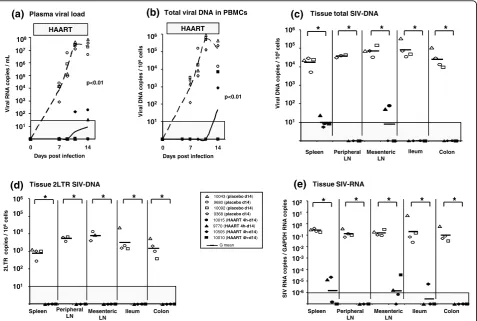
In a first experiment, two groups of four SIV-infected animals received AZT/3TC/IDV treatment or a placebo starting 4 h after intravenous inoculation of SIV. Animals were killed at day 14 pi, when viral replication and dissemination were expected to be maximal in placebo treated macaques (Figure 2a-e). Confirming our previously published observations [9], although early treatment could not prevent infection after intravenous transmission, at day 14 pi, PVL and CVL in HAART treated animals remained almost undetectable (Figure 2a-b). Although levels of viral RNA and DNA were close to the quantification threshold, virus remained detectable in spleen and mesenteric lymph nodes, confirming that residual SIV replication and dissemination persisted despite HAART was initiated very early (4h) after intravenous inoculation of SIV.
In a second experiment, two groups of four SIV-infected animals received AZT/3TC/IDV treatment or a
placebo between 7 and 21 days post-infection and were killed at 21 days pi. In these animals, the effect of anti-retroviral treatment was intermediate between what was observed in macaques treated as early as 4 h pi and macaques treated during early chronic infection. Thus, the PVL at day 21 pi was significantly lower in HAART treated animals than in placebo treated macaques (-2 × log10, p = 0.02), but no significant effect was found for CVL (Figure 3a and 3b). (In the placebo group, animal #14275 which displayed a controller profile was excluded from statistical analysis). In almost all tissues, a small but statistically significant decrease was observed for SIV-DNA (p = 0.03 for spleen, peripheral LN, mesenteric LN and colon) (Figure 3c). The treatment also induced a significant decrease of 2LTR SIV DNA in the spleen, the peripheral LN, and the colon (p = 0.03 for each tissue) (Figure 3d); while for SIV-RNA levels the decrease was significant (p = 0.03) only in peripheral LN (Figure 3e).
Tissue total SIV-DNA (c) 103 104 105 106 101 102 Vira l D N A c o pie s / 1 0
6 c
e
lls
Spleen Peripheral Mesenteric Ileum Colon
*
ND
0 14 28
Plasma viral load (a) Vira l R N A c o pie s
/ mL
0 14 28
103 104 105 106 101 102
Days after treatment initiation
Total viral DNA in PBMCs (b) 103 104 105 106 101 102
Days after treatment initiation
Vira l D N A c o pie s / 1 0 6c e lls
8102 (chronic untreated
8141 (chronic untreated) 9345 (chronic untreated) 20475 (chronic HAART 14d)
20785 (chronic HAART 14d)
16746 (chronic HAART 14d)
20828 (chronic HAART 28d)
20929 (chronic HAART 28d)
20972 (chronic HAART 28d)
G mean Spleen Peripheral LN Mesenteric LN Ileum Colon
Tissue 2LTR SIV-DNA (d) 103 104 105 106 101 102 2LT R copi es / 10 6c e lls Spleen Peripheral LN Mesenteric LN Ileum Colon ND
*
Tissue SIV-RNA (e) Spleen Peripheral LN Mesenteric LN Ileum Colon 10-5 10-4 10-3 10-2 10-1 100 101 102 10-6 S IV RNA copi es / GA P D H RNA copi es ND [image:3.595.55.541.90.378.2]Days after treatment initiation Days after treatment initiation
Figure 1Viral dynamics in SIV-infected macaques receiving a short-term HAART during early chronic infection. Among 9 SIV infected
Initiation of AZT/3TC/IDV therapy after the viremia peak results in limited and tissue-dependent effects on viral replication and dissemination
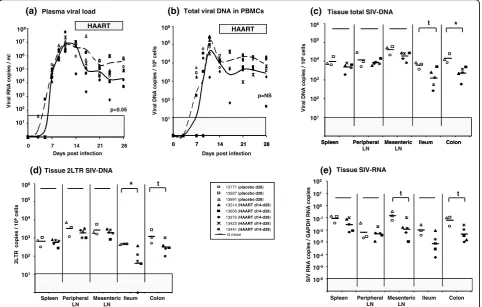
We then addressed the issue whether similar effects could be observed after maximal viral dissemination, at a time where viral reservoirs are expected to be fully established. The same treatment was therefore initiated (day 14 pi) just after viremia peak in a group of five macaques. PVL, CVL, total SIV-DNA, 2LTR SIV-DNA and SIV-RNA levels were determined 14 days later (day 28 pi) in different tissues and compared to levels of three placebo animals also euthanized at day 28 pi.
In HAART treated animals, the effect of treatment was limited. Plasma viral load was significantly lower than in placebo macaques (p = 0.02) (Figure 4a). How-ever, we did not observe any significant effect on CVL, total SIV-DNA, 2LTR or SIV-RNA levels, in the spleen or peripheral lymph nodes (Figure 4b-e). By contrast, the three viral markers were reduced in the digestive
tract (Figure 4c-e), reminiscent of animals treated during early chronic infection.
As for animals treated during early chronic infection, the weak effect of HAART in spleen or peripheral LN could be the consequence of the infection of long-lived cells such as macrophages. In order to identify which cell type sustained SIV production in secondary lym-phoid tissues of HAART treated macaques, we charac-terized SIV-RNA production usingin situhybridization together with T cell staining with anti-CD3 antibodies. In the spleen of placebo treated animals, SIV producing cells were mainly CD3+ (black arrow, Figure 5a). Some CD3-cells also produced weak quantities of SIV-RNA (white arrow, Figure 5a). In HAART treated animals, we confirmed the weak effect of treatment on SIV replica-tion in the spleen with a number of SIV-RNA producing cells equivalent to placebo animals. Similar to previous observation of Cavert et al. in HIV infected patients [10], SIV producing cells in the spleen of macaque
0 7 14
HAART (a) Plasma viral load
Viral
RNA
copies / m
L 10 7
108
103
104
105
106
101
102
p<0.01
0 7 14
Total viral DNA in PBMCs (b)
HAART
103
104
105
106
101
102
V
iral
DNA
copi
es /
10
6c
e
lls
p<0.01
Tissue total SIV-DNA (c)
103
104
105
106
101
102
Viral
D
N
A
copies / 10
6 c
e
lls
* * * * *
0 7 14
Days post infection
0 7 14
Days post infection Spleen PeripheralLN MesentericLN Ileum Colon
Tissue 2LTR SIV-DNA (d)
103
104
105
106
101
102
2LT
R
copi
es /
10
6cel
ls
Spleen Peripheral
LN MesentericLN Ileum Colon
* * * * * 10043 (placebo d14)
9680 (placebo d14) 10092 (placebo d14) 9368 (placebo d14) 10015 (HAART 4h-d14) 9770 (HAART 4h-d14) 10505 (HAART 4h-d14) 10010 (HAART 4h-d14)
G mean
Tissue SIV-RNA (e)
10-5
10-4
10-3
10-2
10-1
100
101
102
10-6
Spleen Peripheral LN
Mesenteric LN
Ileum Colon
SI
V
RNA
copi
es
/
GA
PDH RN
A
copi
[image:4.595.61.539.89.410.2]es * * * * *
Figure 2Viral dynamics in SIV-infected macaques receiving a short-term post exposure HAART. Four hours after SIV intravenous
treated with HAART just after viremia peak were mainly T cells and not macrophages as they generally express CD3 (Figure 5b).
3TC concentrations vary with tissue and are inversely correlated with viral load
As the persistent viral replication in secondary lym-phoid tissues did not seem to be related to infection of long-lived cells such as macrophages, we then hypothe-sized that it could be linked to poor antiviral activity. These could be due to either a poor diffusion of drugs in the tissue, active efflux from target cells or reduced nucleoside reverse transcriptase inhibitor (NRTI) phos-phorylation by endocellular kinases. Drug pharmacoki-netics (PK) can differ between species; however, we have previously shown [11] that 3TC in macaques treated with the same AZT/3TC/IDV combination displays very similar PK to humans. Thus, we first
focused our measurements on the concentration of 3TC in different tissues of macaques treated with HAART between days 14 and 28 pi. Consistent with high impact of HAART on SIV replication in the gut, we found the highest 3TC concentration in the diges-tive tract (G mean 2 nM/106 cell equivalents (eq) in colon). The concentration in the spleen was about 100 times lower (G mean: 0.017 nM/106 cell eq), and the concentration in the peripheral LN was more than 300 times lower, than in colon (G mean: 0.006 nM/106 cell eq) (Figure 6a). Tissue cell concentrations of 3TC-TP, the active form of the drug, varied in the same way (Figure 6b); and transformation rates– calculated by 3TC-TP concentration/3TC concentration – were similar for each tissue tested (G means were 19.4 in PBMC, 26.2 in spleen and 25.7 in peripheral LN), indi-cating that efflux and phosphorylation of 3TC were not the limiting factors of antiviral activity in the
0 7 14 21
Total viral DNA in PBMCs (b) V iral DNA copi es / 10 6c e lls HAART 103 104 105 106 101 102 p=NS HAART
(a) Plasma viral load
107 108 103 104 105 106 101 102 V iral RNA copi es / m l p<0.016
0 7 14 21
Tissue total SIV-DNA (c) Peripheral LN Mesenteric LN n o l o C m u e l I n e e l p S 103 104 105 106 101 102 V iral DNA copi es / 10
6 c
e
lls * * * *
t
0 7 14 21
Days post infection Days post infection
0 7 14 21
LN LN
Tissue 2LTR SIV-DNA (d) 2LT R copi es / 10 6cel ls Spleen Peripheral LN Mesenteric LN Ileum Colon 103 104 105 106 101 102 * * * Tissue SIV-RNA (e) SIV R N A c o pie s / GA PD H R N A c o pie s 10-5 10-4 10-3 10-2 10-1 100 101 102 10-6 Spleen Peripheral LN Mesenteric LN Ileum Colon * t t
13382 (placebo d21) 14275 (placebo d21) 13070 (placebo d21) 13071 (placebo d21) 13614 (HAART d7-d21) 13740 (HAART d7-d21) 15621 (HAART d7-d21) 15638 (HAART d7-d21)
[image:5.595.59.540.91.417.2]G mean
Figure 3Viral dynamics in SIV-infected macaques receiving a short-term HAART before the viremia peak. Seven days after SIV infection,
different tissues. Interestingly, SIV-DNA level as indi-cator of residual viral load in tissues was inversely correlated (p < 0.01) with 3TC local concentration (Figure 6c). Even though the correlation did not reach statistical significance (p = 0,086), SIV-RNA level as indicator of residual viral replication also seemed to be inversely associated with 3TC local concentration (Figure 6d). We also investigated the concentrations of AZT and IDV in the same tissues. For AZT we found concentrations below the quantification threshold in almost all tissues explored (peripheral LN, spleen and colon); this may be due to the short half-life of AZT (data not shown). For IDV we found the same trend of diffusion as for 3TC with much higher concentrations in the colon (G mean: 102 pMol/106 cell eq) than in the spleen (G mean: 0,094 pMol/106 cell eq, p < 0.05). These results suggest that higher levels of residual viral replication in peripheral LN and spleen result, at least partially, from the low diffusion of antiviral drugs in these tissues.
Discussion
We showed that a short term HAART can reduce viral dissemination and replication in all tissues when initiated very early after intravenous inoculation of SIV-mac251, before the viremia peak. In animals treated just after the initial viremia peak or during early chronic infection, we observed significant differences in HAART efficacy depending on the tissue considered. Maximum inhibition occurred in the digestive tract of macaques. These results are in accordance with those described in humans showing a rapid and large decrease of viral replication in GALT after successful HAART [12-15]. Although the GALT is considered today as the major site of HIV replication, there are no data about local dif-fusion of antiretroviral drugs in these tissues. The dosages of 3TC and IDV we performed demonstrate, for the first time, that two commonly used antiretrovirals can diffuse very efficiently in the digestive tract, thus probably explaining the high treatment efficacy observed in this tissue. As we had recently shown [3], in the same
0 7 14 21 28
Total viral DNA in PBMCs (b) 103 104 105 106 101 102 V iral DNA copi es / 10 6 c e lls HAART p=NS HAART 107 108 103 104 105 106 101 102
(a) Plasma viral load
Vira l R N A c o p ie s / ml p<0.05
Tissue total SIV-DNA (c) 103 104 105 106 101 102
Spleen Peripheral Mesenteric Ileum Colon
V iral DNA copi es / 10
6 c
e
lls
* t
0 7 14 21 28
Days post infection Days post infection
0 7 14 21 28
13771 (placebo d28) 13927 (placebo d28) 13691 (placebo d28) 13514 (HAART d14-d28) 13656 (HAART d14-d28) 13276 (HAART d14-d28) 13423 (HAART d14-d28) 13441 (HAART d14-d28)
G mean Spleen Peripheral LN Mesenteric LN Ileum Colon
[image:6.595.58.541.90.397.2]Tissue 2LTR SIV-DNA (d) 103 104 105 106 101 102 Spleen Peripheral LN Mesenteric LN Ileum Colon 2LT R copi es / 10 6 cel ls * t Tissue SIV-RNA (e) 10-5 10-4 10-3 10-2 10-1 100 101 102 10-6 Spleen Peripheral LN Mesenteric LN Ileum Colon SIV R N A c o pie s / G A PD H R N A c o pie s t t
Figure 4Viral dynamics in SIV-infected macaques receiving a short-term HAART just after the viremia peak. Among 8 animals infected
SIV macaque model, the plasma viral load mainly reflects the viral replication in the digestive tract. We could therefore suppose that the rapid decrease in plasma viral load observed after HAART initiation is mainly due to the control of viral replication in the gut.
Despite a strong effect in the GALT, currently used antiretroviral combinations are not sufficient to eradicate the virus. We therefore assume that residual replication in pharmacological sanctuaries and/or viral reservoirs could provide an explanation to the incomplete success of therapy. In patients treated with suboptimal regimens, like the use of only two NRTI, no significant changes were observed in viral replication in LN or tonsils, even after control of PVL [16-19]. Adding a protease inhibitor (PI) increases the efficiency of treatment without achiev-ing a full control of replication even in infected patients with long term HAART [10,17,20,21].
Our results confirm in the SIV-infected macaque model that HAART has limited impact on viral replica-tion in secondary lymphoid tissues in spite of efficient control of PVL or replication in the gut. Contrary to Solas et al., who did not find any relationship between PI levels and HIV RNA levels in the tissues [22], the 3TC dosages we performed showed for the first time that low antiretroviral efficacy in spleen and peripheral lymph nodes could be related to poor drug diffusion in
these organs, therefore favouring residual replication and viral persistence.
Corroborating the data from Kinmanet al. [23], who showed very low diffusion of IDV in the lymph node of macaque after oral administration, the very low level of IDV measured in the spleen and peripheral lymph nodes of treated macaques confirm that secondary lym-phoid tissues could act as real pharmacological sanctuaries.
Although one of the major limitations of our study is that drugs have been administered during a short period (14 to 28 days), several studies in humans indicate that even after several years of HAART, viral mRNA is still produced in peripheral lymph nodes. This confirms that the poor drug diffusion we observed in lymph node and spleen could provide a simple explanation to the absence of virus eradication. As suggested by Stellbrink [24], this residual replication in lymphoid tissues could also permanently seed the latent reservoir.
[image:7.595.62.539.88.349.2]In the central nervous system (CNS) and the testis, the low levels of antiretroviral can be explained by poor diffusion across the blood-brain or blood-testicular bar-riers because of drugs efflux by ABC transporter [22,25,26]. In the peripheral lymph node mononuclear cells, we previously demonstrated a higher level of P-gp mRNA expression than in PBMC [27]. However, we did
(b)
(a) Spleen: macaque 13927 (placebo d28) – ISH SIV + IHC CD3 Spleen: macaque 13514 (HAART d14-d28) – ISH SIV + IHC CD3
Figure 5SIV-producing cells in the spleen of SIV-infected macaques receiving a short-term HAART just after the viremia peak. SIV-RNA
not observe here any differences in the ratios of 3TC and 3TC-TP between the different tissues, indicating that efflux from the cell or kinases activities are not the limiting factors. It is therefore unlikely that P-gp activity is involved in the poor diffusion of antiretroviral we observed in secondary lymphoid tissues.
We also demonstrated that pharmokinetics and phar-macodynamic parameters are important to consider not only in the treatment of infected patients but also in preventive approaches of HIV transmission like post-exposure prophylaxis. After intravenous inocula-tion of SIVmac251, infecinocula-tion could not be prevented even if AZT/3TC/IDV combination was initiated within a few hours, confirming our previous results
[9,28]. Recently [11] we have shown that the same regimen prevents vaginal transmission of the same virus, probably because of initial viral compartmentali-zation and low dissemination [29] in association with good diffusion of NRTI in the female genital tract [30]. Our results thus demonstrate the need to improve antiretroviral biodistribution for better efficacy and limitation of the pharmacological sanctuaries that allow residual viral replication.
Conclusions
When initiated before the peak of viremia, a short-term antiretroviral treatment can impact viral dissemination and replication in almost all tissues. In this case, the
3TC tissue concentrations
(a)
pm
ol
/
10
6cel
ls eq
PBMC Spleen Per LN Colon
10-3 10-2 10-1 100
101
*
*
*
*
-1,5 -1 -0,5 0 0,5
-3 -2 -1 0 1
3TC concentration (log)
Resi
dual
vi
ral
l
o
ad (l
og)
(c)
Correlation between 3TC concentration and tissue residual viral load (DNA)p<0.01
Colon
Spleen & Per LN
13276 13423 13441 13656 13514 G mean
-2 -1,5 -1 -0,5 0 0,5 1
-3 -2 -1 0 1
3TC concentration (log)
Resi
dual
vi
ral
repli
c
ation (log)
(d)
Correlation between 3TC concentration and tissue residual viral replication (RNA)p= 0. 086
Colon
Spleen & Per LN
10-2 10-1 100 101
PBMC Spleen Per LN Colon
ND
3TC-TP tissue concentrations
(b)
pm
ol /
10
6cel
[image:8.595.56.541.90.469.2]ls eq
Figure 63TC levels in tissues of SIV-infected macaques receiving a short-term HAART just after the viremia peak. 3TC and 3TC-TP were
treatment is more effective when initiated earlier. If the identical treatment is started after the peak of viremia, or during chronic infection, the effect of short-term HAART seems to vary according to the tissue considered. In the gut, where antiretroviral drugs diffuse easily, the viral bur-den decreases rapidly; whereas in secondary lymphoid tis-sues, poor diffusion of the antiviral drug could explain the weak effect of treatment on the tissue viral load.
Methods
Animals, infections, treatment and tissue collection We studied 33 young adult male cynomolgus macaques (Macaca fascicularis), each weighing between 2.7 and 4.5 kg. Studies were conducted in accordance with European guidelines for animal care and all experiments were approved by the ethics committee for animal experimentation“Ile de France Sud” (Paris, France). All macaques were inoculated intravenously with 50 AID50 of pathogenic SIVmac251 and divided into nine groups.
Six animals were treated with AZT (4.5 mg/kg) and 3TC (2.5 mg/kg) subcutaneously twice daily and indina-vir (60 mg/kg), orally, twice daily. The treatment was initiated after viral set point (day 150 pi) and the ani-mals were killed after 14 days (chronic HAART 14 d group) and 28 days (chronic HAART 28 d group) of treatment. In parallel, 3 untreated animals were also killed at 150 days pi (chronic untreated).
Four other animals received the AZT/3TC/IDV combi-nation as early as 4 h post-infection and continued until day 14 when the animals were killed (HAART 4h-d14 group). Four animals receiving a placebo in the same conditions were also killed at 14 days pi (placebo d14).
A group of four animals received the same HAART between days 7 and 21 pi (HAART d7-d21 group), then the animals were killed on day 21 pi. Four animals receiving a placebo in the same conditions were killed at 21 days pi (placebo d21).
In last group, 5 animals received the HAART treat-ment between day 14 and day 28 pi and were killed on day 28 (HAART d14-d28 group). Three animals receiv-ing a placebo in the same conditions were killed at the same time (placebo d28).
Immediately after killing the animals, tissue samples from the spleen, peripheral lymph nodes (inguinal or axillary) mesenteric lymph nodes, ileum and colon were collected in quadruplicate and stored at -80°C. In order to reduce the heterogeneous presence of lymphoid tis-sue in the gut, we collected and processed large samples for ileum and colon (250 to 400 mg).
Virological measurements in the blood
Plasma and cell-associated viral loads were determined as previously described [9,31].
Virological measurements in the tissues
RNA and DNA extraction as well as quantification of total SIV DNA, SIV 2 LTR circles and SIV RNA in tissue were performed as previously described [3].
In situhybridisation
SIV gagin situhybridization combined with immunohis-tochemistry for T cell markers was performed as pre-viously described [32]. The specificity of the hybridization signal was systematically checked by hybridizing sense probes on successive sections. Image acquisition and ana-lysis were performed on a Nikon i90 photomicroscope using NIS-elements software.
Determination of antiretroviral concentration in tissues 3TC, 3TC-TP, AZT and IDV were assayed by liquid chromatography coupled with tandem mass spectrome-try (LC-MS/MS) or a modification of these methods, as previously described [33-35].
Statistical analysis
Statistical analyses were carried out using Stat View soft-ware (SAS institute Inc, Cary, North Carolina, USA). Plasma and cell-associated viral load as well as SIV-RNA, total SIV-DNA and 2LTR SIV-DNA were compared in placebo and HAART-treated macaques using a nonpara-metric Mann-Whitney test. Differences in 3TC and IDV concentration in lymphoid tissues were assessed by the same test. The correlation between 3TC concentration and residual viral replication/load in tissue, were evalu-ated using a nonparametric Spearman correlation test.
Acknowledgements
We greatly thank Patricia Brochard and Benoit Delache for their very efficient technical contribution. We thank Christophe Joubert and the technical staff of the CEA for animal care. We also thank Gaëlle Bourry for critical reading of the manuscript. We thank the Glaxo-Smith-Kline laboratories for helpful discussion and providing antiviral drugs.
Author details
1CEA, Division of Immuno-Virology, DSV/iMETI, Fontenay-aux-Roses, France. 2
Assistance Publique-Hôpitaux de Paris, Hôpital Lariboisière, 2 rue Ambroise Paré, 75010 Paris, France.3CEA, Service de Pharmacologie et
d’Immunoanalyse, DSV/iBiTecS, CEA/Saclay, 91191Gif-sur-Yvette, France.
4Université Paris-Sud 11, UMR E01, Orsay, France.5Inserm U625, Rennes,
France.
Authors’contributions
RLG, OB and PR conceived and designed the experiments; OB, PS, AM, CR, LDG, RLG and PR performed the experiments; OB, PS, AM, CR, NDB, LDG, HB, PR and RLG analyzed the data; HB contributed reagents/materials/analysis tools; OB, RLG, PS, PR and AM wrote the paper. All authors read and approved the final manuscript.
Competing interests
The authors declare that they have no competing interests.
References
1. Mattapallil JJ, Douek DC, Hill B, Nishimura Y, Martin M, Roederer M:Massive infection and loss of memory CD4+ T cells in multiple tissues during
acute SIV infection.Nature2005,434:1093-1097.
2. Li Q, Duan L, Estes JD, Ma ZM, Rourke T, Wang Y, Reilly C, Carlis J, Miller CJ, Haase AT:Peak SIV replication in resting memory CD4+ T cells depletes
gut lamina propria CD4+ T cells.Nature2005,434:1148-1152.
3. Mannioui A, Bourry O, Sellier P, Delache B, Brochard P, Andrieu T, Vaslin B, Karlsson I, Roques P, Le Grand R:Dynamics of viral replication in blood and lymphoid tissues during SIVmac251 infection of macaques.
Retrovirology2009,6:106.
4. Tsai CC, Follis KE, Sabo A, Beck TW, Grant RF, Bischofberger N,
Benveniste RE, Black R:Prevention of SIV infection in macaques by
(R)-9-(2-phosphonylmethoxypropyl)adenine.Science1995,270:1197-1199.
5. Ambrose Z, Kewalramani VN, Bieniasz PD, Hatziioannou T:HIV/AIDS: in
search of an animal model.Trends Biotechnol2007,25:333-337.
6. Sharkey ME, Teo I, Greenough T, Sharova N, Luzuriaga K, Sullivan JL, Bucy RP, Kostrikis LG, Haase A, Veryard C, Davaro RE, Cheeseman SH, Daly JS, Bova C, Ellison RT, Mady B, Lai KK, Moyle G, Nelson M, Gazzard B, Shaunak S, Stevenson M:Persistence of episomal HIV-1 infection
intermediates in patients on highly active anti-retroviral therapy.Nat
Med2000,6:76-81.
7. Gulick RM, Mellors JW, Havlir D, Eron JJ, Gonzalez C, McMahon D, Richman DD, Valentine FT, Jonas L, Meibohm A, Emini EA, Chodakewitz JA:
Treatment with indinavir, zidovudine, and lamivudine in adults with human immunodeficiency virus infection and prior antiretroviral
therapy.N Engl J Med1997,337:734-739.
8. Haase AT:Perils at mucosal front lines for HIV and SIV and their hosts.
Nature Reviews Immunology2005,5:783-792.
9. Benlhassan-Chahour K, Penit C, Dioszeghy V, Vasseur F, Janvier G, Riviere Y, Dereuddre-Bosquet N, Dormont D, Le Grand R, Vaslin B:Kinetics of lymphocyte proliferation during primary immune response in macaques infected with pathogenic simian immunodeficiency virus SIVmac251:
preliminary report of the effect of early antiviral therapy.J Virol2003,
77:12479-12493.
10. Cavert W, Notermans DW, Staskus K, Wietgrefe SW, Zupancic M, Gebhard K, Henry K, Zhang ZQ, Mills R, McDade H, Schuwirth CM, Goudsmit J, Danner SA, Haase AT:Kinetics of response in lymphoid tissues to
antiretroviral therapy of HIV-1 infection.Science1997,276:960-964.
11. Bourry O, Brochard P, Souquiere S, Makuwa M, Calvo J, Dereudre-Bosquet N, Martinon F, Benech H, Kazanji M, Le Grand R:Prevention of vaginal simian immunodeficiency virus transmission in macaques by postexposure prophylaxis with zidovudine, lamivudine and indinavir.
AIDS2009,23:447-454.
12. Talal AH, Monard S, Vesanen M, Zheng Z, Hurley A, Cao Y, Fang F, Smiley L, Johnson J, Kost R, Markowitz MH:Virologic and immunologic effect of
antiretroviral therapy on HIV-1 in gut-associated lymphoid tissue.J
Acquir Immune Defic Syndr2001,26:1-7.
13. Kotler DP, Shimada T, Snow G, Winson G, Chen W, Zhao M, Inada Y, Clayton F:Effect of combination antiretroviral therapy upon rectal
mucosal HIV RNA burden and mononuclear cell apoptosis.Aids1998,
12:597-604.
14. Anton PA, Mitsuyasu RT, Deeks SG, Scadden DT, Wagner B, Huang C, Macken C, Richman DD, Christopherson C, Borellini F, Lazar R, Hege KM:
Multiple measures of HIV burden in blood and tissue are correlated with
each other but not with clinical parameters in aviremic subjects.Aids
2003,17:53-63.
15. Poles MA, Boscardin WJ, Elliott J, Taing P, Fuerst MM, McGowan I, Brown S, Anton PA:Lack of decay of HIV-1 in gut-associated lymphoid tissue
reservoirs in maximally suppressed individuals.J Acquir Immune Defic
Syndr2006,43:65-68.
16. Haase AT, Henry K, Zupancic M, Sedgewick G, Faust RA, Melroe H, Cavert W, Gebhard K, Staskus K, Zhang ZQ, Dailey PJ, Balfour HH Jr, Erice A, Perelson AS:Quantitative image analysis of HIV-1 infection in lymphoid
tissue.Science1996,274:985-989.
17. Lafeuillade A, Chollet L, Hittinger G, Profizi N, Costes O, Poggi C:Residual human immunodeficiency virus type 1 RNA in lymphoid tissue of
patients with sustained plasma RNA of < 200 copies/mL.J Infect Dis
1998,177:235-238.
18. Ruiz L, van Lunzen J, Arno A, Stellbrink HJ, Schneider C, Rull M, Castellà E, Ojanguren I, Richman DD, Clotet B, Tenner-Racz K, Racz P:Protease
inhibitor-containing regimens compared with nucleoside analogues alone in the suppression of persistent HIV-1 replication in lymphoid
tissue.Aids1999,13:F1-8.
19. Martínez E, Arnedo M, Giner V, Gil C, Caballero M, Alós L, García F, Holtzer C, Mallolas J, Miró JM, Pumarola T, Gatell JM:Lymphoid tissue viral
burden and duration of viral suppression in plasma.Aids2001,
15:1477-1482.
20. Wong JK, Gunthard HF, Havlir DV, Zhang ZQ, Haase AT, Ignacio CC, Kwok S, Emini E, Richman DD:Reduction of HIV-1 in blood and lymph nodes following potent antiretroviral therapy and the virologic correlates of
treatment failure.Proc Natl Acad Sci USA1997,94:12574-12579.
21. Notermans DW, Jurriaans S, de Wolf F, Foudraine NA, de Jong JJ, Cavert W, Schuwirth CM, Kauffmann RH, Meenhorst PL, McDade H, Goodwin C, Leonard JM, Goudsmit J, Danner SA:Decrease of HIV-1 RNA levels in lymphoid tissue and peripheral blood during treatment with ritonavir,
lamivudine and zidovudine. Ritonavir/3TC/ZDV Study Group.Aids1998,
12:167-173.
22. Solas C, Lafeuillade A, Halfon P, Chadapaud S, Hittinger G, Lacarelle B:
Discrepancies between protease inhibitor concentrations and viral load in reservoirs and sanctuary sites in human immunodeficiency
virus-infected patients.Antimicrob Agents Chemother2003,47:238-243.
23. Kinman L, Brodie SJ, Tsai CC, Bui T, Larsen K, Schmidt A, Anderson D, Morton WR, Hu SL, Ho RJ:Lipid-drug association enhanced HIV-1 protease inhibitor indinavir localization in lymphoid tissues and viral load reduction: a proof of concept study in HIV-2287-infected
macaques.J Acquir Immune Defic Syndr2003,34:387-397.
24. Stellbrink HJ, van Lunzen J, Westby M, O’Sullivan E, Schneider C, Adam A, Weitner L, Kuhlmann B, Hoffmann C, Fenske S, Aries PS, Degen O, Eggers C, Petersen H, Haag F, Horst HA, Dalhoff K, Möcklinghoff C, Cammack N, Tenner-Racz K, Racz P:Effects of interleukin-2 plus highly active antiretroviral therapy on HIV-1 replication and proviral DNA (COSMIC
trial).Aids2002,16:1479-1487.
25. Wong SL, Van Belle K, Sawchuk RJ:Distributional transport kinetics of zidovudine between plasma and brain extracellular fluid/cerebrospinal fluid in the rabbit: investigation of the inhibitory effect of probenecid
utilizing microdialysis.J Pharmacol Exp Ther1993,264:899-909.
26. Hamidi M:Role of P-glycoprotein in tissue uptake of indinavir in rat.Life Sci2006,79:991-998.
27. Jorajuria S, Clayette P, Dereuddre-Bosquet N, Benlhassan-Chahour K, Thiebot H, Vaslin B, Le Grand R, Dormont D:The expression of P-glycoprotein and cellular kinases is modulated at the transcriptional level by infection and highly active antiretroviral therapy in a primate
model of AIDS.AIDS Res Hum Retroviruses2003,19:307-311.
28. Le Grand R, Vaslin B, Larghero J, Neidez O, Thiebot H, Sellier P, Clayette P, Dereuddre-Bosquet N, Dormont D:Post-exposure prophylaxis with highly active antiretroviral therapy could not protect macaques from infection
with SIV/HIV chimera.Aids2000,14:1864-1866.
29. Pope M, Haase AT:Transmission, acute HIV-1 infection and the quest for
strategies to prevent infection.Nat Med2003,9:847-852.
30. Dumond JB, Yeh RF, Patterson KB, Corbett AH, Jung BH, Rezk NL, Bridges AS, Stewart PW, Cohen MS, Kashuba AD:Antiretroviral drug exposure in the female genital tract: implications for oral pre-and
post-exposure prophylaxis.Aids2007,21:1899-1907.
31. Puaux AL, Marsac D, Prost S, Singh MK, Earl P, Moss B, Le Grand R, Riviere Y, Michel ML:Efficient priming of simian/human immunodeficiency virus (SHIV)-specific T-cell responses with DNA encoding hybrid SHIV/hepatitis
B surface antigen particles.Vaccine2004,22:3535-3545.
32. Roulet V, Satie AP, Ruffault A, Le Tortorec A, Denis H, Guist’hau O, Patard JJ, Rioux-Leclerq N, Gicquel J, Jegou B, Dejucq-Rainsford N:Susceptibility of human testis to human immunodeficiency virus-1 infection in situ and
in vitro.Am J Pathol2006,169:2094-2103.
33. Compain S, Durand-Gasselin L, Grassi J, Benech H:Improved method to quantify intracellular zidovudine mono-and triphosphate in peripheral blood mononuclear cells by liquid chromatography-tandem mass
spectrometry.J Mass Spectrom2007,42:389-404.
34. Compain S, Schlemmer D, Levi M, Pruvost A, Goujard C, Grassi J, Benech H:
Development and validation of a liquid chromatographic/tandem mass spectrometric assay for the quantitation of nucleoside HIV reverse
transcriptase inhibitors in biological matrices.J Mass Spectrom2005,
35. Becher F, Pruvost A, Goujard C, Guerreiro C, Delfraissy JF, Grassi J, Benech H:
Improved method for the simultaneous determination of d4T, 3TC and ddl intracellular phosphorylated anabolites in human peripheral-blood mononuclear cells using high-performance liquid chromatography/
tandem mass spectrometry.Rapid Commun Mass Spectrom2002,
16:555-565.
doi:10.1186/1742-4690-7-78
Cite this article as:Bourryet al.:Effect of a short-term HAART on SIV load in macaque tissues is dependent on time of initiation and antiviral diffusion.Retrovirology20107:78.
Submit your next manuscript to BioMed Central and take full advantage of:
• Convenient online submission
• Thorough peer review
• No space constraints or color figure charges
• Immediate publication on acceptance
• Inclusion in PubMed, CAS, Scopus and Google Scholar
• Research which is freely available for redistribution