Accounting Mechanisms for
Distributed Work Systems
The Harvard community has made this
article openly available.
Please share
how
this access benefits you. Your story matters
Citation
Seuken, Sven, Jie Tang and David C. Parkes. 2010. "Accounting
Mechanisms for Distributed Work Systems." In Proceedings of the
24th AAAI Conference on Artificial Intelligence (AAAI'10), July 11–15,
2010, Atlanta, Georgia, 860-866. Menlo Park, California: AAAI Press.
Published Version
http://www.aaai.org/ocs/index.php/AAAI/AAAI10/paper/view/1802
Citable link
http://nrs.harvard.edu/urn-3:HUL.InstRepos:11856150
Terms of Use
This article was downloaded from Harvard University’s DASH
Accounting Mechanisms for Distributed Work Systems
Sven Seuken
School of Engineering & Applied Sciences Harvard University
Cambridge, MA 02138 [email protected]
Jie Tang
EECS Department University of California, Berkeley
Berkeley, CA 94720 [email protected]
David C. Parkes
School of Engineering & Applied Sciences Harvard University
Cambridge, MA 02138 [email protected]
Abstract
In distributed work systems, individual users perform work for other users. A significant challenge in these systems is to provide proper incentives for users to contribute as much work as they consume, even when monitoring is not possible. We formalize the problem of designing incentive-compatible accounting mecha-nismsthat measure the net contributions of users, de-spite relying on voluntary reports. We introduce the Drop-Edge Mechanism that removes any incentive for a user to manipulate via misreports about work con-tributed or consumed. We prove that Drop-Edge pro-vides a good approximation to a user’s net contribution, and is accurate in the limit as the number of users grows. We demonstrate very good welfare properties in simula-tion compared to an existing, manipulable mechanism. In closing, we discuss our ongoing work, including a real-world implementation and evaluation of the Drop-Edge Mechanism in a BitTorrent client.
1
Introduction
Distributed work systems arise in many places where indi-vidual users perform work for other users, often called peer production. For example, users of a peer-to-peer (P2P) file-sharing network share videos, music or software with each other. Amazon Mechanical Turk and other “crowd sourc-ing” applications suggest an explosion of interest in new paradigms for economic production. Within AI, distributed work systems contribute to the agenda on multi-agent re-source allocation, enhancing our understanding of architec-tures to coordinate artificial agents.
Of course, the total work performed by a population must equal the total work consumed. Moreover, while some de-gree of free-riding may be acceptable (e.g., if some users are altruistic while work is extremely costly for others), it is generally accepted that the long-term viability of work sys-tems that operate without the use of monetary transfers must rely on roughly balanced work contributions. Often time this is achieved by seeking to enforce temporally-local balance, e.g., via fair exchange protocols such as BitTorrent. Yet, this “local balance” clearly introduces a large inefficiency– users are limited to consuming work at a rate at which they can
Copyright c°2010, Association for the Advancement of Artificial Intelligence (www.aaai.org). All rights reserved.
themselves produce work, must be able to simultaneously consume and produce work, and cannot perform work and store credits for future consumption (Piatek et al. 2008).1
The problem of designing accounting mechanisms is mo-tivated by this need to tally work contributed and consumed in order to improve system efficiency by temporally decou-pling these activities. The particular challenge that we ad-dress here occurs when there is no ability for a third party to monitor the activities, and instead tallies rely on voluntary reports by the same users that may seek to free-ride. Thus, an accounting system must be robust to manipulations, be-cause users might overstate the amount of work contributed, or understate the amount of work consumed.
Accounting vs. Reputation Mechanisms.The problem of
designing an incentive-compatible accounting mechanism shares some features with work on trust/reputation mecha-nisms (Friedman, Resnick, and Sami 2007). However, there are significant differences which make reputation and ac-counting mechanisms incomparable. First, and somewhat informally, the essence of accurate reputation aggregation is the operation ofaveragingwhereas the essence of accu-rate accounting is the operation ofaddition. In a reputation system like eBay, individual users provide feedback about each other, and the individual feedback reports of two dif-ferent agents regarding a third agent could be very difdif-ferent. The task of the reputation system is to aggregate multiple reports into one overall reputation score; in a sense, “aver-aging” over all reports. In contrast, in distributed work sys-tems, multiple reports about work consumed or performed by an agent simply need to be added together, to eventually determine the overall net contributions of that agent.
Second, in distributed work systems, every positive report byAabout his interaction withB, i.e.,Bperformed work forA, is simultaneously a negative report aboutA, i.e.,A re-ceived work fromB. This fundamental tension is not present in reputation mechanisms where a good report byAabout
B does not reflect badly onA. Third, mechanisms that are sybilproof in traditional reputation systems are not necessar-ily sybilproof in distributed work systems.
Overview of Results. We present what we believe to be the first formal model for the design of incentive-compatible accounting mechanisms for distributed work systems. We suggest a simple misreport attack onBarterCast, an existing accounting mechanism that is already implemented in the BitTorrent clientTribler(Meulpolder et al. 2009), and intro-duce theDrop-Edge Mechanism, a new mechanism that is robust to misreports. We show analytically that Drop-Edge provides a good approximation to a user’s net contribution, and is accurate in the limit as the number of users grows. Furthermore, our simulation results suggest that the effect of misreports in BarterCast can significantly reduce social welfare, while Drop-Edge achieves much better efficiency.
Related Work. Our work is motivated by
Barter-Cast (Meulpolder et al. 2009), a decentralized accounting mechanism that is effective in distinguishing between coop-erative agents and free-riders. However, the authors do not analyze the attacks presented here in detail. (Piatek et al. 2008) also study decentralized accounting and find empiri-cally that most users of P2P file-sharing networks are con-nected via a one hop link in the connection graph. They pro-pose to use well-connected intermediaries to broker infor-mation, but without providing proper incentives to the inter-mediaries to behave truthfully. Feldman et al. (2004) study the challenges in providing robust incentives in fully decen-tralized P2P networks, including potential misreport attacks. However, they do not propose a misreport-proof mechanism. Interestingly, our mechanism shares some similarities with a mechanism proposed by Alon et al. (2010), who con-sider voting environments where the set of candidates co-incides with the set of voters. However, they don’t consider the problem of transitive trust in networks. A recent paper by Resnick and Sami (2009) addresses this exact problem in detail, and they show novel results about sybilproof trust mechanisms. In their domain they do not consider shared trust information and thus they do not have to study mis-report attacks. An interesting, but orthogonal direction, is provided by studies of virtual currency systems (Friedman, Halpern, and Kash 2006). There, work provision or con-sumption is observable and there is a trusted currency.
2
Formal Model
Consider a distributed work system ofnagents each capable of doing work for each other. All work is assumed to be quantifiable in the same units. The work performed by all agents is captured by a work graph:
Definition 1. (Work Graph)A work graphG= (V, E, w)
has vertices V = {1, . . . , n}, one for each agent, and di-rected edges(i, j)∈E, fori, j∈V, corresponding to work performed byiforj, with weight w(i, j) ∈ R≥0denoting
the number of units of work.
In general, the true work graph is unknown to individ-ual agents because agents only have direct information about their own participation:
Definition 2. (Agent Information)Each agenti∈V keeps
a private history(wi(i, j), wi(j, i))of its direct interactions
with other agentsj∈V, wherewi(i, j)andwi(j, i)are the
work performed forjand received fromjrespectively.
i j
i 5 1 0
k w = 0
i
j w = 1 0 0 i k
w = 1 0 0
i
j w = 0 i k
Figure 1: A subjective work graph from agenti’s perspec-tive. Edges where ihas direct information have only one weight. Other edges can have two weights, corresponding to the possibly conflicting reports of the two agents involved.
Based on its own experiences and known reports from other agents, agentican construct a subjective work graph (see Figure 1). Let wij(j, k), wk
i(j, k) ∈ R≥0 denote the edge weight as reported by agentjand agentkrespectively.
Definition 3. (Subjective Work Graph)A subjective work
graph from agent i’s perspective, Gi = (Vi, Ei, wi), is a
set of verticesVi ⊆ V and directed edgesEi. Each edge
(j, k) ∈ Ei for which i /∈ {j, k}, is labeled with one, or
both, of weightswji(j, k), wk
i(j, k)as known toi. For edges
(i, j)and(j, i)the associated weight iswi
i(i, j) = w(i, j)
andwi
i(j, i) =w(j, i)respectively.
Note that the edge weightswji(j, k)andwk
i(j, k)need not be truthful reports aboutw(j, k). These weights may propa-gate through a centralized mechanism, where a center shares received reports with all agents, or a decentralized informa-tion exchange protocol, where agents exchange informainforma-tion about work performed and received bilaterally.
Periodically, an agentican receive a work request by a set of agents with which the agent may have rarely or never interacted with before. This induces a choice set:
Definition 4. (Choice Set)We letCi ⊆V \ {i}denote the
choice set for agenti, i.e., the set of agents that are currently interested in receiving some work fromi.
We assume that an agent has noa prioribias towards as-sisting one agent over another. The role of an accounting mechanism is to provide an estimate of the net work con-tributed by each agentj∈Cito the system.
Definition 5. (Accounting Mechanism) An accounting
mechanismM takes as input a subjective work graphGi,
a choice setCi, and determines the scoreSjM(Gi, Ci), for
any agentj∈Ci, as viewed by agenti.2
Based on the results of the accounting mechanism, the agent then decides who to allocate work to. We use the fol-lowing allocation method in this paper:
Definition 6. (Winner-takes-all Allocation)Given
subjec-tive work graph Gi, choice set Ci, and accounting
mech-anism M, agent i performs one unit of work for agent
j∈arg maxk∈CiS
M
k (Gi, Ci), breaking ties at random. In general, other allocation rules can be used, e.g., pro-portional allocation, or threshold rules.
i j
i
k3 k2 k1
1 0
1 0
1 0
i j
i
k3 k2 k1
1 0
1 0
1 0
1 0
1 0
1 0
i
j i
k
5
5
5
5
2 2 i
j i
k
5
5
5
5
2 5
(a) (b) (c) (d)
Figure 2: (a) Work graph 1 based on true reports. (b) Subjective work graph as viewed byi, including a misreport attack byj
to boost its score in BarterCast. (c) Work graph 2 based on true reports. (d) Subjective work graph 2 as viewed byi, including a misreport attack byjto decreasek’s score and increase its own score. Dotted edges indicate misreports.
Strategic Manipulations
We adopt the model and terminology of Meulpolder et al. (2009), and assume a population that consists of a mixture of cooperative agents (or sharers), who always contribute work, and lazy free-riders who intermittently shirk work. The role of an accounting mechanism is to make it unben-eficial to be a free-rider. We further model a subset of the free-riding agents as strategicagents, who also try to ma-nipulate the accounting mechanism itself through misreport attacks, where an agent reports false information about its work performed or consumed. The non-strategic free-riders are called “lazy” because they try to avoid performing work, but they are too lazy to perform any kind of manipulations.3
Definition 7. (Misreport-proof)An accounting mechanism
M is misreport-proof if, for any agenti∈V, any subjective work graphGi, any choice setCi, any agentj∈Ci, for
ev-ery misreport manipulation byj, whereG0
iis the subjective
work graph induced by the misreports, the following holds:
• SM
j (G0i, Ci)≤SjM(Gi, Ci), and
• SM
k (G0i, Ci)≥SkM(Gi, Ci)∀k∈Ci\ {j}.4
Given a misreport-proof accounting mechanism, we as-sume that strategic agents will choose to follow the protocol and be truthful. We assume that the accounting mechanism itself is fixed along with the allocation rule of an agent. We model only strategic behavior with regard to reports about work performed or consumed. The motivating assumption is that agents area prioriindifferent as to whom they work for, with free-riders having preferences only in favor of re-ceiving work and against performing work.
3
The Drop-Edge Mechanism
In this section we first review BarterCast, the mechanism in-troduced by Meulpolder et al. (2009). We then demonstrate two misreport attacks on BarterCast. Finally, we introduce our Drop-Edge Mechanism which is misreport-proof.
3Another class of attacks are sybil attacks, where an agent in-troduces sybil nodes (fake agents) that perform and consume work. In practice, misreport attacks are much easier to execute than sybil attacks and also more beneficial. In contrast, sybil attacks might require adopting multiple IP addresses and coordinating work be-tween them. According to Pouwelse et al., they have not yet seen sybil attacks in practice, while misreport attacks have a long his-tory (c.f. Kazaa Lite, eDonkey). Thus, for practitioners, protecting against misreport attacks is of higher importance.
4Note that the first requirement is equivalent to
value-strategyproofness as defined for trust mechanisms, and both re-quirements together imply rank-strategyproofness (Cheng and Friedman 2006).
Definition 8. (BarterCast Mechanism) Given subjective
work graph Gi and choice set Ci, construct a modified
graphGB
i = (Vi, Ei, wBi )with weights defined as: ∀(j, k)|i∈ {j, k}:wBi (j, k) =wii(j, k)
∀(j, k)|i /∈ {j, k}:wBi (j, k) = max{wij(j, k), wki(j, k)},
where missing reports in the max-operator are set equal to 0. Let MFGB
i(i, j) denote the maximum flow from i
to j in GB
i . Define the BarterCast Score of agent j as
SB
j (Gi, Ci) =MFGB
i(j, i)−MFGBi (i, j).
5
In BarterCast, an agent takes its own information over re-ports from others. Given two rere-ports, it takes the maximum of the two. Note that even if no agents misreport, two reports for the same edge will generally be in conflict when a decen-tralized mechanism is being used due to the decendecen-tralized in-formation exchange protocol. By taking the maximum of the two reports, an agent always uses the most up-to-date infor-mation it has. The max-flow algorithm bounds the influence of any report that agentjcan make by the edges betweeni
andj, preventing an agent from grossly inflating the work it has performed for another agent. This limits the power of strategic manipulations and also protects against Byzan-tine attacks (i.e., arbitrary attacks not necessarily originating from rational agents). In some sense, using max-flow can be seen as performing a form ofbounded addition.
BarterCast can be manipulated via misreports. In fact,it is a dominant strategy in BarterCast to always report∞work performed, and0work consumed. We illustrate two attacks in Figure 2. We always show the subjective work graph from
i’s perspective and the manipulating agent is j. Graph (a) shows a true work graph. Graph (b) shows agenti’s view of the work graph, now including a misreport by agentj. Agent
j has simply reported that it has done work fork1, k2, and
k3, although it did not. BarterCast cannot catch this: because there never was an interaction there are no reports from these other agents. Note that agentjincreased its score from 0 to 30. Now consider Graph (c) which shows a new true work graph. Graph (d) shows a misreport manipulation by agentj
wherejreported that it has done 5 units of work forkeven though it only did 2 units of work. Because BarterCast takes the maximum of two reports, agentiwill believe j. As a result, agentk’s score has decreased from 0 to -3, and agent
j’s score has increased from 0 to 3.
[image:4.612.73.546.51.133.2]We now introduce a powerful alternative to BarterCast:
Definition 9. (Drop-Edge Mechanism) Given subjective
work graph Gi and choice set Ci, construct the modified
graphGD
i = (Vi, Ei, wiD)with the weightswDi defined as: ∀(j, k)|i∈ {j, k}:wD
i (j, k) =wii(j, k)
∀(j, k)|j, k∈Ci:wDi (j, k) = 0 (1)
∀(j, k)|j∈Ci, k6∈Ci:wiD(j, k) =wki(j, k) (2) ∀(j, k)|k∈Ci, j6∈Ci:wiD(j, k) =wji(j, k) (3) ∀(j, k)|j, k /∈Ci, i /∈ {j, k}:wDi (j, k) = max{wji(j, k), w
k i(j, k)}. Missing reports in the max-operator are set to0. Agent
j’s score isSD
j (Gi, Ci) =MFGD
i (j, i)−MFGDi (i, j).
6
Lines (1)-(3) implement a simple “edge-dropping” idea. Any reports received by agenti from agents in the choice setCiare dropped in determining edge weights in modified graphGD
i . An edge(j, k)is dropped completely if bothj andkare insideCi. We make the following observation:
Proposition 1. Drop-Edge is misreport-proof.
Proof. No report of agentj is used ini’s decision making process whenever agentjis in the choice set of agenti.
4
Theoretical Analysis
In this section we analyze the information loss of Drop-Edge due to the discarded edges. All statements are w.r.t. the centralized version of Drop-Edge only. The analysis is based on agenti’s subjective work graphGi= (Vi, Ei, wi).
GD
i = (Vi, Ei, wiD)denotes the modified graph after the Drop-Edge mechanism has been applied toGi, andGOi =
(Vi, Ei, wiO) analogously for the omniscient mechanism (which adjusts weights like BarterCast would). For both Drop-Edge and the omniscient mechanism, we assume that agents do not perform manipulations. For the first theorem, we only consider the information loss in the work graph that Drop-Edge produces. We later add the use of max-flow to the analysis. For graphGi= (Vi, Ei, wi), we define the net work on edge(k, j)asw˜i(k, j) =wi(k, j)−wi(j, k)so that the overall net work isworki(k, Gi) =
P
j6=kw˜i(k, j).
Theorem 1.For all subjective work graphsGi= (Vi,Ei,wi)
with|Vi| =n, for allk ∈ Vi, for all choice setsCchosen
uniformly at random with|C|=mandk∈C:
EC[worki(k, GDi )]
worki(k, GOi)
= 1−(m−1)
(n−1). Proof.
EC[worki(k, GDi )] =EC[ X
j6=k
˜ wD
i (k, j)] = X
j6=k
EC[ ˜wDi (k, j)]
=X
j6=k
h(m−1)
(n−1) ·0 + ¡
1−(m−1)
(n−1) ¢
·w˜Oi (k, j) i
(4)
=¡1−(m−1)
(n−1) ¢
·worki(k, GOi)
For equation 4, consider edge(k, j). BecauseCis chosen uniformly at random withk ∈ C, the probability thatj is also inside any randomC is m−1
n−1. Ifkandj are insideC the edge gets dropped, otherwisew˜O
i (k, j)is counted. 6Note that we do not need max-flow for misreport-proofness. However, we retain it because it makes a more direct comparison with BarterCast possible and it protects against Byzantine attacks.
Theorem 1 implies that ifnis relatively large compared tom, then the expected net work computed by the Drop-Edge Mechanism is very close to the true net work.7 The
following corollary states this nice property more formally:
Corollary 1.For all subjective work graphsGi= (Vi,Ei,wi)
with |Vi| = n, for all k ∈ V, for choice setsC chosen
uniformly at random with|C|=m, it holds that:
lim
n m→∞
EC[worki(k, GDi )]
worki(k, GOi)
= 1.
We now turn our attention to the approximation ratio of the scores computed by Drop-Edge when the max-flow algo-rithm is used. We consider max-flows restricted to a certain number of hops, and letMFG,h(i, j)denote the max-flow from node i toj in graphGwith exactly hhops. We let
SD
j,h(Gi, C)denote the score computed by Drop-Edge forh hops, i.e., SD
j,h(Gi, C) = MFGD
i,h(j, i)−MFGDi ,h(i, j).
Analogously,S=
j,h(Gi, C)is the score computed by an om-niscient mechanism for exactlyhhops.
Theorem 2. For all subjective work graphsGi= (Vi,Ei,wi)
with|Vi| = n, for allk ∈ Vi, fori’s choice setCi = C
chosen uniformly at random with|C|=mandk∈C:
EC[SkD(Gi, C)]
=EC[Sk,O0(Gi, C)] + n−Xm−1
h=1
h
Y
p=1
¡n−m−p n−1−p ¢
·EC[SOk,h(Gi, C)].
Proof.
EC[SkD(Gi, C)] =EC[MFGD
i (k, i)−MFGDi (i, k)] (5)
=
n−Xm−1
h=0
EC[MFGD
i ,h(k, i)−MFGDi ,h(i, k)] (6)
=EC[MFGD
i,0(k, i)−MFGDi ,0(i, k)] (7)
+
n−Xm−1
h=1
E[MFGD
i,h(k, i)−MFGDi,h(i, k)] (8)
=EC[Sk,O0(Gi, C)] (9)
+EC[MFGD
i,1(k, i)−MFGDi ,1(i, k)] (10)
+
n−Xm−1
h=2
EC[MFGD
i ,h(k, i)−MFGDi,h(i, k)] (11)
=EC[Sk,O0(Gi, C)] +
¡n−m−1 n−2
¢
EC[Sk,O1(Gi, C)] (12)
+¡n−m−1 n−2
¢
·¡n−m−2 n−3
¢
EC[Sk,O2(Gi, C)] (13)
+
n−Xm−1
h=3
EC[MFGD
i ,h(k, i)−MFGDi,h(i, k)] (14)
=EC[Sk,O0(Gi, C)] + n−Xm−1
h=1
h Y
p=1
¡n−m−p n−1−p
¢
·EC[SOk,h(Gi, C)]
In Equation 7 we isolated the expectation of the 0-hop max-flow terms, which are direct paths betweeniandkand thus
the edges are not dropped and Equation 9 follows. In Equa-tion 10 we isolated the expectaEqua-tion of the 1-hop max-flow terms which are paths of length 2 betweeniandk. Because
Cwas chosen uniformly at random, the probability that the intermediate node lies outside ofCisn−m−1
n−2 and Equation 12 follows. The final expression follows from analogous reasoning for allh-hop max-flows.
In practice, running the max-flow algorithm on the full work graph takes too long. The following corollary tells us the accounting accuracy for a restricted max-flow algorithm:
Corollary 2. LetHdenote the max number of hops used in
computing max-flow. Then, for all subjective work graphs
Gi = (Vi, Ei, wi)with |Vi| = n, for all k ∈ Vi, fori’s
choice setCi =Cchosen uniformly at random with|C|=
mandk∈C:
EC[SDk,H(Gi, C)]≥
µ
n−m−H n−H
¶H
EC[Sk,HO (Gi, C)].
In the BarterCast implementation (Meulpolder et al. 2009) and also in our experiments, the max-flow is restricted to at most 1 hop (i.e., paths of length at most 2). For that par-ticular mechanism we get:
EC[Si,D1(Gi, C)]
EC[Si,O1(Gi, C)] ≥
¡n−m−1
n−2
¢ .
Note that the theoretical results bound the accuracy in ex-pectation over choice sets and don’t directly pertain to ac-curacy with respect to selecting the right agent from a given choice set. Fortunately, the experimental results we present in the next section show that Drop-Edge indeed performs very well in practice.
5
Experimental Evaluation
In this section, we evaluate the mechanisms empirically via simulation to better understand the trade-offs that are made in the Drop-Edge and BarterCast mechanisms.
Experimental Set-up. We simulate a P2P file-sharing
en-vironment with 100 agents and discrete time steps. Down-loading a file corresponds to consuming work and upDown-loading a file corresponds to performing work. In every time step, every agent decides whether to perform one unit of work or not. Agents are divided into a fraction1−βof cooperative and a fractionβ of free-riding agents. Cooperative agents always perform one unit of work, while free-riders only per-form work in every other round. Furthermore, we also model strategic free-riding agents who seek to manipulate the ac-counting mechanism. We letγ≤βdenote the total fraction of all agents that are strategic free-riders. With BarterCast, the strategic agents perform the optimal misreport manipu-lation, i.e., always reporting they have consumed0units of work and contributed∞units of work.
In each round that agentiperforms work, it gets a ran-dom choice set of5agents. With probability0.1,iperforms 1 unit of work for a random agent in the choice set, and with probability 0.9 it uses the accounting mechanism and allo-cation rule to determine who receives work. This simulates
the “optimistic unchoking” found to be useful in distributed work systems such as BitTorrent. Each round, every agent contacts one other agent at random to exchange messages about their direct experiences in the network. All agents send a report about the last 5 agents they have interacted with and the 5 agents that have uploaded the most to them. Strategic agents are untruthful when sending these reports.
For both Bartercast and Drop-Edge we run a centralized and decentralized version for the experiment. In the central-ized version, all reports (which can still be untruthful) are made directly to a central entity, immediately after each in-teraction, and are then available to every agent. Considering the centralized version of each mechanism helps isolate the effect of the message passing algorithm. We run each simu-lation for 100 time steps and record the work contributions and consumptions (averaged over 10 trials).
Results. We first verify our theoretical results on
infor-mation loss from Section 4. Fixing a choice set size
m = 5, free-rider agent fraction β = 0.5, and strate-gic agent fraction γ = 0.2, we simulate networks of size
n= 10,20, ...200. After 100 time steps, for every agent we randomly choose a choice set and measure for every agent in the choice set the ratio of the Drop-Edge score and the score under the omniscient mechanism. Averaging over all agents and choice sets, we find that our empirical results closely match the theoretical results from Corollary 2 (Figure 3).
Now that we have established experimentally that at least on average, Drop-Edge provides a good approximation to the agents’ scores, we turn our attention to directly measur-ing the mechanisms’ performance. First, we measure their performance without strategic agents, to isolate their effec-tiveness as algorithms in aggregating information and pro-moting good decisions. Consider the graphs in Figure 4 (a) with zero strategic agents, i.e. whereγ = 0. We expect Drop-Edge to be slightly less efficient because we are drop-ping information that BarterCast is using, and no strategic agents are present that could harm BarterCast. We see that the efficiency is indeed higher under both versions of Barter-cast, but only minimally so (less than 5% difference).
The more interesting analysis concerns the overall effi-ciency with strategic agents present. Theefficiencyof a par-ticular agent type is defined to be the average amount of
0 5 10 15 20 25 30 35 40
Number of Agents / Choice Set Size
0.4 0.5 0.6 0.7 0.8 0.9 1.0
[image:6.612.333.531.540.692.2]Ratio of Drop-Edge Score to True Score Drop-Edge MechanismTheoretical Bound
0.0 0.1 0.2 0.3 0.4 0.5
Fraction of Agents that are Strategic,
0.0 0.5 1.0 1.5 2.0 2.5 3.0
Average Bandwidth per Timestep
Cooperative Agents
Centralized Drop-Edge Decentralized Drop-Edge Centralized Bartercast Decentralized Bartercast
0.1 0.2 0.3 0.4 0.5
Fraction of Agents that are Strategic,
0.0 0.5 1.0 1.5 2.0 2.5 3.0
Average Bandwidth per Timestep
Strategic Agents
Centralized Dropedge Decentralized Dropedge Centralized Bartercast Decentralized Bartercast
0.00 0.05 0.10 0.15 0.20 0.25 0.30 0.35 0.40
Fraction of Agents that are Strategic,
0.0 0.5 1.0 1.5 2.0 2.5 3.0
Average Bandwidth per Timestep
Free-rider Agents
Centralized Drop-Edge Decentralized Drop-Edge Centralized Bartercast Decentralized Bartercast
(a) (b) (c)
Figure 4: Bandwidth of different types of agents, using Bartercast and Drop-Edge. The fraction of free-riding agents isβ= 0.5.
bandwidth received by that type of agent per time step.It is our goal to maximize the efficiency of the cooperative agents and to minimize the efficiency for free-riding agents, and for strategic free-riders in particular. Ultimately, the goal is to cause agents to change from free-riding to cooperating.
We compare Figures 4 (a),(b) and (c), to analyze the rel-ative efficiency of all agent types under the Bartercast and Drop-Edges mechanisms. Note that the total efficiency is the same for both mechanisms because the amount of work per-formed by individual agent types is fixed. In Figure 4(b), we clearly see that strategic agents are able to sharply increase their performance compared to the other agents (see Figures 4(a) and (c)) by misreporting under the BarterCast mecha-nism. This effect is particularly high when only a few strate-gic agents are in the system. With 10% stratestrate-gic agents, the performance of a strategic agent is 3 times as high as that of the other agents under the decentralized BarterCast mecha-nism, and more than 5 times as high under the centralized BarterCast mechanism. With BarterCast, agents have a very large incentive to act strategically. The Drop-Edge mech-anism in contrast leads to the same constant efficiency for each individual agent type (because there is no incentive to manipulate), and in particular the efficiency of cooperative agents is almost twice as high as that of free-riding agents.
In practice, strategic misreports may also occur under Drop-Edge even though such behavior is not rational for an individual agent. We have tested Drop-Edge in settings with strategic agents (not plotted) and although the efficiency of the cooperative agents decreases slightly as the proportion of strategic agents increases, Drop-Edge continues to clearly outperform Bartercast. Interestingly, if we move from a 1-hop maxflow to a standard maxflow algorithm, the efficiency of cooperative agents under Drop-Edge actually increases as the proportion of strategic agents increases. A more detailed analysis of this effect is subject to future investigations.
We also ran a longer experiment withβ = 0.5, γ = 0.2
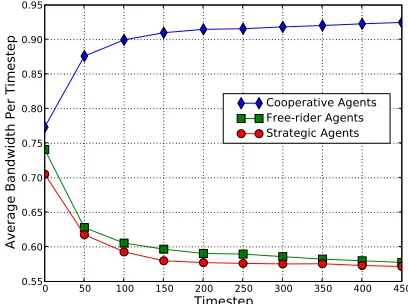
for 500 time steps, measuring how efficiency changes over time. In Figure 5, we see that the benefit that strategic agents gain from misreporting in BarterCast gets even larger over time. Compare this against Figure 6, which presents re-sults for DropEdge. Strategic agents cannot manipulate their scores, and receive decreasing amounts of work as the sim-ulation proceeds. At the end of the run, cooperative agents indeed receive twice as much work per round as the other agents (note they also perform exactly twice as much work).
0 50 100 150 200 250 300 350 400 450
Timestep
0.4 0.6 0.8 1.0 1.2 1.4 1.6 1.8 2.0
Average Bandwidth Per Timestep
[image:7.612.63.536.57.180.2]Cooperative Agents Free-rider Agents Strategic Agents
Figure 5: Bandwidth in BarterCast Mechanism over Time.
0 50 100 150 200 250 300 350 400 450
Timestep
0.55 0.60 0.65 0.70 0.75 0.80 0.85 0.90 0.95
Average Bandwidth Per Timestep
Cooperative Agents Free-rider Agents Strategic Agents
Figure 6: Bandwidth in Drop-Edge Mechanism over Time.
6
Ongoing & Future Research
[image:7.612.330.534.392.544.2]implementation, we realized quickly that now the compu-tational complexity of the Drop-Edge mechanism plays a much larger role. In fact, when comparing BarterCast to Drop-Edge, one drawback of Drop-Edge becomes apparent: every time the composition of the choice set changes, the agents have to re-compute the max-flow algorithm which is a costly operation. Obviously, this was not necessary for the BarterCast mechanism. But in fact, if both mechanisms are implemented as described in Section 3, then any time an edge in the subjective work graph changes its weight, the scores would need to be re-computed. To avoid running the full max-flow algorithm each time a change occurs, we are currently investigating incremental max-flow algorithms that have better running times.
The second avenue involves a more detailed analysis of the max-flow algorithm that is used in both BarterCast and Drop-Edge. Earlier in the paper, we have argued that us-ing max-flow to estimate an agent’s net work is a form of “bounded addition”. A closer look at the semantics of the max-flow algorithm reveals, that simply taking the flow be-tween two agents in one direction minus the flow in the other direction does not really make sense. By using max-flow we are limiting the influence of any agent on the max-flow path by the incoming and outgoing edges of that agent respec-tively. However, this only makes sense for an agent’s outgo-ing edges which represent work it has performed for other agents, and thereby earned trust and is now allowed to make reports about other agents. However, incoming edges repre-sent work consumed and thus there is no reason we should trust an agent more when the agent has a high weight on in-coming edges. It is easy to show that a Byzantine agent that never performs any work but manages to consume work is now able to spread bad information in the accounting mech-anism despite the use of the max-flow algorithm. We are cur-rently exploring variations of the max-flow algorithm that do not suffer from this problem.
The third avenue regards sybil attacks on work account-ing mechanisms. Despite usaccount-ing the max-flow algorithm which provides sybilproofness in reputation systems (Cheng and Friedman 2006), both BarterCast and Edge-Drop can be manipulated by sybil attacks. This is because sybil at-tacks are more powerful against work accounting mecha-nisms than against reputation systems. In PageRank for example, the only concern about a sybil attack is that an agent could increase the reputation of its website by cre-ating a set of sybils that are linking to the original site but an agent does not directly benefit from a sybil web-site with a high reputation. Various reputation mechanisms (e.g., maxflow, hitting-time (Cheng and Friedman 2006; Sheldon and Hopcroft 2007) are sybil-proof in the sense that they can protect against these kinds of attacks. The situation is drastically different in distributed work systems. For ex-ample, in P2P file-sharing, if I can create sybils with a pos-itive score, then I can use these sybils to receive work from other users without any negative effect on my real score. Ex-isting sybil-proof mechanisms do not protect against these kinds of sybil attacks. Thus a new approach is required and subject to our ongoing research.
7
Conclusion
In this paper we have formalized the problem of designing incentive-compatible accounting mechanisms for distributed work systems. We have shown that the existing BarterCast mechanism is highly susceptible to misreport attacks and that strategic agents could benefit significantly from ma-nipulating. To address this, we have introduced the Drop-Edge Mechanism which is misreport-proof. In our theoret-ical analysis we have proved that Drop-Edge provides good approximations to an agent’s net contributions and scores respectively, and is accurate as the number of agents grows. Via simulations of a P2P file-sharing system we have shown that the good approximation of the scores also translates into good system efficiency. When strategic agents are present, the Drop-Edge Mechanism clearly outperforms BarterCast: cooperative agents have higher efficiency, while free-riding agents have lower efficiency. We have shown that the mag-nitude of this effect even grows over time. Thus, we believe that using Drop-Edge over BarterCast in a real system has significant advantages.
Acknowledgements
We are thankful to Michel Meulpolder, Johan Pouwelse, Ian Kash and Ariel Procaccia for helpful discussions on this work. The first author is supported by a Microsoft Research PhD Fellowship. The second author is supported by an ND-SEG Fellowship sponsored by the Department of Defense.
References
Alon, N.; Fischer, F.; Procaccia, A. D.; and Tennenholtz, M. 2010. Sum of us: Strategyproof selection from the selectors. Working Paper, Harvard University.
Cheng, A., and Friedman, E. 2006. Manipulability of PageRank under Sybil Strategies. InProceedings of the First Workshop of Networked Systems (NetEcon06).
Feldman, M.; Lai, K.; Stoica, I.; and Chuang, J. 2004. Robust incentive techniques for peer-to-peer networks. InProceedings of the 5th ACM Conference on Electronic Commerce (EC).
Friedman, E. J.; Halpern, J. Y.; and Kash, I. 2006. Efficiency and Nash Equilibria in a Scrip System for P2P Networks. In Proceed-ings of the 7th ACM Conference on Electronic Commerce (EC). Friedman, E.; Resnick, P.; and Sami, R. 2007. Algorithmic Game Theory. Cambridge University Press. chapter Manipulation-Resistant Reputation Systems, pp. 677–698.
Meulpolder, M.; Pouwelse, J.; Epema, D.; and Sips, H. 2009. Bartercast: A practical approach to prevent lazy freeriding in p2p networks. InProceedings of the 6th International Workshop on Hot Topics in Peer-to-Peer Systems (Hot-P2P).
Piatek, M.; Isdal, T.; Krishnamurthy, A.; and Anderson, T. 2008. One hop reputations for peer to peer file sharing workloads. In Proceedings of the 5th USENIX Symposium on Networked Systems Design and Implementation (NSDI), 1–14.