COMPARISON OF THE IMMEDIATE EFFECT OF DIFFERENT TYPES OF TRUNK EXERCISE ON THE STAR EXCURSION BALANCE TEST IN MALE ADOLESCENT SOCCER PLAYERS
-AN EXPERIMENTAL STUDY
A Dissertation submitted to
THE TAMIL NADU DR. M.G.R. MEDICAL UNIVERSITY, CHENNAI
In partial fulfillment of requirements for the award of the MASTER OF PHYSIOTHERAPY DEGREE
(SPORTS PHYSIOTHERAPY) Submitted by
Reg No: 271450082
NANDHA COLLEGE OF PHYSIOTHERAPY
ERODE-52
THE TAMILNADU Dr.M.G.R. MEDICAL UNIVERSITY,
NANDHA COLLEGE OF PHYSIOTHERAPY
CERTIFICATE
This is to certify that the dissertation entitle “COMPARISON OF THE IMMEDIATE EFFECT OF DIFFERENT TYPES OF TRUNK EXERCISE ON THE STAR EXCURSION BALANCE TEST IN MALE ADOLESCENT SOCCER PLAYERS” is a bonafide research work done by Mr. SHERIN JOHNSON in partial fulfillment of the requirement for the degree of MASTER OF PHYSIOTHERAPY (SPORTS
PHYSIOTHERAPY).
Evaluated on ...
Prof. V.MANIVANNAN, M.P.T, (Ortho)
PRINCIPAL,
NANDHA COLLEGE OF PHYSIOTHERAPY,
ERODE- 638 052.
CERTIFICATE BY THE HEAD OF THE INSTITUTION
This is to certify that the dissertation work entitled “Comparison of the immediate effect of different types of trunk exercises on the star excursion balance test in male adolescent soccer players” was carried out by the candidate bearing the Register No.271450082 (April 2016) in Nandha College of Physiotherapy, Erode, affiliated to The Tamil Nadu Dr. M.G.R Medical University, Chennai. Towards partial fulfillment of the Master of Sports Physiotherapy.
Date :
Place : Erode
Principal Signature
MR. T.LOGANATHAN., M.P.T.,(SPORTS)
ASSOCIATE PROFESSOR,
HEAD SPORTS PHYSIOTHERAPY,
Nandha College of Physiotherapy,
Erode -638 052.
CERTIFICATE BY THE GUIDE
This is to certify that the dissertation work entitled “Comparison of the immediate effect of different types of trunk exercises on the star excursion balance test in male adolescent soccer players” was carried out by the candidate bearing the Register No.271450082 (April 2016) in Nandha College of Physiotherapy, Erode, affiliated to The Tamil Nadu Dr. M.G.R Medical University, Chennai. The dissertation represents entirely an independent work on the part of the candidate but for the general guidance by me.
Date:
ACKNOWLEDGEMENT
I thank GOD almighty and My Parents who laid the foundation for my knowledge and wisdom and who always been in my source of strength and inspiration and who gaid me throught.
I am grateful to our Principal Dr. V. MANIVANNAN, M.P.T (ortho) for granting me permission to do this dissertation in our institution.
I extend my sense of gratitude to my advisor Dr. T. Loganathan, M.P.T (Sports) ASSOCIATE PROFESSOR, for his valuable suggestion from Nandha College of Physiotherapy and constant encouragement throughout the duration of my dissertion.
My heartfelt gratitude to those who mean the most to me. I am indebted to MY DEAR FAMILY MEMBERS and FRIENDS for their prayerful support, inspiration, constant care, love, affection and encouragement throughout this endeavour.
CONTENTS
CHAPTER NO.
TITLE
PAGE NO.
1.
INTRODUCTION 1
1.1 NEED FOR THE STUDY 6
1.2 AIM OF THE STUDY 7
1.3 OBJECTIVES OF THE STUDY 7
1.4 STATEMENT OF THE PROBLEM 8
1.5 HYPOTHESIS 8
1.6 EXPECTED OUTCOME 8
2. REVIEW OF LITERATURE 9
3. MATERIALS AND METHODOLOGY 18
4. DATA ANALYSIS AND INTERPRETATION 22
5. RESULTS & DISCUSSION 25
6.
CONCLUSION 28
7 BIBLIOGRAPHY 30
8 APPENDICES
1
CHAPTER – I
INTRODUCTION
Balance refers to an individual‟s ability to maintain their line of gravity within their Base of support (BOS). It can also be described as the
ability to maintain equilibrium, where equilibrium can be defined as any
condition in which all acting forces are cancelled by each other resulting in a
stable balanced system. There are two types of balances:
Static Balance: It is the ability to maintain the body in some fixed posture. Static balance is the ability to maintain postural stability and
orientation with centre of mass over the base of support and body at rest
Dynamic Balance: Dynamic balance is the ability to transfer the vertical projection of the centre of gravity around the supporting base of
support. Dynamic balance is the ability to maintain postural stability and
orientation with centre of mass over the base of support while the body parts
are in motion.
Trunk stability is important for the connection of movements between
the lower and upper body, as well as the control of body balance and
2
In the current study trunk was defined as the region of the low back
and pelvis, and trunk stability was considered as the ability to control the
position and motion of the trunk during dynamic loading and movement
conditions. In order to maintain optimal trunk stability, coordination and
co-activation neural control of trunk muscles are needed.
Trunk muscles are classified as global and local muscles depending on
its anatomical position and orientation. Local muscles directly or indirectly
attached to the lumbar vertebrae are associated with segmental stability of
the lumbar spine. On other hand, global muscles attached to hips and pelvis
are related to torque production and transfer of load between thoracic cage
and pelvis.
Trunk exercises are often performed to improve sports performance
and strength, prevent injuries and rehabilitate patients with low back pain
and dysfunction. One type of trunk exercises, described as conventional
exercise(CE) include repeated flexion and extension of the trunk, such as sit
-ups or back extension, and are performed to strengthen the trunk muscle,
and are performed to strengthen the trunk muscle.
Another type of trunk exercise described as trunk stabilisation exercise
(SE) keep the lumbar spine in a neutral position accompanying trunk
movements, such as back bridge. The main aim of the SE is to restore and
3
Previous studies have demonstrated that SE improved trunk stability and
athletic performance, and prevent low back pain. Recently several research
have SE improve static and dynamic balance.
It is not known how much the SE contribute to improving physiological
responses, performance, and static and dynamic balance and preventing
injuries because there have been very few studies that investigated the
immediate effects of the SE alone.
Kaji et al23 reported that the SE program immediately improved static
balance. Imai et al.24 compared the immediate effect of the SE on static
balance with that of the CE. They found that static balance improved
immediately with SE but did not improve with the CE. This result indicates
that the effect of training on static balance varies depending on the types of
trunk exercises and that the immediate improvement of static balance is a
specific effect of the SE.
Imai et al15 and Kahle et al13 previously reported that dynamic
balance was improved by a 12-week and 6-week SE program, respectively.
However, the immediate effect of SE or CE on dynamic balance is not yet
known because of the lack of evidence related to the immediate effect of
4
The Star Excursion Balance Test (SEBT) is a dynamic test that requires strength, flexibility, and proprioception. It is a measure of dynamic
balance that provides a significant challenge to athletes and people who are
physically active. The test can be used to assess physical performance but
can also be used to screen deficits in dynamic postural control due to
musculoskeletal injuries like chronic ankle instability. It could be used to
identify athletes at greater risk for lower extremity injury. It is also possible
to use the test during the rehabilitation of orthopedic injuries in healthy
physically active adults.
The SEBT could be used to compare balance ability among different
sports and to assess physical performance. Research have suggested to use
the SEBT as a screening tool for sport participation on the one hand and as a
post-rehabilitation test to ensure dynamic functional symmetry on the other
hand. It‟s also been showed that the performance of SEBT improves after
training.
You need to use 4 strips of athletic tape with a length of 6-8 foot. Then
you should form a „+‟. After this is done, you have to use 4 strips of athletic
tape of the same length but this time you are going to form an „x‟. It is
5
The goal of the SEBT is to maintain single leg stance on one leg while
reaching as far as possible with the contra lateral leg .The person performing
this test must maintain a base of support on one leg, while using the other leg
to reach as far as possible in 8 different directions. This person (standing on
his left leg for example) must reach in 8 different positions, once in every of
the following directions: anterior, anteromedial, medial, posteromedial,
posterior, posterolateral, lateral and anterolateral. The anterior,
posteromedial and posterolateral directions appear to be important to
identification individuals with chronic ankle instability and athletes at
greater risk of lower extremity injury.
It is important, that the test capture the greatest amount of information
of instability in the shortest amount of time. When the person demonstrates a
significantly decreased reach while standing on the injured limb compared to
standing on the healthy limb, the Star Excursion Balance Test has shown his
6
Therefore this study compares the immediate effect of stabilisation
exercise with that of conventional exercise on dynamic balance.
1.1 NEED FOR STUDY
Good lower extremity balance and neuromuscular control are
important factors contributing to the improved performance and reduced risk
of injury among adolescent soccer players. It has been demonstrated that
many athletes are at risk of lower extremity injuries because of the poor
trunk stability and strength. Trunk exercises are done to improve static and
dynamic balance. A few studies have demonstrated immediate effects of
7
need for this study is to identify and compare the immediate effects of
conventional exercises and stabilization exercises on star excursion balance
test, which is a measure of dynamic balance.
1.2 AIM OF THE STUDY
Aim of the study is to compare the immediate effects of trunk exercise
on star excursion balance test in male adolescent soccer players
1.3 OBJECTIVE OF THE STUDY
To determine the immediate effect of conventional exercises on star
excursion balance test among adolescent soccer players.
To determine the immediate effect of stabilisation exercises on star
excursion balance test among adolescent soccer players
To compare and contrast the immediate effect of conventional and
stabilisation exercises on star excursion balance test among adolescent
8
1.4 STATEMENT OF THE PROBLEM
“Comparison of the immediate effect of different types of trunk
exercises on the star excursion balance test in male adolescent soccer players.”
1.5 HYPOTHESIS
Null Hypothesis
Based on review of literature the null hypothesis is stated as “There
won’t be any significant immediate effect for conventional exercise and
stabilisation exercise on star excursion balance test among male adolescent soccer players.”
Alternative Hypothesis
The alternative hypothesis is “There will be a significant immediate
effect for conventional exercise and stabilisation exercise on star excursion balance test among male adolescent soccer players.”
1.6 EXPECTED OUTCOME
Performing stabilisation exercises will bring out remarkable
immediate effect on star excursion balance test among male adolescent
9
CHAPTER – II
REVIEW OF LITERATURE
Mills JD, Taunton JE, Mills WA ,(2005)recently, started to use a
novel test to evaluate the trunk function in patients with
musculoskeletal disease in the lower extremities. The test involved a
body righting movement while sitting on the bed, thus named the
“trunk righting test” (TRT). The aim of this study is to investigate
whether TRT is a reproducible and reliable test for the observers,
independent of their experience.The intraexaminer intraclass
correlation coefficient showed that the reproducibility was higher than
the standard of 0.90, confirming that the test could be performed with
excellent reproducibility within the same examiners. Furthermore, the
interclass correlation coefficient was also as high at 0.93, revealing
that the interobserver reproducibility is also high. There was no
statistically significant difference between the therapists with different
levels of experience. The results suggest that the test is simple and
reproducible even for inexperienced therapists, and that the TRT could
10
Jamison et al.,(2012), done a study on Randomized controlled trial of
the effects of a trunk stabilization program on trunk control and knee
loadinand found that Quasistatic TS exercises did not improve core
strength, trunk control, or knee loading relative to RT potentially
because of a lack of exercises, including unexpected perturbations and
dynamic movement. Together, these results suggest the potential
importance of targeted trunk control training to address these known
anterior cruciate ligament injury risk factors.
Panjabi M M,(1992),The neutral zone appears to be a clinically
important measure of spinal stability function. It may increase with
injury to the spinal column or with weakness of the muscles, which in
turn may result in spinal instability or a low-back problem. It may
decrease, and may be brought within the physiological limits, by
osteophyte formation, surgical fixation/fusion, and muscle
strengthening. The spinal stabilizing system adjusts so that the neutral
zone remains within certain physiological thresholds to avoid clinical
instability.
Bergmark A .,(1989),states that the lack of knowledge implies great
difficulties at numerical simulation of equilibrium states of the spinal
11
made, such as the assumption that the thoracic cage behaves like a
rigid body. A particularly useful point of view about the main
principles of the force distributions appears to be the distinction
between a local and a global system of muscles engaged in the
equilibrium of the lumbar spine. The local system consists of muscles
with insertion or origin (or both) at lumbar vertebrae, whereas the
global system consists of muscles with origin on the pelvis and
insertions on the thoracic cage. Given the posture of the lumbar spine,
the force distribution over the local system appears to be essentially
independent of the outer load of the body (though the force
magnitudes are, of course, dependent on the magnitude of this load).
Instead different distributions of the outer load on the body are met by
different distributions of the forces in the global system. Thus, roughly
speaking, the global system appears to take care of different
distributions of outer forces on the body, whereas the local system
performs an action, which is essentially locally determined (i.e. by the
posture of the lumbar spine). The present work focuses on the upright
standing posture with different degree of lumbar lordosis.
Thomas TR, Ridder MB.,(1989) , compare the effects of different
abdominal exercise programs on abdominal muscular function and
12
assigned to training using: (1) abdominal crunch (AC) weight
machine; (2) steated incline (SI) weight machine; or (3) incline sit-up
(ISU) exercise. Strength training occurred three times per week for 10
weeks. All groups improved in abdominal muscular strength and
endurance. The ISU and AC group improved in muscular power
(timed sit-up), while flexibility was maintained or increased in all
groups. Abdominal skinfolds tended to increase and girths generally
were unaltered by the abdominal exercise programs. These results
suggest that abdominal weight machines or traditional incline sit-ups
are effective in altering abdominal muscular function, but local
abdominal exercise alone is unsatisfactory for reducing stomach
skinfolds or girths.
Hodges PW.,(2003), core stability exercise is an evolving process,
and refinement of the clinical rehabilitation strategies is ongoing. Two
major foci are addressed in contemporary core stability programs:
motor control and muscle capacity. Both of these factors have
considerable foundation in the literature and can be seen as a
progression of exercise rather than conflicting approaches.
Importantly, the clinical efficacy of these approaches is being realized
13
Durall CJ, Udermann BE, Johansen DR et al. ,(2009),These data
suggest that training the trunk musculature twice per week during a
10-week period with a relatively simple floor exercise protocol was an
effective stimulus to improve trunk endurance measures. It is
encouraging that none of the gymnasts reported new episodes of LBP
during the subsequent competitive gymnastics season.
Sato K, Mokha M,(2009) ,conducted a study to identify the
effectiveness of core strength training (CST) on improving athletic
performance. The aim of this study was to determine the effects of 6
weeks of CST on ground reaction forces (GRFs), stability of the lower
extremity, and overall running performance in recreational and
competitive runners. After a screening process, 28 healthy adults (age,
36.9 ± 9.4 years; height, 168.4 ± 9.6 cm; mass, 70.1 ± 15.3 kg)
volunteered and were divided randomly into 2 groups (n = 14 in each
group). A test-retest design was used to assess the differences between
CST (experimental) and no CST (control) on GRF measures,
lower-extremity stability scores, and running performance. The GRF
variables were determined by calculating peak impact, active vertical
GRFs (vGRFs), and duration of the 2 horizontal GRFs (hGRFs), as
14
was assessed using the Star Excursion Balance Test. Running
performance was determined by 5000-m run time measured on
outdoor tracks. Six 2 (pre, post) × 2 (CST, control) mixed-design
analyses of variance were used to determine the influence of CST on
each dependent variable, p< 0.05. Twenty subjects completed the
study (nexp = 12 and ncon = 8). A significant interaction occurred, with
the CST group showing faster times in the 5000-m run after 6 weeks.
However, CST did not significantly influence GRF variables and
lower-leg stability. Core strength training may be an effective training
method for improving.
Hides JA, Jull GA, Richardson C.,(2001), found from their study
that Long-term results suggest that specific stabilisation exercise
therapy in addition to medical management and resumption of normal
activity may be more effective in reducing low back pain recurrences
than medical management and normal activity alone. .
Robinson and Gribble (2009)demonstrated that, in most reach
directions, the maximum reaching distances and associated kinematic
displacement values of the stance limb stabilized by the fourth trial.
15
performed before measuring reaching distances for clinical or research
purposes.
Parkhouse KL, Ball N.,(2011),undertaken a study on influence of
dynamic versus static core exercises on performance in field based
fitness tests. Findings indicate that both types of training improved
specific measures of core stability but did not transfer into any
sport-related skill.
Akuthota V, Ferreiro A, Moore T, et al.,(2008)Core stability is
essential for proper load balance within the spine, pelvis, and kinetic
chain. Abdominal, gluteal, hip girdle, paraspinal, and other muscles
work in concert to provide spinal stability. Core stability and its motor
control have been shown to be imperative for initiation of functional
limb movements, as needed in athletics. Sports medicine practitioners
use core strengthening techniques to improve performance and prevent
injury. Core strengthening, often called lumbar stabilization, also has
been used as a therapeutic exercise treatment regimen for low back
16
Waldén M, Atroshi I, Magnusson H, et al.,(2011), A neuromuscular
warm-up programme significantly reduced the rate of anterior cruciate
ligament injury in adolescent female football players. However, the
absolute rate difference did not reach statistical significance, possibly
owing to the small number of events..
Sato K, Mokha M. (2011) done a study „Does core strength training influence running kinetics, lower-extremity stability, and 5000-M
performance in runners?‟.They found thata significant interaction
occurred, with the CST group showing faster times in the 5000-m run
after 6 weeks. However, CST did not significantly influence GRF
variables and lower-leg stability. Core strength training may be an
effective training method for improving performance in runners.
Sharma A, Geovinson SG, Singh Sandhu J (2012) states that
nine-week strategic core strengthening exercise program increases trunk
stability and in turn improves block difference (vertical jump
17
Childs JD, Teyhen DS, Casey PR, et al(2010) suggest that exercise
programs that target core lumbar musculature may offer no additional
preventative benefit when compared to traditional lumbar exercise
programs. Also, brief psychosocial education may be an important
adjunct to exercise programs as they may prevent the seeking of
health care when experiencing LBP.
Plisky PJ, Rauh MJ, Kaminski TW, et al. (2006) found
components of the SEBT to be reliable and predictive measures of
lower extremity injury in high school basketball players. Our results
suggest that the SEBT can be incorporated into preparticipation
physical examinations to identify basketball players who are at
increased risk for injury.
Filipa A, Byrnes R, Paterno MV, et al (2010)Female soccer players
demonstrated an improved performance on the SEBT after
Neuromuscular training programme that focused on core stability and
18
CHAPTER III
MATERIALS AND METHODOLOGY
3.1 STUDY DESIGN
Cross over experimental study was used.
3.2 STUDY SETTING
This study was carried out in Nandha soccer club , Nandha Outpatient
Department Erode.
3.3 STUDY DURATION
Total duration of study was 6 months.
Treatment duration was 3 weeks.
3.4 SAMPLING METHOD
Sample was collected by convenient sampling method.
3.5 STUDY POPULATION AND SAMPLING
Sampling size – 11 Adolescent male soccer players
4 players SE, CE and NE
4 players CE, NE and SE
3 players NE, SE and CE
3.6 CRIETERIA FOR SAMPLE SELECTION INCLUSION CRIETERIA
Male soccer players in adolescent age group (10-19years).
19 No cerebral concussions
No vestibular disorders
No upper respiratory or ear infections
EXCLUSION CRIETERIA
Soccer players of age less than 10 years and more than 19 years
Female athletes
History of back pain within one year
History of lower extremity injury within one year
3.7 MATERIALS USED Sticking Tape
Measuring tape
Pencil
3.8 PROCEDURE
Thirty adolescent male soccer players participated in this study. Their
mean ± SD age, height, and body mass were 17.9 ± 0.3 years, 168.5 ± 5.4
cm, and 60.1 ±5.1 kg, respectively. The study was comprised of pretest,
interventions and post testing.
Prior to pre testing preparation sessions involving the demonstration
and practice of testing was held once for all participants to get familiarised
with testing procedures. Players performed stabilisation exercise and
20
In the non exercise condition participants sat and rested on a chair for
5 minutes. All the demonstration programmes were taught by researcher‟s
demonstrations. All the participants performed same soccer practice during
the training period of study. During the period of trunk exercise programmes
participants were instructed not to do any additional physical training on an
individual basis. Post testing was conducted after intervention period.
For performing star excursion balance test, floor is marked with a star
pattern in 8 directions: 450apart from each other: anterior, posterior, medial,
lateral, posterolateral, posteromedial ,anterolateral and anteromedial. One
foot is placed in the middle of the star pattern. The subjects performed SEBT
in the anterior, posteromedial and posterolateral directions. Their hands were
placed on iliac crest during each test.
The subject makes a light tap on the floor, and returns the leg to the
centre of the star. The distance from the centre of the star to the tap is
measured. The trial is nullified and has to be repeated if the subject commits
any of the following errors: makes a heavy touch, rests the foot on the
ground, loses balance, or cannot return to the starting position under control.
The longest reach distance in each direction was noted. For accurate
analysis the data of reach distance was normalised by leg length to exclude
the influence of leg length. The leg length were measured from the most
distal end of the anterior superior iliac spine to the most distal end of the
21 3.9. STATICAL TOOLS
Statistical analyses were performed by using the software SPSS for Mac Ver. 19 (SPSS Inc. Chicaco,IL,USA). The test-retest reliability for
the SEBT was calculated by using a two-way random effect model intraclass
correlation coefficients (ICCs). The baseline data of the SEBT between
groups were compared by using a one-way ANOVA. A two-way (group x
time) repeated-measures ANOVA with a mixed-model design design was
22
CHAPTER – IV
DATA ANALSIS & INTERPRETATION
The test-retest reliability analysis demonstrated ICCs of 0.965, 0.888,
and 0.948 for the anterior, posterolateral, and posteromedial directions,
respectively. There were no significant differences between groups at the
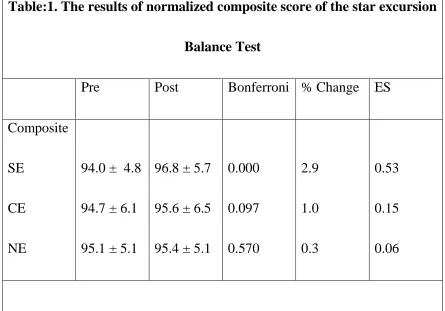
baseline data of each direction (p > 0.05). For the SEBT composite score,
significant condition-by-time interactions existed (F = 5.441, p = 0.010). A
Bonferroni post hoc test detected that the SEBT composite score was
increased significantly only after the SE (p < 0.001, ES = 0.53). A moderate
ES (0.53) was associated with this relation. The composite score did not
change after the CE (p = 0.097, ES = 0.15) and NE (p = 0.570, ES = 0.06)
[image:28.595.84.529.445.756.2](Table 1).
Table:1. The results of normalized composite score of the star excursion
Balance Test
Pre Post Bonferroni % Change ES
Composite
SE
CE
NE
94.0 ± 4.8
94.7 ± 6.1
95.1 ± 5.1
96.8 ± 5.7
95.6 ± 6.5
95.4 ± 5.1
23
In the analysis of each direction, there were significant condition-by-time interactions in the posterolateral direction (F = 5.764, p = 0.008) and
posteromedial direction (F = 7.745, p = 0.002). However, no interaction
effect in the anterior direction was noted (F = 0.116, p = 0.891). In the SE
condition, the Bonferroni post hoc test revealed that the SEBT score of the
posterolateral direction (p = 0.002, ES = 0.44) and posteromedial direction (p
< 0.001, ES = 0.74) was significantly greater at the posttest than at the
pretest (Table 2). Small to moderate ESs were associated with these
24
Table:2. The results of normalized reach distance scores of each direction of the star Excursion Balance Test
Direction Pre* Post* Bonferroni % Change ES
Anterior
SE
CE
NE
74.0 ± 3.4
75.0 ± 6.0
73.3 ± 5.3
73.7 ± 4.6
74.9 ± 5.1
73.5 ± 4.8
-0.4 0.1 0.3 0.07 0.01 0.04 Posterolateral SE CE NE
102.8 ±
7.3
103.6 ±
6.8
105.4 ±
7.4
106.2 ±
8.1
105.2 ±
8.1
104.1 ±
7.8 0.002 0.115 0.191 3.3 1.5 -1.3 0.44 0.21 0.17 Posteromedial SE CE NE
105.3 ±
5.8
105.5 ±
7.6
106.6 ±
4.9
109.8 ±
6.4
106.2 ±
8.2
108.0 ±
25
CHAPTER – V
RESULT AND DISCUSSION
This study compared the immediate effects of different types of trunk
exercises on the performance on the SEBT. One interesting finding was that
the SEBT composite score significantly improved only after the SE but not
after the CE and NE. Thus, the results indicate that the SE has the immediate
effects concerning improvement of dynamic balance.
Although previous studies have demonstrated that 12 weeks and 6
weeks of the SE improved dynamic balance,13,15 the current research
provides the first evidence showing the immediate effects of the SE on
dynamic balance. Concerning the reach direction, results show that the reach
distance improved in the posteromedial and
posterolateral directions and that in the anterior direction did not change. For
the posterior directions, the hip flexion range of motion of the stance leg is
important. 38 Because the trunk is leaning forward to maintain balance in the
SEBT position,39 eccentric muscle contraction of the hamstrings and low
back muscles, such as the erector spinae and multifidus, is needed.40 Thus,
the function of the local muscles as monitors and the control of the trunk
motion by the global muscles are both important. During the SE program
prescribed here, the trunk position was maintained and adjusted by working
26
the control of the trunk position during the posterior directions of the SEBT
after the SE.
The SE involving arm and leg lifts used in this study have previously
been shown to involve high external oblique activity, which is likely to assist
in control of trunk rotation.37 Thus, the improvement in the control of the
trunk rotation may help the control of the lower extremity during the
posteromedial direction of the SEBT.
In contrast, the anterior direction was not changed significantly. This
supported the findings of the previous study that investigated the effect over
8 weeks of training.29 Hock et al32 reported that the range of motion of the
dorsiflexion influenced the anterior direction to a greater degree than
posterior directions. Therefore, it is possible that the anterior direction is
more sensitive to changes affected by the distal contributions.
Although the SE program was effective in improving the SEBT, no
change was found after the CE program. The SE differs from the CE in
terms of the stresses applied on particular body segments. Some basic
principles of physical training must be followed to obtain the optimal effects
of physical training.41 The specific adaptation to imposed demands (SAID)
is one such basic principle. The SAID principle states that the human body
will adapt specifically in response to the demands and stresses placed on
27
unilateral stresses on the hip extensors, and the task of movement is to
maintain and control these positions.
This stress resembles the stress of the SEBT in the posteromedial and
posterolateral directions. On the other hand, the CE applies stress to the
lumbar spine flexors and extensors in a dynamic bilateral manner. Therefore,
the SE may be more suitable than the CE in terms of SAID as a training
program to improve dynamic balance.
LIMITATIONS OF THE STUDY Sample size was small
All participants were male adolescent soccer players
The effect of only few trunk exercises were studied
This study could not explain how long the immediate effect on SEBT
lasts
There were nocontrol groups in this study
RECCOMMENDATIONS FOR FUTURE STUDY Sample size can be increased
Soccer players of different age groups can be included
Duration of the study can be extended
More trunk exercises can be included to find out the effect of those on
28 CONCLUSION
The study demonstrated that the posteromedial and the posterolateral
directions of the SEBT were improved immediately after stabilisation
exercise,but not after CE. Results of this study suggests that stabilisation
exercise programmes used in this has immediate effect in improving
29
BIBLIOGRAPHY
1. Mills JD, Taunton JE, Mills WA. The effect of a 10-weektraining
regimen on lumbo-pelvic stability and athleticperformance in female
athletes: A randomizedcontrolledtrial. Phys Ther Sport. 2005;6:60-66.
2. Hedrick A. Training the trunk for improved athleticperformance.
Strength Cond J. 2000;22:50-61.
3. Jamison ST, McNeilan RJ, Young GS et al.Randomized controlled
trial of the effects of a trunkstabilization program on trunk control and
kneeloading. Med Sci Sports Exerc. 2012;44:1924-1934.
4. Panjabi MM. The Stabilization system of the spine.Part II. Neutral
Zone and instability hypothesis.Journal of Spinal
Disorders.1992;5:390-397.
5. Bergmark A. Stability of the lumbar spine. A study inmechanical
engineering. Acta Orthop Scand Suppl.1989;230:1-54.
6. Thomas TR, Ridder MB. Resistance exercise programeffects on
abdominal function and physique. J SportsMed Phys Fitness.
1989;29:45-48.
7. Hodges PW. Core stability exercise in chronic lowback pain. Orthop
Clin N Am. 2003;34:245-254.
8. Butcher SJ, Craven BR, Chilibeck PD et al. The effectof trunk stability
training on vertical takeoff velocity.J Orthop Sports Phys Ther.
30
9. Durall CJ, Udermann BE, Johansen DR et al. Theeffects of preseason
trunk muscle training on lowbackpain occurrence in women collegiate
gymnasts.J Strength Cond Res. 2009;23:86-92.
10.Sato K, Mokha M. Does core strength training influence running
kinetics, lower-extremity stability,and 5000-M performance in
runners? J Strength CondRes, 2009;23:133-140.
11.Hides JA, Jull GA, Richardson CA. Long-term effectsof specifi c
stabilization exercises for fi rst-episode lowback pain. Spine.
2001;26:E243-248.
12.Harringe ML, Nordgren JS, Arvidsson I et al. Lowback pain in young
female gymnasts and the effectof specifi c segmental muscle control
exercises of thelumbar spine: a prospective controlled
interventionstudy. Knee Surg Sports Traumatol
Arthrosc.2007;15:1264-1271.
13.Kahle NL, Gribble PA. Core stability training indynamic balance
testing among young, healthy adults.Athletic Training and Sports
Health Care. 2009;1:65-73.
14.Parkhouse KL, Ball N. Influence of dynamic versusstatic core
exercises on performance in field based fitness tests. J Bodyw Mov
31
15.15 Akuthota V, Ferreiro A, Moore T, et al. Core stability exercise
principles. Curr Sports Med Rep. 2008; 7(1): 39–44
16.Waldén M, Atroshi I, Magnusson H, et al. Prevention of acute knee
injuries in adolescent female football players: cluster randomised
controlled trial. BMJ. 2012; 344: e3042
17.Sato K, Mokha M. Does core strength training influence running
kinetics, lower‐extremity stability, and 5000‐M performance in
runners? J Strength Cond Res. 2009; 23(1): 133–140
18.Sharma A, Geovinson SG, Singh Sandhu J. Effects of a nine‐week
core strengthening exercise program on vertical jump performances
and static balance in volleyball players with trunk instability. J Sports
Med Phys Fitness. 2012; 52(6): 606–615
19.Childs JD, Teyhen DS, Benedict TM, et al. Effects of sit‐up training
versus core stabilization exercises on sit‐up performance. Med Sci
Sports Exerc. 2009; 41(11): 2072–2083
20.Childs JD, Teyhen DS, Casey PR, et al. Effects of traditional sit‐up
training versus core stabilization exercises on short‐term
musculoskeletal injuries in US Army soldiers: a cluster randomized
trial. Phys Ther. 2010; 90(10): 1404–1412
21.Pearson D, Faigenbaum A, Conley M, et al. The National Strength and
Conditioning Association‟s Basic Guidelines for the Resistance
32
22.Plisky PJ, Rauh MJ, Kaminski TW, et al. Star Excursion Balance Test
as a predictor of lower extremity injury in high school basketball
players. J Orthop Sports Phys Ther. 2006; 36(12): 911–919
23.Filipa A, Byrnes R, Paterno MV, et al. Neuromuscular training
improves performance on the star excursion balance test in young
female athletes. J Orthop Sports Phys Ther. 2010; 40(9): 551–558
24.Bassett DR Jr, Howley ET. Limiting factors for maximum oxygen
uptake and determinants of endurance performance. Med Sci Sports
Exerc. 2000; 32(1): 70–84
25.Paavolainen L, Haäkkinen K, Hämäläinen I, et al. Explosive‐strength
training improves 5‐km running time by improving running economy
and muscle power. J Appl Physiol. 1999; 86(5): 1527–1533
26.Penry JT, Wilcox AR, Yun J. Validity and reliability analysis of
Cooper‟s 12‐minute run and the multistage shuttle run in healthy
adults. J Strength Cond Res. 2011; 25(3): 597–605 [
27.Tauchi K, Endo T, Ogata M, et al. The characteristics of jump ability
in elite adolescent athletes and healthy males: the development of
countermovement and rebound jump ability. International journal of
sport and health science. 2008; 6: 78–84
28.Miura K, Yamamoto M, Tamaki H, et al. Determinants of the abilities
to jump higher and shorten the contact time in a running 1‐legged
33
29.Kaji A, Sasagawa S, Kubo T, et al. Transient effect of core stability
exercises on postural sway during quiet standing. J Strength Cond Res.
2010; 24(2): 382–388
30.Hoch MC, Staton GS, McKeon PO. Dorsiflexion range of motion
significantly influences dynamic balance. J Sci Med Sport. 2011;
14(1): 90–92
31.Earl JE, Hertel J. Lower‐extremity muscle activation during the star
excursion balance tests. J Sport Rehabil. 2001; 10(2): 93–104
32.Pain MT, Challis JH. The influence of soft tissue movement on ground
reaction forces, joint torques and joint reaction forces in drop landings.
J Biomech. 2006; 39(1): 119–124
33.Ambegaonkar JP, Shultz SJ, Perrin DH. A subsequent movement
alters lower extremity muscle activity and kinetics in drop jumps vs.
drop landings. J Strength Cond Res. 2011; 25(10): 2781–2788
34.Kulas AS, Schmitz RJ, Shultz SJ, et al. Sex‐specific abdominal activation strategies during landing. J Athl Train. 2006; 41(4): 381–
386
35.Iida Y, Kanehisa H, Inaba Y, et al. Role of the coordinated activities of
trunk and lower limb muscles during the landing‐to‐jump movement.
APPENDICES
APPENDIX1
ASSESSMENT FORM
Participant Name :
Age / Sex :
Body Weight / Hight/ Kg/ Cm :
College Name :
Medical History :
Recent History :
Previous Injuries :
Recent Surgeries :
Social History :
Personal History :
Pain Assessment :
Side : Right/Left
Site :
Character : Sharp/Dull/Aching/
Throbbing/Radiating
Type of Pain : Constant/Intermittent
Aggravating Factors : Standing / Walking/
Running/Sports
Activities
Relieving Factors :
Vital Signs:
Heart Rate/Mint
Respiratory Rate/ Mint
Blood Pressure (mmHg) On Observation:
Built : Ectomorph/mesomorph/endomorph
Deformity :
Muscle Weakness :
Swelling :
Skin Assessment:
Topical Changes :
Texture :
Colour :
On Palpation
Oedema :
Swelling :
Sensory Assessment :
Superficial :
Deep :
Star Excursion Balance Test
S.
N
o
Pre Test Post Test
APPENDIX 2
PATIENT INFORMATION & INFORMED CONSENT FORM
Principal Investigator :
Supervisor :
Name of the participant :
Title of the study
“ Comparison of the immediate effect of different types of trunk exercises on the star excursion balance test in male adolescent soccer players”
You are invited to take part in this research study. The information in this
document is meant to help you decide whether or not to take part. Please feel
free to ask if you have any queries or concerns.
The participation in this research is purely voluntary and you have the
right to withdraw from this study at any time during the course of the study
without giving any reasons. However, it is advisable that you talk to the
research team prior to stopping the treatment.
Principal Investigatior:
ANNEXURE III
The Star Excursion Balance Test
The participants performed the SEBT in the anterior, posteromedial,
and posterolateral directions.29,32-34 They received verbal instruction and
visual demonstration of the SEBT from the same examiner before
performing the test. The participants stood on the leg they used for kicking a
ball, with the most distal part of the great toe placed on the center of the grid.
While maintaining a single-leg stance, they used the opposite leg to reach, as
far as possible toward the end of the line along a grid in the anterior,
posteromedial, and posterolateral directions. Then, they touched the ground
lightly with the most distal part of the reaching foot before returning to the
starting position. Their hands were held at the iliac crest during the test. All
tests were performed barefoot to rule out the influences of shoes. After six
practice trials were completed, the participants rested for two minutes and
then performed three test trials in each direction.35 The order of the reaching
directions was randomized at
each test session. The test was discarded and then repeated in the same
manner if a participant failed to maintain the unilateral stance, lifted or
moved the standing foot from the grid, or failed to return the
reaching foot to the starting position. The longest reach distance in each
data of reach distance was normalized with the leg length to exclude the
influence of leg length.25,36 The leg length was measured with a tape
measure from the anterior superior iliac spine to the center of the
ipsilateral medial malleolus.36 The composite score was calculated
ANNEXURE IV
Trunk stabilization exercise program
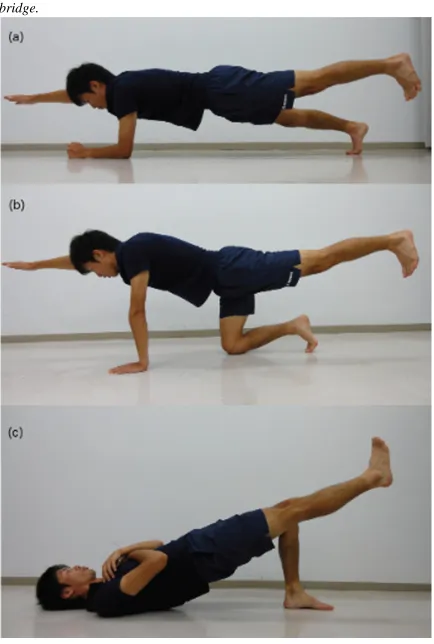
The SE program consisted of the front plank, quadruped exercise, and back
bridge (Figure 1). Okubo et al37 reported that the SE used in this study
involve higher activities of local muscles than other exercises. For the front
plank, participants maintained a prone position in which the body weight
was supported by the toes and forearms. From this position, they raised the
right arm and left leg simultaneously and held them straight up for five
seconds. Next, they raised the left arm and right leg simultaneously and held
them straight up for five seconds. Then, participants lowered their bodies on
the floor and rested for 10 seconds. This routine was repeated five times. For
the quadruped exercise, participants assumed a quadruped position. They
were then asked to hold a neutral pelvis position and to breathe normally.
Then, they raised their right arm and left leg simultaneously and held them
straight up for five seconds. Next, they raised their left arm and right leg
simultaneously and held them straight up for five seconds. Then, they rested
for 10 seconds. This routine was repeated five times. For the back bridge,
participants laid supine on the floor, with their feet flat on the ground, knees
bent at 90_, toes facing forward and hands folded across the chest. They
raised their pelvis to achieve and maintain a neutral hip flexion angle, then
raised one leg from the floor and extended the knee straight. This position
was maintained for five seconds. Then, they raised the opposite leg and
maintained the position for five seconds. Then, they rested for 10 seconds.
Figure 1. Trunk stabilization exercise program for this study: (a) the front plank, (b) the quadruped exercise, and (c) the back
ANNEXURE V
CONVENTIONAL EXERCISE PROGRAM
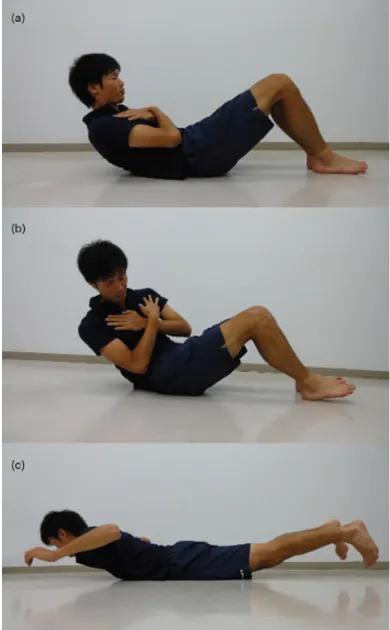
For the CE program, participants performed sit-ups, sit-ups with trunk
rotation, and back extensions (Figure 2). For the sit–ups, participants laid
supine in the standard sit-up position, knees bent at 90_, and hands folded
across the chest with each hand placed
on the opposite shoulder. They were asked to bend and raise the upper body until their elbows reached their thigh and then to return to the starting position. This routine was performed 30 times. For the sit-ups with trunk rotation, participants were asked to raise, bend, and rotate the upper body to the left or right until the elbow touched the opposite thigh from the starting position of the sit-up. This was performed 30 times, alternating on the right and left sides. For the back extension, the participants lifted their upper body and legs off the floor simultaneously from a prone position on the floor. After a comfortable elevation,
they lowered their upper body and legs to return to the starting prone position. These movements were repeated 50 times.
ABSTRACT
Purpose/Background: Trunk exercises, such as trunk stabilization
exercises (SE) and conventional trunk exercises (CE), are performed to
improve static or dynamic balance. Recently, trunk exercises have also
been often used as part of warm-up programs. A few studies have
demonstrated the immediate effects of SE and CE on static balance.
However, immediate effects on dynamic balance are not yet known.
Therefore, the purpose of this study was to compare the immediate
effect of SE with that of CE on the Star Excursion Balance Test (SEBT).
Methods: Eleven adolescent male soccer players (17.9 ± 0.3 years,
168.5 ± 5.4 cm, and 60.1 ± 5.1 kg) participated in this study. A crossover
design was used, and each participant completed three kinds of testing
sessions: SE, CE, and non-exercise (NE). Experiments took place for
three weeks with three testing sessions, and a 1-week interval was
provided between different conditions. Each testing session consisted of
three steps: pretest, intervention, and posttest. To assess dynamic
balance, the SEBT score in the anterior, posteromedial, and
intervention program. The data of reach distance were normalized with
the leg length to exclude the influence of the leg length on the analysis.
Results: The SEBT composite score was significantly improved after
the SE (p < 0.05) but did not change after the CE and NE (p > 0.05).
Furthermore, in the SE condition, SEBT scores of the posterolateral and
posteromedial directions were significantly improved at the posttest,
compared with those at the pretest (p < 0.05).
Conclusions: This study demonstrated the immediate improvements in
the posteromedial and posterolateral directions of the SEBT only after
the SE. This result suggests that the SE used in this study is effective in