Still one size does not fit all: Even using a multimodal approach to teaching
a core communications course
Michael Sankey and Eleanor Kiernan LTSU and Faculty of Arts University of Southern Queensland
Abstract
Research by Sankey and Kiernan (2006) recently explored the value of
multimodal CD-based course materials for first year external university students studying a core communication course. These materials were positively received overall and added significantly to the first year study experience. Since 2006, these materials were also made available to on-campus students. The authors consequently extended the research to include on-campus students and expanded the research instruments to collect more extensive qualitative data. Students also completed a learning styles questionnaire to gauge whether there was any
discernable correlation between their perceptions of the multimodal study materials and their preferred approach to learning. Results revealed that
students overall preferred the CD-based materials but given a choice also wanted ready access to printed materials. Only 10 percent of students wanted only print.
Introduction
At the University of Southern Queensland (USQ), as with many other institutions in
Australia, course materials have traditionally been delivered via lecture and static print-based materials. However, advances in technology and a greater use of multimedia in education has provided many opportunities for course leaders and designers to enrich students’ learning experiences by providing environments that comprise a range of multimedia and online components. A range of forces including pedagogical and pragmatic motivations, have
encouraged many educators to adopt these educational technologies to enhance the delivery of their courses (Sankey & Birch, 2005).
At the beginning of 2003, in a major shift in policy, the USQ decided that all courses of study, for both on- and off-campus students, would begin to be developed in a multimodal (or
hybridised) form. Central to this new delivery (in most cases) is a resource-rich CD containing all essential study materials supported with significant multimedia-based enhancements and online support. This represented a fundamentally new approach to the delivery of course materials at USQ, one that would require significant research to underpin its development and evaluation.
This paper reports on a study conducted on the second version of the multimodal delivery of a first year foundation communications course, CMS1000: Communication and Scholarship, provided to on- and off-campus first year students. This study investigated students’
given the researchers, and more importantly the University, a clear indication of how students perceived this new form of delivery.
This paper first seeks to outline the need for this change of delivery and looks at the
approaches taken in researching this change. Secondly, the paper argues that course materials can be designed to cater for students with a range of different learning styles and backgrounds and seeks to demonstrate that higher levels of student engagement are possible when a range of different media are employed, particularly important for first year students. This hypothesis will be supported with a summary of key points taken from the research conducted into CMS1000, drawing on students’ comments and perceptions of this environment.
Rationale for multimodal delivery at USQ
Taylor (2004) argues that traditional approaches to learning and teaching will not have the capacity to meet the escalating demands of higher education in the future. This is primarily due to the significant societal and technological developments that have resulted in major changes taking place in the field of higher education (Jochems, van Merrienboer, & Koper, 2004). These changes have not been restricted to individual institutions, but have occurred on a more global level, with institutions increasingly competing in the international marketplace for their students. This has required fundamentally new approaches to be considered in the delivery of courses across the board (Kellner, 2004). USQ’s answer has been to implement a multimodal form of delivery; the provision of course content through a resource-based learning package, supplemented by selected interactive teaching support activities using communication technologies or face-to-face sessions (Smith, 2005).
Multimodal delivery at USQ has its genesis in the principles of hybridised learning
environments. The term ‘hybrid’ in the educational context embraces a range of approaches to learning and teaching that integrate a number of delivery media, mainly facilitated by the proliferation of information and communication technologies (Parsons & Ross, 2002). This is linked with the concept that, not all students learn in the same way, and that if course
materials can cater for a range of learning styles there is a good chance that students ‘on the edge’ may engage with the learning required. Any advantage in learning and teaching is important, particularly in the current political climate where universities are under increasing pressure to maintain student numbers, particularly in the first year. This pro-active approach has allowed considerable expansion of support mechanisms for students and has made them available en masse (Cookson, 2002).
Associated with this is the increased reliance on the internet for information retrieval, though currently restricted by the inconsistency of broadband technologies across the range of diverse student bodies. These issues clearly made a CD-based resource the most viable option for the provision of resource rich course materials for foreseeable future, or until broadband
technology becomes ubiquitous. Therefore, in the context of USQ, a multimodal form of delivery is the provision of resource-rich learning environments. These environments are then supported by different combinations of teaching support and are integrated with the
university’s learning management system; USQConnect,
on the internet. Printed resources are also made available for purchase from the university bookshop if students prefer this option. However, as it will be demonstrated, given a choice the majority of students would prefer to print their own resources from the CD.
Integral to the design of the multimodal CD-based learning environments is the premise that students learn in different ways, that each individual has a preferred learning modality (Sarasin, 1999). Further, when this is taken into account and materials are designed to cater for multiple sensory channels, information processing can become more effective (Kearnsley, 2000). This form of instructional design is commonly referred to as ‘multimodal design’ where information is presented in multiple modes, such as visual and auditory modes (Chen & Fu, 2003). When applying multimodal principles, designers are able to cater for a range of different learning modalities, different nationalities, and the range of modes by which people choose to study. This multimodal approach is primarily used to extend textual and verbal forms of communication, to engage one or at most two communication pathways, so that multiple layers of meaning can be established (NMC, 2005).
In practice, this requires the representation of certain core information in multiple ways. This is typically achieved in an electronic environment by making use of a range of multimedia based enhancements. Utilising the benefits that multimedia affords, particularly with the use of multiple representations, the preferred learning modality of the user can then be
accommodated. This strategy, once implemented, has been shown on many occasions to aid in the construction of meaning for today’s increasingly less homogeneous student cohorts (Andrewartha & Wilmot, 2001; Chen & Fu, 2003; Mayer, 2001). For many students, these technologies offer exciting new ways to enrich the learning experience and ‘are the key for re-engaging individuals in more formal learning processes.’ (Jay, 2004, p. 8).
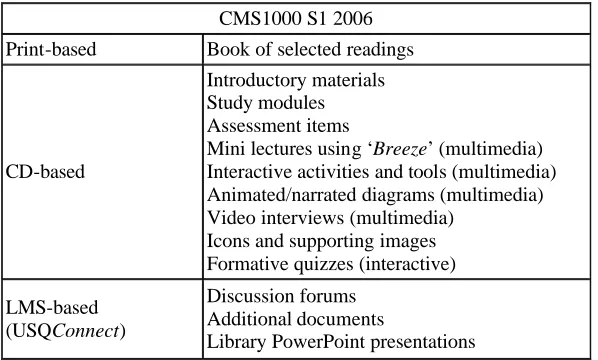
[image:3.595.68.367.573.753.2]As the CD-based materials for CMS1000 were formatted in such a way as to permit them to be viewed as HTML pages, this allowed for a range of navigation features and multimedia-based elements to be incorporated. These navigation features not only gave the course team additional options as to what they could provide their students (in the forms of links to additional resources both on the CD and on the internet), it also gives students a greater freedom in how they approached their study. A description of what is provided to CMS1000 students in this form of delivery is shown in Table 1, a demonstration of this environment will be provided at the conference.
Table 1. The multimodal package for CMS1000
CMS1000 S1 2006 Print-based Book of selected readings
CD-based
Introductory materials Study modules Assessment items
Mini lectures using ‘Breeze’ (multimedia) Interactive activities and tools (multimedia) Animated/narrated diagrams (multimedia) Video interviews (multimedia)
Icons and supporting images Formative quizzes (interactive)
LMS-based (USQConnect)
Discussion forums Additional documents
With the many additional hyperlinked options in the CD-based environment students are presented with a choice (or level of control) as to whether or not they access an alternative representation of the material. This level of control has been seen by Ainsworth and Van Labeke (2002) to significantly improve the learning opportunities for students. Therefore, if a student prefers to listen to, or view a particular concept, as opposed to read it (or do both), they may. This aspect of the environment was seen by first year students enrolled in CMS1000 to be very helpful. It was also seen to make the process of learning (for many) more enjoyable, which in turn made the materials (for some) easier to learn.
As it is USQ policy that all students require access to the internet to fully participate in their courses it becomes possible to further support the CD-based delivery with additional
information and activities housed on USQConnect portal. In some limited cases where students are not able to access the internet, if they are incarcerated for example, alternative arrangements are made. However, for the majority of cases USQConnect provides the opportunity for the course leader to establish either asynchronous or synchronous discussion forums to enable students to interact and communicate with each other and the lecturer.
Meeting the challenge of first-year off-campus students
Some off-campus university students can, at times, feel alienated, particularly early in their first year. To make this mode of studying more meaningful and inclusive, it was decided to make the experience richer for CMS1000 students by providing resources that would enable them to have more interactive activities and to have more contact with other students (on-campus) and the lecturer. This was achieved by using a combination of the multimodal CD and features of the USQConnect, particularly discussion forums, to engage the students. The philosophy underlying this approach is one of social constructivism which suggests that knowledge is created by shared experience. The interaction with people (students and lecturers) is vital in cognitive development according to the social constructivist theory (Hung, 2001). Maor (2003) states that social constructivism regards ‘individual cognition as occurring within a social context and suggests that collaboration between individuals in a social learning environment is an essential aspect of any educational experience.’ (p. 128). It was hoped that using this combination of technology would foster student interaction both with each other and with their lecturer to help them to gain both deeper understanding and lessen their sense of isolation as first year students.
As this change in delivery represented a substantial shift in the provision of the CMS1000 course resources (previously only print-based), it was seen as critical to understand how the students perceived these resources. It was also important to gain a clear understanding of how effective the multimedia elements had been in aiding student understanding of the core concepts within the course. Results of this investigation will help guide both the future development of this course and of multimodal delivery generally at USQ.
Method
The research model adopted for this study was a ‘Concurrent Triangulation Strategy’ (CTS) as defined by Creswell (2003). This strategy allows the collection of both qualitative and quantitative data with a view to triangulating these data. The qualitative measure was
important for this style of mixed methods study, where perceptions (qualitative) are being compared to responses in a quantitative survey.
This study, conducted at the completion of Semester 1 2006, used an online survey consisting of 30 questions, 14 questions using a five point Likert type scale (strongly agree / agree / no opinion / disagree / strongly disagree), eight questions using a two point scale (yes/no) and eight open-ended response questions supplying data initial qualitative data. Four focus groups were also held in which seven questions were responded to. One hundred and thirteen
students voluntarily completed the survey (n=113). This number represented 34% of the total student cohort. Thirty-two students participated in the focus groups, 18 on-campus and 14 off-campus. These instruments sought to understand student perceptions of the CD-based
multimodal environment and to what level they felt engaged by the multimodal nature of the materials. Students were also asked to complete the VARK learning styles survey, found at: http://www.vark-learn.com/english/index.asp, and to supply their results. A summary of the data, drawing on key findings, follow. However, as only limited data may be displayed here a more complete representation of these data is viewable at:
http://www.usq.edu.au/users/sankey/CMS1000S12006/
Demographic data
Of the 113 students responding to the survey 80% were female and 20% were male. These figures are reasonably consistent with the demographic of the student body at USQ where approximately two-thirds of the student body are female. Fifty-three percent (53%) studied off-campus, while 47% were on-campus students. First year students made up 84% of the respondents. Although this is a core course some students still choose to do this course later in their program. Sixty three percent (63%) were in the 25 or less age group. Only three students didn’t have English as their first language.
Findings and discussion
In commencing this analysis it was deemed important by the research team to consider three fundamental aspects. First, did the students like the CD-based material? Second, did the multimodal approach (or design) of the course materials help to engage first year students with the subject matter? Third, did the materials help to cater for different learning styles? Other peripheral issues were included such as navigation of the materials and the use of discussion forums, but these will not be discussed in this paper.
The first of these three aspects is addressed in Question 18 of the survey and it simply asked students, ‘Did you like the CD based materials?’ The data indicates that 86% of students responded in the affirmative (Figure 1) and this sentiment was confirmed by the qualitative analysis. The following two students’ comments provide a sense as to why there was such a positive response:
“It is really easy to access. I didn’t really find any disadvantages. I guess what I like about it is that because it’s in CD form it wasn’t overwhelming. It is not like you are looking at a huge big text book that you have to get through. It was really in manageable chunks and that is one of the things I liked about it”.
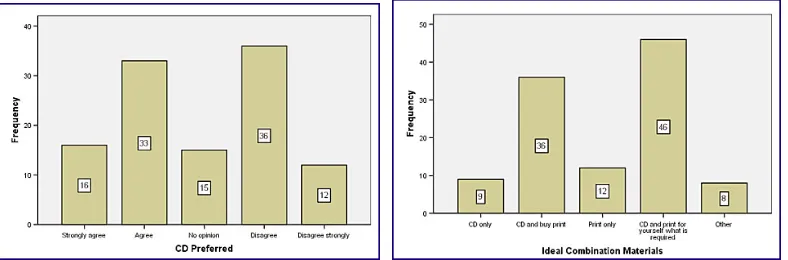
Figure 1 (left) Figure 2 (right). Frequency responses to Questions 18 and 17 of survey.
This high agreement rate for question 18 surprised the research team, as it was anticipated that students would prefer the more traditional print-based approach. However, Question 17
(Figure2) made a more explicit link to print materials when it asked: ‘The study materials viewable on the CD, with links to other aspects of the course are more useful than printed materials’. When this comparison is made with print materials the results are clearly less positive (58% agreed or strongly agreed; 29% disagreed or strongly disagreed and 13% have no opinion. Question 9 (Figure 3) was a balder version of Question 17 where students were now being asked to make a direct comparison between the two forms. When asked, I
preferred to use the CD materials rather than the printed materials, 44% agreed or strongly agreed; 43% disagreed or strongly disagreed and 13% have no opinion.
Figure 3 (left) Figure 4 (right). Frequency responses to Questions 9 and 22 of survey.
Interestingly, students were then asked in Question 22 (Figure 4) to, “Please choose your ideal combination of learning materials”. This question provided students with the
opportunity to clarify their preference. In these responses we clearly see that students were not condemning the CD as such, rather, they wanted to have access to printed materials. Only 11% of the students wanted to receive ‘print only’, as compared to a combined 74% who wanted to receive the CD and would be happy to either print for themselves what they required or buy what they wanted from the bookshop. Eight percent (8%) wanted only the CD, while the remaining 7% who selected ‘other’ wanted to be supplied with everything.
[image:6.595.104.502.87.219.2] [image:6.595.103.497.410.540.2]“Having study materials on CD means that you cannot have the materials with you at all times. You can't read them on the bus or while travelling and printing them is costly and
time-consuming. I think my learning of the materials was fairly restricted as I much prefer print form.”
“I hate sitting at a computer for too long so reading the material was difficult.”
As mentioned above the ease of access to printed materials has been a perceived concern of the research team and many of the sentiments expressed by these and other students revolve around the convenience of (or lack of) access to their preferred way of accessing information. However, the study did find that many students were self-selecting what they wanted to print, and only printed off what was necessary. This is demonstrated in the following comment: “I mostly printed off the sample assignments.’ Or ‘I think I would probably just use the CD and print the stuff off myself and not carry a book around.’ Further, students saw other benefits to providing the materials in this way, as this comment indicates. “I prefer it this way because I can’t afford to be buying all those different study books.”
The lack of ready access to print materials is obviously a concern to some; on the other hand, students expressed their satisfaction with this CD-based materials far more often than they did their dissatisfaction. The four main areas of satisfaction can be summarised as:
§ The use of the additional media (presentation in a variety of forms/multiple representations) made the materials more dynamic/interesting/fun,
§ It is less they have to carry around; more compact, less paper, § It made it easy to access information quickly, and
§ The use of navigation was regarded highly.
This is supported by the many comments made in response to Question 28 (open ended) that asked students: ‘What advantages or disadvantages did you find in having your study
materials supplied to you on CD? How do you think this affected your learning of the materials?’ A very similar question was asked in the focus groups. The following two comments by off- and on-campus students give a summary of the benefits in relation to the use of additional media:
“It helped me learn. I like the fact that it is sort of broken up with text and the visuals, and the power points, and the audio, because otherwise it is a bit too boring. It just had a balance of everything to keep you interested, to keep you going.”
Yes, I thought the CD was great. It’s got everything there and it’s in one place and you can flick from you assignment back to the CD and it is pretty easy. There weren’t really any disadvantages to it and it was pretty helpful. So, I liked it.
Even though some students identified their preference to print out certain aspects of the materials, it is seen that the advantages of what is supplied on the CD (by way of additional media) outweighed the disadvantages of having to print certain aspects of the materials. This point will be investigated in more detail in the following section.
Question 7 of the survey asked students if ‘the interactive multimedia features (such as diagrams with explanations) were more helpful to me than the static, print-based
Figure 5 (left) Figure 6 (right). Frequency responses to Questions 7 and 10 of survey.
Question 10 asked a similar question but also included a reflection on the students’ learning style ‘The interactive multimedia features on the CD (such as the diagrams with
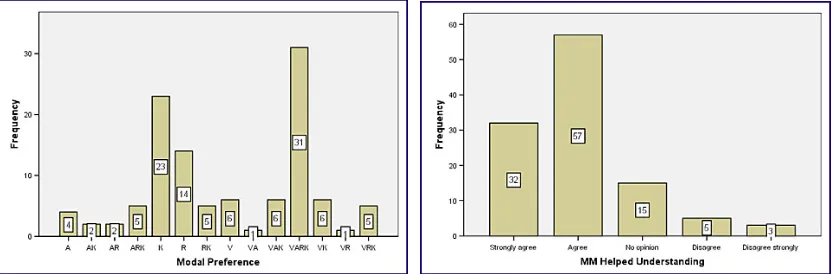
explanations) catered for my approach to learning.’ The results revealed that this was the case as 72% of the students agreed or strongly agreed,. 12% disagreed and 16% chose to express no opinion. This weight of positive sentiment is confirmed by the comments made by students in response to Question 27 (open ended) of the survey. For example,
'It certainly catered for mine. I mostly learn from viewing and listening, and the different materials
provided on the CD facilitated this.’
It should be noted that students were given the opportunity to complete a VARK learning style inventory both in the course (in Module 1) and again as part of the survey instrument. This was designed to give them a basic understanding of how they prefer to learn then asking them to reflect on the outcomes.
Figure 7 (left) Figure 8 (right). Frequency responses to Questions 24 and 12 of survey.
Another question relating to the multimedia features was Q. 12, ‘The multimedia
introductions (using PowerPoint and audio) used for each module; assessment and course overview really helped my understanding of the course content.’ Eighty percent (80%) of respondents either agreed or strongly agreed that these elements had helped them to learn the content, with 7% indicating they hadn’t found them helpful and 13 % choosing to express no opinion. This sentiment may be summed up in the following two comments:
[image:8.595.95.503.70.204.2] [image:8.595.91.508.435.572.2]The multimedia elements actually really did help me a lot. With the power points, I guess it reinforced what I was learning, and actually having somebody talking about it made it a lot easier.
Discussion
There was an unmistakably strong endorsement of CD-based materials, though they clearly did not suit everyone. Having said that, those who did not use the CD were happy to either print for themselves what was required or purchase a printed version from the bookshop. The use of technology, particularly the Breeze and multimedia presentations, was seen to help the students’ understanding of the course concepts and to help cater to different learning styles. An additional bonus for external students who can feel alienated, particularly in the first year, was breaking down the barriers to help them feel more a part of the student culture. Even though the results suggest the CD was successful overall and that it did serve to complement or replace the print materials, further consideration must still be given to the different learning styles of students. It is interesting that while most students like the CD, they would prefer to have access to both printed and CD based materials. Investigating the options of choosing their preferred combination at the time of enrolment is worth considering.
Conclusion
The findings of this research investigating the multimodal delivery of CMS1000 indicate that students had positive attitudes toward the CD-based courses along with the additional
multimedia components. It was seen in the feedback that higher levels of student engagement were possible when utilising imbedded multimedia elements as these were seen to cater for the students’ preferred way of learning. In particular, students agreed that they enjoyed using the course CD, found it easy to use and navigate, and also agreed that the course CD had assisted their performance in the course. This was primarily achieved by providing a more complete representation of the information being presented, thereby increasing the
opportunity for students to engage with their learning materials. Importantly, this was achieved whilst maintaining a balanced environment for more traditional learners, but at the same time integrating a range of multimedia based enhancements for those who learn in non-traditional ways. The CD technology should be not viewed as a perfect learning resource for first year students; most students still want printed material in conjunction with the CD. One of the reasons for offering the CD material mentioned in the introduction was ‘pedagogical and pragmatic’ reasons. If universities favour the pragmatic over the pedagogical, student learning could be compromised as one channel does not reflect all learning styles. Giving first year students options at the beginning of the course (perhaps on their enrolment form) could have a positive impact as students would feel more in control of the process. There are important issues relating to how the implementation of new technologies can be best
integrated before the full benefits to the learning community are realised.
References
Ainsworth, S., & Van Labeke, N. (2002). Using a multi-representational design framework to develop and evaluate a dynamic simulation environment. Paper presented at the International Workshop on Dynamic Visualizations and Learning, Tubingen, Germany.
Andrewartha, G., & Wilmot, S. (2001). Can multimedia meet tertiary education needs better than the conventional lecture? A case study. Australian Journal of Educational Technology, 17(1), 1-20.
Barker, C., Pistrang, N., & Elliott, R. (2002). Research methods in clinical psychology: An introduction for students and practitioners (2 ed.). West Sussex: John Wiley & Sons Ltd.
Chen, G., & Fu, X. (2003). Effects of multimodal information on learning performance and judgement of learning. Journal of Educational Computing Research, 29(3), 349-362. Cookson, P. (2002). The hybridization of higher education: Cross-national perspectives.
International Review of Research in Open and Distance Learning, 2(2), 1 - 4. Creswell, J. W. (2003). Research design: Qualitative, quantitative, and mixed methods
approaches (2 ed.). London: SAGE Publications.
Hung, D. (2001). Theories of learning and computer-mediated instructional technologies.
Education Media International, 38(4), 281-287.
Jochems, W., van Merrienboer, J., & Koper, R. (Eds.). (2004). Integrated e-learning:
Implications for pedagogy, technology and organization. London: Routledge Falmer. Kearnsley, G. (2000). Online education: Learning and teaching in cyber space. Belmont, CA:
Wadsworth/Thomson Learning.
Kellner, D. (2004). Technological transformation, multiple literacies, and the re-visioning of education. E–Learning, 1(1), 9-37.
Maor, D. (2003). The teacher's role in developing interaction and reflection in an online learning community. Education Media International, 40(1-2), 127-137.
Mayer, R. E. (2001). Multimedia learning. Cambridge: Cambridge University Press. NMC. (2005). A global imperative: The report of the 21st century literacy summit. Austin,
TX: The New Media Consortium (NMC) Also available online at: http://www.nmc.org/projects/literacy/index.shtml.
Parsons, P., & Ross, D. (2002). Planning a campus to support hybrid learning. Retrieved 6 April, 2004, from http://www.mcli.dist.maricopa.edu/ocotillo/tv/hybrid_planning.html Punch, K. F. (1998). Introduction to social research: Quantitative and qualitative
approaches. London: Sage Publications.
Sankey, M., & Birch, D. (2005, 28-29 October). Researching transmodal delivery at USQ: Different horses for different courses. Paper presented at the New Researchers for New Times conference, Queensland University of Technology, Brisbane, Australia. Sarasin, L. C. (1999). Learning styles perspectives: Impact in the classroom. Madison, WI:
Atwood Publishing.
Smith, A. (2005, 28 June). Transmodal Delivery. Retrieved 26 August, 2005, from http://www.usq.edu.au/dec/research/transmodal.htm
Taylor, J. C. (2004, February). Will universities become extinct in the networked world? Paper presented at the ICDE World Conference on Open & Distance Learning, Hong Kong.
Dr Michael Sankey is a Senior Lecturer in the Learning and Teaching Support Unit at the University of Southern Queensland, Toowoomba, Australia. His specialty areas include instructional design, web design, learning styles, visual and multiliteracies.
Eleanor Kiernan runs a core communication course in the Faculty of Arts at the University of Southern Queensland, Toowoomba. Her areas of interest include first year university