University of Southern Queensland
Faculty of Engineering and Surveying
How Engineers Become CEOs
-Implications for Education and
Training
A dissertation submitted by
Warren John Coaker
in fulfilment of the requirements of
Courses ENG4111 and ENG4112 Research Project
towards the degree of
Bachelor of Engineering (Mechanical)
ABSTRACT
The aim of this project was to investigate the career progression of engineers -determining the skills and qualities they need to become large company CEOs and thus recommend strategies for long term career development. Specific objectives included:
determine the skills and attributes required by CEOs
determine the attributes of generic engineers
determine maximal path of career progression
develop a ‘Engineer Career Model’
recommend improvements to education and training
The results and conclusions drawn from this project were derived from both qualitative and quantitative techniques using the following general methods:
literature review
questionnaire to top level executives
database search and interpretation
statistical analysis of findings
Findings indicate:
CEOs often reach their position as natural career progression rather than actively seeking management
Personal attributes are perceived as being more important than qualifications
Leadership, communication skills and financial training are the most important training requirements
Most universities do not cover some highly desirable skill sets and attributes
Implications:
University courses can be adjusted to better reflect the needs of business
Students and engineers can plan careers more effectively by considering their personal attributes and the skill sets required of executives (especially when seeking management roles)
Professional development programs can be designed to maximise proficiencies at the most beneficial stage of their career
University of Southern Queensland
Faculty of Engineering and Surveying
ENG4111 Research Project Part 1 &
ENG4112 Research Project Part 2
Limitations of Use
The Council of the University of Southern Queensland, its Faculty of Engineering and Surveying, and the staff of the University of Southern Queensland, do not accept any responsibility for the truth, accuracy or completeness of material contained within or associated with this dissertation.
Persons using all or any part of this material do so at their own risk, and not at the risk of the Council of the University of Southern Queensland, its Faculty of Engineering and Surveying or the staff of the University of Southern Queensland.
This dissertation reports an educational exercise and has no purpose or validity beyond this exercise. The sole purpose of the course "Project and Dissertation" is to contribute to the overall education within the student’s chosen degree programme. This document, the associated hardware, software, drawings, and other material set out in the associated appendices should not be used for any other purpose: if they are so used, it is entirely at the risk of the user.
Professor Frank Bullen
Dean
Acknowledgements
In the preparation of this paper I would like to acknowledge the contribution of everyone who assisted in the conduct of this project.
Most importantly my supervisor, Steven Goh, provided guidance and counselling that was much appreciated. I had some difficulty along the way finding time to dedicate to conducting this project and Steven’s timely advice was always of assistance. Thanks Steven.
Others also provided assistance that was greatly appreciated. The participants who replied to the questionnaire were, of course, providers of invaluable information and I am thankful for their help even though I cannot name them for confidentiality reasons.
TABLE OF CONTENTS
Page
Abstract … … … ii
Limitations of Use … … … iii
Certification … … … iv
Acknowledgements … … … v
Table of Contents … … … vi
List of Figures … … … x
List of Tables … … … xi
Glossary of Terms … … … xii
Abbreviations … … … xvii
CHAPTER 1 - INTRODUCTION 1 1.1 Introduction … … … 1
1.2 Project Aim … … … 2
1.3 The Need … … … 2
1.4 Those involved and those who may benefit … … … 3
1.5 Objectives of this project … … … 4
1.6 Scope … … … 5
1.7 Outcomes and effects … … … 7
1.8 Background … … … 8
CHAPTER 2 - LITERATURE REVIEW 10 2.1 Introduction … … … 10
2.2 Skills and attributes of CEOs … … … 10
2.3 Selection of CEOs … … … 13
2.4 Skills and attributes of engineers … … … … 14
2.5 Professional and career development strategies … … … 15
2.6 Management training for engineers … … … … 16
2.7 Other occupations / degrees … … … 16
CHAPTER 3 – METHODOLOGY 18
3.1 Introduction … … … 18
3.2 Assumptions … … … 18
3.3 Constraints … … … 19
3.4 Background … … … 19
3.5 Literature review … … … 19
3.6 Questionnaire … … … 20
3.7 Database analysis … … … 21
3.8 Collation of results … … … 22
3.9 Qualitative analysis … … … 22
3.10 Quantitative analysis … … … 22
3.11 Career model … … … 23
3.12 Implications for training … … … 23
3.13 Conclusion … … … 23
CHAPTER 4 - REVIEW OF CURRENT EDUCATION AND TRAINING 25 4.1 Introduction … … … 25
4.2 National Training Framework … … … 25
4.3 ‘Low level’ qualifications and vocational training … … 26
4.4 Undergraduate studies … … … 28
4.5 Post-graduate studies … … … 28
4.6 On-the-job training … … … 30
4.7 Conclusion … … … … …. … … 30
CHAPTER 5 – DATABASE FINDINGS 31 5.1 Introduction … … … 31
5.2 Information available … … … 31
5.3 Business sector … … … 33
5.8 Recreations and clubs … … … 38
5.9 Post-nominals (including qualifications) … … … … 39
5.10 Conclusion … … … 40
CHAPTER 6 – QUESTIONNAIRE FINDINGS 42 6.1 Introduction … … … 42
6.2 Discipline and management success … … … … 43
6.3 Time spent in technical and management roles … … … 44
6.4 Motivation … … … 45
6.5 Qualifications of current high level executives … … 47
6.6 Skills and attributes of a CEO … … … 48
6.7 Training type … … … 51
6.8 Training versus stage of career … … … 52
6.9 General qualifications and affiliations … … … … 54
6.10 General comments from participants … … … … 55
6.11 Conclusion … … … 56
CHAPTER 7 – PROPOSED MODEL AND TRAINING CONTINUUM 57 7.1 Introduction … … … 57
7.2 Proposed Career Model … … … 57
7.2.1 At university … … … 59
7.2.2 In technical roles … … … 60
7.2.3 In junior management … … … 61
7.2.4 In mid-management … … … 63
7.2.5 In senior management … … … 64
7.2.6 Summary … … … 64
7.3 Validation and Verification … … … 65
CHAPTER 8 – IMPLICATIONS FOR TRAINING 67
8.1 Introduction … … … 67
8.2 Relative value of skills and attributes … … … … 67
8.3 Leadership … … … 69
8.4 Communication skills … … … 70
8.5 Financial management … … … 73
8.6 Problem solving and strategic planning … … … … 74
8.7 Business acumen … … … 75
8.8 Project management … … … 75
8.9 Technical skills … … … 76
8.10 Conclusion … … … 77
CHAPTER 9 – RECOMMENDATIONS AND CONCLUSION 78 9.1 Introduction … … … 78
9.2 Recommendations … … … 78
9.2.1 Recommendations to undergraduates / junior engineers … 79 9.2.2 Recommendations to learning institutions … … … 80
9.2.3 Recommendations to large organisations … … … 81
9.2.4 Recommendations for further research … … … 81
9.3 Conclusion … … … 82
List of References … … … 83
Bibliography … … … 84
APPENDICES
A. Project Specification … … … A1
B. Questionnaire … … … B1
LIST OF FIGURES
[image:10.595.109.522.137.346.2]Page
Figure 1.1: Research project objectives … … … 5
Figure 2.1: Responsibility versus technical skill … … … 12
Figure 3.1: Flow of project methodology … … … … 19
Figure 3.2: Questionnaire distribution type … … … … 21
Figure 4.1: Australian Qualification Framework … … … … 26
LIST OF TABLES
[image:11.595.112.524.146.714.2]Page
Table 5.1: Industry sector of engineers in management … … 34
Table 5.2: Questionnaire participant titles … … … … 35
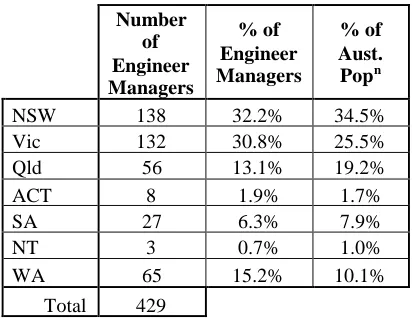
Table 5.3: Top level engineer managers by state … … … 36
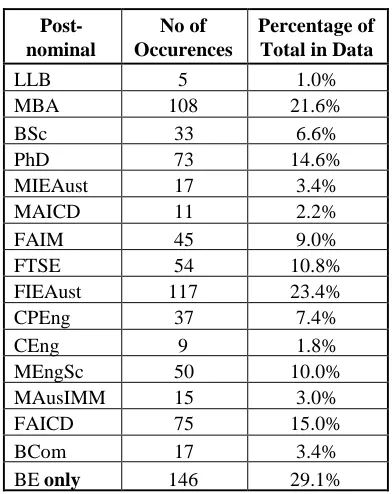
Table 5.4: Post-nominals of participants … …. … … 39
Table 6.1: Responses by degree … … … 43
Table 6.2: Current roles of respondents … … … 43
Table 6.3: Years spent in technical roles … … … … 44
Table 6.4: Years spent in management roles … … … … 45
Table 6.5: Reasons for the move into management … … … 47
Table 6.6: Qualifications of engineers in management … … … 48
Table 6.7: Importance of individual attributes … … … … 49
Table 6.8: Teachable attributes … … … 50
Table 6.9: Types of training suggested for attributes … … … 51
Table 6.10: Career stage suggested for attribute training … … … 53
Table 6.11: Need for qualifications and affiliations … … … 54
Table 7.1: Suggested education and training inputs … … … 65
Table 8.1: Highest importance with training required attributes … 68 Table 8.2: Attributes requiring formal qualifications … … … 68
Table 8.3: Important attributes across career stages … … … 69
Table D.1: Respondent background … … … D-2
Table D.2: Characteristics and Requirements for Training … … D-6
Table D.3: Training Type and Stage … … … D-8
Table D.4: Qualifications and Memberships … … … … D-14
Glossary
accredited course a structured sequence of vocational education and training that leads to an Australian Qualifications Framework qualification or Statement of Attainment.
Australian Qualifications Framework* (AQF) a nationally consistent set of qualifications for all post-compulsory education and training in Australia.
Australian Quality Training Framework* (AQTF) the nationally agreed recognition arrangements for the vocational education and training sector. The Australian Quality Training Framework is based on a quality assured approach to the registration of training organisations seeking to deliver training, assess competency outcomes and issue Australian Qualifications Framework qualifications and / or Statements of Attainment and ensures the recognition of training providers and the Australian Qualifications Framework qualifications and Statements of Attainment they issue, across Australia.
Chief Executive Officer the highest-ranking corporate officer or executive officer of a corporation, company, or agency; CEO (in the context of the project identical to Managing Director).
Competency* (also competence) the ability to perform tasks and duties to the standard expected in employment.
competency-based assessment* (or CBA) the gathering and judging of evidence in order to decide whether a person has achieved a standard of competence.
competency-based training* (or CBT) training which develops the skills, knowledge and attitudes required to achieve competency standards.
core competencies Units of competency within a competency standard that an industry has agreed are essential to be achieved if a person is to be accepted as competent at a particular level. All units may be core, but in many cases competency at a level will involve core units plus optional or specialisation units of competency. Core competencies are normally those central to work in a particular industry.
continuing education* educational programs for adults, usually at the post-secondary level and offered as part-time or short courses in personal, academic or occupational subject areas.
core competencies* identifies units of competency within a competency standard that an industry has agreed are essential to be achieved if a person is to be accepted as competent at a particular level. All units may be core, but in many cases competency at a level will involve core units plus optional or specialisation units of competency. Core competencies are normally those central to work in a particular industry.
core curriculum* that part of the curriculum which is considered essential for all students, and is usually compulsory.
corporate education* educational programs or services offered by business and industry, either in-house or co-operatively with an educational institution.
course* a structured and integrated program of education or training, usually consisting of a number of modules (subjects) or shorter programs, and leading to the award of a qualification.
development development is the growth or realisation of a person’s ability through conscious or unconscious learning.
education* (1) the process of imparting knowledge or developing skills, understanding, attitudes, character or behaviours. (2) the process of acquiring knowledge, skills, understanding, attitudes, etc. (3) the knowledge, skills, understanding, attitudes, etc. acquired. (4) the field of study concerned with teaching and learning.
educational institution* any establishment providing education, including schools, colleges, universities and institutes.
experiential learning* learning through experience, either in a real situation such as a workplace or in role play.
higher education* post-secondary education offered by a university or other recognised higher education institution, or through Open Learning Australia, leading to the award of a degree or higher level qualification.
in-service training* training and professional development of staff, often sponsored by the employer, and usually provided during normal working hours.
knowledge The mental skills involved in such processes as
judgment, thinking and understanding; and the information base of factual and theoretical material that is accessed, manipulated and used cognitively in the application of mental and physical skills.
leadership The art of influencing and directing people to achieve willingly the team or organisational goal.
learning* the process of acquiring knowledge, attitudes, or skills from study ,instruction, or experience.
learning organisation A set of systems, mechanisms and processes in place within an organisation that are used to continuously enhance its capabilities and those who work with it or for it, to achieve sustainable objectives for themselves and the organisations in which they participate.
lifelong learning The process of acquiring knowledge or skills throughout life via education, training, work and general life experiences.
management1 The process of planning, organising, directing and controlling organisational resources in the pursuit of organisational goals.
Managing Director the highest-ranking corporate officer or executive officer of a corporation, company, or agency; (in the context of the project identical to CEO).
National Training Framework* the system of vocational education and training that applies nationally. It is made up of the Australian Quality Training Framework and nationally endorsed Training Packages.
1
off-the-job training* training which takes place away from a person ’s job, usually off the premises, e.g. at TAFE, but may be on the premises, e.g. in a special training area.
on-the-job experience On-the-job experience is expertise gained in the workplace as a result of actually performing a job over a period of time. On-the-job experience is not considered to be formal training. Some trades require completion of a period of on-the-job experience for trade progression to ensure that individuals can perform to the correct standard for current employment before undertaking further training.
on-the-job training* training undertaken in the workplace as part of the productive work of the learner.
professional mastery2 professional mastery in the context of this project is an expression of personal competence displayed by an individual’s ability to combine character, self-confidence, effective leadership, professional knowledge, and experience. It is a process of continual learning developed through education, training and experience.
qualification Qualification refers to the certification given in recognition of successfully gaining a defined set of competencies that relate to the Australian Qualifications Framework in ways defined in an accredited course.
Registered Training Organisation* (or RTO) an organisation registered by a state or territory recognition authority to deliver training and/or conduct assessments and issue nationally recognised qualifications in accordance with the Australian Quality Training Framework.
self-directed learning* learning in which the learner is the principal driving force, deciding how, when, and at what pace learning takes place.
skill* an ability to perform a particular mental or physical activity which may be developed by training or practice. See also basic skill generic skill.
training continuum a complete training regime designed and developed from a suite of competencies and proficiencies within an occupation or career role. In the context of this project, it is the sequence or progression of education and training for engineer from undergraduate to the most senior position within the organisation.
training effectiveness extent to which training prepares an individual for a career role.
training efficiency extent to which training resources (including time) are used economically while achieving effectiveness.
training organisation* an organisation which provides vocational education, training and/or assessment services. See also registered training organisation.
vocational education* education designed to develop occupational skills. See also vocational education and training
vocational education and training*(VET) post-compulsory education and training, excluding degree and higher level programs delivered by higher education institutions, which provides people with occupational or work-related knowledge and skills. VET also includes programs which provide the basis for subsequent vocational programs. Alternative terms used internationally include technical and vocational education and training (TVET), vocational and technical education and training (VTET), technical and vocational education (TVE), vocational and technical education (VTE), and further education and training (FET).
ABBREVIATIONS
AAIM - Associate Australian Institute of Management
AFAIM - Associate Fellow Australian Institute of Management AFIA - Associate Federal Institute of Accountants
AFIBA - Associate Fellow Institute of Business Administration AFIIM - Associate Fellow Institute of Industrial Management AFIM - Associate Fellow Institute of Management
AFIPMA - Associate Fellow Institute of Personnel Management Australia AGSM - Australian Graduate School of Management
AICA - Associate Institute of Chartered Accountants AICD - Australian Institute Company Directors
AIM - Australian Institute of Management
AIMCA - Associate Institute of Management Consultants in Australia AIPM - Associate Institute of Personnel Management
AIPMA - Associate Institute of Personnel Management of Australia
AMP - Advanced Management Programme
ANU - Australian National University
APESMA - Association of Professional Engineers, Scientists and Managers, Australia
ASCPA - Australian Society Certified Practising Accountants
BA - Bachelor of Arts
BBS - Bachelor of Business Studies
BBus - Bachelor of Business
BBusAdmin - Bachelor of Business Administration BBusMgmt - Bachelor of Business Management BBusMktg - Bachelor of Business Marketing
BCom - Bachelor of Commerce
BE - Bachelor of Engineering
CA - Chartered Accountant
CDU - Charles Darwin University
CEng - Chartered Engineer
CEO - Chief Executive Officer
CPA - Certified Practising Accountant
CPEng - Chartered Professional Engineer CPEng - Certified Practicing Engineer
CU - Curtin University
DEng - Doctor of Engineering
DU - Deakin University
FAICD - Fellow Australian Institute of Company Directors FAIM - Fellow Australian Institute of Management FASA - Fellow Australian Society of Accountants FCA - Fellow Institute of Chartered Accountants
FCPA - Fellow Australian Society of Certified Practising Accountants FIAM - Fellow International Academy of Management
FIDA - Fellow Institute of Directors of Australia FSSE - Fellow Society of Senior Executives
FU - Flinders University
GU - Griffith University
JCU - James Cook University
MA - Master of Arts
Mac.U - Macquarie University
MAIM - Member Australian Institute of Management MASA - Member Australian Society of Accountants
MBA - Master of Business Administration
MCDA - Member Company Directors Association of Australia
ME - Master of Engineering
MIE Aust - Member Institution of Engineers Australia
Mon.U - Monash University
MSE - Member Society of Engineers
Mur.U - Murdoch University
PhD - Doctor of Philosophy
QUT - Queensland University of Technology
RMIT - Royal Melbourne Institute of Technology
SMIEAust - Senior Member Institution of Engineers, Australia
SU - Swinburne University
UA - University of Adelaide
UM - University of Melbourne
UN - University of Newcastle
UNSW - University of New South Wales
UQ - University of Queensland
USA - University of South Australia
US - University of Sydney
UT - University of Tasmania
UTS - University of Technology Sydney
UWA - University of Western Australia
UWS - University of Western Sydney
UW - University of Wollongong
Chapter 1
Introduction
‘The things that affect your career are always the things you never hear about. That’s how institutions work.’– David Keith Williamson in ‘The
Department’ (1974), Part 2
1.1
Introduction
The career pinnacle for most people in business is that of the Chief Executive
Officer (CEO). It is the highest ‘rank’ to which business professionals can aspire.
This aspiration does not just apply to businessmen but extends out to others that have
moved into managerial positions from specialist or technical areas. Engineers are one such group.
CEOs have no specific common background and need no specific training to reach that position. Many have university degrees and work their way from the
graduate entry level. Their personal attributes and skills are recognised and their
careers normally progressed rapidly.
It is generally thought that most CEOs come from accounting or law
backgrounds. Particularly in a more traditional view, CEOs with these backgrounds
are seen to have a better understanding of business and hence are more suited to the role. However, there are many CEOs with no background in either accounting or law
that are perceived as being highly successful. It follows that there are other specific
skills and attributes that may identify someone as having the ability to become a CEO.
Engineers are professional group that appear to be under-represented by CEOs in large companies. Given that engineers normally have a wide education
base, often move into managerial roles (and so have business experience) it might be
It follows that by identifying the attributes and skills CEOs required to reach
their positions, it should be possible to adjust the career management and education
and training to maximise the career progression of an individual. The purpose of this project is to achieve exactly that.
1.2
Project Aim
The aim of this project is to determine the career attributes engineers need to develop
to become CEOs of major corporations and identify training and development needs
to assist that career progression in order to better orient career training for engineers.
1.3
The Need
Recognition of engineers is important in developing respect of the profession. It not only increases an individual’s pay packet and chances of promotion but serves to
attract more people into engineering. This is not only self interest but arises out of
the increased responsibility engineers have as a result of increasing technology and
liability for their decisions.
As part of this recognition it is highly desirable that engineers that do make the move
into management (as many do) are capable, and make it to the pinnacle of their potential career structure. This assists to demonstrate the skills and attributes that
engineers can bring to management positions.
Other professions do this well. Lawyers and doctors are traditionally well regarded –
although doctors don’t make the move into management on such a regular basis.
Another profession that, like engineers highly regard professional status, but are
1.4
Those involved and those who may benefit
One of the aims of this project is that it provides some benefit to other individuals
and / or to organisations. It is designed to be applicable to all engineers, engineering
related educational institutions or other engineering organisations.
It is hoped that individuals will be able to use the results of this dissertation to
examine their personal attributes with regard to those required by high level executives in order to maximise the chance of career success. It will not necessarily
apply to all engineers but those who choose to move into management should be able
to benefit by gaining the most useful qualifications and improving those attributes
most desirable in CEOs.
Ideally this will apply not only to undergraduates but also to more experienced
engineers. Undergraduates will be able to make a more informed choice of elective units that may be of benefit in the future. It will also presents them with the
opportunity to make longer term plans to move into management. By identifying
early a preferred career path, an undergraduate may maximise his chance of success.
More senior engineers may also make use of these results through the identification
of the most important qualifications required or expected to assist in the move up the
corporate ladder.
Universities and other learning institutions can also benefit from these results. By
developing the attributes and skills desired for high level executives, the chance of later success by students in increased which reflects well on the institution. The
reputation thus developed is very important to the continued future success of the
University or school as well.
Other engineering institutions can also benefit from the increased success and
perceived competence of engineering graduates. Building the public awareness of
1.5
Objectives of this project
The goal of this research project, ‘How Engineers become CEOs? Implications for
Education and Training’, is to investigate the career progression of engineers determining the skills and qualities they need to become large company CEOs and
thus recommend strategies for long term career development.
In order to achieve this goal a number of objectives need to be reached. They are:
a. To discover ‘accepted’ traits (skills and attributes) of established CEOs.
b. To develop further possible traits desirable in CEOs.
c. To identify a number of engineers that have reached the position of CEO.
d. To confirm the desirable CEO skills and attributes through contact with
those engineers that have reached executive level in their careers.
e. To identify the training requirements to develop those skills and
attributes.
f. To recommend training and development strategies for engineers desiring executive success based on the results found.
g. To write a quality dissertation of results found.
Figure 1.1: Research project objectives
1.6
Scope
The scope of this project is limited to engineers, their potential to reach senior executive positions (specifically that of CEO) and the potential training and
development strategies that may assist engineers to reach those positions.
It will not attempt to address more general career development incorporating other
professional backgrounds or even determine current numbers in CEO positions,
except possibly in a very tangential manner that may add background to the central
discussion.
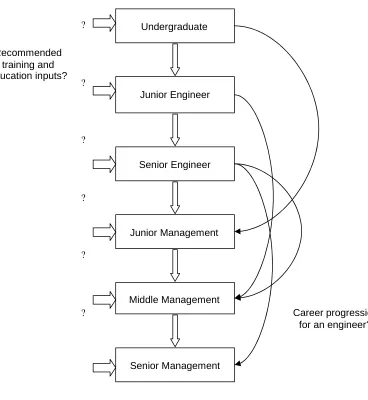
Junior Engineer Undergraduate
Senior Engineer
Junior Management
Middle Management
Senior Management
Career progression for an engineer? Recommended
training and education inputs?
?
?
?
?
?
To answer the broad question of required CEO attributes and the educational
requirements to develop these attributes this dissertation will investigate a number of different issues. These are separated into the later chapters of this paper. This chapter
is introductory and only intended to provide a short background of relevant issues.
Chapter 2 is a literature review that investigates the current body of knowledge in the subject area. It is necessarily grouped into different areas of previous research
including CEO attributes, attributes of professional engineers and current training
and education in management within Australia. Although this study is focused on the current Australian problem it does include some discussion of international trends
dating back over a number of decades.
In Chapter 3 the methodology used by this dissertation is described in detail. In order
to the robustness of the results the methodology is laid out explaining how various
portions of data have been collected, and how it has been used to produce the results
discovered later in this report.
A review of current education and training is included in Chapter 4. This chapter
describes the education undergraduate engineers are receiving with emphasis on the non-technical skills taught at this level. Further, it investigates the education and
training available to engineers at a post-graduate level. These factors are only looked
at very briefly as they do not strictly relate to the topic being investigated.
As described in the methodology a database was used to identify high performing
engineers. This database was also used to extract further information relevant to the
project. The results from this source are looked at in Chapter 5. This information can then be used as an indicator of skills and qualifications that may help an individual to
results from other studies and to focus required CEO attributes to the careers of
engineers specifically.
Chapter 7 uses the results obtained to propose a model for the progression of an
engineer’s career within the management stream. It uses this model to also propose a
training continuum that will maximise an individual’s chance of becoming a high
level executive. Such a model and subsequent individual education and training concept also leads to suggested approaches for learning institutions.
In Chapter 8 the implication for training as investigated in this project are discussed. The chapter draws on the information from previous chapters in order to present
some implications these findings have on training. It relates strongly to the
discussion in chapter 7 but seeks to provide some more detail on individual attributes.
Chapter 9 concludes this dissertation. It outlines the most important issues
discovered during the development of this report and suggests areas for further study.
1.7
Outcomes and Effects
There are a number of expected outcomes from this project. Some of these are as follows:
- Engineers will be able to better plan their careers, particularly if they have ambitions towards managerial roles.
- University courses will be able to adjust programs to cover any identified shortfalls in education, training or development of personal
skill and characteristics.
- Companies will be more aware of engineer qualities and able to utilise
this knowledge for company benefit.
- IEAust and other corporate bodies can design support schemes and
other mechanisms to help develop the careers of engineers and
eventually promote the engineering profession.
1.8
Background
There are a number of ways in which people can become CEOs. For example, they may create and build their own companies, get handed the position by a controlling
interest (eg a family owned company) or through working long hours to develop the
required skills. Usually, of course, the position is earned by working professionally over a number of years –either for the one company or by working in a range of
employed positions. This project will look only at the latter for obvious reasons.
It is in the vast majority of cases it is a long path to success for a CEO. Generally
they start as young professionals learning the basics of their original trade before
moving into middle management and working their way up based on merit.
The career history and success of a CEO can be considered the result of their:
a. experience – a persons experience helps to shape not only their skill sets, but also their personal qualities to some extent.
b. ability or talent – including their intelligence and creativity.
d. character attributes – a persons character is an essential requirement.
While there is no one ‘character type’ needed by a CEO, there are
certainly character types that are not suitable for CEO positions regardless of their intelligence or other skills.
These factors are common to the success of individuals in all careers – and not just ‘white collar’ industries but almost any way of earning a living. It is the nature of
their experience, abilities, skills and attributes that changes between different career
types. For example, financial skills are required for accountants, but project management skills vital to another industry may not be. Likewise, character
attributes such as teamwork may be essential in one career type but not in others.
Part of the challenge is to identify these factors in respect to what is required for a CEO.
Potentially the identification of these factors can lead to model of successful
executive career progression. That is a construct that reflects how the majority of CEOs and other high level executives achieve their professional success. The
development and validation of such a model can lead the basis education and training
Chapter 2
Literature Review
2.1
Introduction
This chapter discusses the current literature and body of knowledge surrounding engineers and career progressions in management. It will outline the latest theories in
a number of areas including:
a. attributes of CEOs,
b. attributes of engineers,
c. models for maximizing career progression,
d. training and education.
Andre Kaspura (Taylor, 2006) found that there are approximately 270 000 people in
Australia with engineering qualifications. Of these though, only 34 000 are working
in technical roles but 100 00 work in engineering related management. The rest appear to work in fields unrelated to engineering.
2.2
Skills and attributes of CEOs
A number of studies have looked at the characteristics of CEOs and interest in the
topic seems to be increasing in recent years.
basis for a questionnaire and follow up information. The characteristics of CEOs they
identified through previous studies were:
a. achievement orientation;
b. humanistic approach;
c. positive outlook;
d. inclusive, participative and empowering style;
e. integrity;
f. balanced approach; and
g. learning and self awareness.
These characteristics were chosen as they were core components across a number of
earlier studies based on theoretical, CEO perception and staff perception approaches. Wood and Vilkinas (2006) found that a humanistic approach and an achievement
orientation were critical to CEO success. A positive outlook was also perceived to be
very important. The remaining characteristics were confirmed as being important to CEO success but not as important as the others listed above.
James Hunt (2006) of the University of Newcastle also provides some valuable
information in his research into the ‘Key Components of Senior Executives in Australia’. His study has some direct correlation to the topic of this project although
not focussed on engineers and not going as far as looking into education and training
implications.
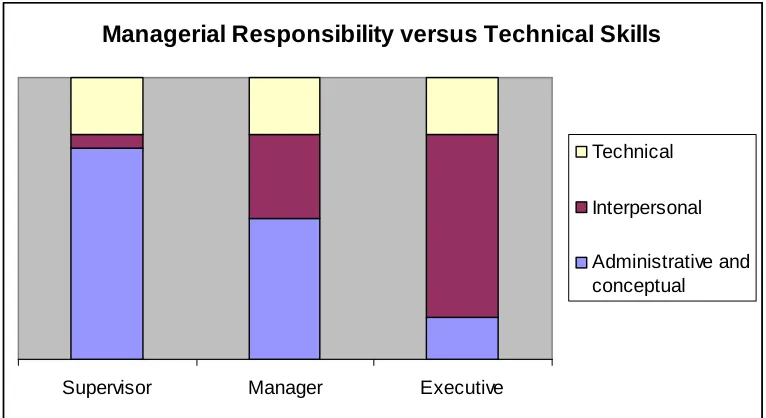
Managerial competency is composed of three interrelated components: knowledge,
engineer needs to be competent in all of these fields although the relative importance
of each varies throughout a professional career. He identifies the major failure of
management is normally related to interpersonal skills.
Managerial Responsibility versus Technical Skills
Supervisor Manager Executive
Technical
Interpersonal
[image:31.595.127.510.164.373.2]Administrative and conceptual
Figure 2.1: Responsibility versus technical skill
Badawy further proposes five unwritten ‘laws’ as follows:
1. Technical managers are made, not born – managerial skills can be
developed.
2. Managing is a skill that takes practice.
3. Managing is an ‘art’ requiring creativity and experience – it cannot be fully quantified by science.
4. Good engineers are not necessarily good managers or vive versa.
In another study, conducted by The Executive Connection (TEC) similar attributes
were found to be common across successful Australian CEOs (Company Director,
2006). The TEC CEO Leadership Study asked 55 CEOs to undertake an online survey – which led to the following conclusions about successful business leadership
in Australia:
a. ambitious,
b. communicative,
c. energy creators,
d. strategic strength,
e. balanced, and
f. innovative.
The study also found that Australian traits appeared different to the equivalent in the United States. Although many traits were found to be similar, as might be expected,
Australians were found to be more flexible, less conservative and show a greater
sense of urgency (Company Director, 2006).
2.3
Selection of CEOsThe selection process undertaken by companies to choose a new CEO reveals a
different viewpoint on the attributes required of a CEO. While most studies are based
on the performance of CEOs, any selection process needs to assess individuals without the benefit of 20/20 hindsight. Thus the emphasis on types of attributes
Dean Ireland, a consultant with Egon Zehnder International lists five criteria that
identify a good CEO (Clark, 2007). These are:
a. Integrity,
b. Resilience,
c. Strategic thinking,
d. Able to deliver results,
e. Team leadership, and
f. Collaborative and influencing.
Ireland notes that it not as simple as someone having these attributes will
automatically become a good CEO. Rather ‘when choosing the right CEO it is critical that the board selects the right person for the right role at the right time’
(Clark 2007).
2.4
Skills and attributes of engineers
It might be expected that individuals with certain characteristics in common will
gravitate towards similar careers. With this in mind it is important to identify the attributes of generic engineers in order to map these attributes to those required by
CEOs. Similarly the skills developed by engineers can be mapped against those of
the Myer-Briggs Test1. Other studies back up the findings that personality types ISTJs (Introverted, Sensing, Thinking, Judging) dominate the engineering fraternity
although types ESTJ (Extroverted, Sensing, Thinking, Judging) and INTJ (Introverted, Intuitive, Thinking, Judging) are also common. Taylor notes that from
these studies it appears that a third of engineers have preferences for sensing,
thinking and judging – and quotes a general description of these personalities as:
‘cautious, conservative, and quiet; literal, realistic and practical;
careful and precise; logical, honest and matter of fact; resistant to
change and comfortable with routine; hard working and responsible. The most important thing to ISTJs is being of service, working hard,
and being responsible.”(www.careermag.com)
From looking at this data, Taylor (2006) concludes that engineers probably make
good managers but is less sure about engineers as leaders – although he does say
engineers do have ‘a fair sprinkling of the traits that could see them become good
leaders’.
This is backed up by other studies. Dr Mark Toner quotes some findings of Myer in
his article in Engineers Australia. According to Toner (2006), in 1980 Myer found a Self-Selection Ratio (SSR) of 2.94 for introverted, abstract, logical, organised types
choosing engineering. This SSR represents a much higher proportion of these
personality types seek engineering as a career – almost three times higher than in the base population.
2.5
Professional and career development strategies
A great deal of information is also available about the career development of
engineers at all levels. A lot of it can be found directly through the University. At a
more senior level Engineers Australia can provide much of the career development
1
information needed. In particular, the training and experience needed to obtain
“Engineering Executive” status is clearly laid out in as a part of that scheme. The
required competencies are listed and give insight into Engineers Australia’s view on what is needed by engineers in executive positions.
2.6
Management training for engineers
At the present all accredited engineering degrees in Australia include 10% of management material (Georg, 2005). Dietrich Georg in writing about the experience
of Professor Archie Johnstons move into management says that ‘engineering
graduates generally do well in the first ten years of their technical careers. Then they
often plateau unless they acquire broader managerial skills.
2.7
Other occupations / degrees
Considering the attributes of graduates with other degrees can provide a comparison of generic skills and attributes of business people generally.
Robert Skeffington (2005) discusses CFOs who make a successful transition to CEO
in an article in BRW magazine. In the article Kokkong Chan says ‘that the competencies of CFOs include: results orientation, people development, functional
competence and strategic thinking’. It identifies these traits as desirable in making
the move to CEO. This assessment and study demonstrated that it is not just engineers who are considering career paths that lead to being a success in business.
2.8
Other relevant issues in the literature
by the nature of their normal career progression generally develop a detailed
knowledge at the grass roots level.
‘Implementation will require harnessing the capabilities of the senior
executive team rather than a focus on the chief executive as an individual.’
This implies that communication, teamwork and leadership qualities are likely to become even more important in the future.
Other general attitudes to promotion and management career success include:
‘If career progression comes as a surprise or shock or is not evolving naturally, then it probably isn’t right,’ says Anna Fieldsend, general manager
for brand marketers DNA Design (New Zealand Herald, 2004).
‘Reaching senior management requires innate ability and boldness rather than
time served,’ says Darryn Melrose, managing director for direct marketers
Chapter 3
Methodology
3.1
Introduction
This chapter details the methodology undertaken during the conduct of this research project. It intends to describe the process undertaken to allow verification of results.
The process described in this chapter evolved over the life of the project and does not
completely reflect that developed in an initial project appreciation.
As such this chapter will cover how the research was conducted, how the data was
obtained and interpreted and will give an outline of the veracity of those results. This will be completed through a discussion of the verification and validation. A brief
sensitivity analysis will also be conducted as part of this process.
The objectives of this project are laid out in chapter one. In order to achieve these, the methodology involved three main processes – a literature review, a questionnaire
sent to relevant individuals and an analysis of a Who’s Who database14. Further investigation and research was undertaken where required to confirm details or add additional information.
3.2
Assumptions
This project assumes that previous research is valid and the results of the intended
3.3
Constraints
This project was constrained in terms of the resources available to conduct it. Time
was a significant constraint that did influence the extent of the research undertaken.
3.4
Background
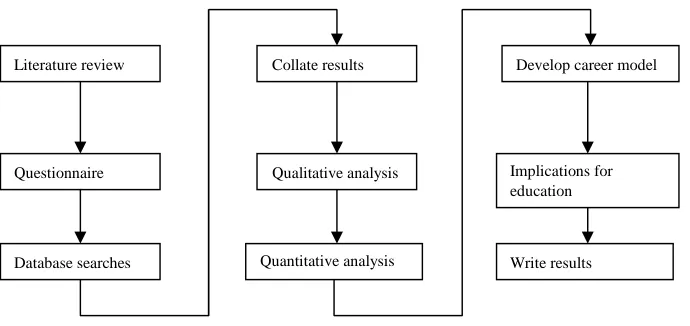
[image:38.595.153.498.306.469.2]The general outline of the conduct is shown in figure 3.1.
Figure 3.1: Flow of project methodology
3.5
Literature review
The first stage of the project was to conduct a review of the available literature. This review focused on the following areas:
a. the skills and attributes of CEOs;
b. the skills and attributes of engineers in general;
c. the educational background of CEOs;
Literature review
Questionnaire
Database searches
Collate results
Qualitative analysis
Quantitative analysis analysis
Develop career model
Implications for education
d. the management background of engineers (in particular the level of
management training received during an undergraduate degree);
e. the career paths of CEOs; and
f. the career paths of engineers.
Sources included the standard literature resources – libraries, internet and applicable
journals. In particular Engineers Australia and the Australian Institute of Management were able to provide valuable information.
The Handbooks of Australian universities were also used to obtain information on the level of management education and training currently being taught in
undergraduate degrees.
3.6
Questionnaire
A questionnaire was developed to gain a view on the perceptions of top-level
executive. It was aimed at discovering their beliefs as to the skills and attributes that
they possessed that had assisted in their commercial success.
Questionnaire participants were selected on the basis that they held a Bachelors
degree in Engineering and have been successful in the business world. These participants were sourced from the Who’s Who In Business database.
In order to maximise the level of response the questionnaire was distributed by both email and regular mail. Figure 3.2 depicts a breakdown of the questionnaires sent
Email, 163
Regular Mail, 352
Figure 3. 2: Questionnaire distribution type
The questionnaire is attached at annex B. The two questionnaires attached were both
used – the one being more suitable for email than the other. This aided to provide a
differential between the two that may have allowed any particular trend or bias to be detected.
As shown in figure 3.2, a total of 515 questionnaires were sent out to individual
engineers. There were 13 responses by email and 39 through regular mail. This represents a response rate of 8% electronically and 11 % in hardcopy.
The responses were analysed by calculating the results of the responses by the number, average and spread of those responses.
3.7
Database analysis
During preliminary searches for sources of information Crown Content’sWho’s Who
in Business in Australia was discovered. An investigation of this database showed it
to be ideal for much of the background research needed in this research project. It contains a comprehensive list of thousands of individuals in business in Australia as
well as details of Australian companies.
It lists details of individuals including their educational background, career
descriptions and current contact addresses. As such it was ideal for identifying and
More than that, it is a resource for providing information regarding the background
of high level executives and their profiles. Although this data appears to be offered as provided by the individual or open sources it does allow extraction of important
information if handled with the requisite care.
The information extracted from the database is discussed in chapter 5.
3.8
Collation of results
Results from all sources were collated in an attempt to provide a comparison across the issues. By comparing results obtained form one source, a level of validation and
verification is achieved to support the findings.
3.9
Qualitative analysis
The qualitative analysis stage of this project consists of a discussion of the findings
from the research. The results from the questionnaire were combined with the information obtained in the literature review and other sources in order to provide a
picture engineers in management.
This was completed on the basis of previous research, the opinions of people with a
engineering background in high level management positions and my own limited
personal experience.
The percentage of support in for each attribute and the range of that support formed
the basis of the statistical analysis applied to the questionnaire.
The results of database searches were also analysed statistically. These analyses are
presented in the relevant chapters – in particular chapters 5 and 6.
3.11 Career model
In order to provide a framework with which to describe the generic progression of a
typical engineers career a model was developed from the findings. This model was
designed to reflect the major features of an engineer’s career, and link them to the skills and attributes required of a CEO in such a way as to help describe and develop
the implications this project has on education and training regimes.
3.12 Implications for training
Having determined the skills and attributes required of a CEO, they needed to be
compared against the current training regime in order to determine how education can be improved.
This comparison was conducted in stages to reflect the different skills and attributes required for a successful engineering career in management in line with the
questionnaire findings.
3.13 Conclusion
This chapter has briefly presented the methodology used in the conduct of this
Essentially by using a literature review to present current thinking; a database
interrogation to provide data on existing high level manager / engineers; and a
Chapter 4
Review of current education and training
4.1
Introduction
The purpose of this chapter is to very quickly review current education and training
in order to clarify the current available learning environments. It is not intended to be
an in depth study of the topic. That would be outside the scope of this project. The chapter will simply scan some of the education and training avenues that are
currently available to engineers. This will include short discussions on the types of
training available that an engineer, or indeed a member of any profession, may experience during his or her career.
4.2
National Training Framework
The National Training Framework is the Australian system of vocational education
and training that applies nationally and is managed by the Department of Education, Science and Training1. It is made up of the Australian Quality Training Framework and nationally endorsed Training Packages.
The Australian Quality Training Framework (AQTF) is the nationally agreed recognition arrangements for the vocational education and training sector. The AQTF
is based on a quality assured approach to the registration of training organisations
seeking to deliver training, assess competency outcomes and issue Australian Qualifications Framework qualifications and / or Statements of Attainment and
ensures the recognition of training providers and the Australian Qualifications
Framework qualifications and Statements of Attainment they issue, across Australia.2
1Recent name change / restructure – was the Australian National Training Authority (ANTA). 2
Essentially the AQF provides a framework for recognised qualifications in Australia
by setting agreed hierarchical layers of qualifications from Level 1 Certificates (Cert
[image:45.595.144.495.163.332.2]I) through to doctorates. Bachelor degrees fit towards the higher end within this scale.
Figure 4.1: Australian Qualification Framework3
These qualifications are often used (rightly or wrongly) by employers to give a basic
assessment of at what level they can expect to begin employment within the
organisation. This is obviously combined with the experience and ability of the individual, but employers are often attracted to those with ‘higher’ qualifications.
Thus it is of benefit to the individual to pursue further studies on the completion of an engineering degree. Particularly for those who wish to move into the upper levels
of management, a higher degree is beneficial. Normally this would be a Masters
degree such as a Masters of Business Administration or similar. As will be discussed
later in this dissertation, the results of the research, backed by the literature, support this assertion.
4.3
‘Low level’ qualifications and vocational training
An alternative to gaining recognised qualifications to develop skills via vocational
training. Vocational education and training is education and training designed to develop occupational competency by providing people with work related knowledge
and skills.
This training is conducted by a number of institutions including employers themselves and may or may not be recognised within the AQTF. It covers an
extremely wide range of training that can be directly or indirectly related to an
individual’s job. Some examples include:
a. Occupational Health and Safety courses;
b. (Workplace) First Aid Training;
c. Equity and Diversity Awareness;
d. Auditing Familiarisation;
e. Certificate courses such as Certificate IV in Complex Procurement;
f. Technical courses such as those taught in the various TAFE schools.
Many of these relate directly to engineers. This includes trades and other technical
courses. A number of engineering students may already possess qualifications of these types before commencing an engineering degree at university. This is
particularly true of mature age and ‘distance’ students.
Although not strictly necessary in order to become an engineer these types of courses
can provide valuable experience in specialist technical areas.
As can be seen in the previous examples these courses are not restricted to technical trades only. Various qualifications exist that relate to various aspects of management
as well. These also are potentially useful to an engineer interested in pursuing
Even after the completion of a degree, these courses can be very beneficial to gain
specific expertise at a level, and in a subject, not necessarily offered at a university.
4.4
Undergraduate studies
These are self-explanatory in terms of the framework for this project. However, it
should be recognised that not all engineering degrees are the same. Apart form the obvious differences in the major courses of studies and the detail of the courses,
some universities place different emphasis on aspects of engineering. For example,
some universities focus mainly on theoretical studies, others on the practical side of
engineering. Still others concentrate on ‘well-rounded’ studies that include more management and other non-technical components than other universities.
Also, for the individual student (or potential student), just the name of the university may become important in the future. Rightly or wrongly, some employers are
attracted to students from more prestigious universities. This may influence the
opportunities available for advancement. Whether or not this is a significant factor is outside the scope and will not be investigated in this project.
For these, and many other reasons, the undergraduate course are not all the same –
some may be better than others in producing engineers prepared for management. Appendix E gives a short list of the management type courses included in
engineering courses at various engineering institutions. It is a rather subjective list as
explained in the appendix and it does not necessarily mean that a university offering more management courses will produce better managers.
4.5
Post-graduate studies
the field in which further studies can be carried out. These courses include
post-graduate diplomas, masters’ degrees and PhDs.
Traditionally these types of studies have been offered by universities in ‘classical’
studies. The modern social and work environment has become more demanding
however, and other learning institutions are offering these types of qualifications.
Some of these institutions are run as businesses fulfilling a perceived need. Others are run by large companies and government in order to train their employees to an
appropriate level in-house.
Traditionally the classic courses, most notably a Masters of Business Administration,
have been the most desirable and have been perceived as being the most effective in
developing a manager’s business skills. This was borne out in the research as discussed later. In the current business environment however, recruitment agency
appear to be looking for more targeted degrees. That is, masters of management that
have a particular industry focus. For example, a Master of Management (Information
Technology) may be more desirable in a executive working in the telecommunications industry than a standard MBA.
Therefore, it may be better for an individual to seek a management type masters degree in their specific area of interest. As discussed later, this is not explicitly borne
out by the results of the questionnaire. Respondent had a strong preference for an
MBA opposed to other degrees. However this is possibly a function of changing social and industry trends as most respondents completed their MBAs a number of
years ago. That said, the public recognition and reputation for MBAs is such that
they are good options for those people who may not identify with a particular
industry or skill set.
Also, although it will not be discussed in this project, it should be noted that MBAs
are often rated by the university or institution through which they were completed. MBAs from some schools are highly rated and are significantly more desirable from
an employer’s perspective (and therefore from a potential employee’ perspective as
4.6
On-the-job training
An important complement to all education is on-the-job training and experience.
Particularly in the early stages of any career, individuals need to learn the processes of the company for which they work. Even the few people who manage to start their
own business need to learn the process and regulations involved with setting it up.
Even a prodigious technical knowledge a graduate or new employee may not
necessarily be effective until he or she learns the process in which to apply that
knowledge. For example, not knowing or understanding the process and paperwork
for getting funding approval for a project can delay the whole thing, even if technically it is ready to go.
4.7
Conclusion
This chapter has very briefly looked at the various types of education and training
available in order to provide a context for the discussion in subsequent chapters. It is
by no means meant to be an exhaustive list of education and training within Australia
– that is well outside the scope of this project.
It is expected that most people have a basic understanding of the normal education
process in Australia. However, it is important to underline the fact that a lot of education and training is nationally ‘recognised’ and fits into a defined framework.
Where possible and applicable, individuals should seek recognised training as it
transferable and accepted by other organisations.
Discussions in the following chapters, although not always explicitly stated,
generally refer to recognised training and qualifications and training. Other
Chapter 5
Database Findings
5.1
Introduction
The intent of this chapter is to outline the findings based on searches of Crown Content’s Who’s Who in Business in Australia database. By listing those individuals
that have achieved success in business the current state of executive and their
backgrounds can be determined.
The chapter will cover generic information in the form of database statistics of
business people in Australia. While it is recognised that the database is not a
complete listing of successful and important business people it had been assumed that it provides a reasonably accurate cross-section of that community. From this
some basic statistics and data can be obtained.
5.2
Information Available
Only limited information is available from the database. The Who’s Who listing of
biographical details is necessarily listed and there are difficulties in obtaining data due to the restrictions to access and the flexibility of the system employed – it is not
intended to provide the type of data this project wanted to extract.
The biographical data listed for individuals in the database includes:
Title
First Name(s)
Surname
Occupation
Honours and Awards
Recreations
Clubs and organisations
Postnominals (including qualifications)
None of this information is guaranteed to be correct. The details supplied for entry
into the database are subject to the integrity and to human error. However, given Crown Content operates the database as a commercial concern, the accuracy has
been assumed to be sufficient to derive general trends amongst successful business
people within Australia.
One area of deficiencies is that of the addresses supplied. Individuals do change jobs
and addresses and as such the work address, residential address and email addresses were not necessarily always correct.
The other major deficiency is that the level of detail is dependent on the individuals
supplying the information. The background supplied on some individuals is quite detailed, listing detailed career and education history while for other individuals this
history is quite sparse. However, over the number of people in the database it is
expected that any trends can still be identified.
For privacy reasons no information that could be used to identify individuals is
5.3
Business sector
The Who’s Who enable the identification of the business, and hence business type of
the listed engineers. In a general way, this shows how these successful engineers’
careers have progressed. That is, if they have achieved success simply by working in an industry that has a technical element applicable to their training, or if the skill sets
of these engineers are applicable to management in general – not just technical based
industries.
To illustrate this idea for example, it would be expected that a larger percentage of
the executives listed would work in the mining industry. And relatively few would
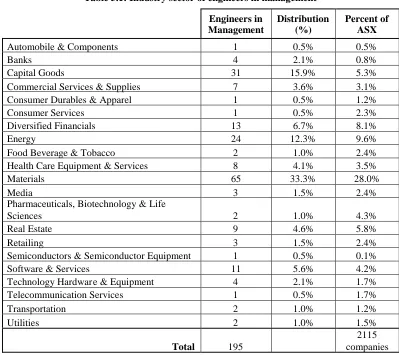
work in finance. Table 5.1 identifies the industry sector of all listed engineers that work for companies listed on the Australian Stock Exchange (ASX).
It lists the number of engineers in each industry group and compares it to the percentage of the number of companies listed in that industry group within the ASX.
The industry sectors are listed as per the Global Industry Classification Standard. The
distribution of companies in the ASX should approximate the number of management executives represented in the Who’s Who in Business.
The table shows a similar distribution between the number of engineers and the
number of companies in the ASX. As expected there are proportionally more engineers in areas such as mining (materials), than there are mining companies in the
ASX. This is a natural result of engineers basing their careers in industries that relate
more closely to their chosen fields of study.
The industry sectors where engineers are ‘over represented’ by greater than 200% are
capital goods, semi-conductors and (surprisingly) banks. There is over twice as many successful engineers in management within these groups than there are companies of
these types within the ASX. The difference in the proportions for other industry
Table 5.1: Industry sector of engineers in management Engineers in
Management
Distribution (%)
Percent of ASX
Automobile & Components 1 0.5% 0.5%
Banks 4 2.1% 0.8%
Capital Goods 31 15.9% 5.3%
Commercial Services & Supplies 7 3.6% 3.1%
Consumer Durables & Apparel 1 0.5% 1.2%
Consumer Services 1 0.5% 2.3%
Diversified Financials 13 6.7% 8.1%
Energy 24 12.3% 9.6%
Food Beverage & Tobacco 2 1.0% 2.4%
Health Care Equipment & Services 8 4.1% 3.5%
Materials 65 33.3% 28.0%
Media 3 1.5% 2.4%
Pharmaceuticals, Biotechnology & Life
Sciences 2 1.0% 4.3%
Real Estate 9 4.6% 5.8%
Retailing 3 1.5% 2.4%
Semiconductors & Semiconductor Equipment 1 0.5% 0.1%
Software & Services 11 5.6% 4.2%
Technology Hardware & Equipment 4 2.1% 1.7%
Telecommunication Services 1 0.5% 1.7%
Transportation 2 1.0% 1.2%
Utilities 2 1.0% 1.5%
Total 195
2115 companies
On the other end of the scale, engineers are under represented by more than 50% in comparison to the distribution of company sectors mainly within the consumer type
industries and (again surprisingly) within the telecommunications sector.
Overall though, there is a strong correlation (0.94) between the number of engineers
that have achieved success in management within a particular sector and the
proportion of companies within that sector. This comparatively even distribution seems to suggest that engineers generally do have management skills that can be
5.4
Title and sex
A review of individuals’ titles can give a simplistic overview of what high
performing individuals have achieved since gaining an engineering degree. Due to
complexities of the searching mechanism the titles of those people with engineering backgrounds only were searched so there is no comparison with the wider business
community in this aspect.
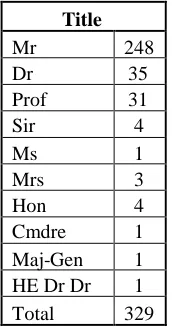
Table 5.2 displays a listing of current high performing engineers by title. The total
number of occurrences in the table reflect that the title field was left empty in many
[image:54.595.277.363.334.498.2]cases.
Table 5.2: Questionnaire participant titles Title
Mr 248
Dr 35
Prof 31
Sir 4
Ms 1
Mrs 3
Hon 4
Cmdre 1
Maj-Gen 1
HE Dr Dr 1
Total 329
The number of engineers who went on to get doctorates or achieve other honours is
indicated by this table.
98% 2%
[image:54.595.139.501.568.730.2]Male Female
Figure 5.1 shows the distribution of male to female engineers that have become
prominent business people.
The low number of women in high level engineering positions is not indicative of the
relative performance between the two groups. There are a number o