Theses
8-2019
Task Planning and Execution for Human Robot
Team Performing a Shared Task in a Shared
Workspace
Tuly Hazbar
Follow this and additional works at:https://scholarworks.rit.edu/theses
This Thesis is brought to you for free and open access by RIT Scholar Works. It has been accepted for inclusion in Theses by an authorized administrator of RIT Scholar Works. For more information, please [email protected].
Recommended Citation
Team Performing a Shared Task in a Shared
Workspace
by
Tuly Hazbar
A Thesis Submitted in Partial Fulfillment of the Requirements for the Degree of Master of Science
in Electrical and Microelectronic Engineering
Supervised by
Professor Dr. Ferat Sahin
Department of Electrical and Microelectronic Engineering Kate Gleason College of Engineering
Rochester Institute of Technology Rochester, New York
August 2019
Approved by:
Dr. Ferat Sahin, Professor
Thesis Advisor, Department of Electrical and Microelectronic Engineering
Prof. Gill R Tsouri, Associate Professor
Committee Member, Department of Electrical and Microelectronic Engineering
Prof. Dan Phillips, Associate Professor
Rochester Institute of Technology Kate Gleason College of Engineering
Title:
Task Planning and Execution for Human Robot Team Performing a Shared Task in a Shared Workspace
I, Tuly Hazbar, hereby grant permission to the Wallace Memorial Library to reproduce
my thesis in whole or part.
Tuly Hazbar
Dedication
Acknowledgments
I would like to thank my advisor Dr. Ferat Sahin for his guidance and support throughout
my studies and research at RIT. I would like to thank my peers at the Multi-Agent
Biorobotics Laboratory and CM Collaborative Robotics Laboratory for making my time at
RIT a memorable learning experience. I would like to thank Shitij Kumar for his input
Abstract
Task Planning and Execution for Human Robot Team Performing a Shared Task in a Shared Workspace
Tuly Hazbar
Supervising Professor: Dr. Ferat Sahin
A cyber-physical system is developed to enable a human-robot team perform a shared task
in a shared workspace. The system setup is suitable for the implementation of a tabletop
manipulation task, a common human-robot collaboration scenario. The system integrates
elements that exist in the physical (real) and virtual world. In this work, we report the
insights we gathered throughout our exploration in understanding and implementing task
List of Contributions
• Designing and implementing a system capable of autonomously tracking and
per-forming table-top object manipulation tasks with a human.
• Outline the main elements of an HRC testbed that enables a human and a robot to
perform a shared task in a shared workspace.
Contents
Dedication. . . . iii
Acknowledgments . . . . iv
Abstract . . . . v
List of Contributions . . . . vi
1 Introduction . . . . 1
1.1 Collaborative Robots . . . 1
1.2 Degrees of Collaboration and Types of Work-cells . . . 2
1.3 Why Human-Robot Collaboration . . . 3
1.4 Gaps in Human-Robot Collaboration . . . 3
1.5 Problem Description and Motivation . . . 4
2 Background Literature . . . . 6
2.1 Human-Robot Collaborative Tasks . . . 6
2.1.1 Fixed vs. Any-order Actions . . . 6
2.1.2 Independent vs. Joint Action . . . 7
2.2 Requirements For Improving Human-Robot Collaboration . . . 8
2.3 Task Planning and Action Selection . . . 9
3 Proposed Method . . . . 12
3.1 Robot Perception . . . 12
3.1.1 Perception of the human arm trajectory . . . 12
3.1.2 Perception of the workpieces . . . 13
3.2 Robot Knowledge . . . 13
3.3 Robot Intelligence . . . 18
3.3.1 High Level Planning: Robot Goal Selection . . . 18
4 Implementation . . . . 22
4.1 Platform . . . 22
4.2 Perception . . . 23
4.3 Knowledge . . . 24
4.4 Planning . . . 26
5 Human-Robot Teaming: User Study . . . . 33
5.1 Task Description . . . 33
5.2 Experiment Setup . . . 35
5.3 Evaluating Fluency of Human-Robot Collaboration . . . 36
5.4 Procedure . . . 38
5.5 Results . . . 39
5.5.1 Human and Robot Only Experiments . . . 39
5.5.2 Human-Robot Collaboration Experiments . . . 40
6 Conclusions . . . . 43
7 Future Work . . . . 45
A Appendix . . . . 46
A.1 Study Questionnaire - Subjective Metrics . . . 46
List of Tables
5.1 The time it takes the human to complete the two tasks designed for this research . . . 40 5.2 The time it takes the robot to complete the two types tasks against the two
different robot behaviors . . . 40 5.3 The objective measures of fluency and efficiency collected during the four
List of Figures
1.1 Degrees of Collaborative Operation [1] . . . 3
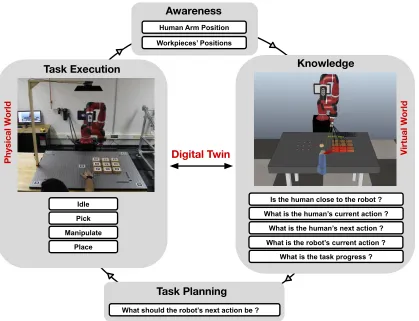
3.1 Overview of the HRC cyber-physical testbed. It is composed of 4 main modules. These modules are integrated through the digital twin concept. . . 13 3.2 Two levels of knowledge: high and low. The input to the knowledge
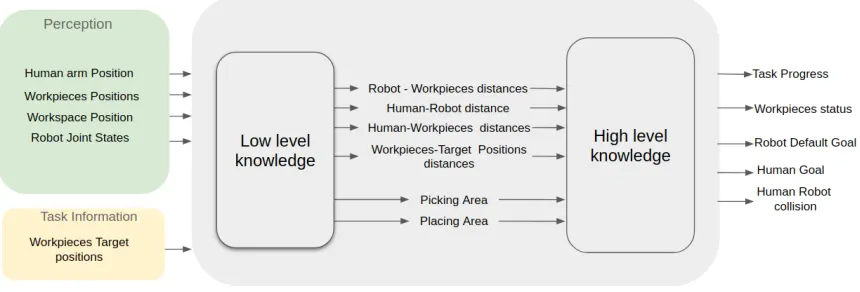
mod-ule is the data acquired through perception at run-time and the task related information acquired once when starting the collaboration. The output of the knowledge module is high level information utilized by the robot to make better decisions. . . 15
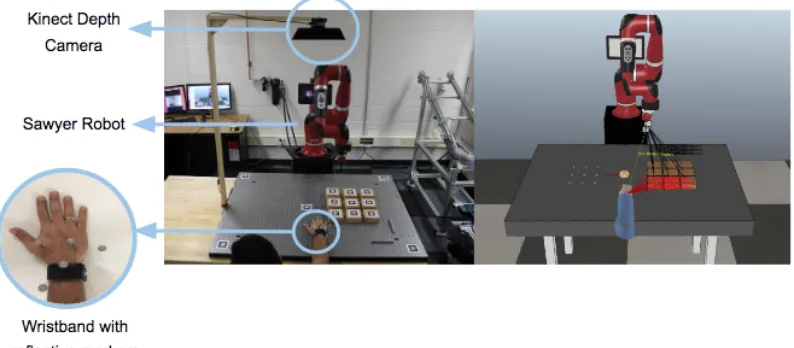
4.1 Experiment setup includes the sensors we use for perception, the robot and the workpeices. We also create a digital replica of the physical-world of the experiment setup . . . 23 4.2 A visualization of the output of the perception module. The fiducial
mark-ers are being detected by the Kinect. . . 24 4.3 The distance calculations acquired from the digital twin. The minimum
distance between the robot end effector and the workpieces is shown in black. The minimum stances between the workpieces and the human arm shown in red. The human robot distance is shown in green. . . 26 4.4 top level state machine . . . 28 4.5 Pick an Object container state: it consists of sub-states needed to preform
the action of picking a workpiece. it starts with getting the location of the workpiece to be picked, then performing the action of moving to the work-piece location, the approaching the workwork-piece, picking it up, and recreating to be ready for the next sequence of actions . . . 29 4.6 A visualization of the CHSM that shows all the states needed to
success-fully perform a pick and place of a workpiece. . . 32
5.2 A pictorial description of the high cognitive load task given to the partici-pant indicating the initial and final state of the task. The two lines drawn in the figure is shown here for clarification purposes however this is not given to the participant. . . 34 5.3 The figure above shows the sequence of actions associated with the
Chapter 1
Introduction
Robotics applications are becoming more prevalent in many industries such as
manu-facturing, military, and healthcare, to name few. This has led to making the idea of robots
sharing the human workspace more common. To support this idea, a new type of robots,
Collaborative Robots, have emerged.
1.1
Collaborative Robots
Collaborative robots are specifically designed for direct interaction with humans. These
robots incorporate features that make them safe to work alongside humans. For example,
Sawyer, the collaborative robot by Rethink Robotics, has Series Elastic Actuators that
di-rectly measure torque at every joint to detect and respond to contact [2]. Even in the case of
contact, these robots are designed with no sharp and all-round shapes, which allow them to
disperse the pressure of an impact. They are easy to program. The force and speed settings
can be easily adjusted and programmed to suit the application. For example, these robots
can be programmed to operate with slower speeds when they are near a human or go a
little faster in the absence of the human operator in the workspace. Hand guiding or path
teach is another feature of collaborative robots. It allows the human worker to rapidly and
1.2
Degrees of Collaboration and Types of Work-cells
Collaborative robots introduced changes in the way we think about how robots can
in-teract with humans and share a workspace. Figure 1.1 describe four levels of human-robot
interaction in a workspace. Tradition industrial robots are not meant to interact with
hu-mans; therefore, fences are used to separate traditional industrial robots from workers. With
coexistence, the human and the robot work next to each other. However, their workspace
does not overlap, and the concept does not provide for contact with the robot. In this type
of interaction, robots are equipped with sensors that can detect collisions so they can slow
down or alter their path to avoid collisions, then restart on their own, limiting the need
for human interaction. Synchronized interaction is when robots share the workspace with
humans in turns, allowing only either the human or the robot to occupy the workspace at
a time. Cooperation is when the human and the robot share a common workspace, but do
not work hand in hand during each work step. Instead, there is a defined intervention zone
in which the robot decreases its speed as soon as the human enters. With collaboration,
the human and the robot work in a shared workspace. Contact between the two is
permit-ted, and the velocity is adapted so that safety is ensured at all times. Collaborative robots
can work with humans in the same parts. However, improved environmental awareness
provides better safety and makes it easier to deploy alongside human workers [3].
In this research, the type of interaction of interest is collaboration. The human and the
Figure 1.1: Degrees of Collaborative Operation [1]
1.3
Why Human-Robot Collaboration
In industry, some tasks are hard to be fully automated, and for industries that undergo
frequent changes in their production line, reconfigurability and adaptability are of great
importance. By teaming a robot with a human, the collaboration benefits the
decision-making ability that comes from the human ability to adapt, and integrate prior knowledge
across domains whereas the robot ability to execute some actions with high speed and
precision can complement human skills. The particular differences between humans and
robots make them especially well-suited to explore complex tasks together as a team.
1.4
Gaps in Human-Robot Collaboration
However, counting on the human’s decision-making skills by having the human plan
for his/her own actions and the robot’s actions does not make the robot a collaborator but
which has many disadvantages towards the overall performance of the team; one apparent
drawback is the decrease in productivity of the team.
Although collaborative robots have become safe and reliable enough to operate close to
humans, human-robot teaming still lacks many aspects that make the collaboration
success-ful, especially when compared to a human-human team executing a shared task. Typically,
when a group of two humans works together, they display a high level of action
coordina-tion, and on the fly work distribution and scheduling. One aim of the HRC research is to
reach this level of coordination referred to as fluency in human-robot teams [4]. In such a
team the two partners are capable of planning their own actions, and coordinate their
ex-ecution with one another. Similar to other research in HRC, we believe that the transition
from robots as recipients of human instructions to robots as capable collaborators hinges
around their ability to select their own action and coordinate its execution with a human
partner[5].
1.5
Problem Description and Motivation
While robots are becoming more widespread across industries; I envision a future where
human-robot collaboration will be essential. The success of this type of collaboration
hinges on the ability of robots to integrate with humans as teammates. The goal of my
research is to enable a robot to be a teammate where it fluently collaborates with a human
partner in performing a shared task in a shared workspace.
I am particularly interested in an HRC scenario where the team consists of a single
hu-man and a single robot. The team members will follow the equal partner teamwork model,
the action execution with the other team member. This teamwork model follows a
decen-tralized decision-making approach adopted by systems and human teams to reduce delays
associated with escalating the decision-making to a centralized unit, improve the quality of
decisions due to the rich local context of the problem and taking into account the facts that
might change during the waiting period for a decision to be made by a centralize unit.
The HRC scenario this research studies, is where the robot is expected to achieve
mul-tiple object manipulations by taking into account, at every stage, the actions of the human
partner and the changes he/she introduces in the workspace. The robot must be able to
move and act in a safe, efficient, and fluent way.
In our experiment, the human and the robot are given a task where they have to put
a set of workpieces in a given specific arrangement. The human and robot manipulate
an overlapping set on workpieces without restrictions or agreement on who can manipulate
which workpiece before the experiment starts. However, there is a constraint that the human
and robot cannot simultaneously choose to manipulate the same workpiece. Given a set of
actions to be performed (to pick, to manipulate, to place) and the set workpieces on which
the actions are performed on, the robot should select workpiece and perform the action
Chapter 2
Background Literature
This chapter provides background information and literature review of related research
in task planning and execution for a human-robot team. It summarizes some of the existing
practices for human-robot collaboration setups in research and industry. A brief discussion
of similar and related research of HRC platforms is also presented.
2.1
Human-Robot Collaborative Tasks
The rich literature on human-robot collaboration is mostly concerned with performing
physical tasks. A collaborative task can be as simple as setting up objects on a table [5], to
complex tasks, like assembling furniture [6]. The task is often specified by a shared plan
or learned from a human expert [7]. What makes a task simple is the fact it does not have a
fixed order of action selection; however, a complex task can have dependencies of actions.
Also, some tasks require more than one agent to be performed, like carrying a table [8].
2.1.1 Fixed vs. Any-order Actions
In a task, subtasks can have different dependencies between them. They can have
rela-tions that enforce a fixed order of acrela-tions. These dependencies can mean that one action
must be completed before another action, influencing the order of action selection [9].
cooking tasks [10]. An example of any-order action tasks can be cleaning up a table [11].
2.1.2 Independent vs. Joint Action
Independent action is one that can be performed by a single agent, for example, picking
and placing an object [5]. In contrast, joint action is where two agents are needed to perform
the action. For example, a joint action rakes place when one agent needs to hold a part while
the other performs the construction [12].
In this work, I focus on common HRC task that falls under table-top manipulation. This
task requires the selection and manipulating of a set of workpieces to satisfy a given final
workpieces arrangement. Our task consists of selecting workpieces in any-order, and the
actions can be performed by any teammate independently.
The HRC scenario this research studies, is where the robot is expected to achieve
mul-tiple object manipulations by taking into account, at every stage, the actions of the human
partner and the changes he/she introduces in the workspace. The robot must be able to
move and act in a safe, efficient, and fluent way.
In our experiment, the human and the robot are given a task where they have to put
a set of workpieces in a given specific arrangement. The human and robot manipulate
an overlapping set on workpieces without restrictions or agreement on who can manipulate
which workpiece before the experiment starts. However, there is a constraint that the human
and robot cannot simultaneously choose to manipulate the same workpiece. Given a set of
actions to be performed (to pick, to manipulate, to place) and the set workpieces on which
the actions are performed on, the robot should select workpiece and perform the action
2.2
Requirements For Improving Human-Robot Collaboration
In most HRC scenarios, it is insufficient to plan a single sequence of actions and blindly
execute it at run-time. Having a human in the loop results in dynamic and partially unknown
environments where the robot needs to adapt to it. Therefore, the robot has to exhibit
adap-tive task planning. The team members typically act in real-time; therefore, they must make
decisions on the fly. Researcher in the field focused on improving different aspects of
HRC. They have set different constrains when performing task planning and action
selec-tion to improve a specific aspect of the collaboraselec-tion. For example, favoring acselec-tions that
avoid plans where the human spends a lot of his/her time being idle [13], plans focus on
reducing the cognitive and the physical load on the human [10] and avoiding plans which
can be misinterpreted by the human [14].
Research in HRC is inspired by humans ability to collaborate on tasks. This suggested
having multiple layers integrated with each other to mimic human cognitive abilities. One
clear fact is that the robot needs some individual and collaborative cognitive skills similar
to what we human have to collaborate with a human successfully. Some of these
cog-nitive skills that have been implemented on robots are geometric reasoning and situation
assessment based on perspective-taking [15] and affordance analysis [16]; acquisition and
representation of knowledge models regarding the other teammate [17], the environment
and the task; and explicit and implicit communication between agents [18]. However,
inte-grating one or more of these modules as a single system architecture has been a challenge
Perceiving humans is a topic that has been the focus of robotics for many years,
espe-cially for safety purposes. But when put in HRC context, perceiving a human as a dynamic
obstacle that needs to be avoided for his/her safety is not enough. A key element that makes
humans great collaborators is their ability to recognized and anticipate the intentions and
actions of their teammates. Much of work in the field of HRC has been dealing with
esti-mating human poses [20], and determining their gaze [21] as a mean to detect the human
activity and intention. This can be leveraged to coordinate the robot actions selection and
execution with the human actions seamlessly. Full human action and activity recognition is
a task that requires knowledge and reasoning both on high-level facts like goals, intentions,
and plans, as well as bottom-up data from human and object motions[22]. Similar to other
work in the literature [23], we recognize human actions through the human arm motion
within the workspace to enable task planning and execution.
2.3
Task Planning and Action Selection
One major research thread in human robot collaboration is task Planning. Task planning
is a key ability for intelligent systems, increasing their autonomy through the construction
of sequences of actions to achieve a final goal. Action selection is a way of characterizing
the most basic problem of intelligent systems: what to do next. However, when working in
a team, planning for the sequence of actions without taking into consideration the actions
of the other team members is not enough, especially when collaborating in achieving a
common task. In the context of human robot collaboration,task planning faces many
chal-lenges. One challenge is the ability to handle state and goal updates from the changing
of belief models of the human teammate to enhance the plan.
Below we describe various approaches to action selection used in artificial
intel-ligence systems in general. Action selection mechanisms can be divided into two main
categories: classical planning, dynamic planning and some approaches are hybrid of both.
• Classical Planning: With this approach, an agent chooses what to do next by computing
an optimal plan (a sequence of actions), and then execute that plan. This approach
sep-arates planning and executing as they do not take-place simultaneously. This approach
requires describing the robot environment, all potential actions the agent can preform and
all of the agent goals in some form of predicate logic. This approach is slow in real-time
planning and it is still unlikely to produce optimal plans because reducing descriptions of
the environment to logic is a process prone to errors[24].
• Dynamic planning: Dynamic planning methods is characterized as a system that
per-forms action selection with simple look-up at the current environment every instant for
the best action to perform right then. Sometimes it is combined with classical planning,
leading to a so-called hybrid approach. Dynamic planning techniques are extremely
pop-ular in real-time interactive applications like computer games because they cope well with
environments that are dynamic and unpredictable in nature. There are several approaches
to implement dynamic planning. One technique relies onCondition Action Rules, where
the conditions are typically boolean, and the action either performed or not based on the
defined conditions. The rules are organized in flat or in hierarchical structures, for
intelligent system behavior. A typical FSM consists of a set of states and transitions
be-tween these states. The transitions are condition–action rules. One state of the FSM is
active in every instant, and its transitions are evaluated. If a transition holds, it activates
another state. FSMs require enumerating all possible states for the agent, which might be
not easy to do for some applications. An FSM state can also be broken down into
sub-states, and a hierarchical FSM (HFSM) can be exploited. Both action-condition rules and
FSMs can be combined with either stochastic preconditions. In this case, the conditions,
states, and actions are no longer boolean or deterministic; rather, they become
proba-bilistic. Consequently, resulting behavior can be smoother. However, evaluation of such
conditions can introduce delays compared to the evaluation of their discrete counterparts
Chapter 3
Proposed Method
This chapter explains our approach to enable the robot to collaborate with a human in
preforming a joint task within a shared workspace. We created a system that integrates four
different modules namely: Robot Perception, Robot Knowledge and Robot Intelligence
in-cluding Action Selection and Execution. The way these modules are integrated is depicted
in Figure 3.1. It is worth pointing out that articulating multiple independent software
mod-ules in one coherent robotic architecture is not only a technical challenge, but also a design
and architectural challenge.
3.1
Robot Perception
The robot teammate should be aware of the human partner and the task workpeices.
Through sensing, the robot will have perception of these two components. These are
im-portant prerequisites to establish a human robot collaboration system.
3.1.1 Perception of the human arm trajectory
Human arm position tracking is crucial for our HRC scenario. This information will
be utilized by other parts of the system to calculate and define the following: (a)
human-workpieces euclidean distances to infer the human goal (b) human current arm position for
What should the robot’s next action be ?
Task Planning
Human Arm Position
Workpieces’ Positions
Task Execution
Idle
Pick
Awareness
Is the human close to the robot ?
What is the human’s current action ?
What is the human’s next action ?
What is the task progress ?
Physical W orld V ir tual W orld Digital Twin Knowledge Place Manipulate
[image:25.612.104.523.89.410.2]What is the robot’s current action ?
Figure 3.1: Overview of the HRC cyber-physical testbed. It is composed of 4 main modules. These modules are integrated through the digital twin concept.
3.1.2 Perception of the workpieces
For tabletop manipulation task, it is essential to know the position of the workpieces
in the workspace at all times. The robot uses this information for motion planning and
defining task progress to select its action.
3.2
Robot Knowledge
In general, the fundamental elements that characterize an HRC scenario include the
following: the agents, the work environment, and the workpieces. Using the information
it needs to preform to achieve the task final goal. This is due to the fact that the perception
module gathered information about the HRC elements in isolation. For example, the output
of the perception module can be the human arm and workpeices positions without any
information which workpiece the human is manipulating. This type of knowledge is vital
for robot autonomy, enabling collaboration, and enhancing the collaboration quality.
The robot needs to have an understanding of the changes in the environment. The
type of data it gathers through perception is not enough to support it is process of decision
making. The human is far superior to its robot counterpart in terms of forming connections
and contextualising the data it gathers through the human senses. It is important to
com-pensate for the unbalance of capabilities as a first step towards studying and improving any
aspect in any HRC scenario. For this purpose, we need to have a setup that supports
study-ing and implementstudy-ing the strategies we envision for improvstudy-ing task plannstudy-ing and execution
for human-robot team.
In this research the knowledge the robot creates can be divided into two levels: low
and high level knowledge as shown in figure 3.2. The low level knowledge come through
two different sources: the task information and the perception module. The task
informa-tion is a static type of informainforma-tion that is loaded once at run-time. It include
scenario-specific knowledge like the number of workpeices to be manipulated and their final
place-ment locations in the workspace. The second part of the knowledge is acquired from
per-ception module at run-time. This type of knowledge is crated and shared during task
plan-ning and execution. These data sets are dynamic and depend on the perception data. At
the HRC elements mentioned earlier. This takes place in the digital twin of our setup.
Figure 3.2: Two levels of knowledge: high and low. The input to the knowledge module is the data acquired through perception at run-time and the task related information acquired once when starting the collaboration. The output of the knowledge module is high level information utilized by the robot to make better decisions.
We choose to leverage the concept of Digital Twin in forming a comprehensive
knowledge about all the components that make up the HRC scenario through the use of
the physics engines, and the calculation modules available in the virtual platform. This
facilitates relating both the human and the robot activity with each other in real time. Also,
depicting the agents’ interaction with the workpieces and the overall task progress.
We believe this explicit integration of all components in a virtual platform is useful for
the following reasons:
• A virtual representation of the workspace can be utilized to set spatial limits in the virtual
world that are necessary for the robot during the interaction. Also, define the description
of the end goal of the shared task in the virtual world that is necessary for the robot to
complete the task — for example, markers on the target locations of where the workpieces
need to be placed. This is used by the robot for path planning. We can eliminate the need
industrial setting compared to a lab environment.
• Real-time HRC diagnostic through visualizing and monitoring the state of the human,
the robot, the workspace, and the workpieces. This can serve as a way to aggregate and
organize the data acquired in a way that can support researchers in the process of analyzing
the robot behavior during and post the interaction.
• Although the virtual world does not account for the uncertainties of the real world, virtual
testing is proven to be a powerful approach for testing HRC algorithms being developed.
Having a realistic data of the human arm trajectory and actions when performing the
task can be used to compare different robot behaviors against it virtually. This gives
valuable insight into the robot behavior being developed through in-depth analysis while
maintaining human safety.
For the reasons mentioned above, we believe the digital twin is a vital factor in
support-ing the design, build, control, monitor, and evaluation of an HRC scenario. We consider it
one of the main elements in our HRC testbed.
The high level knowledge takes the results of the calculation performed by the low
level knowledge and transform it to a higher level understanding of the current situation
regarding the human and the task. The following is a description of the output of the higher
level knowledge module:
• Human Location: This information is the spatial relation between the human arm
and the workspace areas. The workspace has two main areas: 1) the picking area:
arrangement of the workpeices take-place. The robot will be able to know if the
human arm is within the picking area or the placing area.
• Human Goal: We refer to the workpiece the human is intending to manipulate as a
human goal. Recognizing the human goal is vital in the robot goal selection process.
In our HRC scenario, it is based on the Euclidean distance between the human arm
position against the workpieces in the workspace. A probabilistic approach can be
used to assign probabilities on the workpieces the human is intending to manipulate;
the robot can utilize this information in its goal selection process.
• Robot Default Goal: This is the workpiece closest to the robot end effector. The
euclidean distance between the robot’s end effector and the workpieces that need to
be manipulated is calculated and the work piece with the minimum distance value is
set to be the robot default goal.
• Workpieces Status:This information relates the current work piece location in workspace
and whether is needs to be manipulated or not. The work piece during the task can
have one of these four different status: being manipulate by the human , or by the
robot, in its final placement location or needs to be manipulated.
• Task Progress:This information tells how many workpeices need to be manipulated
to achieve the final task goal.
The set of knowledge mentioned above is computed by a dedicated process that
contin-uously runs in the background. This is importance for our HRC scenario since the robot
when needed but this might introduce some delay.
3.3
Robot Intelligence
The robot needs to select and execute -on the fly- an action from a set of possible actions
taking into consideration the human activity. The action can be either external (i.e., to
op-erate on the environment), or internal (e.g.,evaluate a new set of rules). The robot ability
to plan for its own actions takes place on two levels of planning: High and low level
plan-ning. In high level planning the robot reason about which workpiece it should manipulate
which is an internal action. In low level planning the robot selects the actions needed to
successfully and safely place the workpiece in its finial location and this is when the robot
actions causes changes in the environment. The following sections explain these two levels
of planning.
3.3.1 High Level Planning: Robot Goal Selection
With the use of the acquired knowledge, the robot can decide which workpiece it should
manipulate. The selection process will be in favor of minimizing the disruption of human
activity when sharing the workspace and workpieces to be manipulated. In other words,
goal-selection algorithm is a conflict resolution mechanism to avoid the scenario where
both teammates try to manipulate the same workpiece. Therefore, the robot should have
the ability to reason about which workpiece the human is going to choose to manipulate,
refer to as the human goal. Then the robot should eliminate the human goal from the set of
workpieces it can manipulate, and choose the closest workpiece relative to its current end
Procedure 3.1Robot Goal Selection
Input: HumanGoal, TaskProgress, WorkpieceStatus
Output: RobotGoal
1 ifTaskCompleted=Truethen
2 Terminate Execution
3 else
4 forworkpeicesdo
5 Get robot-workpiece distance
6 Check this workpiece status
7 ifWorkpieceStatus=InPickingAreathen
8 Add to robot possible goals
9 Get HumanGoal
10 Eliminate HumanGoal from robot possible goals
11 Find the workpiece with minimum robot-workpiece distance from the robot possible goals
12 returnRobotGoal
3.3.2 Low Level Planning: Robot Task Planning and Execution
After goal selection, the robot starts executing a sequence of actions needed to place the
workpiece in the location defined by the task’s end goal. During execution, the robot should
still be aware of the human partner actions and arm position within the workspace to adapt
to changes that require the robot to change its action on the fly. The distinction between
task planning and execution at this level is blurred since planning, and execution occur
intermixed at various levels, but we will attempt on separating them in our explanation for
clarification purposes. At this level, there are certain expectations on the robot behavior that
has to be met regarding its action selection and execution. The robot should be reactive to
events taking place in its environment. The robot should be able to prioritize some actions
over some others. A lower priority task should be preempted if a higher priority task needs
to be preformed. For example, an action towards preventing collision with a human should
However the preempted task should resume as soon as the higher priority task gives the
control back to it. The robot behavior should support concurrency, where multiple tasks
can run in parallel. While Finite State Machine make a good approach in in programming
reactive systems, It is difficult to represent complex systems with classical FSM models.
This is due to the flatness of the state model and its lack of support for concurrency. We
use a formalism that combines Concurrency with Hierarchical State Machines introduced
in [25].
The simplest state machine contains no sub-state machines and no transitions. Its
activity function computes output values based on input values and local variables. More
complex state machines contain sub-state machines and may be execute sequentially or
concurrently. In a concurrent state machine, there are no transitions - all the sub-state
ma-chines are active concurrently whenever the parent state machine is active. The parent state
outcome is determined by the outcome policies of its sub-states defined at construction. In a
sequential state machine, exactly one sub-state machine is active at any instant. Transitions
transfer control from one sub-state machine to another. A state machine’s activity function
is responsible for computing output values based on the values returned from sub-state
ma-chines. The activity function for a sequential state machine is often quite simple; output
values are computed based on the output values of the single active sub-state machine. On
the other hand, the activity function for a concurrent state machine must compute a set of
output values based on the output values of multiple active sub-state machines.
In our HRC scenario the robot needs to preform basic pick and place actions. Actions
needs to be placed. The workpiece choice is based on the output of the high-level planner
explained in subsection 3.3.1 and the location of workpiece placement is acquired form
the priori knowledge described in section 3.2. For picking, the robot needs to follow this
sequence of actions: Get the location of the workpiece,Move to the picking area,Approach
the workpiece,Close gripperandRetract. Similar routine applies to placing the workpiece:
Get the workpiece placement location,Move to the placing area,Approach the workpiece
placement location,Open gripperandRetract.
At this level of planning, the robot also reasons about the safety of the human partner
when executing the actions. In our system, the robot chooses to be idle when the
human-robot minimum distance is below a certain threshold and then resume its action until the
distance is above that threshold. This behavior is modeled through concurrency state. In
such state, two sub-states are activated, one for monitoring the human-robot distance and
other for preforming the action. the concurrent state terminates when the monitoring state
Chapter 4
Implementation
To study joint task planning and execution dynamics that take place when varying the type
of task and the robot goal selection process, I develop an end-to-end system for joint task
planing and execution that allows a robot to perform object manipulation actions as well as
monitor the execution of the same actions by a human. This section, presents the details of
the system.
4.1
Platform
Our system is built on the Sawyer, Rethink Robotics research robot. Sawyer has one
seven degrees-of-freedom and 1260 mm reach giving it a large workable space for tabletop
manipulation tasks. Sawyer is inherently safe, designed to work alongside people, and
certified that it meets ISO requirements by T ¨UV Rheinland (ISO 10218-1:2011 and PLd
Cat. 3). Due to the sensitive torque sensors embedded into every joint, Sawyer’s built-in
force sensing capabilities allow it to work precisely, while operating safely around humans.
By controlling both force and position, Sawyer controls the amount of force it applies to
different directions, the same way people do when performing tasks. Most of the system
was designed independently of the platform while the action execution part was designed
integrated with each other with each other.
Figure 4.1: Experiment setup includes the sensors we use for perception, the robot and the workpeices. We also create a digital replica of the physical-world of the experiment setup
4.2
Perception
In our system, the human arm position is tracked using the OptiTrack 3D tracking
sys-tem. OptiTrack tracks the human arm using cameras with low-latency and high precision.
This system requires the human partner to have an on body markers; therefore the human
wears a wrist band shown in Figure 4.1 on the hand he/she prefers to use while
perform-ing the task. We are particularly interested in trackperform-ing the current pose of the human arm
relative to the world frame.
To determine the workpieces poses in the workspace, each workpiece is labeled with
unique 2D fiducial marker attached on top on it. We have used ALVAR package for
sensor, is mounted in a way that it captures the top view of the workspace as shown in
Fig-ure 4.1. Kinect was mounted that way to minimize the chances of workpieces occlusion.
The tf(transform) ROS package is used to keep track of the coordinate frames and create
tree structure of the transform data within an entire system that consists of: the robot,
the human arm and the workpeices. This is necessary for easily finding transformations
between different sets of coordinate frames[26].
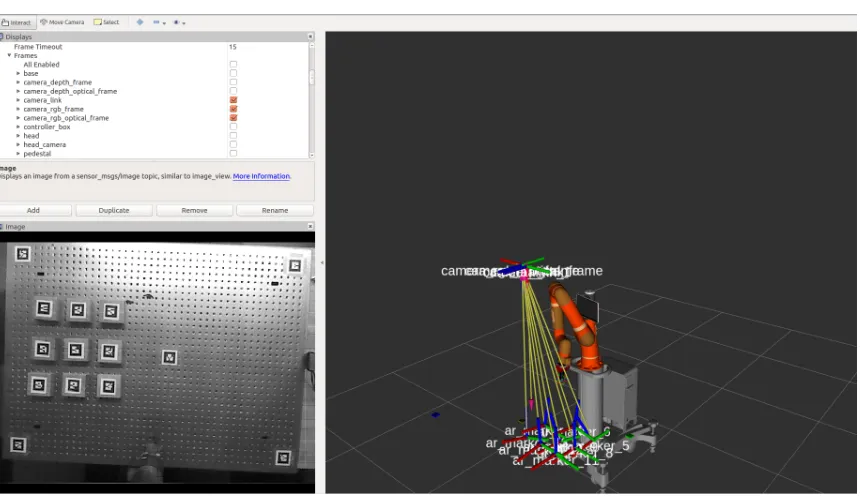
Rviz, ROS 3D visualizer, is used for displaying sensors data, the coordinate frames and
[image:36.612.97.528.303.551.2]the robot states as shown in Figure 4.2
Figure 4.2: A visualization of the output of the perception module. The fiducial markers are being detected by the Kinect.
4.3
Knowledge
As explained in section 3.2 we are leveraging the concept of digital twin where we are
entity (simulation) to be as seamless as possible to have a better way of implementing
our system. We choose the Virtual Robot Experimentation Platform (V-REP) [27] as our
platform for our virtual entity. V-REP presents an easy and intuitive environment to create
virtual system where robots, objects, sensors and humans can be added. Every element in
the physical world that affects the HRC scenario has a counterpart in the VREP simulation
scene as seen in Figure 4.1. The input to the virtual world is the data acquired from the
perception component: robot joint states, human arm position, and workpieces positions to
control the simulated robot, simulated human arm, and simulated workpieces respectively.
As a result they will mirror their real world counterpart state in real-time.
This is achieved by remote API interface that allows communication between V-REP
and an external application via socket communication. It is composed by remote API server
services and remote API clients. Each object in the simulation scene is associated with a
ROS node that acts as a remote API client that that facilitate streaming the perception data
to a specific object in V-REP scene. The scene objects we have are rarely used on their own,
they rather operate in conjunction with other scene objects (e.g. a human arm reaching to a
workpiece to pick). V-REP offers several calculation modules that can directly operate on
one or several scene objects. These calculations are the output of the virtual world. they
represent integrated knowledge that relates the scene objects with each other (see Figure
Figure 4.3: The distance calculations acquired from the digital twin. The minimum distance between the robot end effector and the workpieces is shown in black. The minimum stances between the workpieces and the human arm shown in red. The human robot distance is shown in green.
4.4
Planning
Planning takes place in two different levels as explained in section 3.3: Higher-level
planning and low-level planning. The high level planner responsible for selecting the robot
goal is implemented as ROS service. As explained in procedure 3.3.1, the robot selects
its goal after evaluating the information from the acquired from the knowledge module.
This ROS service will receive a call request from the low level planner when the robot is
ready to manipulate a workpiece. The request is made by theBLOCK-CHOICEstate. The
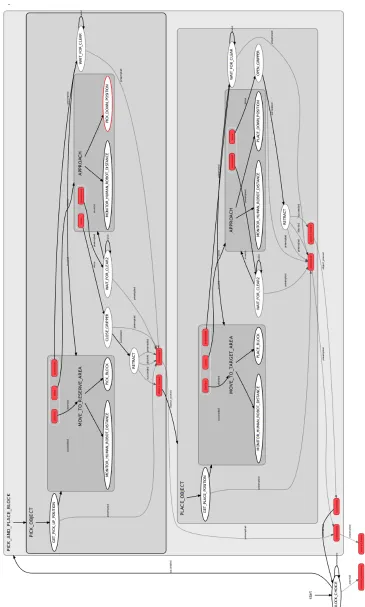
4.6. The state machine ran as a single ROS node. Our system utilized a python library
called SMACH to build and execute hierarchical concurrent state machines[28]. SMACH
has several modules which allow integration with ROS constructs like messages, topics,
actionlib actions and services. In this contexts, a state corresponds to a state of execution.
In other words it corresponds to the system performing some task. This is different from
the formal state machine definition, where each state describes a given configuration of
the system. In the graph chart in Figure 4.6, states are represented in circular shape, and
each arc represents a state transition. States are defined as single execute function which
blocks until function returns an outcome from the set of potential outcomes defined for
that state. A Rectangular shape represents a container state, which is a collection of one or
more states. Containers define different execution policies based on their child states and
outcomes.
In our CHSM we defined different types of states that integrates with ROS constructs:
• ServiceState: represents execution of a ROS service as a SMACH state.
• SimpleActionState: A state to interface with ROS actionlib to call an action.
• MonitorState: A state that subscribes to a ROS topic and blocks while a condition
holds.
The CHSM includes two different types of containers: concurrence container and
simple state machine container. Unlike a state machine, which executes one state at a time
in series, the Concurrence executes more than one state simultaneously. The outcomes of a
Figure 4.4: top level state machine
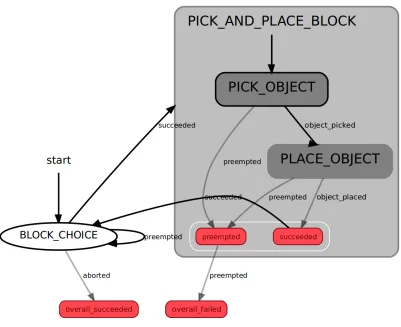
As seen in 4.4, the CHSM starts with executing theBLOCK-CHOICEstate. This state
is a ServiceState that acts as a service client to high-level planner implemented as ROS
ser-vice. The service replies with a workpiece ID that needs to be picked and this is when the
execution of thePICK-AND-PLACE-BLOCK action sequence starts. This super state has
two states that run in sequencePICK-OBJECTandPLACE-OBJECT. If the sequence
exe-cutes with no errorPICK-AND-PLACE-BLOCKreturns succeeded outcome and transition
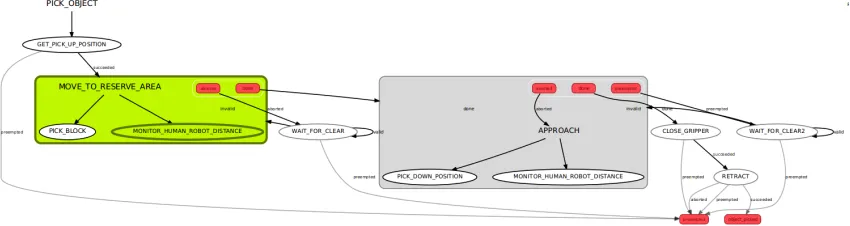
Going into lower levels of the state machine, we will explain here thePICK-OBJECT
container state. Figure 4.5 shows the states and containers nested in this state container.
PICK-OBJECT state starts with with the GET-PICK-UP-POSITION. This state execute
a function that requests the pose of the workpiece that needs to be picked. Note that
we already know the workpiece ID of the workpiece the robot needs to manipulate
be-fore transitioning into this state. Then the state machine transition to the next container
stateMOVE-TO-RESERVE-AREA. This is a concurrent state container, it will activate the
[image:41.612.101.526.326.439.2]MONITOR-HUMAN-ROBOT-DISTANCEandPICK-BLOCKsub-states simultaneously.
Figure 4.5: Pick an Object container state: it consists of sub-states needed to preform the action of picking a workpiece. it starts with getting the location of the workpiece to be picked, then performing the action of moving to the workpiece location, the approaching the workpiece, picking it up, and recreating to be ready for the next sequence of actions
The PICK-BLOCK sub-state is a SimpleActionState. This state will call the ROS
action interface (actionlib) specifically the Joint Trajectory Action Server, a node that
pro-vides a ROS action interface for tracking trajectory execution. This action takes in goals of
the type FollowJointTrajectoryAction that describes the trajectory for the robot to follow.
supply these these trajectories. This service will generate a desired trajectory in response
to our motion plan request. The trajectory goals will be passed to the to the joint trajectory
action through the SimpleActionState PICK-BLOCK all the way to the sawyer trajectory
controller, and reports success when it finished executing.
The robot should reason about the human safety when it is planning and executing its
actions. Therefore, the distance between the human hand and the robot end effector is
mon-itored whenever the robot start executing an action. This is done by
MONITOR-HUMAN-ROBOT-DISTANCE state. It is of MonitorState type, where it checks if a ROS message
has been received to the /human-robot-distance ROS topic. If the state machine is in state
PICK-BLOCKand a ROS message is sent to/robot-distance indicating the
human-robot-distance is below the safe threshold,PICK-BLOCKwill be preempted, and the state
machine transitions toWAIT-FOR-CLEAR. WAIT-FOR-CLEARstate is a MonitorState, it
will check if human-robot-distance ROS topic indicates the human robot distance is above
the threshold so it can transition back to MOVE-TO-RESERVE-AREAand resume
PICK-BLOCK action. IfPICK-BLOCK is completed, MONITOR-HUMAN-ROBOT-DISTANCE
is preempted and the concurrent state container MOVE-TO-RESERVE-AREAreturns
suc-ceed and the state machine transitions to the next concurrent state container APPROACH.
In this is state the same idea used in MOVE-TO-RESERVE-AREAstates container of
im-plementing preemption, using a concurrence container and monitor state is used. In
human robot distance. When the state return succeed , the state machine transition to
RE-TRACT, which another SimpleActionState and under go the same process discussed
ear-lier in PICK-BLOCK. With the successfully completing RETRACT the superstate
PICK-OBJECT returnsobject-pickedoutcome.
At this point the PICK-AND-PLACE-BLOCK transition to PLACE-OBJECT
con-tainer to place the workpiece in it final location according to the final task state goal. The
way we implemented the PLACE-OBJECT contair state follows the same principle
Figure
4.6:
A
visualization
of
the
CHSM
that
sho
ws
all
the
states
needed
to
successfully
perform
a
pick
and
place
of
a
w
[image:44.612.111.476.86.693.2]Chapter 5
Human-Robot Teaming: User Study
To validate the developed system, a case study with one participant was performed. This
chapter describes the task, the experiment setup and procedure followed to conduct and
evaluate the system.
5.1
Task Description
Through the user studies, I would like to observer the joint task planning and
execu-tion dynamics that take place when varying the type of task ( low cognitive load vs high
cognitive load) and the robot goal selection process. Two different task has been created
a low and high cognitive load task. A low cognitive task is a task that is simple enough
to be be preformed by the human without challenging the human perception ability. In the
study the team is asked to transfer a set of workpieces from the picking to the placing area
while maintaining their initial spatial order(see Figure 5.1). Based on the pilot studies this
type of task is simple for the human to perform. The high cognitive load task is a task that
challenges the human perception ability. The participant has to pick a workpiece and figure
out where it should be placed after comparing it to the one-page pictorial description of
the final goal state of the task (see Figure 5.2). I hypothesize that this will create different
to account for while planning and executing its own actions.
Figure 5.1: low cognitive load task given to the participant indicating the initial and final state of the task. The two lines drawn in the figure is shown here for clarification purposes however this is not given to the participant.
Figure 5.2: A pictorial description of the high cognitive load task given to the participant indicating the initial and final state of the task. The two lines drawn in the figure is shown here for clarification purposes however this is not given to the participant.
The second type of variation is the change of robot sequence of actions against these
two tasks. The first robot behavior is considered more efficient in terms of the over all
motion in the workspace when preforming the task. When the robot stats executing the
[image:46.612.116.498.367.527.2]in the workspace. we hypothesis that this is more efficient for the robot over all motion in
the workspace but it might be a burden on the human partner since the human does not know
when the robot is going to do after its done placing the workpiece. Therefore, we create
a more legible action sequence to eliminate this ambiguity in picking an workpiece phase.
The robot will go to a specific position before it starts picking a workpiece. I hypothesize
this will be favorable by the human partner since he/she will be able to understand that the
robot is about to enter the picking area.
Therefore, a user study consists of the following sub-studies:
• User study A :Low cognitive load task with legible over all motion sequence
• User study B :Low cognitive load task with efficient over all motion sequence
• User study C :High cognitive load task with legible over all motion sequence
• User study D :High cognitive load task with efficient over all motion sequence
5.2
Experiment Setup
There are nine workpieces that the human and the robot need to manipulate based on
a given final task goal. In this HRC scenario we do not put any restrictions on the
par-ticipant on which workpieces he/she can manipulate, or create exclusive workspace zones
for any of team members. This will help in creating a similar human-human team kind of
interaction that we hypothesize is more fluent. The table surface is the “workspace” the
human and the robot share. The human and the robot shared task is to manipulate a set of
blocks “workpieces” to place them on the other side of the workspace in specific spatial
two work areas, the Picking Area and the Placing Area. The Picking Area is reserved to
hold the workpieces in their initial states. The Placing Area is where the workpieces need
to be placed based on the given final workpieces states that indicates the completion of the
task. The robot has prior knowledge about what the final state of the workpieces should be.
Figure 5.3 shows a sequence of the experiment setup while the human and robot performing
the task.
5.3
Evaluating Fluency of Human-Robot Collaboration
We choose to evaluate the collaboration through both objective and subjective metrics. The
following explains the objective metrics of interest:
• Robot Idle TimePercentage of time out of the total task time, during which the robot
has been not active. The robot can be idle due to predefined rules to prevent the
human-robot collision.
• Human Idle Time Percentage of time out of the total task time, during which the
human has been not active.
• Number of Collisionsbetween human and robot :(Note: Collision is defined as the
event where the minimum distance between human and robot is below a predefined
threshold.)
• Functional Delay: Percentage of time out of the total task time, between the end of
one agent’s action and the beginning of the other agent’s action.
• Concurrent activity:Percentage of time out of the total task time, during which both
Physical-World Virtual-World
Perception
.
.
.
.
.
.
[image:49.612.110.511.116.576.2].
.
.
• Concurrent activity in the same workspace area: Percentage of time out of the
total task time, during which both agents have been active at the same time within the
same workspace area.
• Number of actions performed by each agent: In our HRC scenario, we count the
number of workpieces manipulated by each agent.
• Time to complete task: i.e. the time taken to place the 9 workpieces in their target
locations.
These metrics are based on the guidelines set by [4] to evaluate the fluency of the
human-robot collaboration and the insights of[13] to improve human-human-robot team performance.
To measure the participant perceived sense of robot collaboration, the participant is
asked to answer a seven-point Likert scale survey. The survey can be found in the appendix
section.
5.4
Procedure
We first explain the purpose of the study to the participant and ask her/him to sign a
con-sent form. Any questions the participant might have will be answered by the researcher.
The participant will be taken to the participant’s seat which is across from the robot. The
participant will be introduced to the robot and the workspace. The participant will be
briefed on the procedure of the experiment. An additional one-page pictorial description
of the task will be given to the participant that involve:(a) the set of objects and targets
locations involved in the task; (b) the final state of the workspace that shows the final
description will be placed on the side of the table where it is visible to the participant during
the experiment. The robot will be activated to perform a demonstration of its movement in
the workspace so the participant can be familiar with it before performing the experiment.
The participant will be asked to wear a wristband that has reflective markers utilized by
the OptiTrack motion tracking systems. The collaborative task will be initialized and the
participant will be informed to start. A total of 4 experiments will be performed where
we run two different robot behaviors against two different type of task we developed and
explained earlier. During the Experiment, we will measure experiment parameters that are
not related specifically to the human subject such as: Human-Robot absolute minimum
distance, Robot Idle Time, Human Idle Time, Human-Robot simultaneous movement time
and Task Completion Time. At the end of each experiment, the participant will be asked
to fill a survey to measure the subjective human satisfaction with each algorithm through a
seven-point Likert scale survey to evaluate the participant perceived sense of robot
collab-oration.
5.5
Results
To validate some of the initial hypotheses explained earlier,some pilot studies were
con-ducted where the human and the robot preform the tasks on their own. The result of the
main four study cases are presented in this section.
5.5.1 Human and Robot Only Experiments
A participant was asked to perform the two types of tasks to confirm the assumption on the
to the low cognitive task. As shown in Table 5.1, it takes the participant 1 minute and 30
seconds more to perform the high cognitive task compared to the low cognitive task which
[image:52.612.93.525.180.232.2]confirms that this task is more challenging on the participant.
Table 5.1The time it takes the human to complete the two tasks designed for this research
Task Type Time to complete task
Low cognitive load task 37 seconds
High cognitive load task 2 minutes and 7 seconds
When the robot performs the task, as shown in Table 5.2 the time it takes the robot to
complete the task with legible motion takes longer time compared to the case of efficient
motion. Therefore, to improve the time it takes the robot to perform a task, efficient motion
will be more suitable for that. However, its overall effect on the fluency of the collaboration
[image:52.612.98.523.409.457.2]needs to be investigated with user studies.
Table 5.2The time it takes the robot to complete the two types tasks against the two different robot behaviors
Task Type/Robot Motion Legible Motion Efficient Motion
Low cognitive load task 2 minutes and 8 seconds 2 minutes and 7 seconds
High cognitive load task 2 minutes ans 25 seconds 2 minutes and 10 seconds
5.5.2 Human-Robot Collaboration Experiments
The objective measures of the four studies conducted with one participant are shown in
Table 5.3. In general, there is no significant difference in the number of workpieces
ma-nipulated by the human across the different studies. However, the participant manipulates
fewer workpieces in the studies where the robot and the human have to preform the high
cognitive task. This is due to the time needed by the participant to find where the
work-piece needs to be placed. In general, the robot takes more time to successfully manipulate
workpieces manipulated by the robot and human.
The number of collisions was low in this study. However, it affects the robot idle time
measure. After the collision takes place and the robot chooses to be idle, it takes some time
to resume its action.
The time taken to complete the task when the human and robot collaborate with each
other is significantly less when compared to the human or the robot performing the task
alone except for one case where the human is performing the low cognitive load task.
In general, it takes longer to perform the high cognitive load task. Also, when the robot is
following the more efficient motion sequence, the time taken to complete the task improves.
However, this not true when more collisions take place.
The concurrent activity across all the studies was high, except for user study C. This
drop was due to the increase in the human idle time. However, it can be seen that even the
concurrent activity was the highest during user study D (95 %), the concurrent activity was
not within the same workspace area.
The Idle human time was the greatest in user study C. In this particular case; it was due
to the human taking longer to start preforming the task. The robot idle time is dependent
Chapter 6
Conclusions
A cyber-physical testbed was created to enable a human-robot team to perform a shared
task in a collaborative workspace. A digital twin of the HRC scenario was created and used
during a human-robot collaborative tabletop manipulation task in a shared workspace. This
setup was successfully used to test robot task planning and execution based on the states
represented and reported using the digital twin, thus validating the importance of using a
virtual world representation of all actors: human, robots, and objects during a human-robot
collaborative task and its significance in task execution and planning.
From the initial user studies, a difference in the dynamics of the collaboration when
varying robot behavior against different types of tasks were observed. From our initial
results, the number of manipulated workpieces seems to exceed the number of workpieces
manipulated by the robot. This is due to the fact the human can perform a pick and place of
a workpiece faster than the robot. However, we notice a small drop in the number as the task
type change. In general, the time it takes to complete the task is related to the number of
collisions that happen during the collaborations. More collisions lead to an increase in task
time completion. The concurrent activity, in general, was high during most of the studies.
The user study we performed is just a validation of the system developed, but to gather
more insights about the dynamics of the collaboration, more user studies has to be
Chapter 7
Future Work
More insights will be gathered through our explorations of understanding and
imple-menting task planning and execution alongside performing human-subject experiments and
evaluating them based on the proposed metrics. The IRB approval is completed. Also,
in-cluding some aspect of the anticipation of human actions will be tested to improve the
col-laboration fluency. In my future work, I would also like to incorporate MUTUAL
ADAP-TATION model in high-level task planning. This could allow the robot to take
information-seeking actions to infer online on how the human goal is affected by the robot’s selection.
As a result, human and robot mutually adapt to each other; the robot builds online a model
Appendix A
Appendix
A.1
Study Questionnaire - Subjective Metrics
• Robot’s contribution
• The robot contributed equally to the team performance.
• I was the most important team member on the team.
• The robot was the most important team member on the team.
• I had to carry the weight to make the human-robot team better.
Trust in Robot
• I trusted the robot to do the right thing at the right time.
Robot Teammate Traits
• The robot was intelligent.
• The robot was trustworthy.
• The robot was committed to the task.
Working Alliance for Human-Robot Team
Bibliography
[1] J. Bruner and B. Kisgergely, “THE DIGITAL FACTORY REPORT Digital
Transfor-mation in Manufacturing,” Tech. Rep.
[2] “Sawyer Safety Overview,” Tech. Rep., 2017.
[3] I. Aaltonen, T. Salmi, and I. Marstio, “Refining levels of collaboration to support the
design and evaluation of human-robot interaction in the manufacturing industry,” in
Procedia CIRP, vol. 72. Elsevier B.V., 2018, pp. 93–98.
[4] G. Hoffman, “Evaluating Fluency in Human-Robot Collaboration,”Robotics: Science
and Systems, Workshop on Human Robot Collaboration, vol. 381, pp. 1–8, 2013.
[5] J. Baraglia, M. Cakmak, Y. Nagai, R. P. Rao, and M. Asada, “Efficient human-robot
collaboration: when should a robot take initiative?” International Journal of Robotics
Research, 2017.
[6] S. Tellex, R. Knepper, A. Li, D. Rus, and N. Roy, “Asking for Help Using Inverse
Semantics,” 2015.
[7] W. K. H. Ko, Y. Wu, K. P. Tee, and J. Buchli, “Towards Industrial Robot
Learning from Demonstration,” Proceedings of the 3rd International Conference
on Human-Agent Interaction, no. October, pp. 235–238, 2015. [Online]. Available:
[8] S. Nikolaidis, A. Kuznetsov, D. Hsu, and S. Srinivasa, “Formalizing human-robot
mutual adaptation: A bounded memory model,”ACM/IEEE International Conference
on Human-Robot Interaction, vol. 2016-April, pp. 75–82, 2016.
[9] R. Schulz, P. Kratzer, and M. Toussaint, “Preferred Interaction Styles for
Human-Robot Collaboration Vary Over Tasks With Different Action Types,”Frontiers in
Neu-rorobotics, vol. 12, jul 2018.
[10] B. Hayes and B. Scassellati, “Autonomously constructing hierarchical task networks
for planning and human-robot collaboration,”Proceedings - IEEE International
Con-ference on Robotics and Automation, vol. 2016-June, pp. 5469–5476, 2016.
[11] R. Alami, M. Warnier, J. Guitton, S. Lemaignan, and E. A. Sisbot, “When the robot
considers the human..”Proceedings of the 15th International Symposium on Robotics
Research, pp. 1–17, 2011. [Online]. Available: http://www.isrr-2011.org/
ISRR-2011/Program files/Papers/Alami-ISRR-2011.pdf
[12] A. Roncone, O. Mangin, and B. Scassellati, “Transparent role assignment and task
al-location in human robot collaboration,”Proceedings - IEEE International Conference
on Robotics and Automation, pp. 1014–1021, 2017.
[13] J. Shah and J. Wiken, “Improved Human-Robot Team
Perfor-mance Using,” Artificial Intelligence, pp. 29–36, 2011. [Online].
Available: https://www.researchgate.net/publication/221473232 Improved
human-robot team performance using Chaski a human-inspired plan execution system
Task Planning,”AAAI Spring Symposium ”To boldly go where no human-robot team
has gone before”., 2004.
[15] L. F. Marin-urias, E. A. Sisbot, R. Alami, L. F. Marin-urias, E. A. Sisbot, R. Alami,
G. Tools, L. F. Marin-urias, E. A. Sisbot, and R. Alami, “Geometric Tools for
Perspec-tive Taking for Human-Robot Interaction To cite this version : HAL Id : hal-01976921
Geometric Tools for Perspective Taking for Human-Robot Interaction,” 2019.
[16] H. S. Koppula and A. Saxena, “Anticipating Human Activities using Object
Affordances for Reactive Robotic Response,” Tech. Rep. [Online]. Available:
http://pr.cs.cornell.edu/anticipation/.
[17] L. M. Hiatt, C. Narber, E. Bekele, S. S. Khemlani, and J. G. Trafton, “Human
model-ing for human–robot collaboration,”International Journal of Robotics Research, no.
1982, 2017.
[18] N. Gildert, A. G. Millard, A. Pomfret, and J. Timmis, “The Need for Combi
![Figure 1.1: Degrees of Collaborative Operation [1]](https://thumb-us.123doks.com/thumbv2/123dok_us/30929.2455/15.612.114.508.109.276/figure-degrees-of-collaborative-operation.webp)