Bruce Millett Jan Mattsson Robert Johnston
ABSTRACT
The Enron and Worldcom cases have demonstrated the crucial importance of ethical and effective executive governance. Reviewing the literature on organisational learning and drawing on the model proposed by Lenz (1994) we develop a model of executive learning comprising four distinct types of executive learning: assumption learning, adaptive learning, developmental learning and maintenance learning. These four types were construed based on the idea that executives may find themselves in four separate contexts, namely, in existing or in new relationships/competencies. Each one of these four contexts, we claim, can initiate a different type of learning. This is evidenced by verbatim data from key informants in five case studies of internationalisation of service firms in Sweden, Norway, Australia and the United Kingdom. Finally, we suggest some implications of the proposed model of executive learning.
INTRODUCTION
Recent scandals such as the Enron, Worldcom and the many dot.com failures, have highlighted the crucial importance of corporate governance in global financial markets (Zandstra 2002; Vinten 2002). Top executives have been able to get away with very innovative accounting methods to be able to sustain the growth of their companies’ shares. Once revealed, a stock market plunge has led to an increased lack of confidence in how financial markets operate. Regulatory efforts are now targeting a number of problem areas such as the transparency and accuracy of executive governance, in particular financial accounting. Among other issues, this brings into the limelight how top executives make decisions and how they learn when leading and building large corporations (Barratt & Korac-Kakabadse 2002). Executives in small to medium enterprise were not exempt from scrutiny either with the recent collapse of many dot.com companies. While such cases raise the issue of ethics in decision-making, they also raise concerns about the general ability of executives to make sound decisions and learn effectively from the consequence of those decisions.
Given that organisational learning and knowledge management are seen as significant sources of competitive advantage (Nonaka & Takeuchi 1995; Moingeon & Edmondson 1996; De Geus 1997; Noble, Sinha & Kumar 2002), there is a need to understand the involvement of executive leaders in seeking such an advantage during the early phases of establishing their business operations as part of an international expansion strategy. More specifically, what types of learning processes become critical at the organisational level during a phase of growth, turbulence and change? Here we define executive leaders as those key players involved in establishing a new or revitalised business operation.
This paper is the outcome of an international and multi-disciplinary research study focusing on a number of different aspects of the international process involving five case study firms from Australia, Sweden and the United Kingdom. The purpose of the paper is to report the findings of one aspect of the study: namely, the identification of the types of learning processes that executive leaders were involved with during the early phases of establishing their business operations as part of an international expansion strategy.
The paper first outlines the methodology used in the study and then provides some background to the five cases involved in the study. Second, after reviewing some relevant background literatures, and especially the model suggested by Lenz (1994), we evidence four distinct types of executive learning. Finally, we discuss some implications for managers and suggest some ideas for future research.
METHODOLOGY
The general aim of the research has been to generate a deeper understanding of organisational learning among service professionals and executives, their customers and other key stakeholders in the context of their organisational networks. The research has particularly focused on the relationship between subsidiaries and their corporate units involved in the internationalisation process, and has attempted to map the nature and occurrence of joint activities between selected key professionals during an initial start-up period. Five recent internationalisations of mainly United States service parent companies were studied. There were three key selection criteria for the cases. First, we needed to have total access to all key informants. Second, each case depicted modern technology and service development in an international context. Finally, English could be used and understood by all respondents so that a standard transcription format could be applied.
The critical incident technique (CIT) was used as an integral part of collecting data. Flanagan (1954) has developed a method (CIT) to study actual behaviour with the purpose of finding behaviours that were critical for the success or failure in a given profession. In general terms, for an incident to be defined as critical we must be able to describe it in detail and it must deviate significantly from what is expected either positively or negatively. Thus, only the deviant incidents are studied. CIT has been used in a number of studies related to service (Bitner, Booms & Stanfield Tetrault 1990; Edvardsson 1991; Johnston 1995; Mattsson 1993). As such, it has been used as an inductive method based on interviews with and observation of respondents to generate incidents that form patterns from which the researcher can generate concepts and theories (Nyquist, Bitner & Booms 1985).
Key professionals who had documented first-hand knowledge of the initial green-field ventures were selected as respondents. They generally held positions as executive leaders as they were either founders or senior managers. In this study, a few considerations guided the selection of incidents. The respondent must have experienced the incident personally and also consider it to be critical during internationalisation. The respondent should also be able to place the incident in time and place and give a detailed account of it. Recent experiences were preferred. No indication was given as to the type of information required and no leading questions were asked. To the contrary, respondents were encouraged to talk undisturbed, openly and freely. Confidential handling of the transcriptions was guaranteed. Selected text materials for this study were read and validated by each respondent as part of the analysis. Therefore, many personal details have not been presented. The names of firms and respondents have been disguised.
Each interview was conducted in an identical way. First, we introduced the study and the aims. The respondent was then asked to give a brief introduction of his role in the start-up. Subsequently, we discussed possible alternative critical incidents that the respondent suggested. Together, we opted for two or three of them. The respondent was then presented with a generic checklist of the content of an incident (background, how it originated, persons involved, sequence of events, outcomes) to help him to talk openly and freely. In this way, the verbalisations were respondent-driven within a semi-structured format.
To secure adequate documentation of accounts, a tape recorder was used. All accounts (in English) were then transcribed in one university department. Subsequently, transcriptions were put into an event format as a first level of analysis. This was done by grouping texts of incidents or fragments thereof into longer accounts of events (see definition above). Each respondent was then given the opportunity to review the written account of the events generated by him/her. Corrections or comments from respondents were registered and taken into account. In this way, some validation of the constructed events was made. The adjustments suggested by respondents were of marginal importance and mostly concerned change of certain facts that were discovered when reading the transcripts.
In this paper, we take the perspective of the executive or the group of executives who drove the initial start-up phase. We focus on the ‘how’ and ‘what’ these individuals learned during this period. By evidencing different types of learning in the cases, we developed a generic framework based on established/new competence and established/changed relationships. Before presenting this framework, we briefly outline some key features of the five cases.
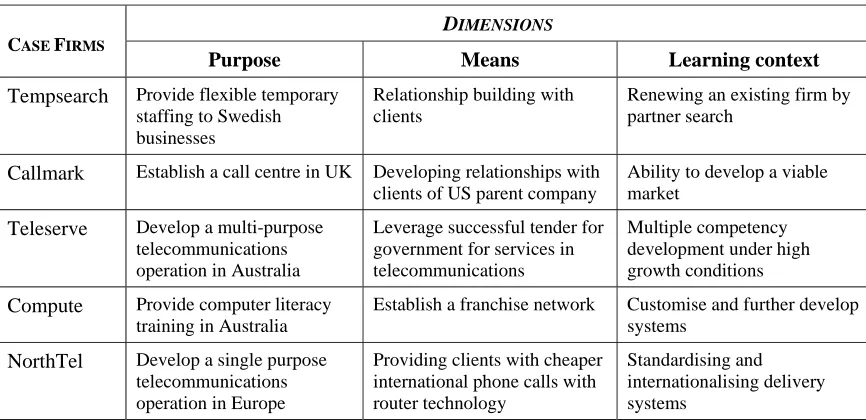
The Five Cases
Table 1: Key Features of the Case Firms
DIMENSIONS
CASE FIRMS
Purpose Means Learning context
Tempsearch Provide flexible temporary
staffing to Swedish businesses
Relationship building with clients
Renewing an existing firm by partner search
Callmark Establish a call centre in UK Developing relationships with
clients of US parent company
Ability to develop a viable market
Teleserve Develop a multi-purpose
telecommunications operation in Australia
Leverage successful tender for government for services in telecommunications
Multiple competency development under high growth conditions
Compute Provide computer literacy
training in Australia
Establish a franchise network Customise and further develop systems
NorthTel Develop a single purpose
telecommunications operation in Europe
Providing clients with cheaper international phone calls with router technology
Standardising and internationalising delivery systems
Tempsearch represents a firm in Sweden offering temporary employment services. Two friends formed a partnership to take over the business from the mother of one of the partners in 1987. They were the new executive leaders responsible for the resurgence of the firm by building more productive relationships with Swedish businesses. Because of an economic depression in Sweden in 1990-91, the volume of business declined. This forced the partners to look for an international partner who could provide a strategic alliance for further growing the business and meeting increasing competition. They entered into a franchise arrangement with an American company in 1992. In 1996, the firm was taken over by another international American company and this provided an additional source of learning and knowledge to the firm. The learning context is characterised by the ability of the executive leaders to seek new skills, knowledge and systems through strategic alliances.
Callmark is a division of a major US organisation that regards itself as a leader in communications customer care involving call centres. The UK operation was set up in October 1992 by a general manager from the American parent company. Under his leadership, the new firm commenced operation by servicing a few existing clients of the US parent company. However, no new clients were forthcoming and in August 1996, he was replaced by another general manager from the parent company who implemented a new strategy that allowed the UK operations to expand significantly. Both general managers played significant executive leadership roles in the development of the firm in the UK. The learning context revolves around each executive leader’s ability to expand the client base.
leadership role in establishing the firm in Australia. The learning context is characterised by the executive leader’s ability to develop multiple competencies for service delivery under conditions for high growth.
Compute was first established in 1983 when the parent company started its first learning centre in Los Angeles to give every child the ultimate computer education. From the initial success of this venture, further learning centres were established at convenient locations on the west coast of the US. In 1992, an Australian entrepreneur gained approval from the American managing director to establish a franchise of Compute in Australia. In a few years, the Australian operation grew to over 40 independent franchises spread over all states of Australia. The Australian entrepreneur and the American managing director played significant executive leadership roles in establishing operations in Australia. The learning context related to the ability of the Australian executive to customise and further develop the systems to match the Australian requirements.
Northtel was founded in December 1994 with the objective of becoming a cost-efficient and customer-oriented provider of competitive telecommunications services through a combination of high quality, low-cost and value-added services. In its relatively short history, the company has established a strong market presence based on its offer to provide customers with high quality and reduced cost international telephone calls. A small group of Swedish and Norwegian entrepreneurs, along with the chief executive officer who they appointed, played strong executive leaderships roles during the establishment of the firm in a number of countries in Europe including Sweden, Norway, Austria and France. The learning context is concerned with the ability of the executives to standardise and internationalise their delivery systems.
The above description of the five cases provides sufficient background on each case and the key executive leaders involved in the establishment of each firm. In the following section, organisational learning in general, and Lenz’s (1994) model of executive leadership in particular, will be discussed in terms of their relevance for explaining the types of learning processes that executive leaders were involved with during the early phases of establishing their business operations as part of an international expansion strategy.
EXECUTIVE LEADERSHIP AND ORGANISATIONAL LEARNING
One perspective on organisations that is relevant to this study is that they are conceived as problem-finding and problem-solving entities where decision-making processes are seen as central leverage mechanisms for managing organisational change (Lenz 1994). While decision-making pervades all aspects of an organisation’s operations, there is no doubt about the important role that executive leaders play in making strategic choices about the future.
Organisational learning is concerned with the dynamics and processes of collective learning that occurs both naturally and in a planned way within and between organisations and their stakeholders. It is the process of continual realignment between the organisation and its environment as both change (Maznevski, Rush & White 1994). These processes and dynamics of learning are seen as more than just the management of change. They are seen as fundamental to the way that organisations develop (Crossan, Lane & Hildebrand 1994).
Particular authors identify various types of learning. For example, Fiol and Lyles (1985) distinguish between higher and lower levels of learning. Senge (1990) differentiates generative from adaptive learning. Argyris and Schon (1978) relate single-loop and double-loop to different activities within organisations and Dodgson (1991) detects a difference between strategic and operational learning. These types of learning differentiate between different levels of complexity and different aspects of activity. However, while these types are prominently identified in the literature on organisational learning, they have had little application for analysing leadership and organisational learning in different contexts.
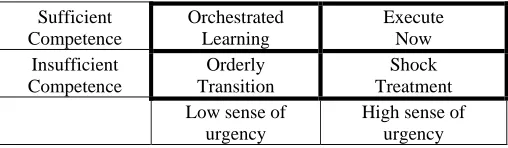
[image:6.612.178.432.399.473.2]Lenz (1994) has specifically developed a theoretical framework that has relevance to explaining the influence that executives have on organisational learning. As illustrated in Figure 1, he has identified four alternative influence processes for leading organisational change. Each process fosters learning and also affects the rate of learning.
Figure 1: Organisational influence and learning processes Adapted from Lenz (1994, p. 158)
Sufficient Competence
Orchestrated Learning
Execute Now Insufficient
Competence
Orderly Transition
Shock Treatment Low sense of
urgency
High sense of urgency
According to Lenz (1994), two factors account for most of the variation in the decisions of effective executives. The first factor involves the extent to which managerial and support personnel are competent in technical and administrative tasks. The second factor relates to the sense of urgency felt by an executive for initiating change. Based on these two dimensions, four approaches to organisational learning and leading change are identified:
Orchestrated learning is a leadership influence process where the executive of an organisation focuses most attention on the design aspects of the organisation and stimulates and supports learning across all aspects of the firm’s operations. If the management and support teams are competent and the sense of urgency is low, the executive can set about developing an organisation that can learn to take care of itself.
Execute Now is when leadership is made applicable to a high sense of urgency and talented people to work with. The senior management determines the strategic agenda and sets out the requirements for action and the focus is on the senior management team’s learning by doing.
little more erratic due to the dismissal of some of the existing role model staff, new priorities in budget allocations, new goals and changing job definitions and expectations.
Orderly Transition is leadership influence when the sense of urgency is low and the extent of talented people to work with is limited. The main challenge for the executive is to manage a change in culture through evolution, rather than revolution, and the executive feels that a longer time period is available to get key staff to unlearn old ineffective practices.
While the Lenz (1994) model may have some relevance and application for mature organisations going through periods of restructuring (Millett & Marsh 2000), it seems to have limited appeal for start-up firms, mainly because of two issues. Start-up generally represents the early phase of development where the urgency is always critical and the question of competency comprises more than just managerial and administrative competence. The first issue then is not whether one may have sufficient or insufficient competence at any point in time, but whether the whole gambit of organisational competence is effectively expanding to meet the daily demands of high growth.
The second and broader issue is concerned with the focus of organisational learning? The Lenz (1994) model is based on how executive leaders exert their influence by responding to two relatively independent factors that account for most of the variation in strategic decision-making; namely the sense of urgency in taking action and the degree of managerial competence in the organisation. As mentioned previously, the model identifies four influence processes that foster learning and also affects the rate of learning. This second issue then is to ask what is the focus and content of the learning that influences executive leaders’ responses in the context of start-ups. In essence, in any contingency model of executive decision-making and organisational learning, we need to understand what role the focus and content of decision-making and learning plays in such models.
In summary, organisational learning is here seen as a continuous process of realignment (Maznevski, Rush & White 1994) and organisational improvement evolves from better knowledge and understanding (Fiol & Lyles 1985). In this context, the study seeks to establish how executive leaders promote effective learning at the organisational level during a phase of growth, turbulence and change. In particular, as mentioned above, there is a need to identify not only the particular processes of learning that were evident during this period, but also the focus and content of the learning. The next section identifies an alternate framework for executive learning.
An Alternate Framework for Executive Learning
The contingency framework developed by Lenz (1994) focuses on the degree of invasiveness by leaders in making decisions over the organisational work environment. Such invasiveness affects the type of influences leaders have and consequently, the rate of learning and change that occurs. In this section, we describe an alternate framework that represents how executive leaders influenced the development of the start-up firms through four types of organisational learning processes that are differentiated by the focus and content of the learning.
organisations’. In the five cases, four different learning processes were identified as critical to their development. As well, a specific focus of learning was identified and associated with each of the learning processes. Hence, the ‘how’ and ‘what’ of organisational learning is identified in Figure 2 as assumption learning associated with values and beliefs, adaptive learning associated with rules and routines, developmental learning associated with knowledge integration, and maintenance learning associated with efficiency and effectiveness.
Established Competence
Maintenance Learning – Efficiency and Effectiveness
Assumption Learning – Values and Beliefs New
Competence
Developmental Learning – Knowledge Integration
Adaptive Learning – Rules and Routines Established
Relationships
[image:8.612.100.514.181.254.2]New Relationships
Figure 2: Four types of executive learning processes
The types of learning processes were contingent upon two relatively independent factors that were grounded in the data: organisational competence and organisational relationships.
Organisational competence refers to the capabilities that are developed to achieve the purposes of the organisation and is consistent with Dunphy, Turner and Crawford’s (1997) view that they include both managerial and technical capabilities. In each of the five cases, the executive leaders realised that success was contingent upon their ability to develop a set of competencies that would not only give them a competitive advantage in the marketplace, but would allow them to fully exploit their original business idea. The type of learning associated with such development depended on whether the organisational competencies were established or new. Established competencies relate to the existing skills, knowledge, and infrastructure that a firm has developed to achieve its purpose. New competencies relates to any expansion or change to the skills, knowledge and infrastructure of the firm. These changes can take many forms, but ultimately they comprise the unknown and the uncertain.
Organisational relationships refer to the type of involvement that each firm developed with critical stakeholders. In each of the cases, stakeholders were a central focus for the executive leaders, and the stakeholders included customers, clients, staff, investors, strategic partners and parent company management. This is consistent with the stakeholder approach to organisational effectiveness (Carroll 1996) where each firm’s success is dependent on the interests of the wider community (Robbins & Barnwell 2002). The strategic constituencies approach to organisational effectiveness suggests that success depends on meeting the demands of powerful stakeholders, rather than those of the wider community (Pfeffer & Salancik 1978). Thompson (2001, p. 100) adds that the importance of stakeholders can vary between strategic leaders and institutional investors.
stakeholders or a renegotiation of such with existing stakeholders. For example, in Callmark the new general manager developed new relationships with existing staff in order to implement a new strategy while in Tempsearch the executive partners spent considerable time learning and negotiating the terms of a new relationship with an American firm. The following sub-sections define and discuss the different types of executive learning with examples from the five cases.
Assumption learning
At various points in each firm’s development, executive leaders were involved in assumption learning. Assumption learning occurs when the executive leaders are restricted by their firm’s existing competencies and wish to explore new opportunities through new types of relationships with specific stakeholders. Put in another way, they are exploring new opportunities or responding to threats on the basis of their existing or known competencies. They do this by challenging their assumptions, values and beliefs as part of a process of negotiating a new shared understanding and relationship with the identified stakeholders. In the cases, the stakeholders included new partner firms, customers and staff. This type of learning has some similarity with Argyris and Schon’s (1978) view of organisational learning as a sharing of assumptions.
The chief executive officer (CEO) of Northtel met an Austrian businessman who was in a similar business. They kept contact and when the circumstances were right, the CEO made the Austrian an offer to buy his business. He recalls, ‘He was looking at me and said, alright, I have known you for two years and you always keep your word so I am going to consider it’. The Austrian did sell and that allowed Northtel to expand their European operations. Over the two years that the relationship developed between the two, they were able to get to know each other and explore their assumptions, values and beliefs about business and other matters. Such assumption learning was fundamental to whether the Austrian joined Northtel or not.
Similarly, the managing partners of Tempsearch participated in a national convention for temporary services in Hawaii as part of their search for a strategic partner for the business. At the convention, they met the managing director of an American firm and after many months of social and business meetings, the two firms entered into a strategic alliance. This is in contrast to other American firms that the partners had dealings with. As one of the partners explains, ‘Many US firms make you feel ripped off…we visited the number one in size in our industry…they wanted to buy us…their CEO came into our meeting, sat there for 20 minutes and said ‘how much do you want?’... We are not used to such talk. We first build up a relation with someone to see what kind of person he is’. The two accounts are indicative of the efforts that executive leaders across the five cases put into developing a shared set of assumptions, values and beliefs and getting to understand people as a prerequisite to bringing new stakeholders into the firm.
incident indicates how assumptions, values and beliefs need to be clarified when executive leaders explore how they can leverage their existing competencies for a new enterprise.
The chief executive of the Australian franchise of Compute had been searching for a business opportunity for four years and had searched through almost 400 propositions. In 1990, he saw an advertisement in Entrepreneur magazine for Compute, selling domestic franchises in the United States. This clicked with the chief executive ‘…because here was a business opportunity of creating a learning centre to teach children how to work with computers— which is what I, as a parent, wanted to consume’. He indicated that there was a natural affinity of getting into the business from being a consumer, and a parent whose son wanted to learn about the computer. The clarification of his assumptions, values and beliefs were consequently important for learning and negotiating a franchise agreement with the American parent company.
In summary, the exemplars of assumption learning all depict a personal affinity of some form that needs to be clarified. Once this has been accomplished, other forms of learning can take place. Assumption learning is a differentiating process that directs attention on assumptions, values and beliefs when executives begin to negotiate or renegotiate aspects of their relationships with specific stakeholders in the context of existing competencies.
Adaptive learning
This type of learning occurs when executive leaders see themselves responding to opportunities and threats in a context of developing new competencies and new relationships. Consequently, adaptive learning focuses on the development of new rules and routines, incorporating strategies, structures and technology as a way forward. At different times in the development of each of the five firms, the executive leaders actively pursued new rules and routines which they believed to be essential to the future of their firm. Such an approach to organisational learning has some similarity to Shrivastava’s (1983, p. 10) core idea of adaptive learning as firms adapting to changes in the environment ‘…by readjusting their goals, attention rules and search rules’. In further support of rules and routines as a significant focus for learning, Levitt and March (1988) see organisations engaged in learning ‘…by encoding inferences from history into routines that guide behaviour’ (p. 320). Here, routines include the rules, procedures, conventions, strategies, and technologies around which firms are developed and managed.
The executive leader of Teleserve created an organisation of several hundred staff in a relatively short period of time. The continuing development and redevelopment of strategies, structures, systems and technology was associated with the need to explore opportunities with new customers and at the same time, develop new or expanded competencies to meet these customers’ needs. He spoke of the issue of developing systems that could keep pace with change and pointed out that the processes that the business is based on ‘…start to get stressed and they start breaking down at various points in time…they weren’t designed for the levels of business that you start putting through them…the challenge is not to put Bandaids on things but when you are running very quickly, you tend to put Bandaids on things because you need to keep the customer happy’. The incident highlights the need to continuously review infrastructure as the rapidly expanding customer base causes chaos in service delivery.
occur, the firm needed to look at Direct Response Inbound services. He revamped the way the firm operated and developed a new capacity to handle inbound, as well as outbound, services in association with a new operational partnership with the parent company in the United States. The incident highlights how the new executive leader engaged in adaptive learning to respond to the challenge. He saw the need for new relationships and new competencies and focused his attention on developing new rules and routines in the form of new strategies, structures, technology and systems.
At Northtel, the strategy to recruit customers was ambitious and enterprising. Ten thousand potential customers had been contacted through direct mail in an unmarked envelope. The enclosed letter was a personalised message from the general manager. The letter was followed up by using telemarketing facilities. The general manager describes the text of the follow-up phone calls: ‘Good morning, I’m calling from (Northtel). Have you got an envelope with a small brochure about how to save money? Yes or no? Can I ask you some questions?…Can we have a meeting with one of the sales force during the coming month?’ Following this initial campaign, Northtel staff had met with 2,100 customers. Approximately fifty percent of those contacted signed contracts. In forging new relationships with firms in Scandinavia, Northtel developed new routines and systems for getting customers signed on. Such an approach to selling in Scandinavia was novel and illustrates how the general manager and his staff were engaged in adaptive learning in developing such an approach in a conservative market.
The office manager at Tempsearch accompanied one of the sales staff from the American partner firm on sales calls. This experience revealed how the Americans could complete 40 sales calls a week. Many sales calls were very brief and at times were without notice, which is an issue in Sweden. This experience forced the office manager to question the content of sales calls. The result was that different types of calls were identified and categorised. By examining the structure and purpose of calls, the office manager established performance measures for each type of visit. These measures became an important part of managing sales staff for results. The cultural differences between the American and Swedish firms became a trigger for changing the rules and routines in the context of improving competencies and changing the relationships with sales staff and customers. The office manager, with the support of the executive leaders, used his visits to the American partner firm to initiate an improvement of the system.
In summary, adaptive learning is about finding new structures, systems and staff to model the new business activities. It is learning by searching for and differentiating the rules and routines required to support the new relationships. It is a tentative blueprint for action that, in retrospect, can be successful.
Developmental learning
Knowledge integration was a critical aspect in the development of the franchise network of Compute in Australia. Each new franchisee had to learn about the products and services of Compute. They had to develop and integrate the critical knowledge base into their own local operations in order to succeed. According to the general manager of Compute (Australia), one of the franchisees had been in the business for a full year and had not read the operations manual. The general manager raises the issue, ‘How do you make them read it? You can’t. You can suggest it, you can open it up with them, but you can’t make them read it’. Because of this, the Compute support structure has been altered to incorporate a mentoring system. The general manager argues that the fastest man in the world over 100 metres still has a coach. The basis of the mentoring system is to have a person from corporate office in the franchisee’s learning centre for a whole day regularly to review the business development kit with the franchisee by raising such questions as, ‘Have you done these things, if not why not? What were the things that took your mind off it?’ The mentoring sessions are meant to stimulate the franchisee about the important things for their business and help them develop and integrate critical knowledge into their operations.
The American parent company of Teleserve sold a software product to the company that won the second telecommunications licence in Australia. The software product was to basically support this company’s carrier network and the American parent was trying to support that product from Philadelphia. As part of their contract with the state government, Teleserve had sub-contracted to a local group of software companies for specialised software requirements and consequently, Teleserve sent some of their staff back to the American parent company in the United States to be trained on critical Teleserve technology. They made an impression in America and, because of the problems that the American parent was having supporting the software for the second licence holder from Philadelphia, they actually asked if Teleserve could support this contract using these staff. The chief executive of Teleserve supported this move: ‘They seemed like a pretty good bunch of guys. So we put another four of them on an airplane to Philadelphia and they learnt all about this product and they brought an American back with them and they started servicing the product and all of a sudden we had a group of about you know ten people sub-contracting software’. The incident illustrates how learning can focus on the diffusion and integration of knowledge to support systems and products across strategic partnerships.
the operation, using a ‘best of brains’ strategy. The incident highlights the importance of developmental learning in order to expand and diffuse the knowledge base of the firm.
In summary, it appears that new systems and routines are not enough. Often different abstract systems need to be integrated to become effective on a larger scale. We may see these efforts to building new knowledge as a secondary or superimposed system that acts on the existing systems as a catalyst. Now the complete set of systems can be made operational. However, at some point in time these systems need to be challenged as to their effectiveness. This is what we term maintenance learning.
Maintenance learning
Maintenance learning occurs when executive leaders emphasise effectiveness and efficiency in their firms. In the context of established and stable relationships with key stakeholders and established competencies, executive leaders are concerned about how well they achieve their goals and how the firm’s resources are allocated and consumed. This type of learning can be associated with Argyris and Schon’s (1978) single-loop learning.
At Callmark, maintenance learning occurred regularly in its dealing with its first client’s staff. A manager of the first client firm believed that Callmark initially took advantage of the department-based system of budgeting for call centre services. In the early stages of operation, Callmark dealt with departments of the first client independently. The manager believed that Callmark account managers encouraged each department to spend generously on call centre services regardless of whether they were under or over budget, hence resulting in a general overspending of the first client’s allocated budget as a whole. From staff feedback on these circumstances, the old contract was suspended and future services according to the manager, were ‘…assessed at a real cost value…and put a dollar return against that investment’. This made it easier for staff of the first client to identify value and be more responsible. Callmark learnt through this experience and, as a result, could demonstrate to the first client how the cost of the services was coming down through the advances in systems and technology.
The chief executive of Northtel recognises the importance of standardisation of their systems and the development of clear operational rules and procedures to assist in the export of such systems to international partners. He promotes maintenance learning by strict adherence to the system requirements as he points out: ‘…we try to have the same kind of standard for everything that we are sending out. Even though we are very small, we have a design manual describing exactly how everything should look, wherever we are. It means that there’s a Northtel brand…The thing that is going to be important now when the market is more mature than it is just now, is in brand decision. And if we don’t have the same offer, the same behaviour, the same way to act in all countries, we do not have a brand.’ The chief executive compares his firm with McDonalds: ‘…not the type of product, but the way they act. Tomatoes should be sliced in a certain way. There should be a certain grill time. This is exactly the same thing we do. We should act the same with the customer. We have the same type of material. If you come to Germany you would see exactly the same colours, you see the same type of presentation. It looks like a Northtel company. It’s adapted of course to the German environment’. Here we evidence standardisation as a means to effectiveness and as a brand builder.
evaluated according to a points system. To get points out of a maximum score of 580, a centre must have met a range of requirements and a centre with a score less than 75 percent is in dramatic need of improvements. This is how deficiencies are highlighted and recommendations arise out of this to improve the inadequate areas. The chief executive emphasises that the very vast majority of recommendations relate to teaching, particularly student retention which has a bottom-line value. The evaluation program is absolutely vital to the learning process. There are two aspects to it. Does the evaluation schema reflect the important issues of running a business? Secondly, how effective is the feedback process? This evaluation program is an example of how easily the learning and application of knowledge of the franchise can be measured quantifiably. Learning can be seen to have changed behaviour, but it is often difficult to establish the extent of that learning. This incident shows an ongoing assessment is possible with comparisons to the immediate past performance being the benchmark.
This section has attempted to evidence the four typologies of executive learning. Each one is distinct and comprises a different set of modus operandi as to ‘how’ and ‘what’ is learned. In one sense they can be seen as different sequences in a life cycle model of learning. However, they are not construed to be linear in their occurrence. To the contrary, executive learning can take place during simultaneous and overlapping typologies of learning. Assumption learning, however, is probably the first and necessary way of learning to start up a new business relationship. Every actor needs to gauge his/her counterpart before making any further commitments. The other three types of executive learning may be interrelated and do not appear to follow in any particular sequence. We may only speculate at this point as to what may drive the sequence of the different types of learning.
SUMMARY AND IMPLICATIONS
We suggest that it is important that executives are aware of the contexts of strategic decision making and executive learning. As the alternative framework for executive learning suggests, the different contexts are shaped by the status of stakeholder relationships and the nature of the firm’s competencies. For the five start-up cases, the executive leaders were confronted with a dynamic set of contexts due to high growth expectations. Let us briefly recapitulate some of the most important issues for the four typologies.
First, assumption learning is highly unstructured and contingent on personal affinity. Albeit, based on existing competencies, socialisation skills and personal judgment are most likely to determine how well an executive can evaluate the respective counterparts in a new relationship. During internationalisation, when different cultures are to be bridged, these skills are put to the ultimate test. Learning about values and basic assumptions of potential partners can take the form of very ‘sensitive’ interactions with great consequences for future business outcomes.
Third, developmental learning is about knowledge integration in an existing relationship. As such, this type of learning comes close to the normal executive tasks as a manager. It is to build business systems from the beginning. This is what business schools teach and executive programs are all about. Today, relevant problems for executives are which degree of business integration to strive for. Internet, for example, can present an array of new opportunities, but the main strategic issue is how and to which degree this new internet business should be integrated with existing brick and mortar business. Maintenance learning, finally, deals with the context of existing competencies and relationships. It is about the standard tools of management and the fine-tuning of existing procedures. Recent trends of the last decade with regard to mergers, downsizing and outsourcing in large corporations are illustrative. Effectiveness and efficiency are thought to be improved if more specialization is introduced and economies of scale can operate to their full extent. Recent corporate experiences, however, do not necessarily support this kind of development.
All in all, we have argued for the crucial importance of enhancing executive learning. We suggest four distinct types, each one depending on a certain business context. Different requirements are at stake in order to take advantage of the learning possibilities. Executives may be more comfortable with one or the other of the types construed, depending on their experience or personality. However, we may speculate that in some instances a use-by-date is applicable for top executives with regard to some types of executive learning. The issue is then how to deal with new learning opportunities when the top decision-makers are not tuned into this. This raises another learning issue, namely that learning can take place on different executive levels, for example, top and middle levels. How can learning, that takes place on middle levels, be supportive of that which goes on at the top level and the reverse? We may construe a dynamic model of learning in which different management levels and types of executive learning are interrelated in a sequence. This may be an approach for future research.
Organisational learning is also linked to how the organisation is seen by stakeholders, for example. its corporate identity. Top executives can, to a high degree, impact the corporate identity by their public actions. That is why executive learning has strategic consequences for the firm, whether managers are aware of it or not. One important finding about learning which is quite clearly illustrated by the Tempsearch case is that executives can be very open about what they do not know in order to fully grasp what knowledge is needed. In essence, by being explicit about the state of ignorance in their company, executives can move more quickly into a new area. Being aware of the limits of knowledge then can be an important inducement to executive learning.
REFERENCES
Argyris, C & Schon, D 1978, Organizational Learning, Addison-Wesley, London.
Barratt, R & Korac-Kakabadse, N 2002, ‘Developing Reflexive Corporate Leadership: The Role of the Non Executive Director’, Corporate Governance, vol. 2, no. 3, pp. 32-36.
Bitner, MJ, Booms, BH & Stanfield Tetrault, M 1990, ‘The Service Encounter: Diagnosing Favorable and Unfavorable Incidents’, Journal of Marketing, vol 54. January, pp. 71-84
Crossan, M, Lane, H & Hildebrand, T 1994, ‘Organisational Learning: Theory to Practice’, in J Hendry, G. Johnson & J. Newton (eds.), Strategic Thinking: Leadership and the Management of Change, John Wiley & Sons, Chichester, pp. 229-265.
De Geus, A 1997, The Living Company, Harvard Business School Press, Boston.
Dodgson, M 1991, ‘Technology Learning, Technology Strategy and Competitive Pressures’, British Journal of Management, 2, 3, pp. 132-149.
Duncan, P & Weiss, A 1979, ‘Organisational Learning: Implications for Organisational Design’, Research in Organisational Behaviour, 1, pp. 75-123.
Dunphy, D, Turner, D & Crawford, M 1997, ‘Organizational learning as the creation of corporate competencies’, Journal of Management Development, April, vol. 16, no. 4, pp. 232-244.
Edvardsson, B 1992, ‘Service Break-downs—Study of Critical Incidents in an Airline’, International Journal of Service Industry Management, vol 3, no 4, pp. 17-29.
Fiol, C & Lyles, M 1985, ‘Organisational Learning’, Academy of Management Review, vol. 10, no. 4, pp. 803-13.
Flanagan, JC 1954, ‘The Critical Incident Technique’, Psychological Bulletin, vol 51, no. 4, pp. 327-357.
Johnston, R 1995, ‘The Determinants of Service Quality: Satisfiers and Dissatisfiers’, International Journal of Service Industry Management, vol 6, no 5, pp 53-71.
Lenz, R 1994, ‘Strategic Management and Organisational Learning: A Meta-theory of Executive Leadership’, in J Hendry, G Johnson & J Newton (eds.), Strategic Thinking: Leadership and the Management of Change, John Wiley & Sons, Chichester, pp. 153-179.
Levitt, B & March, J 1988, ‘Organisational Learning’, Annual Review of Sociology 14, pp. 319-40.
Mattsson, J 1993, ‘How Bank Loan Officers Evaluate Persons Applying for Credit’, International Journal of Bank Marketing, vol. 11, no. 2 1993, pp. 25-34.
Maznevski, M, Rush, J & White, R 1994, ‘Drawing Meaning from Vision’, in J Hendy, G Johnson & J Newton (eds), Strategic Thinking: Leadership and the Management of Change, John Wiley, Chichester, pp. 13-45.
Millett, B & Marsh, C 2000, ‘The Dynamics of Strategic Learning in an Era of Industry Restructuring’, in R Wiesner & B Millett (eds.), Management and Organisational Behaviour, John Wiley & Sons, Australia, Brisbane, pp. 185-196.
Noble, CH, Sinha, RK & Kumar, A 2002, ‘Market Orientation and Alternative Strategic Orientations: A Longitudinal Assessment of Performance Implications’, Journal of Marketing, October, vol. 66, issue 4, pp. 25-39.
Nonaka, I & Takeuchi, H 1995, The Knowledge-Creating Company, Oxford University Press, Oxford.
Nyquist, JD, Bitner, MJ & Booms, BH 1985, ‘Identifying Communication Difficulties in the Service Encounter: A Critical Incident Approach’, in JA Czepiel, MR Solomon & CF Surprenant (eds), The Service Encounter, Lexington Books, New York.
Pfeffer, J & Salancik, G 1978, The External Control of Organisations, Harper & Row, New York.
Prahalad, CK & Hamel, G 1990, ‘The Core Competence of the Corporation’, Harvard Business Review, May/June, pp. 79-91.
Robbins, S & Barnwell, N 2002, Organisation Theory, Prentice-Hall, Frenchs Forest.
Senge, P 1990a, ‘The Leader’s New Work: Building Learning Organisations’, Sloan Management Review, Fall, pp. 7-23.
Senge, P 1990b, The Fifth Discipline: the Art and Practice of the Learning Organisation, Doubleday, New York.
Shrivastra, P 1983, ‘A Typology of Organisational Learning Systems’, Journal of Management Studies, 20, 1, pp. 7-28.
Starkey, K (ed.) 1996, How Organisations Learn, International Thomson Business Press, London.
Thompson, J 1967, Organisations in Action, McGraw-Hill, New York.
Thompson, JL 2001, Understanding Corporate Strategy, Thomson Learning, London.
Vinten, G 2002, ‘The Corporate Governance Lessons of Enron’, Corporate Governance, vol. 2, no 4, pp. 4-9.
Yin, RK 1990, Case Study Research, Sage Publications, California.