Interactive multimedia problem-based learning for
enhancing pre-service teachers’ self-efficacy beliefs
about teaching with computers: Design, development
and evaluation
A Dissertation submitted by
Peter R Albion, BAppSc, MSc, BEdSt, GDipRelEd, GDipEdAdmin, GDipAppComp For the award of
Abstract
Research has suggested that, despite support through policy and resource provision, information and communications technologies (ICTs) have made little impact on the practice of education and that limited teacher preparation for the use of ICTs represents a partial explanation. The purpose of this study was to investigate what form of professional education might be effective in preparing pre-service teachers to integrate ICTs into their teaching. Self-efficacy beliefs about teaching with computers were identified as a potentially significant source of influence on teachers’ use of ICTs for teaching. It was proposed that interactive multimedia using a problem-based learning design (IMM-PBL) should be an effective tool for increasing self-efficacy. Principles for the design of IMM-PBL were derived from the relevant literature.
An IMM-PBL package was designed and developed for delivery in a web browser format using content relevant to the integration of ICTs into teaching. Interviews with and sample responses prepared by computer-using teachers provided the basis for ensuring the relevance of content.
The completed materials were evaluated in use with a group of 24 final year pre-service teachers in a Queensland university. Participants in the trials reported that the materials were engaging and assisted their learning about integrating computers in their teaching. A statistically significant increase in self-efficacy for teaching with computers was found for users who had initially low self-efficacy for teaching with computers.
Certification of Dissertation
I certify that the ideas, experimental work, results, analyses, software and conclusions reported in this dissertation are entirely my own effort, except where otherwise acknowledged. I also certify that the work is original and has not been previously submitted for any other award, except where otherwise acknowledged.
______________________________ Signature of Candidate
_________________ Date
Endorsement
______________________________ Signature of Supervisors
_________________ Date
Acknowledgments
My sincere thanks go to my principal supervisor Professor Perc Marland who provided advice and encouragement from the inception of the study. Despite setbacks and changes in direction, Perc seemed never to doubt that it could be successfully completed. His expansive knowledge and experience of teacher education and associated research provided inspiration at many stages of the journey.
I am grateful also to my associate supervisors. Professor Jeff Bailey first aroused my interest in self-efficacy theory and provided invaluable assistance in the formative first two years of the study. Following Jeff’s appointment elsewhere, Professor David Ross provided practical advice and support during the design and development of the multimedia package and in the final stages of evaluation.
Multimedia development demands a diverse range of talents as is evident in the acknowledgments printed on the cover of the Integrating Information Technology into Teaching CD-ROM. The names listed therein are too numerous to repeat here, except to acknowledge the contribution of my colleague, Dr Ian Gibson. Ian was instrumental in the success of our joint application for funding from the National Priority (Reserve) Fund Teacher Education Initiative, without which the multimedia might never have been developed. It was his experience with problem-based learning that led to its adoption as a design framework and he shared responsibility for the educational design of the materials. His advice and encouragement, although at a distance for the final stages of development, contributed substantially to the shape of the final product.
Thanks also to Dr Tony Rickards who adjusted the teaching of his classes to accommodate the evaluation of the multimedia materials and to the students in his and other classes who, whether they worked with the materials or not, willingly completed questionnaires and other instruments.
I acknowledge also the encouragement and occasional assistance of numerous other colleagues at USQ and elsewhere. I am especially grateful to Dr Ashley Plank, Dr Don Rice and Dr Andrew Sturman who provided advice about statistical procedures.
Dedication
To my grandchildren Emily, Joel and Samuel,
who have no memory of life without computers and the Internet.
Table of Contents
A
BSTRACT...
IILIST OF FIGURES
...
IXL
IST OFT
ABLES...
XCHAPTER 1: BACKGROUND TO THE RESEARCH PROBLEM
... 1
1.1 Clarification of terminology and context ... 2
1.1.1 Terminology...2
1.1.1.1 Computer, information technology and related terms ...2
1.1.1.2 (Interactive) multimedia, hypermedia and hypertext...3
1.1.2 Context ...4
1.2 Possible barriers to teaching with computers... 5
1.2.1 The policy environment for teaching with computers ...5
1.2.2 Resources for teaching with computers...7
1.2.3 Are teachers teaching with computers?...9
1.2.4 Teaching with computers – the next generation...12
1.3 Professional education for teaching with computers: The problem to be investigated ... 15
CHAPTER 2: LITERATURE REVIEW
... 17
2.1 Investigations of computer-using teachers ... 18
2.1.1 Describing teachers’ computer use...18
2.1.1.1 Surveys of exemplary computer-using teachers ...19
2.1.1.2 Teachers in ICT-rich classrooms...22
2.1.1.3 Other studies of computer-using teachers...23
2.1.1.4 Pre-service and beginning teachers’ computer use ...26
2.1.2 Predicting teachers’ computer use...28
2.1.2.1 The work of Marcinkiewicz...28
2.1.2.2 Other predictive studies of teachers’ computer use ...30
2.1.3 Making sense of teachers’ computer use...31
2.1.4 Does the use of ICTs change teachers? ...33
2.1.5 Educating computer-using teachers: Summary of directions from the research ...35
2.2 Teachers’ beliefs about teaching with ICTs... 38
2.2.1 The nature of teachers’ beliefs ...39
2.2.2 Beliefs and teacher behaviour...40
2.2.3 The construct of self-efficacy beliefs...41
2.2.3.1 Self-efficacy beliefs for teaching ...42
2.2.3.2 Self-efficacy beliefs for computer use ...44
2.2.3.3 Self-efficacy for teaching with computers ...47
2.2.4 Changing teachers’ beliefs...49
2.2.4.1 Changing self-efficacy beliefs...51
2.2.4.2 Changes in self-efficacy for teaching ...52
2.2.4.3 Changing self-efficacy for computer use ...53
2.2.4.4 Changing self-efficacy for teaching with computers...54
2.2.5 Education for changing self-efficacy beliefs: Summary of theory and research findings...55
2.3 Case methods in teacher education ... 57
2.3.1 The case for case methods in teacher education ...57
2.3.2 Relationship of cases to teacher expertise and beliefs...59
2.3.2.1 Cases and expertise ...59
2.3.2.2 Cases and beliefs...61
2.3.3 Presenting cases with media...62
2.3.3.1 Interactive video cases...63
2.3.3.2 CD-ROM cases ...66
2.3.3.3 Networked cases...67
2.3.4 The potential of multimedia cases ...68
2.4 Problem-based learning ... 68
2.4.1 The nature of problem-based learning...69
2.4.2 Background to problem-based learning ...70
2.4.3 Characteristics of problem-based learning ...72
2.4.3.1 Role of the group in PBL ...73
2.4.3.2 Role of the tutor in PBL ...74
2.4.4 PBL in teacher education ...75
2.4.5 Computer assisted PBL...76
2.4.5.2 PBL in instructional design for IMM ...78
2.5 Designing educational multimedia... 79
2.5.1 PBL as a constructivist methodology ...80
2.5.2 Interactive multimedia and learning...81
2.5.3 Design of constructivist learning environments ...82
2.5.4 Interactivity in multimedia ...86
2.5.5 Narrative form in multimedia ...89
2.6 Principles for the design of IMM-PBL: A synthesis of the research... 92
CHAPTER 3: RESEARCH QUESTIONS & METHODS... 96
3.1 Research focus... 96
3.2 Research questions... 97
3.3 Research plan for the study ... 98
3.3.1 Proposed schedule of research ...100
3.4 Design and content validation ... 102
3.4.1 PBL validation ...102
3.4.2 Content validation ...103
3.5 Prototype trial ... 103
3.5.1 Microcomputer Utilisation in Teaching Efficacy Beliefs Instrument...105
3.5.2 Attitudes to computers and self-efficacy for computer use...106
3.5.3 Pupil control ideology...107
3.5.4 Teacher efficacy ...108
3.5.5 Innovativeness...108
3.5.6 User evaluation questionnaire...108
3.6 Beta evaluation ... 109
3.7 Evaluation trial ... 113
3.7.1 ACT and SCT ...115
3.7.2 MUTEBI, PCI, teacher efficacy and innovativeness ...115
3.7.3 Open questions about teaching with computers ...116
3.7.4 User evaluation questionnaire...116
3.7.5 Participant journals...117
3.7.6 Participant interviews ...118
C
HAPTER4: IMM-PBL
MATERIALS DESIGN&
DEVELOPMENT... 119
4.1 Funding and personnel ... 119
4.2 Software development environment ... 121
4.3 Overview of the development process ... 123
4.4 Conceptualising scenario development and structure... 125
4.5 Representing the IMM-PBL design... 128
4.6 Content selection and preparation ... 134
4.6.1 Stimulus materials ...135
4.6.2 Reference materials...136
4.6.3 Classroom Computing video...137
4.6.4 Consultant interviews ...138
4.6.5 Consultant responses ...139
4.7 User interface design ... 140
4.7.1 General screen and interface design...141
4.7.2 The desk ...143
4.7.3 The laptop computer ...144
4.7.4 The folders...146
4.7.5 Displaying video clips...147
4.7.6 Displaying consultant responses ...148
4.7.7 The help system...149
4.7.8 Use of intertitles...150
4.8 Materials assembly and programming ... 151
4.8.1 Creating the web site...151
4.8.2 JavaScript programming...153
4.8.3 CD mastering and replication...154
CHAPTER 5: RESULTS... 155
5.1 The IMM-PBL materials... 155
5.2 Design and content validation ... 155
5.2.1 PBL practitioners’ responses to the IMM-PBL materials...155
5.2.2 Consultants’ perspectives on teaching with computers...158
5.2.2.2 Analysis of the interviews ...160
5.2.2.3 Purpose...161
5.2.2.4 Development ...162
5.2.2.5 Method...165
5.2.2.6 Impact ...168
5.2.2.7 Issues...171
5.2.2.8 Internet ...173
5.3 Prototype trial ... 175
5.3.1 Multi-instrument questionnaire...175
5.3.1.1 The respondents...175
5.3.1.2 Scale reliabilities and results ...175
5.3.1.3 Relationships among the variables ...178
5.3.2 User evaluation questionnaire...179
5.4 Beta evaluation ... 182
5.5 Evaluation trial ... 186
5.5.1 Data from the large group...186
5.5.1.1 The respondents...186
5.5.1.2 Scale reliabilities and results ...187
5.5.1.3 Relationships among the variables ...189
5.5.2 Pretest-posttest comparison...190
5.5.2.1 Likert scale instruments ...191
5.5.2.2 Open-ended questions...193
5.5.3 Additional evaluative data...195
5.5.3.1 User evaluation questionnaire ...195
5.5.3.2 Participant journals ...200
5.5.3.3 Participant interviews...203
5.6 Summary of the data... 205
C
HAPTER6: D
ISCUSSION AND CONCLUSIONS... 206
6.1 Applying the IMM-PBL design principles... 206
6.2 Answering the research questions ... 212
6.2.1 Research question 1 ...212
6.2.2 Research question 2 ...215
6.2.3 Research question 3 ...216
6.2.4 Research question 4 ...219
6.2.5 Research question 5 ...222
6.2.6 Research question 6 ...224
6.3 Conclusions ... 226
6.3.1 Design and development of IMM-PBL...226
6.3.2 Effects of IMM-PBL...227
6.4 Recommendations for further development & research... 229
6.4.1 Development...229
6.4.2 Research ...230
REFERENCES
... 232
A
PPENDIXA – PBL
VALIDATION... 251
APPENDIX B – PROTOTYPE TRIAL PRE-TEST QUESTIONNAIRE... 253
A
PPENDIXC – P
ROTOTYPE EVALUATION QUESTIONNAIRE... 257
A
PPENDIXD – B
ETA EVALUATION QUESTIONNAIRE... 260
APPENDIX E – MULTI-INSTRUMENT QUESTIONNAIRE
... 268
APPENDIX F – USER EVALUATION QUESTIONNAIRE... 274
List of Figures
Figure 2.1: Taxonomy of PBL compared to sources of efficacy information...70
Figure 4.1: Overview of the development process ...124
Figure 4.2: IMM-PBL scenario development ...126
Figure 4.3: IMM-PBL scenario structure...126
Figure 4.4: Opening screen of the pre-prototype...128
Figure 4.5: Printed representation of the pre-prototype...129
Figure 4.6: An early "storyboard" for the first scenario ...130
Figure 4.7: An intermediate planning stage for the first scenario ...131
Figure 4.8: Portion of the assets register for scenario two...132
Figure 4.9: Screen specification form used in the prototype review...132
Figure 4.10: Flowchart for the web version of the first scenario...133
Figure 4.11: Storyboard for the web version of the first scenario...134
Figure 4.12: Conceptual arrangement of resources in the IMM-PBL materials...135
Figure 4.13: Typical screen layout in the prototype ...141
Figure 4.14: Typical screen layout in the completed version ...142
Figure 4.15: Typical view of the "computer" window ...145
Figure 4.16: Typical display in the folders window...147
Figure 4.17: Display format for video interviews...148
Figure 4.18: Format for display of consultant responses...149
Figure 4.19: Typical display of help for a task...150
List of Tables
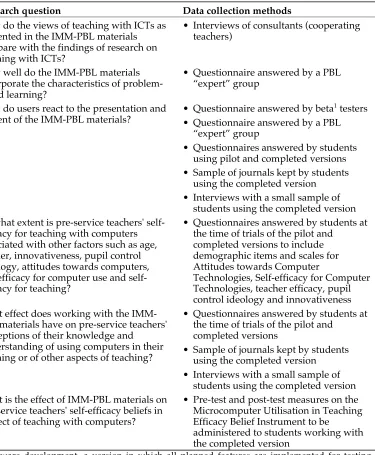
Table 3.1: Research questions and proposed methods of data collection ...99
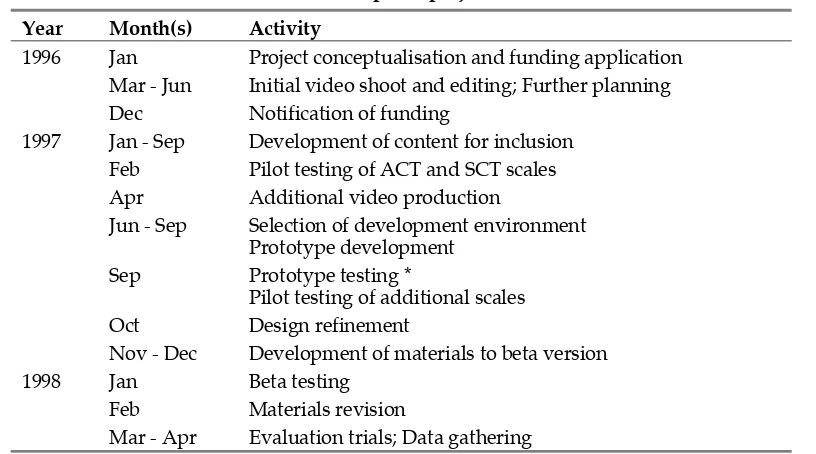
Table 3.2: Anticipated project schedule...100
Table 3.3: Actual project schedule after prototype testing (see * in Table 3.2)...100
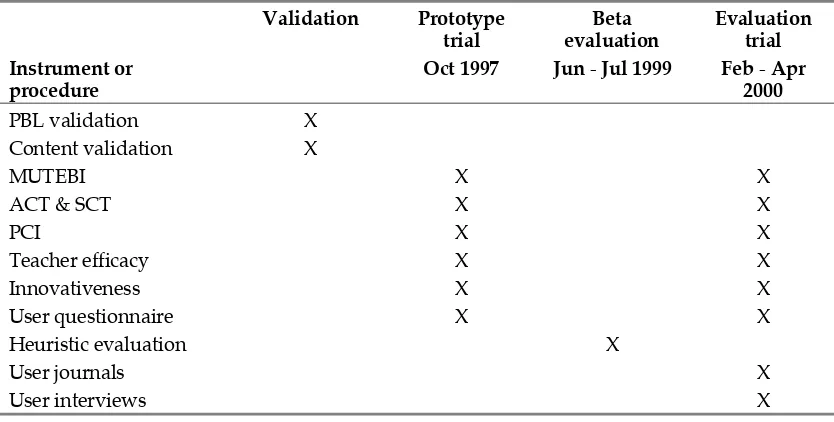
Table 3.4: Schedule of data collection ...101
Table 3.5: Instruments used in the prototype trial ...104
Table 3.6: Structure of prototype evaluation questionnaire ...109
Table 3.7: Open ended questions on prototype evaluation ...109
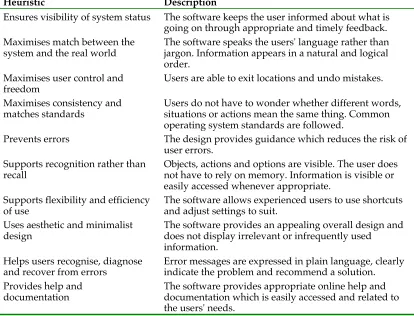
Table 3.8: Interface design heuristics – after Nielsen (1994) ...110
Table 3.9: Educational design heuristics – after Quinn (1996) ...111
Table 3.10: Content heuristics...112
Table 3.11: Instruments used in the evaluation trial ...114
Table 3.12: Open questions as used in the evaluation trials ...116
Table 3.13: Questions used in the participant journal...117
Table 3.14: Schedule of questions for participant interviews...118
Table 4.1: Schedule of questions for teacher interviews...138
Table 4.2: Navigational functions of standard items on the desk...144
Table 4.3: Number of files by type and source...151
Table 5.1: Experience cited by PBL practitioners panel...155
Table 5.2: Responses to PBL practitioners questionnaire...156
Table 5.3: Characteristics of the teachers and their workplaces...158
Table 5.4: Descriptions of major categories from interview analysis...160
Table 5.5: Distribution of statements by category and teacher ...161
Table 5.6: Descriptions of sub-categories of purpose...161
Table 5.7: Distribution of statements coded as purpose...161
Table 5.8: Descriptions of sub-categories of development...162
Table 5.9: Distribution of statements coded as development...163
Table 5.10: Description of sub-categories of method ...165
Table 5.11: Distribution of statements coded as method...166
Table 5.12: Descriptions of sub-categories of impact ...168
Table 5.13: Distribution of statements coded as impact ...168
Table 5.14: Descriptions of sub-categories of issues...171
Table 5.15: Distribution of statements coded as issues...171
Table 5.16: Descriptions of sub-categories of internet ...174
Table 5.17: Distribution of statements coded as internet ...174
Table 5.18: Reliability (alpha), mean and SD of scores (N = 31) ...176
Table 5.19: Correlation coefficients for pairs of scales (N = 31) ...178
Table 5.20: User evaluation data for the prototype trial (N= 15)...179
Table 5.21: Desirability of content elements in the prototype (N = 15) ...181
Table 5.22: Nomination of aspects of teaching in the prototype (N=15)...181
Table 5.23: Characteristics of the beta evaluators ...182
Table 5.24: Ratings on interface design heuristics ...183
Table 5.25: Ratings on educational design heuristics...184
Table 5.26: Ratings on content design heuristics ...185
Table 5.27: Alpha reliability, mean and SD for large group (N = 178) ...187
Table 5.28: Comparison of 1997 and 2000 scores for the multi-instrument questionnaire ...188
Table 5.29: Correlation coefficients for pairs of scales (N = 178) ...189
Table 5.30: Final regression model for SE sub-scale of MUTEBI ...190
Table 5.31: Mean scores on pretest and posttest ...192
Table 5.32: Frequencies of response categories for open-ended questions...194
Table 5.33: User evaluation data for the completed IMM-PBL (N= 24) ...195
Table 5.34: Desirability of content elements in the completed IMM-PBL (N = 24) ...197
Table 5.35: Nomination of aspects of teaching in the completed IMM-PBL (N = 24)...198
Table 5.36: Extracts from the journal of student A ...201
Table 5.37: Extracts from the journal of student B...202
Table 5.38: Extracts from the journal of student C ...202
Chapter 1:
Background to the research problem
Computers and associated technologies have been said to represent an “information revolution” comparable to the revolutions which followed the invention of the alphabet and the printing press (Spender, 1994). The physical presence of computers pervades the modern world of business and entertainment. Their impact on the collective psyche was evident in the widespread concern about the Y2K bug.
Yet, despite the manifest impact of computers elsewhere in society, there have long been suggestions that their potential for education has been largely unrealised. Whereas technology, including computers, would have rendered common practices of many occupations in the late twentieth century incomprehensible to practitioners from the previous century, education appears to be fundamentally unchanged (Papert, 1993). Anecdotal reports from schools confirm that computers, despite being almost universally available, are sometimes little used. A recent Queensland report, prepared within the Government department responsible for education, painted this picture:
Since the late 1980s there have been “back to back” learning technology initiatives in Queensland state schools. While there has been a steady increase in the number of computers and peripherals used for learning, the application of computers to the teaching/learning process is best described as patchy. World’s best practice is occurring in many classrooms, and, more rarely, at the whole school level, but in general computers are used in a supplementary and ad hoc fashion with little impact on student learning outcomes. (Galligan, Buchanan, & Muller, 1999, p. 1)
Acceptance that computers have a place in education is almost universal, even among those who express concerns about the ideological dimensions of educational computing. Bowers (1988) argued for teachers accepting responsibility for helping students to become critically reflective about the impact of technology on culture and Chandler (1990) conceded the effectiveness of computers for certain educational tasks but warned of the need for teachers to be aware of the underlying ideologies of computer software.
The use of computers in schools has been promoted for a variety of reasons, including community expectations and the desire to prepare students for an increasingly computerised workforce. For some years there was doubt about the direct benefits of computers for teaching and learning other than about computers. Now there is clear evidence that, when used appropriately, information and communications technologies have positive effects for student achievement, attitudes and classroom interaction (Galligan et al., 1999).
is "best described as patchy" (Galligan et al., 1999, p.1) and it appears that many students are not yet experiencing the educational benefits of computers.
What are the barriers to more extensive and effective use of computers in schools? What might be done to reduce the effects of those barriers? These questions provide the starting point for this investigation.
1.1
Clarification of terminology and context
Before proceeding to consider these questions it is appropriate to clarify some of the key terminology which will be employed and to establish the context within which the issues will be examined.
1.1.1
Terminology
As computer technologies have evolved over the past couple of decades, so have the terms used in speaking and writing about their uses in education. It would not be possible to write a document of this type without making reference to computer hardware and software and using terminology which may have varied from time to time and place to place. Sometimes the various terms are interchangeable and sometimes not. For this reason, where reference is made to published materials, the original usage of the sources is preserved wherever it is possible to do so without losing the sense of the material. The following comments are offered, not as definitions, but for the general guidance of the reader.
1.1.1.1
Computer, information technology and related terms
The first educational uses of computers occurred when the only computers available were large centralised mainframe systems. Hence as smaller systems, first mini-computers and then personal computers, appeared in classrooms, some writers felt the need to distinguish these from mainframe computers. Personal computers were sometimes referred to as microcomputers in deference to the microprocessors around which they were built. Nowadays it can be safely assumed that, unless there is some indication to the contrary, reference to a computer in education means a personal computer running one of the common operating systems. That usage is generally understood, even internationally. However, regional variations in associated terms abound and may occasionally cause confusion for the reader unfamiliar with the context.
Advancement of Computing in Education has a subgroup, the Society for Information Technology and Teacher Education, which publishes the Journal of Technology and Teacher Education. That journal also publishes articles with titles such as Attitudes of preservice teachers about using technology in teaching (Laffey & Musser, 1998) in which “technology” refers exclusively to computer related technologies. Hence, for most material published in the USA the use of technology can be assumed to mean computer unless it is clear that some other usage is intended. Recently there appears to have been a tendency to use information technology (Moursund & Bielefeldt, 1999) which has the benefit of being more explicit but it remains to be seen how widely the trend is followed.
In the UK, at least in recent years, there appears to have been standardisation on the term
Information and Communications Technology (ICT) (Department for Education and Employment, 1998). Prior to that, the common usage appeared to be information technology
(Twining, 1995) and before that reference was typically to computers (Dunn & Ridgway, 1991a).
In Queensland (and Australia) it has been common to refer to computers or information technology. The use of technology in place of either of those terms has been deprecated by the Australian Council for Computers in Education and the Technology Education Federation of Australia because of the potential for confusion with other aspects of technology in the school curriculum (ACCE, 1999). The term learning technology has been used in Queensland since 1994 (Queensland Department of Education, 1994) and it is gaining some currency at the national level (ACCE, 1999) although there appears to be support also for the use of
information and communications technology (Gibson & Albion, 1996; Moran, Thompson, & Arthur, 1999). There are also occasional alternative usages such as new technologies (Galligan et al., 1999) or communications and information technology (Richards & Nason, 1999).
Of the terms considered, information and communications technology, abbreviated as ICT, should probably be preferred. It has wider international currency than any of the alternatives and is unlikely to be misunderstood even where it is not in common use. Its major disadvantage is the length of the description where use of the acronym is not appropriate. Within this thesis, the use of computer will be assumed to include associated technologies unless an alternative meaning is made clear by the context or otherwise. The terms ICT and computer will be used interchangeably unless clarity of expression demands otherwise.
1.1.1.2
(Interactive) multimedia, hypermedia and hypertext
to multimedia can be assumed to be referring to IMM unless an alternative meaning is made explicit.
Hypertext is a way of constructing computer-supported, non-linear writing. It is “the ability to link any place in text stored in a computer with any other place in the same or different texts, that permits rapid access through buttons and other tools across non-linear pathways” (Horn, 1989, p. 6). The links in the hypertext information web are analogous to associations in human memory.
Hypermedia is “an extension of the idea of hypertext that incorporates other components such as video, illustrations, diagrams, voice and animation, and computer graphics. Typically an author creates computer-supported links between text, graphs, diagrams, photographs, video, music, film and other media” (Horn, 1989, p. 18).
Multimedia and hypermedia are not synonymous (Tolhurst, 1995). It is possible to create multimedia presentations, even interactive ones, which are essentially linear and do not provide for the richly interconnected web of information which is characteristic of hypermedia.
1.1.2
Context
Globalisation is a frequent theme of articles in the popular media. Although much of the discussion of globalisation centres on economic opportunities and effects there are many other aspects of life which are subject to its effects. Among the most obvious are media such as music, film and television.
The educational application of information and communications technologies is another field in which the principal trends appear to be taking shape internationally rather than within national or regional borders. This is hardly surprising given that the design of computer hardware and operating system software is dominated by a few companies and that the Internet makes access to information from and communication with colleagues in other countries virtually instantaneous.
It is true that there are some differences in the terminology used in different parts of the English speaking world to describe the technologies. It is also true that there are significant national differences in the structure and governance of schooling and in the curriculum. However, in reading the English language literature related to educational use of ICTs it quickly becomes evident that many of the issues, including those associated with teacher education, are not confined within national boundaries. International conferences such as the World Conference on Computers in Education and the annual conference of the Society for Information Technology in Teacher Education bring together delegates from many parts of the world who find that the issues they face are very similar.
because it enables greater benefits to be obtained from the results of research conducted in other places. Although some interpretation may be required before application of findings in new settings, most research on the educational applications of ICTs appears to be applicable internationally.
Thus, although the research described herein has been conducted in Queensland and will be most clearly relevant in that context, it is informed by the findings of research conducted in other parts of the world especially in the USA and UK. Moreover, it is likely that the findings will be generally applicable in other places.
1.2
Possible barriers to teaching with computers
Probably the first official recognition of computers in the Queensland school curriculum was in the 1974 revision of the senior secondary school mathematics syllabus which introduced units of work that included computer awareness and programming. Few schools had direct access to computers. Programming was typically taught by means of punched or marked cards that were dispatched to a remote computer centre for execution. Fortunate students, whose cards were correctly prepared, received printed output from their programs a few days later.
In the late 1970s some schools began to acquire early model Apple, Tandy and Commodore computers. These were predominantly local initiatives, promoted by enthusiastic teachers and funded by parent committees. For the first few years of the 1980s the number of computers in Queensland schools was small enough that an annual report listing them and describing their uses could be published. At that time there was little software, educational or not, available off the shelf. Computer education focused on teaching about computers and typically involved programming and other overtly technical aspects of computing. If the use of computers for teaching other content was considered at all, then it was usually in terms of simple tutorial or drill and practice software coded by teachers to their own design or using published program listings. Gradually, as basic applications such as word processors, databases and spreadsheets became available, the more creative or adventurous teachers found ways to use them to support teaching and learning with, rather than about, computers.
Barriers to the extensive and effective use of computers in schools might arise in several ways. One potential barrier might be the failure of policy makers to identify and promote appropriate developments in the educational use of computers. Assuming a supportive policy environment, another potential barrier to success might be failure to provide a sufficient level of computer resources to implement the policy. These represent logical points from which to begin an investigation.
1.2.1
The policy environment for teaching with computers
employment. However, there has been a gradual development towards recognising the benefits that integration of computers in education may provide across a broad range of educational objectives.
The first Queensland policy on computers in education was the Computers in the Curriculum Policy Statement No 1 which was issued in 1983 (Galligan et al., 1999). Its focus was on computer awareness, basic skills, computer assisted learning and vocationally oriented programs. It was followed in 1985 to 1987 with funding to support computer literacy projects in secondary schools.
In 1989, skills in information processing and computing were included in a national list of common and agreed goals for schooling (Australian Education Council, 1989). From 1989 to 1991, the Queensland government provided funding for Business Education Centres in all secondary schools and Electronic Learning Centres in 150 primary and secondary classrooms (Galligan et al., 1999). Although the Business Education Centres had a clear relationship to vocational education, the Electronic Learning Centres supported integration of computers in fields as diverse as art, music and social sciences.
In 1991 the effect of rapid technological change on learning and teaching was identified as one of eleven key issues for Queensland education and the integration of information technology for learning and teaching was identified as one of four goals for schooling (Queensland Department of Education, 1991). From 1992 to 1997 there was an initiative to fund computers for the upper years (six and seven) of primary schooling with a target ratio of one computer for every ten students.
It was more than ten years from the 1983 statement until there was another formal statement of policy in relation to computers in education. That came with the release of the Computers in Learning Policy and Guidelines (Queensland Department of Education, 1994). In contrast to the vocational emphasis of the 1983 policy, this document emphasised the use of computers to support learning across the curriculum at all year levels, although it also acknowledged the importance of computer skills for future entry into the workforce.
The most recent initiative, Schooling 2001 (Education Queensland, 1998b), has set system-wide targets to be achieved by 2001. These include the provision of one computer for every 7.5 students, the connection of every classroom to the Internet, and the use of computers “in all key learning areas, P-12”. At the same time, minimum standards for teachers in the use of learning technology have been set for achievement by 2001 (Education Queensland, 1998a).
Similar policy environments that recognise the potential contributions of ICTs to learning exist in the various Australian states (Moran et al., 1999), in the UK (Department for Education and Employment, 1998), and in the USA (CEO Forum, 1999). However, in every case there is concern that the potential is not being realised. If the barrier is not in the policy environment, then perhaps it is in the availability of computing resources.
1.2.2
Resources for teaching with computers
Computers are an accepted part of modern life. They are used almost universally in business and, in many countries, they are becoming increasingly common in homes. The Australian Bureau of Statistics (1999) reported that 35.4% of Australian households frequently used a computer at home. This rate rose to 58.7% for households comprising a married couple with children. About 25% of the adult Australian population accessed the Internet from any site in the 12 months to March 1998. As access to computers has increased in the wider community so has the expectation that computers will be used in schools as they are elsewhere.
Over the past two decades computers have become increasingly available in schools throughout the industrialised world. Cuban provided some indicative statistics for schools in the USA:
In 1981, 18 percent of schools had computers; in 1991, 98 percent had them.
In 1981, 16 percent of schools used computers for instructional purposes; by 1991, 98 percent did so.
In 1981, there were, on average, 125 students per computer; in 1991, there were 18.
In 1985, students used computers in school labs just over 3 hours a day; in 1989, that figure had risen to 4 hours a day. (Cuban, 1993, p. 186)
The trends evident in these statistics have continued. Recent data from the USA revealed ratios of one instructional computer per 5.7 students, one instructional multimedia computer per 9.8 students and one Internet connected computer per 13.6 students (Resnick, 1999). Students in elementary schools were likely to be able to access computers in both classroom (84% of students) and laboratory (79%). In secondary schools students were much more likely to be able to access laboratory computers (91% of students) than classroom computers (47%).
teachers on practicum in Queensland primary schools, 75% reported that there was at least one computer available in the classroom where they worked (Albion, 1996b). More recently, from a sample of student teachers working in 33 primary schools in and around Melbourne, it was found that 64% of the schools provided computers in classrooms and 57% had a computer laboratory (Jones, 1998).
Provision of computers in schools is affected by many factors including the availability of funding. A relatively small proportion of schools has adopted a policy whereby each student has a personal laptop computer (Albion, 1999b). Although the majority of such schools are privately operated, a small number of government schools have developed laptop programs. These programs appear to be based on the assumption that the benefits of computers for teaching and learning increase in proportion to the availability of computers and can be maximised by having one computer for each student. One writer has suggested that, in order to ensure access to computers whenever they are needed, in addition to personal laptops for students and teachers, schools should have more powerful computers for specialised tasks resulting in a preferred ratio of about 1.5 computers for each student (Moursund, 1996). Although this might eventuate in the future, a review of the relevant literature suggests that the benefits being claimed for laptop programs are very similar to those reported for the use of desktop computers at more modest ratios of around one computer for three or four students (Albion, 1999b). It seems inevitable that, as computer technology advances, schools will eventually have access to abundant, affordable computers but there do not currently appear to be compelling reasons for pursuing a 1:1 ratio of computers to students at the expense of other educational resources.
Many of the early efforts to provide computers for teaching in Queensland schools depended upon the local support of schools, parents and communities. However, there is evidence of commitment by Queensland governments to the provision of computers for use by teachers and students at all levels in schools (Galligan et al., 1999). The first Queensland government initiative in 1985 provided computer laboratories in secondary schools for the purpose of teaching computer literacy. Because the project provided for a laboratory of 30 or 15 computers depending upon school enrolment the computer to student ratio varied. During the 1992 to 1997 period, the first broad initiative for primary schools sought to provide computers for Years Six and Seven at the rate of one computer for every ten students.
that consideration be given to setting a new Queensland target of one computer for five students by 2005.
The combination of community expectations, educational policy and government funding has resulted in it being reasonable to assume that teachers and students in Queensland schools typically have some access to computers for support of teaching and learning. Similar conditions exist elsewhere, with the differences being in degree rather than kind. For example, there may be local variations in the ratio of students to computers or the capabilities of the computers, but teachers and students in most industrialised countries will have some access to computers for teaching and learning.
If the barriers to achieving the potential of computers for teaching and learning are not in the policy environment nor in the simple availability of computing, then where might they be? There may be answers to be found by examining patterns in the use of computers in schools.
1.2.3
Are teachers teaching with computers?
Papert has been a consistent advocate for the educational use of computers and was the prime mover behind the introduction of Logo as a medium for children working with the computer. However, he has expressed disappointment at the lack of impact of computers on education by comparison with their effects on other professions. He has likened the creation of computer laboratories in schools to the response that a living body makes to a foreign object such as a splinter by attempting to seal it off from the rest of the organism (1993).
Papert’s view that the introduction of computers has had less than the anticipated impact on the day to day activity of education has been supported by research. Much of the research has been conducted in the USA but comparisons with Australian data where it is available suggest that the overall picture is similar.
Results obtained from broadly based survey research conducted by the International Association for the Evaluation of Educational Achievement (IEA) in 20 countries between 1987 and 1990 suggested that only relatively small proportions of teachers were active users of computers in their teaching (Plomp & Pelgrum, 1993). Among a group of eight industrialised countries the availability of computers for instructional purposes in lower secondary schools ranged from 36% of schools (Japan) to 100% of schools (USA) with each of the others recording over 70% availability. In each case more than half of the computers were located in “computer rooms” and for all but the USA (30%) and France (27%) the proportion located in classrooms was less than 20%. General purpose and subject specific software was widely available in the survey schools. However, the proportion of teachers who used computers in common subjects such as science, mathematics and the mother tongue was 15% or lower except for mathematics in Switzerland (21%) and for each of these subjects in the USA (> 40%).
which surveys were completed by the principal, the computer coordinator and a sample of computer-using and non-computer-using teachers. Only one secondary teacher in six used computers in a substantial way. At the elementary level, most teachers reported students using computers in their classes but, with only one or two computers available in a majority of cases, the experience of individual students was necessarily limited. Moreover, the majority of teachers focussed their goals for computer use on basic skills rather than higher order thinking.
The second phase of the IEA study was conducted in 1992 and found that computers in schools were still used mainly for learning about computers although there was some increase in use across the curriculum (Pelgrum, Janssen Reinen, & Plomp, 1993). Responses from students in 17 different samples taken across countries and levels of education indicated that in no case did more than 30% of the students report having used the computer more than 10 times for a particular curriculum area in a year. In the vast majority of cases the proportion was less than 10%. In elementary schools (Japan, Netherlands and USA) the most common use was for playing games, followed by drill and practice, learning new material and word processing. In secondary education the most regular use was for programming or word processing followed by learning new material or drill and practice. Games were also widely reported as a significant use.
Again, Becker (1998) reported additional insights about the USA data gathered in the 1992 IEA study. He noted that the data suggested that the typical student had between 40 and 120 minutes of computer access per week, that the patterns of use indicated a focus on practice of routine skills rather than higher level problem solving and that between 1989 and 1992 there was a decline in computer programming instruction and an increase in the use of word processing. Most of the word processing activity appeared to be undertaken in computer education or business education classes but increasing numbers of English and language arts teachers reported students using word processing for assignments as an individual option rather than as part of systematic instructional practice. He suggested that more widespread use of computers as productivity tools was restricted by teachers’ priorities among competing instructional objectives, and limited time and computer resources.
In another study which surveyed a sample of 1200 USA teachers who had been nominated as worthy of recognition for their efforts at using technology, Hadley and Sheingold (1993) received returns from 608 participants who were in 576 different schools across the USA. The teachers who responded were mature and experienced and included a greater proportion of males than were in the teaching population as a whole. A wide variety of computer-based practices were reported, although, as in the IEA studies, word processing, drill and practice, tutorial programs and games were widely used.
ways that were not of critical importance to their teaching. Marcinkiewicz concluded that teachers were under-utilising the computers available in their schools.
Australia did not participate in the IEA study and there are no comparable data for a sample of schools or teachers with equivalent coverage to that found in the IEA studies. Sherwood (1993) replicated the work of Hadley and Sheingold (1993) in Australia during 1992. Of 731 teachers who were surveyed following their nomination as “experienced and effective users of computer technology in the classroom”, 362 responded. As in the USA study they were mature and experienced. The most common application in use was word processing but significant numbers also reported using drill and practice software, adventure games, simulations and problem solving programs and tutorial and paint programs. No indication of frequency of use was reported.
Roberts and Albion (1993) reported that a sample of computer coordinators in Australian secondary schools characterised approximately 40% of the teachers in their schools as making “no use of computers” and just 20% as “regular and effective users”. Other than for teaching about computers, the most common use of computers in the curriculum was in the teaching of English, and word processing was the most commonly used application.
An international survey of IT use in education was undertaken in 25 countries (not including Australia) between November 1998 and February 1999 (International Association for the Evaluation of Educational Achievement, 1999). It found that the availability of computers for instruction was continuing to rise and had reached an average of one computer for ten students in many of the countries. Many schools in the developed countries had Internet access but its use by students was still low. There were indications that ICTs facilitate changes in pedagogical practices towards student-centred approaches but adequate training of teachers was still a major problem in most countries.
Data from a recent large scale survey in the USA (Resnick, 1999) confirmed the impression that some teachers are adapting their approaches to integrate technology but that there are many teachers who have yet to adopt technology. In 54% of schools over half of the teachers used the Internet for instruction and in 69% of schools at least half of the teachers used a computer daily for planning and/or teaching. However, 55% of fourth grade students and 34% of eighth grade students reported that they “never or hardly ever” used a computer for school work. Fewer than 20% of students reported that their language arts teachers had them “use a computer to write drafts or final versions of stories or reports” more often than one or twice a month.
When these results are compared to those from the IEA study (Pelgrum et al., 1993), it is clear that there has been some increase in the use of computers for teaching. However, it is by no means clear that the level of use of computers for teaching and learning is commensurate with the investment of public funds.
the target ratio of one computer per ten students in the upper two years of primary school. The results for computer use were mixed with just 20% of schools providing strong evidence of computers being used as tools for teaching and learning. Significant integration occurred in only two subject areas, English and technology, although there was more limited evidence of computer use in science, mathematics and the arts.
In Queensland, as in other developed economies (International Association for the Evaluation of Educational Achievement, 1999), most teachers now work in settings where the prevailing policies actively encourage them to integrate computers. Most teachers have access to computers that could be used for teaching and learning. Nevertheless, it seems that relatively few teachers have adapted their practice to make computers an integral component of the teaching and learning environments in their classrooms.
In an interesting metaphor, teachers’ experience of the Internet has been compared to that of people who become involved in a different country (Williams & McKeown, 1996). A common first experience is that of a tourist who seldom achieves more than a superficial appreciation of the country they visit. Immigrants may be uncomfortable at first but eventually begin to feel at home. Natives are born in a country and are typically well adapted. In applying this metaphor to people’s experience of the Internet, it has been suggested that the distinction falls along age lines with those under 25 being closer to natives in the new technological world (Bigum & Lankshear, 1998). Could it be that the failure of computers to have their anticipated impact on schooling is a generational phenomenon? Will the barriers go down and computers be more often integrated into teaching as the new generation of teachers, natives in the new technological landscape, take their place in the classroom?
1.2.4
Teaching with computers – the next generation
It is tempting to look to the next generation of teachers as the best hope for widespread use of computers for teaching. Information technology has become widely accessible in homes, schools and other places over the past couple of decades. Hence it seems reasonable to expect that mostly younger, newly graduating teachers will be more comfortable with computers and that they will be less likely to have committed themselves to teaching practices that do not readily support computer use.
Research in the area of student teachers’ knowledge of and attitudes towards computers has been conducted in various contexts over the past decade or so. In studies conducted in the UK during 1987 and 1988 (Summers, 1988, 1990), a substantial minority of students (34% to 43%) admitted to negative feelings about computers. The majority had little or no experience of computer use but generally agreed that knowledge of computers was important for teachers. A comparative study conducted in Australia during 1989 yielded generally similar results (Wilson, 1990) although only 24% of students in that study reported negative feelings about computers.
These studies were conducted at a time when the student teachers who progressed directly from secondary schooling to teacher preparation would have been in secondary schools during the mid to late 1980s. At that time, although many secondary schools in the UK and Australia would have had computers the numbers were small and access was limited. If this is a reasonable explanation for the limited computer experience and lack of knowledge evident among student teachers, then it might be expected that student teachers’ knowledge and experience of computers would have increased over time.
In a longitudinal study of computer literacy skills among students entering a US teacher education course between 1991 and 1997 (Sheffield, 1998), students were asked to rate themselves for several computer related skills. The scale ranged from 1 (no experience), to 3 (basic familiarity), to 5 (expert). A generally upward trend was observed from year to year especially for the use of the word processor and the mouse. However, the only category on which the mean rating in the final year exceeded 3 was for use of the mouse. The mean for word processing rose from 2.13 in 1991-92 to 2.89 in 1996-97 but mean ratings for databases and spreadsheets both remained below 2 for the duration of the study.
A study conducted during 1997 with 110 first year teacher education students in Australia (Albion, in press) collected self-report data on attitudes towards computers and confidence in using various types of software at the beginning of the course. On a scale from 1 to 4, the mean rating for usefulness of computers was toward the high end at 3.2 but the mean level of comfort was just above the half-way point at 2.5 and overall confidence for using computer applications returned a mean of 2.3. The latter value was a composite score across several applications among which the highest mean was 2.9 for word processing.
Based on these studies, it seems that student teachers regard computers as being somehow important and useful for their future careers. However, many of them appear to lack confidence in their own capacity to make effective use of computers. The implication appears to be that it would be unwise to rely upon the computer skills that students bring to a teacher education course as the sole basis for their use of computers in teaching.
of attention to computer use in methods courses had left them unable to effectively integrate computers into their subject areas. Moreover, their supervising teachers in the schools did not generally use computers or encourage the student teachers to do so. Where students did use computers in teaching it was mostly restricted to low level applications such as drill and practice although several student teachers of English were able to use word processors for writing skill development.
In a study which used ethnographic methods to explore and describe use of computers in the classroom by beginning elementary teachers in south-eastern Michigan, those uses were found to be quite limited (Novak & Knowles, 1991). Especially in the first year, the beginning teachers’ available time was consumed by the routine tasks of teaching and the use of computers was an extra which, although they saw it as important, was of lower priority than more basic activities. When the computer was used, it was often as a sort of electronic workbook. During the second year there was some development in uses such as word processing but the workbook view continued to dominate. The authors concluded that the beginning teachers had few examples of exemplary computer use upon which to draw and that teacher education programs could do more through modelling of computer use and provision of field experiences which included computer use. Restricted computer use by these beginning teachers despite their stated desire to use it may have been, as they claimed, the result of other pressures on their time but might also be related to the professional environment in which they found themselves.
Dunn and Ridgway (1991a; 1991b) examined the use of computers during initial and final teaching practice sessions for the same cohort of 103 student teachers in the UK. The proportion of students using computers for teaching increased from 45% in the initial practice to 71% on the final practice, with almost 80% of the latter qualifying as more than token usage. However, the researchers considered this unacceptably low because 12% of the responding students would graduate with no experience of using computers with children and the experience of those who had used computers was generally limited to a narrow range of applications. In an Australian study, Downes (1993) investigated use of computers in practice teaching at three different stages of a course. Although there were significant increases in the frequency of use later in the course, there were still fewer than 50% of student teachers using computers in their final practice teaching session. The most significant factor influencing student teachers’ use of computers with children was found to be the supervising teachers’ use of computers with children.
teaching practice (Jones, 1998) found that only 18% used some form of learning technology daily and 42% used it only once during the four week experience. This was despite their supervising teachers having been specifically requested to encourage students to use computers and to provide role models by demonstrating their own use of technology.
On the basis of this evidence, the solution to realising the educational potential of ICTs does not appear to lie in simply waiting for a generational change in the teaching workforce. Pre-service and beginning teachers do not appear to use computers significantly more than their more experienced colleagues. In fact, some studies (Hadley & Sheingold, 1993; Oliver, 1993; Sherwood, 1993) have found that more experienced teachers are more likely to be successfully integrating computers into their teaching. If simply waiting is not the answer, then a solution must be sought elsewhere.
The review of the Queensland project for funding computers in primary schools found that the reasons for restricted integration of computers in the curriculum were linked to limited professional development being available for teachers (Galligan et al., 1999). Although schools were permitted to spend up to 20% of the grants on teacher professional development, only 2% of the total expended over 5 years was used for this purpose. The reluctance to divert funds from the purchase of hardware to develop the capacity to use it effectively is a serious obstacle to the effective integration of computers into teaching.
In an editorial comment on a collection of papers in the Journal of Information Technology in Teacher Education, Collis (1993) noted that in many of the papers a focus on the teacher rather than the student emerged as a “reflection of the centrality of the teacher in the school-IT use environment” and suggested that a “focus on teacher change rather than student outcomes is a reasonable choice for teacher-education strategists” (p. 124) seeking to improve the effectiveness of learning and teaching with computers. It appears that the solution to improving educational opportunities for students in the schools may lie in first improving opportunities in teacher preparation courses and in professional development for practising teachers.
1.3
Professional education for teaching with computers:
The problem to be investigated
The evidence summarised in the previous section suggests that teachers represent the major barrier to realising the educational potential of ICTs and that professional education of teachers provides the key to overcoming that barrier. Cogent arguments have been offered for alternative points of view (Bigum & Lankshear, 1998; Cuban, 1993, 1998; Hodas, 1993) which attribute the difficulties with integrating computers to the culture of school or to the constantly changing expectations visited upon teachers as information technology has evolved.
support of programs to encourage teachers, through appropriate professional education, to adopt approaches which will lead to better integration of ICTs in classrooms. Thus, on the balance of probabilities, it seems reasonable to investigate the possibilities for developing programs of professional development that will assist teachers to adopt teaching approaches which appropriately integrate the use of ICTs.
Chapter 2:
Literature review
As outlined in Chapter 1, the overall direction of this study is the investigation of what approach to professional education might be successful in preparing pre-service teachers for integrating information and communications technologies (ICTs) into their teaching.
There is no single body of research that encapsulates the knowledge upon which such a project could be based. As a consequence this review comprises a series of sections which deal with the several fields from which ideas have been drawn.
Several different methods were employed to locate and access relevant literature. Throughout the course of the research, periodic searches were conducted through the electronic version of the ERIC index and in EBSCOhost using search terms relevant to the various areas of interest. In addition, full text searches were conducted in electronic versions of the proceedings of the EDMEDIA (1996 to 1998) and SITE (1996 to 1999) conferences, the contents of new issues of several relevant journals were regularly scanned and searches of the World Wide Web were conducted using the AltaVista index. Citations in sources located through these searches provided a secondary source of relevant references. Although the literature search was probably not exhaustive it was a thorough search of the most relevant sources.
The order in which the major sections are presented in this review has been chosen to elucidate the logic underpinning the design of the multimedia materials which have been developed in this study. The review will begin by considering the research related to computer use by teachers in the expectation of identifying one or more key factors which influence teachers’ behaviour relative to teaching with ICTs. It will consider what is known about teachers’ use of computers and the factors which influence that use before turning to some studies about the preparation of teachers for computer use.
Because, as will become apparent in the course of the review, teachers’ beliefs play a significant role in determining their approaches to the use of computers for teaching, the second major body of literature to be reviewed will be in the area of teachers’ beliefs. Self-efficacy beliefs will be identified as particularly important influences on behaviour and the literature on self-efficacy as it relates to teaching and computer use will be reviewed. The section on beliefs will conclude by reviewing research related to changes in beliefs and the nature of the educational experiences that might result in the desired changes in beliefs about teaching with computers.
Both the research on computer-using teachers and self-efficacy theory point to the importance of models or exemplars as influences on teachers’ use of computers. Literature related to case-based methods in teacher education is reviewed, especially in relation to its use as a basis for the design of multimedia materials.
sufficiently good match between self-efficacy theory and problem-based learning to support the selection of PBL as the basis for design of the proposed multimedia package.
Because there appears to be no accepted model for the application of PBL to the design of interactive multimedia (IMM), the literature related to the design of constructivist learning environments is reviewed as the basis for developing guidelines for the design of IMM using PBL as the design framework (IMM-PBL). Research on interactivity in multimedia and related work on the use of narrative form in IMM design is also reviewed.
The chapter concludes with a statement of research-based principles for the design of IMM-PBL.
2.1
Investigations of computer-using teachers
Teachers' use of computers in their teaching varies and has been characterised as "patchy" (Galligan et al., 1999). Some teachers have made considerable progress towards integrating ICTs into their teaching but others have not. These differences may be influenced by characteristics of the teachers or of the environments in which they work. In either case, understanding how computer-using teachers and their circumstances are different should provide useful indications of what measures might be effective in preparing teachers to integrate ICTs.
This section will review the research about computer-using teachers. It will also consider some research into the effects of computer use on approaches to teaching before turning to a consideration of what research might reveal about educating computer-using teachers.
A search in the ERIC databases reveals a substantial volume of literature related to the use of computers by teachers in classrooms. Additional references were located in conference proceedings and in reference lists of already located papers. Much of the available literature is restricted to describing computer use in particular circumstances. There appear to have been few studies conducted on a large scale. All of the identified studies that either used large samples or tracked teacher behaviour over a substantial period are included in this review. Other studies describing computer use by practising or pre-service teachers were selected on the basis of their attempts to identify and explain patterns of behaviour or their direct relevance to the Australian scene. A further, smaller, set of studies attempts to identify ways of predicting teachers' use of computers and as many of these as were identified were included in the review.
2.1.1
Describing teachers’ computer use
from a number of smaller studies undertaken using predominantly qualitative methods. Finally, there are some studies which have looked specifically at the computer use of pre-service and beginning teachers. Findings from each of these groups of studies will be reviewed in turn.
There appear to be relatively few published studies in each of the first two groups. This might be explained by the difficulty of marshalling the resources to support either extensive surveys or longitudinal studies. The studies which were located for review were conducted as long ago as 1985 but, as noted in Chapter 1, many of the general trends relevant to computer use by teachers appear to be stable over that period of time. Moreover, as will be evident from this review, more recent though less extensive studies have returned results consistent with the surveys and longitudinal work reviewed here. The studies reviewed in these two categories were the most extensive and widely cited. The surveys were conducted nationally in the USA and one was replicated in Australia. The longitudinal work was conducted in the USA over a period of a decade from 1985.
With the exception of one study conducted in Australia, the qualitative studies in the third group were undertaken in the USA and Canada. The fourth group of studies of pre-service teachers are from the USA, UK and Australia. In each case the studies reviewed here are thought to represent the most significant findings in the field. As was argued in Chapter 1, teachers’ responses to IT in education appear to be broadly similar internationally and the characteristics of computer-using teachers revealed by this research are likely to be relevant beyond their immediate locality.
2.1.1.1
Surveys of exemplary computer-using teachers
In the classrooms in which these teachers worked, computers were used as a multipurpose tool. The most commonly used software was the word processor and the most frequent approach to curriculum was for students to make their own products using software tools, often incorporating several different kinds of software.
As many as 88% of the teachers indicated that computers had made a difference to their teaching. Overall the changes included higher expectations for students’ work, greater opportunity to support students working individually and independently and a change from teacher-centred to student-centred classrooms with the teacher acting more as a coach than as information dispenser.
According to Hadley and Sheingold (1993), the data showed discernible patterns in the evolution of teachers’ practices with computers over time. Teachers with more years of experience using computers reported higher levels of comfort with computers, used more applications, were more likely to have students creating their own projects and were more likely to explain an idea or demonstrate a skill with the computer. As they gained experience, teachers tended to increase their use of word processors and databases and decreased their use of drill and practice software. The use of the computer for enrichment, remediation and drill declined slowly with years of experience. Overall the pattern appeared to be one in which teachers began with approaches that were similar to familiar practices like the use of printed workbooks and, as they gained experience, decreased these uses in favour of approaches that afforded more opportunity for self-generated learning by students.
For these teachers, the major incentives for incorporating computers into their teaching appeared to be related to expanding opportunities for students, increasing the effectiveness of teaching and personal satisfaction from professional growth. Overall they rated barriers to computer use as diminishing over time. The most significant barriers were reported as inadequate administrative support, routine problems with factors including time, space and access, lack of suitable software, difficulties in integrating computers with school system requirements, and limitations with hardware and support services.
Sherwood (1993) reported on an Australian survey conducted in 1992 and using the instrument from the Hadley and Sheingold (1993) study. Following a nomination process which sought names of teachers considered to be “experienced and effective users of computer technology in the classroom” (p. 169), surveys were sent to 731 teachers and 362 responses were received. As in the USA study, the respondents were mature and experienced, with 49% between 35 and 44 years old and 61% having been teachers for 13 years or more. Again, men were over represented in comparison to the population. About half of the teachers had used a computer in their teaching for more than seven years and 65% had a home computer. They had taken advantage of a variety of opportunities for learning how to use computers in their classrooms but almost 80% reported that they were to some degree self-taught. Although they were supported at school level they felt that support from the wider school system was inadequate.
As in the USA study, a large proportion (76%) of the teachers felt that the computer had made a significant difference to the way they taught. Similar changes to those in the USA were reported, namely, a move from teacher-centred to student-centred classrooms with more emphasis on individualised and independent work and higher expectations of students’ performance.
The perceived incentives and barriers to computer use were also similar to those in the USA Rather than gains in personal financial rewards or status these teachers were motivated by the enhancement that computers could offer to students’ learning and to their own professional satisfaction. The most common and significant barrier was limited access to computer hardware, followed by inadequate financial support. Other major barriers included lack of time to develop lessons that use computers and inadequate training with computers, especially as it relates to integrating computers into teaching.
Surveys of teachers selected for their notable use of computers in teaching (Hadley & Sheingold, 1993; Sherwood, 1993) have provided valuable data about exemplary teachers but they do not provide any basis for determining what proportion of teachers might fit into the exemplary category nor how they differ from other teachers. Using data collected from a broader sample of schools and teachers in the US component of the 1989 IEA survey (Pelgrum et al., 1993), Becker (1994) reported an analysis which sought to answer these questions. He began by defining a set of criteria similar to those used by Hadley and Sheingold to nominate their exemplary teachers and applied the criteria to data collected in the IEA survey. On that basis he determined that exemplary computer-using teachers represented about 5% of computer using teachers and about 3% of the overall teacher population including those who did not use computers at all.
professional development and support staff, and provision of additional resources such as smaller class sizes or funds for software.
Becker’s analysis revealed substantial personal differences between the exemplary computer-using teachers and the others. He characterised the two largest differences as “alterable”, that is, capable of being changed by school or system initiatives. Firstly, exemplary computer-using teachers spent more than twice as much time working on computers at school but there were only small differences in home use which suggested that the difference was in opportunities for use at school rather than in personal interests. Secondly, exemplary computer-using teachers had more formal training in using and teaching with computers.
Other differences reported by Becker were in what he termed “general experience variables” (p. 309) which are not directly alterable but may provide indicators of characteristics which might be sought in recruits to teaching. Hadley and Sheingold (1993) concluded that at least five years of computer use was required for teachers to develop expertise. Becker found that exemplary users had, on average, taught for three years longer than the other computer users and had used computers for a year longer. On the basis of additional results, Becker concluded that experience alone was not sufficient but it did contribute. Differences in teachers’ own educational backgrounds also appeared to contribute. A large proportion of exemplary users had more graduate credits and there were also differences in areas of undergraduate study. Becker suggested that the differences arose from greater interest in both subject matter and effective teaching and learning. Finally, although males comprised only a quarter of the other computer-using teachers, ne