arXiv:cs/0505074v1 [cs.DB] 26 May 2005
Instance-Independent View Serializability for
Semistructured Databases
Stijn Dekeyser
University of Southern Queensland
[email protected]Jan Hidders
University of Antwerp
Jan Paredaens
University of Antwerp
Roel Vercammen
∗University of Antwerp
[email protected]February 1, 2008
Abstract
Semistructured databases require tailor-made concurrency control mech-anisms since traditional solutions for the relational model have been shown to be inadequate. Such mechanisms need to take full advantage of the hierarchical structure of semistructured data, for instance allowing con-current updates of subtrees of, or even individual elements in, XML documents. We present an approach for concurrency control which is document-independent in the sense that two schedules of semistructured transactions are considered equivalent if they are equivalent on all possi-ble documents. We prove that it is decidapossi-ble in polynomial time whether two given schedules in this framework are equivalent. This also solves the view serializability for semistructured schedules polynomially in the size of the schedule and exponentially in the number of transactions.
1
Introduction
In previous work [5, 6, 7] we have shown that traditional concurrency control [21] mechanisms for the relational model [2, 11, 19, 20] are inadequate to capture the complicated update behavior that is possible for semistructured databases. Indeed, when XML documents are stored in relational databases, their hierar-chical structure becomes invisible to the locking strategy used by the database management system.
∗Roel Vercammen is supported by IWT – Institute for the Encouragement of Innovation
by Science and Technology Flanders, grant number 31581.
1 INTRODUCTION 2
In general two actions, on two different nodes of a document tree, that are completely ‘independent’ from each other, cannot cause a conflict, even if they are updates. Changing the spelling of the name of one of the authors of a book and adding a chapter to the book cannot cause a conflict for instance. Most classical concurrency control mechanisms, when applied in a naive way to semistructured data, will not allow such concurrent updates. This consideration is the main reason why the classical approaches seem to be inadequate as a concurrency control mechanism for semistructured data.
Most of the work on concurrency control for XML and semistructured data is based on the observation that the data is usually accessed by means of XPath expressions. Therefore it is suggested in [5] to use a simplified form of XPath ex-pressions as locks on the document such that precisely all operations that change the result of the expression are no longer allowed. Two alternatives for conflict-checking are proposed, one where path locks are propagated down the XML tree and one where updates are propagated up the tree, which both have their specific benefits. This approach is extended in [7] where a commit-scheduler is defined and it is proved that the schedules it generates are serializable. Finally in [9] an alternative conflict-scheduler is introduced that allows more schedules than the previously introduced commit-scheduler.
A similar approach is taken in [4] where conflicts with path locks are detected by accumulating updates in the XML tree and intelligently recomputing the results of the path expressions. As a result they can allow more complex path expressions, but conflict checking becomes more expensive. Another related approach is presented in [17] where locks are derived from the path expressions and a protocol for these locks is introduced that guarantees serializability.
Several locking protocols that are not based on path expressions but on DOM operations are introduced in [14, 15]. Here, there are locks that lock the whole document, locks that lock all the children of a certain node and locks that lock individual nodes or pointers between them. An interesting new aspect is here the possibility to use the DTD for conflict reduction and thus allowing more parallelism. Although these locking protocols seem very suitable in the case of DOM operations, it is not clear whether they will also perform well if most of the access is done by path expressions. A similar approach, but extended with the aspect of multi-granularity locking, is presented in [12, 13]. This approach seems more suitable for hierarchical data like semistructured data and XML. However, such mechanisms will often allow less concurrency than a path based locking protocol would.
A potential problem with many of the previously mentioned protocols is that locks are associated with document nodes and so for large documents we may have large numbers of locks. A possible solution for this is presented in [10] where the locks are associated with the nodes in a DataGuide, which is usually much smaller than the document. However, this protocol does not guarantee serializability and allows phantoms.
1 INTRODUCTION 3
large. This paper investigates the possibilities of a document-independent con-currency control mechanism. It extends the preliminary results on this subject that were presented in [8].
The total behavior of the processes that we consider in this paper is straight-forward: each cooperating process produces a transaction of atomic actions that are queries or updates on the actual document. The transactions are interleaved by the scheduler and the resulting schedule has to be equivalent with a serial schedule. Two schedules on the same set of transactions are called equivalent iff
for each possible input documentthey represent the same transformation and each query gives the same result in both schedules. This is a special defini-tion of view equivalency, which we will use to decide view serializability [3] for a schedule.
Note that we consider view serializability, as opposed to conflict serializ-ability. As we will show later on, conflict serializability, which might be more interesting from a computational point of view, will allow less schedules to be serialized and hence can be too restrictive.
The updates that we consider are very primitive: the addition of an edge of the document tree and the deletion of an edge. Semantically the addition is only defined if the added edge does not already exist in the document tree. Analogously the deletion is only defined if the deleted edge exists. A more general semantics, that does not include this constraint, can be easily simulated by adding first some queries.
There are some schedules for which the result is undefined for all document trees (e.g., a schedule consisting of two consecutive deletions of the same edge). These schedules are meaningless and are called inconsistent. Hence a schedule is consistent if there exists at least one document tree on which its application is defined. We prove that the consistenty of schedules is polynomially decidable. In order to tackle the equivalence of schedules and transactions we first consider schedules without queries, and as such we have only to focus on the transformational behavior of the schedules. We will see that, contrary to the relational model, the swapping of the actions cannot help us in detecting the equivalence of two schedules. We prove that the equivalence of queryless sched-ules is also polynomially decidable, and that view serializability is exponentially decidable in the number of transactions and polynomially in the number of op-erations. Finally we generalize the results above for general schedules over the same set of transactions.
The paper contains a number of theoretical results on which the algorithms are based. The algorithms are a straightforward consequence of the given proofs or sketches. The complete proofs are given in [16].
2 DATA MODEL AND OPERATIONS 4
2
Data Model and Operations
The data model we use is derived from the classical data model for semistruc-tured data [1]. We consider directed, unordered trees in which the edges are labelled.
Consider a fixed universal set of nodesN and a fixed universal set of edge labelsLnot containing the symbol/.
Definition 1. A graph is a tuple (N, E) with N ⊆ N and E ⊆N × L ×N. A document tree (dt) T is a tuple (N, E, r) such that (N, E) is a graph that represents a tree with rootr. The edges are directed from the parent to the child.
<document id="0"> <person id="1",age="55", spouse= > <name>Peter</name> <addr>Parklane 7</addr> <child>
<person id="3", age="22"> <name>John</name> <addr>Unistreet 1</addr> <hobby>swimming</hobby> <hobby>cycling</hobby> </person> </child> </person>
<person id="2", age="43"> <name>Mary</name> <addr>Parklane 7</addr> <hobby>painting</hobby> </person> </document> "2" document r person person @id @age name name name addr @id addr addr hobby@id hobby swimming cycling 2 0 Peter John Parklane 7 Unistreet 1 55 22 3 43 Mary
Parklane 7 2
[image:4.612.135.489.271.425.2]1 painting hobby @age @id @age person child @spouse
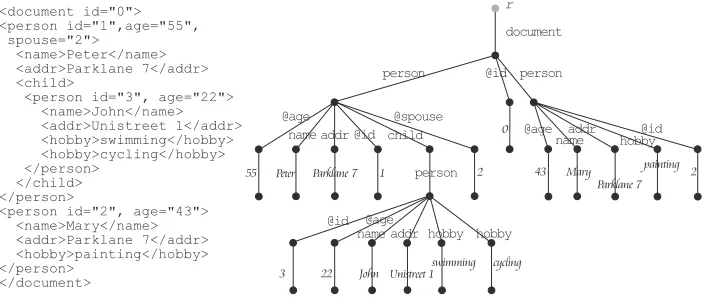
Figure 1: A fragment of an XML document and itsdtrepresentation.
Example 1. Figure 1 shows a fragment of an XML document and itsdt rep-resentation.
This data model closely mimics the XML data model as illustrated in the next example. We remark, however, the following differences:
• order: Siblings are not ordered. This is not crucial, as an ordering can be simulated by using a skewed binarydt.
• attributes: Attributes, like elements, are represented by edges labeled by the name of the attributes (started with a @). The difference is that in this data model an element may contain several attributes of the same name.
• labels: Labels represent not only tag names and attribute names, but also values and text.
2 DATA MODEL AND OPERATIONS 5
A label path is a string of the form l1/ . . . /lm with m≥ 0 and everyli an
edge label inL. Given a pathp= ((n1, l1, n2), . . . ,(nm, lm, nm+1)) in a graph G, thelabel path ofp, denoted ¯λT(p) (or ¯λ(p) whenT is subsumed) is the string l1/ . . . /lm.
Processes working on document trees do so in the context of a general pro-gramming language that includes an interface to a document server which man-ages transactions on documents. The process generates a list of operations that will access the document. In general there are three types of operations: the query, the addition and the deletion. The input to a query operation will be a node and a simple type of path expression, while the result of the invocation of a query operation will be a set of nodes. The programming language includes the concepts of sets, and has constructs to iterate over their entire contents. The input to an addition or a deletion will be an edge. The result of an addition or a deletion will be a simple transformation of the original tree into a new tree. If the result would not be a tree anymore it is not defined.
We now define the path expressions and the query operations, subsuming a givendtT.
The syntax of path expressions1is given byP:
P ::= peǫ| P+
P+ ::= F | P+/F | P+//F F ::= ∗ | L
The set L(pe) of label paths represented by a path expressionpeis defined as follows:
L(peǫ) = {ǫ}
L(∗) = L
L(l) = {l}
L(pe/f) = L(pe)· {/} ·L(f)
L(pe//f) = L(pe)· {/} ·(L · {/})∗·
L(f)
Letnbe an arbitrary node ofT andpea path expression. We now define the three kinds of operations: the query, the addition and the deletion.
Definition 2. The query operation query(n, pe) returns a set of nodes, and is defined as follows:
• query(n, pe)with n∈ N andpe∈ P. The result of a query on a dtT is defined asquery(n, pe)[T] ={n′ ∈N| ∃pa path inT from n ton′ with ¯λ(p)∈
L(pe)}.
The update operationsadd(n, l, n′)anddel(n, l, n′)return no value but
trans-form adtT = (N, E, r)into a new dtT′= (N′, E′, r):
1
2 DATA MODEL AND OPERATIONS 6
• add(n, l, n′)with n, n′∈ N andl∈ L. The resulting T′= add(n, l, n′)[T]
is defined byE′ =E∪ {(n, l, n′)} andN′=N∪ {n′}. If the resultingT′
is not a document tree anymore or (n, l, n′) was already in the document
tree then the operation is undefined.
• del(n, l, n′
) with n, n′ ∈ N
andl ∈ L. The resulting T′
= del(n, l, n′
)[T]
is defined byE′
=E− {(n, l, n′
)} andN′
=N− {n′}
. If the resultingT′
is not a document tree anymore or (n, l, n′)was not in the document tree
then the operation is undefined.
Note that the operations explicitly contain the nodes upon which they work. As we will explain in Section 4 this is justified by the fact that the scheduler decides at run time whether an operation is accepted or not.
We now give some straightforward definitions of schedules and their seman-tics.
Definition 3. Anactionis a pair (o, t), whereo is one of the three operations
query(n, pe), add(n, l, n′) and del(n, l, n′) and t is a transaction identifier. A
transaction is a sequence of actions with the same transaction identifier. A
scheduleover a set of transactions is an interleaving of these transactions. The sizenS of a scheduleS is the length of its straightforward encoding on a Turing tape2.
We can applya scheduleS on adtT. The result of such an application is
• for each query inS, the result of this query.
• thedtthat results from the sequential application of the actions ofS; this
dt is denoted byS[T]
If some of these actions are undefined the application is undefined. Two sched-ules are equivalent iff they are defined on the same non-empty set ofdts and on each of these dts both schedules have the same result. The definition of serial and serializable schedules is straightforward.
Since a transaction is a special case of a schedule all the definitions on schedules also apply on transactions.
Note that the equivalence of schedules and transactions is a document-independent definition. Let
T1= ({n1, n2},{(n1, l2, n2)}, n1),
T2= ({n1, n2},{(n1, l1, n2)}, n1),
T3= ({n1},∅, n1) be threedts and let
S1= (add(n2, l2, n3), t1),(query(n1, l1/l2), t2),
S2= (query(n1, l1/l2), t2),(add(n2, l2, n3), t1) be two schedules.
S1 andS2 are equivalent on T1, they are not equivalent onT2and their appli-cation is undefined onT3.
LetS3be the empty schedule and
2
3 CONSISTENCY OF QUERYLESS SCHEDULES 7
S4= (add(n1, l1, n2), t1),(del(n1, l1, n2), t2).
S3 andS4are not equivalent although they are equivalent on manydts. We will later on use the definition of equivalence to define serializability. In this paper we study view serializability, which is less restrictive than conflict serializability. We illustrate this claim by introducing informally a scheduling mechanism for generating conflict serializable schedules. A possible approach for this is to have a locking mechanism where operations can get locks, and in which a new operation of a certain process will only be allowed if it does not require locks that conflict with locks required by earlier operations. Because operations with non-conflicting locks can be commuted, any schedule that is allowed by such a scheduler can be serialized. The following example shows, however, that the reverse does not hold: Indeed, the next schedule
S= (add(r, l1, n1), t1), (del(r, l1, n1), t2), (add(r, l2, n2), t2), (del(r, l2, n2), t2), (add(r, l2, n2), t1), (del(r, l2, n2), t1).
is consistent since it is defined onT = ({r},∅, r). Furthermore it is serializ-able, and the equivalent serial schedules are
S1= (add(r, l1, n1), t1), (add(r, l2, n2), t1), (del(r, l2, n2), t1), (del(r, l1, n1), t2), (add(r, l2, n2), t2), (del(r, l2, n2), t2)
S2= (del(r, l1, n1), t2),(add(r, l2, n2), t2), (del(r, l2, n2), t2),(add(r, l1, n1), t1), (add(r, l2, n2), t1), (del(r, l2, n2), t1).
but we cannot go from S to S1 nor to S2 only by swapping with consistent intermediate schedules. This illustrated that an approach based on conflict serializability can be too strict.
3
Consistency of Queryless Schedules
A schedule is calledqueryless(QL) iff it contains no queries. Because of the way that operations can fail it is possible that the application of a certain transaction is not defined for any document tree. We are not interested in such transactions. We call a transactiontconsistentiff there is at least onedtT witht[T] defined.
Example 2. The next transaction is consistent:
(add(r, l1, n1), t1),(del(r, l1, n1), t1),(add(r, l2, n2), t1), (del(r, l2, n2), t1), (add(r, l2, n2), t1),(del(r, l2, n2), t1).
Note, however, that there are dts on which this transaction is undefined. For example, if T contains an edge (r, l3, n1), then t1[T] is undefined, since the
application of the first action oft1 is undefined.
The next transaction is inconsistent:
3 CONSISTENCY OF QUERYLESS SCHEDULES 8
We call a schedule S consistent iff there is at least one dt T with S[T] defined. Remark that there are consistent schedules that cannot be serializable because they contain an inconsistent transaction. For instance, the consistent scheduleS = (add(r, l1, n1), t1), (del(r, l1, n1), t2), (add(r, l1, n1), t1) is defined onT = ({r},∅, r), and hence is not serializable, because every equivalent serial QL schedule would be undefined (since the transaction t1 is not consistent). Transactiont1has the property that all QL schedules over a set of transactions that containt1 are non-serializable.
Note that the definition of consistent QL schedule is document-independent. It is clear that we are only interested in consistent transactions and schedules. Remark also that if two QL schedules are equivalent then they are both consis-tent. This equivalence relation is defined on the set of consistent QL schedules. We will characterize the consistent QL schedules and prove that this prop-erty is decidable. For this purpose we will first attempt to characterize for which document trees a given consistent QL scheduleS is defined, and what the prop-erties are of the document trees that result from a QL schedule. We do this by defining the sets Nmin
I (S), NImax(S), EImin(S) and EImax(S), whose informal
meaning is respectively the set of nodes that are required in the inputdts on whichS is defined, the set of nodes that are allowed, the set of edges that are required and the set of edges that are allowed. In the same way we define the setsNOmin(S),NOmax(S),EOmin(S) andEOmax(S) taking into account the output
dts.
Definition 4. Let S be a QL schedule. φS(n, o) (φS((m, l, n), o)) indicates that the first occurrence of the noden (the edge(m, l, n)) in the scheduleS has the form of the operator o. 3 λ
S(n, o) (λS((m, l, n), o)) indicates that the last occurrence of the noden(the edge(m, l, n)) in the QL scheduleShas the form of the operationo. We define the setsNmin
I (S),NImax(S),EImin(S)andEImax(S), and the setsNOmin(S),NOmax(S),EOmin(S)andEOmax(S)as in Figure 2. AdtT is called a basic input tree (basic output tree) ofS iff it contains all the nodes ofNmin
I (S)(NOmin(S)), only nodes ofNImax(S)(NOmax(S)), all the edges ofEmin
I (S)(EOmin(S)) and only edges ofEImax(S)(EOmax(S)).
ConsiderS= (add(n1, l1, n2), t1), (del(n4, l2, n3), t2), (del(n1, l1, n4), t3) then
Nmin
I (S) ={n1, n3, n4}
Nmax
I (S) =N − {n2}
Emin
I (S) ={(n4, l2, n3),(n1, l1, n4)}
Emax
I (S) =EImin(S) ∪ {(m, l, n)∈
N × L × N |m, n6=n2, n3, n4}
Nmin
O (S) ={n1, n2}
Nmax
O (S) =N − {n3, n4}
Emin
O (S) ={(n1, l1, n2)}
Emax
O (S) =EOmin(S) ∪ {(m, l, n)∈
N × L × N |m, n6=n2, n3, n4}
3
3 CONSISTENCY OF QUERYLESS SCHEDULES 9
Nmin
I (S) = {m|φS(m,add(m, l, n))} ∪ {m|φS(m,del(m, l, n))} ∪ {n|φS(n,del(m, l, n))} Nmax
I (S) =N − {n|φS(n,add(m, l, n))} Emin
I (S) = {(m, l, n)| φS((m, l, n),del(m, l, n))} Emax
I (S) =EImin(S) ∪ {(m, l, n)| no (m1, l1, m) nor (m1, l1, n) occurs inS}
Nmin
O (S) = {m|λS(m,del(m, l, n))} ∪ {m| λS(m,add(m, l, n))} ∪ {n|λS(n,add(m, l, n))} Nmax
O (S) =N − {n|λS(n,del(m, l, n))} Emin
O (S) = {(m, l, n)| λS((m, l, n),add(m, l, n))} Emax
O (S) =EOmin(S)∪ {(m, l, n)| no (m1, l1, m) nor (m1, l1, n) occurs in S}
Figure 2: The Definition of the basic input and output sets.
We will prove in Theorem 1 that the application of a consistent scheduleS
is defined on each basic input tree ofS. AlthoughNmax
I (S),EImax(S),NOmax(S) andEOmax(S) are in general infinite,
they can be represented in a finite way: Nmax
I (S) by{n|φS(n,add(m, l, n))}, Emax
I (S) byEImin(S)∪{n| there is a (m1, l1, n) that occurs inS},NOmax(S) by
{n|λS(n,del(m, l, n))},EmaxO (S) byEOmin(S)∪{n| there is a (m1, l1, n) that occurs inS}.
Lemma 1. LetSbe a schedule with sizenS. Nmin
I (S), NImax(S), EImin(S), EImax(S), Nmin
O (S), NOmax(S), EOmin(S)andEOmax(S)can be calculated inO(nS.log(nS)) -time and inO(nS)-space. For each of these sets and for any node or edge it is decidable in O(nS)-time and O(log(nS))-space whether the node or edge is in the set.
Proof. (Sketch) We can decide whether a node or an edge is in one of the basic input or output sets by examining the actions of the scheduleS.
When a QL schedule is inconsistent this is always because two operations in the QL schedule interfere, as for example the two operations in the inconsistent transaction of Example 2: (add(n1, l1, n), t1) and (add(n2, l2, n), t1). If these two operations immediately follow each other then at least one of them will always fail. However, if between them we find the action del(n1, l1, n) then this does no longer hold. The following definition attempts to identify such pairs of interfering operations and states which operations we should find between them to remove the interference.
Definition 5. A QL schedule fulfills theC-conditioniff
1. Ifadd(n, l1, n1)andadd(n2, l2, n)appear in that order inSthendel(n, l1, n1)
appears between them.
2. Ifadd(n1, l1, n)andadd(n2, l2, n)appear in that order inSthendel(n1, l1, n)
appears between them.
3. Ifadd(n, l1, n1)anddel(n2, l2, n)appear in that order inSthendel(n, l1, n1)
3 CONSISTENCY OF QUERYLESS SCHEDULES 10
4. Ifadd(n1, l1, n)anddel(n, l2, n2)appear in that order inSthenadd(n, l2, n2)
appears between them.
5. If add(n1, l1, n)anddel(n2, l2, n)appear in that order inS and(n1, l1)6= (n2, l2) thendel(n1, l1, n)appears between them.
6. If del(n, l1, n1) and add(n2, l2, n) appear in that order in S then some del(n3, l3, n)appears between them.
7. If del(n1, l1, n) and add(n, l2, n2) appear in that order in S then some add(n3, l3, n)appears between them.
8. If del(n1, l1, n) and del(n, l2, n2) appear in that order in S then some add(n3, l3, n)appears between them.
9. Ifdel(n1, l1, n)anddel(n2, l2, n)appear in that order inSthenadd(n2, l2, n)
appears between them.
The following theorem establishes the relationship between consistency, basic input trees and the C-condition.
Theorem 1. The following conditions are equivalent for a QL schedule S:
1. there is a basic input tree ofS and the application ofS is defined on each basic input tree ofS.
2. there is a basic input tree ofS on which the application of S is defined;
3. S is consistent;
4. S fulfills the C-condition;
5. there is a tree on which the application of S is defined and all trees on which the application ofS is defined are basic input trees of S.
Proof. (Sketch) Clearly 1 →2 → 3 →4 and 5→3. We prove that 4 implies 1. First we prove that there is a basic input tree for whichS is defined. Then we prove that the application ofS is defined on each basic input tree ofS by induction on the length ofS. Finally 3 implies 5. Indeed, letS be defined on
T, where T is not a basic input tree ofS. T does not satisfy one of the four conditions of Definition 4. In each case this yields a contradiction.
Corollary 1. It is decidable whether a QL schedule or a transaction is consis-tent inO(n3
S)-time andO(nS)-space.
Proof. (Sketch) This follows from the decidability of the C-condition and The-orem 1.
For the basic input and output sets we can derive the following property:
Property 1. If S is a consistent QL schedule thenEmin
4 EQUIVALENCE AND SERIALIZABILITY OF QL SCHEDULES 11
By ADD(S) we denote the set of edges that are added by the QL schedule
S, i.e., they are added without being removed again afterwards, and by DEL(S) we denote the set of edges that are deleted by the QL scheduleS, i.e., they are deleted without being added again afterwards.
Definition 6. Let S be a consistent QL schedule. We denote
ADD(S) ={(m, l, n)|λS((m, l, n),add(m, l, n))}
DEL(S) ={(m, l, n)|λS((m, l, n),del(m, l, n))}
We callADD(S)the addition set ofS andDEL(S)its deletion set.
Remark that two consistent QL schedules with the same ADD and DEL are not necessarily equivalent. IndeedS1= (del(n1, l1, n2), t2) andS2= (add(n1, l1, n2), t1), (del(n1, l1, n2), t2) are not equivalent although ADD(S1) = ADD(S2) and DEL(S1) = DEL(S2).
Lemma 2. LetS be a consistent QL schedule and T be a basic input tree of S. S[T] =T∪ADD(S)−DEL(S)is a basic output tree4.
Proof. (Sketch) ClearlyT∪ADD(S)−DEL(S) is the result of the application ofS onT. We verify that T∪ADD(S)−DEL(S) is a basic output tree.
The following lemma establishes the relationships between the addition and deletion sets, and the basic input and output sets.
Lemma 3. Let S be a consistent QL schedule. Nmin
O =(NImin− {n | ∃(m, l, n)∈DEL(S)})∪
{n| ∃(m, l, n)∈ADD(S)}
Nmax
O =(NImax− {n| ∃(m, l, n)∈DEL(S)})∪
{n| ∃(m, l, n)∈ADD(S)}
Emin
O = (EImin−DEL(S))∪ADD(S) Emax
O = (EImax−DEL(S))∪ADD(S) Proof. (Sketch) Results from Lemma 2.
4
Equivalence and Serializability of QL
Sched-ules
The purpose of a scheduler is to interleave requests by processes such that the resulting schedule is serializable. This can be done by deciding for each request whether the schedule extended with the requested operation is still serializable, without looking at the instance. In this section we discuss the problem of deciding whether two consistent QL schedules are equivalent, and whether a consistent QL schedule is serializable.
To begin with, it can be shown that the application two QL schedules over the same set of transactions on the same dt T result in the same dt, if they are both defined.
4
4 EQUIVALENCE AND SERIALIZABILITY OF QL SCHEDULES 12
Lemma 4. LetS andS′ be two QL schedules over the same set of transactions.
S[T] =S′[T]if S[T]andS′[T]are both defined.
Proof. (Sketch) Considering a given edge, this edge is alternatively added and deleted in each of the applications. Since the two QL schedules are over the same set of transactions, the edge belongs to no result or to both results
As a consequence the problem of deciding whether two consistent schedules over two given transactions are equivalent reduces to the problem of deciding whether their result is defined for the samedts, which can be decided with the help of the basic input and output sets.
Theorem 2. Two consistent QL schedules S1,S2 over the same set of
trans-actions are equivalent iff they have the same set of basic input trees, ie. iff Nmin
I (S1) = NImin(S2), NImax(S1) = NImax(S2), EImin(S1) = EImin(S2) and Emax
I (S1) =EImax(S2). Hence their equivalence is decidable in O(nS.log(nS)) -time andO(nS)-space.
Proof. From Lemma 1 and Lemma 4.
Note that this theorem does not hold for two arbitrary QL schedules. Indeed
S1 = (add(m, l, n), t) andS2 = (add(m, l, n), t),(del(m, l, n), t) have the same basic input trees and are not equivalent.
We can use the basic input and output sets to decide whether one consistent schedule can directly follow another consistent schedule without resulting in an inconsistent schedule.
Lemma 5. LetS1andS2 be two consistent QL schedules. LetnS be the size of S1.S2. S1.S2 is consistent iff NImin(S2)⊆NOmax(S1), EImin(S2) ⊆EOmax(S1), Nmin
O (S1) ⊆ NImax(S2), EOmin(S1) ⊆ EImax(S2). The consistency of S1.S2 is
decidable inO(nS.log(nS))-time and O(nS)-space.
Proof. (Sketch) A result of the C-conditions, Lemma 1 and Theorem 1.
The following lemma shows how the basic input and output sets can be com-puted for a concatenation of schedules if we know these sets for the concatenated schedules.
Lemma 6. LetS1, S2, ..., Sn andS1.S2...Snbe(n+ 1)consistent QL schedules. Then
Nmin
I (S1...Sn) =Sni=1(NImin(Si)∩Tk<iNImax(Sk)) Nmax
I (S1...Sn) =Tni=1(NImax(Si)∪Sk<iNImin(Sk)) Emin
I (S1...Sn) =Sni=1(EImin(Si)∩Tk<iEmaxI (Sk)) Emax
I (S1...Sn) =Tni=1(EImax(Si)∪Sk<iEImin(Sk))
IfnS is the size of S1.S2...Sn then these equalities can be verified inO(n3S) -time andO(nS)-space.
5 EQUIVALENCE AND SERIALIZABILITY OF SCHEDULES 13
Finally, the previous theorems can be used to show that serializability is decidable.
Theorem 3. Given a QL scheduleSofnttransactions. It is decidable whether S is serializable inO(nnt
t .n3S)-time, and inO(n2S)-space.
Proof. (Sketch) Indeed,
1. we verify whether each transaction is consistent, which is done inO(n3
S.nt
)-time and inO(nS)-space (Corollary 1);
2. we draw a graph that indicates which transactions can follow directly which other transactions (i.e. Ti.Tjis defined), which is done inO(n2t.nS.log(nS
))-time and inO(n2
t+nS)-space (Lemma 5);
3. S is serializable iff there is a Hamilton path that is equivalent withS; to verify this:
(a) we calculate the orderedNmin
I , NImax,EImin andEImax of the
trans-actions, which is done inO(nt.nS.log(nS))-time andO(nt.nS)-space
(Lemma 1); (b) there areO(nnt
t ) Hamilton paths, for each of them:
i. we verify its consistency, which is done inO(n3
S)-time andO(nS
)-space (Corollary 1);
ii. we calculate the orderedNmin
I , NImax, EImin and EImax of the
Hamilton path, which is done inO(nS.log(nS))-time andO(nS
)-space (Lemma 1);
iii. Lemma 6 and Theorem 2 are verified in O(n3
S)-time and in O(nS)-space.
5
Equivalence and Serializability of Schedules
In the previous section we only considered QL schedules, but in this section we consider all schedules. We start with generalizing the notions that were introduced for QL schedules.
Definition 7. A schedule S is called consistent iff its corresponding QL sched-ule S′
is consistent. ADD(S) = ADD(S′
) where S′
is the QL schedule of S. Analogously forDEL,Emin
I ,EImax,EOmin,EOmax,NImin,NImax,NOmin,NOmax.
5 EQUIVALENCE AND SERIALIZABILITY OF SCHEDULES 14
Example 3. Letl16=l3. Consider the following schedules:
S1= (add(n2, l2, n3), t1),(query(n1, l1/l2), t2), (del(n2, l2, n3), t1),(del(n1, l3, n2), t1)
S2= (query(n1, l1/l2), t2), (add(n2, l2, n3), t1), (del(n2, l2, n3), t1),(del(n1, l3, n2), t1)
S1 andS2are correct and their corresponding QL schedules are equal. They
are equivalent on alldts on which they are defined, hence they are equivalent. Consider the following schedulesS3 andS4:
S3= (add(n2, l2, n3), t1),(query(n1, l1/l2), t2), (del(n2, l2, n3), t1)
S4= (query(n1, l1/l2), t2), (add(n2, l2, n3), t1), (del(n2, l2, n3), t1)
S3 andS4are consistent and their corresponding QL schedules are equal. They
are equivalent on some dts on which they are defined and not equivalent on others.
Finally, letS5 andS6 be the following schedules:
S5= (add(n2, l2, n3), t1),(query(n1, l1/l2), t2), (del(n2, l2, n3), t1),(del(n1, l1, n2), t1)
S6= (query(n1, l1/l2), t2), (add(n2, l2, n3), t1), (del(n2, l2, n3), t1),(del(n1, l1, n2), t1)
S5 andS6are consistent and their corresponding QL schedules are equal. They
are, however, equivalent on nodton which they are defined.
In order to prove the decidability of the equivalence of two schedules over the same set of transactions we first define the notion of SOP, Set Of Prefixes in Subsection 5.1, and some additional notation in Subsection 5.2.
5.1
SOP
- Set Of Prefixes
Informally, the notion “Set Of Prefixes” (SOP) of a path expression pe for a label pathlp, will allow us to find a set of path expressionspe′, such that all
path expressionspe′/lptogether represent exactly these label paths of pethat
end on lp. For example, consider the path expressionpe=b//∗ and the label path lp =a. Then b/a and b//∗/a represent the label paths of pe that end with label patha. Hencebandb//∗area-prefixes ofb//∗.
We will now define the set of non-emptylp-prefixes inpe, denoted as SOP(pe)lp
as a set of path expressions that together represent the set of label pathspe′
such thatpe′/lp∈L(pe)5. For instance SOP(b//∗)
a={b, b//∗}.
Definition 8. Let pebe a path expression, lp be a label path and l ∈ L. The set of non-emptylp-prefixes inpe, denoted asSOP(pe)lp is defined by
5
5 EQUIVALENCE AND SERIALIZABILITY OF SCHEDULES 15
SOP(pe)ǫ ={pe}
SOP(pe/∗)l = SOP(pe/l)l = {pe}
SOP(pe//∗)l = SOP(pe//l)l={pe, pe//∗}
SOP(pe/∗)lp/l = SOP(pe/l)lp/l= SOP(pe)lp
SOP(pe//∗)lp/l = SOP(pe//l)lp/l
=SOP(pe)lp∪SOP(pe//∗)lp OtherwiseSOP(pe)lp =∅.
Furthermore we define L(SOP(pe)lp) =Spei∈SOP(pe)lpL(pei).
Lemma 7. L(SOP(pe)lp) ={lp′ | lp′/lp∈L(pe)}.
Example 4.
• SOP(a/∗/∗/b)a/b= SOP(a/∗/∗)a ={a/∗}
• SOP(a//∗/c)a/b/c= SOP(a//∗)a/b= SOP(a)a∪SOP(a//∗)a ={a, a//∗}
• SOP(∗//∗)a/b/c= SOP(∗)a/b∪SOP(∗//∗)a/b=∅∪SOP(∗)a∪SOP(∗//∗)a=
∅ ∪ ∅ ∪ {∗,∗//∗}={∗,∗//∗}
• SOP(a//b//d)b/c/d={a, a//∗, a//b, a//b//∗}
Lemma 8. Let pe be a path expression and lp be a label path. SOP(pe)lp =
{pe′ | pe′ a prefix of peand L(pe′/lp)⊆L(pe)} ∪ {pe′//∗ | pe′ a prefix of pe
andL(pe′//∗/lp)⊆L(pe)}.
Lemma 9. Let pe be a path expression of length npe and lp be a label path.
SOP(pe)lp is uniquely defined, finite and is computable in O(npe2 .(npe+nlp)) -time andO(log(npe+nlp))-space.
Proof. From Lemma 8 we know that we have to calculate the two sets:{pe′|pe′
a prefix of pe and L(pe′
/lp) ⊆ L(pe)} and {pe′
//∗ | pe′
a prefix of pe and
L(pe′
//∗/lp) ⊆ L(pe)}. Hence SOP(pe)lp can be calculated in O(n4pe)-time
[18], and inO(n2pe)-space.
Lemma 10. Let pe be a path expression and lp1 and lp2 be two label paths.
L(SOP(pe)lp1)⊆L(SOP(pe)lp2)iff ∀pei∈SOP(pe)lp1(L(pei/lp2)⊆L(pe)).
Proof. From Definition 8 and Lemma 7.
Theorem 4. Let pe be a path expression and lp1 and lp2 be two label paths.
It is decidable inO(n2
pe.(npe+nlp))-time and in O(npe+log(npe+nlp))-space whetherL(SOP(pe)lp1) =L(SOP(pe)lp2).
5 EQUIVALENCE AND SERIALIZABILITY OF SCHEDULES 16
5.2
PQRN
- Potential Query Result Nodes
The main concept that is introduced in this subsection is the set of Potential Query Result Nodes (PQRN) for a query Q in a schedule S. This set will contain all nodesn, that are added or deleted inS, and for which there exists a document treeT, such thatnis in the result of the queryQwhenS is applied to T. 6. For this puprose, we need to introduce some additional notations to characterize the trees on which a queryQin a scheduleS will be executed. We will use these notations later on, and we also give some complexity results for calculating the value of these concepts.
LetS be a consistent schedule that contains the queryQ= query(n, pe).
• We denote by SQ the actions of S that occur before Q; SQ is called a subschedule ofS;
• Let T be a basic input tree of S. We define TQ = SQ[T] as the dt on
whichQinS is evaluated; hence the result of the application of the query
QinS isQ[TQ];
• We denote by Emin(SQ) as the set that contains exactly those edges
that are required in TQ; This set is equal to (Emin
I (S)−DEL(SQ))∪
ADD(SQ) (Lemma 3);
• We denote byEmax(SQ) as the set that contains exactly those edges that
are allowedinTQ; This set is equal to (Emax
I (S)−DEL(SQ))∪ADD(SQ)
(Lemma 3).
Emin(SQ) is a forest (Property 1). As such every nodemofEmin(SQ) has a
unique ancestor without a parent inEmin(SQ); it is denoted byARoot(SQ, m).
The label of the path from ARoot(SQ, m) to m in Emin(SQ) is denoted by ALabel(SQ, m).
Lemma 11. Alabel(SQ, m)andARoot(SQ, m)can be computed inO(n2
S)-time andO(nS)-space.
Proof. A consequence of Lemma 1.
If add(m, l, n) or del(m, l, n) are operations of S we say that n is a non-building-nodeofS. Otherwisenis called abuilding-nodeofS. Note that
Emax(SQ) =Emin(SQ)∪ {edges that contain only building nodes}since Emin(SQ) = (Emin
I (S)−DEL(SQ))∪ADD(SQ), Emax(SQ) = (EImax(S)−DEL(SQ))∪ADD(SQ) and Emax
I (S) =EImin(S)∪ {edges that contain only building nodes}.
We will now define the set of nodes PQRN(S, Q). This set will contain all non-building-nodes that can be in the result of a query that starts with a node
nthat is not in Emin(SQ). After the formal definition we will show that this
definition corresponds to this informal description. Finally we will show that this set is computable in polynomial time and space.
6
5 EQUIVALENCE AND SERIALIZABILITY OF SCHEDULES 17
Definition 9.LetSbe a consistent schedule that contains a queryQ= query(n, pe). We define the set PQRN(S, Q)as:
PQRN(S, Q) ={m|
• m a node in the graphEmin(SQ);
• m a non-building-node;
• ARoot(SQ, m) a building-node;
• ARoot(SQ, m)6=n;
• L(SOP(pe)ALabel(SQ,m))6=∅
}.
Lemma 12. Let S be a consistent schedule, Q= query(n, pe)a query that ap-pears inS, andna node that is not in the graphEmin(SQ). ThenPQRN(S, Q) is the set of non-building-nodesm, such that there exists a basic input treeT of S for which mis in the result of the queryQon the document tree SQ[T].
Lemma 13. PQRN(S, Q) can be computed inO(n5
S)-time and O(nS)-space.
Proof. From Theorem 4 and Lemma 11.
5.3
Decidability of Equivalence
We will now establish the main result of this paper by proving that the equiva-lence of two schedules is decidable in our framework.
Lemma 14. Given two consistent schedules S1 and S2 over the same set of
transactions and whose QL schedules are equivalent. Let Q= query(n, pe) be a query in these schedules and let na be the total number of actions in S1 and
S2. It is decidable in O(n6S)-time and O(nS)-space whether Q gives the same answer in S1 as inS2 for every possible basic input tree of S1 andS2.
Proof. The next conditionCN D(S1, S2, Q) detects whenQgives the same an-swer inS1 as inS2for every possible basic input tree ofS1 andS2 :
Definition ofCN D(S1, S2, Q)
1. {m| there is a path of L(pe) fromn tom inEmin(SQ
1 )} ={m| there is a path ofL(pe) fromntominEmin(SQ
2)}; this can be done inO(n3S)
time; this is a consequence of a result in [18]
2. furthermore, ifnis a building-node of Si:
(a) P QRN(S1, Q) =P QRN(S2, Q)
(b) for the nodesm∈P QRN(S1, Q) hold that
i. ARoot(S1Q, m) =ARoot(S2Q, m) ii. L(SOP(pe)ALabel(SQ
1,m)) =
6 CONCLUSION AND FUTURE WORK 18
All this can be computed inO(n6
S)-time and inO(nS)-space.
The definition of theCN Dcondition is illustrated in the following example.
Example 5. In Example 3 we have
• Emin(SQ
1) = {(n1, l3, n2),(n2, l2, n3)} and Emin(SQ2) = {(n1, l3, n2)}; 1.
is fulfilled;n1is a building-node;n2andn3are non-building-nodes;PQRN(S1, Q) = PQRN(S2, Q) =∅; henceCN D(S1, S2, Q)is fulfilled andQgives the same
answer in S1 as in S2 for every possible basic input tree ofS1 andS2.
• Emin(SQ
3) = {(n2, l2, n3)} and Emin(S4Q) = ∅; 1. is fulfilled; n2 is a
building-node;n3is a non-building-node;PQRN(S3, Q) ={n3}andPQRN(S4, Q) =
∅; hence2.(a)is not fulfilled and Q does not give the same answer inS3
as inS4 for every possible basic input tree ofS3 and S4.
• Emin(SQ
5) ={(n1, l1, n2),(n2, l2, n3)}andEmin(S6Q) ={(n1, l1, n2)}; hence
S5 andS6 are not equivalent, since1.is not fulfilled andQ does not give
the same answer in S5 as in S6 for every possible basic input tree ofS5
andS6.
Theorem 5. Given two consistent schedules S1 and S2 over the same set of
transactions and whose QL schedules are equivalent. It is decidable in O(n6S) -time andO(nS)-space whether they are equivalent.
Proof. Consequence of Lemma 14.
Finally, we can now combine the previous theorems to show that serializ-ability is decidable in our framework.
Theorem 6. Given a consistent schedule S. It is decidable in O(nnt
t .n6S)-time andO(n2
S)-space whether S is serializable.
Proof. From Theorem 3 and Theorem 5.
6
Conclusion and Future Work
REFERENCES 19
in the size of the schedule and exponential in the number of transactions. Im-proving this complexity result is expected to be difficult, since it is generally known that deciding view serializability isN P-complete [21].
In future work, we will extend the results of this paper by defining the behaviour of currently undefined actions, and hence allowing more schedules to be serialized. For example, the addition of an edge which is already in the input tree is undefined in our current work, and hence the operation fails. However, we could also say that as a result of this addition, we obtain an output tree which is equal to the input tree, and a message which indicates that the edge was already present. In this approach the result of a schedule applied on a document tree would be an annotated version of the schedule and an output document tree. A schedule would then be serializable iff there exists a serial schedule with the same operations, which has, for each document, the same output document tree and the same message for each operation.
References
[1] S. Abiteboul, P. Buneman, and D. Suciu.Data on the Web: From Relations to Semistructured Data and XML. Morgan-Kaufmann, San Francisco, 1999.
[2] P. Bernstein, V. Hadzilacos, and N. Goodman. Concurrency Control and Recovery in Database Systems. Addison Wesley, Reading, Mass., 1987.
[3] P. A. Bernstein and N. Goodman. A sophisticate’s introduction to dis-tributed concurrency control (invited paper). InEigth International Con-ference on Very Large Data Bases, September 8-10, 1982, Mexico City, Mexico, Proceedings, pages 62–76. Morgan Kaufmann, 1982.
[4] E.-H. Choi and T. Kanai. XPath-based concurrency control for XML data. In Proceedings of the 14th Data Engineering Workshop (DEWS 2003), Kaga city, Ishikawa, Japan, March 3-5 2003. Available at: http://www.ieice.org/iss/de/DEWS/proc/2003/papers/6-C/6-C-04.pdf.
[5] S. Dekeyser and J. Hidders. Path locks for XML document collaboration. In T. W. Ling, U. Dayal, E. Bertino, W. K. Ng, and A. Goh, editors, Pro-ceedings of the 3rd International Conference on Web Information Systems Engineering (WISE 2002), pages 105–114. IEEE Computer Society, 2002.
[6] S. Dekeyser and J. Hidders. A commit scheduler for XML databases. In
Proceedings of the Fifth Asia Pacific Web Conference, Xi’an, China, 2003.
REFERENCES 20
[8] S. Dekeyser, J. Hidders, and J. Paredaens. Instance indepedent concurrency control for semistructured databases. InProceedings of the Eleventh Italian Symp. on Advanced Database Systems (SEBD 2003), pages 323–334, 2003.
[9] S. Dekeyser, J. Hidders, and J. Paredaens. A transaction model for XML databases. World Wide Web Journal (to appear), 2003.
[10] T. Grabs, K. B¨ohm, and H.-J. Schek. XMLTM: efficient transaction management for XML documents. In Proceedings of the 2002 ACM CIKM International Conference on Information and Knowledge Manage-ment (CIKM 2002), pages 142–152, McLean, VA, USA, November 4-9 2002. ACM.
[11] J. Gray, G. Putzolo, and I. Traiger. Modeling in Data Base Management Systems, chapter Granularity of locks and degrees of consistency in a shared data base. North Holland, Amsterdam, 1976.
[12] M. P. Haustein and T. H¨arder. Adjustable transaction isolation in xml database management systems. In Z. Bellahsene, T. Milo, M. Rys, D. Suciu, and R. Unland, editors,XSym, volume 3186 ofLecture Notes in Computer Science, pages 173–188. Springer, 2004.
[13] M. P. Haustein and T. H¨arder. A lock manager for collaborative processing of natively stored xml documents. In S. Lifschitz, editor,SBBD, pages 230– 244. UnB, 2004.
[14] S. Helmer, C.-C. Kanne, and G. Moerkotte. Lock-based pro-tocols for cooporation on XML documents. Technical Report 06/2003, University of Mannheim, Germany, 2003. Available at: http://pi3.informatik.uni-mannheim.de/publications/TR-03-006.ps.
[15] S. Helmer, C.-C. Kanne, and G. Moerkotte. Evaluating lock-based proto-cols for cooperation on xml documents. SIGMOD Rec., 33(1):58–63, 2004.
[16] J. Hidders, J. Paredaens, and R. Vercammen. Proof of se-rializability for semistructured databases. Technical Report UA 2004-01, University of Antwerp, 2004. Available at: http://www.adrem.ua.ac.be/pub/TR2004-01.pdf.
[17] K.-F. Jea, S.-Y. Chen, and S.-H. Wang. Concurrency control in XML document databases: XPath locking protocol. In Proceedings of the 9th International Conference on Parallel and Distributed Systems (ICPADS 2002), pages 551–556. IEEE, December 17-20 2002.
[18] G. Miklau and D. Suciu. Containment and equivalence for an xpath frag-ment. In L. Popa, editor, PODS, pages 65–76. ACM, 2002.
REFERENCES 21
[20] A. Silberschatz and Z. Kedem. Consistency in hierarchical database sys-tems. Journal of the ACM, 27(1):72–80, 1980.