Multiphysics Computational Modelling of High-Speed
Partially-Rarefied Flows
by Simone Colonia
Supervisors: Rene Steijl Geroge Barakos
School of Engineering - University of Liverpool
Abstract
Hypersonic flows of practical importance often involve flow fields having continuum and rarefied
re-gions. It is well known that Boltzmann equation based methods can provide more physically accurate
results in flows having rarefied and non-equilibrium regions than continuum flow models. However, these
methods are extremely computational expensive in near-equilibrium regions, which prohibits their
appli-cation to practical problems with complex geometries and large domains where continuum and rarefied
regions coexist. On the other hand, Navier-Stokes (or Euler) based methods are computationally efficient
in simulating a wide variety of flow problems, but the use of continuum theories for the flow problems
involving rarefied gas or very small length scales produces inaccurate results due to the breakdown of
the continuum assumption and occurrence of strong thermal non-equilibrium. A practical approach for
solving flow fields having continuum to rarefied regions is to develop numerical methods combining
ap-proaches able to compute the continuum regime and/or the rarefied (or thermal non-equilibrium) regime.
The aim of this thesis is to investigate and develop new methods for the calculation of hypersonic flow
fields that contain both continuum and rarefied flow regions.
The first part of the work is dedicated to the continuum regime. Among the different numerical
invis-cid flux functions available in the literature, the AUSM-family has been shown to be capable of solving to
a good accuracy flow fields at a wide range of Mach regime including high-speed flows. For this reason an
implicit formulation of the AUSM+ and AUSM+upschemes, with a Jacobian defined fully analytically, has been implemented in the Helicopter Multi-Block CFD code (HMB2), developed at the University of
Liverpool, to predict continuum high-speed flow. The original form of the schemes lead to the presence
of different branches in the computational algorithm for the Jacobian since do not guarantee the fluxes
AUSM+ and AUSM+up schemes is proposed in chapter 2. Here, a blending is introduced by means of parametric sigmoidal functions at the points of discontinuity in the schemes formulations. Predictions
for wide range of test cases obtained employing the proposed formulation are compared with results
available in the literature in chapter 3 to show that the reliability of the schemes has been preserved in
the proposed formulation.
Later on, the work focuses on partially-rarefied high-speed flows. At the University of Liverpool, this
kind of flows are simulated using the hybrid approach available in the Multi-Physics Code (MΦC) where
a discrete velocity method for kinetic Boltzmann equations is coupled with a traditional Navier-Stokes
solver. Firstly, the discrete velocity method has been improved with the implementation of kinetic
mod-els for diatomic gases in the framework. A validation of the correctness of the implemented modmod-els is
discussed in chapter 6. However, employing a discrete velocity method in hybrid simulation leads to high
computational and memory cost. In this context, gas-kinetic schemes have been identified by the author,
in the related literature, as efficient approaches, relative to discrete velocity methods, capable of
mod-elling complex gas flows with moderate rarefaction effects but with significant thermal non-equilibrium.
Thus, two gas-kinetic schemes, analytically defined on the basis of the Chapman-Enskog expansion of
non-dimensional Shakhov and Rykov models, have been proposed in chapter 5. Compared with similar
gas-kinetic schemes available in the literature, the presented schemes differ in the approach employed to
evaluate the terms of Chapman-Enskog solutions and in the kinetic models used as mathematical
foun-dations of the schemes. In chapters 6 and 7 the scheme is tested for various cases and Mach numbers,
including complex 3D flows, proving to be a viable way to improve the performance of hybrid simulations,
maintaining an acceptable level of reliability, if used in place of more complex methods for weakly rarefied
Contents
Abstract i
Contents vi
List of Figures x
Acknowledgement xi
Publications xii
Nomenclature xiv
Subscripts and Superscripts xvi
Acronyms xvii
1 Introduction 1
1.1 Motivation . . . 1
1.2 Literature Survey About Methods for Partially-Rarefied Flow . . . 6
1.2.1 Hybrid Methods . . . 7
1.2.2 Gas-Kinetic Schemes, the BGK-NS Method and the Unified Gas-Kinetic Scheme . 10
1.3 Aim of the Thesis . . . 13
1.4 Thesis Overview . . . 14
2 Continuum Flows Solver - HMB2 17
2.2 Conservation Laws . . . 21
2.3 Turbulence modelling . . . 23
2.4 Fully Implicit Formulation for a Steady Case . . . 24
2.5 Variable extrapolation - MUSCL . . . 25
2.6 A Jacobian Matrix for the AUSM+ Scheme . . . 26
2.6.1 Derivatives of the Interface Speed of Sound . . . 28
2.6.2 Derivatives of the Interface Mach Number . . . 30
2.6.3 Derivatives of the Interface Pressure Formula . . . 31
2.7 Extension to the AUSM+up Scheme . . . 33
2.7.1 Derivatives of the interface Mach number with the pressure diffusion term . . . 33
2.7.2 Derivatives of the Scaling Factor fa . . . 33
2.7.3 Derivatives of the Interface Pressure Formula with the Velocity Diffusion Term . . 34
3 Continuum Flows Results and Discussion - HMB2 35 3.1 High-Mach Regime: AUSM+ Scheme . . . 36
3.1.1 Performance and accuracy of the implicit implementation . . . 36
3.1.2 Shock-wave / turbulent boundary-layer interactions . . . 43
3.1.3 Orion CEV aerodynamic testing . . . 45
3.2 Transonic Regime: AUSM+up Scheme . . . 49
3.3 Low-Mach Regime: AUSM+up Scheme . . . 53
3.4 Conclusions . . . 57
4 Rarefied and Hybrid Flow Solvers - MΦC 58 4.1 Introduction . . . 58
4.2 Boltzmann Equation . . . 60
4.3 Non-dimensional Shakhov Model . . . 61
4.4 Non-dimensional Rykov Model . . . 63
4.6 Discrete Velocity Method for Kinetic Boltzmann Equations in MΦC . . . 69
4.6.1 Diffuse Wall Boundary Conditions . . . 72
5 Analytical Definition of Gas-Kinetic Schemes for Slightly Rarefied Flows 73 5.1 The BGK-NS Method and the Unified Gas-Kinetic Scheme . . . 75
5.2 Gas-Kinetic Scheme for Near-Continuum Flows based on the Shakhov Model: S-GKS . . 79
5.3 Gas-Kinetic Scheme for Near-Continuum Flows based on the Rykov Model: R-GKS . . . 83
6 Partially-Rarefied High-Speed Flows Results and Discussion - MΦC 88 6.1 Discrete Velocity Method - Assessment of the Rykov Model Implementation . . . 90
6.2 Assessment of the Analytical Gas-Kinetic Schemes . . . 93
6.3 Computational and memory cost . . . 112
6.4 Conclusions . . . 116
7 Complex Three-Dimensional Cases for the GKS: Waveriders 117 7.1 Introduction . . . 117
7.2 Results . . . 120
7.3 Conclusions . . . 124
8 Conclusions and Future Works 125 8.1 Summary of Findings . . . 125
8.2 Future Works . . . 128
A Dimensionless Temperature in HMB2 130 B L2-Norm of the Residual 131 C Modified AUSM+ and AUSM+up Schemes and Relative Jacobians 132 C.1 Modified AUSM+ and AUSM+up Schemes . . . 132
C.1.1 AUSM+ . . . 132
C.2 Jacobian Matrix . . . 134
C.2.1 Modified AUSM+. . . 134
C.2.2 Modified AUSM+up . . . 136
D Non-dimensional ES Model with Rotational Degrees of Freedom 137
E Moments of the Rykov Model Collision Term 139
F Collision Numbers 140
G The Chapman-Enskog Solution of the Shakhov Model 141
H The Chapman-Enskog Solution of the Rykov Model 144
I The S-GKS as a Limit of the S-UGKS for a Well-resolved Flow 148
J The R-GKS as a Limit of a UGKS based on the Rykov Model for a Well-resolved
Flow 150
K Laplacian Smoothing 153
L L2-Norm Between to Consecutive Solutions 154
List of Figures
1.1 The Knudsen number limits on the mathematical models. . . 3
1.2 Knudsen number as a function of the altitude for the Orion and Apollo re-entry vehicles, from [1]. . . 4
1.3 Coupling techniques, adapted from [2]. . . 9
2.1 Sigmoidal function examples for different values ofK. . . 27
2.2 Split Mach number functions and derivatives. . . 31
2.3 Split pressure functions and derivatives. . . 32
3.1 Infinite cylinder (R = 1) . . . 38
3.2 Orion CEV . . . 39
3.3 Infinite cylinder, Euler grid, AUSM+,M = 3. . . 40
3.4 Inviscid flow around a 15◦ cone with blunt nose (R= 0.01L) at M = 5. . . 41
3.5 15◦ cone with blunt nose (R= 0.01L) . . . 42
3.6 SST, AUSM+ with entropy satisfying a1/2,M = 2.84,Re= 6.5×10⁷m−1. . . 43
3.7 SST, AUSM+ with entropy satisfying a1/2,M = 2.84,Re= 6.5×10⁷m−1. . . 44
3.8 Orion CEV sketch with angle of attack definition, from [3]. . . 45
3.9 Orion CEVCL andCD: SST, AUSM+,M = 3, ReD = 1.5×10⁶. . . 46
3.10 Orion CEV StRe1D/2: laminar flow, AUSM+ with entropy satisfyinga1/2. . . 47
3.11 Orion CEV Mach Contours. . . 48
3.12 Convergence history: RAE2822 aerofoil , M = 0.73,α =−2.31◦ and Re= 6.5×10⁶. . . . 50
3.14 ONERA M6 wing −Cp profiles at two different sections along the span, M = 0.84, angle
of attack 3.06◦. . . 51 3.15 ONERA M6 wing upper surface Mach lines and contours, M = 0.84, angle of attack 3.06◦. 52 3.16 Parked position and pitch angle definition . . . 54
3.17 S809 aerofoil −Cp profiles,α=−2.1◦ and Re= 1×10⁶. . . 54
3.18 S809 aerofoil Residual vs Iteration,α=−2.1◦ and Re= 1×10⁶. . . 55 3.19 Parked MEXICO blade−Cp profiles at two different sections along the blade,M = 0.029,
pitch angle 81◦ and Re= 4.93×10⁵. . . 56
4.1 State-based coupling techniques, adapted from [2, 1]. . . 68
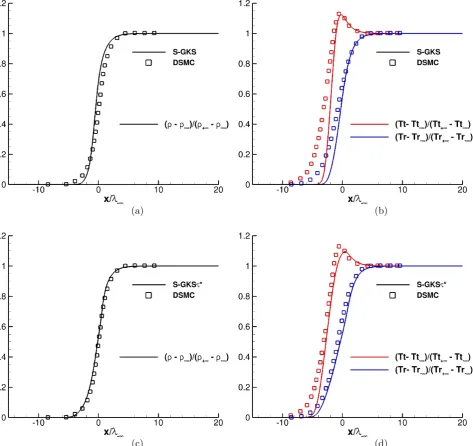
6.1 Non-dimensionalρ,Tr andTt normalised profiles for M = 7 normal shock in Nitrogen,Zr
eq. (4.12) andµeq. (4.17). DVM physical space cell’s size equal to 0.25λ−∞. Comparison between DVM results form present work and [4]. . . 91
6.2 Non-dimensional ρ, Tr and Tt normalised profiles for M = 2.8 normal shock in Nitrogen,
constantZr = 4.2 (i.e. Zr = 2.52 for the Rykov model) andµ eq. (4.18). DVM physical
space cell’s size equal to 0.25λ−∞. DSMC results from [5]. . . 91 6.3 DVM results for Nitrogen flow over a 2D flat plate: M = 4.89, Re = 422, Kn = 0.024 and
xref = 5cm. DSMC and experimental results from[6]. . . 92
6.4 Non-dimensionalρ,Tr and Tt profiles for M = 2.8 normal shock in Nitrogen, constantZr
and µeq. (4.18). GKS physical space cell’s size equal to 0.125÷0.5λ−∞. . . 94 6.5 Non-dimensionalT contours for M = 5 monoatomic gas flow over an infinite cylinder with
Kn = 0.0025, based on the diameter, and adiabatic inviscid wall boundary condition.
Comparison between GKS and AUSM+ results from present work. . . 94 6.6 Non-dimensionalρandT normalised profiles for normal shocks in Argon at different Mach
6.7 Non-dimensionalρ,Tr and Tt normalised profiles for M = 2.8 normal shocks in Nitrogen,
constantZr = 4.2 (i.e. Zr = 2.52 for the Rykov model) and µeq. (4.18). GKS physical
space cell’s size equal to 0.25λ−∞. DSMC results from [5]. . . 96 6.8 Non-dimensionalρ,Tr and Tt normalised profiles for M = 10 normal shocks in Nitrogen,
constantZr = 5 (i.e. Zr = 3 for the Rykov model) and µeq. (4.18). GKS physical space
cell’s size equal to 0.25λ−∞. DSMC results from [5]. . . 97 6.9 Computational grids for two-dimensional flat plate, wedge and cylinder test cases. In (a),
(b) and (c) different colors represent different blocks; in (d) the part of the domain solved
employing the GKS is defined in red while the DVM region in blue. . . 98
6.10 R-GKS results for Nitrogen flow over a 2D flat plate: M = 4.89, Re = 422, Kn = 0.024
and xref = 5cm. Zr eq. (4.12) and µeq. (4.17). . . 100
6.11 R-GKSτ∗ results for Nitrogen flow over a 2D flat plate: M = 4.89, Re = 422, Kn = 0.024 and xref = 5cm. Zr eq. (4.12) and µeq. (4.17). . . 101
6.12 R-GKS and Xu et al. [7] results comparison for Nitrogen gas flow over a 2D flat plate:
M = 4.89, Re = 422, Kn = 0.024 and xref = 5cm. Zr eq. (4.12) and µeq. (4.17). DSMC
and experimental results from [6]. . . 102
6.13 τcorrection, equation (5.56), contours for Nitrogen flow over a 2D flat plate: M = 4.89,
Re = 422, Kn = 0.024 and xref = 5cm. Zr eq. (4.12) and µeq. (4.17). . . 102
6.14 R-GKS results for Nitrogen flow over a 25◦ 2D wedge: M = 4. Zr eq. (4.12) and µ eq.
(4.17). . . 104
6.15 R-GKSτ∗ results for Nitrogen flow over a 25◦ 2D wedge: M = 4. Zr eq. (4.12) and µ eq.
(4.17). . . 105
6.16 τcorrection, equation (5.56), contours for Nitrogen flow over a 25◦ 2D wedge: M = 4. Zr eq.
(4.12) andµeq. (4.17). . . 106
6.17 R-DVM prediction of (Tt−Tr)/Ttcontours for Nitrogen flow over a 25◦ 2D wedge: M = 4.
6.18 R-GKS results for Nitrogen flow over a 2D cylinder: M = 12, Kn = 0.01 andxref = 8cm.
Zr eq. (4.12) and µ eq. (4.17). . . 108
6.19 R-GKSτ∗ results for diatomic gas flow over a 2D cylinder: M = 12, Kn = 0.01 and xref = 8cm. Zr eq. (4.12) and µeq. (4.17). . . 109
6.20 R-GKS/DVM hybrid results for Nitrogen flow over a 2D cylinder: M = 12, Kn = 0.01 and xref = 8cm. Zr eq. (4.12) and µeq. (4.17). . . 110
6.21 τcorrection, equation (5.56), contours for Nitrogen flow over a 2D cylinder: M = 12, Kn = 0.01 andxref = 8cm. Zr eq. (4.12) andµ eq. (4.17). . . 111
6.22 L2-norm of the update between two consecutive solution for the flat plate test case. . . 114
6.23 L2-norm of the update between two consecutive solution for the 25◦ wedge test case. . . . 114
6.24 L2-norm of the update between two consecutive solution for the cylinder test case. . . 115
7.1 Example of a waverider shape from a conical flow. . . 118
7.2 Example of current vehicles designed employing waverider concepts. . . 119
7.3 Waverider design,dLE =Length/103. . . 121
7.4 (Tt−Tr)/Tt contours for Nitrogen flow over a waverider at KnL = 0.001 (KndLE = 1), R-GKS solution. . . 122
7.5 (Tt−Tr)/Ttcontours for Nitrogen flow over a waverider atKnL= 0.0004 (KndLE = 0.4), R-GKS solution. . . 122
7.6 (Tt−Tr)/Ttcontours for Nitrogen flow over a waverider atKnL= 0.0002 (KndLE = 0.2), R-GKS solution. . . 123
Acknowledgement
The financial support by the University of Liverpool is gratefully acknowledged. Furthermore, this work
has made use of the University of Liverpool cluster Chadwick [8], the SuperMUC supercomputer at
Leibniz-Rechenzentrum [9] through a PRACE project and the facilities of N8 HPC [10] provided and
funded by the EPSRC and N8 consortium coordinated by the Universities of Leeds and Manchester. A
Publications
Journals:
• Implicit implementation of the AUSM+and AUSM+up schemes. Colonia S., Steijl R. and Barakos
G.N., International Journal for Numerical Methods in Fluids, Volume 75, Issue 10, pages 687-712,
DOI: 10.1002/fld.3891.
• Kinetic Models and Gas Kinetic Schemes for Hybrid Simulation of Partially Rarefied Flows. Colonia
S., Steijl R. and Barakos G.N., AIAA Journal (Articles in Advance), DOI: 10.2514/1.J054137.
• A Gas Kinetic Scheme for Hybrid Simulation of Partially Rarefied Flows. Colonia S., Steijl R. and
Barakos G.N., Progress in Flight Physics Volume 8 - EUCASS book series, accepted.
Conferences:
• Assessment of Implicit Implementation of the AUSM+Method and the SST Model for Viscous High
Speed Flow. Colonia S., Steijl R. and Barakos G.N., 5th European Conference for Aeronautics and
Space Sciences, 1-5 July 2013, Munich (Germany).
• Kinetic Models with Rotational Degrees of Freedom for Hybrid Methods. Colonia S., Steijl R. and
Barakos G.N., 6th European Conference on Computational Fluid Dynamics (ECFD VI),
ECCO-MAS 2014, 20-25 July 2014, Barcelona (Spain).
• Kinetic Models and Gas Kinetic Schemes for Hybrid Simulation of Partially Rarefied Flows. Colonia
S., Steijl R. and Barakos G.N., AIAA Atmospheric Flight Mechanics Conference 2015, 5-9 January
• Gas Kinetic Schemes for Hybrid Simulation of Partially Rarefied Flows. Colonia S., Steijl R. and
Barakos G.N., 6th European Conference for Aeronautics and Space Sciences, 29 June to 3 July
2015, Krakow (Poland).
• Coupling of Particle-Based and Grid-Based Methods within Object-Oriented Multi-Physics CFD
Framework. Steijl R., Colonia S. and Barakos G.N., 4thInternational Conference on Particle-Based
Methods, PARTICLES 2015, 28-30 September 2015, Barcelona (Spain).
Technical notes:
• Shakhov Model and GKS for Monoatomic Gases in MΦC. Colonia S., MΦC-TN15-001, University
of Liverpool.
• Rykov Model and GKS with Rotational Degrees of Freedom in MΦC. Colonia S., MΦC-TN15-002,
Nomenclature
a Speed of sound
an=1,2,3... Taylor expansion coefficient
c Particle velocity vector
cp Pressure coefficient
cx Particle velocity in x-direction
c′x cx−ux, particle velocity fluctuation
e Specific energy
E Energy/Error
f Particle/velocity distribution function
F mf
fvol Mass forces
F Flux vector
h Specific enthalpy
H Enthalpy
J Jacobian matrix
Kn Knudsen Number
m Molecular mass
M Mach number
n Cell face normal vector
nx Unit vector in x-direction
p ρT (non-dimensional equilibrium pressure)
P Primitive variables vector
pr ρTr (non-dimensional rotational pressure)
pt ρTt (non-dimensional translational pressure)
qx Total heat flux in x-direction
qrx Rotational heat flux in x-direction
qtx Translational heat flux in x-direction
R Gas constant
Re Reynolds number
sig Sigmoidal function
t Time variable
T Total temperature
Tr Rotational temperature
Tt Translational temperature
V Velocity Vector
W Conservative variables vector
WS/R Conservative variables, Shakhov/Rykov model
x Spatial coordinates vector
Zr Collision number
γ Specific heat ratio
δ Boundary layer thickness / Standoff distance / Kronecker Delta ∆ Increment / Step
ζ Rotational degrees of freedom
λ Particle mean free path
µ Viscosity
ξ Degree of departure from the local thermodynamic equilibrium
ρ Density
τ Viscous stress, particle collision time Φ Generic macroscopic variable
Φ Vector of macroscopic variables
Subscripts and Superscripts
Φ Average value of Φ
ˆ
Φ Non-dimensional value of Φ Φref Reference value of Φ
Φ∞ Free stream value of Φ
Φ−∞ Free stream value of Φ upstream of the normal shock Φ+∞ Free stream value of Φ downstream of the normal shock Φi, ΦL Value of Φ at the left state
Φi+1, ΦR Value of Φ at right state Φj+1/2 Value of Φ at interface
Acronyms
ADI Alternating Direction Implicit
AUSM Advection Upstream Splitting Method BGK Bhatnagar-Gross-Krook model
BGK-NS Gas-Kinetic BGK scheme for the NS equations
BSL Baseline
BTE Boltzmann Transport Equation
CE Chapman-Enskog
CEV Crew Exploration Vehicle CFD Computational Fluid Dynamics CFL Courant Friedrichs Lewy DSMC Direct Simulation Monte Carlo DVM Discrete Velocity Method EFM Equilibrium Flux Method ES Ellipsoidal-Statistical
ESA European Space Agency
FEM Finite Element Method
GCG Generalised Conjugate Gradient GMRES Generalised Minimal Residual
GKS Gas Kinetic Scheme
GKS τ∗ GKS with modifiedτ
HEXAFLY High-Speed Experimental Fly Vehicles HLLE Harten, Lax, van Leer and Einfeldt HMB Helicopter Multi-Block Code ILU Incomplete Lower Upper ISS International Space Stations IXV Intermediate eXperimental Vehicle
LAPCAT Long-Term Advanced Propulsion Concepts and Technologies LAURA Langley Aerothermodynamic Upwind Relaxation Algorithm
LE Leading Edge
LM-Roe Low-Mach Roe
LU-SGS Lower-Upper Symmetric Gauss-Seidel
MD Molecular Dynamics
MΦC Multi-Physics Code
MPC Modular Particle-Continuum method MPCV Multi-Purpose Crew Vehicle
NS Navier-Stokes equations
ONERA Office National d’Etudes et de Recherches A´erospatiales OTV Orbital Test Vehicle
RANS Reynolds-Averaged Navier-Stokes SABRE Synergetic Air-Breathing Rocket Engine R-GKS GKS based on the Rykov model
R-Model Rykov Model
S-GKS GKS based on the Shakhov model S-Model Shakhov Model
SST Shear-Stress Transport
S-UGKS UGKS based on the Shakhov model
TE Trailing Edge
Chapter 1
Introduction
1.1
Motivation
Until its last flight in 2011, the Space Shuttle has been the only manned lifting body re-entry vehicle,
while among ballistic re-entry capsules the Russian Soyuz, whose program started in the late 1960’s, and
the Chinese Shenzhou, from early 2000’s, are still operational. However, in the United States, works on
unmanned hypersonic and re-entry vehicles has continued since the early 2000’s with recent examples
being the Boeing X-37 Orbital Test Vehicle (OTV) and X-51 Waverider still under development.
More-over, in these years, the NASA Orion Multi-Purpose Crew Vehicle (MPCV) and the SpaceX Dragon
V2 spacecraft are being developed with the intend to facilitate space human exploration as well as to
provide means to deliver or retrieve crews to or from the International Space Station (ISS), mission at
the moment accomplished by the Soyuz. On the European front, at the beginning of 2015, the European
Space Agency (ESA) has successfully launched the Intermediate eXperimental re-entry Vehicle (IXV) to
validate European reusable lifting body technologies.
Regarding the United Kingdom, nowadays an important ongoing project sees the country as primary
investor. The program is led by Reaction Engines Limited and it aims to develop a single-stage-to-orbit
space-plane named Skylon and its engine SABRE, a combined air-breathing rocket propulsion system.
In July 2013 the British government pledged 60m to support the production of a full-scale prototype of
the SABRE engine.
Development of new hypersonic and re-entry vehicles demands accurate predictions of pressure, heat
Indeed, these quantities define the aerothermodynamic performance of the vehicle necessary to design
the structure as well as the navigation, control and thermal protection systems.
A gas is composed of atoms and molecules in continuous motion colliding with each other. Molecules
in a gas contain translational, rotational and vibrtional energy (as well as chemical and electrical energy)
and an important aspect in modelling hypersonic flows involves predicting the energy transfer between
these different modes. When perturbed, the molecular collisions in the gas change the macroscopic
quan-tities and push the flow towards local thermodynamic equilibrium1. However, a redistribution of energy
among the internal degrees of freedom requires a certain number of molecular collisions and thus a
char-acteristic time depending on temperature and density of the gas. If a very large amount of collisions take
place over a change in the state of the gas, the flow energy is instantaneously distributed equally among
all modes and the fluid can be considered continuum. On the other hand, if very few collisions occur,
significant non-equilibrium can take place such that the flow must be considered rarefied.
The Navier-Stokes equations (NS) provide the conventional mathematical model to represent at
macroscopic level a continuum fluid. However, the conservation equations do not form a determinate
set unless it is possible to define a constitutive equation for the fluid which links the shear stress tensor
and the deformation of the fluid. When the gradients of the macroscopic variables become so steep that
their length scale is of the same order as the average distance travelled by molecules between collisions,
the number of impacts is not enough to drive the fluid towards a local thermodynamic equilibrium. At
these conditions the flow can no longer be considered a continuum and the transport terms in the
Navier-Stokes equations fail since the constitutive relation is not valid. The mathematical model at molecular
level is the Boltzmann equation (BTE) [11] which recognizes the particle structure of the gas as a system
ofndiscrete molecules and is valid in the whole range of Knudsen numbers [12]. The Boltzmann equation
describes the behaviour of a gas by a distribution function representing the probability of particles with
certain position and particle-velocity at time t. The macroscopic quantities at each position at time t
are given by the moments of the distribution function in the velocity, or phase, space, a Cartesian space
having the particle-velocity components as coordinates.
1
The parameter that is generally employed to describe the degree of rarefaction in a flow is the Knudsen
number,Kn.
Kn= λ∞
Lref
. (1.1)
Indeed, the latter represents the ratio between the mean-free-path 2 (λ∞) and a reference length (Lref)
of the problem. Locally it can be expressed by means of local mean-free-path and gradients’ scale as
KnQ =
λ Q
dQdl (1.2)
where Q represents a generic flow quantity. As Kn → 0 a sufficiently large amount of collisions take
Figure 1.1: The Knudsen number limits on the mathematical models.
place so that even in presence of a perturbation the particles distribution function presents only a small
departure from the equilibrium Maxwellian distribution. At this condition, the Navier-Stokes equations
can be obtained as hydrodynamic limit of the Boltzmann equation [13]. In contrast, when Kn → ∞,
the gas particles experience very few collisions when perturbed and the velocity distribution function is
far from the equilibrium Maxwellian. The traditional requirement for the Navier-Stokes equations to be
valid is that the Knudsen number should be less than 0.05.
As can be seen from the example in figure 1.2 for the Orion and Apollo re-entry capsules, hypersonic
vehicles experience flow fields that can range from being completely free molecular to continuum. At
very high altitudes (90Km and up) the flow around these vehicles can be considered entirely rarefied
whereas at low altitudes (70Km or below) the flow field could be considered predominantly continuum.
At intermediate altitudes, the flow around hypersonic aircraft can be characterised as mainly continuum
with localised areas, generated by the rapid expansion in the wake of the vehicle as well as by strong
2
Figure 1.2: Knudsen number as a function of the altitude for the Orion and Apollo re-entry vehicles, from [1].
gradients in shock waves and boundary layers, that display rarefaction effects.
Moreover, it is well known that, due to the high free stream enthalpies and steep flow field gradients,
hypersonic flows may display different forms of non-equilibrium processes. At low temperatures (<800K)
air can be modelled as a mixture of calorically perfect gases having constant specific heats since only
translational and rotational modes are fully excited; above 800K the specific heats become functions of the
temperature due to the gradual excitation of the vibrational degrees of freedom. As the air temperature
increases to 2500K also chemical reactions occur. The classical continuum approach to model flows in
chemical non-equilibrium employs N species continuity equations (where N is the number of species
considered), 3 momentum equations, and 3 energy equations describing the conservation of vibrational,
electronic, and total energies [14, 15]. Alternatively, a reduced two-temperature model can be obtained
by combining the equations for vibrational energy conservation and electronic energy conservation into
a single relation for vibrational-electronic energy conservation. The latter approximation may be invalid
in the viscous boundary layer adjacent to the wall (where the physically correct boundary conditions
computationally more appealing formulation [14]. Regarding the reaction rates required by the source
terms of the continuity equations, several chemical kinetic models, based on Arrhenius formulations of
the reaction rates, for air are available in the literature [16]. In contrast, rarefied simulations of flows
using the BTE can intrinsically account for the effects of both chemical and thermal non-equilibrium,
provided the gas components are modeled with the appropriate degrees of freedom [17].
Thus, the development of present and future hypersonic and re-entry vehicles requires predictions for
a wide range of conditions and flow regimes. Wind tunnel facilities can not reproduce realistic simulations
of many of these flow conditions and regimes, and for this reason numerical approaches are becoming
more and more relevant in the design of high-speed vehicles. As an example, the aerodynamic design
of the Space Shuttle was based on experimental data from cold hypersonic wind tunnels and, since high
temperature effects could not be modelled properly, they were extrapolated to flight condition using
simplified models. This led in the first flight of the STS-1 to an unpredicted increase in the nose-up
pitching moment that almost caused the loss of the aircraft.
In this context, the purpose of the current dissertation is to deliver an improvement among the
current available numerical approaches for partially-rarefied, high-speed, flows involving temperatures
at which translational and rotational modes can be considered fully excited and vibrational-chemical
non-equilibrium does not occur. This kind of flows are often encountered by hypersonic vehicles, for
1.2
Literature Survey About Methods for Partially-Rarefied Flow
Because the Navier-Stokes equations are an accurate model of the flow forKn <0.05 [12] traditional
continuum computational fluid dynamics models can simulate gas flows only if their Knudsen number
is below this limit. On the other hand the mathematical model at molecular level is the Boltzmann
equation and for flow fields where strong rarefaction effects occur the Direct Simulation Monte Carlo
method (DSMC) [17, 18, 19] is typically employed to statistically estimate the solution of the BTE.
Alternatively a discrete velocity method (DVM) [20, 21, 22, 23, 24] can be used to solve a kinetic model
approximation of the BTE such as the Bhatnagar-Gross-Krook (BGK) model [25], the Shakhov model
[26] and Ellipsoidal-Statistical (ES) model [27] for monoatomic gases or the Rykov model [28] and ES
model [29] for diatomic gases with rotational non-equilibrium. Recently an alternative method has been
presented in [30] where inelastic collisions are the same as in the Rykov model, but elastic collisions are
modelled by the Boltzmann collision operator for monoatomic gases.
Numerical approaches based on the BTE can represent well any regime, but incur a cost in
computa-tional time and memory that is considerably higher than continuum flows methods by several orders of
magnitude, due to the larger number of degrees of freedom that the BTE involves, and become rapidly
too expensive, often impossible, as the Knudsen number becomes smaller. For this reason, various
nu-merical methods for partially-rarefied flows have been proposed in the literature.
For almost continuum flows, to overcome the limitation of the NS equations the standard procedure
is to use slip velocity and temperature jump boundary conditions [31, 32, 33], but the constants which
are involved are hard to identify and their validity is still questionable.
It is well known that in the limit of a continuum flow the BTE leads to the Euler or the NS equations
when a zeroth or first order Chapman-Enskog (CE) expansion [34] is employed to represent the
distribu-tion funcdistribu-tion, respectively [13]. Different sets of equadistribu-tions, called Burnett and Super-Burnett equadistribu-tions
are obtained when higher order CE expansions are used [35]. The Burnett equations provide greater
accuracy than the NS equations for shock structures [36]. However, this improvement is achieved only
equations exhibit also instabilities in transient processes so that small wavelength fluctuations could blow
up in time [37].
Another particular class of solutions of the BTE is the one obtained employing a moment method.
As example the Grad’s 13-moment equations is a set of moments of the BTE in which closure is achieved
assuming a Grad-type polynomial series expansions form for the distribution function [38]. In [39] the
so-called regularized Grads 13-moment equations are proposed employing a different closure method to
add some terms of Super-Burnett order to the usual 13 equations. The latter has been extensively
em-ployed in [40] to successfully predict shock wave structures in a monoatomic gas for a wide range of Mach
numbers. Alternatively, moment equations can be generated employing the maximum-entropy moment
closures as addressed in [41] for one-dimensional normal shock structures in monoatomic gases.
However, the most commonly used approach to simulate partially-rarefied flows is probably
repre-sented by hybrid techniques. Firstly introduced in [42, 43, 44, 45], these methods propose to employ the
expensive approach only where strictly required, leaving the rest of the domain to a traditional continuum
approach. An extensive discussion about this kind of methods is presented in section 1.2.1.
A different but similarly successful approach is the Unified Gas-Kinetic Scheme (UGKS) presented in
[46, 47]. The UGKS uses a finite-volume method where the numerical fluxes are based on the solution
of the Shakhov model for a monoatomic gas, or the Rykov model for a diatomic gas with rotational
non-equilibrium. Its particular formulation allows the scheme to simulate flows in both rarefied and
continuum regimes. The latter will be discussed in more detail in section 1.2.2.
1.2.1 Hybrid Methods
To simulate flow fields where continuum and rarefied regimes coexist, hybrid techniques have been
introduced in [42, 43, 44, 45]. In these methods, the expensive approach is employed only in regions of
the domain where rarefaction effects become predominant and it is coupled with a finite-volume scheme
for the NS equations used where the flow can be considered continuum.
following continuum breakdown parameter for expanding flows has been proposed firstly in [48]
P =M
√
πγ
8
dpds (1.3)
wheresis the curvilinear coordinate along the streamline and a valueP of about 0.05 has been indicated
for the limit of the continuum approach. Subsequently, in [49] an expensive numerical investigation of
one-dimensional normal shock waves and two-one-dimensional bow shocks comparing DSMC and NS results has
been carried out with the purpose of determining an appropriate and more general breakdown parameter
represented by the local Knudsen number (1.2). This led in [50] to state the following breakdown criteria
Knmax=max(Knρ, KnV, KnT)>0.05 (1.4)
where the gradients of all the macroscopic variables are considered. In [51] it has been noticed that, when
rotational non-equilibrium is considered, equation (1.4) fails to predict the position of the interfaces
between continuum and rarefied domains in the post-shock region where the fluid is still in thermal
non-equilibrium. Thus, in [52] a new criterion has been suggested to also consider the latter effect
Knmax =max(Knρ, KnV, KnT,5×
Tt−Tr
Tr
)>0.05; (1.5)
the new parameter switches on in a compression region whereTT RA > TROT more than 1%. Finally in
[53] an improvement on the results has been noticed when also the magnitude of the energy transferred
by the rotation-translation relaxation processes compared with the total amount of energy stored in
rotational energy was taken into account. This, led to the following revised version of the breakdown
criteria
Knmax=max(Knρ, KnV, KnT,|
Tt−Tr|
2Tr
)>0.05. (1.6)
Since vibrational-translational relaxation is much slower than rotational-translational relaxation, no
ad-ditional breakdown parameter is needed when also vibrational excitation models are considered [54].
While the most widely used breakdown criteria remains to evaluate the set of local Knudsen numbers
based on the characteristic length scales for the local macroscopic quantities shown in equations (1.5)
the equilibrium energy flux [58], the residual of the Grad13 moments equations 3 [43] and an indicator function only of density, temperature, heat flux and stress tensor [59] have been proposed.
In hybrid techniques the coupling between the two different simulation methods is achieved by means
of an exchange of information among the parts of the domain where they are employed. In recent works,
this has been achieved exchanging, between the two solvers, numerical fluxes at the interface, figure 1.3a,
or flow state variables throughout an overlap region, figure 1.3b,[2, 55, 56, 54]. Alternatively, a buffer
re-(a) State-based coupling (b) Flux-based coupling
Figure 1.3: Coupling techniques, adapted from [2].
gion where the two models are blended at equation level has been employed [58, 57, 59]. The flux-coupling
approach when used to couple a continuum solver and the DSMC suffers from a main disadvantage that
reduce its efficiency as reported in [56] and [2]. This is due to the statistical scatter, that affect DSMC
results. Indeed, in [60] the statistical error, E, in the flux quantities has been shown to scale as
Ef lux∼
Estate
Kn (1.7)
meaning that the state-coupling is a preferable choice when the DSMC method is employed in the hybrid
approach. However, the scattering error also affects this approach and a sampling procedure is needed.
Different efforts have been done to reduce the statistical errors that affect the DSMC. Among them the
ones proposed in [61] and [62] have been used in the context of hybrid simulations.
3
Regarding the macroscopic and microscopic numerical methods employed in a hybrid approach,
dif-ferent choices have been made. The most common and mature approach is to couple a DSMC and a
standard continuum solver [2, 56, 54, 57, 59] for which also vibrational non-equilibrium has been
consid-ered [1]. Nonetheless, alternative options have been explored such as in [58], in which a DVM for the
BGK model has been used instead of the DSMC, and [59], where a DVM for the ES model is employed
as mid-stage between DSMC and continuum solver. Furthermore, in [55] a direct numerical simulation of
the full collision term of the BTE has been coupled with the BGK-NS gas-kinetic scheme [63] (for further
information see section 1.2.2). A common aspect in all these works, except [1], is that, due to the choice
of the continuum approach, the interfaces between the two domain have to be placed where the flow is
close to thermal-equilibrium. In [1] a multitemperature continuum approach is employed to overcome
this limitation. Another hybrid method is the ’all particle’ hybrid scheme presented in [64, 65, 66], where
particles type methods are employed throughout the whole domain. This method can handle very strong
coupling between the two flow regimes and allows a simpler code development due the similarity between
continuum and rarefied simulation schemes. However, the latter has been considered not relevant for the
present work being more suitable for cases in which a mainly rarefied flow shows small continuum regions
due to the higher computational cost of the particle approach to the NS equations. Finally, the majority
of the works cited are focused on steady state simulations and only few works have successfully simulated
unsteady flows [67, 56, 68].
1.2.2 Gas-Kinetic Schemes, the BGK-NS Method and the Unified Gas-Kinetic Scheme
Upwind shock-capturing schemes for the numerical solution of the Euler equations can use two
dif-ferent methods to evaluate the numerical fluxes at the interface [69]. One is based on the method of
characteristics and solves a local Riemann problem, the other locally reconstructs a kinetic problem and
integrates the gas distribution function over the phase space. Indeed, the latter uses a conventional
dis-continuous reconstruction and a Chapman-Enskog expansions truncated at Euler of Navier-Stokes level
to model the two gas states on either side of an interface. For the NS equations the classical approach
discreti-sation scheme while gas-kinetic schemes can evaluate both contributions as a single entity.
First examples of gas-kinetic schemes are the Equilibrium Flux Method (EFM) [70] and the
Ki-netic Flux Vector Splitting (KFVS) [71] based on the collisionless BTE. Due to this, the EFM and the
KFVS suffer a high dissipative behaviour as well as a high computational cost, relative to traditional
upwind-based schemes, since error and exponential functions arise from the half integrals of the interface
distribution function. This is due to the fact that both schemes split the flux vector according to the
sign of the particle velocity and thus taking moments of the distribution function in the velocity space
require the evaluation of left and right half integrals. To improve the efficiency, by avoiding error and
ex-ponential functions, the Kinetic Wave/Particle Splitting method (KWPS) has been developed in [72, 73]
combining both the particle and the wave propagation models 4 of fluid flows. However, the KWPS
is even more dissipative than the EFM and KFVS schemes. For this reason in an effort to reduce the
numerical dissipation, the modified EFM has been proposed [74].
During the same period, the BGK-NS method has been presented by Xu in [63, 75] where the update of
the conservative variables is obtained integrating the BGK equation to model the gas evolution process
more accurately. Since the BGK-NS method takes into account the particle collisions in the gas evolution
process, no modification to reduce the numerical dissipation are required in contrast to the EFM and no
shock instabilities are observed [76]. A general solution of the kinetic model equation, with an equilibrium
initial state, is employed to represent the velocity distribution function. It is known that the BGK model
recovers the incorrect Prandtl number in the continuum limit and for this reason a simple correction,
that consists in scaling the energy numerical flux, has been proposed by Xu [63]. The approach has
been often applied by Xu and co-workers [77, 7] also in the limiting case of a well-resolved flow when the
solution assumes a simplified form based on the CE expansion. In this case a multi-temperature BGK
model without [77] and with [7] excited rotational degrees of freedom, and more recently including also
vibrational degrees of freedom [78], has been used. The assumption of a well-resolved flow leads to a
simpler scheme but rules out discontinuities in the reconstructed distribution function and therefore it is
4In the particle propagation model the flux vector is splitted according to the sign of the particle velocity, while in the
valid only for relatively small perturbances from equilibrium. However, as suggested in [79] it is possible
to regularise the CE expansion in order to extend the validity of the approach. Recently a GKS has been
proposed in [80] where an analytical solutions of the BGK equation up to third order CE expansion,
which gives the Burnett equations, is used. Furthermore, based on previous theoretical works [81], recent
studies in [82, 83] employing the BGK-NS scheme showed how GKS methods can also improve
simu-lations of turbulent flows thanks to their multiscalar approach. In these works, a turbulent gas-kinetic
scheme is obtained by establishing a relation between the relaxation time of the employed kinetic model
and the turbulent quantities evaluated by means of a turbulence model. Similar improvements have been
observed also when a DVM is employed to study turbulent flows [84], however the latter results much
more expensive.
In [85] the BGK-NS method has been improved, resulting in the Unified Gas Kinetic Scheme (UGKS),
and then successfully employed with the Shakhov (S-UGKS) [46] and Rykov model (R-UGKS) [47]. The
UGKS also involves the update of the non-equilibrium distribution function and employs a discrete
in-tegration method in the phase space as well as a non-equilibrium initial distribution function, based on
the CE expansion of the kinetic model. This allows to extend the validity of the scheme towards rarefied
flow conditions.
Finally, it is important to notice that the required moments in velocity space and the complex
formu-lation make the BGK-NS and UGKS significantly more expensive than classical continuum flow methods
1.3
Aim of the Thesis
The current project aim is to develop the numerical tools available at the CFD Laboratory of the
Uni-versity of Liverpool towards the simulation of high-speed flow and, in doing so, to deliver an improvement
among the current available numerical approaches to simulate flow fields encountered by hypersonic
ve-hicles in their flight path. Among them, the work focuses in particular on partially-rarefied, high-speed,
flows involving temperatures at which translational and rotational modes can be considered fully
ex-cited and vibrational-chemical non-equilibrium does not occur. To achieve the stated aim the following
objectives have been identified:
• improvement of the continuum methods employed at the CFD Laboratory with the implementation
of a numerical flux function reliable for high-speed flows;
• implementation and assessment of kinetic models for diatomic gases with translational and
ro-tational non-equilibrium to improve the discrete velocity method solver employed at the CFD
Laboratory to simulate rarefied flows;
• development and assessment of an alternative method, less expensive compared to the discrete
velocity method, to simulate partially-rarefied flows with significant translational and rotational
non-equilibrium;
• integration of the latter method in the hybrid solver, available at the CFD Laboratory, to be coupled
with the previously improved discrete velocity method to simulate partially-rarefied flows with high
translational and rotational non-equilibrium.
1.4
Thesis Overview
At the CFD Laboratory of the University of Liverpool two Computational Fluid Dynamics codes
are available. The Helicopter Multi-Block (HMB2) CFD code is a continuum solver based on a finite
volume spatial discretisation and a fully un-factored time discretisation. The solver has been revised
and updated over many years and successfully employed in a wide range of fluid dynamics applications
including subsonic and transonic flows [87, 88, 89]. The code uses Roe’s or Osher’s schemes for the
evaluation of the inviscid fluxes. The Multi-Physics Code (MΦC) presented in [90, 91, 92], instead, is a
computational framework designed for simulations of complex flows, where different mathematical models
can be employed in different regions of the flow domain depending on the flow physics. The continuum
flow solver is based on the compressible NS equations, and a cell-centred block-structured finite-volume
method is employed using the AUSM+and AUSM+upformulations proposed in chapter 2 for the inviscid fluxes. For flows with strong rarefied effects, the framework includes Molecular Dynamics (MD) methods
as well as deterministic DVM for a range of kinetic Boltzmann equations. To couple continuum and
rarefied flow solvers both state and flux based approaches, see section 4.5 for further information, are
available in MΦC.
To develop a numerical method for high-speed partially-rarefied flows a reliable continuum solver is
an essential requirement. Thus, to improve the capability of the codes available at the CFD Laboratory
to predict high-speed flow, the first part of the project has been dedicated to the implicit implementation
of the AUSM+ and AUSM+upschemes [93, 94] with an analytically defined Jacobian. The latter, when possible, is favoured over the numerical evaluation because more efficient. The AUSM-family has been
shown to be capable of solving to a good accuracy flow fields at a wide range of Mach regime including
high-speed flows [95, 96], but, in their original formulations, they do not guarantee the fluxes to be
continuously differentiable functions of the primitive variables. This would imply the presence of different
branches in the computational algorithm, increasing the computational cost, and reduced stability for
is introduced by means of parametric sigmoidal functions at the points of discontinuity. Considering an
implicit implementation is important for the further development of the solver in the context of high-Mach
flows; implicit time marching approaches can relieve the restriction in time step due to the presence of stiff
source terms when chemically reacting flow are considered. For this work HMB2 has been employed and
an assessment of the proposed AUSM+ and AUSM+up schemes is presented in chapter 3. Afterwards, the proposed schemes have been implemented also in MΦC.
Later on, the focus has been shifted entirely on MΦC in order to improve the capability of the
framework to simulate high-speed partially-rarefied flows in the context of hybrid approaches.
In MΦC a DVM solver is available to predict flows in rarefied conditions. At the beginning of the
project for non-continuum flow modelling, the Shakhov and ES models were included for monoatomic gas
flows. However, in rarefied gas flows at high velocities it is necessary to take into account the excitation
of the internal degrees of freedom. Thus, as a step towards realistic simulations, the framework has been
firstly improved with the addition of the Rykov model and an Ellipsoidal-Statistical (ES) model [29] for
diatomic gases with rotational non-equilibrium. Results employing these models can be found in chapter
6 and are part of two publications [99, 100].
A major drawback using a DVM in hybrid simulations is the computational and memory cost. Based
on the literature survey of related works, the author believes that a GKS can represent an efficient
methods, relative to DVM, capable of modelling complex diatomic gas flows with moderate rarefaction
effects but with significant rotational non-equilibrium and thus, when employed in the context of hybrid
simulation, it can extend the validity of the continuum formulation. For this reason, two GKS methods,
analytically-defined on the basis of the Chapman-Enskog (CE) expansion of non-dimensional Shakhov
and Rykov models, are proposed in chapter 5 to simulate weakly rarefied flows. The derivatives of the
equilibrium function and the time derivatives of the primitive variables are defined analytically employing
the compatibility condition of the kinetic model for the latter. In previous works from Xu and co-workers
[77, 7] similar gas-kinetic schemes are defined using the CE solution of the BGK model with rotational
non-equilibrium and the required derivatives are expressed in terms of Taylor series where the coefficient
correct constant Prandtl number in the continuum limit is obtained by rescaling the energy flux [63], while
in the present work a kinetic model involving a Prandtl number correction is directly employed to define
the GKS. As demonstrated in appendix H the Rykov model leads in the continuum limit to a variable
Prandtl number, depending on the collision numberZr and this should lead to more accurate results for
diatomic gases where thermal non-equilibrium effects are important. As shown in chapter 6 the proposed
GKS approaches are able to resolve shock structures with and without rotational non-equilibrium, in
contrast to traditional single-/multi-temperature NS approaches [15, 14], and are cheaper alternatives
to the DVM for a range of relevant flows. Thus, they can be a viable way to improve the performance
of hybrid simulations reducing the domain where more complex methods are required, maintaining an
acceptable level of reliability. The formulation as well as an assessment of the two schemes have been
published in the literature [100, 101, 102].
Finally, since for the development of a CFD solver it is important to guarantee the capability to
cope with practical and realistic applications; the proposed methods have been tested to predict flow
fields around waverider shapes in chapter 7. These geometries have been chosen due to their easy access,
methods to build own waverider shapes are available in the literature, and the renewed interest in these
Chapter 2
Continuum Flows Solver - HMB2
In the context of the present project a fully analytical Jacobian of the AUSM+and AUSM+up schemes have been implemented in HMB2 in order to improve the capability of the solver to predict flow fields
over a large interval of Mach numbers including high-speed flows. The schemes are presented in the
current chapter and available in the following publications:
• Assessment of Implicit Implementation of the AUSM+Method and the SST Model for Viscous
High-Speed Flow. Colonia S., Steijl R. and Barakos G.N., 5thEuropean Conference for Aeronautics and
Space Sciences, 1-5 July 2013, Munich (Germany).
• Implicit implementation of the AUSM+and AUSM+up schemes. Colonia S., Steijl R. and Barakos
G.N., International Journal for Numerical Methods in Fluids, Volume 75, Issue 10, pages 687-712,
DOI: 10.1002/fld.3891.
2.1
Introduction
Computational fluid dynamics methods based on the Navier-Stokes equations have gained significant
prominence in recent years and have been used for a wide range of Mach numbers; however, a number of
challenges remain, including the derivation of accurate and robust numerical schemes for the convective
flux computation that are able to cope with a wide range of Mach numbers as well as turbulent flows.
In the context of this work, the CFD code developed at the University of Liverpool, HMB2, has
been employed and extended. This solver uses a finite-volume spatial discretisation [103] and a fully
for a wide range of aerospace applications including subsonic and transonic flows ( [87] and [88] ). The
code generally employs Roe’s or Osher’s schemes for the evaluation of the inviscid fluxes. In the context
of the present work, the AUSM+ and AUSM+upschemes have been implemented.
Nowadays, upwind flux functions have overcome the challenge to compute compressible flow
phenom-ena reliably and with reasonable accuracy, and several approximation procedures for solving the Riemann
problem have been proposed including the methods of Roe [104], Van Leer [105], HLLE [106], and AUSM
[93] amongst others. In order to solve the interface Riemann problem, the left and the right states at
the surfaces of each finite volume need to be extrapolated from the centroid. The most common choice
is the Monotone Upstream-Centred Scheme for Conservation Laws, MUSCL, introduced by Van Leer in
[107]. Another interpolation technique that has been successfully used in the literature for high-speed
flows ( [108], [109] ) is the Spekreijse’s interpolation introduced in [110]. As a limiter for both schemes
the Van Albada limiter [111] seems to be the most popular.
Among the different Riemann solvers the AUSM-family has been shown to be capable of solving to
a good accuracy flow fields at a wide range of Mach regime. The original AUSM scheme was introduced
by M.-S. Liou in [93] and then improved in [112] obtaining the AUSM+. The aim of the AUSM-family was to combine the desirable attributes of the flux difference (Roe) and flux vector splitting (Van Leer)
methods. The basic idea is the recognition of the convection and acoustic waves as two physically distinct
processes. Recently, Liou [94] extended the AUSM+-family to solve flows at all speed regimes with the
AUSM+up scheme. In the low Mach number regime the speed of sound and the convective speed are quite different. This results in an large amount of numerical dissipation which affects the solution along
with possible slowing or stalling of the convergence. To avoid both problems, Liou introduced a rescaling
factor [94], so that the resulting sound and convective speeds become of equal order.
Various explicit and implicit schemes have been proposed to advance in time the system of ordinary
differential equations, obtained by the spatial discretisation. In an explicit method, the solution at the
time stepn+1 depends only on the known solution at the previous time step. In the implicit schemes, the
new solution does not only depend on the known solution at the previous time step, but also on a coupling
residual at the new time step, results in a large system of linear equations which as the time step tends
to infinity results in the standard Newton’s method. A system of linear equations needs to be solved,
and this task can be accomplished using direct or iterative methods. The former are based on the exact
inversion of the system sparse matrix by means of the Gaussian elimination, as can be found in [113],
or a direct sparse matrix method, like the Boeing Real Sparse Library [114]. Although the recovery of
the standard Newton’s method, and of the quadratic convergence when the Jacobian is well defined, was
demonstrated on both structured and unstructured grids [113], [115], their application in complex three
dimensional problems requires an excessively high computational effort. Thus, in these cases the linear
system has to be solved using an iterative matrix inversion methodology. Different iterative methods
have been proposed in the literature. Among them there are the Alternating Direction Implicit (ADI)
scheme [116], the line Jacobi scheme [117], the Lower-Upper Symmetric Gauss-Seidel (LU-SGS) scheme
[118], and Newton-Krylov methods. The first four methods are based on splitting the implicit operator
into a sum or products of decoupled parts, that are easily inverted. For this reason they introduce a
fac-torisation error and are less implicit (the coupling between the grid point variables at the new time step is
not considered overall but only along particular directions). The Newton-Krylov methods, instead, treat
the system of linear equation in a more global way, allowing a fully un-factored approach in which the
new time level is introduced simultaneously for all the cells. Obviously, this leads to increased
computa-tional effort. Among the Krylov methods two examples are the Generalised Conjugate Gradient (GCG)
methods introduced in [119] and [120, 121] and the Generalised Minimal Residual (GMRES) method
introduced in [122]. It has to be noted that the efficiency of Krylov-subspace methods depends strongly
on the pre-conditioning operation. The purpose of the pre-conditioning is to cluster the eigenvalues of
the system matrix around unity. One of the most successful pre-conditioners is the Incomplete Lower
Upper factorisation method, [123], with different levels of fill-in (commonly zero, ILU(0)). Until the
early nineties memory intensive methods like the Newton’s method were severely restricted by computer
technology. One of the first attempts to employ a Newton method solver to high-speed flows is reported
in [108] and [109]. The work follows some of the ideas developed in [113] for subsonic and transonic flows,
problems of the Newton’s method. In both these line of works [108, 109] and [113] a direct method has
been used, but in following works, [124] and [125] respectively, iterative methods have been taken into
account with an ILU(0) factorisation.
For the implicit formulation, the derivatives of the interface fluxes are needed. In [126], [127] and [128]
numerical Jacobians for the AUSM+, AUSM+up and AUSMPW+ schemes, respectively, have been cho-sen and successfully employed for low Mach, subsonic, transonic and hypersonic flows. However, when
possible, an analytical Jacobian is preferred because it is more efficient. Analytical Jacobians for the
AUSM and AUSM+schemes were studied in [129] and [130] respectively. In [129] a comparative study of analytical Jacobians for different schemes is shown, and the AUSM Jacobian failed to converge, though
no information was given about its derivation. In [130], instead, a complete study of the derivation of a
simplified analytical Jacobian for the AUSM+ was presented. Moreover, the latter has been successfully applied in a point implicit Runge-Kutta scheme to solve subsonic and transonic flows. Since this work
was not focused on high-speed cases no discussion about the impact of the simplifications on the solution
2.2
Conservation Laws
Fluid mechanics is based on the conservation laws for mass, momentum, and energy. These laws can
be stated in the integral form, applicable to an extended region, or in the differential form, applicable at
a point. In the integral form, the expressions of the laws depend on whether they relate to a material
volume, which consists of the same fluid particles and whose bounding surface moves with the fluid, or
to a fixed volume field in space. The system of the aforementioned laws, stated in the integral form and
related to a material volume, can be written as follow
d dt
∫∫∫
V
U dV+
∫∫
S
Pj nj dS=
∫∫
S
Gj dS+
∫∫∫
V
Q dV (2.1)
where
U=
ρuρi
E
Pj =
pδ0ij
ρuj
Gj =
σ0ij
σijui+kddxTj
Q=
ρfvol, i0
ρfvol, j uj
. (2.2)
It is often useful to relate the integral form to a fixed volume field in space. This can be done by
applying the Reynolds transport theorem to the system (2.1)
d dt
∫∫∫
V
U dV+
∫∫
S
Fjnj dS=
∫∫
S
Gj dS+
∫∫∫
V
Q dV (2.3)
with
Fj =Uuj+Pj. (2.4)
Since the volume that appears in equations (2.3) does not depend on time, it is possible to reverse
the operations of derivation and integration. Then the surface integrals appearing in these equations can
be transformed in volume integrals using the Gauss divergence theorem. Thus, equations (2.3) can be
reduced to another form which does relate flow properties at a given point, the differential form
∂ ∂tU+
∂ ∂xj
Fj =
∂ ∂xj
Gj+Q. (2.5)
System (2.5) is called conservation form of the fundamental equations. A non-conservation form, i.e. in
terms of the substantial derivative, can be also given as follows
Dρ
Dt +ρ ⃗▽ ·V= 0
ρDV
Dt =ρFvol+ ⃗
▽ ·σ¯¯− ▽p
ρDe
Dt =ρFvol·V+ ⃗
▽ ·(¯σ¯·V)− ▽ ·(pV) +k▽2T
Both forms are equally valid statements of the fundamental principles. In order to be properly formulated
the problem is subject to initial and boundary conditions.
The relation between the stress and the velocity of deformation in a continuum is called a constitutive
equation and it depends on the nature of the fluid. The velocity gradient tensor can be decomposed
into symmetric and antisymmetric parts. The antisymmetric part represents fluid rotation without
deformation, and can not by itself generate stress. Thus, stresses are generated by the strain rate tensor
(the symmetric part of the velocity gradient tensor). Assuming a linear relation, that the medium is
isotropic and that the stress tensor is symmetric the following relation can be derived
σij =λ′(▽ ·V)δij+ 2µ(symm▽Vij) (2.7)
where (symm▽Vij) is the symmetric part of the velocity gradient tensor and µand λ′ are the first and
second viscosity coefficients. A fluid obeying equation (2.7) is called a Newtonian fluid. The momentum
equations written for a Newtonian fluid are the so-called Navier -Stokes equations
[
∂(ρui)
∂t +
∂(ρuiuj)
∂xj
]
=ρfvol, i−
∂p ∂xi
+µ ∂
2u
i
∂xj∂xj
+ (λ′+µ) ∂
∂xi [ ∂uj ∂xj ] (2.8)
if we consider an inviscid fluid, we obtain the Euler equations
[
∂(ρui)
∂t +
∂(ρuiuj)
∂xj
]
=ρfvol, i−
∂p ∂xi
. (2.9)
In HMB2, the Sutherland’s law [131] is employed for the viscosity
µ=µref
(
T Tref
)3/2
Tref +TS
T+TS
(2.10)
where, T is the temperature of the fluid, Tref is a reference temperature (Tref = 273.15K), µref is the
viscosity at that reference temperature (µref = 1.716·10−5kg/ms) andTS is the Sutherland temperature
(TS= 110.4K). The heat flux vector,qi, is calculated using Fourier’s Law
qi =−k
∂T ∂xi
(2.11)
where k is the heat transfer coefficient. Finally, an ideal gas approximation is used, with the adiabatic
![Figure 1.2: Knudsen number as a function of the altitude for the Orion and Apollo re-entry vehicles,from [1].](https://thumb-us.123doks.com/thumbv2/123dok_us/8034698.219752/23.595.184.428.75.319/figure-knudsen-number-function-altitude-orion-apollo-vehicles.webp)