Microtiming deviations in groove
Andrew McGuiness
Thesis submitted for the degree of Master of Electronic Arts by
Research of the Australian National University.
DECLARATION
The thesis and computational model comprising this submission are my
original work. All sources of data and other information are
acknowledged in the list of references.
………..
Andrew McGuiness
PREFACE
Physical creativity
I was originally drawn to study fine motor control in musical performance because of a phenomenon I have experienced when performing at the piano. I found that, in situations where a musical piece (of Western notated art music, in this case) was sufficiently well known and any technical difficulties sufficiently overcome, the most finely-tuned and expressive execution of short passages was always unplanned and in fact not the execution which I had practised. I discovered that I could at times allow my hands to take over the performance, and that the result would be more subtle and musically successful than I had consciously anticipated. In light of the theory
described in this thesis, it seems possible that those short passages were in fact under the control of open loop motor programs. The schemata for the motor programs appear to have been dynamically generated, and to have taken into account both the musical structure of the piece, as laid out in the notation, and ephemeral details of the current performance.
According to the theory outlined in this thesis, a series of open loop motor programs, triggered at intervals within the macroperiod, control timing at finer temporal levels than the tactus. The short passages I played seemed outside of cognitive control and yet took account of the musical context at different levels. If they were in fact under open loop motor program control, it would seem that the mechanism for generating the schemata for the motor programs is capable of dynamically integrating input and making creative decisions – a kind of physical creativity.
Microtiming deviations in groove
...1DECLARATION ...2
PREFACE ...3
List of figures ...7
List of equations ...8
List of tables ...9
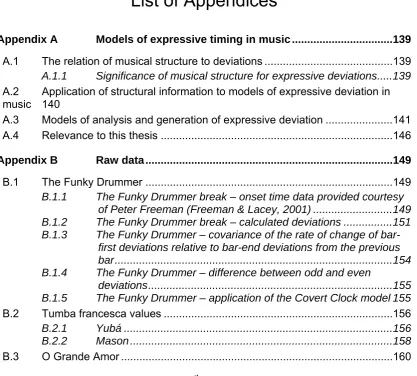
List of Appendices ...9
Extended Abstract ...11
Overview ...11
What is groove microtiming? ...11
A new theory of rhythmic timing and entrainment ...12
Original contribution ...13
The Covert Clock Theory...13
The VROOGE model...14
Chapter 1 Psychological and musicological approaches to groove microtiming ...15
1.1 Defining terms ...15
1.1.1 Pulse, beat, tactus, tatum, ...16
1.1.2 Meter...16
1.1.3 Rhythm ...17
1.1.4 Groove ...17
Chapter 2 Review of theories of meter and entrainment...19
2.1 The concept of an internal clock...19
2.1.1 The tempo range of rhythmic behaviour ...20
2.1.2 Spontaneous tempo and the referent time level ...20
2.2 A multiple clock model...23
2.3 Hierarchical clocks ...25
2.3.1 Evidence for an hierarchical clock system...25
2.3.2 Nested clocks and better timing performance ...30
2.4 Timing control below the level of the fastest central clock...34
2.4.1 Motor programs ...34
2.4.3 Evidence for a different mechanism for timing below the tactus
level...37
2.4.4 Functional anticipation ...38
2.4.5 Possible functions of microtiming deviations in a musical context ...42
Chapter 3 The macroperiod in groove music, and the psychological present...43
3.1 Hierarchical planning of movement sequences...43
3.1.1 Hierarchical meter and timing ...44
3.2 The psychological present...44
3.2.1 Rhythm, the body, and the psychological present ...46
3.3 Period segmentation in various groove-like musics ...46
3.3.1 Cross meters ...47
3.3.2 Asymmetrical bisection of the macroperiod. ...48
3.3.3 Bell patterns in Central and West African drumming, and other reference patterns...50
3.3.4 The clavé pattern in Afro-Cuban music ...51
3.3.5 The tal in North Indian music ...51
3.3.6 Duration of the macroperiod interval...52
3.4 Summary 53 Chapter 4 The Covert Clock Theory ...55
4.1 Review of studies of microtiming deviation in groove music ...55
4.1.1 Consistency of microtiming deviation patterns ...55
4.1.2 Recreating and applying microtiming deviation patterns ...56
4.2 The Covert Clock theory of microtiming deviations ...56
4.2.1 Contrasting properties of cross-rhythms and hierachical meter 58 4.2.2 Some predictions of the Covert Clock Theory ...59
Chapter 5 An examination of the Covert Clock Theory using microtiming data analysis...61
5.1 Extraction of microtiming data, and general approach to analysis ...61
5.2 The Funky Drummer ...62
5.2.1 Data acquisition and treatment ...63
5.2.2 Analysis ...66
5.2.3 Swing ...68
5.2.4 Application of the Covert Clock Theory to The Funky Drummer deviations...69
5.3 Tumba Francesca...73
5.3.1 Data acquisition and treatment ...73
5.3.2 Application of the Covert Clock Theory to Tumba Francesca deviations...74
5.4 O Grande Amor...84
6.1 Outline of the VROOGE model ...87
6.2 Existing models of microtiming deviations...88
6.2.1 Groove templates ...88
6.2.2 Bilmes’s approach ...89
6.2.3 Simulating Expressive Timing By Modulated Movements – Waadeland’s model ...92
6.3 Development of the VROOGE model...98
6.3.1 The basic model for repetitive timing and correction processes 98 6.3.2 The introduction of correction processes to the basic two-process model...99
6.3.3 Pressing’s Referential Behaviour Theory ...99
6.3.4 Simultaneous phase and period correction ...102
6.3.5 Period correction triggered by different conditions from phase correction ...102
6.3.6 Separating phase and period correction processes ...103
6.3.7 First- and second-order correction processes ...106
6.3.8 Entrainment latency ...110
6.3.9 Adding microtiming deviations to the model ...110
6.3.10 Two different approaches to generating microtiming deviations ...111
Chapter 7 The VROOGE software...113
7.1 Entrainment ...113
7.2 Sequence 114 7.3 Microtiming deviations...114
7.4 User-set parameters...114
7.5 Evaluation of the VROOGE software ...114
Chapter 8 Summary and conclusion ...118
8.1 Impetus for research on microtiming and groove ...118
8.2 Summary of achievements...118
8.2.1 Clarification of the relationship between entrainment and planning processes in rhythm ...118
8.2.2 Integration of entrainment processes with microtiming deviation processes...119
8.3 Outstanding issues for the current topic...119
8.4 Broader issues to be addressed...120
8.4.1 Issues for psychological research...120
8.4.2 Issues for musicological research...121
8.4.3 Issues for music technology ...121
List of figures
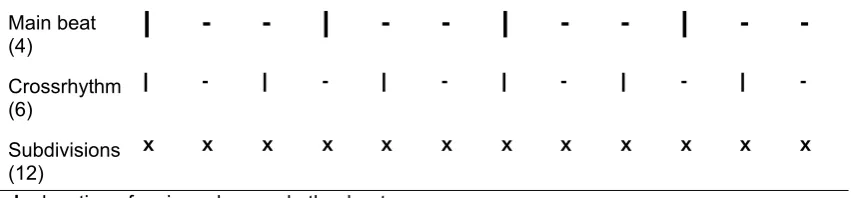
Figure 3-1 An 8-beat cross rhythm to 4 main tactus beats is a different subdivision of the tactus ...48 Figure 3-2 A 6-beat cross meter to 4 main tactus beats is a different grouping of
subdivisions ...48 Figure 3-3 Period layers in a song from the Aka people, from a figure provided in
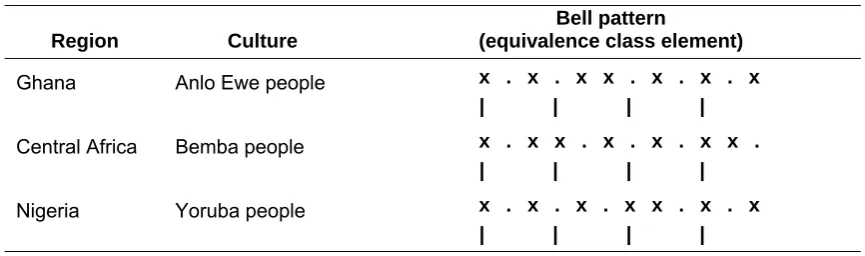
(Arom, 1994)...49 Figure 3-4 Drawn from figures given in (Anku, 2000). ...51 Figure 3-5 Cuban clavé pattern...51 Figure 3-6 North Indian jhaptal metric pattern, from a figure in (Clayton, 1997) (+ =
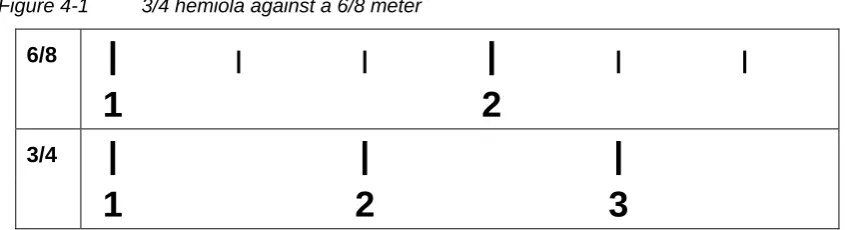
clap; o = wave) ...51 Figure 4-1 3/4 hemiola against a 6/8 meter ...57 Figure 5-1 Microtiming deviations for the drum break in The Funky Drummer, by bar.
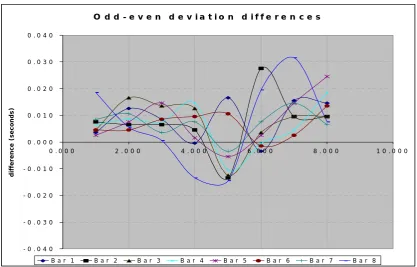
...65 Figure 5-2 Funky Drummer odd-even deviation differences by bar ...69 Figure 5-3 Deviations generated by a covert 3/4 clock against a 4/4 tactus with 16th
tatums (see text). An absolute swing value of 12msec has been added to every even-numbered tatum onset time. ...71 Figure 5-4 Deviations for t3he catá, bulá I and bulá II of the toque macota of the
Yubá dance. Individual drum strokes on successive eight notes (the smallest rhythmic value) are joined by lines. ...76 Figure 5-5 Catá and bulá deviations for the Frenté dance. The catá appears to
follow a deviation strategy which is independent to that of the bulá...78 Figure 5-6 Bulá I deviations using a covert clock of 5 against 12, scaled by 0.17 ...79 Figure 5-7 Bulá II deviations using a covert clock of 5 against 12, scaled by 0.29 ....80 Figure 5-8 Tambora deviations for the Masón using a covert clock of 5 against 12,
scaled by 0.22 ...81 Figure 5-9 Bulá deviations for the Masón using a covert clock of 5 against 12,
scaled by 1.0 ...82 Figure 5-10 Hi-hat deviations for Getz/Gilberto’s O Grande Amor...83 Figure 7-1 VROOGE model output for the Bulá 2 part for the Macota toque of the
Yubá dance ...115 Figure 7-2 Covert Clock model results for the Bulá 2 part for the Macota toque of the
List of equations
Equation 6-1...93
Equation 6-2...93
Equation 6-3...93
Equation 6-4...94
Equation 6-5...94
Equation 6-6...98
Equation 6-7...100
Equation 6-8...101
Equation 6-9...104
Equation 6-10...105
Equation 6-11...105
Equation 6-12...105
Equation 6-13...106
List of tables
Table 2-1 Summary of experimental findings for period of referent time level and
spontaneous tempo. ...22
Table 5-1 Covariance of 1-1 deviations with preceding 4-4 deviations ...67
[image:9.595.93.511.298.674.2]Table 6-1 Feature comparision of microtiming deviation models. ...96
Table 6-2 Experimentally determined gain parameter estimations for entrainment models ...109
List of Appendices
Appendix A Models of expressive timing in music ...139A.1 The relation of musical structure to deviations ...139
A.1.1 Significance of musical structure for expressive deviations...139
A.2 Application of structural information to models of expressive deviation in music 140 A.3 Models of analysis and generation of expressive deviation ...141
A.4 Relevance to this thesis ...146
Appendix B Raw data ...149
B.1 The Funky Drummer ...149
B.1.1 The Funky Drummer break – onset time data provided courtesy of Peter Freeman (Freeman & Lacey, 2001) ...149
B.1.2 The Funky Drummer break – calculated deviations ...151
B.1.3 The Funky Drummer – covariance of the rate of change of bar-first deviations relative to bar-end deviations from the previous bar...154
B.1.4 The Funky Drummer – difference between odd and even deviations...155
B.1.5 The Funky Drummer – application of the Covert Clock model 155 B.2 Tumba francesca values ...156
B.2.1 Yubá ...156
B.2.2 Mason ...158
B.3 O Grande Amor ...160
Extended Abstract
Overview
Much work has and is being done on the topic of timing variation in Western notated art music: see Appendix A to this thesis and, representatively, (Bresin, 1998,2000; Bresin, De Poli, & Vidolin, 1992; Canazza, De Poli, Di Federico, & Drioli, 1999; Canazza, De Poli, Drioli, Roda, & Zamperini, 2000; Canazza, De Poli, Roda, & Vidolin, 1997; Canazza, Roda, & Orio, 1999; Cannazza, De Poli, Di Sanzo, & Vidolin, 1998; Clynes, 1983; Clynes, 1986a,b; Clynes, 1987; Clynes, 1992; Clynes, 1995; Clynes & Walker, 1982; Desain & Honing, 1991,1992,1993,1996; Epstein, 1988; Friberg, 1995; Friberg & Bresin, 1997; Friberg, Bresin, Fryden, & Sundberg, 1998; Gabrielsson, 1982; Honing, 1992; Honing, 2001; Mazzola & Zahorka, 1994a,b; Palmer, 1989,1996; Palmer, 1997; Palmer & Pfordresher, 2003; Palmer & van de Sande, 1995; Repp, 1990,1992,1998; Shaffer, 1980,1981; Shaffer, 1985; Shaffer, Clarke, & Todd, 1985; Sundberg, Friberg, & Fryden, 1991; Timmers, Ashley, Desain, & Heijink, 2000; Todd, 1985,1989; Widmer, 1994,1996,2000,2001). However, less investigation has been undertaken into microtiming deviations in repetitive musics with globally stable tempo. Such musics are here referred to inclusively as groove
musics – some examples are: traditional African drumming; funk; and Latin music.
This thesis presents a theory (the Covert Clock Theory) and proposes a model of the production of musical groove. The computer model presented rests on arguments regarding what constitutes groove, both in a musical sense and - beyond the scope of musicology - in terms of how and why humans produce and respond to groove.
Through the examination of human perception and production of rhythm, I propose to develop a model, based on the Covert Clock Theory, of the generation of
microtiming deviations characteristic of groove. Ideally, the model should be intuitively controllable by a musician setting a small number of parameters, and should generate deviation patterns which are musically useful and have similar characteristics to those generated by human musicians.
What is groove microtiming?
with deviations typically in the range ~5ms to ~50ms. Some limited musicological studies (see eg. (Bilmes, 1993b; Cholakis, 1999b; Freeman & Lacey, 2001; Freeman & Lacey, 2002)) of microtiming deviations in groove have been undertaken but these do not attempt to account for microtiming in terms of underlying timing processes. This thesis represents an attempt to integrate the musicology of microtiming with psychological and human movement theories of rhythmic timing control, in order to develop a theory of the process by which performers generate microtiming
deviations. The theory and results have implications for the psychology of rhythm, for music technology, for musicology and music performance, and for motor planning theory in general.
A new theory of rhythmic timing and entrainment
Theories and models of human rhythmic entrainment, musical timing and motor control are critically reviewed in light of the experimental and musicological literature. Evidence is presented for different psychological or perceptual processes for a) timing control within the range of rhythmic synchronisation, and b) time intervals below that range.
A new theory of production is presented in which a system of interlocking interval timers or clocks provides trigger signals to motor programs at the start of each isochronous interval. Interval timers with resting periods close to the period of the driving stimulus (which may simply be an isochronous pulse train) alter their period to entrain to the driving stimulus. Entrainment may be in any harmonic relation to the stimulus – clock triggers and stimulus pulses may be in a one-to-one relation, or a 1:2, 1:3, 1:4, 2:1, 3:1, or 4:1 relation. The ratios of clock period to stimulus period are effectively limited by the range of synchronisation, which is approximately between 200ms and 1500ms. Within this range, nested harmonic clocks may occur, with the longest period perhaps four times the shortest period. Harmonic relations between clock periods are more stable because they lead to most reinforcement between clocks, but non-harmonic ratios, although less stable, are also possible.
Timing control at intervals smaller than the current synchronisation period (ie. between the triggers of the fastest active interval timer) is achieved by open-loop motor programs triggered by the interval timer. Timing at this lowest level might (hypothetically) be achieved by means of a very fast (perhaps 1000Hz) oscillation and a counter mechanism, which are not available to cognitive control. Revisions to timing in the motor program schema are made following execution of the motor program, on the basis of sensory feedback.
The delay for revisions to take effect following execution is equal to the time needed for planning, sensory feedback, and any other delays attributable to the
neuromuscular system. At least some of these delays contribute to the necessity for
functional anticipation by the timer triggerof the sensorimotor goal. Functional
anticipation is defined as the time between the timer trigger and the completion of the action. For instance, a sensorimotor goal of eg. producing a drum attack to be heard at a defined time within the rhythmic stream, requires a functional anticipation at least equal to the time needed to convey the command to the muscles and for the physical completion of the action.
Phase correction is modelled in the implementation of the Covert Clock Theory as a separate process from period correction - although referencing the same
asynchronies between sensory feedback and expected sensory feedback following the interval timer trigger. Phase correction is thus a motor implementation process. In the theory, phase correction involves an adjustment to the amount of functional
anticipation. The phase correction process functions in the same temporal range as microtiming deviations (ie. below ~50ms) and may be invoked in response either to subliminal timing perturbations of the driving stimulus, or to asynchronies resulting from interval timer errors or motor implementation errors.
Original contribution
The Covert Clock Theory
The Covert Clock Theorysuggests that the covert clock and the tactus interact so that a given clock onset may occur earlier or later, but without the actual period of the clock being adjusted. Early or delayed triggering of the beginning of the interval timer cycle will of course result in some inter-trigger periods being shorter or longer than the clock period; but a key point of the theory is that the clock retains its previously established period.
The coincidence of the main and covert clocks at every four beats of the tactus and every three beats of the covert clock (in the example given) defines the start of the macroperiod. The macroperiod has duration within the capacity of echoic memory – the ‘psychological present’.
The Covert Clock Theory can be seen as a means of extending the duration of motor programs. Other devices found in traditional African drumming are also discussed as fulfilling the same function.
The VROOGE model
The VROOGE model of microtiming deviations in groove is a software
implementation of the microtiming process described by the Covert Clock Theory. (The name VROOGE is simply an anagram of ‘groove’.) The VROOGEmodel entrains to an external isochronous pulse train through period correction of a main tactus interval timer. Weighted referencing by the motor timing process to both the tactus and the covert clock results in changes to the local tempo of motor program implementation, without altering the period of the underlying clock. This facet of the model corresponds to expansion or contraction of motor program duration, as described in the Covert Clock Theory. Local tempo changes in motor program implementation from one tactus trigger to another result in progressively increasing or decreasing deviations through the duration of the tactus. The deviation amount is in fact the integral of the tempo change relative to the base tempo given by the (unchanged) tactus clock.
The VROOGE modelis evaluated through analysis of microtiming data of examples of groove music and comparison with model –generated data. Predictions of the theory are tested against the data and some agreement is found.
Chapter 1 Psychological and musicological
approaches to groove microtiming
The first section of the thesis comprises a review of the literature dealing with the psychology of musical rhythm and meter, to provide the basis for developing a theory of microtiming deviations. As with the rest of the thesis, the focus will be on groove music – in this section, in its relation to the perception and production of rhythm and meter. Chapter 3 provides relevant musicological background, while Chapter 4 relates the musicological material of Chapter 3 to psychological theory.
The musicological characteristics of groove are dealt with more fully below. For the present, it is enough to note that groove music has a focus on rhythm,
expressed via repetitive patterns usually of the same length, within the framework of a tempo which is apparently invariant. The musicological section will mainly discuss various relevant aspects of traditional African drumming practice (from several different cultures), although the main thrust of the theory is applicable to the wider range of musics which could be called groove, including some of the musics of the African diaspora (such as Cuban music and funk).
The Covert Clock Theory of microtiming deviations is presented in Chapter 5; while Chapter 6 tests results of the Covert Clock theoretical model against microtiming data from a range of musics. Chapter 7 reviews existing
computational models of entrainment, and such models of microtiming which are relevant for groove music. Chapter 8 presents the VROOGE model of microtiming deviations, based in the Covert Clock theory described in Chapter 5.
Appendix A reviews models of microtiming which are not relevant to groove music. These are mainly related to stylistic structural aspects of Western notated art music.
We turn now to a definition of terms used in the thesis.
1.1 Defining
terms
Before attempting to define groove music, and what separates it from, say, 18th century classical music, it is necessary to clarify the meaning of commonly used terms relating to rhythm. Words such as beat, meter, measure, accent, and even
1.1.1
Pulse, beat, tactus, tatum,
Snyder (Snyder, 2000) describes a beat as a single point in time, with no duration but only a temporal position. It is an imaginary temporal reference point which need not be represented by a musical event, one of a series of such points which compose a pulse. This raises the question, “How do we know it is there?” Beats are the components of a series of identical (unaccented) and isochronous points in time – so that once a pulse is established, each beat does not need to be explicitly marked by a musical event for us to retain a sense of an ongoing stream of isochronous beats.
Fraisse (Fraisse, 1982) noted that people can easily match a motor act with a regular series of sounds, which indicates a strong link between rhythm perception and production (Krumhansl, 2000). An important feature is the ability to tap to more complex rhythmic sequences (Fraisse, 1982) - that is, to find a regular pulse which fits a musical sequence, although the music contains musical events which fall on beat subdivisions, and may not include a musical event on every tactus pulse. Clearly, there is a choice of pulse tempos from which to choose in this situation, and the pulse level at which most people tap may be termed the tactus, following Lerdahl and Jackendoff’s use of the term. (Lerdahl & Jackendoff, 1981) The tactus can be subdivided into equal or quasi-equal parts (eg in Western music notation, eighth-note subdivisions of a quarter-note tactus may be made) and the term pulse is then used to refer to the stream of tactus subdivisions which are most often sounded in the music.
Tactus subdivision parts may themselves be subdivided. The smallest
subdivisions of the tactus have usefully been dubbed tatums (for temporal atom) by Bilmes (Bilmes, 1993b), in tribute to stride pianist Art Tatum.
1.1.2 Meter
Meter refers to a cyclic grouping of either tactus beats or tatums, or both. In the last case, tactus beats are subdivided as well as being organised into repeating higher-level groups. Binary subdivisions at one or more levels are common, as are ternary subdivisions. Compound meters, comprising eg. binary groupings or subdivisions at one level and ternary groupings or subdivisions at another level are found in different cultures.
asymmetrical or so-called ‘limping’ meters. For example, groupings of 12 subdivisions in a 3-2-2,3-2 pattern, 11 subdivisions in a 3-2-2-2-2- pattern, 7 subdivisions in a 3-2-2 pattern, and 9 subdivisions in a 2-2-2-3 pattern are found variously in areas of Greece, Turkey, Albania and the former Yugoslavia.
(Friedberg, 2000; Various, 2000) Justin London (London, 2000) has pointed out that such complex meters conform to the rule of maximal evenness, so that there are only two different groupings of subdivisions in the meter, and the two
groupings are as close as possible, for the given number of tactus beats.
One interpretation of meter, based on Lerdahl and Jackendoff’s influential Generative Theory of Tonal Music (Lerdahl & Jackendoff, 1983), includes an hierarchical system of accents relating to the several grouping levels. Meter of this kind is one of the meanings of the word as used here, but should not be thought of as privileged in any way.
1.1.3 Rhythm
Rhythm has been variously used to mean any of: pulse, meter, pattern of durations and accents, or as a collective term to refer to the interaction of all of these in a musical utterance. I will use the term rhythmic pattern to refer to patterns of interonset intervals only.
1.1.4 Groove
Groove is a term used to describe the rhythmic feel of music with a stable global tempo. Analysis of musical examples of groove, including jazz, Cuban drumming, and funk music, has found systematic microtiming deviations from quantised onset times. These microtiming deviations are the focus of the theory and model
presented in this thesis. The theory and model ignore the contribution to groove of accent patterns, subtle loudness changes, offset timings, and timbre - although musicians would generally agree that these are all important components of the perception of groove.
• ‘… emerging from one or more carefully aligned rhythmic patterns, characterised by:
• perception of recurring pulses, and subdivision structure to such pulses,
• perception of a cycle of time, of length 2 or more pulses, enabling identification of cycle locations, and
• effectiveness in engaging synchronizing body responses (eg. dance, foot-tapping)…’
- with what Pressing calls ‘Black Atlantic groove’ (based on the West African diaspora) showing ‘relatively high levels of syncopation’ while emphasising a ‘metronomic’ approach to timing, without rubato. (Pressing, 2002) The word ‘metronomic’ should not be taken to exclude microtiming variations, but does mean that rubato - variation in global tempo for expressive reasons – is not an attribute of groove music (see the discussion in Appendix A).
The definition of groove given above excludes jazz (which does not usually exhibit a defined, repetitive macroperiod) but includes funk and Latin music, and
Chapter 2 Review of theories of meter and
entrainment
This chapter reviews experimental and theoretical literature on human entrainment to, and production of, an isochronous pulse, as a means of providing a temporal grid as a reference for microtiming deviations.
Two levels of timing control are identified. The first is the range of synchronisation or entrainment, with period in the range of ~200msec to ~1500msec – some kind of internal clock or interval timer is presumed to exist to produce these intervals. Motor programs are discussed as providing the second level of timing control, for events which occur between the beats of the (fastest such) internal clock or interval timer.
A theory of multiple internal clocks, with periods in hierarchical relation to each other is proposed. This new theory is constructed by drawing principles from existing theories and in later chapters is further developed into the Covert Clock theory of microtiming deviations which is implemented as computer software.
2.1
The concept of an internal clock
Most people can tap to a beat, dance in time and create music in time with others - this is evidence that people can entrain to an isochronous beat. In fact, even if the beat is not completely steady, entrainment is possible: even poor musicians keep time with each other, even though not as well as good musicians. (Fraisse, 1982)
Furthermore, people can produce the same behaviour without an external
stimulus: they can tap an isochronous (or quasi-isochronous) beat without hearing anything but their own taps, dance without music, and sing or play the piano solo. In fact, even more basic activities display a quasi-isochronous temporal structure: most people walk, run, chew, engage in sexual intercourse, or ride a bicycle, in a rhythmic way. Babies suckle rhythmically and chefs chop vegetables rhythmically.
either an emergent oscillation (for instance, as described in (Kelso, Holt, Rubin, & Kugler, 1981)), or some other kind of internal timekeeper mechanism (eg.
(Vorberg & Wing, 1996)). The main difference between the two approaches is that phase information is presumed to be available from an oscillator, whereas a clock or interval timer provides only a trigger at the start of the timed interval. [In both cases, phase correction, relative to the stimulus, must be achieved either by adjusting the period of the oscillator or interval timer, or by a separate, direct phase correction process. A model described by Hary and Moore (Hary & Moore, 1985,1987), based on their experimental findings, postulates phase correction as provided through a mixed strategy of reference to either the external stimulus or the subject’s own tap.] The theory proposed in this thesis does not directly address the oscillator versus clock debate: although an oscillator is used to give the sign (negative or positive) or asynchrony in the implementation of the
computation model of entrainment, this is pragmatic choice rather than a theoretical preference.
Researchers have clarified a number of attributes of the phenomenon of human rhythmic behaviour, including the range of tempi and spontaneous tempo.
2.1.1
The tempo range of rhythmic behaviour
Fraisse stated that the range of periods to which synchronisation was possible was 200msec to 1800msec (Fraisse, 1982). He identifies a number of
spontaneous activities of the human organism such as the suckling reflex of the newborn with (period between 600milliseconds and 1200ms); and walking (period about 550ms). (Fraisse, 1982)
Parncutt’s (Parncutt, 1994) summary of the experimental literature on entrainment points to periods around approximately 600msec as having the greatest salience, with decreased salience at periods smaller than 400msec and longer than
900msec. Entrainment to periods below about 200msec and above about 1800msec is thought not to occur. (Parncutt, 1994)
2.1.2
Spontaneous tempo and the referent time level
Jackendoff, 1981) If people are asked to tap to music, it is likely that they will make explicit their referent time level for the music. Parncutt (Parncutt, 1994) tested subjects tapping responses to six different cyclically repeating interonset interval patterns, each presented at six different tempos, from very slow to very fast. Parncutt found that responses gravitated toward a moderate pulse period of about 700msec.
Fraisse (Fraisse, 1982) states that “…sucking movements occur at a cadence that seems to be characteristic for each infant.” He refers to studies of spontaneous
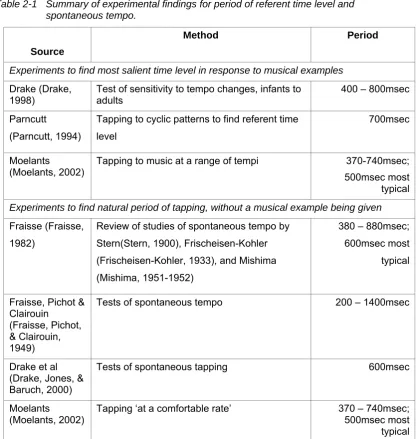
Table 2-1 Summary of experimental findings for period of referent time level and spontaneous tempo.
Source
Method Period
Experiments to find most salient time level in response to musical examples
Drake (Drake,
1998) Test of sensitivity to tempo changes, infants to adults 400 – 800msec Parncutt
(Parncutt, 1994)
Tapping to cyclic patterns to find referent time level
700msec
Moelants
(Moelants, 2002) Tapping to music at a range of tempi 500msec most 370-740msec; typical
Experiments to find natural period of tapping, without a musical example being given
Fraisse (Fraisse, 1982)
Review of studies of spontaneous tempo by Stern(Stern, 1900), Frischeisen-Kohler (Frischeisen-Kohler, 1933), and Mishima (Mishima, 1951-1952)
380 – 880msec; 600msec most typical
Fraisse, Pichot & Clairouin
(Fraisse, Pichot, & Clairouin, 1949)
Tests of spontaneous tempo 200 – 1400msec
Drake et al (Drake, Jones, & Baruch, 2000)
Tests of spontaneous tapping 600msec
Moelants
(Moelants, 2002)
Tapping ‘at a comfortable rate’ 370 – 740msec; 500msec most
typical
A summary of experimental findings for the referent time level and for spontaneous tempo is given in Table 2-1. The tempo ranges given for
experiments to find the natural period of tapping without a musical example being given refer to the range over the sample of subjects. The variability within a
[image:22.595.95.515.74.514.2]Based on these findings, I will refer to the ‘moderate tempo’ as the tactus and assume its period varies around approximately 500msec, with the lower and upper limits of entrainment roughly half and triple that period respectively. The upper bound of entrainment has little impact on the current model. However the lower bound will be significant in differentiating between central clock-controlled timing, and motor implementation timing (see below).
2.2
A multiple clock model
A multiple-timer model has been developed by Ivry and Richardson and Ivry, Richardson et al (Ivry & Richardson, 2002; Ivry, Richardson, & Helmuth, 2002) to account for decreased timing variance within both hands in bimanual
simultaneous (in-phase) tapping, found in experimental studies of patients with unilateral cerebellar lesions, (Helmuth & Ivry, 1996) and subsequently in neurologically-healthy subjects. (Ivry et al., 2002) This multi-effector advantage was found even when people tapped with finger movements on one side of the body and forearm movements on the other side, or in finger and foot
combinations. Data analysis of these conditions showed increased motor
variability when the two limbs were of unequal mass, but decreased central (clock) variability as calculated according to the Wing and Kirstofferson (Wing &
Kristofferson, 1973a; Wing & Kristofferson, 1973b) two-process model . (Ivry et al., 2002) The multiple effector advantage persisted even for practised musicians, with very low baseline variances. The improved timing found with multiple effectors was even better when three effectors were moved in synchrony. The multiple timer model theorises that a new timer is engaged with each additional effector. The model incidentally accounts for the preference of musicians to move in time with the rhythm, to improve timing.
open loop mode, without feedback – thus there is no period correction, once synchronisation to an external pulse stimulus is achieved. Ivry and his colleagues explicitly reject either continuous or discrete feedback from the limbs as a source of improved clock stability in the multiple effector advantage. A discrete linear phase correction process added to a multiple timer simulation and based on feedback of asynchronies between the two limbs actually increased motor implementation timing variability. The authors argue that, although continuous proprioceptive-based feedback would probably reduce motor timing variability, it is unclear whether such a process would actually be viable during tasks such as repetitive tapping. (Ivry et al., 2002)
The Ivry and Richardson model may account for spontaneous tempo: if individuals have neural machinery or processes akin to a bank of timers, each with a fixed frequency, spontaneous tempo might arise from optimal period nesting as described above. Tempi other than spontaneous tempo would then be produced by adding weighted contributions from other clocks. The model allows for both spontaneous tempo stability and tempo flexibility. Period correction is achieved through weighting the contributions of timers with different fixed periods; and conversely the phases and slightly different periods of multiple timers required to control multiple effectors in synchrony is achieved in the same way. Note that period correction in response to an external pulse train will involve discrete time referencing – weights will be updated in response to perceived asynchronies between stimulus and response events. Internally, the timers utilise continuous referencing of each other’s activation levels to achieve synchronisation.
However, while Ivry and Richardson’s gated activation function effectively accounts for the temporal coupling of multiple timers to control synchronous effector actions, a drawback appears when it is extended to accommodate nested clocks. Gated activation will keep timers in phase which are at or near the same period but does not readily adapt to entrainment at harmonic frequencies.
2.3
Hierarchical clocks
Although listeners may have a preference for tapping at a particular rate for a given piece of music, they can often choose to tap to a pulse level at a faster or slower tempo. In Western music this faster or slower pulse will often be at periods of half or double the tactus. Higher number subdivisions or groupings (eg. of three and four, or even of prime numbers such as five) are also found, but multiples of two and three are much more common.
It seems reasonable to assume that timing for tapping at a particular pulse level will be controlled by a clock with the same period as the pulse at that level. The fact that people who can tap at more than one pulse level can also generally move at will between pulse levels supports the further assumption that the clocks at different levels may be active whether they are the basis for the current level of tapping period or not. This leads to the concept of nested clocks.
A clock with a period at some multiple of the tactus (ie at a sub-harmonic frequency to the tactus) can be called a super-tactus clock; while a clock with a period at some factor of the tactus (at a harmonic frequency) can be termed a
sub-tactus clock. A simple example is a tactus with period 600msec, a super-tactus with period 1200msec, and a sub-super-tactus with period 300msec. Of course, the tactus period may be too large to permit a super-tactus – a tactus period of 1000msec would give the smallest super-tactus a 2000msec period, outside the range of synchronisation as noted above. A fast tactus speed will put any subdivision below the level of the fastest clock in the range of synchronisation (200msec). On the other hand, a short tactus period of, say 250msec will allow the participation of clocks at 500msec and 1000msec, creating two clock levels above the tactus; and the reverse is obviously true for a long tactus period.
2.3.1
Evidence for an hierarchical clock system
who asked subjects to tap in time with sequences made up of intervals in various ratios to each other, and then to continue without the stimulus. In one experiment two intervals in were repeated and in another, the two intervals were presented in a S-L-L pattern. The shorter interval ranged over the two experiments from 200msec to 533msec. The ratios used were 1:4, 1:3, 2:5, 1:2, 3:5, 2:3, 3:4, and 4:5. The 1:1 ratio was not present. Subjects tended towards 1:2 timing in
reproducing all intervals, from which Povel inferred that simple ratios are easier to reproduce. However, subjects had difficulty reproducing even the 1:2 ratio for the S-L-L patterns.
An internal clock account of Povel’s (Povel, 1981) results for the two-interval experiment would attribute the dominance of the 1:2 pattern to its being the only one for which a subdivision of the pattern period is feasible. A 1:2 ratio allows for a subdivision into 3 equal parts, each part with a duration (in Povel’s experiment) of 334msec – within the range of synchronisation and therefore capable of being clocked. Less simple ratios require the shorter interval to be subdivided putting the clock period below the range of synchronisation. For instance, both the 2:5 ratio and the 3:4 ratio require a subdivision into 7 equal parts. (The 1:4 and 1:3 patterns had a short interval of ≤ 250 msec and so were already at the edge or outside the range of synchronisation.)
The S-L-L pattern also used short intervals of about 250msec, except for three cases, two of which had complex ratios which would lead to subdivisions below that level. For the 1:2 ratio with the short interval at 400msec, standard deviations were higher than for the first experiment. The added difficulty, according to the hierarchical clock theory, here came from the addition of the second long interval, making the period of the pattern 2000msec – above the range of synchronisation.
Povel (Povel, 1981) presented intervals in longer patterns, which allowed for the emergence of a higher-level beat, covering repetitions of the short intervals. Patterns which were reproduced well were (with intervals in milliseconds):
• 250-250-500 (in the hierarchical clock theory, this would be a sub-tactus at 250msec, tactus at 500msec, and super-tactus a 1000msec);
• 250-250-250-750 (subtactus 250ms, tactus 750ms, supertactus 1500ms);
• 250-250-250-250-500-500 (subtactus 250ms, tactus 500ms, supertactus 1000ms)
Two patterns were not well produced:
• 200-200-600 (this produces a period of five 200ms beats – the short intervals are outside the range of synchronisation assumed here, and do not concatenate into a factor of the long interval);
• 400-400-400-600-600 (once again the subdivision of the 400ms tactus to produce the syncopation of the last onset requires a clock at 200ms, below the range of synchronisation.)
While Povel (Povel, 1981) introduced a theory of beats, and recognised that the range of synchronisation is approximately 250ms to 1500ms, he does not appear to have considered an hierarchical clock system to account for the his
experimental findings. Povel (Povel, 1981; Povel, 1984; Povel & Essens, 1985) developed a rule-based coding system to account for the choice of period and location of temporal grid to match to cyclical patterns of inter-onset intervals but the preferences shown for a particular tactus in response to a pattern can also be accounted for by attributed to a system of nested clocks. The introduction of pitch can affect the selection and location of grid, as can the introduction of loudness accents. Pitch and accent appear to be used as cues to indicate the location of the temporal grid in the stream of onsets; however these factors are beyond the scope of the present model and do not contradict the principle of hierarchic meter.
Desain and Honing (Desain & Honing, 2003) note the ability of listeners to unconsciously abstract a rhythm matched to a temporal grid from timing
information which is in fact quite noisy. In one experiment, subjects were asked to categorize rhythms generated from every combination of four onsets within a fixed duration on a fine temporal grid. Unsurprisingly from the point of view of the hierarchical meter theory, 97% of responses categorized the rhythms to a
the period of the cycle. The sub-tactus clock pulse falls on groupings of 2
subdivisions. So, in the 2:5:1 interval pattern it arrives at the start of the 2-interval, and the start of the 5-interval, reinforcing those onsets and stabilising the
perception of the pattern. But for the 5:2:1 interval sequence, the subtactus clock (still falling on groupings of 2 subdivisions) coincides only with the start of the 5 interval (and not with the 2 interval and the 1 interval). Actual interval durations are not given and are apparently not a feature of the model, whereas in the
hierarchical clock theory the upper and lower bounds of the range of
synchronisation are a key factor in choice of tactus, and therefore in the stability of rhythmic patterns.
Vorberg and Hambuch (Vorberg & Hambuch, 1978) appear to have been the first to explicitly propose the possibility of two nested interval clocks to control different levels of the metrical hierarchy in music. Analysis of data from a synchronization tapping experiment where subjects were required to synchronize the first tap in a group of either one, two, three or four taps with a regular stimulus, found positive peaks in serial covariance groupings, at lags equal to the groupings (with the exception of some groupings of 500msec period taps.) Inter-tap intervals (ITIs) were either 300msec or 500msec. However, the authors finally reject the notion of hierarchically nested clocks, because they found that the variance of “natural” groupings (starting with the tap coinciding with the stimulus) had no tendency to be less than the variance for groups overlapping the stimulus boundary. However, the hierarchical clock models discussed by these authors involve intermittent activation of interval timers at lower levels (Vorberg & Hambuch, 1978). A full hierarchically-nested clock theory would include serial timing at lower levels,
together with by serial timing at higher levels. In this case, the regulation of the lower-level period provided by the higher-level clock would be expected to stabilise the lower-level period, so that variance would be reduced overall, rather than only at the level of the higher clock. A further consideration is that groups of three or more 500msec period taps would produce a higher-level period outside the range of synchronization assumed here. The authors do note that testing over a larger tempo range might produce different effects. (Vorberg & Hambuch, 1978)
covariances for nominally equal subdivisions divisions of the beat indicated direct timing of the beat interval but not of subdivisions (see discussion, below).
However, small number divisions of the beat (two to four, at a beat period of over 1000ms) had positive covariance, which Monahan cited in support of nested interval clocks at the beat level and at twice the frequency (or half the period) of the beat.
Listeners in an experiment by Fraisse (Fraisse, 1967) were asked to adjust the interval between two isochronous pulse trains (at the same tempo) to produce isochrony (at twice the tempo of each separate sequence). Performance was best for periods of about 500-600msec (cited in (Parncutt, 1994)), consistent with a fastest clock period of about 250-300msec.
Experimental data obtained by Drake (Drake, 1993) and cited by Parncutt (Parncutt, 1994) shows that binary/quaternary grouping dominates over ternary grouping for both children and adults. Binary groupings maximise the number of pulse levels which fall within the range of synchronisation – ternary subdivisions mean that sub-tactus clocks must be faster, while ternary groupings of the tactus mean that super-tactus clocks must be slower. Data obtained by Fraisse (Fraisse, 1982) and others supports this interpretation: when subjects were asked to tap in groups of three or fours, intertaps intervals were shorter than the usual 600ms, and averaged 420ms for groups of three and 370ms for groups of four. The period of a three grouping of 420ms intervals is 126ms, and the period of a four grouping of 370ms intervals 1480ms. Bisection of either of the component intervals would fall outside the synchronisation range. Drake (Drake et al., 2000) explicitly states that the ability to respond to other pulse levels than the referent (tactus) level depends on the activation of multiple oscillators .
One of Lerdahl and Jackendoff’s (Lerdahl & Jackendoff, 1981) rules for metrical well-formedness is, ‘Every beat at a given level must also be a beat at smaller levels.’ Parncutt’s (Parncutt, 1994) model of pulse salience and metrical accent states that:
‘The salience of a perceived meter, or the probability of a given metrical interpretation, is proportional to the sum (or some other aggregate) of the salience of the pulse sensations that make it up. The most likely meter to be perceived is the one with the highest predicted salience.’ (Parncutt, 1994)
And further, that there is mutual salience enhancement among consonant pulses, so that sub-tactus, tactus and super-tactus clocks, where they exist contribute to increased salience of pulses where they coincide. The frequently-noted
predominance of binary/quaternary grouping over ternary grouping is implicit in Parncutt’s model of pulse salience, as no consonant sub-tactus can occur in three-groupings (because, unless synchronisation can occur with the fastest pulse - giving three subtactus to each tactus – no even subgroup can be made within the three-grouping.) The fastest pulse is presumed here to be too fast for internal clock synchronisation.) Binary relations also maximise the number of consonant pulses within the range of synchronisation, since the period of a super-tactus clock will be 3 times that of the tactus and nine times that of the sub-tactus where
ternary relations prevail, but only twice and four times the periods of the tactus and sub-tactus with binary relations.
Large, Fink & Kelso (Large et al., 2002) suggest the ability of subjects to
synchronise tapping to different referent time levels may reflect the ‘simultaneous representation of three periodicities within a single coordinative structure’ (Large et al., 2002); and that the ability to synchronise with unpredictable patterns at prescribed metrical levels indicates the interaction of different levels in temporal tracking (Large et al., 2002) – in other words, a system of hierarchical clocks.
2.3.2
Nested clocks and better timing performance
So far, clocks (or oscillators) have been considered as entraining to external rhythmic stimuli. Tactus and sub-tactus clocks at adjacent pulse level and
case – see eg. Parncutt (Parncutt, 1994) on meter ambiguity) the super-tactus interval could conceivably begin on a different sub-tactus than the tactus. In other words, the tactus could coincide with the first of each pair of a binary sub-tactus, while the super-tactus coincided with the second of each pair. Mutual entrainment between internal clocks would ensure that the start of the timing interval of all nested clocks coincided with the start of the timing interval of the slowest clock.
Repp (Repp, 2002b) describes an experiment in which subjects tapped on-beat (ie. at the tactus level) and timing perturbations of the tactus onset or one or more subtactus-rate onsets were introduced. Definite phase resetting effects occurred for +/-60msec on-beat perturbations in both the 540msec period and the
720msec period conditions, without any subdivisions marked. By contrast, where on-beat perturbations were followed by unperturbed subdivision stimuli, correction responses were reduced to roughly 50% (540msec period) and, for the 750msec period, to the much lower 20%.
Why does the introduction of unperturbed subdivisions so dramatically alter the response in the 720msec period condition, relative to the 540msec period condition? A possible explanation might relate to nested internal clock intervals. Assuming that 270msec is at the lower edge of the range of synchronisation, a 270msec period (half of 540msec) clock would be unavailable, or of weak
amplitude. Reinforcement of the 540msec tactus would be correspondingly weak (despite the presence of audible subdivisions in the stimulus), and phase resetting of the 540msec period tactus would be more likely to occur. By contrast,
subdivisions at half the period of the 720msec tactus (360msec) would fall within the range of synchronisation. In this case, the 720msec tactus would be reinforced by the subtactus clock at 360msec. The 360msec subtactus clock would itself remain unperturbed because of the unperturbed subdivision stimuli, and despite the perturbation in the stimulus at tactus level.
In contrast to theories which propose timers with oscillator properties including phase entrainment, the timing control hypothesis of Semjen and Ivry (Semjen & Ivry, 2001) posits a single timekeeper to provide a base duration and a counter mechanism which generates target timing intervals by counting multiples of the base duration. Subjects in an experiment continued either bimanual or unimanual tapping after synchronising to a metronome. The metronome provided two pulse trains at different pitches, both with 1000msec period and one in a phase relation between 0msec and 900msec to the other. The hypothesis predicts that timing patterns of alternate-hand tapping should be quite similar to those of single-hand tapping. As expected, variance for two-handed and one-handed tapping was nearly identical.
However, the prediction was also borne out that simple subdivision interval ratios, and particular the 1:1 ratio of anti-phase, would show less timing variance than complex interval ratios (Semjen & Ivry, 2001), supporting the idea that consonant clocks reinforce each other to produce better timing. On the assumption that internal clocks become less reliable (perhaps of weaker amplitude) as periods are further removed from an individual’s spontaneous tempo, the better timing
exhibited for simpler interval ratios could in part reflect poorer timing for smaller intervals towards the limit of the range of entrainment. In fact, a sharp rise in relative variation was found for periods below 300msec. (Semjen & Ivry, 2001) Three-level nesting is also likely to be a factor, given the tactus period of 1000msec: the tendency for 1:4 intervals (at phase delays of 200msec and
800msec) to assimilate to 1:3 intervals is likely due to the influence of a sub-tactus clock with period 500msec, so that the fastest active clock tends to entrain at 250msec, rather than the required 200msec. To achieve an accurate 1:4 ratio would require the 500msec clock (which in this case is not needed for direct timing of any interval) to be turned off. The 200msec clock would then receive
reinforcement on one in every five timing intervals, rather than one in two, as is the case for the 250msec clock in this scenario.
Also supporting the timing control hypothesis was the reduction in variability in the full cycle (1000msec) duration when it was produced as the sum of two sub-intervals. Variance was most reduced in the anti-phase condition and some other subdivisions also produced a decrease, although extreme phase conditions
longer of the two uneven intervals, rather than the taps which began the longer intervals, consistent with hierarchical timing. (Semjen & Ivry, 2001)
The decrease in variance for the full cycle in the anti-phase condition could be accounted for by mutual entrainment of the longer-period and shorter-period clocks (rather than hierarchical control of the faster clock by the slower). Mutual entrainment of the interval start, or clock trigger, would tend to cancel out
variances in individual clocks; and the more clocks there were that were mutually-entrained, the stronger this effect would be expected to be. In support of this view, optimal tempo sensitivity for infants, children and adults, whether musically trained or not, is always found at periods between 400msec and 800 msec (Drake, 1998): just within the range at which both a sub-tactus clock (at period 200msec and up) and a super-tactus clock (at period 160msec or less) could be both entrained.
Evidence for mutual entrainment comes from studies of bimanual finger and hand movements. Kelso et al (Kelso et al., 1981) found mutual entrainment effects between the two hands when subjects were asked to move them at the same time. In right-handed subjects the left hand was attracted to the rhythm of the right hand. (cited in (Summers & Burns, 1990))
Yamanishi et al (Yamanishi, Kawato, & Suzuki, 1980) required subjects to maintain different phase differences between the two hands in a tapping task. Unstable performance was found at phase differences other than zero (in-phase) and 180o (anti-phase), and a tendency to entrain to the nearest stable phase of 0o or 180o. (Semjen & Ivry, 2001; Summers & Burns, 1990) This finding is consistent with the theory of mutual-entraining tactus and sub-tactus clocks in a binary relation.
2.4
Timing control below the level of the fastest central
clock
How is timing control achieved below the level of the fastest clock – whether tactus or sub-tactus – for periods of 200msec and below? I shall refer to this level as the tatum level (Bilmes’s (Bilmes, 1993b) coining is a contraction of temporal atom, and carries a reference to the massive technique of stride pianist Art Taum). Rhythmic subdivisions are often heard at periods below 200msec – the 16th hi hat pulse carried by drummer Clyde Stubblefield in James Brown’s The Funky Drummer (Brown, 1986) for example, has a 149msec mean length; a recording of Ashanti drumming from Baule on the Ivory Coast has 12 micropulses per bell pattern, each 104msec long (Waterman, 1998); and Pressing (Monahan, 1993; Pressing, 1983) gives a range of smallest intervals down to below 100msec for dance drumming among the Ewe people of West Africa.
2.4.1 Motor
programs
A motor program is a set of muscle commands which are assembled before the movement begins, and allow the whole sequence to be carried out without the necessity of peripheral feedback. (Keele, 1968) Motor programs are therefore especially useful for timeframes which are too short to allow sensory feedback.
A tactus clock is able to be corrected on the basis of the last perceived asynchrony with the stimulus pulse, but movements which are completed in 150msec or less are sequenced too fast for sensory feedback to play a role on the basis of the last movement. The time taken for subjects to make corrective hand movements in a (visual) tracking task was 190-220msec after delayed feedback was made available to them – strikingly close to the lower limit for the range of rhythmic synchronisation. Schmidt (Schmidt, 1975) puts the time to process sensory input into errors and initiate corrections at 120-200msec. Welford (Welford, 1974) gives simple auditory reaction time as about 150msec – 200msec.
look at the new position, it should be available to direct arm pointing; while bit-by-bit tracking in the slow condition would not be associated with a single motor program to move the whole distance. Subjects were able to point accurately when the light moved fast (but not when it moved slow), indicating the existing of open
loop control - pre-programmed control in which the action-sensory feedback-modification of movement loop is not closed.
The tatum programs will need to issue commands to control position of limbs, amplitude, and so on. However, for present purposes I will deal with timing control in isolation from the rest of the program. The time for sensory feedback and preparation of a new motor program are not the only considerations for the duration of motor programs controlling tatum timing. Unless relative phase information is hypothesised to be available from the central clocks, timing control from the clocks consists in a trigger signal at the start of the timing interval of the fastest clock. Assuming that relative phase information is unavailable, the motor program which is triggered will have to provide all timing information up to when a new clock trigger is received. (Since we are dealing only with timing information, it is simpler to ignore kinaesthetic feedback for the moment. Schmidt (Schmidt, 1975)) indicates that proprioceptive feedback, which operates very quickly, is monitored during the action to ensure it takes the intended path.)
Where the fastest clock is available at the tactus level – the 600msec tactus subdivided into 4 tatums in the Funky Drummer drum pattern (Freeman & Lacey, 2001) - open loop control of tatum timing must span the 600msec period, that is, the timing of four 16th notes on the hi hat plus whatever kick or snare hits occur off the beat. As the tactus interval progresses, sensory feedback from the beginning of the tactus interval becomes available, and a motor program for the next interval can be prepared.
2.4.2
Motor program schema
How is a motor program modified to better match goals? In Schmidt’s (Schmidt, 1975) account, as a motor program is run, information relating to instances of the action are stored:
• initial conditions (state of the body and its environment)
• parameters for the motor program, including force and timing information
• the error between the feedback and the planned goal
The motor program is assumed to be a greater or lesser variation of an action which has already been learnt. A schema is the abstraction of a pattern of rules to generate a prototype. As a number of instances of the action have been
completed, a schema relating the four different elements given above begins to be abstracted from the stored sets of information. As enough sets of information are stored, and the motor response schema relating the different elements is refined, it becomes possible to successfully generalise the action to slightly changed initial conditions and goals, through the interpolation between parameter specifications. (Schmidt, 1975)
If we confine ourselves to specifying timing information – such as a pattern of temporal intervals which fills the tactus duration – the application of a schema becomes plausible. Assume that the goal is to fill the tactus duration with four evenly-spaced onsets, beginning on the beat, and ending with a fifth onset on the next beat. If entrainment to the current tempo has only recently been achieved and this is perhaps the first time we have played a note in this session (and perhaps we are not very expert), it may be that the motor program we call up is a little too fast. To repeat it correctly, we modify a parameter controlling overall speed, and play it again. Clearly, if we repeat that process many times (as people do when they practice a musical instrument) the speed of that particular program will become finely-tuned to the tempo of the tactus. A similar process would be applied if the intervals were perceived to be uneven when the motor program was executed. Changes are made offline and the program executed again.
2.4.3
Evidence for a different mechanism for timing below the
tactus level
A comparison of timing at the beat level with timing at the tatum level has been made by Shaffer et al (Shaffer et al., 1985) in timing data from performance by a concert pianist of Erik Satie’s Gnossienne No. 5. While the beat level is very slow (>1000msec), it is marked in the piece clearly and invariably by a bass note, alternating with a chord. The right hand plays a fluid melody, with groupings which (in notation) subdivide the beat evenly at different times into 4, 6, 7 and 8. At other times the RH has no onsets at all for two beats, or plays a variety of uneven rhythms. It was found that groups notated as comprising equal notes, were not in fact played evenly. If the duration of the beats depends on the sum of the durations of RH small notes, then the ratio of the variance of the sum of the intervals making up the beat to the sum of the variance of the intervals will be ≥1. It was found that the ratio was <1, indicating beat independently time from their sub-intervals, and sub-intervals constrained within the beats. The particular piano texture – a steady, even LH with fluidly-timed faster notes in the RH, is
characteristic of Chopin – whose instruction to keep the LH steady and vary the RH is well known to piano students. Examples of similar freedom in the RH and clock-controlled rhythm in the LH, were also found in performances of Chopin and Bach. (Shaffer, 1981) Shaffer (Shaffer, 1985) distinguishes between biological clocks and a less-precise temporal pattern generator which is triggered by a clock external to it.
An experiment in judgement and production of beat fractions, relative to an isochronous pulse shows a marked deterioration in accuracy for intervals <200msec. (Sternberg & Knoll, 1994) The poor judgement and production of single intervals in this region seems to reflect a lack of an interval timer, and compared to the ability of musicians at least to produce reasonably even intervals at that level if they are permitted to play all subdivision onsets seems to indicate that motor expression assists relative timing at this level.
case only two durations) can be reproduced consistently and accurately. Friberg (Friberg & Sundström, 2002) gives the range of ratios of the long note to the short note in jazz swing, at different tempi, as 1:1 to 3.5:1, while analysis of data for ten of the 16 different drummers given in Cholakis (Cholakis, 2003c) shows a variation between 1.5:1 to 2.7:1.
If concatenated, production of even intervals would be produced by an
(unconscious) revision of the motor program following a cognitive review of its evenness. The perception of evenness at this level of timing would relate to a direct comparison of the pattern’s component intervals to each other, rather than on asynchronies to a temporal grid produced by nested clocks.
Wright (Wright, 2002) notes that skilled drummers can control timing down to a single millisecond – when two drums are played together, such a small timing difference is heard as a timbre change, due to phase interference between the soundwaves produced by each drum. Such a level of control, combined with the non-simple ratios produced at sub-tactus timing levels, suggests a fast clock at ~1000Hz, with a counter mechanism.
2.4.4 Functional
anticipation
Closely related to the problem of timing motor programs below the level of central clock control, is the phenomenon of synchronisation error (SE) or phase
asynchrony in synchronisation tasks.
Experimental studies of synchronisation tapping (Dunlap, 1910; Pressing, 1998a; Repp, 2001a; Semjen, Schulze, & Vorberg, 2000; Thaut, Tian, & Azimi-Sadjadi, 1998; Vos, Mates, & van Kruysbergen, 1995) show that taps tend to anticipate the metronome, with the amount of anticipation increasing with period. In line with Paillard’s (Paillard, 1948) view, Pressing (Pressing, 1999) ascribes the consistent small negative phase asynchrony found in human entrainment to compensation for consistent delays in neuroanatomical transmission and processing. Semjen et al (Semjen et al., 2000) raise a difficulty with this interpretation, finding
Semjen et al (Semjen et al., 2000) tested timing synchronisation tapping to a perfectly isochronous metronome at a range of periods for adult subjects with at least three years’ experience playing a musical instrument. The mean phase difference across all subjects and trials in Semjen et al’s experiment (Semjen et al., 2000) was about –10msec for the shortest period of 200msec (where a negative asynchrony means that the tap preceded the metronome), about – 15msec for a period of 400msec, and about –30msec for the longest period of 640msec (data in the paper is provided graphically) (Semjen et al., 2000). Thaut et al (Thaut, Tian et al., 1998) found a mean asynchrony of –21msec for tapping to an isochronous pulse with 400msec period, and –30.3msec for a 600msec isochronous pulse.
As Semjen et al (Semjen et al., 2000) note, inter-response interval (IRI) variability is the result, at least in part, of error correction processes. In other words, the perceptual goal is stability of the phase error or asynchrony – also known as the synchronisation error (SE) - and correction processes will orient toward this goal. In an experiment by Repp (Repp, 2001a), auditory feedback from the subject’s taps made it more likely that the SE would be reduced so that the sound of the tap was closer to the (antiphase, in Repp’s experiment) synchronisation point.
Repp (Repp, 2001a) compared the effect on continuation tapping of a single changed IOI at the end of an isochronous stimulus train, perturbed by a subliminal 10msec in either the positive or negative direction, with the effect of three and five changed IOIs at the end of the sequence. The change was echoed in the
immediately following inter-tap intervals (ITI), but for the singled changed IOI, subsequent ITIs returned to the previously established period. In the three-changed and five-three-changed conditions, ITI intervals gradually adjusted (following the initial echoing of the change), with more persistence of the new period