1962 No. I
euratom
π
Information Bulletin of the European Atomic Energy Community (Euratom)
Quarterly
Edited by :
Euratom, Dissemination of Information Directorate, 51-53 rue Belliard, Brus-sels. Telephone: 13 40 90
Published by:
A. W. Sythoff, Leiden, Netherlands
Five editions:
English, German, French, Italian and Dutch
Contents :
Foreword
"The ORGEL Project", by J . C. Leny Isotopie analysis of Antarctic ice "A site in Florence for the European University", an address by Mr. Etienne Hirsch, President of the Euratom Com-mission
"Agriculture and the Atom", by F. van Hoeck
BRa goes critical
News from the Euratom Official
Spokes-A view of the rrsestrch reactor*· core
Yearly subscription:
United Kingdom 18/—
Western Germany D M 10.
France N F 12.—
Belgium B.fr. 125.—
Italy Lit. 1500
Netherlands f g.—
United States 83.50
Single copies:
United Kingdom 6/—
Western Germany D M 3.—
France N F 4.—
Power reactors
Nuclear Physics
eui*atom
Information Bulletin of the European Atomic Energy C o m m u n i t y
(Euratom)
Reactor Technology
Nuclear Fusion
Radioisotopes
Mineralogy and Geochemistry
T h e E u r o p e a n A t o m i c E n e r g y C o m m u n i t y (EURATOM)
b e g a n its work s o m e four years a g o . After the p e r i o d
devoted to the o r g a n i z a t i o n of its d e p a r t m e n t s a n d to the
l a u n c h i n g of its different p r o g r a m m e s , t h e t i m e has n o w
come to create a p u b l i c a t i o n presenting, a t r e g u l a r i n t e r
vals, a n overall view of the work E u r a t o m is d o i n g in fulfil
m e n t of the mission it has b e e n given. T h i s mission c o n
sists, a c c o r d i n g to Article I of the T r e a t y instituting t h e
C o m m u n i t y , in
Ship Propulsion
Biology
"creating the conditions necessary for the speedy establishment and
growth of nuclear industries in the member States, and thus help
ing bring about higher living standards and wider exchanges with
■other countries''''.
O n 25th M a r c h 1957 in R o m e , six states, namely :
T H E KINGDOM OF BELGIUM T H E GERMAN F E D E R A L REPUBLIC T H E FRENCH R E P U B L I C
T H E ITALIAN R E P U B L I C
T H E GRAND DUCHY OF LUXEMBOURG THE KINGDOM OF T H E NETHERLANDS
signed the treaty which instituted the European Atomic Energy C o m m u n i t y (Euratom). Automatic Information Methods Health Protection Insurance Economics
Education and
O n l y the pooling of all the resources of t h e m e m b e r
countries, thus realising E u r o p e a n u n i t y in the n u c l e a r
field, will m a k e the fulfilment of this a i m possible.
E u r a t o m ' s mission entails the execution of c e r t a i n tasks
i n c l u d i n g in p a r t i c u l a r the d e v e l o p m e n t of r e s e a r c h a n d
the establishment of a powerful n u c l e a r i n d u s t r y .
T h e s e tasks, a n d the others w h i c h a r e b o u n d u p w i t h
t h e m , m e a n the. c a r r y i n g o u t of projects in m a n y different
fields. T h e a m b i t i o n of this p u b l i c a t i o n will be to show
some aspects of the work involved. 11 is m e a n t for those w h o ,
a l t h o u g h they m a y not be directly c o n c e r n e d with the a p
plications of n u c l e a r energy, are nevertheless interested
in the p r o b l e m s w h i c h it poses. As for the n u c l e a r spe
cialist, he should be a b l e to find useful i n f o r m a t i o n on
activities o t h e r t h a n those to which he devotes his p r o
D20 (Moderator)
Organic liquid (Coolant) Fuel Elements
D20
Cooling Circuit
< W a t e r Circulating Pump
The
Project
ORGanique
The sort of crossword puzzle we have used as a title shows h o w the word ORGEL was invented. It is the label given to a particular type of reactor which the EURATOM Commission is developing, its basic charac-teristics being the use of heavy water as moderator and of an organic liquid as coolant.
Why heavy water? Why an organic liquid? These are some of the questions which this article tries to answer.
urde
by J. C. Leny
T h e ORGEL project ranks high in the nuclear research p r o g r a m m e of the European Community and involves a considerable commitment in resources to the practical application of a n idea. Before dealing with the technical aspects of the project it is therefore worth-while to make a brief comment on some of the methods of tackling nuclear reactor research. T h e r e are some who hold the opinion that it is unwise to pick a particular type of reactor and concentrate your research resources on it; they will argue that this means putting all your eggs in the same basket. O n the other hand it can be argued equally well that if you disperse your efforts on several small projects, each of which may look promising, your research organi-sation tends to lose the unity of purpose which is essential to its health. T h e philosophy of the ORGEL project is in sympathy with this second way of thinking; its ultimate aim is to prepare the building of full-scale organic-cooled power-reactors, and although it is by no means the only reactor project being promoted by Euratom a consider-able proportion of Euratom's resources in people and money are being devoted to it. ORGEL should there-fore help to preserve this unity of purpose.
It would almost be understatement to say that the events happening inside a working reactor are complicated. However, the principle behind these events is relatively straightforward ; the basic fission process involves the split-ting of nuclei by neutrons, and a consequent large release
of energy which is what we want to use ; however, an important aspect of the reaction is that further neutrons are ejected which in their turn are potentially capable of splitting nuclei. It is this which makes a "chain reaction" possible. O n e difficulty is that these neutrons are emitted at very high energies, i.e. at very high velocities, and it so happens that in this state their chance of hitting a nucleus is small; on the other hand, the slower they are the greater this probability becomes, until the stage is reached where a chain reaction is a practical proposition. It is precisely the role of the " m o d e r a t o r " to slow down the neutrons.
T h e M o d e r a t o r
This leaves the nuclei of light atoms to be taken into consideration. As they are hardly heavier than neutrons (in fact, in the case of hydrogen, exactly as heavy) they are naturally m u c h more affected when they arc hit by them and, in fact, absorb a substantial proportion of their energy, thus slowing them down.
This does not m e a n that all materials consisting of light atoms are suitable as moderators. Indeed however well a particular material may slow down neutrons, it must obviously be avoided if it has a marked tendency to capture them. It is for this reason that light elements such as boron and lithium are completely ruled out. Even ordinary water, although it is rieh in hydrogen atoms, whose nuclei are the lightest that exist, is relegated to a fairly inferior position in the list of eligible candidates, for exactly the same reason. This tendency to capture neutrons can be expressed in " b a r n s " , and the following table shows the relative merits of the four moderators which are most frequently used.
difficult and costly process, is at the moment not available in any quantity within the European Community. It is this factor which has determined the choice of natural uranium as fuel for ORGEL.
Light water Heavy water Carbon Beryllium 0,66 barns 0,001 barns 0,0034 barns 0,01 barns
It can be seen that heavy water comes off as the best moderator among these four, which is the reason for its selection in the case of ORGEL. This may perhaps sound like a truism; why not choose the best available mode-rator? T h e answer is that heavy water is relatively ex-pensive and therefore need not be chosen unless it is necessary.
A few remarks about the fuel and the coolant will show why in fact heavy water is necessary in the case of ORGEL.
T h e fuel
For reasons which will shortly become apparent, natural uranium, and not enriched uranium, is to be used as fuel. Natural uranium contains only 0,7% uranium 235, which is the fissile isotope capable of producing the neutrons necessary for a self-sustained reaction, and as so little uranium 235 is present the neutrons have to bo carefully "economised". If light water, for instance, were used as a moderator, it would absorb so m a n y neutrons, in com-parison with heavy water, that no chain reaction could ever be started. I n other words, the reactor would never become critical. In the case of uranium enriched in the U 235 isotope this would of course not apply, but en-riched uranium, apart from being the outcome of a
T h e coolant
Whereas heavy water has been employed in reactors (as moderator but also as coolant) for more than 15 years, the use of an organic substance as coolant is very recent and is no more than two or three years old. T h e term "organic substance" is perhaps a little vague as it covers practically anything in the realm of organic chemistry. It is only in fact a certain range of organic substances which has aroused the interest of the nuclear engineer, for certain specific reasons. T h e nuclear engineer's am-bition is to find the most efficient way of evacuating and utilizing the heat generated by the fissions occurring in the core of the reactor, and he consequently has hundreds of requirements. However, his m a i n preoccupation is to try and obtain heat from the fuel at the highest possible temperature; indeed, it is a well established fact that the hotter the working fluid of a machine converting heat into power, the higher its thermal efficiency.
T h e ultimate working fluid of most types of power reactor is, as in conventional thermal stations, steam. Although specially difficult problems are in the way of the nuclear engineer's efforts towards high temperatures, the de-signers of conventional stations are also limited in what they can do. At the moment, for example, even in the most modern installations, a steam temperature of 550o C is seldom exceeded.
O n e method of cooling the fuel of a reactor is simply to use water without another intermediate fluid. However, the boiling point of water at atmospheric pressure is 1 oocC
and therefore relatively low. Increasing this temperature involves increasing the pressure, which means building thick-walled pressure vessels, thick-walled tubes, and other such expensive complications—right at the heart of the reactor. If, on the other hand, a fluid can be found which boils at a much higher temperature, these disadvantages are to a great extent overcome. W h a t makes several organic substances specially interesting is precisely that they boil at temperatures as high as 400o C. T h e solution
and it is of course used for actuating the power producing turbine.
T h e high boiling point of organic fluids is not the only characteristic which recommends their use.
A second advantage is that they do not react with ordinary steel and with aluminium, which means that these cheap materials can be used extensively in the reactor.
Thirdly they are only slightly activated when subjected to radiation so that no important problems should arise over protection of personnel.
Although the picture we have d r a w n is very rosy u p till now, there are some snags about organic fluids, such as their tendency to absorb neutrons. This is another reason, besides the fact that the fuel will be natural u r a n i u m , for choosing the least "neutron-greedy" of moderators, namely heavy water.
O
'Λ
Fuel Elements Organic Coolant
Gas (insulating pressure tube f r o m moderator)
Graphite filler
W h a t w o u l d a n ORGEL r e a c t o r l o o k l i k e ?
This is rather an awkward question inasmuch as no ORGEL reactor exists as yet. D i a g r a m ι may however convey an impression of the arrangement that is envisaged. T h e most important parts of the reactor are the so-called "pressure tubes", which contain bundles of fuel elements and the circulating organic coolant. These pressure tubes are grouped together in a vessel holding the D20 mode
rator b u t there is, of course, no contact between the organic liquid and the D20 . It will, in fact, be seen from
diagram ι that the heavy water has its own independent cooling circuit, but in comparison with the organic circuit the amounts of heat involved are small. A layer of gas is to separate the organic fluid from the D20 for purposes
of insulation (see diagram 2), so that there should be little heating up from this cause. T h e remainder of the heat will be generated within the mass of the D20 itself
and will correspond to the energy derived from the neu trons in the very process of moderating them.
Diagram 2. Section through a pressure-tube.
W h a t d o e s t h e ORGEL p r o g r a m m e i n v o l v e ?
O R G E L
R
ORG
E
L
T h e r e s e a r c h a n d d e v e l o p m e n t p r o g r a m m e
This programme includes investigations into a wide range of problems. For instance, we know that a reactor combining heavy water and an organic fluid will work, i.e. we know that it is possible to obtain a reaction where at any instant enough "fresh" neutrons are being produced to make up for those which are being absorbed.
But, although it is possible, through calculation on the basis of known data, to forecast under what conditions this self-sustaining reaction will occur, it is not yet possible to do this with sufficient accuracy in the case of ORGEL.
Hence the plan to build an "ORGEL Critical Experiment" (Eco-Expérience Critique ORGEL) at Euratom's research establishment in Ispra, which will permit an exact evaluation of ORGEL'S "neutron balance".
Another important field of research is the organic coolant itself. Here again a m a x i m u m amount of accuracy must be obtained in the assessment of its behaviour at high temp-eratures. In any case several compounds will be tried out, including some by-products of the petroleum industry, which have the shining merit of being inexpensive.
As for the fuel, although it has been decided that it will be natural uranium, a choice has to be made concerning the precise form it will take: one important requirement will be the ability of the fuel-elements to release heat at high temperatures, and thus ceramic fuels such as uranium oxide and uranium carbide, which can withstand these high tem-peratures, are the obvious choice. Considerable work on uranium oxide is already being done, for instance within the framework of the U.S.—Euratom agreement, and the fruits of this work will be there for ORGEL'S picking. However, uranium carbide has been singled out as the fuel for ORGEL for several reasons, including the fact that this compound's higher thermal conductivity makes it more promising for high temperature working conditions. Since on the whole much less is known about it than about uranium oxide, a substantial part of the ORGEL research effort is being devoted to uranium carbide.
There are also the technological studies associated with the pressure-tubes, m a d e mainly of aluminium, which are vital parts of the reactor. They must have a very high degree of leaktightness, they must be able to withstand the expansion and contraction effects caused by changes in temperature, the thickness of their walls must, in order to reduce the absorption of neutrons by the metal, not exceed a few millimetres etc. Finding a solution which will satisfy all these requirements is clearly not a simple matter. T h e list of problems to be solved could be continued almost indefinitely; they will certainly keep the various research teams busy for several years.
T h e t e s t - r e a c t o r
T h e ORGEL test-reactor, according to what is by now nuclear tradition, has already been christened; its name is ESSOR (ESsai-ORgel) * and sums u p , perhaps rather poetically, the ambition of those working on the whole ORGEL project.
T h e primary purpose of ESSOR will be, once the research and development program has yielded results, to test them a n d improve upon them under reactor operational conditions. It must be stressed that it is not to be a proto-type, in the way Calder Hall was a prototype of the cur-rent generation of gas-cooled power reactors in the United K i n g d o m . A prototype belongs to a m u c h more advanced stage in development and means t h a t a l l themajor cha-racteristics of the reactor have crystallized.
ESSOR will not in fact consist purely of a n ORGEL reactor; although its central portion will be a " t r u e " ORGEL, this will be surrounded by a so-called "feed-zone" using highly enriched fuel elements which will "feed" the "oRGEL-zone" with neutrons. If the feed-zone were absent, the ORGEL-zone would have to attain criticality on its own, which would impose severe limitations on the flex-ibility with which its constituent parts could be rearranged or altered. Fortunately, however, the feed-zone will per-mit almost any arrangement to be considered for specific test purposes thanks to the supply of surplus neutrons which it can provide as required.
T h e design of ESSOR, which is in the hands of private concerns within the Community, should be finalized early in 1962. At that time more accurate data will be available on what the construction of the reactor would involve, and it is still conceivable that alternative methods should then be sought of achieving what ESSOR is m e a n t to achieve. However, if a positive decision is taken, the re-actor might be operational in 1965, by which time the research a n d development program should have pro-duced reliable results.The program as a whole is being carried out either under contract by nuclear research centers, firms of industrial designers and other industrial undertakings in the Community, or by the scientific facili-ties of Euratom, and more particularly those at Ispra. T h e Commission's purpose is indeed to maintain a harmonious balance between the work of bodies outside Euratom and that of the technical services of the Commission. This is a general principle which answers one of the major aims of the E u r a t o m Treaty which is to develop nuclear in-dustries within the European Community.
ITT
The ice-pack in front of King Baudoun B a s e .
' . -
Isotopie analysis of Antarctic ice
"
On 5th Marck ig6i, the Danish icebreaker " E R I K A D A N " was welcomed in Ghent harbour on its return from the King Baudouin Base in the Antaictic, bringing back the members of the third Belgian expedition together with those of the ig6o-ig6i summer expedition. There was another group on board who had, in the course of twenty days of almost continuous work, devoted them-selves to the unusual task of drilling deep into the Antarctic ice
to bring out ice-samples. This operation was suggested by Professor E. Tongiorgi of Pisa University and was carried out under a research contract between the Italian Atomic Energy Commission (C.N.E.N.) and Euratom. The operation produced the results which were sought, but success was earned at the price of hard work and discomfort, as the following extracts from the official report will show:
"The principal difficulty was the limited time available
for the carrying out of the exercise. In fact, it was not
possible, for various reasons, for the ship to remain off
the Antarctic coast longer than twenty days at the most.
If any success was to be achieved under these conditions,
arrangements had to be made for the rapid assembly and
dismantling of the equipment as well as for the possibility
of round-the-clock all-weather operation".
"At 23.00 hrs. on 9th January, the
"ERIKA DAN"came
alongside the ice-pack at the bottom of King Leopold III
bay, the scheduled landing point.
On 10th January, the 25 tons of equipment as well as the
2500 litres of kerosene and the 2500 litres of petrol to
ensure the continuous running of the compressor and the
drill for 400 hours were landed and rapidly transported
to the spot chosen for the drilling"
"The assembly of the equipment and the prefabricated
shelter was completed in under 48 hours in favourable
weather conditions at 4 o'clock on the morning of 12th
January"
" O n 27th January the drill had got down to
the-115.72 m level, but as the result of a technical mishap, the
core barrel jammed at this level.
In view of the satisfactory results already obtained,
coupled with the state of the ice-pack, which was causing
us some anxiety, we decided to abandon the rods and the
core barrel in order to get aboard as rapidly as possible.
The re-embarkation of men, samples and equipment was
completed at midnight on 29th January, a few hours
before the onset of a fierce blizzard which accelerated
the break-up of the pack and caused the collapse of the
King Leopold III Bay access ramp".
Core-sample taken at a depth of 36 m. The clear rings mark the compact ice, while the dark areas indicate firn.
T h e two polar ice-caps, Greenland and the Antarctic, have for some time been centres of attraction for those striving to learn more about the climate of the earth and in particular its fluctuations through the years. They owe this privileged status to the fact that they do not melt and do not undergo any chemical changes and thus constitute a stable record of the way snow has accumulated year after year.
Although the ice-caps have a story to tell, it is no easy task to decipher it, but fortunately the advances made in nuclear science have given us a relatively new technique for tracing its chapters, isotopie analysis.
I s o t o p i e a n a l y s i s o f h y d r o g e n a n d o x y g e n
In the case of snow and ice, it is naturally the isotopes of hydrogen and oxygen which are of interest. T h e r e are two stable (i.e. non-radioactive) isotopes of hydrogen, ordinary hydrogen of mass ι and " d e u t e r i u m " of mass 2, often referred to as "heavy hydrogen". O n the earth, as a whole, there are approximately 6.400 atoms of hydrogen for every atom of deuterium, which gives us an average H / D ratio of 6.400.
Although the chemical properties of both isotopes are by definition identical, the considerable difference of mass between them favours their separation. This has become very apparent in the course of hydrological research. For instance equatorial waters tend to be richer in heavy water ( D20 ) than cooler waters because of the constant
evaporation which they sustain. There is no mystery in this : as D20 molecules are slightly heavier than ordinary
H20 molecules, they are less volatile and tend to "stay
behind".
A converse phenomenon occurs in the atmosphere, where water condensing in the w a r m season tends to be richer in D20 than in the cold season.
Condensation in the atmosphere means rainfall, hail, snow: it should therefore be possible, by analysing the heavy water content at gradually increasing depths in the ice-cap, to recognise the swing from summer to winter and winter to summer and thus have a means of recognising
The work-table in the glaciological laboratory of King Baudouin Base.
each annual layer of ice. This should afford one method of dating the ice, simply by counting the layers like the rings of tree-trunks.
This is only one piece of information among m a n y that isotopie analysis of hydrogen will yield. Besides this, climatic variations can be detected a n d valuable glaciological studies can be carried out on the annual rate of accumulation, fluctuations in this rate and on the ice flow.
W h a t we have said of hydrogen applies in a similar m a n n e r to oxygen, of which there are three stable isotopes, O i 6 , O i 7 and 0 1 8 . In water O16 re-presents 99.76% of total oxygen and O18 0.198%, the percentage of O17 being so small as to be negligible. Here again the greater mass of water molecules containing 0 1 8 makes them less volatile than molecules con-taining ordinary oxygen.
11
T r i t i u m
Packing of icesamples in the glaciological l a b o r a t o r y .
Β .
Unfortunately since 1952 the tritium produced by natural means has been
widely exceeded by that produced by thermonuclear explosions. There
fore it has become impossible to study important problems such as the rate
and mechanism of production of natural tritium and the yearly and ge
ographical variations involved,—it has become impossible, that is, every
where except in the polar icecaps, which offer us the hope of finding
precipitations prior to 1952 of known age which could be employed as a
basis for a study of these questions.
Once the problems relating to production have been solved, the distribution
of tritium in depth will in turn provide us with an
absolute
method of dating
the ice:—The halflife of tritium is approximately 12 years, i.e. if one
considers a given mass of tritium, half of it disintegrates into a stable, non
radioactive element in that period. After a further 12 years, the radio
activity is of course halved again, so that only
1¡
iis left, and the process
continues until the activity is reduced to
1/
s,
1/
16,
1/
32. . .
.of the original
activity. In the case of the polar icecaps this means that if reliable data are
at hand on the rate of production of tritium through the years, an absolute
chronology of the ice can be established on the basis of the residual radio
activity detected in samples. The effectiveness of the method is only
limited by the fact that when the activity is reduced to, for instance, ^32 of
the original, further reductions are so small that they cannot be measured
with accuracy. The chronology obtained will therefore not stretch beyond
50 or 60 years.
R a d i u m D
Tritium is of course only one among many natural fission products which
constitute natural radioactive fallout. Another is radium D, which originates
from the disintegration of atmospheric radon, and it is expected that
measurable quantities will be found in the icesamples brought back from
the expedition, thus providing another method of establishing an absolute
chronology. As the halflife of radium D is 22 years and therefore much
longer than that of tritium, the data obtained will not only serve to confirm
the chronology provided by tritium, but will extend it further into the past.
The arduous task of extracting all this information from the icesamples is
now going on in the laboratories of Brussels University and Pisa University.
Thanks to elaborate techniques involving the use of instruments for the
detection of radioactivity, the amounts of tritium and radium D which
are present can be measured directly. However, when it comes to measuring
the distribution of nonradioactive isotopes in a sample, the scientist has
to turn to other instruments and in particular to the massspectrograph.
It will take time and patience to obtain and collate all the results but it is
hoped that a picture will gradually emerge out of what is at the moment
just the pieces of a jigsawpuzzle. A new insight into the way our climate
has changed in the course of the past decades may well be given to us, and
from there perhaps even an insight into the way our climate will change in
the future.
Agriculture
and the
Atom
W A G E N I N G E N
13
Agricultural productivity is of primary importance in the world of to-day; its improvement, essential to the rise in our standard of living, is in some countries a matter of life and death. Although the farmer himself can do m u c h by his own work, an all-important role is played by the handful of men who devote their lives to agricultural research.
Agricultural research existed long before the secrets of the atom were unfolded, but this field of endeavour can now be counted among the m a n y to which nuclear energy has brought new tools rich in promise.
T h e author of this article describes three of the m a i n applications of nuclear science in agriculture, namely :
T h e use of radioisotopes as tracers;
T h e use of radiation in genetics in order to breed better species ;
T h e use of radiation for preserving food.
T h e E u r a t o m Commission, in order to make a first con-tribution to the effort which must be m a d e in these three directions, has recently concluded a "contract of asso-ciation" with the D u t c h research institute "Stichting In-stituut voor Toepassing van Atoomenergie in de Land-bouw (i.T.A.L.), Wageningen. Both parties, E u r a t o m and iTAL, share in the m a n a g e m e n t of the association's pro-jects, in the formation of the research teams and in the cover of the costs involved.
A U T O R A D I O G R A M
The dark spots show where the radio-active substance, in this instance Phosphorus 32, was applied directly on a leaf. The substance has travelled in the treated leaf and in the other adult leaves of the plant, but has accumulated mainly in the young leaves (hence the darker shade of the small leaves) whose metabolism is more active.
(Made by E. LEVI, of Euratom's Biology Department, seconded to the Euratom —ITAL Association in Wageningen.)
Radioisotopes
in
agricultural
research
b y F . v a n H o e c k
15
F o r e w o r d
Within the group of sciences coming under the general heading of applied biology, agronomy and medicine are fields in which numerous and important uses have been found for radioisotopes. W e should make it clear however that we are referring only to agricultural research, as direct applications to agriculture are exceptional and sub-ject to the greatest caution.
Another point which should be noted is that in seeking to make full and effective use of nuclear methods and techniques in this area of applied research, enormous importance attaches to the results obtained in the funda-mental research work carried out by biologists on the interaction between radiation and living matter.
T r a c e r s a n d r a d i a t i o n
Radioisotopes are the radioactive forms of the normal elements present in matter. As stable and radioactive isotopes are chemically identical, their behaviour in biolo-gical systems is the same; they differ from one another, however, in that those which are radioactive emit a perceptible and measurable a m o u n t of radiation.
I n agricultural research, radioisotopes are used in two ways. Firstly, as tracers: the radioisotope is introduced into a biological system, where it behaves in the same way as its stable isotope, but the radiation it emits enables us to locate it, to keep track of it if it moves a n d to measure its concentration in certain places. T h e second way in which radioisotopes can be used involves the actual effect pro-duced by radiation: a n organism or substance subjected to the effect of ionizing radiation undergoes certain physico-chemical changes which can be m a d e use of in various ways.
T h e application of radioisotopes involves the use of strict measurement techniques. In the case of tracers, the radio-activity present is measured by reference to the n u m b e r of ionizing particles released per unit time (unit : curie). In the case of radiation received by a body, the dose is expressed in the form of the total ionization induced in the body by the dissipation of the energy from this radia-tion (unit : roentgen, rad or rem).
T r a c e r s
of artificial radioactivity, the construction of the first cyclotron at Berkeley a n d the Fermi atomic pile at Chi-cago, provided research-workers with an ever-increasing n u m b e r of useful radioisotopes. Nowadays, a wide variety of tracer radioisotopes is available for a vast range of applications. A few examples are listed below.
Pedology is the study of the soil as a nutritive substratum for plants, and the interplay between this substratum a n d the plant life growing in it.
With the help of tracers, it is possible to determine in what proportions various constituent elements of the soil are available to plant life. Phosphorus, for example, can-not be wholly assimilated by plants, and the use of phosphorus 32 makes it possible to distinguish between the portion which cannot be absorbed and the portion which the plant needs for its growth.
T h e effective use of fertilizers raises a n u m b e r of problems. T h e way in which the fertilizer is distributed, the season when it is applied, the form in which the product is marketed are all factors likely to affect the final result obtained. M u c h depends upon whether the fertilizer is applied immediately beside the seeds or spread over the whole field, and whether it is put down at sowing-time or when the plant begins to grow. All these problems can be rapidly solved by the use of tracers incorporated in the fertilizer which shows clearly which factor induces the greatest absorption of the different elements by the plant.
T h e study of vital mechanisms and functions of plant life belongs to the science of physiology. T h e way in which plants feed through their roots or their leaves, the a b -sorption of nutritive elements, their passage through the cellular membranes, their translocation and their utili-zation in the plant are all subjects which are being ex-tensively investigated at the present time.
T h e mechanism of photosynthesis (the process whereby carbohydrates are formed from C 02, H20 and energy
supplied by sunlight), which for long had remained a mystery, has now begun to yield up its secrets, mainly as a result of the discoveries m a d e possible by tracers such as Carbon 14 and T r i t i u m (Hydrogen 3). T h e complete sequence of the photosynthesis process, ranging from the reduction of C 02 to the formation of sugars, has been
established a n d the genesis of the chlorophyll molecule has been elucidated. A great deal of effort is still being devoted to this problem which is fundamental to plant animal life on our planet.
Plant pathology also makes use of tracers to develop fungi-cides, weed-killers a n d insecticides. In pest control work, it is important to have reliable information on the
biolo-gical cycle and habits of insects. T h e marking of insects by means of radioisotopes has proved a more effective means than the methods used hitherto in studying the distances covered by insects in flight, the routes they follow and their feeding habits.
R a d i a t i o n
Agricultural genetics seeks to obtain new varieties of culti-vated plants with useful characteristics, such as increased and earlier yields, good resistance to disease, etc. Along-side the conventional techniques of hybridization and the crossing of different species, we now have the mutation method, in which a b r u p t and hereditary changes are induced in living beings by natural causes or artificial means. Irradiation by Cobalt 60 or Caesium 137 sources is one of the ways of inducing these mutations. T h e first research using ionizing radiations was carried out in 1927 by Müller, of the University of Texas, a n d Stadtler, of the University of Wisconsin. M u t a t i o n breeding has been developed especially in Sweden, where significant results have been obtained ; for instance a new variety of barley has been produced which, thanks to its short a n d sturdy stalk, is particularly resistant to wind a n d rain. M a n y institutions are now working on mutation breeding, which has already yielded a n u m b e r of useful practical results. At first sight, the sum total of the progress m a d e m a y not seem to a m o u n t to very much, but, on the other hand, it would be highly unreasonable to expect the ideal plant to be produced by one mutation. W h a t in fact happens is that research-workers seek to isolate, amongst the mu-tants obtained after treatment, plants with one or the other interesting characteristic, which they then attempt to incorporate in a new strain by crossing the species obtained with plants possessing other interesting charac-teristics. Hence the importance currently accorded to methodological research aimed at determining first of all the factors encouraging the emergence of the greatest possible n u m b e r of mutations, a n d then the methods of ensuring that small-scale mutations, which are often diffi-cult to discern b u t are potentially important, are not overlooked.
Preservation of foodstuffs : this is one of the few cases where direct application of radiation to consumable products can be envisaged.
T h e economic importance of reducing wastage by im-proving foodstuff preservation methods is obvious and there can be no doubt about the need for exploring the possibilities offered by irradiation in this field. After the first rather haphazard, a n d hence disappointing, attempts
Through exposure to radiation, certain buds have undergone somatic mutations. Hence the appearance of yellow flowers on a plant normally giving white flowers.
(From work done by K. BROERTJES, of IT AL, in the course of a stay in Brook-haven, U.S.A.)
to make use of radiation, it became clear that it was essential to carry out basic research to find out more about what happens in irradiated matter, to determine what doses and conditions would yield the best results and, lastly, to make certain that the irradiated products, which in the final analysis are intended for h u m a n consumption, would be innocuous.
T h e complexity of the problems to be solved before a product can be put on to the market has so far prevented the attainment of anything practical, but great progress has already been m a d e and satisfactory results will cer-tainly be obtained very soon in the case of several pro-ducts, such as potatoes, fish, eggs and certain kinds of fruit.
L i m i t a t i o n s
Whilst radioisotopes offer definite advantages and have unquestionably m a d e it possible to elucidate problems which otherwise would have remained obscure, it is no less true that their use is subject to certain reservations. A tracer m a y be justifiably used only when it is certain that its behaviour is the same as that of its stable isotope. Before interpreting data, therefore, it should be ascer-tained that the radiation emitted by the tracer does not
appreciably perturb the organism in question. Further-more, it is only approximately true to say that all the isotopes of a given element behave in exactly the same way; the different masses of these elements may give rise to different chemical effects, and in particular may mo-dify reaction speeds. This effect exerted by mass is especially noticeable when isotopes of light elements form part of simple molecules, the differences in mass in these cases being comparatively greater; (the most striking example is Tritium, or Hydrogen 3 : it has three times the mass of ordinary Hydrogen). Furthermore, it is now known that a n u m b e r of biochemical reactions do not take place indifferently with all the isotopes of a given element: the various isotopes of carbon, for example, are not fixed in the same proportions during photosynthesis. Finally it is important to guard against cases of simple isotopie exchange, that is, the passive replacement of one isotope by another, as these may simulate an absorption or translation which is merely apparent.
It is therefore essential for the research-worker to take these limitations into account, when planning his ex-periments and interpreting their results. Provided these precautions are taken, radioisotopes will continue to render very valuable services to the cause of agricultural research.
19
A site
in Florence
for the
European
University
Ladies and gentlemen,
I must briefly recall the scope and significance of the proposals d r a w n up by the Interim Committee for the European University, which concluded its work here a little over a year ago.
In conformity with the instructions received from the Councils of Ministers of the European Communities, the Committee drew up three separate sets of proposals which mesh together to form a single overall programme. T h e first set of proposals involves the development of exchanges amongst existing universities which are and will continue to be the basis of university education in our countries. It is essential that students be given far greater opportunities than they now have of studying abroad for a substantial portion of their university careers. I n the modern world and in the Europe of today, anyone who has not spent some time outside his own country in the course of his school and university training is bound to be regarded as something of a provincial. If we are to achieve adequate results, curricula will have to be har-monized, a general degree equivalence system evolved and a wide range of special facilities provided. It is also important to arrange for large-scale exchanges of teaching staff amongst our universities; the introduction of the practice of the sabbatical year would help towards the attainment of this goal.
A second category of proposals is concerned with the
Seventy-five acres of land placed at the disposal of the European University by the city of Florence.
development and creation of European institutes for higher education and research. T h e idea here is to provide students, research-workers and professors from all the member countries with an opportunity of attending spe-cialized institutes with particularly valuable traditions or with modern facilities and equipment not readily found elsewhere.
O n e possibility will be to develop institutes of established competence and worth, such as the College of Europe in Bruges and other institutes for European studies. Another would be to set up new institutes for advanced research, which are generally acknowledged to be lacking in Europe.
Lastly, the project involves the creation of the European University which is the occasion for our meeting here today. W h a t I have just said shows clearly, I think, that in the minds of the promoters of the European University idea there is no intention of minimizing the prestige of the established universities or their contribution to Euro-pean education, nor of overlooking the need for the development of specialized institutes.
I n the basic conception of the European University at Florence, there is one fundamental feature which is quite unique. Whereas the traditional-type university acts as host to a minority of students and professors from other countries, students and professors will carry out their re-search work a n d play their part in the corporate life of the new university in a setting where no one nationality will be numerically preponderant.
Another novel characteristic of this university is that it will not aim at covering the whole span of the work done at a traditional-type university. T h e students who attend will already have completed three of four years of their studies at existing universities and establishments, and they will have to be up to genuine research work standard when they enter the University. T h e only degree which it is planned to confer is a European University doctorate. T h e new University will not have faculties, but instead a n u m b e r of departments which will by no means cater for the whole range of subjects normally taught at univer-sities. On the basis of the suggestions m a d e so far, priority would go to those subjects which would benefit from being treated in a European context and for which there is a genuine need, and which would at the same time serve to give fresh meaning to the cultural values by which we set such store.
In conclusion, there is one aspect of this project that I should like to single out for special mention. Far from there being any desire to limit the University to the six member countries of the European Communities, it has always been clearly understood that students and profes-sors from other countries, and in particular those for whose development Europe feels that she bears a special responsibility, would have full access to it. Already a number of countries have signified keen interest in the possibility of participating in the work of the University. Ladies and gentlemen, you may feel that the practical approach adopted towards the new University, the first
official act of which we are celebrating today, falls short of the ambitious spirit in which it was originally conceived, especially in view of the fact that during the initial five-year period it is planned to provide facilities for no more than 500 students per year. In my view, however, the Interim Committee has been well-advised to take heed of the various recommendations for moderate and reasonable action which were made to it from various quarters. It should not be forgotten that our most highly-reputed universities were not created overnight. Let us place our trust in those whose mission it will be to guide the European University in Florence on its way on the basis of the traditional academic freedoms, and to build up from these modest beginnings an institution in line with the demands which will inevitably be
m a d e on it and worthy of the ideals to which they are pledged.
21 Villa Tolomei, Florence.
The site of the future buildings of the European University
A view of the BR2 materials testing reactor in Mol, Belgium.
© '. ©
r
minili
t
Ull
V
In view of the special benefit which the BR2 materials testing reactor in Mol could bring to the whole European Community, the Belgian Nuclear Energy Centre (C.E.N.) and Euratom have concluded an agreement for the joint operation of this reactor.
This is the story of BRa's first criticality on 29th June 1961, as told to
us by Mr. Dumont Rush of United Nuclear Corporation's Development Division—NDA, who designed the reactor in conjunction with CEN.
B R 2
g°
es critical
23
T h e first criticality of a reactor is always a big event for its creators. They perhaps get the same thrill out of it as the pioneers of the steam engine did when they saw their first contraptions grinding into motion. In reality, how-ever, the starting up of a reactor is usually a rather slow and routine affair, and all that can be said is that it does not happen every day.
In the case of BR2, the procedure which led up to criti-cality on J u n e 29th, 1961 was, in fact, not completely routine. As we shall see something came to disturb the normal course of events for a short period of time.
W e shall not go into all the characteristics of this rather unusually-shaped reactor as it is only the active core which is of interest in connection with its criticality. Let us just say that the reactor is moderated and cooled by light water and uses as fuel 9 0 % enriched uranium (i.e. 9 0 % U 235, the fissile isotope of uranium, and 10% U 238). Another feature is the use of beryllium as " r e -flector". T h u s the fast neutrons emitted by the fission of the U 235 atoms are slowed down (or "moderated") by the water, as they must be if they are to have a good chance of causing further fission, but instead of tending to leak out of the core, as would be normal if the beryllium
were not present, they tend to be reflected back into it; this gives them a greater opportunity of splitting further atoms.
Beryllium has other interesting properties, including its mechanical strength. Hence in BR2 it has been used also for the supporting structure of the core. T h e beryllium matrix is about one meter in diameter and one meter high, and it can be seen from the schematic cross-section (Fig. 1) that it resembles a honeycomb, the holes being used to position the fuel elements, the control rods etc. With this arrangement the beryllium surrounds the fuel and thus fulfills its function as a reflector at the same time as its mechanical function.
As beryllium has the further advantage of being resistant to corrosion, it was possible in the design of the reactor to allow the beryllium matrix simply to bathe in the cooling-water.
FIG. 2
FIG. 4
FIG. 6
FIG. 7
FIG. 8
QÉ = Control rod in the core.
Ba = Control rod out of the core.
^B = Fuel element.
| w | = Water.
24
25
Control rods, consisting of motor-driven cadmium-cy linders, were placed in the positions marked in red and blue on Fig. 2. These rods are all identical but can be used in different ways, as will be pointed out later. At any rate, the basic function of a control rod is to absorb neutrons and therefore to brake the activity of the fuel. T h e position marked " U " contained a U 235 fission chamber. This instrument makes it possible to measure the neutron population, or flux, in the core at any time. Each neutron which causes one of the atoms of U 235 in the chamber to undergo fission sends a small electrical pulse to a device in the control room. This device counts the individual pulses and is also capable of summing up the counts over precise lengths of time, like 10 seconds, 30 seconds, 100 seconds etc. Another device interprets the signals coming from the fission chamber still further and shows at all times the rate of change of counts per second, i.e. the rate of change of flux. If we take the reci procal of this quantity we can express it in another way, i.e. we can say that it takes a certain length of time before the flux increases by a given factor. T h e " p e r i o d " is defined as the time in seconds during which the flux changes by the factor 2.7183. Thus a positive period of
100 seconds means that the neutron flux is increasing 2.7183 times every hundred seconds, and an infinite period signifies that the flux is stable. During operation at very low power, the period is the most important measure of safety, and consequently the reactor control system was set so that a 30-second period would cause an alarm, a 25-second period would prevent the withdrawal of any control rod, and a 9-second period would stop the reactor.
If fuel elements are introduced into a reactor and their total mass is below the critical mass, they are incapable of starting a self-sustained reaction. In other words, the fuel is not capable of producing enough neutrons to make up for loss by leakage out of the core and non-fission capture. Hence, an outside neutron-source is necessary to sustain the flux-level. This is why in the position marked " N " there was an antimony-beryllium source which supplied enough neutrons to give a count rate of about 10 to 20 counts per second (cps) with no fuel elements in the core.
P r e p a r a t i o n for t h e criticality a p p r o a c h
During the day preceding criticality, all instruments and controls were checked carefully. At 08.30 hours on the day of criticality a second routine check was m a d e to see that proper voltages and currents obtained at all import ant places and that the safety devices were correctly set.
T h e design of the reactor control system requires that one of the control rods be fully withdrawn from the core before any other rod can be lifted. At 09.00 hours, rod A was selected and was raised to its top position out of the core.
It had been decided that one additional control rod should be held out of the core during the entire approach. Thus, no matter where the other three rods were, there would remain two to act as safety rods and be ready to be shot into the core for the rapid insertion of a lot of negative reactivity. Indeed experience acquired in the critical experiments showed that three rods were more than enough to control the reactor when loaded with six fuel elements. Rod Β was selected accordingly as second safety rod.
T h e core was now as shown in Fig. 2. All instrument checks had been completed, the two safety rods were out of the core, the other three rods were in the core, a n d the source was giving something more than 10 cps at the detector.
T h e reactor was now ready for starting its approach to criticality.
P r o c e d u r e for a s a f e c r i t i c a l i t y a p p r o a c h
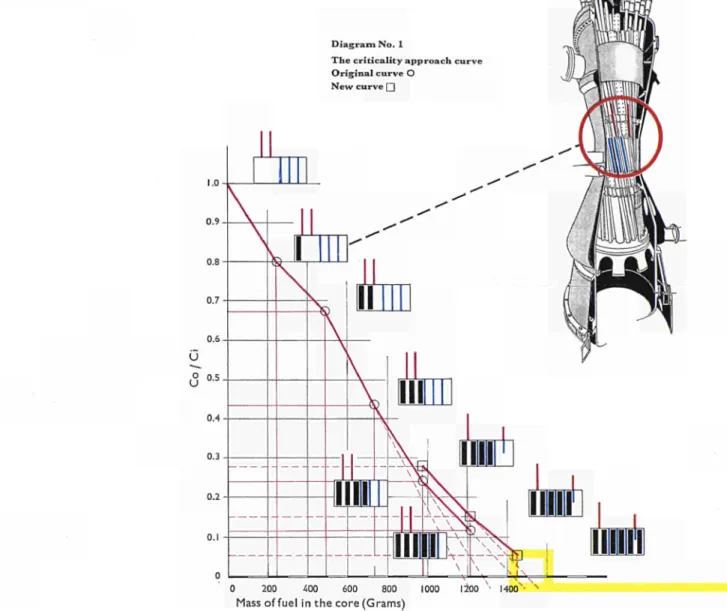
Diagram No. 1
The criticality approach curve Original curve O
New curve Q
0 200 400 600 800 1000 liOO ' 1400 · N
Mass of fuel in the core (Grams)
mathematically that if the ratio of the initial count rate (with no fuel in the reactor) to the count rate after any fuel addition is calculated, i.e. Co/Ci, then Co/Ci is approximately equal to (ï—kett). As fuel is added, the count rate increases until it becomes so m u c h larger than the initial count-rate that Co/Ci tends to zero; kett is in this case approaching unity and the reactor is almost critical.
This fact is used to plot progressively the approach curve, which shows the value of the ratio Co/Ci against mass of u r a n i u m in the core. At any step in the approach pro-cedure, this curve m a y be extrapolated to Co/Ci = zero to m a k e an estimate or prediction of the critical mass. If the fuel elements are loaded in the proper sequence the slope of the approach curve decreases as the mass of u r a n i u m in the core increases, i.e. the curve is concave upward or dish-shaped ; in this case any straight line ex-trapolation to Co/Ci = 0 will give a predicted critical mass less than the true one, and fuel loading m a y continue with confidence.
O n e possible procedure is to base this prediction of the critical mass on the condition where no control rods are
in the core; this means that at the final stages of the approach the reactor must be eased into criticality by the very gradual insertion of a fuel element. Another method is to base the prediction on the condition where the control rods are in the core, which implies loading a little more fuel than is necessary and obtaining criticality by slowly pulling out a control rod. This is the safer procedure and it was adopted in this case.
For the initial criticality of BR2, it was difficult to m a k e full use of the conventional approach curve because the minimum possible increments of fuel were complete fuel elements and only six are required for criticality. With only six points on the curve, each extrapolation gives only a very poor approximation to critical mass and, indeed, it was discovered that the procedure had to be modified towards the end of the approach. When the fifth element had been loaded, a straight line extrapolation of the approach curve did not show that it was safe to introduce the sixth element, and the method had consequently to be changed to prove that the sixth element could be loaded with safety.
T h e a p p r o a c h
With a core arrangement as shown in Fig. 2 and with two rods completely out of the core as safety rods, count rates were measured with the three control rods respectively in and out of the core. W e shall however only mention the values obtained when the rods were in the core, as they are the vital values for the building up of the approach curve.
T h e count rate obtained before fuel-loading was 14.3 cps, which was the value of Co used afterwards for calculating the value of Co/Ci.
As mentioned above, the criticality approach diagram plots Co/Ci against mass of fuel in the reactor. T h e first
point of the diagram thus corresponds to the condition where there is no fuel in the core and Co/Ci is 1. At 09.30 hours the first fuel element was introduced (see Fig. 3). Again, the count rate was determined a n d the value obtained was 17.96. This gives a value of 0.796 for Co/Ci. T h e first element to be introduced contained 243 grams of U 235, and therefore 0.726 is plotted against 243 grams on the approach diagram. If an extrapolation is m a d e to Co/Ci = o, the value obtained for the predicted critical mass is 1190 grams.
At 10.28 hours a second fuel element was introduced (see Fig. 4). This element weighed 244 grams, bringing the total mass in the core to 487 grams. T h e corresponding
27
Diagram No. 2
This diagram, which is a continuation of dia-gram No. 1, shows the last stages of BR2's ap-proach to criticality. AH six fuel elements are now in the core and criticality is obtained by withdrawing control rods gradually.
0.05
0.04 U
0.03
0.02
value of Co/Ci was found to be 0.675 a s plotted on the
approach diagram. Thus the critical mass with control rods in, as extrapolated from the last two points, was found to be about 1850 grams and it was considered safe to add another fuel element.
At 11.25 hours a third element was introduced (see Fig. 5). At this point the extrapolated critical mass with control rods in was 1170 grams. This value was below that ob tained in the case of the 2nd fuel element and was there fore received with some surprise. Indeed the approach curve now looked convex instead of concave. This fact indicated that the choice of position for inserting the second fuel element m a y not have been the best. Never theless, the situation was still well in hand and it was decided to load another element.
A fourth element was therefore placed in position at 12.41 hours (see Fig. 6). At this point the extrapolated critical mass with control rods in was about 1280 grams. T h e next increment of fuel would bring the total mass in the core to 1216 grams, quite close to the 1280 extrapolated value, but previous experience gave assurance that the reactor would still be far from critical.
Therefore the fifth element was introduced in position at 14.37 hours (see Fig. 7). This gave an extrapolated critical mass value of 1455 grams. It thus became evident that there was difficulty with the procedure because the sixth fuel element would bring the total mass of U 235 in the core up to 1457 grams, two grams more than the value of the extrapolated critical mass with the three control rods in. Even though there was strong evidence from previous experience that the reactor would be far from critical with the sixth element in place and the three control rods in, it was considered unsafe to load the sixth element until measurements in BR2 could prove the safety of the situation.
After considerable cogitation and discussion among re actor physicists who had previous experience with the initial start-up of several reactors, it was decided to move a safety rod halfway into the core and to remove the fifth fuel element in order to construct a new curve from the fourth fuel element level.
Rod A was at all times kept full out as safety rod, b u t rod Β was brought down to act as ordinary control rod. Counts were m a d e with rods C, D and E full in and rod Β half-way in, and with rods C, D and Β full in a n d rod E half-way in. This interchange afforded a double check on the condition of the reactor, and it was on the basis of the latter arrangement that the new approach curve was constructed.
At 18.15 hours, with this altered arrangement, the fifth fuel element was inserted again and the extrapolated critical mass was found to be 1530 grams. This is well over the total mass of six elements and it was now with the satisfaction of having a comfortable safety margin in hand that is was decided to load the sixth element. Without changing the control rod settings, the sixth element was introduced in position at 18.25 hours (see Fig. 8). U n d e r these conditions Co/Ci was determined to be 0.058 and it was clear that the reactor was close to criticality.
It was thus decided to attempt to bring the reactor critical by raising control rods, previous experiments having in dicated that BR2 should go critical with six elements in the core and most of the control rod poison out of the core. At 19.35 hours, the slow process of gradually bringing out the control rods started. Little by little the count rate increased until at 21.10 hours the only control rod re maining in the core was C, about half-way in.
From diagram N° 2, which gives a graphical record of these last stages, it is clear how the rods, whose full
ψ
ψ ψ
-ψ~.*.ψ
êêêiê §86θ§
1
29
travelling distance is 960 m m , are worth relatively little d u r i n g the first 200 m m of travel a n d again d u r i n g the last 200 m m .
R o d C was now a t 500 m m n e a r its position of m a x i m u m reactivity change per m m of travel. At this time the count r a t e was 9100 cps a n d a p p r o a c h i n g the value of 10.000 w h i c h h a d been fixed as the m a x i m u m flux level for the purposes of this first criticality. Therefore, at 21.20 hours the n e u t r o n source was w i t h d r a w n far enough to let the c o u n t go down to a b o u t 25 cps. T h e reactor was not critical, which m e a n t that the source was still required to m a i n t a i n 25 cps, b u t the effective multiplication factor
(kett) was very close to unity, p e r h a p s 0.998.
Next, the remaining control rod, C, was w i t h d r a w n in small steps until a t 630 m m the reactor was on a positive period of a b o u t 100 seconds. At this stage, the source was removed completely a n d at 22.10 hours, the reactor was stabilized a n d the chain-reaction was self-supporting with C a t 610 m m .
T h e flux was then reduced to 100 cps a n d raised again to 10.000 cps by moving the control rod C slightly. This was the final proof of criticality.
N e w s from the Euratom Official Spokesman
Visit of E u r a t o m Commission to Japan Radioactivity monitoring
Following the invitation by the Government of Japan, Mr. E. Hirsch, President, and Mr. H. L. Krekeler and Mr. E. M. J. A. Sassen, Members of the Commission of the European Atomic Energy Community (Euratom) paid an official visit to Japan between 2 and 8 November. They were received in audience by H.M. the Emperor. They called on and had discussions with Prime Minister Ikeda and Foreign Minister Kosaka.
The Euratom delegation visited the Japan Atomic Energy Research Institute and the Atomic Fuel Corporation, Tokaimura Nakagun Ibaragiken, to see the activities on the spot in the field of nuclear research and development. They were also given the opportunity to meet the chairman and representatives of the Japan Atomic Industrial Forum and to have an exchange of views on the problems related to the industrial application of nuclear energy.
Minister Miki, Chairman of the Japanese Atomic Energy Commission, provided the Euratom delegation with every opportunity to obtain firsthand information.
Minister Miki expressed the wish that an agreement for co-operation on the peaceful application of nuclear energy might be concluded between Japan and Euratom. The Euratom delegation welcomed this initiative and declared that appropri-ate action will be taken by the Euratom Commission in accord-ance with the institutional procedures provided in the Euratom Treaty. President Hirsch, in the name of the Commission, extended a formal invitation to Minister Miki and members of the Japanese AEC to visit Europe and the Euratom installations and Minister Miki accepted with appreciation this invitation The Euratom delegation was accompanied during their stay in Japan by H. E. Ambassador T. Shimoda, Chief of the Japanese Mission to the European Communities in Brussels. On the completion of the formal programme in Japan President Hirsch conveyed to Minister Miki his deep appreciation of the warmth and spontaneity of the welcome accorded by the Government and the people of Japan.
The Euratom Commission has recently published a document setting out, on the one hand, the present organizational set-up in the Community countries with regard to radioactivity monitoring, and on the other hand the final results of radio-activity measurements for i960. The Commission has collected this information as part of the supervisory rôle which it is called upon to play in this field.
The document shows the considerable extent to which the monitoring post network has grown since the publication of the first detailed report in i960.
The measurement results comprise the figures relating to the radioactivity levels of dusts in suspension in the atmosphere, fall-out and precipitation and, for the first time, the figures pertaining to surface waters.
The Commission is paying particular attention to the trends indicated in the results, which are supplied to it at regular intervals, and which will be published as soon as possible for the year 1961.
Ship propulsion
The European Atomic Energy Community signed on 15 Decem-ber 1961 a contract with the Italian companies Fiat and Ansaldo under which they are to draw up plans for the construction of a 50,ooo-ton tanker powered by a water-reactor of an established type.
Forty percent of the costs involved will be borne by Euratom and 60% by Fiat and Ansaldo. The first 8-months' stage of this 2-year contract will be devoted to the selection of the reactor type, while during the second phase Fiat will be concerned with the development of the reactor type chosen and Ansaldo will look after the planning of the ship, together with the keel mock-ups and tank trials as well as the designing of the drive unit.
Heat transfer
Reactor Centrum Nederland The High Flux Reactor in Petten
The European Atomic Energy Community has extended for a two-year period the large-scale contract in progress with the Société Nationale d'Etude et de Construction de Moteurs d'Aviation (SNECMA) under the US/Euratom Research and Development Programme.
The first stage of this work related to improvements in heat transfer in boiling-liquid-cooled nuclear reactors. These studies, on which about 15 research workers are engaged, are being carried out in close collaboration with the research laboratories of Euratom, which are assigning some of their own staff to work on the project. The problem consists in boosting the specific reactor power by whirling the liquid coolant, by means of metal strips twisted longways into spirals, in the core containing the nuclear fuel, a system which is intended to prevent the formation of a steamlock acting as a heat-insulator.
A Van de Graafi accelerator for Ispra
The European Atomic Energy Community has concluded with the Dutch company High Voltage Engineering a contract for the supply of a positive-ion Van de Graaff accelerator with a maximum power of 1 million e V. Intended for Euratom's Joint Research Centre at Ispra, this apparatus will serve as a source of neutron pulsations for the critical assembly ECO to be constructed under the ORGEL project (study of a natural uranium fuelled, heavy-water-moderated and organic liquid-cooled reactor string).
This apparatus is the second of its kind to be ordered by the Commission from High Voltage Engineering. In i960, this firm was commissioned to supply the Central Nuclear Measure-ments Bureau set up by Euratom at Geel (Belgium) with a positive-ion, 3 million eV Van de Graaff accelerator for neutron experiments.
Water-steam mixtures in power reactors
The European Atomic Energy Community has concluded with the Centro Informazioni Studi Esperienze (CISE) a new research contract on the uses of water-steam mixtures in power reactors.