This is a repository copy of A Structure Theorem for Graphs with No Cycle with a Unique
Chord and Its Consequences.
White Rose Research Online URL for this paper:
http://eprints.whiterose.ac.uk/74349/
Article:
Trotignon, N and Vuskovic, K (2010) A Structure Theorem for Graphs with No Cycle with a
Unique Chord and Its Consequences. Journal of Graph Theory, 63 (1). 31 - 67 . ISSN
0364-9024
https://doi.org/10.1002/jgt.20405
Reuse
See Attached
Takedown
If you consider content in White Rose Research Online to be in breach of UK law, please notify us by
A structure theorem for graphs with no cycle with a
unique chord and its consequences
Nicolas Trotignon∗ and Kristina Vuˇskovi´c†
August 6, 2008
Abstract
We give a structural description of the class C of graphs that do
not contain a cycle with a unique chord as an induced subgraph. Our
main theorem states that any connected graph inCis a either in some
simple basic class or has a decomposition. Basic classes are chordless cycles, cliques, bipartite graphs with one side containing only nodes of degree two and induced subgraphs of the famous Heawood or Petersen graph. Decompositions are node cutsets consisting of one or two nodes and edge cutsets called 1-joins. Our decomposition theorem actually
gives a complete structure theorem forC, i.e. every graph inC can be
built from basic graphs that can be explicitly constructed, and gluing them together by prescribed composition operations; and all graphs
built this way are inC.
This has several consequences: anO(nm)-time algorithm to decide
whether a graph is inC, anO(n+m)-time algorithm that finds a
max-imum clique of any graph inC and anO(nm)-time coloring algorithm
for graphs inC. We prove that every graph inCis either 3-colorable or
has a coloring withωcolors whereωis the size of a largest clique. The
problem of finding a maximum stable set for a graph inC is known to
be NP-hard.
AMS Mathematics Subject Classification: 05C17, 05C75, 05C85, 68R10 Key words: cycle with a unique chord, decomposition, structure, detection, recognition, Heawood graph, Petersen graph, coloring.
1
Motivation
In this paper all graphs are simple. We give a structural characterization of graphs that do not contain a cycle with a unique chord as an induced
∗Universit´e Paris I Panth´eon-Sorbonne, Centre d’´Economie de la Sorbonne, 106–112
boulevard de l’Hˆopital, 75647 Paris cedex 13, France. E-mail: [email protected]. Partially supported by ADONET, network, a Marie Curie training network of the European Community.
†School of Computing, University of Leeds, Leeds LS2 9JT, UK. E-mail:
subgraph. For the sake of conciseness we call C this class of graph. Our main result, Theorem 2.1, states that every connected graph in C is either in some simple basic class or has a particular decomposition. Basic classes are chordless cycles, cliques, bipartite graphs with one side containing only nodes of degree two and graphs that are isomorphic to an induced subgraph of the famous Heawood or Petersen graph. Our decompositions are node cutsets consisting of one or two nodes or an edge cutset called a 1-join. The definitions and the precise statement are given in Section 2. The proof is given in Section 3. Both Petersen and Heawood graphs were discovered at the end of the XIXth century in the research on the four color conjecture, see [19] and [13]. It is interesting to us to have them both as sporadic basic graphs. Note that our theorem works in two directions: a graph is inCif and only if it can be constructed by gluing basic graphs along our decompositions (this is proved in Section 4). Such structure theorems are stronger than the usual decomposition theorems and there are not so many of them (see [3] for a survey). This is our first motivation.
Our structural characterization allows us to prove properties of classical invariants. We prove in Section 6 that every graph G in C satisfies either χ(G) =ω(G) orχ(G)≤3 (whereχ(G) denotes the chromatic number and ω(G) denotes the size of a maximum clique). This is a strengthening of the classical Vizing bound χ(G) ≤ ω(G) + 1. So this class of graphs belongs to the family ofχ-bounded graphs, introduced by Gy´arf´as [12] as a natural extension of perfect graphs: a family of graphsGisχ-boundedwithχ-binding function f if, for every induced subgraph G′ of G ∈ G, χ(G′) ≤ f(ω(G′)).
A natural question to ask is: what choices of forbidden induced subgraphs guarantee that a family of graphs is χ-bounded? Much research has been done in this area, for a survey see [21]. We note that most of that research has been done on classes of graphs obtained by forbidding a finite number of graphs. Since there are graphs with arbitrarily large chromatic number and girth [11], in order for a family of graphs defined by forbidding a finite number of graphs (as induced subgraphs) to be χ-bounded, at least one of these forbidden graphs needs to be acyclic. Vizing’s Theorem [24] states that for a simple graphG, ∆(G)≤χ′(G)≤∆(G) + 1 (where ∆(G) denotes the maximum vertex degree of G, and χ′(G) denotes the chromatic index
H1|1 H2|1 H3|1
[image:4.612.171.426.74.254.2]H2|2 H3|2 H3|3
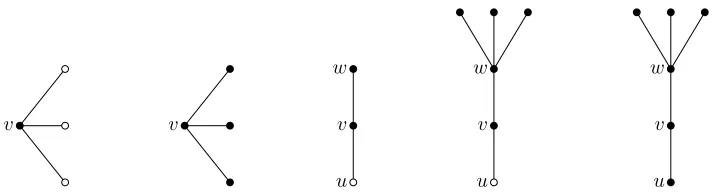
Figure 1: Some s-graphs
inC; and it follows from a construction of Poljak [20] that finding a maximum stable set of a graph in C is NP-hard (see Section 7). All this is our second motivation.
A third motivation is the detection of induced subgraphs. Asubdivisible graph (s-graph for short) is a triple B = (V, D, F) such that (V, D∪F) is a graph andD∩F =∅. The edges in D are said to bereal edges of B while the edges in F are said to be subdivisible edges of B. A realisation of B is a graph obtained fromB by subdividing edges ofF into paths of arbitrary length (at least one). The problem ΠB is the decision problem whose input
is a graphGand whose question is ”DoesGcontain a realisation ofB as an induced subgraph?”. In the discussion below, by “detection problem”, we mean “problem ΠB for some fixed s-graphB”. This is restrictive since a lot
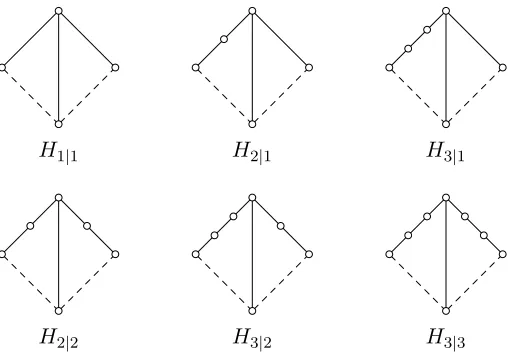
of detection problems of great interest (such as the detection of odd holes, where ahole is an induced cycle of length at least four) are not of that kind. Let H1|1 be the s-graph on nodes a, b, c, d with real edges ab, ac, ad and subdivisible edges bd, cd. We also define for k, l ≥1 the s-graph Hk|l
obtained fromH1|1by subdividing the edgeabinto a path of lengthkand the edgeacinto a path of length l. See Fig. 1 where real edges are represented as straight lines and subdivisible edges as dashed lines. The question in Problem ΠH1|1 can be rephrased as “Does G contain a cycle with a unique chord?” or “IsGnot in C?”. The existence of a polynomial time algorithm was an open question. A consequence of our structural description of C is anO(nm)-time algorithm for ΠH1|1 (see Section 5). This is a solution to the recognition problem for the classCand it is interesting for reasons explained below.
Several problem ΠB’s can be solved in polynomial time by non-trivial
K K′
Figure 2: Some s-graphs
that may look similar at first glance are NP-complete (see [1], [17], and [16] for a survey). A general criterion on an s-graph that decides whether the related decision problem is NP-complete or polynomial would be of interest. Our solution of ΠH1|1 gives some insight in the quest for such a criterion.
A very powerful tool for solving detection problems is the algorithm three-in-a-tree of Chudnovsky and Seymour (see [4]). This algorithm decides in timeO(n4
) whether three given nodes of a given graphGare in an induced tree ofG. In [4] and [16] it is observed that every detection problem ΠB for
which a polynomial time algorithm is known can be solved easily by a brute force enumeration or by using three-in-a-tree. But as far as we can see, three-in-a-tree cannot be used to solve ΠH1|1, so our solution of ΠH1|1 yields the first example of a detection problem that does not fall under the scope of three-in-a-tree. Is there a good reason for that? We claim that a polynomial time algorithm for ΠH1|1 exists thanks to what we calldegeneracy. Let us explain this. Every statement that we give from here on to the end of the section is under the assumption that P6=NP.
Degeneracy has to deal with the following question: does putting bounds on the lengths of the paths in realisations of an s-graph affect the complex-ity of the related detection problem? For upper bounds, the answer can be found in previous research. First, putting upper bounds may turn the complexity from NP-complete to polynomial. This follows from a simple observation: letB be any s-graph. A realisation of B, where the lengths of the paths arising from the subdivisions of subdivisible edges are bounded by an integer N, has a number of nodes bounded by a fixed integer N′ (that depends only onN and the size ofB). So, such a realisation can be detected in timeO(nN′
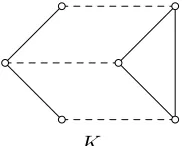
) by a brute force enumeration. But surprisingly, putting up-per bounds in another way may also turn the complexity from polynomial to NP-complete: in [2], a polynomial time algorithm for ΠK is given, while
in [18] it is proved that ΠK′ is NP-complete, where K, K′ are the s-graphs represented in Figure 2. Note that ΠK is usually called the pyramid (or
3PC(∆,·)) detection problem.
edge is subdivided into a path of length at least three. We believe that a satisfactory structural description of the class C′ of graphs that do not
contain a realisation of H3|3 is hopeless because ΠH3|3 is NP-complete. So why is there a decomposition theorem for C ? Simply because degenerate small graphs like thediamond (that is the cycle on four nodes with exactly one chord) are forbidden in C, not in C′, and this helps a lot in our proof of Theorem 2.1 (the decomposition theorem for C). This is what we call thedegeneracy of the class C. It is clear that degeneracy can help in solving detection problems, and our results give a first example of this phenomenon. So the last question is: can putting lower bounds turn the complexity from NP-complete to polynomial? We do not know the answer. Also, we were not able to solve the following questions: what is the complexity of the problems ΠH2|1, ΠH3|1, ΠH2|2 and ΠH3|2? The related classes of graphs are not degenerate enough to allow us to decompose, and they are too degenerate to allow us to find an NP-completeness proof.
A fourth motivation is that our classC is related to well studied classes. It is a generalization of strongly balanceable graphs, see [7] for a survey. A bipartite graph isbalanceable if there exists a signing of its edges with +1 and
−1 so that the weight of every hole is a multiple of 4. A bipartite graph is strongly balanceable if it is balanceable and it does not contain a cycle with a unique chord. There is an excluded induced subgraph characterization of balanceable bipartite graphs due to Truemper [23]. A wheel in a graph consists of a holeHand a nodevthat has at least three neighbors inH, and the wheel isodd if v has an odd number of neighbors in H. In a bipartite graph G, a 3-odd-path configuration consists of two nonadjacent nodes u andv that are on opposite sides of the bipartition ofG, together with three internally node-disjoint uv-paths, such that there are no other edges in G among the nodes of the three paths. A bipartite graph is balanceable if and only if it does not contain an odd wheel nor a 3-odd-path configuration [23]. So a bipartite graph is strongly balanceable if and only if it does not contain a 3-odd-path configuration nor a cycle with a unique chord.
We note that the basic graphs from our decomposition theorem that do not have any of our cutsets, and are balanceable, are in fact 2-bipartite.
Class C is contained in another well studied class of graphs, thecap-free graphs (where a cap is a graph that consists of a hole and a node that has ex-actly two neighbors on this holes, and these two neighbors are adjacent) [6]. In [6] cap-free graphs are decomposed with 1-amalgams (a generalization of a 1-join) into triangulated graphs and biconnected triangle-free graphs to-gether with at most one additional node that is adjacent to all other nodes of the graph. This decomposition theorem is then used to recognize strongly even-signable and strongly odd-signable graphs in polynomial time, where a graph isstrongly even-signableif its edges can be signed with 0 and 1 so that every cycle of length≥4 with at most one chord has even weight and every triangle has odd weight, and a graph isstrongly odd-signableif its edges can be signed with 0 and 1 so that cycles of length 4 with one chord are of even weight and all other cycles with at most one chord are of odd weight.
2
The main theorem
We say that a graphGcontainsa graphH ifH is isomorphic to an induced subgraph ofG. A graphGisH-freeif it does not containH. ForS⊆V(G), G[S] denotes the subgraph of G induced by S. A cycle C in a graph G is a sequence of nodes v1v2. . . vnv1, that are distinct except for the first and
the last node, such that fori= 1, . . . , n−1,vivi+1 is an edge andvnv1 is an
edge (these are the edges ofC). An edge of G with both endnodes in C is called achord ofC if it is not an edge ofC. One can similarly define a path and a chord of a path. In this paper we will only use what is in literature known as chordless paths, so for the convenience, in this paper (like in [5]) we define a path as follows: apath P in a graphGis a sequence of distinct nodesv1. . . vnsuch that fori= 1, . . . , n−1,vivi+1 is an edge and these are the only edges ofGthat have both endnodes in{v1, . . . , vn}. Such a pathP
is also called av1vn-path. A holeis a chordless cycle of length at least four.
A triangle is a cycle of length 3. Asquare is a hole of length 4. A cycle in a graph is Hamiltonian is every node of the graph is in the cycle. Let us define our basic classes:
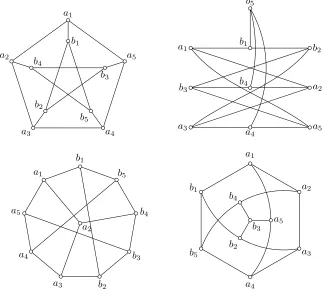
The Petersen graph is the graph on nodes {a1, . . . a5, b1, . . . , b5}so that
{a1, . . . , a5} and {b1, . . . , b5} both induce a C5 with nodes in their natural order, and such that the only edges between the ai’s and the bi’s area1b1,
a2b4,a3b2, a4b5,a5b3. See Fig. 3.
vertex-a1
a5
a4
a3
a2
b1
b3
b5
b2
b4
a1
a5
a4
a3
a2
b1
b2
b3
b4
b5
b1
a1
a5
a4
a3 b2
b3
b4
b5
a2
a1
b1
b5
a4
a3
a2
a5
b4
b2
[image:8.612.136.458.80.375.2]b3
Figure 3: Four ways to draw the Petersen graph
transitive, and are not themselves a cycle with a unique chord, to check that they are inC, it suffices to delete one node, and then check that there is no cycle with a unique chord. For the Petersen graph, deleting a node yields an Hamiltonian graph, and it is easy to check that it does not contain a cycle with a unique chord. For the Heawood graph, it is useful to notice that deleting one node yields the Petersen graph with edges a1b1, b3b4, a3a4 subdivided.
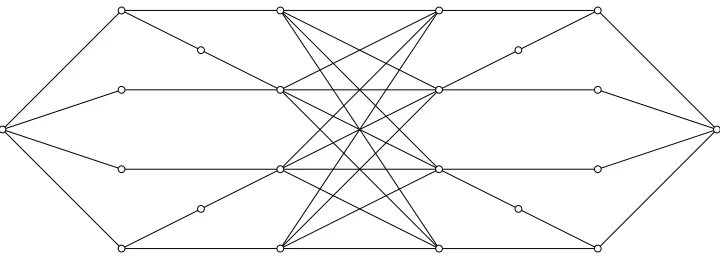
Let us define our last basic class. A graph is strongly 2-bipartite if it is square-free and bipartite with bipartition (X, Y) where X is the set of all degree 2 nodes ofGandY is the set of all nodes ofGwith degree at least 3. A strongly 2-bipartite graph is clearly inCbecause any chord of a cycle is an edge linking two nodes of degree at least three, so every cycle in a strongly 2-bipartite graph is chordless.
We now define cutsets used in our decomposition theorem:
a1 a2 a3 a4 a5 a6 a7 a8 a9 a10 a11 a12 a13 a14
a1 a
2 a3
a4 a5 a6 a7 a8 a9 a10 a11 a12
a13 a 14 a1 a2 a3 a11 a10 a5 a7 a4 a6 a9 a14 a8 a12 a13
a1 a2
a3 a4
a5 a6
a7 a8
a9 a10
a11 a12
[image:9.612.136.458.80.374.2]a13 a14
Figure 4: Four ways to draw the Heawood graph
• A proper 2-cutset of a connected graph G is a pair of non-adjacent nodesa, b, both of degree at least three, such thatV(G) can be parti-tioned into non-empty setsX,Y and{a, b} so that: |X| ≥2,|Y| ≥2; there are no edges between X and Y; and both G[X ∪ {a, b}] and G[Y ∪ {a, b}] contain an ab-path. We say that (X, Y, a, b) is a split of this proper 2-cutset.
• A 1-join of a graphG is a partition ofV(G) into sets X and Y such that there exist setsA, B satisfying:
– ∅ 6=A⊆X, ∅ 6=B⊆Y; – |X| ≥2 and |Y| ≥2;
– there are all possible edges betweenA and B; – there are no other edges betweenX andY.
1-Joins were first introduced by Cunningham [9]. In our paper we will use a special type of a 1-join called aproper 1-join: a 1-join such that A and B are stable sets ofG of size at least two. Note that a square admits a proper 1-join.
Our main result is the following decomposition theorem:
Theorem 2.1 Let G be a connected graph that does not contain a cycle with a unique chord. Then either G is strongly 2-bipartite, or G is a hole of length at least 7, or G is a clique, or G is an induced subgraph of the Petersen or the Heawood graph, orG has a 1-cutset, a proper 2-cutset, or a proper 1-join.
The following intermediate results are proved in the next section. Theo-rem 2.1 follows from TheoTheo-rems 2.3 and 2.4 (more precisely, it follows from 2.4 for square-free graphs, and from 2.3 for graphs that contain a square).
Theorem 2.2 LetGbe a connected graph that does not contain a cycle with a unique chord. If G contains a triangle then either G is a clique, or one node of the maximal clique that contains this triangle is a 1-cutset ofG.
Theorem 2.3 Let G be a connected graph that does not contain a cycle with a unique chord. Suppose that Gcontains either a square, the Petersen graph or the Heawood graph. Then either G is the Petersen graph or G is the Heawood graph or G has a 1-cutset or a proper 1-join.
Theorem 2.4 LetG be a connected square-free graph that does not contain a cycle with a unique chord. Then eitherGis strongly 2-bipartite, orGis a hole of length at least 7, or Gis a clique orG is an induced subgraph of the Petersen or the Heawood graph, or G has a 1-cutset or a proper 2-cutset.
3
Proof of Theorems 2.2, 2.3 and 2.4
We first need two lemmas:
Lemma 3.1 Let G be a graph inC, H a hole of G andv a node of G\H. Then v has at most two neighbors in H, and these two neighbors are not adjacent.
Proof —Ifv has at least three neighbors inH, thenH contains a subpath P with exactly three neighbors of v and V(P)∪ {v} induces a cycle of G with a unique chord, a contradiction. If v has two neighbors in H, they must be non-adjacent for otherwiseH∪ {v} is a cycle with a unique chord. 2
Lemma 3.2 Let Gbe a connected graph that has no 1-cutset. If {a, b} is a 2-cutset ofG and abis an edge, then G6∈ C.
Proof —Suppose{a, b}is a 2-cutset ofG, andabis an edge. LetC1, . . . , Ck
be the connected components of G\ {a, b}. Since G is connected and has no 1-cutset, for every i ∈ {1, . . . , k}, both a and b have a neighbor in Ci.
Let G′ be the graph obtained from G by removing the edge ab. So for
every i∈ {1, . . . , k}, there is an ab-path Pi in G′ whose interior nodes are
contained inCi. ThenG[V(P1)∪V(P2)] is a cycle with a unique chord, and
henceG6∈ C. 2
IfH is any induced subgraph ofGand Dis a subset of nodes of G\H, theattachment of D over H is the set of all nodes of H that have at least one neighbor inD. When clear from context we do not distinguish between a graph and its node set, so we also refer to the attachment ofG[D] overH.
Proof of Theorem 2.2
SupposeGcontains a triangle, and letC be a maximal clique ofGthat con-tains this triangle. In fact,C is unique or otherwiseG contains a diamond. IfG6=C and if no node ofC is a 1-cutset ofG then let Dbe a connected induced subgraph ofG\C, whose attachment overC contains at least two nodes, and that is minimal with respect to this property. So, D is a path with one end adjacent toa∈C, the other end adjacent to b∈C\ {a} and D∪ {a, b} induces a chordless cycle. If D has length zero, then its unique node (say u) must have a non-neighborc ∈C since C is maximal. Hence,
{u, a, b, c} induces a diamond, a contradiction. IfDhas length at least one then letc6=a, bbe any node of C. Then the hole induced byD∪ {a, b}and nodec contradict Lemma 3.1. This proves Theorem 2.2.
Proof of Theorem 2.3
Claim 1 We may assume that Gis triangle-free.
Proof — Clear by Theorem 2.2 (note thatGcannot be a clique). 2
Claim 2 We may assume that Gis square-free.
Proof — Assume G contains a square. Then G contains disjoint sets of nodesAandB such thatG[A] andG[B] are both stable graphs,|A|,|B| ≥2 and every node of A is adjacent to every node of B. Let us suppose that A∪Bis chosen to be maximal with respect to this property. IfV(G) =A∪B then (A, B) is a proper 1-join ofG, so we may assume that there are nodes inG\(A∪B).
Else, let us take a connected induced subgraph D of G\(A∪B), whose attachment overA∪B contains nodes of bothAandB, and that is minimal with respect to this property. SoD =u . . . v is a path, no interior node of which has a neighbor in A∪B and there exists a ∈ A, b ∈ B such that ua, vb ∈ E(G). By Claim 1, u =6 v, u has no neighbor in B and v has no neighbor inA. By maximality of A∪B, u has a non-neighbor a′ ∈A and v has a non-neighborb′ ∈B. Now, D∪ {a, b, a′, b′} is a cycle with a unique
chord (namelyab), a contradiction. This proves (1).
From (1), it follows that Ghas a proper 1-join with special sets A, B. 2
Now, we just have to prove the following two claims:
Claim 3 If Gcontains the Petersen graph then the theorem holds.
Proof — Let Π ={a1, . . . a5, b1, . . . , b5}be a set of ten nodes of G so that G[Π] has adjacencies like in the definition of the Petersen graph. We may assume that there are some other nodes in G for otherwise the theorem holds.
(1) A node of G\Π has at most one neighbor in Π.
OtherwiseGcontains a triangle or a square, contrary to Claims 1, 2. This proves (1).
Here below, we use symmetries in the Petersen graph to shorten the list of cases. First, the Petersen graph is edge-transitive, so up to an automor-phism, all edges are equivalent. But also, it is “distance-two-transitive”, meaning that every inducedP3 is equivalent to every other induced P3. To see this, it suffices to check that every inducedP3 is included in an induced C5 and that removing anyP3 always yields the same graph.
(2) The attachment of any component ofG\Π overΠ contains at most one node.
Else, let D be a connected induced subgraph of G\Π whose attachment over Π contains at least two nodes, and that is minimal with respect to this property. By minimality and up to symmetry, D is a path with one end adjacent toa1 (and to no other node of Π by (1)), one end adjacent to x∈ {a2, a3} (and to no other node of Π). Moreover, no interior node of D has a neighbor in Π. Ifx=a2thenD∪ {a1, . . . , a5}is a cycle with a unique chord, a contradiction. Ifx=a3 thenD∪ {a1, a5, b3, b4, b5, a4, a3} is a cycle with a unique chord, a contradiction again. This proves (2).
From (2) it follows that Ghas a 1-cutset. 2
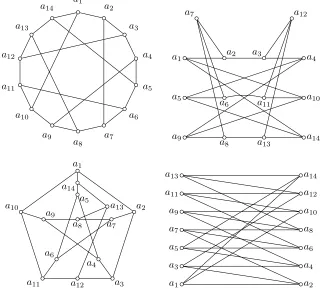
Proof —Let Π ={a1, . . . , a14}be a set of fourteen nodes ofGso thatG[Π] has adjacencies like in the definition of the Heawood graph. We may assume that there are some other nodes inG for otherwise the theorem holds.
(1) A node of G\Π has at most two neighbors in Π.
Suppose that some nodev inG\Π has at least two neighbors in Π. Since the Heawood graph is vertex-transitive we may assume va1 ∈ E(G). By Claims 1 and 2, v cannot be adjacent to a node at distance 1 or 2 from v, namely to any of a2, a14, a10, a3, a13, a9, a11, a5, a7. So, the only other possible neighbors are a4, a6, a8, a12. But these four nodes are pairwise at distance two in Π, so by Claim 2,vcan be adjacent to at most one of them. This proves (1).
(2) The attachment of any component ofG\Π overΠ contains at most one node.
Else, letDbe a connected induced subgraph ofG\Π whose attachment over Π contains at least two nodes, and is minimal with respect to this property. By minimality and up to symmetry, D is a path, possibly of length zero, with one end adjacent to a1, one end adjacent to ai where i 6= 1 and no
interior node ofD has neighbors in Π. Note that by assumption, ifD is of length at least one then no end of D can have more than one neighbor in Π, because such an end would contradict the minimality ofD. So,a1, ai are
the only nodes of Π that have neighbors inD(whenDis of length zero this holds by (1).
Ifi= 2 thenD∪ {a1, a2, a7, a8, a9, a10}is a cycle with a unique chord. If i∈ {3,4,5} then D∪ {ai, ai+1, . . . , a8, a13, a14, a1} is a cycle with a unique
chord. If i = 6 then D∪ {a6, a5, a4, a9, a8, a13, a14, a1} is a cycle with a unique chord. Ifi∈ {7,8} thenD∪ {a1, a2, . . . , ai} is a cycle with a unique
chord. If i = 9 then D∪ {a9, . . . , a14} is a cycle with a unique chord. If i∈ {10,11}thenD∪{a1, a2, a3, a4, a9, a10, ai}is a cycle with a unique chord.
If i ∈ {12,13} then D∪ {a1, a2, a3, a4, a5, a6, a11, a12, ai} is a cycle with a
unique chord. If i = 14 then D∪ {a1, a2, a7, a8, a13, a14} is a cycle with a unique chord. In every case, there is a contradiction. This proves (2).
From (2) it follows that Ghas a 1-cutset. 2
This proves Theorem 2.3.
Proof of Theorem 2.4
We consider a graph G containing no cycle with a unique chord and no square. So:
Our proof now goes through thirteen claims, most of them of the same kind: if some basic graphHis an induced subgraph ofG, then eitherG=H and soG itself is basic, or some nodes of G\H must be attached to H in a way that entails a proper 2-cutset. At the end of this process there are so many induced subgraphs forbidden in G that we can prove that G is strongly 2-bipartite.
Claim 2 We may assume that Gis triangle-free.
Proof — Clear by Theorem 2.2. 2
Claim 3 We may assume that Gdoes not contain the Petersen graph.
Proof —Clear by Theorem 2.3. Note thatGcannot admit a proper 1-join
since it is square-free. 2
Claim 4 We may assume that Gdoes not contain the Heawood graph.
Proof — Clear by Theorem 2.3. 2
Claim 5 We may assume that G does not contain the following configura-tion: three node-disjoint paths X = x . . . x′, Y = y . . . y′ and Z = z . . . z′, of length at least two and with no edges between them. There are four more nodes a, b, c, d. The only edges except those from the paths are ax, ay, az, bx′, by, bz′, cx′, cy′, cz, dx, dy′, dz′.
Proof — Let Π = X∪Y ∪Z ∪ {a, b, c, d}. Nodes a, b, c, d, x, x′, y, y′, z, z′ are called here the branch nodes of Π. It is convenient to notice that G[Π] can be obtained by subdividing the edges of any induced matching of size three of the Petersen graph. Note also that either G[Π] is the Heawood graph with one node deleted (when X, Y, Z all have length two), or G[Π] has a proper 2-cutset (when one of the paths is of length at least three, the proper 2-cutset is formed by the ends of that path). Hence we may assume that there are nodes inG\Π.
(1) A node of G\Π has neighbors in at most one of the following sets: X, Y, Z,{a},{b},{c},{d}.
Letube a node ofG\Π. Note that a, b, c, dare pairwise at distance two in Π, so by Claims 1 and 2,u can be adjacent to at most one of them.
Suppose first that ux ∈ E(G). Then u can be adjacent to none of a, d, y, y′, z, z′ by Claims 1 and 2. Ifuis adjacent to some other branch-node
a neighborvin the interior ofY orZ (sayZ up to symmetry) for otherwise the claim holds. By Lemma 3.1 and since xdz′Zzcx′Xx is a hole, we note thatu has exactly two neighbors in X∪Z, namely x and v. If vz′ ∈/ E(G) then xuvZzaybz′dx is a cycle with a unique chord, a contradiction. So
vz′ ∈ E(G) and xuvZzcx′bz′dx is a cycle with a unique chord (namely vz′), a contradiction again. Hence we may assume that ux /∈ E(G), and symmetricallyux′, uy, uy′, uz, uz′ ∈/ E(G).
Suppose now thatua∈E(G). Then u cannot be adjacent to any other branch-node of Π by the discussion above. So we may assume thatu has a neighbor in the interior ofX, Y, Z (sayZ up to symmetry) for otherwise our claim holds. Now we definevto be the neighbor ofualongZ closest tozand observe that uvZzcx′byau is a cycle with a unique chord, a contradiction. Therefore we may assume thatu is not adjacent to any branch-node of Π.
We may suppose now that u has neighbors in the interior of at least two of the paths among X, Y, Z (say X, Z w.l.o.g.) for otherwise our claim holds. Let v (resp. w) be a neighbor of u in X (resp. Z). SinceX∪Z ∪ {d, c} induces a hole, by Lemma 3.1, N(u)∩(X ∪Z) = {v, w}. If vx /∈
E(G) then vuwZz′dxaybx′Xv is a cycle with unique chord. Sovx∈E(G) and symmetrically, vx′, wz, wz′ ∈ E(G). If u has no neighbor in Y then vuwz′dy′Y ybx′v is a cycle with a unique chord, soumust have at least one
neighborw′ inY. By the same discussion that we have done above onX, Z we can prove thatw′y, w′y′ ∈E(G). Now we observe thatG[Π∪ {u}] is the
Heawood graph, contradicting Claim 4. This proves (1).
(2) The attachment of any component of G\Π is included in one of the sets X, Y, Z,{a},{b},{c},{d}.
Else let D be a connected induced subgraph of G\Π whose attachment overlaps two of the sets, and is minimal with respect this property. By (1), Dis a path of length at least one, with endsu, vandu(resp. v) has neighbors in exactly one set Su (resp. Sv) of X, Y, Z,{a},{b},{c},{d}. Moreover, no
interior node ofDhas a neighbor in Π. IfSu =XandSv ={a}then letwbe
the neighbor ofu closest to x along X. We observe thatayY y′dxXwuDva
is a cycle with a unique chord, a contradiction. Every case where there is an edge between Su and Sv is symmetric, so we may assume that there
is no edge between Su and Sv. If Su = X and Sv = Z then let w (resp.
w′) be the neighbor of u (resp. of v) closest to x′ along X (resp. to z′ alongZ). Ifw=xandw′ =z thenxdy′Y yazvDuxis a cycle with a unique chord, a contradiction. So up to symmetry we may assumew′ 6=z. Hence wXx′cy′Y ybz′Zw′vDuw is a cycle with a unique chord, a contradiction.
So up to symmetry we may assume that Su = {a} and Sv = {c}. But
By (2), either some component of G\Π attaches to a node of Π and there is a 1-cutset, or some component attaches to one ofX, Y, Z (sayX up to symmetry), and{x, x′} is a proper 2-cutset. 2
Claim 6 We may assume that G does not contain the following configura-tion: three node-disjoint paths X =x . . . x′, Y =y . . . y′ and Z =z . . . z′, of length at least two, and such that the only edges between them are xy, yz, zx′, x′y′, y′z′ and z′x.
Proof — Note that G[x, y, z, x′, y′, z′] is a hole on six nodes. Also either
G[X∪Y ∪Z] is the Petersen graph with one node deleted (whenX, Y, Z have length two), orG[X∪Y ∪Z] has a proper 2-cutset (when one of the paths is of length at least three, the 2-cutset is formed by the ends of that path). Hence we may assume that there are nodes inG\(X∪Y ∪Z). (1) A node of G\(X∪Y ∪Z) has neighbors in at most one of the sets X, Y, Z.
Letu be a node of G\(X∪Y ∪Z). Note that u has neighbors in at most one of the following sets: {x, x′},{y, y′},{z, z′}, for otherwiseGcontains a triangle or a square, contradicting Claims 1 and 2.
Ifuhas at least two neighbors amongx, x′, y, y′, z, z′then we may assume by the paragraph above ux, ux′ ∈ E(G). Since X ∪Y and X ∪Z both
induce holes, every node inX∪Y ∪Z is in a hole going throughx, x′. So,
by Lemma 3.1uhas no other neighbors inX∪Y∪Z. Hence, from here on, we assume thatu has at most one neighbor amongx, x′, y, y′, z, z′.
If ux∈E(G) then we may assume thatu has neighbors in one of Y, Z, sayZ up to symmetry. Letv∈Z be a neighbor of u. Then by Lemma 3.1, sinceX∪Z induces a hole, v and x are the only neighbors ofu inX∪Z. So, xuvZz′y′x′Xx is a cycle with a unique chord, a contradiction. Hence
we may assume thatu has no neighbors amongx, x′, y, y′, z, z′.
If u has neighbors in the interior of at most one of X, Y, Z our claim holds, so let us suppose that u has neighbors in the interior of X and the interior of Y. Since X ∪Y induces a hole, by Lemma 3.1, u has a unique neighbor v ∈ X and a unique neighbor w ∈ Y. If u has no neigh-bor in Z then xXvuwY yzZz′x is a cycle with a unique chord, a
contra-diction. So u has a neighbor w′ ∈ Z that is unique by Lemma 3.1. If vx, wy /∈E(G) thenx′zyxz′y′Y wuvXx′is a cycle with a unique chord, a con-tradiction. So, up to a symmetry we may assumevx∈E(G). Ifwy′ ∈/ E(G)
then x′y′z′xyY wuvXx′ is a cycle with a unique chord, a contradiction, so wy′ ∈ E(G). By the same argument, we can prove that w′z ∈ E(G). If vx′, wy, w′z′ ∈ E(G) then we observe that G[X∪Y ∪Z∪ {u}] is the
vx′ ∈ E(G) and wy /∈ E(G). But then, wuvxyzx′y′w is a cycle with a
unique chord, a contradiction. This proves (1).
(2) The attachment of any component of G\(X∪Y ∪Z) is included in one of the setsX, Y, Z.
Else let D be a connected induced subgraph of G\(X∪Y ∪Z), whose attachment overlaps two of the sets, and is minimal with this property. By (1), D is a path of length at least one, with ends u, v and no interior node ofDhas a neighbor inX∪Y∪Z. We may assume thatuhas neighbors only in X and v only in Y. Let u′ (resp. v′) be the neighbor of u (resp. of v) closest to x along X (resp. to y along Y). If u′ 6= x′ and v′ 6= y′
then zyY v′vDuu′Xxz′Zz is a cycle with a unique chord, a contradiction, so we may assume v′ =y′. Let u′′ be the neighbor of u closest to x′ along X. If u′′ 6= x then uu′′Xx′zZz′y′vDu is a cycle with a unique chord a
contradiction. So, u′′ = x and uxz′Zzx′y′vDu is a cycle with a unique chord, a contradiction. This proves (2).
By (2) one of {x, x′},{y, y′},{z, z′}is a proper 2-cutset of G. 2
Claim 7 We may assume that G does not contain the following configura-tion: four node-disjoint pathsX =a1. . . a5,Y =a2. . . a6,Z =a3. . . a7 and T = a4. . . a8, of length at least two, and such that the only edges between them are a1a2,a2a3, a3a4, a4a5, a5a6, a6a7,a7a8 anda8a1.
Proof — EitherG[X∪Y ∪Z∪T] is obtained from the Heawood graph by deleting two adjacent nodes (when X, Y, Z, T have length two), or G[X ∪
Y ∪Z ∪T] has a proper 2-cutset (when one of the paths is of length at least three, the 2-cutset is formed by the ends of that path). Hence we may assume that there are nodes inG\(X∪Y ∪Z∪T).
(1) A node of G\(X∪Y∪Z∪T)has at most two neighbors inX∪Y∪Z∪T. For suppose that a nodeuofG\(X∪Y∪Z∪T) has at least three neighbors inX∪Y∪Z∪T. Since every pair of path fromX, Y, Z, T can be embedded in a hole (for instance,X∪Y orX∪Z ∪ {a2, a6} are holes, and the other cases are symmetric), by Lemma 3.1, the neighbors ofu lie on three or four paths and every path contains at most one neighbor ofu.
Suppose u is adjacent to one of the ai’s, say a1. Then by Lemma 3.1
Up to symmetry we assume that u has neighbors x ∈ X, y ∈ Y, z ∈
Z. These neighbors are unique and are in the interior of their respective paths. So uxXa5a6Y a2a3Zzu is a cycle with a unique chord (namely uy), a contradiction. This proves (1).
(2) The attachment of any component of G\(X∪Y ∪Z∪T) is included in one of the setsX, Y, Z, T.
Else letDbe a connected induced subgraph ofG\(X∪Y∪Z∪T), whose at-tachment overlaps two of the sets, and is minimal with respect this property. By the choice ofD, the following hold. Dis a path, possibly of length zero, with ends u, v, and we may assume up to symmetry that u has neighbors in X and that v has neighbors in Y or in Z. No interior node of D has neighbors inX∪Y ∪Z∪T. Ifu 6=v then u has neighbors only in X and v only in Y or inZ. Ifu=v then by (1) uhas neighbors only in X∪Y or only in X∪Z.
Ifv has neighbors inY then letxbe the neighbor ofuclosest toa5 along X and y be the neighbor of v closest to a6 along Y. If x =a1 and y =a2 thenD∪ {a1, . . . , a8}is a cycle with a unique chord, so up to symmetry we may assume x 6= a1. But then, uxXa5a4T a8a7a6Y yvDu is a cycle with a unique chord, a contradiction.
So v has neighbors in Z. We claim that v has a unique neighbor z in Z, that is in the interior of Z, and that Z has length two. Else, up to the symmetry between a3 and a7 we may assume that the neighbor z of v closest to a3 along Z is not a7 and is not adjacent to a7. Let x be the neighbor ofuclosest toa5alongX. Ifx=a1 thena1Xa5a6Y a2a3ZzvDua1 is a cycle with a unique chord. Sox 6=a1. If v is not adjacent toa7, then a5a6a7a8T a4a3ZzvDuxXa5 is a cycle with unique chord, a contradiction. So v is adjacent to a7. In particular, u 6=v. By (1), a7 and z are the only neighbors of v in Z. But then a5a6a7ZzvDuxXa5 is a cycle with unique chord, a contradiction. So, our claim is proved. Similarly, it can be proved thatu has a unique neighborx inX, that this neighbor is in the interior of X, and thatX has length two. We observe that the three pathsxuDvz,Y, T and nodes a1, a3, a7, a5 have the same configuration as those in Claim 5, a contradiction. This proves (2).
By (2), one of {a1, a5}, {a2, a6}, {a3, a7}, {a4, a8} is a proper 2-cutset. 2
Proof — We put Π = P13∪P15 ∪P48∪P37∪P57. Either G[Π] is the Heawood graph with three nodes inducing aP3 deleted (when the five paths have length two), or G[Π] has a proper 2-cutset (when one of the paths is of length at least three, the 2-cutset is formed by the ends of that path). Hence we may assume that there are nodes inG\Π.
(1) A node of G\Π has at most two neighbors in Π.
Letu be a node of G\Π and suppose that u has more than two neighbors in Π. By Lemma 3.1 and since P13∪P15 ∪P37 ∪P57 is a hole, u has at most two neighbors among these paths. So, u must have one neighbor in P48, and this neighbor is unique since the union of P48 with any of the other paths yields a hole. For the same reason, u has a unique neighbor in exactly two paths amongP13, P15, P37, P57. So there are two cases up to symmetry: eitheru has neighbors in two path amongP13, P15, P37, P57 that have a common end, oruhas neighbors in two path amongP13, P15, P37, P57 that have no common ends.
In the first case, we may assume that u has neighbors x ∈ P37, y ∈
P48 and z ∈ P13. Note that x 6= a3 and z 6= a3, for otherwise P13 or P37 would contain two neighbors of u. Suppose y 6= a4. If z 6= a1 then xuyP48a8a1P15a5P57a7P37x is a cycle with a unique chord, a contradiction. If z = a1 then by Claim 1, x 6= a7 and hence xuyP48a8a1P13a3P37x is a cycle with a unique chord, a contradiction. So y = a4. But then, since G does not contain a square, xa3 ∈/ E(G) and hence uxP37a7a8a1P13a3a4u is a cycle with a unique chord, a contradiction.
In the second case, we may assume that u has neighbors x inP13, y in P48 and z in P57. If x =a1 then the previous case applies. Hence we may assume x6=a1 and symmetrically z 6=a5. So, uxP13a3a4P48a8a7P57zu is a cycle with a unique chord (namelyuy). This proves (1).
(2) The attachment of any component of G\Π is included in one of the sets P13, P15, P37, P57, P48.
Else letDbe a connected induced subgraph ofG\Π, whose attachment is not contained in one of the sets, and is minimal with respect to this property. By the choice ofDthe following hold. Dis a path, possibly of length zero, with endsu, v, whereuhas neighbors in one of the setsP13, P15, P37, P57, P48that we denote byXu, andv has neighbors in another one, sayXv. No interior
node of D has neighbors in Π. If u 6= v then u has neighbors only in Xu
and vonly in Xv. If u=v then by (1)u has neighbors only in Xu∪Xv.
If Xu = P48 then up to symmetry we may assume Xv = P57. Let x
unique chord. So,Xu 6=P48, and symmetricallyXv 6=P48.
IfXu,Xv are paths with a common end then we may assumeXu =P37
andXv =P57. Letx be the neighbor ofu closest to a3 alongP37and y the
neighbor ofv closest to a5 along P57. We note that x, y6=a7 for otherwise the attachment of D is a single path P37 or P57 contrary to the definition ofD. So,xuDvyP57a5a4P48a8a1P13a3P37x is a cycle with a unique chord.
IfXu,Xv are paths with no common end then we may assumeXu =P13
and Xv = P57. We claim that u has a unique neighbor in P13, that is in
the interior ofP13, and that P13 has length two. Else, up to the symmetry between a1 and a3 we may assume that the neighbor x of u closest to a3 along P13 is not a1 and is not adjacent to a1. Let y be the neighbor of v closest to a5 along P57. If y = a7 then the previous case applies, i.e. the neighbors ofuandvin Π are contained in the paths with a common end. So y6=a7. Ifu is not adjacent to a1, then xuDvyP57a5P15a1a8P48a4a3P13x is a cycle with a unique chord. Souis adjacent toa1. By (1),a1andxare the only neighbors of uin Π. But then xuDvyP57a5P15a1P13xis a cycle with a unique chord. Our claim is proved, and similarly we can prove thatv has a unique neighbor inP57, that this neighbor is in the interior ofP57 and that P57 has length two. Now we observe that the paths xuDvy, P15, P37, P48 have the same configuration as those in Claim 7, a contradiction. This proves (2).
By (2), one of {a1, a5}, {a1, a3}, {a4, a8}, {a5, a7} {a3, a7} is a proper
2-cutset. 2
Claim 9 We may assume that Gdoes not contain a cycle with exactly two chords.
Proof — For letC be a cycle inGwith exactly two chordsab, cd. We may assume up to the symmetry between c and d that a, c, b, d appear in this order alongC for otherwise there is a cycle with a unique chord. We denote by Pac the unique path in C from ato c that does not go throughb, d. We
define similarlyPcb,Pbd,Pda. We assume that Cis a cycle with exactly two
chords inG that has the fewest number of nodes.
IfPcb has length one thenPac∪Pbdis a cycle with a unique chord unless
Pad has also length one. But then G[a, b, c, d] is a square or contains a
triangle, a contradiction to Claims 1 and 2. SoPcb has length at least two
and symmetrically,Pac,Pbd,Pda have all length at least two.
Letu be a node ofG\C that has at least three neighbors inC. Note that by Lemma 3.1, u has at most one neighbor in each of Pac, Pcb, Pbd, Pda
because the union of any two of them forms a hole. So, up to symmetry we may assume that u has neighbors x ∈ Pad, y ∈ Pac,z ∈ Pbd (and possibly
one more in Pcb). If y = c then x 6= d and xd /∈ E(G) for otherwise
Gcontains a square or a triangle, contradicting Claims 1 and 2, and hence ucdPbdbaPadxuhas a unique chord (namelyuz). Soc6=yand symmetrically,
b6=z. HenceyuzPbddPadaPacy is a cycle with a unique chord (namelyux),
a contradiction. Sou has at most two neighbors in C.
Let x and y be two neighbors of u in C, and suppose that they both belong to the same path, say Pbd. W.l.o.g. x is closer to b on Pbd. By
Claims 1 and 2, thexy-subpathP of Pbd is of length greater than 2. LetC′
be the cycle induced by (C\P)∪ {x, y}. ThenC′is a cycle with exactly two
chords that has fewer nodes than C, contradicting our choice of C. This proves (1).
(2) The attachment of any component ofG\C is included in one of the sets Pac, Pcb, Pbd, Pda.
Else letD be a connected induced subgraph ofG\C, whose attachment is not contained in one of the sets and is minimal with respect to this property. By the choice of D the following hold. D is a path possibly of length zero, with ends u, v, where u has neighbors in one of the sets Pac, Pcb, Pbd, Pda
that we denote by Xu, and v has neighbors in another one, say Xv. No
interior node of D has neighbors in C. If u 6=v then u has neighbors only in Xu and v only in Xv. If u = v, then by (1) u has neighbors only in
Xu ∪Xv. Let x be a neighbor of u in Xu, and y a neighbor of v in Xv.
By (1), (N(u)∪N(v))∩C={x, y}.
If Xu and Xv share a common end then up to symmetry we assume
Xu = Pac, Xv = Pad. Neither x nor y coincides with a for otherwise the
attachment ofDoverC is inPac orPad, contrary to the definition ofD. So,
uDvyPaddPbdbPbccPacxuis a cycle with a unique chord.
So Xu and Xv do not share a common end, hence up to symmetry we
assume Xu =Pac, Xv = Pbd. By the previous paragraph, we may assume
x6∈ {a, c}andy6∈ {b, d}. Ifxa, yb /∈E(G) thenxPaccPcbbaPaddPbdyvDuxis
a cycle with a unique chord. So, up to symmetry we assumexa∈E(G). If yd /∈E(G) thenxuDvyPbdbaPaddcPacxis a cycle with a unique chord, a
con-tradiction. So,yd∈E(G). SincexabPbccdyvDux cannot be a cycle with a
unique chord,xc, ybare either both inE(G) or both not inE(G). In the first case, the three pathsxuDvy,Pad, Pbc have the same configuration as those
in Claim 6. In the second case, the five paths xuDvy,Pad, Pbc, xPacc, yPbdb
have the same configuration as those in Claim 8. This proves (2).
Claim 10 We may assume that G does not contain a cycle with exactly three chords.
Proof —LetCbe a cycle inGwith exactly three chordsab,cd,efsay. Up to symmetry we may assume that a, c, e, b, d, f appear in this order along the cycle and are pairwise distinct for otherwise C contains a cycle with a unique chord. We denote by Pac the unique path from a to c in C that
does not go through e, b, d, f. We define similarly Pce, Peb, Pbd, Pdf, Pf a. If
G[{a, b, c, d, e, f}] contains only three edges then Paf ∪Pf d ∪Pce ∪Peb is
a cycle with a unique chord (namely f e), a contradiction. Hence, up to symmetry we may assume ac∈E(G). Now Paf ∪Pdb∪Pce is a cycle with
one, two or three chords : ac and possibly f d and eb. By Claim 9, this cycle must have three chords, soeb, f d∈E(G). Note that bd /∈E(G) since G contains no square by Claim 1, and similarly af, ce /∈ E(G). Now we observe that the pathsPaf, Pce, Pbd have the same configuration as those in
Claim 6, a contradiction. 2
Claim 11 We may assume that G does not contain a cycle with at least one chord.
Proof — Let C be a cycle in G with at least one chord ab. We choose C minimal with this property. Cycle C must have another chord cd, and we may assume that a, d, b, c are pairwise distinct and in this order along C for otherwise C contains a cycle with at least one chord that contradicts the minimality of C. By Claim 9, C must have another chord ef, and again we may assume that a, e, d, b, f, c are pairwise distinct and in this order along C because of the minimality of C. By Claim 10, C must have again another chordgh, and again we may assume thata, g, e, d, b, h, f, care pairwise distinct and in this order along C because of the minimality ofC. Now, the path fromatof alongCthat goes throughcand the path frome to balong C that goes through dform a cycle smaller thanC with at least one chord (namelycd), a contradiction. 2
A non-induced path P in a graph G is a sequence of distinct nodes v1. . . vn such that fori= 1, . . . , n−1,vivi+1 is an edge (these are theedges of the path). There might be other edges: the chords of the paths.
Claim 12 We may assume thatGdoes not contain the following configura-tion: five non-induced pathsP =a . . . c, Q=a . . . c, R=b . . . d, S=b . . . d, X=c . . . d, node-disjoint except for their ends, of length at least one, except for X that can be of length zero or more, together with edge ab.
nodes{x, y} ⊆Π can be embedded into a cycle containing only edges of the non-induced paths andab, so ifxy is an edge of G[Π] that contradicts our statement then there is a cycleC of G[Π] such thatxy is a chord ofC, and this contradicts Claim 11. In particular, the five non-induced paths have no chords, so they are in fact paths. Note that P, Q, R, S are all of length at least two for ifP (say) is of length one, then the unique edge ofP is a chord of a cycle ofG[Π], and this contradicts Claim 11.
We now show that {a, c} is a proper 2-cutset of G. Assume not. Then there is a path D= u . . . v in G\Π such that u has a neighbor x in (P ∪
Q)\ {a, c} (say in Q\ {a, c}) andv has a neighbor y in (X∪R∪S)\ {c}. Suppose that y ∈X\ {c}. Then the five non-induced paths aQxuDvy, aP cXy,R,S andyXdform a configuration that contradicts the minimality ofX.
Soy 6∈X\ {c}, and hence w.l.o.g.y∈R\ {d}. SouxQaP cXdSbRyvDu is a cycle with at least one chord (namelyab), contradicting Claim 11. 2
Claim 13 We may assume that G does not contain the following induced subgraph (that we call I): six nodes a, b, c, d, e, f with the following edges: ab, ac, ad, be, bf.
Proof — We may assume that G has no 1-cutset. Hence, by Lemma 3.2,
{a, b} is not a cutset of G. So there exists a path in G\ {a, b} with an end having neighbors in{c, d}and an end having neighbors in{e, f}. We choose a minimal such path D = u . . . v. Up to symmetries and since G contains no square and no triangle by Claims 1 and 2, we may assume that u has a unique neighbor in {c, d}, and that v has a unique neighbor in {e, f}. W.l.o.g. du, vf ∈ E(G). Note that from the minimality of D, c, e have no neighbor inD.
Sinceais not a 1-cutset there is a pathF inG\awith one endyadjacent to c and an end x adjacent to some node w in D∪ {e, b, f, d}. We choose such a pathF minimal with respect to this property. Ifxis adjacent toeor bthenGcontains a cycle with at least one chord (namelyab), contradicting Claim 11. So,w∈D′ =duDvf. Note that from the minimality of F,ehas no neighbor inF.
Since b is not a 1-cutset, there is in G\b a path H with an end z adjacent to eand an end t adjacent to some nodesin D∪F∪ {f, d, a, c}. LetQ=acyF x. If s∈Qthen ezHtsQadD′f beis a cycle with at least one chord (namelyab), contradicting Claim 11. Sos /∈Q. Let Q′ =adD′w\w
(note that if w = d then Q′ = a). If s ∈ Q′ then sQ′acyF xwD′f bezHts is a cycle with at least one chord (namely ab), contradicting Claim 11. So s /∈Q′. Hence, s∈f D′w.
Now we observe that the five non-induced pathsbezHts,bf D′s,acyF xw, adD′wandwD′stogether with edgeabhave the same configuration as those
We can now prove thatGis strongly 2-bipartite. Indeed, we may assume thatGhas no 1-cutset andGcontains no square by Claim 1. We may assume that G is not a chordless cycle because C3 is a clique, C4 is a square, C5, C6 are induced subgraphs of the Petersen graph and Ck wherek ≥7 is an
output of our theorem. We may also assume thatG is not a clique. Let us call a branch of a graph G any path of length at least one, whose ends are of degree at least 3, and whose interior nodes are of degree 2. Since G is not a chordless cycle, has no 1-cutset and is not a clique of size one or two, it is edge-wise partitioned into its branches. In particular, every node of G is of degree at least two. No branch of G is of length one, because such a branch is an edge ofGthat has both ends of degree at least three, and then Gcontains either a triangle, a square or anI, and this contradicts Claim 2, 1 or 13. We may also assume that G has no branch of length at least 3 because the ends of such a branch, sayaand b, form a proper 2-cutset (note that a and b cannot be adjacent since there is no branch of length 1, and since there is no 1-cutset, for every connected component C of G\ {a, b}
there is anab-path in G[C∪ {a, b}]).
So we proved that every branch ofGis of length exactly 2. This implies that the set X of all nodes of G of degree 2 and the set Y of all nodes of Gwith degree at least 3 are stable sets. So G is strongly 2-bipartite. This proves Theorem 2.4.
4
Structure theorem
Theblock GX (resp. GY) of a graph Gwith respect to a 1-cutset with split
(X, Y, v) is G[X∪ {v}] (resp. G[Y ∪ {v}]).
Theblock GX (resp. GY) of a graphGwith respect to a 1-join with split
(X, Y, A, B) is the graph obtained by takingG[X] (resp. G[Y]) and adding a nodey complete toA (resp. x complete toB). Nodesx, y are called the markers of their respective blocks.
Theblock GX (resp. GY) of a graphGwith respect to a proper 2-cutset
with split (X, Y, a, b) is the graph obtained by taking G[X∪ {a, b}] (resp. G[Y ∪ {a, b}]) and adding a node c adjacent to a, b. Node c is a called the marker of the block GX (resp. GY).
A graph is basic if it is connected and it is either a clique, a hole of length at least 7, a strongly 2-bipartite graph, or an induced subgraph of the Petersen graph or the Heawood graph. Note that the square is not basic (but has a proper 1-join). EveryCk,k≥3,k6= 4 is basic.
Figure 5: A graph in C with no extremal decomposition
basic, but both blocks have a proper 2-cutset.
Lemma 4.1 Let GX and GY be the blocks of decomposition of G w.r.t. a
1-cutset, a proper 1-join or a proper 2-cutset. Then G ∈ C if and only if GX ∈ C and GY ∈ C.
Proof — SupposeGX and GY are the blocks of decomposition ofGw.r.t.
a 1-cutset or a proper 1-join. ThenGX andGY are induced subgraphs ofG,
and hence if G ∈ C then GX ∈ C and GY ∈ C. Conversely, suppose that
GX ∈ C and GY ∈ C. If they are blocks w.r.t. a 1-cutset, then every cycle
ofGbelongs toGX orGY, and henceG∈ C. Assume they are blocks w.r.t.
a proper 1-join. Then every cycle C that has at least two nodes inX and at least two nodes inY, has at least two nodes in A and at least two nodes inB. SinceA and B are stable sets, C is either a square or it has at least two chords. It follows that every cycle ofGwith a unique chord is contained inGX or GY (where possibly the marker node plays the role of one of the
nodes of the cycle). HenceG∈ C.
Now suppose thatGX andGY are the blocks of decomposition ofGw.r.t.
a proper 2-cutset, with split (X, Y, a, b). SupposeG ∈ C. Suppose w.l.o.g. that GX contains a cycle C with a unique chord. Then C must contain c.
Let P be an ab-path in G[Y ∪ {a, b}]. Then G[(V(C)\ {c})∪V(P)] is a cycle with a unique chord, a contradiction. SoGX ∈ C and GY ∈ C.
To prove the converse, assume thatGX ∈ CandGY ∈ C, andGcontains
a cycle C with a unique chord. Since C cannot be contained in GX nor
GY, it must contain a node of X and a node of Y, and hence it contains
a and b. Let PX (resp. PY) be the section of C in G[X ∪ {a, b}] (resp.
G[Y ∪ {a, b}]). Since C contains a unique chord, w.l.o.g. PY is a path and
PX has a unique chord. But then GX[V(PX)∪ {c}] is a cycle with a unique
chord, a contradiction. 2
that can be explicitly constructed, and gluing them together by prescribed composition operations, and all graphs built this way are inC.
Cliques, holes and induced subgraphs of the Petersen graph or the Hea-wood graph can clearly be explicitly constructed. Also strongly 2-bipartite graphs can be constructed as follows. Let X and Y be node sets. We construct a bipartite graphs with bipartition (X, Y) by making every node of X adjacent to two nodes of Y. Every strongly 2-bipartite graph can be constructed this way, and every graph constructed this way belongs toC. In-deed, a graph so constructed does not have an edge both of whose endnodes are of degree at least 3, whereas a chord of a cycle has endnodes that are both of degree at least 3.
The composition operations we need are just the reverse of our decom-positions, and the union of two graphs. Each operation takes as input two node disjoint graphsG1 and G2, and outputs a third graphG.
Operation O0 is the operation of taking the disjoint union of two graphs, i.e. V(G) =V(G1)∪V(G2) and E(G) =E(G1)∪E(G2).
Operation O1 is the operation that is the reverse of 1-cutset decomposi-tion. For some node u of G1 and some node w of G2, G is obtained from the disjoint union of G1 \ {u} and G2 \ {w}, by adding a new nodev and all the edges between v and NG1(u)∪NG2(w).
Operation O2 is the operation that is the reverse of proper 1-join decom-position. For some nodeu(resp. v) ofG1 (resp. G2) such thatNG1(u) (resp. NG2(v)) is a stable set of size at least 2,Gis obtained from the disjoint union ofG1\ {u} and G2 \ {v} by adding all edges between NG1(u) and NG2(v).
Operation O3 is the operation that is the reverse of proper 2-cutset de-composition. For some degree 2 node u (resp. v) of G1 (resp. G2) with neighborsu1 andu2 (resp. v1 and v2) such thatu1 andu2 (resp. v1 andv2) are nonadjacent, and (dG1(u1)−1) + (dG2(v1)−1)≥3 and (dG1(u2)−1)+ (dG2(v2)−1)≥3,Gis obtained from the disjoint union ofG1\ {u, u1, u2}and G2\ {v, v1, v2}by adding new nodesw1 andw2 and all edges between w1 and (NG1(u1)\ {u})∪(NG2(v1)\ {v}) and between w2 and (NG1(u2)\ {u})∪(NG2(v2)\ {v}).
Theorem 4.2 If G∈ C then either G is basic or can be obtained starting from basic graphs by repeated applications of operations O0, . . . ,O3. Con-versely, every graph obtained in this way is in C.
5
Constructing a decomposition tree
We will now construct a decomposition tree for an input graph G, and then use this tree to obtain anO(nm) recognition algorithm for class C (in descriptions of algorithms,n stands for the number of nodes andm for the number of edges). An O(n5
) or a slightly more involved O(n4
) algorithm could be obtained from first principles, but we use sophisticated algorithms from other authors, namely Dahlhaus [10], Hopcroft and Tarjan [14, 22, 15] to get our algorithm to run in O(nm)-time. Note that we do not use the full strength of the works of these authors since they are able to decompose fully a graph in linear time using 1-joins, or using 1-cutsets, or using 2-cutsets. But their notions of decompositions differ slightly from what we need so we just use their algorithms to find the cutsets in linear time. We leave as an open question whether it is possible to recognize graphs inC in
O(n+m)-time.
We could use the definition of blocks of decomposition from Section 4 to construct a decomposition tree, and use it to obtain the recognition algo-rithm, but such a tree cannot be used for our coloring algoalgo-rithm, because for coloring we need the blocks of a square-free graph with respect to a proper 2-cutset to be also square-free. So in this section, blocks of decomposition w.r.t. a 1-cutset and a proper 1-join stay the same as in Section 4 but the blocks of decomposition w.r.t. a proper 2-cutset are redefined here below.
Theblock GX (resp. GY) of a graphGwith respect to a proper 2-cutset
with split (X, Y, a, b) is the graph obtained as follows:
• if there exists a nodecofGsuch thatN(c) ={a, b}, then take such a nodec, and let GX =G[X∪ {a, b, c}] and GY =G[Y ∪ {a, b, c}];
• elseGX (resp. GY) is the block defined in Section 4 that is the graph
obtained by taking G[X∪ {a, b}] (resp. G[Y ∪ {a, b}]) and adding a nodec adjacent toa, b.
Node cis called themarker of the block GX (resp. GY).
Lemma 5.1 Let G ∈ C and suppose that GX and GY are the blocks of
decomposition ofGw.r.t. a 1-cutset, a proper 1-join or a proper 2-cutset. If Gis connected and triangle-free thenGX andGY are connected and
triangle-free.
Proof — The blocks of G are clearly connected. The blocks of G with respect to a 1-cutset or a proper 1-join are induced subgraphs ofGso they are triangle-free. If one of the block of G w.r.t. a proper 2-cutset {a, b}
Lemma 5.2 Let G ∈ C and suppose that GX and GY are the blocks of
decomposition of G w.r.t. a proper 2-cutset with split (X, Y, a, b). If G is connected, triangle-free, square-free, Petersen-free, has no 1-cutset and no proper 1-join, thenGX and GY have the same property.
Proof — For connectivity and triangles, the lemma follows from Lemma 5.1.
For squares, suppose that w.l.o.g. GX contains a squareC. Since G is
square-free, C contains the marker node c (that is not a real node of G), and hence C = cazbc, for some node z ∈ X. Since c is not a real node of G,dG(z)>2 for otherwise,z would have been chosen to serve as a marker.
Letz′ be a neighbor ofzthat is distinct fromaandb. Note that since Gis
triangle-free,az′ andbz′ are not edges. Sincezis not a 1-cutset, there exists a path P inG[X∪ {a, b}] fromz′ to {a, b}. We choose z′ and P subject to
the minimality ofP. So, w.l.o.g.z′P a is a path. Note thatbis not adjacent
to the neighbor ofa alongP sincez is the unique common neighbor of a, b becauseGis square-free. So by minimality of P,bdoes not have a neighbor inP. Now letQbe a path fromato bwhose interior is inY. So,bzz′P aQb is a cycle with a unique chord (namely az), a contradiction.
For the Petersen graph, it suffices to notice that if a block ofGcontains it, then the marker c must be in it, and this is a contradiction sincec is of degree two.
For 1-cutsets, suppose w.l.o.g. thatGX has a 1-cutset with split (A, B, v).
Since G is connected and G[X∪ {a, b}] contains an ab-path, v 6=c (where c is the marker node of GX). Suppose v = a. Then w.l.o.g. b ∈ B, and
hence (A, B∪Y, a) is a split of a 1-cutset of G (with possibly c removed fromB ∪Y, ifc is not a real node of G), a contradiction. Sov 6=aand by symmetryv6=b. Sov ∈X\ {c}. W.l.o.g.{a, b, c} ⊆B. Then (A, B∪Y, v) is a split of a 1-cutset of G(with possiblycremoved fromB∪Y, if cis not a real node ofG), a contradiction.
For proper 1-joins, it suffices to notice that the blocks of G are square-free, so they cannot have a proper 1-join. 2
Lemma 5.3 Let GX and GY be the blocks of decomposition of G w.r.t. a
1-cutset, a proper 1-join or a proper 2-cutset. Then G ∈ C if and only if GX ∈ C and GY ∈ C.
Proof —By Lemma 4.1 we may assume thatGX andGY are the blocks of
decomposition ofG w.r.t. a proper 2-cutset, with split (X, Y, a, b) and that the marker c is a real node of G. So GX and GY are induced subgraphs
ofG. Hence,G∈ C implies GX ∈ C and GY ∈ C.
To prove the converse, assume thatGX ∈ CandGY ∈ C, andGcontains
a cycleCwith a unique chord. SinceC cannot be contained inGX norGY,
LetPX (resp. PY) be the section ofC inG[X∪ {a, b}] (resp. G[Y ∪ {a, b}]).
SinceC contains a unique chord, w.l.o.g.PY is a path andPX has a unique
chord. Note that c 6∈V(PX), since c is of degree 2 in Gand it is adjacent
to both aand b. Hence GX[V(PX)∪ {c}] is a cycle with a unique chord, a
contradiction. 2
An algorithm of Hopcroft and Tarjan [14, 22] finds in linear time a 1-cutset of G (if any). An algorithm of Dahlhaus [10] finds in linear time a 1-join ofGif any. The next lemma shows how to use this algorithm to find a proper 1-join or determine thatG6∈ C.
Lemma 5.4 Let G be a graph that is not a clique and has no 1-cutset. Assume Ghas a 1-join. If this 1-join is not proper, then G6∈ C.
Proof — Let (X, Y, A, B) be the split of a 1-join ofG that is not proper. If |A| = 1 then A is a 1-cutset of G, a contradiction. So |A| ≥ 2, and by symmetry |B| ≥ 2. Since the 1-join is not proper, w.l.o.g. there is an edge with both ends in A. This edge together with any node of B forms a triangle, and so by Theorem 2.2 (and sinceG is not a clique and has no
1-cutset) G6∈ C. 2
Recall that in a graph Gtwo nodes aand bform a2-cutsetifG\ {a, b}
is disconnected. Hopcroft and Tarjan [15] give an algorithm that finds a 2-cutset in a graph (if any) in linear time. This 2-cutset is not necessarily a proper 2-cutset (which is what we need). We now show how to find a proper 2-cutset in linear time.
Recall that if H is an induced subgraph of Gand Dis a set of nodes of G\H, theattachment of Dover H is the set of all nodes ofH that have a neighbor inD.
Lemma 5.5 There is an algorithm with the following specifications.
Input: A connected graph G that has no 1-cutset nor a proper 1-join, and is not basic.
Output: G is correctly identified as not belonging to C, or a proper 2-cutset ofG.
Running time: O(n+m).
Proof — Consider the following algorithm.
Step 1: Let G2 be the subgraph of G induced by the degree 2 nodes of G. Since G has no 1-cutset and is not a chordless cycles (because Ck, 3≤k6= 4, is basic andC4 admits a proper 1-join), the connected
degree at least 3 inG. If there exists a pathP inG2 whose attachment
{a, b} over G\P is such that ab is an edge, then output G 6∈ C and stop.
Step 2: If there is a path P inG2 of length at least 1 then let {a, b} be the attachment ofP over G\P. Output{a, b}as a proper 2-cutset of Gand stop.
Step 3: Now all paths of G2 are of length 0. Create the graph G′ from
G\V(G2) as follows: for every pathP ofG2 put an edge between the pair of nodes that are the attachment of P over G\P. Note that if G2 is empty, then G =G′. If G′ has no 2-cutset, output G /∈ C and
stop.
Step 4: Find a 2-cutset {a, b} of G′. Note that {a, b} is also a 2-cutset of G. If abis an edge of G, then outputG6∈ C and stop. Otherwise, output{a, b} as a proper 2-cutset of Gand stop.
Since 2-cutsets in Step 3 and 4 can be found in time O(n+m) by the Hopcroft and Tarjan algorithm [15], it is clear that the above algorithm can be implemented to run in timeO(n+m). We now prove the correctness of the algorithm.
First note that sinceGis not a clique and it does not have a 1-cutset, all nodes of G have degree at least 2. Suppose the algorithm stops in Step 1. So there exists a pathP inG2 whose attachment overG\P induces an edge ab. Since dG(a) ≥3, it follows that V(G)\(V(P)∪ {a, b}) 6=∅, and hence
{a, b}is a 2-cutset ofG. So by Lemma 3.2, the algorithm correctly identifies Gas not belonging toC.
Suppose the algorithm stops in Step 2. By Step 1, ab is not an edge. Since dG(a) ≥ 3, |V(G)\(V(P)∪ {a, b})| ≥ 2, and since P is of length at
least 1, |V(P)| ≥ 2. Since G has no 1-cutset, there is anab-path in G\P. Hence{a, b} is a proper 2-cutset of G.
Suppose the algorithm stops in Step 3. This means that G′ has no 2-cutset. Since the output is G /∈ C, the only problem is when G ∈ C, so let us suppose for a contradiction G ∈ C. Then by Theorem 2.1, G has a proper 2-cutset{a, b}with split (X, Y, a, b). SincedG(a)≥3 anddG(b)≥3,
{a, b} ⊆ V(G′). If |X∩V(G′)| ≥ 1 and |Y ∩V(G′)| ≥ 1, then {a, b} is a 2-cutset of G′, so we may assume w.l.o.g. that X∩V(G′) =∅. Since{a, b}