promoting access to White Rose research papers
White Rose Research Online
[email protected]
Universities of Leeds, Sheffield and York
http://eprints.whiterose.ac.uk/
This is an author produced version of a paper published in Advanced
Engineering Informatics.
White Rose Research Online URL for this paper:
Published paper
Mitchinson, B., Chan, T.S., Chamber, J., Pearson, M., Humphries, M., Fox, C.,
Gurney, K., Prescott, T.J. (2010)
BRAHMS: Novel middleware for integrated
BRAHMS: Novel middleware for integrated systems computation
Ben Mitchinsona, Tak-Shing Chana, Jon Chambersa, Martin Pearsonb, Mark Humphriesa, Charles Foxa, Kevin Gurneya, Tony J.
Prescotta
aAdaptive Behaviour Research Group, Department Of Psychology, The University Of Sheffield, Sheffield, S10 2TN, UK. bBristol Robotics Laboratory, University West Of England, Bristol, BS16 1QD, UK.
Abstract
Biological computational modellers are becoming increasingly interested in building large, eclectic models, including compo-nents on many different computational substrates, both biological and non-biological. At the same time, the rise of the philosophy of embodied modelling is generating a need to deploy biological models as controllers for robots in real-world environments. Fi-nally, robotics engineers are beginning to find value in seconding biomimetic control strategies for use on practical robots. Together with the ubiquitous desire to make good on past software development effort, these trends are throwing up new challenges of in-tellectual and technological integration (for example across scales, across disciplines, and even across time)—challenges that are unmet by existing software frameworks. Here, we outline these challenges in detail, and go on to describe a newly developed software framework, BRAHMS, that meets them. BRAHMS is a tool for integrating computational process modules into a viable, computable system; its generality and flexibility facilitate integration across barriers, such as those described above, in a coherent and effective way. We go on to describe several cases where BRAHMS has been successfully deployed in practical situations. We also show excellent performance in comparison with a monolithic development approach. Additional benefits of developing in the framework include source code self-documentation, automatic coarse-grained parallelisation, cross-language integration, data logging, performance monitoring, and will include dynamic load-balancing and ‘pause & continue’ execution. BRAHMS is built on the nascent, and similarly general purpose, model markup language, SystemML. This will, in future, also facilitate repeatabil-ity and accountabilrepeatabil-ity (same answers ten years from now), transparent automatic software distribution, and interfacing with other SystemML tools.
Key words:
integration, framework, embodied modelling, biomimetic robotics
[image:2.595.37.291.492.644.2]1. Introduction
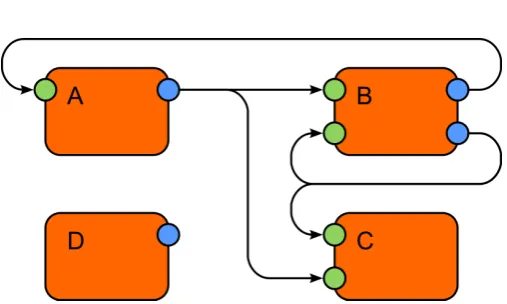
Figure 1: Example block diagram of an integrated dynamic system built from independent processes. Rectangles are processes, circles are input/output ports, and arrows are links between ports.
Moves are afoot in the world of computational biological modelling towards the construction of large, integrated, mod-els [1, 2, 3, 4, 5, 6, 7, 8], in the spirit of Daniel Dennett’s
Email addresses:[email protected](Ben Mitchinson)
‘whole iguana’ [9]. Such models will generally include compo-nents that represent disimilar biological operations (e.g. neural processing, muscle mechanics, pharmacological interactions) at different levels of abstraction (e.g. biophysical, point cells, cell populations, tissues, purely phenomenological, see for in-stance [13]). Implementations of such integrated models can be either ‘modular’ (each component stands independently and exposes an interface to allow its integration into a larger sys-tem) or ‘monolithic’ (where such interfaces are lacking or in-formal, such that reconfiguration of the larger system may re-quire modification of components). Here, we highlight some advantages of modular implementation, and introduce a new proposed framework for such implementations. Whilst this framework has its roots in solving problems in the field of bio-logical modelling, we emphasise that it is not limited by those origins, and we expect it to be of equal interest to researchers in other fields and sectors. The problems of integration, of course, become all the more visible when crossing disciplinary and or-ganisational boundaries.
shortcom-ings of models of biological systems by asking them to solve the same problems with which the organism itself is faced—
in vivomodelling, as it were. The particular problems thrown
up by this move are discussed further, below. This, in itself, is driving the engineering discipline of biomimetic robotics [10], whereby biological mechanisms are seconded to replace tech-nological mechanisms in real-world robot control problems. The goal of this work is to produce information-processing sys-tems that integrate conventional control syssys-tems with biological models, with algorithms at different levels of abstraction, and that maintain reliable performance in complex, changing, real-world environments. Whilst embodied modelling research can often be performed under laboratory conditions with generous resources, if biomimetic systems are to be deployed effectively in production robots they must be able to operate in severely resource-limited environments. The case studies, presented be-low, are taken from these two, related, frontiers of research. The first addresses all of these problems simultaneously—large-scale integration, reliable deployment in a complex environ-ment, and strict resource limitations.
Modularity is considered a desirable general trait in the de-sign of complex software [11], in large part owing to the prin-ciple of ‘divide and conquer’ [30], breaking down a problem into manageable, and largely independent, sub-problems. As integrated models become more complex, so researchers can expect to benefit increasingly from the software-engineering advantages of modular development—that is, developing col-lections of relatively independent ‘processes’, ‘linked’ together to form a ‘system’ that can be computed, Fig. 1. In addition, model components have become complex in themselves so that reimplementing a component from published equations is no longer trivial, driving a need to share component implementa-tions if peers are easily to review the operation of, or include in their own integrated models, components published by others. Components embedded in a monolithic system cannot easily be extracted, and thus cannot easily be included in other systems. Furthermore, software development in the academic environ-ment has needs that are particularly well-served by the modular approach. At base, our intent is dissemination of knowledge, so the only barriers to sharing software are technical. Physi-cal researchers build models of physiPhysi-cal systems, and since we all research in the same universe, these models are inherently reusable. Software is (for most academic disciplines) not the goal itself but a necessary (and laborious) step towards the goal, so that the ‘not invented here’ culture is ameliorated in compar-ison with some other arenas. Finally, directly representative models of the physical world are, by nature, dynamic system models, so the interface that each module requires is, essen-tially, identical.
We define a Modular Execution Framework (MEF) as any middleware that facilitates linkage of software components into a computable dynamic system—a well-known example is Simulink [12]. Given the varied levels of abstraction and the disimilar operations represented, it is not generally possible to compute an integrated model in a single computationengine— rather, the challenge is to link task-specific engines together [8]. A bespoke solution to this integration problem may serve for
any single project but, as we will see, a general solution offers more for less effort, and the startup cost is considerably out-weighed by the immediate benefits.
In Section 2, we run over the particular challenges and re-quirements for integrated computation, with emphasis on the academic research environment; we expect most of these is-sues to be familiar to workers in other environments, however. We go on in Section 3 to introduce our proposal, BRAHMS [14], beginning with an overview of its use. In Section 4, we contrast BRAHMS with existing and developing solutions and show it to be well positioned with respect to these. In Section 5 we report case studies from projects that are using BRAHMS in solving real-world research problems. In Section 6 we re-port, briefly, on performance and scaling. Section 7 provides a complete worked example of developing for BRAHMS. We report on project status in Section 8 and conclude in Section 9 that BRAHMS already offers a solution to most of the identi-fied challenges and will, through planned developments, meet the remainder.
2. Challenges And Requirements
2.1. Varied Development
The primary challenge (as described above) is to integrate software processes, and the primary requirement is, therefore, to offer a middleware platform which will execute processes in concert. Inter-disciplinary integration may include pro-cesses developed in, on, or by different authors, centres, plat-forms, programming languages, human languages, program-ming styles and (importantly) at different times. Cross-industry, integration may also be required across problem domains and technical languages. Without direct communication and sub-stantial refactoring, such disparate offerings will not generally be integrable. Software engineers meet such challenges by of-fering fixed, public, interfaces to develop against. In this con-text, an interface requires two facets: one between process and framework, the other between processes; these interfaces must be general (exclude no possibilities), static (backward compat-ibile), accessible and available in multiple programming lan-guages on multiple platforms.
Since it is not immediately obvious, we choose to highlight in particular the importance of integration across time. Often, researchers wish to revisit their own, or other workers’, inves-tigations at a later date, and the first stage of this is confirming that the original results can be reproduced. Surprisingly often, in our experience, this is not possible, and the reasons are not al-ways clear. An effective tool for integration through time must offer repeatability, such that ‘old’ code can still be executed, and will generate the same results that it did originally.
2.2. Varied Deployment
on robotic hardware) is generating use cases based on low-end hardware. These two trends push the computational envelope at opposite ends, and any solution must be deployable in all these environments. A researcher may develop initially on a desk-top machine, for convenience; experimental work may involve large models or parameter spaces and, thus, high-end hardware; embodied models will eventually be deployed on robots. If there is an intellectual interest in mobile roboticsper se, robotic deployments may be required to run entirely on low-end em-bedded hardware. Alternatively, if the interest is more in the capabilities of the model, such deployments may have to run across embodied systems and larger, off-robot, systems, with the two hardware components communicating over some net-work (e.g. Wireless Ethernet). The requirements are, that a researcher should only have to develop once for such varied de-ployment cases, and that the middleware should be able to take advantage of the resources of the currently available hardware without becoming unwieldy on low-end hardware.
2.3. Code Sharing
Computational researchers spend much time authoring soft-ware, and disappointingly often this work is repeated in other labs, by other researchers, or even by the same researchers, when documentation, compatible source-code and/or compat-ible binary code is, or becomes, unavailable. Anecdotal (and more concrete [5, 18]) evidence suggests that ‘...easier to rewrite it myself than try and obtain/understand/integrate their original code...’ is a common story (this should not be taken to indicate that reimplementation is a trivial task—see the ref-erenced works). Any solution should offer great potential for code sharing and reuse, which is to say more than that the code
couldbe integrated—it must bestraightforwardto do so. This
requires a (preferably, automatic) archiving/distribution mech-anism, that shared code be in a form that is immediately usable (rather than having to be configured, have its dependencies met, and then be compiled with a particular tool, say), and that the solution encourages authors to document their work [19] (facil-itating ‘intellectual’ integration).
In addition, ‘background functionality’ like parallelisation or data marshalling is neither trivial nor quick to author (and most researchers do not want to become software engineers), so sharing such functionality with all process developers is de-sirable. Therefore, as much functionality as possible should be subsumed into the middleware—‘general’ process code should be shared. We use the term ‘supervisor’ to refer to this shared code, which might, at minimum, be responsible for reading a system document, loading required processes, connecting them together, progressing them through time, collating results, and returning these to the caller.
2.4. Open Standards
There is more to working with integrated systems than their execution; other possibilities include a system design GUI and an archival/retrieval tool (see also Section 2.3). It is, thus, a requirement that the middleware should work with open and
extensible data standards. Moreover, the needs of academic re-search are constantly changing and often cannot wait—the so-lution must be able to support these changing needs in a timely manner. In practice, therefore, it is a requirement that the solu-tion be open source and extensible by anyone. It is also widely-held in the community that science should be available to ev-eryone, which strongly favours the adoption of non-commercial solutions.
2.5. Adoption
If they are to adopt any proposal, potential users must per-ceive its advantages to outweigh its costs, both initially and in the long-term. The short-term requirement is met if the startup cost is sufficiently low—interfaces must be few, simple, and well documented; immediately available ‘added value’ will help to offset this cost. The long-term requirement is met if, in comparison with an equivalent bespoke monolithic design, overall performance does not suffer and per-process develop-ment effort is similar or less. Furthermore, an integration solu-tion should by its nature be inclusive, so the solusolu-tion must be available to all, no matter their access to resources; this obser-vation echoes that above in favouring a non-commercial solu-tion. Adoption will be the more willing the more freedom that is given to the developer to do things their way—this means making the interface available in multiple languages, on multi-ple platforms.
3. BRAHMS
BRAHMS represents part of our commitment to the philos-ophy and methodologies of neuroinformatics: developing gen-eral purpose tools that facilitate large-group working in neu-roscience, and sharing and reusing resources. It is an MEF developed in-house during the course of a large-scale, multi-centre project (WhiskerBot [3]) which presented many of the challenges outlined in Section 2. This was a computational neu-roscience project, but from the outset BRAHMS was required to integrate diverse processes (see Section 5). The primary de-sign goals of BRAHMS are performance, flexibility and exten-sibility. BRAHMS is open source and licensed under the GNU General Public License. In this section, we provide a brief de-scription – for much more detail and formal specifications, see the documentation [14].
3.1. Overview
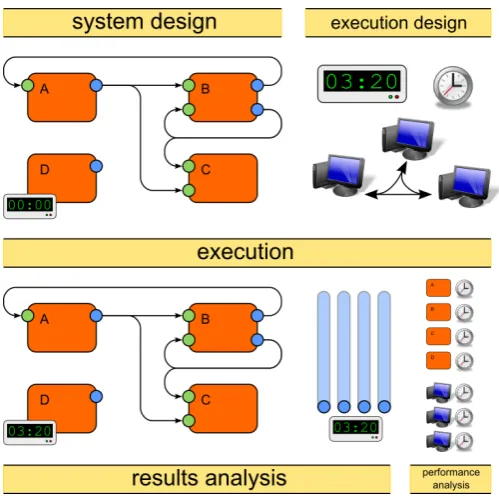
Figure 2: Typical BRAHMS workflow: system design (link processes into a system); execution design (run time, performance monitoring options, de-ployment model); execution (progress system, log output ports, monitor per-formance); results analysis (review new system state and output logs); perfor-mance analysis (review per-process and per-machine data).
in just a few lines of script. BRAHMS is invoked to exe-cute these systems, taking advantage of parallel computing re-sources where available, and the results can easily be pulled into an analysis environment. BRAHMS is not tied to any particular interactive environment but, currently, comprehensive invoca-tion bindings exist only for Matlab [12]. In time, the library of provided (and third party) processes will increase, additional supervisor functionality will accrue, and bindings will be devel-oped for other environments (see Section 9.2 for future plans).
BRAHMS is implemented as an execution ‘engine’, which progresses SystemML documents through time, and a lightweight front-end for that engine that is invoked from the shell. Taken together, these comprise the ‘supervisor’ discussed in this document, and detail of the relationship between the two is beyond our scope, here. We note, however, that alternative front-ends may be authored in future, providing a graphical in-terface to BRAHMS, for example (we mention this, also, in sec-tion 9.2). In addisec-tion, the BRAHMS engine may be included as a component in third-party software systems.
3.2. Systems and SystemML
SystemML [20] defines a virtual namespace of specifica-tions of components (processes, data containers, utilities). The namespace comprises public branches (which are shared, per-sistent, and can be augmented by any user subject to some con-straints) and private, local, branches (which are unconstrained). A SystemML file contains a snapshot of a stateful dynamic system in time, Fig. 1 – that is, a collection of stateful pro-cesses (drawn from the namespace) and a collection of stateful links (containing data containers drawn from the namespace)
connecting them together. Along with the SystemML infras-tructure, which provides practical support (a server for public branches of the namespace and a software toolbox for interact-ing with the server and with SystemML files), these constitute the SystemML project. The first public namespace server is expected to be commissioned in the coming year (meanwhile, only local namespace branches are in use). The BRAHMS su-pervisor’s main functionality is to load a SystemML system from file, instantiate it using the namespace, progress it through time, and finally, if required, store its final state to file.
Each process in a SystemML file is represented as a Sys-temML class name along with class-specific state data. The class name indexes the SystemML namespace to find a pro-cess specification, which details the propro-cess interface and the computation it performs. Attached to that specification may be implementations for different environments, e.g. BRAHMS. A process may publish outputs, each of which specifies a trans-port protocol (e.g. periodic transtrans-port at a specified sample rate) and data structure. The data structure comprises a SystemML class name and class-specific state data. The class name in-dexes the SystemML namespace to find a data container speci-fication, which details the data interface and the data it contains (for instance, BRAHMS ships with a data class representing a multidimensional numeric array). As with processes, imple-mentations of the data container for BRAHMS may be attached to the specification node. Each link in a SystemML file spec-ifies a source output (implicitly, thus, a transport protocol and data structure), a destination input, and transport-protocol pa-rameters (e.g. sample delay, for a periodic transport protocol).
The class-specific state data for a process or data container (termed ‘StateML’) is understood by design tools for and imple-mentations of those classes (for instance, NeuroML [8] might be the StateML for some neural processes). These class-specific data are not used by a SystemML client such as BRAHMS so the set of systems that can be represented is extensible simply by the addition of new process or data classes to the names-pace. Transport protocols are the responsibility of the middle-ware, however, so extending this set requires augmentation of the BRAHMS engine.
3.3. Processing Model
rates, these intervals may be of varying periods (if inputs or outputs are running at sample rates that are not multiples of one another).
BRAHMS does not attempt to provide run-time functional-ity – interaction with the system from the framework is limited to pause and cancellation. This is by design: such interaction is provided exclusively by component processes of the system. Of course, processes can provide any interaction desired, so this is not a limitation (rather it is part of the modular philosophy). As example, a GUI process was recently developed in our group that allows the user to inject signals into the system using the mouse at run-time. Conversely, multiple GUIs are under devel-opment that provide visual feedback of system operation (i.e. act as virtual instruments); one is included in the current public release, for testing.
Note that this absence of run-time functionality also leads to an important aspect of the BRAHMS approach to integration. Where data streams require transformation to be understood by source and destination processes, this transformation must be provided by an interposed process – BRAHMS itself offers no data transformation services. An example of such a transfor-mation is the numeric stream resample process provided with BRAHMS. Note, however, that BRAHMS is responsible for data transport, so ‘transformations’ that are purely transport op-erations (such as transport delay) can be implemented by the middleware (or, if appropriate, by a process).
3.4. Interfaces
The core of BRAHMS is the supervisor-process interface—C was chosen as the language for this for its durability and inter-operability with other languages. Language bindings are pro-vided for C++, Matlab and Python, and additional bindings are expected to follow. The interface as a whole has been designed according to modern API design principles [21], for example with an eye to minimality, extensibility, and backward compat-ibility. It comprises four aspects, as follows.
First, processes offer an extensible events interface through which the supervisor can invoke process operations (such as ini-tialize or service ports). The remaining three aspects are call-back interfaces allowing processes to invoke supervisor func-tionality in the context of an event. They are: an implemen-tation of parts of the W3C XML Document Object Model in-terface [22] (for manipulating StateML, amongst other things), the inter-process interface (for interacting with ports and, thus, the wider system), and a small interface of BRAHMS-specific functions (e.g. serving to send log messages or obtain random seeds).
In addition to the above, each data container class offers a class-specific interface to allow manipulation of its contents by processes. Inter-process data passing then proceeds as follows: the source process publishes a port during initialization, speci-fying the class and structure of data containers to pass over it, forming the source end of a link; at run-time, the source process writes data into a container using the class-specific interface, and passes the container into the link; the supervisor marshals the data across the link according to the transport protocol; the
destination process pulls the container from the other end of the link and reads the contents using the class-specific interface.
One interesting aspect of the interface is the serial-ize/unserialize function, used to transfer data objects between machines during system connection. The same interface is of-fered by each process and utility, providing both for automatic run-time load-balancing (both within and between machines) and for a ‘pause & continue’ execution model, whereby the sys-tem can be paused, stored on disk, and reloaded and continued at a later date or on another machine, with or without modifi-cation whilst it is paused. BRAHMS does not currently offer a real-time operational mode, though the interface allows for this expansion in future.
3.5. Modules
Process classes are implemented in modules, in one of the languages for which bindings are provided. A process module implements responses to calls from the supervisor on the events interface. A simple process module might respond to only two events, first to publish an output, and second to pass data into it on each time step. Data classes are implemented in similar modules, but receive a different set of events. A simple data module might respond to two events, to log its current state for later retrieval, and to return its log to the supervisor. In addition, it will offer an interface to its content for use by processes, as described above.
Note that a process module might be a front-end or interface for an existing computational engine, rather than an implemen-tation of a new algorithm. Depending on the architecture of the engine, this may be straightforward. Illustrating that this is possible, we note that the above is an adequate description of the component language bindings for Matlab and Python, which are each implemented as a BRAHMS process. Simi-larly, a BRAHMS process has been developed that provides an interface with the Webots [24] robotic simulator. We do not anticipate difficulties in adding lightweight front-ends to many bespoke computational engines, though the practical problems in linking to particular engines remain to be discovered.
3.6. Supervisor
Automatic parallelisation is provided at a coarse-grained (process) level. Finer-grained parallelisation can be imple-mented within processes, but it will generally be much easier to break processes up and let BRAHMS parallelise them (models that consist of collections of similar objects, like network mod-els, lend themselves particularly to this technique). One opera-tional mode of the supervisor, ‘Solo’, offers lightweight paral-lelisation in a shared-memory environment using multithread-ing. Another, ‘Concerto’, offers multiprocessing for paralleli-sation over a computing cluster, currently using either TCP/IP or MPI as the communications layer. Note, that Concerto per-forms an identical operation to Solo, it just distributes it across multiple processes.
The data transport provided by the supervisor might com-prise sharing a memory pointer (Solo), or routing a container over ethernet (Concerto), or through a stateful system file to another user, on another platform, at another time. Such transport operations are achieved without onus on the pro-cess developer. Background functionality beyond parallelisa-tion includes inter-process data compression (Concerto), time-windowed port logging, distributed-system performance mon-itoring, and a planned pause & continue execution model (whereby system snapshots at non-zero time can be coherently stored, exchanged, examined, modified, or sent for further exe-cution).
3.7. Connectivity
Connectivity in BRAHMS is according to the SystemML standard; we describe this, briefly, here. Each process expresses two interfaces, input and output. Each interface consists of one or more ‘sets’, which are semantic groups of input and out-put ports, allowing them to be treated in groups depending on their significance. Most processes do not need this semantic grouping, and express only the ‘default’ set on each interface. Links between processes are specified in the SystemML docu-ment, so the ‘structure’ of the input interface (number and name of inputs) is known when the process is first called. However, the nature of each individual output is unknown until it is cre-ated by the process, so system initialisation is an iterative pro-cedure, with each process (in general) being called repeatedly, with more and more of its inputs available at each call. On each call, the process may create any number of outputs, which the framework will then route to any processes that take them as inputs. Thus, the presence or absence, number, class, transport specification, structure, content, and name of ports on a process output interface may all depend on any aspect of the process input interface or of the process state data. Whilst many exist-ing processes do not express such dependencies (or only rela-tively trivial dependencies), this model allows complete flexi-bility where required.
3.8. Accountability
One of the dimensions of Varied Development, above, is time. This means that we should be able to integrate, today, pro-cess code that was generated many years ago. However, com-puting environments change, and researchers forget. BRAHMS
offers accountability; that is, everything that bears on the re-sults produced from an execution (details of each loaded library module, external library, of the run-time environment, platform, operating system, etc.) is recorded in an ‘execution report’ in the Report File. If a repeat of the execution does not produce identical results, it is possible to identify why (thus, account-ability favours repeataccount-ability by identifying sources of disagree-ment). Note that this is dependent on the deterministic pro-cessing model used in BRAHMS, which provides 100% repro-ducibility given the same initialisation.
3.9. Software Development Kit
A BRAHMS release includes template processes, process development tutorials, and example processes authored in all four currently supported languages (C, C++, Matlab, Python). Creating a new BRAHMS process involves only copying the template for the chosen programming language, and adding the content that performs the actual algorithm intended. Also included is the BRAHMS ‘Standard Library’, a collection of processes implementing simple operations (such as sum, prod-uct and resample) which are intended to be useful in produc-tion systems, whilst doubling as rich illustrative material. The Standard Library also includes the data container class that will be most useful, ‘data/numeric’, which is a container for an N-dimensional array of numeric data in a comprehensive (and ex-tensible) range of fixed-bit-width element formats.
The Matlab invocation bindings included with BRAHMS provide interfaces to the Execution, System, and Report files, and allow invocation of the BRAHMS executable, such that BRAHMS appears and behaves like a Matlab toolbox. Note that this does not imply that BRAHMS is tied in to Matlab in any way; it is just that bindings have only been authored for this environment (youcan author these files in a text editor, but we do not recommend this approach). These bindings al-low the easy construction of systems from processes and links, and the design of the generic StateML used by the processes in the Standard Library (termed ‘DataML’). BRAHMS does not know about process state specifics, in general, so additional tools are needed to design StateML for processes that do not use DataML—however, DataML can represent multi-dimensional arrays, associative arrays, and ordered sets, so it is expected to prove adequate for a large majority of developments (all exist-ing BRAHMS processes use DataML as their StateML). Invo-cation Bindings for other interactive environments are expected to follow in future (Python and Octave are likely to be targeted early). A future GUI system design tool would provide equiva-lent functionality, and could be seen as another ‘binding’.
4. Related Projects
Many integration efforts have already been made (or are un-derway) that meet some of the above challenges in more con-strained domains—just in Computational Neuroscience, for in-stance, NSL [26], CATACOMB [27], MOOSE [31], and NEST [32], to name but a few. Our concern, here, is to solve these challenges in such a way that integration can take place more generally; therefore, we do not discuss these more targeted so-lutions. Nonetheless, we note that such bespoke solutions might be imported into BRAHMS as processes in a straightforward way, so that BRAHMS provides integration across these solu-tions.
We do not have the space, here, for a comprehensive review of more general frameworks, though we note that we have been unable to identify any alternative that takes the same inclusive, general, approach of BRAHMS. Below, we very briefly contrast BRAHMS with three approaches to integration that we consider to be of potential interest in our particular area (computational neuroscience). We also draw the reader’s attention to the other frameworks discussed in this issue.
4.1. Simulink
Simulink [12] has a long history, and is a useful tool for learn-ing about integrated systems. More recently, it offers multi-language support (Matlab, C, C++, Ada, Fortran) but as yet no standard support for parallelisation even within a shared-memory space. The data format is open (though not extensi-ble, since Simulink is proprietary). Involving at least a Matlab installation and instantiation, the resource requirement is sub-stantial (though we currently have no data on run-time perfor-mance). In the long-term, support may improve in the technical areas where Simulink does not meet the requirements, but it is likely to remain costly, closed source and with a large resource footprint. In summary, whilst Simulink is a mature and well-developed product, it fails to meet several of the challenges we outlined above.
4.2. IKAROS
IKAROS [28] (also, this issue) is a project of similar spirit to the BRAHMS project, but has rather different focus. Its pos-itive points include the ‘WebUI’, which allows real-time mon-itoring of system state through a browser, good documenta-tion, and a simple developer interface. It also provides some facilities that are outside of the scope discussed here. How-ever, where BRAHMS aims to meet all of the challenges listed above, IKAROS attempts to solve a more constrained problem, albeit in a straightforward and effective way.
IKAROS is constrained to a single inter-process data-type (2D single-precision matrices), does not support dynamic cre-ation and structuring of outputs based on connectivity, has more constrained support for process state, and the plugin architec-ture requires the whole system to be rebuilt from source when new modules are added. This last is a particular problem for ac-countability, since the code that executed to generate archived results is generally no longer available. There is no discussion
of bindings for other languages. The IKAROS interface is au-thored in C++, which might become a problem in the future if the project intended to move towards dynamic loading or ac-countability. IKAROS also lacks some framework functionality available in BRAHMS, though such features can presumably, as for BRAHMS, be added without modifying the plugin code-base. In summary, we understand that IKAROS and BRAHMS are solutions to different, if not quite orthogonal, problems.
4.3. Large-Scale Modeling Program and MUSIC
The International Neuroinformatics Coordinating Facility (INCF) have recently launched a program to foster infrastruc-ture for researchers working with large-scale neural models. Attendees of the first program workshop [8] noted the large and growing set of neuron simulators available, and agreed on the importance of interoperability and component reuse. Focus was on modularity, particularly the supervisor-process inter-face, process-process interinter-face, and common file format. Con-sequently, run-time inter-process communication was also dis-cussed as a necessary future development to integrate computa-tion engines into systems. They also highlighted background functionality (node allocation, communications initialisation) and marshaling of extremely large data sets.
All of these issues are addressed by our proposal. Other in-teroperability concerns raised in the workshop report are not applicable to BRAHMS; e.g. no application scripting is re-quired since BRAHMS is responsible for procedure. Within the program, a communications library called MUSIC [29] is un-der development. The MUSIC approach leaves everything but inter-process communication to the process, in stark contrast to BRAHMS, which aims to provide as much common function-ality as possible. Each approach has its advantages—in partic-ular, large and/or closed-source efforts may regard their work as more suited to a MUSIC interface than a BRAHMS front-end (though the latter is generally not onerous to construct, as briefly discussed). In contrast, BRAHMS allows extremely rapid development of powerful cross-platform engines, which MUSIC does not. We do not consider that BRAHMS and MU-SIC are competitors, and expect to offer a BRAHMS-MUSIC interface in the near future.
5. Case Studies
5.1. WhiskerBot
research projects, where different experiments may need to be run using related hardware/software tools; we discuss the ad-vantages of reconfigurability further, below.
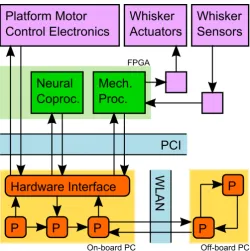
Figure 3: WhiskerBot/ScratchBot architecture summary. Hardware information-processing is above the PCI bus, with two processors implemented in FPGA (marked), and the remainder custom electronics and DSP. BRAHMS processes (rounded rectangles) are distributed on the on-board PC, with further processes optionally linked in on the off-board PC.
The hardware platform consists of a sensory head and an information-processing stack, mounted on a differential-drive robotic platform with associated control electronics along with a lead-acid battery and power switching equipment. The head is equipped with novel analog sensors emulating the capabilities of rat whiskers, each of which is driven to move in one plane with respect to the head by contraction of a shape metal al-loy fiber, emulating muscular contraction. DSP-mediated path-ways connect the head, upstream and downstream, with a Field-Programmable Gate Array (FPGA) bank (a programmable logic array). The FPGA interfaces, similarly, with the con-trol electronics of the drive platform. On the upstream side, the FPGA attaches to the PCI bus of a single-board computer (Nallatech BenNuey PC104plus, Intel Celeron, 650MHz, FSB 133MHz, 512MB SDRAM). Finally, the PC is equipped with wireless/wired internet, connecting it at long latency to the lab-oratory LAN for off-board processing. That one aspect of this project was an investigation of eclectic hardware approaches to mobile information processing is reflected in this architecture.
[image:9.595.38.289.127.379.2]In its onboard configuration, the computational model con-sists of the following. In hardware, a model of sensory signal generation in rat whisker sensors comprises a biomechanical model, which was laid on to the DSP, and a model of hun-dreds of primary afferent neurons (sensory cells), laid on to the FPGA. Also, a model of whisker motor pattern genera-tion, implemented in hundreds of neurons, also laid on to the
Figure 4: Summary diagram of the WhiskerBot computational model. Not all processes are shown, and the details are unimportant, but the figure illustrates the different types of processing being integrated. Clockwise from bottom-left: spiking neuron models of parts of brainstem (in FPGA), a part of the brain which is seen here as performing sensory signal conditioning; a rate-coded neural model of Superior Colliculus, a part of the brain concerned with spa-tial awareness; information-theoretic models of higher brain regions, including Thalamus and Cortex; arithmetic and neural model of action selection [16] in a part of the brain called Basal Ganglia; a sensory/arithmetic model of mo-tivation; a geometric platform abstraction layer (modelling body, sensor and actuator mechanics).
FPGA. The FPGA exchanges data with the PCI bus of the PC at 2kHz. In the PC, fourteen BRAHMS processes are integrated to form the remainder of the control system, running variously at 200Hz or 2kHz. These include computational neuroscience models of various parts of the brain using various and distinct modelling approaches (see the caption of Figure 4 for a sum-mary), a hardware-interface sub-system that uses the current environmental noise level to drive the animals motivation (loud noises scare it), and a platform abstraction layer that gener-ates control signals for the mobile platform to implement the plans of the more abstract processing modules. Interfacing the software and hardware, an additional BRAHMS process encap-sulates the upstream/downstream interface to the head and the FPGA neural coprocessor by interfacing with the PCI bus using the hardware manufacturer’s API. Upstream and downstream translation processes stand between this hardware interface pro-cess and the computational propro-cesses, performing conversion between spike-timing and firing-rate encodings of neural sig-nals, as well as upsampling and downsampling, as appropriate. The total data transfer rate in this configuration is between 1 and 2MiBs−1, depending on data container content, in tens of
separate inter-process links.
deploy-ment on much more powerful hardware (e.g. a processing clus-ter), but primarily because there is no longer a need to meet the real-time constraint of the send/receive cycle on the PCI bus. A third, supplementary, configuration, has the role of the FPGA neural coprocessor played by an emulator, which per-forms identically to the FPGA model at the binary bit level; this is used to confirm the relationship between the onboard and developmental configurations.
The three configurations described above serve different roles, and answer different research questions. The first, on-board, investigates the performance of the computational model embodied in a real-world sytem [16], but the experimental space is sorely limited by resource constraints. At the same time, it illustrates that BRAHMS can satisfy the real-time con-straints of this system (5mS period PCI send/receive cycle) ro-bustly. Note that the real-time constraint of this configuration is met through consistent iteration times, rather than through the provision of any real-time guarantee (as mentioned above, BRAHMS does not currently offer a real-time mode). The sec-ond configuration, in pure software, allows the free investiga-tion of much larger-scale or higher-resoluinvestiga-tion models and the importance of scale, the latter being of particular interest when modelling neural systems since the amount of redundancy in neural processing systems is an open question. The third con-figuration allows easy in-depth investigation of the operation of the fixed-point hardware implementation in comparison with the original model, and thus offers confirmation that the model is rendered sensibly in the first configuration (debugging the operation of the hardware coprocessorin situis, of course, la-borious). In addition, it allows testing of scaling-up of the hard-ware model at low cost. Importantly, the BRAHMS approach to modelling and deployment allows all these configurations to exist alongside, without generating work for the developer—in all cases, the common modules use the same implementations, and are merely parameterised differently. This general result, of being able to maintain integration across widely different de-ployment cases, is a significant achievement that was not previ-ously possible.
In addition to these ‘complete robot’ configurations, it is straightforward to wire up new arrangements of the system that target particular questions. For instance, a new biological result [35] recently indicated that rats use short-latency feedback to effect active control of the movements of their whiskers. We were able to quickly reconfigure the software architecture to implement the same strategy on the robot in a bench-test, per-forming stationary whisking against an obstacle, and observe the changes in the nature of the sensory signals collected with equivalent feedback in place. This sort of flexibility is a great advantage when engineering solutions in a cross-discipline con-text such as this, where the intellectual environment can change completely mid-project.
This approach to model development also makes it possible to make use of earlier effort in later work; that is, to integrate across time. WhiskerBot has now evolved into ScratchBot, an artefact of the ICEA project [4], and the computational model uses much of the same implementation as was used on the pre-vious robot, allowing the development process to genuinely ‘hit
the ground running’. The mobile drive platform has a diff er-ent structure, without nonholonomic constraints—this requires only updating the motor translation layer. The sensory hard-ware has been redesigned, based on lessons from the first edi-tion, and now has eighteen whiskers driven by DC motors—this requires some updates to the hardware, and reprogramming the DSP, but otherwise only adds additional information, which the developer of the upper computational model can integrate into higher modules at leisure. Also, additional processing modules are being added to the upper computational model (hippocam-pal and more realistic cortical models)—this requires only im-plementing the new modules and wiring them in (modifying the script that stitches the processes together into a system). Since some of the new models are too computationally inten-sive to run on the onboard PC, we are moving towards using the WLAN/LAN connectivity of the robot to spread the BRAHMS implementation across the onboard and an offboard, more pow-erful, machine, using Concerto. This seamless expansion would not have been possible had we been working with a monolithic system, or with another, less flexible, framework.
In computational neuroscience, a model generally proves it-self in the long term by performing comparably in different en-vironments, rather than being tailored to a particular test case. A monolithic implementation of a robot control system such as that described, could not be tested in this way. However, the individual modules developed to implement biological or bio-inspired solutions in this project certainly can; either indi-vidual modules, or groups of modules, can be tested and/or ex-amined by other researchers, with ease. Alternatively, they can be adopted for use as components of other projects, whether to further research into their own operation, or to play supporting roles in unrelated investigations. Parts of the WhiskerBot model have, for example, been seconded for use in an unrelated ocu-lomotor model, described below. Both reproduction of results and adoption of components are supported just by the publica-tion of the SystemML document describing the model. Module implementations can be obtained from the SystemML server (not yet commissioned), and the SystemML system described in the document can be broken apart by the user into valid com-ponent parts, if only parts of the system are to be reused.
5.2. Other Use Cases
BRAHMS is used to integrate the individual model compo-nents. In the latest approach to this task, a Hippocampal model, developed in Hungary in Python, is integrated with the Basal Ganglia model, developed in the UK in Matlab, with the We-bots simulator (developed commercially, in C++), as well as with BRAHMS Standard Library components. The Cortex and Amygdala models remain, as yet, undeveloped, but the devel-oper can be confident that their integration will be straightfor-ward whatever form they take, as described previously. In this way, the modular approach breaks time dependencies as well as software dependencies.
Some implementations from the WhiskerBot model are cur-rently in use as part of the large-scale oculomotor control model of the REVERB project [23]. This model deploys across a com-pute cluster and a separate, differently configured, robot-control machine. The robot itself is a model of the vertebrate eye, with 2 degrees of actuated freedom of look direction, and a camera as sensor; interaction with the robot consists of sending control signals to the actuators and collecting data from the camera. The design has the members of the cluster communicating over the Myrinet installed on the cluster, whilst the robot-control ma-chine is linked in over the LAN; this implementation is not yet complete, but in the meantime the same system is being inves-tigated in different configurations (on the developer’s desktop, and on the cluster without using the Myrinet). Flexibility in ployment options is allowing this work to run at full-speed de-spite the deployment environment not yet being ready. Parallel computation is allowing the developer to rapidly obtain feed-back on modifications to the model parameters, yet this model is not ‘targeted’ at parallel computation; rather, it can be de-ployed in parallel, when appropriate.
As the oculomotor project develops, the control model will choose the actions taken by a simulated mobile platform for the eye robot; since the robot itself cannot move, the world will be moved around it by rendering onto a hemispherical shell that surrounds the eye robot. This will require the integration of a bank of rendering servers, and the complete system will be required to integrate on a consistent time interval to keep up with the camera and projector refresh rates, as well as to pro-vide timely control signals for the robot actuators. With much of the hard work of these integration problems performed by BRAHMS, the researchers are, rather, able to concentrate on how their models behave. With consistent model inter-faces, it is assured that the models they are working with now will fit together straightforwardly with the software that is de-veloped to solve the rendering task.
Future uses for BRAHMS in our own group are lining up fast, as expected. A new, detailed, model of Striatum (part of the action selection system used in WhiskerBot) will use BRAHMS to integrate across distinct cell model populations with different complexities and different sample rates, and to parallelise the execution of the model. Another application will be to investigate cortical models developed in the Topographica modeling package with different control strategies for whiskers interacting with physical objects. BRAHMS will provide the software to stitch together the physical whisker sensors, the whisker actuators, and the Topographica models, in a closed
control loop. BRAHMS has also been chosen as the integration platform for the large European project BIOTACT [25]. Taken together, these use cases illustrate reuse, various dimensions of integration, and varied substrates of deployment.
6. Performance
To measure overhead and scaling, we designed the follow-ing model. We compute a simple (and meanfollow-ingless) operation across (double-precision scalar) elements on a rectangular grid of sizePbyEelements. Each of thePgroups ofEelements is assigned to a single process. Each process computesO elemen-tal operations per element on each iteration (the elemenelemen-tal op-eration consists of a floating-point addition and division—care was taken in design to avoid floating-point exceptions). Thus, we can scale the number of processes (P), the working set size (PE), and the computational complexity of a process iteration (EO) independently. The result of each of thePprocesses is passed to the next process, forming a loop, such thatP inter-process links are also performed.
We implemented the model twice—once in BRAHMS, and once as a monolithic executable (both in C++, with C-style inner-loop optimisations). The BRAHMS implementation was run multi-threaded (MT, one thread per process up to the de-fault maximum of eight per core) and single-threaded (ST), for a total, along with the monolithic case (M), of three implemen-tations. We used the same object code for the inner loop (O,E) in each case, and briefly reviewed the generated assembler for surprises (Windows only). We did not attempt to optimise the outer loops (P,N) in the monolithic implementation, but we are happy that the (very simple) implementation was not obviously wanting, and we note that ST and M asymptote to the same execution time as complexity increases.
For each of the two benchmarks described below, at each parameter point, we computed a large number of iterations (N) and measured the execution time of the slowest worker thread, Tb, using system-supplied performance counters. We
repeated the whole of each benchmark several times (R), and took the minimum Tb across these repetitions at each
param-eter point, to filter out any noise arising from other demands on the test platforms. We define the effective elemental oper-ation time, Te = Tb/PEON = Tc+To, with Tc the time to
compute the elemental operation andTo the
implementation-specific per-operation overhead. Thus,Teis expected to
asymp-tote toTc(which is unknown) as process iteration complexity
(EO) increases. Tc itself is, in general, dependent on the
pa-rameters, as the changing working-set size moves the effective workspace between CPU caches and main memory; here, we kept working-set size small enough so that Tc was constant
throughout. We obtained a good estimate of Tc, then, based
on the longest execution of the monolithic implementation, and used this as a baseline against which to compare the execution times returned by BRAHMS. Execution times returned by the monolithic implementation were consistently in line with ex-pectations based on this estimate ofTc(i.e. no overhead and
no multi-core speed-up). Te/Tc, finally, is a measure of the
indicating no cost. We also define the monolithic process itera-tion time,Tp=Te×EO, which is the time spent overall on each
[image:12.595.308.544.89.256.2]iteration of each process using the monolithic implementation. The three implementations (MT, ST, M) were built and run on two software platforms: (A) Windows XP 32-bit SP2 and (B) Ubuntu 32-bit 8.10. Both were built and run on the same hardware platform: Intel Core2 Quad Q6600 2.40GHz 4GB PC2-6400. Performance was similar on the two platforms (though not identical, see Figures). Performance on several other hardware and software platforms (not reported) displayed no inconsistencies.
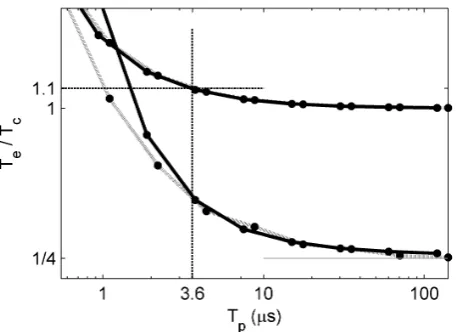
Figure 5: Overhead incurred by using BRAHMS against monolithic process iteration time (solid/dotted lines, platform A/B; ST and MT are both shown, MT is the lower pair). Overhead decreases as process iteration time increases, falling below 10% (ST) at an iteration time of around 3.6µs (marked with dashed lines). Fine solid line to right indicates ideal speed-up for 4 cores as overhead becomes negligible.
The first benchmark measured the overhead of one process and one link as the process iteration time,Tp, was varied. The
parameter set had P = 16, E = 32, N = 1000 and O vary-ing between 1 and 256 (for a workvary-ing-set of a few kiB). The small working set size is necessary because with larger work-ing sets, it is not possible to achieve a low enoughTpto detect
the overhead. The results in Figure 5 indicate that the ST over-head becomes small (10%) with Tp around 3.6µs, suggesting
an overhead of around 360ns per iteration for the process and link together. In the MT case, the overhead is larger, due to the cost of inter-thread synchronisation. However, very good use of the hardware is already achieved with process iteration times as low as 10µs. Platform A (Windows) appears to incur a slightly higher cost for inter-thread synchronisation, but the difference is already negligible atTp=3.6µs.
The second benchmark aimed to confirm that BRAHMS performance scales well. To this end, we chose a parameter point with a small per-process memory requirement (E=256,
[image:12.595.40.269.235.401.2]O=256,N=25) and varied the process (and, therefore, link) count, P, between 1 and 1024. This gives a working-set size that varies between a kilobyte and a megabyte (overheads due to the framework not included). Note also that the thread count follows Pto begin with, but is capped at 32 (see above). The
Figure 6: Overhead incurred by using BRAHMS against number of pro-cesses/links in the computed system (solid/dotted lines, platform A/B; ST and MT are both shown, MT is the lower pair). System scale has no discernible impact on performance. Fine solid lines to left indicates ideal speed-up for 2/4 threads (on 4 core hardware).
results of Figure 6 show that increasing Phas no discernible impact on ST or MT performance on either platform.
Both above benchmarks were computed using
brahms bench which is supplied with BRAHMS 0.7.2 (the data published here were obtained using a pre-release version). The first benchmark is overheadi, the second is
scaling. Direct measurements ofToon each platform (known
asoverheadinbrahms bench) gave figures of around 230ns for a process and 130ns for a link (ST); the sum of these to 360ns is entirely consistent with the figure returned by the indirect overhead benchmark detailed above.
7. Example
To illustrate explicitly, we provide a complete example sys-tem, here. The example we choose is the classic Lotka-Volterra predator-prey model (sometimes known as ‘rabbits and foxes’), which is one of the tutorials that ships with BRAHMS (though in the shipped tutorial it is implemented in m-script; here, we implement it in C++). This system is not a good candidate for modularisation, since the computation of each module consists of one or two floating-point operations per process iteration, but it exemplifies the major features (taking state, taking inputs, providing outputs, linking a system).
7.1. Example Process
The ‘rabbits’ process was based on the ‘1199’ (the most re-cent C++binding) template, with the changes detailed in Figure 7. We do not show the ‘foxes’ process, but it is similar.
EVENT STATE SET is called once, asking the process to ini-tialise its state (unserialize). In other words, to accept param-eters. EVENT INIT CONNECT may be called multiple times, with more inputs available on each call. The details of han-dling this event vary with the nature of the process. This pro-cess creates its output on the first call, and validates its input on the last – this procedure suffices for many types of pro-cess.EVENT INIT POSTCONNECTis serviced only because tim-ing data has been finalized at this point, and the process needs to calculate its sample period.EVENT RUN SERVICEis called mul-tiple times during execution, with the clock set to the instant at which the framework requires the input and output interfaces to be serviced. Our process accepts only accepts regular ticks (be-cause it setsF NOT RATE CHANGER), so it can safely ignore the clock and simply step its dynamics on each call to this event. Reading input and writing output are usually exactly as simple as shown here.
7.2. Example System
The ‘rabbits and foxes’ system script creates an empty sys-tem, adds the two processes (‘rabbits’ and ‘foxes’), links them together in a loop, then sends the system for execution (Fig-ure 8). This script mostly uses the SystemML Matlab Bind-ings (sml system), which are provided as part of SystemML (though they are currently shipped with BRAHMS, for conve-nience) to construct the system. It goes on to use the BRAHMS ‘995’ (Matlab) Invocation Bindings (brahms execution), to create, modify, and invoke an execution of that system. The output of the script is given in Figure 9.
7.3. Multi-processing
This system is already deployed in multiple (two) threads (9µs per iteration). However, since the computation in each thread is so tiny, it actually runs rather faster (1µs per itera-tion) if we disable multi-threading, since the overhead due to inter-thread signalling is avoided. Nonetheless, we can run in Concerto mode (multi-processing) by adding a single line to the system script telling the execution to launch two BRAHMS ‘voices’ on the local system using the sockets layer to commu-nicate.
Separate multi-processing instances are called ‘voices’ to distinguish them from the ‘processes’ that are components of a system; running multiple voices on a single machine is a test-ing configuration, referred to as a ‘babble’. The iteration time returned by this two-voice babble is around 60µs, showing up the additional overhead of serializing each data packet into and out of the sockets layer before passing it to the destination pro-cess. The results returned are, of course, identical. The execu-tion runs for 1000 samples (10 seconds at 100Hz), so run phase completes in around 60ms.
Depending on the configuration of the platform, launching a Concerto execution on multiple nodes may be achieved in ex-actly the same way (one extra line in the system script) if that line specifies the IP addresses of the target machines. In another case, perhaps where the deployment hardware is asymmetric, it is straightforward to request through the bindings that a specific
#define COMPONENT_FLAGS (F_NOT_RATE_CHANGER)
...
class Rabbits : public Process { Symbol event(Event* event);
DOUBLE a, b, r, T; numeric::Input input; numeric::Output output; };
Symbol Rabbits::event(Event* event) { switch(event->type) {
case EVENT_STATE_SET: { ...
a = nodeState.getField("a").getDOUBLE(); b = nodeState.getField("b").getDOUBLE(); r = nodeState.getField("r").getDOUBLE(); return C_OK;
}
case EVENT_INIT_CONNECT: {
if (event->flags & F_FIRST_CALL) { output.create(hComponent); output.setName("out");
output.setStructure(TYPE_REAL | TYPE_DOUBLE, Dims(1).cdims());
}
if (event->flags & F_LAST_CALL) {
input.attach(hComponent, iif.getPort("in")); input.validateStructure(TYPE_REAL | TYPE_DOUBLE,
Dims(1).cdims()); }
return C_OK; }
case EVENT_INIT_POSTCONNECT: {
T = sampleRateToPeriod(time->sampleRate); return C_OK;
}
case EVENT_RUN_SERVICE: {
DOUBLE f = *((DOUBLE*) input.getContent()); r += T * (a * r - b * r * f);
output.setContent(&r); return C_OK;
} }
return S_NULL; }
% create empty system sys = sml_system;
% add process
state = struct(’a’, a, ’b’, b, ’r’, r); sys = sys.addprocess(’rabbits’, ...
’dev/abrg/rabbits’, fS, state);
% add process
state = struct(’c’, c, ’f’, f); sys = sys.addprocess(’foxes’, ...
’dev/abrg/foxes’, fS, state);
% link them
sys = sys.link(’rabbits>out’, ’foxes<in’); sys = sys.link(’foxes>out’, ’rabbits<in’);
% execute
exe = brahms_execution; exe.stop = 10; % run 10 secs exe.all = true; % log everything out = brahms(sys, exe); % execute
% plot
[image:14.595.49.277.442.564.2]plot([out.rabbits.out; out.foxes.out]’)
Figure 8: Complete M (Matlab) script for the ‘rabbits and foxes’ system. This script produces the plot in Figure 9.
Figure 9: Output from the script of Figure 8, for the following parameters:
a=2,b=1.2,c=0.9,r=0.5,f=0.5,f S=100.
% execute
exe = brahms_execution;
exe.addresses = {’192.168.1.10’ ’192.168.1.11’}; exe.launch = ’each ssh $(ADDR) brahms $(EXECFILE)
--voice-$(VOICE) $(ARGS) $(LOG)’; ...
Figure 10: Additions to the system script for a typical multi-processing invoca-tion. The token ‘each’ indicates that the line should be run once for each voice. Multi-processing systems that handle the launching of multiple instances them-selves (such as MPI), thus, do not need this prefix.
command be issued to start each voice. If desired, the execu-tion can, of course, be performed without using the bindings (i.e. there is no need to have Matlab deployed where BRAHMS is running). Figure 10 shows the two lines that would typically be added to the system script to launch it on a typical processing cluster usingssh.
8. Status
BRAHMS has been public since April 2007; version 0.7.1, the latest bugfix release on the stable 0.7 branch, was released 5 November 2008. Funding for maintenance of this branch has already been secured until the end of the BIOTACT project at the end of 2011; we intend to apply for further funding in the meantime to support the development of planned features. Pro-cesses authored against the 0.7 branch will interoperate with fu-ture releases. At time of writing, a release candidate of version 0.7.2 is undergoing testing.
Solo is now fairly mature, having been performing well in a variety of environments for around two years, with only mi-nor changes. Concerto is less mature and has beta status, but is considered sufficiently stable for deployment in the RE-VERB project. All releases are available for Windows 32-bit, GNU/Linux 32-bit (built on Ubuntu) and GNU/Linux 64-bit (built on Debian). We anticipate offering builds for other plat-forms in the near future.
Note that aperiodic links, pause & continue execution, real-time mode, execution reports, and the SystemML public names-pace are items that have been discussed, but that are not yet implemented or fully implemented.
9. Conclusions And Future Works
9.1. Meeting The Challenges
BRAHMS solves the primary challenge of integration across Varied Development by specifying a common, flexible interface in multiple programming languages, against which new com-putational engines can be developed, and onto which existing computational engines can be imported. It meets the challenge of Varied Deployment through implementation as a lightweight standalone native executable and by allowing processes to be developed in similarly lightweight native code (if required for deployment on very limited systems, the supervisor can be built without some facets, e.g. the GUI and multiprocessing sup-port). BRAHMS offers extensive (and accreting) background functionality in the supervisor, meeting one aspect of the chal-lenge of Code Sharing (a BRAHMS ‘hello world’ process re-quires only one line of code inserted into the template, yet can distribute its complex processing across massively parallel re-sources).
reader knows at least some aspects of what a piece of code is intended to do). However, it does not directly address the chal-lenge of sharing process code—see Section 9.2 for details of how this will be addressed by future developments. BRAHMS employs Open Standards throughout.
Adoption of the suite is well underway: the success of BRAHMS as the integration framework for the WhiskerBot project has led to its being chosen to play this role in three other well-funded research projects, involving varied use cases (5), and users have reported finding the workflow agreeable.
New processes benefit from being built into the BRAHMS framework by taking advantage of services provided by the system, and are constrained in their operation only by the re-quirements of the supervisor-process interface (i.e. a process is free to interact with the operating system, with hardware, with the user, as required). Integrating existing processes into BRAHMS can be achieved either by wrapping the existing pro-cessing engine in a lightweight BRAHMS process (contingent on cooperation and/or access to source code) or by meeting the communications interface or API of the existing software. Some discussed features are, as noted in Section 8, incom-plete; however, users can begin using BRAHMS immediately and take advantage of feature additions as they become avail-able.
BRAHMS has been shown to perform comparably with a monolithic implementation in terms of execution time, so long as the iteration time of the individual process is large enough. In addition, we have demonstrated that performance scales com-fortably to over a thousand processes, running either sequen-tially or in separate threads, and we know of no reason why problems should occur with still larger counts.
The multi-configuration approach adopted for the Whisker-Bot project is made possible by the use of BRAHMS as the integration tool. The first configuration is an example of an au-tonomous robot using biomimetic control techniques to solve practical problems (navigation, object localisation and discrim-ination, motivation, action selection) in a realistic environment. At the end of the WhiskerBot project, this robot was equipped to follow navigational plans, explore its environment, and lo-cate objects, albeit in a fairly rudimentary way. However, it is also an example of the embodied modelling approach. The platform continues to develop (in the context of ICEA), using feedback from the performance of the embodied model to in-form the development of the biological models using the lab-oratory configuration, which in turn is feeding back to gener-ate more effective and more comprehensive biomimetic control strategies, as well as informing the evolution of the design of the robotic platform. We believe that this integrated develop-ment approach, where models are cycled through constrained and unconstrained environments, tested against biological data as well as against real-world control problems, will continue to prove its worth as a route to developing tomorrow’s robotic controllers. We consider that BRAHMS is the only integration framework currently available that lends itself to supporting this cross-discipline approach to development.
9.2. Future Work
Above, we mentioned the SystemML file format, which is used by BRAHMS to represent systems. This open file format is a point of interface between BRAHMS and other tools. Be-yond that, in future, SystemML will also offer an infrastructure for the publication of processes represented in such systems. Per-process data in the infrastructure will include specification of parameterisation and of input/output interfaces, as well as of the algorithm itself. The infrastructure will provide archiving, distribution, version control and automatic patching (without breaking accountability) of published processes. The interplay of this infrastructure with accountability will ease the identifi-cation and removal of software bugs, whilst guaranteeing back-wards compatibility. This infrastructure will allow BRAHMS to meet the final challenge identified above, that of effective sharing of process code. The formal algorithm/implementation publication mechanism is also expected to contribute to the re-duction of the practical problem we term the ‘Tale of Two Mod-els’, that of algorithmic details becoming lost irrecoverably in undocumented optimised code.
Asked to execute a SystemML document that contains pub-lished processes that are not available locally, BRAHMS will be able to obtain implementations of the specified processes from a SystemML server and, thus, execute the model without man-ual intervention. Thus, processes published to the infrastructure will be immediately available to co-workers (the infrastructure is not intended to distribute models—other tools already exist to serve this end). In addition, where expert authors choose to make available processes of general interest, these can be used in any model.
We are committed to completing the maturation of Concerto, of the BRAHMS Standard Library and of the existing process language bindings. In addition, the SystemML infrastructure will be put in place in the coming year to support publications made by projects that have already adopted the suite. Con-tingent on funding, we intend to develop process bindings for other languages (e.g. Java and Octave), as well as invocation bindings to allow the use of BRAHMS from other interactive environments (e.g. Python and Octave).
One other likely development for the near future is a GUI system designer (operating within the SystemML space en-tirely, this is strictly-speaking independent of BRAHMS). In-corporating the BRAHMS engine into this software will cre-ate a design-and-execute environment similar to that provided by, for example, Simulink [12]. Developments that are under discussion for future development are the inclusion of services providing similar functionality to the IKAROS WebUI, and the addition of support for real-time processing. As the core tech-nologies stabilise, we hope that BRAHMS will become increas-ingly community-driven; as a highly modular project, it is well suited to distributed development.
10. Acknowledgments