A Re-presentation of Object Phenomena
Through the Medium of Painting
P11d'4ei
By John Vella, Dip.FA, BA(Hons.)
Jt
Signed statement of originality
This Thesis contains no material which has been accepted for a
degree or diploma by the University or any other institution.
To the best of my knowledge and belief, it incorporates no
material previously published or written by another person
except where due acknowledgement is made in the text.
Signed
statement of authority of access
to
copying
This Thesis may be made
available
for loan and limited
copying in accordance
with
the Copyright Act 1968.
Abstract
Through the development of a series of object/paintings
(Paintjects), this thesis examines processes of abstraction,
presentation and reception.
Ideas concerning the status of painting as image (pictorial
space) as opposed to object (actual space/surface) and the
means by which these various characteristics are discerned and
articulated, forms both an historical and conceptual zone within
which this project functions.
Various painting issues such as the pictorial scale, content and
composition of non-objective painting have both personally
and historically become problematic due to their arbitrariness.
(These same issues have also been used in the vanguard of
claims for the death of painting as a medium.) This project has
sought to negotiate these 'problems' through imposing a series
of limitations derived from the placement of an object behind
the canvas.
Here, the various functions, memories and appearances of an
object, provide options for both the selection of materials, and
the processes through which they are engaged.
The aim of the Paintject is then to question the relationship
between the object and its representation (its semiological
status) through setting the object in a state of oscillation
between what it is and what it seems to be.
Acknowledgements
A very special thank you to my supervisor Paul Zika
and the Centre for the Arts.
Contents
Introduction:
Saint Marcel . .. . . .. . .. . .. .. . .. . .. . . .. .. .. .. . .. . .. . .. . . . .. . . .. . . .. . .. .. .. . . .. . .. . . .. . . 1
Enter the
Paintject ...
3
Notes ... 14
Objects and the Domestic Surface:
Screen Door ... 18
Souvenir ... 20
Stuffed Birds ... 22
The Cast and the Photograph ... 24
Cleaning: the Articulation of Surface ... 30
Bath ... 36
Notes ... 39
How Does This Work Sit and What Do I Call
It?
Real Abstraction ... 43
Humour ... 58
To be Frank ... 62
Related Art Practices:
Jasper Johns, Bertrand Lavier and Rene Magritte ... 66
Titles ... 71
Belief and Touch ... 76
Notes ... 82
Conclusion:
The End as a Beginning ... 91
Epilogue ... 94
Notes ... 98
Appendices:
Other W arks ...
:.:i· ... 99Bibliography ... 103
List of illustrations ... 109
Introduction:
Saint Marcel
In a dark corner of the church of Santa Cecilia in Sao
Paulo lies the mesmerising image of the child saint
Santa Donata. Her prostrate position combined with the
uncanny anatomical veracity and naturalistic colouring
with which she is rendered, gives viewers the charged
sensation of watching someone sleep. The priest of this
parish once confided to my grandmother that every two
or three years, they had to open the glass casket in which
the image rests, to trim her hair and fingernails because
they had not stopped growing since the image arriv_ed
from Rome ... The explanation of this miraculous
phenomenon, legend has it, is that beneath the waxen
surf ace of the statue is the actual body of the saint,
preserved by a remarkable embalming technique.
Its surface is meticulously worked to render the image
true to life. In the 1930's, the image had to be encased in
glass because skeptical visitors, drawn by the legend,
would poke at the relic to see if it would bleed.
Fig.I,
The
... isolation of the odd artifacts of our culture ...
harks back to many artists' efforts to embalm objects
we take for granted, as if they were to be treasured
rare archaelogical finds, ..
. Duchamp
...
may have set
this twentieth century form of taxidermy into motion
by transforming
...
anything from a urinal to a bicycle
wheel into a mysterious witness of our civilisation
....
2Marcel
Duchamp, FOUNTAJN,
33.5 cm high,
1964. Fabricated replica of
Enter the
Paintject
This project began with the residue, both physically and
conceptually of my honours submission, which questioned the
picture/painting phenomenon through the third dimension.
The honours project, personified as a character named
JacksonJudd (a hybrid of Donald Judd, the Minimalist and
Jackson Pollock the Abstract Expressionist)
, was concerned
with creating a zone where the intuitive making of Pollock
could sit comfortably with the prefabrication of Judd; a space
where picture could become object.
Fig.2,
MEET JACKSONJUDD,
Mixed Media,
Dimensions variable, 1996.
Fig.3,
MEET JACKSONJUDD,
Mixed Media,
Dimensions variable, 1996.
JacksonJudd began with a decision to start the 'work
' in the
workshop. Previously, depending on the scale of image to be
painted, I had built stretchers to a predetermined set of
dimensions. In this instance I tackled the stretcher as an
This current investigation was motivated by a desire to return to
making paintings and re-defining what a painting can be in the
process. Once again the stretcher was the catalyst: I stretched
some canvas over a stretcher as any other painter would, and
then with a piece of cardboard, dragged some black paint across
the fabric surf ace. What emerged was an image of the stretcher
behind, which became the painting (fig.4). This painting
enabled me to address (if not resolve) many of the issues in
painting (more specifically non-objective painting) that had
become problematic for me.
4Fi
g.4,
U
NTITL
E
D
,
Acrylic on canvas and stretcher, 30 x 23cm, 1
997.
Retitled:
A
c
ryli
c
o
n
ca
n
vas a
nd
s
tr
etc
h
e
r
.
5Fig.5,
UNT
ITLED
.
Acrylic on
canvas and
stretcher,
30 x 23 c
m, 1997.Retitled:
A
c
ryli
c on ca
nvas
and
s
tr
e
t
c
h
e
r.
Fig.6
,
UNTITLED,
Acrylic
on
canvas and
stretcher,
63.5 x 35 cm
, 1997. Retitled:
Acryli
c o
n
c
anvas and
stre
t
c
h
e
r
.
To
return
to
the
early works in this project
(figs.4/5/6)
was to
realise that the process in itself found a way around the
problems
but in
order to continue painting that way I would
have had either to endlessly repeat the same composition, or
make
stretchers
that were more complex. The manipulation of
the
stretcher
to
aesthetic
ends would dilute its form/function
connection,
(thereby allowing the problem
s
of
C.C.S to
resurface under a different guise) and as
I
had no desire to
repeat the same
composition,
I
attempted
to find
another way.
6Once the
object was selected, (as with
the
stretcher)
pictorial
issue
s
of composition, scale and content were
then
no
longer
purely
arbitrary, as
the
object
performed
as a template
that
remained present behind the
canvas
.
7Fig.7,
ONE LOUVRED DOOR
,
Acrylic
on satin and
l
o
u
vred
door
,
53 x
28.5
x 2.5 cm,1997
.
Retitled: Acrylic on satin
and
louvr
e
d door.
The
size of
the
object, its appearance and
design
,
defined the
Scale
and
Composition
of
the painting
,
whilst
Content became
an assimilation of
the
object's
physical
and
functional reality
,
the image
and
the
exchange
between
the
two
.
8C.C.S. then
became
integrated
into the process
of
making the
se
objects,
9rather
than being
subservient to an arbitrary, abstract aesthetic
that had
(for
me) become redundant.
returned the work to the same issues (albeit through objects)
that I had attempted to resolve
.
Fig
.
8
,
OBJECT POVERTY,
In
s
tall
a
ti
o
n
,
A
ccess Co
nt
e
mp
orary
Art
G
all
ery
,
S
y
dn
ey
,
19
97
.
Fi
g.
9,
OBJECT POVERTY,
In
s
tall
a
t
io
n
,
A
ccess Co
nt
e
m
porary
Art
G
all
e
ry
,
S
y
dn
ey
,
199
7
.
Reflecting on this body of work it became ironically clear that I
was communicating in a confused dialogue of bits and pieces
calculated to be pleasing to the eye
;
a form of meaningless
gesturing with things
,
as oppo
s
ed to marks.
However at this early stage
, Object Po
ve
rty played a crucial
role in the development of this project, as it provided me with
the opportunity to critically evaluate the work to date
.
This critiquing of the project became the catalyst that allowed
me to see the potential of certain aspects of the exhibition and
subsequently enabled me to commit my
s
elf to making paintings
with objects behind them
.
Fig
.10
,
OBJECT2
(OBJECT POVERTY),
Mi
xe
d m
e
di
a - s
i
x o
bj
ec
t
s
,
Considering these works, I realised that through an
attempt to
solve the problems
of
painting, not
only
had they translated the
picture
into
a cover, but that the works consisted
of odd
juxtapositionings
of so
many
opposing
forces placed in tension,
that constituted
a
different type
of art object.
11Comprising
neither paintings that are simply objects, nor objects that are
simply
paintings, this is
a
new
category
of
object,
that I have
named the Paintj
ect.
12Fig
.
I I
,
BOIL
, S
T
EAM
, SIMMER
, POACH, FRY,
[image:15.568.203.484.362.554.2]The making of the
Paintject begins at garage sales and second
hand markets, where I select these objects. Here (without
paint), I make critical decisions that determine how the work
proceeds and begin to think about how to incorporate the
object.
13Do I construct a deep box around it? Should I just
stretch directly over it? How will the viewer respond (or not) to
a bath etc. ?
14Viewing these objects on site, I engaged less with their
Objectness and instead saw how they would respond when
behind the canvas. Their actual (three-dimensional) surfaces
and designs were transformed mentally into (two-dimensional)
marks as I began to see through the objects as things (in the
present), and see them instead as images (in the future).
This temporal projection continues to evolve through my
attempts to preserve the original state of the objects (through
not cleaning them) so as to allow their histories (verified by the
alibis of their surfaces) to remain intact.
15Placing the object behind does not remove all of the formal
painting issues (such as what colour or texture to use) but
provides a framework within which their selection is rendered
less arbitrary. The Paintject then provides a zone within which I
can respond to the 'accidents' of paint, through the object
itself.
17Aesthetic decisions are then made through the object as a
form of collaboration.
18Whilst artists such as Frank Stella attempted to negotiate the
problems of painting 'through eliminating improvisation on the
canvas itself. .. ';
19I am interested in translating the painting
into a site of improvisation, which through its context ceases to
be problematic.
In this project, the strict limitations of Stella's stretcher are
exchanged for the dimensions of the object behind, and are
made malleable in so far as I decide how to include, or exclude
them from the picture itself.
The blank canvas in this project is then anything but a
Fig.12,
BREAD AND MILK CRATES,
Circular Quay
,
Sydney
, 1998.
At this early stage of the project it was important to me that the
works could perform as
paintings. The rectilinear shape of
objects
such
as
cutlery trays, louvred doors, and bread crates,
fitted comfortably into the notion of a painting as a geometric
form
on
a wall, and their impressions
(mediated
through their
structures) resembled the grids of Piet Mondrian or Peter
Halley
21and
so
fitted neatly
into
familiar
genres
of
abstraction.
22Fig.13
,
Fig
.14,
ONE CUTLERY
TRAY
TOUCHED BY
A PIECE OF THE
BERLIN WALL
,
ONE CUTLERY TRAY TOUCHED BY
A
SCREEN DOOR.
Acrylic on canva
s
and cutlery tra
y,
A
later series
focussed on the
Painting
as a combination of
touches
,
from a variety of objects (such as vitamin
pills,
screen
doors
and
pieces
of
the Berlin Wall
[figs.13/14]).
These
painterly investigations led to
experiments
incorporating
the paintings
as
units determined by the dimensions
of
the
objects
themselves
and a variety of
domestic
storage scenarios.
Fig.16,
Fig.15,
CUTLERYTRAYSTACK
1,
Acrylic
on
canvas and
cut
l
ery
trays,
34
x
33.5
x 42
cm,
1997.
ACRYLIC
ON CANVAS
AND
CUTLERY TRAYS
(HUNG
IN
THE FORMAT OF
A
KITCHEN
CUPBOARD),
The decision to purchase a small object
;
a power point,
transformed the entire project. Once covered, the power point
-unlike the cutlery trays and bread crate works - presented the
Image
(in a photographic sense) of a familiar object.
The viewer, recognising the power point in the painting
,
conjured up their personal experience of it; and so the
functional
,
mnemonic and visual reality of the object
,
altered
the affective response to the work.
23Fig.17,
ONE POWER POINT,
Acrylic on canvas and power point,
11
.5
x
13
x
4.5
cm,
1998
.
Retitled; Acrylic on canvas and power point.
This defined the new criteria for the objects that I purchased
and determined that it was no longer enough that a thing
NOTES TO PAGES 1-5
INTRODUCTION
SAINT MARCEL
Mumz, V ,'Surface Tens10n', Parkett 46, 1996, [p 46]
2 Rosenblum,R, 'Notes on Jeff Koons,' S Coles&R V10lette,(ed) The Jeff Koons Handbook, London Anthony d'Offay Gallery and Thames and Hudson, 1992, [p 19]
ENTER THE PAINTJECT
3 A parallel European movement to Pop developed under the lltle of New Realism.
New Realism (attempted to) funcl!on through the found object, the symbolic and often used the trope of accumulallon of the same object to develop a form of three chmens10nal picture The promment members were Yves Klem, Tmguely, Arman and Spoem, Pierre Restany See also the French movement Supports/Surfaces ' the arllsts of Supports/Surfaces made a pomt of usmg only the trad11Ionally conslltuent elements of pamting . the artists of Supports/Surfaces were pnmanly concerned with the problems of paml!ng .' M. Raphael Rubenstem, 'The Pamitng Undone,' Art mAmenca, Nov 1991, [p 138]
4 Not long after my undergraduate course at the Nallonal Art School (Sydney) had ended, I was asked to make a paml!ng that looked hke one that I had already sold Workmg away on the comm1ss1on in my parents' carport, I had a simple revelal!on that when I pamted, I was putung colours and textures here and there, and that when 1t looked nght, I would stop and then do another one I knew that essenually my work was often bemg purchased because 11 matched curtams and lounges (flus bothered me because my work chd not actually demand to be seen in any other way, 11 was essenl!ally all appearance orchestrated so as to be visually pleasmg to the eye) Beyond 'lookmg better' there seemed to be no reason why one colour, texture, compos1tton
or scale was more successful than another These aspects of a picture the essential elements
-then became ma sense problemal!c See also Frank Stella's negol!at1on of the open ended nature of Abstract Expressionism 'One aspect of Abstract Express10msm that troubled Stella was the ambivalence arllsts felt about cons1denng a picture fimshed, an atlltude associated primarily with the "open-ended" aspect of the picture making process espoused by de Koomng . [through usmg the lmuts of the canvas to chelate compos1Uon, and hllllting lus palette and mark] Stella elmunated 1mprov1sat1on on the canvas itself, the concept of the firushed picture as the reahsatJ.on
of a p1ctonal idea - good or bad - ceased to be problemal!c ' Rubm W S , Frank Stella, New York TheMuseumofModemArt,NewYork, 1970,[p 13]
5 Note that many of the works in tlus project have been rel!tled for reasons that I will outlme later. Ongmal titles have been retamed m the exegesis so as to descnbe their development and impact
through the course of the project
6 It is worth nollng that I am reconSidenng the prospect of relullllng to these works (figs 41516)
NOTES TO PAGES 6-9
7 A precedent for tins lmk with object to pamung, and object as pamtmg, can be found m Robert Rauschenberg's work BED (fig 43) 'With !JED [Rauschenberg] made a stretcher for the qmlt, just as though 11 were a canvas, and started to paint. .. .' Tomkins, C , The Bride and the Bachelors, Great Britain We1denfield and Nicolson, 1965, [p 215] Rauschenberg pamted on the
qmlt and so used the qmlt as a canvas to make a work that both referred to, and was, a bed In contrast, the work m tins project IS never a func!IOn of painting directly onto the object 8 Early works mvolved the stretchmg of canvas directly over the objects thus completely domg
away with the stretcher However as I wanted somethmg that could somehow be accepted as a
pamung I found the literal presence of a covered object to be too obviously sometlnng else -sculptural etc
9 'These objects' includes the pambng construct (as stretcher and canvas), the pambng as image, and the object behmd 1t
10 A solo exlub1Uon with Access Contemporary Art Gallery, Sydney, 1998
11 These 'forces' compnse of terms such as the mass produced, the deS1gned, the ongmal, the found object and the Readymade.
12 The 'Pamt1ect' label has also been employed so as to avoid confusion w1thm tins paper
Note that the term 'Pa1nJ1ect' mcludes the pamUng construct (as stretcher and canvas), the
painbng as image, and the object behmd 1t, together as one umt
13 As evidenced m my sketchbooks (that are filled with annotated sketches of the layout and construction of vanous works) the PainJ1ect IS a funcuon of the dragram These drawmgs enable me to thmk through the physical logistics of the works, and in no way determine the end result, nor mtroduce the possib1hty of complete prefabricabon The true expenments and sketches m tins project are not to be found m the journals or notebooks, but m the many speculauve works (three-dimenS1onal sketches) that often biter the stucho.
14 The fanuhar chmensrnn of the PainJ1ect IS a function of the type of objects that I select The generic quality of these objects means that everyone has (more than likely) at some Ume or other experienced them in the real world, which allows them to project onto/through 1t. If I covered a Pluhppe Starck designer object, fewer people would respond in the same way, as they would not know (or have known) the object mumately.
ThlS 'boXJng' IS alhed to the format of the rubbmg ' a rubbmg most often takes the format of a rectangular unit capturing a given figure or object along with a patch of its background, [meaning that] ind1v1dual images [and in tins case objects] are framed' R Krauss, 'Perpetual
Inventory', essay m Robert Rauschenberg a Retrospective, W Hopps, & S Davidson, New
York Solomon Guggenheim Publications, 1998, [p 216].
NOTES TO PAGES 9-12
Where m the early days 1t bothered me to have my pamtmgs used as decoration (see Enter the
Parnt1ect note #4), now it excites me m that the surface/decoratJ.ve aspect 1s not the whole work
So to engage with the Pamtject only on the level of appearances is to miss the poml
17 'Not only did [Stella] wish to avoid the mecharucal appearance of the trumg and fainng of geometnc art, but he wished frankly to reveal the trackmg of the brush with whatever awkwardness that nnght entrul Such an approach consUtuted for lnm more than an affinnauon of antt-elegance, it revealed an insistence upon the importance of the conception of the picture as
opposed to the refinements of 1ts execuuon ' W S Rubm , Frank Stella, [p 32]
S1m1larly, I am not mterested m my works bemg j2Illlll!l1lJl displays of a techmcal prowess 18 In 1968 Carl Andre commented 'the one tlnng I learned m my work 1s that to make the work I
wanted to, you couldn't impose properues on matenals, you have to reveal the properties of the material 'Andre quoted m D. Batchelor, M1mmalrsm (Movements m Modem Art) Londow Tate
Gallery Pubhshmg, 1997, [p 60] Andre will be discussed later See agam Robert Rauschenberg who has conUnually referred to his process as a collaborauon with objects and matenals Using objects to make marks could be seen as an attempt to negotiate what Duchamp descnbed as the artist's paw.'. I wanted to get away from la patte (the arust's touch, his personal style,
his "paw'') and from all that reunal pamtmg ... .' Duchamp quoted in C Tomkins, The Brule and the Bachelors, [p 24]
19 Rubin W S., FranJ.. Stella, [p 13] Frank Stella wdl be discussed m detad later 20 Ita11cs denote jownal excerpt.
21 I am assunnng that the reader 1s already fam1har with the work of Mondnan. The work of Peter Halley wdl be discussed m detrul later See fig 46
22 Wlnlst not bemg literally 'flat', objects such as cutlery trays and bread crates have flat faces and a depth that 1s not d1ss1m1lar to the depth of a thick stretcher This connects with Jasper Johns' approach 'The mobfs Johns chose -flags, targets, letter and number gods - were m themselves
flat; tlns led to the poss1blity of makmg the field of the moUf 1denUcal with the field of the canvas . .' W S Rubm, Frank Stella, [p 12] See also Gary Hume's Door senes wlnch' seeks a moUf eqwvalent to the constramts of a flat support.' 'Defirutely Sometlnng', I.Janel Bov1er on Gary Hume, Parkett48, 1999, [p. 19]
Hume wdl be discussed m detrul later
23 'In 1934, Andre Breton defined Duchamp's Readymades as "Manufactured objects promoted to
the dignity of objects of art through the ch01ce of the arust " Unlike the surrealist objel trouve
which is a common object chosen for its accidental aesthetic value, the readymade has no
aestheUc value accordmg to Duchamp . ' Breton quoted in C. Tomkms, The Brule and the Bachelors, [p 26] Note that tlns is a debatable claim as the readymades did accrue an aestheuc
response. The point to make IS that Duchamp did not select the objects for therr esthetlc delight 'The choice was based on a react10n of visual md1fference, accompamed at the tune by a total
lack of good or bad taste ... m fact a total anesthesrn ' Marcel Duchamp quoted m 'Photography Painung and the Real, The Quesuon of Landscape m the Painung of Gerhard Richter,' in J P. Antome, Gerhard Richter Photography, Pamtmg and the Real, Pans: Ed!Uons Dis Vmr,
1995., [p 56] Jn add1t1on to the reasons already menuoned the Pamt1ect objects are selected to a
NOTES TO PAGE 12
The compos1tlons/arrangements of the objects that I select, are a function of their mherent
structural configurations and a destre to be 'pleasing' in the aesthetic sense So the aesthetic
dtmenston is present, but mediated through the object.
24 A frustration with the bnttle nature of cotton duck canvas led me at this stage to expenment with usmg vanous fabncs to cover the objects I settled on a fabnc known as thermal lmmg, a Ihm, suede-coated canvas (also known as curtain blocJ.out) winch bemg coated m suede removed the
problem of the weave The 'problem' with the weave can perhaps be summed up ID tins quote discuss1Dg a viewmg of the Shroud of Tunn (fig 85) 'Yet tins stam 1s ID tls physical condtttons as m its perceptual effects 1Dseparable from the texture of its support. Lookmg closely at a stam of the Shroud ofTunn results . ma total loss of perspecttve The weave "eats up" all effect of outlme, and even tonal d1sbncbon.' G. D1dt-Hubennan, 'The Index of the Absent Wound Monograph on a Stam,' trans. T, Repensek, October 29, Summer 1984, [p 69]
Objects and the Domestic Surface:
Screen Door
Both your eye and your body engage with the object.
The object is the thickness of a wall and the size and shape of a door.
It projects out from the wall and yet presents itself as a window
through it.
It hangs in the position that a door would be.
A grey, greenish, yellow stain swathes over the curves on its surface.
Spills and stains flow over the edges of the object connecting the
image to the wall upon which it hangs.
The image appears as something dissolved and erased.
Like a large sponge the surface draws you not just to it but through it
into the space of the picture.
The image itself belies a presence and an essence of transformation
-of shadows, ghosts and residues.
There seems to be something pushing the canvas from behind.
You can sense that something is there but it is not actually visible.
The object reveals itself to be somehow familiar and ordinary and yet
it seems estranged.
Fig.18
,
SCREEN DOOR,
Acrylic on canvas and screen door,
200
x78.5
xI 6
cm,I
998.
Retitled:
Acrylic on canvas and screen door.
You read the title: Screen
Door,
and the description of
the materials in
the catalogue: Acrylic
on
canvas and
screen
door.
Now you realise that the
'curves' are those of
a screen door that is
actually present behind the painting.Confronted by a truth you can not
verify you are for
ced to deal with the presence and you believe; or
instead, you question.
Now you recognise the thing, the image itself
is no longer officially
Souvenir
..
.
the unfamiliar, the mysterious, gives rise to thought
,
whereas the depiction of familiar things provokes
a
...
response
... based not on reason but recollection
....
2Fig.19,
MUM'S STORAGE
UN
IT
,
(UVLNG ROOM),
8 Yallambee Court,
Bau
lkh
am Hills, Sydney,
N.S.W.
Sentimental objects such as the souvenir and the trophy are
mechanisms that are measured by our proximity to them and their
proximity to (or contact with) the event. They conjure up a moment
because they were
,
at a certain point in time, close to it, and so often
what they signify
,
not what they
look like, is the reason that we keep
and display them. Someone else's souvenir usually means nothing
much to us
;
3the trophy that the next-door neighbour won for his
soccer grand-final (that we did not see) doesn't allow us to conjure up
that specific moment.
4The narrative associated with
'
what they signify' is sometimes made
visible through the marks left by a particular event or action. In this
instance the mark becomes a souvenir within the
so
uvenir
, as
it refer
s
These relationships, between the visible and invisible aspects of the
souvenir, are engaged through the Paintject as a means of
appropriating and re-contextualising our particular experiences of
objects, and the narratives we associate with them. To this end, the
visible signs of engaging with the world are rendered invisible, by the
cover, displaying the objects in disguise.
5Covered and not cleaned, the (mass produced) object behind retains
the marks of former ownership, (which make it unique) and assumes a
dual uniqueness through its inclusion in the Paintject, as only that
particular object can ever be there. However a paradox emerges as the
viewers see the cover (a version of the original object mediated
through paint) and are then made to engage with their own particular
experience of the very object from which they are estranged.
6This proximity - of image/object/viewer - within the Paintject then
appropriates the cycle of the souvenir, but becomes a very different
trigger, as it serves to signify the object that the viewer has previously
seen or made contact with. The 'souvenir' in this context thus
becomes the moment itself where the object of sentiment is not the
object they view, but the object conjured up in their memory.
7Stuffed Birds
Fig.20,
MALTESE HOME INTERIOR,
Melleiha, Mal
ta.
As a souvenir, the stuffed bird represents one of the most bizarre
trophies that a man (I do not know any women that do this) can
collect. To my shame it is a very Maltese
8thing to do: go out, shoot
some birds, stuff them and place them in a glass cabinet, where you
can admire their plumage, or the real-ness of their posture, on the
piece of tree that you glued them to.
In the case of a stuffed animal, the inside is simply a scaffold that
props up the skin in the 'right'
places. This skin perpetrates an ironic
disguise that attempts to defeat the 'look' of something dead.
The stuffed animal thus becomes the
surrogate version of itself when
it was alive and so it exists as an inanimate index.
When you reflect upon the fact that the birds were shot out of the sky
by their
'owners', there seems to be a strange kind of relationship that
develops. The shooter displays his birds as
he would any object in his
house that he likes or is proud of.
He will know the details of
the
So there is a type of
'
caring' relationship, that maybe requires the kind
of stasis that death (transforming the animate into the inanimate)
brings with it.
Fig.21
,
DFTA!L OF DI
S
PLAY
CA
BI
N
FT IN MALTE
S
E HOME,
Melleiha, Malta.
An object held still and presented as an item of display
,
then contains
within it a desire to be contemplated and thus communicates in an
The Cast and the Photograph
Fig.22,
J.S. Deville
,
LIFE MASK OF WILLIAM BLAKE
,
Plaster, h
.
27
.
6 cm
,
1807 .
.
. . the Head of William Blake
..
. was cast from life.
What affected me as a child was feeling the presence of
someone through the skin, where the contact with the skin with
whatever was registering it, the impression, was not really as
important an idea somehow of a pressure behind the skin which
was both physical and psychological
.
.. In a way the casting
process in that instance .
.
. is a way of getting beyond the
minutae of surface incident and instantly into that idea of
10
presence
....
Fig.
23
,
ONE STOVE ELEMENT
(DETAIL),
Acrylic on canvas and stove
element, 40.5 x 21.5
x 14 cm
,
1998. Retitled: A
crylic on
Fi
g.24,
What had
formerly
been the
city of
Pompeii
assumed an
entirely
changed
appearance
, but not
a
living
one;
it now
appeared
rather to become
completely
petrified in dead
immobility. Yet
out of it stirred a
feeling that death
was
beginning
to talk
... the
entombed city
represented
the
suspension of
history and the revelation
of
the invisible ...
it was
the trace
of a
woman's breast visible
as a
negative
impression left
in
the
ash
,
a
macabre natur
e
morte that
provided the
erotic subtext to a
mediation
on
the
suspension
of
life in the ruins
of
the present. .
..
11Allan M
cCollum
,
THE DOG FROM POMPE/I,
(
In
s
tall
a
ti
o
n
v
iew
)
, pl
as
t
e
r
cas
t
s
,
The photograph brought with it the simulacral notion of the
mirage, of a reality that had been engulfed within its own
technology of imitation, a fall into the hall of mirrors, a
disappearance into a labyrinth in which original and copy are
indistinguishable.
12I wanted my paintings to have the objectivity of a photograph ... where
the object has to be physically in front of the camera for the image to
appear ... at the same time, I wanted the paint to show its own process,
like the way a photographic print appears in a darkroom tray ... this
required an exorbitant realism where (I) had to trap the object within
its own image.
13The Paintject is not purely about simulating the seen reality through
studying the effects of light on a surface. These works are instead to
do with capturing an object as an image through contact, and hence I
would suggest that they have more in common with Henri
Cartier-Bre-sson's so called DeCisive Moment (the photograph) than with the
hand of Van Gogh or Vermeer (the painting).
For the photograph to occur the object must, at the moment of capture,
have been present with the camera; however the painter can imagine
the subject (at a distance) thereby allowing the painting to manifest a
representation, without the actual presence of the subject.
In
the case of the Paintject, the object behind is presented as if to be
photographed; under the canvas (as opposed to the lights of the
photographic studio), and similarly attached to the gaze of the canvas
as lens. The Paintject is then paradoxical as it uses paint to make a
painting, but somehow requires and makes use of the
However less like a traditional camera and more like a polaroid
,
the
Paintj
ec
t develops the im
a
ge on site
,
in the presence of the subject.
In thi
s
scenario
,
the moment of the trace normally rendered invisible
by separation is somehow frozen in time enabling the viewer to
witne
s
s the moment of c
a
pture.
15Thi
s
compres
s
ion
o
f the
s
ubject with
its impression disables the mobility
16of the trace; as in this case the
painting relies on a cont
a
ct with the subject
,
and so takes on not only
the form of the object behind, but also its weight.
17In this instance the
painting bears not just a visual
,
but also this physical indexical
relationship to its source
;
and
s
o the Paintje
c
t exchanges traditional
notions of achieving a picture as an image for an existence as a
painting derived model of the object encased within it.
Fi
g
.2
5,
ONE STOVE ELEMENT,
A
cry
li
c o
n
canvas
and
s
t
ove
e
l
e
m
e
nt
,
40
.
5
x
2
1.
5
x
14
c
m
,
1
998
. R
e
titl
e
d
;
Acrylic o
n
"
.,,
··.
Fig.26,
Marcel Duchamp,
FEUILLE DE VIGNE
FEMELLE
(FEMALE FIG LEAF)
,
Galvanised plaster,
9
x14
x12.5
cm,1950.
As a three dimensional trace of sorts, the Paintject
18could be
perceived to engage in the manipulation of the cast paradigm, which
has a variety of historical and contemporary precedents.
In the historical case, Marcel Duchamp often manipulated the cast, or
an impression of an object, so as to separate the visible world into
'appearances' and 'apparitions,' that he characterised as being like
'cast' to 'mould'.
19For Duchamp the cast was both a means of
transforming the object's relationship to its own representation, and a
sidestepping of the encumbrances of the artists' hand.
20A more recent application of the cast exists in the work of Rachel
Whiteread
.
Following on from the Duchampian derived early
investigations of Bruce Nauman
,
21her practice involves reversing the
cast to mould relationship. Whiteread is not concerned with the
conceptual manoeuverings of extracting the artist's hand, so much as
she is with finding another means of estranging the mundane
.
The negative spaces, in and around often domestic objects, are filled
with materials such as cement, resin and rubber
,
and the object itself is
removed
.
Whiteread then engages the cast as a means of producing the
one original trace, however her
'
original
'
is not the object itself, but
the space around it m
a
de object. This process reveals the spaces inside
a mattre
s
s
,
or under a sink, as independent, three-dimensional forms
which retain the minor surface indentations (traces) of the original
fig
.
27
,
Bruce Nauman,
A CAST
OF THE
SPACE UNDER
MY CHAIR,
Co
ncrete
,
44.5
x 39.1x37.
1cm
,
1965
-
68
.
fig
.
28,
Rachel Whiteread
,
UNTITLED (BATH),
Plaster and
g
las
s,
l03 x 209.5 x
l05.5 cm
,
1990.
The absence/presence exchange of Whiteread, becomes in the case of
the Paintject, a form of double presence, where both the object and its
trace remain integrated into a single construct. Here the painting, (as
the cover that enables this dual presence), substitutes the minor
surf ace indentations upon the surface of the original object, for the
traces that occur through the canvas from behind. Through these
means, form is retained, but subdued, enabling the characterisation of
representation - as being
'like a veil draped over matter, concealing as
much as it reveals .
..
'
23-
to find its literal translation.
fi
g
.
29
,
T
.V., (work
in pr
og
r
ess)
,
Canvas
and t
e
levision
,
80
x
70 x 31.5 cm, 1998
.
Retitled
;
A
cry
lic
on can
vas
and
Cleaning: The Articulation of Surface
I remember as a child when my mother would go crazy
if
I forgot to
use a coaster on the table. Without a coaster or a tablecloth, you
would get this wonderful mark under the coffee mug where the heat or
moisture transferred onto the wood. The extreme of this form of
exchange was when I traced a title page for a school project without
putting something protective underneath, and left the cover of the
book
Treasure Island permanently engraved on the dining table.
My mother bought a new table with a beautiful wooden surface, but
she also bought an ugly brown, padded cover that she used to protect
the table from further acts of 'creation.'
You could not see the surface of the table any more; its appearance
was thus sacrificed to preserve its beauty. Only when visitors came
around did the table get revealed in all of its virginal glory as an item
These rituals became regular points
of
tension
for
my
family.
They were about welcoming
people into
our
home but they
were also
about
being judged not
only
by
who
we were
,
but by how we lived.
Our
environment
and thus our
objects spoke about
us. We
sought
to
control our environment so as to control
the response to it
, (or at the
very
least limit it
within a
range) which was not just
about
the things
themselves but the
way
in
which
they
were
kept
and
presented.
Fig
.3
0
,
MY PARENTS
'
BATHROOM
CAB
INET
.
8
Yallambee
Co
urt,
Baulkham
Hill
s,
Syd
n
ey,
N.S.W.
Fig.31
,
THINGS ON MY PARENTS'
TELEVJS/ON,
8 Yallambee
Court
,
Baulkham
Hill
s,
Sydney, N
.
S
.
W.
Cleaning,
as a
mode
of
presentation, requires that
we
make direct
contact with
the
object.
24In
the act of
cleaning
,
we
allow our
touch to
be mediated through
one object onto
another
, and attempt
to
eliminate
both the
surface stains etc. as
well
as
the trace
of our own
efforts to
remove them. These cleaning
actions
are duplicated
across
the
surfaces of
my paintings
as
I
scrape, scrub and wipe.
However
rather
than
attempt
to remove
or erase,
in the
act of
painting I
seek
to
articulate both the movement resulting from the
action
itself
,
and the
reaction between the materials and the canvas
surface.
As
an object,
The
surlace
becomes a tenuous
site
where fiction and reality
struggle
with notions
of subjectivity
and objectivity to find
boundaries or to determine difference.
25Fig.32
,
STUFFED AND COVERED BIRDS,
In
the archives of the Tasmanian
Mu
se
um
and
Art
Gallery, 1999
.
Fig
.
33,
Rene Magritte
,
LES AMANTS [THE LOVERS}
,
Oil on canvas
,
54 x 73 cm
,
1928.
As with mum
's
table, the act
of
covering
a
thing can involve an
element of protection and also reduce the need to clean. The
surrogate
surface of the cover is left to collect the dust, or take the blows, that
would otherwise fall
on
the object beneath it, and
so
to cover
a
thing
(like to clean it) implies a state of preservation and protection; an
attempt to delay decay.
26However there is also often an aesthetic
dimension to the cover as the process of obscuring something can also
serve to embellish and transform it.
Through new materials
such
as
Formicas, laminates and veneers,
spaces and their contents became decorated, blended, sanitised and
sealed. Floor coverings went up and over
skirtings,
thereby dissolving
wall to floor junctions. Modernism's tropes of the grid and the
stripe
(along with myriad other motifs) were employed as patterns,
translated through colours, that formed the double camouflage of
decoration. I
say
double
as these patterns
,
as
decorative elements,
assumed
the dual function
of
making
surlaces appear
prettier but
also
In the case of
the
veneer, these
patterns
acquired yet another
level
of
deceit. Mum
'
s first table
(
the one I
bad damaged)
was really only skin
deep.
The table appeared
to be made from pine but,
with
time,
as
the
surface
peeled back
,
revealed itself
to be
a veneer ob
s
curing a core of
chip-board
.
The veneer surface allowed the object
to perform
as a
pine
table through
the
mimicry
of
the look
of one
,
enabling
the table to
acquire a
pre
s
tige (and a
price
to go with it) way
beyond
its true
chipboard value.
In
painting
,
prefabricated
imitation textures made
their
appearance at
precisely the moment
when
painting
itself was
turning
away
from the reproductive depiction
of
reality.
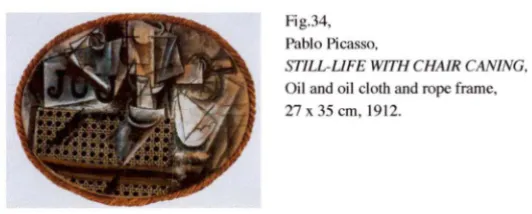
In the
papi
ers colle
s
of Georges
Braque
and
Pablo Picasso
,
and
in the
still
lifes
of
Juan Gris,
Gino
Severini
,
Kurt
Schwitters,
and others
,
cheap simulations assumed the task
previously performed by painterly imitation
....
In these paintings
,
wood-grain,
brass nameplates,
..
.
greasy
bank notes
,
etc
.
are
juxtaposed
as
pure
texture
,
reformulating
the enigma
of
painting
and compelling
us
to
turn
our attention
from the objects
themselves to the
solving of
that
enigma
....
28Fig.3
4
,
Pabl
o
Pic
asso.
STILL-UFE WITH C
H
A
IR
CAN
I
NG,
O
il and
o
il cl
o
th and ro
pe f
ram
e,
2
7
x 35
cm,1
9
1
2.
As
the
true
state of
the
object
behind the
facade of
the painting
remains perpetually
in question,
the
Paintjec
t
,
like the
veneer
,
engages
[image:40.574.198.464.475.582.2]employed not just as a simulated surface but a mechanism of
transformation.
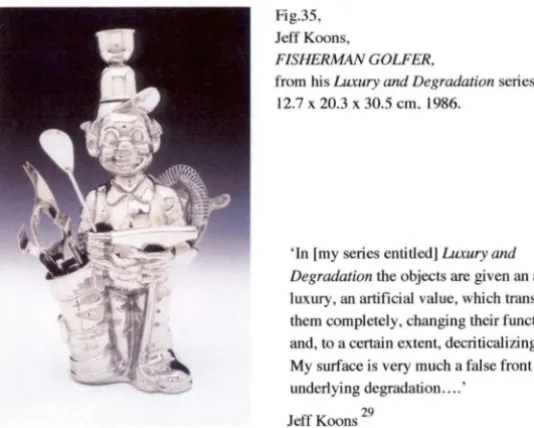
Fig
.
3
5,
J
eff
K
oo
n
s
,
FI
S
HERMAN
G
OLF
E
R
,
fr
o
m hi
s
Luxury
a
n
d
D
eg
r
ada
ti
o
n
se
ri
es
,
12.7 x
20
.
3
x
30.5 cm
. 1986
.
'
In
[my series entitled] Luxury and
D
eg
radati
o
n
th
e o
bj
ects
are
giv
en an
art
ifi
cial
luxury
,
an artifi
c
i
al v
alu
e,
which tran
sfo
rm
s
them
complete
l
y, c
han
ging
their fun
c
ti
o
n,
and, to a certain extent
,
decriticalizin
g them.
My
surface
is
very much a false fr
ont
for an
und
e
rl
y
in
g
d
egra
d
a
ti
o
n
.
..
.
'
Je
ff
K
oo
n
s
29As opposed to other surface coverings, such as carpets
,
veneers are
characterised by a thinness that enables them to disguise objects
without overtly affecting their forms. The paradox of the veneer is a
function of this thinness
,
as it serves to disguise itself (as well as
the
object) through identifying its edge with the edge of the object it
obscures. Whilst being a surface, the veneer then attempts to become
a volume. Mum's table did not desire to be perceived as a chipboard
table with a pine surface, but as a solid pine table.
Ironically, whilst assuming many
of the characteristics of the veneer,
the paintings in this project desire to preserve and emphasise their
nature as surfaces. Rather than attempting to merge with the volume
of the object behind, the painting is content to obscure it,
simultaneously preserving its role as
both a cover and a picture.
This cover (unlike the
veneer
)
doe
s
not attach it
s
elf to the actual
[image:41.572.202.469.134.348.2]In this way, the surface of the
Paintject re-presents the volume of the
Bath
Began the bath painting yesterda
y
.
Whilst doing it I
r
ealised that it
would not work as an object
if
the
outer rim/structure of
the bath appeared through the
canvas.
I
have decided to
have the image be something of an actual bath
-even a specific one (mum and dad's bath ... my bath in Sydney).
Fig.36
,
MY PARENTS'
BATHROOM
,
8 Yallambee
C
ourt
,
Baulkham
Hills,
Sydne
y
,
N.S.W.
I
want to put a simple green enamel (a particular acqua green) on the
top surface in high gloss.
This
will speak of the notion of the bath,
bathroom surfaces and even a pool of water.
The piece will be different in that its colou
r
,
form
and
,
maybe, the title
will reveal the identity of the object behind.
The interesting thing for me is
the way in
which it dissects and
r
ea
rran
ges aspects of
the appearance and function of
a bath.
H
ere
'
spillage' and 'dirt' can become the
aesthetic,
the permanent
and even the decorative.
The indent of a bath
,
which allows it to
be filled with water, now
contains the
r
esidues of the painting that have seeped through the
canvas staining the actual bath that is now in darkness.
A psychological/ metaphorical Cubism ... a dissection not just of
You encounter a
glistening surface
that floats above a
curtain
of
stains.
The
colour of
the
surface
is reminiscent of
something
but
you
are not
certain
of its
origin.
The
surface stops
as
a
fluid might with
a
delicate meniscus that perches on the
edge
from which the 'curtain' is
suspended.
The
object
is body
scale
and floats
off
the ground in an
ominous way. It seems to
speak
of some kind of mortuary
sl
ab or
tomb
.
31Fig
.
37
,
BATH,
Acrylic and
ename
l
on canvas and
bath
,
55
x 74 x
169
cm,
1999.
Retit
l
ed: Acrylic and enam
e
l
on canvas and
bath.
Entitled BATH
you
become aware of why it engaged
you
.
You knew it
all along
and yet
it
seems estranged
from the baths
you
know (more
like a form from which they might be determined or extruded)
.
You
read more - Acrylic and enamel on canvas and bath -
only
to realise
that a bath is actually present under this 'facade' (or is it??).
B
uried
BATH
represents a
turning point in this project
as
it transferred the
object
not directly through its design or
structure,
but rather through
a
combination of its function and surface.
What
appears on the surface
of
this Paintject
is
not the profile
of a
bathtub, but the enamel
colour
33which mimics the
surface of
the
actual
bath and
a
representation if not
a
replication
of overflow and spillage (the action of a
bath being
used). Here the
sign
and
signified
became merged
as
the dripping,
flowing paint
on
the
edge of
BATH is in
effect
the
spillage
that it
represents.
34Fig.38,
BATH
(DETAIL),
Acrylic
and
enamel
and
bath,
55
x
74
x
169
cm,
1999.
Retitled:
A
cry
li
c
and
e
nam
e
l
o
n
ca
nv
as
and bath.
Fig.39,
Pat Steir,
WATERFALL
OF
THE
AS
I
AN N
IGHT
,
NOTES TO PAGES 19-26
OBJECTS AND THE DOMESTIC SURFACE
SCREEN DOOR
Journal Excerpt 13/6/98
SOUVENIR
2 Seward, K., 'Frankenstem m Paradise,' Parkell 50151, 1997, [p.71] 3 Unless 11 becomes a part of our collection. This 1s another issue in itself
4 For an ID depth analysis of the souverur see S. Stewart, On Longing· Narratives of the Miniature, the
Gigantic, the Souvenir, the Collectwn, Balttmore The John Hopk1Ds Umvers1ty Press, 1984, ppl36-137
5 Pamt here ts then apphed hke make up 'The faults' and 'ble1D1sbes' of the objects are disgwsed through the 'cosmettc' of the image and so the cutlery tray becomes a thmg of beauty, the bath tub of mystique, the bed of nostalgia When tt was suggested ID a cnt1que that works such as Screen Door embodied 'the sublime', I rephed that they were more about a facade of special effects calculated to give that impression
6 Thts process relates directly to the exchanges that occur with the ownershtp of an object
'What defines an object, irrespecttve of its means of producbon as an md1v1dual. are the traces and imprints
of parttcular events, that are parttcular to the 1Dd1v1duals that engage with them A transfonnalton occurs when produclton and presentalton ends and ownership begins .. 'A McCollum, Journal excerpt, source
unknown
7 In the same way in whtch the photograph of a thing ts not the thmg itself, but refers to 11 and ID so doing
becomes somethmg else.
STUFFED BIRDS
8 I am of Maltese descent
9 See also Santa Donata quote on p J · Her 'prostrate postllon and s!tllness', combmed with her state of presenta!Jon -as an object to be viewed - aroused cunos1ty, canng and contact Whtlst not offictally 'stuffed' she perfonns very much hke the trophy birds See also the photograph· ' . all photographs in a sense s!Jll Itfe-freeze 11, preserve 11, as something no longer hve but munortally tmmobile ' R Solnit, Once
Removed Portraits by J John Prwla , 'The Col or of Shadows, the Weight of Breath, the Sound of Dust',