UNIVERSITI TEKNIKAL MALAYSIA MELAKA
Numerical Solution of Nanofluids Flow and Heat Transfer over a
Moving Surface with Thermal Radiation
This reportsubmitted in accordance with requirement of the Universiti Teknikal Malaysia Melaka (UTeM) for the Bachelor’s Degree in Manufacturing Engineering
Technology (Process and Technology) with Honours
by
MUHAMMAD ASYRAF BIN AZLI B071410505
950828-04-5129
i
DECLARATION
I hereby, declared this report entitled “Numerical Solution of Nanofluids Flow and Heat Transfer over a Moving Surface with Thermal Radiation” is the results of my
own research except as cited in references.
Signature : ……….
Author’s Name : ………
ii
APPROVAL
This report is submitted to the Faculty of Engineering Technology of UTeM as a partial fulfillment of the requirements for the degree of Bachelor’s Degree in Manufacturing Engineering Technology (Process and Technology) with Honours. The member of the supervisory is as follow:
iii
ABSTRAK
iv
ABSTRACT
v
DEDICATION
vi
ACKNOWLEDGMENT
Firstly, thanks to Almighty Allah for graciously blessed me with the ability to undertake and finally complete this thesis.
I wish to express my most profound thanks to my supervisor, Mr Iskandar Bin Waini for his countless hours of reflecting, reading, encouraging, and most of all patience throughout the entire process. Also, I would like to recognize with much gratefulness to my co-supervisor, Mr Mohamad Ridzuan Bin Mohamad Kamal for his valuable guidance.
vii
TABLE OF CONTENTS
Declaration i
Approval ii
Abstrak iii
Abstract iv
Dedication v
Acknowledgement vi
Table of Content vii
List of Tables x
List of Figures xi
List Abbreviations, Symbols and Nomenclatures xii
CHAPTER 1: INTRODUCTION 1.0 Introduction 1
1.1 Background of Study 1
1.2 Problem Statement 2
1.3 Objective of Project 2
1.4 Scope of Project 3
1.5 Gantt Chart and Flow Chart 4
viii
2.1 The Concept of Boundary Layer 6
2.2 Flow and Heat Transfer of Nanofluid over Moving Surface 7
2.3 Flow and Heat Transfer with Thermal Radiation Effects 12
CHAPTER 3: METHODOLOGY 3.0 Introduction 18
3.1 The Governing Equations 18
3.2 Similarity Transformation 20
CHAPTER 4: NUMERICAL FORMULATION 4.0 Introduction 32
4.1 Finite Difference Method 32
4.2 Newton’s Method 36
4.3 The Block Tridiagonal Matrix 38
4.4 Starting Conditions 42
CHAPTER 5: RESULT AND DISCUSSION 5.0 Introduction 45
5.1 Result Validation with Previous Results 45
5.2 Research Findings and Discussions 47
CHAPTER 6: CONCLUSION AND RECOMMENDATION 6.0 Introduction 58
6.1 Conclusion of Research 58
ix
REFERENCES 61
x
LIST OF TABLES
5.1 Comparison of present results for reduced Nusselt number '
0 ,and reduced Sherwood number '
0 , against Olanrewaju et al. (2012) and Shateyi and Prakash (2014) for different values of Pr when Ha = 0, Le = 2, Nb = Nt = 0.1, R = 1, = 0.149
5.2 Comparison of present results for reduced Nusselt number'
0 , and reduced Sherwood number '
0 , against Olanrewaju et al. (2012) and Shateyi and Prakash (2014) for different values of Le when Pr = 0.71, Ha = 0, Nb = 0.1, Nt = 0.1, R = 1, = 0.150
5.3 Comparison of present results for reduced Nusselt number'
0 , and reduced Sherwood number '
0 , against Olanrewaju et al. (2012) and Shateyi and Prakash (2014) for different values of when Pr = 0.71, Ha = 0, Le = 2, Nb = Nt = 0.1, R = 151
5.4 Comparison of present results for reduced Nusselt number'
0 , and reduced Sherwood number '
0 , against Olanrewaju et al. (2012) for different values of R when Pr = 0.71, Ha = 0, Le = 2, Nb = Nt = 0.1, = 0.152
5.5 Values of '
0 and '
0 at different values of Nb with parameters Pr = 0.71, Ha = 0, Le = 2, Nt = 0.1, R = 1, = 0.153
5.6 Values of '
0 and '
0 at different values of Nt with parameters Pr = 0.71, Ha = 0, Le = 2, Nb = 0.1, R = 1, = 0.153
xi
LIST OF FIGURES
1.5 Flow Chart of the Project 4
2.1 The development of the boundary layer for flow over a flat plate, and the different flow regimes
7
4.1 The grid for difference approximations 33
4.2 Plots of the velocity, temperature, and nanoparticle fraction profiles for the case Pr = 0.71, Ha = 0, Le = 2, Nb = Nt = 0.1, R = 1, = 0.1
43
5.1 The effect of velocity parameter, on the velocity profiles 54 5.2 The effect of magnetic field parameter Ha, on the temperature
profiles
54
5.3 The effect of radiation parameter R, on the temperature profiles 55 5.4 The effect of thermophoresis parameter Nt, on the temperature
profiles
55
5.5 The effect of Brownian motion parameter Nb, on the temperature profiles
56
5.6 The effect of magnetic field parameter Ha, on the nanoparticle concentration profiles
56
5.7 The effect of Lewis number parameter Le, on the nanoparticle concentration profiles
57
5.8 The effect of thermophoresis parameter Nt, on the nanoparticle concentration profiles
xii
LIST OF ABBREVIATIONS, SYMBOLS AND
NOMENCLATURE
Abbreviations
UTeM - University of Technical Malaysia Melaka FTK - Fakulti Teknologi Kejuruteraan
MHD - Magnetohydrodynamic
SRM - Spectral Relaxation Method
OHAM - Optimal Homotopy Asymptotic Method SQLM - Spectral Quasi-Linearisation Method HAM - Homotopy Analysis Method
DRA - Duan–Rach Approach
ChPDM - Chebyshev Pseudospectral Differentiation Matrix HPM - Homotopy Perturbation Method
Symbols
- Thermal diffusivity of the fluid
- Fluid density
- Electrical conductivity
*
- Stefan-Boltzman constant
- Similarity variable
- Velocity parameter
- Nanoparticle heat capacity and base fluid capacity ratio
- Coefficient of viscosity
- Kinematic viscosity
xiii
Nomenclature
0
B - Magnetic field of constant strength
C - Concentration of nanoparticle
w
C - Surface concentration of nanoparticle f
C - Skin-friction coefficient
B
D - Brownian diffusion coefficient T
D - Thermophoresis diffusion coefficient
Ha - Hartman number
k - Thermal conductivity coefficient s
K - Rosseland mean absorption coefficient
Le - Lewis number
Nb - Brownian motion
Nt - Thermophoresis parameter
x
Nu - Local Nusselt number
Pr - Prandtl number
w
q - Heat flux from the plate
m
q - Mass flux from the plate
x
Re - Stagnation flow Reynold’s number
R - Radiation number
x
Sh - Sherwood number
x, y - Cartesian coordinate
u, v - Velocity componentsU - Free stream velocity
T - Temperature
w
T - Moving surface temperature
1
CHAPTER 1
INTRODUCTION
1.0 Introduction
This chapter will explain the overview of the study and the purpose of this study. The chapter includes the background of the study, problem statement, objectives that is expected to be achieved and the scope of the study that is going to be conducted.
1.1 Background of Study
Many engineering and industrial processes involve heat transfer by means of a flowing fluid in either laminar or turbulent regimes. If the heat transfer in the fluids were decreasing in the term of thermal resistance, it would benefit many of these processes. Nanofluids itself have the potential to reduce its thermal resistance and industrial groups, food and manufacturing, all these would be benefits from this heat transfer. The example of poor heat transfer of fluids is such as oil, water and ethylene glycol mixture. This is due to the thermal conductivity of the such fluids that have a job in the heat transfer coefficient between the medium heat transfer and the surface itself. Besides, Choi (1995) had introduced a technique which used a mixture of a nanoparticles and the base fluid. This is to see the presence of the fluids with the substantially in the higher conductivities. The mixture result of fluids and the nanoparticles was referred as a nanofluids.
2 investigated on the melting heat transfer in the MHD flow nanofluids on exponentially permeable stretching sheet.
This project is mainly focus on solving fluid flow, heat transfer and mass transfer problems by using numerical methods. The governing boundary layer equations are reduced to a system of the highly nonlinear ordinary differential equations by using the suitable similarity transformations. Then the resulting equations are solved numerically using the Keller-box method. The MATLAB software was used in order to solve the related problems.
1.2 Problem Statement
Boundary layer behaviour over a moving continuous surface is an important type of flow occurring in several engineering processes. For example, many extrusion processes involve the cooling of persistent strips or filaments by drawing them through a quiescent fluid. These phenomena are same for the boundary layer along moving flat plate. The boundary layer equations must be used in order to solve boundary layer problem. There are many ways in order to solve boundary layer equation such as Taylor’s series that the result sometimes is not really accurate. The problem may occur if the calculation that had been made got many error and not accurate. So, in order to solve the boundary layer equations, others numerical methods will be used.
1.3 Objective of Project
The main objective of this project is to investigate the effect of thermal radiation on flow and heat transfer of nanofluid over a moving surface. The specific purposes for this project are summarized as follows:
a) To formulate the governing partial differential equations of the nanofluid into the ordinary differential equations using similarity transformation. b) To develop the numerical algorithm of the related problem using
3 c) To investigate the effect of thermal radiation on the laminar boundary layer
flow of nanofluid over a flat plat.
1.4 Scope of Project
Scopes for this project is based on objectives that have stated and there are the several scopes that will be carrying out:
a) The laminar flow for a steady, two-dimensional and incompressible viscous flow are considered.
b) The model used for the nanofluid incorporates the effects of Brownian motion and thermophoresis.
c) This problem is formulated using similarity transformation and solves numerically using Keller-box method.
4
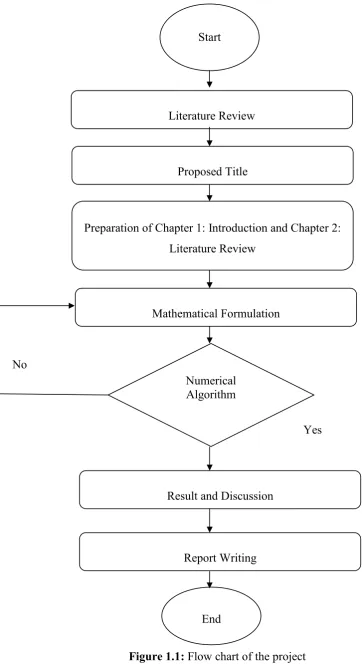
5 No
[image:19.595.101.464.75.740.2]Yes
Figure 1.1: Flow chart of the project Start
Literature Review
Proposed Title
Preparation of Chapter 1: Introduction and Chapter 2: Literature Review
Numerical Algorithm
Result and Discussion
End
Mathematical Formulation
6
CHAPTER 2
LITERATURE REVIEW
2.0 Introduction
This section discusses the previous researches obtained from the internet, journals, articles and books about the topic related to this study. Section 2.1 explained the concept of boundary layer. The overview of flow and heat transfer of nanofluid over moving surface is discussed in Section 2.2. Lastly, flow and heat transfer with thermal radiation effects is presented in Section 2.3.
2.1 The Concept of Boundary Layer
Boundary layer is a very thin layer of fluid adjoining to the surface of an object around which the fluid is flowing. External flows past an object encompass an extremely wide variety of fluids mechanics phenomenon. Clearly, the character of the flow field is a function of the shape of the body. The characteristic of the flow depends very strongly on the various parameters for a given shaped object such as size, orientation, speed and fluid properties. The Reynolds number, ReUL , where L is the characteristic dimension of the body is the most important of these parameters for the typical external flows. The Reynolds number were divided into two region which is a viscous boundary layer adjacent to the surface of the vehicle and the essentially inviscid flow outside the boundary layer.
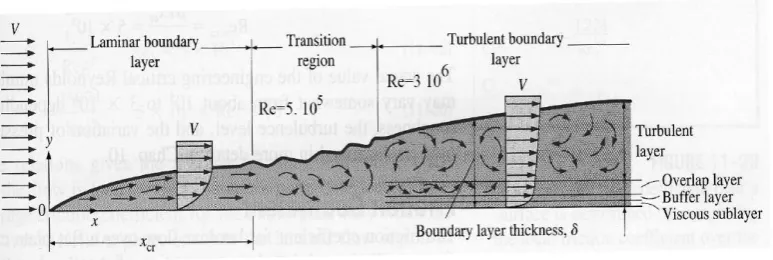
7 boundary into the flow. The velocity gradient in real fluids sets up shear forces near the boundary that will reduce the flow speed to the boundary. The fluid layer which has had its velocity affected by the boundary shear is called the boundary layer. For smooth upstream boundaries the boundary layer starts out as a laminar boundary layer in which the fluid particles move in smooth layers. As the laminar boundary layer increases in thickness, it becomes unstable and finally transforms into a turbulent boundary layer in which the fluid particles move in haphazard paths. When the boundary layer has become turbulent, there is still a very thin layer next to the boundary layer that has laminar motion which is called the laminar sublayer which shown in Figure 2.1.
Figure 2.1: The development of the boundary layer for flow over a flat plate, and the different flow regimes
2.2 Flow and Heat Transfer of Nanofluid over Moving Surface
[image:21.595.129.516.306.436.2]8 which is the nanofluid properties may vary significantly within the boundary layer because of the effect of the temperature gradient and thermophoresis. He also developed a new correlation structure that can reproduce published nanofluid heat transfer data reasonably well.
Shateyi and Prakash (2014) studied a new numerical approach for magnetohydrodynamic (MHD) boundary layer flow and heat transfer of nanofluid over a moving surface in the presence of thermal radiation. The aim of this study is to develop numerical technique which is spectral relaxation method (SRM) to solve the problem. Results shows that an excellent agreement was observed between SRM method and those obtained using other method. On the other hand, it can be found that the local temperature rises as the Brownian motion, thermophoresis and radiation effects intensify.
Unsteady MHD boundary-layer flow and heat transfer of nanofluid over a permeable shrinking sheet in the presence of thermal radiation is investigated by Nandy et al. (2014). The main idea is to study the simultaneous effect of the magnetic field and thermal radiation on the flow and heat transfer due to the unsteady, two-dimensional laminar flow of a viscous nanofluid caused by a permeable shrinking sheet. The methodology used in this studied are fourth order Runge–Kutta method with shooting technique. The results obtained from the study is the dimensionless velocity increases with increasing magnetic and suction parameters for the first solution and decreases for the second solution. In addition, the dimensionless temperature and the rescaled nanoparticle volume fraction both decrease with increasing magnetic parameter for the first solution and increase for the second solution.
9 solution exists for all values of the velocity ratio parameter α (>0) meanwhile for the shrinking sheet similarity solution may or may not exist.
Nanofluid flow over an unsteady stretching surface in presence of thermal radiation is studied by Das et al. (2014). The main purpose is to study the effect of thermal radiation on boundary layer flow of a nanofluid over a heated stretching sheet with an unsteady free stream condition. The methodology used are shooting method and Runge–Kutta–Fehlberg scheme. As a result, it is noticed that the fluid temperature and the thermal boundary layer thickness increase for increasing thermal radiation, Brownian motion and thermophoresis meanwhile the effect is opposite for unsteadiness parameter.
Flow and heat transfer over a moving surface with non-linear velocity and variable thickness in a nanofluids in the presence of Brownian motion is introduced by Abdel-wahed et al. (2015). This study investigated the effect of hydro-magnetic flow and heat transfer characteristic of a nanofluid over a steady moving surface with variable thickness on the mechanical properties of the surface in the presence of Brownian motion and heat source during the heat-treating process. The equations are solved using optimal homotopy asymptotic method (OHAM) for general conditions. It is noticed that Brownian motion and thermophoresis have a negative effect on the surface hardness and strength. On the other hand, it can be found that nanoparticle concentration near the non-flat surface is bigger and thinner than that on the flat surface.
10 thickness whereas Prandtl number maximizes the rate of thermal boundary layer thickness. Other than that, viscous dissipation, thermal radiation, Brownian motion and thermophoresis parameters enhance the temperature profile whereas Prandtl number and the velocity parameter reduce it significantly.
Effect of chemical reaction on MHD boundary layer flow and melting heat transfer of Williamson nanofluid in porous medium is explored by Krishnamurthy et al. (2015). The objective of the study is to discuss the nanoparticles analysis for the Williamson fluid model. The resultant nondimensionalized boundary value problem are solved numerically by Runge–Kutta–Fehlberg fourth–fifth order method followed by shooting technique. It is concluded that velocity and the boundary layer thickness increase and temperature distribution decreases due to increase in melting parameter. Besides that, chemical reaction parameter decreases the concentration profile, whereas the velocity and temperature of the fluid are not significant with increase of chemical reaction parameter.
Abdel-wahed and Emam (2016) worked the MHD boundary layer behavior over a moving surface in a nanofluid under the influence of convective boundary conditions. The major objective in this study is to study the MHD boundary layer with convective boundary conditions over a flatness-moving surface taking the nanoparticles Brownian motion and thermophoresis force into account. The method used to solve the equation is fourth order classical Runge–Kutta method. The results gained from the work is the values of the Nusselt and Sherwood numbers for non-linear thermal radiation model are high comparing with non-linear model.