by
Jonathan Pugh
B.Sc. Hons (University of Tasmania)
Submitted in fulfilment
of the requirements for the degree of
Master of Science
University of Tasmania
Hobart
January 2001
This Thesis contains no material that has been accepted for a degree or diploma by the University or any other institution, except by way of background information and duly acknowledged in the Thesis, and to the best of my knowledge and belief no material previously published or written by any other person except where due
acknowledgement is made in the text of the Thesis.
1
7
„
Due to the extensive use of modem technology and the advent of mobile
communications, bandwidth usage by Internet applications such as multi-user virtual reality systems needs to be kept to a minimum. In traditional multi-user virtual reality simulations, synchronization data about deterministic objects must be regularly sent to remote simulations in order to maintain consistency among the simulations. Using these systems, a maximum of about ten objects can be simultaneously synchronized
over a typical modem connection.
There is scope for eliminating synchronization information caused by deterministic objects by taking advantage of their predictability. Using the efficient rolling mechanism provided by the Replicated Time Warp mechanism (presented in this thesis), the need to send synchronization data for deterministic objects is eliminated at the expense of extra local computation required to predict the deterministic objects.
By eliminating the bandwidth restrictions, the Replicated Time Warp system enables virtual worlds far more complex than previously possible to be created and
synchronized over modem or wireless connections. Virtual Worlds containing one hundred or more dynamic objects can be simultaneously synchronized over a modem
1 Introduction
2
1.1 Rationale 2
1.2 Requirements for Multi-User Virtual Worlds 4
1.3 Aims 6
1.4 Definitions 6
1.5 Originality 7
1.6 Chapter Overview 8
2 Design Issues
10
2.1 Message Passing 10
2.2 Remote Entity Approximation 20
2.3 Data Distribution 27
2.4 Concurrency Control 34
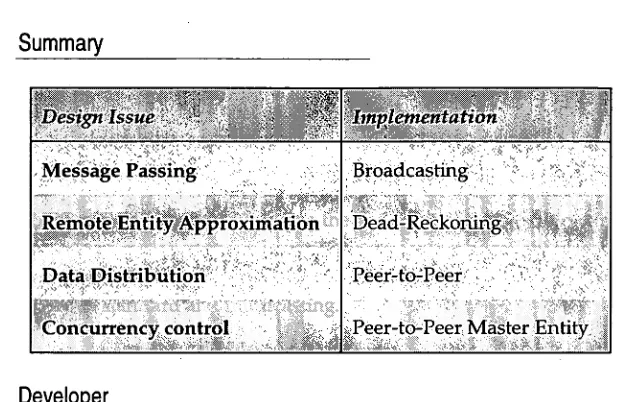
2.5 Summary 52
3 Related Work
54
3.1 SIMNET 54
3.2 DIS 57
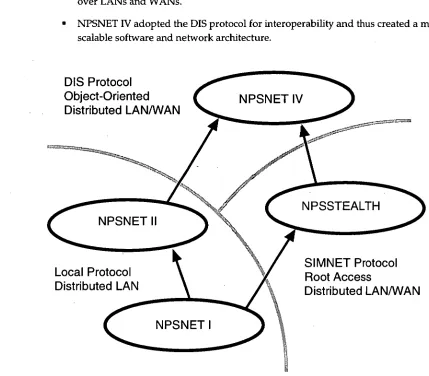
3.3 NPSNET IV 59
3.4 HLA 63
3.5 DIVE 67
3.6 SPLINE 69
3.7 BrickNet 71
3.8 Environment Manager 74
3.9 Summary 76
4 Replicated Time Warp
77
4.2 Time Warp 79
4.3 Replicated Time Warp 92
4.4 Related Work 96
4.5 RTW and Time Warping 97
4.6 RTW Analysis 98
4.7 Summary 110
5 Conclusion
111
6 Appendix A: Profiling 113
1.1 Rationale
Virtual worlds are real-time simulations that give the user a strong sense of immersion within the simulated world (usually done primarily through the use of 3D graphics). Since these virtual worlds often imitate the real world, the experience is termed 'Virtual Reality' (VR). Multi-user virtual reality enables people to interact closely with each other within these virtual worlds through the use of computer networks,
regardless of the participants' actual geographical locations.
Ever since the concept of virtual worlds has existed, one of the main aims has been to enable multi-user participation (Macedonia et al 1994). As an example, at VR World 95 several speakers said that they would not consider a single-user environment as true virtual reality. Dave Sims writes in his review about VR World 95 that 'other users' is clearly the hot new element in VR (Sims 1995).
Applications of multi-user virtual reality are almost limitless and include simulation environments such as group military training and vehicle or weapon prototyping (see SIIVINET, DIS & NPSNET), cooperative work environments, group learning
environments and group entertainment environments.
Multi-user virtual reality systems first became popularised in military circles (see SIMNET), but the technology developed there has been spreading through the academic and commercial worlds. It is filtering down through these systems and will soon become an accepted part of everyday computing activities on the Internet. The current commercial driving force in multi-user virtual reality is locally networked (Ethernet LANs) or Internet networked (online) gaming systems. This push towards multi-user virtual reality has been helped by a recent boom in 3D technologies for personal computers. Graphics previously possible only on high-end workstations worth thousands of dollars is now available on personal computers for only a few hundred dollars through the use of specialized 3D accelerator cards.
Large companies such as Intel are moving in this direction with new multi-media technologies such as Intel's new MMX Pentium chips, which enable faster and higher quality 3D graphics as well as other multi-media enhancements. Major software companies embracing 3D technologies include Microsoft with their Direct3D technology and Apple with their Quickdraw3D technology.
designed for use over the Internet and currently has two versions: VRML 1 and VRIVIL 2. VRML 1 is simply a file format for 3D data, whereas VRML 2 supports animation of the 3D data as well. There is a lot of interest in producing multi-user VRIVIL, with plenty of discussion occurring on relevant VRML mailing lists and newsgroups.
As an example of the enthusiasm in multi-user virtual reality, a proposal for multi-user VRIVIL, 'Living Worlds', is supported by Apple, Fujitsu, IBM, Intel, Silicon Graphics, Sony and many other companies (Honda et al 1997). Its first draft was frozen at VRIVIL97 and the second draft is under development. When a standard for multi-user VRML is agreed upon, it will be a major boost to multi-user virtual reality on the Internet, just as the previous VRML standard has made single-user Virtual Reality popular on the Internet.
Several small companies are now emerging that are embracing the technology used in large-scale multi-user military simulations and are adapting it to online games. MaK Technologies is making the most of both worlds by developing a training system for the US Marines that is planned to be marketed both as a simulation system for the military as well as a networked multi-player game (The Australian April 29 1997). It is only a matter of time before more socially useful applications become commercially viable. A few simple multi-user virtual reality systems are currently available for use on the Internet, which have chat facilities as well as limited interaction (Trueman 1995).
•
Nanawban d PC homesPOTS m od ern s)
Ecoadban d PC ham es (SUN, cable, satellite)
60
50
Millions
of 40
Households
30
20
10
0
1996 1997 1998 1999
2000
uxe : Gemini Kenn a, 1996
Figure 1 Estimated Modem Usage Statistics (Intel 1997)
One must also realize that any system should attempt to reduce bandwidth
as
much as possible to allow many multi-user virtual worlds to be run simultaneouslyover
the Internet without clogging up the network. Currently military simulations enable thousands of simultaneous users, but are run over their own dedicated networks.It is for the above reasons I have decided to tackle multi-user virtual reality with an aim of producing a multi-user virtual reality system that has minimal bandwidth requirements, can accommodate high latency connections and will run on current personal computers.
1.2 Requirements for Multi-User Virtual Worlds
Each multi-user virtual reality system has a minimum set of requirements to meet. These requirements vary from system to system, but various common elements can be found. The most general of these requirements include consistency, scalability
and
responsiveness.These particular areas are important for all multi-user virtual reality systems and are the focus of most multi-user virtual reality studies. Other requirements may be
present, depending on the application at hand. Examples of extra requirements include security requirements, fault tolerance requirements, support for spoken interaction or comprehensive run-time modification and extension.
Due to the vast array of applications for multi-user virtual reality, the final degrees of consistency, scalability and responsiveness required will be determined by the
Scalability
The system must be able to support the required number of participants and shared objects for the purposes of the particular application. Numbers of users and shared objects range from tens for collaborative work applications, to hundreds of thousands for military simulations. The software architecture is considered scalable if its
responsiveness and consistency does not degrade excessively as the number of users increases.
Responsiveness
Studies have shown that delays of more than 100ms in a user interface begin to be perceived by humans and adversely affect their performance (Bailey 1982, Woodson 1987, Fluckiger 1995). The total elapsed time between a user action and the sensory feedback should generally be less than 100ms. Multi-user virtual reality systems should thus ideally attempt to keep user interface delays below 100ms. The degree to which humans are affected by delays is application dependent. Tasks requiring speed and accuracy are affected the most. The system must try to support the responsiveness requirements of the application at hand.
Improving a multi-user virtual reality system's user interface delays involves
shortening both response times and notification times. The response time is the time it
takes a user's interface to reflect its own actions (Ellis et al 1991). The notification time is
the time required for a user's action to be propagated to the other users' interfaces (Ellis et al 1991). The minimum notification time possible is the same as the response time plus the time it takes for a message to traverse from the sender to the receiver (end-to-end delay). The optimal response time of a multi-user application involves having the local changes reflected as fast as the same application running as a single user application (Ellis et al 1991, Karsenty & Beaudouin-Lafon 1993).
Consistency
Within a multi-user virtual reality system, each user should see consistent views of the parts of the virtual worlds they are interested in. The notion of consistency enables collaboration. The degree of consistency maintained within various multi-user systems varies. Certain applications allow less consistency, which simplifies their design, but also reduces the degree of collaboration that can be obtained. Designing virtual worlds that do not have consistency requirements is trivial, because they are no longer multi-user.
A measurable quantity that relates to consistency is the time is takes for any event to be committed. The commit time is the time it takes for a local user's action to be reflected locally and to be guaranteed never to be altered. The optimal commit time is
alteration of the user's actions is disconcerting to the user, the commit time should also generally attempt to stay below the 100ms threshold.
1.3 Aims
The aim of this research is to produce a software architecture for the development of multi-user virtual worlds targeted at the largest home market—modem users. The system must meet the requirements of scalability, responsiveness and consistency as needed by these users. In particular, the system should reduce the required bandwidth and network to-end delay to their minimum possible values; bandwidth and end-to-end delay being the problem areas for modem users.
For simplicity, only the 3D graphical animation components of multi-user virtual worlds are considered. Sound and video, for example, are not considered.
1.4 Definitions
The following definitions are given in a multi-user virtual reality context:
• Behaviour — a set of instructions that determine how an object in a virtual world
acts.
• Commit Time — the time it takes for a local user's action to be reflected locally and
to be guaranteed never to be altered.
• Concurrency — when more than one process accesses an object at a time.
• Concurrency Control — a process that maintains consistency between virtual worlds.
• Entity — an object in a virtual world that is usually rendered.
• Host — a computer connected to a network.
• NAK — negative acknowledgement (see Reliable Multicasting).
• Network Access Delay — the time necessary at the source to wait for the medium to
be available, or for the network to be ready to accept the block of information (Fluckiger 1995).
• Network Access Speed — the frequency at which bits may be sent or received during
transmission periods at the interface between the end-system and the network (Fluckiger 1995).
• Network Bit Transmission Delay — the time necessary to transmit the sequence of
• Network End-to-End Delay — this measure also takes into account the time it takes for the data to be transmitted onto the medium and received from the medium, not just the network transit time. It is equal to Access Delay + Network Latency + Bit Transmission Delay.
• Network Latency — the time it takes for an empty message to travel across a network from the source application layer to the destination application layer.
• Network Transit Delay — same as Network Latency.
• Notification Time — the time required for a user's action to be propagated to every user's interface (Ellis et al 1991)
• Object — an object in a virtual world usually has a unique identifier, data
associated with it representing its state and a view for rendering. Object may also have behaviour.
• Optimistic Concurrency Control — more than one user can modify an object at a time; inconsistencies are resolved later.
• Peer — a host that acts both as a client and as a server.
• Peer-to-Peer — hosts can send messages directly to each other and do not rely on a central server.
• Pessimistic Concurrency Control — only one user can modify an object at a time. Inconsistencies are thus guaranteed not to occur.
• Response Time — the time it takes for a user's interface to reflect their own actions (Ellis et al 1991)
• Responsiveness — a combined measure proportional to both response and notification times.
• TCP — Transmission Control Protocol. Used for sending messages reliably across the Internet.
• Totally-Ordered Multicast — when a sequence of messages are transmitted to a group by totally-ordered multicast the messages reach all of the members of the group in the same order.
• UDP — User Datagram Protocol. Used for sending messages unreliably across the Internet.
• Virtual Reality (VR) — an alternate reality created by a Virtual World. • Virtual Reality System — a system designed to simulate Virtual Worlds. • Virtual World — a real-time simulation that gives the user a strong sense of
immersion within the simulated world.
1.5 Originality
• An analysis of multi-user virtual reality techniques from various multi-user virtual reality systems, and grouping of these techniques into general categories. These general categories are then used to re-analyse various multi-user virtual reality systems.
• The adaptation of a Replicated Time Warp mechanism for real-time multi-user interaction by synchronizing the Time Warp replicas with the local real-time clocks and synchronizing the remote local real-time clocks with each other. Also by providing a mechanism to handle interactive input and output through a reversible execution concurrency control mechanism.
• The application of Time Warping to the Replicated Time Warp system to reduce the sizes of rollbacks, while still obtaining the benefits of smoothing the perceived effects of end-to-end delay that the Time Warping provides.
1.6 Chapter Overview
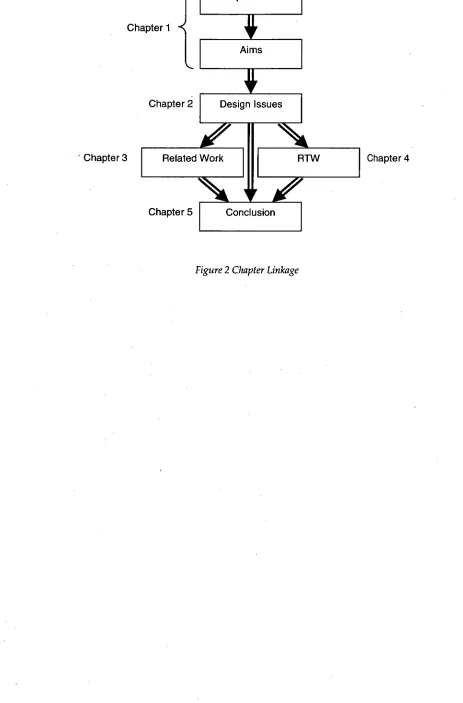
Chapter 1, Introduction provides the aims of this study and defines some requirements
for multi-user virtual reality systems.
Chapter 2, Design Issues provides background information necessary to analyse and
design multi-user virtual worlds. Several multi-user virtual reality techniques are described and it is shown how each technique can be used to help meet aspects of the requirements of multi-user virtual worlds. This information will be used to compare various multi-user virtual reality systems in the Related Work and Replicated Time Warp chapters.
Chapter 3, Related Work describes various multi-user virtual reality systems that exist
today. Each system will be related to the requirements and techniques for meeting these requirements as described in the previous chapter.
Chapter 4, Replicated Time Warp presents the background of the Replicated Time Warp
system and explains how it works. It analyses and discusses its performance, and compares it to methods described in Chapter 2.
Chapter 5, Conclusion shows how the Replicated Time Warp mechanism meets the
aims and requirements presented in the first chapter. It provides a summary of the advantages and disadvantages of the Replicated Time Warp and suggests some future work.
Requirements
Ch apter 1
Chapter 2
Aims
4
Design IssuesRTW Related Work
' Chapter 3 Chapter 4
[image:14.562.48.511.101.804.2]Chapter 5 Conclusion
In order to meet the requirements for multi-user virtual worlds set out in the
Introduction chapter, the software that distributes the virtual world must be designed carefully. This chapter provides background information necessary to design or analyse multi-user virtual reality software architectures. Several techniques used in multi-user virtual reality systems are described and how they can help meet
requirements for multi-user virtual reality systems.
2.1
Message Passing
There are generally three ways of passing messages on a network: unicasting, multicasting and broadcasting. These methods can send messages either reliably (the message is guaranteed to reach its destination) or unreliably (the message is not guaranteed to reach its destination). The choice of unicasting, multicasting or broadcasting has an impact on the response times and scalability of a multi-user virtual reality system. These methods and their implications are discussed in the following sections.
Unicasting
Hosts
Figure 3 Llnicasting
An important factor associated with message sending is network latency. Network latency is the time it takes for an empty message to travel across a network from the source application layer to the destination application layer (see Figure 4). Latency will always be present due to the speed of light limitations.
Latency has been ignored for a long time due to the nature of the current generation of networked applications that shunt relatively large amounts of data across the network. With the advent of more interactive and group oriented networked applications, latency is becoming recognized as the other significant limiting factor in networks besides bandwidth.
Sender
Receiver
First bit of the block
transmitted by the
source
First bit of the block
received by the
source
1
Latency
Design Issues
12
A more useful measure than latency for assessing the performance of multi-user virtual reality systems is end-to-end delay. This measure also takes into account the time it takes for the data to be transmitted onto the medium and received from the medium, not just the transit time (see Figure 5).
Data block ready for transmission
Network or medium
ready
First bit of Last bit of the block the block
received received First bit of the
block transmitted
EN:
4 Access delay
•
101. • Bittransmission delay Latency
End-to-end delay
Figure 5 End-to-End Delay (Fluckiger 1995)
Detailed definitions of the components of Figure 5 are given below,
• The access speed is the frequency at which bits may be sent or received during transmission periods at the interface between the end-system and the network. As not all networks can transport bits at that speed in a sustained way over long periods of time, the achievable average bit rate may be lower than the access speed. In general, packet networks do not transport data at the access speed, whereas all circuit-based networks can (Fluckiger 1995).
• The time necessary at the source to wait for the medium to be available or for the network to be ready to accept the block of information is sometimes called the access delay (Fluckiger 1995).
• Bit transmission delay is the time necessary to actually transmit the sequence of bits of the block, one after the other, once the network is ready. For a given block size, this delay only depends on the access speed (Fluciciger 1995).
• The return trip delay or round trip time is the elapsed time between the emission of the first bit of a data block and its reception by the same end-system after the block has been echoed by the destination end-system. This includes the time taken by the destination end-system to receive, store and retransmit the block. Thus it cannot be entirely taken as an intrinsic characteristic of the communications subnetwork (Fluckiger 1995).
transmission delay; as a consequence, data compression can reduce end-to-end delay. Data compression can also lead to increased end-to-end delay if buffering is used by the data compression scheme. Compression should thus be done on a per message basis. An example of where data compression increases end-to-end delay is data compression on modems.
Typically, end-to-end delays of less than 100ms are required for audio interaction and less for interactive manipulation requiring visual feedback. Other properties such as object motion might be less sensitive to latency, especially if described by behaviours evaluated locally at each peer (Hagsand 1996).
For networks with large latencies, such as Wide Area Networks (WANs), the network latency becomes a critical issue in the performance of the system. Local Area Networks (LANs) typically have network latencies less than 10ms and so can use relatively inefficient algorithms in terms of response and notification times. WANs can have network latencies of about 12.5ms to 400ms (Hagsand 1996).
Table 1 shows some typical latencies obtained from experimental tests using
Within a LAN
ISDN:t5 ISP:
Modern toISP
Computer's Serial Port to MOdem
Internal Modem Delays
Screen Redraw Delay,(75I-li
°cal' Host Processing
Telephone Line Delay
Tas Uni within Tasmania
Tas Uni within Australia ,
Tas Unite; the USA
Tas Uni to Europe
Tas Urn to Japan
Tas Uni to Africa
Within Swederi
Sweden to America
Sweden to Já
Source traceroute Cheshire 1446 Cheshire 1996 , Fheshife:1996 Cheshire 1996 Cheshirel 996 Cheshire 1996 )traceroute. :traceroute, .§ traceroute' traceroute e traceroute traceroute
Ha gsand 1996
Hagsand 1996 1,-Iagsand 1996 Round Trip Time to 3ms 1 260nis' 3 300ins 400ms 50Orns 600ms ,800ms
Table 1 Typical Latencies
Reliable Unicasting
With reliable unicasting, the delay for a lost packet using TCP is typically (Tanenbaum 1996):
Terv[abl = timeout + ;Jab]
where
Tejab] = end-to-end delay for the reliable unicast from host 'a' to host 'b'
timeout = Tjab] + 4. Tdev
Tev[ab] = end-to-end delay for an unreliable unicast from host 'a' to host 'b'
where
= round trip time between hosts 'a' and 'b'
= 2.,ev[ab], assuming the end-to-end delay is symmetrical
Tdev = mean deviation of T[ab]
standard deviation of T„,[ab]
The reader is referred to Tanenbaum (1996) for the exact method for calculating 'T dev'. Substituting, we find that:
;jab] = timeout + Tjab]
= (T„,[ab] + 4•Tdev) + Tev [ab]
= 4.Tde, + 3.TeJab], assuming end-to-end delay is symmetrical
3.TJab]
Thus a reliable unicast sent via TCP that needs to recover from a packet loss will incur a delay at least three times larger the normal end-to-end delay.
Multicasting
Multicasting is the process of sending a single message to a group of hosts on a network. This is different to unicasting where a single message is sent from one host to one other host (see Figure 6). If multicasting is implemented in hardware (sometimes it is emulated by software using multiple unicasts) it can dramatically reduce the
bandwidth required to send a single message to multiple hosts—a task required very often in multi-user virtual reality systems and other groupware applications. When the term 'multicasting' is used, it usually refers to hardware-supported multicasting.
Hosts
Multicasting
Host
Figure 6 Multicasting
Local host processing requirements are also reduced over unicasting. The sending host only needs to send one message (unlike unicasting where a new message must be sent to each host). If the number of members of a multicast group is 'n' then n-1 messages would have to be sent for a unicast implementation of multicasting (you do not have to send one to yourself), whereas hardware multicasting requires only one.
A host will request to become a member of a particular multicast group. If the request is successful then that host will be able to receive and send messages to that particular group. It should be noted that the time required to join and leave multicast groups is finite, as is the number of available multicast groups.
Multicasting is supported over the Internet via the IP Multicast standard as described by Deering (1989). The limited number of multicasts groups available on the Internet is a restriction for multi-user virtual reality systems (Hagsand 1996 p. 36, p. 38). There can be difficulty managing which applications use which addresses in the multicasting address space since there is no register of which ones are being used at any given time.
approximately 50 bytes (Gautier & Diot 1998). Due to this limited bandwidth, sessions on the MBONE may have to be booked (Savetz et al 1998).
A consortium of major computer industry players has joined the IP Multicast Initiative (http:/ /www.ipmulticast.com/), including Microsoft and Intel. They are attempting to accelerate the adoption of multicasting to support the emerging generation of
multicast enabled applications. These include replicated databases and groupware applications.
Reliable Multicasting
Within multi-user virtual reality systems, it is often required that messages are sent reliably. For this reason reliable multicasting and its effects on performance and scalability are discussed here.
Several attempts have been made to make generic reliable multicasting schemes, but it has been recognized that different applications have different requirements and can suffer severely from using a generic multicast protocol that accommodates for the most demanding application (Floyd et al 1995). For example some applications require total ordering of messages, whereas some require no ordering at all. Ordering severely decreases the performance of a reliable multicast protocol.
One philosophy is to build a multicast protocol that meets only the minimal requirements of eventual delivery of every message to its destination. If further ordering is required, it is possible to layer this on top of the minimal reliable multicasting scheme.
In order to have reliable multicasting some sort of acknowledgment mechanism is necessary. Reliable unicasting uses positive acknowledgments: when a receiver receives a message, the fact is acknowledged. This mechanism does not scale well when applied to multicasting because as the number of hosts increases, so does the number of acknowledgments when a message is sent.
An alternative scheme is to use negative acknowledgments. Each message that is multicast is tagged with a sequence number by the sender. Receiving hosts keep track of the sequence numbers and can detect when a message is missed when it receives its next message because messages will arrive out of order. When the missing message is detected, a negative acknowledgment (NAK) is sent to the sender for the message to be resent.
Negative acknowledgments can suffer from the problem of NAK implosions. These occur when a message is lost near the source. Because a large number of receivers will not receive the message, a large number of NAICs will be sent. The way around this problem is to use a local recovery mechanism (see Floyd et al 1995).
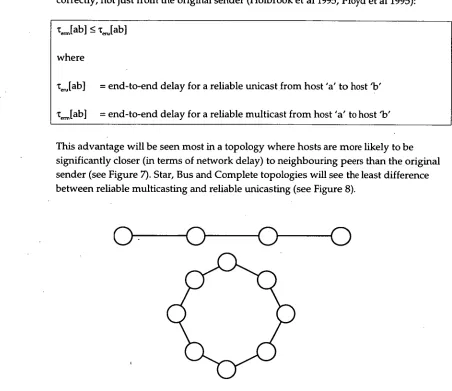
unicast protocol because recovery can occur from a closer peer that received that data correctly, not just from the original sender (Holbrook et al 1995, Floyd et al 1995):
temfab] Terjabl
where
te„,[ab] = end-to-end delay for a reliable unicast from host 'a' to host 'b'
;jab] = end-to-end delay for a reliable multicast from host 'a' to host 'b'
This advantage will be seen most in a topology where hosts are more likely to be significantly closer (in terms of network delay) to neighbouring peers than the original sender (see Figure 7). Star, Bus and Complete topologies will see the least difference between reliable multicasting and reliable unicasting (see Figure 8).
[image:23.562.62.514.108.499.2]Figure 7 Topologies where Neighbouring Hosts are Likely to be Closer than the Sender
A reliable multicasting standard is not defined for the Internet, but one can implement reliable multicasting on top of IP multicasting and unicasting facilities.
As with reliable unicasting, there is a trade-off between the number of duplicate messages and the recovery time from dropped messages. Log-Based Receiver-Reliable multicasting for instance (Holbrook et al 1995) actually sends duplicate messages but has smaller recovery times.
Broadcasting
Broadcasting is a special case of multicasting where all hosts receive messages sent. This type of network traffic is generally unfriendly because hosts do not have a choice but to process each message that is broadcast. This takes up processor time if they are not interested in the messages. Broadcasting has, however, been used for military simulations running over dedicated networks where each connected host has been part of the same simulation, thus interested in every message (see SIMNET and DIS).
Hosts
Broadcasting
Host
Figure 9 Broadcasting
Message Passing Summary
Multicasting
is better when sending to a large number of peers because it has faster recovery from lost packets, consumes less bandwidth and less processing time. Unfortunately it lacks the hardware infrastructure on the Internet that unicasting has.linicasting
can be used when sending messages between single peers because it will consume less processing time and less bandwidth.Predicted Path
Deviation
Actual Path
2.2 Remote Entity Approximation
Multi-user virtual reality usually requires some degree of object replication: Copies of objects are simulated on local hosts so that they are available for rendering and smooth animation. Remote Entity Approximation deals with the synchronization of these locally simulated objects and interactions from remote users.
Dead-Reckoning
In multi-user virtual worlds, there are special entities called 'avatars'. Avatars are special in that they are visual representations of users in a virtual world. They are tightly coupled to the user's input devices, and usually change very frequently in a non-deterministic manner in response to the user's input. Avatars can be any object in a virtual world, but are usually some sort of vehicle (such as a tank in a military simulation) or a humanoid object.
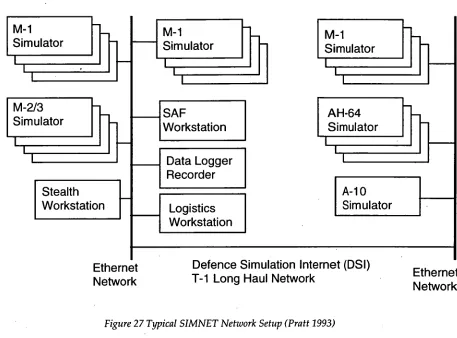
It is difficult to increase the number of avatars in a virtual world due to the unpredictable nature of their actions and consequent need for updates across the network. Remote Entity Approximation takes advantage of what little predictability it can find in avatars to approximate future states of these objects in the virtual world. This predictability can come from physical constraints, such as inertia, that apply to realistically modelled objects. It reduces the frequency that these objects' positions and orientations need to be sent to other participants by sending them only after the object has deviated from its predicted path by some predetermined error (Pratt 1993). This is the principle of dead-reckoning (see Figure 10).
Figure 10 First Order Dead-Reckoning
Dead-reckoning uses simple parametric object behaviour prediction to reduce network bandwidth and reduce the visible effects of latency (avatar behaviour descriptions are generally simple due to their unpredictability). Due to the frequency of avatar updates and the simplicity of their behaviour descriptions, it is efficient to specify them
predicted at any point in time from a network message specifying the last known position and velocity of the object:
current position (old position) + (old velocity).(time since old update)
When new information arrives updating the avatar, the new position of the avatar may be significantly different to that of the predicted one. Usually smoothing techniques are used to make the transition between the old position and the new one smooth.
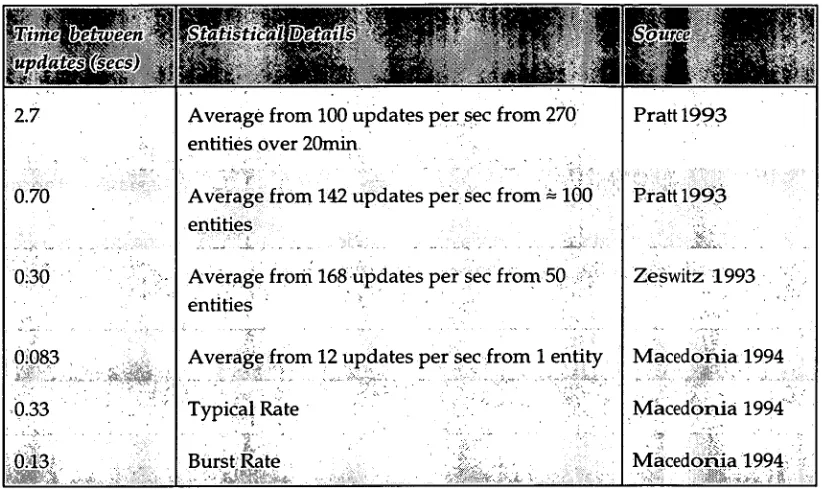
To update a dead-reckoned entity requires one unreliable multicast. Dead-reckoning is beneficial in handling missing network messages from unreliable delivery due to the frequency of updates: if a message is missed it will not be long before a new one is received to set the object back onto its correct course. In order to ensure a regular stream of updates so that missed messages are handled with minimum impact to the users, a time is set after which, if no updates have been sent, an update is sent anyway. A typical minimum update rate for military simulations is one packet every five seconds (Macedonia 1994). New hosts connecting to dead-reckoned simulations can also use these updates to gather information about the current virtual world state within a small period of time.
Average from 100 updates per sec from 270 entities over 20min
Average from 142 updates per sec from 100 entities
Average from 168 updates per sec from 50 entities
Average from 12 updates per sec from 1 entity
Typical Rate . • Burst Kate •
[image:27.567.115.526.83.328.2]Pratt 1993 Pratt 199 Zeswitz 1993 Macedonia 1994 Macedonia 1994 Macedonia 1994 2.7 0.70
Table 2 Typical Dead-Reckoning Update Rates for Military Simulat'ons
Using traditional dead-reckoning and broadcasting techniques for military simulation it has been estimated that in order to support 100 000 entities, being updated once per second, a sustained load of 230Mbps would be required. The peak load would reach up to 700Mbps. Using multicasting to prune the distribution of data would still require more than 100Mbps (Singhal 1996).
The above calculations also assume that the virtual world is run as the only consumer of network resources. In practice, the availability of a large dedicated network will be rare. If this technology is to be used on the Internet then it will need to perform on shared networks. These may be shared with other network services and other
networked virtual worlds. The effective available bandwidth can thus be dramatically reduced. Virtual worlds will only be able to contain a fraction of the number of objects available on a dedicated network. This means that the local hosts have less information to process and can thus use some of their computational power for reducing network bandwidth (hence the Replicated Time Warp system described in this thesis).
Dead-reckoning techniques are an active area of research. The number of avatars in the system can be increased by using better dead-reckoning algorithms to reduce the network traffic, but there is a fundamental limit for non-deterministic objects because their future states cannot be precisely predicted. Variants such as Position History-Based Dead-Reckoning (Singhal 1996) have shown that improvements are still being made in this area.
Design Issues 23
Predicted Path Possible Range of Paths 0.
Figure 11 Limits of Prediction
If avatars were completely unpredictable, there would be no point in trying to predict what was going to happen because you would be wrong. You are better off not predicting.
Behaviours that are more complex can be used, other than simple dead-reckoning. It is unlikely, however, that very complex behaviours will be used for avatar objects
because the period between updates is very small, so the avatar's behaviour only needs to be predicted into the near future.
Delay Compensation
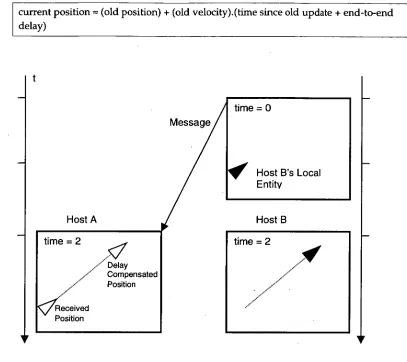
A local host can compensate for end-to-end delay by predicting the behaviour of a remote object an extra period into the future equal to the end-to-end delay for the remote avatar. End-to-end delay can be calculated using a clock-synchronization mechanism (see section 4.3 Replicated Time Warp, Clock Synchronization).
time =0
le' Host B's Local Entity
Host B
time = 2
./ Delay Compensated Position
Host A
c
ReceivedPosition
current position = (old position) + (old velocity).(time since old update + end-to-end delay)
Message
[image:29.562.99.506.83.445.2]•
Figure 12 Delay Compensation
Locally Simulated Objects
For objects other than avatars, behaviours can be more complex because non-deterministic interactions with these objects are less frequent. Since it is not obvious which host will interact with these objects, it makes sense to simulate them in sync with the local real-time clock because then they are in sync with any local user interactions; local interactions are reflected immediately in the locally simulated object's behaviour.
Unfortunately, locally simulated objects are not in sync with remote interactions because the interactions arrive late due to network delay. This causes discontinuities in the interactions between remote avatar objects and locally simulated objects. Time Warping takes advantage of the fact that interactions are usually spatially localized around the avatar, and synchronizes locally simulated objects with nearby remote avatars (see below). If an avatar is sufficiently predictable, however, Delay
Remote User 1
Time Delay
Remote User 2
100 Remote User 3
2.5 2 1.5 1 0.5 50 World X Coordinate 100 50 World Y
Coordinate -50 -50
With delay compensation, the remote avatar's delay is compensated for so that interactions between remote and local entities are synchronized.
Time Warping
Time warping (not to be confused with Time Warp) is a clever technique for latency hiding for the users of multi-user virtual worlds (Sharkey et al 1996). It synchronizes the simulation time of locally simulated objects with the simulation time of remote non-deterministic objects. Normally the actions of remote non-deterministic objects in a multi-user virtual world are observed late by a local user. The actions are observed as they arrive at the local host and so have a delay equal to the end-to-end delay of the network. Because deterministic objects are often simulated locally, they generally exist synchronized with the local time. This enables interactions between the local user and deterministic objects to occur without any synchronization problems. Since the remote users' actions are observed late, interactions with the local user's copy of the
deterministic objects by remote users is out of sync. This causes anomalies in the form of discontinuous jumps by the interacting deterministic objects that are visible to the local user.
Figure 13 enables visualization of the circumstances just described. This diagram consists of a flat two-dimensional plane that represents spatial coordinates in a virtual world. An object's local simulation time delay is represented on the vertical axis. Remote users exist at a simulation time that is delayed by their network end-to-end delay. Deterministic objects immediately surrounding them are simulated with zero delay, thus interactions between the remote users and locally simulated deterministic objects cause discontinuous jumps due to the discontinuous simulation times.
Figure 13 Remote Users Exist in a Delayed Time with Respect to the Locally Simulated Objects Surrounding Them (Sharkey et al 1996)
late time frame (the 'past') throughout the virtual world space (Figure 14). This means that deterministic objects travelling from the local user towards the remote user within the local user's virtual world actually experience a slowing of time so that when they reach the remote user's area in the virtual world, they are synchronized with the remote user's time. This means that interactions by the remote user on deterministic objects, as observed by the local user, are in sync. This means that no discontinuous jumps of deterministic objects are observable. Instead, the harsh anomalies that were present before are smoothed over time.
100
Figure 14 Remote Users Exist at the Same Time as the Locally Simulated Objects Directly Surrounding Them (Sharkey et al 1996)
An assumption of time warping is that interactions by users will be confined to a localized area—the area of space synchronized with those non-deterministic interactions. Generally, this assumption is reasonable.
An example of the effects of not having time warping versus having time warping can be considered. Consider first a simple example of a game of virtual tennis: With continuous time warping, as the local user hits the ball towards the remote user's side of the court, the ball starts trartsitioning to the past i.e. time slows down for the ball. The local user observes the ball approaching the remote user at a reduced speed. When the remote user hits the ball, however, the timing of the remote user's racquet swing will be synchronized with the motion of the ball and the remote user will appear to hit the ball correctly. The ball now transitions from the 'past' to the 'present' as it
Server
Outgoing
Messages
Incoming Messages
If continuous time warping was not used, the ball would always be synchronized with the local user's time all the time. As it approached the remote user, the local user would observe the ball moving past the racquet (because it doesn't know yet that the remote user has swung at it). When the data arrives that tells us that the remote user has swung their racquet, rollback of the ball occurs, the racquet swing event is inserted and the ball's position is recalculated (the rollforward). The end result is that the ball jumps from behind the remote user's racquet to the correct position in front of the racquet. The ball has performed an ugly discontinuous jump, rather than a nicer smooth transition.
2.3 Data Distribution
One of the main issues to decide upon when designing multi-user virtual reality systems is the data distribution mechanism. There are two main data distribution mechanisms: client-server and peer-to-peer (or replicated). The choice of data distribution mechanism affects the performance and scalability of the multi-user virtual reality system. The following discussion assumes the availability of hardware multicasting for message passing.
Client-Server
Client-server multi-user virtual reality systems typically consist of a server that controls the initial distribution and updating of the virtual world for the connected clients (see Figure 15). Clients can request a connection to the server. Once granted, the server then transfers the necessary data for the client to be synchronized with the other clients. The client is added to the list of clients that need to be updated by the server.
Clients
Topology Independence
The client-server data distribution mechanism is naturally suited to a star network topology. This topology is most commonly seen on the Internet where a server is set up to allow users dial-up access to the Internet over a modem.
Client-server architectures can increase delay times and bandwidth requirements because all changes to data need to be made via the server (Waters et al 1996). The delay becomes that of the time taken for the message from the client to reach the server, the time taken by the server in receiving the message from the network and processing it if necessary, and the time taken for the server to send the message to the other clients. In the case of a star network topology, the client-server notification time can equal the peer-to-peer notification time because all traffic has to go through the server at the centre of the star anyway. The server can either unicast the message to the other clients or, more efficiently, multicast it.
The client-server architecture can work well when network delays are very small, such as on a LAN. It can also result in a simpler overall implementation. Because all
operations performed on objects in the virtual world are transferred via the server, the server is the only computer that needs to deal with concurrency control issues. The client-server architecture simplifies concurrency control because the data is maintained at a central location. Consistency requirements are easily met since the data is modified centrally and then distributed to clients.
Security
Computer
Safe
Methods
Data
Redistribution
Hack
Network
■111111111
Data
Network
Figure 16 Client-Server Security
Scalability
The client-server architecture does not scale well in terms of the number of users it can support because as the number of users rises, the server must process more messages per second. For each client, the server must receive the client's update, process it and distribute the results.
The client-server architecture also requires a larger bandwidth than peer-to-peer (except in a star topology) because a message is sent to the server and then from the server to the clients, rather than directly from the local peers to remote peers in the peer-to-peer scheme.
Fault Tolerance
The server in a client-server architecture is also a critical point of failure. If the server fails then none of the clients can operate in a multi-user manner any longer. This is because the server is relied upon both to distribute client messages to other clients and for concurrency control.
Partitioning Ability
Partitioning (also known as 'replication on demand' or filtering) is the breaking up of a virtual world into different sections based on a particular host's interests in remote events. These partitions are ideally created such that they are independent of each other. This reduces the amount of information that a particular host needs to know and thus also reduces the required network bandwidth and local host processing. The host attempts to operate purely on a 'need-to-know' basis. In an optimal application hosts only receive exactly the data of interest to them (Macedonia 1996).
Typical partitioning seen in virtual worlds includes 'rooms' where one needs to pass though some kind of doorway to observe or interact with the next room and its contents. Virtual worlds can also be partitioned into large areas based on the
Network
Connection
Peers
world, you do not need to know about it (assuming also that the host cannot interact with anything it cannot see).
Another form of partitioning involves sending out various levels of detail of information. If a host has good bandwidth it can receive the maximum amount of information. If the host has limited bandwidth it can receive a courser level of information that requires less bandwidth.
In the client-server situation, because the server has complete knowledge of the virtual world, messages can be precisely filtered to individual clients. For example, if the server is powerful enough, it can calculate which objects a client can see and send information only regarding those objects. This is particularly useful if a client has limited bandwidth because the server can apply flow control strategies to ensure the network does not become congested. Congestion causes packets to be lost, thereby introducing a much larger delay when trying to recover from the lost packets by retransmission mechanisms.
Peer-to-Peer
For peer-to-peer (or replicated) data distribution the virtual world is replicated (either partially with the use of partitioning, or fully) at the respective hosts. For virtual reality applications, replication is always used to some extent because the state of the virtual world is required at each local host for rendering. It is difficult to hold the visible portion of the virtual world at a remote location when it needs to be accessed around 30 times per second for rendering.
The replication distribution mechanism makes it harder to maintain consistency between data in virtual worlds, but avoids the server bottleneck that a client-server architecture has. It can also produce optimal application notification times.
Safe
Methods
.1.10•
Data
Redistribution
Data
Topology Independence
The peer-to-peer architecture operates well in any network topology. This is because messages are sent directly from peer to peer (see Figure 17) and thus depend only upon the network's routers to reach their destination. They should reach their destination using the optimal route if the network's routers do their job.
Security
Having data altered and distributed by peers increases the chances of hacking occurring because the peer can directly alter data held within the computer or it can send false information about the data when it redistributes it (Figure 18).
Hack
Computer
Network
Figure 18 Peer-to-Peer Security
Scalability
The peer-to-peer architecture scales better than the client server architecture when multicasting is available because messages are sent directly to peers (reducing required bandwidth). The processing load is distributed more evenly because each peer
calculates its own next state and distributes it itself.
Fault Tolerance
If a peer fails, other peers can continue operating because they do not depend on the operation of each peer. The failed peer can either re-enter the virtual world (i.e. resynchronize its entire virtual world database) or it may be able to recover smaller portions of lost information from nearby peers.
virtual world after some timeout if required or another peer may be able to take over responsibility for updating these objects.
Partitioning Ability
Partitioning in a peer-to-peer situation is more complex than the client-server scenario because peers suddenly do not have a complete picture of the virtual world when partitioning occurs. This is because as soon as a peer stops sending information to another peer, that peer loses track of the peer and cannot work out whether to send updates to that peer or not. Instead, the virtual world needs to be partitioned in agreed upon partitions. Each partition would typically be assigned a different multicast address so that anyone in that partition could join that multicast group and receive information relevant to that partition. Because each partition only receives information about partitions it is interested in, as opposed to information concerning the entire virtual world, bandwidth can be reduced.
Hybrid Systems
..
...
Peer-to-Peer
Figure 2-19 Hybrid Architecture
The following benefits are found that are specific to client-server modem pools:
• Multicasting does not work over popular modem protocols (e.g. PPP). Unicasting is just as efficient in the Client-Server model.
• Maximum security is maintained. Hackers will find it difficult to compromise the security offered by the client-server solution.
• Maximum partitioning can be applied. This ensures that minimum network bandwidth is used, which is particularly useful for limited bandwidth devices such as modems.
The communications between the servers that host the modem pools are good candidates for peer-to-peer communication. The reasons are:
• Security is not as much of an issue because the servers are usually maintained in secure access areas at the Internet Service Provider. A hacker would need to access this machine in order to compromise the system.
• Because the server machines will be less likely to be moved or changed, it is easier to configure them to ensure access to IP multicasting for maximum efficiency in communication.
Client-Server Peer-to-Peer
Fault Tolerance
Topology Independence
Partitioning Ability
Scalability
Securi
Ba d
•
Excellent",
Bad
Good
Data Distribution Summary
Client-server systems, due to the centrally located data, have better capabilities for filtering, flow control, partitioning and security. They can also be easier to implement.
Peer-to-peer architectures provide optimal performance in all network topologies when multicasting is available, (whereas client-server provides optimal performance only in a star topology). Peer-to-peer systems also have better scalability. Peer-to-peer systems are thus good to use if the network topology is not known at the design stage or if the system is designed to work under any network topology.
Table 3 Peer-to-Peer vs. Client-Server Data Distribution
2.4 Concurrency Control
Concurrency control looks at the methods used to handle situations where multiple users attempt to modify the same object at the same time. Concurrency control enables different virtual worlds to maintain consistency between each other, and consistency enables collaboration. Very little work has been published on concurrency control for multi-user virtual reality systems.
Important performance factors associated with concurrency control are commit time (tc), notification time (rn) and bandwidth usage. Commit time and notification time are defined as follows,
• Commit Time — the time it takes a local user's action to be reflected locally, and to
be guaranteed never to be altered.
• Notification Time — the time required for a user's action to be propagated to every
user's interface (Ellis et al 1991)
information can be sent across the network to keep all the objects in remote virtual worlds consistent.
•Many algorithms exist for concurrency control in databases, but most results do not apply to real-time groupware, such as multi-user virtual reality systems: databases are designed to give the illusion of being the only user on the system, whereas groupware systems are designed to make users aware of each other. The most important property of a groupware system, interface response time, is not as important in a distributed database design (Karsenty & Beaudouin-Lafon 1993).
Several concurrency control mechanisms are appropriate for multi-user virtual reality systems (Ellis et al 1991, Coulouris et al 1994 & Broil 1995). Some of the most
appropriate mechanisms include,
• Client-Server Locking
• Peer-to-Peer Distributed Locking
• Peer-to-Peer Master Entities
• Reversible Execution
Each of these are discussed, analysed and compared. Hardware multicast capabilities are assumed to be available.
Client-Server Locking
Right Hand Client Left Hand
Client
Lock
Request
Lock Released
Figure 20 Lock Request
Lock Granted Lock Request
Figure 21 Lock Grant and Second Lock Request
Lock Granted
Figure 23 Second Lock Granted
Obtaining a Lock
Observing the left-hand client in the above figures it can be seen that three messages are required for each successful lock: the lock request, the lock grant and the lock release. Therefore:
n, =
where
n, =- number of messages to obtain a lock
r„ = one reliable unicast message
= tum[as] + T,, + tejsa]
2.tem[as] + To , since ;Jab] = tem[bal
where
td = commit time when a lock needs to be obtained
tsi = time for the server to process the lock request
tem[as] = client-server end-to-end delay for a reliable unicast
Once a lock has been obtained for an object, that object can be updated as many times as required without needing to obtain further permission. For an update to an object with a lock, one message is unicast to the server and the server multicasts the results to the rest of the clients:
nu = 1.ru + 1.rm
where
nu = number of messages for an update
ru = one reliable unicast
rm = one reliable multicast
If required (i.e. if the network layer does not guarantee in order delivery of messages) the server can implement ordering by timestamping update messages with a sequence number sent to clients to ensure that they can be processed in the correct order at the clients.
Con-unit time is also optimal once the lock has been granted because with locking, updates are always guaranteed to be committed once the lock has been obtained:
tc = ^Cc,
where
tc = commit time
Tcs = commit time for a single-user application
= Tjas] + T„ Term[S]
where
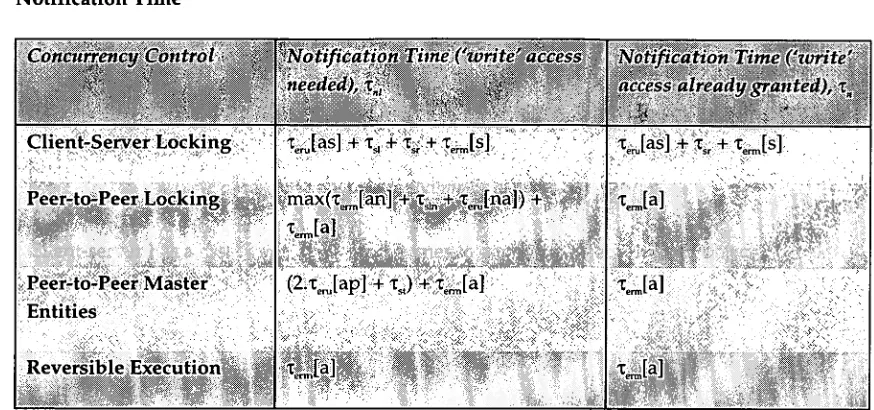
Tn = notification time
Tjas] = the client-server end-to-end delay for a reliable unicast
tsr = time for the server to relay the message
Tenis] = the client-server end-to-end delay for a reliable multicast from the server to all clients
The time for an update to reach remote clients when a lock needs to be obtained as well is given by:
=t+;
= Tern[as] + + T„ TejS]
where
"cm = notification time when a lock needs to be obtained
This is assuming that the update is sent in the same packet as the lock request. This is not general practice, but makes sense in multi-user virtual reality systems because the update packet is generally small. If the update were only sent after the lock has been accepted, the notification time would be that of obtaining the lock (;) plus the time to send the update (c):
t„, = tc, tn
= (2.t[as] + Ts) + (Ter [as] + T„ Tenn [S])
= 3.Tern[as] + + Ts, + Tenn [S]
Discussion
Lock Request
The server can be designed such that the main programming logic is located on the server only. Clients send requests for operations to be performed by the server and the server processes them and reports the results back. This aids application development because program updates only need to be deployed at the server. Having program logic in one location also makes security tighter.
Peer-to-Peer Distributed Locking
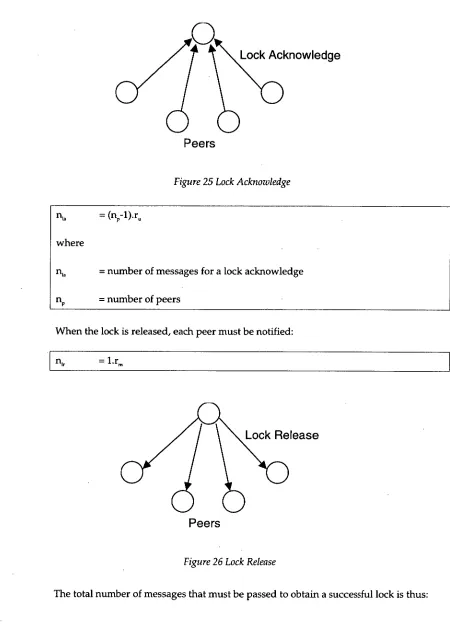
The peer-to-peer distributed locking scheme is similar to the client-server locking scheme except that in this case the lock request is multicast from the requesting peer to each other peer:
Peers
Figure 24 Lock Request
nirq = 1.rm
where
nIrq = number of messages for a lock request
r
m
= one reliable multicastLock Acknowledge
[image:46.560.62.512.63.691.2]Lock Release
Peers
Figure 25 Lock Acknowledge
ni. = (np-1).r.
where
ni. = number of messages for a lock acknowledge
nP = number of peers
When the lock is released, each peer must be notified:
nir = 1.rm
Peers
Figure 26 Lock Release
n,
= tr„, + (np-1).r. + 1.r.
= 2.r + (n -1).r m p u
where
n, = total number of messages for a lock
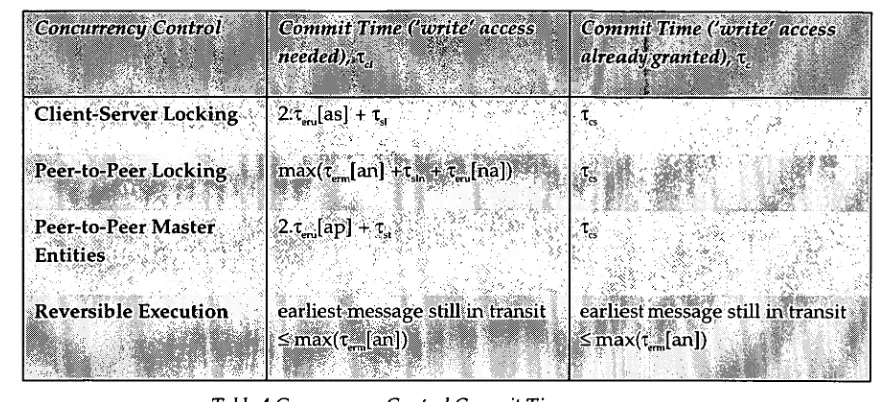
The commit time (the time to get a lock),
max(terjanj + tin + te,„[nap
= commit time when a lock needs to be obtained
= time for the peer 'n' to process the lock request
teru[na] = peer-to-peer reliable unicast end-to-end delay for from peer 'n' to peer 'a'
tern [an] = end-to-end delay for the reliable multicast message from peer 'a' to peer 'n'
With locking, updates are always guaranteed to be committed once the lock has been obtained. Commit time is optimal once the lock has been granted:
"rc = tcs
where
tcs = commit time for single-user application
The notification time once a lock has been obtained is the time it takes for a client's message to be passed to the other clients:
Tn = term[a]
where
te,„,[a] = the peer-to-peer end-to-end reliable multicast delay for reliable multicast from peer 'a' to all peers
no = 1.r,,,
The notification time when a lock has to be granted as well is given by:
= max(tem[ an] + Tst. + Teru[na]) + teruja]
Discussion
Peer-to-peer locking does not scale very well due to the number of acknowledgments that are needed: one from each remote peer.
Peer-to-Peer Master Entities
In this scenario, a special instance of each object exists called the master entity. The master entity is responsible for updating data about itself at other hosts so that all interested hosts can observe it. The holder of the master entity has the exclusive rights to change that entity (although other peers can request modification). Other processes can only modify the object by obtaining the master entity through migration (transfer of the entity across the network), or by sending requests to the master entity. The master entity can then update itself based on these incoming messages. The changes to the master entity from remote hosts are serialized (total ordering) by the master entity.
The process of obtaining the master entity is a similar process to obtaining a lock in the client-server locking protocol. First, a peer that wants control of the master entity requests the entity from whoever has it:
nIrq = 1.ru
The peer with the master entity can then transfer it, or a token representing it if the peer already has a replicated version of the master entity:
n, = 1.ru
n1 =rçq+n
= 2.r.
where
n, = total number of messages for a successful transfer
Updates to the master entity are then transmitted directly to peers from the holder of the master entity:
nu = 1.r.
The holder of the master entity enjoys optimal commit time when performing operations on that object:
IC = tc,
where
IC = commit time
'cs = commit time for a single-user application
The commit time for the first update (when master entity is not already at the local host):
iC = te,Jap] + T„ Teru [pa]
2.T.Jap] + , since ;Jai)] = Teru[pa]
where
= time to obtain the master entity
= time for the peer to process the master entity transfer request
teru [ap] = reliable unicast delay from peer 'a' to master entity holder 'p'
Tn = te,ja]
where
term[a] = end-to-end reliable multicast delay from peer 'a' to all other peers
If the master entity has to be obtained first:
=
(2.terjap] + t„) +
The commit time to send an update when you are not the holder of the master entity (and you do not want to actually obtain possession of the master entity) is:
T. = ;jai)] + T, + term[p]
Discussion
The advantage of the master entity mechanism over client-server mechanisms is that the holder of the master entity enjoys the fast response times that a server can have. It also helps distribute computational load because the holder of the master entity becomes the one responsible for evolving it and distributing the resulting changes.
Initial commit times are relatively low, and bandwidths are smaller than the other locking schemes because locks do not have to be released. Remote hosts have the option of modifying master entity objects without obtaining the master entity by sending the update to the master entity. This is a good option for one-off changes because the holder of the master entity still enjoys the fast commit times.
It is possible that a peer could fail and the master entity could be destroyed. This can be avoided by replicating the master entity at each peer and passing a token that represents the holder of the master entity. If a peer fails, the responsibility of managing the master entity can be passed to another peer.
Reversible Execution
Reversible execution is the most unusual of the concurrency control mechanisms looked at in this section. It is the only optimistic concurrency control mechanism. It also has a lot in common with the Replicated Time Warp mechanism presented in this thesis. Three factors characterize reversible execution,
• Operations are executed immediately (otherwise known as 'optimistically').
• When two or more operations have been executed concurrently, one or more of these operations may have to be undone and re-executed in the correct order.
The 'undoing' of conflicting operations is also known as rollback, and the 're-execution'
of operations is known as the rollforward process. The entire process is called 'conflict
resolution'.
Some researchers have stated that they think that reversible execution concurrency control is not suited to virtual reality systems because of the real-time nature of VR systems and the extra time required to perform rollbacks (Broll 1995, Macedonia & Zyda 1995). Other researchers (Sarin & Greif 1985, Karsenty & Beaudouirt-Lafon 1993) think that reversible execution is a good idea for real-time cooperative work because of its fast response times. Others are undecided (Wang et al 1995). Ultimately the use of reversible execution should not be accepted or rejected immediately, but be decided upon on a case-by-case basis.
A controversial side effect of reversible execution, caused by the fact that operations are executed immediately upon receipt, is that it does not always provide the user with a 'what you see is what it is' view of the simulation. A participant may see inconsistent states that no other participant sees and that could not have occurred if command execution were delayed until the correct order were known. The application designers must consider whether temporarily inconsistent states are an acceptable price to pay for the improved response time (Sarin & Greif 1985).
Karsenty & Beaudouin-Lafon (1993) describe an algorithm that is essentially reversible execution for concurrency control in groupware application. Within their system, each object is considered independent of each other object. This means that any incoming events can be executed in any, order and the results will remain the same. In most multi-user virtual reality systems this will not be the case: objects will have
dependencies between each other. It is necessary to eliminate as many dependencies as possible to increase efficiency, otherwise all objects dependent on the incoming event will have to be rolled back.
Shared Whiteboard applications keep a list of drawing events and execute them in order to produce the final image. When a late event arrives, the image can be redrawn with the late event executed in the correct order. This mechanism is not appropriate for larger multi-user virtual worlds because of the real-time, dynamic nature of virtual worlds. Virtual worlds have animated objects that are updated many times a second. It is not efficient to rollback every object in the simulation. A more efficient algorithm that keeps track of dependencies between objects and reduces the number of rollbacks should be used. This is what the Replicated Time Warp mechanism achieves.