by
Xudong Wu, M.A. (Fujian Teachers University)
•••••...School of Education
Submitted in fulfilment of the requirements
for the degree of
DOCTOR OF PHILOSOPHY
UNIVERSITY OF TASMANIA
I, Xudong Wu, the undersigned, hereby declare that this thesis does not contain
any material which has been accepted for the award of any other higher degree or
graduate diploma in any tertiary institution and that, to the best of my knowledge
and belief, this thesis does not contain any material previously published or written
by another person, except when due reference is made in the text of the thesis.
Pvi'l
(Xud Wu)
Dated 4
'? / Fe
1, • ) 9 st
English learning in China belongs in what is called "foreign language" learning, which has so far been little studied in the field of second language acquisition research. This study investigated, within a single theoretical framework, the English language development of Chinese university students as revealed from their oral production, and how some learner-internal and learner-external factors contributed to this development. The oral English development was investigated by examining how the subjects used the English they learnt in the classroom to express the discourse functions of "foreground" and "background" and the concept of "past time" in oral narrative. The learner-internal factors considered were: the subjects' attitudes both in relation to English learning and to the classroom learning environment, their motivations for learning English, and their learning strategies. The learner-external factors under investigation were: the subjects' classroom learning experiences, and their out-of-class contact with English.
Based on some representative theories of second language acquisition, and relevant empirical studies, a conceptual framework was first established which delineated the possible relationships between the chosen factors and their relevant concepts.
Data for the study were collected in an 11-month period from 20 students majoring in English in Foreign Languages Department of Fujian Teachers University in China. The subjects were chosen by random sampling from 98 of the 109 students enrolled in 1989. The data comprised (i) three administrations of four types of questionnaires which provided information concerning the subjects' attitudes, motivations, learning strategies, and out-of-class contacts with English; (ii) the subjects' performance of a metalinguistic judgment test; and (iii) orthographic transcriptions of the subjects' speech elicited at an interval of three to four weeks, two narratives for each subject on each of the 14 occasions.
Data analyses reveal the following main findings. First, discourse functions had selective impact on the subjects' choice of linguistic features to express them, on their expression of the notion "past time", and on their adoption of self-corrections and communication strategies. Second, the subjects' oral English development can be described linguistically and non-linguistically. Linguistically, the development was reflected in the subjects' growing ability to use more types of linguistic features. Non-linguistically, the development manifested itself in (i) an ability to break chronological order of the events described in oral narratives, (ii) a growing desire to be both conceptually and linguistically accurate in oral production, as indicated by the use of irregular verbs in past tense after a growing number of auxiliaries and inflectional forms of the link verb "to be", and by the self-correction of more types of linguistic features, and (iii) a growing ability to cope with communication problems. Third, the subjects' intrinsic interests in English-speaking people and in learning English appeared to be channeled by the knowledge-oriented language instruction into the adoption of the type of learning strategies which enabled them to extend only the Ic.nowlege about the target language. The lack of oral practice both in and out of the classroom resulted in a great gap between a highly analytical knowledge about the target language and an under-developed procedural knowledge. The under-developed procedural knowledge prevented the subjects from engaging in fluent oral communication. The possible dissatisfaction with their own oral learning outcomes appeared to prevent the subjects from further participating in oral practice.
The completion of a research project of such a magnitude as the present study could never have been possible without the assistance of many other people.
I owe a great debt of gratitude to my supervisor Dr. William Ramsay, Senior Lecturer, Department of Educational Studies, the University of Tasmania, for his guidance and unfailing attention to this research project in the past six years or so. He went through in great detail every draft of every chapter of the thesis, provided well-informed comments on the organisation of the chapters, and helped improve greatly the appropriateness of the English used.
I also owe a great debt of gratitude to my co-supervisor Professor Kevin Collis, Head, Department of Educational Studies, the University of Tasmania, for his long-standing attention to this study. After reading the first draft of the thesis, he made a lot of constructive suggestions with respect to the further editing and polishing of the thesis. He was most patient in bringing me to understand the meaning of his comments, and to realise the significance of the research findings. His care and encouragement also made the two years spent in Hobart a memorable experience in my life.
I am very grateful to Dr. Wayne Ransley, Senior Lecturer, Department of Educational Studies, the University of Tasmania, who read the results chapters of the thesis, and provided invaluable suggestions on the adoption of statistical techniques to analyse the data.
Thanks are extended to my co-supervisor Professor Caisheng Liao, Dean, Foreign Languages Department, Fujian Teachers University, P.R. China, for his support during the empirical part of the present study. Without his assistance, the smooth implementation of the empirical study would not have been possible.
Professor John Biggs, Head, Department of Education, Hong Kong University provided a copy of his Study Process Questionnaire (SPQ), from which the English Learning Process Questionnaire (ELPQ) used in the present study was adapted.
All the students and teachers of Foreign Languages Department of Fujian Teachers University, P.R. China who participated in the empirical part of this study have my gradtitude. Their unfailing cooperation made the data collection during the 11-month period a much easier task than it otherwise would have been.
Mrs. Gail Wilson took pains to read part of the draft of the thesis.
For a man with a family, spending about six years doing a PhD without family support is almost unimaginable. I am very grateful to my wife, Xiaoling Huang, for her patience and support during these long years. Thanks are extended to my mother Boying Fu, father-in-law Lishong Huang, and mother-in-law Hua Wei, for their indispensable roles in minimising the repercussions of the PhD research project on a normal family life. Thanks are also extended to my daughter, Xia Wu, who never complained about having to play by herself at home on Sundays when other children went out with their parents.
•—■
"Ct
00
N
N N
Orientation of the present study
••
■
4
Rationale for the present study Key research questions for the study Content of remaining chapters
Need for indirect application of the existing theories of second language acquisition theo ries
Gene ral aspects of L2 learning and their interrelation as
8
6
".0
0
8
.^.
•
P.
. ...
•
V.
,
•
II.
in
Theories of L2 learning, Type 1: "Single-perspective" theories
CHAPTER 3
REVIEW OF THE RELATED RESEARCH LITERATURE
3.1
3.2
The need to employ related research literature in order to specify
relationships between the factors to be investigated in this study Research relating to the learning environment
23 23
i) Methodological approaches to L2 classroom research 24
ii) Characteristics of teacher talk during classroom L2 instruction 27
iii) Behaviours of the learners in L2 classrooms 32
iv) Classroom interactions: learner-learner and teacher-learner 34
v) Effects of formal instruction on L2 learning 38
3.3 Individual characteristics of L2 learners 41
i) Research related to the role of motivation and attitude in L2 learning 41
ii) Learning strategies of L2 learners 43
iii) Communication strategies of L2 learners 46
3.4 Cognitive processes of L2 learning and production 47
i) The process of converting input into intake 47
ii) The role of planning and monitoring during L2 production 48 3.5 L2 learning outcomes
i) L2 learners' internal representation of grammatical rules
48
of target language 49
ii) L2 development in terms of "function-form" relationships 50
3.6 Summary and conclusion 54
CHAPTER 4
A CONCEPTUAL FRAMEWORK: RELATIONSHIPS BETWEEN FACTORS TO BE INVESTIGATED IN THE STUDY
4.1 Prior considerations 58
4.2 Characteristics of English learning in Foreign Languages Department
of Fujian Teachers University 59
4.3 Concept of "function" 60
4.4 Relationships between the factors to be investigated in the study -
a conceptual framework 62
4.5 Sub-questions for research, variables for investigation, and
• • ■ 11 /1 •1..1 •v. ••=1 •v. ••=1 ->N
0 0 ••-•, Cn
■ O NhNhNNN NC N In In
0 N 0000 ON
N. 00 00 00 00 00 00
00 00 00 00 00 00
Q
c•1 c•I
O\ ON ON CN
Subjects' internal representations of the English knowledge Subjects' classroom English learning experiences
Subjects' out-of-class contact with English Subjects' out-of-class contact with English
Subjects' internal representations of the English knowledge
English learning, attitude toward the classroom learning environment,
Oral production of English
Subjects' individual characteristics, viz, attitude in relation to Oral English production: narratives
motivations for learning English, and learning strategies Time frame for data collection
toward the Classroom Learning Environment Questionnaire, and Motivation for Learning English Questionnaire, The Attitude
5. 3 Data collection
e•-■ o•-■ • • • •
5.4 Preparation of data, and their analyses
The English Learning Process Questionnaire The Metalinguistic Judgment Test
5.5 Analyses of the relationships to be explored in the study 5. 1 Research design
8
Sample Procedures of investigation
••••I
•v.
• •••1
•
• •=1
Observation of subjects' classroom English learning
• •••=1 • oml • • ••••I • • ■ ••1
Language Contact Profile Questionnaire
CHAPTER 6
RESULTS FOR SUBJECTS LEARNING CONTEXTS - ENGLISH LEARNING IN THE CLASSROOM AND OUT-OF-CLASS CONTACT WITH ENGLISH
6.1 Results for subjects' experiences of English learning in the classroom 94 i) Types of knowledge about English taught during the instruction 96 ii) Types of practice in English which subjects were required to do
during classes 99
iii) Classroom interactions 102
iv) Summary of subjects' English learning experiences in the classroom 106 6.2 Results for subjects' out-of-class contact with English 108 i) Description of the Language Contact Profile Questionnaire 108 ii) Amount of time, and changes in amount of time, subjects spent on
six sub-types of out-of-class contact with English (LCPQ data) 110 iii) Subjects' preferences, and changes in their preferences, for listening,
speaking and reading English or Chinese when given choice 111 iv) Subjects' participation, and changes in participation, in out-of-class
activities that helped to improve their levels of English proficiency 113 v) Summary of subjects' out-of-class contact with English 115 6.3 Overall summary of subjects' English learning contexts 116
CHAPTER 7
RESULTS FOR SUBJECTS' INDIVIDUAL CHARACTERISTICS - ATTITUDES, MOTIVATIONS, AND LEARNING STRATEGIES
7.1 Profiles, and changes in profiles, of subjects' two attitudinal
aspects and overall attitude in relation to English learning 118 i) Description of the Attitude in Relation to English Learning
Questionnaire and the ways of determining types of attitude profile 118 ii) Profiles of subjects' two attitudinal aspects and overall
attitude in relation to English learning 120
iii) Changes in profiles of subjects' two attitudinal aspects and overall
attitude in relation to English learning 121
7.2 Profiles, and changes in profiles, of subjects' attitude toward the classroom
i) Description of the Attitude toward the Classroom Learning Environment
Questionnaire and the ways of determining types of attitude profile 121 ii) Profiles of subjects' three attitudinal aspects and overall attitude toward
the classroom learning environment 123
iii) Changes in profiles of subjects' three attitudinal aspects and overall
attitude toward the classroom learning environment 124
7.3 Profiles, and changes in profiles, of subjects' integrative and instrumental
motivations for learning English 125
i) Description of the Motivation for Learning English Questionnaire
and ways of determining types of profiles of the two motivations 125 ii) Profiles of subjects' integrative and instrumental motivations
for learning English 127
iii) Changes in profiles of subjects' integrative and instrumental
motivations for learning English 127
7.4 Profiles, and changes in profiles, of subjects' surface, deep and achieving
motives for learning English 128
i) Description of the English Learning Process Questionnaire and
ways of determining types of motive profile 128
ii) Profiles of subjects' surface, deep and achieving motives for
learning English 129
iii) Changes in profiles of surface, deep and achieving motive for
learning English 130
7.5 Profiles, and changes in profiles, of subjects' adoption of three types of
English learning strategy 131
i) Description of the English Learning Process Questionnaire and
ways of determining nature of profiles 131
ii) Profiles of subjects' adoption of three types of English
learning strategy 132
iii) Changes in profiles of subjects' adoption of three types of
English learning strategy 133
7.6 Overall summary of the investigation into subjects'
individual characteristics 134
CHAPTER 8
RESULTS FOR SUBJECTS' LEARNING OUTCOMES - INTERNAL REPRESENTATIONS OF ENGLISH KNOWLEDGE AND ORAL ENGLISH
DEVELOPMENT IN TERMS OF "FUNCTION-FORM" RELATIONSHIPS
8.1 Internal representations of English knowledge 137
ii) Subjects' performance on the Metalinguistic Judgment Test 140
Performance on the Discrimination Task 141
Performance on the Location Task 143
Performance on the Correction Task 143
Performance on the Rule Statement Task 148
Summary of the subjects' performances on the four tasks 150 8.2 Oral English development in terms of "function-form" relationships 151
i) Linguistic forms used to express foreground and
background information 153
Sentence types used to express foreground and background
information in narratives 153
Types of verb in foreground and background sentences 159 Types of verb form used in foreground and background sentences 160 ii) Linguistic and non-linguistic means of referring to the notion of time 169
Linguistic means of referring to past time 169
Non-linguistic means of expressing past time 174
Summary of linguistic and non-linguistic means of
referring to past time 176
iii) Production strategies subjects adopted to solve problems
from oral production 177
Self-correction during oral production 177
Adoption of communication strategies during oral production 182
8.3 Overall summary of subjects' learning outcomes 189
CHAPTER 9
INTERPRETATION OF RESULTS
9.1 Interpretation of the results in terms of nine types of relationship 192 i) Relationships between subjects' English learning experiences
in the classroom and their attitudes in relation to both English
learning and the classroom learning environment 192
ii) Relationships between subjects' attitude in relation to
English learning and their motivations for learning English 193 iii) Relationships between subjects' attitude toward the classroom
learning environment and their motivations for learning English 196 iv) Relationships between subjects' motivations for learning English
N N
'rr
in
In
.11.
11
v
■
I
v
■
I
N N N N N N N N
Some conclusions
10. 3 Recommendations
Oral English development in te rms of "function-form" relationships
English teaching in China on oral English development
English and surface, deep and achieving learning strategies adopted internal representations of their knowledge of the English language
linguistic forms and strategies adopted during oral production viii)
Relationships between functions under examination, and ix)
Relationship between subjects' oral learning outcomes
9. 2 Summary of the interpretations of results in terms of the and the development of a procedural knowledge
and subsequent oral English practice
nine types of relationship
1. Summary of interrelation between aspects of L2 learning as perceived
by some representative theories of L2 learning 20
2. A conceptual framework of oral English development in the foreign
language classroom setting 65
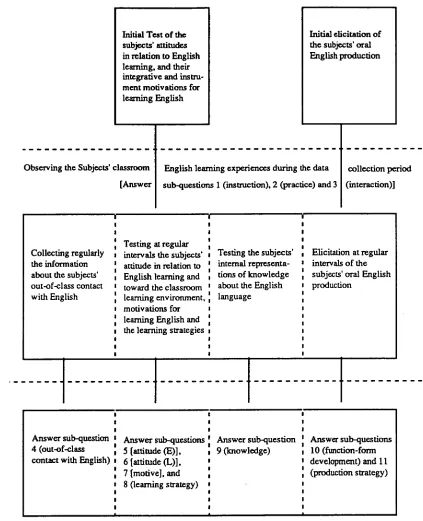
3. Model showing research procedures adopted in the study 74
LIST OF TABLES
1. A summary of factors found to be related to L2 learning 4
2. A summary of aspects of L2 learning dealt with in each
representative theory of L2 learning reviewed 18
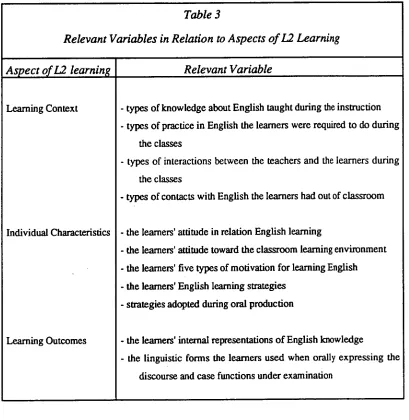
3. Relevant variables in relation to aspects of L2 learning 68 4. A summary of the courses subjects attended in data collection
period, together with class periods for each course per week 83 5. A summary of number of teachers for each course, native languages
of teachers, and teaching materials adopted for each course
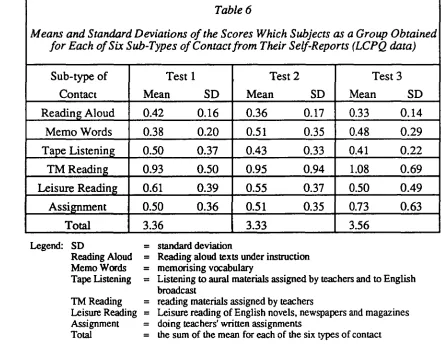
during three semesters of English learning at the University 95 6. Means and standard deviations of the scores which subjects as a group obtained
for each of six sub-types of contact from their self-reports (LCPQ data 110 7. Percentages of subjects indicating preferences for listening,
reading and speaking English or Chinese at three tests 112
8. Results for the Cochran Q tests for subjects' indications of preference for
listening to, speaking, and reading English at three LCPQ administrations 113 9. Differences between subjects' indications of participation
in non-oral English activities at three LCPQ administrations 114 10. Percentages of subjects who indicated participation, and no
participation, in oral English activity at the three LCPQ administrations 115 11. Means and standard deviations of the scores for two attitudinal
aspects and overall attitude in relation to English learning
at the test prior to English learning at the University 120
12. Means and standard deviations of the scores for three attitudinal aspects
and overall attitude toward the classroom learning environment (Test 1) .123 13. Means and standard deviations of the scores for integrative and instrumental
motivations for learning English prior to English learning at the University 127
14. Means and standard deviations of the scores for surface,
deep and achieving motives (Test 1) 130
15. Means and standard deviations of the scores for three
types of learning strategies (Test 1 133
16. Excerpt from Table 16 (Si), A summary of subjects' responses
in four tasks required in Metalinguistic Judgment Test 140 17. A summary of total Type 4 and total Type 2 responses
to Discrimination Task 141
18. A summary of totals of four types of responses to the Correction Task 144 19. A summary of totals of three types of response to the Rule Statement Task 148 20. Excerpt from Table 20 (S2), Types of sentence used by subjects
to express foreground and background information 153
21. A summary of occurrence of new types of sentence in the oral production 157 22. Excerpt from Table 22 (S2), Types of verb used by subjects
to express foreground and background information 159
23. Excerpt form Table 23 (S2), Target verb forms used by subjects
to express foreground and background information 162
24. A summary of total numbers of target verb form types used in expressing
foreground and background information in all 14 elicitation sessions 163 25. A summary of occurrence of new target verb forms in the oral production 164 26. Excerpt from Table 26 (S2), Non-target verb forms used by subjects
to express foreground and background information 166
27. A summary of occurrence of new non-target verb forms
in the oral production 167
28. Excerpt from Table 28 (S2), Percentage of past and non-past time reference in relation to that of actual time malting in expression
of foreground and background information 170
29. Subjects' varying abilities to use linguistic means to express
the concepts of "past in the past" and "future in the past 173° 30. Subjects' varying organisation of narrative events that
did not follow a chronological order 176
31. Excerpt from Table 31 (S2). Self-correction made by subjects when producing narratives orally, divided according to foreground and
background information 178
32. Six aspects of subjects' adoption of self-correction strategy 179 33. Excerpt from Table 33 (S2), Communication strategies adopted
by subjectswhen orally producing narratives, divided according
to foreground and background information 183
34. Percentages of elicitation sessions in which no communication strategy
35. Six aspects of subjects' adoption of communication strategies
in the 14 elicitation sessions 185
36. Correlation coefficients between overall attitude in relation to
English learning and integrative and instrumental motivations 194 37. Correlation coefficients between overall attitude in relation to English
learning and three types of motives (surface, deep and achieving 195 38. Correlation coefficients between overall attitude toward the classroom
learning environment and integrative and instrumental motivations 196 39. Correlation coefficients between overall attitude the classroom learning
environment and three types of motives (surface, deep and achieving 197 40. Correlation coefficients between integrative and instrumental motivations
and overall participation in out-of-class contact with English 198 41. Correlation coefficients between three types of motives (surface, deep and
achieving) and overall participation in out-of-class contact with English 198 42. Correlation coefficients between three types of motives (surface,
deep and achieving) and their corresponding learning strategies 199
LIST OF APPENDICES
1. A summary of approaches to interlanguage variability 240
2. Questionnaire about English learning in secondary schools 243
3. Language contact profile questionnaire (LCPQ) 244
4. The attitude in relation to English learning questionnaire (AELQ) 246 5. The motivation for learning English questionnaire (MLEQ) 249 6. The attitude toward classroom learning environment questionnaire (ACLEQ) 252
7. The English learning process questionnaire (ELPQ) 255
8. Metalinguistic judgment test 260
9. A summary of scores each subject obtained for six sub-types of out-of-class
contact at three administration of LCPQ 262
10. Analysis of variance (one factor, repeated measure) for amounts of time subjects reported to have spent on six sub-types of out-of-class contact with
English in three LCPQ administrations 265
11. A summary of subjects' indications of preference for listening, speaking and
reading English or Chinese at three LCPQ administrations 267 12. A summary of raw scores subjects obtained for non-oral English activities
in which they participated during three semesters of English learning at the
13. A summary of subjects' indications of participation in out-of-class oral
English activity at three LCPQ administrations 271
14. A summary of the scores which subjects obtained for two attitudinal aspects, and overall attitude in relation to English learning in the testing session prior to their English learning at the University and in the
three testing sessions after their English learning at the University 272 15. Analysis of variance (one factor, repeated measure) for subjects'
indications of two attitudinal aspects and overall attitude in relation to English in one pre-university English learning testing session and
three post-university English learning testing sessions 276 16. A summary of scores obtained by subjects for three attitudinal aspects
and overall attitude toward the classroom learning environment in
three testing sessions 277
17. Analysis of variance (one factor, repeated measure) for scores obtained by subjects for three attitudinal aspects and overall attitude toward the
classroom learning environment in three testing sessions 280
18. A summary of scores obtained by subjects for integrative and instrumental
motivations for learning English in one pre-university English learning testing
session and in three post-university English learning testing sessions 281
19. Analysis of variance (one factor, repeated measure) for the scores obtained
by subjects for integrative motivation and instrumental motivation for learning English in one pre-university English learning testing session
and three post-university English learning testing sessions 285
20. A summary of the scores obtained by subjects for surface, deep and
achieving motives for learning English in three testing sessions 286
21. Analysis of variance (one factor, repeated measure) for the scores
obtained by subjects for surface, deep and achieving motives for
learning English in three testing sessions 289
22. A summary of the scores obtained by subjects for three types of
English learning strategy in three testing sessions 290
23. Analysis of variance (one factor, repeated measure) for the scores obtained by subjects for three types of English learning strategy
in three testing sessions 293
24. Table 16. A summary of subjects' responses in four tasks required
in Metalinguistic Judgment Test 294
25. Table 20. Types of sentence used by subjects to express foreground
and background information 301
26. Table 22. Types of verb used by subjects to express foreground
27. Table 23. Target verb forms used by subjects to express
foreground and background information 314
28. Table 24. Non-target verb forms used by subjects to express
foreground and background information 325
29. Table 26. Percentages of past and non-past time reference in relation to those of actual time marking in expression of
foreground and background information 330
30. Table 31. Self-correction made by subjects when producing narratives
orally, divided according to foreground and background information 334 31. Table 33. Communication strategies adopted by subjects when
producing narratives orally, divided according to foreground
and background information 341
32. A summary of scores obtained by the subjects for overall participation
1.1 Orientation of the present study
The present study examined, within a single theoretical framework, two major problems about adult English learning in the classroom setting in P.R. China. The first was the description of the learners' oral English development in terms of "function-form" relationships. Here "function" roughly referred to the ideas which the learners attempted to express in English, and "form" referred to the target linguistic forms which the learners employed during the oral expression of their ideas. The second problem was whether, and if so, how, some learner-external and learner-internal factors influenced the above-mentioned oral English development.
The learner-external factors referred to two aspects of the learners' learning contexts.
One was the formal classes which the learners attended to learn English, the other
was the learners' out-of-class contacts with English. The learner-internal factors were
the learners' attitude, motivation, and learning strategies in relation to English
learning in the Chinese context.
1.2 Rationale for the present study
Selection of the two major problems for the present study was prompted by the
personal experience of the author as a teacher of English at Foreign Languages
Department of Fujian Teachers University in China. His students all majored in
English and so were required, in the course of four years, basically to be proficient in
four aspects of English learning, viz, listening, reading, speaking, and writing.
Usually the students made satisfactory progress in listening, reading, and writing.
However, when it came to speaking the result was often frustrating. The students
tended to speak less often and, perplexingly, less fluently as the learning proceeded.
Therefore, the question "Why did the students show little progress over time in their
oral abilities?" was selected as a topic for the present study when the decision was
made to investigate adult English learning in the Chinese context. In other words,
this author firstly attempted to describe the learners' oral English development in the
classroom setting, and secondly, to search for the factors that influenced such oral
English development.
the selection of these two major problems. First of all, it strengthened the author's belief that oral English development in the Chinese context needed empirical research, because empirical study of English learning in China was almost non-existent. Li et al. (1988) summarised the contemporary state of research into English teaching and learning in China as being characterised by the lack of systematic understanding of, and research into, the new theories, new methods and new disciplines in the field of linguistics, the absence of a theory of language teaching and learning developed in the Chinese context, and the backwardness of the research methodology (See p.539 for the original Chinese).
The literature also showed that much of the research into learning English as a second language had been carried out either in a naturalistic or in a mixed classroom setting. Few studies had been carried out in the so-called foreign language
classroom setting. The three terms above need some explanation. Naturalistic setting refers to the context in which a learner does not acquire the target language through classroom instruction, but through communicating orally with native speakers of the target language. Mixed classroom setting refers to the context in which a learner learns the target language through classroom instruction in the target language community and thus has many opportunities to use the target language by participating in natural communication situations. Foreign language classroom refers to the context in which the target language is learned through classroom instruction outside the target language community and thus has few chances to use the target language in natural communicative situations. According to the above definitions, English learning in China belongs in the category of foreign language classroom learning. There had been some discussion in the literature about the differences between naturalistic second language (L2) learning and foreign language learning and the impact of the situational differences on the process of L2 learning (Ringbom 1979). However, such discussion will always be a topic for speculation unless sufficient evidence is accumulated to show how L2 learning takes place in a foreign language classroom setting as well as in a naturalistic setting.
The second thing achieved from the preliminary reading of the literature was the decision to adopt the "function-form" approach to describe the oral English development of adult Chinese students. The literature had indicated that the language produced by L2 learners was characterised by its variability. Not only did learners show performance variations in each stage of L2 development (Hatch 1974), but they performed variably on different language tasks (Dickerson 1975; Schmidt
1977). However, L2 learners' underlying target language system, though imperfect, had been regarded as rule-governed. Selinker (1969, 1972) called this imperfect target language system "interlanguage" (or IL).
system, then how, from their speech production, could the variability be accounted for. Earlier research into L2 learners' speech production, such as error analysis and morpheme studies, could not answer this question. Thus the study of speech production of L2 learners until recently has become the business of looking for the hidden systematicity of L2 learners' variable performance in their target languages.
The variability of learners' target language production had been approached from a number of different perspectives. Tarone (1988) classified these approaches into two broad categories. One category was termed "Inner Processing", and the other "Social-linguistic and Discourse". Each category enclosed a number of models and theories within it (See Appendix 1). It was this foreseeable variability of L2 learners' target language production, and the existence of various approaches to target language production variability, that caused the author to consider the selection of an appropriate approach to the description of oral English production by the Chinese students.
The adoption of the "function-form" approach for this study was based largely on Tarone's assessment of various approaches to the variability of L2 learners' target language production. Tarone (1988) put forward four criteria for the assessment of those approaches. Simply put, these criteria were: (a) the approach must stipulate some systematicity in L2 performance variation, (b) the causes of systematic variation proposed must be empirically verifiable, (c) all known facts of target language production variation had to be explained and ultimately predicted by the approach, and (d) those approaches that are not empirically verifiable must be characterised by their internal consistency, parsimony, and elegance. According to Tarone, the "function-form" approach met the first three criteria, but failed to meet the fourth because of its confused and undeveloped use of the central term "function". Despite this demerit, she still regarded this approach as more adequate in its capacity to describe a L2 learner's target language system and account for its systematicity and variability than other approaches she studied. Other researchers had also pointed out the necessity of examining the functional aspect of L2 learners' performance in order to reveal the systematicity of their underlying target language system (Wagner-Gough and Hatch 1975; Hakuta and Cancino 1977).
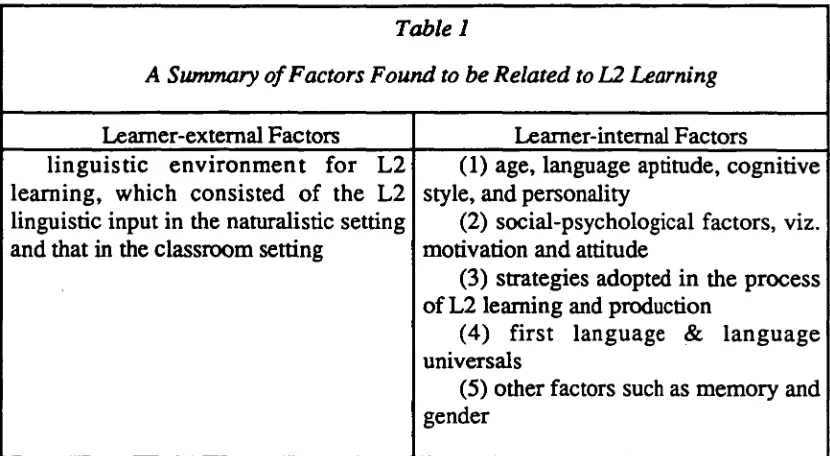
Table 1
A Summary of Factors Found to be Related to L2 Learning
Learner-external Factors Learner-internal Factors
linguistic environment for L2 (1) age, language aptitude, cognitive learning, which consisted of the L2 style, and personality
linguistic input in the naturalistic setting (2) social-psychological factors, viz. and that in the classroom setting motivation and attitude
(3) strategies adopted in the process of L2 learning and production
(4) first language & language universals
(5) other factors such as memory and gender
The selection of learner-external factors for investigation was relatively straightforward. Since English is not the language for daily communication in China, the learners' linguistic environment mainly consisted of English classes in which English was taught and practised. Once outside the classroom, the learners' major source of English was English novels, magazines and newspapers. They may also have had access to limited English on radio and television. Therefore, English learning in the classroom and out-of-class contact with English were the two learner-external factors chosen for investigation in this study.
for investigation in the study were motivation, attitude, and strategies adopted in the process of L2 learning and production.
The decision to investigate the impact of the selected factors on oral English development within a single theoretical framework was due to the fact that research into L2 learning was generally fragmented. This was largely revealed through the contrast between the wide range of factors found to be related to L2 learning and fewer research attempts to discover how the factors interrelated in influencing L2 learning process. Efforts that had been made to look into the relationships between the factors were invariably found in those studies that investigated the correlation between a single variable and learner L2 proficiency. Examples are, the relationship between attitude toward native speakers and L2 proficiency; the relationship between learning strategies and L2 proficiency; and the effect of instruction on the ultimate level of L2. In addition, those types of study had been conducted under varying theoretical frameworks in order to answer different questions about L2 learning. From those studies, it is virtually impossible to obtain a comprehensive
picture of how individual relevant factors interrelated to contribute to L2 learning.
In summary, the reasons that prompted the selection of research questions for the present study were related both to the personal experience of the author and to the contemporary state of research into L2 learning.
The personal experience of the author as a teacher of English in a university in China resulted in his desire not only to describe the oral English development of adult Chinese students of English but also to find out what factors influenced oral English development in the classroom setting.
1.3 Key research questionsfor the study
Two major problems, stated in 1.1, have indicated the general direction of the study in the investigation of adult English learning in the Chinese context. The first problem concerned the description of the classroom L2 learners' oral English development in terms of "function-form" relationships. The investigation of this problem entailed examining both the way(s) in which the linguistic forms the learners used were related with the ideas they wanted to express and the way(s) in which the development of the "function-form" relationships might be described.
The second problem concerned whether the selected learner-external and learner-internal factors for investigation influenced the learners' oral English development and if so, how. Logically, an assessment of the impact of those factors on oral English development should presuppose (i) a delineation of possible relationships between the selected learner-external and learner-internal factors, and oral English development in the classroom setting, (ii) the description of the learners'
English language development as revealed from their oral English production (this
was what the first problem was concerned with), and (iii) the description of the state
of the selected learner-external and learner-internal factors in the same period of
time when the same learners' oral English development was being described. Only
with the above three types of information could even a partial answer to the second
major problem be possible.
Thus, the two major problems could be approached as a whole. In other
words, a framework would first be built which specified the relationships between
learner-external and learner-internal factors, and oral English learning development
in the classroom setting. Then an empirical investigation of the selected factors and
the oral English production in terms of "function-form" relationships could be
conducted over a period of time so that possible changes in the states of the selected
factors and the development of oral English could be traced. Finally, the established
framework could be used to interpret the results of the investigation. Therefore, to
answer the two major problems entailed the provision of responses to the following
six key research questions.
1. How might learner-external factors, learner-internal factors, and the learners'
oral English development be interrelated in the foreign language classroom setting?
2. How might learner-external and learner-internal factors be described in a
particular classroom?
3. Would the learner-external and learner-internal factors show any change over
time? If so, how?
5. How might the learners' oral English development in terms of "function-form" relationship be described?
6. Would the learner-external and learner-internal factors influence the learners' oral English development in the way(s) described in the established linkage of the factors (i.e., in Key Question I)? If so, how?
1.4 Content of remaining chapters
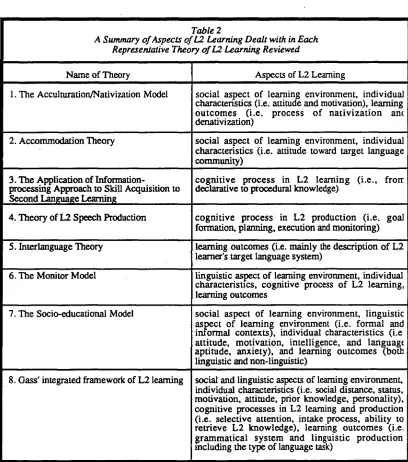
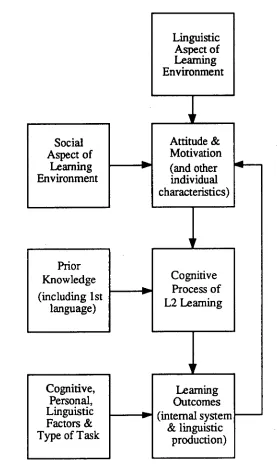
Chapter 2. After the reasons for an indirect application of the existing theories of second language acquisition are stated, a review of some representative theories of second language acquisition is presented. The review results in the identification of four general aspects of second language learning dealt with in the theories, and of the relationships between the four general aspects as perceived by the theories. Then the general aspects of second language learning in which the factors to be investigated belong are examined and compared with those identified from the review of theories. Finally, relationships between the general aspects of second language learning in which the factors to be investigated belong are explored on the basis of the outcome of the comparison.
Chapter 3. A review of related empirical research in each of the four general aspects of second language learning is presented with the aim to specify further the relationships between the factors to be investigated. The review enables the identification of relevant concepts to the factors to be investigated and the relationships between some of the factors and their relevant concepts.
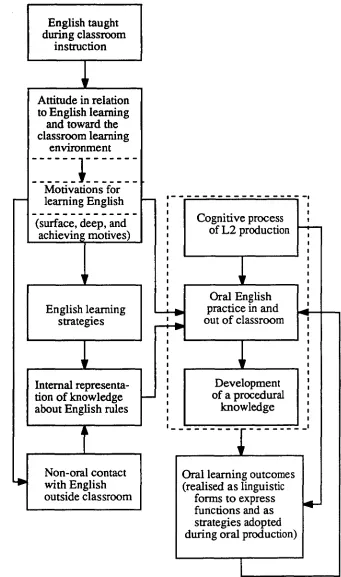
Chapter 4. The conceptual framework for the study, which delineates the relationships between the factors to be investigated, together with their relevant concepts, is described. In establishing this conceptual framework, consideration is given not only to relationships identified in Chapters 2 and 3, but also to the characteristics of English learning environment to be investigated in this study. The sub-questions for research, variables for investigation, and relationships to be explored, which flow from the conceptual framework, are then presented. The concept of "function" is also operationally defmed.
Chapter 5. This chapter describes the research design, instruments adopted for the investigation of each variable, and methods of data collection, preparation and analysis. The analysis of the relationships to be explored is also described.
during the three semesters are presented. ANOVA (one factor, repeated measure), the Cochran Q test, Wilcoxon signed-rank test are reported for examining the changes in the subjects' three categories of out-of-class contact with English during the three semesters of English learning at the university.
Chapter 7. This chapter presents the results for investigation into the subjects' attitudes, motivations, and learning strategies in relation to English learning. These consist of the subjects' indications of these characteristics during the data collection period, and ANOVA (one factor, repeated measure) for examining the changes in the subjects' indications of these characteristics during the three semesters.
Chapter 8. A description is given of subjects' English learning outcomes in terms of their internal presentations of their knowledge of the English language, and their oral English development in terms of "function-form" relationships during the three semesters of English learning at the university.
Chapter 9. The results for the investigation described in Chapters 6, 7 and 8 are interpreted in terms of the nine types of relationships between the investigated factors conceptualised in Chapter 4.
2.1 Need for indirect application of the existing theories of second language
acquisition
As indicated in 1.3 (p.6), before the question of whether, and, how,
learner-external and learner-internal factors would influence oral English development in the
foreign language classroom setting (i.e., Key Question 6) could be answered, a
framework should first be established which specified the possible relationship
between learner-external and learner-internal factors, and oral English development
(i.e., Key Question 1).
The adoption of a theory of second language acquisition seemed a
straightforward way of establishing the above relationships. Since this study was
about L2 learning in a foreign language classroom, presumably it could best be
guided by a theory of L2 learning in the classroom setting. However, no
empirically-founded theory of L2 learning in the classroom setting was available at the time of
the study. This lack of a theory of classroom L2 learning was also discussed in van
Lier (1988). After examining the seven "most prominent theories" of L2 learning
described in Ellis (1985a), he found that only Ellis' own Variable Competence
Model "explicitly uses classroom data as analytical evidence..." He then went on to
comment:
We thus have the curious situation that most second-language acquisition
theorising ignores the L2 classroom as a relevant source of data and as a
relevant place to apply findings.
(p. 23)
word" (Gardner 1985). Gardner went on to give reasons for this:
since not one of them comprises formal axioms, nor do any of them generate unequivocal predictions. Instead, each emphasises certain concepts, sometimes in specific circumstances or contexts, and attempts to organise or interpret data, .... They are descriptive, rather than predictive models, and all are often susceptible to different interpretations. (p.124)
Since the direct application of existing theories of second language acquisition was not feasible either, the only option left was the indirect application. The following steps were regarded by the present author as necessary for such an application:
(i) examine the existing theories of L2 learning to identify general aspects of L2 learning which they commonly dealt with,
(ii) establish the relationships between the identified general aspects, as commonly perceived by the existing theories of L2 learning,
(iii) examine in what general aspects of L2 learning the learner-external and learner-internal factors, and oral English development belong, and then compare the general aspects in which they belong to those identified from the review of existing theories of second language acquisition, and
(iv) on the basis of the comparison, explore possible relationships between the general aspects of L2 learning in which the learner-external and learner-internal factors, and oral English development, belong.
To simplify the expression, the term "learner-external and learner-internal factors, and oral English development" will from now on be referred as "the factors to be investigated (in this study)".
2.2. General aspects of L2 learning and their interrelation as perceived by the
representative theories of second language acquisition
The existing theories of L2 learning were mainly of two types. One type attempted to explain the process of L2 learning mainly from a particular viewpoint and so was termed here as "single-perspective" theory. The other type attempted to account for L2 learning more comprehensively by integrating studies of various aspects of L2 learning. In this study, it was called "integrated" theory.
i) Theories of L2 learning, Type 1: "Single-perspective" theories
Three types of "single-perspective" theories will be reviewed in this sub-section. They are: theories with a social process focus, theories with a cognitive focus, and theories with a linguistic focus.
Theories with a social process focus Two theoretical models stood out as the more prominent among the theories with this focus. They were: the Acculturation/Nativization Model (Schumann 1978; Andersen 1980, 1981, 1983) and the Accommodation Theory (Giles 1979; Giles et al. 1977, Giles and Byrne 1982; Ball and Giles 1982). The common aim of these models was to explain why the L2 learning without classroom instruction took place in target language communities in the way it did. The explanation was sought by identifying mainly those social and cultural factors that motivated individuals to learn the target language, or prevented them from doing so.
The Acculturation Model (Schumann 1978) sees the acquisition or non-acquisition of an L2 as the result of acculturation or non-acculturation of the learner to the target language group. Acculturation, in turn, is determined by the degree of actual social and psychological distance between the learner and the target language group. The learner's social and psychological distance are mainly influenced by the relationships of the learner's social group with the target language group, the learner's attitude toward the target language and the target language community, and the learner's motivation to learn the target language. According to Schumann, social factors play a leading role in the process of acculturation, and psychological factors come into play when social distance is indeterminant, i.e., when social factors exert a neither clearly positive nor clearly negative influence on acculturation. The degree of acculturation determines the amount of contact the learner might have with the target language and also the degree to which the learner is open to the target language that is available. This, in turn, determines the final proficiency which the learner can achieve.
attempts to reshape his/her interlanguage in accordance with the target language system. This is apparent in later stage of L2 learning without classroom instruction, when the learner has more adequate access to the target language.
The Accommodation Theory attributes the learner's proficiency in a target language primarily to his/her level of motivation. This was seen to be the result of the degree to which the learner identifies him/herself ethnolinguistically with the target language community. The learner with high regard of his/her own ethnic group and language will tend to have low level of motivation for learning the target language, and accordingly will achieve only a low level of L2 proficiency. This is because he/she is likely to avoid informal language contexts and the only way he/she can learn the target language is through formal language instruction, which will put higher demands on the learner's intelligence and language aptitude. The learner who has lower regard of his/her own ethnic group and language will have a higher level of motivation and is predicted to achieve higher L2 proficiency. This is because he/she will benefit not only from formal language teaching, but also from his/her voluntary search for opportunities to learn the target language in informal language contacts.
Theories with a cognitive focus Two theories will be reviewed below. One comes from the application of a so-called information-processing approach to skill acquisition (e.g., Anderson, 1980, 1982; Shiffrin and Dumais, 1981; Schneider, Dumais, and Shiffrin, 1984) to second language learning (Levelt, 1978; Faerch and Kasper, 1983; McLaughlin et al. 1983; Hulstijin and Hulstijin, 1984). This theory deals with the cognitive processes involved in L2 learning. The other is Faerch and Kasper's (1980, 1986) theory, which is concerned with the cognitive processes involved in L2 oral production.
The process of acquiring a skill is conceptualised by the information-processing approach as one in which complex procedures, integrating elementary pieces of information, are established. Two notions are central to this conceptualisation. One is controlled information processing, and the other automatic information processing.
Controlled information processing refers to the learners' allocation of their limited attention (short term memory) to select and co-ordinate the pieces of information and to integrate them subsequently into procedures. Automatic information processing refers to the formation of a ready-made procedure in long term memory after repeated practice of the steps involved in the procedures.
knowledge. This knowledge has to be rehearsed in the working memory to keep it available for the interpretative procedures when it is put into use in general-purpose production. Therefore, the use of this knowledge is a slow process. The other is a procedural stage. In this stage, the knowledge is converted from declarative to procedural form by a gradual process of compilation. Compilation, in turn, consists of composition, and proceduralisation. Composition is a process of combining into a single production similar and sequential productions in solving a problem so that the production can speed up. Proceduralisation refers to procedures of creating new productions from the products of old productions whose declarative information need not be retrieved into working memory. Procedures of creation can be improved indefinitely by tuning and restructuring, which, in turn, may decrease or increase the number of sub-procedures.
In this view of cognitive skill acquisition, learning a second language is a process of establishing a procedural knowledge through the compilation of declarative language knowledge, and gradually tuning and restructuring the procedural knowledge. How fluently and automatically the language use can take place depends on the number of sub-procedures subsumed into overall procedures. The larger the number, the more fluent and automatic the language use will be. However, language skill acquisition is not merely a matter of speeding up the execution of similar procedures formed originally from declarative knowledge. Establishing new procedures which reorganise a body of facts and rules previously acquired is actually the essence of the language acquisition.
Faerch and Kasper (1980, 1986) regard the cognitive processes involved in L2 production as consisting of four stages: goal formation, planning, execution, and
monitoring. In the first two stages, decisions are made upon what to say and how to say it. It is at these stages that the learner's prior knowledge of, and experience with, first and second languages influences the decision-making. Execution and planning are interrelated since execution might lead to the revision of the plan because of retrieval or articulatory problems. Alternatively, execution and planning take place at the same time. The process of planning and execution is monitored by the learner to see whether the established plan matches the communicative goal and whether the utterances match the communicative goal and formulated plan.
overgeneralisation of L2 linguistic material. Adjemian (1976) regards an interlanguage as governed by linguistic rules, like any natural language. However, it is incomplete by nature, and is in a state of flux. Tarone (1979) treats an interlanguage as a continuum of styles ranging from formal to vernacular. It is not only constrained by linguistic universals but also by the social contexts in which it is produced.
The recent concerns of the Interlanguage Theory included three questions of L2 learning. The first was how to account for systematicity and variability of interlanguage development (See 1.2, p.3). The second was how an interlanguage is acquired. The more recent trend has been to examine the process of acquisition from an interactive point of view, examining both how linguistic forms are mapped onto functions and how functions are mapped onto linguistic forms. The third issue was the role of first language in interlanguage formation. Instead of inferring first language transfer to the learner's L2 product, researchers examined transfer of first language as a process, which "results in learners taking different developmental paths to target-language mastery or makes it more difficult to learn certain construction" (McLaughlin 1987: 77). The influence of first language is also found in other aspects of L2 learning, e.g., a cognitive process of interlanguage rule formation (Schachter 1983) and interlanguage production (Kellerman 1979), L2 learners' choice of linguistic forms in L2 production (Schachter 1974; Schachter and Rutherford 1979; Wode 1981).
ii) Theories of L2 learning, Type 2: "Integrated" theories
The so-called "integrated theories" were theories which were pieced together from research upon a wide range of variables in L2 learning. Empirical studies in this field have been fragmented in nature, and few attempts have been made to test these theories empirically. Therefore, most of them are little known. In addition, most of these theories are similar in their account of major learning aspects and how these aspects interrelate. So the selection of this type of theory for examination was based on the individuality with which the interrelationship of the aspects of learning was perceived. Three are reviewed in this section. They are: Krashen's Monitor Model (1981, 1982, 1985), Gardner's Socio-educational Model (1985), and Gass' framework of L2 learning (1988).
Affective Filter Hypothesis.
The first hypothesis concerns the cognitive processes involved in two distinct and independent ways of developing L2 competence, as can be seen from the definitions given by Krashen of the terms "acquisition" and "learning". The former is "a subconscious process identical in all important ways to the process children utilise in acquiring their first language"; the latter "a conscious process that results in 'knowing about' language" (1985, p.1). The concept, or rather, metaphor, of Monitor also refers to the cognitive process of consciously editing one's own L2 production by the "learned" rules of grammar. The Natural Order Hypothesis claims that the acquisition of certain morphemes and structures in English and other languages follows predictable stages of development, and thus it deals with the outcomes of L2 learning. The Input Hypothesis, as its name suggests, attempts to explain how L2 learning takes place by focusing on the target language to which the learner was exposed or, in ICrashen's words, "comprehensible input". The Affective Filter Hypothesis deals with the conditions under which the learner might have access to the so-called "comprehensible input". As such, it focuses on the learner's affective factors in L2 learning. In summary, the major aspects of L2 learning covered in the five central hypotheses in the Monitor Model are: cognitive process of learning, learning outcomes, linguistic input to which the learner was exposed, and the learner's affective factors.
Interrelationships among these major aspects of learning can be delineated from the process of L2 language learning. As perceived by Krashen, the learning begins by converting "comprehensible input" into intake, i.e., "that portion of the L2 which is assimilated and fed into the interlanguage system" (Ellis 1985a: 159). The learner's language aptitude plays an important role in facilitating conscious learning by interacting with the intake. However, in acquisition situation, attitudes and motivation are more influential because low levels of these attributes might become the affective block to the intake. The cognitive processes involved in learning and acquisition are different, the former being conscious and the latter subconscious. The predictable or "natural" sequence of language development is the result of acquisition, not that of learning.
The Socio-educational Model The major components of Gardner's socio-educational model (1985) are: social milieu, individual differences, learning contexts, and outcomes. "The language acquisition process is viewed as involving a particular causal interplay of these four types of variables" (p.146).
of these individual differences is that "... other things being equal, (the) four different types of individual differences... will influence achievement directly..." (p.147). These differences contribute to L2 learning in different ways. Intelligence "determines how well or how quickly individuals understand the nature of any learning task or any explanations provided" (p.147). The learner with high language aptitude can better apply their higher verbal and cognitive abilities to the new language. Motivation, which has attitude as its foundation, determines the level of activity at which the learner works to learn the target language. Anxiety associated with language learning has an inhibiting effect on language performance, thus it is an obstacle to language learning.
Two types of learning contexts are distinguished in this theory: formal and informal. The formal context refers to the classroom setting, and the informal to the naturalistic setting. The primary objective in a formal context is instruction, but, instruction is not important in an informal context. All four types of individual differences are regarded as influencing the learning process. Nevertheless, in an informal context, motivation and situational anxiety play a more important role than intelligence and aptitude in determining the L2 learner's achievement of skill, though these relationships are not constant. The learning outcomes are of two types: linguistic, e.g., grammar, vocabulary, pronunciation, and non-linguistic, e.g., "attitudes, values, etc. that develop from the (learning) experience" (p.147). These outcomes are not only regarded as the results of the influences by "prior cognitive (intelligence and aptitude) and affective (motivation and situational anxiety) characteristics" (p.147), but also seen as having important implications for subsequent L2 learning.
To sum up, this theory sees the process of L2 learning as taking place in a cultural context. The process of learning is influenced by learners' individual differences. However, in two different learning contexts, i.e., informal context and formal context, the roles of individual differences can be different. The learning produces both linguistic and non-linguistic outcomes, which, in turn, may influence the subsequent L2 learning.
Gass' integrated framework of L2 learning Gass (1988) proposed a framework in which she attempted to describe how the L2 learner converts input into output. This framework contains five variables: apperceived input, comprehended input, intake, integration and output.