Eu ro pe
1
Re search In sti tu te of Or gan ic Agri cul tu re FiBL, Acker stras se, CH-5070 Frick, tel. +41 62 8657272, fax +41 62 8657273, e-mail ad [email protected], In ternet www.fibl.org
7.4
Eu ro pe
Helga Wil ler and To ralf Rich ter1
166 ha 500 ha 984 ha 2,004 ha 6,000 ha 8,780 ha 15,000 ha 16,934 ha 20,241 ha 28,944 ha 29,850 ha 30,552 ha 32,546 ha 40,000 ha 42,610 ha 49,999 ha 53,515 ha 57,001 ha 85,912 ha 103,672 ha 107,000 ha 156,692 ha 178,360 ha 187,000 ha 235,136 ha 297,000 ha 509,000 ha 665,055 ha 696,978 ha 724,523 ha 1,168,212 ha 1-1,000 ha 1,001-10,000 ha 10,001-100,000 ha
100,001- 1000,000 ha >1000,000 ha
Eu rope
7.4.1
Sta tis ti cal De ve lop ment: Con ti nu ed Growth
Since the be ginning of the 1990s, organic farm ing has rapidly developed in almost all European countries. Growth has, however, slowed down recently.
According to the Swiss Research Institute of Or ganic Agriculture FiBL, by the
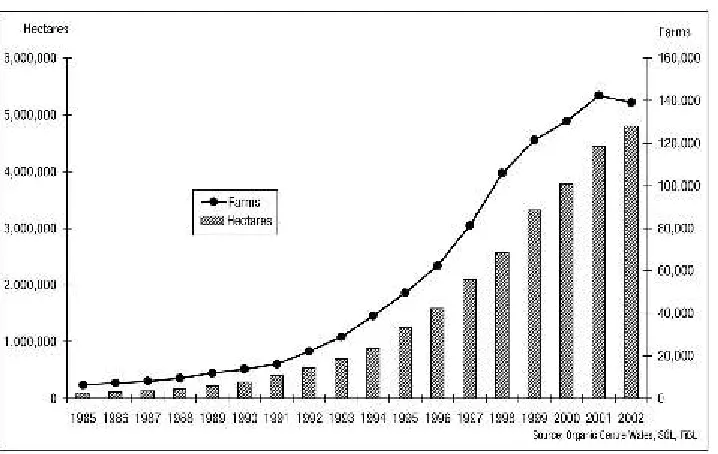
31.12.2002 in the 15 countries of the European Union (EU), around 4.8 million hect -ares were man aged organically by al most 140,000 farms. This constituted 3.5 percent of the agricultural area and 2 percent of the farms in the EU.
According to the SOEL-statistics in the whole of Europe cur rently 5.6 mil lion hect ares are man aged or gan i cally by ap prox i mately 175,000 farm ers.
Compared to the previous year, this is an in crease of 9 percent in the organic land area in the EU, mainly due to a strong growth in France, Spain and the UK. The number of farms went down, however, mainly due to a decrease in organic farms in Italy.
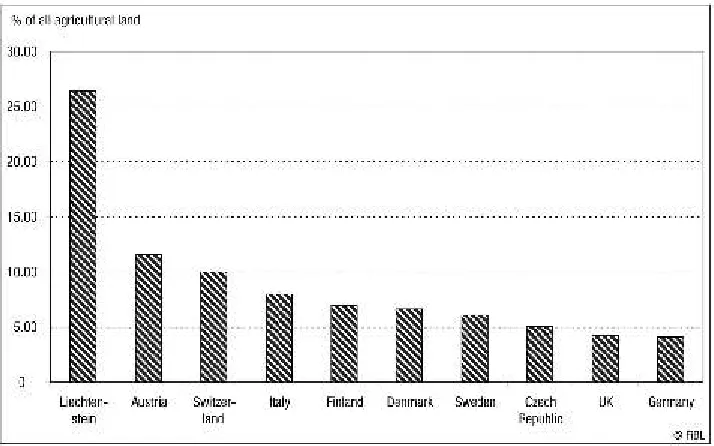
There are also sub stan tial dif fer ences be tween in di vid ual coun tries re gard ing the im-portance of organic farm ing. More than 11 percent of ag ricultural land is organic in Austria, and 10 percent in Switzerland. Some countries have yet to reach one percent. The coun try with the highest number of farms and the greatest number of hectares is Italy. One quarter of the European Union’s organic land and more than one third of its organic farms are located here.
Fi gu re 10: De ve lop ment of land un der or gan ic ma na ge ment and of or gan ic farms in the Eu ro pe an Union 1985 to 2002
[image:3.460.57.416.74.301.2](Sour ce: Or gan ic Cen tre Wa les, SOEL, FiBL)
Figure 11: Or ganically ma naged area in Eu rope: the 10 countries with the hig hest area of or ganic Land (Eu ro pe an Union, Ac ces si on coun tries, EFTA coun tries) per 31.12.2002
Eu rope
7.4.2
Mi les to nes in the His to ry of Or gan ic Agri cul tu re in Eu ro pe
1924 Be gin nings of or gan ic agri cul tu re in Ger ma ny with Ru dolf Steiner’s cour se on bio-dynamic farming; in the 1930s and 1940s the first bio-dynamic associa-tions are founded in Eu rope („De meter“)
1930s/40s Dr. Hans Mueller ac tive in Swit zer land (or ganic-bi o log i cal farm ing, which is now the most common organic farming practice in the Ger man speaking countries; represented by „Bioland“, „BioSuisse“)
1946 Soil Association founded in the U.K. by Lady Eve Balfour (organic farming)
1972 In ter na tional Fed er a tion of Or ganic Ag ri cul ture Move ments IFOAM founded
1973 Re search In sti tu te of Or gan ic Agri cul tu re FiBL foun ded in Swit zer land, now the lar gest or gan ic re search in sti tu te world wi de
[image:4.460.50.407.79.302.2]1975 Foundation Ecology & Ag riculture SOEL founded in Germany
Figure 12: Or ganically ma naged area in Eu rope: the 10 countries with the hig hest sha re (%) of or -gan ic land (Eu ro pe an Union, EU-Ac ces si on coun tries, EFTA coun tries) per 31.12.2002
1980s Most of the or ganic as so ci a tions and or ga ni za tions founded
1990 First BioFach Fair takes place in Ger many, now the big gest fair for organic prod ucts world wi de
1991 IFOAM Eu ropean Un ion Re gional Group foun ded
1991 EU Reg ulation 2092/91 on or ganic ag riculture pub lished in the of ficial Jour nal of the Eu ropean Commission; the regulation became law in 1993
1992 EU reg ulation 2078/92 published in the of ficial Journal of the European Un ion, area based support for organic farming un der this regulation granted in almost all Eu ropean Un ion countries since 1994 (now con tinued un der EU Regulation 1257/1999)
1992 IFOAM Ac cred i ta tion Pro gram es tab lished
1995 First ac tion plan for organic farming launched in Den mark
1999 Global Co dex Alimentarius standards on or ganic ag riculture pub lished
2000 Agenda 2000 im plemented in cluding con tinuation of the area-based payments as well as other support measures for organic farming (Ru ral De velopment reg-u la tion No. 1257/1999)
2001 January, BSE crisis in Eu rope, re sulting in a major shift in at titude in favor of or ganic farming
2001 May, Copenhagen: First steps taken towards a European action plan for organic far ming
2003 European consultation on the action plan for organic farming
Eu rope
7.4.3 The IFO AM Eu ro pe an Union Re gio nal Group
2The IFOAM Regional Group European Union (IFOAM EU group) was founded in 1991. It unites the in terests of the European organic sec tor. Each European country has a representative and a substitute on the board of the group. The group meets three times a year, and one meet ing takes places in Brussels for in formation exchange with the European Commission. A ma jor step in the year 2003 was the establishment of a Brussels of fice, funded by the or ganic sector or pub lic monies of the member states.
The IFOAM EU group has several working groups. One is dealing with the EU regula-tion on organic farming, one with policy quesregula-tions one with research.
The main is sues in 2003 regarding EU regulation on organic farming were related to bought-in an imals, seeds, revision of the annexes on in puts and on processing, organic wine, equivalence of EU regulation and the IFOAM basic standards, aquaculture and guidelines for inspection bodies.
The policy sub group re leased a pa per on the co-ex istence of GMO and or ganic fam-ing. This group is also involved in the dis cussions on the European ac tion plan on or-ganic farming.
The research subgroup is involved in a new European research project, which will sup-port the revision of EU regulation on organic farm ing; this project will start in 2004. The IFOAM EU group is also invited by the European Commission to present sugges-tions on research ac tivities. Suggessugges-tions in clude: research on the benefits of organic farming, organic viticulture and wine processing, processing and aquaculture.
7.4.4
The Eu ro pe an Mar ket for Or gan ic Foods
The main in formation and fig ures presented here were compiled as part of a FiBL sur -vey among experts of the organic sec tor in November 2003. Many of these fig ures are estimates, and the methods of research be hind these fig ures might vary from country to country, as no uni form data collection sys tem for mar ket data is yet available. The figures should therefore be treated with utmost caution.
2 The in formation in the sub-chap ter on the IFOAM Eu ropean Union Re gional Group is based on
Additional in formation is available from Organic Monitor (The Global Market for Or-ganic Food & Drink, 2003; see also chapter 4 in this book) and from a survey which was conducted within the European research project OMIaRD (Padel et al. 2003).
An update of the study of the European market of Hamm et al. (2002) with reliable figures on the European market with organic products should be pub lished in spring 2004.
According to Organic Monitor (2003) in 2002 nearly half of the organic food sales worldwide were gen erated in Europe. The European sales of organic products were es -timated to have ex panded by about 8 percent in 2002 (Organic Monitor 2003) to reach approximately ten to eleven billion Euro (FiBL, survey 2003). Af ter years of tremen-dous organic sales growth, in many European countries the mar ket is now ma turing. Reasons can be found in the broad market pen etration, which comes to a fi nal stage in countries like Den mark, Austria or Germany and the advanced development of or-ganic assortments in the big retail companies. Furthermore the number of oror-ganic consumer remained stable and did not increase as a result of new conventional food scares.
Comparing European countries, Ger many is still the biggest national market in Eu-rope with nearly 30 percent of the total EuEu-ropean market volume. National markets with organic sales volumes of more than one billion Euro of can be found in France, the United Kingdom and Italy (see figure 13).
However there is no sin gle common and homogenous mar ket for organic food all over Europe. The in dividual national organic markets are at different stages of develop-ment. In countries such as Greece or Portugal, the organic market is still in the pi oneer phase. In Italy, France and the United Kingdom, a first boom phase in the marketing of organic produce was apparent in recent years. Within a third group with countries like Austria, Switzerland, Den mark or Sweden the organic markets are quite ma ture now, supported by na tional government ac tivities as well as by ac tive mar ket de velop-ment mea sures by the leading na tional retail chains.
Eu ro pe
Fi gu re 13: Or gan ic pro duct sa les in se lec ted Eu ro pe an coun tries in 2002 (FiBL sur vey 2003)
Fi gu re 14: Aver age con su mer ex pen di tu re on or gan ic pro du ce in Eu ro pe an coun tries 2002 (Sour ce: FiBL)
Migros, this development was widely missed in Denmark by the leading retail chains COOP Denmark and Dansk Supermarket.
In Switzerland the or ganic mar ket share al together amounts 4 per cent, however some relevant sub-markets actually have much higher mar ket relevance (eggs 12 per cent, milk 11 per cent, vegetables 11 per cent, bread 8 percent, fruit 7 per cent).
Generally it is no ticeable that those countries where the market leading supermarket chains have broad as sortments with more than 500 organic items the high est market shares can be ob served. In most countries al ready at least 75 percent of organic products are sold through mul tiple retail chains. When, however, like in Ger many, dis -counters dominate the food mar ket and broad or ganic as sortments are of fered only by smaller and regional oriented retailers there is a technical bar rier for a maximal market penetration of organic products.
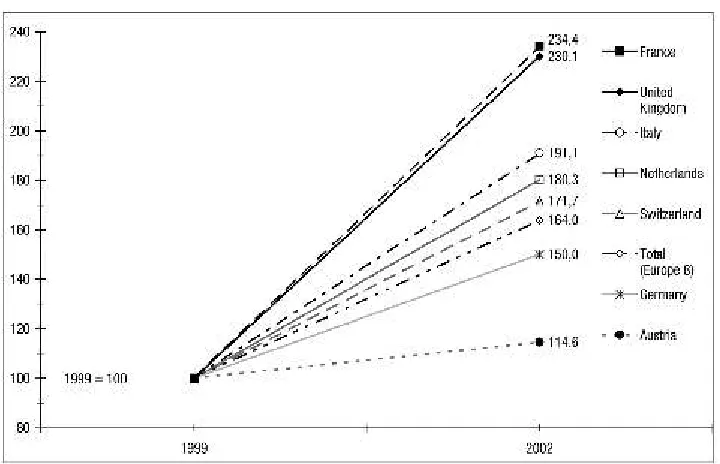
[image:9.460.54.414.351.583.2]There has been considerable growth in the market for organic products in Europe in recent years. However, competition be tween the countries of Europe is growing and the annual growth rates be tween 1999 and 2002 differs clearly by country (see figure 15).
Eu rope
The highest growth rate in the last years could be ob served in France and the United Kingdom (see figure 15). In both countries the organic market grew an nually by more than 40 percent in the last three years on average. In a group with Italy, the Nether-lands and Switzerland, the average market growth varied be tween 20 to 30 percent per year. In Austria and Denmark where the market is po sitioned at a matured stage nearly no market growth of the organic sales occurred.
Between 1999 and 2002, organic sales and organic land areas developed with a dif ferent dynamic in many European countries. Moreover, two countries developed in dif ferent directions. While the organic demand decreased in the last three years in Den -mark, the organic land area conversely in creased. The opposite development took place in Austria. The most well balanced development be tween demand and supply could be ob served in France and Germany over the last years.
What does the fu ture for the European organic market look like? What are the market prospects in terms of growth, what are the main in fluencing fac tors? To answer these questions, 129 experts from all over Europe were in terviewed within of the project OMIaRD (Organic Market Initiatives and Rural De velopment, see Padel et al. 2003). The following paragraphs summarize the main results of the market expert survey.
„Fragmented and un derdeveloped market“ and „lack of mar keting know-how“ re-ceived high scores from a list of pos sible constraints for the development of supply. More than 70 of 129 experts also considered „poor co-operation and communication“ and „low levels of farm gate premiums“ to be im portant constraints, whereas ‘"lack of su per mar ket in volve ment" and „com pe ti tion from non-or ganic al ter na tives“ were not seen as important.
„High consumer price“, „poor availability of organic products“, „lack of consumer in -for ma tion and aware ness“ and „poor prod uct pre sen ta tion“ were con sid ered im por-tant by more than two thirds of the respondents in the area of demand, whereas „com-pe ti tion from near or ganic al ter na tives“ and „lack of cred i bil ity of the cer tif i ca tion sys-tems“ were not considered important.
Experts agreed that organic marketing struc tures need to im prove with expected in -creases and that in creased product range can help stimulate demand and that new consumer groups should be tar geted. They do not think that promotion should be based on risks as sociated with conventional food.
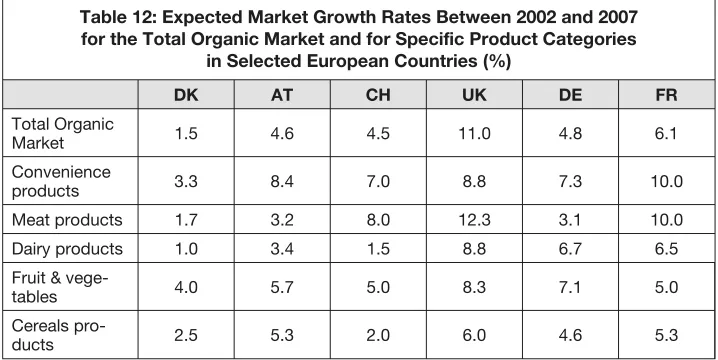
Table 12: Ex pected Mar ket Growth Ra tes Bet ween 2002 and 2007 for the To tal Or gan ic Mar ket and for Spe ci fic Pro duct Ca te go ries
in Se lec ted Eu ro pe an Countries (%)
DK AT CH UK DE FR
To tal Or gan ic
Mar ket 1.5 4.6 4.5 11.0 4.8 6.1
Con ven ien ce
pro ducts 3.3 8.4 7.0 8.8 7.3 10.0
Meat products 1.7 3.2 8.0 12.3 3.1 10.0
Dai ry pro ducts 1.0 3.4 1.5 8.8 6.7 6.5
Fruit & ve
ge-tab les 4.0 5.7 5.0 8.3 7.1 5.0
Ce reals
pro-ducts 2.5 5.3 2.0 6.0 4.6 5.3
Source: Pa del et al. 2003
7.4.5
EU Re gu la ti on on Or gan ic Far ming
With EU reg u la tion on or ganic pro duc tion 2092/91, con sid er able pro tec tion for both consumers and producers has been achieved. This regulation has been im plemented in all countries of the European Union since 1993. In De cember 1999, the European Commission decided on a logo for organic products. This can be used for all produce whose production is reg ulated by EU regulation 2092/91.
The brochure „Organic farming – Guide to Community Rules“, pub lished by the Eu-ro pean Com mis sion in 2001 pEu-ro vides ex ten sive in for ma tion about EU reg u la tion 2092/91.
Eu rope
but consumer confidence clearly needs to be increased by extra measures at national level.
Work on the EU regulation on organic farming is constantly in progress, and the regu-lation is adapted to new developments and findings.
A major development related to the EU regulation on organic farm ing is the im plementation of EU regulation 1452/2003 which requires all EU countries to es tablish da -tabases for organic seed from 1 January 2004 in order to make the supply situation more trans par ent. Or ganic seeds and veg e ta tive prop a gat ing ma te rial must be used if an of fi cial da ta base shows that the rel e vant va ri ety or a com pa ra ble va ri ety is avail able. It is only when the mar ket supply for suitable seeds or vegetative propagating ma terial has been exhausted that a farmer can be given approval to use conventional seeds or propagating material. From January 2004 the organicXseeds internet database set up by the Swiss Research Institute of Or ganic Agriculture FiBL will be the official database for organic seeds and vegetative propagating material in Germany.
7.4.6
Or gan ic Far ming Re search in Eu ro pe
Or ganic farm ing re search is or ga nized dif fer ently in the Eu ro pean coun tries. Un til the 1980s it was mainly car ried out by private research in stitutes, which have been the driving force for the development of organic farm ing research since the 1920s. In the 1980s the first universities took organic farm ing on their cur ricula, in the 1990s the first EU-funded projects on organic farm ing contributed to a better collaboration of researchers on organic farming on a European level, and the first state research institutes became active.
To day’s high po lit i cal and so ci etal ac cep tance and in ter est in or ganic farm ing re search is reflected in the fact that a European ac tion plan is un der work and that na tional ac -tion plans exist already, in cluding spe cial programs for organic farming research (e. g. Germany: Federal Or ganic Farming Scheme BOEL; Den mark: Dan ish Research Center for Organic Farming DARCOF). At the state research in stitutions organic farm ing is getting in creasing attention in many countries: In France the National Agricultural Re-search Institute INRA now has an organic farm ing coordination group (Comité Interne Agriculture Biologique CIAB), and the German Federal Agricultural Research Institute FAL has one research in stitute dedicated to organic farming research, and it is also increasing coordination activities.
on the contrary, has a very low support for organic farming research. In spite of the fact that Italy has the biggest land area un der organic management in Europe, it has one of the lowest budgets for organic farming research. The figures for research fund -ing are based on European Commission report as well as on in formation of the Italian Ministry of Agriculture.
Un der the Eu ro pean Un ion’s re search frame work pro grams, sev eral or ganic farm ing projects have been funded. In the calls under the Sixth Framework Program, which was launched in De cember 2002, organic farm ing plays a more prominent role than in earlier programs, and several organic farm ing projects are funded under it.
The following projects with relevance to the development of the organic sec tor in Eu-rope started in 2003 or will start in 2004 (se lection).
❍ Food from low in put and or gan ic pro duc ti on sys tems: En su ring the sa fe ty and improving quality along the whole chain (QLif)
[image:13.460.57.413.69.298.2]Coor di na ti on: Uni ver sity of New cas tle and FiBL to start early 2004
Eu rope
❍ Sci en tific Sup port of the Re vi sion of Reg u la tion 2092/91 Coor di na ti on: DAR COF
to start ear ly 2004
❍ Or ganic In puts Eva lua ti on
Scien ti fic Co-or di na tion: FiBL Swit zer land In ter net: http://www.organicinputs.org
❍ Fur ther De vel op ment of Or ganic Farm ing Pol icy in Eu rope, with Par tic u lar Em-phasis on EU En largement EU (CEEPOF)
Co-or di na ti on: Re search In sti tute of Or ganic Ag ri cul ture FiBL, Swit zer land and University of Wales, Institute of Rural Studies, UK
In ter net http://www.irs.aber.ac.uk/EU CEE OFP
❍ Eu ro pean In for ma tion Sys tem for Or ganic Mar kets (EIS fOM) Co-or di na ti on: Uni ver sity of Wales, In sti tute of Ru ral Stud ies, UK In ter net http://www.eisfom.org
❍ Or ganic Mar ket ing Ini tia tives and Ru ral De vel op ment (OMI aRD) Co-or di na ti on: Uni ver sity of Wales, In sti tute of Ru ral Stud ies, UK; In ter net http://www.irs.aber.ac.uk/omiard/in dex.html
A major ini tiative to im prove in formation exchange among those in terested in organic farming research is the in ternational database Or ganic Eprints. Or ganic Eprints is an in ter na tional open ac cess ar chive for pa pers re lated to re search in or ganic ag ri cul ture. The archive contains fulltext pa pers in elec tronic form together with bibliographic in -formation, ab stracts and other metadata. The da tabase with currently more than 1200 entries is available at www.orgprints.org. The da tabase was set up by DARCOF, and it is now further developed as part of a project under the German Federal Organic Farming Scheme.
7.4.7
Sta te Sup port for Or gan ic Agri cul tu re
7.4.8
En lar ge ment and Or gan ic Far ming
In the countries of Central and Eastern Europe organic farm ing is also gain ing im por-tance. The area un der organic management is in most cases, however, not as high as in the countries of the European Union. The Czech Republic, though, has converted more than 5 percent of its agricultural land, which is a higher percentage than Germany has.
The countries wishing to be come part of the European Union cur rently adapt their leg is la tion to EU leg is la tion. The coun tries Czech Re pub lic, Es to nia, Hun gary, Lith u a -nia, Latvia, Poland, Slovakia, and Slovenia al ready have regulations for supporting and protecting organic farming. Both the Czech Republic and Hungary are on the third country list of EU regulation 2092/91, which means they can ex port their organic products without further controls into the European Union.
Many farmers in Central and Eastern European countries are us ing far more ex tensive farming meth ods. This means that conversion to organic farm ing is a lot easier for them. Producers from CEE coun tries can of fer or ganic products at comparably low prices. Already now an in creasing amount of organic products in cluding cereals is im -ported into Western Europe. In order to avoid competition and price dumping it is very im portant to promote the domestic market in the accession countries.
7.4.9
Ac ti on Plans
At the Conference „Organic Food and Farming – Towards Partnership and action“, which took place in Den mark in 2001, ag riculture min isters from twelve European countries called for a European ac tion plan for the development of organic farm ing and food (Ministry of Food, Agriculture and Fisheries 2002).
Currently, the action plan is be ing developed fur ther by members of the European Commission, as sisted by the IFOAM European Union group as well as by scientists who have al ready developed concepts for ac tion plans un der the European Union’s re-search programs. In the spring of 2003 a consultation on the European ac tion plan was carried out among European cit izens who were asked to comment the action plan. Ac-cording to the European Commission, there had never been a consultation with so much feedback as this one.
Eu rope
tion, research, train ing and the measures to support organic farming un der the Com-mon Agricultural Policy.
7.4.10 Fu tu re
The land area un der organic management has in creased continually since the mid 1980s throughout the European Union. Almost all European governments now pro-vide strong po litical support, and this was demonstrated at the European Conference on organic farming held in Denmark in May 2001. In order to achieve the targets which many governments have set themselves fur ther efforts will, however, be needed.
Current challenges in clude good cooperation by the private organic sec tor with gov-ernments to forge ac tion plans and further measures to support organic farm ing as well as reg ulation re lated is sues. An other challenge is the 6th re search frame work pro-gram, which offers vast pos sibilities for fund ing organic farm ing research. In order to tap these fund ing sources good project proposals, good collaboration with the ac tors of the organic sec tor, and excellent collaboration be tween colleagues both within as well as outside the organic farm ing research community are needed. And fi nally, EU enlargement, due from 2004 onwards, needs to be prepared in order to guarantee a balanced development of the organic market within Europe.
7.4.11 Re fer en ces
Eu ro pe an Com mis si on (2003) Re cent Pub lic Con sul ta tions, Clo sed Con sul ta tions: To-wards a Eu ropean Ac tion Plan for or ganic food and far ming. The „Your Voi ce in Eu ro pe Ho me pa ge, Eu ro pe an Com mis si on, Brus sels, avai la ble at http://eu ro pa.eu.int/your voi ce/con sul ta tions/in dex_en.htm and http://eu ro pa.eu.int/your voi -ce/results/244/index_en.htm. Date gi ven in Document 20.03.2003
Eu ro pean Com mis sion, Di rec tor ate-Gen eral for Ag ri cul ture (2001): „Or ganic far ming – Guide to Com munity rules“, Brussels, 2001, Avail able at
http://europa.eu.int/comm/ag ri cul ture/qual/or ganic/bro chure/abio_en.pdf
Eu ro pe an Com mis si on, Re search Di rec to ra te Ge ne ral (2002): Se mi nar Or gan ic fra ming Re search in Eu ro pe (on li ne). EU-Agri net Ho me pa ge. Eu ro pe an Com mis si on DG Research, Brus sels. Date gi ven in Do cument 31.10.2002 (cited 03.01.2003). Available at http://eu ro pa.eu.int/comm/re search/agri cul tu re/events/or gan
Fos ter, Ca ro lyn and Ni co las Lamp kin (2000): Or gan ic and in-con ver si on land area, hol-dings, li ves tock and crop pro duc ti on in Eu ro pe. Oct ober 2000. Avai la ble at www.or gan ic.aber.ac.uk/library/Eu ro pe an%20or gan ic%20far ming.pdf
Hamm, Ul rich, Gro ne feld, Frie de ri ke und Dar ren Hal pin (2002): Ana ly sis of the Eu ro pe -an Mar ket for Or g-an ic Food. Or g-an ic Mar ke ting In itia ti ves -and Ru ral De ve lop ment 1. School of Ma na ge ment and Bu si ness, Uni ver si ty of Wa les, Abe rystw yth, UK
Lamp kin, 2001: Num ber of cer ti fied and po li cy-sup por ted or gan ic and in-con ver si on farms / land in Eu rope. The Or ganic Cen tre Wa les, Abe rystwyth, www.or gan-ic.aber.ac.uk/stats.shtml
Mi nis try of Food, Agri cul tu re and Fis he ries (2002): Eu ro pe an Con fer en ce - Or gan ic Food and Far ming. 10.-11. May 2001, Co penhagen, Den mark. Mi nistry of Food, Agri cultu re and Fis he ries, Co pen ha gen, Den mark, 2001, www.fvm.dk/kon fer en cer/or gan -ic_food_far ming/
Niggli, Urs and Hel ga Wil ler: Or ganic Far ming re search in Eu rope (2001): Cur rent Sta tus and fu tu re pro spects. Pub lis hed at En vi ro Wind ows En vi ron men tal In for ma ti on for Bu si nes ses and Lo cal Aut ho ri ties, Eu ro pe an En vi ron ment Agen cy EEA, Co pen ha -gen, Den mark 2001, http://ew-news.eea.eu.int/Agri cul tu re/or gan ic/Europe/Report
Organic Mo nitor (2003) The Glo bal Mar ket for Or ganic Food & Drink. The Or ganic Mo ni tor, Lon don. Info at http://www.or gan ic mo ni tor.com/700140.htm
Padel, S., C. Sey mour and C. Fos ter (2003): Report of all three rounds of the Delphi In -qui ry on the Eu ro pe an Mar ket for Or gan ic Food. In ter nal Pro ject Re port: Or gan ic Mar ke ting In itia ti ves and Ru ral De ve lop ment QLK5-2000-01124. In sti tu te of Ru ral Stu dies, UK-Abe rystw yth
Re search In sti tu te of Or gan ic Agri cul tu re FiBL (2003): Or gan ic Far ming in Eu ro pe - Pro-vi sio nal Sta tis tics 2002, Pro Pro-vi sio nal re sults of a FiBL sur vey No vem ber 2003, The Or gan ic Eu ro pe Ho me pa ge, FiBL, Frick, con ti nu al up da te. Avai la ble at www.or gan -ic-eu ro pe.net/eu ro pe_eu/statistics.asp
Willer, Helga and Toralf Rich ter (2003): FiBLStatistics: Or ganic Farms, Area and Mar kets in Se lected European Coun tries. Re sults of a FiBL sur vey No vember 2003. Pro -vi sional fig ures. Re search In sti tute of Or ganic Ag ri cul ture FiBL, CH-Frick,
Eu rope
7.4.12 Ap pen dix: De ve lop ment of Or gan ic Agri cul tu re in the Coun tries of
the Eu ro pe an Union
The fig ures on the development of organic farm ing in the countries of Europe are based on statistics compiled by Nicolas Lampkin, University of Wales, which were col-lected as part of the EU-project „Ef fects of the CAP-reform and pos sible further de-velopments on organic farming in the EU“; the more recent figures were contributed by the Research Institute of Or ganic Agriculture FiBL, Switzerland. The graphs were made by Zentrale Markt- und Preisberichtstelle fuer Erzeugnisse der Land-, Forst- und Ernaehrungswirtschaft GmbH (ZMP), whose contribution to this publication is grate-fully acknowledged. The year always refers to De cember 31st
.
Fi gu re 18: De ve lop ment of or gan ic agri cul tu re in Bel gi um
Eu rope
Fi gu re 20: De ve lop ment of or gan ic agri cul tu re in Fin land
Fi gu re 22: De ve lop ment of or gan ic agri cul tu re in Ger ma ny
Eu rope
Fi gu re 24: De ve lop ment of orga nic agri cul tu re in Ire land
Fi gu re 26: De ve lop ment of orga nic agri cul tu re in Lu xem bourg
Eu rope
Fi gu re 28: De ve lop ment of or gan ic agri cul tu re in Por tu gal
Fi gu re 30: De ve lop ment of or gan ic agri cul tu re in Swe den