FABRICATION OF COMPLETED DENTURE VIA 3D
PRINTING TECHNOLOGY WITH REVERSE
ENGINEERING METHOD
SYED MUHAMMAD AL-AMIN BIN SYED IDRIS
B071410788
UNIVERSITI TEKNIKAL MALAYSIA MELAKA
UNIVERSITI TEKNIKAL MALAYSIA MELAKA
FABRICATION OF COMPLETE DENTURE VIA 3D PRINTING
TECHNOLOGY WITH REVERSE ENGINEERING METHOD
This report submitted in accordance with requirement of the Universiti Teknikal Malaysia Melaka (UTeM) for the Bachelor’s Degree in Manufacturing Engineering Technology
(Product Design) (Hons.)
by
SYED MUHAMMAD AL-AMIN BIN SYED IDRIS
B071410788
9302010-08-5841
UNIVERSITI TEKNIKAL MALAYSIA MELAKA
BORANG PENGESAHAN STATUS LAPORAN PROJEK SARJANA MUDA
TAJUK: Fabrication of Complete Denture via 3D Printing Technology with Reverse Engineering Method
SESI PENGAJIAN: 2016/17 Semester 2
Saya SYED MUHAMMAD AL-AMIN BIN SYED IDRIS
Mengaku membenarkan Laporan PSM ini disimpan di Perpustakaan Universiti Teknikal Malaysia Melaka (UTeM) dengan syarat-syarat kegunaan seperti berikut:
1. Laporan PSM adalah hak milik Universiti Teknikal Malaysia Melaka dan penulis. 2. Perpustakaan Universiti Teknikal Malaysia Melaka dibenarkan membuat salinan
untuk tujuan pengajian sahaja dengan izin penulis.
3. Perpustakaan dibenarkan membuat salinan laporan PSM ini sebagai bahan pertukaran antara institusi pengajian tinggi.
4. **Sila tandakan ( )
SULIT
TERHAD
TIDAK TERHAD
(Mengandungi maklumat yang berdarjah keselamatan atau kepentingan Malaysia sebagaimana yang termaktub dalam AKTA RAHSIA RASMI 1972)
(Mengandungi maklumat TERHAD yang telah ditentukan oleh organisasi/badan di mana penyelidikan dijalankan)
Alamat Tetap:
156, Persiaran Bukit Meru 1,
Meru Heights,
30020 Ipoh, Perak.
Tarikh: ________________________
Disahkan oleh:
Cop Rasmi:
Tarikh: _______________________
DECLARATION
I hereby, declared this report entitled “Fabrication of Complete Denture via 3D Printing Technology with Reverse Engineering Method” is the results of my own
research except as cited in references.
Signature : ……….
Author’s Name : ………
APPROVAL
This report is submitted to the Faculty of Engineering Technology of UTeM as a partial fulfillment of the requirements for the degree of Bachelor of Engineering Technology (Product Design) (Hons.). The member of the supervisory is as follow:
i
ABSTRAK
ii
ABSTRACT
This study presents the denture fabrication process by implementing the techniques used in the addictive manufacturing which is 3D printing technology involving reverse engineering method. Reverse engineering techniques that been applied is 3D scanning method that suitable to recover surface data of a product. A Rexcan CS2+ scanning device was used to obtain the surface data of the complete denture model that received from the dental clinic. The scanned data was refined using the Geomagic Studio and then converted to STL format for CAD and 3D printing application. The complete dentures design were converted to STL format for production of the product using the Projet HD 1000 machine, one of the rapid prototyping (RP) technique. Cold cure acrylic resin (VERTEX, Castavaria) will be used as the denture material on the gum section. On the teeth section, the composite resin will be applied to add an aesthetic value to the part. Then, the final dentures were polished and tested on an edentulous model to test the bite and adaptability. The finished denture will be tested to ensure the adaptability and comfortability. Thus, the result shows a fabricated denture is printed and fixed to the user. She felt comfort while tested the printed complete denture. This method of fabrication by addictive manufacturing is much faster compared to traditional method. The time taken to complete the denture is 5 hours. Otherwise by conventional method consumed about 15 hours. The result for the denture needs to be checked either to be satisfactory and good accuracy. Unlike the traditional method of fabrication, this research has potential to reduce fabrication period of time and make it easier to replace a new set of denture that had been broken.
iii
DEDICATION
Alhamdulillah first and essential, I would love to commit this project to my almighty God, Allah S.W.T for maintaining me level-headed throughout this process. Allah S.W.T my creator, my strong pillar, my source of inspiration, wisdom, knowledge, and understanding. The Almighty has been the source of my strength throughout this project and on His wings only have I soared.
iv
ACKNOWLEDGEMENT
First and foremost, I am very thankful to ALLAH S.W.T for giving me strength and opportunity to complete my Final Year Project 1 report. ALLAH S.W.T that is merciful helped me with His blessed to writing this report.
I would like to take this opportunity to express my sincere gratitude and appreciation acknowledgment to my supervisor Encik Mohd Nazri Bin Ahmad from the Faculty of Engineering Technology, University Teknikal Malaysia Melaka (UTeM) for their essential supervision, patience, constructive comments, motivational support and encouragement towards the completion of this report.
I wish to thank my parents, Mr. Syed Idris Bin Syed Hassan and Mrs. Nor Azian Binti Alang Ahmad and all siblings for their seed of motivation for completing this degree. Not to forget, my beloved friends for their support and willingness in helping me to solve problems and tasks. I would like to acknowledge and pay deep appreciation to Universiti Teknikal Malaysia Melaka (UTeM) for allowing me to conduct my research and providing any assistance requested.
v
TABLE OF CONTENT
Abstract i
Abstrak ii
Dedication iii
Acknowledgement iv
Table of Content v
List of Tables vii
List of Figures viii
List Abbreviations, Symbols and Nomenclatures ix
CHAPTER 1: INTRODUCTION 1
1.0 Background 1
1.1 Problem Statement 2
1.2 Objectives 3
1.3 Scopes 3
1.4 Organization of this project 3
1.5 Project Planning 4
CHAPTER 2: LITERATURE REVIEW 5
2.0 Introduction 5
2.1 Type of Denture 6
2.1.1 Partial Denture 6
2.1.2 Removable Complete Denture 7
2.1.3 Implant Supported Denture 7
2.2 Parts of Complete Dentures 8
2.2.1 Parts of Partial Dentures 8
2.2.2 Parts of Removable Complete Denture 10
2.2.3 Parts Implants Supported Denture 11
2.3 Material of denture 12
vi
2.3.2 Artificial Teeth Material 13
2.4 Fabrication Technique of Denture 14
2.4.1 Conventional Fabrication of Denture 15
2.4.2 Advanced Technique of Denture Fabrication 18
2.5 Reverse Engineering 20
2.5.1 Overview of Reverse Engineering 20
2.5.2 Reverse Engineering Advantages 22
2.5.3 Reverse Engineering Application 23
2.5.4 The Principle of Reverse Engineering 24
2.5.5 Reverse Engineering Hardware 25
2.5.5.1 Contact Methods 26
2.5.5.2 Non-Contact Methods 27
2.5.6 Reverse Engineering Software 29
2.5.7 Reverse Engineering Phase 31
2.5.7.1 Scanning-Phase 31
2.5.7.1.1 Contact Scanners 31 2.5.7.1.2 Non-Contact Scanners 32
2.5.7.2 Point Processing-Phase 33
2.5.7.3 Application Geometric Model Development 33
2.6 Rapid Manufacturing 35
2.6.1 Rapid Manufacturing Process 36
2.6.1.1 Stereolithography 37
2.6.1.2 Solid Ground Curing (SGC) 38
2.6.1.3 Laminated Object Manufacturing 40
2.6.1.4 Selective Laser Sintering 41
2.6.1.5 Fused Deposition Modelling 43
2.6.1.6 3D Printing 44
2.7 Rapid Prototyping 46
2.7.1 Rapid Prototyping Basic Principle 46
2.7.2 Classification of RP Systems 47
2.8 Rapid Tooling 49
vii
CHAPTER 3: METHODOLOGY 52
3.1 Method of Research 53
3.2 Experimental Process Level 56
3.2.1 Level 1: Identify and obtain the research product 56 3.2.2 Level 2: Reverse Engineering (3D Scanning) 56
3.2.3 Level 3: 3D Editing Process 61
3.2.4 Level 4: Fabrication 3D Printing (liquid Based) 64 3.2.5 Level 5: Dental Laboratory Procedure 66
3.3 Data Comparison and Testing 68
3.3.1 Data Comparison 69
3.3.2 Complete Denture Fitting 70
CHAPTER 4: RESULT AND DISCUSSION 71
4.1 Fabrication Result 72
4.2 3D Editing Result 75
4.3 Data Comparison Result 76
4.3.1 3D Comparison Result 77
4.3.2 2D Comparison Result 80
4.4 Fitting and Testing Result 83
CHAPTER 5: CONCLUSION AND RECOMENDATION 85
5.1 Conclusion 85
4.2 Recommendation 86
REFERENCES 88
viii
LIST OF TABLES
2.1 2.2 2.3
3.1
RE Software
Development years of rapid manufacturing machine Classification of rapid prototyping technologies
Phase of 3D editing process
29
36 48 62 4.1 4.2 4.3 Complete Denture Comparison. Estimate duration of full denture replacement. Estimateduration of reverse engineering method in making complete denture replacement. 73
74
74
4.4 The result of triangle point in each phase. 76
4.5 Critical Surface Result 79
4.6 Critical surface that being point out for 2D Comparison. 80
ix
LIST OF FIGURES
2.1 2.2 2.3 2.4
Type of denture
Parts of Partial Dentures Implant Denture Parts
Fabrication Technique for All Type of Denture
6 9 11 14 2.5 Conventional Denture Fabrication Procedure 16
2.6 Conventional technique Denture Fabrication 17
2.7 Digital Denture Fabrication Steps 19
2.8 Optimal CAD/CAM Denture Workflow 19
2.9 Procedure of Reverse Engineering 21
2.10 Basic Principle of Reverse Engineering 25
2.11 Mitutoyo Crysta-Apex CMM Machine 27
2.12 Solutionix Rexcan CS2+ 3D Scanner 28
2.13 Solutionix Rexcan CS2+ 3D Scanner Specification 28 2.14 Classification Of Data Acquisition Techniques Used in Contact
and Non-Contact
32
2.15 RM Process 37
2.16 SLA Principle 38
2.17 SGC Principle 39
2.18 LOM Process 40
2.19 SLS Process 42
2.20 FDM Process 44
2.21 3D Printing of Inkjet: Binder Jetting 45
2.22 Rapid Prototyping Basic Principle 47
2.23 Comparison of Rapid Tooling and Rapid Prototyping 49
2.24 Rapid Tooling Classification 50
3.1 General Process Flowchart 53
3.2 Methodology Process Plan 55
x
3.4 Rexcan CS2+ Scanner 58
3.5 Denture that is mounted perfectly on the scan table 58
3.6 Process Flow of Scanning Phase 59
3.7 Scanned data that been auto-scan perfectly 60
3.8
3.9
Scanned data that been align perfectly with below 0.016 tolerance.
Phase of 3D editing process
60
62
3.10 Projet HD 1000 Printer 64
3.11 3D Printing Phase 65
3.12 Complete denture model that being cleaned using Isoprophyl Alcohol
66
3.13 Acrylic resin cold cure that is used 67
3.14 Composite resin that covered-up the tooth section. 67
3.14 Dental Laboratory Procedure 68
3.18 3.19 4.1 4.2 4.3 4.4 4.5 4.6 4.7 4.8 4.9 4.10
The comparison data that had been best fit align
The 3D printed complete denture that being fit into the user
3D Printed Complete Denture
Comparison in the duration of making complete denture graph The original scanned data compared to NURBS data
[image:16.595.116.520.63.632.2]The result of 3D comparison of both data Table of 3D Comparison Result
Figure of critical surface tolerance point. Figure of critical surface tolerance result 2D comparison result
Critical surface that being point out for 2D Comparison Figure of critical surface tolerance result in 2D comparison
xi
LIST OF ABBREVIATIONS, SYMBOLS AND
NOMENCLATURE
ACT - Abrasive Computer Tomography CAD - Computer Aided Design
CAE - Computer Aided Engineering CAM - Computerized Aided Manufacturing CMM - Coordinate Measuring Machine CNC - Computer Numerical Control DDM - Digital denture Manufacturing DOF - Degree of Freedom
FDM - Fused Deposition Modelling FPD - Fixed Partial Denture
IOD - Implant-assisted Overdenture
ISO - International organization for Standardization LOM - Laminated Object Manufacturing
OEM - Original Equipment Manufacturers PMMA - Poly (methyl methacrylate)
PSM - Projek Sarjana Muda
RCD - Removable Complete Denture RE - Reverse Engineering
RM - Rapid Manufacturing
RP - Rapid Prototyping
RPD - Removable Partial Denture RT - Rapid Tooling
SGC - Solid Ground Curing SLA - Stereolithography STL - StereoLithography 2D - Two-Dimensional 3D - Three-dimensional
1
1.0 Background
3D printing technologies that also synonyms with rapid manufacturing are technologies that emerging as one of the advanced tools nowadays.The 3D printing technologies are processed that realizing the digital design into the physical part.It starts from a digital 3D model, then it will be converted become thin layers by a specific software and tools. Moreover,3D printers also capable of creating an aerospace part, automotive part, complex part shape, firearm part, and many more.It had been implemented in many types of industries due to its functions.Based on the technologies, the 3D printing techniques and tools help to enable rapid fabrication of early product that harvests the visual and functional characteristics of finalizing the end-product.
Reverse engineering is the operation of examining extant products into yield understanding of the product basically in term of the product mechanism and manufacturing.It helps to discover the product technologies principle, system, function through various of analysis study on the product.
Dentures work as replacements for missing teeth that been broken or taken out.The denture can be plugged out and plugged into your mouth when it necessary. Mainly, the denture has two type, which is complete denture and partial denture. A complete denture is a replaces all teeth within an arch of your mouth and gums. Mainly, this project will focus on developing and fabricate a removable complete denture (RCD) by using reverse engineering approach.The RCD will be fabricated with 3D
INTRODUCTION
2 printing technology application.The manual method or conventional style will be taking a long period of time to produce.The user having difficulty without teeth in their daily basis due to the long process of fabricating.Furthermore, the manual method involves too many steps, such as making an impression, master model, wax up, mould casting, divesting, preparation and lastly veneering.The reverse engineering method will replicate the existing dentures and the part will be produced by using 3D printing technology.
1.1 Problem Statement
The complete denture that been produced by conventional method enormously relied based on the denture technician or dentist skills in producing it.The process of fabricating denture has many steps and principally associated with labour intensive work.Thus, the quality of the complete denture will depend on the skill of the dentist and usually takes a lot of time to manufacture it.The prosthodontists rated that good quality denture will take up to 10 weeks to be created (The Denture Centre,2017).This project will be focused on to produce complete denture by using 3D printing technology with the help of reverse engineering method.
3
1.2 Objective of Project
The main objective of this study are :
i. To fabricate a set of denture via 3D Printing Technology method.
ii. To implement Reverse Engineering technique in setting the complete denture scanned data by a 3D scanning method.
1.3 Scopes of Project
This research study is to analyze the reverse engineering approach that can be used to replicate a set of the denture.The complete denture will be scanned by the 3D scanner to get the result of the data.The scanner that would be in cloud file format then will be edit with the help of Geomagic software.The Geomagic software will assist to get better result of scan data.Then, after the scan data had been finalized, the research will continue covers in 3D printing technology as rapid manufacturing approach.The material that will be used for the modeling is VisiJet FTI.
1.4 Organization of Project
This report is carried in few chapters and every of it's been declared respectively: (a) Chapter 1: Introduction
This chapter will define introduction to the project. It contains an introduction, background of the project, problem statement, objectives, and scope of the project.
(b) Chapter 2: Literature Reviews
4 (c) Chapter 3: Methodology
This section will show how the process flow and the project methodology that has been used in this project.
(d) Chapter 4: Result & Discussion
This part will state out the result that has been obtained and describe the discussion of the project respectively.
(e) Chapter 5: Conclusion & Recommendation
This chapter will discuss the summarization of the project and the major conclusion of the project. Hence the recommendation for a future use.
1.5 Project Planning
5
2.0 Introduction
This chapter shows a literature review of fabrication of complete denture by using 3D printing technology with reverse engineering method. The literature review can be defined as a survey and assessment of current literature information based on your topic studies. All the information of the literature will be summarized by showing theories and point of views.
This chapter 2 mainly discussed the literature review that had been done to complete the study of fabrication of complete denture by using 3D printing technology with help of reverse engineering method. It is also will explore the reverse engineering study, the technique of complete denture fabrication, 3D printing technology and dentures.The references mostly have been cited from the book, journal, thesis, article, and website.
LITERATURE REVIEW
6
2.1 Type of Denture
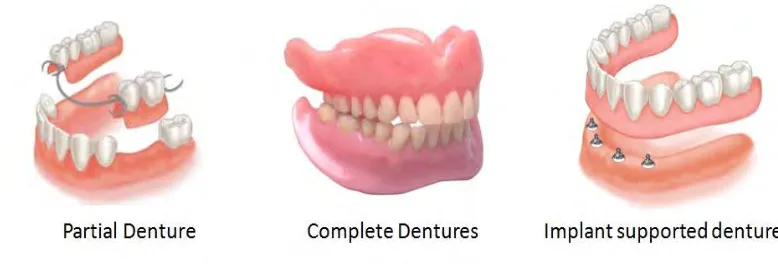
Mainly it has several types of denture available nowadays based on the patient conditions.According to Singla (2007), denture has been classified into many types such as a removable denture or known as a full denture, where it is helpful for a someone missing all teeth. There is another type of denture that is classified as fixed partial dentures. Pahlevan (2005) described that the fixed partial dentures are worn by a person that had lost some number of teeth however still having a number of natural teeth. Another classified denture type is an implant over-denture. It is a denture that artificially-made restoration for the tooth roots that have been lost.It used exactness dental attachment that been placed on tooth roots that been saved or into dental implants which the surgically placed the cylindrically form of pore titanium (Vecchiatni
et al., 2009). Figure 2.1 shows the three type of classified dentures.
Sources:Dentaire, C. (n.d.). Types of Dentures: Complete, Partial and Semi-Precision Dental Implants. Retrieved May 04, 2017, from
[image:23.595.116.505.337.477.2]http://cliniqueprothesedentaire.com/types-of-dentures-partial-complete/
Figure 2.1: Type of denture.
2.1.1 Partial Denture
7 removable partial dentures. Fixed partial dentures (FPDs) are "dental prostheses that are luted, screwed, or mechanically attached or otherwise securely retained to natural teeth, tooth roots, and/or dental implant abutments” (Small, 2011). Removable partial dentures (RPDs) (conventional and implant-supported) treatment is considered a viable option to replace missing teeth as inexpensively as possible, but it has limitations (Etman and Bikey, 2012).
2.1.2 Removable Complete Denture
Complete dentures are full-coverage oral prosthetic devices that replace a whole arch of missing teeth (Abdullaibrahim, 2016). The complete denture purpose is to restore normal contour, functions, comfort, and speech (Memon, 2013). In term of aesthetics reason, the complete denture helps to provide crucial support for your face, it will maintain your face normal contour, especially in mouth section. It additionally helps the user to maintain the function of the teeth on the daily basis such as feeding, talking and smiling.A complete denture appliance got to have a sensible balance of occlusion in order to enhance the stability of the denture functionality or called mastication (Noraniah, 2012). Complete dentures have an effect on speech sounds by altering the dimensions and morphology of the mouth. The insertion of complete dentures plates often leads to speech alteration before using the denture (Khalid, 2015).
2.1.3 Implant Supported Denture