THE AGGREGATE CONSUMPTION FUNCTION - AN ANALYSIS
Including an estimate of the Australian Short-Run Consumption Function, 1959-1969
Submitted as a thesis for the degree of Master of Economics.
ABSTRACT
CHAPTER 1 2
3 4
5
CONTENTS
Introduction
The Keynesian Consumption Function and its Derivative Forms
The Permanent Income Hypothesis
Wealth and the Consumption Function I: The Life Cycle Hypothesis
Wealth and the Consumption Function II: Further Evidence
6 Studies of the Australian Consumption Function
7 The Australian Aggregate Consumptio~
Function: 1959-1968 8 Conclusions
APPENDIX Statistical Sources and Data Used
BIBLIOGRAPHY
(iii)
1
8 50
108
169
217 268
277
iii..
ABSTRACT
In recent years the debate as to the correct form of
the aggregate consumption function !1as continued unabated. Research on the question has been stimulated by the increasing efforts to build up econometric models of national economies. Over the years these models have grown both in size (i.e. in the number of equations and variables employed) and complexity. However, the consumption function has remaine(1 an important relationshir in these models. The continuing debate has now generated an exceedingly large literature, and i t is the first aim of this thesis to review the more important contributions to this literature. Four cho.pters are devoted to this aim. The first deals with work based essentially upon the original formulation of the consumption function by Keynes, the second deals with Friedman's Permanent Income Hypothesis and the literature which that 11as inspired, while the final two chapters are given over to a discussion of wealth and the conswnption function, including the Life Cycle Hynothesis of Ando, Hodigliani and Brumher~.
P,esearch into tlte nature of the Australian consumption function has not kert pace with overseas work, and the resulting literature is small hoth i.n terms of the total nrunber of c:tudies and in terms of the ntnnber of successful overseas ideas that have been tried using Australian data. It is the second aim of this thesis to review the 'vork on the Australian consrnnption function, and a
iv.
The third aim of our work was to provide new estimates of the short-run Australian agr,reri;ate conswnntion function. Eleven different hypotheses were chosen for estimation on the basis of their perfonnance wici1 overseas and ~ustralian data, as revealed by our prior review of the literature. These were estimated first uslng data on total consumption and then using data on consumntion of non-durable p.;oods and services. L\ttcmpts were made to introduce lags in to the hypotheses by the use of the geomctri c lag model and the Almon variab1 c teclmiriuc.
T:-ie method of estimation used was single eriuation least squares (SELS). However, for one oE the hypotlleses,attempts were made to obtain estimates by the us~ of two recently proposed methods, both possessin~ superior properties to SELS.
On the basis of statistical reliability and ex-nost
forecast perfonnance, the best hypothesis when non-durable consumntion data was used, involved current disTJosable income and lagged
CHAPTER ONE INTRODUCTION
1.1 Introduction The aims of this thesis are threefold: (i) To provide a critical review of the more important overseas literature on the aggre~ate consumption function; (ii) To critically review the literature on the Australian aggregate consumntion function;
(iii) To attempt to remove some of the deficienciec; in the Australian work, that have been revealed by (i) and (ii), by providing new
estimates of the Australian consumption function using quarterly data. This chapter is given over to a discussion in section L 2 of the nature of the aggregate consumntion function and the motivation lying behind research into its form. This is follo,·1ed in section 1. 3 with some further discussion of the aims and scope of this thesis.
1. 2 The Aggregate Consumption Function While not a specifically Keynesian idea, the consumption function was not regarded as a
macroeconomic relationshir) of central importance until the
publication of Keynes' General Theory of Emp_~y!_nent, Interest, and
~fancy. Jn the chapters of tlte General Theory_ dealing uith the consumption function, Keynes groupc~d the factors influencing the amount spent on consumpti.on from a given level of income into
1
subjective factors and objective factors. The subjective factors
2.
leading a nerson to refrain from soending out of his income included: (i) the desire to built un a reserve against unforeseen contingencies; (ii) preparation for old age, or the education of dependents;
(iii) allowinr; for greater consumption at a later data; (iv) pure miserliness. Keynes assumed that these factors could be taken as given in the short run.1 The objective factors included: (i) the level of real income; (ii) offsettirig changes in prices and money income; (iii) windfall gains; (jv) changes in _the rate of interest; (v) chan8es in the tax structure; (vi) changes in income expectations. Although Keynes alloued that windfall gains i1erc capable of
influencing the level of consumntion expenditure in the short period, and that substantial ch;mges in the rate of interest and in the tax structure mir;ht have some affect, he concluded that "aggregate income ••• is, as a rule, tl1e nrincipal variable upon which the
consumption-constituent of the aggregate demand function will depend". 2 Thus, according to Keynes, in the short-run (with subjective factors
taken as g:i.ven) we can say that
C
=
<P(X) (1.1)where C aggregate real desired consumution expenditure
x
aggregate real income.Keynes called rt>' the marginal pronc:>nsity__to consume and assumed that 0 <qi' < 1.
1. Ibid.
3.
The consumption function formed an integral part of the model underlying the General T~, and hence estimation of its parameters '·JaS 0 f interest as a test of the model and the conclusions
derived therefrom. In early work on estimation, <I> was taken to be
linear in form and the adjustment of consumption to changes in income was taken to be instantaneous. Thus the consumption function was
fonnula ted as
= (1. 2)
where b is the marginal propensity to consume. The corresponding aggregate savings function is derived from the identity
y
't (1. 3)
Combining (1. 2) and (1. 3) yields the saving function
= -a
+
(1 - b)xt
(l.4)Throughout the rest of this thesis we shall refer to (1. 2) as the basic Keynesian consumption functi.on; similarly for (1.4).
Supporters of the General The~ were encouraged then, when estimates of (1. ?) indicated that the consumption function relation-ship was stable, and that the marginal propensity to consume, b, was indeed a -positive fraction. Because of the intimate connection
between the size of the margi.nal propensi.ty to consume and the size of the multiplier, the size of the estimate of b had a further
After the period in which the rrime motive for research lay in the testing of the General Th~, impetus for further
research came from two sources. Firstly, a number of people thoup.;h t the analysis by KeynPs, leading to (1.1), was unsatisfactory. At the same time, since desired constnnption expenditure constituted such a high proportion of aggregate demand, they recognized the benefits
to policy makers from having available a correctly formulated and estimated consumption function. Hence these people tackled anew the problem of formulating the aggregate consumption function. The results of this work were the various writings of Duesenberry,
1 Modigliani, Ilrumberg, Friedman and others.
The oecond source of motivation for further research came from the effort to build and estimate comnletc models of the national economy based upon the principles of the General Theory. These
econometric models of the economy were designed to serve one or more of the following ob;ectives: (i) To increase understanding of the structure of the economy; (ii) To act as a forecasting device;
?
(iii) To enable quantitative ana1vsis of policy measures.- A central feature of these models is the explanation of the determinants of
aggregate demand. Since aggregJ1te c:onsumption is the largest component of aggregate demand, the cxplanatio11 of its deterrninan ts is an
important feature of an econometric model. Thus econometric work on
1. Detailed references to this work are given below.
5.
the consumption function has been further stimulated bv the various model-building projects that have be.en undertaken. To improve the overall performance of a model its several narts should he as refined as possihle. Jlence the continuous work on the improvement of the consumption function, or its complement the savings function. In this drive to improve the consumption function, the model builders have been able to draw upon the writings of the group mentioned in the previous paragraph.
1. 3 Aims and scope of this thesis As noted in section 1.1, the first aim of this thesis is to provide a critical review of the work that has been done on the aggregat0 consum-rtion function. The next four chapters are devoted to thjs task. Although thP review is
6.
Early in the 1950's investigators began a.rethink on the question of the consumption function, and several ne\J
fonnulations, not explicitly based u~on Kevnes, were put fon1ard. These new formulations were based unon an examination of the
behaviour of an individual consumer. From the results obtained an aggregate conslllllption function was derived. The two most prominent examples of this approach, the Permanent Income Hypothesis and the Life Cycle Hypothesis, are discussed in chapters three and four respectively. These ideas, in turn, prompted further empirical work in the same spirit. A discussion of some of this work is also
included in chapters three and four. Finally,some more recent studies of the consumption function are discussed in chapter five. Throughuul these four chapters an attempt has heen made to single out the i<leas that have worked well with the aim of using these, uherever possible, in our own study of the Australian consumption function.
7.
Australian ideas which have not hecn a<lequately tested. To be able to do this we must first have carried out a review of overseas and Australian work on the consumption function. Throughout chapter seven quarterly data will be used, hence our estimates can be looked upon as estimates of the short-run consumption function. Finally some general conclusions and suggestions for further work are given in chapter eight.
CHAPTER TWO
THE KEYNESIAN CONSUMPTION FUNCTION AND ITS DERIVATIVE FORMS
2.1 Introduction In section 2.2 of this chapter some of the early empirical work on the consumption function will be examined. The functions to be discussed were all formulated by the investigator taking the basic Keynesian consumption function, Ct ~a+ bXt, and then introducing some extra factor in an attempt to obtain an improved estimate of the aggregate consumption function. These derivative formulations were obtained in a variety of ways:
9.
The literature on the Keynesian consumption function and its derivatives is very extensive and it is not possible to examine any more than a small fraction of the work done. However, it is hoped that the ten studies to be examined will give the reader an indication of how econometric work on the consumption function was developing during the period covered - what methods of estimation were employed, what tests of significance were used, how easily researchers were satisfied with their results,and so on.
An assessment of these studies is carried out in section 2. 3. One conclusion drawn there is that the variable X , the 0 previous peak v~lue of income, is a very effective explanatory variable. The inspiration for the inclusion of this variable came
from work by Franco Modigliani.1 Both Modigliani and James
Duesenberry independently advanced the hypothesis that consumption could be adequately explained by current income and previous peak income. Modigliani's work, like that discussed in section 2.2, was of an essentially derivative nature. Duesenberry, however, advanced his version of the hypothesis only after an examination of the theory of consumer behaviour at the micro level. The Duesenberry-Modigliani
2
hypothesis has been long lived and much tested, and for this reason
1. Colin Clark, when introducing the variable, termed it the Modigliani factor.
2. The latest test, at the time of writing, was in D. G. Craig
II >
10.
it will be examined in greater detail in section 2.4 although
(because of Duesenberry's work) the hypothesis cannot be considered as solely a derivative of the Keynesian consumption function.
Finally, general conclusions are given in section 2.5 along with implications for Australian empirical work.
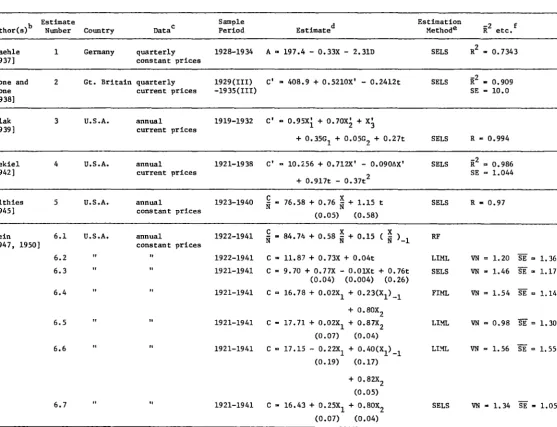
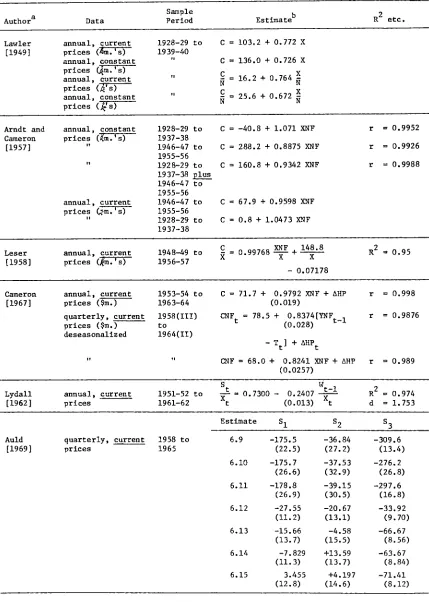
2.2 Studies of the Keynesian Consumption Function1 The ten studies to be examined are summarized in table 2.1.2 The first
3
estimate, by Staehle, departs from the Keynesian formulation in a number of ways: (i) The dependent variable, A, is a measure of the average propensity to consume. The observations on A are derived by dividing an index of retail sales by an index of labor income.
4
(ii) In addition to the income variable, X, a measure of the inequality in the distribution of income is included as an explanatory variable. This measure, denoted by D, is defined as:s
D = cumulative median income - median income cumulative median income
1. The notation used below is listed in Avpendix 2.1. 2. See p. 22 below.
3. H. Staehle: "Short-period variations in the distribution of incomes", Review of Economics and Statistics, Vol. 19 (1937), pn. 133-143.
4. No attempt will be made for these early studies to describe the income variable used in terms of present day national accounting tenns.
5. The cumulative median income is that amount which raises the
cumulative total of ranked incomes to half the total of all incomes where the cumulative total is built up by cumulating from the
lowest income upwards.
ll.
1
The value of including D was checked in a second article with the 2
use of bunch map analysis. The income measure used was obtained by deflating an index of labor income by an index of wage rates. The method of estimation was single equation least squares (SELS). No other formulations of the function, or other variables, were
tried. With the exception of the bunch map analysis the only test 2
of the estimate was the value of R (0.7343). The work is, however, significant as one of the first estimates of the consumption function using quarterly data.
3
The second study, by Stone and Stone, is again a quarterly study. Here a trend term has been included "to make allowance for trend influences bearing on the relation of [ C'] to [X']". 4 In addition tp the estimate shown for Great Britain, estimates were made of the consumption functions of Germany, Holland, Poland, Sweden and the United States. These estimates involved regression of
consumption on to income and a trend tenn, except for those cases
L H. Staehle: "New considerations on the distribution of incomes and the 'propensity to consume'", Revtew of Economics and
Statistics, Vol. 20 (1938), pp. 134-141.
2. For an account of bunch map analysis see: S. Valavanis, Econometrics (New York: McGraw-Hill, 1959), pp. 146-150. 3. R. Stone and W. M. Stone: "The marginal propensity to consume
and the multiplier, a statistical investigation", Review of Economic Studies, Vol. 6 (1938-1939), pp. 1-24.
12.
where the correlation between income and the trend term was so high 1
as to make the resulting parameter estimates unreliable, in which case the trend term was dropped. In each of these latter cases annual data was used. Only in the case of Poland was deflated data employed. In all cases the method of estimation was SELS. No other statistical measures of goodness of fit were calculated except the
-2
adjusted coefficient of determination (R ) and the standard error of the estimate. The authors of this study conclude that
"It does not appear, in the cases studied, that information other than that of changes in income is important in explaining changes in the movement of consumption except where a change takes place in the relation of consumption to income". 2
3
Estimate number 3, by Polak, was the result of testing at least fifteen different formulations of the consumption function. The final form chosen was
C' = 0.9SXi + 0.7ox2 +
x3
+ 0.35Gl + O.OSG2+
0.27t (2 .1) where Xi,x2
andx3
are, respectively, "lower" incomes, "higher"1. If there are exact, or nearly exact, linear relationships between regressors the standard errors of the parameter
estimates will be very large. Thus it would be hard to reject the hypothesis that, for example, the population values of the parameters are all zero. For an explanation of this problem of multicollinearity (or intercorrelation) see: A. S. Goldberger, Econometric Theory (New York: John Wiley and Sons, Inc., 1964), pp. 192-194.
2. Stone and Stone: "The marginal propensity to consume and the multiplier", p. 20.
3. J. J. Polak: "Fluctuations in United States consumption,
13.
incomes and farmers' incomes;
c
1 and G2 are capital gains on securities and commodities respectively; t is a trend term. This
formulation differs from that of Stone and Stone by splitting the income variable up into a number of categories, the motive for this being that the marginal propensity to consume from the different income types is likely to be different and the distribution of total income amongst the various categories could change over time. Other variables considered were "higher" incomes lagged one year (
cx2>-1>'
Pareto's measure of the equality of income distribution (a), and the general level of prices of consumption goods (p). The criteria used to choose between the various estimates were: (i) the magnitude and sign of parameter estimates; (ii) the magnitude of the multiple correlation coefficient R; (iii) the magnitude of the increase in R as extra variables were added into the regressions. Polak assumed that the marginal propensity to consume out of farmers' incomes was unity, hence the coefficient of unity forx3.
The method ofestimation was SELS. No special measures of goodness of fit or statistical significance are shown,but Polak indicates1 that bunch map analysis was employed. As are the Stones, Polak is content with
the Keynesian formulation of the consumption function, concluding that
14.
"The theory is right in assuming that income is the most important factor of consumption
expenditure. The influence of all other factors is practically negligible - even that of the
distribution of income, if the distinction between [lower] and [higher] income is taken into account". 1
2
Estimate number
4,
by Ezekiel, is of interest because of the dynamic variables exµerimented with. The estimate attempts to measure the influence of a time trend and the rate of change of income on consumption. Ezekiel's estimate can be rewritten asC'
=
10.256 + 0.622X' - 0.090(X')_1 + 0.917t - 0.37t 2
Thus it can be seen that Ezekiel has thought it worth while to include lagged income as an explanatory variable, as opposed to Polak 3 who rejected it. The estimate also includes a non-linear term -0.37t2• However, it has been shown that the coefficient of t2 is not significant at the 5% level of significance.4 Ezekiel
(2.2)
also estimated the same relationship after putting it into per-capita terms and deflating. However, on the basis of the size of the
coefficient of multiple determination corrected for degrees of -2
freedom, R , this was rejected. The method of estimation was SELS.
1. Ibid., p. 10.
2. M. Ezekiel, "Statistical investigations of saving, consumption and investment", American Economic Review, Vol. 32 (1942), pp. 22-49, 272-307.
3. See p. 13 above.
15.
The study by Smithies1 has several features which mark it off from most of the previous work, including that not reported here. Firstly, constant price data are used. 2 All further studies
to be reported automatically use deflated data. Secondly, the income variable used represents disposable income. Prior to this stage it is difficult, in terms of current national income accounting concepts, to say exactly what is the nature of the income variable used. Subsequent studies examined sometimes do not use the disposable income conceptjbut there is usually a special reason for this. (For example, Klein in estimates 6.4 to 6.7 does not employ disposable income data, although he recognizes the desirability of doing so, because the data is not available.) Thirdly, the standard errors of the parameter estimates are given, enabling tests of statistical significance to be performed. Except for these factors the Smithies' function is not greatly different to that formulated by Stone and Stone (estimate number 2). Once again the method of estimation is SELS.
Estimates 6.1 to 6.7 differ from previous estimates in that each is part of a system of relationships forming an econometric
3
model of the United States economy. Estimate 6.1 is from a simple
1. A. Smithies, "Forecasting postwar demand: I", Econometrica, 13 (1945)~ pp. 1-14.
2. Note, however, that constant price data was used by Staehle in estimate 1.
3. See L. R. Klein, Economic Fluctuations in the United States, 1921-1941 (New York: John Wiley and Sons, Inc., 1950).
] 6.
1 three equation model estimated by the method of reduced forms. The income variable used is disposable income. The formulation of the function departs from the basic Keynesian function in that it is cast in a per-capita form, and a lagged value of per-capita income is included. Standard errors of the parameter estimates and values of the statistics SE and VN were calculated for the reduced form equation from which 6.1 is derived. The variable
L
( N )_
1, where L represents private holdings of liquid assets, was
2
also tried, but its coefficient in the reduced form equation was found to be statistically insignificant. Estimates 6.2 and 6.3
are alternative estimates of the consumption function for a large 16 equation model. In both formulations the income variable is disposable income. Both formulations are quite simple, the only special feature being the non-linear term -0.0lXt in 6.3. This term
1. For an account of the reduced form approach to estimating the parameters of a system of equations see Goldberger, Econometric Theory, pp. 294-329. The reduced-form approach is employed because SELS estimates of the parameters of a relationship, where the relationship forms part of a simultaneous system of equations, lack the property of consistency (which, roughly
speaking, means that as the sample size (n) grows the probability that the parameter estimate
(e )
differs from the actual parametern
value (8) by more than an arbitrarily small amount (£) should be decreasing, i.e.
lim
P(le -
ej
> £)=
o
).
n
n+co
1 7.
is included to test the hypothesis that the marginal propensity to consume is varying over time. (From 6.3 we find that dX , the dC marginal propensity to consume, equals 0.77 - O.Olt, a, decreasing
function of time). Estimate 6.2 is obtained using the limited-!
infonnation maximum likelihood method, while SELS is used to derive estimate 6.3. Estimates 6.4 to 6.7 are from a six equation model. 2 In all estimates the only variables used are income variables - wage income before taxation (X
2) and non-wage income before taxation (X1). Lack of data prevented the use of disposable income type variables. In 6.4 and 6.6 the lagged value of
x
1 has been included as an explanatory variable. Estimate 6.4 has been found by use of the
3
full-information maximum likelihood method, while 6.5 and 6.6 have been found by use of the limited information maximum likelihood method. Asymptotic standard errors are in parenthesis below each
parameter estimate in 6.5 and 6.6. Finally a SELS estimate of
formulation 6.5 is given. The influence of the estimation technique is quite substantial as can be seen by comparing the magnitude of the estimated coefficient of
x
1 in 6.5 (0.02) with that in 6.7 (0.25).
1. See Goldberger, Econometric Theory, pp. 338-345.
2. Klein, Economic Fluctuations in the United States, pp. 58-80. The two previous models referred to above are discussed in both of the publications listed in footnote 3, p. 15 above.
18.
A most important feature of this work is the use of estimation techniques (reduced form, full information and limited information maximum likelihood) suitable for the estimation of relationships
forming part of a simultaneous system. 1
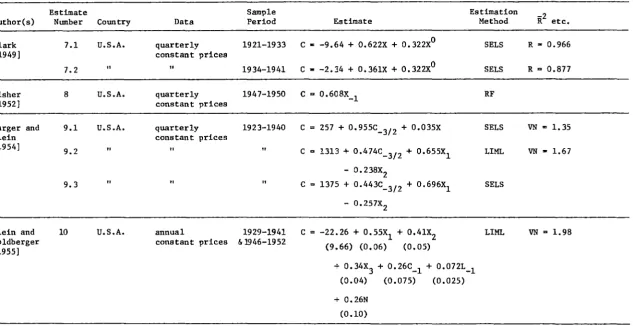
Estimates 7.1 and 7.2, by Clark, were obtained in an indirect fashion. On the assumption that total taxation was a stable linear function of gross national product, Clark formulated his conswnption function as
c
=
(2.3)0
where X
=
gross national product and X = the highest previous value of X attained a year or more previously. In addition Clark's import function was:(2.4)
where I
=
imports. Subtracting (2.4) from (2.3) gives(2.5)
(2.5) was estimated for both (1921-1933) and (1934-1941). These estimates were combined with corresponding estimates of (2.4) to
give estimates 7.1 and 7.2. Clark's reason for adopting this approach is to reduce the number of equations and endogenous variables in
19.
1
his equation system. The only other variable tried by Clark was gross national product lagged two quarters. This was rejected on the basis of bunch map analysis. Clark offers no statistics or tests in support of his consumption function except the value of the correlation coefficient. Bunch map analysis is used to support the inclusion of
x
0 in the function. The function does receive some other support in that it is part of a system of equationsdesigned to explain the United States trade cycle, which Clark feels 2
the system does quite well. Although Clark's consumption function is part of a system of equations, he estimated it by SELS and thus the parameter catimates will not be consistent.
Estimate 8 was part of a small, highly aggregative quarterly model of the United States.3 The consumption function was very
simple; aggregate consurnption was made proportional to lagged gross national product. The proportional character of this consumption
function marks it off from the Keynesian function, since proportionality implies that the average propensity to consurne equals the marginal propensity (whereas the Keynesian function normally shows the average propensity greater than the marginal propensity). The system was
1. Ibid., p. 102. 2. Ibid., pp. 115-116.
20.
estimated by the method of reduced forms, standard errors being given for the estimates of the reduced form parameters.
1
Estimates 9.1 to 9.3, by Barger and Klein, are noteworthy for including lagged consumption as an explanatory variable.
c_
312 is a simple average of the consumption of the two previous quarters, i.e. In 9.1 the variable X is gross income before taxes; in 9.2 and 9.3,x
1 is wage income (before taxes) and
x
2 is non-wage income (before taxes). Relationship 9.1 was part of a model set up in recursive form, enabling consistent parameter2 estimates to be obtained by application of the SELS method. The 95% confidence limits for the parameter estimates are:
0.931 < Cll <
= 0.984 -0.072 < =
=
< 0.122where a
1 is the coefficient of
c_
312 and a2 is the coefficient of X. Barger and Klein note that the result is defective for the following1. H. Barger and L. R. Klein, "A quarterly model for the United States economy", Journal of the American Statistical Association, Vol. 49 (1954), pp. 413-437.
2. Consistent estimates of the parameters of a recursive system can be obtained by application of SELS to each equation of the system, if it is assumed that unlagged disturbances in separate equations are independent. See Goldberger, Econometric Theory, pp. 354-355. Barger and Klein do not make this assumption and use the following
procedure to obtain consistent estimates: (1) The equation with only one dependent variable (say Y
1) is estimated by SELS; (2) The equation with two dependent variables (Y
1, Y2) is estimated by SELS, b~t actual observations on Y
1 are replaced values Y
1• And so on for subsequent equations. Klein, "A quarterly model for the U.S. economy",
21.
reasons: (i) The statistic VN indicates significant autocorrelation of the disturbances; (ii) The marginal propensity to consume out of current income (a
2) is very low; (iii) The confidence limits for a2 1
include negative values. While the study suffers from these defects it is also impressive for the care the authors have taken to obtain consistent parameter estimates and for the calculation of confidence limits. Relationship 9.2 was part of a model which was partially recursive. Limited-information maximum likelihood estimation was required to obtain consistent parameter estimates. A SELS estimate of 9.2 was provided also (see 9.3). Barger and Klein subjected their models to a further teat by examining how well they predicted in comparison to three "guesswork" models. In this test the performance of the models both within and without the sample period was checked.
2
Estimate 10, by Klein and Goldberger, is the consumption function for a 20 equation model of the United States economy. In setting up the equation for testing,the authors have taken account of the functional distribution of income by providing three income
variables -
x
1 (disposable employee compensation),
x
2 (disposable non-wage non-farm income) andx
3 (disposable farm income). In addition, allowance is made for population changes and lags in
1. Barger and Klein, "A quarterly model for the United States economy", pp. 422-423.
TABLE 2.la
Author(s)b Estimate
Sample
Estimated
Estimation
il2 f
Number Country Datac Period Methode etc.
Staehle 1 Germany quarterly 1928-1934 A= 197.4 - 0.33X - 2.31D SELS R2 m 0.7343
[1937] constant prices
Stone and 2 Gt. Britain quarterly 1929(III) c' m 408.9 + o.s21ox• - 0.2412t SELS -2 R • 0.909
Stone current prices -193S(III) SE = 10.0
[1938]
Polak 3 u.s.A. annual 1919-1932 C' D o.95Xi + o.1ox2 + x3
[1939] current prices
+ 0.3SG1 + O.OSG2 + 0.27t SELS R = 0.994 Ezekiel 4 u.s.A. annual 1921-1938 C' = lO.iS6 + 0.712X' - 0.0906X' SELS -2 R = 0.986
[1942] current prices
+ 0.917t - 0.37t2
SE = 1.044
N
c x N
Smithies s u.s.A. annual 1923-1940
N •
76.s8 + 0.16N
+ 1.1s t SELS R • 0.97 IU[194S] constant prices (0 .OS) (O.S8)
.
Klein 6.1 u.s.A. annual 1922-1941
N •
c 84.74 + o.s8 xN
+ o.1s N x )_l RF[1947' 19SO] constant prices
6.2 " 1922-1941 C m 11.87 + 0.73X + 0.04t LIML VN 1. 20 SE = 1. 36
6.3 1921-1941 C = 9.70 + 0.77X - O.OlXt + 0.76t SELS VN • 1.46 SE = 1.17 (0.04) (0.004) (0.26)
6.4 1921-1941 c = 16.78 + 0.02X1 + 0.23(X1)_
1 FIML VN = 1.S4 SE = 1.14 + o.8ox2
6.S " 1921-1941 c - 17.71 + 0.02X1 + 0.87X2 LIML VN = 0.98 SE = 1. 30
(O. 07) (0.04)
6.6 " 1921-1941 c c 17 .15 - 0.22X
1 + 0.40(X1)_1 LI!il. VN = 1. S6 SE = 1. SS (0.19) (0.17)
+ 0.82X 2 (O. OS)
6.7 " 1921-1941 C m 16.43 + o.2sx
[image:26.730.94.652.105.532.2]Table 2.1 continued Author(s) Clark [1949] Fisher [1952] Barger and Klein
[1954]
Klein and Goldberger [1955] Estimate Number 7.1 7.2 8 9.1 9.2 9.3 10 Country u.s.A. II u.s.A. u.s.A. II II U.S.A. Sample Data Period quarterly 1921-1933 constant prices
II
1934-1941 quarterly 1947-1950 constant prices
quarterly 1923-1940 constant prices
II II
II II
annual 1929-1941 constant prices & 1946-1952
a. For definition of notation see Appendix 2.1, p. 50. b. For sources see text.
Estimation Estimate
c .. -9.64 + 0.622X + 0.322XO c - -2.34 + 0.361X + 0.322XO C "' 0.608X_
1 c
=
257 + 0.955c_312 + 0.035X c .. 1313 + 0.474c_
312 + 0.655X1 - 0.238X
2 c .. 1375 + 0.443C_
312 + 0.696X1 - 0.257X
2 c
=
-22.26 + o.55x1 + o.41x2 {9.66) (0.06) (0.05)
+ 0.34X
3 + 0.26C_1 + 0.072L_1 (0.04) {0.075) (0.025) + 0.26N
(0.10) Method SELS SELS RF SELS LIML SELS LIML
c. All quarterly studies except that by Stone and Stone employ deseasonalised data.
-2 R etc. R • 0.966 R"' 0.877
VN ., 1.35 VN"' 1.67
VN "' 1.98
d, The figures in parenthesis are the standard errors. In estimate 6.5 and 6.6 the figures are asymptotic standard errors. e. SELS
=
single equation least squares; RF ~ reduced form; LIML=
limited-information maximum likelihood;FIML
=
full-information maximum likelihood,f. SE = standard error of the estimate; SE - SE corrected for degrees of freedom; VN
=
Von Neumann ratio (used for testing for possible autocorrelation of disturbances).23.
behaviour with the introduction of the variables N and
c_
1• A variable not encountered before is L_1 - end of year liquid assets held by persons. This is the most fundamental modification to the Keynesian function reported so far. Klein and Goldberger argue that the consumer's stock of wealth will affect his expenditure plans for
1
coming periods and that a convenient way to measure wealth stocks is by means of
L.
The problem of multicollinearity between the three income variables was overcome by the use of survey data. Instead of estimating the coefficients a1, a2 and a3 in
and
and then time series data was used to estimate the coefficient a 1 of
A A
a a
a
1[x1
+ (
~
a )X2+ (
_l, )X ]1 a1 3
where A denotes the survey data estimate. The entire model was tested
for its forecasting ability both within and without the sample period. The estimation method was limited-information maximwn likelihood.
2.3 Assessment The aim of this section is to provide some
assessment of the studies just outlined. The early studies examined (estimates 1 to 5) appear to do quite well when casually examined.
24.
The hypotheses tested a-ppcar to be ahle to exn1ain more than 90~~ of the variation in consumption ex-penditure. The lowest value for
the multiple correlation coefficient is O. 73Lf3 for estimate number 1. In addition, the consumption functions finally formulated in estimates 1 to 5 have the virtue of being quite simµle in form. However, it is too much to be asked to accept estimates on the basis of the value of the correlation coefficient alone. These five estimates, and the rest also, suffer from a number of deficiencies.
First, in six of the ten cases the estimation method was SELS. Sinc,e the consumption function is, in reality, part of a system of relationships linking the various economic aggregates (even if the other relationships are not ~melt out), use nf SF.LS
1 will usually result in inconsistent estimates of its parameters. Secondly, in only three cases (estimates fi, 9 and 10) was any check made for possible autocorrelation of disturbances. The consequences of autocorrelated disturbances are: (1) The conventional least-squares formulae for calculating the variances (and hence standard errors) of parameter estimates may seriously underestimate the variances of least-squares parameter estimates; (2) The usual form of the t-test will not hold; (3) The classical least-squares estimator is no longer a best-estimator (BLUE) since another
linear-unbiased-1. See footnote 1, p. 16 above. See also Goldberger, Econometric Theory, pp. 288-2911 and T. Haavelmo, "Methods of measuring the marginal
25.
estimator (the generalized least-squares estimator) with smaller 1
sampling variances exists. Thus, the consequences of autocorrelation are that our estimates are no longer BLUE, standard errors are not correctly calculated, and the normal tests of significance are inapplicable. In view of these consequences the lack of a test for autocorrelation is a serious failing. Thirdly, a check on the
statistical significance of parameter estimates is almost impossible as in only very few cases were standard errors calculated. Fourthly, only in the case of estimates 9 and 10 was the predictive ability of the function checked against data from outside the sample period. Fifthly, many of the studies used income variables that were not of the "disposable income" type. Sixthly, in many studies the sample period was exceedingly short, estimates being calculated on less than twenty observations. Finally, hypotheses for testing were still being formulated in most cases by taking the Keynesian consumption function and tinkering with it in some way - trying different methods of deflation, splitting up the income variable in a variety of ways etc.
2fi.
In an attempt to overcome some of these deficiencies 1
Robert Ferber made a systematic study of a number of hypotheses using a common set of annual data. The hypotheses were used to derive seven basic savings functions, namely:
A
s
:::r f(X)B
s
:: f(X,x_1>
c
s
= f(X, N)D
s
= f (X, t)E
s
= f(X,x_l'
t) ·F S/X
=
f [ ( X - XO) /X)G S/X ,. f(X/XO)
Three separate sample periods were used (1929-1940, 1923-1940, 1923-1930 and 1935-1940), and the data was in turn deflated by a price index, population, or both. The combination of basic
hypotheses with different sample periods and different me.thods of deflating resulted in approximately sixty different savings functions.
-2
As well as calculating R , a check was made on each function for the possibility of autocorrelated disturbances. Average absolute percentage forecast-errors were calculated for three different periods outside
1. R. Ferber, A Study of Aggregate Constllllption Functions (New York: National Bureau of Economic Research, Technical Paper No. 8, 1953) and R. Ferber, "The accuracy of aggregate savings functions in the post war years", Review of Economics and Statistics,
27.
the sample period (four in the case of estimates based on 1923-1930 and 1935-1940 data).1
In examining his results Ferber stated that: "We seek functions that
(a) will supply the most accurate forecasts when fitted to the entire period of observation, and (b) are likely to be as accurate in predicting
savings for prosperous years as for depressed years."2
Applying the first criterion brought functions of type F and G, and functions of type B when price deflated, to the fore. It was not possible to choose between these by employing the second
criterion. Functions of type F and G do, however, perform better relative to a naive forecasting model (St
=
St-l) than do the functions of type B. Of the various functions of type F and G tested,the price deflated form of type F seems the best on the-2 3
grounds of R and forecast ability. In later work, Ferber states that the inclusion of lagged income also aids the predictive ability of the savings function.
Thus, to conclude this section, it appears from Ferber's work that the best hypothesis at that time was one involving current
0
income (X), previous peak income (X ), and possibly lagged income (x_ 1). As stated in section 2.1 this hypothesis and its variations has been
1. Further periods were tested in Ferber, '"The accuracy of aggregate savings functions in post war years".
2. Ferber, A Study of Aggregate Consumption Functions, p. 46.
28.
well tested over a considerable period of time and, while not of an entirely derivative nature, it will be convenient at this point to examine it in some greater detail. While doing so, results of several econometric studies more recent in time than that by Ferber
1 will be drawn upon.
2.4 The Duesenberry-Modigliani Hypothesis The hypothesis that 0
past income levels, and particularly past peak income (X ), affected consumption expenditure is most strongly associated with the names of Profs. James Duesenberry and Franco Modigliani. Each independently suggested a form of consumptlun functlon including XO. 2
One source of motivation for the DM hypothesis was the
3 estimates of national income and consumption published by S. Kuznets. These estimates were for overlapping decades (e.g. 1869-78, 1874-83)
1. One potentially important variable not discussed by Ferber is liquid assets. Its influence will be discussed below.
2. See J. S. Duesenberry, "Income-Consumption Relations and their Implications", reprinted in Readings in Macroeconomics, ed. by M. G. Mueller (New York: Holt, Rinehart and Winston, Inc., 1966), pp. 61-76; J. S. Duesenberry, Income, Saving and the Theory of Consumer Behaviour, (New York: Oxford University Press, 1967); F. Modigliani, "Fluctuations in the Saving-Income Ratio: A Problem in Economic Forecasting". New York: National Bureau of Economic Research, Studies in Income and Wealth, Vol. 11, 1949. The Duesenberry-Modigliani hypothesis will be referred to as
the DM hypothesis.
3. S. Kuznets, Uses of National Income in Peace and War, Occasional Paper No. 6 (New York: National Bureau of Economic Research, 1942). Revised estimates of these data were published in S. Kuznets,
29.
and, as such, emphasized the long-run characteristics of movements in national income and consumption. The long-run ratio of consumption to net national product was shown by these figures to have been
almost constant for some 70 years. Between 1869 and 1928 the ratio fluctuated between 0.84 and 0.89 only. On the other hand, annual or quarterly data on consumption and income will display a wide
variation in the consumption-income ratio. Ideally1 then, the aggregate consumption function should be capable of reconciling the secular (or long-run) constancy of the consumption-income ratio with its cyclical (or short-run) fluctuations as shown by annual or quarterly data. The baslc Keynesian consumption function cannot do this for
= a > 0
implies a falling consumption-income ratio as income rises. Thus· the vast majority of consumption functions, which were all some modification of et
=
a+ bXt, were inconsistent with long-run data.One early attempt to explain the discrepancy between the implications of the Keynesian type function and the long-run data
1
was made by Smithies. Smithies did this by estimating the Keynesian consumption function (in per-capita form) with a time trend added. The estimate was:
c
N 76.58
+
x
o.
76N
(0.05)
+
l.lSt (0.58)Smithies reports that applying this formula to changes in Kuznets national product figures yielded changes in consumption very close to
]().
1
those given by Kuznets. This attempt was shown to have failed by Modigliani,who re-estimated the Smithies function using revised
2 data and obtained
c
Nx
11.1
+
o.78N
+
o.83tThis revised estimate did not reproduce the Kuznets figures. As an alternative hypothesis Modigliani offered:
=
0.773Xt +0.125X~
where C = real consmnption per capita, X = real disposable income 0
per capita, and X m the highest value of X prior to period t.
(The constant term was found to be statistically insignificant.) To see how (2.6) helps to reconcile the secular stability of the consumption-income ratio with its cyclical fluctuations, first rearrange (2.6) to give:
=
XO
t 0.773
+
0.125x-t
(2.6)
In the case of steady growth of income, the highest value of X prior 0
to period twill be Xt-l" Hence Xt
=
Xt-l" Suppose income isx - x
growing steadily at the rate of 2% per period (i.e. tx t-1 =.02). t
1. Smithies, of course, was not the first to estimate a consumption function of this form. However, as far as we are aware, he is the first to specifically mention the fact that this form of
The
XO
t
ratio
X
will t31.
then be equal to 0.98. The consumption income
ratio will be a constant, namely: 0.773
+
0.125 x 0.98=
0.895. Thus a consumption function of the form suggested by Modiglianiis consistent with a constant long term consumption-income ratio. On the other hand, suppose income begins to decline. In this case
x
0 stays fixed at the previous peak value of income. Function t(2.6) is now of the form
= a
+
0. 773Xt0
where a is a constant equal to 0.125X • The consumption income
t
ratio is now equal to
a
=
xt
+
0.773and will rise as Xt falls. When the recovery begins, and Xt increases back towards its previous peak, : will fall and
t
et
X
will fall back towards its long-run value. tSince 1945,declines in the absolute level of income have been exceedingly rare, cycles of economic activity being
32.
a + b (2.7)
If income is always rising, but at a fluctuating rate, (2.7) can be written as
(2.8)
xt-1
Now, if 100A% is the long-run rate of income growth,
=
(1 - A) xtand (2.8) becomes
=
c
Hence, the long-run
X
ratio is a constant. Suppose that the rate of growth rises above its long run rate to (A+ 6A). Then (2.8) becomes::: a
+
b(l - A - 6A)c
( X )LR - b6A
that is,
the~
ratio falls below its long-run value (~
)LR" SimilarlY, if the rate of growth falls below its long-run rate,c
11.
examine data for which the short-run characteristics have been suppressed (such as the Kuznets data), we would expect to find
c
a constant
X ratio.
On the other hand, if we examine short...:run data we should expect to find the~
ratio fluctuating about its long-run value,according as the actual rate of growth fluctuatesabout the long-run rate of growth. Thus, the DM hypothesis reconciles, in a fairly simple way, the observed long-run and short-run behaviour
c
of the
X
ratio.The work of Duesenberry resulted in a savings function of the form:
=
One argument used by Duesenberry in support of his hypothesis was that consumers would attempt to maintain previously attained consumption standards in the face of a decline in income. As a measure of these standards
x
0 was introduced into the consumption(savings) function. An alternative measure suggested was
c
0, previous peak consumption;givin~:
= a (
+
bWe have already seen above that Ferber' s work, using
(2.9)
annual data for the United States, gave support to the DM 1
hypothesis over a series of others tested. T.M. Brown provided a further check using annual data for Canada for the period 1926-1941, 1946-1949.2 Brown was investigating the general question of lags in consumer behaviour and tested some seven basic hypotheses. The first hypothesis was the simple Keynesian consumption function:
A:
The next two hypotheses assumed that consumers were slow to react to changes in their income status:
B:
C:
Hypothesis C implies that past peak disposable income is the most
important influence on consumption expenditure (besides current income). On the other hand, hypothesis B implies that the most recent lagged
value of income has the greatest effect of the various past values. The next two hypotheses assume that consumers are affected by past
1. Modigliani's consumption function is et aX t
+
bXO ts
(1 a)XtbX~
=
(1 - a - b)X+
b(X - XO)St X - XO t t t
t
(1 - b)
+
b t txt - a
x
twhich is a linear version of the type·F function chosen by Ferber as best performer (see p.26-27 above).
35.
consumption standards: D:
E:
Hypothesis D implies that the most recent consumption experience is the most important of past experiences, whereas hypothesis E implies that previous peak consumption is the most important -no matter how far back in time that experience was. The final two hypotheses are derived from differing assumptions about the marginal propensity to consume (mpc):
x2 F: et ao
+
alxt+
a2Z tG: et
=
ao+
alxt+
a2xtxt-lHypothesis F implies that the mpc is a linear function of income., since F implies that
dCt
dX
=
al+
a2Xt tHypothesis G, on the other hand, implies that the mpc is a linear function of lagged income,since G implies that
36.
Brown judged the DM hypothesis with shift variable as the best
f . 1
per ormer, i.e.
Brown repeated the 14 regressions, this time with
disposable income split into disposable wage and disposable non-wage income. The best result was the estimate of
c
t
where xlt' x2t are disposable wage income and disposable non-wage income respectively. Thus, the DM hypothesis is not directly confirmed, but Brown's results do provide further support for the inclusion of lagged values of variables in the consumption function.2
The work done by Brown has been repeated by Arnold Zellner, this time using quarterly data for the United States.3 Since
Zellner had observations on liquid asset holdings, the shift variable
c
A was not used but was replaced by Lt-l - beginning of quarter liquid
1. The presence of the intercept a
0 means that this is not strictly the DM hypothesis. A statistically significant estimate for a
0
'
c
would mean that X~ will decline (assuming a
0>0) even if Xt is growing at some steady rate.
2. In assessing the various regression results Brown appears to have used the following statistics: (i) The t-ratio (i.e. the ratio of the parameter estimate to its standard error); (ii) The
standard error of the estimated (corrected for degrees of freedom); (iii) The coefficient of variation (i.e. the ratio of the standard error of the estimate to the mean value of the dependent variable);
(iv) The Non-Neumann ratio; (v) R2. See ibid., p.361-362. 3. A. Zellner, "The short-run consumption function", Econometrica,
37.
assets. Zellner did not bother with the non-linear hypotheses (F and G) of Brown, and thus tested a total of 10 formulations of the consumption function (hypotheses A to E with and without Lt_
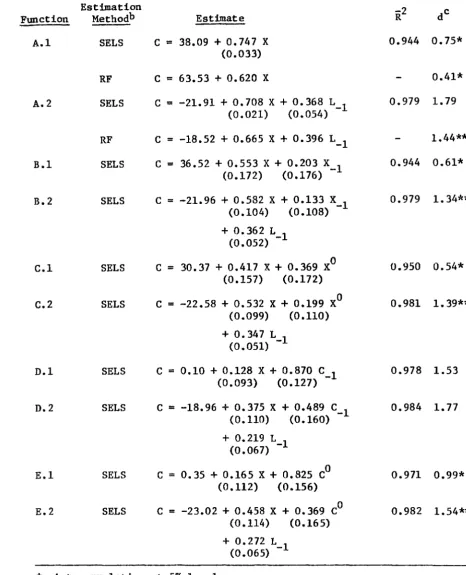
1). Each formulation was estimated by SELS and by the method of Reduced Forms. In the case of hypotheses B to E the reduced form estimate yielded a negative mpc and the results were not presented by Zellner. The results obtained are shown in table 2.2 (p.38). The data used was for 1947 (I) to 1955 (I), excluding 1950 (III) and 1951 (I).
These results were subjected to a much more careful examination than for any previous work. Each estimate was first considered in the light of the following three criteria: (i) the consistency of the signs of the parameter estimates with prior expectations, (ii) the statistical significance of the parameter estimates, (iii) the possible auto correlation of disturbances. If the estimate passed all three of these tests it was included in a group of acceptable hypotheses. These were then ranked according to their predictive ability, both within and without the sample period, and to the value of
R.
2. In judging their predictive ability Zellner employed three "naive" or "guess work" models. After subjection to this array of tests functions A.2(SELS estimate) and D.2 were chosen, i.e.
38. TABLE 2.2a Estimation
Function Methodb Estimate
A.l SELS C
=
38.09+
0.747 XA. 2 B.l B.2 C.1 C.2 D.l D. 2 E.1 E. 2 (0.033) RF C
=
63.53+
0.620 XSELS C
=
-21.91+
0.708 X + 0.368 L_1 (0.021) (0.054) RF C = -18.52+
0.665 X+
0.396 L_1 SELS SELS SELS SELS SELS SELS SELS SELSc
=
36.52+
o.553x
+
0.203x_
1(0.172) (0.176)
c
= -21.96 + o.582x
+ o.133x_
1(0.104) (0.108)
+
O. 362 L_ 1 (0.052)C
=
30.37+
0.417 X+
0.369 XO (0.157) (0.172) C=
-22.58+
0.532 X+
0.199 XO(0.099) (0.110)
+
O. 347 L_ 1 (0.051)c
= 0.10+
0.128x
+
o.870c_
1(0.093) (0.127)
c
=
-18.96+
o.375x
+ o.489c_
1(0.110) (0.160)
+
0.219 L_ 1 (0.067)c
= 0.35+
0.165x
+
0.825c
0(0.112) (0.156)
c
=
-23.02+
0.458x
+
0.369c
0(0.114) (0.165)
+
0.272 L_ 1(0.065)
*
Autocorrelation at 5% level. ** Test inconclusive at 5% level.-2
R de
0.944 0.75*
0.41* 0.979 1. 79
1.44** 0.944 0.61*
0.979 1. 34**
0.950 0.54*
0. 981 1. 39**
0.978 1.53
0.984 1.77
0.971 0.99*
0.982 1.54**
a Derived from table II p. 560 of A. Zellner "The Short-Run Consumption Function".
[image:43.557.60.527.74.649.2]39.
D.2: C
=
-18.96 + 0.375X + 0.489C_ 1 + (0.110) (0.160)0.219L_1 (0.067) Thus the quarterly work of Zellner, like that of Brown, does not confirm the DM hypothesis directly but favours a function employing the variables disposable income and liquid assets or disposable income, lagged consumption and liquid ass.ets.
For later purposes it will be useful to include here a 1
mention of some work by Z. Griliches et al. In this work Griliches produced several new estimates of functions D.1 and D.2 using revised data. For the same sample period as Zellner, the new estimate of D.2 was:
-24.7 + 0.576Xt + (O .113)
0.228Ct-l + (O .150)
0.319L l t -( O. 070)
2
(R
=
0.983, d=
1.68) Estimates were also calculated for 1952-1960 and 1947-1960. The estimate for 1947-1960 was:et
=
-13.1+
0.539Xt+
(0.077)
0.265Ct-l
+
(0 .102)0.258L l t -(0. 044)
(R2
=
0.997, d=
1.45) These estimates would appear to confirm Zellner's conclusions aboutthe worth of liquid assets and lagged consumption as explanatory variables.
Estimates of D.l were also calculated. The estimate for
1. Z. Griliches et. al. , "Notes on estimated aggregate quarterly
1947-1960 was
c
=
3.1
+
t
40.
0.300Xt
+
(0.085)
0.670e l t -( 0. 097)
2
(R
=
0.994, d=
1.09) Zellner's estimate of D.l was regarded by him as unacceptable since the estimated coefficient of Xt was not statistically different from zero. This is not the case for this new estimate, however, and this formulation is worthy of further testing.A further test of the DM hypothesis was made by Duesenberry and others when constructing a quarterly econometric model of the
1
United States economy. The actual hypothesis tested was a variation of Duesenberry's original hypothesis2, namely:
et
-X-- =a t-1
x
+
b t-1+
XOt-1
e
t-1c
-x
t-2
(2.10)
Duesenberry et. al. chose this form after experimentation. However, Griliches et. al. suggest the following derivation3
et R =
-t xt-1 xt-1 Zt XO
t-1 a + i3Z
t
Y (R•'< - R t t-1 )
(2.11)
(2.12)
(2.13)
(2.14)
1. J.S. Duesenberry, 0. Eckstein, and G. Fromm, "A Simulation of the United States economy in recession", Econometrica, Vol. 28 (1960), pp. 749-809 esp. pp. 800-807.
2. See(2.9) p. 33 above.
41.
Rt is the consumption-income ratio; Zt is the ratio of income in period (t-1) to peak income prior to period (t-1); R>~ is the
t
desired value of Rt; a, S and y are constants. The following restrictions are imposed upon the parameters of the model: a>O, S<O, and O<y<l. Equation (2.13) states that the desired consumption-income ratio is equal to a constant plus an adj us tmen,t term szt. I f
x
income is growing steadily at 100>.% then z = - - = t-1 1
+
>.1 and tx
t-2
R1c = a
+
B (1+
A.),t a constant. But, if there is a decline in income zt will fall
cx
0t-1 will stay fixed, while Xt-l will fall), leading to a rise in R~ (given that S<O). The further Zt falls, the higher Rt rises. As the economy enters into the recovery stage, and income begins to rise, zt will increase ann the desired consumption ratio will fall. This process is identical with that described above2 -when the DM hypothesis was first discussed except that now we
are talking of the desired consumption ratio.- Equation (2.14) links the actual and desired consumption ratios. This equation implies that the actual value of the ratio changes by some fraction of the
discrepancy between the desired value of the consumption ratio and the actual value previously attained.3 Substituting (2.13) into
1. The rate of growth is here defined as A.
x
t-1- x
t-2x
t-22. See pp. 30-31.
3. Note the correspondence between equations (2.13) and (2.14) and the partial adjustment or rigidity model for generating distributed lags. See M. Nerlove, Distributed Lags and Demand Analysis for Agricultural and Other Commodities, (Washington: U.S. Dept. of Agriculture, 1958), pp. 14-20 or K.F. Wallis, "Some recent developments in applied
(2 .14)
i.e.
i.e.
42.
gives:
R l + y(a + BZ ) - yR l
t- t t
-et
-X-- = ay
+
t-1et
-X-- =a
t-1
+
x
t-1 et-1()y---
+
(1 y )-x0 xt-2
t-1
x
t-1e
t-1b - - + c
-xo
x
-2t-1 t
(2 .10)
where a =
ay,
b=
Sy,
c= (1-y)
and parameter restrictions imply that a>O, b<O and O<c<l.The commonsense of the parameter restrictions can now be easily demonstrated. Suppose the economy enters a slump. As X falls consumers could be expected to aim at consuming an increasing proportion of their falling income (so as to protect previously
attained consumption standards) i.e., we would expect to see R~ rising. Since Zt is falling during this time, R* will only rise if B<O. Hence the restriction on
s.
To see the need for the restriction on a,suppose income were constant over a period of time. Zt would then be unity and R£, the desired consumption ratio, would equal (a+ S).
Since R* must be positive, the restriction on S implies that a>O. t
To derive the restriction on y1first write (2.14) as:
R
=
yR*+
(1- y)R l (2.15)t t t
-Lagging (2.15) one period gives:
43.
Sub~tituting (2.16) into (2.15) yields: 2
Rt
=
yR~+
(1-y)yR~-l+
(1-y) Rt_ 2Repeated lagging and substitution gives: 2
[R~
+
(1-y) R~-l+
(1-y) R£_ 2+ ... ]
(2.17) That is, Rt is a weighted average of current and past values of the desired consumption ratio. So that the most recent values of R* have the greatest effect in determining Rt the weights should decline, i.e. we must have O<l - y<l, i.e. O<y<l. The 'old'Duesenberry function (2.9) is a special case of (2.10) when y
=
1, i.e. when Rt=
R£·The model formulated by Duesenberry et. al. was a
recursive model for which consistent parameter estimates could b~
1
obtained by the use of SELS. The model was fitted to per capita
D A
data for 1930-'38, 1948-'57. The variables
x?---
andx?--- ,
wheret-1 t-1
Dt = per capita consumer debt and At = per capita liquid assets·,
were also tried. These,however1 did not have significant coefficients. The final result for the period 1948-1957 was:
x
c
= o.8218 - o.6250
~-l
+
o.7843 xt-l (0.0819)xt-1 (0.0526) t-21. See footnote 2, p. 20 above.
R2 0.866 SE 0.0069 VN = 1.84.