ISSN 0252-8266
1
eurostat
EUROSTATISTIK
Daten zur Konjunkturanalyse
EUROSTATISTICS
Data for short-term economic analysis
EUROSTATISTIQUES
Données pour l'analyse de la conjoncture
Monatlich D Monthly D Mensuel
1-2
D
1995
i
Theme / Thème
General statistics / Statistiques générales
eurostat
OFICINA ESTADÍSTICA DE LAS COMUNIDADES EUROPEAS
DE EUROPÆISKE FÆLLESSKABERS STATISTISKE KONTOR
STATISTISCHES AMT DER EUROPÄISCHEN GEMEINSCHAFTEN
ΣΤΑΤΙΣΤΙΚΗ ΥΠΗΡΕΣΙΑ ΤΩΝ
ΕΥΡΩΠΑΪΚΩΝ ΚΟΙΝΟΤΗΤΩΝ
STATISTICAL OFFICE OF THE EUROPEAN COMMUNITIES
OFFICE STATISTIQUE DES
COMMUNAUTÉS EUROPÉENNES
ISTITUTO STATISTICO DELLE COMUNITÀ EUROPEE
BUREAU VOOR DE STATISTIEK DER EUROPESE GEMEENSCHAPPEN
SERVIÇO DE ESTATÍSTICA DAS COMUNIDADES EUROPEIAS
L2920 Luxembourg Tél. 43 011 Télex COMEUR LU 3423
B1049 Bruxelles, rue de la Loi 200 Tél. 299 11 11
Las publicaciones de Eurostat están clasificadas por temas y por series. La clasificación se encuentra al final de
la obra. Para mayor información sobre las publicaciones, rogamos se pongan en contacto con Eurostat.
Para los pedidos, diríjanse a las oficinas de venta cuyas direcciones figuran en la página interior de la
contracubierta.
Eurostats publikationer er klassificeret efter emne og serie. En oversigt herover findes bag i hæftet. Yderligere
oplysninger om publikationerne kan fås ved henvendelse til Eurostat.
Bestilling kan afgives til de salgssteder, der er anført på omslagets side 3.
Die Veröffentlichungen von Eurostat sind nach Themenkreisen und Reihen gegliedert. Die Gliederung ist hinten in
jedem Band aufgeführt. Genauere Auskünfte über die Veröffentlichungen erteilt Eurostat.
Ihre Bestellungen richten Sie bitte an die Verkaufsbüros, deren Anschriften jeweils auf der dritten Umschlagseite
der Veröffentlichungen zu finden sind.
Οι
εκδόσεις της Eurostat ταξινομούνται κατά θέμα και κατά σειρά. Η ακριβής ταξινόμηση αναφέρεται στο
τέλος κάθε έκδοσης. Για λεπτομερέστερες πληροφορίες σχετικά με τις εκδόσεις, μπορείτε να
απευθύ-νεσθε στην Eurostat.
Για τις παραγγελίες μπορείτε να απευθύνεσθε στα γραφεία πώλησης, των οποίων οι διευθύνσεις
αναγράφονται στη σελίδα 3 του εξωφύλλου.
Eurostat's publications are classified according to themes and series. This classification is indicated at the end of
the publication. For more detailed information on publications, contact Eurostat.
Orders are obtainable from the sales offices mentioned on the inside back cover.
Les publications d'Eurostat sont
classées par thème et par série. Cette classification est précisée à la fin
de l'ouvrage. Pour des informations plus détaillées sur les publications, contactez Eurostat.
Pour les commandes, adressez-vous aux bureaux de vente dont les adresses sont indiquées à la page 3
de la couverture.
Le pubblicazioni dell'Eurostat sono classificate per tema e per serie. Tale classificazione è precisata alla fine
dell'opera. Per informazioni più dettagliate sulle pubblicazioni rivolgersi all'Eurostat.
Per eventuali ordinazioni rivolgersi a uno degli uffici di vendita i cui indirizzi figurano nella 3
apagina della
copertina.
De publikaties van Eurostat zijn ingedeeld naar onderwerp en serie. Deze indeling is achter in het boek
opgenomen. Voor nadere informatie over de publikaties kunt u zich wenden tot Eurostat.
Gelieve bestellingen op te geven bij de verkoopbureaus, waarvan de adressen op bladzijde 3 van de omslag zijn
vermeld.
As publicações do Eurostat estão classificadas por tema e por série. Esta classificação está indicada no firn da
obra. Para mais informações sobre as publicações é favor contactar Eurostat.
EUROSTATISTIK
Daten zur Konjunkturanalyse
EUROSTATISTICS
Data for short-term economic analysis
EUROSTATISTIQUES
Données pour l'analyse de la conjoncture
Luxembourg: Office des publications officielles des Communautés européennes, 1995
© EGKS-EG-EAG, Brüssel · Luxemburg, 1995
Nachdruck — ausgenommen zu kommerziellen Zwecken — mit Quellenangabe gestattet.
© ECSC-EC-EAEC, Brussels · Luxembourg, 1995
Reproduction is authorized, except for commercial purposes, provided the source is acknowledged.
© CECA-CE-CEEA, Bruxelles · Luxembourg, 1995
Reproduction autorisée, sauf à des fins commerciales, moyennant mention de la source.
Vorwort
Mit der monatlich erscheinenden Veröffentlichung
Eurostatistik - Daten zur
Konjunkturanalyse
werden innerhalb kürzester Frist die neuesten statistischen Daten
über die Europäische Gemeinschaft als Ganzes (EUR 12), über jedes Mitgliedsland
sowie über die Vereinigten Staaten und Japan bekanntgegeben.
Eurostatistik
enthält nicht die Gesamtheit des bei Eurostat verfügbaren statistischen
Materials, sondern eine Auswahl der relevantesten Reihen über die konjunkturelle
Entwicklung.
Schnelligkeit und Pünktlichkeit sind die wichtigsten Vorzüge dieser Veröffentlichung.
Aus diesem Grunde wurde sie im Umfang bewußt klein gehalten und enthält keine
Anmerkungen zur Methodik, die im übrigen in den spezialisierten Veröffentlichungen
von Eurostat zu finden sind.
Die in Eurostatistik veröffentlichten Daten stammen aus der Datenbank New Cronos
(Hinweise zur On-line -Benutzung finden sich am Ende Dieser Veröffentlichung). New
Cronos setzt sich zusammen aus dem alten Cronos sowie REGIO und ist nicht mehr
in Form von Zeitreihen, sondern in Form von multidimensionalen Tabellen dargestellt.
New Cronos ist somit eines der Produkte zur Verbreitung statistischer Daten, das
direkt aus der Eurostat - Referenzdatenbank gespeist wird. Darüber hinaus sind die
Daten in der Datenbank Eurocron verfügbar, die vom Host Eurobases der
Kommission angeboten wird.
Weitere Informationen über Eurostat und seine Produkte können bei folgender Stelle
angefordert werden:
Eurostat - Informationsbüro Data Shop
L-2920 LUXEMBURG 121, rue Joseph II
Telephon: (352) 4301 34567 Büro 3/235
Telefax: (352) 43 64 04 B-1049 Bruxelles
Inhaltsverzeichnis
Zeichen und Abkürzungen
KURZ NOTIERT
5
KONJUNKTURDATEN
1. Volkswirtschaftliche Gesamtrechnungen . .31
2. Beschäftigung
35
3. Arbeitslosigkeit
39
4. Industrielle Produktion
42
5. Meinungsumfrage in der Industrie
52
6. Industrieerzeugnisse
56
7. Einzelhandel
61
8. Landwirtschaftliche Erzeugnisse
63
9. Außenhandel
66
10. Verbraucherpreise
87
11. Landwirtschaftliche Erzeugerpreise . . . .
92
12. Löhne und Gehälter
94
13. Finanzstatistiken
95
14. Zahlungsbilanz
102
Anmerkung betreffend Grafiken und Tabellen:
Π Die Daten beziehen sich auf das Gebiet der
Bundesrepublik Deutschland vordem 3.10.1990
einschließlich WestBerlin.
0
%
T/T1 %
T/T4%
T/T12%
BALANCEN
1990=100
1000
MIO
MRD
Τ
TJ(GCV)
GWH
USD
ECU
SZR
ESVG
NACE
SITC
EUR
UEBL
ACP
Weniger als die Hälfte der verwendeten
Einheit
Prozent
Prozentualer Zuwachs eines
Vierteljahres gegenüber dem vorher
gehenden Vergleichszeitraum
(Monat.Vierteljahr.Jahr)
Prozentualer Zuwachs eines
Vierteljahres gegenüber dem
entsprechenden Vierteljahr des
Vorjahres
Prozentualer Zuwachs eines Monats
gegenüber dem entsprechenden Monat
des Vorjahres
> Saldo zwischen den positiven
Antworten (Zunahme.Verbesserung der
Situation)und den negativen Antworten
(Abnahme,Verschlechterung der
Situation)der Konjunkturumfrage bei
den Unternehmern in der Gemeinschaft
Basisjahr
in 1000
Million
Milliarde
Metrische Tonne
Terajoule = 109KJ
Gigawattstunde = 106kWh
USDollar
Europäische Währungseinheit
Sonderziehungsrechte
Europäisches System
Volkwirtschaftlicher Gesamtrechnungen
Allgemeine Systematik der
Wirtschaftszweige in den Europäischen
Gemeinschaften
Standard International Trade
Classification
Mitgliedstaaten insgesamt
BelgischLuxemburgische
Wirtschaftsunion
EUROSTATISTIK: kurz notiert
E
Soweit nicht anders angegeben, beziehen sich die Angaben auf den Gebietsstand der Bundesrepublik Deutschland vor dem 3.10.1990; sie schließen
Berlin (West) ein.
Wechselkurse:
Weiterer
Zinsanstieg im Vereinigten Königreich
Am 7. Dezember kam es zu einem weiteren Zinsanstieg im Vereinigten
Königreich, als die Bank of England einen Anstieg der Basisausleihesätze
um 0,5 Prozentpunkte auf 6,25 % bekanntgab. Obwohl die Inflation im
Vereinigten Königreich ihren tiefsten Stand seit 27 Jahren erreicht hat,
wurde dieser Schritt als Präventivmaßnahme gegen die Inflation unter
nommen, da die britische Wirtschaft derzeit relativ hohe Wachstumsraten
zu verzeichnen hat. Dies war der zweite Zinsanstieg im Vereinigten
Königreich in den letzten drei Monaten. Das Pfund Sterling, das am 20.
Dezember bei 2,4527 DM stand, reagierte kaum auf die Bekanntgabe.
Zwei Tage später kam es auch in Finnland zu einem Zinsanstieg, dem
ersten seit zwei Jahren. Auch in diesem Fall sollte diese Maßnahme dazu
dienen, die Inflationserwartungen und den Kostendruck zu dämpfen.
Angesichts der ungewissen politischen Lage fiel die italienische Lira im
Dezember auf einen historischen Tiefststand und wurde am 20. Dezember
m i t i 050 LIT für 1 DM gehandelt. Damit hat sie seit Mitte April 1994 über
10 % ihres Wertes eingebüßt. Am 21. Dezember erholte sie sich jedoch
leicht und schloß in London mit 1 045 LIT ab.
Mitte Dezember war der holländische Gulden die stärkste Währung
innerhalb des Wechselkursmechanismus, gefolgt vom belgischen Fran
ken, dem irischen Pfund, der DMark, dem französischen Franken, der
dänischen Krone, dem Escudo und der Peseta. Im Dezember gab der
französische Franken leicht nach und fiel unter die Marke von 3,45 FF für
1 DM, womit er seinen tiefsten Stand seit Dezember 1993 erreichte.
Der Dollar konnte nach der Mitte November erfolgten Anhebung der
USLeitzinsen einen leichten Wertzuwachs verbuchen. Vom 15. November
bis zum 20. Dezember stieg sein Wert gegenüber dem Yen um 2,1 % und
gegenüber der DMark um 1,7%; Anfang Dezember lag er zum ersten
Mal seit Anfang Oktober wieder über 100 Yen.
Renditen von Staatsanleihen: Weiter leicht nachgebende Anleiherendi
ten
Im November gaben die Renditen von Staatsanleihen in mehreren
Ländern weiterhin leicht nach. In Dänemark fielen die Renditen von 8,9
auf 8,6%; in Spanien, Belgien, Deutschland, Luxemburg und dem
Vereinigten Königreich gingen sie um rund 10 Basispunkte (0,1 %)
zurück. Trotz dieses Rückgangs sind die Renditen allerdings erheblich
höher als vor 12 Monaten.
Demgegenüber war in Italien ein Anstieg der Renditen auf ihren höchsten
Stand seit Mai 1993 zu verzeichnen.
Geldvolumen: Banque de France legt
Geldmengenziele für
1995 fest
Am 16. Dezember gab die Banque de France ihre Geldmengenziele für
1995 bekannt. Für das M3Wachstum wurde mittelfristig eine Obergrenze
von 5 % jährlich festgelegt, was mit dem inflationsfreien Wirtschafts
wachstum von 2,5 %—3 % vereinbar sein sollte. In den 12 Monaten bis
September 1994 war das M3Wachstum in Frankreich weiterhin negativ;
dies wurde allerdings auf außergewöhnliche Umstände und eine Neufest
legung der Definition von M3 zurückgeführt, wodurch die negative
Wachstumsrate höher ausfiel, als dies ansonsten der Fall gewesen
wäre.
Das Wachstum der deutschen Geldmenge M3 verlangsamte sich in den
12 Monaten bis September 1994 erneut: Nach einer auf das Jahr
umgerechneten Wachstumsrate von mehr als 11 % in den ersten
Monaten des Jahres beläuft sich das Wachstum nur noch auf 7,5 %.
Ferner deuten vorläufige Daten auf eine Wachstumsrate von etwa 7 % in
den 12 Monaten bis Oktober hin, was dem von der Bundesbank für 1994
anvisierten Zielkorridor von 4—6 % näherkommt.
Amtliche Währungsreserven: Devisenabfluß aus Italien
Italien verzeichnete im Oktober einen Abfluß von Währungsreserven in
Höhe von rund 3,5 Mrd. ECU; dies entspricht fast 14 % seiner gesamten
Währungsreserven (ohne Gold). Der Rückgang der Währungsreserven
ging mit einer Schwäche der italienischen Lira einher.
Von dem Devisenabfluß aus Italien abgesehen kam es Im Oktober nur zu
wenigen wesentlichen Änderungen beim Stand der amtlichen Währungs
reserven; allerdings wuchsen die griechischen Währungsreserven weiter
hin an und lagen Ende Oktober um über 40 % über ihrem Stand von Ende
1993.
PREISE: EUTeuerungsrate — im November
bei
3%
Die Jahresinflation in der EU, gemessen am Index der Verbraucherpreise,
betrug im November 3 %. Sie blieb damit im dritten aufeinanderfolgenden
Monat unverändert.
Das aktuelle Niveau ist der niedrigste Wert seit siebeneinhalb Jahren. Im
Juli und August lag die Inflationsrate bei 3,1 %, nachdem sie von März bis
Juni auf dem Stand von 3,2 % verharrt war.
Der gegenwärtige Wert wurde zum letzten Mal im März 1987 verzeichnet.
Im Oktober 1990, während der Golfkrise, erreichte die Inflationsrate den
Höchststand von 6,3 %. Im November des Vorjahres betrug sie 3,2 %,
und stieg im Dezember/Januar noch einmal auf 3,4 % an, bevor sie auf
das jetzige Niveau fiel.
Nach den heute von EUROSTAT, dem Statistischen Amt der EG in
Luxemburg, veröffentlichten Zahlen fiel in FRANKREICH die Teuerung
wiederum am geringsten aus, sie lag bei vorläufig 1,6%. Über ¡dem
EUDurchschnitt liegen lediglich ITALIEN, PORTUGAL, SPANIEN, und
GRIECHENLAND.
Für die neuesten Inflationsraten der Mitgliedstaaten — mit entsprechen
den Vorjahreszahlen — ergibt sich folgende ansteigende Reihenfolge:
Nov.
94
Nov.
93
Nov. 93 Nov. 92
FRANKREICH 1,6% ρ
2,2%
BELGIEN
2,0 %
2,5 %
LUXEMBURG 2,0%
3,5%
DÄNEMARK
2 , 1 %
1,5%
IRLAND
2,4%
1,4%
NIEDERLANDE 2,5 %
2,8 %
Nov.
94
Nov.
93
Nov. 93 Nov. 92
VER. KÖNIGREICH 2,6%
1,4%
DEUTSCHLAND* 2,7%
3,6%
ITALIEN
4,0 % ρ
4,3 %
PORTUGAL
4,0 %
6,5 %
SPANIEN
4,4 %
4,8 %
GRIECHENLAND 10,6%
12,3%
EU
3,0 % ρ
* Der Verbraucherpreisindex tür die Bundesrepublik Deutschland bezieht sich
weiterhin auf den Gebietsstand vor dem 3.10.90
ρ Vorläufig
Die zukünftigen neuen Mitgliedstaaten hatten folgende Raten: FINNLAND
1,6% (1,4%), SCHWEDEN 2,2% (4,8%) und ÖSTERREICH (Oktober)
2,9 % (3,5 %).
Die Inflationsrate in einigen anderen Staaten: VEREINIGTE STAATEN
2,7%
(2,7%), JAPAN 0,8% (1,0%), KANADA (Oktober) 0 , 2 %
(1,9 %), SCHWEIZ 0,5 % (2,3 %) und NORWEGEN 1,8 % (1,9 %).
Arbeitslosigkeit in der Europäischen Union: im November bei 10,7
%
EUROSTAT, das Statistische Amt der EG in Luxemburg, schätzt die
saisonbereinigte Arbeitslosenquote der EU im November auf 10,7 %, wie
schon im Vormonat Oktober. Im November 1993 hatte die Rate 10,8 %
betragen.
EUROSTAT beziffert die Zahl der Arbeitslosen in der EU im November auf
etwa 17 Millionen. Dabei handelt es sich um eine saisonbereinigte Zahl,
die sich an den Kriterien der Internationalen Arbeitsorganisation (ILO)
orientiert.
Seit November 1993...
— wurden die deutlichsten Rückgänge im VEREINIGTEN KÖNIGREICH
(von 10,2 % auf 8,8 %), in DÄNEMARK (von 10,7 % auf 9,5 %, Zahlen
vom Oktober), in IRLAND (von 18,3 % auf 17,5 %) und in SPANIEN (von
22,7 % auf 22,1 %) verzeichnet.
— gab es den größten Anstieg in ITALIEN (von 11,2 % auf 12,0 %), in
den NIEDERLANDEN (von 9,5% auf 10,1 %, Zahlen vom Oktober), in
PORTUGAL (von 5,6 % auf 6,2 %) und in LUXEMBURG (von 2,9 % auf
3,5 %), das aber trotzdem die bei weitem niedrigste Arbeitslosigkeit
innerhalb der „Zwölf" hat.
— ist die Quote bei den Männern gesunken (von 9,6 % auf 9,2 %), bei
den Frauen aber geringfügig gestiegen (von 12,7 % auf 12,8 %).
— hat die Arbeitslosigkeit bei den unter 25jährigen abgenommen (von
20.4 % auf 19,5 %). Am ausgeprägtesten war dies in SPANIEN (von
38,4% auf 36,3%), dem VEREINIGTEN KÖNIGREICH (von 15,6% auf
13.5 %), in DÄNEMARK (von 11,4 % auf 10 %, Zahlen vom Oktober) und
in BELGIEN (von 20,3 % auf 19,4 %).
Anmerkungen
1. Die Pressemitteilung ist eine Zusammenfassung des in Kürze erschei
nenden EUROSTAT Monatsbulletins Nr. 1/1995 (Themenkreis 3 Reí
Β)·
1
2. Die Arbeitslosenquote und die Zahl der Arbeitslosen werden nach den
Empfehlungen der ILO geschätzt, wobei die unterschiedlichen nationalen
Methoden zur Erfassung der Arbeitslosigkeit weitgehend ausgeschaltet
werden.
3. Die Arbeitslosenquote wird geschätzt durch Extrapolation der 1991er
Ergebnisse der EU-Arbeitskräfteerhebung in allen Mitgliedstaaten. Die
Einbeziehung der 1992er Ergebnisse kann, sobald verfügbar, zu
Revisio-nen der Schätzungen führen.
EU: Aufschwung in der Industrieproduktion hält an
Im September stieg die Industrieproduktion in der EU erneut an —
nunmehr schon im achten aufeinanderfolgenden Monat. Der Anstieg wird
hauptsächlich aus der Zunahme der Produktion bei Vorleistungs- und
Investitionsgütern genährt.
Nach den Daten, die heute von EUROSTAT, dem Statistischen Amt der EG
in Luxemburg, veröffentlicht wurden, ist der Produktionsindex
(arbeitstäg-lich bereinigt) im September gegenüber dem gleichen Monat des
Vorjah-res um 5,8 % gestiegen.
Die saisonbereinigte Produktion war im Zeitraum Juli bis September um
1,7 % höher als im vorhergehenden Quartal. In JAPAN lag der
entspre-chende Wert bei geschätzt +0,9%, in den Vereinigten Staaten bei
1,5%.
Für die Hauptsektoren sind im dritten Quartal folgende Veränderungen
gegenüber dem zweiten Vierteljahr ausgewiesen:
— Vorleistungsgüter + 2,3 %
— Investitionsgüter + 1,7 %
— dauerhafte Konsumgüter + 1,4 %
— nicht-dauerhafte Konsumgüter + 1,4 %
In den elf Mitgliedsländern und den EFTA-Staaten, für die Zahlen
vorliegen, ergeben sich für den Dreimonatszeitraum folgende
saisonberei-nigte Veränderungsraten der Industrieproduktion (* = geschätzt):
ITALIEN 4,4% DEUTSCHLAND 1,5%
IRLAND* 3,4% VER. KÖNIGREICH 1,0%
LUXEMBURG* 3,2% PORTUGAL* 1,0%
SPANIEN 2,6% NIEDERLANDE 0,8%
GRIECHENLAND 2,1 % DÄNEMARK 0,6 %
FRANKREICH 1,6%
FINNLAND 4 , 1 % SCHWEDEN 0,7%
ÖSTERREICH * 0,9 %
AUSSENHANDEL
Das Außenhandelsbilanzdefizit der Europäischen Union lag in den ersten
fünf Monaten 1994 um 4,6 Mrd. ECU niedriger als im gleichen Zeitraum
1993.
Dieses Ergebnis ist darauf zurückzuführen, daß die Extra-EU-Ausfuhren
zwischen den beiden Zeiträumen stark gestiegen sind, nämlich um
+14,1 %, während in der gleichen Zeit die Einfuhren um nur 11,1 %
zunahmen.
Italien meldete von allen EU-Ländern in den ersten fünf Monaten 1994 die
bemerkenswerteste Verbesserung der Handelsbilanz. Sein
Extra-EU-Handelsbilanzüberschuß schnellte von 1,4 Mrd. ECU im gleichen Zeitraum
1993 auf 4,3 Mrd. ECU hoch. Dieses Ergebnis ist hauptsächlich auf die
schnelle Zunahme der italienischen Ausfuhren (+15,4 % gegenüber dem
Vorjahr) bei einer Steigerung der Einfuhren um nur 4,4 %
zurückzufüh-ren.
Im Mai 1994 verzeichnete Deutschland einen beachtlichen
Handelsbilanz-überschuß (3,1 Mrd. ECU), wodurch sein extra-EU-Ergebnis für die ersten
fünf Monate 1994 auf 8,5 Mrd. ECU (den höchsten Überschuß unter den
EU-Ländern) anstieg. Die Einfuhren und Ausfuhren nahmen gegenüber
dem entsprechenden Zeitraum des Vorjahres um 9,4 % bzw. 12,3 %
zu.
Der Extra-EU-Handelsbilanzüberschuß Frankreichs verbesserte sich in
dem obengenannten Zeitraum gegenüber demselben Zeitraum des
Vor-jahres leicht (von 2,1 Mrd. ECU 1993 auf 2,6 Mrd. ECU 1994). Die
Veränderungsraten der Einfuhren und der Ausfuhren lagen weit unter dem
EU-Durchschnitt (6,6 % bzw. 7,9 %).
Irland und Dänemark verzeichneten jeweils leichte
Handelsbilanzüber-schüsse (0,3 Mrd. ECU bzw. 0,8 Mrd. ECU), womit gegenüber 1993
geringfügige Veränderungen eintraten. Während des Zeitraums Januar bis
Mai 1994 gab es bei den irischen Ausfuhren verglichen mit dem gleichen
Zeitraum des Vorjahres eine beachtliche Wachstumsrate (22,4 %),
wäh-rend sie in Dänemark niedriger ausfiel (12,2%). Auf der Einfuhrseite
betrugen die Wachstumsraten 21,9 % bzw. 14,4 %.
Das Vereinigte Königreich war das EU-Land mit dem höchsten
Handels-bilanzdefizit in der Zeit von Januar bis Mai 1994, nämlich 9,7 Mrd. ECU.
Gegenüber 1993 verschlechterte sich die Position des VK damit leicht
(um 0,2 Mrd. ECU), wenngleich sich der Abstand zwischen der
Wachs-tumsrate der Ausfuhren und der der Einfuhren in positiver Richtung
entwickelte (+3,8 Punkte).
Im gleichen Zeitraum stieg das Defizit der Niederlande auf 8,1 Mrd. ECU
verglichen mit 5,9 Mrd. ECU 1993. In den Niederlanden lagen die
Veränderungsraten von Einfuhren und Ausfuhren in den ersten fünf
Monaten 1994 bei 23,9 % bzw. 17,1 %.
Von Januar-Mai 1993 bis Januar-Mai 1994 verbesserten Spanien und die
BLWU ihre Handelsbilanzdefizite um beinahe denselben Betrag (0,4 Mrd.
ECU bzw. 0,6 Mrd. ECU).
Beide Länder wiesen für ihre Extra-EU-Ausfuhren eine hohe
Wachstums-rate aus (12,1 % bzw. 30,8 %), die weit über den VeränderungsWachstums-raten der
Einfuhren (5,6 % bzw. 23,5 %) lag.
In Portugal und Griechenland lag das Außenhandelsdefizit für die ersten
fünf Monate 1994 jeweils bei insgesamt 1,3 Mrd. ECU. Für Portugal
bedeutet dieses Ergebnis eine Talfahrt um 0,1 Mrd. ECU gegenüber dem
Vorjahr, während sich das griechische Defizit gegenüber dem Vorjahr um
0,3 Mrd. ECU verringerte. In der Zeit von Januar bis Mai 1994 stiegen die
Extra-EU-Einfuhren Portugals schneller (8,8 % Wachstumsrate) als die
Ausfuhren (5,6 %). Im gleichen Zeitraum gingen die griechischen
Einfuh-ren um 2,4 % zurück, wähEinfuh-rend die Extra-EU-AusfuhEinfuh-ren dieses Landes
eine Zunahme von 19,7 % auswiesen.
1994: Weit geringerer Rückgang der Agrarpreise als in früheren
Jahren
Der starke Rückgang der Agrarpreise früherer Jahre in der EU hat sich im
letzten Jahr stark abgeschwächt. Gleichzeitig war bei den Terms of Trade
der Landwirtschaft eine leichte Verbesserung festzustellen.
Nach einer Vorausschätzung von EUROSTAT sind die realen
Erzeugerprei-se landwirtschaftlicher Produkte (Output) im Jahr 1994 um 1,3%
gegenüber 1993 gesunken.
Dieser Index fällt nunmehr seit 1989. Der Rückgang des Jahres '94 ¡st
seitdem aber bei weitem der niedrigste. Insgesamt ¡st der Index seit Mitte
der Achtziger um 26,1% zurückgegangen.
In PORTUGAL (+4,9%), GRIECHENLAND (+4%), BELGIEN (+2%) und
den NIEDERLANDEN (+1,2%) hat sich der Trend der letzten Jahre
gewendet, und die realen Erzeugerpreise sind gestiegen. In SPANIEN
verzeichnete man 1994 ebenfalls einen Anstieg (um 5,6%) wie schon im
Jahr zuvor (um 1,3%). In anderen Ländern wurden Rückgänge
beobach-tet, besonders ausgeprägt in ITALIEN (-4,7%) und LUXEMBURG
(-4,8%).
Die realen Erzeugerpreise für pflanzliche Produkte sind leicht angestiegen
(+1,4%). Bei Getreide und Reis wird 1994 mit einem Rückgang um
12,3% gerechnet. Im Jahr zuvor waren die Erzeugerpreise für diese
Produkte um 4,2% gefallen. Diese Entwicklung dürfte eine Folge der
Reform der Gemeinsame Agrarpolitik sein.
Die realen Erzeugerpreise für Tiere und tierische Produkte sanken um
3,7%. Der überaus starke Rückgang der Preise für Schweine im Jahr
1993 (-24%) hat sich 1994 abgemildert und betrug nur noch 2,2%.
Der reale Index der Einkaufspreise landwirtschaftlicher Betriebsmittel
(Input) ist um 2,1% zurückgegangen. Die Entwicklung der letzten Jahre
hat damit weiter angehalten. Am stärksten war der Rückgang in
Däne-mark (-4,4%) und in Portugal (-4,9%).
Insgesamt ergab sich somit 1994 in der EU eine leichte Verbesserung der
realen Terms of Trade um 0,7% gegenüber 1993. Besonders ausgeprägt
war diese Verbesserung in Portugal (+10,2%) und Spanien (+8%). In
Luxemburg (-2,5%), ITALIEN (-3,5%) und FRANKREICH (-4,1%) haben
sich dagegen die Terms of Trade verschlechtert.
Anmerkung:
Foreword
Π
Eurostatistics - data for short-term economic analysis
is a monthly publication aimed
at providing, as rapidly as possible, the latest statistical data on the European
Community as a whole (EUR 12), each Member State, the United States and Japan.
Eurostatistics
does not present all the statistics held by Eurostat, but a selection of the
most relevant series on the economic situation.
Speed of publication and punctuality are the main features of this publication; that is
why it is deliberately streamlined and does not contain any methodological notes,
which are given in Eurostat's specialized publications.
The data published in Eurostatistics are taken from Eurostat's on-line database, New
Cronos (instructions regarding on-line consultation may be found at the end of this
publication). New Cronos includes old Cronos and Regio, both represented not by
chronological series but through multi-dimensional tables. New Cronos is a
dissemination product directly from Eurostat's Reference Environment. The data are
also available via the Commission host Eurobases in the Eurocron database.
Further information on Eurostat and its products can be obtained from the following
addresses:
Eurostat - Information Office Data Shop
L-2920 Luxembourg 121, Rue Joseph II
Tel.: (352) 4301 -34567 Office 3/235
Fax: (352) 43 64 04 B-1049 Bruxelles
V
Tel.: (02) 299 66 66
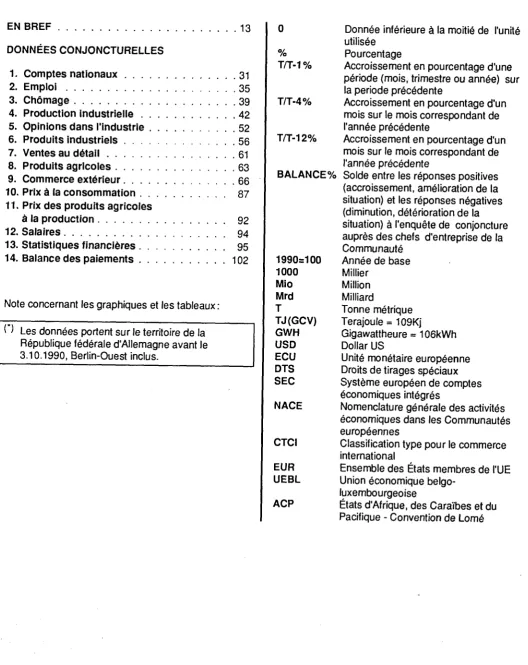
Contents
Symbols and abbreviations
IN BRIEF
9
SHORT-TERM TRENDS
1. National accounts
31
2. Employment
35
3. Umeployment
39
4. Industrial production
42
5. Opinions in industry
52
6. Industrial products
56
7. Retail sales
61
8. Agricultural products
63
9. External trade
66
10. Consumer prices
87
11. Producer prices of agricultural products. . 92
12. Wages and salaries
94
13. Financial statistics
95
14. Balance of payments
102
Note concerning graphs and tables:
Π Data for the Federal Republic of Germany,
including West-Berlin, as constituted prior to
3 October 1990.
0
%
T/T-1
%
T/T-4%
T/T-12%
BALANCE%
1990=100
1000
MIO
MRD
Τ
TJ(GCV)
GWH
USD
ECU
ESA
SDR
NACE
SITC
EUR
UEBL
ACP
Data less than the unit used
Per cent
Percentage increase of one period
(month, quarter, year) on the
corresponding previous period
Percentage increase on the
corresponding quarter of the previous
year
Percentage increase on the
corresponding month of the previous
year
Balance between positive replies
(increase, improvement in the situation)
and negative replies (reduction,
worsening of the situation) in the
short-term-trends enquiry conducted among
heads of enterprises in the Community
Reference year
Thousand
Million
Thousand million
Tonne
Terajoule=109kj
Gigawatt hour (= 106kWh)
US dollar
European currency unit
European system of integrated
economic accounts
Special drawing right
General industrial classification of
economic activities within the European
Communities
Standard international trade
classification
EUROSTATISTICS: in brief
Unless otherwise stated, data for the Federal Republic of Germany, including West Berlin, as constituted prior.to 3 October 1990.
EXCHANGE RATES: further increase in UK interest rates
There was a further increase in UK interest rates on December 7, when
the Bank of England signalled that bank base rates should be increased by
V
2% to 6.25%. This move occurred despite the fact that UK inflation is at
its lowest level for 27 years, but was intended as a pre-emptive strike
against inflation, since the British economy is currently growing at a fairly
fast rate. It was the second Increase in UK interest rates in the last three
months. Sterling was hardly affected by the announcement and stood at
DM 2.4527 on December 20.
Two days later, Finnish interest rates were also increased, in this case for
the first time for two years. Again, the intention of the Finnish authorities
was to dampen inflation expectations and cost pressures.
Amid political uncertainties the Italian lire reached further all-time lows in
December, touching LIT 1050 against the mark on December 20. It has
now depreciated by over 10% since mid-April 1994. However, on
December 21 it appreciated slightly, closing in London at LIT 1045.
In mid-December the Dutch guilder remained at the top of the ERM grid,
followed by the Belgian franc, the punt, the mark the French franc, the
Danish krone, the escudo and the peseta. The French franc weakened
slightly in December, falling below the FF 3.45 level against the mark, its
lowest level since December 1993.
The dollar strengthened slightly following the increase in US official
interest in mid-November. Between November 15 and December 20, it
appreciated by 2.1% against the yen and by 1.7% against the mark; it
rose above Y 100 in early December for the first time since early
October.
GOVERNMENT BOND YIELDS: further slight easing in bond yields
There was a further slight easing in the yield on government bonds in
several countries in November. In Denmark yields fell from 8.9 to 8.6%,
and in Spain, Belgium, Germany, Luxembourg and the UK yields fell by
around 10 basis points (0.1%). Despite these falls, yields are significantly
higher than they were 12 months ago.
However, yields rose in Italy, to stand at their highest level since May
1993.
NEY SUPPLY: Banque de France sets monetary targets for 1995
On December 16 the Banque de France announced its monetary targets
for 1995. It set a growth ceiling for M3 of 5% per year over the medium
term, which was said to be consistent with non-inflationary economic
growth of 2.5-3%. In the 12 months to September 1994, the growth rate
of France's M3 continued to be negative, but this was felt to be due to
extraordinary factors together with a redefinition of the definition of M3
which led to a greater than otherwise negative growth rate.
The growth of Germany's M3 continued to slow in the year to September
1994, growing by 7.5%, down from an annualised growth rate of over
11% in the first few months of the year. Furthermore, provisional data
indicate a growth rate of around 7% in the year to October, closer to the
Bundesbank's 1994 target of 4-6% growth.
FOREIGN OFFICIAL RESERVES: outflow from Italy
Italy experienced an outflow of reserves in October of some 3.5 billion
ecu, which equates to almost 14% of its total foreign official reserves
excluding gold. This fall in reserves coincided with a period of weakness
in the Italian lire.
Aside from the outflow from Italy, there were few substantial changes in
the level of foreign official reserves In October, although Greece's reserves
continued to increase, at the end of October standing at over 40% higher
than at the end of 1993.
PRICES: EU annual inflation — 3% in November
EU annual inflationas measured by the Consumer Price Index (CPI)
-was 3% in November, unchanged for the third consecutive month.
The current level is the lowest for seven-and-a-half years. It was 3.1% in
August and July after remaining at 3.2% from March to June.
The rate was last at this level in March 1987. In between it peaked at 6.3%
in October 1990 during the Gulf crisis. Last November inflation stood at
3.2%. It touched 3.4% in December/January before falling to the present
level.
Today's figures from EUROSTAT-the EC Statistical Office in Luxembourg
-show FRANCE still with the lowest rate, a provisional 1.6%. Only ITALY,
PORTUGAL, SPAIN and GREECE are above the EU average.
Latest rates in Member States, in ascending order of inflation, with
corresponding figures for a year earlier, are:
Nov
94
Nov
93
Nov
94
Nov
93
Nov 93 Nov 92 Nov 93 Nov 92
FRANCE 1.6% ρ 2.2% UNITED KINGDOM 2.6% 1.4%
BELGIUM 2.0% 2.5% GERMANY* 2.7% 3.6%
LUXEMBOURG 2.0% 3.5% ITALY 4.0% ρ 4.3%
DENMARK 2.1% 1.5% PORTUGAL 4.0% 6.5%
IRELAND 2.4% 1.4% SPAIN 4.4% 4.8%
NETHERLANDS 2.5% 2.8% GREECE 10.6% 12.3%
EU 3.0% ρ
* The CPI for Germany continues to reflect the geographical borders prior to
3 October 1990
ρ Provisional
Corresponding rates for forthcoming new Member States are: FINLAND
1.6% (1.4%), SWEDEN 2.2% (4.8%) and AUSTRIA (October) 2.9%
(3.5%).
Annual rates in some other countries were: UNITED STATES 2.7%
(2.7%), JAPAN 0.8% (1.0%), CANADA (October) -0.2% (1.9%), SWIT
ZERLAND 0.5% (2.3%) and NORWAY 1.8% (1.9%).
UNEMPLOYMENT IN THE EUROPEAN UNION: 10.7% in november
Today's figures from EUROSTAT-the EC statistical office in Luxembourg
-estimate EU seasonally-adjusted unemployment in November 1994 at
10.7%, same as October. In November '93 it was 10.8%.
EUROSTAT estimates that around 17 million people were unemployed in
the EU in November-a seasonally-adjusted figure in line with Internatio
nal Labour Organisation (ILO) criteria.
Since November 1993...
- Most significant falls are in the UNITED KINGDOM (10.2% to 8.8%),
DENMARK (10.7% to 9.5% - October figures), IRELAND (18.3% to
17.5%) and SPAIN (22.7% to 22.1%).
- Biggest rises are in ITALY (11.2% to 12.0%), the NETHERLANDS (9.5%
to 10.1%-October figures), PORTUGAL (5.6% to 6.2%) and LUXEM
BOURG (2.9% to 3.5%), which, nevertheless, still has the Twelve's lowest
rate by far.
- Male unemployment is down (9.6% to 9.2%) but female unemployment
up slightly (12.7% to 12.8%).
- The under-25 rate is down (20.4% to 19.5%). Biggest falls are in SPAIN
(38.4% to 36.3%), the UNITED KINGDOM (15.6% to 13.5%), DENMARK
(11.4% to 10% - October figures) and BELGIUM (20.3% to 19.4%).
Notes
1. This news release summarises EUROSTAT Monthly Bulletin Theme 3
Series Β No 1/1995, out shortly.
2. The unemployment rate and numbers of unemployed are estimated
according to ILO recommendations after taking account of the differences
between national methods of recording unemployment.
3. The unemployment rate Is estimated by extrapolating the 1991 results
of the labour force surveys for all Member States. Introduction of 1992
results, when available, will probably lead to revisions.
EU INDUSTRIAL PRODUCTION-STILL RISING
EU industrial production was up again in September - for the eighth
consecutive month. The rise is being fuelled by capital and intermediate
goods.
Today's data from EUROSTAT-the EC statistical office in
Luxembourg-show that the production index, adjusted for working days, rose by 5.8%
in September compared to the same month last year.
And seasonally-adjusted production from July to September was 1.7% up
on the previous three months. In JAPAN the corresponding rise was an
estimated 0.9%; in the UNITED STATES 1.5%.
Rises in the main sectors July-September compared with April-June
were:
- intermediate goods 2.3%
- capital goods 1.7%
- consumer durables 1.4%
- consumer non-durables 1.4%
Seasonally-adjusted change in industrial production over the same period
in the 11 Member States for which data are available, and for EFTA
countries where available, is as follows (* = estimate):
ITALY
IRLAND*
LUXEMBOURG *
SPAIN
GREECE
FRANCE
FINLAND
AUSTRIA*
EXTERNAL TRADE
4.4%
3.4%
3.2%
2.6%
2.1%
1.6%
4.1%
0.9%
GERMANY
UNITED KINGDOM
PORTUGAL *
NETHERLANDS
DENMARK
SWEDEN
1.5%
1.0%
1.0%
0.8%
0.6%
0.7%
The European Union external trade deficit recorded an ECU 4.6 billion
decrease in the first five months of 1994 compared to the same period in
1993.
This result is due to the extra-EU exports' rapid increase (+14.1%
between the two periods) while, at the same time, imports went up by
11.1%.
As far as the trade balance is concerned Italy was the EU country that
showed the most important improvement in the first five months of 1994:
its extra-EU surplus soared to ECU 4.3 billion from ECU 1.4 billion
recorded in the same period of 1993. This result is mainly due to the rapid
increase of Italian exports (+15.4% compared to a year earlier) while the
imports went up by 4.4% only.
In May 1994 Germany registered a considerable trade surplus (ECU 3.1
billion) which enhanced its extra-EU position for the first five months of
1994 to ECU 8.5 billion (the largest surplus among the EU countries).
Imports and exports showed respectively a 9.4% and 12.3% increase
compared to the corresponding period of the previous year.
France's extra-EU trade surplus slightly improved in the above mentioned
period this year and a year earlier (from ECU 2.1 billion in 1993 to ECU
2.6 billion in 1994). Both imports and exports recorded rates of change
well under the EU average (6.6% and 7.9% respectively).
Ireland and Denmark both experienced small trade surpluses (ECU 0.3
billion and ECU 0.8 billion respectively) showing marginal changes
compared to 1993.
During the period January-May 1994 Irish exports recorded an important
rate of growth compared to the same period a year earlier (22.4%), while
Denmark recorded a lower one (12.2%). On the imports side these rates
were respectively 21.9% and 14.4%.
The United Kingdom was the EU country that experienced the largest
trade deficit in the period January-May 1994 which reached ECU 9.7
billion.
The UK's trade position showed a slight deterioration (ECU 0.2 billion)
with reference to 1993 even if it recorded a positive gap between the
exports and imports growth rates (+3.8 points).
In the same period the Dutch deficit increased to ECU 8.1 billion
compared to the 1993's ECU 5.9 billion. The Netherlands experienced in
the first five months of 1994 import and export rates of change of 23.9%
and 17.1% respectively.
Between the periods January-May 1993-1994 Spain and the BLEU
improved their trade deficits by nearly the same amount (ECU 0.4 and
ECU 0.6 billion respectively). Both countries showed a fast growth rate of
their extra-EU exports (12.1% and 30.8%) well over the imports' rate of
change (5.6% and 23.5% respectively).
Portugal and Greece registered the same external trade deficit for the first
five months of 1994 which totaled ECU 1.3 billion. As for Portugal this
result represents an ECU 0.1 billion erosion compared to the previous
year, while the Greek deficit improved by ECU 0.3 billion. During the
period January-May 1994 Portuguese extra-EU imports increased more
rapidly (8.8% growth rate) than exports (5.6%). In the same period Greek
imports dropped by 2.4% while extra-EU exports showed a 19.7%
increase.
1994: MUCH SMALLER DECLINE IN EU FARM PRICES THAN IN
PREVIOUS YEARS
It appears that EU agricultural prices fell much less steeply last year than
in previous years with a modest increase in the terms of trade.
A forecast for 1994 from EUROSTAT suggests a drop of 1.3% in
producer prices of agricultural products (output) in real terms between
1993 and 1994.
This indicator has fallen since 1989 but this latest annual fall is the lowest
by far since then. Overall the index is down 26.1% on the mid-80s.
Real prices are expected to have risen in PORTUGAL (by 4.9%), GREECE
(4%), BELGIUM (2%) and the NETHERLANDS (1.2%), reversing the
downward trend of previous years. They should also rise in SPAIN (by
5.6%), continuing the rise (of 1.3%) recorded in 1993. Elsewhere there
are falls-particularly marked in ITALY (down 4.7%) and LUXEMBOURG
(4.8%).
Real prices for crop products are expected to rise slightly by 1.4%.
Cereals and rice are predicted to decline by 12.3% following a 4.2% fall in
1993. This might be due to the consequences of Common Agricultural
Policy reform.
Real prices for animals and animal products are expected to fall by 3.7%.
The fall in pig prices, a steep 24% in 1993, is expected to have moderated
to only 2.2%.
Purchase prices for agricultural production (input) in real terms are
expected to have fallen by 2.1%, continuing the trend of recent years.
Steepest falls were in DENMARK (4.4%) and PORTUGAL (4.9%).
As a result, real agricultural terms of trade in the EU are expected to have
improved slightly In 1994-up 0.7%. A marked improvement is foreseen
for PORTUGAL (up 10.2%) and SPAIN (8%) They are expected to have
fallen in LUXEMBOURG (by 2.5%), ITALY (3.5%) and FRANCE (4.1%).
Note
Avant-propos
Eurostatistiques - Données pour l'analyse de la conjoncture
est une publication
mensuelle qui a pour but de fournir dans les meilleurs délais les données statistiques
les plus récentes pour la Communauté européenne en tant qu'ensemble (EUR12),
pour les pays membres ainsi que pour leurs principaux partenaires
extra-communautaires (États-Unis d'Amérique et Japon).
Eurostatistiques
ne publie pas d'une manière exhaustive toutes les statistiques
disponibles auprès d'Eurostat, mais les plus importantes parmi celles-ci.
Cette publication se veut rapide et facilement maniable. Pour cette raison, elle ne
comporte pas de notes méthodologiques, qui sont par ailleurs disponibles dans les
publications spécialisées d'Eurostat.
Les données publiées dans Eurostatistiques proviennent de la base de données New
Cronos (les instructions pour le mode de consultation on-line se trouvent à la fin de
cette publication). New Cronos se compose de l'ancien Cronos et de Regio,
représentés non plus sous forme de séries chronologiques mais de tableaux
multidimensionnels. New Cronos constitue en fait un des produits de diffusion
émanant directement de l'environnement de Référence. Ces données sont aussi
disponibles dans la base de données Eurocron, accessible par l'intermédiaire du
serveur Eurobases de la Commission.
De plus amples informations concernant Eurostat et ses produits peuvent être
obtenues aux adresses suivantes:
Eurostat - Bureau d'information Data Shop
L-2920 Luxembourg 121, Rue Joseph II
Tél. : (352) 4301-34567 Bureau 3/235
Fax : (352) 43 64 04 B-1049 Bruxelles
Tél.: (02)
299 66 66
Fax: (02)
295 01 25
[image:14.595.46.575.151.817.2]
(15)