Int. J. Electrochem. Sci., 4 (2009) 592 - 601
International Journal of
ELECTROCHEMICAL
SCIENCE
www.electrochemsci.org
Simultaneous Determination of Dopamine, Uric Acid and
Ascorbic Acid with CTAB Modified Carbon Paste Electrode
S. Sharath shankar, B.E. Kumara Swamy*, Umesh Chandra, J.G.Manjunatha and B.S. Sherigara Department of P.G. Studies and Research in Industrial Chemistry, Kuvempu University, Jnana Sahyadri, Shankaraghatta-577 451, Karnataka, India
*
E-mail: [email protected]
Received: 8 February 2009 / Accepted: 13 March 2009 / Published: 22 March 2009
A cation surfactant Cetyltrimethyl ammonium Bromide (CTAB) modified carbon paste electrode was fabricated and applied to simultaneous determination of ascorbic acid, dopamine and uric acid. The modified electrode resolved the overlapped voltammetric responses of ascorbic acid, dopamine and uric acid in to three well defined voltammetric peaks by cyclic voltammetry (CV). The results showed that the electrocatalytic activity of CTAB modified carbon paste electrode (CTABMCPE) was more excellent when compared to bare CPE. The scan rate and concentration effect were linear with anodic peak current of dopamine. The modified electrode showed good selectivity, stability and antifouling properties.
Keywords: CTAB, Carbon paste electrode, cyclic voltammetry, Dopamine, Uric acid, Ascorbic acid.
1. INTRODUCTION
pharmaceuticals [13]. UA and AA are both present in biological fluids such as blood and urine [14]. As reported, the concentration of AA is generally much higher than that of DA (100 to 1000 times) [15].
At traditional electrodes, AA and UA are oxidized at potentials close to that of DA, resulting in an overlapping voltammetric response [16-18]. Moreover, the unmodified electrodes very often suffer from the fouling effect due to the accumulation of oxidized products on the electrode surface, which results in rather poor selectivity and sensitivity in addition, oxidation of DA at the electrode surface in the presence of AA results in a homogeneous catalytic oxidation of AA. The regenerated DA returns to the electrode, resulting in an enhanced current [19]. Therefore, improvement of the selectivity of DA monitoring techniques has been the focus of much research, and simultaneous detection of neurotransmitters and coexisting species, especially AA and UA, is a problem of critical importance not only in the field of biomedical chemistry and neurochemistry but also in diagnostic and
pathological research. CTAB, a cationic surfactant with a hydrophilic head on one side and a long hydrophobic head
on the other side, had been widely used in electrochemistry and electro analytical chemistry field for different purposes [20-23]. It is well known that surfactants not only endow the electrode/solution interface with different electrical properties, but also adsorb at electrode surface or aggregate into super molecular structures to change electrochemical process [24-27]. Electrochemical characterization of CTABMCPE was studied and mechanism was predicted to show adsorptive behavior of CTAB on carbon paste electrode [CPE]. They revealed that CTAB formed a compact monolayer on the electrode surface with high density of positive charges directed outside the electrode [28]. Recently surfactant modified carbon paste electrode was studied by our group [29-33].
In this work, the immobilisation of CTAB at carbon paste electrode was explored by cyclic voltammetry which might be able to explain the enhancement effects of surfactant in electroanalytical chemistry for Dopamine, uric acid, ascorbic acid. The results revealed not only the adsorptive behavior CTAB but also the influences of CTAB adsorption on the surface of the electrode interface and the redox reactions in solution. These results might be able to explain the enhancement effects of surfactants in electroanalytical chemistry.
2. EXPERIMENTAL PART 2.1. Reagents and Chemicals
2.2. Apparatus and Procedure
Cyclic voltammetry (CV) was performed on Model EA-201 Electroanalyser (Chemilink System). All the experiments were carried out in a conventional three electrode electrochemical cell. The electrode system contained a carbon paste as working electrode (3.0mm in diameter), a platinum wire counter electrode and saturated calomel electrode as reference electrode (SCE). The carbon paste electrode was prepared as fallows, 70% graphite powder and 30% silicone oil were mixed by hand in an agate mortar to produce a homogeneous paste. The paste was then packed into the cavity of a homemade carbon paste electrode and smoothed on a weighing paper. CTABMCPE electrode was prepared by immobilizing the CTAB solution on to the surface of bare CPE.
3. RESULTS AND DISCUSSION
3.1. Electrochemical characterization of the modified electrode
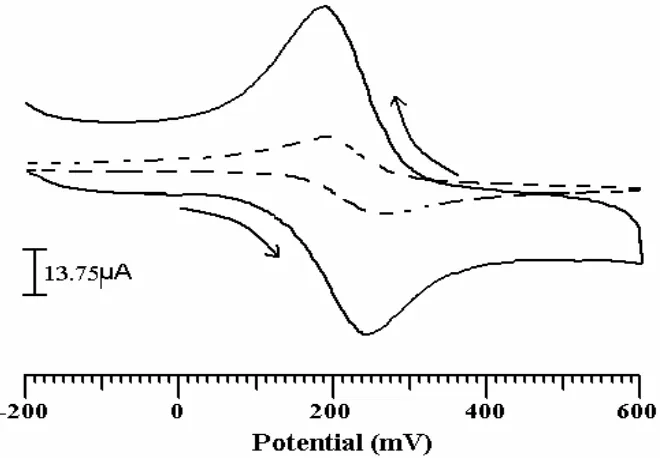
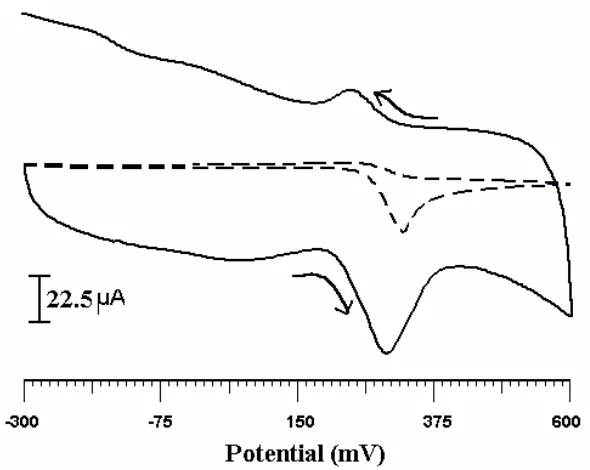
[image:3.612.142.472.455.684.2]Cyclic voltammetry was used to estimate the electroactive surface of the modified electrode. Fig.1 represents the CVs of bare CPE (dashed line) and CTABMCPE (solid line), which were recorded in 1X10⁻³M K4[Fe(CN)6] solution containing 1M KCl as supporting electrolyte at a scan rate of
50 mV/s. A well defined redox peak with great enhancement was observed at CTABMCPE when compared with bare CPE . This may be ascribed to the higher electrochemical activity of the CTABMCPE. Compared with the bare CPE the peak current at CTABMCPE increased and was 4.0 times of that on bare CPE. Due to increased peak current the modified electrode possesses the highest electrocatalytic activity.
Figure 1. Cyclic voltammograms obtained for the electrochemical response of 1X10⁻³M K4[Fe(CN)6]
3.2. Electrocatalytic oxidation of DA at CTABMCPE
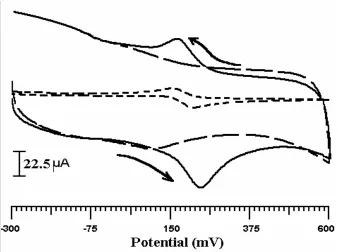
The electrochemical behavior of DA at the CTABMCPE was investigated using cyclic voltammetry and the cyclic voltammograms are shown in Fig.2 at the bare CPE (doted line). The cyclic voltammogram of 1X10⁻⁴M DA showed a pair of redox peaks in pH 7.4 PBS in the range from -300 to 600mV. The CTABMCPE was scanned in the same range without adding DA in PBS of pH 7.4 (dashed line).A big background current was obtained at CTABMCPE without giving any peaks. However in the presence of 1X10⁻⁴M DA a well defined strongly enhanced redox peaks were observed (solid line). The results of the enhancement of the peak current showed the excellent catalytic a ability of CTABMCPE.
Figure 2. Cyclic voltammograms of 1X10⁻⁴M DA obtained at the bare CPE (doted line) and in the absence (dashed line) or in the presence (solid line) of 1X10⁻⁴M DA at CTABMCPE scan rate 50 mV/s in 0.2M PBS (pH. 7.4).
3.3. Effect of scan rate
[image:4.612.137.475.248.500.2]
(a)
0 50 100 150 200 250 300 350 400 450
0 50 100 150 200 250 300 350 400 450
i
pa(
µµµµ
A
)
υ
υ
υ
υ (
mV/s
)
(b)
[image:5.612.142.475.77.669.2]
3.4 Effect of concentration of DA
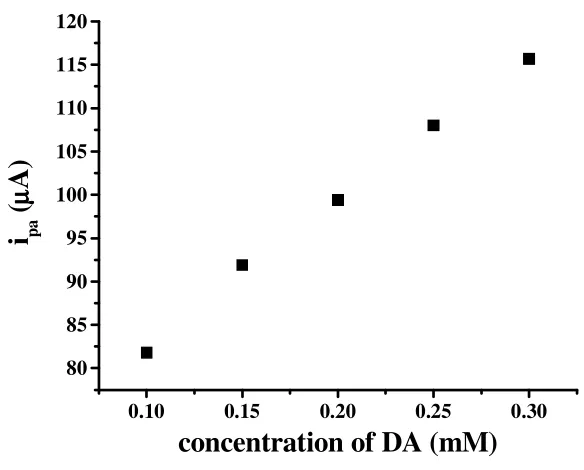
The electrocatalytic oxidation of DA was carried out by varying the concentration of DA at CTABMCPE. By increasing the concentration of DA, the electrochemical anodic and cathodic peak current goes on increasing with shifting Epa towards positive and Epc with negligible shifting of 1.0 X10⁻⁴ to 3.0X10⁻⁴ DA concentration. The plot of Ipa vs concentration (Fig.4) showed increase in the electrochemical peak current, the graph obtained linearly increased in peak current with increase in the DA concentration and Ipa proportional to concentration of DA.
0.10 0.15 0.20 0.25 0.30
80 85 90 95 100 105 110 115 120
i
pa(
µµµµ
A
)
[image:6.612.161.453.230.465.2]concentration of DA (mM)
Figure 4. Graph of anodic peak current of DA verses concentration.
3.5. Electrochemical oxidation of AA at the CTABMCPE
Figure 5. Cyclic voltammograms obtained for the oxidation of 1X10⁻³AA at CTABMCPE (solid line) and bare CPE (dashed line) at scan rate 50mV/s, 0.2M PBS (pH. 7.4).
[image:7.612.156.451.419.654.2]
3.6. Electrochemical oxidation of UA at CTABMCPE
Fig.6 shows the cyclic voltammogram of 0.5X10⁻³M UA at a bare CPE (dashed line) and CTABMCPE (solid line) in presence of phosphate buffer of pH 7.4. At the bare electrode, the electrocatalytic oxidation of UA occurs at approximately 324mV and the voltammetric peak is rather broad, suggesting slow electron transfer kinetics, presumably due to the fouling of the electrode surface by the oxidation product. However at CTABMCPE the UA showed well defined redox peak with the oxidation peak potential at 296mV, which was negatively shifted by 28mV and reduction peak potential was at 234mV.
3.7. Simultaneous detection of dopamine uric acid and ascorbic acid at CTABMCPE
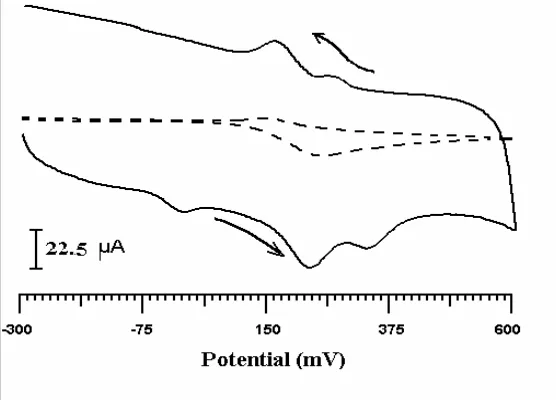
[image:8.612.167.445.451.651.2]AA and UA are present along with DA in mammalian brain. The concentration of AA and UA is much higher than that of DA. Since the oxidation potential of AA and UA are nearly same as that of DA, at bare electrode which result in an overlapped voltammetric response. However the CTABMCPE has ability to separate the oxidation peak potentials of AA, DA and UA.
Fig .7 showed the cyclic voltagrams for solution containing mixture of both 1X10⁻³M AA and 1X10⁻⁴M DA and 0.5X10⁻³M UA in phosphate buffer solution of pH 7.4. The bare CPE (dashed line) showed only one broad and less sensible single anodic peak. The CTABMCPE was able to separate the oxidation peaks of AA, DA and UA by showing three anodic peaks and cathodic peaks (solid line) with strong enhancement. The peak to peak separation of DA-AA was 231mV and DA-UA was 103mV. These separations were large enough to identify DA, UA and AA peaks individually. Hence CTABMCPE can act as a good sensor for determination of important neurotransmitter.
4. CONCLUSIONS
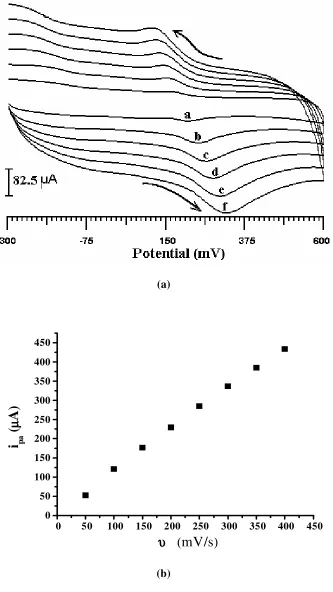
In this work CTAB, a cationic surfactant as a modifier to study the electrochemical response of an interesting neurotransmitter DA, CTABMCPE strongly enhanced both anodic and cathodic peak current of DA. The increase in the concentration of DA result in greater the enhancement of electrochemical oxidation at certain stage. Electrochemical process was found to be adsorption controlled and the results also indicated that the problem of the overlapped voltammetric responses of DA with AA and UA, due to their co-existence in real biological matrixes can be effectively overcome by use of CTABMCPE the modified electrode has a good selectivity, sensitivity and reproducibility. With its low cost and ease of preparation CTABMCPE will have good application for further sensor development.
References
1. S. Marceglia, G. Foffani, A. Bianchi, G. Baselli, F. Tamma, M. Egidi, A. Priori, J. Physiol, 571 (2006) 579.
2. N. Kemppainen, P. Marjamaki, M. Roytta, J. Rinne, J. Neural. Transm, 108 (2001) 827. 3. L. Schwieler, G. Engberg, S. Erhardt, Synapse, 52 (2004) 114.
4. J. Berke, S. Hyman, Neuron, 25 (2000) 515.
5. G.Di.Chiara, V.Bassareo, S.Fenu, M.De Luca, L.Spina, C.Cadoni, E.Acquas, E.Carboni, V. A. Valentine, D. Lecca, Neuropharmacology, 47 (2004) 227.
6. I .Franken, J. Booij, W .van den Brink, Eur. J. Pharmacol, 526 (2005) 199.
7. M.Heien, A. Khan, J.Ariansen, J.Cheer, P.Phillips, K.Wassum, M.Wightman, Proc Natl Acad. Sci, 102 (2005) 10023.
8. O.Rohr, B.Sawaya, D.Lecestre, D.Aunis, E .Schaeffer, Nucleic Acids Res, 27 (1999) 3291. 9. C.Scheller, S.Sopper, C.Jassoy, V.ter Meulen, P.Riederer, E.Koutsilieri, J. Neural Transm, 107
(2000) 1483.
10.J.Premkumar, S.B Khoo, J.Electroana. Chem, 576 (2005) 105. 11.C. R.Raj, F.Kitamura, T.Ohsaka, Analyst, 9 (2002) 1155.
12.Lin Mei Niu, Hong Qun Luo, and Nian Bing Li, Instrumentation science and Technology, 35 (2007) 59.
13.J.B. Raoof, Ojani, and A.Kiani, J.Electroanal.Chem, 515 (2001) 45.
14.Zhongua Wang, Yiming Wang and Guoan Luo, The Analyst, 127 (2002) 1353. 15.R.M. Wightman, L.J May, A.C.Michael, Anal.Chem, 60 (1988) 769A.
16.F.Gonon, M.Buda, R.Cespuglio, M.Jouvet, J.F.Pujol, Nature, 286 (1980) 902. 17.R.D.O’Neill, Analyst, 119 (1994) 767.
18. A. Salimi, H. Mam-Khezri, R. Hallaj, Talanta, 70 (2006) 823.
19. M .A. Dayton, A.G .Ewing, R.M. Wightman, Anal. Chem, 52 (1980) 2392. 20.C.G. Hu, S.S Hu, Electrochimica. Acta, 49 (2004) 405.
21.F.Wang, J.J.Fei, S.S.Hu, Colloid surface B, 39 (2004) 95. 22.W.S.Huang, Bull. Korean Chem. Soc, 26 (2005) 1560.
29.E.Niranjana, R.Raghavendra Naik, B.E.Kumara Swamy, B.S.Sherigara, H.Jayadevappa, Int. J. Electrochem. Sci, 2 (2007) 923
30.M. Panduranga Char, E. Niranjana, B.E. Kumara Swamy, B.S. Sherigara and K. Vasantakumar Pai, Int. J. Electrochem. Sci., 3 (2008) 588.
31.J.G.Manjunatha, B.E. Kumara Swamy, G.P.Mamatha, Umesh Chandra, E.Niranjana andB.S. Sherigara, Int. J. Electrochem. Sci., 4 (2009) 187
32.S. Chitravathi, B.E.Kumara swamy, E. Niranjana, Umesh Chandra, G.P.Mamathaand B.S.Sherigara, Int. J. Electrochem. Sci., 4 (2009) 223
33.Umesh Chandra, Ongera Gilbert, B.E. Kumara Swamy, Yadav D Bodke and B.S Sherigara, Int. J. Electrochem. Sci., 3 (2008) 1044.