A Longitudinal Study Investigating Synchronization
in a Singing Quintet
*Sara D’Amario,*Helena Daffern, and†Freya Bailes,*Heslington, andyLeeds, United Kingdom
Research suggests that synchronization between musicians during ensemble performances can be affected by the rhythmic or tonal complexity of the piece being performed and by group roles such as leader-follower relationships. Since previous studies have mostly been conducted within single performance sessions, developmental aspects of interpersonal synchronization in ensembles remain underinvestigated. This longitudinal study followed a newly formed singing ensemble from initial rehearsals to the performance stage in order to investigate the evolution of synchronization between advanced singing students during a university term of study in relation to the musical content of the piece and leader-follower relationships.
An advanced postgraduate singing quintet was recorded using head-worn microphones and laryngograph elec-trodes to allow fundamental frequency evaluation of the individual voices. The quintet, formed to complete a 1-year Master’s programme in ensemble singing, rehearsed two pieces composed for the study, during five rehearsals over 3 months. Singers practised the same pieces in a randomized order across rehearsals and per-formed three repetitions of the same pieces before and after each rehearsal, resulting in six recordings per piece/rehearsal. Audio and laryngograph data of the repeated performances were collected, and synchroniza-tion was measured by extracting note times from the fundamental frequency values. The asynchronies of the two pieces before and after rehearsals were calculated and compared both within rehearsals (pre and post) and between rehearsals (rehearsals 1-5).
Results demonstrate an increase in the precision of synchronization over the course of study, depending on the piece being rehearsed, and a more variable synchronization for the more rhythmically complex piece. Results also show changes in the distribution of the tendency to precede all co-performers across rehearsals, which became equally distributed among the musicians during the last rehearsal. The results reported here could have important implications for the tailoring of rehearsal strategies that could improve interpersonal synchronization between musicians during ensemble performances.
Key Words: Interpersonal synchronization—Rehearsal stages—Entrainment—Ensemble Communication– Ensemble Singing.
TAGGEDH1
INTRODUCTIONTAGGEDEND
Sensorimotor synchronization refers to the interpersonal syn-chronization of rhythmic movement with an external rhythm.1,2This ubiquitous behaviour occurs in many contexts, such as hand shaking, playing sports, music, and dancing. It was previously thought to be unique to humans;1however, it was recently observed in some animals. A dancing bird, named Snowball, and a California sea-lion were able to synchronize head bobs with a beat of a Backstreet Boys song3or a metro-nome,4respectively. In some activities, interpersonal coordina-tion emerges spontaneously, for example, when people rocking chairs or walking together adjust their movements or stride.5 Sometimes, coordination of movements occurs even when peo-ple intentionally try not to coordinate their actions, if visual
information between them is shared.6 In other contexts, syn-chronization is intentional, being based on a specific goal, such as during music ensemble performances.
Notably, in ensemble playing, sensorimotor synchronization represents an essential skill. Musicians in small ensembles must coordinate their actions with their co-performer's actions, and orchestral members must follow the conductor's gestures in order to achieve performance excellence. Their joint action is remarkably precise, as shown by the typical asynchrony mea-sured between nominally synchronous sound events being in the order of 30-50 ms in small ensembles.7
A theoretical framework has been proposed including three cognitive processes that enable this tight interpersonal coordination in ensemble performances, named (i)
anticipa-tory audianticipa-tory imagery, (ii) prioritized integrative attention
and (iii)adapting to others’action timing.8Thefirst process,
anticipatory auditory imagery,refers to the ability to
antici-pate one's own sound and the co-performer sound, creating auditory and motor imagery of their auditory effects; this auditory imagery ability depends on the level of musical experience.9 The second process, prioritized integrative
attention, refers to an attentional strategy that musicians
employ to facilitate cohesive and precise performance. Musicians pay attention to their own actions and to the co-performers’ actions, whilst assessing the overall incoming actual sound from the ensemble. The third process,adapting
to others’action timing, is an important ability in ensemble
Accepted for publication June 27, 2018.
Supported by the White Rose College of the Arts and Humanities (WRoCAH).
Conflict of Interest: The authors declare that the research was conducted in the
absence of any commercial orfinancial relationships that could be construed as a
potential conflict of interest.
From the *Department of Electronic Engineering, University of York, Heslington,
York, United Kingdom; and the ySchool of Music, University of Leeds, Leeds,
United Kingdom.
Address correspondence and reprint requests to Sara D'Amario, Department of Electronic Engineering, University of York, Heslington, York Y010 5DD, United
Kingdom. E-mail:[email protected]
Journal of Voice, Vol.&&, No.&&, pp. 112 0892-1997
© 2018 The Authors. Published by Elsevier Inc. on behalf of The Voice Founda-tion. This is an open access article under the CC BY license.
(http://creativecommons.org/licenses/by/4.0/)
https://doi.org/10.1016/j.jvoice.2018.06.011
performance and refers to the constant temporal adjustment of one's own timing with the co-performer(s)’timing. Tem-poral adjustments are necessary to master intentional expressive tempo changes or unintentional temporal fl uctu-ations due to noise in the cognitive motor processes.
These incessant temporal adaptations, which enable such remarkable sensorimotor synchronization in any musical ensemble, are sustained by two independent error correction processes, named phase correction and period correction.8 Phase correction refers to the automatic process that adjusts the way two or more consecutive beats are aligned and, thus, greatly supports precision in interpersonal synchronization. Period correction, by contrast, refers to the controlled adjust-ments of the duration of each timekeeper interval on the basis of previous information; it is not automatic but requires con-scious and explicit attention, control and awareness by the musicians.10,11Period correction is mostly needed with obvi-ous tempo change, whilst phase correction is continuobvi-ously triggered to adapt to small temporalfluctuations.8Phase and period corrections appear gradually, rather than instan-taneously, after a timing change is introduced in the synchro-nization or a joint action begins.
Findings regarding error correction processes are mostly based on tapping tasks, in which participants tap along to rhythmic sequences of auditory stimuli (for a review, see the works of Repp1,2). Recently, they have also been investigated in two professional string quartets. In this case, researchers found that the first violinists exhibit contrasting patterns of adjustments with the co-performers. In one quartet, the first violinist showed fewer adjustments to the co-performers, than the others’adjustment to her. In the second quartet, research-ers found no difference in the adjustment patterns between the
first violinist and the other members of the ensemble. These
findings suggest different strategies used during the perfor-mance, iefirst-violin ledversusa more democratic approach.12
Reported evidence indicates that synchronization in ensembles could be affected by the rhythmical complexity of the piece being performed.1315The modality of sensory information occurring between beats was investigated in a study manipulating the number of notes within each crotchet beat. Pianists performing melodies with a metro-nome were less synchronized when playing melodies in which the crotchet beats were subdivided by adding quaver notes, compared with when the crotchets beats of the melo-dies were not subdivided.13In addition, pianists performing duets with different note ratios between the two musical parts (1:1, 1:2 and 2:1 ratio) were best synchronized when the lower part was playing fewer notes (2:1 ratio) and less synchronized when playing more notes (1:2 ratio), under conditions whereby the upper parts heard only themselves, whilst the lower parts heard both parts.14Pianists were also more synchronized when playing the same melody in unison than in a round, characterized by a delay of the entry of the second performer, suggesting that the non-simultaneous entrance might decrease the degree of synchronization.15 The effect of the rhythmical complexity of the piece has not been analysed in larger ensembles; further investigations
might shed some light on the effects of the rhythmical com-plexity of the piece on the sensorimotor synchronization between musicians in larger ensembles.
Temporal coordination can also be affected by the role of the individuals within a group, such as leader-follower rela-tionships between musicians in ensembles. Investigations based on duo performances, in which specific group roles were assigned between musicians, demonstrate that the effect of acting as leader or follower might affect synchroni-zation in ensembles, depending on the piece being perform-ed.1417The designated leader is more likely to precede the co-performer in melody-accompaniment pieces,14 to lag when performing the same melody in a round15but not to be affected by the instruction to act as leader or follower when playing a two-part piece with a less clear separation of roles induced by the score.17
A number of case studies have recently analysed leadership in string quartets, which emerges spontaneously during per-formances, without assigning specific group roles.1821 The analysis of temporal coordination and/or body movements among musicians indicates the relative leadership of thefirst Violin20 and a complex pattern of leader-follower relation-ships during ensemble performances.18,19Thesefindings con-trast with a simpler division of roles characterized by the artistic attribution of leader to the first Violin, with co-performers acting as co-leaders/followers. Another study forced the unidirectional communication between the first Violin of a string quartet and the other members of the ensemble, by introducing changes to the score being per-formed known only to the first Violin. Notably, when dynamic and temporal changes were introduced to the score, the unidirectional relationship with thefirst Violin decreased, suggesting that leadership in ensembles might be affected by the sharing of knowledge between co-performers.21
Overall, the results from the above studies analysing leader-ship in ensemble playing demonstrate that lagging behind or preceding a co-performer might be related to their leader-follower roles. Therefore, the analysis of preceding or lagging a co-performer during ensemble performance is a valuable measure of leadership, which is usually thought of in a social context, rather than in terms of performance timings. Research so far has been mostly focused on instrumental ensembles; future investigations with singers are needed to better understand this complex phenomenon in singing ensembles.
Additionally, whilst there is a strong body of research into interpersonal synchronization that analyses single per-formance sessions, the developmental aspects of synchroni-zation in ensembles remains mostly unexplored. Whilst members of professional ensembles synchronize their entrances with near-perfect precision with the other co-per-former(s), this may require practice over several rehearsals to be achieved. Therefore, the investigation of the evolution of temporal coordination between musicians across rehear-sals is of interest to music pedagogy, aimed at refining rehearsal strategies, and music psychology and psychology research, in terms of understanding social interaction.
ARTICLE IN PRESS
The analysis of interpersonal synchronization has been mostly conducted investigating duo1417,2225 and quartet performances.1821This study focuses on singing quintet per-formances, an area that currently lacks thorough investiga-tion, and aims to analyse the evolution of sensorimotor synchronization with practice, variation of leader-follower relationships between singers during and across rehearsal ses-sions, and in relation to the piece being performed. Specifi -cally, this investigation addresses the following questions:
Do interpersonal synchronization and/or the leader-follower relationships between singers change with practice in a singing quintet?
Do these changes, if any, differ in relation to the con-trasting musical features of the pieces rehearsed?
Although this is an explorative study, it was hypothesized that practice increases sensorimotor synchronization between singers during singing quintet performances and that this effect depends on the rhythmical complexity of the piece being performed.
TAGGEDH1
METHODSTAGGEDEND
Participants
Ethical approval for the study (with reference D'Amario070817) was obtained from the Physical Sciences Ethics Committee (PSEC) at the University of York (UK). A soprano, mezzo, mezzo, tenor and bass singing quintet took part in the study (three females, age Mdn= 23,
Range= 6). Singers were Master of Arts students in
ensem-ble singing at the Department of Music of the University of York. At the time of the study, the quintet was a newly formed ensemble established as a regular quintet working towards performances and Master’s exams. They had met for only one rehearsal prior to the beginning of thefirst ses-sion but rehearsed regularly throughout the duration of the study in preparation for their final exam. All singers had formal singing training with a professional singing teacher
(Mdn= 8, Range= 13), and extensive experience
perform-ing in choir (Mdn= 10.8, Range= 11) and in singing ensembles such as duo, trio and quartet (Mdn= 7,
Range= 8). The bass had 12 years of experience conducting
and 5 years composing. They reported not having absolute pitch, and having normal hearing, except for the bass who reported sporadic tinnitus during his life that did not affect his singing during the rehearsal sessions.
Materials
This investigation made use of two chorales composed by Johann Sebastian Bach: one piece was the chorale ‘Jes, mein Hort und Erretter’from the Cantata BWV 154‘Mein liebster Jesus ist verloren’; the other was the chorale‘Nun danket alle gott’ from the Cantata BWV 192. The pieces were arranged for the singing quintet ensemble in the study
by the first author. These chorales were chosen for their structural characteristics: two short pieces, mostly homo-phonic, with different melodic contour and harmonic struc-ture from each other, and feasible for mastery withinfive, short rehearsal sessions. The two arranged pieces comprise eight phrases, to be sunglegatoto the vowel/i/. This vowel was chosen by the singers that took part to a pilot study investigating synchronization in singing duo performan-ces.16The same vowel was used in the present study for con-sistency with the previous investigation. To facilitate the analysis of synchronization based onfotracking (see section Analysis), the two pieces were arranged based on the follow-ing criteria: (i) avoidfollow-ing repeated notes and (ii) limitfollow-ing semitones. The onset-offset detection and, consequently, interpersonal synchronization can be potentially difficult to compute from thefotrack of audio recordings when melo-dies move chromatically, since the expected vibratorange for classical singers might span a semitone. Similarly, true beginnings of repeated notes during legato singing can be difficult to detect, if singers do not produce a noticeable pause in phonation between notes. Two pieces with these characteristics (ie, without repeated notes, and only few semitones), which maximize asynchrony detection were
dif-ficult tofind, and arrangement of the pieces was preferred. The pieces do not include any expressive markings, as sing-ers were invited to develop their own expressive interpreta-tion. No clear leader-follower roles are defined in the pieces to allow relationships between singers to emerge spontane-ously during rehearsals. The two pieces varied in their rhythmic, melodic and harmonic structure, as follows:
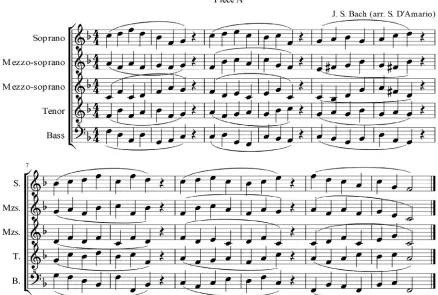
Piece A: characterized by a clear homophonic struc-ture, with a constant 1:1 note ratio across performers (ie, equal note length for each voice), featuring simulta-neous entries and breaths, and a stable rhythm, as shown inFigure 1.
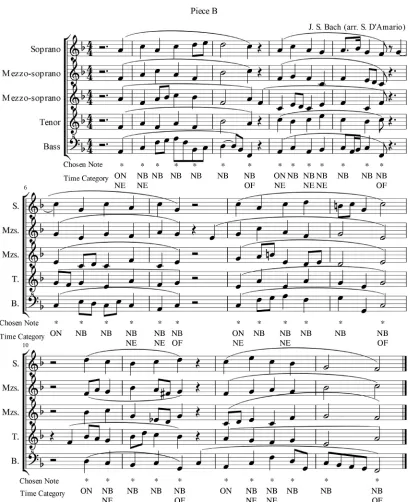
Piece B: characterized by a different harmonic struc-ture, and a different and more complex melodic and rhythmic structure, including ornamentations within each part that varied the note ratio across performers. Entries were systematically manipulated in a way that, except for thefirst simultaneous entry, each singer had one occasion to start the phrase on an up-beat ahead of the others (ie, the mezzo entered ahead of the others in bar 3, the tenor entered earlier in bar 5, the bass in bar 7, the soprano in bar 9 and the mezzo in bar 11), as shown inFigure 2.
The contrasting characteristics identified above were intro-duced to investigate whether the evolution of synchronization might vary depending on the properties of the piece being sung.
Design
This investigation is a longitudinal study includingfive stu-dio-based rehearsals. During each rehearsal, the above pieces were practised, and three repeated performances of
ARTICLE IN PRESS
the pieces were recorded pre-rehearsal and post-rehearsal. This study resulted in a 5 (rehearsals) £ 2 (pieces) £ 2 (takes, 1 pre-rehearsal and 1 post-rehearsal)£ 3 (repeated performances for each take) design, featuring a total of 30 repeated performances per piece, recorded during the course of the study. The order of recording and rehearsing the two pieces was randomized within rehearsals. Therefore, in rehearsals 1, 4 and 5, singers first recorded-rehearsed-recorded piece A and then piece B, but in rehearsals 2 and 3, the quintet recorded-rehearsed-recorded piece Bfirst, fol-lowed by piece A.
Additionally, a short questionnaire was administered at the end of the last rehearsal, and singers were interviewed a month after the end of the experiment as part of a study into the verbal interactions of the group by a different lead researcher, which will be thoroughly reported elsewhere. As far as the current study, the verbal discussions were scruti-nized in relation to singers’specific reference to synchroni-zation, and the results were reported in the introductive section of the results.
Apparatus
The experiment took place in a bespoke recording studio of the Department of Electronic Engineering at the University of York. The room was 5.2m£ 7.6m, the ambient noise level was 37dB(A) and the RT60 reverberation time was 0.32 s. Therefore, the room was an environment not alien to
[image:4.612.87.525.67.362.2]the singers in terms of acoustic (relatively dead typical of a practice room or recording studio) and look (a recording studio with acoustic panelling on the walls and recording equipment). The quintet stood in a semi-circle of approxi-mately 1.5 m in radius in the sequence soprano (S1), mezzo 1 (S2), mezzo 2 (S3), tenor (S4) and bass (S5), with S1 oppo-site S5. This ensemble was not a choir with several voices per part but a vocal ensemble. This aspect limits the rele-vance of any comparisons to spacing in choirs. Neverthe-less, some considerations have been made regarding the placement of voices. The 1.5 m radius was chosen so the dis-tance between adjacent singers was 2p£1.5/(2£4)1.2 m. This is larger than a conventional choral spacing but close to what is often considered preferable on a concert podium.26In combination with the fact that each singer was alone per part, this distance of 1.2 m indicates that the self-to-other ratio was high and that each singer could very eas-ily hear their own voice above the others. Four sets of data were acquired: acoustic data, based on head-mounted close proximity microphones (DPA 4065) and a stereo condenser microphone (Rode NT4) providing right and left outputs, and electrolaryngograph recordings, using electrolaryngo-graph electrodes (Lx) from Laryngoelectrolaryngo-graph Ltd. (www.lar yngograph.com). The stereo microphone used in the study was a twin cardioid microphone pointing towards S3, with its main axes pointing at S2 and S4. This stereo microphone was chosen as being most sensitive to the area in front to the microphone capsule, where the singers stood, while FIGURE 1. Piece A used for the study. The full set of notes was used for the analysis of synchronization between singers.
ARTICLE IN PRESS
picking up minimal noise from the rear and marginal from the sides. Each head-mounted microphone was placed on the cheek of the singer at approximately 2.5 cm from the lips, whilst the stereo microphone was placed at equal dis-tance in front of the singers at approximately 1.5 m from the lips. Lx electrodes were placed on either side of the neck at the level of the larynx. Lx is widely used for the analysis of the singing voice27and has been recently used to investi-gate synchronization in singing ensemble performances,16,17 as it allows the identification of the individual contribution of each singer. The Lx signal may be too weak to be reliable for use on certain populations, such as sopranos28and when
[image:5.612.103.513.55.557.2]a thick layer of subcutaneous tissue is present in the neck.29 The Lx recordings resulted to be unusable for 0.7% of a set of 96 recordings of a short two-part piece composed for a singing duet, and discontinuous Lx segments in the order of 30 ms were observed in a study testing the use of laryngo-graph for the analysis of synchronization in singing ensem-bles.16 Closed proximity microphones were used to investigate synchronization when the Lx signal was unus-able. The stereo recordings were collected for the analysis of the verbal interactions between singers during the five rehearsals but were not used to measure interpersonal syn-chronization during the repeated performances. Each Lx FIGURE 2. Piece B used for the study, showing the notes, highlighted with *, and the time categories upon which the analysis is based.
ARTICLE IN PRESS
box was connected to a preamplifier (ART CleanBox Pro) to reduce noise and interference between the Lx boxes over long cable runs. The 12 outputs (5 Lx with preamplifiers, 5 head-mounted microphones, and the stereo microphone comprising right and left channels) were attached to a multi-channel audio interface (Focusrite Liquid Saffire 56), which was connected to a PC; the 12 outputs were then recorded using a digital audio workstation (Reaper 5.40) at a sampling frequency of 44.1 kHz and 24-bit depth.
Procedure
Ensemble members were invited to five rehearsal sessions over a 4-month period, from September 2017 to January 2018. In each session, they rehearsed each piece for 10 minutes and performed the pieces three times before and after each rehearsal, endeavouring to make each repetition an individual performance. Each session was approximately 1-hour long. Singers were fully engaged during all rehear-sals. Prior to the first rehearsal, participants were asked to
fill in a background questionnaire and consent form. The
first four rehearsal sessions were approximately 3 weeks apart from each other. The fifth session took place after 6 weeks from the fourth, due to the Christmas break. The last rehearsal session was held the week before the ensemble members’formal performance exam, set up in the form of a public concert; this was designed to conclude the analysis of synchronization at a time when the ensemble should be at its most cohesive, since based on 4 months of practice. Sing-ers were not aware of the purpose of the study. SingSing-ers were required to work on expressiveness, working towards afinal performance of the stimulus pieces at the end of the term of study. This was designed to encourage a realistic approach to rehearsal and promote a development of the quintet, although the two pieces rehearsed were not performed on stage at the end of the study term. They were left free to use the short rehearsal sessions in any way they chose to create an expressive interpretation. Singers received the score of the stimuli on the day of each laboratory session to practise and perform the piece, but thefirst author retained the score at the end of each session, so singers were not able to rehearse the pieces between lab sessions. This allowed the authors to record and analyse any changes in the develop-ment of synchronization relating to the given pieces during the term of study. Singers performed and rehearsed the piecesa cappella, and an audience was never present.
Analysis
Lx and audio recordings from the head-mounted micro-phones were imported in Praat30as .wavfiles, and two data-sets were extracted from each recording: thefoestimates in Hertz and the corresponding timestamps with a time step of 1 ms. These two datasets were then entered into Excel as a tabular list of data. An automated peak-picking algorithm, TIMEX,16was used to extract the following four time cate-gories, as defined in D'Amario et al16: onsets (ON) and off-sets (OF) of phonation, and note beginnings (NB) and note
endings (NE) within the sunglegatophrases from the acous-tic and Lx recordings. This algorithm, tested on a set of singing duo recordings, proved to be a valuable and success-ful method, recommended for the analysis of interpersonal synchronization between singers during ensemble perform-ances.16 The algorithm relies mostly on the Lx recordings but automatically scrutinizes the acoustics data from the head-mounted microphones when the Lx signal is too weak to be detected. The acoustic recordings were also scrutinized in case of soft phonation, since the Lx signal may not pick small vocal fold vibrations. The data extraction automated through TIMEX was then visually cross-validated by the
first author. Note errors due to the singers missing notes or performing the wrong notes (i.e., entering or delaying the notes for more than 50% of its expected values) were less than 0.05%, identified comparing Lx and audio recordings with the notated scores. Notes at which errors occurred were excluded from the analysis.
All notes from piece A, the clearly homophonic piece, were selected for the investigation of interpersonal synchro-nization. Conversely, the analysis of temporal coordination in piece B was focussed on notes being relevant to synchro-nization, as shown inFigure 2.
Asynchronies were then calculated for each pair of sing-ers, subtracting the timing of one singer from that of another, such as soprano minus mezzo and soprano minus tenor. This procedure gave a matrix with a total of 20 chan-nels of asynchronies. These chanchan-nels were implemented for each time category (ie, ON, NB, NE and OF) selected for the analysis of interpersonal synchronization.
Asynchronies that fell outside three times the interquar-tile range (IQR) were automatically detected as extreme outliers in SPSS (IBM SPSS Statistics v. 24) and excluded from the analysis. The identification of outliers was run for each time category, pre-rehearsal and post-rehearsal condi-tions, piece and rehearsal.
Following three measures of synchronization were used: (i) precision of synchronization, as quantified by absolute asynchronies; (ii) consistency of synchronization, as
quanti-fied by SD of absolute asynchronies, computed across the 20 channels for each time category; and (iii) tendency to pre-cede or lag a co-performer, as quantified by signed asyn-chronies.
Multilevel linear models were then implemented step by step for each response variable (ie, precision, consistency and tendency to precede/lag), to investigate thefixed effects of rehearsal sessions and piece (the last one nested within rehearsals), and the random effects of participant, note, time category and take (ie, pre-rehearsal and post-rehearsal), as shown in Table 1. Pairs of singers were also entered as random effects in the model investigating the ten-dency to precede/lag. Multilevel linear models were chosen because they reinforce the statistical power of the analysis providing an assessment of the variability of thefixed effects across random effects.31The models were implemented in R Studio,32 using the lme4 package. A Bonferroni correction was implemented for multiple multilevel linear models,
ARTICLE IN PRESS
dividing the critical Pvalue (0.05) by the number of com-parisons being made, 3, corresponding to the total number of models developed for the three response variables. For this reason, aP-value threshold was set atP= 0.016.
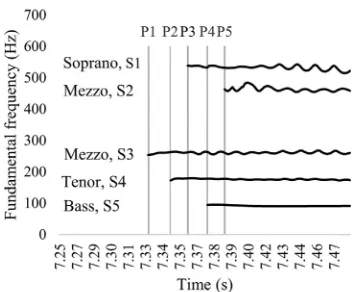
In addition, the tendency to precede/lag a co-performer was investigated analysing the temporal rank order across thefive singers for each time category/note/repeated perfor-mance/rehearsal. As shown inFigure 3, the temporal rank order for note beginnings and onsets was analysed identify-ing the entrance temporal position of each sidentify-inger from posi-tion 1 (singer who preceded all co-performers) to posiposi-tion 2
(singer who entered immediately after), to positions 3, 4, up to position 5 (singer who lagged all co-performers). Simi-larly, the sequence for note ending and offset was based on the analysis of the exit temporal position.
For each singer, the tendency to occupy a given position was measured counting the number of occurrences spent in that position, ie the observed frequency on a given position. This was computed for each position/rehearsal/singer, tak-ing all notes, time categories and both pieces together. Then, three aspects of the effect of rehearsals on the ten-dency to precede/lag were analysed:
- The interaction between rehearsal (1-5) and position (1-5) for each singer, through Pearson's chi-square tests for independence. The test indicates whether the fre-quencies observed in each position are independent from the rehearsals. A total of 5 Pearson's chi-square tests were conducted, one for each singer.
- The interaction between rehearsals (1-5) and the fre-quencies at which each singer sang in position 1, through a Pearson's chi-square test for independence. This analysis demonstrates whether there is a signifi -cant relationship between rehearsals and the number of occurrences each singer spent in position 1. One chi-square test was implemented, including the frequencies that each singer occurred in position 1 in each rehearsal.
[image:7.612.45.579.91.272.2]- The distribution of the tendency to precede all the others computed across the five singers for each rehearsal. This investigation was conducted through a total of 5 chi-square goodness of fit tests (ie, one for each rehearsal), comparing the observed frequency dis-tribution with an equal frequency disdis-tribution. These TABLE 1.
Primary and Nested Fixed Effect Coefficients and Significance
Parameter Fixed effects Fixed effect coefficients and significance
Rehearsal 1 Rehearsal 2 Rehearsal 3 Rehearsal 4 Rehearsal 5
Precision
Rehearsals b=¡9.7***,
t(40505)=¡5.4
b=¡6.8***,
t(40505)=¡3.8
b=¡8.8***,
t(40505)=¡4.9
b=¡11.9***,
t(40505)=¡6.6 Pieces b=49.1***,
t(40532)=23.5
b=32.4***,
t(40532)=15. 5
b=30.7***,
t(40532)=14.7
b=23.4***,
t(40533)=11.2
b=17.7***,
t(40532)=8.5 Consistency
Rehearsals n.s. n.s. n.s. n.s.
Pieces b=48.9***,
t(3794)=14.1
b=19.5***,
t(3798)=6.0
b=14.2***,
t(3798)=4.4
b=13.4***,
t(3799)=4.1
b=10.5***,
t(3799)=3.2 Tendency
Rehearsals n.s. n.s. n.s. n.s.
Pieces b=10.2***,
t(39783)=4.0
n.s. n.s. n.s. n.s.
Theb- fixed effect coefficients - of rehearsal and piece on the predictor being considered (ie, precision, consistency and tendency to precede/lag) are given with reference to the specific base level of the factor, ie rehearsals 2, 3, 4 and 5versusthe base level rehearsal 1, and piece Bversuspiece A. Thebcoefficients indicate that for each 1 unit increase in the predictor being considered, the effect of the given predictor changes by the amount specified by thebcoefficient. For example, for each 1 unit increase in the precision of rehearsal 1, precision computed in rehearsal 2 decreases by 9.7 units. n.s.= not statistical significant; ***P<0.001.
FIGURE 3. Excerpt from the 5 Lx signals showing the temporal rank order regarding the entrances of the 5 singers performing the onset of thefirst note of piece A recorded during rehearsal 5. Based on the temporal entrance order from position 1 (P1) to position 5 (P5), the resulting temporal sequence observed here was S3-S4-S1-S5-S2, where S3 and S2 were thefirst and last singers to precede and lag all-co-performers, respectively.
ARTICLE IN PRESS
[image:7.612.80.257.509.655.2]analyses informed whether the tendency to precede all co-performers was equally distributed in each rehearsal. Whilst the previous Pearson's chi-square test for independence presented in the previous point is an omnibus analysis that investigates the interaction between rehearsals and frequencies in position 1 across thefive rehearsals, the 5 chi-square goodness-of-fit tests allows us to narrow the analysis, investigating the dis-tribution separately at each research.
A Bonferroni correction was carried out for multiple chi-square tests, which were 11 in the study. AP-value threshold was set atP= 0.0045, obtained by dividing the critical value (0.05) by the number of chi-square tests (ie,P= 0.05/11).
TAGGEDH1
RESULTSTAGGEDEND
The following three subsections present the results of the analyses of thefixed effects of rehearsal and piece on inter-personal synchronization. The b fixed effect coefficients
of rehearsal and piece on the predictor being considered (ie, precision, consistency and tendency to precede/lag) are given in the following sections and inTable 1with reference to the specific base level of the factor, ie rehearsals 2, 3, 4 and 5 versus the base level rehearsal 1, and piece B versus
piece A. The b coefficient indicates that for each 1 unit increase in the predictor being considered, the effect of the given predictor changes by the amount specified by the b coefficient.
In addition, the verbal discussions were scrutinized in relation to specific reference to synchronization, and singers neither discussed nor debated synchronization during the
five rehearsal sessions.
Precision
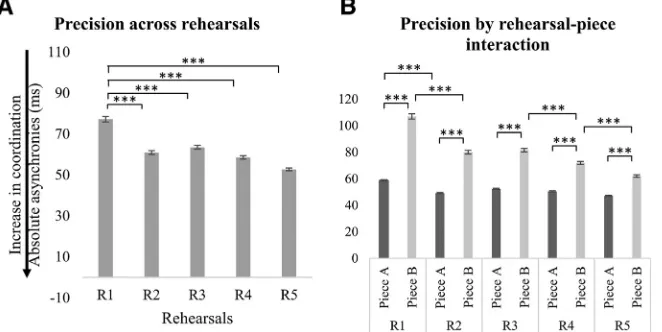
[image:8.612.144.475.548.714.2]Results from the multilevel linear modelling as explained in section Analysis show that precision of synchronization improved from thefirst to the last rehearsals. As shown in Figure 4A and Table 1, compared to the baseline in
rehearsal 1, precision improved in rehearsal 2 (b=¡9.7, t
(40505) =¡5.4, P < 0.001), in rehearsal 3 (b=¡6.7, t
(40505) =¡3.8, P < 0.001), and also in rehearsal 4 (b=¡8.8, t(40505) =¡4.9, P < 0.001) and rehearsal 5 (b=¡11.9, t(40505) =¡6.6, P < 0.001). Precision in the synchronization of piece A was better than that of piece B in all rehearsal sessions, as shown inTable 1andFigure 4B. The variance partition coefficient (VPC) among pairs of singers, time categories, and pre-rehearsal and post-rehearsal was 0.009, 0.030 and 0.00026, respectively. This indicates that only 0.9%, 3% and 0.026% of the variability of precision of synchronization over five rehearsals can be attributed to pairs of singers, time categories, and pre-rehearsal and post-pre-rehearsal, respectively. As shown in Figure 4B, posthoc comparisons revealed that precision in the synchronization of piece A improved in rehearsal 2 (M= 49.2, SD= 43.4) compared with rehearsal 1 (M= 58.7, SD= 50.1, t= 6.4,P<0.001). Similarly, preci-sion in piece B was better across rehearsals, as it improved in rehearsal 2 (M= 80.0, SD= 140.1) compared with rehearsal 1 (M= 106.9, SD= 50.1, t= 11.6,P<0.001), in rehearsal 4 (M= 71.8, SD= 116.3) compared with rehearsal 3 (M= 81.5, SD= 130.1, t= 4.0,P<0.001), and in rehearsal 5 (M= 62.0, SD= 90.5) compared with rehearsal 4 (t= 3.9,P<0.01).
Consistency
Thefive rehearsals did not predict synchronization consis-tency, as shown in Figure 5A, but the pieces within each rehearsal were significant predictors. The consistency in the synchronization of piece A was better than that of piece B in all rehearsals, as shown in Table 1andFigure 5B. The variance partition coefficient between pre-rehearsal and post-rehearsal was 0.04%, among time categories 5.6% and among notes 12.5%. In addition, posthoc comparisons between rehearsals of the two pieces show that the consis-tency of piece B improved significantly from the first rehearsal (M= 81.9, SD= 122.0) to the second rehearsal
FIGURE 4. Precision of synchronization: (A) by rehearsal and (B) by interaction between rehearsal and piece. Error bars represent 95% CI of the mean.P-values have been adjusted using the Holm method. ***P<0.001.
ARTICLE IN PRESS
(M= 47.4, SD= 66.9, t= 9.3, P < 0.001), as shown in Figure 5B.
Tendency to precede/lag
Rehearsal number did not predict the tendency to precede or lag a co-performer computed for each pair of singers. The piece being rehearsed predicted the tendency to pre-cede/lag during thefirst rehearsal: the amount of leadership/ lagging was greater when singers performed piece B (M= 12.4, SD= 198.1) than piece A (M= 6.3, SD= 76.9),
b= 10.2, t(39783) = 4.0,P<0.001. The VRP among pairs was 0.9%, notes 0.3%, time categories 3.7% and rehearsals 0.075%.
In addition, Pearson's chi-square tests for each singer, which analysed the interaction between rehearsal number and positions in each rehearsal session (as defined in section Analysis), show that there was a significant association between the given variables. The occurrences that each singer spent in each position (P1-P5) did depend on rehear-sals (for singer 1: x2(16) = 55.1, P < 0.001; for singer 2:
x2
(16) = 70.2, P<0.001; for singer 3: x2(16) = 63.6, P<
0.001; for singer 4: x2(16) = 42.8,P<0.001; for singer 5
x2
[image:9.612.147.467.59.227.2] [image:9.612.143.470.460.721.2](16) = 54.0, P <0.001). This demonstrates that the ten-dency to precede/lag co-performers was significantly associ-ated with the rehearsal sessions (ie, R1-R5). Figure 6 illustrates the time spent in each position for each singer across the rehearsals. Interestingly, the bass (S5) spent most FIGURE 5. Consistency of synchronization: (A) by rehearsal and (B) by interaction between rehearsal and piece. Error bars represent 95% CI of the mean.P-values have been adjusted using the Holm method. **P<0.01; ***P<0.001.
FIGURE 6. Occurrences of entry positions from position 1 to position 5 across rehearsals computed for each singer.
ARTICLE IN PRESS
time in position 1 in rehearsals 1-4, therefore mostly preced-ing all co-performers.
An analysis of leadership as indexed by entering in posi-tion 1 followed. This showed that the distribuposi-tion between singers varied significantly across rehearsal (x2(16) = 96.7,P
<0.001). This result demonstrates that tendency to precede all co-performers did relate to the different rehearsals (ie, R1-R5). Results from the goodness of fit chi-square test indicate that the observed frequencies of position 1 for each singer (see Fig. 7) were not equally distributed across rehearsal 1 (x2(4) = 69.0, P < 0.001), rehearsal 2 (x2(4) = 17.4, P= 0.002), rehearsal 3 (x2(4) = 53.1, P <
0.001), and rehearsal 4 (x2(4) = 27.6,P <0.001). Notably, there was no significant difference between singers in occu-pying the first position in rehearsal 5 (x2(4) = 6.4,
P= 0.172). This indicates that the tendency to precede all other co-performers changed during the course of study: it was not equally distributed among thefive singers in thefirst four rehearsals, but it was during the last rehearsal, as shown inFigure 7.
In summary, these results show that when calculated at the level of relationships between the pairs of singers, the
five rehearsals did not affect the relationships. However, the tendency to precede/lag each co-performer was significantly associated with rehearsal number. Notably, the tendency to precede all co-performers became equally shared among the singers by the end of thefirst term of study.
TAGGEDH1
DISCUSSIONTAGGEDEND
This study analysed the evolution of sensorimotor synchro-nization between advanced singers in a newly formed sing-ing quintet ensemble, dursing-ing five rehearsals spread across theirfirst term of study. The developmental aspects of syn-chronization were analysed during and across rehearsals, and in relation to the pieces practised. Three measures of interpersonal synchronization were investigated: precision and consistency of synchronization, as quantified by the absolute andSDof absolute asynchronies, and tendency to precede or lag a co-performer, as indicated by the signed asynchronies. These measures were objectively quantified
through the analysis of the acoustics and electrolaringo-graph recordings. Verbal discussions between the singers during thefive rehearsals were also scrutinized in relation to reference to synchronization.
Precision significantly improved from thefirst to the last rehearsal. In each rehearsal, precision was better in piece A, the more homophonic piece, than piece B (more poly-phonic). Notably, precision in piece A improved signifi -cantly only between the first two rehearsals but improved across the whole term of study in piece B. This suggests that the complexity of the piece being practised might affect the precision of synchronization between performers in ensem-bles. Singers practising a homophonic piece might signifi -cantly improve the precision of interpersonal coordination with only two rehearsals, establishing a stable degree of syn-chronization for the remaining rehearsals. Conversely, with a more complex piece, performers might need several rehearsals to establish a stable degree of synchronization. Further studies that increase the number of rehearsals ana-lysed will inform whether/when singers establish a higher degree of synchronization in piece B, the more complex material.
Synchronization in piece A was more consistent than piece B in each rehearsal, as quantified by theSD of abso-lute asynchronies. The consistency of sensorimotor synchro-nization did not change in piece A during the full term of study. The consistency improved significantly between the
first two rehearsals of piece B and then remained stable dur-ing the remaindur-ing rehearsals. Thesefindings suggest that the piece being rehearsed might interact with rehearsal to affect the consistency of synchronization.
Analyses show that while singers varied in the balance of leadership (as indexed by preceding all other voices), across thefirst four rehearsals, by thefinal rehearsal no significant differences between the members of the quintet were appar-ent in occupying thefirst position. Although the analysis of the rank order positions does not offer a thorough analysis of the leader-follower relationships, these results suggest that the tendency to precede all co-performers changes across rehearsals, becoming equally distributed among sing-ers toward the end of the first term of study. These results further expandfindings based on single laboratory sessions, suggesting a complex pattern of relationships between string players in ensemble quartets, rather than a clearer separa-tion of roles.18,19The previous investigations provided a sin-gle snapshot of the leader-follower relationships in music ensemble, reporting: (i) a unidirectional dependence of Viola on Violin I, and of Violin I on Cello, and (ii) a bidirec-tional dependence between Violin II and Cello, and Violin II and Viola. This study sheds some light on the develop-mental aspects of the group relationships in music ensem-bles, finding an equally distributed tendency to precede all other co-performers by the end of thefirst term of study.
[image:10.612.44.291.589.711.2]In addition, the above findings regarding the relation-ship between rehearsal number and synchronization did not vary largely among pairs of singers and time catego-ries. Notably, synchronization results were also consistent FIGURE 7. Distribution of position 1 across rehearsals, based on
the number of occurrences each singer preceded all co-performers.
ARTICLE IN PRESS
between pre-rehearsal and post-rehearsal, suggesting that the individual rehearsal might not affect the synchroniza-tion. Singers were not told to focus on synchronization, but on expressiveness; they may improve precision and consistency of synchronization in different rehearsals if temporal coordination is the goal of the rehearsal.
Interestingly, the improvements in the synchronization observed across rehearsals are not linked to any specific tar-geted practice of the singers to improve synchronization, as demonstrated by the lack of specific reference to synchroni-zation in the verbal discussions during the five rehearsals. Differences in the synchronization observed in the study across the first term of study might be related to a number of different extraneous variables. External factors occurring between rehearsals might have elicited an improvement in the synchronization. Singers were rehearsing the MA pieces between thefive laboratory rehearsal sessions, and the more time spent together as an established ensemble during the course of the study might have elicited an improvement in the synchronization. Further studies should analyse the role of rehearsal in more depth to understand whether the rehearsal has a significant effect on the synchronization between musicians in ensemble.
TAGGEDH1
LIMITATIONS AND FUTURE WORKTAGGEDEND
Precision of synchronization improved between thefirst two rehearsals in piece A, and also improved consistently in piece B across the term of study. It is now of interest to investigate whether this improvement is perceivable. A lis-tening test including multiple recordings of the same pieces for each rehearsal is planned, analysing whether the per-formers, other musicians and non-experts might perceive a change in the degree of synchronization.
Further research should also investigate the repeatability of the above findings across different quintets, analysing whether these results typify the ensemble. Future investiga-tions should also consider the effects of musicians’expertise, investigating whether the skill development influences the evolution of sensorimotor synchronization in singing quin-tet ensembles.
TAGGEDH1
CONCLUSIONTAGGEDEND
This study analysed the evolution of synchronization between advanced singing students during theirfirst term of study, in relation to the musical content of the piece being rehearsed and leader-follower relationships, conceptualized as tendency to precede/lag the co-performers. Precision of synchronization increased across rehearsals depending on the piece being rehearsed: it improved between thefirst two rehearsals in the less complex piece, piece A, and consis-tently across the five rehearsals in the most complex piece, piece B. Likewise, consistency of synchronization was piece-specific: it did not change during thefirst term of study in piece A, but improved in thefirst two rehearsals in piece B. Finally, the tendency for members of the ensemble to precede/lag the others differed significantly across
rehearsals, suggesting that leader-follower relationships changed in different rehearsals. The tendency to precede all co-performers became equally shared among thefive singers by the last rehearsal session.
The results reported here could have important implica-tions for the tailoring of rehearsal strategies that could improve interpersonal synchronization in an ensemble set-ting. The study contributes to the investigation of interper-sonal coordination between musicians, highlighting the developmental aspects of interpersonal synchronization in singing ensembles. The results of this study are of interest to psychology research, aimed at clarifying the psychological processes that characterize interpersonal coordination, non-verbal communication, and social interaction.
TAGGEDH1
ACKNOWLEDGEMENTSTAGGEDEND
The authors would like to thank the singers who took part in the study, Nicola Pennill for data design assistance, Gior-gio Mauri for data analysis support, and Sten Ternstr€om for useful feedback during the write-up of this paper.
TAGGEDH1
RESEARCH DATATAGGEDEND
Research data associated with this article can be found, in the online version, at https://zenodo.org/deposit/1239798.
TAGGEDH1
REFERENCESTAGGEDEND
1. Repp BH. Sensorimotor synchronization: a review of the tapping liter-ature. Psychon Bull Rev. 2005;12:969–992. http://dx.doi.org/10.3758/ BF03206433.
2. Repp BH, Su Y-H. Sensorimotor synchronization: a review of recent research (2006-2012).Psychon Bull Rev. 2013;20:403–452. http://dx. doi.org/10.3758/s13423-012-0371-2.
3. Patel AD, Iversen JR, Bregman MR, et al. Experimental evidence for synchronization to a musical beat in a nonhuman animal.Curr Biol. 2009;19:827–830.http://dx.doi.org/10.1016/j.cub.2009.03.038. 4. Cook P, Rouse A, Wilson M, et al. A California sea lion (Zalophus
cal-ifornianus) can keep the beat: motor entrainment to rhythmic auditory stimuli in a non vocal mimic. J Comp Psychol. 2013;127:412–427.
http://dx.doi.org/10.1037/a0032345.
5. Demos AP, Chaffin R, Begosh KT, et al. Rocking to the beat: effects of music and partner's movements on spontaneous interpersonal coordi-nation.J Exp Psychol Gen. 2012;141:49–53.http://dx.doi.org/10.1037/ a0023843.
6. Issartel J, Marin L, Cadopi M. Unintended interpersonal co-ordina-tion:“can we march to the beat of our own drum?”.Neurosci Lett. 2007;411:174–179.http://dx.doi.org/10.1016/j.neulet.2006.09.086. 7. Rasch RA. Synchronization in performed ensemble music.Acta Acust
united with Acust. 1979;43:121–131.
8. Keller PE. Joint action in music performance. In: Morganti F, Carassa A, Riva G, eds.Enacting Intersubjectivity: A Cognitive and Social Perspective to the Study of Interactions. Amsterdam: IOS Press; 2008:205–221.
9. Keller PE, Koch I. Action planning in sequential skills: relations to music performance.Q J Exp Psychol. 2008;61:275–291.http://dx.doi. org/10.1080/17470210601160864.
10. Repp BH, Keller PE. Adaptation to tempo changes in sensorimotor syn-chronization: effects of intention, attention, and awareness.Q J Exp Psy-chol. 2004;57A:499–521.http://dx.doi.org/10.1080/02724980343000369. 11. Repp BH. Processes underlying adaptation to tempo changes in
senso-rimotor synchronization. Hum Mov Sci. 2001;20:277–312. http://dx. doi.org/10.1016/S0167-9457(01)00049-5.
ARTICLE IN PRESS
12. Wing AM, Endo S, Bradbury A, et al. Optimal feedback correction in string quartet synchronization.J R Soc Interface. 2014;11 20131125.
http://dx.doi.org/10.1098/rsif.2013.1125.
13. Loehr JD, Palmer C. Subdividing the beat: auditory and motor contri-butions to synchronization.Music Percept. 2009;26:415–425.http://dx. doi.org/10.1525/mp.2009.26.5.415.
14. Goebl W, Palmer C. Synchronization of timing and motion among performing musicians.Music Percept. 2009;26:427–438.http://dx.doi. org/10.1525/MP.2009.26.5.427.
15. Zamm A, Pfordresher PQ, Palmer C. Temporal coordination in joint music performance: effects of endogenous rhythms and auditory feed-back. Exp Brain Res. 2015;233:607–615. http://dx.doi.org/10.1007/ s00221-014-4140-5.
16. D'Amario S, Daffern H, Bailes F. A new method of onset and offset detection in ensemble singing.Logop Phoniatr Vocology2018.http:// dx.doi.org/10.1080/14015439.2018.1452977.
17. D'Amario S, Daffern H, Bailes F. Synchronization in singing duo per-formances: the roles of visual contact and leadership instruction.Front Psychol 9,2018.http://dx.doi.org/10.3389/fpsyg.2018.01208.
18. Timmers R, Endo S, Wing AM. Temporal coordination in string quartet performance; In:Proceedings of the International Symposium on Perfor-mance Science. 569–574http://mediatum.ub.tum.de/doc/1207051/1207051. pdf.
19. Timmers R, Endo S, Bradbury A, et al. Synchronization and leadership in string quartet performance: a case study of auditory and visual cues.Front Psychol. 2014;5:645.http://dx.doi.org/10.3389/fpsyg.2014.00645. 20. Glowinski D, Badino L, D'Ausilio A, et al. Analysis of leadership in a
string quartet. In:Proceedings of the 3rd International Workshop on Social Behaviour in Music, ACM ICMI 2012. St Monica, CA.
21. Badino L, D'Ausilio A, Glowinski D, et al. Sensorimotor communica-tion in professional quartets.Neuropsychologia. 2014;55:98–104.http:// dx.doi.org/10.1016/j.neuropsychologia.2013.11.012.
22. Palmer C, Spidle F, Koopmans E, et al. Temporal coordination in vocal duet performances of musical rounds. In: Proceedings of the Stockholm Music Acoustics Conference, SMAC 2013. Stockholm, Swe-den678–682.
23. Keller PE, Appel M. Individual differences, auditory imagery, and the coordination of body movements and sounds in musical ensembles.Music Percept. 2010;28:27–46.http://dx.doi.org/10.1525/rep.2008.104.1.92. 24. Bishop L, Goebl W. Beating time: how ensemble musicians’cueing
ges-tures communicate beat position and tempo. Psychol Music. 2017;46:84–106.http://dx.doi.org/10.1177/0305735617702971. 25. Bishop L, Goebl W. When they listen and when they watch: pianists’
use of nonverbal audio and visual cues during duet performance.Music Sci. 2015;19:84–110.http://dx.doi.org/10.1177/1029864915570355. 26. Daugherty JF. Spacing, formation, choral preferences and sound :
auditors choristers perceptions of and perceptions of auditors and cho-risters.J Res Music Educ. 1999;47:224–238.
27. D'Amario S, Daffern H. Using electrolaryngography and electroglot-tography to assess the singing voice: a systematic review. Psychomusi-col Music Mind Brain. 2017;27:229–243. http://dx.doi.org/10.1037/ pmu0000184.
28. Pabst F, Sundberg J. Tracking multi-channel electroglottograph mea-surement of larynx height in singers. Scand J Logop Phoniat. 1993;18:143–152.http://dx.doi.org/10.3109/14015439309101360. 29. Colton RH, Conture EG. Problems and pitfalls of
electroglottogra-phy. J Voice. 1990;4:10–24. http://dx.doi.org/10.1016/S0892-1997 (05)80077-3.
30. Boersma P. Praat, a system for doing phonetics by computer.Glot Int. 2001;5:341–347.
31. Gelman A, Hill J.Data Analysis Using Regression and Multilevel/Hier-archical Models. Cambridge, UK: Cambridge University Press; 2007.
32. RStudio.RStudio: Integrated Development for R. RStudio, Inc., Bos-ton, MA.http://www.rstudio.com/. 2015.