placebo-controlled trial.
White Rose Research Online URL for this paper: http://eprints.whiterose.ac.uk/116781/
Version: Accepted Version
Article:
Antonino, D, Teixeira, AL, Maia-Lopes, PM et al. (5 more authors) (2017) Non-invasive vagus nerve stimulation acutely improves spontaneous cardiac baroreflex sensitivity in healthy young men: A randomized placebo-controlled trial. Brain Stimulation, 10 (5). pp. 875-881. ISSN 1935-861X
https://doi.org/10.1016/j.brs.2017.05.006
© 2017 Elsevier Inc. This manuscript version is made available under the CC-BY-NC-ND 4.0 license http://creativecommons.org/licenses/by-nc-nd/4.0/
[email protected] https://eprints.whiterose.ac.uk/ Reuse
Items deposited in White Rose Research Online are protected by copyright, with all rights reserved unless indicated otherwise. They may be downloaded and/or printed for private study, or other acts as permitted by national copyright laws. The publisher or other rights holders may allow further reproduction and re-use of the full text version. This is indicated by the licence information on the White Rose Research Online record for the item.
Takedown
If you consider content in White Rose Research Online to be in breach of UK law, please notify us by
Non-invasive vagus nerve stimulation acutely improves spontaneous cardiac baroreflex sensitivity in healthy young men: A randomized placebo-controlled trial
Diego Antonino, André L. Teixeira, Paulo M. Maia-Lopes, Mayara C. Souza, Jeann L. Sabino-Carvalho, Aaron R. Murray, Jim Deuchars, Lauro C. Vianna
PII: S1935-861X(17)30797-0
DOI: 10.1016/j.brs.2017.05.006
Reference: BRS 1064
To appear in: Brain Stimulation
Received Date: 27 January 2017 Revised Date: 9 May 2017 Accepted Date: 17 May 2017
Please cite this article as: Antonino D, Teixeira AL, Maia-Lopes PM, Souza MC, Sabino-Carvalho JL, Murray AR, Deuchars J, Vianna LC, Non-invasive vagus nerve stimulation acutely improves
spontaneous cardiac baroreflex sensitivity in healthy young men: A randomized placebo-controlled trial,
Brain Stimulation (2017), doi: 10.1016/j.brs.2017.05.006.
M
A
N
U
S
C
R
IP
T
A
C
C
E
P
T
E
D
Non-invasive vagus nerve stimulation acutely improves spontaneous
cardiac baroreflex sensitivity in healthy young men: A randomized
placebo-controlled trial
Diego Antonino1*, André L. Teixeira1*, Paulo M. Maia-Lopes1, Mayara C. Souza1, Jeann L. Sabino-Carvalho1, Aaron R. Murray2, Jim Deuchars2, Lauro C. Vianna1
1
Faculty of Physical Education, University of Brasília, Brasília, DF, Brazil.
2
School of Biomedical Sciences, University of Leeds, Leeds LS2 9JT, UK. *Authors equally contributed.
Correspondence: Lauro C. Vianna, PhD
NeuroVASQ - Integrative Physiology Laboratory Faculty of Physical Education, University of Brasília Darcy Ribeiro Campus, Brasília, Brazil
M
A
N
U
S
C
R
IP
T
A
C
C
E
P
T
E
D
ABSTRACT
Background: Despite positive outcomes of transcutaneous vagus nerve stimulation (tVNS) via the auricular branch of the vagus nerve (ABVN), the mechanisms underlying these outcomes remain unclear. Additionally, previous studies have not been controlled the possible placebo effects of tVNS.
Objective: To test the hypothesis that tVNS acutely improves spontaneous cardiac baroreflex sensitivity (cBRS) and autonomic modulation, and that these effects are specific to stimulation of ABVN.
Methods: Thirteen healthy men (23±1yrs) were randomized across three experimental visits. In active tVNS, electrodes were placed on the tragus of the ear and electrical current was applied by using a Transcutaneous Electrical Nerve Stimulation device. A time-control visit was performed with the electrodes placed on tragus, but no current was applied (sham-T). Additionally, to avoid a placebo effect, another sham protocol was performed with same electrical current of the active visit, but the electrodes were placed on the ear lobe (an area without cutaneous nerve endings from the vagus – tLS). Beat-to-beat heart rate (HR) and blood pressure (BP) were monitored at rest, during stimulation (active, sham-T and tLS) and recovery. cBRS was measured via sequence technique. Both HR (HRV) and BP variability (BPV) were also measured.
Results: Arterial BP and BPV were not affected by any active or sham protocols (P>0.05). Resting HR and LF/HF ratio of HRV decreased (∆–3.4±1% and ∆–15±12%,
P<0.05, respectively) and cBRS increased (∆24±8%, P<0.05) during active tVNS, but were unchanged during both sham protocols.
Conclusion: tVNS acutely improves cBRS and autonomic modulation in healthy young men.
M
A
N
U
S
C
R
IP
T
A
C
C
E
P
T
E
D
INTRODUCTION
It is well established that some diseases are accompanied by severe cardiac autonomic dysfunction characterized by sustained excessive sympathetic outflow and parasympathetic withdrawal (e.g. hypertension, diabetes, heart failure, coronary artery disease, obesity) [1-4]. Given the significant financial costs associated with the development of novel pharmaceutical drugs, there is increasing interest in non-pharmacological alternatives.
Electrical vagus nerve stimulation (VNS) has been approved for use in treatment-resistant patients with epilepsy and major depressive disorder and has been further suggested as a potential treatment for a broad range of conditions including Alzheimer’s disease, heart failure, inflammation, chronic pain, diabetes, tinnitus and obesity [5-12]. However, VNS requires an invasive surgical procedure for electrode implantation and has been associated with adverse side-effects such as dysphonia, vocal hoarseness and dyspnea [13, 14]. As such, this limits the application of VNS to patients who are treatment-resistant to all existing pharmacological approaches. Given these considerations, non-invasive transcutaneous vagus nerve stimulation (tVNS) via the auricular branch of the vagus nerve (ABVN) has been developed, with similar efficacy to the invasive technique [15] and beneficial outcomes for patients with epilepsy [16, 17], coronary artery disease [18] and major depressive disorder [19].
M
A
N
U
S
C
R
IP
T
A
C
C
E
P
T
E
D
Clancy et al. [21] demonstrated in humans that tVNS acutely improved cardiac autonomic modulation assessed by heart rate (HR) variability (HRV), likely to be at least in part due to a reduction in sympathetic nerve activity measured with microneurography. More recently, De Couck et al. [22] verified that short (10-min) and long term (60-min) tVNS slightly improves HRV in healthy subjects. Unfortunately, these previous studies did not measure spontaneous cardiac baroreflex sensitivity (cBRS).
Additionally, both Clancy et al. [21] and De Couck et al. [22] compared active tVNS (electrical current applied on ABVN) with control protocol (electrodes placed on the ABVN but no current was applied). Such approach can possibly bias the interpretation about the tVNS effect, because tVNS induces nuisance, which not occurs during the control protocol. In this sense, the subject’s expectancy about the intervention becomes unpredictable, such that subjects may think the tVNS is either beneficial (i.e., placebo) or harmful (i.e., nocebo). Placebo and nocebo effects, in turn, could per se influence autonomic regulation [23]. In this context, a possible approach to avoid the placebo effects of tVNS is to mimic the same electrical stimulation, but applying the current on an auricular site that is not innervated by the ABVN, such as the ear lobe [24].
M
A
N
U
S
C
R
IP
T
A
C
C
E
P
T
E
D
METHODS Subjects
Young male subjects (n = 13; age = 23 ± 1 yrs) participated in the present study with mean weight and height of, 80 ± 3 kg; 177 ± 2 cm (mean ± SEM), respectively. The rationale for including only men are based on the fact the cardiovascular control is markedly different between men and women [25]. In addition, the cyclical variations in female sex hormones across the menstrual cycle (i.e., estrogen and progesterone) could be a confound factor [26, 27]. All subjects were healthy, normotensive, non-smokers, and were recreationally active (self-reported habitual physical activity for at least 6 consecutive months with a minimum frequency of 3 days per week in ≥ 30-min sessions). Subjects had no history or symptoms of cardiovascular, pulmonary, metabolic, or neurological disease as determined from a detailed medical health history questionnaire. No subjects were using prescribed or over-the-counter medications. Participants were recruited through posters placed at the University of Brasília, Brazil. Written informed consent was obtained from all subjects and all study procedures were approved by the University of Brasília institutional research committee (CAAE: 54104216.0.0000.0030) in accordance with the Declaration of Helsinki.
Study Protocol
M
A
N
U
S
C
R
IP
T
A
C
C
E
P
T
E
D
applied (sham tragus – sham-T), and 3) electrodes were placed on the ear lobe and current applied according with active tVNS (transcutaneous lobe stimulation – tLS). Participants were seated (90° of knee angle) while HR, finger arterial BP and respiration were monitored continuously. Data recordings were obtained at baseline (10 minutes), during test period (15 minutes; active tVNS, sham-T or tLS), and during recovery (10 minutes).
HR and arterial BP were measured on a continuous beat-to-beat basis using finger photoplethysmography (Human NIBP Controller, AD instruments, NSW, Australia). Brachial arterial BP was also measured with an automated digital sphygmomanometer (Omron, HEM-7200, Japan) for absolute measures of BP and to confirm finger measurements. Respiratory frequency was visually monitored in order to avoid the potential confounding influence of large respiratory excursions on cardiovascular measurements.
The subjects were asked to refrain from consuming caffeine/alcohol and from engaging in physical exercise for 6 and 24 h, respectively, prior to the tests. To avoid potential diurnal variations, subjects were always tested at the same time of day for each subject and in the same quiet, temperature-controlled room (~21°C).
Transcutaneous vagus nerve stimulation (tVNS)
M
A
N
U
S
C
R
IP
T
A
C
C
E
P
T
E
D
the inner and outer surface of the tragus of the ear during active and sham-T protocols (Fig. 1B), and on the ear lobe during tLS protocol (Fig. 1C). The active tVNS protocol was performed according with previous reports [15, 21, 28]. Briefly, the electrical current was applied continuously for 15 min with a pulse width of 200 µs and pulse frequency of 30 Hz. The stimulation amplitude was adjusted between 10 and 50 mA, at level of each participant’s sensory threshold. In the sham-T protocol, the electrode was attached to the tragus and the amplitude was increased until the participant reported sensation. Participants were then told that stimulation interventions would be equivalent types of “nerve stimulation”, though they might perceive them differently but the electrode leads were disconnected from the TENS machine without the participants’ knowledge. During the tLS protocol, the electrode was placed on the ear lobe and the electrical current was applied with the same parameters as the active tVNS. The tLS protocol was performed to exclude the possibility of any confounding sensory effect of tVNS due to electrodes being sited at the ABVN dermatome, and to determine if the effects of stimulation were specific to the tragus and not due to the sensation of stimulus.
Spontaneous cardiac baroreflex sensitivity (cBRS)
M
A
N
U
S
C
R
IP
T
A
C
C
E
P
T
E
D
consecutive beats with corresponding increases or decreases in systolic BP and RR interval were identified as arterial baroreflex sequences (GAINall). Sequences were
detected only when the variation in RR interval was greater than 1.0 ms, systolic BP changes were greater than 1 mmHg, and ≥3 consecutive cardiac cycles. A linear regression was applied to each individual sequence and only those sequences in which
R2 was >0.85 were accepted. The slopes of the systolic BP and RR interval relationships were then calculated and averaged for a measure of spontaneous cBRS. Overall results were similar when HR was used as the dependent variable for these cBRS measures and therefore only RR interval measures are presented. In addition, the gains for up (GAINup) and down (GAINdown) sequences and the total number of sequences detected
were also calculated.
Heart rate variability (HRV)
M
A
N
U
S
C
R
IP
T
A
C
C
E
P
T
E
D
high-frequency power (HF) (0.15–0.4 Hz). As no firm evidence has yet been presented for the physiological meaning of the VLF band, only the power densities of LF and HF band were investigated. Total power and normalized units of LF and HF were also calculated. Normalized units were calculated by dividing each spectral band by the total power minus the VLF power and were multiplied by 100. The ratio of LF to HF (LF/HF) was also calculated as a measure of autonomic balance.
Blood pressure variability (BPV)
Spectral analysis of BPV was performed employing the software CardioSeries v2.4, which uses Fourier transformation to calculate spectral power of HRV and systolic BPV. BPV was calculated after appropriate spline interpolation and equidistant representation of systolic BP data. The VLF band was defined in the range of 0.02–0.07 Hz, the LF band in the area of 0.07–0.15 Hz, and the HF band between 0.15 and 0.40 Hz [31]. The LF component of BPV was used as a proxy of the sympathetic modulation of the vascular tone [31].
Statistical analysis
M
A
N
U
S
C
R
IP
T
A
C
C
E
P
T
E
D
M
A
N
U
S
C
R
IP
T
A
C
C
E
P
T
E
D
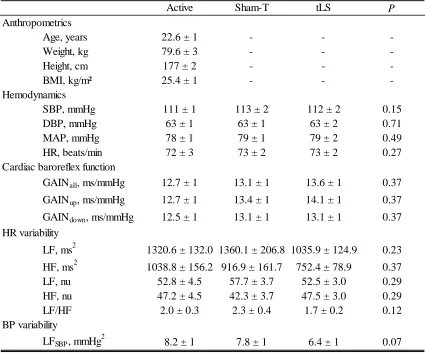
RESULTSBaseline characteristics of the subjects are present in Table 1. No significant differences are found in any resting physiological variables between active, sham-T and tLS protocols (P > 0.05). During both active tVNS and tLS, the range of the stimulation amplitude was between 40-50 mA, with an average of 45 ± 1 mA.
Active tVNS significantly increased cBRS GAINall (baseline: 12.7 ± 1
ms/mmHg; tVNS: 15.1 ± 1 ms/mmHg; recove/ry: 13.1 ± 1 ms/mmHg; Interaction P = 0.04, Fig. 2A black square) (∆24 ± 8%, active tVNS vs. baseline; P = 0.0159). In striking contrast, no changes were observed during sham-T (baseline: 13.1 ± 1 ms/mmHg; sham-T tVNS: 13.7 ± 1 ms/mmHg; recovery: 13.4 ± 1 ms/mmHg; Interaction P = 0.73, Fig. 2A white circles) (∆6 ± 5%, sham-T vs. baseline) or tLS (baseline: 13.6 ± 1 ms/mmHg; tLS: 13.9 ± 1 ms/mmHg; recovery: 13.8 ± 1 ms/mmHg; Interaction P = 0.23, Fig. 2A gray triangles) (∆3 ± 2%, tLS vs. baseline) protocols. Similarly, the gains for up (Fig. 2B) and down (Fig. 2C) sequences significantly increased during active tVNS (GAINup: ∆24 ± 11% vs. rest, P = 0.014; GAINdown: ∆26
± 7% vs. rest, P = 0.003), but was unchanged during either sham-T (GAINup: ∆8 ± 6%
vs. rest, P = 0.202; GAINdown: ∆4 ± 5% vs. rest, P = 0.257) and tLS (GAINup: ∆-2 ± 3%
vs. rest, P = 0.336; GAINdown: ∆7 ± 4% vs. rest, P = 0.072). The total number of
sequences was not significantly different between active tVNS, sham-T or tLS (125 ± 12 vs. 125 ± 11 vs. 122 ± 14 respectively, P = 0.93).
M
A
N
U
S
C
R
IP
T
A
C
C
E
P
T
E
D
tVNS vs. baseline; P = 0.004). However, HR was unchanged during sham-T (baseline: 73 ± 2 bpm; sham-T: 71 ± 1 bpm; recovery: 73 ± 1 bpm; Interaction P = 0.07, Fig. 3A white circles) (∆–1.5± 1% sham-T vs. baseline) or tLS (baseline: 73 ± 2 bpm; tLS: 73 ± 2 bpm; recovery: 73 ± 3 bpm; Interaction P = 0.38, Fig. 3A gray triangles) (∆–1.2 ± 1% tLS vs. baseline). Systolic BP was unchanged by either active, sham-T or tLS protocols (P > 0.05, Fig. 3B).
Consistent with previous publications, active tVNS significantly reduced LF/HF ratio, an index of sympathovagally-mediated oscillations in HR variability, and returned to baseline values during recovery (baseline: 2.0 ± 0.3; active tVNS: 1.53 ± 0.3; recovery: 2.43 ± 0.5; Interaction P = 0.02, Fig. 3C black squares) (∆–15 ± 12%, active tVNS vs. baseline; P = 0.014). On the other hand, no changes in LF/HF ratio were observed in either sham-T (baseline: 2.3 ± 0.4; sham-T: 2.65 ± 0.5; recovery: 2.87 ± 0.4; Interaction P = 0.50, Fig. 3C white circles) (∆23 ± 16%, sham-T vs. baseline) or tLS (baseline: 1.72 ± 0.2; tLS: 1.65 ± 0.2; recovery: 2.1 ± 0.3; Interaction P = 0.23, Fig. 3C gray triangles) (∆4 ± 10%, tLS vs. baseline) protocols. Interesting, both absolute (ms2) and normalized (nu) values for LF and HF components of HRV were unchanged during any conditions with exception of LF (ms2) which significantly increased during sham-T (∆48 ± 15%, vs. rest, P = 0.002) and trend to increase during tLS (∆29 ± 13%, vs. rest, P = 0.023), but was unchanged during active tVNS (∆4 ± 11%, vs. rest). Importantly, the respiration rate was unchanged during any of the conditions.
M
A
N
U
S
C
R
IP
T
A
C
C
E
P
T
E
D
M
A
N
U
S
C
R
IP
T
A
C
C
E
P
T
E
D
DISCUSSION
In accordance with our initial hypothesis, the present study shows that: 1) active tVNS acutely improves spontaneous cBRS; 2) LF/HF ratio is decreased by tVNS in healthy young men; 3) tVNS evokes slight decrease in HR; and 4) the aforementioned effects are specific to stimulation of ABVN.
A major finding of this study is that spontaneous cBRS increased in response to tVNS of the ABVN. The baroreflex is a closed-loop, negative feedback control system that constantly senses arterial pressure by baroreceptors in a beat-to-beat fashion and quickly regulates systemic arterial pressure physiologically to attenuate perturbations in arterial pressure [32]. Previous studies demonstrate that afferent VNS resets the baroreflex operating point and induces sympathoinhibition in animal models [20, 33]. A striking outcome of the current study was that increases in BRS were evident even with non-invasive VNS. Further these effects were observable even in healthy young men, who would be expected to have a strong baseline cBRS. Since BRS decreases with disease [34] and age [35], this suggests that tVNS could provide a significant opportunity to improve BRS in an inexpensive and non-invasive approach that could be generally applicable.
M
A
N
U
S
C
R
IP
T
A
C
C
E
P
T
E
D
precise mechanisms underlying the main findings of the present study are not fully understood, but some relevant points should be considered.
The central circuitry associated with tVNS autonomic effects might involve activation of the NTS by ABVN afferents. Since the baroreceptor afferent fibers join their respective glossopharyngeal nerve and also project to the NTS, tVNS might potentiate the effectiveness of cBRS at the NTS level [15], again consistent with activation of NTS by tVNS [36]. In addition, this could activate the caudal ventrolateral medulla to inhibit the rostral ventrolateral medulla and thus reduce sympathetic output to both the heart and peripheral vasculature [15, 37]. Furthermore, the NTS could also activate the dorsal motor nucleus of the vagus and the nucleus ambiguus to increase cardiac parasympathetic activity [38]. In support of this idea, Clancy et al. [21] demonstrated a significant attenuation in muscle sympathetic nerve activity evoked by tVNS, which may attenuate α-adrenergic receptors constrictor function in blood vessels and thus decrease peripheral vascular resistance. Considering our findings, the aforementioned physiological responses can be responsible for the small decreases in HR, the increases in cardiac autonomic modulation and spontaneous cBRS observed during active tVNS.
M
A
N
U
S
C
R
IP
T
A
C
C
E
P
T
E
D
In this sense, men tend to have a higher baseline LF/HF than women [41]. The reasons of these discrepancies are unclear, but some aspects should be considered. For example, it has been shown that body posture may change the autonomic and hemodynamic control [42, 43], and our subjects were seated while Clancy et al. [21] performed tests in a semi-supine position. We decided to perform experiments in a seated position due the fact that it is likely possible that people will conduct tVNS whilst watching TV or other such daily activity (i.e., external validity). In addition, our subjects were healthy, young and male, and the sample of Clancy et al. [21] was composed by both male and female subjects with a range of age between 20 to 62 years. Furthermore, the present study added a sham protocol that minimizes the sensory effects of tVNS (i.e., tLS) which was not performed by the Clancy study.
Limitations
M
A
N
U
S
C
R
IP
T
A
C
C
E
P
T
E
D
sensitivity using the sequence technique at rest and during perturbations [44-46], and the sequence method has been shown to correlate with the Oxford technique [47]. Perspectives
The improvements in cBRS and sympathovagal balance caused by tVNS have clinical implications. Several cardiovascular disease states are accompanied by autonomic dysfunction, characterized by an impairment in cardiac baroreflex sensitivity, increased sympathetic nerve activity and parasympathetic withdrawal (e.g. hypertension, coronary artery disease, heart failure, diabetes and obesity) [1, 3, 4, 20]. In addition, cardiac autonomic dysfunction is a powerful predictor of mortality in patients with cardiac disease [48, 49], and in older people with low cardiovascular risk [50].
In this regard, non-pharmacological approaches (i. e., exercise and diet regimens) have been consistently shown to improve cBRS and autonomic modulation [51-53]. More recently, a promising strategy to promote beneficial outcomes for a range of conditions is the electrical stimulation of vagus nerve. Although VNS has been suggested for potential complementary treatment of a broad range of conditions including epilepsy, depression, Alzheimer’s disease, heart failure, inflammation, chronic pain, diabetes, tinnitus and obesity [5-12], the mechanisms involved in the efficacy of this technique remain unclear.
Conclusions
M
A
N
U
S
C
R
IP
T
A
C
C
E
P
T
E
D
sympathovagal balance could play a role in the mechanisms involved in previously reported beneficial outcomes caused by tVNS. Future studies are needed to confirm these findings in older and diseased populations.
ACKNOWLEDGMENTS
The time and effort expended by all the volunteer subjects is greatly appreciated. This study was in part funded by CAPES and FAPDF.
DISCLOSURES
M
A
N
U
S
C
R
IP
T
A
C
C
E
P
T
E
D
REFERENCES[1] Esler M, Rumantir M, Wiesner G, Kaye D, Hastings J, Lambert G. Sympathetic nervous system and insulin resistance: from obesity to diabetes. Am J Hypertens. 2001;14:304s-9s.
[2] Mancia G, Grassi G, Giannattasio C, Seravalle G. Sympathetic activation in the pathogenesis of hypertension and progression of organ damage. Hypertension. 1999;34:724-8.
[3] Olshansky B, Sabbah HN, Hauptman PJ, Colucci WS. Parasympathetic nervous system and heart failure: pathophysiology and potential implications for therapy. Circulation. 2008;118:863-71.
[4] Katsube Y, Saro H, Naka M, Kim BH, Kinoshita N, Koretsune Y, et al. Decreased baroreflex sensitivity in patients with stable coronary artery disease is correlated with the severity of coronary narrowing. Am J Cardiol. 1996;78:1007-10.
[5] Ardesch JJ, Buschman HP, Wagener-Schimmel LJ, van der Aa HE, Hageman G. Vagus nerve stimulation for medically refractory epilepsy: a long-term follow-up study. Seizure. 2007;16:579-85.
[6] Boon P, Moors I, De Herdt V, Vonck K. Vagus nerve stimulation and cognition. Seizure. 2006;15:259-63.
[7] De Ferrari GM, Crijns HJ, Borggrefe M, Milasinovic G, Smid J, Zabel M, et al. Chronic vagus nerve stimulation: a new and promising therapeutic approach for chronic heart failure. Eur Heart J. 2011;32:847-55.
[8] De Herdt V, Bogaert S, Bracke KR, Raedt R, De Vos M, Vonck K, et al. Effects of vagus nerve stimulation on pro- and anti-inflammatory cytokine induction in patients with refractory epilepsy. J Neuroimmunol. 2009;214:104-8.
[9] Engineer ND, Riley JR, Seale JD, Vrana WA, Shetake JA, Sudanagunta SP, et al. Reversing pathological neural activity using targeted plasticity. Nature. 2011;470:101-4. [10] Kirchner A, Birklein F, Stefan H, Handwerker HO. Left vagus nerve stimulation suppresses experimentally induced pain. Neurology. 2000;55:1167-71.
[11] Hein E, Nowak M, Kiess O, Biermann T, Bayerlein K, Kornhuber J, et al. Auricular transcutaneous electrical nerve stimulation in depressed patients: a randomized controlled pilot study. J Neural Transm. 2013;120:821-7.
[12] Huang F, Dong J, Kong J, Wang H, Meng H, Spaeth RB, et al. Effect of transcutaneous auricular vagus nerve stimulation on impaired glucose tolerance: a pilot randomized study. BMC Complement Altern Med. 2014;14:203.
[13] Ben-Menachem E, Revesz D, Simon BJ, Silberstein S. Surgically implanted and non-invasive vagus nerve stimulation: a review of efficacy, safety and tolerability. Eur J Neurol. 2015;22:1260-8.
[14] Spuck S, Tronnier V, Orosz I, Schonweiler R, Sepehrnia A, Nowak G, et al. Operative and technical complications of vagus nerve stimulator implantation. Neurosurgery. 2010;67:489-94.
[15] Murray AR, Atkinson L, Mahadi MK, Deuchars SA, Deuchars J. The strange case of the ear and the heart: The auricular vagus nerve and its influence on cardiac control. Auton Neurosci. 2016;199:48-53.
M
A
N
U
S
C
R
IP
T
A
C
C
E
P
T
E
D
[17] Stefan H, Kreiselmeyer G, Kerling F, Kurzbuch K, Rauch C, Heers M, et al. Transcutaneous vagus nerve stimulation (t-VNS) in pharmacoresistant epilepsies: a proof of concept trial. Epilepsia. 2012;53:e115-8.
[18] Zamotrinsky AV, Kondratiev B, de Jong JW. Vagal neurostimulation in patients with coronary artery disease. Auton Neurosci. 2001;88:109-16.
[19] Fang J, Rong P, Hong Y, Fan Y, Liu J, Wang H, et al. Transcutaneous Vagus Nerve Stimulation Modulates Default Mode Network in Major Depressive Disorder. Biol Psychiatry. 2016;79:266-73.
[20] Saku K, Kishi T, Sakamoto K, Hosokawa K, Sakamoto T, Murayama Y, et al. Afferent vagal nerve stimulation resets baroreflex neural arc and inhibits sympathetic nerve activity. Physiol Rep. 2014;2.
[21] Clancy JA, Mary DA, Witte KK, Greenwood JP, Deuchars SA, Deuchars J. Non-invasive vagus nerve stimulation in healthy humans reduces sympathetic nerve activity. Brain Stimul. 2014;7:871-7.
[22] De Couck M, Cserjesi R, Caers R, Zijlstra WP, Widjaja D, Wolf N, et al. Effects of short and prolonged transcutaneous vagus nerve stimulation on heart rate variability in healthy subjects. Auton Neurosci. 2016.
[23] Meissner K. The placebo effect and the autonomic nervous system: evidence for an intimate relationship. Philos Trans R Soc Lond B Biol Sci. 2011;366:1808-17.
[24] Peuker ET, Filler TJ. The nerve supply of the human auricle. Clin Anat. 2002;15:35-7.
[25] Joyner MJ, Wallin BG, Charkoudian N. Sex differences and blood pressure regulation in humans. Exp Physiol. 2016;101:349-55.
[26] Teixeira AL, Ramos PS, Vianna LC, Ricardo DR. Effects of ovarian hormones and oral contraceptive pills on cardiac vagal withdrawal at the onset of dynamic exercise. PLoS One. 2015;10:e0119626.
[27] Teixeira AL, Ramos PS, Vianna LC, Ricardo DR. Heart rate variability across the menstrual cycle in young women taking oral contraceptives. Psychophysiology. 2015;52:1451-5.
[28] Kraus T, Kiess O, Hosl K, Terekhin P, Kornhuber J, Forster C. CNS BOLD fMRI effects of sham-controlled transcutaneous electrical nerve stimulation in the left outer auditory canal - a pilot study. Brain Stimul. 2013;6:798-804.
[29] Fisher JP, Ogoh S, Junor C, Khaja A, Northrup M, Fadel PJ. Spontaneous baroreflex measures are unable to detect age-related impairments in cardiac baroreflex function during dynamic exercise in humans. Exp Physiol. 2009;94:447-58.
[30] Heart rate variability: standards of measurement, physiological interpretation and clinical use. Task Force of the European Society of Cardiology and the North American Society of Pacing and Electrophysiology. Circulation. 1996;93:1043-65.
[31] Stauss HM. Identification of blood pressure control mechanisms by power spectral analysis. Clin Exp Pharmacol Physiol. 2007;34:362-8.
[32] Kamiya A, Kawada T, Shimizu S, Sugimachi M. Closed-loop spontaneous baroreflex transfer function is inappropriate for system identification of neural arc but partly accurate for peripheral arc: predictability analysis. J Physiol. 2011;589:1769-90. [33] Kawada T, Li M, Zheng C, Shimizu S, Uemura K, Turner MJ, et al. Chronic vagal nerve stimulation improves baroreflex neural arc function in heart failure rats. J Appl Physiol (1985). 2014;116:1308-14.
M
A
N
U
S
C
R
IP
T
A
C
C
E
P
T
E
D
[35] Monahan KD. Effect of aging on baroreflex function in humans. Am J Physiol Regul Integr Comp Physiol. 2007;293:R3-R12.
[36] Frangos E, Ellrich J, Komisaruk BR. Non-invasive Access to the Vagus Nerve Central Projections via Electrical Stimulation of the External Ear: fMRI Evidence in Humans. Brain Stimul. 2015;8:624-36.
[37] Guyenet PG. The sympathetic control of blood pressure. Nat Rev Neurosci. 2006;7:335-46.
[38] Izzo PN, Deuchars J, Spyer KM. Localization of cardiac vagal preganglionic motoneurones in the rat: immunocytochemical evidence of synaptic inputs containing 5-hydroxytryptamine. J Comp Neurol. 1993;327:572-83.
[39] Mendelsohn ME, Karas RH. The protective effects of estrogen on the cardiovascular system. N Engl J Med. 1999;340:1801-11.
[40] Tenan MS, Brothers RM, Tweedell AJ, Hackney AC, Griffin L. Changes in resting heart rate variability across the menstrual cycle. Psychophysiology. 2014;51:996-1004. [41] Koenig J, Thayer JF. Sex differences in healthy human heart rate variability: A meta-analysis. Neurosci Biobehav Rev. 2016;64:288-310.
[42] Abad C, Kobal R, Kitamura K, Gil S, Pereira L, Loturco I, et al. Heart rate variability in elite sprinters: effects of gender and body position. Clin Physiol Funct Imaging. 2015.
[43] Son JT, Lee E. Comparison of postprandial blood pressure reduction in the elderly by different body position. Geriatr Nurs. 2013;34:282-8.
[44] Herpin D, Ragot S. Mid- and long-term reproducibility of noninvasive measurements of spontaneous arterial baroreflex sensitivity in healthy volunteers. Am J Hypertens. 1997;10:790-7.
[45] Holwerda SW, Reynolds LJ, Restaino RM, Credeur DP, Leidy HJ, Thyfault JP, et al. The influence of reduced insulin sensitivity via short-term reductions in physical activity on cardiac baroreflex sensitivity during acute hyperglycemia. J Appl Physiol (1985). 2015;119:1383-92.
[46] Iellamo F, Legramante JM, Raimondi G, Castrucci F, Massaro M, Peruzzi G. Evaluation of reproducibility of spontaneous baroreflex sensitivity at rest and during laboratory tests. J Hypertens. 1996;14:1099-104.
[47] Davies LC, Francis D, Jurak P, Kara T, Piepoli M, Coats AJ. Reproducibility of methods for assessing baroreflex sensitivity in normal controls and in patients with chronic heart failure. Clin Sci (Lond). 1999;97:515-22.
[48] La Rovere MT, Bigger JT, Jr., Marcus FI, Mortara A, Schwartz PJ. Baroreflex sensitivity and heart-rate variability in prediction of total cardiac mortality after myocardial infarction. ATRAMI (Autonomic Tone and Reflexes After Myocardial Infarction) Investigators. Lancet. 1998;351:478-84.
[49] De Ferrari GM, Sanzo A, Bertoletti A, Specchia G, Vanoli E, Schwartz PJ. Baroreflex sensitivity predicts long-term cardiovascular mortality after myocardial infarction even in patients with preserved left ventricular function. J Am Coll Cardiol. 2007;50:2285-90.
[50] Koopman JJ, van Bodegom D, Maan AC, Li Z, Ziem JB, Westendorp RG, et al. Heart rate variability, but not heart rate, is associated with handgrip strength and mortality in older Africans at very low cardiovascular risk: A population-based study. Int J Cardiol. 2015;187:559-61.
M
A
N
U
S
C
R
IP
T
A
C
C
E
P
T
E
D
[52] Sales AR, Silva BM, Neves FJ, Rocha NG, Medeiros RF, Castro RR, et al. Diet and exercise training reduce blood pressure and improve autonomic modulation in women with prehypertension. Eur J Appl Physiol. 2012;112:3369-78.
M
A
N
U
S
C
R
IP
T
A
C
C
E
P
T
E
D
Figure LegendsFigure 1. Experimental protocol of the study. A. The shaded area shows the distribution of the auricular branch of the vagus nerve to the external ear. B. Position of the electrodes which were placed on the tragus of the ear during active and sham-T protocols. C. Position of the electrodes which were placed on the ear lobe during tLS protocol.
Figure 2. Response of cardiac baroreflex sensitivity for all (GAINall, panel A), up
(GAINup, panel B) and down (GAINdown, panel C) sequences during the baseline, tVNS
and recovery in the active (black squares), sham-T (white circles) and tLS (grey triangles) protocols. All values are mean ± SE. *P < 0.05 tVNS vs. baseline in the active protocol.
Figure 3. Response of heart rate (HR, panel A), systolic blood pressure (SBP, panel B), sympathovagal balance, represented by the ratio between the low and high frequency components of heart rate variability (LF/HF, panel C), and low frequency component of systolic blood pressure variability (LFSBP, panel D) during the baseline, tVNS and
M
A
N
U
S
C
R
IP
T
A
C
C
E
P
T
E
D
[image:26.595.85.510.148.502.2]Table
Table 1. Baseline characteristics.
Values are means ± SE. BMI, body mass index; SBP, systolic blood pressure; DBP, diastolic blood pressure; MAP, mean arterial pressure; HR, heart rate; LF/HF, ratio between low and high frequency powers of heart rate variability; BP, blood pressure; LFSBP, low frequency component of systolic blood pressure variability; P, level of
significance (P < 0.05).
Active Sham-T tLS P Anthropometrics
Age, years 22.6 ± 1 - -
-Weight, kg 79.6 ± 3 - -
-Height, cm 177 ± 2 - -
-BMI, kg/m² 25.4 ± 1 - -
-Hemodynamics
SBP, mmHg 111 ± 1 113 ± 2 112 ± 2 0.15 DBP, mmHg 63 ± 1 63 ± 1 63 ± 2 0.71 MAP, mmHg 78 ± 1 79 ± 1 79 ± 2 0.49 HR, beats/min 72 ± 3 73 ± 2 73 ± 2 0.27 Cardiac baroreflex function
GAINall, ms/mmHg 12.7 ± 1 13.1 ± 1 13.6 ± 1 0.37
GAINup, ms/mmHg 12.7 ± 1 13.4 ± 1 14.1 ± 1 0.37
GAINdown, ms/mmHg 12.5 ± 1 13.1 ± 1 13.1 ± 1 0.37
HR variability
LF, ms2 1320.6 ± 132.0 1360.1 ± 206.8 1035.9 ± 124.9 0.23 HF, ms2 1038.8 ± 156.2 916.9 ± 161.7 752.4 ± 78.9 0.37 LF, nu 52.8 ± 4.5 57.7 ± 3.7 52.5 ± 3.0 0.29 HF, nu 47.2 ± 4.5 42.3 ± 3.7 47.5 ± 3.0 0.29 LF/HF 2.0 ± 0.3 2.3 ± 0.4 1.7 ± 0.2 0.12 BP variability
LFSBP, mmHg 2
M
A
N
U
S
C
R
IP
T
A
C
C
E
P
T
M
A
N
U
S
C
R
IP
T
A
C
C
E
P
T
M
A
N
U
S
C
R
IP
T
A
C
C
E
P
T
M
A
N
U
S
C
R
IP
T
A
C
C
E
P
T
E
D
Highlights
• Non-invasive vagus nerve stimulation (tVNS) is investigated as a therapy for a range of conditions.
• The mechanisms involved in positive outcomes of tVNS are not fully understood.
• We show that tVNS improves spontaneous cardiac baroreflex sensitivity in healthy men.