'
i
c0M (78) 309 f i na L
BnusseLsr 5 JuLy 1978
.i
,l
sffilAI"S
ffiffi
rl*..--ProposaL for a
COUNCIL DECISION
adopting a research and deveLopment prognamme for
the European Economic Community in the fieLd of reference
materials and methods (Community Buneau of Reference
-BCR) and appLied metroLogy (non-nucLear indirect action)
(1979-1982)
(submitted to the Counci t by the Commission)
-2-CONTENTS
Introductlon
Motivatlon and content
of
the proposalProject
I -
Reference materials and methods (BCR)Programme
Projec|- 2
-
Distribution
and management ofreference materials
Programme
Project 3
-
Applied metrologyProgramme
Proposal
for
a Council Decision adopting amultiannual research and development programme
for
the European Economic Communityln
the fleLdof
reference materlals and methods (gCn) and applledmetrology
Annex
3
5
5
9
r3
r3
15
16
r8
Annex If
Advisory Committee on Prograrune
Management
Opinion of the ACPM
24
INTRODUCTION
The programme on reference materj-als and methods (Community
eureiu oe Reference - BCR) was initially launched in 1973
for a period of three years (x) ; in 1976, a second phase
was ad;pted, covering a three-year period and ending on 31 December f978 (xx).
In broad outline, the objectives of the second Progralnme
can be defined as follows i
to develop reference materials and methods by drawing
on the knowledge and skill of public and private laboratories in the member countries;
to promote collaboration between bodi-es specializ\\g in thi; type of workr dD acti-vity which amounts in effect
to coordination;
to back up the national efforts j-n the field of reference materials with projects of interest to the community.
The term ,'reference material" is understood to mean a
material or substance, one or more properties of which are sufficiently well established to be used for the calibration
of an instrument or the verification of a, measurement method'
Reference materials are used in every brafrch of commercial, industrial, medical and scientific activiftV to verify the
;;;Gt
functionins and the accuracvof
inlslTYm:ll:-ildmeasurement methods, and to ensure that vplid comparisons
can be made of the results obtained by di]fferent
Iaboratories or in different countries'
]
The f irst period of the progranrme wa: . an ]initiation. phase:
it consistLa in defining-areas for which ]it was desirable
todevelopreferencematerialsrlayingdownruresor fio-eaure and preparj-ng a number of contracts for
experimental work.
x) Council Decision
**) coon"il Decision of
18 June L973' OJ L I89
-4-The second phase conslsted ln the development of the activities
under contract in important fields - e.9. those relevant to Lndustrial applications - which have resulted in certified
reference materials. New fields have been explored, one being
clinical chemistry (medical analyses), in which major projects
have been set i.n train.
The implementation of the progranme was backed up by the collaboration of the iIRC, which assists greatly in providing
secretarial services for worklng parti-es, evaluating
measurements and drafting certlfication reports.
In vj-ew of the very encouraging results of the indirect action prograrnme on reference materials and methods, it is proposed to fotlosr up this activity by allocatlng somewhat
ampler resources to itr notably in regard to personnel.
The result of this activity is to produce batches of samples
of reference materials whj-ch represent considerable assets.
It is now necessary to ensure those functions needed for
correct management of these assets (safe storage, dLstribution
and sale of reference materials).
Finally, it is proposed that for the first time research and
devetopment projects be undertaken in the field of applied
metrology. This will call for close collaboration between
specialized laboratories in the member countries. The
objective of the project will essentially be to lmprove the
accuracy and comparability of measurements, and to develop improved methods. It will be the technical and scientlfic
extension of the Community activities in the fieLd of legal
metrology. Without interfering with existing collaboration
projects under international agreements, it w111 supplement them when their possibilities are limited by lack of funds. In a first stage, this action could be of an exPerimental
nature with limited resources which should, however, be
MOTIVATION AND CONTENT OF THE PROPOSAL
PROJECT I
REFERENCE MATERIALS AI{D I/IETHODS (BCR)
Review of the results of the past progrilIune
The BCR progralnme on reference materials and methods has not
only succeeded in developing, by joint action, reference materials of Community-wide interest and of recognized quality, but has forged many links of collaboration in the Course of the work, resulting in a degree of harmonization of national activities.
The preparation of a BCR reference material is essentially
based on broad collaboration between the most expert public and private laboratories in the member
countries-Since the operations involved are highly specialized, only
a very small part of the progranme can be implemented on
the blsis of proposals received in response to public invitations to tender. Public calls for proposals have
not proved to be verY effective.
The projects are drawn uP gradually as needs become known
in discussions with experts and members of the Advisory
Conunittee.
When a project has been defined in broad outline with the help
of experts and potential participants, it is submitted to the
ACPM (x) for an opinion. Next, the participants meet.a number
of times to decldE on the details of implementation (method
of preparation, stability tests, methods of analysis,
orglniiation of the progiamme and procedure for processing the results). This is the basis on which the Cornmission
concludes contracts with each of the participants in the
measurement or analytical programme. When the experimental
work is completed and evaluated the Commission discusses the results with the contractors and experts to examine
whether these results warrant certj.fication of the property or Properties of the material. A draft report is submitted to I conunittee of experts, then, where appropriate' to the Certification Groupl and then to the ACP!'!.
(*)ecpu
-6-The decision to certify a reference material is taken by 't,he Commissi-on on the advice of the ACPM"
Each reference material is the subject of a report summarizing the results and conclusions of the work that Ied up to
certification. The reference materials are offered for sale
in the form of samples accompanied by a certificate and a
copy of the report.
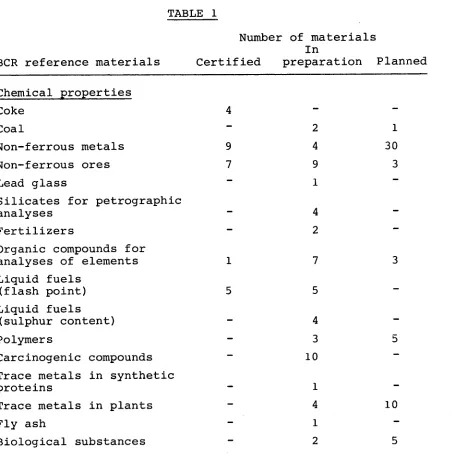
Tab1e I gj-ves some j-nformation on the reference materials
already certified as at 30 April L978 and those in
preparation or planned.
TABLE I
BCR reference materials
Number of materials
In
Certif ied preparation Plan:ned
Chemical properties
Coke
Coal
Non-ferrous metals
Non-ferrous ores Lead glass
Silj-cates for petrographic
analyses Fertilizers
organic compounds for
analyses of elements Liquid fuels
(f1ash point)
Liquid fuels
(sulphur content)
Polymers
Carci-nogenj-c compounds
Trace metals in synthetic proteins
Trace metals in plants
Fly ash
Biological substances
[image:6.586.60.532.253.712.2]BCR reference materials
Number of materials
In
Certified preparation Planned
Physical and technological properties
Thermal conductivity Dielectric
Magnetic susceptibility Coloured glass
Reflectivity
Powders
particle size
specific surface area
Porosity
Raman spectroscoPy
Vacuum measurement (gauges)
Impact Toughness
2 3 2
I I
6 6 5
I I t
Total 26 86 57
-8-The total number of projects relatlng to referenee materlarls and measurementg ls 52. They were the subject of I34 contracts
during the first phase (1973-75) and 228 contracts duri.ng the
period from I January L976 up to the date of this document.
As a rule - and this is also true for similar activities of national organlzations - the total duration of a project for
the preparation of a reference material from the definition
of the project to the certification of the product is abourt
three to four years. This explains why many reference materrials are in preparation and only some are fully certified. Becaruse
many laboratories participate in each project, several meertS.ngs
must be held to coordinate the work in whlch they have to collaborate. The need to ensure adequate coordination and to
evaluate the results puts high demands on Commisslon staffi
responsible for the management of the progranme and on JRC:
staff who make a substantial contribution to the work.
In addition to the batches of high-quality certified reference
materials produced, the benefits of these activitles inclurde the excellent collaboration established between the member
countries, the interest shown by specialized institutes in,
PROGRAIIII,IE
It is j-ntended that the proposed Programme will be
implemented in the'strme spirit of close collaboration belween the laboratories of the member countries as in
the past. The JRC will continue to be associated with
the projects according to its available expertise.
The research does not include any standardization work. This'
however, does not rule out projects relating to precision measurement, the results of which might prove useful later
on for standardLzation by the responsible bodies.
The activities envisaged in the Prograrnme will include :
a) Production and certification of reference materials
- definition of requS-rements for reference materials
through contacts with possible users and by exchanges
of iniormation on existing reference materials
- characterlzation of materials
- organization of inter-laboratory comparisons
approval of laboratories
- certification of reference materials at Community level
b) Devel nt of associated reference methods
Methods associated to reference materials, having margins-of error *hi;[ can be aelermined and are in any case small for chemical analyses, ProPerty measurements or testing'
Areas of activity
The areas of activity are selected so that BCR reference
materials and methodi meet one or several of the following criteria :
- help towards the implementation of sectoral policies
(e.g. environment, energy) t
- have recognized value in industry or in commercial
transactions;
facilitate the imptementation of regulations and directives for the removal oi technical barriers to trade;
- help to improve living condltions (public health,
-
10-Ferrous metals (objectives : ECSC, industry)
As in the past, the research will be restricted to those requirements which are not covered by the existing
organj-zations already collaborating under the provisions
of the ECSC Treaty. Hence this sector will not be a major
area of activity.
Non-ferrous metals (objectives : industry, commercial
ffi
There is no organized collaboration as in the case of iron and steel. The need for reference materials j-s an i-mportant
one, notably in regard to ores and refined metals (copper,
lead, zinc, etc.).
Non-metallic materials (objective : industry)
A number of problems are already bej-ng dealt with in the current activities. They relate in particular to glass and
ceramics. These do not seem to caII for any major effort.
rnorganic materials and products (objectives : industry,
implementation of directives, environment)
Under this heading it is proposed to include in particular problems relating to environmental protection, such as
reference samples for measuring heavy and toxic metals
in fumes, water or industrial and urban waste.
Organic materials and products (objectives : industry, implementation of directives, environment, energy)
This is a very wide field which will probably be the focus of a good deal of activity. Besides organic synthesis
products and the analytical problems they give rise to
(e.9. simultaneous presence of sulphur and halogens),
it is intended to give special attention to problems of environmental and consumer protection (e.9. heavy
and toxic metals in proteins and plants).
Foodstuffs (objective : implementation of directives)
No work has as yet been done on human and anj-mal foodstuffs under the BCR progranme. They are the subject of numerous
directives, however, the implementation of which will caII
Biomedical analyses (objective : public health)
The Community laboratories for biomedical .rr.ly=." (*) carry
out an average of I0 analyses (results) per person per year.
These analyses relate to a large number of biological substances or drugs present in biological fluids (bIood, urine, etc.) or in tissues (muscle, etc.).
The results sometimes vary appreciably from one laboratory to another. This is due to a certain extent to the absence
of adequate biological reference materials to check the accuracy of the routine method.s and to the lack of
sufficiently accurate methods.
According to some estimates, the number of required reference
materiats could amount to some hundred products for the most common analyses.
For the most frequently used compounds, there are existing
reference methods (gas chromatography combined with mass
spectrometry). These techniques can be used to produce
certified reference materials (carbohydrates, lipids, amino acj-ds, vitamins and inorganic compounds). Another
important requirement is for reference materj-als to determine
the presence in the blood of drugs used in long-term
treatment. For compounds of higher molecular weight (protein
group such as enzymes, protein hormones and coagulants) ' the methods are not yet satisfactory.
Physical and technological Propertigs of -m?lerials
-rc5j eCEIvesi
-industry, implementation of directives,
energy, environment)
There are relatively few certified reference materials
for physical properties that are publicly available. They
are sometj-mes provided by the manufacturers of equipment
or by private associations. Reference materials of wider availability would be very useful. There are reguirements with respect to optical properties, thermal, electrical or magnetj-c properties, and the precise characterization of porous or finely divided materials. In several of
these fields , work is already in progress and well
worth following up.
-L2-Staff and appropriations
The programme Reference lvtaterials and t"lethods (BCR) had a staff
of 7 members ( 4 e + I B + 2 C ) for the period L976-78.'fhe
total appropriation amounted Lo 2 r 7 m.illion EUA for three
years.
The staff allocated to this action was insuffj-cient and t.his r
fact was deplored on several occasions by the ACPM. In or{aler
to ensure adequately the role of coordination whiich is essen-tial and to undertake projects in the new fields of foodstuffs
and biomedical analysis as indicated in the progiamme, a
minimum increase of staff by one person of category A is proposed.
The appropriations for contracts were kept at the sErme le'uel
as for the years L977 and 1978, with an annual increase o:E
fOt including inflation.
Cost of staff (8 staff members) f.760.000 EUA
Ad.ministration and contracts 4.840.000 EUA
PRO'EET 2
DISTRIBUTION ATiID MAIiIAGEMENT OF REFERENCE MATERIALS
PROGRAMME
Reference materials certified by the Corununity are offered for sale by the Commission. This service' which will have to be placed on an established basis, involves
the following tasks 3
1. The setting up of a storage system for reference
materials. They will have to be stored in one or
more establishments with special expertise in the field of reference materials, such as the JRC and
speciallzed national laboratories. It will be necessary for the depository establlshments to have at their
disposal the qualified personnel necessary for the supervision and where necessary periodlc inspection of the reference materials.
In the event of storage in a JRC establishment the
BCR progranme could profit from the expertlse and
infrastructure existing by virtue of the METRE
progralnme. Provision should nevertheless be made
for the services strictly specific to the storage
and handling of reference materials for sale to be
chargeable to the BCR Programme.
If the materials were stored in other establishments'
the service provided by the body in question (super-vision of the preservation of products and the packing and despatch of samples) would have to be the subject
of contracts concluded with the Commission.
2. The development of an effLcient system for receivlng orders, foiwarding them to the storage location(s) '
preparing invoices, despatching samples, and drawing
-r
4-Although the Commission intends to use automated
management techniques as far as possible, the need
for a minimum staff cannot be ruled out.
3. The editing and dissemination of documents (catalogues, advertisements and annual reports on activities) to bring
the existence of reference materiars to the notice of
those concerned.
Staff and approprj-ations
To ensure an appropriate management of this actLon it. j-s
proposed to allocate to it a staff of I A + I B + I C. The estimated expenditure include rather high cdsts in the starti-ng phase for storage contracts and for setting
appropriate means of computarized management.
Cost of staff (3 staff members) 527.400 EUA
Administration and contracts 962.600 EUA
Total for 4 years L.490.000 EUA
In the long run the income from sales of reference materials
could compensate partly the management expenditures for
PRO\TECT 3
APPLIED METROLOGY
As yet there is no community sci-entific and techni-caI
prograrnme in the field of applied metrology except for
nuclear measurements (Central Bureau for Nuclear
Measurements CBNM).
commercial transactions, however, frequently require that
products be measured, weighed or analysed with sufficient
accuracy. Most industrial activities rely on still more
sophisticated measurements .
The i-mportance of "measurement" explains why one of the tasks the European Economic Community has set itself is that of harmonizing the rules and practices in the member countrj-es relating to measuri-ng instruments and methods
relevant to legar metrology. rn this field, which covers
those measurements whose accuracy is ruled by legal texts,
twenty-sj-x directives have been adopted by the Council.
They relate to i-nstruments for measuring 1ength, volume
(gas meters, water meters, etc.), weighl, electrj_cal_ energy and alcoholic strength.
The basj-c units are the subject of international agreements
and international collaboration, and there is no guestion of interfering with them.
This apart, applied metrology offers a fairly wide field in which it is j-mportant for the Community not just to improve measurement techniques and their accuracy, but
even more to sti-mulate collaboration with a vi_ew to
improving the comparability of exj-sting methods and
encouraging the joint development of new methods reguired
by technical progress. A variety of collaboration arrangements already exist but it appears important now to bring them to-gether, specially for those fields of applied metrorogy which correspond to Community objectives. In those fields wirere new
metrorogy needs arise, a close collaboration at community level would enable to make better use of existing means and
facilities (specially for expensive projects) and to ensure
homogeneous development of measurement technj_ques so that the
establishment of future community directives would be
-15-PROGRAII|ITE
Objectives
To promote metrology projects based essentially on
collaboration between laboratories
in
the"rnember countrieswith a view
to
:-
ensuring the equivalence and comparabilityof
secondarystandards and
transfer
standards;improving the accuracy
of
measurementsi-
developing metrologyin
areasof
importanceto
theCommunJ-ty
aand where projects are costly.
Projects
The progranune
is to
be put under way progressivelyin
the following areas.1.
Intercomparisonof
secondary andtransfer
st4ndardsfor
derlvedunits
of
measurementThis work would essentially concern
units
derived from thebase
units
such as force and pressure. Such intercomparisonwould
result in
improving mutual confidence Lnthe
level
of accuracyof
measurements madein
the various medber countries.It
could also leadto
an lmprovementln
theoverall
Levelof
accuracy.2.
Improvementof
measurement technlques andthelr
accuracy Thiswill
mainly consistof joint
researchin
areas ofCommunity
interest in
which the lmprovementof
measurenent accuracyis
a matterof
major economlc importance.For instance, although there
is
adirective in
force on gasmeters, the accuracy
that it
requiresls
not
suf,fLclentfor
very large gas flows under hlgh pressure (x).
(x)on uncertaLnty
of
onlylE
(current value)in
the meterS-ngof
rnillions
of
cubic metresof
gas can have seriousDifficult problems of this kind require large test facilities
which are very expensive and could not be fully used if they were reproduced in all member countries. It would therefore be
most useful for the Community to stimulate collaboration by a
financial support.
3. Development of new measurement techniques
With technological progress and changing condj-tions of lJ-fe,
new needs for methods of measurements are emerging in fields of importance for the Community. This applies to a variety of
topics (e.9. industrial metrology, safety regulations for equipment and regulations for environmental protection) for which there is a growing need for methods of measurement and
reference materials. Development costs in these new fields
of metrology may be very high and cost-sharing by means of
efficient collaboration could be extremely advantageous. In
this and other similar fields, the Community should be involved
at an early stage, for this would result in a more efficient
use of the skills and resources of the member countries.
Further-morer dn important consequence of such collaboration at an early
stage j-s to avoid the development of rules and standards that
differ from one country to another and are afterwards difficult to harmonize.
4. Exchange of personnel
Since collaboration depends not only on equipment but also on
individuals, it appears important to give special attention to and to encourage exchanges of personnel - perhaps specialists in the context of the programme itself. They would continue to
receive their salary from their own employer, but would benefit
from Community allowances to cover expatriation costs.
Staff and appropriations
Because metrology problems often involve difficult commercial and regulation aspects, they should be treated with great care.
In additj-on the projects should be set up so as to include a
close collaboration between the partners.
The minimum personnel to start this action is 2 A + f C officials.
The appropriations for contracts are evaluated at a modest level. In fact the unit cost of metrology projects could be very high due to the fact that they will always involve several laboratories
and require high accuracy measurements.
Cost of staff (2 a + r c)
Administration and contracts
Total for 4 years
665.000 EUA
-18-PROPOSAL FOR A COUNCIL DECISION
ADOPTING A MULTIANNUAL RESEARCH A}ID DEVELOPMENT PROGRAMI4E FOR THE EUROPEAN ECONOMIC COMMUNITY
IN THE FIELD OF REFERENCE MATERIALS AND II'IETHODS (BCR) AND
APPLIED METROLOGY
(ind.irect action)
COUNCTL DECISION
adopting a research and development progranme
for the European Economic Community in the field of
reference materials and methods
(Community Bureau of Reference - BCR)
and applied metrology
(non-nuclear indirect action)
(L979-1982)
THE COUNCIL OF THE EUROPEAN COMMUNITTES,
Havi-ng regard to the Treaty establishing the European
Economj-c Community, and in particular Article 235 thereof, Having regard to the proposal from the Commission,
Having regard to the opinion of the European Parlj-amerrt(I),
Having regard to the opinion of the Economic and Social committee Q) ,
Whereas according to Article 3 (a) and (h) of the Treaty,
the activities of the Community shall include, inter aLia,
the eliminationr ds between Member States, of quantitative
restrictj-ons on the import and export of goods, and of all other measures having equivalent effect, together with the
approximation of the laws of the Member States to the extent required for the proper functioning of the common market;
-?0-Whereas the research projects covered by this Decision are of such a
nature as to make an effective contribution to the carrying out of
these Community tasks and whereas, therefore, they are necessary for the achievement, within the Common Market, of the said objectives;
whereas the Treaty does not provide the necessary powers for
thi s purpose;
Whereas, in its ResoLution of 14 January 1974 on a first action
programme of the European Communities'in the fieLd of science and
(3)
tecnnoLogy , the Counci L stated that the whoLe range of avai LabLe
ways and means, incLuding 'indirect action, shouLd be used as
app rop r i at e;
lljhereas the Scientific and TechnicaL Research Committee (CREST) has
deLivered an opinion on the Commission proposaL,
HAS DECIDED AS FOLLOI,JS:
ArticLe 1
A research and deveLopment programme for the European Economic
Community in the fieLd of reference materiaLs and methods and of appLied metroLogy, as defined in the Annexr'is hereby adopted for a
period of four years with effect from 1 January
1979-Arti cle 2
The upper Limit for commitments for expenditure and the maximum
number of staff necessary for the 'impLementation of the programme
are estimated at 11.3 miLLion European units of account and 14 staff
respectiveLy, the European unit of account being defined in the FinanciaL ReguLations in force,
Article 3
The Commission shall be responsj-ble for the implementation of the programme. It sha1l be assisted in this task by the
Advisory Committee .on Programme Management set up by the
Council Resolution of f9 November L973, the terms of
reference of which are set out in the Resolution of
( 4'l
f8 JuIy L977'"'. The Joint Research Centre (JRc) shaLL r"emain
associated with the 'impLementation of the p.og.urr"(5). Article 4
During the third year the programme shall be reviewed and
possibly revj-sed in accordance with the appropriate procedure and after consultation of the Advisory Committee on Programme Management.
Article 5
The information resulting from the implementation of the progranme shal1 be dj-sseminated in accordance with Councj-l
Regulation (EEc) No 2380/74 ot 17 September 1974 adopting
provisions for the dissemination of information reLating to research
programmes for the European Economic Commun'ity(6).
Done at Brussels, For the Council The President
(4) OJ No C I92, II.8.L977, p. I
(5) OJ No L 200, 8.8.L977, p. 7
-22-Annex
Reference materials and methods (Community Bureau of Reference BCR)
and applied metrology
(Non-nuclear j-nd.irect actj-on)
The progranme comprises three projects as described below. The first two are activities of the Community Butreau of
Reference.
The aim of the programme defined below is to strengthen'
supplement and harmonize national efforts in the field
of reference materials, analytical and measuring methods
and applied metrology.
1. Reference materials and methods
This project shal1 include the following activities :
- exchange of informatj-on on reference materj-a1s and methods
and in particular on national activities in these fiel<ls;
- determination of the requi-rements for reference materials
and methods;
- characterization of materials;
- organization of inter-laboratory comparisons; joint preparation of reference materials;
- certification of the properties of reference materials
at Community level;
2. Management and distribution of Community reference materials
Storage and preservation of BCR reference materials in JRC laboratories and national laboratories;
Preparation of information to be disseminated to publicize
reference materials by suitable means within and outside
the Communi-ty;
- Dj-stribution of samples.
3. Applied metrology
This project comprises the following activities :
Inter-laboratory comparisons of secondary and transfer
standards for derived units of measurement;
Improvement of measuring techni-ques and their accuracyi - Development of ne\d measuri-ng techniques;
- Exchange of information and exchange of scientifj-c personnel.
-24-AIiINEX I
ADVISORY COMMITTEE ON PROGRAMME MANAGEMENT
The terms of reference of the commi-ttee are set out in the
Council Resolution of 18 July L977.
rts powers extend to the non-nuclear part of the programne
on measurements, standards and reference techniques (METRE) (direct actj-on) and to the programme on reference materiars
and methods (BCR) and applied metrology.
rf necessary, the Member states will review the composj-tj-on
of their delegations to this Committee so that they can
ANNEX II
OPINION OF THE ACPM
The ACPM is of the unanimous opinion that the results of the current BCR programme are very satisfactory. The reference
materials prepared and certified up to now appear to have
aroused interest not only in the Community but also in non-member countries. The ACPM wishes to stress that the
implementatj-on of the BCR programme has provided an
opportunity for very fruitful cooperation, which should
be continued and extended, between experts and participating laboratories of the member countries.
The work in the field of reference materials and associated methods should therefore be actively continued.
The ACPM is unanimously in favour of the progranme proposed
by the Commission and approves the options outlj-ned for projects 1 and 2 on reference materials and associated methodsr €rs regards both their technical content and the
staffing and budgetary implications.
The ACPM is also in favour of the Commission proposal that
cooperation be promoted by way of indirect action in those
fields of applied metrology which are regarded as appropriate,
where a specific need arises and where the planndd activitj-es will not interfere with national efforts or existing
-rv-FIIfANCIAT NECORD
1. ntsIEVAllll HJDGET IIEADING COIE : 3353.
2. TIILE 0F HIDGET I{EADING : Reference naterials and nethods (nCn)t
applieil netrolory,
3. L;EGAL SASIS :
-In application of Article ?35 of the treaty establishing the EEC
-CounciL Decision of 1! lrlarch L976 (L January L976 - 31 December :19?8)
-Council Decision of
4. TBSCRIPII0N, 0BJECTIIIE AUD JIISEFICAIION 0F IIIE PROJECT :
4.1. !gegr&I&!
fhe project relates to
- the preparation, ln close col-Laboration between the member
countries, of reference nateriaLs of interest to the Commu:rity;
- the joint d.eflnition of reference method.s;
- characterization of naterials;
- clistribution of certified. reference specimens resulting from
the progrannei
- research in the fieltL of appJ-ied. metrology. 4.2.
9Ei@
- to promote the preparation of reference naterials and refe:rence nethod.s at Commu:rity level;
- to develop cooperation and. oonseguently coord.ination betwer:n
national aotivities in the fielci of reference materials an<1 appl-ied netroi.oryl
- to back up nationa,l efforts \r projects of interest to the
Connunity especially in respect of particularly costly pro,jects.
4.3. Justification
To facilitate cornmercial transaotions and ind.ustrial operations and.
ensure efficiently rned,ical care and environmental protection,, it is necessary to have reliable method.s of analysis and measurement.
llb ensure that results are conparable in d.ifferent parts of :bhe
Comnunity, the method.s and lnstruraents used. have to be calib::ated.
\r means of reference naterlals.
llhe Communityts efforts in the way of harmonization d.irectives have *
to be backed. up by technical and scientiflc work designed to facili-tate corect inplenentation of the d.irectives and. the clevelopment
of ad.equate methocls of measurement.
5. FIISAIICLAL IMPIICIfiIONS OI. mE FRO.XECt IIt gUA (at cunent prices)
5.0.
!.0.0. lbta1 cost over the full period.
- to the comnunity bridept : 1113001000 EIJA
- to national administrations : I erooorooo EuA - to other sectors at national Level : J
Itotal cost : 13r3001000 EUA
).0.1. Multiannual tirnetable
Appropriations for corunitment
r979 1980 1981 tg82 tbtal
Personnel Administrative operations Ibchnical operations Contracts 640,400 245|OOO 55,000 t,875,500 727,600 262|OOO 59'o@ 2,098,000 768r4OO 277 |OOO
62r0oo
2,28?1000
816,ooo
294|OOO
55, ooo 755, roo
2t952r4OO 1, o78rOO0
?42rOOO
7 tO27 ,600
ttotal 2,815, t)00 i,146,600 3,394,400 r r 942, 100 l_1r300r000
Appropriations for paSnnent
t979 1g80 1981 LgB2 r.983 lllotal
Pensor:neI Administrativt operations tbchnical operations Contracts 640,4oo 245|OOO 55,0O0 t ,075, 5o0
727 r5OO
262p}o 59r000 l_,393,O00 768,400 2?7,OOo 52,ooo 1, 887,0O0 815r0oo 294|OOO 65,ooo t,880,ooo 791,100 2t952t4OO 1,0?B,ooo ?42rOOO
7 rO27 r5}o
-VI-J.O.2. Method. of calsulation
a) Personnel costs
Ihe staff reguired for this progtanme has been estim&ted. at :
staff in category.A
staff in category B
sta.ff in category C
the A staff camprises flve persons for project Ir on$ person for
project 2 and. two persons for project 3.
the previous prog?a^nme 1975f1978 for ruhich
quite inad.equat€o One extra member of staff
one A for project 2 and two A for project l
if these operations are to be success:Pul.
been evaluated. proportionately.
In calculating the relevant expend.iture, account has been taken of the pararneters laid. d.own for the preparation of the prelf-ninary clneft
hrd.gBt for 1979. $o lncrease tn purchasing power is foreseen. Only
a variation in weighting has been taken into consid.efation to allow
for changes in the gpneral price level in the Community.
b) Expend.iture on adninistrative and technical operations
fhese cover costs of travel, missions and. the organipation of meetings
and the use of a scientific and technical support whbn this is
essential for the proper execution of the prog?a;rxne. c) Contract expend.iture
As the type of subject ancl qualifications of the contract hold.r:rs vary a uniform method. of caloulation cannot be used..
In any case, the Ad.visory Comnittee on Programme Management wi.Ll be
consulted. on the al-location of appropriations.
a) Uultia"nnual forecasts
I
2
4
Project I correspond.s to
the staff allocation was
is essential. A staff of are the absolute minimum
fhe B a^nd C staff have
The rates adopted L979
-
1.07; 1980for the
- 1.13;
7.
8.
!.1. Inplications in respect of revenue
For infornation purposes, it is pointecl out that sone revenue i6 to be expected. (see point 8).
6. TYFE OF CONMOT rc 3E APPTIED Scientific controls : ACP!{
responsible offioial.s of DC XII
Adninistrative controls :
Buclgetary execution : General Direotorate for Financial Control
aegulariiy of expenditure : GeneraL Direotorate for Fina^ncial Control
FINANCING ITIE PROJECT
J.0.
?.1. 7.2.
?.3. Appropriations to be entered in firture brdgBts
NEIIENUE
8.r. Iegef-@,
Artiotes 3(1), Iast paragraph of 8? ana !O(4) of the Financial
Regulation of 21 Decenber L977.
8.2. f\rpe of revenue
The revenue r:nd.er this progranne will come from the services suppLietl
upon request and against palrorent for public or private und.ertakings or bod.ies.
fhis revenue wiLl- be used. to cover the
3388 of the statement of expenditure.
the revenue wilL be entered. in Chapter
8.3. Amount of revenue
ltJ! token entry
1t80 token entry
1981 token entry
1982 token entry 8.4. Methocl of calculation
In I)ll, the revenue amounted. to 11 271.35 EUA. It is not possible to
prepare valitl forecasts for revenue in L979 and future Jrears since
it wiff depend essentiaLly on the requests made to the Conmisslon which in principle cannot be estturatetl. at the present time.
expend.iture entered. in Iten
92 of the Brrdget (.erticf e 924),
a