COMMISSION OF THE EUROPEAN COMMUNITIES
studies
COMMISSION OF THE EUROPEAN COMMUNITIES
It
./
The aspects of establish,ment,
planning and control
of urban retail outlets in Europe/
:111. ·I Jr 1
r
This publication is also available in
DE ISBN 92-825-0290-2 FR ISBN 92-825-0292-9 IT ISBN 92-825-0293-7 NL ISBN 92-825-0294-5
A bibliographical slip can be found at the end of this volume
©Copyright ECSC- EEC- EAEC, Brussels-Luxembourg, 1978
CONTENTS
INTRODUCTION
.
.
. .
.
.
.
.
.
.
.
. .
.
.
.
.
.
.
.
.
I.
II.
RECENT DEVELOPMENTS
.
.
.
.
.
.
.
.
. . .
. .
.
. .
.
. . .
.
A. GENERAL FACTORS •....
. . .
.
.
. .
.
.
.
. .
.
Rise in the standard of living
.
.
Urban developmentThe private car •
....
.
.
.
B. SUPERMARKErS AND SUPER-STORES
.
.
.
.
.
.
.
.
.
.
.
. . .
C. THE DEVELOPMENT OF THE WHOLESALE TRADE
. . .
.
. .
. .
.
.
ACTION BY THE AUTHORITIES.
.
.
. .
.
.
.
.
.
. .
.
.
.
.
. .
A. COUNTRIES WITHOUT SPEX:IFIC REGULATIONS. . . .
.
. .
.
.
.
a) Germany • • • •
....
.
. .
.
.
.
b) United Kingdom •.
.
.
..
c) Ireland • • • • • • •. . .
.
.
.
.
.
d) Netherlands • • • • • •.
.
.
. .
.
. .
. .
.
.
.
B. COUNTRIES WITH SPEX:IAL LAWS
a) Luxembourg
.
.
.
. . .
.
.
.
.
.
.
b) Italy
.
• •
.
. .
.
.
.
c) France.
. .
.
.
.
.
.
....
d) Belgium.
.
•
.
. .
.
.
.
.
.
. . .
III. PROSPECTS
. .
.
.
. .
.
.
.
.
.
.
.
.
.
. .
. .
.
.
.
.
. .
.
A. THE URBAN SECTOR.
.
. . .
. . .
.
.
.
.
.
.
.
. .
.
.
. .
B. THE RURAL SED TOR.
.
. .
. .
.
.
.
. .
.
. .
... .
C. THE WHOLESALE TRADE. . .
.
.
.
.
.
.
.
. . .
. .
.
.
. . .
CONCLUSION.
.
.
.
. .
. .
.
. .
.
. .
. . .
. .
.
.
. .
. .
.
.
.
.
ANNEXES.
.
.
.
.
.
.
. .
. .
.
.
. .
.
.
. .
.
. .
.
.
. .
. .
. .
5
7
7
7
7
78
10 12 12 12 12
13 13
14
14
14
16
17
20 20 20
21
23
INTRODUCTION
Almost everywhere in Europe the pattern of trade has undergone profound changes marked, on the one hand, by a process of selection and, on the other, by the appearance and spread of new types of establishments and new selling methods. The main development in recent times in the majority of Community countries has been the growth of self-service super-stores selling high-volume products on small margins. And yet today a change is often to be seen in ideas about expected developments. People are once again becoming more interested in specialized establishments, which are largely found in the traditional commercial centres of urban areas. These areas have a wide range of facilities and activities. It would appear that many firms will in future be more attracted by the idea of neighbourhood services than by costly out-of-town developments involving lengthy procedures and uncertain outcome. Europe's trading facilities, meaning the sum-total of wholesale and retail firms, have developed along very different lines depending on the Member States concerned. At the beginning of 1972 the Nine had 3 102 900 outlets -12.2 per thousand inhabitants. Contrary to popular belief, the commercial system in France does not operate on a vast scale and on average ranks with that of the Netherlands. On the other hand, the relatively low density of the facilities in Germany and Ireland contrasts vividly with the relative super-abundance of establishments in Belgium and Italy. There are significantly fewer food stores than non-food stores in the United Kingdom and, especially, the Netherlands. The opposite is true in Ireland and Italy, whereas there is a fairly even balance between the two categories in Belgium, Luxembourg and France. In the Federal Republic of Germany, one third of the retail trade is accounted for by food stores and two thirds by non-food stores. Average selling area is highest in Germany and lowest in Italy. A general reduction has been taking place in recent years, especially in the food sector. In Germany nearly 7 000 small food outlets close yearly. Yet the number of specialized non-food outlets is on the increase in Belgiun, France and the United Kingdom. In the wholesale sector there is a gener·al trend towards concentration, with the exception of Italy, where the nu,nber of outlets continues to increase.
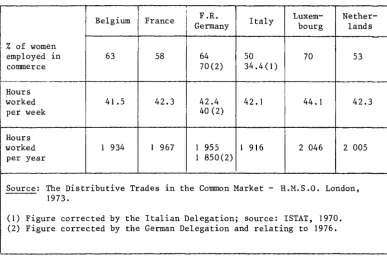
In 1971, the retail trade employed differing proportions of the total active population, depending on the country. In the Netherlands, the figure was approximately 16 %, falling to ll %in Italy and 10% in the United Kingdom. Generally speaking, the number of employed staff is increasing. It exceeds 75 % of the active population in the Federal Republic of Germany and 70 % in France and the Netherlands, but drops to 39 % in Italy, where the proportion of self-employed persons (plus non-wage-earners) is still very large; it is also still considerable in Belgium. The number of working women is also tending to increase: in France, for example, the figure is 56.6 % and in Belgium 46.8% (in the retail trade). In the wholesaling the figures are 28.9 % for France, approximately 25 % for Belgium and nearly 20
%
for the Netherlands.I. R~ENT DEVELOPMENTS
EUropeans have seen their living conditions change radically in the post-war period. The resulting change in their purchasins habits fostered the
emergence of new types of trading facilities. other factors operated to the same effect:' technical progress, industrialization and the concentration of businesses, the reduction in working hours and the growing proportion of working women.
A • GENERAL FACTORS
Rising standards of living, urban development and the use of private cars have been the main factors exerting a direct influence on the creation of shopping outlets.
- Rise in the standard of li vin.g
In the ten years from
1966
to1975
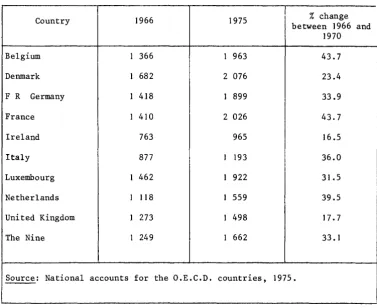
per capita consumption by the private final consumer rose by more than33
%
throughout Europe, according to the O~D.The highest increases were in Belgium, France, the Netherlands, Germany and Italy, the lowest in the United Kingdom, Denmark and Ireland.
Nowadays the vast majority of EUropean households ow.n a refrigerator, a television, a washing machine and a car.
- Urban development
Urbanization was rapid after the war, mainly caused by p0pulation drift from the countryside and the increase in population. The poralation of the Nine is at present 258 million, with the highest density per km2 in the Netherlands and Belgium. Next come the Federal Republic of Germany and the United Kingdom. Population density is lowest in France and Ireland. The vast majority live in urban areas. To meet the increased demand for housing, cities have greatly extended their boundaries while attempting to adapt themselves to the require-ments of modern urban development. Urban growth has spawned new residential areas, not alw~s provided with neighbourhood shops, their place being taken by suburban super-stores. In most cases, the new types of outlets require more selling area per person.
- The private car
This has radically changed habits in most countries of Europe. Consumers are attracted by the idea of consolidated shopping at regular intervals in supermarkets. Further population movements have arisen from holidays and the spread of second homes. On the other hand, a certain proportion of customers without means of transport have suddenly found themselves isolated and, in some cases, abandoned.
B. SUPERMA.RKErS AND SUPER-STORE3
Self-service shops have increased, selling high-volume products at discount prices, generally on the edge of town, the trading premises being located on large areas of low-cost land where there are no parking problems.
In Luxembourg and Italy, however, legal restrictions have prevented all but limited growth in these new forms of trading. In Denmark there are only seven discount shops.
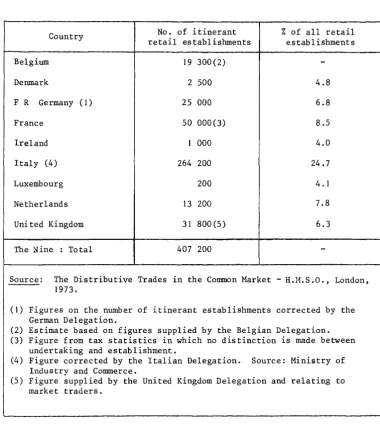
In Ireland, again, hypermarkets are not a characteristic feature of retailing, no doubt because of the low urban concentration. On the other hand, town-centre renewal programmes have brought the construction of shopping town-centres which include a number of retail outlets. Itinerant motorized traders, who often slip through the taxman's net, continue to be of great importance. In the United Kingdom, the situation has been marked by the tendency to reduce the number of shops and to increase selling area. This is particularly true of the food and household shopping sector, and has led in the last 20 years to the rapid growth of supermarkets and, more recently, to the development of super-stores and hypermarkets. At the end of 1976, there were some 125 of these newer outlets with a selling area greater than 2 333 square meters, mainly in built-up areas. The development of these outlets in out-of-town locations has been prevented generally by policies which seek to control unplanned growth of urban areas by maintenance of green belts around them
and, in particular, by the development of control powers vested in local authorities. Within urban areas extensive reconstruction, modernisation and extension of shopping centres has been undertaken and covered centres, pedestrianized areas and traffic management schemes have been provided. New shopping centres have also been established in new towns.
In the Federal Republic of Germany reconstruction enabled a network of well-located modern shops to be created in the old towns. Alongside the
traditional commercial outlets in town centres and on the outskirts, commercial centres were set up according to a master plan, mainly because of changes in the population structure and distribution. The Rhein-Main-Taunus-Zentrum near Frankfurt (30 000 m2) and the Ruhrpark near Bochum (70 000 m2) in particular deserve to be mentioned in this context. Such centres sometimes take the form of sub-centres (neighbourhood centres), for example, the Nordwest-Zentrum (25 000 m2) at the heart of three districts near Frankfurt which were being revitalized.
next few years this form of trading will not grow dramatically although the number of commercial centres is expected to increase.
In the mid-sixties hypermarkets and self-service stores beg~~ to appear, taking about ll
%
of the market, so it seems. In most cases there was no attempt to set them up, as in France, in a regional shopping centre or to attach a shopping arcade. At the beginning of 1976 there were some l 100 hypermarkets and self-service stores with a selling area of some 4 600 000 m2. Their average size is approximately 4 200 m2. However, some 250 establish-ments, i.e. 20%,
have an area greater than 6 000 m2 and a hundred more are over 10 000 m2. Increasing importance is accruing to the non-food sector in the range of articles on sale. In some regions these supermarkets have made a major contribution to the extension of selling area.Traditional retail outlets, located chiefly in the heart of towns, are trying to maintain, or increase, their attractiveness, in particular by the
establishment of pedestrian precincts. This is particularly true of consumer durables or goods requiring supplementary instructions. At present there are 400 pedestrianized street3 in 270 West German municipalities. The necessary investments are financed jointly by the authorities and the businesses concerned.
In Belgium, too, there has been a distinct trend towards concentration and larger selling areas, especially in the food sector. Supermarkets and hyper-markets began developing from 1960 onwards and the town centre lost some of its privileged position with the establishment of large attractive shopping complexes on the outskirts. At the beginning of 1975 there were 709 super-markets and 70 hypersuper-markets. So-called neighbourhood shopping centres with an area less than 10 000 m2 have a supermarket as a "magnet" • Centres whose area is between 10 000 and 20 000 m2 are generally built around a hypermarket or the branch of a department store. Regional shopping centres, far fewer in number, exceed 20 000 m2 in area. They include several department stores and serve a very large clientele. On a smaller scale, a number of shopping areas have been built within the urban fabric and certain streets have been
pedestrianized with the aim of revitalizing town centres.
It is chiefly in France that hypermarkets have been built on green-field sites. This spontaneous proliferation was the result of rapid and haphazard urban development, which for long neglected shopping facilities. On l January 1977 there were 353 hypermarkets employing 69 000 persons with a total sales area of 2 000 000 m27 accounting for 8
%
of all retail sales. However, thehyper-The main concern in the Netherlands, especially after
1945,
was to integrate retail trading into an urban framework in the most harmonious manner possible and in line with a systematic concept of commerce in urban areas. Inparticular, facilities were relocated within reach of consumers living in the new residential quarters of expanding towns, in commercial centres, most frequently along with other collective facilities. The system distinguishes, hierarchically, between area, local and other centres. On
1
September1972,
there were 646 new centres. The rapid increase in the sales area in
establishments (an increase of
80
%
between1945
and1972)
indicates how much businesses have expanded. The rising standard of living and the increase in individual mobility have led to a steady change in purchasing habits,particularly since
1970.
As a result of this development and under pressure from rising costs in the retail trade, distributive undertakings have tended to estahlish themselves on the edges of towns in the form of large self-service stores, discount stores and regional commercial centres. These new types of trading establishments are a threat to shops in town centres, which are alr.eady suffering from the depopulation of these centres and because of trafficproblems.
However, it is the policy of the Netherlands to keep these urban centres alive and economically healthy; hence the opposition to green-field sites.
The effects of building such major projects on the edge of urban areas on the retail trade, the environment and traffic are given detailed study before permission to build is granted. The result of this restrictive policy is that a relatively small number of such large-scale markets have been able to set up so far.
Apart from these large-scale establishments, the question which has attracted attention in the past years is that of improving conditions for businesses located in urban-renewal areas. By pursuing an active policy, buying up buildings and improving living conditions and also by helping undertakings located in urban-renewal areas, the authorities hope that these areas will remain both residential and commercial, an improvement in living conditions going hand in hand with greater profitability for the businesses there.
C • THE DEVELOPMENT OF THE WHOLESALE TRADE
In France, from 1953 onwards, the State, motivated by the desire to regularize transactions, took a hand itself in the establishment of markets of national importance responsible for marketing perishable foodstuffs, particularly fruit and vegetables. In 1975 the twenty such markets in operation handled nearly 4 000 000 tonnes of goods, including 1 400 000 at the Paris-Rungis market alone. Private enterprise, sometimes encouraged by attractive credit facilities, has constructed 24 wholesale distribution centres in ten years, handling a vast range of industrial products. other schemes are under consideration or in hand. In the United Kingdom, the wholesale markets in London play an important part in food distribution. Each year Covent Garden Market, at its new site, handles up to 1 000 000 tonnes of fruit and
vegetables, Smithfield Market handles approximately 170 000 tonnes of meat, while Billingsgate is the main fish distribution centre. In Italy, the Bologna wholesale centre is a remarkable experiment in concentration.
II. ACTION BY THE AUTHORITIES
Generally speaking, the policy followed as regards the geographical
distribution of commercial outlets is based on the need for balanced develop-ment of the distributive machinery in the interest of both traders and consumers. The need is seen everywhere to maintain and improve town centers with schemes for the renovation, rehabilitation and restoration of the urban fabric by means of plans to control traffic and parking and the pedestrian-ization of streets.
A distinction must be made between solutions based on general town-planning regulations and those which apply regulations specifically tailored to the creation or change of trading facilities. The latter category merits further investigation.
A. COUNTRIES WITHOUT SP~IFIC REGULATIONS
Germany, Denmark, the United Kingdom, Ireland and the Netherlands have no specific regulations on the opening of commercial outlets. The current solutions deserve attention.
In Germany, particularly from 1972 onwards, there was a sharp increase in selling space as a result of the efforts by major undertakings to increase their market share and offset the steady rise in wages by extending self-service. In some places this has produced overcapacities which have brought tougher competitive conditions, to the detriment of small and medium-sized businesses in particular. The relevant authorities are keeping a sharp eye on these effects and bear them in mind when considering applications for building permits. The federal law on building, as amended in 1976, lays down that local authorities must give more thought to drawing up zoning plans and, where urban development plans exist, integrate them with local zoning plans. The law also provides for increased participation by those concerned, i.e. by medium-sized retailers.
Building regulations, which were amended recently, proceed from the view that large retail enterprises occupying a sales area in excess of 1 500 m2 generally have an effect on urban development. If a business fits this description, a building licence is not issued - outside central neighbour-hoods - except for special areas. In the last few years, the local author-itieB responsible for the issue of building licences have taken increasing account of the problems which can arise when large retail outlets are set ~p,
particularly on the edge of town or in open country. Increased awareness of the problems plus the new regulations are expected to get a firmer grip on this development.
regarding the retail trade in any part of the country will be contained in the structure plan or in the local plan, and individual proposals to develop stores will be considered by the local planning authorities in the light of this policy and other material considerations. Unsuccessful applicants have the right of appeal to the appropriate Minister. The need to maintain and improve the condition of town centres by means of renovation schemes is fully recognized.
In Ireland a similar form of control is to be found in the pro~s1ons of zoning plans. Provision for shopping centres is made in the planning of new developments and it is forbidden to locate shops outside these centres.
In the Netherlands, the law on land use planning provides for regional plans, local structure plans and utilization plans valid for ten years, the latter embracing the planning of distributia_n services. By virtue of an amendment of the
1976
law on land use planning, the drawing up of these documents is subject to a distribution-planning enquiry in which national experts have an important part to play in each province. The enquiry has two aims:- to provide a clear idea of the structure of the retail trade, its location and function, as well as consumers' purchasing habits;
- to provide information about expected developments, taking particular account of population trends. As far as long-established neighbourhoods are concerned, the aim is, rather, to limit the extensio;1 of shopping facilities.
This information is vital for devising a system of shopH organized in a balanced fashion according to the various requirements involved. In a country where scarcity of land demands even greater care and attention than elsewhere, it is unusual to find large retail outlets on an isolated site in open country. The authorities have managed to limit the number of establish-ments built on the outskirts of towns without making such developestablish-ments
B. COUNTRI:ES WITH SP:EX:IAL LAWS
Luxembourg, Italy, France and Belgium have adopted regulations restricting the freedom to establish or extend business premises.
a) 1;1.12Se,mb_£U£g
The law of 2 June 1962 laying down the conditions for taking up and
exercising certain occupations and the laws governing the establishment and administration of undertakings maintained the ban on large chain stores already provided for in the Grand Ducal Order of 14 August 1934. This ban applies to all retail outlets which have at least two genuinely separate and independent branches with seven or more employees.
The Law on Establishment of 26 August 1975 extends these restrictions by stipulating that the same definition shall include retail outlets which, although autonomous and separate, inter-communicate. As a result, all commercial establishments are obliged to separate physically distinct branches operating under one roof. The law also states that, as regards retail outlets - whether separate or grouped - whose selling space exceeds 600 m2, approval must be specifically authorized by the Minister responsible, acting on the opinion of a special committee which considers applications for the establishment, extension or conversion of premises. Such authorization may be refused if the opening of the new premises is likely to jeopardize the national or regional balance of the distributive trade. The committee
includes representatives of consumer organizations, the Chamber of Commerce and Trades, the Departments of Public Works and the Interior, Economic Affairs and Small Firms and Traders, as well as the Mayor (or his deputy) of the area in which the proposed premises are to be located.
Restrictive legislation has hampered the development of large retail outlets since the passing of the law of 1926, which made the opening of new businesses subject to authorization in the form of a permit issued by the local authority. This procedure was extended in 1938 by a second law and by the circulars of 1958 and 1962. These various legal instruments gave the Prefetto (chief administrative officer) the power to issue permits to operate bazaar-type stores, department stores and, later, supermarkets.
This authorization is issued by the Mayor of the municipality in which the business is located, after consultation of a special committee made up of representatives of commerce and the administration. Authorization may be refused only if the applicant does not possess the necessary qualifications or if his application runs counter to the local development plan or to the law itself. Besides the municipal authorization, a regional permit is also required for opening businesses with an area of more than 400 m2 in municipal-ities with fewer than 10 000 inhabitants, and for opening large retail
complexes with a selling area of more than 1 500m2 designed, by virtue of their size and location, to serve areas wider than the territory of a single municipality. The authorities retain discretionary powers in this area only in the formulation of the municipal plans and in determining the correct balance in the development of various forms of distribution.
The general principles laid down in the law of 11 June 1971 were extended by Law No 524 of 14 October 1974 to the catering and restaurant sector and to itinerant traders by Law No 398 of 19 May 1976.
There are several factors contributing towaa~ds stemming the indiscriminate expansion of the distribution system and bringing about a rational restructur-ing at a higher level of productivity (a trend further strengthened by the need for personal qualification); they are: the laying down in the municipal plan of the maximum total selling area for high volume goods, the possibility of imposing minimum sales areas for each type of outlet and the expansion of the range of goods offered. But experience in the first few years of
application of the new law has shown that it is not yet fully effective owing to difficulties connected with the establishment and operation of the new structures.
Many municipalities have no urban planning schemes at all or have only inadequate planning machinery. Lack of funds has also prevented local authorities from drawing up plans for commerce, the priority being given to decentralization. To these general difficulties must be added the lack
of experience on the part of municipalities with regard ·~o commercial planning and the disadvantages arising from the large number of Gmall municipalities
(more than 6 000 have a population less than 5 000). Furthermore, the plans approved do not always pursue the idea of modernizing retail networks and are inconsistent with the general objectives.
To overcome these difficulties, the Italian Association for the Town and Country Planning of the Distributive Trades and the National Institute for the Distributive Trades were asked to prepare methodological proposals with a view to helping the municipalities in preparing their commercial schemes which could embrace homogeneous zones on a larger scale than that of individual municipalities.
Law No 73-1193 of 27 December 1973 on the regulation of commerce and owner-operated undertakings was designed to meet complaints against the large-scale retail establishments by introducing important provisions on the planning of the distributive trades. Prior to that, the creation of new commercial outlets was subject only to one requirement, namely the obtaining of a building licence under the Planning Law.
Bearing in mind that, within a framework of fair and open competition, the freedom and desire to engage in business remain the foundation of commerce and owner-operated businesses, the Law instituted a procedure for granting authorizations for the development of commercial sites which is distinct from the procedure for granting building permits; it also set up a Department Committee on the Distributive System which has power of decision. In reaching his decision this body has to take into account commercial and trading
structures, changes in shopping facilities, the pattern of urban and rural activities and the desired balance between the various forms of commerce. Decree No 74-63 of 28 January 1974 brought these provisions into force.
Before building permission is granted (where this is necessary) and before the project is started (where no building permit is required) the following must be submitted for authorization by the Department Committee:
Projects for retail shops having an overall floor space exceeding 3 000 m2 or a sales area exceeding 1 500 m27 reduced to 2 000 and 1 000 m2
respective-ly in municipalities with less than 40 000 inhabitants.
Projects to expand shops or increase the sales area of commercial
establishments which have already reached the said limits or will reach or exceed them as a result of the projected work, if the latter involves a sales area exceeding 200 m2.
- Projects to convert existing buildings into retail establishments with an overall area or sales area not less than the above-mentioned limits.
Once authorization has been granted for a new establishment, it may be neither assigned nor transferred to another party.
The Committee, which is chaired by the Prefet, is composed of 24 membres and 20 alternate members, as follows:
-nine elected local officials, including the Mayor of the municipality where the project is to be sited, appointed by the Conseil General (County Council); - nine representatives of trades and crafts, appointed by the Chambers of
Commerce and Trades & Crafts;
- two representatives of consumer associations, appointed by the Prefet. The Director of Public Investments and the Director of Competition and Prices attend the meetings.
The Committee is informed by reports from the Director for Competition and Prices and from the appropriate Chambers of Commerce and Industry and of Trades and Crafts.
It has to take a decision, stating its reasons, within three months of an application being lodged. Where a project requires substantial modification, it is resubmitted to the Committee which must take a decision within two months. Once these time limits have expired, authorization is deemed to have been granted.
The Prefet or one-third of the members m~ appeal against the Committee's decision within two months of the meeting or of tacit approval. The applicant also has the right of appeal, which he must exercise within a specified period commencing on the day the decision is published. Appeals are submitted to the Minister for Commerce and Owner-Operated Undertakings, who consults the National Planning Committee for the Distributive System and must take a decision within three months.
The building permit may n•t be granted or construction begun before the Committee or the Minister has delivered a decision.
The National Planning Committee for the Distributive System reflects the structure of the local committees and comprises:
- nine representatives of elected local officials, five appointed by the National Assembly and four by the Senate;
-nine representatives of commercial and craft activities appointed by the Minister;
- two consumer representatives appointed by the consumer associations represented on the Comite national de la Consommation (National Consumers Association).
The experience of two years' operation has shown the need for a number of improvements to the machinery for town-planning in relation to the
distributive trades since the Law on Commerce came into force. The Decree of
6 October 1975 (No 75-9:0) basically introduced a two-year period of validity for authorizations and provided for the introduction of penalties for breach of the statutory provisions. A circular of 10 March 1976 further stipulated that the provisions of the Law covered only the opening of new sales areas. Once opened to the public, the establishments could change their activities at will as long as they did not increase the area beyond the
permitted limits.
The Law of 29 June 1975, based in part on the French Law, is the outcome of an agreement between the economic circles concerned. It l~s down that
the redevelopment of existing buildings not previously used for trading. Authorization must also be obtained for any significant change in the nature of the business carried on in premises already used for commercial purposes. The agencies involved in implementing the Law are:
The Social and Economic Committee for Retail Distribution made up of officials from the ministerial departments for Economic Affairs, Small Firms and Traders, Public Works, Employment and Labour, and Agriculture. A negative opinion delivered by this Committee is final and the local authorities must endorse it.
If the opinion is favourable, a second opinion must be delivered by the Provincial Committee for Retail Distribution which, not counting the Chairman, is made up of ten members representing the consumers, workers, small firms and traders, agriculture and composite trading. On the basis of these two opinions, the municipality makes its decision.
If there is an appeal against the decision of the Municipal Council, the file is forwarded to the National Committee for Retail Distribution which discounting the Chairman and Vice-Chairman, is made up of 18 members representing consumers, workers, small firms and traders, agriculture, composite trading, wholesalers and the Federation of Belgium Undertakings. The final decision is then taken by an Interdepartmental Committee,
composed of the Ministers for Economic Affairs, Small Firms and Traders, Public Works and Regional Affairs.
The Social and Economic Committee for Retail distribution and the Regional Committees give their opinion taking due account of the location of the project, its size in relation to the municipality, consumer interests, the number of jobs created and the likely repercussions on the existing trading structure.
The Law introduces a detailed procedure with a whole series of time limits, the most important of which are described below:
The Mayor forwards the application to the Social and Economic Committee which has
90
days to deliver its opinion. If this opinion is unfavourable, the Council of Mayor and Aldermen must issue a refusal decision within 15days. If the decision is favourable, the Provincial Committee must deliver its opinion within 30 days and the Council of Mayor and Aldermen also has 30 days in which to act.
On expiry of a period of 165 days from the date of notification or receipt, the applicant may call upon the Committee, which then has 30 days to give a ruling on his application; the absence of a decision is tantamount to a refusal.
The authorization lapses if the project has not been implemented within two.years, unless a one-year extension has been granted by the Council of Mayor and Aldermen.
III. PROSPEXJTS
All the Member States recognize the basic restructuring and vital role played by the distributive trades in town and land-use planning. Modernization of commercial facilities is to be encouraged in view of the attendant consumer benefits. The process of concentration, generally evidenced by the appear-ance of hypermarkets, has still not come to an end but it will slow down a little while specialized stores will increase, largely due to affiliated trading. The refinement of planning methods, environmental requirements and short-term economic conditions mean that the authorities will have to monitor the establishment of the main commercial facilities to ensure a satisfactory balance between economic considerations and social and environmental factors. Increasing use will be made of participation procedure, allowing users to share in the decision-making by the authorities while more attention will be given to forward studies.
A. THE URBAN SEXJTOR
The growth of large-scale commercial facilities is unlikely to continue at the rate recorded in past years. More modest projects restricted to the needs of new suburban areas or seeking to renovate the existing location will often be preferred to large out of town developments or to urban renewal projects -both are expensive and unwieldy. There has been increased interest everywhere in revitalizing city centres within the existing structure. A return to neighbourhood trading is clearly taking shape in line with traditional ideas which recommend an attractive, integrated variety of social, cultural, recreational and service facilities. As in the past, small self-service stores, supermarkets and convenience stores might well be the centres for groups of neighbourhood shops. The supermarket above all may need to rethink its market strategy. Pedestrianized streets may increase; shopping centres may be better
integrated into built-up areas, they will be smaller and may seek to blend in with their environment. In some countries large stores may no longer
experience the same increase in sales volume. The expansion of hypermarkets will be slow. Around 1980 the problem may arise, replacing the oldest of them. Large establishments will accept a reduction in their unit area and try to increase productivity while seeking to set up close to shopping arcades, medium-sized special-range shops and service stores. Shopping facilities in medium-sized towns should experience a degree of renewal as part of land use planning.
However, the increase in property taxes and financial contributions demanded by the local authorities in some countrie3 will present developers of shopping facilities with problems for which satisfactory solutions have in many cases not been found but which the authorities must investigate in order to restrain the possible extra loading of retail prices.
B. THE RURAL SEXJTOR
increased car ownership. Here, too, use could be made of consultation with the aim of securing the survival or improvement of shopping facilities which are the backbone of small towns, villages and hamlets. The State can play an important role in some countries by giving priority to the development of rural and mountainous areas and encouraging local initiatives, if necessary by granting financial assistance. In particular, encouragement must be given in small towns, to the operation of facilities sufficiently diversified to counteract the attraction of neighbouring towns but modest enough not to harm neighbourhood businesses providing the inhabitants of outlying areas with their everyday requirements. To remain profitable, rural commercial
activities could in some countries be linked with other activities in premises built or converted with the help of the local authorities and could group together to set up joint warehouses and central buying organizations and at the same time organize regular delivery rounds and markets for the most remote areas. But a number of countries are not in favour of a system of State subventions.
C • THE WHOLESALE TRADE
CONCLUSION
It m~ be wondered what led some authorities to take action in the planning of the distributive trades sector. Their attitude is largely explained by the sweeping chRn2~s to the pattern of commerce. The point was to mitigate certain of the effects of over-rapid change without hampering modernization. Town-planning regulations have generally reinforced the obligations imposed on developers so that trade can be conducted in the best conditions. The demands of modern distribution have revealed the need for studies by inter-disciplinary teams and the advantages of consultation of the parties concerned, in particular consumers.
Some Community countries have introduced - parallel to the rules on the granting of building permits - additional provisions to regulate the establishment of shopping areas exceeding a certain size. There can be no question of finding one system which could be proposed to all Member States. Each country has adopted the solution most appropriate to its own structure and the habits of its people. Some countries recommend setting up public land authorities in charge of the renovation of town centres, others favour building leases with long terms, others take the view that chambers of
commerce should play a greater part in the building of commercial facilities, while still others stress the desirability of leases with an option to
purchase as a means of improving ways of financing such facilities. It may simply be noted that legal measures recently promulgated in the Community have attracted great interest and could serve as a precedent, always bearing in mind that excessively strict rules should be avoided, for they might cumulatively slow down the replacement of facilities. In any case, it would be both premature and lLnrealistic to contemplate harmonization at the EUropean level before passing beyond the stage where information is being exchanged. But, by recapitulating and collating the information provir1.ed7 it may be
possible to identify a number of ideas which could find gf:neral acceptance. Town-planning in relation to the distributive trades mus·.; take account not only of the existing relationships between trading centres in the same built-up area but also of the hierarchy of towns in a region and the requirements of rural areas. It must endeavour to reconcile a large number of economic, social and environmental considerations which sometimes conflict with each other.
Subject to this, facilities must be designed for the whole of a built-up area as part of a general programme and not merely at local level, as clashes of interest between local communities must often be reconciled.
Ideally a development plan would be drawn up within which the interests of commerce would be taken into account.
This point prompts the recommendation of extensive decentralization of
procedure and the adoption of methods which will bring together all concerned in the private and public sectors.
a well-defined field of observation, detailed information must be gathered on staff engaged in the distributive trades and their movements, on existing shopping areas and their dynamic geographical distribution, and on the experience obtained by those bodies involved in the operation of establish-ments. Some countries a.lready have specialist institutes or are making preparations to establish them.
Table No 2 RETAIL TRADE ESTABLISHMENTS IN THE COMMUNITY COUNTRIES Number of Number of non-Country Year retail food food retail establishments estab 1 ishments Belgium 1970 66 731(9) 77 562 Denmark 1969 33 108 24 811 F.R. Germany I974 II8 989(4) 226 974(4) France I97I 275 378 3I6 I80(6) Ireland 1971 2I I64 12 686 (5) Italy I972 406 495 (I) 396 944 (1) (6) I41 670(7) (3) (6) I22 551 (7) (3) = 548 165 = 5I9 495 Luxembourg I975 I 578 (9) 2 I15 Netherlands I972 70 000 99 000 United Kingdom I971 197 807 275 I84(6) Total number of retail trade establishments 144 293 57 9I9 345 963(4) 59 I 558 (8) 33 850 803 439 (I) (6) 264 22I (7) (3) = I 067 660(8) 3 693 I69 000 472 99I (6) 31 790(7)(5) = 504 78I (8) Average area par estab lis"hment (in sq. m.)
I21.4(4) 64
Table N° 3
ITINERANT RETAIL TRADING ESTABLISHMENTS IN THE COMMUNITY COUNTRIES
1972
No. of itinerant % of all retail retail establishments establishments Country
Belgium 19 300(2)
-Denmark 2 500 4.8
F R Germany ( I ) 25 000 6.8 France 50 000(3) 8.5
Ireland I 000 4.0
Italy (4) 264 200 24.7
Luxembourg 200 4.1
Netherlands 13 200 7.8 United Kingdom 31 800(5) 6.3 The Nine : To tal 407 200
-Source: The Distributive Trades in the Common Market- H.H.S.O., London, I973.
(I) Figures on the number of itinerant establishments corrected by the German Delegation.
(2) Estimate based on figures supplied by the Belgian Delegation. (3) Figure from tax statistics in which no distinction is made between
undertaking and establishment.
(4) Figure corrected by the Italian Delegation. Source: Ministry of Industry and Commerce.
[image:30.484.49.430.113.537.2]Table N° 4
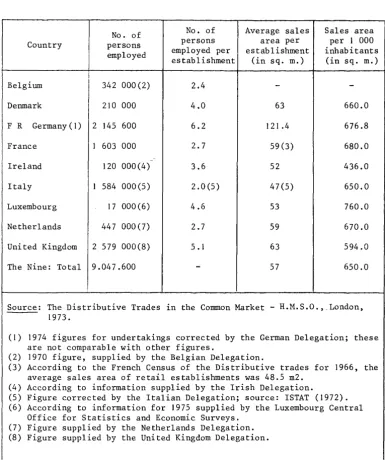
PERSONS EMPLOYED AND SALES AREA IN THE RETAIL TRADE IN THE COMMUNITY COUNTRIES
I972
No. of No. of Average sales Sales area Country persons persons area per per I 000 employed employed per establishment inhabitants
establishment (in sq. m.) (in sq. m.) Belgium 342 000(2) 2.4
-
-Denmark 210 000 4.0 63 660.0 F R Germany ( 1) 2 145 600 6.2 12I .4 676.8 France 1 603 000 2.7 59 (3) 680.0
-Ireland 120 000(4) 3.6 52 436.0 Italy I 584 000(5) 2. 0 (5) 47(5) 650.0 Luxembourg I7 000(6) 4.6 53 760.0 Netherlands 447 000 (7) 2.7 59 670.0 United Kingdom 2 579 000(8) 5 .I 63 594.0 The Nine: Total 9.047.600
-
57 650.0Source: The Distributive Trades in the Common Market- H.M.S.O.,.London, I973.
(I) I974 figures for undertakings corrected by the German Delegation; these are not comparable with other figures.
(2) I970 figure, supplied by the Belgian Delegation.
(3) According to the French Census of the Distributive trades for I966, the average sales area of retail establishments was 48.5 m2.
(4) According to information supplied by the Irish Delegation.
(5) Figure corrected by the Italian Delegation; source: !STAT (I972). (6) According to information for I975 supplied by the Luxembourg Central
[image:31.485.53.439.117.578.2]Table N° 5 THE WORKING POPULATION ENGAGED IN COM}ffiRCE IN EUROPE INCLUDING HOTELS AND RESTAURANTS (in 'ooo) Belgium Denmark F R Germany France 1971 1975 1971
I
1975 1971 1975 1971 1975 engaged in 684 697 352 (I) 344 3 847 3 599 3 283 3 438 3 703 3 748 2 355 (I) 2 332 26 225 24 828 20 511 20 764 working 18.5 18.6 14.9(1) 14.8 14.7 14.5 16.0 16.6 in commerce and office workers) 388 419 263(1) 252 2 810 2 693 2 307 2 507 of 3 034 3 118 I 923 (I ) I 899 21 914 20 898 16 115 16 803 number 12.8 13.4 13.7(1) 13.3 12.8 !2.9 14.3 14.9 inpopulation in
Table N° 5 (cont'd) THE WORKING POPULATION ENGAGED IN COMMERCE IN EUROPE (in 'ooo) Belgium F R Germany (I) France (3) Italy Netherlands 1961 1971 1970 1976 1968 1975 1961 1971 1961 1971 commerce 473.2 576.7 3 727 3 355 2 232 2 341 2 020 2 508(2) 585 754 working 13.2 14.8 14.0 12.6 10.9 10.8 9.7 11.0 13.7 I5.9 in 226.8 155.3 2 923 2 718 I 482 I 723 695 969(2) 365 556 8.4 II.3 I2.2 11.2 9.7 9.5 5.5 5.6 I0.8 I4.0
in engaged
% of women employed in commerce Hours worked per week Hours worked per year
Table N° 6
SOME INFORMATION ON THE LARGE RETAILING TRADING COMPANIES IN CERTAIN EUROPEAN COUNTRIES (1970)
I F.R.
Belgium France
Germany Italy
63 58 64
so
70(2) 34.4 ( 1)
41.5 42.3 42.4 42.1 40 (2)
1 934 1 967 1 955 1 916 1 850 (2)
Lux em- Nether-bourg lands
70 53
44.1 42.3
2 046 2 005
Source: The Distributive Trades in the Common Market - H.M.S.O. London,
- - -
1973. [image:35.492.61.448.135.401.2]Table N° 7 BREAKDOWN OF RETAIL SALES BY FORM OF ORGANIZATION IN THE COMMUNITY COUNTRIES % All Products I96l a.:.d I971 The major (concentrated commerce) Affiliated commerce
I
I
Volun~ary
I
Consumer Other Multiple Department var:iety Cooper a-Hail order Total retailers stores stores stores tives sales cha~ns coopera-Total i tives I962 I971 I962 I971 I962!
I97I I962 I I I97I I962 I971 I962 I971 1962 I97I 1962 I971 I962 I971 1962 'I971 4.0 9.9 3.9 3.9 4.2I
4.3 3.0 2.4 0.5 0.8 15.6 21.3 5.8 6.0 1.0 1.0 6.8 7.0 77.6 71.7 3. I 6.0 3.5 3.6 -2.0 I0.3 11.4 0.1 0.2 17.0 23.2 4.5 8.0 9.0 6.7 I3.5 16.7 69.5 60.I 9 .I I4.6 ~-5 8.8 1.2 1.5__ 3.1 3.0 3.5 4.7 23.4 32.6 I5.0 I5.2 21.5 22.4 34.5 39.6 42.1 27.8 I9.8(1) I0.9(1) 3.2(1) 3. 9 (I) 37.8 62.2(1) (I) I 8.6 I5.2!
3.3 4.2 4.2I
5.3 2.6 2.9 0.7 1.1 19.4 28.7 6.0 8.0 5.6 7.6 II .6 15.6 69.0 55.7I I
i
6 .o 10.2 5.5 6.6 1.0 4.7 0.2 0.2 -12.7 21.7 1.5 8.8 3.8 4.4 5.3 I3.2 82.0 65.I 11.3 3.0 0.4 0.5 1.7 3.4 1.3 1.7 O.I 0.2 4.8 8.8 1.0 3.4 I .0 2.2 2.0 5.6 93.2 85.6 2.0 2.7 " " " " " "
-2.5 3.2 " " " " 6.5 10.0 91.0 86.8 17.6 20.3 3.3 4.8 1.0 1.5 1.7 1.6 0.6 0.9 24.2 29 .I 10.0 9.6 10.0 15 .I 20.0 24.7 55.8 46.2 24.0 29.I 4.5 4.5 4.3 5.8 10.2 7. I 2.5 3.8 45.5 50.3 3.4 6.4 3.5 3.6 3.9 10.0 47.6 39.7 from thesis by Guy Stehle, "Turnover figures for the Community's retail trade", Paris, 1975. Most of the figures are from "The Distributive Trades in the Common Market" -H.M.S.O. London , 1973, and have been corrected and supplemented somecountries. for
1976
from
t"!te
German
Table N° 7 (Cont'd) BREAKDOWN OF RETAIL SALES BY FORM OF ORGANIZATION IN THE COMMUNITY COUNTRIES The major Food
products 1971
(concentrated commerce) Affiliated commerce Consumer Other Country Multiple Department Variety Cooper a-Mail orderT Voluntary Total Total retailers stores stores stores tives sales chains cooper a-tives Belgium 13.2 1.2 4.0 3.2 -21.6 12.3 1.3 13.6 64.8 Denmark 7.9 0.5 2.1 17.4 -27.9 15.3 12.4 27.7 44.4 F R 18.0 3.4 1.0 5.5 0.3 28.2 32.0 36.0 61.3 3.8 Germany 23.6 ( 1)
'
5.8(1) ,/ 9.1 (1) 0.2(1)'
68.0(1) ~v
v France 22.0 1.1 5.2 4.9 -33.2 12.5 9 .I 21.6 45.2 Ireland 16.5 0.8 3.8 0.5 -21.6 18.0 9.0 27.0 51.4 Italy 3.5 -1.6 2.7 -7.8 5.5 3.0 8.5 83.7 Luxembourg 1.0 " " 1.0 -" 16.0 3.0 19.0 " Netherlands 21.6 1.4 1.1 3.3 0.1 27.5 19.4 12.5 31.9 40.6United Kingdom
Table N° 8 GENERAL DATA ON THE COMMUNITY COUNTRIES 1975 Population Population density Total area 'ooo Country 'ooo sq. km per sq. km. Belgium 30.5 9 801 321 Denmark 43. I 5 060 117 F R Germany (I) 248.6 61 832 249 France 549.1 52 748 96 Ireland 70.3 3.127 45 Italy 301.2 55 830 185 Luxembourg 2.6 356 138 Netherlands 40.8 13 660 335
United Kingdom
Belgium
Denmark
21.0 31.0 45.0 80.0 82.8
79.0
Table
N°
9
STANDARD
OF
LIVING
INDICATOR
IN
THE
COMMUNITY
COUNTRIES
Household
equipment
-refrigerators
(%
de
population)
F
R
France
Ireland
Italy
Germany
25.8
52.0(1)
36.
I
41.3 48.3 58.9 63.7 68.5 72.5
85
.0(
I)
76.5 79.9 82.8 85.3
{
96.9 (92.5)
(I)
86.8
48.3
95.9
88.5
98.7
89.7
66.6
95.3
96.6
90.8
Luxembourg
Netherlands
97.0 97.0
Data
supplied
by
the
nine
national
delegations
and,
for
France,
by
I.N.S.E.E.
(household
consumption).
Delegation
has
supplied
data
from
two
sources:
those
from
the
first
source
are
marked
with
(I).
United Kingdom
60.3 65.6 68.8 74.2 77.6 81.8 85.3
I
Table N° II THE DEVELOPMENT OF HYPERMARKETS IN SEVEN COMMUNITY COUNTRIES (Figures harmonized according to French definition) Number and area of hypermarkets and similar establishments (sq. m.) 1.1.1972 1.1 .1973 1.1.1974 1.1.1975 I. I. 1976 47 64 67 70 72 318 900 445 500 470 100 505 200 527 100 2 10 16 17 -18 400 48 500 107 500 110 500 -370 400 500 538 699 2 070 000 2 153 000 -4 058 000 147 209 276 307 320 817 000 I 242 400 I 561 800 I 757 600 I 833 600 I (1) 3 (I) 5 (I) 6(1) 9 (I) 6 500 25 120 38 220 43 220 70 217 18 20 25 30 -65 000 -125 000 -22 54 78 83 IOO(x) 83 000 195 000 -400 OOO(x) Report of the Commission des Comptes Commerciaux de la Nation 1977. are defined as stores with a sales area exceeding 2 500 sq. m. the Italian Delegation, source: INDIS. 1.1.1977
-
-
-
- 777Table
N°
13
STt\NDARD
OF
LIVING
INDICATORS
IN
THE
COMMUNITY
COUNTRIES
Belgium
Denmark
F
R
France
Ireland
Italy
Luxembourg
Nether-United
E.E.C.
Germany
lands
Kingdom
259
248
280
288
164
257
357
257
251
267
(I) 1975:
288
1976:
307
244
282
283
277
176
228(2)
227
258
309
262
(I) 1975:
289
1976:
300
272
428
302
236
127
246
397
344
366
293
(I) 1975:
317
1976:
344
C.E.E.
en
chiffres,
edition
1976,
Credit
Lyonnais.
by
the
German
Delegation.
by
the
Italian
Delegation;
Source:
Country
Belgium Denmark F
R
Germany
Fra.nce Italy Netherlands United
Kingdom
Table
N°
I4
DENSITY
OF
SUPERMARKETS
AND
HYPERMARKETS
IN
SEVEN
EUROPEAN
COUNTRIES
(Harmonized
according
to
French
definition)
Population
at
l.I.75
'ooo
inhabitants 9
792
5
065
62
040
52
876
55
845
13
657
56
075
Number
of
hypermarkets
at
1.1
.75
per
million
inhabitants
7.1 3.4 8.7 5.5 0.
I
2.2 1.5
Number
of
supermarkets
at
I.I.75
per
million
inhabitants
72.4 98.9 67.7 51.4 15.4 66.0(x) 49.9
Source:
Institut
national
de
la
Statistique
et
des
Etudes
economiques
(INSEE)
-Rapport
1976
de
la
Commission
des
Comptes
commerciaux
de
la
Nation.
(x)
At
I
.
I.
Belgium 59.3
combined
27.5 82.8 63.1
white
TV
71.5 18.3 7.4
of
the
European
type
of
information
was
Table
N°
15
OWNERSHIP
OF
CONSUMER
DURABLES
BY
HOUSEHOLDS
IN
THE
DIFFERENT
COMMUNITY
COUNTRIES
IN
MAY
1975
Denmark
F
R
France
Ireland
Germany
64.9
53
63.8
60.0
39.4
40.2
14.6
11.5
79.0
94.0
89.0
66.6
56.1
85.9
66.0
52.2
70.1
74.8
73.0
49.6
24.8
30.8
12.2
6.3
12.1
9.7
8.
I
4.1
Connnunities;
IN
SEE
(Collection
No
M
55).
not
supplied
for
Luxembourg.
Italy
Netherlands
United Kingdom
64
.I
61.1
56.0
-28.9
20.0
95.3
92.9
85.0
82.0
88.6
72.0
92.2
67.4
40.0
1.1
32.5
19.0
14.7
7.2
Country
Belgium Denmark F R Germany France Ireland Italy Luxembourg Netherlands United Kingdom The Nine
Table N° 16
PER CAPITA FINAL CONSUMPTION BY PRIVATE INDIVIDUALS; IN DOLLARS AND AT 1970
PRICES AND RATES OF EXCHANGE
1966 1975
1 366 1 963
1 682 2 076 1 418 1 899 I 4IO 2 026
763 965
877 I 193 1 462 1 922 I 1I8 1 559 1 273 1 498 1 249 1 662
% change between 1966
1970 43.7 23.4 33.9 43.7 16.5 36.0 31.5 39.5 17.7 33.1
Source: National accounts for the O.E.C.D. countries, 1975.
[image:47.491.60.438.130.438.2]STUDIES
which have been published in English in the series .,Commerce and Distribution"
(1)8714- No. 1
Market structures and conditions of competition in the wholesale trade in the countries of the EEC
1976, 39 p. (DE, EN, FA) UKL 0.55; USD 1.30; BFA 45
8790- No.2
Synoptic tables of the specific measures taken by the Member States of the
European Communities in the field of commerce
1976, 168 p. (DE, EN. FA, IT, NL) UKL 3.30; USD 7.80; BFA 270
European Communities- Commission
The aspects of establishment, planning and control of urban retail outlets in Europe
Luxembourg: Office for Official Publications of the European Communities
178-48 p.- 17,6 x 25 em
Collection studies, Series Commerce and Distribution DE, EN, FA, IT, NL
ISBN 92-825-0291-0
Catalogue number: CB-NK-78-004-EN-C BFA 50
LIT 1350
DKA 8,80 HFL 3,50
OM 3,20 UKL 0.85
FF 7,25 USD 1.60
In recent decades European commerce has undergone a series of profound changes, which have unmistakably greatly affected the development of urban retail outlets.
It is precisely the combined action of such seemingly diverse factors as the rise in living standards, urban development, greater use of the private car and the increase in the number of vehicles registered which, by changing the life styles of the people of Europe, has promoted the emergence of new types of shopping facility.
The action taken by the public authorities in the light of these changes to achieve a balanced structure in the distribution network, in both the operators' and consumers' interest, has been based either on general urban development regulations or on special regulations, depending on the country.
This report, drawn up by Government experts from the Member States ( 1), makes a quantitative and qualitative analysis of these problems and of the urban and rural prospects for the development of the various types of trading facility.
(1) On 1 October 1976 the Working Group of Government Experts on Commerce and Distribution set up a Sub-group on the Establishment, Planning and Control of Urban Retail Outlets. The Sub-group, which drew up this report, was:
Chairman :Mr. Cantile (I) Rapporteur :Mr. Baldacci (F) Members :Mr. de Bruyne (B)
Mrs. Clairebois (B) Mr. Teck(B) Mr. Rasmussen (OK)
Salgs- og abonnementskontorer · Vertriebsburos · Sales Offices Bureaux de vente · Uffici di vendita · Verkoopkantoren
Belgique - Belgie
Moniteur beige- Belgisch Staatsblad
Rue de Lot,vain 4042 -Leuvensestraat 40-42 1 000 Bruxelles - 1 000 Brussel Tel 5120026
CCP 000-2005502-27 Postrekening 000-2005502-2 7
Sous-dep6ts - Agentschappen:
Librairie europeenne - Europese Boekhandel
Rue de Ia Loi 244 - Wetstraat 244 1040 Bruxelles -- 1040 Brussel
CREDOC
Rue de Ia Montagne 34- Bte 11 Bergstraat 34 - Bus 11 1 000 Bruxelles - 1 000 Brussel
Dan mark
J. H. Schultz - Boghandel
Momtergade 19 1116 K0benhavn K Tel. 141195 Girokonto 1195
BR Deutschland
Verlag Bundesanzeiger
Breite Stra~e - Postfach 1 0 80 06 5000 Koln 1
Tel (02211 210348 (Fernschreiber: Anzeiger Bonn 8882 5951
Postscheckkonto 834 00 Koln
France
Service de vente en France des publica-tions des Communautes europeennes Journal officiel
26, rue Desa1x 75732 Paris Cedex 15
Tel. (1 I 578 61 39 - CCP Paris 23-96
Ireland
Government Publications
Sales Office G.P.O. Arcade Dublin 1 or by post from
Stationery Office
Beggar's Bush Dublin 4 Tel. 688433
ltalia
Libreria della Stato
Piazza G. Verdi 10 00198 Roma- Tel (6) 8508 Telex 62008
CCP 1/2640
Agenzia
Via XX Settembre (Palazzo Ministero del tesoro) 00187 Roma
Grand-Duche de Luxembourg
Office des publications officielles des Communautes europeennes
5, rue du Commerce
Boite postale 1003 - Luxembourg Tel. 49 00 81 - CCP 191 90-81 Compte courant bancaire: BIL 8-109/6003/300
Nederland
Staatsdrukkenj'- en wtgeverijbednjl
Christoffel Plantijnstraat. 's-Gravenhage Tel (0701 814511
Postgiro 42 53 00
United Kingdom
H.M. Stationery Office
P.O. Box 569 London SE1 9NH Tel. (01 I 928 6977, ext. 365 National G1ro Account 582-1002
United States of America
European Community Information Service
2100 M Street, N.W Suite 707
Washmgton, D.C. 20037 Tel. (2021 872 83 50
Schweiz - Suisse - Svizzera
Librairie Payot
6, rue Grenus 1211 Geneve Tel. 31 89 50 CCP 12-236 Geneve
Sverige
l.1brairie C.E. Fritze
2, Fredsgatan Stockholm 16
Postgiro 193, Bankgiro 73/4015
Espana
Libreria Mundi-Prensa
Castell<' 37 Madnd 1 Tel. 2754655
Andre Iande · Andere Lander · Other countries · Autres pays · Altri paesi · Andere Ianden
BFA 50 DKR 8,80 OM 3,20 FF 7,25 LIT 1 350 HFL 3,50 UKL 0.85 USD 1.60