This is a repository copy of Special Purpose Entities and their role in Megaprojects: a new focus for understanding megaproject behaviour.
White Rose Research Online URL for this paper: http://eprints.whiterose.ac.uk/97193/
Version: Accepted Version Proceedings Paper:
Sainati, T, Brookes, NJ and Locatelli, G (2014) Special Purpose Entities and their role in Megaprojects: a new focus for understanding megaproject behaviour. In: Proceeding of the 14th Annual Conference of the European Academy of Management. EURAM 2014, 04-07 Jun 2014, Valencia, Spain. . ISBN 978-84-697-0377-9
This is an author produced version of a paper published in the Proceeding of the 14th Annual Conference of the European Academy of Management (EURAM 2014).
[email protected] https://eprints.whiterose.ac.uk/ Reuse
Unless indicated otherwise, fulltext items are protected by copyright with all rights reserved. The copyright exception in section 29 of the Copyright, Designs and Patents Act 1988 allows the making of a single copy solely for the purpose of non-commercial research or private study within the limits of fair dealing. The publisher or other rights-holder may allow further reproduction and re-use of this version - refer to the White Rose Research Online record for this item. Where records identify the publisher as the copyright holder, users can verify any specific terms of use on the publisher’s website.
Takedown
If you consider content in White Rose Research Online to be in breach of UK law, please notify us by
1 Please quote this paper as
T. Sainati, N.J. Brookes, G. Locatelli Special Purpose Entities and their role in Megaprojects: a new focus for understanding megaproject behaviour. Proceeding of the 14th Annual Conference of the European Academy of Management - EURAM 2014 4-7 June - Valencia
TITLE: Special Purpose Entities and their role in Megaprojects: a new
2
Abstract
Special Purpose Entities, “SPE”, are legal joint ventures (usually a limited company of some
type or a limited partnership) created to fulfil a specific objectives. The main two applications of SPE in project management are project partnering and project financing, particularly for the delivery (and sometimes operations) of megaprojects.
SPEs receive little attention from project management researched beyond their treatment as a financial instrument or risk mitigation measure. We contend that the influence of SPEs on a project’s behaviour needs to be explored and understood far more holistically. We argue that
SPE have a profound effect on project governance, the relationships between actors within the project and ultimately on the project success.
This paper provides a bibliometric analysis to pave the way to this research stream by analysing the historical adoption of SPE in projects, the evolution of the SPE literature and the existing gaps for future researches.
3
1
Introduction and Aims of the Paper
There is an extremely lengthy and deep tradition in researching projects that attempts to link
organizational structure to project behaviour. Foci of project management investigations in this milieu have moved from considering matrix structures to enact projects (Katz & Allen, 1985) to considering “project-based” organisations (Hobday, 2000), (Wikström, Artto, Kujala, &
Söderlund, 2010). We contend that project management researchers should now turn their attention to another form of organization that is increasingly being used to deliver megaprojects
in particular. This organizational form is known as a “special purpose entity” or an SPE. SPEs comprise the organizational form by which a substantive number of megaprojects are delivered (Megaproject cost action, 2014), (Darrin Grimsey & Lewis, 2004).
SPEs are an extreme version of “project-based organisations” when employed in the context
of megaproject delivery. They are legally independent organisations whose sole purpose is the
delivery (and sometimes the operation) of a single megaproject (Finnerty, 2013). Megaproject SPEs have longevity, often running into decades, and can “out survive” their initial owners who frequently sell them or are merged themselves into other organisations. These SPE
characteristics present unique challenges for project behaviour in terms of the relationships between project actors, project governance and, ultimately, project performance.
Given the prevalence of SPEs in delivering megaprojects, there is a surprising dearth of research focused upon them in the field of project management. Whilst other organization structures are the centre of much attention, interest in SPEs is confined to their role as financial
instruments or in mitigating risk. Their holistic influence on wider megaproject behaviour remains largely unexplored. This paper seeks to remedy this situation by taking initial steps in
4 The aims of this paper are therefore twofold:
• Firstly, the paper provides a more detailed exploration of the construct of an SPE and an
historical analysis of its role in megaproject delivery.
• Secondly, the paper presents the results of a bibliometric analysis of current SPE research and
uses this to identify gaps in research attention
The paper concludes by articulating a series of research questions that arise from its
bibliometric analysis.
2
SPEs and Megaprojects
SPEs are especially relevant typology of organisation in the Megaproject filed and their
adoption grew over the last decades. There are two main advantages associated to SPEs that explain the growing adoption in Megaproject industry: its enable to perform project financing
and project partnering. Besides, for historic reasons, the available understanding and literature on SPE deeply investigates the theme of Risk management (i.e. risk sharing, risk transfer, etc.) and Finance (i.e. project financing), whether few attention is left on project governance (despite
the relevance of the subject for either practitioners or academics).
2.1
History and Definitions of SPEs
One of the most simple and accepted definitions of “Special Purpose Entities”(SPE) is “SPEs are set up as orphan companies with their shares settled on a charitable trust and with professional directors” (Basel Committee on Banking Supervision, 2009).
5
international accounting principles and national legislator made several attempts in order to regulate and recognise the SPE.
SPEs have been first used on 1970 when the “Government National Mortgage Association”
(Ginnie – Mae) securitized government-insured mortgages (Ketz, 2003). At that time, the
regulations regarding SPE were almost inexistent. In the 1990, The International Accounting Standard (IAS) started to issue standards and regulations about SPEs.
One of the first fundamental accounting standards (the so called “IAS 27”) only required that
firms must report the controlled entities (among them the SPE) on their balance sheets: neither a specific treatment of SPEs nor specific guidelines were available at that time. The IAS 27
was not enough developed allowing several different interpretations; the organisations were able to play in the grey areas covering the ownerships of SPE to hide profits and debits, pursue shady businesses etc.
Consequently, In July 1998 IASC-SIC (Standing Interpretations Committee) recognised that the ambiguity associated to SPE was too much, so it issued the DI-12 (Draft Interpretation 12).
This official document included for the first time “pragmatic guidelines”, i.e. more clear and detailed guidelines constraining the treatment of SPEs into balance sheet (IASC, 1999). In particular the DI-12 proposed that firms must report SPE in the balance when is able to control the SPE and obtain the majority of the benefits from the SPE’s activities (Larson, 2008).
Several Institutions, banks, consultancy firms and industrial operators opposed to this interpretation and claimed technical reasons for avoiding the report of SPEs into the balance
sheets (Larson, 2008). Most of those organisations have been later involved in SPE scandals, like the Enron bankruptcy (2001). In the investigation following the improvise Enron
6
weak legislation with financial instruments, based on SPE, like the “commodity prepay”. They
enabled to hide, temporarily, a certain amount of liability by triangulations of false transactions
between a bank institution, his subsidiary (the SPE) and the entity who want to hide part of his depth (in this case Enron) (Smith, 2011).
The Scandal of Enron and similar others, pushed the accountancy standard organisations and legislators to work on a redefinition of the accounting principles, with special emphasis of what should be reported into the official statements and what can be left “off-sheet”.
There is often a confusion about “what is it” and “what is not” an SPE, however most of the
literature, e.g. (Basel Committee on Banking Supervision, 2009), (UNECE, 2012), agree on
two main features differentiating SPE from other forms of organization:
Fixed and pre-defined purposes: this feature is established with legal means (e.g. corporate
statute) or de-facto (e.g. restricted duties, capabilities and power of action). In some cases, SPE issues his operations through predefined management rules (e.g. a set of financial derivate like Credit Default Swap CDS). In these cases (usually called “SPE with autopilot”) the “management roles” constrain the purposes. Example of fixed purposes are
securitization of assets or liabilities, Leverage Buyout operations, construction and
operation with a defined infrastructure, etc.
Self-fenced organizations: risk of bankruptcy of parent organizations must not affect SPE
life and operations. This feature is essential for most SPE applications, e.g. securitization, project financing, etc. This feature is realized thorough legal means; e.g. SPE can be
established as an “orphan entity” e.g. the several types of “trust-corporations”.
These two features allow the SPE to be used for a broad range of applications: structured finance, project financing, corporate and project partnerships, risk transfer, tax structuring,
7
2.2
Using SPEs to Deliver Megaprojects
Since the early ’90 SPE become more and more involved in the design, delivery (and
sometimes operate) of Infrastructural Megaprojects (from now on just “Megaprojects”) in wide range of sectors: telecommunication, transportations (highways, railways, etc.), energy production (power plants, grid, etc.), civil infrastructures (dams, bridges, etc.) and mega event.
Megaprojects are extremely large-scale investment projects that typically cost more than EUR 1 billion. Megaprojects share an extreme complexity (both in technical and human terms) and
a long record of poor delivery (Merrow, 2011), (Ruuska, Ahola, Artto, Locatelli, & Mancini, 2011), (Flyvbjerg, Bruzelius, & Rothengatter, 2003). Megaprojects require a vast amount of financial resources and long planning horizons, for instance the pay back is usually longer than
a decade. Moreover, the knowledge and expertise required in the project governance & delivery belongs to a wide range of spectrum, e.g.: legal, financial, technical, environmental, social, etc.
Consequently, most of the megaprojects are delivered by one or more SPEs. Since, as previously explained, the SPEs have been originally designed for structured finance and tax
optimisation, it is unsurprising that project management researchers have not investigated the impact of SPEs on the behaviour of projects particularly in their influence on project governance.
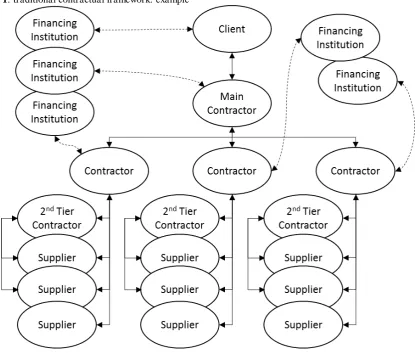
Before the widespread use of SPE, a complex and strictly hierarchical (consisting in several tiers) supply chain of contractors and suppliers was used to delivers Megaprojects. Linkages among stakeholders consisted of a network of client/supplier contracts (Clough, Sears, & Sears,
2005).
This research consider as “traditional contractual framework SPE” project organisations
characterised by:
Network of industrial operators having a strictly definite role into the project, e.g.
8
Whether each industrial operators transfer scope and risk tanks trough contractual
relationships.
Whether contractual relationships are “client-supplier” (one to one) between two subjects.
The resulting project network therefore the link of several independent client-supplier relationships.
Where project management leadership is associated to a main contractor acting as system
integrator (Brusoni, 2005). Client directly or indirectly (by an agent) control the work
performed by the main contractor.
Fig. 1 exemplifies the contractual relationships characterising the “traditional contractual
[image:9.595.89.505.357.716.2]network”.
9
The “traditional contractual framework” has two main shortcomings in delivering
megaprojects: a misalignment of interest between the internal stakeholders and a limited ability
to attract financial resources.
Firstly, the misalignment of interests among project stakeholders, particularly the stakeholders
involved in the project governance is typical of both typologies of relationships: contractual based (hard relations) and principal-agent (Kelleher Jr, Smith, & Hancock, 2011). Misalignment of interests is a prerequisite of other related issues: opportunistic behaviours,
litigation among partners, higher transaction cost, etc. (Reuer & Ariño, 2002), (Müller & Turner, 2005).
Secondly, the limited ability to attract external financial resources exists because of the fragmentation of project delivery chain. In projects, the ability to attract financial resources depends on the perceived risk by lenders. Other things being equal a bigger company, respect
to a small company, is able to attract more financial resources at lower cost: the synergic integration of stakeholder’s capabilities (financial resources, knowledge and experience,
technological means, etc.) allow higher financial guarantees (Finnerty, 2013). The “traditional contractual framework” does not exploit these synergies at systemic level because:
Network of contracts: the network is based on multiple linkages “client-supplier” (i.e.
contract between owner and main contractor, contracts between the main contractors and first tier suppliers, etc.). Indeed some actors have higher visibility, power and control over
the network (e.g. main contractor), the logic by which contractual relationships are designed is local rather than systemic (Clough et al., 2005).
Duration of the contract: under “traditional contractual framework”, most of project
stakeholders are committed to the project for a limited period, i.e. design and deliver the
10
As result, the traditional approach is not oriented to the systemic integration of stakeholder capabilities during the entire project lifecycle.
Synergies between project stakeholders: under the “traditional contractual framework”,
organizations do not pool resources together; therefore, resource synergies difficultly take
place. By contrast, SPE approach enables to integrate stakeholder resources into a single organization empowering synergies.
In order to increase the availability of external finances and align the interests of stakeholders, approaches to delivering projects based on Special Purpose Entities (SPE) have emerged since the early 90’s (European PPP Expertise Centre, 2012), (Brealey, Cooper, & Habib, 1996).
Since then, megaprojects have increasingly adopted an SPE “traditional contractual framework”: now about half of these are designed and delivered with SPE (Megaproject cost
action, 2014).
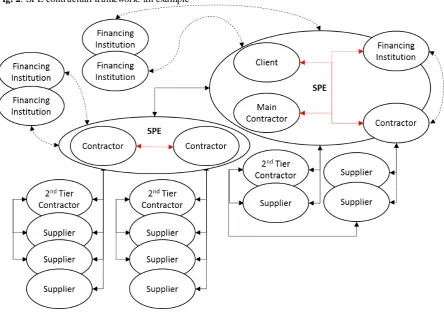
The SPE framework permits to merge the traditional stakeholders into ad-hoc companies (the SPEs) with their own assets & liabilities, resources & capabilities (corresponded by the SPE
partners) and for their performance (resulting from the joint action of SPE partners). Fig. 2 introduces graphical example showing the relationships (internal in red colour and external in
11
Fig. 2: SPE contractual framework: an example
The adoption of SPE for the design, delivering and sometimes the operation of megaprojects growth over time (Finnerty, 2013). Exact statistics are quite difficult to present because of: The ambiguity associated to definition/recognition of SPEs: there are different types of
SPE, which are defined and treated differently depending on the country considered (Basel Committee on Banking Supervision, 2009). In order to cope with this issue, the statistics about SPE consider indirect drivers (e.g. companies, without neither worker nor assets,
having a defined life, etc.) (OECD, 1996). This solution enables to identify general patterns associated to SPE but it includes some degrees of ambiguity into the statistics.
The lack of data and insights about SPE: this is because SPEs are treated as off-sheets
financial vehicles. Legal provisions about information disclosure are weaker for SPEs with
12
1996). Public-Private Partnerships (PPP) make exception because of both: the public purposes of SPE and the applicable laws and regulations (Carmona, 2010).
This paper investigates the adoption of SPE in the megaprojects field by considering existing statistics on PF and PPP.
(Grimsey et al) argue that doesn’t exist a unique definition of PPP, rather: “Depending on the country concerned, the term can cover a variety of transactions where the private sector is given the right to operate, for an extended period, a service traditionally the responsibility of
the public sector alone, ranging from relatively short term management contracts (with little or no capital expenditure), through concession contracts (which may encompass the design
and build of substantial capital assets along with the provision of a range of services and the financing of the entire construction and operation), to joint ventures where there is a sharing of ownership between the public and private sectors. Generally speaking, PPPs fill a space
between traditionally procured government projects and full privatisation.”
The literature associated to these two domains is larger with respect the one related to SPE. By
considering PF and PPP is easier to find data and statistics. Then, adoption of SPE approach in industry is assessed indirectly by considering the related topics. PF and PPP are the most important project-based applications of SPE.
During 90’s, the megaproject industry started to adopt SPE approach, the first move took place
in UK thorough Private Finance Initiative (PFI); this aimed to involve private sector in
financing and managing public infrastructures (Brealey et al., 1996). Progressively several other countries started to embark the PF/PPP framework for developing and operating megaprojects; especially relevant are the following examples: UK, Australia, Netherlands,
13
Therefore, countries (not only in Europe) developed different institutional and regulatory frameworks associated to PPP and project financing (Medda, Carbonaro, & Davis, 2013).
The rate of growth in the adoption of PPP/PF approaches decreased (and in some countries stopped) since 2008 because of the global crisis (EPEC, 2012). In particular, the economic
crisis has three implications (J. Clifton, Díaz-Fuentes, & Revuelta, 2013), (Medda et al., 2013), (Kateja, 2012):
Lack of liquidity: affecting the availability of funds for private investors (in both developed
and developing countries).
Uncertainty about future markets and service demands: a prerequisite for the PF is the
resiliency of the forecast. During the global crisis, future market scenarios are more
uncertain.
Decrease of public commitment on megaprojects: this occurred especially in Europe due
to: budget scarceness, vast level of public depth and political commitment on accounting rigour (only developed countries).
All these reasons are exacerbated for developed countries. Developing countries suffer less (or
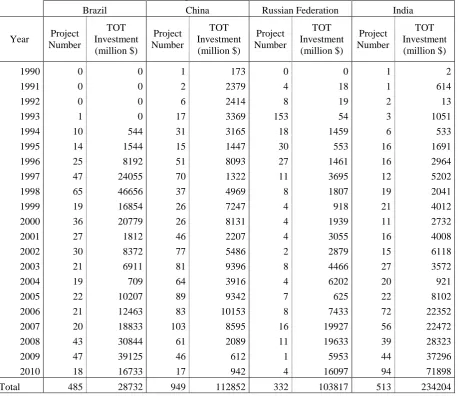
did not suffer at all) this change on tendency. Table 1 shows private investments in PPP megaprojects in BRIC (Brazil Russia, India & China) countries. Table 1 shows that a part of
14
Table 1: Private investments on BRIC-PP, adapted from (Kateja, 2012)
Brazil China Russian Federation India
Year Project
Number TOT Investment (million $) Project Number TOT Investment (million $) Project Number TOT Investment (million $) Project Number TOT Investment (million $)
1990 0 0 1 173 0 0 1 2
1991 0 0 2 2379 4 18 1 614
1992 0 0 6 2414 8 19 2 13
1993 1 0 17 3369 153 54 3 1051
1994 10 544 31 3165 18 1459 6 533
1995 14 1544 15 1447 30 553 16 1691
1996 25 8192 51 8093 27 1461 16 2964
1997 47 24055 70 1322 11 3695 12 5202
1998 65 46656 37 4969 8 1807 19 2041
1999 19 16854 26 7247 4 918 21 4012
2000 36 20779 26 8131 4 1939 11 2732
2001 27 1812 46 2207 4 3055 16 4008
2002 30 8372 77 5486 2 2879 15 6118
2003 21 6911 81 9396 8 4466 27 3572
2004 19 709 64 3916 4 6202 20 921
2005 22 10207 89 9342 7 625 22 8102
2006 21 12463 83 10153 8 7433 72 22352
2007 20 18833 103 8595 16 19927 56 22472
2008 43 30844 61 2089 11 19633 39 28323
2009 47 39125 46 612 1 5953 44 37296
2010 18 16733 17 942 4 16097 94 71898
Total 485 28732 949 112852 332 103817 513 234204
It is expected that the development of PPP/ PF infrastructures (delivered with SPE) will restart
to grow in the next future. Developing countries already showed a continuous growth in the sector, while developed countries are embarking policies to stimulate the development of large
infrastructures; with this respect, PPP and PF approaches are especially relevant. For example, the European Union is pushing for the harmonisation of PPP legislation and the Project Bond initiative (European Investment Bank, 2012). Nowadays about half of megaprojects are delivered by SPE and the other half by companies with the “traditional approach” (Megaproject
15
2.3
Project Financing and Project Partnering in Megaproject SPEs
SPEs are flexible organisation that permit a wide range of application; among the others, there
are two peculiar applications exploited in delivering Megaprojects: Project Financing and Project Partnering.
Project financing aims to gain financial advantages for the project shareholder in terms of
financial commitment and cost of depth. Particularly in Megaprojects, when the “traditional
contractual framework” is not suitable, the application of project financing is a quite common
approach (Finnerty, 2013). Project financing is characterized for long due diligence and negotiation process at the beginning of project. This happen because external financial organizations want to assure sufficient guarantees to legitimate the increase of leverage and
decrease of cost of depth. During this phase identification and transfer of risk is the most important aspect to issue. Project Shareholders aim to demonstrate that project is viable and is
affected by low risk; then specific measures may take place, e.g. off-take contracts. Design of SPE is another measure enabling a clear cutting of project risk: the project vehicle is affected only by the project risk and not to all other risks affecting shareholder organizations. This because of the “self-fenced” feature characterizing any SPE. Therefore, the design of SPE
enable to frame: management, duties, financial commitment of the project. As a result SPE can
be also understood as the technical mean enabling financial and management engineering (Yescombe, 2002).
Project partnering is the second most important applications associated to the use of SPE in
Megaprojects. Project partnering aims to gain synergies among project stakeholders by aligning their interest (C. Clifton & Duffield, 2006). There are several typologies of
16
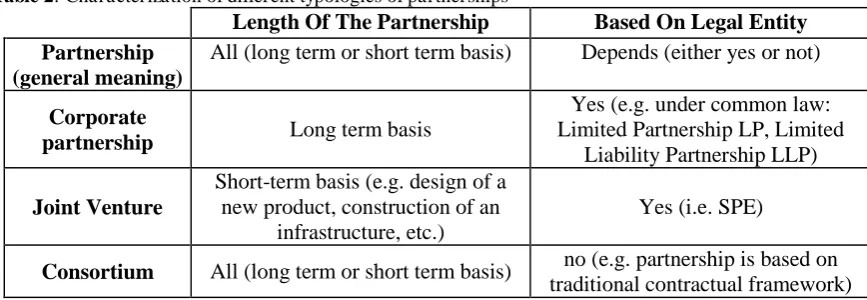
(legal, business etc.). Moreover, inside the same domain (e.g. legal) the terms have different meaning in different countries. Table 2 summarises, in a simplified way, the main differences
between different typologies of partnerships. These differences consider two main drivers: length of the partnership and availability of a legal entity as partnering vehicle. According to
[image:17.595.76.510.226.376.2]this framework the SPE are the legal entities enabling joint ventures among project stakeholder.
Table 2: Characterization of different typologies of partnerships
Length Of The Partnership Based On Legal Entity Partnership
(general meaning)
All (long term or short term basis) Depends (either yes or not)
Corporate
partnership Long term basis
Yes (e.g. under common law: Limited Partnership LP, Limited
Liability Partnership LLP)
Joint Venture
Short-term basis (e.g. design of a new product, construction of an
infrastructure, etc.)
Yes (i.e. SPE)
Consortium All (long term or short term basis) no (e.g. partnership is based on traditional contractual framework)
A popular type of partnering trough SPE used (not only) in megaprojects is the Public-Private-Partnerships (PPP). A PPP is a government service or private business venture funded and
operated through a partnership of government and one or more private sector companies.
3
The Bibliometric Analysis
3.1
Methodology phases
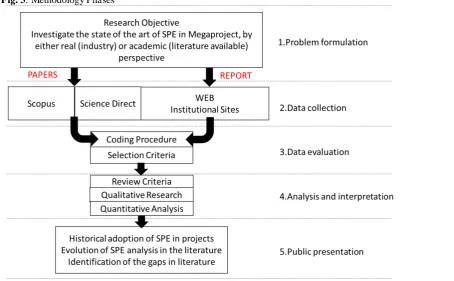
The methodology employed in the research consists of the following steps: problem
formulation, data collection, data evaluation, analysis and interpretation, public presentation. These phases are not intended to be perfectly sequential rather cyclic and interactive. Fig. 3
17
Fig. 3: Methodology Phases
Phase 1: Problem formulation
The objective of the research is to investigate the state of the art of SPE in Megaproject, by
either real (industry) or academic (literature available) perspective. Three main outcomes are: historical adoption of SPE in projects;
evolution of SPE analysis in the literature;
Identification of the gaps in literature.
Phase 2: Data collection
The research is based on secondary data from:
international journal papers (from Scopus and Science Direct server); international conference papers (from Scopus and Science Direct server); books;
report of national and international organizations (e.g. Basel Council, OECD, national statistic organizations or regulatory authorities).
The collection follow two paths: the first is associated to papers (international journals and
18
The first collection path (for journal and books) relies on web server Databases (DBs): Scopus and Science Direct. The authors selected a set of keywords associated to SPEs. The keywords
are then assembled in search strings with the other parameters presented in Table 3.
The second path consist on the collection of institutional documents among with the most
relevant sources are reports. Among the other, the most important institutions considered are: Financial Accounting Standards Board, International Accounting Standards Board, World Bank etc. The criteria adopted to select the reports are:
significance of the report in the eyes of research objective and RQs; most updated reports;
importance of the issuing organization (both at national and international level).
[image:19.595.75.511.427.596.2]In summary the data collected consist of: 2166 Journal Papers, 1094 Conference Papers, 66 Books and 24 Reports: 3350 documents in total
Table 3: Search parameters for the literature collection (Scopus and Science Direct)
Phase 3: Data Evaluation
The 3350 documents collected at previous phase are all individually ranked (by considering
four grades of relevance) and coded. The ranking is determined according to (Pittaway, Robertson, Munir, Denyer, & Neely, 2004) principles. The ranking is based on a relevance scale from zero (absence) to three (High) considering the following elements: Theory
WEB Database
Scopus Science Direct
Keywords Rots Special Purpose Entit*, Special Purpose Vehicle*, Project Financ*, Structured
Financ*, Off Sheet Fianc*, Secutitization*, Shell compan*
Subjects considered
Engineering, Business, Management and Accounting, Decision Sciences, Economics, Econometrics and Finance
Bank, Cash flow, Decision support, Developing country, Energy policy, Firm, Interest rate, Project
management, Renewable energy, Renewable management, Risk management, Stock market,
Supply chain, Supply chain, Sustainable development and World bank
19
Robustness, Implication for Practice, Methodology, data supporting arguments, Generalizability, Contribution. Documents (about 50) with “relevance” 2 or 3 are read entirely
and then further analysed in the following phases.
The coding phase, for all the 3350 documents collected is based on a tagging procedure
considering: abstract, title and keyword of each source collected. Tagging procedure is based on the following fields:
CATEGORY: is the domain i.e. legal, financial, management related. These tags are not mutually exclusive.
FIELD: is it the main topic, e.g. off-sheet accounting, bankruptcy, project financing, etc.. SECTOR: e.g. manufacturing, banking, etc..
LOCATION: e.g. city, country etc..
METHODOLOGY ADOPTED e.g. survey, statistical analysis, quantitative modelling, etc.
Phase 4: Analysis and Interpretation
The critical review is: focused on outcomes, oriented to literature integration, based on neutral perspective, gives a representative coverage, is organized either in a conceptual and historic manner (depending on the paragraph considered) and considers as audience general scholars
(no deep or specific knowledge is required).
Phase 5: Public Presentation
The public presentation includes three main contributes:
historical adoption of SPE in projects: obtained from the review of institutional reports and
journal papers;
evolution of SPE analysis in the literature: obtained from the statistical analysis (phase 4);
20
3.2
Analysis Results
The bibliometric analysis is helpful to understand the evolution of the literature about SPE over
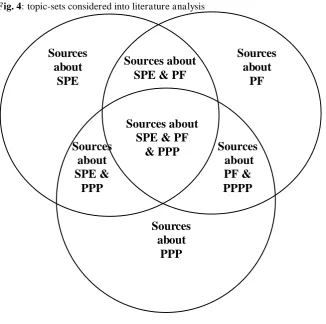
the last 40 years and to identify the gaps that still need to be addressed by future research. This paragraph, based on the methodology presented in section §3.1, divides the sources (i.e. the document collected) according the specific topic discussed. In particular the sources has
been clustered according to three topics: Special Purpose Entity - SPE, Project Financing - PF, Public Private Partnership - PPP and they relative overlaps (i.e. more than one topic discussed)
[image:21.595.75.402.297.621.2]as in Fig. 4.
Fig. 4: topic-sets considered into literature analysis
Table 4reports in detail the sample of 3350 sources analysed: more than 90% are Journal and
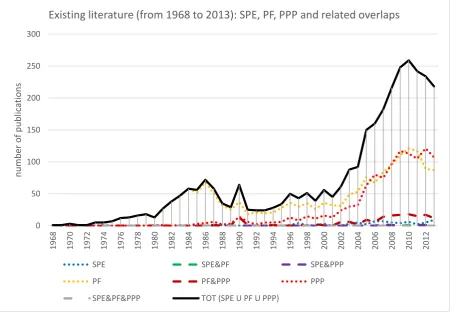
Conference Papers. This table shows that most of the existing literature belongs to the PPP and PF domains without an explicit reference to SPE. Fig. 5 shows the number of publications (total and for set) from 1968 to 2013. There is a growing number of publications since 2002, most of
these belonging to PF and PPP topics (without an explicit reference to SPE). Conversely, the
Sources about
SPE
Sources about
PF
Sources about
PPP Sources about
SPE & PF
Sources about SPE & PF
& PPP Sources about PF & PPPP Sources
about SPE &
21
publications about SPE (and related overlaps) are still a number too low to define a definite trend. Moreover, the graph shows that the “SPE topic” is still vastly under-researched. Fig. 6
presents the publications associated to Project Management (PM) and Finance (F) domains. These data are obtained by counting all the paper having “Project Management” or “Finance”
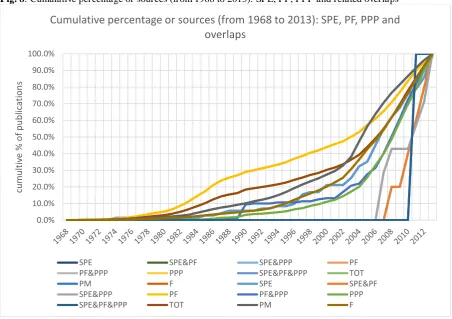
into: title, abstract or keywords. Project Management and Finance have been chosen because are domains closely related and comparable with SPE. Similarly, Fig. 7 compares (as percentage) the publications associated to the three sets. Fig. 8 reports for all the different
subcategories (of Fig. 4) the cumulative and relative number of publications in the period considered.
In short, these Figures show that:
the publications associated to the three sets (PM, F, Total SPE) reported a similar
exponential growth (Fig. 6);
on average the number of publication about SPE (alone or with other topics) had an
escalation since 2001 (Fig. 5 and Fig. 7);
the escalation is shared from all the different sets (and relative overlaps) even if the rates
are different (Fig. 8).
Fig. 8 in particular shows that in last ten years, the publications associated to PM and F grew
slower in comparison to SPE (and related topics), with the exception of PF. This result emphasizes the growing interest on SPE. Looking at the results is important to keep in mind the size of the samples analysed because the comparison is issued on relative basis. Some topics
(PM, F, PF, PPP) reported thousands of publications while other much lesser (i.e. SPE&PF, SPE&PPP, SPE&PF&PPP reported less than ten, SPE less than hundreds and PF&PPP in the
22
[image:23.595.74.527.173.340.2]growth associated to small size samples are less significant by the statistical point of view. This also explain the irregular shape of: SPE&PF, SPE&PPP and SPE&PF&PPP curves.
Table 4: Sample of sources analysed.
Fig. 5: existing literature (from 1968 to 2013): SPE, PF, PPP and related overlaps. : 2011 - 2013’s data are
provisional 0 50 100 150 200 250 300 1 9 6 8 1 9 7 0 1 9 7 2 1 9 7 4 1 9 7 6 1 9 7 8 1 9 8 0 1 9 8 2 1 9 8 4 1 9 8 6 1 9 8 8 1 9 9 0 1 9 9 2 1 9 9 4 1 9 9 6 1 9 9 8 2 0 0 0 2 0 0 2 2 0 0 4 2 0 0 6 2 0 0 8 2 0 1 0 2 0 1 2 n u m b e r o f p u b li cat io n s
Existing literature (from 1968 to 2013): SPE, PF, PPP and related overlaps
SPE SPE&PF SPE&PPP
PF PF&PPP PPP
SPE&PF&PPP TOT (SPE U PF U PPP)
SURCES SPE PF PPP SPE&PF SPE&PPP PF&PPP SPE&PF&PPP TOT
ABS
TOT REL
JOURNAL 47 1242 785 5 6 80 1 2166 62%
CONFERENCE 27 627 379 1 0 60 0 1094 31%
BOOK SERIE 7 85 65 0 0 12 0 169 5%
CHAPTER 1 10 28 0 1 4 0 44 1%
BOOK 1 16 3 0 0 2 0 22 1%
PROCEEDING 2 7 4 0 1 1 0 15 0%
REPORT 0 6 3 0 0 0 0 9 0%
TOT ABS 85 1993 1267 6 8 159 1 3519
[image:23.595.73.527.408.722.2]23
Fig. 6: Existing literature (from 1968 to 2013): Project Management (PM), Finance (F) and TOT (SPE U PF U PPP). Logarithmic scale
Fig. 7: Existing literature (from 1968 to 2013) on relative basis: Project Management (PM), Finance (F) and TOT (SPE U PF U PPP)
1 10 100 1000 10000 100000 Lo g p u b li cat io n s
Existing literature:PM, F and TOT (SPE U PF U PPP)
TOT (SPE U PF U PPP) PM
F Expon. (TOT (SPE U PF U PPP))
Expon. (PM) Expon. (F)
0.0% 1.0% 2.0% 3.0% 4.0% 5.0% 6.0% 7.0% 8.0% 9.0% 10.0% % o f p u b li cat io n s
Existing literature (relative):PM, F and TOT (SPE U PF U PPP)
[image:24.595.74.525.456.769.2]24
Fig. 8: Cumulative percentage or sources (from 1968 to 2013): SPE, PF, PPP and related overlaps
4
Discussion, Conclusion and Further investigations
4.1
Discussion and Conclusions
The analysis of the SPE literature and the tables and graphs reported in section (§3.2) provide
several significant insights:
SPE are a fundamental aspect of the project delivery chain and in particular the project
governance;
there is huge gap in the literature related to SPE (Table 4);
the number of publications related to SPE, and related topics, grew significantly in the last
ten years (Fig. 6);
the number of publications related to SPE shows higher Relative Rate of growth with
respect Project Management (PM) and Finance (F) (Fig. 6, Fig. 8).
0.0% 10.0% 20.0% 30.0% 40.0% 50.0% 60.0% 70.0% 80.0% 90.0% 100.0% cu m u lti v e % o f p u b li cat io n s
Cumulative percentage or sources (from 1968 to 2013): SPE, PF, PPP and overlaps
SPE SPE&PF SPE&PPP PF
PF&PPP PPP SPE&PF&PPP TOT
PM F SPE SPE&PF
SPE&PPP PF PF&PPP PPP
25
The literature coding and analysis described into the methodology section (§3.1) enables to identify the existing gaps associated to the SPE literature. The main results are summarised in
Fig. 9. The figure disaggregates the sources analysed by considering two axes: “Disciplines” and “Topics”.
“Disciplines” are the general disciplines analysed; i.e. economy and finance, management,
legal, product development, social behaviours, contracting, project. “Topics” are the specific
topics addressed by more than one discipline: i.e. securitization and taxes, strategic alliances,
knowledge and technology transfer, risk management (mostly transfer), project procurement and supply chain configuration, project financing, project governance, games theory applied to partnership.
Both matrix axes (Fig. 9) are ranked according to the number of publications available: the top-left corner presents the “Disciplines” and “Topics” whether most publications are available,
the bottom-right one present the “Disciplines” and “Topics” where fewer publications exist.
Consequently “Disciplines” and “Topics” on the top-left have been deeply analysed in the
literature, while the ones located in the bottom-right are literature gaps (because of the vast margin of growth associated to its).
Fig. 7 shows that most of the existing literature on SPE refers to the Economics & Finance
subject, in particular: Securitization and taxes, Strategic alliance, Risk Management. By contrast, the literature gaps are mainly in the disciplines of Contracting and project
management, particularly for the topics of strategic alliance, knowledge and technology transfer, Risk management, project financing and project governance. Further detailed analysis shows that other gaps are related to enabling factors and barriers for the delivery and design of
26
The few papers available in project management are based on surveys or single case study. The project management papers dealing with SPEs analyse them the in civil and construction
industry (especially by considering the PPP) or from the product development perspective.
Fig. 9: Gaps in the literature
The objective of the research is to investigate the state of the art of SPE as a key governance element for the delivery of megaprojects. The study focuses on three main aspects: (1) historical adoption of SPE in megaprojects, (2) evolution of the SPE topic in the literature and
(3) the identification of existing gaps in the literature.
Firstly, the SPE approach is widely used worldwide and nowadays is the most relevant approach in terms of number of projects and GDP used for delivering (and sometime operate)
megaprojects. All these figures emphasize the relevance of the SPE in economic and social terms. The historical analysis shows a continuous grow (since 90’s until now) in the adoption
of the SPE approach in megaprojects. Most of the developed countries had a different trend in the last six years due to the global crisis. A continuous growth in the adoption of SPE approach
27
Secondly, the literature shown an increasing attention of scholars to SPE and related topics (PF, PPP and overlaps between these). Therefore the rate of growth associated to SPE literature
(and related topics) is demonstrated to be high, comparable to the ones associated to Project Management (PM) and Finance (F).
Thirdly, the research found the literature gaps relating to the overlaps of two drivers: disciplines and topics. Specifically for the project management the main gaps are related to: procurement and supply chain configuration, strategic alliances, project financing, project governance.
In summary, the value of the research is twofold: demonstrate the relevance of SPE in megaproject and identify the vast lack of publications in some critical areas of knowledge.
These gaps are relevant for both practitioners and academics.
This research paves the way to a new research stream related to the investigation of SPE for the delivering of megaprojects.
This research aims to impact on both academics and practitioners by identifying a critical research stream in Megaproject domain. This research stream is particularly relevant because
SPE is a very common approach to deliver Megaproject, then a better understanding of the governance principles may help project management community to deliver better infrastructures.
4.2
Further Investigations
The paper seeks to identify main streams of research over the topic “project governance through SPE”: Megaproject performance, Stakeholder management, SPE design.
For each of these streams, the research identifies some of the most critical and unanswered open questions; the authors aim to refine and answer to these questions in the further researches.
28
The first stream of further researches identifies as unit of analysis the casual relationships taking place between the SPE (in terms of design or behaviour) and the Megaproject
performance.
Megaproject performance are understood in a broad sense (because of intrinsic characteristics
of Megaprojects): not only the traditional iron triangle (Time, Cost and Quality/Scope) but also the long-term benefits in economic, social and environmental terms.
Some of the main unanswered questions, concerning SPE & Megaproject performance, are: How can the design of SPE affect Megaproject performance?
How can the design of SPE be improved in order to increase the performance in
megaprojects?
Which are the main differences between SPE and “traditional contractual framework” with
respect their impacts on Megaproject performance?
Which way can SPE increase the sustainability of Megaprojects?
The second stream focuses on the relations between stakeholder management and the governance of SPE. Stakeholder management is herein understood as both internal and external with respect the SPE.
In particular, the stream aims to identify how the SPE structure affects the internal stakeholders (or actors) by considering systemically: their relation of power, the decision-making
procedures, the evaluation criteria and the soft aspects characterising SPEs.
On the other hand, the stream aims to identify the role and the typical behaviours that the SPE have externally: i.e. in relation with Megaproject stakeholders (e.g. utilities, regulator, external
contractors, etc.).
Besides, the boundaries of SPE are not always clear especially because of the dynamic
29
phases and internal in other ones), hence a clear understanding of the dynamic boundaries of SPE is demanding.
Some critical questions associated to this second stream (Stakeholder Management through SPE) are:
Which are the organisational boundaries of SPE? How do they evolve during project
lifecycle?
Which way SPE approach affect stakeholder management (during the whole lifecycle of
infrastructure)?
How to design SPE in order to manage the control of the sponsor during the whole infrastructure’s lifecycle?
How to design SPE in order to maximize the control from public institutions?
Which typologies of corporation better fit with SPE purposes?
The third research stream focuses on effective design of SPE and it is strictly dependent to the results of the previous two research streams.
The deliverables of this stream may be extremely valuable for both academics and
practitioners: e.g. principles governing SPE, identification of different typologies of SPEs that fits with specific aims or circumstances, the rationales governing the design of SPE (with
special emphasis on project governance). Some of possible research questions may be: Which approaches, means and principles enable to design flexible and resilient SPE?
30
5
References
Basel Committee on Banking Supervision. 2009. “The Joint Forum–Report on Special Purpose Entities”; www.bis.org/publ/joint23.pdf.; accessed 12/11/2013.
Brealey, Richard A, Ian A Cooper, and Michel A Habib. 1996. “Using project finance to
fund infrastructure investments.” Journal of Applied Corporate Finance, 9 (3): 25–39. doi:10.1111/j.1745-6622.1996.tb00296.x.
Brusoni, Stefano. 2005. “The Limits to Specialization: Problem Solving and Coordination in
modular Networks.” Organization Studies, 26 (12): 1885–1907.
Carmona, M. 2010. “The Regulatory Function in Public-Private Partnerships for the Provision of Transport Infrastructure.” Research in Transportation Economics, 30 (1): 110– 125.
Clifton, C, and C F Duffield. 2006. “Improved PFI/PPP Service Outcomes through the
Integration of Alliance Principles.” International Journal of Project Management, 24 (7): 573–586.
Clifton, Judith, Daniel Díaz-Fuentes, and Julio Revuelta. 2013. “Financing Utilities: How
the Role of the European Investment Bank Shifted from Regional Development to Making Markets.” Utilities Policy. In Press, Corrected Proof.
Clough, Richard Hudson, Glenn A Sears, and S Keoki Sears. 2005. Construction
Contracting: A Practical Guide to Company Management. J. Wiley.
EPEC, European PPP Expertise Centre. 2012. “Market Update:Review of the European PPP Market in 2012.”; www.eib.org/epec/resources/epec_market_update_2012_en.pdf; accessed 10/12/2013.
European Investment Bank. 2012. “An Outline Guide to Project Bonds Credit
Enhancement and the Project Bond Initiative.”;
www.eib.org/attachments/documents/project_bonds_guide_en.pdf, access; accessed 03/12/2013.
European PPP Expertise Centre. 2012. “Market Update: Review of the European PPP Market in 2012.”; http://www.eib.org/epec/resources/epec_market_update_2012_en.pdf
Finnerty, John D, 2013, Project Financing Asset-Based Financial Engineering, Third
Edition. Hoboken, N.J.: John Wiley & Sons.
Flyvbjerg, Bent, Nils Bruzelius and Werner Rothengatter, 2003, Megaprojects and risk:
An anatomy of ambition. Cambridge University Press.
Grimsey, D, and M K Lewis. 2005. “Are Public Private Partnerships Value for Money? Evaluating Alternative Approaches and Comparing Academic and Practitioner Views.” Accounting Forum, 29 (4): 345–378.
Grimsey, Darrin, and Mervyn K Lewis. 2004. Public and Private Partnerships. The
31
Hobday, Mike. 2000. “The project-based organisation: an ideal form for managing complex products and systems?” Research Policy, 29(7), 871–893.
IASC. 1999. “Draft Interpretation SIC –D12, Consolidation of Special Purpose Entities”.
London.
Kateja, Alpana. 2012. “Building Infrastructure: Private Participation in Emerging
Economies.” Procedia - Social and Behavioral Sciences, 37: 368–378.
Katz, Ralph, Thomas J. Allen. 1985. “Project performance and the locus of influence in the R&D matrix.” Academy of Management Journal, 28(1), 67–87.
Kelleher Jr, Thomas J Currie Smith and L L P Hancock. 2011. Smith, Currie and
Hancock’s Common Sense Construction Law: A Practical Guide for the Construction Professional. Wiley. com.
Ketz, J Edward, 2003, Hidden Financial Risk: Understanding Off-Balance Sheet
Accounting. Wiley. com.
Larson, R K. 2008. “An Examination of Comment Letters to the IASC: Special Purpose Entities.” Research in Accounting Regulation, 20 (C): 27–46.
Medda, F R, G Carbonaro, and S L Davis. 2013. “Public Private Partnerships in
Transportation: Some Insights from the European Experience.” IATSS Research, 36 (2): 83– 87.
Megaproject cost action, 2014, “Project Portfolio.” http://www.mega-project.eu/portfolio/.; accessed 02/01/2014
Merrow, Edward W, 2011, Industrial Megaprojects: Concepts, Strategies, and Practices
for Success. Wiley. com.
Müller, Ralf, and J Rodney Turner. 2005. “The Impact of Principal–agent Relationship and Contract Type on Communication Between Project Owner and Manager.” International Journal of Project Management, 23 (5) (July): 398–403.
OECD, 1996, OECD Benchmark Definition of Foreign Direct Investment: Third Edition.
http://www.oecd.org/daf/inv/investment-policy/2090148.pdf; accessed 21/09/2013
Pittaway, L, M Robertson, K Munir, D Denyer, and A Neely. 2004. “Networking and
Innovation: a Systematic Review of the Evidence.” International Journal of Management Reviews, 5-6 (3-4): 137–168.
Reuer, Jeffrey J, and Africa Ariño. 2002. “Contractual Renegotiations in Strategic
Alliances.” Journal of Management, 28 (1) (February): 47–68.
Ruuska, Inkeri, Tuomas Ahola, Karlos Artto, Giorgio Locatelli, and Mauro Mancini.
32
Smith, Donald. 2011. “Perspectives: Hidden Debt: From Enron’s Commodity Prepays to
Lehman's Repo 105s.” Financial Analysts Journal, 67 (5).
UNECE, 2012, “United Nations Economic Commission for Europe - The Impact of Globalization on National Accounts”;
http://www.unece.org/fileadmin/DAM/stats/groups/wggna/Guide_on_Impact_of_globalizatio n_on_national_accounts_FINAL21122011.pdf.; accessed 15/10/2013
Wikström, Kim, Karlos Artto, Jaakko Kujala and Jonas Söderlund. 2010. “Business models in project business.” International Journal of Project Management, 28(8), 832–841.