Open Access
Review
RNA interference: learning gene knock-down from cell physiology
Simone Mocellin*
1and Maurizio Provenzano
2Address: 1Department of Oncological & Surgical Sciences, University of Padova, Italy and 2Department of Transfusion Medicine, Clinical Center,
National Institutes of Health, Bethesda, MD, USA
Email: Simone Mocellin* - [email protected]; Maurizio Provenzano - [email protected] * Corresponding author
Summary
Over the past decade RNA interference (RNAi) has emerged as a natural mechanism for silencing gene expression. This ancient cellular antiviral response can be exploited to allow specific inhibition of the function of any chosen target gene. RNAi is proving to be an invaluable research tool, allowing much more rapid characterization of the function of known genes. More importantly, RNAi technology considerably bolsters functional genomics to aid in the identification of novel genes involved in disease processes.
This review briefly describes the molecular principles underlying the biology of RNAi phenomenon and discuss the main technical issues regarding optimization of RNAi experimental design.
Introduction
In 1998 Fire and coll. coined the term RNA interference (RNAi) referring to the phenomenon of post-translational silencing of gene expression that occurs in response to the introduction of double-stranded RNA (dsRNA) into a cell [1]. This phenomenon can result in highly specific sup-pression of gene exsup-pression. RNAi technology is rapidly spreading in research laboratories worldwide, as it is asso-ciated with a number of practical and theoretic advantages over preexisting methods of suppressing gene expression (Table 1). RNAi promises to revolutionize key areas of medical research, as demonstrated by the preliminary findings obtained in the fields of cancer, infectious dis-eases and neurodegenerative disorders. In this review the principles underlying this phenomenon as well as the technical challenges encountered while using RNAi for research purposes are discussed.
The physiology of RNAi
Introduction of long dsRNA into a mammalian cell trig-gers a vigorous nonspecific shutdown of transcription and
translation, in part due to activation of dsRNA-dependent protein kinase-R (PKR) [2]. Activated PKR phosphorylates the translation initiation factor EIF2: this effect, in associ-ation with activassoci-ation of Rnase-L and induction of inter-feron production, halts protein synthesis and promotes apoptosis. Overall, this is believed to represent an antivi-ral defense mechanism [3]. Owing to this phenomenon, initial observations of RNAi induced by long dsRNA in plants [4] and the nematode Caenorhabditis elegans [1] were at first applied to mammalian cells with little suc-cess. In a breakthrough experience reported by Elbashir et al., it was discovered that dsRNAs 21–23 nucleotides long – termed small interfering RNAs (siRNAs) – could sup-press mammalian gene exsup-pression in a highly specific manner [5], pointing the way to gene silencing in mam-malian cells.
RNAi is a highly conserved mechanism throughout taxo-nomical species [6]. In addition to have an antiviral activ-ity, RNAi is also believed to suppress the expression of potentially harmful segments of the genome, such as
Published: 22 November 2004
Journal of Translational Medicine 2004, 2:39 doi:10.1186/1479-5876-2-39
Received: 29 September 2004 Accepted: 22 November 2004 This article is available from: http://www.translational-medicine.com/content/2/1/39
© 2004 Mocellin and Provenzano; licensee BioMed Central Ltd.
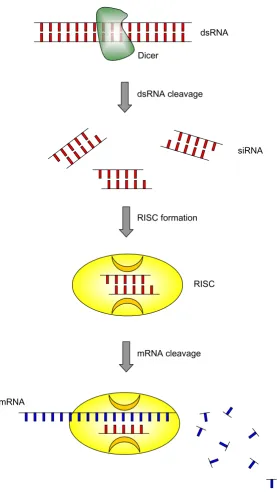
transposons, which might otherwise destabilize the genome by acting as insertional mutagens [7]. Though its mechanisms are not fully elucidated, RNAi represents the result of a multistep process (Figure 1). Upon entering the cell, long dsRNAs are first processed by the RNAse III enzyme Dicer [8]. This functional dimer contains helicase, dsRNA binding, and PAZ (named after piwi, argonaute, and zwille proteins) domains. Whereas the former two domains are important for dsRNA unwinding and media-tion of protein-RNA interacmedia-tions, the funcmedia-tion of the PAZ domain species, is not completely elucidated [9,10]. Dicer produces 21–23 nucleotide dsRNA fragments with two nucleotide 3' end overhangs, i.e. siRNAs. Recently it has been suggested that Dicer has functions other than dsRNA cleavage that are required for siRNA-mediated RNAi in mammals [11]. RNAi is mediated by the RNA-induced silencing complex (RISC) which, guided by siRNA, recog-nizes mRNA containing a sequence homologous to the siRNA and cleaves the mRNA at a site located approxi-mately in the middle of the homologous region [9]. Thus, gene expression is specifically inactivated at a post-tran-scriptional level. In C. elegans, Dicer has been shown to interact with rde proteins. The rde proteins bind to long dsRNA and are believed to present the long dsRNA to Dicer for processing [12]. Mutants displaying a high degree of resistance to RNAi have been reported to possess mutations at rde-1 and rde-4 loci [13]. Given the highly conserved nature of these enzymes, similar mutations may be of significance in mammalian cells.
Besides gene silencing, RNAi might be involved in other phenomena of gene regulation. DNA/RNA interactions are known to influence DNA methylation. It appears that RNAi can also function on this level by methylating cytosines as well as CpG sequences more classically asso-ciated with methylation. If the target sequence shares homology with a promoter, transcriptional silencing may occur via methylation. Moreover, RNA appears to interact with chromatin domains, which may ultimately direct
DNA methylation. Studies of C. elegans have shown that RNAi can spread among cells through mechanisms that may not hinge upon siRNA [14]. The systemic RNA inter-ference-deficient (sid) locus, sid-1, encodes a conserved protein with a signal peptide sequence and 11 putative transmembrane domains, suggesting that the sid-1 pro-tein may act as a channel for long dsRNA, siRNA, or a cur-rently undiscovered RNAi-related signal. Sid-1 mutants retain cell-autonomous RNAi but fail to show spreading of RNAi. It remains unclear whether this systemic RNAi occurs in mammals, although a strong similarity is reported between sid-1 and predicted human and mouse proteins.
siRNA synthesis and delivery strategies
Several strategies for inducing siRNA-mediated gene silencing have been developed, each of them presenting specific advantages and disadvantages (Table 2).
[image:2.612.55.560.100.238.2]Synthesis, purification, and annealing of siRNAs by indus-trial chemical processes [15] is becoming increasingly popular. This method is rapid and purity is generally high. This may be the best approach for initial "proof of princi-ple" experiments. In vitro siRNA synthesis is an alternative and relies upon the T7-phage polymerase [16]. This polymerase produces individual siRNA sense and anti-sense strands that – once annealed – form siRNAs. Extra nucleotides required by the T7 promoter are removed by RNase digestion and cleaning steps. Otherwise, recom-binant Rnase-III can be used to cleave long dsRNAs to pro-duce multiple siRNAs [17]. Although technically easy, this approach presents the drawback of the generation of non-specific siRNAs. siRNAs can be produced by polymerase-III promoter-based DNA plasmids or expression cassettes [18]. These constructs produce small inverted repeats, sep-arated by a spacer of three to nine nucleotides, termed short hairpin RNAs (shRNAs), which are processed by Dicer into siRNAs [19]. Transcription begins at a specific initiation sequence, determined by the promoter used. In Table 1: Comparison between different methods for gene silencing.
Method Advantages Drawbacks
RNA interference Specific Relatively easy
Knock-down (not knock-out) Needs transfection
Anti-sense DNA Easy Inexpensive
Variable efficiency Variable specificity Needs transfection Dominant negative mutants Stable suppression
Specific protein domains can be targeted
Needs transfection Variable/unexpected effect Knock-out animal Complete gene silencing Labor intensive, expensive
Lethal mutants may prevent embryonic development Small molecule inhibitors Easy delivery Variable specificity
Mechanism of RNA interference (RNAi)
Figure 1
Mechanism of RNA interference (RNAi). The appearance of double stranded (ds) RNA within a cell (e.g. as a consequence of viral infection) triggers a complex response, which includes among other phenomena (e.g. interferon production and its conse-quences) a cascade of molecular events known as RNAi. During RNAi, the cellular enzyme Dicer binds to the dsRNA and cleaves it into short pieces of ~ 20 nucleotide pairs in length known as small interfering RNA (siRNA). These RNA pairs bind to the cellular enzyme called RNA-induced silencing complex (RISC) that uses one strand of the siRNA to bind to single stranded RNA molecules (i.e. mRNA) of complementary sequence. The nuclease activity of RISC then degrades the mRNA, thus silencing expression of the viral gene. Similarly, the genetic machinery of cells is believe to utilize RNAi to control the expression of endogenous mRNA, thus adding a new layer of post-transciptional regulation. RNAi can be exploited in the experimental settings to knock down target genes of interest with a high specific and relatively easy technology (see text for more details).
Dicer
dsRNA
dsRNA cleavage
siRNA
RISC formation
RISC
mRNA cleavage
addition to a defined initiation sequence, the U6 polymerase-III promoter terminates with TTTT or TTTTT [20]. The products are shRNAs that contain a series of uri-dines at the 3' end, a feature that seems to favor RNAi [21].
Suppression of gene expression by RNAi is generally a transient phenomenon [22]. Gene expression usually recovers after 96 to 120 hours or 3 to 5 cell divisions after transfection, which is likely due to dilution rather than degradation of siRNAs. However, by introducing plasmids which express siRNA and a selection gene, stable RNAi can be sustained as long as two months after transfection [23]. Interest is growing in the use of viral vector-mediated RNAi. Adenoviral and retroviral vectors have been reported to produce siRNAs in vivo [24,25] and stable RNAi is obtained using this method, though in the absence of a selective pressure [26,27]. Virus-mediated RNAi may circumvent some of the problems associated with cells that are generally refractory to RNAi, such as non-transformed primary cells [28]. At present, the ques-tion of whether funcques-tional RNAi will continue in all prog-eny of a cell with stable vector integration remains unanswered.
Designing RNAi experiments
Several crucial considerations should be beard in mind while designing RNAi experiments. The below examples regard RNAi experiments performed with chemically syn-thesized siRNA.
1. The first step is to design a suitable siRNA sequence. A growing number of libraries of validated siRNAs directed toward some frequently targeted genes are available. However, if the gene of interest has not been targeted using siRNA before, a novel siRNA must be developed. In mammalian cells RNAi is mediated by 21- to 23-nucle-otide siRNAs containing symmetrical two nucle23-nucle-otide 3' overhangs. Given a siRNA sequence alone, it is not cur-rently possible to predict the degree of gene knockdown
produced by a particular siRNA. Nevertheless, several observations have been made that can be taken into account to increase the probability of producing an effec-tive siRNA. The chief variable is the gene target site. Gen-erally, it is recommended that a target site located at least 100–200 nucleotides from the AUG initiation codon is chosen. Targets within 50–100 nucleotides of the termi-nation codon should instead be avoided. The 5' and 3' untranslated region (UTR) should also be avoided, since associated regulatory proteins might compromise RNAi. This is just a general recommendation, as some siRNAs targeting the 3' UTR have also been shown to induce RNAi [29]. Numerous on-line design tools will produce a list of suitable gene target sites. It is important to ensure that the sequence is specific to the target gene by performing a BLAST search in order to avoid cross reaction with unwanted genes. As an example, Biocomputing at the Whitehead Institute for Biomedical Research – a non-profit independent research and educational institution affiliated with the Massachusetts Institute of Technology – is one of several organizations that has developed a freely available web-based siRNA design tool.
[image:4.612.54.561.99.218.2]2. The structural characteristics of the siRNA molecules are another crucial aspect to be considered while designing RNAi experiments. SiRNA of 21 nucleotides with 3'-d(TT) or (UU) overhangs are considered the most effective [30]. Despite the fact that nucleotide-protein steric interactions contribute to the relationship between siRNA length and activity, the reason for this relationship is not completely elucidated. For optimal siRNA secondary structure, the GC ratio should ideally be between 45 and 55%, and mul-tiple identical nucleotides in series, particularly poly(C) and poly(G), should be avoided to determine any require-ments for modification, such as fluorophore labeling to allow for siRNA tracking and quantification of transfec-tion efficiency.
Table 2: Comparison between siRNA delivery methods.
Method Advantages Drawbacks
Chemical or enzymatic synthesis Rapid
Enzymatic: no need to test individual siRNA Chemical: high purity
Transient RNAi Needs transfection
Enzymatic: variable purity & specificity Chemical: expensive
DNA plasmid vector or casette Less expensive Stable RNAi
Labor intensive Needs transfection Viral vector Stable RNAi
May be effective in cells resistant to transfection with dsRNA/plasmids
3. To induce RNAi, siRNA must be transfected into the cells of interest. Several transfection reagents exist, the most commonly used being liposomal or amine-based. In some cases electroporation may be used, but cell toxicity can be high with this technique [31]. Cell lines show var-ying responses to different transfection reagents, and it may be necessary to try more than one reagent or approach. Transfection efficiency is optimized by titrating cell density, transfection time, and the ratio of siRNA-to-transfection reagent. The cell passage number and antibi-otic use can also affect the efficiency of transfection.
4. Recently, experimental design features have been sug-gested to guarantee the rigor of RNAi experiments [32]. Due to the high specificity of RNAi, a siRNA with a one-nucleotide sequence mismatch can serve as a negative control. If this approach is used, absence of homology with other targets should be confirmed at the design stage. It is important to remember that mismatched siRNAs could target mutant gene sequences. Therefore loss of functional target gene silencing should be demonstrated to validate this approach. Alternatives include sequences that preset no homology to any known gene. Some inves-tigators have suggested that scrambled siRNA is not suffi-ciently homologous to the target sequence to function as an adequate control; therefore, they propose a combina-tion of mismatched and scrambled controls [32]. A more challenging functional control is to demonstrate the "res-cue" of the target gene function following artificial overex-pression of the target gene. Transfection of a plasmid expressing the gene sequence to which a siRNA is targeted results in production of mRNA that would also be targeted by the siRNA. This problem can be overcome using plas-mids containing silent mutations. This approach takes advantage of degeneracy of gene coding, i.e., amino acids are represented by more than one three-nucleotide codon sequence. Rescue is achieved by expression of a protein identical to the native protein from a nucleotide sequence that differs from the native nucleotide sequence to which the siRNA is targeted. Alternatively, siRNAs directed to the 3'-UTR can be used. Many researchers use more than one siRNA, with each targeted to different areas of the gene sequence. A consistent RNAi response using different siR-NAs with a variety of targets within the gene sequence of interest would increase confidence in experimental results. Dose-respons characteristics should be deter-mined and the lowest effective concentration of siRNA be used to avoid nonspecific effects.
5. The effect of RNAi should be quantified at both the mRNA and the protein level. The knockdown of a protein should be probably evaluated after mRNA reduction has been proved: in fact, a reduction in protein levels not accompanied by a decrease in mRNA might indicate that other mechanisms are at work, such as RNAi mediated by
microRNA. Northern blot analysis is considered by many to be the gold standard. Real-time reverse transcriptase polymerase chain reaction, incorporating internal con-trols to quantify "housekeeping" gene transcript levels, can also be used [33]. Protein knockdown can be con-firmed by Western blot analysis, immunofluorescence, flow cytometry and phenotypic and/or functional assays. Although RNAi generally occurs within 24 h of transfec-tion, both onset and duration of RNAi depend on the turnover rate of the protein of interest, as well as the rate of dilution and longevity of the siRNAs. The duration of gene silencing can also be modified by factors such as the concentration of serum in the culture medium, which affects cell-cycle rate. It is therefore necessary to determine the time course of any silencing observed under specific conditions using the modalities discussed.
Conclusions
synthetic or in viral vectors, as screening tools. Two main avenues of research can rely upon RNAi libraries. First, in a high-throughput manner each gene in the genome is knocked-down one at a time and the cells or organism scored for a desired outcome, such as death of a cultured cancer cell but not a normal cell. Due to the very large numbers of assays required to screen all 35–50,000 genes in the human genome, this approach is highly labor-intensive and time consuming. The other approach is to use large pools of RNAi viral vectors and apply a selective pressure that only cells with the desired change in behav-ior can survive. The identity of the genes knocked-down in the surviving cells can then be identified by sequencing the RNA interference vectors that they carry. Both approaches show consider-able promise in identifying novel genes that may make important therapeutic targets for inhibition either by conventional drug discovery methods or, more intriguingly, by RNA interference itself.
Acknowledgements
We truly thank Ms. Marta Briarava for her help with graphics.
References
1. Fire A, Xu S, Montgomery MK, Kostas SA, Driver SE, Mello CC:
Potent and specific genetic interference by double-stranded RNA in Caenorhabditis elegans.Nature 1998, 391:806-810. 2. Williams BR: Role of the double-stranded RNA-activated
pro-tein kinase (PKR) in cell regulation.Biochem Soc Trans 1997,
25:509-513.
3. Williams BR: PKR: a sentinel kinase for cellular stress.Oncogene
1999, 18:6112-6118.
4. Hamilton AJ, Baulcombe DC: A species of small antisense RNA in posttranscriptional gene silencing in plants.Science 1999,
286:950-955.
5. Elbashir SM, Harborth J, Lendeckel W, Yalcin A, Weber K, Tuschl T:
Duplexes of 21-nucleotide RNAs mediate RNA interference in cultured mammalian cells.Nature 2001, 411:494-501. 6. Maine EM: A conserved mechanism for post-transcriptional
gene silencing.Genome Biol 2000, 1:1018-1022.
7. Hannon GJ: RNA interference.Nature 2002, 418:244-248. 8. Knight SW, Bass BL: A role for the RNase III enzyme DCR-1 in
RNA interference and germ line development in Caenorhabditis elegans.Science 2001, 293:2269-2273.
9. Bernstein E, Caudy AA, Hammond SM, Hannon GJ: Role for a bidentate ribonuclease in the initiation step of RNA interference.Nature 2001, 409:363-367.
10. Cerutti L, Mian N, Bateman M: Domains in gene silencing and celldifferentiation proteins: The novel PAZ domain and redefinition of the Piwi domain. Trends Biochem Sci 2000,
25:481-486.
11. Doi N, Zenno S, Ueda R, Ohki-Hamazaki H, Ui-Tei K, Saigo K: Short-interfering-RNA-mediated gene silencing in mammalian cells requires Dicer and eIF2C translation initiation factors.
Curr Biol 2003, 13:41-47.
12. Tabara H, Yigit E, Siomi H, Mello CC: The dsRNA binding protein RDE-4 interacts with RDE-1, DCR-1, and a DExH-box heli-case to direct RNAi in C. elegans.Cell 2002, 109:861-865. 13. Tabara H, Sarkissian M, Kelly WG, Fleenor J, Grishok A, Timmons L,
Fire A, Mello CC: The rde-1 gene, RNA interference, and transposon silencing in C. elegans.Cell 1999, 99:123-127. 14. Winston WM, Molodowitch C, Hunter CP: Systemic RNAi in C.
elegans requires the putative transmembrane protein SID-1.
Science 2002, 295:2456-2460.
15. Elbashir SM, Lendeckel W, Tuschl T: RNA interference is medi-ated by 21- and 22-nucleotide RNAs. Genes Dev 2001,
15:188-194.
16. Donze O, Picard D: RNA interference in mammalian cells using siRNAs synthesized with T7 RNA polymerase.Nucleic Acids Res 2002, 30:e46-52.
17. Yang D, Buchholz F, Huang Z, Goga A, Chen CY, Brodsky FM, Bishop JM: Short RNA duplexes produced by hydrolysis with Escherichia coli RNase III mediate effective RNA interfer-ence in mammalian cells. Proc Natl Acad Sci USA 2002,
99:9942-9949.
18. Sui G, Soohoo C, Affar EB, Gay F, Shi Y, Forrester WC, Shi Y: A DNA vector-based RNAi technology to suppress gene expression in mammalian cells.Proc Natl Acad Sci USA 2002,
99:5515-5520.
19. Paddison PJ, Caudy AA, Hannon GJ: Stable suppression of gene expression by RNAi in mammalian cells.Proc Natl Acad Sci USA
2002, 99:1443-1448.
20. Bogenhagen DF, Sakonju S, Brown DD: A control region in the center of the 5S RNA gene directs specific initiation of tran-scription: II. The 3' border of the region.Cell 1980, 19:27-31. 21. Elbashir SM, Martinez J, Patkaniowska A, Lendeckel W, Tuschl T:
Functional anatomy of siRNAs for mediating efficient RNAi in Drosophila melanogaster embryo lysate. EMBO J 2001,
20:6877-6882.
22. Yang S, Tutton S, Pierce E, Yoon K: Specific double-stranded RNA interference in undifferentiated mouse embryonic stem cells.Mol Cell Biol 2001, 21:7807-7812.
23. Brummelkamp TR, Bernards R, Agami R: A system for stable expression of short interfering RNAs in mammalian cells. Sci-ence 2002, 296:550-554.
24. Shen C, Buck AK, Liu X, Winkler M, Reske SN: Gene silencing by adenovirus-delivered siRNA.FEBS Lett 2003, 539:111-115. 25. Stewart SA, Dykxhoorn DM, Palliser D, Mizuno H, Yu EY, An DS,
Sabatini DM, Chen IS, Hahn WC, Sharp PA, Weinberg RA, Novina CD: Lentivirus-delivered stable gene silencing by RNAi in pri-mary cells.RNA 2003, 9:493-498.
26. Brummelkamp TR, Bernards R, Agami R: Stable suppression of tumorigenicity by virus-mediated RNA interference.Cancer Cell 2002, 2:243-247.
27. Devroe E, Silver PA: Retrovirus-delivered siRNA.BMC Biotechnol
2002, 2:15-21.
28. Barton GM, Medzhitov R: Retroviral delivery of small interfer-ing RNA into primary cells. Proc Natl Acad Sci USA 2002,
99:14943-14948.
29. McManus MT, Petersen CP, Haines BB, Chen J, Sharp PA: Gene silencing using micro-RNA designed hairpins. RNA 2002,
8:842-849.
30. Elbashir SM, Martinez J, Patkaniowska A, Lendeckel W, Tuschl T:
Functional anatomy of siRNAs for mediating efficient RNAi in Drosophila melanogaster embryo lysate. EMBO J 2001,
20:6877-6882.
31. Benov LC, Antonov PA, Ribarov SR: Oxidative damage of the membrane lipids after electroporation. Gen Physiol Biophys
1994, 13:85-91.
32. Whither RNAi ?Nat Cell Biol 2003, 5:489-492.
33. Mocellin S, Rossi CR, Pilati PL, Nitti D, Marincola F: Quantitative real-time PCR: a powerful ally in cancer research.Trends Mol Med 2003, 9:189-195.
34. Mocellin S, Wang E, Panelli M, Pilati PL, Marincola F: DNA array-based gene profiling in tumor immunology. Clin Cancer Res
2004, 15:4597-4605.