Rochester Institute of Technology
RIT Scholar Works
Theses
Thesis/Dissertation Collections
6-1-1996
Pattern, the visual mathematics: A search for logical
connections in design through mathematics,
science, and multicultural arts
Seung-eun Lee
Follow this and additional works at:
http://scholarworks.rit.edu/theses
This Thesis is brought to you for free and open access by the Thesis/Dissertation Collections at RIT Scholar Works. It has been accepted for inclusion
in Theses by an authorized administrator of RIT Scholar Works. For more information, please contact
Recommended Citation
PicrdoTrKwe, r't.t/ry
'jX7ipu.lv z&ietQStd(XtrmaiKc'i-J: ffocub.The(i^piicaiom o". crWx<M Wfflrtu't. fifesspwn,Jiii*iaiin^jfli dtfifi,tmijpivxeiu3ili'-rCiluvjtv-tzxi patcrr?;i t.driftersvcy.
Symmetr, yo
Thetheoreticalconcepts ofsymmetry dealwith
grouptheoryandfiguretransformations.Figure transformations,orsymmetryoperations referto themovement and repetition of anone-, two,and
three-dimensionalspace.
Themotif ibelj urwlu. vaed U> cfaau patem.Afci
w the ivxttk arwlmetwung
J\ one variet.
Ilhowtuoirwti)
,^gjingnuirtmgiltjpg.v/htch art familiar rhtzrtiofIcingir-the\X''tJ. have been-.tapedfcjbrwJerfg I iivCTiitt-;.cfBattemtiatkindni WeiLon Imowledg*teemto ihare tki lame&asK pattum-farming prKtszet OutersatztheWmdnies o/natureand
.^rr.pcreand vafidWtxempB'f1 and mouj: iri termiof Semiociw Hut poM' vx*.-reaudto (tv.peoplean OpportunityCo get abroader under-standingaboutt)vzmeQ.fi and (wft'.nu
. ofcrou-toktadiMue.
d-:ivi;i10mthefi>e
MathematicalpatternsSometimesreflectvisuaipattern',that tfre eyefinds particularlyaesthetic.Onefamous example i Kuchmathematicalpatternisthe golden ratio.Accordingto the
Greeks,thegoldenratiotstheidealproportionfoi'the sidesof : rectanglethattheeyefindsthemost pleasing The<)olci*?nrati* is found innature Thechamberedshellgrowsto termalogamf)
piral,a mathematical curvethatspiralsouti dependentonthegoldenraffb.'
Thevalue ofthegoldenratiois(1 +05) '2,an mr approximatelyequal to 1.67 S Itisthewhendividinga .-twopiecessothat theratio ofthelongerpieceto the'JnjJV'ta
.v+1
-flrWcmUlhihbe<|.m'" I'"* Incommunities,varioustaboos i-jmtintobeingregarding his wayn||(fe.Togetherwiththe concept ofrevering heaven,.,
rifin.il ritesinorder spiritstograntthis wish,andhemadethedoud Image Itssymbol, cloudshapes were carved on sacritidal uten silsinthehopesthaithedesires theysymbolizedwould reach heaven.Thedoudmotifs appearIn descriptionsofthe
ofheaventhatare scat tered throughandenllegends,
nd serve as symbolic represen-ons of(his idealrealm.
Sbrjo, Wand,SO0BX. B, Intuitionor some jreientreligionscience, r.iinnolthe mj(>cvv>e<n tcih.wc grM-j.iti.jidiespiral .i,robotizes artr.tr> in thelife gtvmg <d duos.
-. analytical t1
C
u l t ug
Patternarrangementippeai meaningfulpatternsolhuminbehavioiSine* IhttUscveryand e; of patternedhumaibehavior isI logy,itwould set
behaviorpatterns cotintently |fate assetfori erycultureinIheworldii knowntodecoratealleastsomep
A
search
for logical
connections
in design
through mathematics,
science and multicultural arts
A Thesis Report
Submitted
to the
Faculty
ofThe College
of
Imaging
Arts
and
Sciences
In
Candidacy
for
the
Degree
of
Master
of
Fine Arts
Seung-Eun Lee
Department
ofGraphic
Design
CONTENTS
TITLE PAGE
J
CONTENTS
5
APPROVALS
7
INTRODUCTION
11
ACKNOWLEDGEMENT
13
RESEARCH
15
METHODOLOGY
19
SYNTHESIS
34
IMPLEMENTATION
37
EVALUATION
42
CONCLUSION
42
FUTURE PLAN
43
I,
hereby grant permission to
the Wallace Memorial library of RIT to reproduce my thesis whole or part.
Any reproduction will not be for commercial use or profit.
I also prefer to be contacted each time a request for production is made.
1can be reached at the address following:
175 Boniface Drive
Rochester, NY 14620
U. S. A.
Tel
716) 271 2701
85-16 Chungdam-dong
Kangnam-gu
Seoul. 135-110
S. Korea
Tel
+011 82 2) 544 3313
SEL2147/ilritvax. rit.isc. edu
SLee288918/ilaol.com
web-sile
http://www.espritdomain.com
APPROVALS
Advisor:
Professor
R.
Roger Remington
_
Date
Associate Advisor :
Professor Robert Keough
Date
Associate Advisor :
Dr. Richard D. Zakia
Date
Department Chairperson:
Professor Mary Ann Begland
Date
We
see patterns everywhere around usthathave
arelationship
withboth
the
natural and man-made world.These
patterns provide visualenrichment and enjoyment.It
is
alsotrue thatpatterns are sometimes regarded asforms
ofdecoration
such as wallpaper ortextile in
thecontext of arthistory.
However,
patterns are morethanjust
aform
ofdecoration. Through many
eras,
different
cultureshave developed
patternsas a system ofrecognition,
andbased
onmathematical system.Patterns
areformed
by
repeating
a motif as one ofthe
fundamental
regions.Some
ofthemotifshave
a symbolicmeaning
connectedtoculture andregion.
Living
in
themodernage,
weareadapting
toamulti-cultured society.Therefore,
it is
desired
toexaminehow
patternshave been developed
by
different
andsuccessive cultures.To
help
readers understand cross-cultural motifs andpatterns,
I
alsoinclude
Semiotics
tosupportthis topic.There
is
nolimitation
to thestudy
of patterns.I
have done
research onculture,
history
of art andcraft,
graphictheory, textiles, folk
art, religion,
cognitivestudies, psychology,
mathematics, crystallography
and even music.As
result, I
believe
thatall ofthesefields
areinterrelated in
analyzing
patterns.No
aspectis
moreimportant
thananother.Each
discipline
supportstheother asthey
coexist.The
goal ofthis thesisis
tocreateimages
based
onexisting
theoriesrelatedI
am gratefulto
my
thesis committee,
Prof. R. Roger
Remington,
Prof.
Robert Keough
andDr. Richard D. Zakia
whohave
guidedmethrough
stages ofaccomplishing
this
thesis.Special
recognitiontomy friends Gedeon Maheux
andDavid Seah for
theirwholehearted support
in
knowledge
of computers andencouraging
me allthe time withtheirbeautiful friendship.
My
appreciation also goestoAndy
Lee
whohelped
meby
reading
and commenting
onthemanuscript ofthisthesisreport,
andteaching
me otherknowledge
of computers with sincerity.I
also givethanks to thefaculties
oftheDepartment
ofGraphic
Design,
Prof. Heinz
Klinkon,
Prof. James Ver
Hague,
Prof.
Nancy
A.Ciolek
andProf.
Mary
Ann
Begland
for
teaching
me graphicdesign
and computer graphics.My
gratitudetocolleagues,
Yih-Chi
Wang,
Aaron
Lui,
Joseph A.
DiGioia,
Antoinette
Monnier
andJung-mei Tsen
for
theirwarmfriendship.
Special
thanks
toMr.
Eric Leader
atPrinting Prep
Inc.,
Buffalo
andETC
at theRIT
Library
for
producing
thefinal
implementation
andpublishing
this thesisbook
andCD-ROM.
Above
all,
unlimited appreciation andmy
indebtness
tomy
parents,
Mr.
Choosing
aTopic
During
theSummer
of1994,
1
startedtoconsidermy
thesis topic.Anything
could
be
atopicbut I decided
tochoose patternsbecause
it
containscontemporary,multi-cultural and academic
issues in
whichI
have
astrong
interest.
The
topicalsohad
tobe
ontheviewpoint offundamental
graphictheory
andtobe
understoodby
both
graphic professionalsandnon-professionals.I
rememberedthatwhiletaking
Theory
andMethods
<amajor courseinthefirst quarter of1993)withProf. Roger
Remington,
I
wasattractedto
William
Morris'pattern
in
Art
S Craft Movement
anddecorative
artsin
theperiod ofArt
Nouveau. Since I
had done
research ontheArt Nouveau
periodextensively
atthetime, I had
anidea
wheretobegin my
research.With
thosequestionsin mind,
I
found
it
necessary
tounderstand graphic
theory
andapplications of pattern.Since
1
had been
interested in computers,
I
thoughtit
wouldbe
aninteresting
newway
topresentthetheory
of pattern with printedmedia andinteractive
multimedia applications.I
believed
thatshowing
thesubject patternwithnewinteractive
media wouldbe
ainteresting
way
tosatisfy
allrequirementsfor
the thesisgoals.[Research
8 analysis]
Material Resources:
1
startedmy
research attheRIT Wallace Library. I
printed alist
ofrelated articlesfrom
theword patternusing
theEinstein
search engine.Furthermore,
I
did
my
thesisresearch attheRochester Public
Library
in
downtown Rochester
andthebookstores
aroundtheRochester
area.I
tried tofamiliarize
myself with wordsthatdescribe
pattern and gatheredmoreinformation
onbooks
onhow
patternshave
been
studiedin
many
waysanddifferent
fields
ofstudy.However,
I
found
thatmost ofthosebooks
talkedjust
withinarthistory. I
wasnot satisfiedbecause I
couldn'tfind
whatI
neededtoknow.
Prof. Roger Remington
lent
meWucius Wong's Principle
ofTwo
Dimensional
Design
andPrinciple
ofThree Dimensional Design. Those
twobooks
werehelpful for
meto
understandtheidea
ofdifferent
structuresin
twoandthreedimensional
composition.He
also suggestedthebook Basic Visual
Concept
andPrinciples
(Charles
Wallschlaeger
S Cynthia
Busic-Snyder). It
guidedmetoexpressmy
pointof view onthe
graphictheory.In
orderto
getideas
about comparison ofEastern
andWestern
Culture,
1
brought
somebooks
aboutKorean
traditionalandcontemporary
artfrom Korea. 1
wasabletoscansomeimages
and quotesinto
thecomputer.I
also gave alist
oftheRESEARCH
During
the
researchstage,
I
readThe Visual Mind
by
L.
Loreto,
R. Farinato
andM. Tonetti. The book
talked
aboutInteractive Multi-Window Computer Graphics
in
chapter 27.It
showedillustrations
of production and comparison ofsymmetry
patternsin
a multi-window arrangement.The
chapter usedtheinteractive
computer programSYMPATI
software as reference.SYMPATI
is
aMS-DOS
application which works onIBM
compatiblePC's
(see Appendix 7.a>I
wasinterested
tofind
theprogram andlearn how
it
works.I
called a student who studies atIllinois Institute
ofTechnology
in
Chicago
tosee
if
he
could getany
information
oncrystallography for
me,
especially SYMPATI.
However,
he
sent me ademo
version of a programLAZY,
a software program which can createthestructure of anatom, instead
oftheSYMPATI. That
was abetter
pro gramfor
mebecause
thesoftware wasfor Macintosh
andI
wasabletouseit
onmy
Macintosh
computer.Research
in
Cambridge &
Boston,
Massachusetts
During
theFall/Winter
Break,
I
wentdown
toBoston
tofind
moreinformation.
Since MIT
andHarvard
University
arelocated
in
theBoston
area,
1
thought
they
musthave
a greatlibrary
system with good resources.On
top
ofthat,
the
Boston
regionis
known
as one ofthebiggest
publication centers.When I
gottoCambridge
in
Massachusetts,
I
tried togetinto
theHarvard
University
Library.
However,
theonly way
toget accessto theirlibrary
wastohave
a certificatethatcontainsthe
list
ofthebooks
issued
by
theRIT
library.
I
experiencedthesame problem atMIT.
I
had better luck
withtheBoston Public
Library
andtheCambridge Public
Library.
I
found
several goodbooks.
They
wereWilliam Justema's The Pleasure
ofPattern
(1968),
Pattern The Historical Panorama
(1976),
andM.
Richard Proctor's The
Principle
ofPattern
(1969).
Nevertheless,
those
books
can notbe
checked out ofMassachusetts,
soI
had
tospend alot
oftime
reading
thebooks
andmaking
photo copiesthere.The
last
day
before coming back
toRochester,
I
stoppedby
theMIT
Bookstore. The MIT Press
always publishes goodbooks,
soI
expectedtofind
something
useful.I
washappy
thatI found
three
books
relatedto pattern.They
were:
The Visual Mind
(Michele
Emmer,
The MIT
Press,
1993),
A Primer
ofVisual
Literacy
(Dondis,
Donis A.. The MIT
Press,
1973),
andStrange Attract
onSigns
ofChaos
(Alice
Yang,
The New Museum
ofContemporary
Art,
1989).Figure1
MindMapping
1.aidsreadinganddevelopment/expression of creativity.
2.makesadvantageous use of visualmemory for increasedretention.
3. isanatural process.The brain hasa natural tendencyto cluster,orgroup ideas. 4.canbeteamed easily.
isadaptabletobothgroups andindividuals 5. is especiallyvaluablefor note-taking,
speechmakingandplaning, problem-solving, brain storming, planning session, and reviews exercises.
6. isanalternativetoformalnote-taking. Becauseofflexibilityand adaptability, newmaterialcanbeeasilyadded. 7. isa whole-brain activity. Adapted
from;'
Use Both SidesofYour BrainbyTonyBuzan.
The Visual
Literacy
was anotherimportant
sourcefor my
thesisdevelopment.
It
helped
metounderstandthebasic
elements ofdesign
andhow
topresentmeaningful
synthesis of visualinformation.
Although spending
just 4
shortdays for
research, this
trip
toBoston
wasvery helpful
in
termsofgetting
goodmaterials.After I
cameback
toRochester,
1
could propel myselftogo onto
thenext stage.Brain
Storming
andMind
Mapping
At
thebrain
storm stage ofmy
thesisdevelopment,
I
wrotedown anything
thatrelatedto theword pattern.It
couldbe any
simplewords,
dots, lines,
shapes,
and symbolsthatcamefrom my
mind orthatI
had
seen.I
wasstillbrain storming
even attheend oftheresearchbecause I believe
thatbrainstorming
is
thebest way
for
idea
expansion.Besides
brainstorming,
thereis
anotherway
toexpandideas.
This
is
called mind mapping."">Through
thedevelopment
process,
I
alwaysreminded myselfto getfeedback
through thismethod.[THESIS
PROJECTPLANNING
|
Through
theFall
quarter of1994,
1
had been
writing
the thesisplanning
report.The
thesisplanning
is
themeans ofmanaging
thedesign
process,
containing
10items
which areProject
Title,
Designer's Name
andAddress,
Documentation
ofNeeds,
Problem
Statement,
Mission
Statement, Methodology, Timeline,
Evaluation
Plan,
Bibliography
andGlossary
ofTerms.
Although I
did
notexactly follow
theplanduring
theentireprocess,
I
was abletouseit
as a guideline
of what was expected.With
theguideline,
I
had freedom
toaddor change whatI originally
planned.Basically,
I
stepped aheadbased
ontheplanning
report.On
thestage ofdoing
research onmethodologies,
experimented with otherfields
such asanthropology, religion, culture,
etc..It
also gaveme anintuitive idea
tohave better
perspective,(seeAppendix2)Based
ontheresearch,
whichI
had done
during
the
phase ofthe thesisplanning,
I
wasseeking
more possibilitiesin
relationtonewtheoriesabout pattern.Prof. Roger Remington
emphasized and remindedme abouttheimportance
ofmethodology
severaltimes, constructing methodology
was one ofthemostimportant
processesfor my
thesis.In
fact,
from
thismethodology,
I
synthesized allmaterials andinformation
on adiagram
calledtheresearchmap. (see Appendix 3)RESEARCH
had
tosupportmy
ideas
for
thefinal design. For
this
I
spentlot
oftimesetting up
theappropriatemethodology.
Within
the
limited
time, I
rushed myselftocoverotherunfamiliar
fields
ofstudy.Topics
such ascrystallography,
mathematicaltheories andtheperception
theory
were studied.I
tried tounderstandtheessentialideas
ofthe
theories
first,
andthenI
madetheresearchmap
toconnectthesemethodology
topics.My Study
became
more extensivethanI
anticipated,
soI
spentalot
oftime
deciding
whichcategory
tofocus
onfor my
thesis.Collecting
Definitions
ofPattern
First
ofall, it
wasnecessary
tohave
thedefinition
ofthesubject.There
aremany
interpretations
ofthewordpattern,
soI
wrotedown
themeanings asI
wentalong
withtheresearch.The
richness of patternis
based
onorder,
and represents ablend
oftheorganic and geometric.
It
is
a sort ofdesign
thatconsistsof a number of similar compositional
figures. Most
compositionof patternis
astructurethatgovernspositionand arrangement of
figures
andforms
tobring
aboutvisualorder andharmony.
Pattern
resultsfrom
therepetition of ashapesize, color, texture,
value,direction,
position,
andorientation,
eitherby
itself
orin
combination.[
The
termpatternnecessarily
implies
adesign
composed of one ormoredevices,
multiplied and arrangedin orderly
sequence.A
singledevice, however,
complicated or complete
in itself it
may
be,
is
not apattern,
but
a unit with which thedesigner,
working according
tosomedefinite
plan ofaction,
may
composeapattern.
]
Christie,Archibald H. Pattern Design(1969)Once I
gatheredthedefinitions
ofpattern,
I
organized andinterpreted
them
into
my
own words.Therefore,
it
helped
medecide
onthemaintopicandtheme
for my
thesis.Reading
Peter
Steven's
theHandbook
ofRegular Patterns
(1980),
I began
tohave
more questions.The book
is
full
ofillustrations
such as classes offinite
one-dimensional
(line),
two-dimensional(plane)
pattern classes.It
is
helpful for
artists and
designers
tounderstandtheunderstructure of repeated pattern.Although
the
book
has
goodinformation,
it
does
nothave
theexplanation of whatsymmetry
group
theory
orX-Ray
crystallography is
about.I really
wantedtoknow
whatthenotations such asmt,pg, orc2mmmeant.I
askeda studentmajoring
in mathematics,
but he didn't
seemtoknow. I
wasdisappointed. I
asked a professorin
theDepartment
ofImaging
Science
atRIT. He
saidthat
he knows
thetheory but
I
did
not getany helpful
knowledge
abouttheFigure2
FihnnarciSequence
Fabonacci sequenceisproducedbystarting with1andadding theprevioustwonumbers toarriveat thenext,continuing to infinity. The firsttwelveFibonaccinumbers are1,1 2, 3, 5, 8, 13, 21, 34, 55, 89,and144. Thesenumbershaveinterestingproperties and are often evidentinnature and art.
I
looked for
somebooks
aboutX-Ray
crystallography
atthe RIT
library. It
wasnot
easy
tolearn
anewfield
ofstudy
depending
ononly books.
Fortunately,
I
found Elements
ofx-ray
Crystallography
writtenby
Azaroff,
Leonid V.
(1968)
andSymmetry
in
Science
andArt
by
Shubnikov,
A.
V.,
andV.A,
Kopstic
(1974).
These
two
books introduced
thebasic
theory
of crystallography.Although
it
tookalong
timeto
understand
the
mathematicaltheory, I had
a greattime
studying
it.
I
willexplainthe
general
idea
ofcrystallography
on page 13.Mathematical Concept
Nature likes
to
repeatdesigns. Recall
the
structure ofsnowflakes, the
hexagonal
shape ofhoneycombs,
and molecularstructure patterns.With
these
examples
in mind, it
comes asno surprisethatmathematicianshave
attemptedtoclassify
these
repeating
patterns.There
aremany
typesofpatterns,
visualpattern,
human behavior
pattern,
mathematical pattern... and so on.Visual
patternis
associated withpoint,
line,
shapes,
and geometry.Human behavior
can act asapattern,
such asthe
sleep
patternof an average adult
is
atnight.Mathematics
is
aform
of patternderived from
number,
logic,
andspatialforms. Mathematics
is
notonly
aboutnumbers andonly
usefulfor
buying
orselling.Western
culturesusually
referstomathematics asjust
arithmetic(as
thepublicthinks),
orthestudy
ofnumber and space.However,
mathematicsis
notjust
asthedictionary
defines,
it
has
evolvedinto
the"science
of patterns".Numerical
systems are also part of pattern.We
don't
recognizenumbers aspattern
because
humans
are notborn
withtheknowledge
ofmathematicsbut
acquirethis througheducation.
The
infant
learn
numbers as an abstractentity
whichcannot
be
seen,
heard, felt,
smelled,
ortasted, but
remembered and utilizedfor
therest of
his
orher
life. Once
they
learn how
toidentify
numbers,
they
are abletouse theknowledge
ofcounting
torecognize mathematic patterns ratherthanjust
seeing
themas shapes.
Mathematical
patterns sometimes reflectvisualpatternsthat thehuman
eye
finds particularly
aesthetic.One
goodexampleis
thegolden-ratio.The Greeks
found
the
goldenratio astheideal
proportionfor
thesides of a rectanglethataremost
pleasing
to
thehuman
eye.The
rectangularface
ofthefront
ofthe
Parthenon
has
sides whose ratiois
in
thisproportion,
andit
may be
observed elsewherein
Greek
architecture.The
goldenratiois
alsofound
in
nature-.The
chambered shell of theNautilus
mollusk growntoform
alogarithmic
spiral,
amathematical curvethatspirals
based
onthe
goldenratio.The
goldenratio cropsup
in
variousparts of mathematics.One
well-knownexample
is in
connection withtheFibonacci
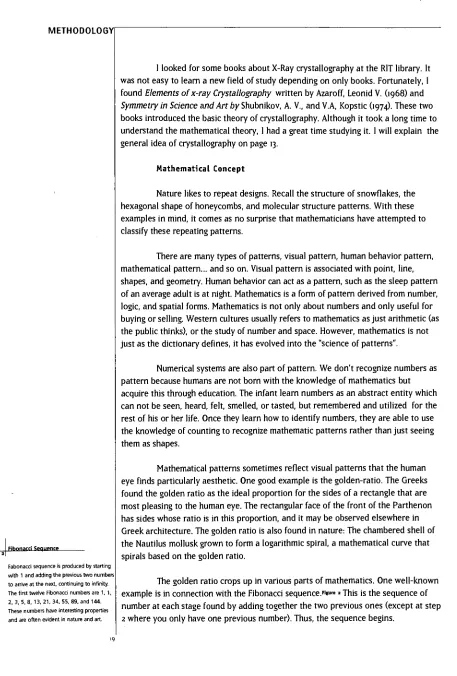
sequence."p"*This
is
thesequence of number at each stagefound
by
adding
together thetwo
previous ones(except
atstep
[image:16.580.77.534.71.747.2]METHODOLOGY
Figure 3Interlaced
Islamic Pattern
<j>
yfc
SrRk'St
5k
L.
J>*i.
>JXL^fj^JJ^
What
is
Crystallography?
Crystallography
is the
study
ofthe
externalform
ofthecrystals andtheirinternal
structures(i.e.
the
arrangement of atomsin
them).Crystals
are solid matterin
which atoms areessentially
arrangedaccording
toanunderlying
crystallattice.
The symmetry
possiblein
a crystalis
traditionally
called crystallographic symmetry.Although
Crystallography
originated withminerals, it includes
moregeneraltopics-undergoing development
into
abroad
areaof pure applied research.Crystallography
is
aninterdisciplinary
field
thathas
close contacts withmany branches
ofothersciences such as
chemistry,
mathematics andbiology.
Islamic Pattern
The
vision ofIslamic
patternis
theknowledge
ofthecultural orderof anordered universe.
The Islam
lands
werethecrossroads ofEast
andWest,
the
nexusof
the
greattraderoutes,
sothepeople were great navigators ofthedesert
asthey
were
later
tobe
ofthe
oceans oftheworld.They
held
allnatural phenomenain
greatrespect and noted
the
structure ofstar and plantformations.
Their
land
ofdesert developed
in
thepeople a cosmic sense of scale anddistance
in
relationtotopography
andtheheavens
combined witha minute order and geometry.Repeated
pattern andinterlaced
patterns are often characterizedin
Islamic
art.
Symmetric
tiling
of oneform
or anotherhave been
used asdecoration
onbuildings
in the
Islamic
world.We
frequently
obtain or symbolizemeaning
by
theuseof symmetry.
This
is
found
in the
religiousicons,
theexquisite mosaic and patternsused
in
Islamic
art.The Islamic
patternis
based
upon aningenious
application ofgeometry
andthestructure as aninstrument to unify
thediversity
encompassing
allin
one reflectsIslamic
cosmology.The
patternis
drawn
nextending
toinfinity,
exploiting
ambiguity, illusion
andflux.
The
largest
published collections ofinterlace
patterns areby
authorJ. Bourgoin.
Therefore,
we will observemost oftheinterlaced
patternsin three
areas.
First,
interlaced
patterns consist either ofidentical
strandsor oftwo shapesof strands.
Second,
thesemeasures are relatedto thesymmetry
properties ofthepattern.
Third,
an explanation ofthefrequent
appearanceofinterlace
patternsconsists of strands of a single shape or
just two
different
shapein
Islamic
art.ns<"3BrankoGnmbaumandG. C.Shephard,The Visual Mind(1993)
Tiling
Tiling
is
one ofthepracticalapplicationsofsymmetry.
The
repetitionofsome
basic
motifsfollowing
some rulestocover anentire surface makesatwo-dimensionalspace group.
Tiling
canbe
used asdecorative
wallpapersortextiles
Figure*
MauritzConelisEsther
Maurits Cornelis Escherwasborn in Leeuwarden in 1898. Hisgraphic artbursts
withcunning^planned visual surprises.
[
A
tiling
is
covering
ofthe
planeby
closedshapes without gaps oroverlaps;
twoother synonymoustermsaretessellationand parquetry.Mathematically,
thespace
is
treatedas aheavy
outline oftiles thatfit perfectly
together.The
fitting
togetherofshapestofill
an areais
a pleasurablechallenge-play
with colored polygonshapes orthecompletion of a
jigsaw
puzzle are examplesin
whichtheshapes aregiven,
and we expectthem tofit
togetherin
many different
ways.]
doschamchnader,ne VisualMind(1993)Islamic
andMoorish
patternhave
attracted peopleto
theirintricate
pattern.Dutch
graphic artistMauritz Conelis Escher
is the
mostfamous
artistdisplayed
tiling
asurfaceby
a single motif or afew
motifs ofinteresting
shapes.Mauritz Conelis Escher
At
thefirst meeting
withDr. Richard Zakia
he
suggestedthatI do
someresearch on
Mauritz Conelis Escher (i898-i972).ns"4 1
found
twobooks
aboutM.
C.
Escher
atBorder's Bookstore
andI
scanned overhis
bibliography
and chronologicalartworks,
but I didn't pay
attentiontohis
works upontheregulardivision
oftheplanethatwere
derived from
mathematics and crystallography.It
wasn't until after winterbreak
whenI
found
theVision
ofSymmetry,
theSymmetries
in
Culture,
andtheSymmetry. 1
nowhad
abetter
cluetounderstandtheformation
of patternin
relationtosymmetry
theory.I
resumedresearching M. C.
Escher. The
mostfancy
application ofthelaws
ofcrystallography
canbe
seenin
thework of
M. C.
Escher,
who arrangedpeople, animals,
andinsects in
two-dimensionalone-,
two-andmulti-colored symmetrical patterns.One
ofthepractical applications ofsymmetry
is
tiling-repetitionofsomebasic
motiftocover an entire availablesurface,
making
atwo-dimensionalspacegroup.
Tiling
canbe
used asdecorative
wallpapers ortextiles
ortoinvestigate
propertiesofgeometricalshape.
Crystallographers
usethesymmetry group
of a patternin
theirclassificationscheme; it is
based
ontheidentification
of anunderlying
geometriclattice
ofthe pattern relatedtoits
translationsymmetries andtheirlocation,
in
relationto thislattice,
of centers ofrotation,
axis of reflection and axis of glide-reflection.The
crystallographers'and
mathematicians'
quest
is
for
alogical
analysis of a givenstructure;
Escher's
quest wasto
discover
thevarious waysin
whichtocreate original periodic patternsin
theplane.(seeAppendix 7.c)Tiling
&
Symmetry Group
The
mathematical modelfor
internal
structure of crystalsis
onein
whichatoms arealigned
in
a periodiclattice,
so almost all mathematicalinvestigations
ofMETHODOLOGY
always a minimal patch ofthe
tiling
that
fills
thewholetiling
by
translating
it
againand again
in
twodifferent directions. One
canfirst fill
out aninfinite
strip
withthepatch,
then translate thestrip
tofill
outtheplane.Mathematicians
usegeometrictransformations oftheplanethatpreserveshapeto
describe
theorder.These
transformationsaretranslation,
rotation,
reflectionand glide reflection.
Each
such geometrictransformationis
called asymmetry
ofthetiling;
thecollection of all symmetries of atiling
is
calledthesymmetry group
oftiling.
Symmetry
groups arenotjust
collections of geometrictransformationsbut
also
have
algebraic structure.Periodicity
of atiling severely limits
thepossibilitiesfor
symmetries otherthantranslations;
thereareonly
171different
types ofsymmetry
groups of periodictiling.
Symmetry
During
my
research, I
wassurprisedtofind
thatmany
subjects such ascrystallography,
fractal,
Islamic
patterns,
music andmany
more all relatetosymmetry.This
leads
metoquestionmyself;
Why
arehumans
attractedtosymmetry?Why
did
it
make peoplefeel
comfortable?Did it
happen
naturally?Did God
createit
thisway?As
for
thetheology field,
it
coversthestudies ontheory
ofperception,cognitivetheory,
group
theory,
etc..At
this point,1
needto talkmore aboutthedefinition
ofsymmetry
and
why I
had
tostudy symmetry
andhow symmetry
theory
supportstheexplanationof pattern.
Symmetry
is
avery
simpleconcept,
but
it
also means morethanjust
apleasing
visualresponse.Symmetry
appealstoour visualsense,
andthereby
plays arole
in
oursense ofbeauty.
Symmetry
has
enjoyed a special placein
both philosophy
andtheology.
Symmetry
is
amathematicalproperty
which generates repeatedpatterns,
as well as a
feature
usedin
theperception and categorization ofform.
Symmetry
plays arole
in
a wide range ofdecorative designs
andtextiles.
Symmetry
is
based
onsuperposition.
Elements
which areregularly
superpositionedalong
an axis arethusregularly
repeated.The resulting
patternis
symmetrical.In both everyday
usage andmathematics,
symmetry has
thesense ofrepetition,
such as a wallpaperrepeating
one
design
over anumber oftimes.The
perfectsymmetry
is
repetitive andpredictable,
but
sometimes peopleconsider
imperfect
symmetry
tobe
morebeautiful
thanexactmathematical symmetry.Man
seemstolike
visualsymmetry,
balance
or comfort sothat
is
why
manusually
makes objects with symmetrical shape.
Symmetry
is
amathematicalas well as anaesthetic
concept,
andit
allows classification ofdifferent
types
of regular patternand
distinguishes between
them.The symmetry
concept provides perspectivefrom
our world as an
integrated
whole.The
collection of all suchsymmetry patterns, based
ontilingsin
thehave been
classifiedby
their symmetries;
These
symmetries are called eitherthe
wallpaper groups orthe two-dimensionalcrystallographic groups.
Symmetries
restrictthe
kinds
of pattern arrangements possibleforming
a sort of grammar.All
patterns are produced
by
thesame rules.Pattern
structures canchange,
but
therules cannot.
There
arelimited
possibilitiestobuild
patternsbased
ongroup
theory.I'm
not a mathematician andI
don't know
thespecificdetails beyond
thebasics,
soI
amgoing
tointroduce
the theoriesonthefollowing
pages and appendixestohelp
interested
readers understand.Humans
have
theability
todiscern
patterns.Symmetry
relatesharmony
and proportion and
it
provides perspectiveform.
Symmetry
is
divided
into
twolarge
classes;
pointgroup
andspace group.The symmetry
groupshave
algebraic structure and provide away
ofgenerating
periodictilingsasI
talkedabout ontheprevious pages.Author
Dorothy
K. Washburn
andDonald W. Crowe
pointed outthedifferences
in
cross-cultural preferencesfor
alltheplane pattern symmetriesassociated with
culturally
meaningfulstimuli,
andinvestigated
thesignificance ofdifferent
geometriesin
different
cultural contexts.Point Groups
are when atleast
one special pointin
theobject or patterndiffers from
alltheothers.This
special pointhas
animportant
distinguishing
feature:
it
remains unchanged no matter whattypeofsymmetry
operationis
performed.Such
symmetries
belong
to thepoint-group
category.For
anexample,
asystem of concentric rings resemblethepattern when a stoneis
throwninto
still water.The
pattern remainsunchangedif it is
rotated aroundits
center regardless ofits
position.Those
are often calledfinite
patterns andtherearegroup
i andm,
group2 and2mm, group3
and3m, group4
and4mm, groups
and5m,
group6 and6mm,
group7
and7m,
group8 and8mm,
10mm, 12mm, 16mm, 24mm,
...,andhigher.
<seeAppendix 7.d )Space
groupsare anotherform
of symmetries.However,
thereis
no pointin
theobject or patternthatis
different from
alltheothers.For example,
patterns ofhexagons like
abeehive
are considered a space group.In
general,
space groups canbe
one-dimensional,
two-dimensionalorthreedimensional-according
towhethertherepetition extends
in
theX,
Y,
orZ
axis.If
adesign
admitstranslationsin
only
onedirection
thedesign
is
called aband,
strip,
frieze,
orone-dimensionalpattern.In
thebeehive
example,
thehexagons
in
thepatternextendin
twodirections-length
and width.The corresponding symmetry
is
called atwo-dimensionalspace group.If
a planefigure
admitstranslationsin
twoormore
directions,
it is
atwo-dimensionalpattern.Two-dimensional
patterns arecommonly
found
onwallpaper,
tile, textiles,
and othermedia wherebroad
areas are coveredby
motif repetition.A
pattern canbe
generatedsimply
by
arepeating
motif.This symmetry
METHODOLOGY
distance
andtheresulting
patternis
periodic createdby
infinite
repetition ofthesame motif.
From any
one-dimensional pattern withperiodicity,it is
easy
togeneratea planar pattern
by
repetition,
extending
theperiodicity
in
twodirections.
Symmetry
Operation
Symmetry
operation andits
combinations provided7
possibilitiesfor creating
border decoration
with one color and17
possibilitiesfor
twocolorone-dimensionalgroups.
There
are another17
possibilities with one colorfor creating
planartwo-dimensional
spacegroup
and 46 possibilitiesfor
twocolor,
two-dimensionalgroups.For
three-dimensional periodicity,
thereare altogether 230 possibilities.One-color finite
one-dimensional7 two-dimensional17
Reflection
Glide-reflection
Rotation
Two-colorfinite
one-dimensional17 two-dimensional46
No
matterhow
complicated,
every
rigid motion oftheplaneis
one offour
basic
rigid motions.They
aretranslation,
rotation, reflection,
and glide reflection.The
term
"operation"
implies
action or movement.Translation
themotif movesup
ordown,
left
or right ordiagonally
while
keeping
thesame operationin
translation,
theresulting
patternis
periodic.the
figure
across a vertical axis or across ahorizontal
axisthemotifturns
in
rotationthemotif
both
translateand reflects(see
Appendix7.e and7.ffor
thefull
explanation ofthesymmetry
operation)Symmetry
in Culture
Pattern
arrangement reflectsculturally
meaningful patterns andhuman
behavior. Since
thediscovery
and explanation ofhuman behavior
is
theessence ofanthropology, it
would seemthatan analyticaltechnique
which canisolate
behavior
consistently
andobjectively
wouldbe
a great assetfor
thestudy
of certainkinds
ofcultural activities.
Practically
every
culturein
theworldis
known
todecorate
atleast
some portions of
its
material possessions withrepeatedpatterns. Dorothyk.washbumand DonaldW.Crowe(1988)Incidentally,
I
wasstudying
Dorothy
K. Washburn
andDonald W. Crowe's
Symmetries
ofCulture
(1988).
They
talkedabout patternsoccurring
ondecorated
objects
from
culture.They
also showed one-andtwo-color,
one-andtwo-dimensional,
andthecommon
finite design. I
borrowed
the
idea
pattern oftriangles
from
the
symmetry group
classificationfor my
thesis.
While I
wasstudying
withthisbook,
I
explored
many structurally
similar patterns which arefrom
different
Mgure5
BpnoltBManriplhrnt
In the 1960and1907sanIBM researcher,Benoit Mandelbrot, invented a newgeometry,whichhecalled
"fractal" geometry.Hecoinedthe term"fractal"
tosuggest "fractured"
and "fractional"
-ageometrythatfocusesonbroken, wrinkled,and uneven shapes.
historical
periods, (see Appendix 7. gand7.h)Chaos
Theory
andFractal
Fractal
is
a geometricalfigure
in
which anidentical
motifkeeps repeating
itself
oninfinite
scale.Originally
thegeometry
ofnatureis
fractal
to theextentthatwhen
looking
at shapesin nature-clouds,
treesand coastline-small parts arethe same asbig
parts.Traditional dynamics deals
with regularpatterns,
where aschaosis
thescience ofthe
irregular.
It
aimstoextract newkinds
of patternfrom
apparentrandomness,
patternthatwouldnotbe
recognized as suchin
atraditionalapproach.Chaos
is
akind
of randomness of which origins areentirely deterministic. It
alsoinvolves
shapes which are almostinvariably
fractal.
Chaos
theory
has
resultedfrom
asynthesis ofimaginative
mathematics andreadily
accessible computer power.It
presents a universethatis
deterministic,
obeying
fundamental
physicallaws,
but
with a predispositionfor
disorder,
complexity
andunpredictability.
It
is
thebeautiful
graphics associated with chaotic systemsthatmakeit
appealing
topeople who seethem.They
showhow
asimpleequation,
wheninput
into
acomputer,
can producebreathtaking
patterns of everincreasing
complexity.(seeQuickTimeMoviesonCD-ROM )
While playing
around withHSC Software Kai's Power Tool
2.1,
a plug-infor
thePhotoshop,
I
appreciatedthebeautiful fractal
pattern.To
me,
fractal
is
anabsolutely
revolutionary
approachthatappliesthetheory
of pattern.After
discovering
thefact
thatfractal
is
relatedtosymmetry theory, I
usedfractal
as a part ofmy
thesis.The
fact
thatfractal
is
relatedtosymmetry
theory
wasnotsurprising any
more sinceI
wasbeginning
to
understandthatall researchtopicsareinterrelated.
Mandelbrot Set
The
fractal geometry
wasinvented
by
Benoit B.
Mandelbrot,"*"^
andhas
become known
astheMandelbrot
set.The
fractal geometry
is
between
theexcessivegeometric order of
Euclid
andthegeometric order of general mathematics.It
is
based
onaform
ofsymmetry
thatis infinite
self-similarity.The
patternthatMandelbrot
and othersdiscovered
in
one region ofthecomplex plane was along
proboscidean
insect
shape ofstable points-themandelbrotsetitself,
usually
in
black-surrounded
by
aflaming boundary
offiligreed detail
thatincludes
miniature,
slightly distorted
replicas oftheinsect shape,
andlayer
uponlayer
of self-similarforms.
METHODOLOGY
Figure6|Quasicrystal
Acrystallatticecanhave two, three-,four-, five-,and six-fold symmetiy.Thesealloys can notbecrystalsinthe usual sense,hence the new term'quasicrystal'
8
OP.
&
\
*** &$
calltheprocessof
unfolding
thedetail
"zooming
in"ontheset's
boundary
or"magnifying"
it.
<seealsoQuickTime MoviesonCD-ROM)Icons
ofChaos
andStrange Attractor
Points symmetrically
relatedhave
symmetrically
relatedimages.
This
condition
is
usedfor
themathematicalform
oftheequation;
and once a symmetric equationis
found,
we can useit
todo dynamics. This
symmetry-creationis
calledchaotic
icons.
The
"icons"for fluid flow
are calledattractor,andthey
arein
animaginary
mathematical space of which points correspondtoall possibleflow-patterns.
People do
notnormally
thinkthatchaosis
a meansfor creating
pattern,
but
thestrange attractor
is
anotherkind
offractal
patternmadeby
adynamical exhibiting
chaos.(seeAppendix 7.i)
Quasicrystal Pattern
Lattices
in
theplane orthree-dimensionalspace canhave
rotationalsymmetries of orders
2,3,4,
and6
but
cannot achievefive-fold
rotational symmetry.It
wasn't untiltheearly
1970's,
whenamathematician, Roger
Penrose,
discovered
away
to tile theplanewithfigures
thatexhibitlocal fivefold symmetry
as recreationinvestigation.
The
significance ofthediscovery
was addedtoin 1984
whencrystallographers
identified it
as Quasicrystals.F|"6A
quasicrystalis
amaterialwithouttheregular
lattice
structure ofordinary
crystals,
but has
its
atoms arrangedin
ahighly
orderedfashion
thatexhibitslocal
symmetry.Quasicrystals
are somewherebetween
amorphousbodies
(like
glass)and perfect crystals(like diamonds). The
study
ofQuasicrystals
is
still atits
infancy,
but
it
demonstrated
thepossibility
of a mathematicalframework
thatcan serve as abasis for understanding
thesenewly
discovered
materials.3D-Stereo
Random Dot Pattern
Not many
peopleknow
that the3D-Stereo randomdot
patternis
based
on thesymmetry
theory.Bela Julez devised
thestereogram madeup
ofrandomly
distributed
dots.
<seeAppendix7.j
)The
image
seenby
theright eyeis identical
to thatseen
by
theleft
in
allbut
a central squareregion,
whichhas been
cutout,
shifted alittle
tooneside and stuckdown
again ontothebackground. The
whitegap
left
behind
wasthenfilled
with arandom pattern ofdots. If
the twoimages
are viewedthrougha
stereoscope,
thesquarethatwas cut out appearstofloat
in
front
ofthe
background.
Such
stereograms contain spatialdata
which are processedautomatically
by
theViSUalSystem.BrunoErnst.The Eye BeguOed-Optical illusions(1986)Human Sense
ofOrder
The
searchfor
patternis
part ofhuman
nature.Human
mind and culturepatterns.
As
in
human
behavior,
patternlies
attheheart
of culturalsystems,
allowing
both
participants and observersto
anticipatethefuture. The
creation andperceptionof pattern
has
alogical
as well as aesthetic component.Humans
areendowedfrom
birth
withthecapacity
tojudge
experiencesby
such prior categories as
similarly
or contrast.We
distinguish
thefamiliar from
theunfamiliarandthesimple
from
thecomplex.Moreover,
thereis
arelationship between
our reactionstoremembered sights andtosimple shapes.
For
example, if
weseesomething
familiar,
it
becomes
theexpected andthus takenasnormal,
unless an unfamiliar context arouses attention.Geometrical simplicity
can alsobecome
monotonous and
fail
toregister except whereit
contrasts withless
ordered surroundings.If
theaim ofhistory,
archaeology,
andanthropology
todescribe
andstudy
theproducts of
human behavior
whichconsistently
reoccur andthusform
non-randompatterns,
andif
wetreatthese
patterns as manifestations ofideas
held
in
commonby
makers and users oftheartifacts,
thenwemust,
first
ofall,
give our attentiontoclassificatory
aspectsofthosephenomena whichrelateto thosenon-randomideas
and patterns of
behavior. We
offerhere
oneway
ofmorerigorously
defining
the units of analysisfor
a whole class of phenomena-repeateddesign-in
away
whichenables ustoaddress
important
problemsrelating
togroup
formation,
maintenance,
and
interaction.
The
problem ofwhy
peopledo
thingssimilarly
is pervasive, profound,
andnottrivial.
It
deserves
ourbest
systematic efforts.[
Order
andcomplexity
areantagonistic, in
thatordertends toreducecomplexity
whilecomplexity
tends toreduce order.To
create order requires notonly
rearrangementbut
in
most cases alsotheelimination of whatdoes
notfit
theprinciples
determining
theorder.On
theotherhand,
when oneincrease
thecomplexity
of anobject,
order willbe harder
toachieve.Order
andcomplexity,
however
cannotexist withouteach other.
Complexity
without order producesconfusion;
orderwithout
complexity
producesboredom. Although
orderis
neededtocope withboth
the
inner
and outerworld,
man cannot reducehis
experiencetoa network ofneatly
predictableconnections without
losing
thestimulating
riches and surprises oflife.
Being
complexily
designed,
man mustfunction complexity
if
he
is
tobe
fully himself;
and
to
thisendthesetting
in
whichhe
operates mustbe
complex also.It
has
long
been
recognizedthatthegreat worksof man combine
high
order withhigh
complexity.]
RudolfArnheim, PsychologyofArt(1972)
Gestalt
Theory
and theLaw
ofPragnanz
Patterns
canbe
consideredin
termsof perceptiontheory.
Patterns
arecomposed
from
abasic
list
of visualelements;
dot,
line,
shape,
direction,
tone,
color,
texture,
scale,
dimension,
orientation andmovement.The
interaction
and effect ofhuman
perception on visualmeaning
is
from
theresearch and experimentationin
Gestalt
psychology.However,
Gestalt
thinking
has
moretoofferthanjust
theMETHODOLOGY
base
is
thebelief
thatan approachtounderstanding
andanalyzing
all systemsrequires
recognizing
thatthe
system as a wholeis
madeup
ofinteracting
parts,
which can
be
isolated
and viewed ascompletely
independent
andthenresembledin
thewhole.Gestalt
theory
wasone principlethatcontributedtoorder and structurein
a
pattern;
thatis,
symmetry
contributedto the"goodness"
ofthepattern.
Gestalt
theory
ofperception,
theLaw
ofPragnanz
defines
psychological organizationas"good"
(regular,
symmetrical,
simple)asprevailing
conditions allow.It
wouldbe
defined emotionally least
provoking,
simplest,
least
complicated,all of whichdescribe
thestate arrived at
visually
throughbilateral
symmetry.Axial
balance designs
arenot
only
easy
tounderstand,
they
areeasy
todo,
employing
theleast
complicatedformulation
Of COUnterpOiSe. Dondis,DonisA.. A PrimerofVisualLiteracy (1973)Visual
Literacy
Visual
literacy
is
theanalysis ofpoints,
lines
and shapesin space,
while artis
often concerned with aesthetic appreciation or withtheuse ofspacetoevoke anemotional response.
The
figures
andforms
involve
theuse ofbasic
visualelements;
point,
line
and plane.They
are part oftheattributes ofform
thatcreatetone, texture,
orpattern.The
mathematicianmay
thinkabout anddefine
words such aspoint,
line,
plane,
and volumein
abstractterms.Point
usedrepetitively
in
aregular configuration canbe
usedtocreatevarious patterns.
Patterns
canbe
createdby
a simple shape or configuration called acell of
fundamental
region.Line
canbe
usedfor
representation ofshapes,
toform
objects,
and structures.Line
canbring
meaning, symbolism,
and expressiontovisualforms
andtheirmessage.Like
points ordots,
lines
canbe
usedtoproducetone.Patterns
canbe
organizedfrom
a set of
lines
into
a configurationthatcanbe
repeated aninfinite
number oftimes.Plane is
defined
in
Euclidian geometry
asformless,
representing
aninfinite
expanse of
flat
surface areathatstretchestwo-dimensionally
in
alldirections. Like
points and
lines,
planes canbe
usedtocreateimages
withtone, texture,
and pattern.Paul Klee's Form
Generation
theory
Prof. Robert Keough
suggestedthatI
readPaul Klee's Pedagogical
Sketchbook (Sibyl
Moholy-Nagy,
1953;whenI
talkedwithhim
aboutstarting
todesign
theapplication of graphicelementssuch as
dot, line,
plane,
and color, (see Appendix 7. k)Paul
Klee(i879-i94o),
artist and masterteacher
atthe
Bauhaus,
developed
his
theory
regarding
pictorialdimension
ofform
generationstarting
with point asthecomes
into
being-the
first dimension. If
the
line
shiftsto
form
aplane,
weobtain atwo-dimensional
element.In
the
movementfrom
planes givesriseto
abody.
Summary
of
the
kinetic
energies which movethe
pointinto
line,
theline
into
aplane,
andthe
plane
into
aspatialdimension."PauiKiee,TheThinHngEyefwei)William
Morris
andThe
Arts
andCraft
Movement,
19C.
Sometimes
the
Arts
andCraft
Movement,
19Cis
criticizedfor
its
lack
ofpractical
tendency.
However,
anyone will appreciateSir William Morris
(1834-1881)
if
they
viewedhis
patterns.Sir Morris
revolutionizedthe
art ofpattern-making
andaltered
the
course ofWestern
design. His
patternsdisplay
the
value ofform,
function
andbeauty.
Morris
himself
wrote;'The
speciallimitations
ofthe
material shouldbe
apleasure
to you,
not ahindrance;
adesigner,
therefore,
should alwaysthoroughly
understand
the
process ofthespecial manufacturehe
is
dealing
with orthe
resultstill
be
a more"tour de force".
'wnuamMoms,textiles(im3)
Geometry
andPattern
The
human
visual-cognitivesystemlooks for
geometric shapes.Geometry
is
the
mathematicalstudy
ofshape.It
enablesmankindtorecognize atriangle
as atriangle,
a circle as acircle,
but
notsize norcolor,
ratherits
shape.Whenever
weseethree
straightlines
joined
attheirendsto
form
a closedfigure,
werecognizeit
as atriangle.
Geometry
is the
conceptofproportion,
whichis
relatedto the
Pythagorean
axiom
that
everything
is
arrangedaccording
tonumber.It
is
aproperty
ofnumbers,
harmony,
proportion andhas
been
usedin
aesthetics.On
the
otherhand,
symmetry
is
alsoregarded as akind
of geometry.The
name of geometrical proportion a:b=c:d
is
harmoniously
ordered orrhythmically
repeated proportions
introduced
in
alogical
recurrencesin
allconsciously
composedplans.
Either Euclidean geometry
ornon-Euclideangeometry
is
based
ondistance
and
angles,
but
the
transformations thatpreservedistances
and angles areprecisely
the
rigid motionsin
Euclidean
geometry.Moorish
orIslamic
decorative
art,
Chinese
lattice,
andGreek
andCeltic
canon
is
famous for
the
geometric ornamentation andpatterns.Those
arestructuredwithnumerical and geometrical relationships
progressing
throughthe
dimensions.
The
useofthegeometric principle ofsymmetry for
thedescription
andunderstanding
offorms
representsthe
unionof mathematics anddesign. The only
limitation is
they
must consist ofregularly
repeated patterns.The
geometricMETHODOLOGY
Hgure7
ien4JQescaaesil5aSJSffl_
Figures
Frenchmathematician and philosopher.He introduced the ideaof coordinate geometry. Incoordinategeometry, figurescanbe describedbymeansof algebraic equations.
Siprpinski Triangles
The Sierpinskigasketisthe simplest example with which we can makethepoint.This is obtainedbyrepeatedlydeletingthemiddle
quarter of atriangle, removingsmallerand smallerpieces, forever. Itwasinvented
by
Waclaw Sierpinskiand named after.The Sierpinskigasket canbe thoughtofasbeing composedofthreeidenticalgaskets,eachhalf thesizeofthe original.Golden
Section,
Golden
rectangle,Fibonacci Numbers
andSymmetry
In nature,
this
mathematicalrelationship
appearsrepeatedly
in
growthpattern.
The
golden sectionis
thata certainlength
is
divided
in
suchaway
thatthe
ratio of
the
longer
partto thewholeis
thesame astheratio oftheshorterparttothe
longer
part.Mathematical
relationshipsbetween
thefeatures
ofthegolden rectangleand
the
spiral showtheconnectionbetween
thespiral andthe
golden section.The
goldensection was said
by
Kepler
tobe
"one
ofthetwo treasuresofgeometry," and
was considered
by
Plato
asthekey
to thephysics ofthecosmos.This
mathematicalrelationship
appearsrepeatedly
in
growthpatternsin
nature andhas fascinated
mathematiciansand artists
for
centuries.There
is
also a connectionbetween
thespiral andFibonacci
series.The
construction ofthegoldenrectangle
has
a connectionamong
thegoldensection,
spirals andthe
Fibonacci
numbers.They
arerelatedtoeach other sincethegoldenratio
is
obtained.The
golden ratiois
asymmetry because
whenpatterns are generatedby
simple rulesthedefinition
ofsymmetry
includes
harmony
and proportion.The
fundamental property
ofthelogarithmic
spiral correspondsprecisely
to theprinciple thatgovernsthegrowth ofshells.The
principleis
thesimplestpossible;
thesizeincreases,
but
the
shape remainsthesame.The only
mathematical curve whichfollows
thispattern of growthis
thelogarithmic
spiral.<seeAppendix7.1)The
essence of shell shapeis
capturedby
thelogarithmic
spiral,
characterizedmathematically
by
Decartesfis-7in
1638.The
logarithmic
spiral was observedin
'many
man-made and organicforms.
Algorithmic
Beauty
ofSeashells
Shells
are one ofthemostinteresting
creations ofGod. The
shellis
ametaphor of geometrical
proportion,
symbolic,
and a patternformation
ofbiology.
The
fundamental property
ofthelogarithmic
spiralcorrespondsprecisely
to theprinciplethatgoverns
the
growth of shells.The
mathematicalcurvethat
follows
thispattern of growth
is
once againthelogarithmic
spiral, (see Appendix7.m and7.n>The
logarithmic
spiral shape alsorevealsvariouscolorsandpatternsonthesurfaces effected
by
flowing
water.Like
atree's
annualring,
mostshell patterns arehistorical
records of whathappens
atthe
growing
edge.Each kind
of shellhas
millionsof various patterns with
lines, dots,
ripples, regularity,
irregularity,
symmetry
and so on.Several
shellsdisplay
triangles
astheirbasic
patternelement,
andthepatternsaresimilarto the
famous
Sierpinsky
triangles"** withtheir
fractal
geometry.Multi-cultural Mathematics
The
connectionbetween geometry
and artlies
in
theircommoninterest in
space.
In
some cases art canbe
thoughtof as a creative application ofgeometry.The geometry
involved in
art anddesign
canbe
much more accessible and enjoyabletomost of
us,
andthedevelopment
of geometrical concepts and skills canbe
appliedto
help
peopleenjoy
creative art.The
multi-cultural connectionlies
in
thenaturally
multi-cultural context ofart.
By
looking
atthegeometry
oftwo-dimensionalpatternsanddesigns,
art ofthiskind
canbe
found
all overtheworldin
brickwork,
woodwork,
tiles,
weaving, carpets,
and other works of art.
The Arabic
geometricaldesigns have
perhapsthemostdeveloped
and sophisticatedtraditionin
thisrespect,
but many
ofthesedesigns
arefound
in
ancientIndia, China,
andAfrica
and,
ofcourse,
have been
integrated into
modern
Western
culture.The
artistic and mathematicalbeauty
ofthesedesigns,
whether ornotthey
are part of
culture,
areexamples of multi-culturalmathematics.The
pattern ofthenumber
bonds
is
reflectedin
thepattern oflines
whichit generates,
thusgiving
strong
visual supporttoanimportant
numerical relationship.The
act ofdrawing
may
itself
be
pleasurable,
and provide a contrastto therepetitive recall ofnumberbonds.
An
example ofthelink between
mathematics andtheart ofmulti-culturesis Arabic
patterns and
designs
thatprovide anideal
contextfor
workin
geometry
and art.The
analysis ofthedesign
by
synthesisinto
agenerating
algorithm oralgorithms can
be
exciting.Mathematics
canbe
abstractedfrom
certain patterns anddesigns
in
an attempttodescribe
thepatternsmore orless formally. As
I
described
in
thepreviouspage,
thegroup
theory
has been
usedtoprovethatonly
seven orseventeen ofsuch patterns can exist.
The formal deduction
oftheresults onsymmetry
groups andtheirsubgroups would completethe
development
ofthe thirdstage ofgeometric
thinking, recognizing
mathematicsin
thedesign,
oranalyzing
anddescribing
the
design
mathematically.Semiotics
Semiotics,
aterm
derive
from
theGreek,
is
thetheory
ofhow different
signs are constituted and classified
according
to theiruseandinterpretation.
The
sharing
generates auniformresponseto the
symbol andtendency
todefine
its
integrity
in interpretation.
Semiotics
is
thestudy
andapplication of signs.Signs
areanything
andeverything
thatconvey
meaning.For
example,
words aresigns,
picturesare
signs,
colors aresigns.Graphic designers
usesignstorepresentinformation
andideas.
In my
thesisI
attemptedtoconvey
thisinformation;
i.
Patterns
canbe
createdusing
mathematics and crystallography.METHODOLOGY
3.
Patterns
are aesthetic.4.
Patterns
are usedin
many
ways...arts and
crafts,
graphicdesign,
textiles,
etc.5.
Patterns
areculturally defined.
Motif
A
motifitself is
not apattern,
but
thebasic
unitof apatternwith anarbitrary
or abstractshape,
orderived
object.Also it
canalsobe
aunitcell orfundamental
region,
mostly consisting
of symmetry.Although
different
cultures andreligions sharethesame
motifs,
thename andmeaning
attachedtoeach one varies.I
showedtwomotifs as a main subjecttoexplainhow
motif reflectsdifferent
cultures.
These
were aspiral and a cloudhaving
swirling shape,
whicharefamiliar
topeopleand
have been
studiedin symmetry
theory.The
arts ofliving
in
theWest
have been
shapedby
knowledge. The diversities
ofEastern
wisdomandWestern
knowledge
seemtosharethesamebasic
pattern-forming
processesthatcreatetheharmonies
ofnature and art.In general,
decorative
motifs are signsthathave
symbolicmeaning,
most ofwhich were
originally
conceived as symbols.Computer Generated Pattern
The
consequences of computertechniquescannot yetbe
estimated,
but
we
learn
agreatdeal from
almostany
sequence of order andstyling
ofits
effect.The
ability
ofthecomputernotonly
toorganizebut
alsotointroduce
anexactly
calculateddose
ofrandomnessresultsin giving
latitude
tochance.Within
afixed framework
ofpredeterminedmoves not
only
exhibitfeatures
of aestheticinterest, they
also offerunrivaled
insights into
theoperation of our sense of orderin
theperception ofComplex patterns.(seeAppendix 7.o andQuickTimeMoviesonCD-ROM)
Motion Pattern
Like
any
otherpattern,
motion patternis
worthy
of consideration.It
is
usedfor
virtualgames orscreendesign
and animation as well.I
found
someCD-ROMs,
such as
Head
Candy
andGrooveThing
thatprovided good examples of motion patterns at several computerstores:Lechmere,
Compu
U.S.A,
andComputer City.
With
parts of animationfrom
theCD-ROMs
mixed with some other animationfrom
online
service,
I
created an animation as an example of motion patter