Open Access
Research
Complement receptor 1 polymorphisms associated with resistance
to severe malaria in Kenya
Vandana Thathy
1, JoAnn M Moulds
2,4, Bernard Guyah
1, Walter Otieno
1and
José A Stoute*
3Address: 1The US Army Medical Research Unit and the Kenya Medical Research Institute, Nairobi, Kenya, 2Department of Microbiology and
Immunology, Drexel University College of Medicine, Philadelphia, PA, USA, 3Department of Cellular Injury, Walter Reed Army Institute of
Research, Silver Spring, MD and Department of Medicine, Uniformed Services University of Health Sciences, Bethesda, MD, USA and 4LifeShare
Blood Centers, Shreveport, LA, USA
Email: Vandana Thathy - [email protected]; JoAnn M Moulds - [email protected]; Bernard Guyah - [email protected]; Walter Otieno - [email protected]; José A Stoute* - [email protected]
* Corresponding author
Abstract
Background: It has been hypothesized that the African alleles Sl2 and McCb of the Swain-Langley
(Sl) and McCoy (McC) blood group antigens of the complement receptor 1 (CR1) may confer a survival advantage in the setting of Plasmodium falciparum malaria, but this has not been demonstrated.
Methods: To test this hypothesis, children in western Kenya with severe malaria-associated anaemia or cerebral malaria were matched to symptomatic uncomplicated malaria controls by age and gender. Swain-Langley and McCoy blood group alleles were determined by restriction fragment length polymorphism and conditional logistic regression was carried out.
Results: No significant association was found between the African alleles and severe malaria-associated anaemia. However, children with Sl2/2 genotype were less likely to have cerebral malaria (OR = 0.17, 95% CI 0.04 to 0.72, P = 0.02) than children with Sl1/1. In particular, individuals with
Sl2/2 McCa/b genotype were less likely to have cerebral malaria (OR = 0.18, 95% CI 0.04 to 0.77, P
= 0.02) than individuals with Sl1/1 McCa/a.
Conclusion: These results support the hypothesis that the Sl2 allele and, possibly, the McCb allele
evolved in the context of malaria transmission and that in certain combinations probably confer a survival advantage on these populations.
Background
Plasmodium falciparum malaria is responsible for most of the more than one million deaths that occur each year from malaria infection in Africa [1]. Most of these deaths occur as a result of complications such as severe malaria-associated anaemia (SMA) and cerebral malaria (CM) or
coma [2]. The pathogenesis of these complications is poorly understood. Evidence from several studies [3-7] suggests that the complement receptor 1 (CR1, CD35) may be involved in the pathogenesis of severe malaria. However, its exact role is not known.
Published: 08 November 2005
Malaria Journal 2005, 4:54 doi:10.1186/1475-2875-4-54
Received: 09 August 2005 Accepted: 08 November 2005
This article is available from: http://www.malariajournal.com/content/4/1/54
© 2005 Thathy et al; licensee BioMed Central Ltd.
CR1 is a protein ranging in Mr from 190 to 280 kDa. It is found on erythrocytes and most leukocytes and it is divided into three to four long homologous repeat regions (LHRs) and 27 to 30 short consensus repeats (SCRs), also known as complement control protein repeats (CCPs) [8] (Figure 1). LHR-A binds C4b, whereas LHR-B and C bind both C4b and C3b. LHR-D binds mannan-binding lectin and C1q [9,10]. Together with other erythrocyte comple-ment regulatory proteins such as decay accelerating factor (DAF, CD55) and membrane inhibitor of reactive lysis (MIRL, CD59), CR1 serves to attenuate the complement cascade. Specifically, CR1 promotes the Factor I-mediated inactivation of C3b to C3bi and promotes inactivation of C3 convertases. CR1 on erythrocytes also binds opsonized immune complexes carrying them to organs of the reticu-loendothelial system for removal. Altogether, these func-tions serve to protect erythrocytes and other host cells from complement-mediated damage. In addition, CR1 is thought to be a receptor for the P. falciparum erythrocyte membrane protein 1 (PfEMP-1) [3,4]. The interaction between PfEMP-1 and CR1 may be responsible for roset-ting, a phenomenon in which erythrocytes infected with P. falciparum late stage parasites bind to uninfected eryth-rocytes in vitro and has been associated with cerebral malaria in several African studies [11,12].
The CR1 gene exhibits a number of polymorphisms. There are several size variants which are felt to be the result of
unequal gene crossover [13]. The most common variant has four LHRs (Figure 1). Polymorphisms that correlate with the quantitative expression of CR1 on erythrocytes of Caucasians but not of Africans have also been identified [14,15]. Lastly, the Knops blood group antigens, includ-ing the Swain-Langley (Sl), McCoy (McC) and their alle-les, have been localized to the CR1 protein in LHR-D [16-18].
The study of the Sl and McC blood group antigens may offer further clues as to the role of CR1 in the pathogenesis of severe malaria. The phenotypic absence of these anti-gens, designated Sl -1,2 [19] and McC(a-b+) respectively, is occasionally the result of low CR1 copy numbers on the RBC or, most commonly, due to non-synonymous base substitutions [17]. The alleles responsible for the pheno-typic absence are very rare in ethnic groups that are not of African descent. Thus, this observation has led to the hypothesis that the Sl2 and McCb alleles may confer a
sur-vival advantage in the face of diseases such as malaria. In support of this hypothesis Sl -1,2 erythrocytes were found to rosette less in vitro than Sl 1,-2 erythrocytes [3]. How-ever, a recent study failed to reveal an association between Sl2 or McCb and resistance to severe malaria in The
Gam-bia, West Africa [20]. The present study describes the find-ings of an investigation designed to determine whether there is an association between resistance or susceptibility to severe malaria and the Sl and McC blood group alleles Schematic diagram of the most common structural variant of complement receptor 1 (CR1*1, F allele)
Figure 1
Schematic diagram of the most common structural variant of complement receptor 1 (CR1*1, F allele). The amino terminal (NH2) extracellular portion is composed of 30 complement control protein repeats (CCPs; vertical boxes numbered 1–30) arranged into four long homologous regions (LHRs) A-D, each composed of seven CCPs. There are two dis-tinct functional domains each composed of three complement control protein repeats (CCPs) (vertical hatched boxes): site 1 in LHR-A (CCPs 1–3) binds mainly C4b and has convertase decay accelerating activity, and two virtually identical copies of site 2 in LHR-B (CCPs 8–10) and LHR-C (CCPs 15–17) that bind C3b and C4b, as well as PfEMP-1, and possess Factor I- cofactor activity. Functional differences in sites 1 and 2 are determined by amino acid sequence differences. Boxes with the same hatch-ing pattern reflect near amino acid identity of the CCPs. CCP 25 (stippled box) carries the Swain-Langley (Sl) and McCoy (McC) Knops blood group antigens. The CCP repeats are followed by a transmembrane domain (TM) and a cytoplasmic tail (CYT).
Site 2
CYT TM Site 1 Site 2 McCa/b
Sl1/2
LHR A LHR BLHR C LHR D
NH2
in western Kenya, a region of malaria endemicity. The findings suggest that, contrary to a previous report [20], Sl2 does confer an advantage in the setting of malaria infection.
Methods
Populations and study design
Participants were recruited under human use protocols approved by the Human Subjects Research Review Board, Office of the Surgeon General, US Army, and the Ethics Review Committee of the Kenya Medical Research Insti-tute, Nairobi, Kenya. All procedures were in accordance with the Helsinki Declaration. The study had a matched case-control design. The demographics of some of the study participants as well as the inclusion/exclusion crite-ria have been described before [5-7]. SMA cases, defined as children with asexual P. falciparum parasitaemia by Giemsa-stained thick and thin blood smear and Hb ≤ 5 g/ dL, were recruited from the pediatric ward of the Nyanza Provincial General Hospital (NPGH), Kisumu, Kenya. The NPGH catchment area is the malaria holoendemic region of the Lake Victoria basin in western Kenya, where most individuals are of the Luo ethnic group. Because CM is uncommon in the Lake Victoria basin, CM cases were recruited from the pediatric ward of the Kisii District Hos-pital (KDH), as well as from the NPGH. KDH is located in the highlands of western Kenya where transmission is sea-sonal and consequently receives many more CM cases than the NPGH [21]. The predominant ethnic group in Kisii is the Abagusii. CM was defined as asexual P. falci-parum parasitaemia by Giemsa-stained blood smear and a Blantyre coma score of ≤ 2 [22], lasting at least 30 min if there was a history of convulsions. One control with symptomatic uncomplicated malaria was matched to each case by age ± two months and gender and was iden-tified from the outpatient clinic of the same hospital where the corresponding case was obtained. Symptomatic uncomplicated malaria was defined as a Giemsa-stained blood smear positive for asexual P. falciparum and an axillary temperature ≥ 37.5°C or, in the absence of the lat-ter, two of the following signs or symptoms: nausea/vom-iting, irritability, poor feeding, myalgias or headache. Children were excluded from participation if there was evidence of other concomitant serious infections (i.e. meningitis excluded by lumbar puncture, pneumonia, sepsis) or chronic illness. All children with suspected CM underwent a lumbar puncture to exclude meningitis and were enrolled if the results of Gram stain and culture were negative. In addition, because some of our studies also included the measurement of erythrocyte complement regulatory proteins, children were excluded if they had a history of blood transfusion in the three months preced-ing enrolment to avoid the influence of donor erythro-cytes.
Genotyping of CR1 Knops blood group polymorphisms
A whole blood sample obtained at enrolment, and prior to any blood transfusion, was used to extract DNA and/or blotted onto filter papers for later extraction. Personnel who were unaware of the group assignments of the study participants carried out DNA extraction, amplification and interpretation of restriction fragment length polymor-phisms (RFLPs) patterns. DNA was extracted from whole blood using the QIAamp DNA blood extraction protocol (Qiagen, Valencia, CA). DNA extraction from filter papers was performed using saponin and Chelex as previously described [23]. Once extracted, genomic DNA was stored frozen at -20°C for later analysis. The Sl1/Sl2 and McCa/ McCb Knops blood group alleles result from single nucle-otide polymorphisms that cause specific amino acid changes[17] in exon 29 (encoding CCP 25; Figure 1). An established PCR-RFLP method was used for the detection of both SNPs [24]. Briefly, the oligonucleotide forward primer 24KnNde: 5'-ACC AGT GCC ACA CTG GAC CAG ATG GAG AAC AGC TGT TTG AGC AT-3' and reverse primer 25Rb: 5'-GGA GGA GTG TGG CAG CTT G-3', were used to amplify a 305 bp fragment of CR1 exon 29 by PCR. The amplification reactions were carried out on ~500 ng of genomic DNA in a 100 µl final volume con-taining 1× GeneAmp PCR Buffer II (Applied Biosystems, Foster City, CA), 2.5 mM MgCl2, 200 µM each dNTP, 0.2 µM each primer and 5 U AmpliTaq Gold® DNA Polymer-ase (Applied Biosystems, Foster City, CA). After 9 min of initial denaturation at 95°C, the thermocycling program used consisted of 1 min denaturation at 94°C, 1 min annealing at 58°C, and 1 min extension at 72°C for 44 cycles, followed by a final extension of 10 min at 72°C. For RFLP analysis, 28 µL of each PCR product was digested with either MfeI (New England Biolabs, Beverly, MA), for the detection of Sl1/Sl2, or BsmI (New England Biolabs), for the detection of McCa/McCb, and the restriction frag-ments were resolved by agarose gel electrophoresis as pre-viously described [24].
Statistical analysis
All analyses were done using SPSS version 11.5 (SPSS Inc., Chicago, IL). Chi-square tests were performed to compare the observed and predicted frequencies of genotypes based on allelic frequencies in different ethnic groups. Conditional logistic regression based on matched pairs and adjusted for ethnic groups was carried out for each single locus (Sl and McC) and for the combination of the two loci. Thus, each regression model included terms both for genotype and ethnic group. All tests were two-sided with α = 0.05.
Results
Population demographics
matched in age, gender and ethnic group distribution. Most of the cases and controls recruited from the NPGH were of the Luo ethnic group, whereas most of the cases and controls recruited from the KDH were of the Abagusii ethnic group.
Genotype frequencies
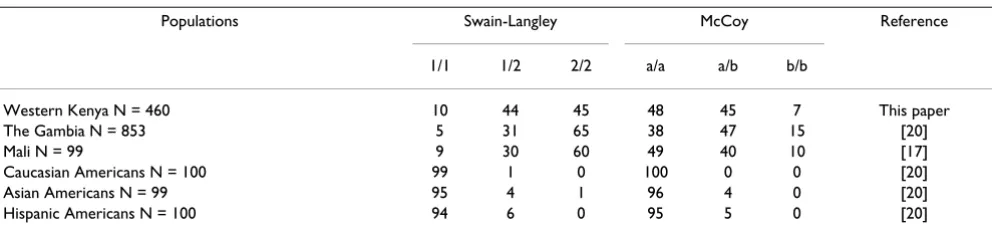
Sl2 and McCb alleles were more common in The Gambia [20], Mali [17] and western Kenya than in other non-Afri-can ethnic or racial groups where they occurred in very few numbers (Table 2). There were no significant differences between predicted and observed genotype frequencies for the two major ethnic groups, Luos and Abagusiis (data not shown), suggesting that the genotypes within these populations are in Hardy-Weinberg equilibrium.
Sl2/2 is associated with decreased susceptibility to cerebral malaria
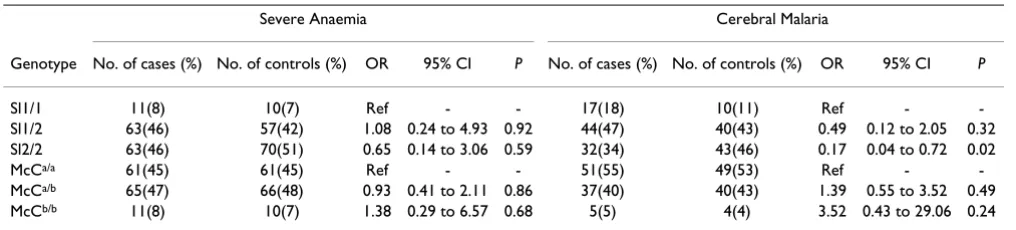
In order to explore whether the Sl2 or McCb alleles confer resistance or susceptibility to severe malaria compared to the Sl1 and McCa alleles, conditional logistic regression of the individual genotypes at each locus was carried out using Sl1/1 or McCa/a as reference (Table 3). There was no association between the Sl1/2 or Sl2/2 genotype and
resistance or susceptibility to SMA. Although there was a trend towards decreased susceptibility to SMA for the Sl2/ 2 genotype, the association was not significant (OR = 0.65, 95% CI 0.14 to 3.06, P = 0.59). On the other hand, individuals with the Sl2/2 genotype were less likely to have cerebral malaria than individuals with Sl1/1 (OR = 0.17, 95% CI 0.04 to 0.72, P = 0.02). This finding was independent of the hospital site since inclusion of this variable in the model did not affect the results. There was no significant effect of the McCa/b or McCb/b genotypes, when averaged over the different Sl alleles, on resistance or susceptibility to CM.
Sl2/2 McCa/b genotype is associated with decreased
susceptibility to cerebral malaria
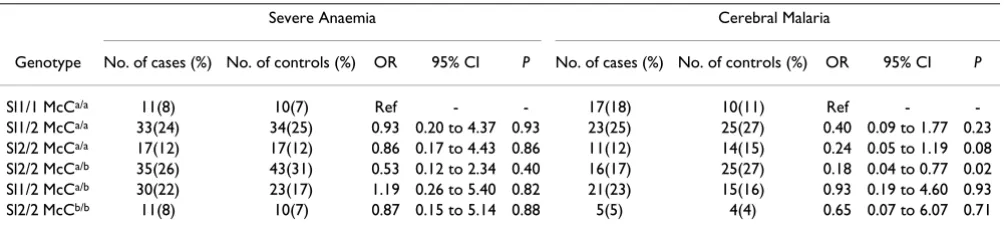
[image:4.612.57.555.99.257.2]In order to determine the effect of the different genotype combinations at the Swain-Langley and McCoy loci on the susceptibility to severe malaria conditional logistic regression was carried out using the Sl1/1 McCa/a genotype as reference (Table 4). Only six of the ten possible Sl/McC genotype combinations were found. Although it is not known whether the haplotypes for the group with geno-type Sl1/2 McCa/b are 1a/2b or 1b/2a, it was assumed that these individuals were 1a/2b because genotypes Sl1/1
Table 2: Percent of Swain-Langley and McCoy genotypes in various populations.
Populations Swain-Langley McCoy Reference
1/1 1/2 2/2 a/a a/b b/b
Western Kenya N = 460 10 44 45 48 45 7 This paper
The Gambia N = 853 5 31 65 38 47 15 [20]
Mali N = 99 9 30 60 49 40 10 [17]
Caucasian Americans N = 100 99 1 0 100 0 0 [20]
Asian Americans N = 99 95 4 1 96 4 0 [20]
[image:4.612.57.553.605.721.2]Hispanic Americans N = 100 94 6 0 95 5 0 [20]
Table 1: Group demographics
Nyanza Provincial General Hospital N = 320 Kisii District Hospital N = 140
Severe Anaemia Cerebral Malaria Cerebral Malaria
Cases N = 137 Controls N = 137 Cases N = 23 Controls N = 23 Cases N = 70 Controls N = 70
Mean age in months (SD)
14.8(12.6) 14.5(12.2) 29.0(15.7) 30.1(15.7) 28.5(15.9) 29.0(15.8)
No. of females (%) 57(41.6) 57(41.6) 9(39.1) 9(39.1) 37(52.9) 37(52.9)
Ethnic groups (%)
Luo 114(83.2) 115(83.9) 22(95.7) 19(82.6) 3(4.3) 4(5.7)
Abagusii 1(0.7) 0 1(4.3) 4 (17.4) 66(94.3) 65(92.9)
Luhya 15(10.9) 19(13.9) 0 0 1(1.4) 1(1.4)
Other 7(5.1) 3(2.2) 0 0 0 0
McCa/b, Sl1/1 McCb/b and Sl1/2 McCb/b were not found in the population, suggesting that haplotype 1b is extremely rare or does not exist. Table 4 shows that among CM cases and controls with McCa/a background the susceptibility to CM (OR) decreased from Sl1/2 to Sl2/2, suggesting a gene dose effect. The strongest association was seen with geno-type Sl2/2 McCa/b (OR = 0.18, 95% CI = 0.04 to 0.77, P = 0.02). Interestingly, heterozygosity at both loci or homozygozity for Sl2 and McCb did not show any signifi-cant benefit.
Discussion
The present study has shown that individuals with the Sl2/ 2 genotype that confers the Sl -1,2 phenotype have decreased susceptibility to CM compared to individuals with the Sl1/1 genotype. This finding was independent of ethnicity, of the genotype at the McC locus and of the hos-pital site where the cases and controls were recruited. Among the combined genotypes, a trend of increasing benefit was observed in the background of McCa/a from Sl1/2 to Sl2/2, which is consistent with a gene dose effect. Although the level of statistical significance may be influ-enced by a larger sample size in the Sl2/2 category, the association nevertheless appears strongest with the acqui-sition of one McCb allele (Table 4).
The finding that genotype Sl2/2 McCa/b might be the one
that most influences the level of susceptibility to CM may seem counterintuitive since in Table 3 McCa/b did not
show any significant advantage and perhaps showed a trend towards a detrimental effect relative to McCa/a.
How-ever, in the analysis in Table 3 the reference genotype McCa/a contains three variants: Sl1/1 McCa/a, Sl1/2 McCa/a,
and Sl2/2 McCa/a with the latter two both showing
indica-tions of decreased susceptibility due to the presence of Sl2 (Table 4). The lack of significant benefit from Sl2/2 in SMA probably reflects the distinct pathogenic mecha-nisms between this condition and CM, but this does not exclude a role for CR1 in the pathogenesis of SMA.
In contrast to this study, a previous case-control study in The Gambia [20] failed to demonstrate any significant association between Sl2/2 and resistance to severe malaria. The divergence in findings between the present and the previous study could be explained by important methodological differences. In the Gambian study con-trols did not have malaria. This may have led to an over-representation of non-protective genotypes in the controls because these children did not have the most important risk factor for severe malaria, i.e. malaria. Further, cases and controls were not matched by age in the Gambian study, and in fact, cases were older than controls by an average of almost one year. In addition, it is possible that differences in the pathogenesis of severe malaria between the two sites on the basis of other genetic factors and/or differences in the malaria transmission patterns may exist.
The mechanism by which the Sl2 and McCb alleles could
confer protection from severe malaria is not known, since these polymorphisms are located near the C-terminus of the CR1 molecule in an area that is outside the binding sites for C3b, C4b, and PfEMP-1. Nonetheless, there are a number of potential explanations based on the knowl-edge of CR1 function and the nature of the amino acid substitutions that take place. The Sl2 allele is the result of the substitution of glycine, a neutral amino acid, for the basic amino acid arginine at position 1601 (R1601G), whereas the McCb allele is the result of the substitution of
[image:5.612.53.561.99.214.2]the acidic amino acid glutamic acid for the basic amino acid lysine at position 1590 (K1590E) [17]. These modifi-cations may inflict significant conformational or charge changes to the rest of the molecule and may consequently impact on the conformation and function of the C3b and C4b binding sites and/or the PfEMP-1 binding site. Accordingly, Sl -1,2 erythrocytes have been reported to rosette less than Sl 1,-2 erythrocytes [3]. In addition, it is known that CR1 molecules are aggregated on the erythro-cyte surface and this aggregation is felt to be critical to the binding affinity of CR1 for C3b and C4b [25]. Therefore, it is possible that the amino acid substitutions not only induce conformational changes to the individual CR1
Table 3: Conditional logistic regression based on matching to compare individual genotypes.
Severe Anaemia Cerebral Malaria
Genotype No. of cases (%) No. of controls (%) OR 95% CI P No. of cases (%) No. of controls (%) OR 95% CI P
Sl1/1 11(8) 10(7) Ref - - 17(18) 10(11) Ref -
-Sl1/2 63(46) 57(42) 1.08 0.24 to 4.93 0.92 44(47) 40(43) 0.49 0.12 to 2.05 0.32
Sl2/2 63(46) 70(51) 0.65 0.14 to 3.06 0.59 32(34) 43(46) 0.17 0.04 to 0.72 0.02
McCa/a 61(45) 61(45) Ref - - 51(55) 49(53) Ref -
-McCa/b 65(47) 66(48) 0.93 0.41 to 2.11 0.86 37(40) 40(43) 1.39 0.55 to 3.52 0.49
McCb/b 11(8) 10(7) 1.38 0.29 to 6.57 0.68 5(5) 4(4) 3.52 0.43 to 29.06 0.24
molecules but also affect the ability of functional aggre-gates to form due to conformational incompatibility or charge interference between different CR1 molecules. This could explain why some combinations of these alleles, such as heterozygosity at both loci or homozygosity for both Sl2 and McCb, did not offer any significant
advan-tage.
Although the current expectation is that CR1 may influ-ence the development of severe malaria by virtue of its function as a regulator of the complement cascade on RBCs or by its direct interaction with the infected RBCs leading to rosette formation, CR1 may exert its effect on malaria in other ways that are not yet understood. In addi-tion to being present on RBCs, CR1 is also present on fol-licular dendritic cells, macrophages and T and B lymphocytes and, therefore, may also have immunoregu-latory functions that affect the development of immunity against malaria [13]. Mice deficient in CR1/CR2 have depressed humoral immune responses [26]. Further stud-ies will be required to explore this possibility.
Further evidence that the role of CR1 in the pathogenesis of severe malaria may not be as expected is found in a recent case-control study in Papua New Guinea that aimed to determine whether there was an association between individuals who had the low CR1 expression allele (L) and resistance to severe malaria [27]. Contrary to expectation, the association was found only in hetero-zygotes (HL), and not in homohetero-zygotes (LL), which pre-sumably had the lowest CR1 levels. In addition, although there was an association with resistance to severe malaria as a whole, there was no apparent association between these polymorphisms and CM. These results suggest that the relationship between the number of CR1 molecules on the RBC surface and severe malaria is not a straightfor-ward one.
The results obtained in the study presented here have bio-logical significance and are further supportive evidence of the importance of CR1 in the pathogenesis of severe
malaria. Whatever the mechanism is by which CR1 is involved in the pathogenesis of malaria, knowledge of which alleles are associated with resistance or susceptibil-ity to severe malaria will make it possible to observe the relationship between structure and function and suscepti-bility to severe malaria.
Conclusion
The results support the conclusion that the Sl2 allele and, possibly, the McCb allele have evolved in the context of
malaria transmission in Africa and that in certain combi-nations probably confer a survival advantage to malaria endemic populations.
Authors' contributions
Vandana Thathy, assisted by Bernard Guyah, optimized and carried out the PCR, performed the restriction enzyme digestions and interpreted the RFLP results. JoAnn M. Moulds developed the PCR-RFLP assay. Walter Otieno supervised the clinical evaluations of the study participants. José A. Stoute was the principal investigator who designed the study, wrote the protocol and drafted the original manuscript that was reviewed and edited by all authors.
Acknowledgements
We would like to thank the children who participated in our studies as well as their parents for their willingness to contribute to this research endeavor. We are indebted to our dedicated staff of clinicians, nurses, driv-ers and field workdriv-ers who made these studies possible. We are also grateful to Dr. John Rowlands for statistical support and for reviewing the paper. This work is published with the permission of the Office of the Director, the Kenya Medical Research Institute.
[image:6.612.55.557.100.214.2]This work was supported in part by the US Army Medical Research and Materiel Command, by grants from the National Heart Lung and Blood Institute (RO1 HL 7502-01) to José A. Stoute and from the National Insti-tute of Allergy and Infectious Diseases (RO1 AI 42367) to Joann M. Moulds. Vandana Thathy was supported by a fellowship from the Ellison Medical Foundation and the National Research Council. Bernard Guyah and Walter Otieno were supported by a training grant from the Fogarty International Center (1 D43 TW06239-01). Funding agencies had no role in the design of the study, the data collection, data analysis, data interpretation, writing
Table 4: Conditional logistic regression to compare genotype combinations to the non-African genotype Sl1/1 McCa/a.
Severe Anaemia Cerebral Malaria
Genotype No. of cases (%) No. of controls (%) OR 95% CI P No. of cases (%) No. of controls (%) OR 95% CI P
Sl1/1 McCa/a 11(8) 10(7) Ref - - 17(18) 10(11) Ref -
-Sl1/2 McCa/a 33(24) 34(25) 0.93 0.20 to 4.37 0.93 23(25) 25(27) 0.40 0.09 to 1.77 0.23 Sl2/2 McCa/a 17(12) 17(12) 0.86 0.17 to 4.43 0.86 11(12) 14(15) 0.24 0.05 to 1.19 0.08 Sl2/2 McCa/b 35(26) 43(31) 0.53 0.12 to 2.34 0.40 16(17) 25(27) 0.18 0.04 to 0.77 0.02 Sl1/2 McCa/b 30(22) 23(17) 1.19 0.26 to 5.40 0.82 21(23) 15(16) 0.93 0.19 to 4.60 0.93
Sl2/2 McCb/b 11(8) 10(7) 0.87 0.15 to 5.14 0.88 5(5) 4(4) 0.65 0.07 to 6.07 0.71
Publish with BioMed Central and every scientist can read your work free of charge
"BioMed Central will be the most significant development for disseminating the results of biomedical researc h in our lifetime."
Sir Paul Nurse, Cancer Research UK
Your research papers will be:
available free of charge to the entire biomedical community
peer reviewed and published immediately upon acceptance
cited in PubMed and archived on PubMed Central
yours — you keep the copyright
Submit your manuscript here:
http://www.biomedcentral.com/info/publishing_adv.asp
BioMedcentral
of the manuscript, nor in the decision to submit the manuscript for publi-cation.
"The views of the authors do not purport to reflect the position of the Department of the Army or the Department of Defense. The U.S. Govern-ment has the right to retain a nonexclusive, royalty-free license in and to any copyright covering this paper."
References
1. Organization WH: World Health Report. Geneva, WHO; 2002. 2. Severe falciparum malaria. World Health Organization,
Communicable Diseases Cluster. Trans R Soc Trop Med Hyg
2000, 94 Suppl 1:S1-90.
3. Rowe JA, Moulds JM, Newbold CI, Miller LH: P. falciparum roset-ting mediated by a parasite-variant erythrocyte membrane protein and complement-receptor 1. Nature 1997,
388:292-295.
4. Rowe JA, Rogerson SJ, Raza A, Moulds JM, Kazatchkine MD, Marsh K, Newbold CI, Atkinson JP, Miller LH: Mapping of the region of complement receptor (CR) 1 required for Plasmodium falci-parum rosetting and demonstration of the importance of CR1 in rosetting in field isolates. J Immunol 2000,
165:6341-6346.
5. Waitumbi JN, Opollo MO, Muga RO, Misore AO, Stoute JA: Red cell surface changes and erythrophagocytosis in children with severe Plasmodium falciparum anemia. Blood 2000,
95:1481-1486.
6. Stoute JA, Odindo AO, Owuor BO, Mibei EK, Opollo MO, Waitumbi JN: Loss of red blood cell complement regulatory proteins and increased levels of circulating immune complexes are associated with severe malarial anemia. J Infect Dis 2003,
187:522-525.
7. Waitumbi JN, Donvito B, Kisserli A, Cohen JH, Stoute JA: Age-related changes in red blood cell complement regulatory proteins and the susceptibility to severe malaria. J Infect Dis
2004, 190:1183-1191.
8. Krych-Goldberg M, Atkinson JP: Structure-function relationships of complement receptor type 1. Immunol Rev 2001,
180:112-122.
9. Ghiran I, Barbashov SF, Klickstein LB, Tas SW, Jensenius JC, Nichol-son-Weller A: Complement receptor 1/CD35 is a receptor for mannan-binding lectin. J Exp Med 2000, 192:1797-1808. 10. Klickstein LB, Barbashov SF, Liu T, Jack RM, Nicholson-Weller A:
Complement receptor type 1 (CR1, CD35) is a receptor for C1q. Immunity 1997, 7:345-355.
11. Carlson J, Helmby H, Hill AV, Brewster D, Greenwood BM, Wahl-gren M: Human cerebral malaria: association with erythro-cyte rosetting and lack of anti-rosetting antibodies. Lancet
1990, 336:1457-1460.
12. Rowe A, Obeiro J, Newbold CI, Marsh K: Plasmodium falciparum rosetting is associated with malaria severity in Kenya. Infect Immun 1995, 63:2323-2326.
13. Ahearn JM, Fearon DT: Structure and function of the comple-ment receptors, CR1 (CD35) and CR2 (CD21). Adv Immunol
1989, 46:183-219.
14. Herrera AH, Xiang L, Martin SG, Lewis J, Wilson JG: Analysis of complement receptor type 1 (CR1) expression on erythro-cytes and of CR1 allelic markers in Caucasian and African American populations. Clin Immunol Immunopathol 1998,
87:176-183.
15. Rowe JA, Raza A, Diallo DA, Baby M, Poudiougo B, Coulibaly D, Cockburn IA, Middleton J, Lyke KE, Plowe CV, Doumbo OK, Moulds JM: Erythrocyte CR1 expression level does not correlate with a HindIII restriction fragment length polymorphism in Afri-cans; implications for studies on malaria susceptibility. Genes Immun 2002, 3:497-500.
16. Moulds JM, Nickells MW, Moulds JJ, Brown MC, Atkinson JP: The C3b/C4b receptor is recognized by the Knops, McCoy, Swain-langley, and York blood group antisera. J Exp Med 1991,
173:1159-1163.
17. Moulds JM, Zimmerman PA, Doumbo OK, Kassambara L, Sagara I, Diallo DA, Atkinson JP, Krych-Goldberg M, Hauhart RE, Hourcade DE, McNamara DT, Birmingham DJ, Rowe JA, Moulds JJ, Miller LH:
Molecular identification of Knops blood group
polymor-phisms found in long homologous region D of complement receptor 1. Blood 2001, 97:2879-2885.
18. Rao N, Ferguson DJ, Lee SF, Telen MJ: Identification of human erythrocyte blood group antigens on the C3b/C4b receptor. J Immunol 1991, 146:3502-3507.
19. Daniels GL, Cartron JP, Fletcher A, Garratty G, Henry S, Jorgensen J, Judd WJ, Levene C, Lin M, Lomas-Francis C, Moulds JJ, Moulds JM, Moulds M, Overbeeke M, Reid ME, Rouger P, Scott M, Sistonen P, Smart E, Tani Y, Wendel S, Zelinski T: International Society of Blood Transfusion Committee on terminology for red cell surface antigens: Vancouver Report. Vox Sang 2003,
84:244-247.
20. Zimmerman PA, Fitness J, Moulds JM, McNamara DT, Kasehagen LJ, Rowe JA, Hill AV: CR1 Knops blood group alleles are not asso-ciated with severe malaria in the Gambia. Genes Immun 2003,
4:368-373.
21. Marsh K, Snow RW: Malaria transmission and morbidity. Par-assitologia 1999, 41:241-246.
22. Molyneux ME, Taylor TE, Wirima JJ, Borgstein A: Clinical features and prognostic indicators in paediatric cerebral malaria: a study of 131 comatose Malawian children. Q J Med 1989,
71:441-459.
23. Farnert A, Arez AP, Correia AT, Bjorkman A, Snounou G, do Rosario V: Sampling and storage of blood and the detection of malaria parasites by polymerase chain reaction. Trans R Soc Trop Med Hyg 1999, 93:50-53.
24. Moulds JM, Thomas BJ, Doumbo O, Diallo DA, Lyke KE, Plowe CV, Rowe JA, Birmingham DJ: Identification of the Kna/Knb poly-morphism and a method for Knops genotyping. Transfusion
2004, 44:164-169.
25. Paccaud JP, Carpentier JL, Schifferli JA: Difference in the cluster-ing of complement receptor type 1 (CR1) on polymorphonu-clear leukocytes and erythrocytes: effect on immune adherence. Eur J Immunol 1990, 20:283-289.
26. Molina H, Holers VM, Li B, Fung Y, Mariathasan S, Goellner J, Strauss-Schoenberger J, Karr RW, Chaplin DD: Markedly impaired humoral immune response in mice deficient in complement receptors 1 and 2. Proc Natl Acad Sci U S A 1996, 93:3357-3361. 27. Cockburn IA, Mackinnon MJ, O'Donnell A, Allen SJ, Moulds JM, Baisor