http://eprints.whiterose.ac.uk/93810/
Version: Accepted Version
Article:
Carfora, V, Caso, D and Conner, M orcid.org/0000-0002-6229-8143 (2016) The role of self-identity in predicting fruit and vegetable intake. Appetite, 106. pp. 23-29. ISSN 0195-6663
https://doi.org/10.1016/j.appet.2015.12.020
© 2015, Elsevier. Licensed under the Creative Commons Attribution-NonCommercial-NoDerivatives 4.0 International http://creativecommons.org/licenses/by-nc-nd/4.0/
[email protected] https://eprints.whiterose.ac.uk/
Reuse
Unless indicated otherwise, fulltext items are protected by copyright with all rights reserved. The copyright exception in section 29 of the Copyright, Designs and Patents Act 1988 allows the making of a single copy solely for the purpose of non-commercial research or private study within the limits of fair dealing. The publisher or other rights-holder may allow further reproduction and re-use of this version - refer to the White Rose Research Online record for this item. Where records identify the publisher as the copyright holder, users can verify any specific terms of use on the publisher’s website.
Takedown
If you consider content in White Rose Research Online to be in breach of UK law, please notify us by
The role of self-identity in predicting fruit and vegetable intake
1
CarforaV.a*, Caso D. a, Conner M. b 2
aDepartment of Humanities, University of Naples ‘‘Federico II’’, Via Porta di Massa, 1, 3
80133 Naples, Italy 4
bSchool of Psychology University of Leeds, Leeds,UK 5
6
Abstract
7
This research investigated whether the Theory of Planned Behavior (TPB) with the addition of self-8
identity could predict fruit and vegetable intake when controlling for past behavior. Previous 9
research had demonstrated the efficacy of TPB to predict intention and behavior in relation to food 10
choice and the additional power of self-identity, but had failed assess the effects of self-identity 11
while controlling for past behavior. At baseline (N = 210) TPB components and past behavior in 12
relation to fruit and vegetable consumption plus self-identity as a healthy eater were measured by 13
questionnaire in a sample of university students. At time 1, 4 weeks later, self-reported fruit and 14
vegetable consumption was measured. Structural Equation Modelling (SEM) indicated attitude, 15
PBC and self-identity to be significant predictors of intention (subjective norm and past behavior 16
were not significant). Intention, self-identity and past behavior were direct predictors of behavior. 17
The current findings support the independent effect of self-identity as a healthy eater on both 18
intentions and future behaviour when controlling for TPB variables and also past behavior. The 19
discussion considers the importance of self-identity in changing intentions and behavior for 20
behaviors such as fruit and vegetable consumption. 21
22 23
Keywords: 24
Fruit and vegetable 25
Intake 26
Theory of planned behavior 27
Self-identity 28
29 30
Introduction
31
The current research is an application of an extended model of the Theory of Planned Behavior 32
(TPB; Ajzen, 1991) to understanding fruit and vegetable consumption in a sample of students from 33
South Italy. Healthy eating is an important determinant of various health outcomes. Guidelines for 34
healthy eating (Cialfa et al., 2003; USDA/USDHHS, 2010) recommend the daily consumption of at 35
least five servings of fruits and vegetables and also for any fresh vegetables consumed to be as 36
varied as possible. This behavior can promote health by providing the necessary vitamins and 37
antioxidants (CDC, 2012) and contributes to physical health by helping preventing cancers and 38
chronic illnesses (e.g., Dauchet, Amouyel, & Dallongeville, 2006; He, Nowson, & MacGregor, 39
2006; WHO, 2003), and weight gain (e.g., Alinia, Hels, & Tetens, 2009; Sartorelli, Franco, & 40
Cardoso, 2008). The World Health Organization (WHO, 2003) reported that low fruit and vegetable 41
intake was responsible for 11% of strokes, 19% of gastrointestinal cancers and 31% of ischemic 42
heart disease. 43
European levels of daily fruit and vegetables intake in 2013 amounted to 342grams per capita 44
(Freshfel, 2015). This is below the recommended minimum of 400grams of fruit and vegetables per 45
day recommended by the World Health Organization (2003). Although Italians are traditionally 46
viewed as consuming a healthy ‘Mediterranean diet’ that includes plenty of fruits and vegetables 47
(e.g., Turati et al., 2015), the National Institute of Statistics (Multiscopo ISTAT, 2014) reported that 48
only 18.1% of the Italian population consumes at least four daily servings of fruits, vegetables and 49
fresh vegetables. Disadvantaged consumers in the South of Italy report even lower rates of fruit and 50
vegetable consumption (14.2% in South versus 21.1% in the North of Italy consumed at least 4 51
portions; Multiscopo ISTAT, 2013). Therefore, the understanding of factors involved in regular 52
fruit and vegetable consumption in Italians could be used to inform interventions designed to 53
increase this behavior. 54
55
Theoretical Background 56
57
The present study adopted the theory of planned behavior (TPB; Ajzen, 1991) as a theoretical 58
framework to predict fruit and vegetable consumption, since TPB constructs have been found to be 59
strong predictors of various dietary behaviors (Armitage & Conner, 2001a; Conner & Norman, 60
2005; McEachan et al., 2011; Mullan, Wong & Kothe, 2013). In a meta-analytic review across 61
various behaviors, Armitage and Conner (2001a) indicated that the TPB model reliably explained 62
between 40 and 50% of the variance in intention, and between 20 and 40% of the variance in 63
behavior. More recently, the review of McEachan et al. (2011), which considered the efficacy of 64
TPB for different health behaviors showed that the TPB predicted 21.2% of the variance in dietary 65
behavior (mainly based on intentions) and 52.4% of dietary intentions. In this review, attitude 66
emerged as the most important predictor of intention ( = 0.39), followed by perceived behavioral 67
control ( = 0.27), subjective norm ( = 0.22) and past behavior ( = 0.16). 68
69
Studies have applied the TPB model to predict a variety of specific eating behaviors including fruit 70
and vegetable intake (e.g., Blanchard et al. 2009a; Blanchard et al., 2009b; Conner, Norman, & 71
Bell, 2002; De Bruijn et al., 2007; Elliott & Armitage, 2009; Godin et al., 2010; Kothe, Amaratunga 72
& Mullan, 2011; Kothe & Mullan, 2014; Povey et al., 2000). In a review of 23 such studies 73
(specifically, 15 studies on the determinants of fruit and vegetable intake, 7 on the determinants of 74
intention and fruit and vegetable intake and one on the determinants of intention), Guillaumie, 75
Godin, and Vézina-Im (2010) reported that 30% to 57% of the variance in intentions were 76
accounted for by attitudes, perceived norms, and perceived behavioral control, while 6% to 32% of 77
the variance in fruit and vegetable consumption was accounted for by intentions and perceived 78
behavioral control. Therefore there exists ample empirical evidence that TPB is a useful way to 79
understand fruit and vegetable intake. 80
81
The present research further analyzes how well the TPB predicts intentions and action for this 82
behavior in an Italian population. Importantly, additional predictors (self-identity and past behavior) 83
were included in the present research to increase the predictive validity of the TPB in relation to 84
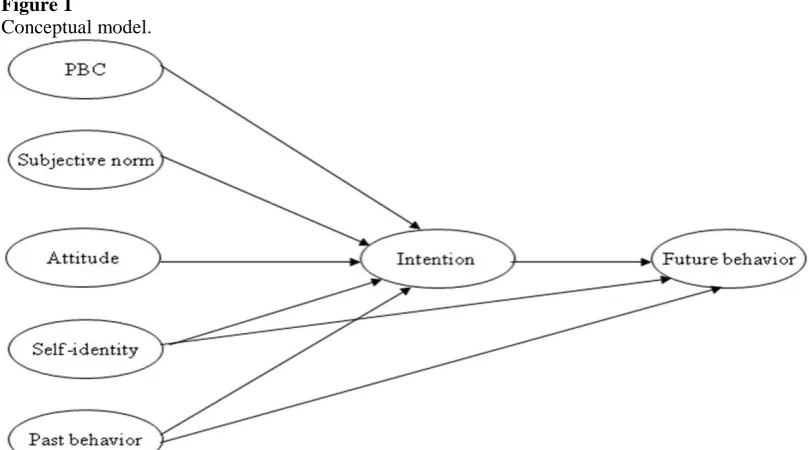
fruit and vegetable consumption (Figure 1). 85
Figure 1 100
Conceptual model.
101
102
Note. PBC = Perceived behavioral control 103
104 105
Self-identity appears to be a motivational construct that adds to predictions within the TPB (Conner 106
& Armitage, 2002). This concept can be described as a salient aspect of one’s self-perception (e.g., 107
“I think of myself as a green consumer”; Sparks, 2000). Several authors have suggested self-identity 108
as a useful additional variable in the TPB (e.g., Bissonnette & Contento, 2001; Charng, Piliavin, & 109
Callero, 1988; Cook, Kerr, & Moore, 2002; Nigbur, Lyons & Uzzell, 2010; Terry, Hogg, & White, 110
1991). The basis of the assumed relationship between self-identity and behavioral intentions relies 111
on identity theory (Stryker, 1968, 1980, 1987), where the self is regarded as a social construct, a set 112
of identities related to the different roles that everyone occupies in the social settings. A role can be 113
considered as a collection of expectations about role-appropriate behavior (Simon, 1992); it is 114
assumed that the pattern of behaviors have been internalized as a role identity and the more salient 115
the identity, the more it will increase the intention to implement the related behaviors (Charng, 116
Piliavin, & Callero, 1988). This is because acting a role-congruent behavior helps to confirm a 117
person’s status as a role member (Callero, 1985). 118
119
Consistent with this view, Terry, Hogg and Duck (1999) argued that self-identity influences 120
intentions because the performance of a certain behavior allows the individual to validate the self-121
concept that originates from role identities and helps the person to develop a positive and significant 122
self-evaluation. Therefore, people intend to perform a behavior consistent with their personal 123
beliefs, norms and their social roles (e.g., self-identity). The predictive power of self-identity has 124
been found over and above the effects of other TPB variables (e.g., Charng, Piliavin, & Callero, 125
1988; Conner & Armitage, 1998; Ries et al., 2012), especially in the domain of food choice (Sparks 126
& Guthrie, 1998; Sparks & Shepherd 1992; Sparks et al., 1995). This is particularly the case for 127
self-identity as a predictor of intention (Sparks & Guthrie, 1998, Sparks & Shepherd 1992). For 128
example, Sparks et al. (1995), examining five dietary changes linked to fat consumption, included a 129
measure of self-identity. This was defined as the “identification as someone who is concerned about 130
the health consequences of diet”. They reported that this construct significantly predicted the 131
expectations of making dietary changes independently of attitudes. Conner and Armitage’s (1988) 132
review of six similar studies, indicated that self-identity accounted for 1% of the variance in 133
intention over and above TPB variables (attitude, subjective norm, perceived behavioral control). 134
variables (Armitage & Conner, 2001b; Arnold et al., 2006; Evans & Norman, 2003; Hagger & 136
Chatzisarantis, 2006; Manetti, Pierro & Livi, 2004). 137
138
Some studies have also examined the effects of self-identity on behavior whilst controlling for TPB 139
variables. The suggestion is that self-identity may influence behavior independently of intentions 140
(and perceived behavioral control). This occurs for two reasons. On one side, implicit aspects of 141
identity could emerge through unconscious processes beyond the awareness (Devos & Banaji, 2003 142
for review). On the other side, identity could involve experiences of reflexive consciousness 143
through its regulating function (Baumeister, 1998). In fact, identities produce a standard for 144
behavior (Stryker & Burke, 2000), allowing individuals’ to evaluate the congruency between 145
behavior meanings and their identities. Negative or positive emotions could arise from this 146
evaluation and individuals could change their behaviors if they are not consistent with identity 147
expectations (Burke, 2006). 148
Biddle, Bank, and Slavings (1987) showed that self-identity had an effect on a social behavior over 149
and above the effect of intentions and PBC. Theodorakis (1994) showed that role-identity about 150
physical activity explained intention and behavior. More pertinently, Strachan and Brawley (2009), 151
in a study on healthy-eater identity and self-efficacy as determinants of healthy eating behavior 152
demonstrated that these variables increased the explained variance in healthy eating behavior. 153
Similarly, Dunn et al. (2011), in a study of fast food consumption, reported intention was predicted 154
by attitude, subjective norms, efficacy and identification as a healthy eater, although self-155
identification did not influence behavior. Ries et al. (2012), in a study on prediction of intention to 156
perform physical activity, showed that self-identity significant determined intention and behavior, 157
independently of other TPB variables. Brouwer (2012) reported that self-identity as a healthy eater 158
predicted intention and healthy eating independent of other TPB variables. More recently, Brouwer 159
and Mosack (2015) showed that identity as a healthy eater was a significant determinant of healthy 160
eating intentions over and above the TPB components and a significant determinant of overall 161
healthy eating behaviors, fruit and low-fat dairy intake over and above intentions and PBC. 162
A limitation of a number of the above studies is that in examining the effect of self-identity they 163
failed to consider the effect of controlling for past behavior. Although the role of past behavior in 164
the TPB has prompted considerable debate (see Eagly & Chaiken, 1993: 178-182; Ajzen, 1991, 165
2002 for reviews), a number of studies shown past behavior to be a strong predictor of intentions 166
and behavior (e.g., Conner et al., 1999; Hagger, Chatzisarantis, & Biddle, 2002; Mullen et al. 1987; 167
Norman & Conner, 2006; Norman & Smith, 1995) that remains when controlling for TPB variables 168
(e.g., Conner & Armitage, 1998; Ouellette & Wood, 1998). Relatedly, Fishbein (1997) claimed that 169
measures of self-identity could be a measure of past behavior, since people possibly could infer 170
their self-identities by examining their past behavior (Sparks & Guthrie, 1998). This would point to 171
the need to examine the effects of self-identity within the TPB whilst controlling for past behavior 172
in order to show their independent effects. Sparks and Guthrie (1998) showed that self-identity as a 173
“health-conscious consumer” predicted intention to avoid meat independently of other TPB 174
variables and also controlling for past behavior. Armitage and Conner (1999a, 1999b, 1999c) in 175
three studies with different samples (students, hospital workers and general population) showed that 176
self-identity independently predicted intentions to follow a low-fat diet, also controlling for past 177
behavior (see also Astrom & Rise, 2001 on healthy eating). Similarly, Dean, Raats and Shepperd 178
(2012), in relation to fresh and processed organic food purchase, confirmed that self-identity and 179
past behavior independently predict intention, over and above the effect of the traditional TPB 180
constructs. Granberg and Holmberg (1990), in a study on U.S. and Swedish Voters, showed that 181
self-identity, controlling for past behavior, impacted not only on intention, but also on behavior. 182
Conner et al. (1999), applying the TPB to alcohol consumption, showed that self-identity as a 183
"drinker" and past behavior contributed to predict intentions over and above the effects of the 184
traditional three components of the TPB (attitudes, subjective norms, and PBC). Moreover, alcohol 185
intentions and PBC. More recently, a meta-analysis (Rise, Sheeran & Hukkelberg, 2010) showed 187
that self-identity was a significant predictor of intentions and also behavior. In this meta-analysis, 188
the addition of self-identity explained an additional 6% (p < .001) of variance in intentions and an 189
additional 2% variance in behavior. 190
191
In summary, the present research builds on previous research by examining the impact of self-192
identity as a healthy eater on intentions and fruit and vegetable consumption in the context of TPB 193
variables and past behavior. We predicted that self-identity would add to predictions of intentions 194
and behavior over and above the TPB variables whilst controlling for past behavior. 195
196 197
Material and Method
198 199
Participants and procedures 200
201
In March 2014, a total of 250 online questionnaires were sent to a convenience sample of university 202
students on two occasions separated by 4 weeks. A total of 210 returned completed questionnaires 203
at time 1 and 206 at time 2 (58 male; 146 female; mean age = 22.91; SD = 8.33). Only those 204
participants who responded at both time 1 and time 2, were selected for the analyses (N = 206). 205
Students were recruited from second-year psychology undergraduates of South Italy. Participants 206
had the study explained to them, provided written consent and then completed the first 207
questionnaire. A link to the second questionnaire was sent by email allowing completion on-line. 208
The low sample attrition rate between time points can probably be attributed to the fact that data at 209
each time point was collected during classroom time. 210
211
Measures 212
213
The questionnaire at time 1 included measures of components of TPB and past behavior in relation 214
to the consumption of fruit and vegetable, self-identity as a healthy eater and also gender and age. 215
Intentions (INT) to eat 5 portion of fruit and vegetable per day in the next month were measured 216
using three items on a 7-point Likert scale (Armitage & Conner, 1999a; e.g., “I intend to eat a diet 217
based on the consumption of at least five portions of fruit and vegetables per day over the next 218
month…definitely do not – definitely do”; all scored 1–7, with higher scores indicating greater 219
intention to eat five portions of fruit and vegetables per day). Composite reliability was 0.79. 220
221
Three items were used to assess students' general attitudes (ATT) towards consumption of 5 222
portions of fruit and vegetable per day. Each adjective pair was rated on a 7-point response format 223
(Armitage & Conner, 1999a; e.g., “The consumption of at least five portion of fruit and vegetable 224
per day in the next month is bad – good, negative – positive, unfavorable- favorable”; all scored 1– 225
7, with higher scores indicating positive attitude to eat five portions of fruit and vegetables per day). 226
Composite reliability was 0.79. 227
228
To assess subjective norm (SN) three items on a 7-point Likert scale were used (Armitage & 229
Conner, 1999a; e.g., “People who are important to me want me to eat at least five portions of fruit 230
and vegetables per day over the next month…strongly disagree- strongly agree”; all scored 1–7, 231
with higher scores indicating greater level of subjective norm about eat five portions of fruit and 232
vegetables per day).. Composite reliability was 0.77. 233
234
Perceived behavioral control (PBC) was measured by three items (Armitage & Conner, 1999a; e.g., 235
“Whether or not I eat at least five portions of fruit and vegetables per day over the next month is 236
greater control over eating five portions of fruit and vegetables per day). Composite reliability was 238
0.81. 239
240
Self-identity (SI) was measured by three items on a 7-point Likert scale (Sparks et al., 1995; “I think 241
of myself as a healthy eater”; “I think of myself as a person who is interested in eating healthy”; ‘‘I 242
think of myself as someone who is concerned about the health consequences of what I 243
eat…strongly agree - strongly disagree’’; all scored 1–7, with higher scores indicating greater 244
values of self-identity as healthy eater). Composite reliability was 0.86. 245
246
Se l f- r e p o r t e d ( P B) p a s t b e h a vi o r was assessed with one item. Response format were 247
formed by 6-points ranging from 1 to more than 5 portions of fruit and vegetable per da y (“How 248
many portion of fruit and vegetable did you eat a day in the last month? ”) .
249 250
At time 2, after one month, self-reported future behavior (FVI) was measured with the same item 251
used at time 1 to tap past behavior. 252
253
Tested Model 254
255
The present study aimed to verify whether self-identity played a decisive role in the prediction of 256
intention and behavior, about the daily consumption of fruit and vegetable, in a sample of Italian 257
students, controlling their past behavior. According to the TPB (Ajzen, 1991), we hypothesized that 258
intention mediated the impact of attitude, PBC, subjective norm, past behavior and self-identity on 259
behavior, and behavior was also predicted by a direct effect of self-identity and past behavior on it. 260
Figure 1 showed the hypothesized structural model for the study. Larger ovals indicate latent 261
variables, smaller ovals indicate error variance, and rectangles depict observed measures. 262
263 264
Statistical analysis 265
266
All descriptive analyses were performed using PASW 17. Mplus 7 statistical software was used to 267
conduct structural equation modeling (SEM). Adequacy of fit of the SEM models was estimated by 268
using Chi-Square and recommended incremental goodness-of-fit indexes: the root mean square 269
error of approximation (RMSEA), the comparative fit index (CFI), the Tucker-Lewis Index (TLI) 270
and the Standardized Root Mean Square Residual (SRMR; Iacobucci, 2010). A non-significant 271
Chi-Square would indicate that the model fits the data well (Iacobucci, 2010). CFI and TLI cut-off 272
values of at least 0.90 are generally considered to represent acceptable fit (Bentler, 1990; Tucker & 273
Lewis, 1973). Browne and Cudeck (1992) suggest that a RMSEA value of 0.05 or less indicates 274
good fit, and that values up to 0.08 represent errors that approximate to those expected in the 275
population. Values of the SRMR less than 0.08 are generally considered acceptable (Hu & Bentler, 276
1999). 277
278 279
Results
280 281
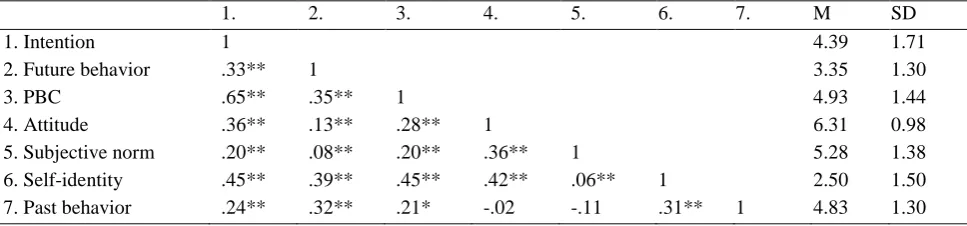
Table 1 reports the correlations among constructs and their mean and SD. The items generally 282
showed reasonable variation and were not unduly skewed. The attitude measure tended to have a 283
high mean and slightly reduced variance. Examination of the correlations (Table 1) indicated that 284
PBC and self-identity were the strongest correlates of intentions, while self-identity, intention and 285
past behavior were the strongest correlates of behavior. 286
Table 1 289
Descriptive finding and correlations between study variables
290
1. 2. 3. 4. 5. 6. 7. M SD
1. Intention 1 4.39 1.71
2. Future behavior .33** 1 3.35 1.30
3. PBC .65** .35** 1 4.93 1.44
4. Attitude .36** .13** .28** 1 6.31 0.98
5. Subjective norm .20** .08** .20** .36** 1 5.28 1.38 6. Self-identity .45** .39** .45** .42** .06** 1 2.50 1.50 7. Past behavior .24** .32** .21* -.02 -.11 .31** 1 4.83 1.30
Note: ** p < 0.001; *p< 0.05
291 292
To test the construct validity, the measurement or confirmatory factor analysis model including five 293
latent factors indicating attitude, PBC, subjective norm, intention and self-identity, while past 294
behavior was incorporated as an observed variable. Goodness-of-fit statistics for the measurement 295
model were acceptable. The chi-square was significant ( 2 = 65.58, df = 38, p < 0.001), but all the 296
other indices pointed to a very good fit (RMSEA = 0.06; CFI = 0.96; TLI = 0.95; SRMR = 0.04). 297
The parameter estimates were all significant and presented higher values (from 0.64 to 0.96). When 298
the sample is small as is the case here, the Chi-Square statistic might not differentiate between good 299
or poor fitting models (Barbaranelli, 2007). Therefore since all other indices indicated a good fit, 300
the measurement model was accepted as a model with acceptable fit. No model modification was 301
made and throughout a conservative strategy of not freeing cross-loadings was followed due to 302
potential impacts on construct validity (Hair et al., 2006). Given the good fit of the confirmatory 303
factor analysis, hypothesized paths among variables were verified. 304
The traditional TPB model was good fit to the data ( 2 = 6.59, df = 3; p = not significant; RMSEA = 305
0.07; CFI = 0.98; TLI = 0.94; SRMR = 0.03) PBC, attitude and past behavior were significant 306
predictors of intention (respectively = 0.57; = 0.19; = 0.12), future behavior was significantly 307
predicted by intention ( = 0.27) and past behavior ( = 0.26). Intention mediated the impact of 308
attitude, PBC and past behavior on future behavior. Levels of explained variance were significant 309
for intention and behavior (respectively R2 = 0.47, 0.18). 310
Adding self-identity to the TPB model also produced a good fitting model. Chi-square was not 311
significant ( 2 = 3.80, df = 3) and all fit indices were optimal (RMSEA = 0.04; CFI = 0.99; TLI = 312
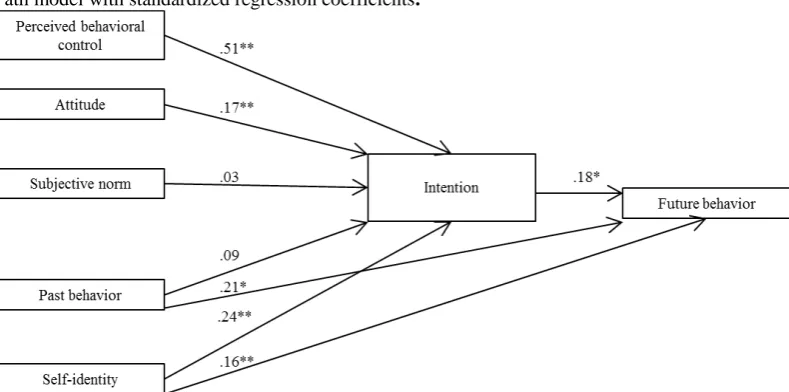
0.99; SRMR = 0.02). Intention was significantly determined by PBC ( = 0.51), attitude ( = 0.17) 313
and self-identity ( = 0.16), but not by subjective norm and past behavior. In this case, fruit and 314
vegetable consumption was determined more by self-identity ( = 0.24) and past behavior ( = 315
0.21) than by intention ( = 0.18). The final model accounted for 49% of the variance in intentions 316
and 22% in behavior. Standardized estimates of paths results are shown in Figure 2. 317
Figure 2 332
Path model with standardized regression coefficients.
333
334
Note. ** p< 0.001; *p< 0.05; covariances and error variables not shown for ease of interpretation.
335 336 337
Discussion
338
Theory of planned behavior, self-identity and fruit and vegetable intake
339
The present study aimed to test the validity of an extended TPB model, including past behavior and 340
self-identity for predicting and understanding intentions and behavior for fruit and vegetable intake. 341
The findings showed that the TPB is a useful framework to understand the fruit and vegetable 342
intake. Attitude and self-identity (as a healthy eater) had a moderate impact on intention, while the 343
PBC had a large effect on it, all constructs explained 49% of the variance of intention, controlling 344
for past behavior, which was not a significant predictor of intention. Also subjective norm was 345
shown to have no effect on intention. Considering the fruit and vegetable intake, intention, self-346
identity and past behavior had direct effects on behavior explaining 22% of the variance. Intention 347
mediated the effects of attitudes and PBC on behavior, past behavior had only a direct effect on 348
behavior, while self-identity showed both a direct effect and an indirect effect through intentions on 349
behavior. 350
These findings are generally consistent with the literature, which report that attitude and perceived 351
behavioral control are the more important predictors of healthy eating (Povey et al., 2000; Sjoberg 352
et al., 2004), that subjective norms show low or not significant relationship to healthy eating 353
(Blanchard et al., 2009; Lien, Lytle, & Komro, 2002; Louis, Chan, & Greenbaum, 2009; Paisley & 354
Sparks, 1998) and that self-identity (e.g., Strachan & Brawley, 2009; Brouwer & Mosack, 2015) 355
explains additional variance in intention. Congruent with Armitage and Conner (1999a, 1999b, 356
1999c), self-identity as healthy eater was shown to be an important predictor of an individual’s 357
intention to eat 5 fruit and vegetables per day. In summary, the results of the present study 358
suggested that intentions to eat 5 fruit and vegetables per day are driven in part by a desire to 359
confirm a perception of the self as a healthy eater. 360
The predictive effect of past behavior on future behavior found here is also coherent with the review 361
of Conner and Armitage (1998), which showed across seven tests that past behavior, after taking 362
account intentions and PBC, explained 13% of behavior’s variance. Consistent with the results of a 363
review of Sparks (2000) and the studies of Astrom and Rise (2001) and more recently of Rise, 364
Sheeran and Hukkelberg (2010), self-identity was here found to be a strong predictor of fruit and 365
vegetable intake even when controlling for past behavior and TPB variables; therefore people who 366
perceived themselves as healthy eaters were more likely to actually eat fruit and vegetables 1 month 367
later. This finding that self-identity predicts behavior when controlling for past behavior is 368
Allom and Mullan (2012) who showed that fruit and vegetable intake was predicted by intention 370
and a healthy-eater self-schema (similar to self-identity), but not by past behavior. 371
Fishbein and Ajzen (2010) criticized the inclusion of self-identity in the TPB framework starting 372
from the way in which identity is assessed. They discussed the fact that some measure of self-373
identity overlap with the attitude (i.e., if items consider a person values performance of the 374
behavior), with subjective norm (i.e., if items refer to a person’s identification with a social group or 375
with a social rule), and with past behavior (i.e., if items represent self-report of current behavior). 376
The present research showed independent effects of a self-identity measure and measures of 377
attitude, subjective norm and past behavior and the correlation with these constructs was modest. 378
379
Limitation and methodological issues
380
A number of potential limitations of the present study should be noted. First, the sample was 381
limited to young adults in higher education and contained a limited number of males potentially 382
limiting the generalizability of the findings. Second, a reliance on self-reported measures of past 383
and future behavior is a limitation, although a common one in studies on the TPB and various 384
eating behaviors. This is particularly the case because reviews of the TPB indicate it to be less 385
predictive of objective compared to self-reported behavior (Armitage & Conner, 2001). The 386
reliance on self-reported behavior, although common in TPB studies of eating behavior, means the 387
impact on objectively measured behavior is unknown. An more accurate way to measure self-report 388
behavior could be the use of a food diary (e.g. Brouwer & Mosack, 2015; Conner et al., 2001) or 389
more specific scale, as the seven-item food frequency questionnaire presented by the National 390
Cancer Institute to measure fruit and vegetable consumption over the past 30 days (Thompson, 391
Byers, & Kohlmeier, 1994) or the Food Frequency Questionnaire (Willett & Lenart, 1998). 392
However, all these methods remain self-report and open to similar criticisms. Third, it should be 393
noted that we employed a brief measure of self-identity measure (Sparks et al., 1995). Although 394
reliable a longer measure such as the scale of Strachan and Brawley (2008), which uses nine-item to 395
assesses it, or the Eating Identity Type Inventory, developed by Balke et al. (2013) could of 396
provided more precise estimates of the effects of self-identity. 397
398
Future direction and practical implications
399
Following the findings of Brouwer and Mosack (2015), which showed that healthy eater identity 400
predicted fruit consumption but not vegetable intake, in the future it could be interesting to explore 401
the power of self-identity to separately predict fruit consumption or fruit consumption while 402
controlling for the different relevant TPB variables. This might provide useful insights into how to 403
change each. For example, fruit consumption might be more determined by attitude and self-404
identity while vegetable consumption is more determined by PBC and subjective norms, suggesting 405
the value of different intervention approaches. 406
407
In addition, as suggested by Conner and Norman (2005) and by Sparks and Shepherd (1992) further 408
investigation to define the precise nature of self-identity would be valuable. For example, overlap 409
with other constructs such as moral or personal norm, which are related to individuals’ feelings of 410
obligation to act or not a particular behavior, would be useful. Moreover, the current findings 411
suggestion that promoting the self-identity as a healthy eater as a useful way to promote both 412
intentions and behavior in relation to fruit and vegetable intake in young adults need further 413
exploration. In particular, we need to test if changing such identities can be a useful way to change 414
intentions and behavior in this population. However, instilling such identities may be difficult. 415
Nevertheless promoting various forms of positive reactions to healthy eating may be a more 416
productive way to promote increased fruit and vegetable consumption than the more usual focus on 417
tackling risk factors. For example, public health campaigns and educational programs could try to 418
instill a healthy eating identity by associating fruit and vegetable intake with positive identity 419
421
Conclusion
422
The current study provides a useful contribution to the literature on the TPB and fruit and vegetable 423
intake in showing that self-identity is a significant predictor of intentions and behavior, even when 424
controlling for past behavior. The fact that self-identity influences behavior both directly and 425
indirectly (through intentions) suggests it might be a useful basis for attempting to change fruit and 426
vegetable consumption, at least in young people from the south of Italy. 427
428
References
429
Alinia, S., Hels, O., & Tetens, I. (2009). The potential association between fruit intake and body weight-a review.
430
Obesity Reviews, 10, 639-47. http://dx.doi.org/10.1111/j.1467-789X.2009.00582.x
431
Allom, V., & Mullan B. (2012). Self-regulation versus habit: The influence of self-schema on fruit and vegetable
432
consumption. Psychology & Health, 27, 7-24, http://dx.doi.org/10.1080/08870446.2011.605138
433
Ajzen, I. (1991). The theory of planned behavior. Organizational Behavior and Human Decision Processes, 50,
179-434
211.
435
Ajzen, I. (2002). Residual Effect of Past on Later Behaviour: Habituation and Reasoned Action Perspectives.
436
Personality and Social Psychology Review, 6, 107-122.http://dx.doi.org/10.1207/s15327957pspr0602_02
437
Astrom, A. N., & Rise, J. (2001). Young adults’ intentions to eat healthy good: Extending the theory of planned
438
behavior. Psychology and Health, 16, 223-237. http://dx.doi.org/10.1080/08870440108405501
439
Armitage, C. J., & Conner, M. (1999a). Distinguishing perceptions of control from behavior: predicting consumption
440
of low-fat diet using the theory of planned behavior. Journal of Applied Social Psychology, 29, 72-90.
441
Armitage, C. J., & Conner, M. (1999b). Predictive validity of the theory of planned behavior: the role of
442
questionnaire format and social desiderability. Journal of Community and Applied Social Psychology, 9, 261-72.
443
Armitage, C., J., & Conner, M. (1999c). The theory of planned behaviour: Assessment of predictive validity and
444
perceived control. British Journal of Social Psychology, 38, 35-54. http://dx.doi.org/10.1348/014466699164022
445
Armitage, C. J., & Conner, M. (2001a). Efficacy of the theory of planned behavior. A meta-analytic review. British
446
Journal of Social Psychology, 40, 471-499. http://dx.doi.org/10.1348/014466601164939
447
Armitage, C. J., & Conner, M. (2001b). Social cognitive determinants of blood donation. Journal of Applied Social
448
Psychology, 31, 1431-1457. http://dx.doi.org/10.1111/j.1559-1816.2001.tb02681.x
449
Arnold, J., Loan-Clarke, J., Coombs, C., Wilkinson, A., Park, J., & Preston, D. (2006). How well can the theory of
450
planned behavior account for occupational intentions? Journal of Vocational Behavior, 69, 374-390.
451
http://dx.doi.org/10.1016/j.jvb.2006.07.006.
452
Barbaranelli, C. (2007). Analisi dei dati. Tecniche multivariate per la ricerca psicologica e sociale. Milano: Led.
453
Baumeister, R. F. (1998). The self. In D. T. Gilbert, S. T. Fiske, & G. Lindzey (Eds.), The handbook of social
454
psychology (pp. 680-740). Boston, MA: McGraw-Hill.
455
Bentler, P. M. (1990). Comparative fit indexes in structural models. Psychological Bulletin, 107, 238-246.
456
http://dx.doi.org/10.1037//0033-2909.107.2.238
457
Biddle, B. J., Bank, B. J., & Slavings, R. L. (1987). Norms, preferences, identities and retention decisions. Social
458
Psychology Quarterly, 50, 322-337. http://dx.doi.org/10.2307/2786817
459
Bissonnette, M. M., & Contento, I. R. (2001). Adolescents’ perspectives and food choice behaviors in relation to the
460
environmental impacts of food production practices. Journal of Nutrition Education, 33, 72-82.
461
http://dx.doi.org/10.1016/S1499-4046(06)60170-X
462
Blanchard, C. M., Fisher, J., Sparling, P. B., Shanks, T. H., Nehl, E., Rhodes, R. E., Courneya, K. S., & Baker, F.
463
(2009a). Understanding adherence to 5 servings of fruits and vegetables per day: A theory of planned behavior
464
perspective. Journal of Nutrition Education and Behavior, 41, 3-10. http://dx.doi.org/10.1016/j.jneb.2007.12.006
465
Blanchard, C. M., Kupperman, J., Sparling, P. B., Nehl, E., Rhodes, R. E., Courneya, K. S., & Baker, F. (2009b). Do
466
ethnicity and gender matter when using the theory of planned behavior to understand fruit and vegetable consumption?
467
Appetite, 52, 15-20.http://dx.doi.org/10.1016/j.appet.2008.07.001
468
Blake, C. E., Bell, B. A., Freedman, D. A., Colabianchi, N., & Liese, A. D. (2013). The Eating Identity Type
469
Inventory (EITI). Development and associations with diet. Appetite, 69, 15-22. http://dx.doi.org/
470
10.1016/j.appet.2013.05.008
471
Brouwer, A. (2012). Motivating Healthy Diet Behaviors: The Self-As-Doer Identity. Theses and Dissertations. Paper
472
1
473
Brouwer, K. E., & Mosack, A. M. (2015). Motivating Healthy Diet Behaviors: The Self-as-Doer Identity. Nutrition &
474
Food Science, 45, 39-53. http://dx.doi.org/10.1080/15298868.2015.1043335
475
Browne, M. W., & Cudeck, R. (1992). Alternative ways of assessing model fit. Sociological Methods Research, 21,
476
230-258. http://dx.doi.org/10.1177/0049124192021002005
Burke, P. J. (1980). The self: Measurement from an interactionist perspective. Journal of Social Psychology
478
Quarterly, 43, 18-29. http://dx.doi.org/10.2307/3033745
479
Callero, P.L. (1985). Role-Identity Salience. Social Psychology Quarterly, 48, 203-1.
480
http://dx.doi.org/10.2307/3033681
481
CDC (Center for Disease Control and Prevention). (2012). Fruits and vegetables. Retrieved from CDC website
482
http://www.cdc.gov/nutrition/everyone/fruitsvegetables/
483
Charng, H. W., Piliavin, J., & Callero, P. (1988). Role identity and reasoned action in the prediction of repeated
484
behavior. Social Psychologv Quarterly, 51, 303-317. http://dx.doi.org/10.2307/2786758
485
Cialfa, E., D'Amicis, A., Leclercq, C., Quaglia, G. B., Sette, S., Ticca, M., & Tomassi, G., (2003). Linee guida per
486
una sana alimentazione italiana. Istituto nazionale di ricerca per gli alimenti e la nutrizione, Roma Italia, p. 86.
487
Retrieved from nut.entecra.it/
488
Conner, M., & Armitage, C. J. (2002). The Social Psychology of Food. Open University Press.
489
Conner, M., & Armitage, C. J. (1998). Extending the Theory of Planned Behavior: A Review and Avenues for
490
Further Research. Journal of Applied Social Psychology, 28, 1429-64.
http://dx.doi.org/10.1111/j.1559-491
1816.1998.tb01685.x
492
Conner, M., & Norman, P. (2005). Predicting health behavior. Open University Press.
493
Conner, M., Norman, P., & Bell, R. (2002). The theory of planned behavior and healthy eating. Health Psychology,
494
21, 194-201. http://dx.doi.org/10.1037//0278-6133.21.2.194
495
Conner, M., Kirk, S. F., Cade, J. E. and Barrett J. H. (2001). Why do women use dietary supplements? The use of the
496
theory of planned behavior to explore beliefs about their use. Social Science and Medicine, 52, 621-633.
497
http://dx.doi.org/10.1016/S0277-9536(00)00165-9
498
Conner, M., Warren, R., Close, S., & Sparks, P. (1999). Alcohol consumption and the theory of planned behavior: An
499
examination of the cognitive mediation of past behavior. Journal of Applied Social Psychology, 29, 1676-1704.
500
http://dx.doi.org/10.1111/j.1559-1816.1999.tb02046.x
501
Cook, A. J., Kerr, G. N., & Moore, K. (2002). Attitudes and intentions towards purchasing GM food. Journal of
502
Economic Psychology, 23, 557-572. http://dx.doi.org/10.1016/S0167-4870(02)00117-4
503
Dauchet, L., Amouyel, P., Hercberg, S., & Dallongeville, J. (2006). Fruit and Vegetable Consumption and Risk of
504
Coronary Heart Disease: A Meta-Analysis of Cohort Studies. Journal of Nutrition, 136, 2588-2593. Retrieved from
505
http://jn.nutrition.org/content/136/10/2588.long
506
Dean, M., Raats M. M., & Shepherd R. (2012). The Role of Self-Identity, Past Behavior, and Their Interaction in
507
Predicting Intention to Purchase Fresh and Processed Organic Food. Journal of Applied Social Psychology, 42,
669-508
688. http://dx.doi.org/10.1111/j.1559-1816.2011.00796.x
509
De Bruijn, G., Kremers, S., De Vet, E., De Nooijer, J., van Mechelen, W., & Brug, J. (2007). Does habit strength
510
moderate the intention–behavior relationship in the Theory of Planned Behavior? The case of fruit consumption.
511
Psychology and Health, 22, 899-916. http://dx.doi.org/10.1080/14768320601176113
512
Devos, T., & Banaji, M. R. (2003). Implicit self and identity. In M. R. Leary & J. P. Tangney (eds.), Handbook of self
513
and identity (pp. 153-175). New York: Guilford Press.
514
Dunn K. I., Mohrc P., Wilson C. J. & Gary A. (2011). Determinants of fast-food consumption. An application of the
515
Theory of Planned Behaviour. Appetite, 57, 349-357. http://dx.doi.org/10.1016/j.appet.2011.06.00
516
Eagly, A. H., & Chaiken, S. (1993). The psychology of attitudes. Fort Worth, TX: Harcourt Brace
517
Jovanovich. http://dx.doi.org/10.1002/mar.4220120509
518
Elliott, M. A., & Armitage, C. J. (2006). Effects of implementation intentions on the self- reported frequency of
519
drivers’ compliance with speed limits. Journal of Experimental Psychology Applied, 12, 108-117.
520
http://dx.doi.org/10.1037/1076-898X.12.2.108
521
Evans, D., & Norman, P. (2003). Predicting adolescent pedestrians’ road-crossing intentions: An application and
522
extension of the theory of planned behavior. Health Education Research, 18, 267-277.
523
http://dx.doi.org/10.1093/her/cyf023
524
Fishbein, M. (1997). Predicting, understanding and changing socially relevant behaviors: Lessons learned. In C.
525
McGarty & S. A. Haslam (Eds.), The message of social psychology (pp. 77-91). Oxford, UK: Blackwell.
526
Fishbein, M., & Ajzen, I. (2010). Predicting and Changing Behavior: The reasoned action approach. New York:
527
Taylor and Francis Group.
528
Freshfel (2015). European Fresh Produce Association. Retrieved from:
529
http://www.freshfel.org/asp/what_we_do/consumption_monitor.asp
530
Godin, G., Amireault, S., Bélanger-Gravel, A., Vohl, M. C., Pérusse, L., & Guillaumie, L. (2010). Prediction of daily
531
fruit and vegetable consumption among overweight and obese individuals. Appetite, 54, 480-484.
532
http://dx.doi.org/10.1016/j.appet.2010.01.018
533
Granberg, D. & Holmberg, S. (1990). The intention-behavior relationship among US and Sweedish voters. Social
534
Psychiilogy Quarterly, 53, 44-54. http://dx.doi.org/10.2307/2786868
535
Guillaumie, L., Godin, G., & Vezina-Im, L. A. (2010). Psychosocial determinants of fruit and vegetable intake in
536
adult population: A systematic review. International Journal of Behavioral Nutrition and Physical Activity, 7, 12.
537
Hair, J., Black, B. Babin, B., Anderson, R., & Tatham, R. (2006). Multivariate Data Analysis (6th edition). Upper
539
Saddle River, NJ: Prentice-Hall.
540
Hagger, M. S., & Chatzisarantis, N. (2006). Self-identity and the theory of planned behavior: Between and within
541
participants analyses. British Journal of Social Psychology, 45, 731-757. http://dx.doi.org/10.1348/014466605X85654
542
He, F. J., Nowson, C. A., & MacGregor, G. A. (2006). Fruit and vegetable consumption and stroke. Meta-analysis of
543
cohort studies. Lancet, 367, 320-326. http://dx.doi.org/10.1016/S0140-6736(06)68069-0
544
Hu, L., & Bentler, P. M. (1999). Cutoff criteria for fit indexes in Covariance Structure Analysis: Conventional criteria
545
versus new alternatives. Structural Equation Modeling, 6, 1-55. http://dx.doi.org/10.1080/10705519909540118
546
Iacobucci, D. (2010). Structural equations modeling: Fit Indices, sample size, and advanced topics. Journal of
547
Consumer Psychology, 20, 90-98. http://dx.doi.org/10.1016/j.jcps.2009.09.003
548
Kothe, E. J., Amaratunga, R., & Mullan, B. A. (2011). Randomised controlled trial of a brief theory-based
549
intervention promoting breakfast consumption. Appetite, 56, 148-155. http://dx.doi.org/10.1016/j.appet.2010.12.002
550
Kothe, E. J., & Mullan, B. A. (2014). A randomised controlled trial of a theory of planned behaviour to increase fruit
551
and vegetable consumption. Fresh facts. Appetite, 78, 68-75. http://dx.doi.org/10.1016/j.appet.2014.03.006
552
Lien, N., Lytle, L. A., & Komro, K. A. (2002). Applying theory of planned behaviour to fruit and vegetable
553
consumption of young adolescents. American Journal of Health Promotion, 16, 189-197.
554
http://dx.doi.org/10.4278/0890-1171-16.4.189
555
Louis, W. R., Chan, M. K. H., & Greenbaum, S. (2009). Stress and the theory of planned behavior. Understanding
556
healthy and unhealthy eating intentions. Journal of Applied Social Psychology, 39, 472-493.
557
http://dx.doi.org/10.1111/j.1559-1816.2008.00447.x
558
Mannetti, L., Pierro, A., & Livi, S. (2004). Recycling: Planned and self- expressive behavior. Journal of
559
Environmental Psychology, 24, 227-236. http://dx.doi.org/10.1016/j.jenvp.2004.01.002
560
McEachan, R. R. C., Conner, M., Taylor, N. J., & Lawton, R. J. (2011). Prospective prediction of health-related
561
behaviors with the Theory of Planned Behavior: a meta-analysis. Health Psychology Review, 5, 97-144.
562
http://dx.doi.org/10.1080/17437199.2010.521684
563
Mullan, B., Wong, C. L., & Kothe, E. J. (2013). Predicting adolescent breakfast consumption in the UK and
564
Australia using an extended theory of planned behaviour. Appetite, 62, 127-132.
565
http://dx.doi.org/10.1016/j.appet.2012.11.021
566
Mullen, P. D., Hersey, J. C., & Iverson, D. C. (1987). Health behavior models compared. Social Science and
567
Medicine, 24, 973-983.http://dx.doi.org/10.1016/0277-9536(87)90291-7
568
Multiscopo ISTAT( 2013). Survey Aspects of Daily Life. Retrived from http://www.istat.it/en/archive/129934
569
Multiscopo ISTAT( 2014). Survey Aspects of Daily Life. Retrived from http://www.istat.it/en/archive/129959
570
Nigbur, D., Lyons, E., & Uzzell, D. (2010). Attitudes, norms, identity and environmental behaviour: Using an
571
expanded theory of planned behaviour to predict participation in a kerbside recycling programme. British Journal of
572
Social Psychology, 49, 259-284. http://dx.doi.org/10.1348/014466609X449395
573
Norman, P., & Conner, M. (2006). The theory of planned behaviour and binge drinking: Assessing the moderating
574
role of past behaviour within the theory of planned behaviour. British Journal of Health Psychology, 11, 55-70.
575
http://dx.doi.org/10.1348/135910705X43741
576
Norman, P., & Smith, L. (1995). The theory of planned behaviour and exercise - an investigation into the role of prior
577
behaviour, behavioural intentions and attitude variability. European Journal of Social Psychology, 25, 403-415.
578
http://dx.doi.org/10.1002/ejsp.2420250405
579
Ouellette, J. A., & Wood., W. (1998). Habit and intention in everyday life: The multiple processes by which past
580
behaviour predicts future behaviour. Psychological Bulletin, 124, 54-74. http://dx.doi.org/10.1037/0033-2909.124.1.54
581
Paisley, C. M., & Sparks, P. (1998). Expectations of reducing fat intake: The role of perceived need within the theory
582
of planned behavior. Psychology and Health, 13, 341-353. http://dx.doi.org/10.1080/08870449808406755
583
Povey, R., Conner, M., Sparks, P., James, R., & Shepherd, R. (2000). The theory of planned behavior and healthy
584
eating: Examining additive and moderating effects of social influence variables. Psychology & Health, 14, 991-1006.
585
http://dx.doi.org/10.1080/08870440008407363
586
Ries, F., Hein, V., Pihu, M., & Armenta, J. M. S. (2012). Self-identity as a component of the Theory of Planned
587
Behavior in predicting physical activity. European Physical Education Review, 18, 322-334.
588
http://dx.doi.org/10.1177/1356336X12450792
589
Rise J., Sheeran P., & Hukkelberg S. (2010). The role of self-identity in the Theory of Planned Behavior: A
meta-590
analysis. Journal of Applied Social Psychology, 40, 1085-1105. http://dx.doi.org/10.1111/j.1559-1816.2010.00611.x
591
Sartorelli, D. S., Franco, L. J., & Cardoso, M. A. (2008). High intake of fruits and vegetables predicts weight loss in
592
Brazilian overweight adults. Nutrition Research, 28, 233-238.http://dx.doi.org/10.1016/j.nutres.2008.02.004
593
Simon, R. W. (1992). Parental role strains, salience of parental identity, and gender differences in psychological
594
distress. Journal of Health and Social Behavior, 33, 25-35.http://dx.doi.org/10.2307/2136855
595
Sjoberg, S., Kim, K., & Reicks, M. (2004). Applying the theory of planned behavior to fruit and vegetable
596
consumption by older adults. Journal of Nutrition for the Elderly, 23, 35-46.http://dx.doi.org/10.1300/J052v23n04_03
Sparks, P. (2000). Subjective expected utility-based attitude–behavior models: The utility of self-identity. In D. J.
598
Terry & M. A. Hogg (Eds.), Attitudes, behavior, and social context: The role of norms and group membership (pp.
31-599
46). Mahwah, NJ: Lawrence Erlbaum.
600
Sparks, P., & Guthrie, C. A. (1998). Self-identity and the theory of planned behavior: A useful addition or an
601
unhelpful artifice? Journal of Applied Social Psychology, 28, 1393-1410.
http://dx.doi.org/10.1111/j.1559-602
1816.1998.tb01683.x
603
Sparks, P., & Shepherd, R. (1992). Self-identity and the theory of planned behavior assessing the role of
604
identification with green consumerism. Social Psychology Quarterly, 55, 388-399.
605
Sparks, P., Shepherd, R., Wieringa, N., & Zimmermanns, N. (1995). Perceived behavioral control, unrealistic
606
optimism and dietary change: An exploratory study. Appetite, 24, 243-255.
http://dx.doi.org/10.1016/S0195-607
6663(95)99787-3
608
Strachan, S. M., & Brawley L. R. (2009). Healthy-eater Identity and Self-efficacy Predict Healthy Eating Behavior: A
609
Prospective View. Journal of Health Psychology, 14, 684-695.http://dx.doi.org/10.1177/1359105309104915
610
Stryker, S. (1968). Identity salience and role performance: The importance of symbolic interaction theory for family
611
research. Journal of Marriage and the Family, 30, 558-564.
612
Stryker, S. (1980). Symbolic interactionism: A social structural version. Palo Alto, CA: Benjamin/Cummings.
613
Stryker, S. (1987). Identity theory: Developments and extensions. In K. Yardley & T. Honess (Eds.), Self and identity
614
(pp. 89-104). New York: Wiley.
615
Stryker, S., & Burke, P. J. (2000). The past, present and future of identity theory. Social Psychology Quarterly, 63,
616
284-297. http://dx.doi.org/10.2307/2695840
617
Terry, D. J., Hogg, M. A., & Duck, J. M. (1999). Group membership, social identity, and attitude. In D. Abrams & M.
618
A. Hogg (Eds.), Social identity and social cognition (pp. 280-313). Oxford, UK: Blackwell.
619
Theodorakis, Y. (1994). Planned behaviour, attitude strength, role identity, and the prediction of exercise behaviour.
620
The Sport Psychologist, 8, 149-165.
621
Thompson, F., Byers, T., & Kohlmeier, L. (1994). Dietary assessment resource manual. Journal of Nutrition, 124,
622
2305S–2306S.
623
Tucker, L. R., & Lewis C. (1973). A reliability coefficient for maximum likelihood factor analysis. Psychometria, 38,
624
1-10. http://dx.doi.org/10.1007/BF02291170
625
Turati, F., Pelucchi, D., Galeone, C., Praud, D., Tavani, A., & La Vecchia C. (2015). Mediterranean diet and
non-626
fatal acute myocardial infarction: a case-control study from Italy. Public Health Nutrition, 18, 713-20.
627
http://dx.doi.org/10.1017/S1368980014000858.
628
U.S. Department of Agriculture and U.S. Department of Health and Human Services (USDA/USDHHS). (2010).
629
Dietary guidelines for Americans. Washington, DC: U.S. Department of Agriculture and U.S. Department of Health and
630
Human Services, 1990.
631
WHO (World Health Organization). (2003). Diet, nutrition and the prevention of chronic diseases. Report of a Joint /
632
WHO/FAO Expert Consultation. Retrieved from http:// whqlibdoc.who.int/trs/who_trs_916.pdf
633
Willett, W., & Lenart, E. (1998). Reproducibility and validity of food-frequency questionnaires. In W. Willett (Ed.),
634
Nutritional epidemiology, 2nd ed., (pp. 101-147). New York: Oxford.
635
http://dx.doi.org/10.1093/acprof:oso/9780195122978.003.06