This is a repository copy of
Guidelines for the Content of Statistical Analysis Plans in
Clinical Trials.
.
White Rose Research Online URL for this paper:
http://eprints.whiterose.ac.uk/125763/
Version: Published Version
Article:
Gamble, C, Krishan, A, Stocken, D orcid.org/0000-0001-8031-1738 et al. (12 more
authors) (2017) Guidelines for the Content of Statistical Analysis Plans in Clinical Trials.
JAMA - Journal of the American Medical Association, 318 (23). pp. 2337-2343. ISSN
0098-7484
https://doi.org/10.1001/jama.2017.18556
© 2017, American Medical Association . Reproduced in accordance with the publisher's
self-archiving policy.
[email protected]
https://eprints.whiterose.ac.uk/
Reuse
Items deposited in White Rose Research Online are protected by copyright, with all rights reserved unless
indicated otherwise. They may be downloaded and/or printed for private study, or other acts as permitted by
national copyright laws. The publisher or other rights holders may allow further reproduction and re-use of
the full text version. This is indicated by the licence information on the White Rose Research Online record
for the item.
Takedown
If you consider content in White Rose Research Online to be in breach of UK law, please notify us by
Guidelines for the Content of Statistical Analysis Plans
in Clinical Trials
Carrol Gamble, PhD; Ashma Krishan, BSc; Deborah Stocken, PhD; Steff Lewis, PhD; Edmund Juszczak, MSc; Caroline Doré, BSc; Paula R. Williamson, PhD; Douglas G. Altman, DSc; Alan Montgomery, PhD; Pilar Lim, PhD; Jesse Berlin, ScD; Stephen Senn, PhD; Simon Day, PhD; Yolanda Barbachano, PhD; Elizabeth Loder, MD, MPH
IMPORTANCEWhile guidance on statistical principles for clinical trials exists, there is an absence of guidance covering the required content of statistical analysis plans (SAPs) to support transparency and reproducibility.
OBJECTIVETo develop recommendations for a minimum set of items that should be addressed in SAPs for clinical trials, developed with input from statisticians, previous guideline authors, journal editors, regulators, and funders.
DESIGN Funders and regulators (n = 39) of randomized trials were contacted and the literature was searched to identify existing guidance; a survey of current practice was conducted across the network of UK Clinical Research Collaboration–registered trial units (n = 46, 1 unit had 2 responders) and a Delphi survey (n = 73 invited participants) was conducted to establish consensus on SAPs. The Delphi survey was sent to statisticians in trial units who completed the survey of current practice (n = 46), CONSORT (Consolidated Standards of Reporting Trials) and SPIRIT (Standard Protocol Items: Recommendations for Interventional Trials) guideline authors (n = 16), pharmaceutical industry statisticians (n = 3), journal editors (n = 9), and regulators (n = 2) (3 participants were included in 2 groups each), culminating in a consensus meeting attended by experts (N = 12) with representatives from each group. The guidance subsequently underwent critical review by statisticians from the surveyed trial units and members of the expert panel of the consensus meeting (N = 51), followed by piloting of the guidance document in the SAPs of 5 trials.
FINDINGS No existing guidance was identified. The registered trials unit survey (46 responses) highlighted diversity in current practice and confirmed support for developing guidance. The Delphi survey (54 of 73, 74% participants completing both rounds) reached consensus on 42% (n = 46) of 110 items. The expert panel (N = 12) agreed that 63 items should be included in the guidance, with an additional 17 items identified as important but may be referenced elsewhere. Following critical review and piloting, some overlapping items were combined, leaving 55 items.
CONCLUSIONS AND RELEVANCERecommendations are provided for a minimum set of items that should be addressed and included in SAPs for clinical trials. Trial registration, protocols, and statistical analysis plans are critically important in ensuring appropriate reporting of clinical trials.
JAMA. 2017;318(23):2337-2343. doi:10.1001/jama.2017.18556
Editorialpage 2301
Supplemental content
CME Quizat
jamanetwork.com/learning andCME Questionspage 2348
Author Affiliations:Author affiliations are listed at the end of this article.
T
ransparency has been described as a fundamental value of society and initiatives to increase transparency in relation to clinical trial data have been launched.1Given theinflu-ence of statistical decisions on trial conclusions, well-documented and transparent statistical conduct is essential. This is relevant given concerns regarding research reproducibility.2
The contribution of the statistician to the design and analysis of clinical trials is acknowledged to be essential.3Guidance on
sta-tistical principles for clinical trials (International Conference for Har-monisation of Technical Requirements for Pharmaceuticals for Human Use [ICH] E9)4state that “the principal features of the
eventual statistical analysis of the data should be described in the statistical section of the protocol.” However, ICH E94and SPIRIT
(Standard Protocol Items: Recommendations for Interventional Trials)5guidelines refer to a separate statistical analysis plan (SAP).
The level of detail appropriate for a SAP exceeds that of a protocol. According to ICH E9,4a SAP “contains a more technical and
detailed elaboration of the principal features of the analysis described in the protocol, and includes detailed procedures for executing the statistical analysis of the primary and secondary vari-ables and other data.” While guidance exists on the content of clini-cal trial protocols5and reporting standards for clinical trials,6both
of which require a summary of the statistical analyses, there is no guidance on SAP content. Consequently, there is marked variation in practice.
This Special Communication provides recommendations for a minimum set of items that should be addressed and describes the methods used to develop this list. The recommendations are intended to aid the drafting of SAPs for clinical trials and improve their completeness.
Methods
The need to develop guidance on SAPs was raised during discus-sion by statisticians attending a UK Clinical Research Collaboration (UKCRC) Registered CTU (Clinical Trials Unit) Statisticians’ Opera-tional Group meeting in November 2012. This group included 46 senior statisticians, each representing their CTU within the net-work. This wider group was engaged throughout the development process as well as user-testing and piloting. The members of the CTU network, based in the United Kingdom, conduct clinical trials funded by governmental agencies, foundations, and pharmaceuti-cal companies under the remit of the European Medicines Agency, the UK Medicines and Healthcare Products Regulatory Agency (MHRA), and the US Food and Drug Administration. An application for funding was developed and submitted to the Medical Research Council Network of Hubs for Trials Methodology Research in December 2013 and the project started in May 2014. The SAP guid-ance document was developed with the primary intention of being applicable to the final analyses of later-phase randomized clini-cal trials addressing the minimum recommended content of a SAP within the context of the following assumptions:
1. The SAP is not a standalone document and should be read in conjunction with the clinical trial protocol;
2. The clinical trial protocol should be consistent with the prin-ciples of the SPIRIT 2013 Statement5; and
3. The SAP is to be applied to a clean or validated data set for analysis.
This guidance document summarizes the findings of a compre-hensive search to identify existing SAP guidance; a survey of cur-rent practice of statisticians within UKCRC-registered CTUs; and a Delphi survey to establish consensus. Consistent with advice received from the Central Office of Research Ethics, the UK Health Research Authority Decision Tool7indicated ethical approval was
not required for the surveys and consent to take part was indicated by survey participation.
Identification of Guidance
Major randomized clinical trial funding bodies and regulators were identified from responses to a previous survey,8which had
gener-ated a list of funders actively supporting clinical trials across at least 2 CTUs within the last 5 years. The full list is contained in eTable 1 in theSupplementand includes the European and Devel-oping Countries Clinical Trials Partnership, FP7 Health Research, Medical Council of Canada, National Cancer Institute of Canada Clinical Trials Group, European Organisation for Research and Treat-ment for Cancer, National Institutes of Health, and the National Institute for Health Research. The list, which was reviewed by the project team (May 2014), was extended to include regulators (US Food and Drug Administration, European Medicines Agency, and MHRA).
All funders and regulators were contacted by email (June 2014). If a response was not received, up to 2 further reminder emails were sent. If no response was received, the organization was contacted by telephone and the study team discussed whether alternative con-tacts within the organization could be approached to participate.
Journals were contacted in parallel to funders and regulators, and includedJAMA,BMJ, theNew England Journal of Medicine, and theLancetas the leading medical journals publishing clinical trials. Journals identified via a PubMed search (June 2014) publishing SAPs as standalone publications were also contacted (Trials,Critical Care and Resuscitation, andInternational Journal of Stroke). The goal was to identify whether the journals had any internal guidance or recommendations on SAPs, if they followed any externally avail-able guidance on SAPs, whether and how they used SAPs within the peer-review process, and any policies on the publications of SAPs. Each journal website was searched for information relating to SAPs within their support for authors and reviewers prior to con-tacting a journal editor.
Survey of Current Practice
The aim of the survey was to identify current practice and opin-ions about SAPs. A list of the 45 registered CTUs was accessed from the UKCRC website (June 2014). One CTU reported being split across 2 sites, with each using separate standard operating procedures, and requested that each site complete the survey separately. The survey was developed by A.K., C.G., and D.S. and adapted in response to comments from the project team. To reduce the number of survey questions, copies of standard operational procedures for SAPs and templates or examples of SAPs were also requested. In addition, the survey was piloted during July 2014 by statisticians from the CTUs of the study proj-ect team prior to distribution.
A senior statistician at each CTU, identified as the network’s nominated statistics contact, was asked to complete the survey to reflect practices and majority opinion within the statistician’s CTU Clinical Review & Education Special Communication Guidelines for the Content of Statistical Analysis Plans in Clinical Trials
2338 JAMA December 19, 2017 Volume 318, Number 23 (Reprinted) jama.com
(August 2014). For networks in which there was no nominated statistics contact, the survey was sent to the CTU director who was asked to delegate completion on behalf of the unit. Two reminder emails were sent to encourage responses. Survey completion was highlighted at network events at which nonresponders were ap-proached to discuss completion. A copy of the survey and the par-ticipating CTUs is provided in eAppendix 1 in theSupplement.
The Delphi Survey
Participants
The aim of the Delphi survey was to establish consensus among a broad range of stakeholders. The initial list of participants was sent to the project team for review and amendment (January 2015). The UKCRC-registered CTU participants were identified from the sur-vey of current practice (n = 46). CONSORT and SPIRIT guideline authors were identified from relevant publications and websites (n = 16). Pharmaceutical industry contributors were selected from recommendations from the project team and aimed to have both industry and academic experience (n = 5). The journal editors con-tacted to identify existing guidance were also concon-tacted to partici-pate in the Delphi survey (n = 7). Regulators from the European Medicines Agency and the MHRA were included (n = 2). Contacts with the US Food and Drug Administration were unsuccessful in identifying a participant for the Delphi survey.
Delphi Contents
A comprehensive list of items that should or could be included within a SAP was derived after reviewing suggested guidance identified from contacting funders and regulators, considering the responses to the survey of current practice, and reviewing copies of standard operational procedures for SAPs and examples of SAPs provided with the survey responses or identified in the literature search. Items were listed individually but grouped under relevant domains.
The list was reviewed by the project team for completeness, comprehension, and suitability of the domains (January 2015). The Delphi survey was completed during February 2015, with each round lasting 2 weeks. During round 1, Delphi participants could suggest additional items for inclusion in round 2. Round 2 included all items from round 1 as well as the additional items suggested by partici-pants. Suggestions were reviewed by the project team and checked for duplication prior to inclusion in round 2.
Scoring Process
Participants were asked to score the importance of each item when writing, following, or reviewing a SAP. The scale was presented with 1 to 3 labeled “not important,” 4 to 6 labeled “important but not critical,” and 7 to 9 labeled “critical.”9
All individual participants who completed round 1 were emailed and asked to complete round 2. In round 2, for each item, pants were presented with the number and percentage of partici-pants who chose each score. Participartici-pants were shown their score from round 1 and provided with an option to revise their score for each of the items or keep it the same as their score in round 1.
Consensus Meeting
The definition of consensus was predefined and is presented in eTable 2 in theSupplement. Items were determined to be in (consensus-in) if 70% or more of participants scored the item as
criti-cal and less than 15% of participants scored the item as not impor-tant. Items were deleted (consensus-out) if 70% or more of partici-pants scored it as not important and less than 15% of participartici-pants scored it as critical.
Following round 2 of the Delphi process, a consensus meeting was held (March 2015) with expert representation from each group: CTU senior statisticians, regulators (MHRA), statisticians in the phar-maceutical industry, and journal editors. The 12 expert panel mem-bers are listed in eTable 3 in theSupplement.
All items included in the Delphi survey were reviewed at the con-sensus meeting. Items on which concon-sensus had been reached were highlighted but not discussed further. The expert panel members were asked to discuss each item for which consensus had not been reached and, following discussion, to make a recommendation re-garding its inclusion with consensus-in items within the minimum set of items that should be addressed and included in SAPs for clini-cal trials.
Critical Review and Piloting
The aim of the critical review and piloting was to ensure the guid-ance produced was fit for purpose, appropriate to the needs of stat-isticians authoring and implementing SAPs, and to identify any items requiring clarification. The first draft of the guidance underwent criti-cal review by attendees at the UKCRC Registered CTU Statisticians’ Operational Group meeting in April 2015. Meeting attendees were able to provide additional comments based on further discussions with the statistics team within their CTU until September 2015. Fol-lowing incorporation of comments, the guidance was sent to the ex-pert panel involved in the Delphi consensus meeting prior to being piloted by senior statisticians across 5 trials in January 2016.
Results
Of the 39 funding bodies or regulators that were contacted and asked about their requirements or guidance for SAPs, 28 responded (72%). Four responders referred to ICH E9,43 to the UK
Medical Research Council website or ICH Good Clinical Practice guidance,3and 21 indicated an absence of guidance or
recommen-dations relevant to SAPs. A comprehensive search of the literature and references of published SAPs did not identify any publications relevant to the content of SAPs.
The survey to establish current practice was distributed by email to each of the 45 UKCRC-registered CTUs (46 respondents), with a 100% response rate. Responses demonstrated variability in cur-rent practice around the processes of producing SAPs and their con-tent. The production of guidance on SAP content was supported by 85% (n = 39) of responders.
Of the 73 invited participants in the Delphi process, 56 (77%) completed round 1 and 54 (73%), round 2. Those completing round 2 included CTU statisticians (40/46; 87%), editors (3/7; 43%), guideline authors (8/16; 50%), industry (5/5; 100%), and a regula-tor (1/2; 50%) (3 responders contributed to 2 groups each). Thirty percent of the responders were from outside the United Kingdom and included Canada, Germany, Ireland, Denmark, Australia, and the United States.
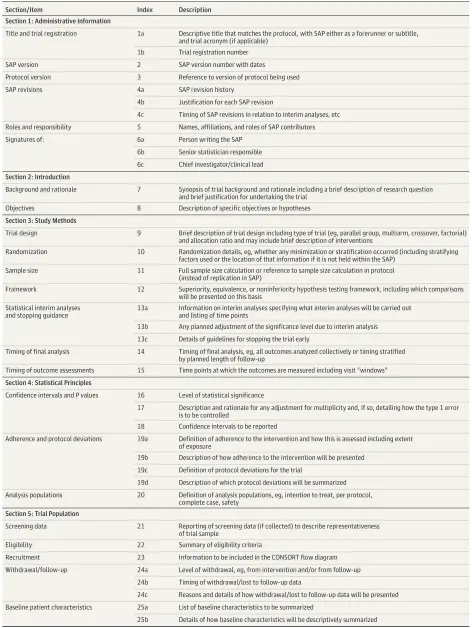
Table. SAP Guidance Document: Recommended Items to Address in a Clinical Trial SAPa
Section/Item Index Description Section 1: Administrative Information
Title and trial registration 1a Descriptive title that matches the protocol, with SAP either as a forerunner or subtitle, and trial acronym (if applicable)
1b Trial registration number
SAP version 2 SAP version number with dates
Protocol version 3 Reference to version of protocol being used
SAP revisions 4a SAP revision history
4b Justification for each SAP revision
4c Timing of SAP revisions in relation to interim analyses, etc
Roles and responsibility 5 Names, affiliations, and roles of SAP contributors
Signatures of: 6a Person writing the SAP
6b Senior statistician responsible
6c Chief investigator/clinical lead
Section 2: Introduction
Background and rationale 7 Synopsis of trial background and rationale including a brief description of research question and brief justification for undertaking the trial
Objectives 8 Description of specific objectives or hypotheses
Section 3: Study Methods
Trial design 9 Brief description of trial design including type of trial (eg, parallel group, multiarm, crossover, factorial) and allocation ratio and may include brief description of interventions
Randomization 10 Randomization details, eg, whether any minimization or stratification occurred (including stratifying factors used or the location of that information if it is not held within the SAP)
Sample size 11 Full sample size calculation or reference to sample size calculation in protocol (instead of replication in SAP)
Framework 12 Superiority, equivalence, or noninferiority hypothesis testing framework, including which comparisons will be presented on this basis
Statistical interim analyses and stopping guidance
13a Information on interim analyses specifying what interim analyses will be carried out and listing of time points
13b Any planned adjustment of the significance level due to interim analysis
13c Details of guidelines for stopping the trial early
Timing of final analysis 14 Timing of final analysis, eg, all outcomes analyzed collectively or timing stratified by planned length of follow-up
Timing of outcome assessments 15 Time points at which the outcomes are measured including visit “windows”
Section 4: Statistical Principles
Confidence intervals andPvalues 16 Level of statistical significance
17 Description and rationale for any adjustment for multiplicity and, if so, detailing how the type 1 error is to be controlled
18 Confidence intervals to be reported
Adherence and protocol deviations 19a Definition of adherence to the intervention and how this is assessed including extent of exposure
19b Description of how adherence to the intervention will be presented
19c Definition of protocol deviations for the trial
19d Description of which protocol deviations will be summarized
Analysis populations 20 Definition of analysis populations, eg, intention to treat, per protocol, complete case, safety
Section 5: Trial Population
Screening data 21 Reporting of screening data (if collected) to describe representativeness of trial sample
Eligibility 22 Summary of eligibility criteria
Recruitment 23 Information to be included in the CONSORT flow diagram
Withdrawal/follow-up 24a Level of withdrawal, eg, from intervention and/or from follow-up
24b Timing of withdrawal/lost to follow-up data
24c Reasons and details of how withdrawal/lost to follow-up data will be presented
Baseline patient characteristics 25a List of baseline characteristics to be summarized
25b Details of how baseline characteristics will be descriptively summarized
(continued)
Clinical Review & Education Special Communication Guidelines for the Content of Statistical Analysis Plans in Clinical Trials
2340 JAMA December 19, 2017 Volume 318, Number 23 (Reprinted) jama.com
suggested by responders. Round 2 contained 110 items (89 pre-populated items from round 1 and the 21 suggested items) and at the end of round 2, consensus was reached that 46 items should re-main in with 1 item deleted (consensus-out).
At the end of the consensus meeting, there were 63 items in (consensus-in), 30 items deleted (consensus-out), and 17 items that the expert panel felt are important but do not necessarily need to be included (eTable 4 in theSupplement). These 17 items may be found in other trial documents but the SAP should incorporate ref-erences to where details of these items can be found.
The critical review meeting, held in London, was attended by 51 statisticians from 37 CTUs (April 2015). Participants were asked to consider the ordering and clarity of the descriptions of each of the 63 items and to highlight any concerns. To ensure discussion and complete coverage of the items within the meeting, attend-ees were split into groups, with each group allocated 1 of the 6 sections to review and provide feedback on as a priority. Meeting attendees were also encouraged to discuss the draft guidance with other statisticians within their CTUs and return any addi-tional collective responses. Addiaddi-tional responses were received from 8 CTUs.
Two issues were raised: the first was whether the sample size calculation should be replicated from the protocol in full or refer-enced and the second was concerning the use of a 2-stage analysis in which the assumptions of the analysis approach are tested and then the analysis determined by whether the assumptions are met or not. The sample size statement was amended to support an indi-vidual statistician’s preference to replicate or reference the
proto-col. The issue surrounding the 2-stage analysis was more contro-versial and in response to discussions, the guidance was amended to ensure that this was highlighted in the discussion of that item. During critical review of the 63 items, some items were found to overlap and were combined, leaving 55. TheTabledisplays the essential items and their subitems. There are 6 sections: Title and Trial Registration (11 items/subitems); Introduction (2 items); Study Methods (9 items/subitems); Statistical Principles (8 items/ subitems); Trial Population (8 items/subitems); and Analysis (17 items/subitems).
An open request for 5 volunteers to undertake piloting of the recommendations in the guidance document was made at the criti-cal review meeting. Twelve statisticians expressed an interest and were invited to participate; 5 were selected to cover CTUs with vary-ing experience in Wales, England, and Scotland, each of whom ap-plied the guidance document to trials in adults and children, and in-cluded pharmaceutical and nonpharmaceutical interventions including devices and physiotherapy. The piloting feedback did not require any changes to the guidance and the comments received sup-ported its content and usability.
[image:6.612.75.543.77.366.2]An elaboration and explanation of each item is included within eAppendix 2 in theSupplement. Examples are provided to illus-trate each item, along with an explanation of the rationale and detailed description of the issues to be addressed. Examples for each item are based on real SAPs either published in journals, provided by responders to the CTU survey, or contained within National Institute for Health Research’s Health Technology Assess-ment monographs.
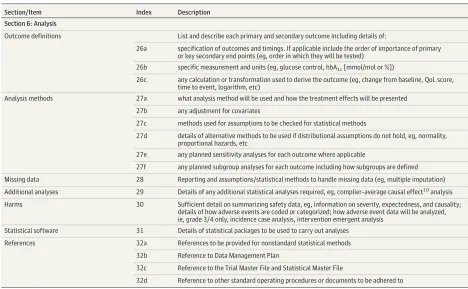
Table. SAP Guidance Document: Recommended Items to Address in a Clinical Trial SAPa(continued)
Section/Item Index Description Section 6: Analysis
Outcome definitions List and describe each primary and secondary outcome including details of:
26a specification of outcomes and timings. If applicable include the order of importance of primary or key secondary end points (eg, order in which they will be tested)
26b specific measurement and units (eg, glucose control, hbA1c[mmol/mol or %])
26c any calculation or transformation used to derive the outcome (eg, change from baseline, QoL score, time to event, logarithm, etc)
Analysis methods 27a what analysis method will be used and how the treatment effects will be presented
27b any adjustment for covariates
27c methods used for assumptions to be checked for statistical methods
27d details of alternative methods to be used if distributional assumptions do not hold, eg, normality, proportional hazards, etc
27e any planned sensitivity analyses for each outcome where applicable
27f any planned subgroup analyses for each outcome including how subgroups are defined
Missing data 28 Reporting and assumptions/statistical methods to handle missing data (eg, multiple imputation)
Additional analyses 29 Details of any additional statistical analyses required, eg, complier-average causal effect10analysis
Harms 30 Sufficient detail on summarizing safety data, eg, information on severity, expectedness, and causality; details of how adverse events are coded or categorized; how adverse event data will be analyzed, ie, grade 3/4 only, incidence case analysis, intervention emergent analysis
Statistical software 31 Details of statistical packages to be used to carry out analyses
References 32a References to be provided for nonstandard statistical methods
32b Reference to Data Management Plan
32c Reference to the Trial Master File and Statistical Master File
32d Reference to other standard operating procedures or documents to be adhered to
Discussion
It is important that every clinical trial has a clear and comprehen-sive SAP to support reproducibility. Leading organizations and funding bodies openly support data sharing as best practice for clinical trials.11Such support will undoubtedly increase the
avail-ability of data from original research, resulting in an increase of attempts to replicate results. To support the reproducibility of research and allay concerns of misconduct and fraud in clinical research, a clear comprehensive and transparent account of pre-planned statistical analyses must be available.12The aim of this
guid-ance is to establish the minimum set of essential items required for a SAP for a clinical trial. It is intended to lead to improvements in the integrity of trial conduct and reporting by facilitating critical ap-praisal, execution, replication, and identification of any deviations from the prespecified methods.
This SAP guidance was developed following established trans-parent methods and involving a diverse range of stakeholders in-volved in the design, funding, conduct, review, and publication of clinical trials. Although the guidance was developed with a focus on the regulatory requirements of trials of medicinal products, and in particular later-phase trials, many aspects are transferable to stud-ies of other types of interventions, phases, and designs.
This guidance document does not cover when a SAP should be written, but early authoring of SAPs—before any data have been col-lected or analyzed—is the best approach. The final opportunity to amend the SAP should be in response to blind review, defined as the checking and assessment of data during the period between trial completion and the breaking of the blind, the act of unveiling each participant’s random allocation.4Following this point, deviations
from the SAP and additional analyses should be clearly indicated as such within all reports and publications.4In the United Kingdom, the
Health Research Authority has developed a protocol template13to
improve consistency in the way that the items covered by SPIRIT are included within a protocol and a similar template may be beneficial for SAPs.
This guidance assumes that the SAP is not a standalone docu-ment, and therefore, it is not necessary to replicate large portions of the protocol, which should instead be clearly referenced. The SAP should contain a statement that it is consistent with the
princi-pal features of the statistical methods described in the protocol or a section detailing which analyses are different to those planned in the protocol and why. Any abbreviations used should be spelled out in full.
SAPs should be made publicly available.14A major step toward
public availability of SAPs is the requirements of the US National Institutes of Health Final Rule for Clinical Trials Registration and Results Information Submission,15which in addition to posting of
results within ClinicalTrials.gov also requires posting of the SAP if not contained within the protocol. In the discussion of public com-ments relating to the Final Rule,15it was noted that many of the
benefits of the protocol that were cited by commenters were derived from the information regarding the statistical analyses. This represents acknowledgment that SAPs have an important role in reducing the occurrence of, and facilitating the detection of, bias particularly in relation to selective analysis and reporting.16,17Some
journals, includingJAMA, require the SAP to be submitted along-side the report of a clinical trial for use within the peer-review pro-cess. The SAP may be made available as supplementary material or published as a standalone article. While this is encouraging, and increases public availability of SAPs, there is no guidance on how the SAP should be used or evaluated. Similar to protocols, the abil-ity of a SAP to provide transparency is dependent on its content.
Any guidance needs to be responsive to relevant information from future projects and initiatives, as well as changes in legislation. Key initiatives that may influence SAP content include the addendum to ICH E9 on estimands and sensitivity analyses,18data-sharing
initiatives,19and mandatory requirements to post clinical trial results
in the European Clinical Trials Database and ClinicalTrials.gov.15,20,21
Future revisions of this document will be made available periodically and extensions to other study designs, including observational studies22and studies with adaptive designs and Bayesian analyses,
should be considered.
Conclusions
Recommendations are provided for a minimum set of items that should be addressed and included in SAPs for clinical trials. Trial reg-istration, protocols, and statistical analysis plans are critically im-portant in ensuring appropriate reporting of clinical trials.
ARTICLE INFORMATION
Accepted for Publication:November 7, 2017. Author Affiliations:Biostatistics Department, University of Liverpool, Liverpool, England (Gamble, Williamson); Clinical Trials Research Centre, University of Liverpool, Liverpool, England (Krishan); Newcastle University, Newcastle, England (Stocken); Currently with Leeds Institute of Clinical Trials Research, University of Leeds, Leeds, England (Stocken); Edinburgh University, Edinburgh, Scotland (Lewis); University of Oxford, Oxford, England (Juszczak); UCL Comprehensive Clinical Trials Unit, London, England (Doré); Centre for Statistics in Medicine, University of Oxford, Oxford, England (Altman); University of Nottingham, Nottingham, England (Montgomery); Janssen Research & Development LLC, Raritan, New Jersey (Lim); Johnson & Johnson, Titusville,
New Jersey (Berlin); Luxembourg Institute of Health, Strassen, Luxembourg (Senn); Clinical Trials Consulting & Training Limited, Buckingham, England (Day); Medicines and Healthcare Products Regulatory Agency, London, England (Barbachano); BMJ, London, England (Loder).
Author Contributions:Dr Gamble and Ms Krishan had full access to all of the data in the study and take responsibility for the integrity of the data and the accuracy of the data analysis.
Concept and design:Gamble, Stocken, Lewis, Dore, Williamson, Montgomery, Lim, Berlin, Senn. Acquisition, analysis, or interpretation of data: Gamble, Krishan, Stocken, Juszczak, Dore, Williamson, Altman, Montgomery, Lim, Day, Barbachano, Loder.
Drafting of the manuscript:Gamble, Krishan, Stocken, Dore, Altman, Lim.
Critical revision of the manuscript for important intellectual content:Gamble, Stocken, Lewis, Juszczak, Dore, Williamson, Montgomery, Lim, Berlin, Senn, Day, Barbachano, Loder. Statistical analysis:Gamble, Krishan, Stocken, Williamson, Senn.
Obtained funding:Gamble, Stocken, Lewis, Juszczak, Dore, Williamson, Montgomery. Administrative, technical, or material support: Williamson, Lim.
Supervision:Gamble, Stocken.
Conflict of Interest Disclosures:All authors have completed and submitted the ICMJE Form for Disclosure of Potential Conflicts of Interest. Dr Berlin is a full-time employee of Johnson & Johnson. Dr Loder is head of research forBMJ. No other disclosures were reported.
Clinical Review & Education Special Communication Guidelines for the Content of Statistical Analysis Plans in Clinical Trials
2342 JAMA December 19, 2017 Volume 318, Number 23 (Reprinted) jama.com
Funding/Support:This work was funded by grant MR/L004933/1-R44 from the UK Medical Research Council Network of Hubs for Trials Methodology Research and supported and endorsed by the UK Clinical Research Collaboration Registered Clinical Trials Unit Network.
Role of the Funder/Sponsor:The funders/ sponsors had no role in the design and conduct of the study; collection, management, analysis and interpretation of the data; preparation review, or approval of the manuscript; and decision to submit the manuscript for publication.
REFERENCES
1. Bonini S, Eichler HG, Wathion N, Rasi G. Transparency and the European Medicines Agency: sharing of clinical trial data.N Engl J Med. 2014;371 (26):2452-2455.
2. Baker M. Is there a reproducibility crisis? aNaturesurvey lifts the lid on how researchers view the crisis rocking science and what they think will help.Nature. 2016;533(7604):452-455.
3. International Council for Harmonisation of Technical Requirements for Pharmaceuticals for Human Use.ICH Harmonised Guideline: Integrated addendum to ICH E6(R1): Guideline for Good Clinical Practice E6(R2). London, England: European Medicines Agency; 2016.
4. International Conference on Harmonisation of Technical Requirements for Registration of Pharmaceuticals for Human Use.ICH Harmonised Tripartite Guideline: Statistical Principles for Clinical Trials E9. London, England: European Medicines Agency; 1998.
5. Chan A-W, Tetzlaff JM, Gøtzsche PC, et al. SPIRIT 2013 explanation and elaboration: guidance for protocols of clinical trials.BMJ. 2013; 346:e7586.
6. Moher D, Hopewell S, Schulz KF, et al; Consolidated Standards of Reporting Trials Group. CONSORT 2010 explanation and elaboration: updated guidelines for reporting parallel group randomised trials.J Clin Epidemiol. 2010;63 (8):e1-e37.
7. UK Health Research Authority. HRA decision tool.http://www.hra.nhs.uk/research-community /before-you-apply/determine-whether-your-study -is-research/. Accessed November 6, 2017.
8. Conroy EJ, Harman NL, Lane JA, et al. Trial steering committees in randomised controlled trials: a survey of registered clinical trials units to establish current practice and experiences.Clin Trials. 2015;12(6):664-676.
9. Guyatt GH, Oxman AD, Kunz R, et al. GRADE guidelines, 2: framing the question and deciding on important outcomes.J Clin Epidemiol. 2011;64(4): 395-400.
10. Dunn G, Maracy M, Tomenson B. Estimating treatment effects from randomized clinical trials with noncompliance and loss to follow-up: the role of instrumental variable methods.Stat Methods Med Res. 2005;14(4):369-395.
11. Taichman DB, Sahni P, Pinborg A, et al. Data Sharing statements for clinical trials: a requirement of the International Committee of Medical Journal Editors. secondary data sharing statements for clinical trials.http://www.icmje.org/news-and -editorials/data_sharing_june_2017.pdf. Published June 6, 2017. Accessed November 11, 2017.
12. Herson J. Strategies for dealing with fraud in clinical trials.Int J Clin Oncol. 2016;21(1):22-27.
13. Health Research Authority. Protocol guidance and template for use in a Clinical Trial of an Investigational Medicinal Product (CTIMP): secondary protocol guidance and template for use in a Clinical Trial of an Investigational Medicinal Product (CTIMP) 2015.http://www.hra.nhs.uk /about-the-hra/consultations-calls/closed -consultations/protocol-guidance-template-use -clinical-trial-investigational-medicinal-product -ctimp-consultation-use/. Accessed October 13, 2017.
14. Finfer S, Bellomo R. Why publish statistical analysis plans?Crit Care Resusc. 2009;11(1):5-6.
15. National Institutes of Health, Department of Health and Human Services. Final rule for clinical trials registration and results information submission: 42 CFR Part 11.https://www .federalregister.gov/documents/2016/09/21/2016 -22129/clinical-trials-registration-and-results
-information-submission. Published September 21, 2016. Accessed October 13, 2017.
16. Dwan K, Altman DG, Clarke M, et al. Evidence for the selective reporting of analyses and discrepancies in clinical trials: a systematic review of cohort studies of clinical trials.PLoS Med. 2014;11 (6):e1001666.
17. Kirkham JJ, Dwan KM, Altman DG, et al. The impact of outcome reporting bias in randomised controlled trials on a cohort of systematic reviews.BMJ. 2010;340:c365.
18. International Conference on Harmonisation of Technical Requirements for Registration of Pharmaceuticals for Human Use. Final concept paper: E9(R1): addendum to statistical principles for clinical trials on choosing appropriate estimands and defining sensitivity analyses in clinical trials. http://www.ich.org/fileadmin/Public_Web_Site/ICH _Products/Guidelines/Efficacy/E9/E9__R1__Final _Concept_Paper_October_23_2014.pdf. Accessed October 13, 2017.
19. Smith CT, Hopkins C, Sydes M, et al. How should individual participant data (IPD) from publicly funded clinical trials be shared?BMC Med. 2015;13(1):1.
20. European Commission. Commission guideline: guidance on posting and publication of
result-related information on clinical trials in relation to the implementation of article 57(2) of regulation (EC) No. 726/2004 and article 41(2) of regulation (EC) No. 1901/2006.http://ec.europa.eu /health/files/eudralex/vol-10/2012_302-03/2012 _302-03_en.pdf. Accessed October 13, 2017.
21. European Commission. Technical guidance on the format of the data fields of result-related information on clinical trials submitted in accordance with article 57(2) of regulation (EC) No. 726/2004 and article 41(2) of regulation (EC) No. 1901/2006.http://ec.europa.eu/health /files/eudralex/vol-10/2013_01_22_tg_en.pdf. Accessed October 13, 2017.