E U R O P E A N I N V E S T M E N T B A N K
EIB
INFORMATION
November 1991 · N ° 7 0 ISSN 02503891
— EIB operations outside the
Community
—
—
.
Given that the ElB's primary task is to pro vide financing for capital investment required to further European integration, the Bank devotes the bulk of its activity to achieving balanced economic develop ment within the Community. However, under special authorisations granted unanimously by the Board of Governors under Articlel8(') of the Bank's Statute, the EIB may make loans available for pro jects to be carried out either in whole or in part outside the Community. These spe cial authorisations have been provided for projects of direct interest to the Com munity and having a physical link with it, such as energy or communications infra structure. However, the Board of Govern ors also grants blanket authorisations to finance projects in nonmember coun tries, thereby enabling the Bank to partici pate in Community development aid policies with countries or groups of coun tries outside the EEC with which the Com munity has privileged ties based on com mon historical or geographical interests.
The Community's development aid
policies in support of nonmember coun tries take the form of bilateral agreements or conventions signed between the EEC and individual countries or groups of
countries. These agreements define
mutual cooperation ties in general terms covering commercial aspects and econ omic or technical assistance managed by the Commission of the European Com munities. Some of these agreements also involve financial cooperation in which the EIB plays a key role. This package of policies, implemented jointly by the Com mission and the EIB, fulfils two of the fun damental objectives for building Europe, as enshrined in the Preamble to the Treaty of Rome: working for peace and stable
DEN EUROPÆISKE INVESTERINGSBANK EUROPAISCHE INVESTITIONSBANK ΕΥΡΩΠΑΪΚΗ ΤΡΑΠΕΖΑ ΕΠΕΝΔΥΣΕΩΝ
EUROPEAN INVESTMENT BANK BANCO EUROPEO DE INVERSIONES BANQUE EUROPEENNE D'INVESTISSEMENT
BANCA EUROPEA PER GLI INVESTIMENTI EUROPESE INVESTERINGSBANK BANCO EUROPEU DE INVESTIMENTO
<&±$LB
Contents
international relations, whilst participating in the development of world trade.
A WIDE THEATRE OF OPERATIONS
The Community's policy of cooperation with non-member countries was limited in the 1960s to twenty or so African coun tries which were parties to the Yaoundé Conventions and a handful of Mediter-ranean countries which had signed bilat-eral agreements with the EEC. The scope of the Community's policy has since wid-ened considerably and grown in sub-stance to cope with the difficulties con-fronting an increasing number of countries on their road to development and to respond to the widespread interest being shown in the move towards Euro-pean unity. Nowadays over one hundred countries throughout the world enjoy the fruits of the Community's policy of cooperation with non-member countries: among these, 69 African, Caribbean
EIB operations outside
the Community pagel
As the European Community's financing arm, the EIB devotes the bulk of its activity to promoting European integration. It also operates, however, in over 80 non-mem-ber countries, implementing the financial aspects of cooperation and development aid policies arranged by the Community.
Redirected Mediterranean policy: a greater role for the EIB page 4
Renewal of the bilateral financial proto-cols between the EEC and the Maghreb and Mashreq countries and Israel for the period 1991 - 1996 confirms not only the importance attached by the Community to its partnership with countries on the southern and eastern shores of the Mediterranean, but also the role which the EIB is called upon to play in imple-menting this policy. Scope for operations has been broadened further by introduc-ing an innovative feature : so-called "hori-zontal" financial cooperation designed to support, outside the framework of the fin-ancial protocols, capital projects of com-mon interest to partners on both shores of the Mediterranean.
From Lomé III to Lomé IV: the role of the EIB in the ACP countries page 7
The fourth Lomé Convention bringing together the Community and 69 countries in Africa, the Caribbean and the Pacific came into force on 1 September of this year. The EIB is helping to attain the econ-omic objectives provided for in this Con-vention by granting loans for projects fos-tering the sustained development of the countries concerned.
and Pacific (ACP) States, parties to the fourth Lomé Convention ('), and 12 Mediterranean countries, which have signed bilateral agreements with the EEC, benefit from substantive cooper ation arrangements, including, in par ticular, financial aspects in which the EIB is closely involved.
The EIB, the Community's financial institution deploying funds raised on the capital markets, enhances this financial cooperation with its own contribution reflecting its specific banking identity.
It grants loans from its own resources and manages, under mandate from the Community, risk capital financing and interest subsidies as an adjunct to its loans. The EIB places at the disposal of both the Community and the countries involved its banking knowhow and experience earned in over thirty years of financing productive investment.
Furthermore, since 1990, the EIB has been lending to countries in Central and Eastern Europe. Here again, the Bank is involved in Community cooper ation and aid policies aimed at mod ernising the economies of five countries (Poland, Hungary, Czechoslovakia, Bul garia, Romania), working closely with
the Commission (2). The EIB makes loans
in these countries to back up endeav ours to create a market economy, while
the Commission implements the
"PHARE" technical cooperation pro gramme
munity budget.
3), financed from the Com
The Table 1 illustrates the breakdown of financing deployed as part of EEC fin ancial cooperation with nonmember countries.
COMMON GROUND
EIB lending operations in furtherance of
the Community's policies are
implemented under the terms of agree
ments negotiated by the Community,
the EIB being involved in their prepara tion. Loans are subject to ceiling amounts, authorised for each agree ment (see Table) by the Bank's Board of Governors. Regardless of the non member country in which the EIB con ducts operations, the latter comply with several fundamental principles which reflect the Bank's specific features.
Implementation of financial cooper ation provided for in these agreements
results in close cooperation between
the Bank and the Commission, which is responsible for grant aid and technical
assistance. Responsibilities between
the two institutions are thus clearly
delineated: the EIB operates in those sectors where investment can be fin anced through loan aid, i.e. industry, energy, mining, economically essential infrastructure, tourism and agricultural development. The purpose of such cooperation is to encourage efficient management of the means available and to tailor the type of financial assist ance to local economic conditions, in the interests of the countries and pro jects concerned.
With the exception of the Bank's oper ations in Eastern European countries, the funds deployed by the EIB in non member countries are drawn both
Table 1 : CONVENTIONS, FINANCIAL PROTOCOLS AND DECISIONS IN FORCE OR CONCLUDED AT 1 OCTOBER 1991
million ecus
Operations mounted from budgetary resources
Agreement Durotic
Loans trom own resources |'|
Risk capital
operations (' Grant aid [
Loans on special conditions MEDITERRANEAN COUNTRIES
Second Financial Protocol Third Financial Protocol Yugoslavia Turkey Algeria Morocco Tunisia Algeria Morocco Tunisia Egypt Jordan Lebanon Syrie Egypt Jordan Lebanon Syna Cyprus
Fourth Financial Protocol
Third Financial Protocols
Fourth Financial Protocols
Third Financial Protocols
Fourth Financial Protocols
Third Financial Protocol Fourth Financial Protocol Third Financial Protocol Third Financial Protocol
19881991 19911996
awaiting signature
19881991
19911996
"NonProtocol" horizontal linancial cooperation
1991 '995 '993 '993 '99c 550 730 133 151 13: ?80 220 !6S 219 63 53 no 45 115 62 62 23 .14 4 II 6 IS 25 15 2.5 5 25 771' 50 52 '62 52 193 101 189 35 '9 24 242 44 22 41 12.5 3 205: 350 B07 600 239 324 224 353 438 284 449 100 73 '46 568 '26 = 9 15c 63 32 33 62 2 030
ACP STATESOCT
ACP Third Lomé Convention (4i Fourth Lomé Convention OCT Council Decision I4)
Council Decision
CENTRAL AND EASTERN EUROPEAN COUNTRIES |'| Poland / Hungary
Czechoslovakia / Bulgaria / Romania
19861990 19901995 19861990 19901995 19901993 19911993
1 100 ; 200
20 25
1 000 700 600 325 15 25
5 785|5| 9 9751s) 60; 1151s!
1 015IÌ
25PI
8 500 12 000 120 ■65
(') Loans attracting interest subsidies from the European Development Find in the case of projects in the ACP States and the OCT and from lhe General Budget of the Euro pean Communities in the case of projects in certain Mediterranean countries. Amounts required for interest subsidies are financed from grant aid.
P) Granted and managed by the Bank. (*) In the form of interest subsidies managed by the EIB. |3) Granted and managed by the Commission. (') Including 105 million in interest subsidies managed by the EIB. (*) The duration of which has been extended until entry into force of the fourth Lomé (8) The figures do not include Commission budget appropriations for these coun
Convention. tries.
from : the Bank's own resources in the case of its loans; third party resources managed under mandate in the case of risk capital funding or interest subsidies. In this way, the EIB is able, as some of the resources are derived from budge-tary funds, to modulate the conditions (duration and interest rates) of its financ-ing in non-member countries to the best advantage. Funds managed by the Bank under mandate are clearly identi-fied as such to the recipients when the loans are granted and such operations are not posted in the ElB's balance sheet, but are recorded separately in the "Special Section" (see box article).
Regardless of whether the investment is in the public or private sector, Bank lending is accorded solely for projects deemed technically, economically and financially viable. This constraint is necessary in view of the ElB's status as an institution raising funds on the mar-kets and reflects the dictates of sound banking practice: as the EIB can provide only a proportion of the funds which a non-member country needs to pursue its economic development, the Bank con-siders one of its basic responsibilities is to guarantee that resources are invested as effectively as possible in keeping with priorities jointly agreed with recipient countries. As a result, any project eligible for financing is thoroughly examined to assess not only its inherent merits, but also its contribution to the development of the country in which it is located.
Lastly, the EIB, which has to safeguard its "AAA" rating on the markets, ensures
('I In addition, 20 Overseas Countries and Terri-tories (OCT) also enjoy financial and technical assist-ance as a result of decisions taken by the Council of the European Communities.
(2) For details of EIB activity in Eastern European
countries, see, in particular, "EIB Information" Nos. 68 and 69.
(3) "Poland a n d Hungary - Aid for economic
restruc-turing", extended in 1990 to cover Czechoslovakia, Bulgaria, Yugoslavia a n d Romania: this technical assistance programme was set up by decision of the Council of the European Communities. It covers the environment, agriculture, vocational training and balance of payments support. The programme has been funded with Community budgetary appropria-tions amounting to 500m ecus in 1990, 785m ecus in 1991 a n d a projected 1 000m ecus in 1992.
that loans disbursed are backed by
appropriate forms of security. The first guarantee that the project will be properly completed is the rigorous
selection and appraisal process referred to above. However, under its Statute, the Bank also requires that each finance contract be secured by a
"OWN RESOURCES", "RISK CAPITAL" AND THE "SPECIAL SECTION"
The Lomé Convention and the Mediterranean Financial Protocols refer to the European Investment Bank providing loans from its "own resources". Under mandate the EIB also manages "risk capital" provided for in these agreements. This terminology is used here in a specific sense which can cause confusion for the uninitiated. The distinction, in particu-lar, between "own resources" and "own funds" is not always clear.
"Own resources"
What are referred to as "own resources" are essentially the proceeds of the ElB's borrow-ings on capital markets, mainly raised through public bond issues. Own resources also include the Bank's "own funds" made up of the paid-in portion of its subscribed capital and reserves. Own resources are fully accounted for on the Bank's balance sheet. On 31 December 1990 the ElB's "own resources" included:
ECU billion
Borrowings 48.86 Own funds
Paid in capital 2.10 Reserves 5.97 Balance of profit and loss acc.(*) 0.89
Total own resources 57.82 * Annually credited to the reserves
"Risk capital"
The Convention and Protocols also provide for a specific form of concessionary finance referred to as "risk capital". These funds are drawn from the budgets of the Member States through the European Development Fund under the Lomé Convention, and from the budget of the Community in the Mediterranean. They are managed by the EIB under mandate from the Member Countries in the first case and from the EEC in the second. Risk capital is mostly used as quasi capital (in the form of conditional loans and subordinated loans) but can also be used for capital participations. As for all operations under man-date, this concessionary or soft loan funding is recorded off balance sheet in a fiduciary account called the "Special Section".
The "Special Section"
The Special Section was set up by the Board of Governors in 1963 to account for conces-sionary financing the EIB carried out in Turkey under mandate from the EC Member States with funds provided from their budgets. The ElB's activities were also widened to provide concessionary finance in African states and later in Caribbean and Pacific countries under what became known as the Yaoundé Conventions and then the Lomé Conventions, and in the Mediterranean region under the Financial Protocols. In 1977, the Bank's Board of Governors extended the Special Section to cover further operations the EIB carries out under mandate inside and outside the Community.
guarantee, generally that of the non-member State concerned. Moreover, in the case of loans granted as part of Community policy towards
non-member countries implying an element of risk, Bank lending made available in such countries is covered by a blanket guarantee from the Community budget
(in the case of Mediterranean countries) or Member States (in the case of ACP countries).
— Redirected Mediterranean
Policy: Agreater role for the EIB,
Beyond the geographical and cultural bonds which link the southern and north-ern shores of the Mediterranean, the move towards closer ties between Europe and non-member countries on the Mediterranean seaboard benefiting from Community development aid reflects a need born out of ever closer economic interdependence. Cooper-ation was given a fresh boost at the end of 1990 when the "Redi rected Mediter-ranean Policy" was adopted, comprising three facets :
- renewal of bilateral financial protocols with each of the Maghreb and Mashreq countries, and Israel for the period 1991 -1996; these constitute the fourth gener-ation of protocols signed by the Com-munity and the countries concerned during 1991 ('); the funds available under these protocols approach 2 billion ecus, a 30% increase on the previous pack-age;
- creation of "horizontal" financial cooperation, implemented outside the bilateral terms of reference for financial protocols. This horizontal cooperation, the main innovation compared with pre-vious protocols, concerns all those Mediterranean countries having associ-ation or cooperassoci-ation agreements with the EEC. The cooperation is aimed at providing funds for regional projects of relevance to the Community, notably in the area of environmental protection; for the years 1992-1996, funding will com-prise EIB loans (up to a ceiling of 1800m ecus) and grant aid (230m ecus) from budgetary resources;
- improved trade concessions granted by the Community in favour of such coun-tries and the application of duty-free
arrangements as from 1 January 1993 (instead of 1996) for products from Maghreb and Mashreq countries; this facet of cooperation will also involve fin-ancial support of the order of 300m ecus drawn from budgetary resources, pro-vided by the Community to Maghreb and Mashreq countries embarking on structu-ral reform programmes.
A CLEAR FRAMEWORK: THE FINANCIAL PROTOCOLS
The Community's policy of cooperation with Mediterranean countries takes the form of bilateral agreements which include financial protocols. Such proto-cols define the Community's participa-tion in financing investment intended to further the economic and social develop-ment of signatory countries. The five-year protocols provide for loans from EIB own resources and financing from budgetary resources for risk capital operations (2),
managed by the EIB under mandate from the Community. Most of the proto-cols also include a grant aid component, again funded from the EC budget, part of which may, at the request of the reci-pient country, be used to finance an inter-est subsidy - in general 2% - on Bank loans.
Since EIB loans from own resources rep-resent the bulk of financial cooperation (see Table, page 2), the Bank's contribu-tion is significant, as evidenced by the graph page 5 illustrating the sectoral breakdown of EIB operations in the countries concerned. Since 1976, the EIB has granted loans of over 1700m ecus towards implementing the financial protocols with the Maghreb countries (Algeria, Morocco, Tunisia), the Mashreq countries (Egypt, Jordan, Lebanon, Syria), Malta, Cyprus and Israel. More-over, between 1964 and 1981, the EIB made an active contribution to imple-menting three financial protocols with
Turkey giving rise to financing of over 734m ecus (3). Lastly, since 1975, EIB
lending in Yugoslavia has been used to finance projects furthering the economic development of the country and building transport infrastructure to link Greece with the rest of the Community; between
1975 and 1990, such operations involved a total of some 760m ecus (4).
Drawing on its knowledge of the econ-omies concerned and its experience in financing productive investment, the EIB participates actively in deliberations between the Community and each non-member Mediterranean State about the nature and type of operation needed to further the latter's development. Thus in order to allocate effectively the means available under the various protocols, as soon as these are signed the EIB and the Commission arrange joint programming missions to each of the signatory states in order to define, in agreement with the authorities concerned, an indicative pro-gramme of objectives and areas for fin-ancial cooperation. These programmes, which are drawn up in such a way that they can be revised during the five-year lifetimes of the financial protocols, are subject, where necessary, to regular review so that due account can be taken of any changes in the economic situation of a beneficiary country or in national development plan priorities.
A LASTING CONTRIBUTION TO DEVEL-OPMENT
EIB loans cover a broad range of capital investment, but are primarily directed
towards basic infrastructure projects
necessary for the urban and rural devel opment of the recipient countries. The Bank has provided financing for the con struction of two stretches of the EastWest motorway in Algeria, upgrading of the railway network in Tunisia and building of water supply systems, notably in Cyprus, to name but a few of the more recent projects. Similarly, the EIB has funded construction of a desalination plant and modernisation of the international air port in Malta.
Environmental protection and rehabilita tion of areas affected by environmental degradation are also priority targets for financial cooperation with Mediter ranean countries: substantial funds have been lent for such major projects as sewerage and sewage disposal in nine coastal towns in Morocco, the building of a waste water collection and treatment system serving Greater Algiers, etc. Other loans have been used to help fin ance the construction of waste process ing plants (in Malta for instance) or water purification facilities, as in Jordan as part of the programme for improving sanita tion infrastructure in Amman.
These loans illustrate the efforts made by the EIB to further the cause of environ mental protection both outside and
inside the Community (5). The EIB, as a
member of the Committee of Interna tional Development Institutions for the Environment (CIDIE), is also involved in implementing the Environmental Pro gramme for the Mediterranean in con junction with the World Bank and with the joint support of the Commission of the European Communities and the United
Nations Development Programme
(UNDP) : the two institutions provide tech nical assistance in pinpointing and defin ing projects as well as strengthening bodies concerned with environmental protection in countries on both Mediter ranean seaboards.
Through its loans, the EIB also enables nonmember Mediterranean countries to acquire installations to generate, trans
port and distribute energy. Financing has
been forthcoming for power supply sys tems in both rural areas (Morocco, Cyprus) and urban areas (Amman in
Jordan, Cairo in Egypt) and for natural gas supply networks (Cairo). Loans have also been made available for installa tions to expand local electricity genera ting capacity, for instance in Egypt (through the use of natural gas and oil at ShoubrahEIKheima, north of Cairo) and in Algeria (power station at Bechar).
Bank financing also serves to further industrial development : loans have pro moted major industrial projects (for example, the settingup of an Egyptian European joint venture near Alexandria to manufacture tyres for heavy goods vehicles) or fostered smaller businesses. Several global loans, the proceeds of which are onlent by local banking part ners whose own development is fur thered in the process, have been granted in Jordan, Cyprus, Israel, Tunisia and Morocco; such loans make it possible to provide financing for hundreds of local industrial or tourismbased businesses, many of which have sprung from joint ventures with European partners.
Lastly, the EIB has financed projects in the agricultural sector geared to the devel opment of cooperatives, for example in Jordan (for sheepfarming), Tunisia and Morocco (via global loans for smaller onfarm schemes). In addition, EIB sup port has been also made available for developing land under cultivation, in par ticular through loans for irrigation schemes, some of which, such as those in Nubariya (Egypt) and Mitidja (Algeria), cover over 20000 hectares.
RISK CAPITAL: A FLEXIBLE A N D WELL
ADAPTED INSTRUMENT
Risk capital, financed through budgetary resources and managed by the EIB, is a particularly versatile form of funding which can be made available over a long period (up to 25 years). Risk capital assistance was developed by the EIB under the Lomé Conventions benefiting ACP States and extended to cover finan cial cooperation with Mediterranean countries in the third generation of finan cial protocols (19881991 ). The volume of such funds was substantially increased in the fourth protocols (see Table, page 2), furnishing unequivocal proof of the Com munity's determination to bolster indus trial cooperation with Mediterranean
countries and foster joint ventures between local and Community promo ters.
The purpose of risk capital is to promote the creation of equity in industrial or tour ism companies; operations of this kind usually provide an injection of equity for
companies and are conditional, leaving
scope for flexible interest rate formats and repayment terms linked to the devel opment of the project (output levels achieved, profits made, etc.). In some cases, loans from risk capital resources may, in the interests of the project fin
anced, be subordinated such that repay
ment is only due after other bank loans contracted for the project have been repaid. Risk capital financing can be used in conjunction with a loan from the EIB (as was the case with the tyre factory in Alexandria).
Risk capital can also be used to finance direct participations, acquired by the Bank in the name of the EEC, in com panies set up by local partners, often in association with European promoters, in one of the sectors of the economy identi fied as a priority target in the financial protocol. Risk capital was used in this way to acquire stakes in venture capital companies set up to promote the financing of corporate equity in Morocco (Société de Participation et de Promotion du
Financing provided in the Mediterranean countries
19771990 (million ecus)
D Energy
□ Infrastructure
D Industry and services (individual loans)
Partenariat - S.P.P.P.) and Algeria (Société Financière Algéro-européenne de Participation - FINALEP): in both cases, acquisition of the capital stake was supplemented by a conditional loan to the newly-established venture capital company to finance the creation or bolstering of local businesses' equity bases. Such financial packages, how-ever, can also be used to channel funds to existing local financing bodies keen to expand or diversify their business : an example of this approach was the recent acquisition by the EIB of an equity par-ticipation in the Cyprus Development Bank (CDB), supplemented by a global loan from risk capital resources to the Cyprus Central Bank for the financing, via local banks, of participations in Cypriot industry.
These operations reveal the full spec-trum of possibilities offered by risk capi-tal : the flexibility of the terms and condi-tions applied thanks to their budgetary origin makes such instruments particu-larly well-suited to financing projects in the productive sectors, especially where the investment involved is to be implemented in a fragile economic envi-ronment. Moreover, the provision of long-term resources and equity to com-panies fosters the development of local industries and promotes partnership with European businesses, thereby giv-ing Mediterranean countries wider access to new technologies and mar-kets.
AN INNOVATION: HORIZONTAL
FINANCIAL COOPERATION
The main innovation in the Redirected Mediterranean Policy lies in the cre-ation, for the period 1992-1996, of
"non-Protocol" horizontal financial cooperation comprising : loans from the ElB's own resources (up to a ceiling of 1800m ecus) and 230m ecus worth of budgetary funds, of which 105m ecus
will be deployed to provide 3% interest subsidies on the Bank's loans for envi-ronmental protection projects (6).
This cooperation will represent addi-tional support outside the framework of the financial protocols as part of the Community's dialogue with different partners on the southern and eastern seaboards of the Mediterranean and is directed towards all those non-member countries in the region which are parties to bilateral cooperation or association agreements.
Loans granted under these innovative arrangements will be aimed at promot-ing projects of relevance to all or part of the region and to the Community itself.
The main areas targeted for funding will be the transport, telecommunications and energy sectors as well as environ-mental protection schemes. The latter are being given particularly high priority in view of the serious problems facing the Mediterranean Basin, which is why EIB loans for such projects will carry interest subsidies. Indeed, urgent schemes (such as converting industries, creating or modernising water purifica-tion plants or providing ballast water cleansing facilities, constructing urban or industrial waste treatment plants, etc.) have already been pinpointed as essen-tial conservation measures for the Mediterranean area; in this respect, joint studies conducted by the EIB and the World Bank under the Environmental Programme for the Mediterranean rep-resent a major contribution towards the type of action that needs to be taken.
Lastly, the industrial sector will also benefit from this horizontal financial cooperation: the EIB will be able to deploy 25m ecus of risk capital from budgetary funds to assist European pro-moters interested in setting up projects with local partners, particularly smaller businesses/industries. These loans will supplement risk capital operations pro-vided for under the financial protocols
and aimed at local entrepreneurs in non-member countries which have signed bilateral agreements.
Within the framework of the Redirected Mediterranean Policy, the EIB has been entrusted with a wider mandate with over 4000m ecus at its disposal. This prospect will enable the Bank to build on the contribution that it has been mak-ing for over 15 years to the development of countries in the southern and eastern Mediterranean. Hence, the EIB will take on added responsibilities as a Com-munity institution in implementing the policy of financial cooperation with non-member Mediterranean countries whose- stability and expansion are essential for the development of the region as a whole.
(') The Third Financial Protocols, barring those con-cerning Cyprus and Malta (which run until 1993) and Yugoslavia (covering the period 1991 - 1996), expired on 31.10.91.
0 Except for those protocols with Yugoslavia and Israel.
(3) The ElB's operations in Turkey date back to the
First Financial Protocol implemented from 1964 as part of the 1963 EEC-Turkey association agreement; the last protocol to be implemented was the Third Financial Protocol (1979-1981), since when financial cooperation with this country has been suspended and the signing of the Fourth Financial Protocol post-poned.
(4| In view of the domestic situation in Yugoslavia,
new operations with this country have been tempo-rarily suspended.
(5) O n the northern Mediterranean seaboard, the
EIB has been involved in a large number of pro-grammes to clean up rivers (Po, Tiber, Segura, Nerv-ion), coastlines (Liguria, Veneto) and gulfs (Naples, Saronic - Athens, Thessaloniki). For more information on this topic, please refer to the brochure "Protection of the Environment", as well as the newsletter "EPM Currents" available solely in English and French, giv-ing information about the Environmental Programme for the Mediterranean.
(6) As Yugoslavia qualifies for budgetary aid
_ From Lomé III to Lomé IV:
The role of the EIB in the ACP
countries
—
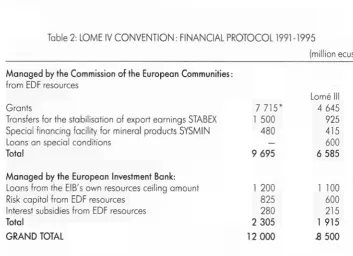
Following ratification by all the Member States of the European Community and more than two thirds of the 69 African, Caribbean and Pacific States (ACP), the fourth Lomé Convention (19912000) came into force on September 1, 1991. It is accompanied by a Financial Protocol spanning the first 5 years (199195) which foresees funding up to 12 billion ecus. The Commmission of the Euro pean Communities manager grants totalling 9 695 million ecus from the European Development Fund (EDF) while the EIB has responsability for a total of 2 305 million ecus: up to 1 200 million ecus in loans from its own resour ces and, from EDF resources, 280 mil lion ecus for interest rate csubsidies as well as 825 million ecus in the form of risk capital.
THE LOMÉ FRAMEWORK
Under two Yaounde Conventions (1963 75) and the first three Lomé Conventions (197691), the European Investment Bank, through its participation in the implementation of EC financial and technical cooperation policies, evolved new working relations with on increas ing number of ACP partners. In particu lar Lomé I, signed in 1975, was a major political milestone involving countries of the North and the South in a contractual commitment for the benefit of both. The second and third Lomé Conventions widened and intensified these coopera tive links and Lomé IV now sets the framework for the European Com munity's development cooperation pol icy in the ACPs countries up to the year 2000.
[image:7.595.208.562.54.310.2]Given the nature of the funds provided by the two institutions, the Convention foresees a division of responsibilities between the Commission and the EIB.
Table 2: LOME IV CONVENTION : FINANCIAL PROTOCOL 19911995
million ecus
Managed by the Commission of the European Communities :
from EDF resources
Grants
Transfers for the stabilisation of export earnings STABEX Special financing facility for mineral products SYSMIN Loans an special conditions
Total
Managed by the European Investment Bank:
Loans from the ElB's own resources ceiling amount Risk capital from EDF resources
Interest subsidies from EDF resources Total
G R A N D TOTAL
7 715'
1 500
480
9 695
1 200
825
280
2 305
12 000
Lomé III
4 645
925
415
600
6
585
1 100
600
215
1
915
5
500
including 1 150 million ecus for structural adjustment and 350 million ecus for emergency aid.
Requests for financing of projects in industry (including agroindustry), min ing, tourism, commercial agriculture, as well as infrastructure projects in sectors such as transport, telecommunications, energy and water are thus received by the EIB.
With loans from its own resources, the EIB principally finances viable projects in countries whose economic and financial
Financing provided under the third Lomé Convention
Sectoral breakdown (19861991)
¡million ecus!
D Energy
□ Infrastructure
D Industry and services (individual loans)
Β Industry and services (global loans)
situation is such that they can assume the debt involved and ensure that ser vice payments are maintained. These loans attract an interest rate subsidy from the grant aid foreseen under the Conventions.
Risk capital financing, a form of conces
sionary funding introduced under the
second Yaoundé Convention and
the extent that certain predetermined fin-ancial or technical targets are achieved.
LOMÉ III IN A DIFFICULT FINANCIAL ENVIRONMENT
Under the third Lomé Convention (1986-1991 ) it was foreseen that the EIB would provide up to 1.7 billion ecus for projects in ACP countries: made up firstly of a ceil-ing of 1.1 billion in loans from the Bank's own resources and secondly, 600 million ecus from risk capital resources. While the economic situation, especially in sub-Saharan ACP countries has somewhat limited the demand for loans from the Bank's own resources, the rate at which risk capital has been committed demon-strates once again that the terms of this financing tool are particularly well suited to the many ACP States with limited bor-rowing capacity.
When Lomé III expired on 31 August 1991, the EIB had committed funding of some 1 330 million ecus: about 740 mil-lion ecus from the Bank's own resources and about 590 million ecus from risk capital resources. The balance of 10 mil-lion ecus from risk capital will be carried over.
Of total financing provided under the third Lomé Convention, 736 million ecus (55%) went to industry, tourism and related services. Energy schemes received 264 million ecus (20%) and water supply and other revenue-genera-ting infrastructure 330 million ecus, or 25% of loans provided (see graph page 7). In industry as well as in infrastructure an increasing number of rehabilitiation and modernisation schemes were fin-anced. In manufacturing and tourism the EIB provides individual loans for larger projects and finances small and medium-sized ventures indirectly through global loans to development banks and other financial institutions. Global loans com-bine the ElB's ability to raise funds on the finest terms on the international capital markets, and the local operational knowledge of ACP financing institutions, such as first-hand contacts with the pri-vate sector and governments, as well as knowledge of local markets and devel-opment priorities.
Industrial projects financed through indi-vidual loans under Lomé III included
iron-ore processing in Mauritania, an open-cast gold mine in Ethiopia, an alumina plant in Guinea, a cotton spinning plant and an integrated textile complex in the Ivory Coast, a mill producing cotton and polyester in Mauritius, a cotton ginnery in Mozambique, an integrated tuna-processing complex and a textile mill in Madagascar. In agro-industry the EIB fin-anced a vegetable cannery in Mozam-bique, abattoirs in Botswana, tea pro-cessing facilities in Kenya, flour mills in Mauritius and Swaziland, palm-oil pro-duction in Nigeria, Papua New Guinea and Sao Tome and Principe, and coffee sorting and storing equipment in Burundi. A chemical complex for processing phos-phates was financed in Senegal, a saw-mill in Malawi, and two factories produc-ing cardboard boxes and plastic sheeting and sacks in Burkina Faso.
In cooperation with local and regional development banks, the EIB was able to maintain a steady flow of funds to small and medium-sized industrial enterprises (SMEs). A total of 321 SMEs attracted some 125 million ecus from EIB global loans. The overwhelming majority of these ventures were in the private sector, about 90 % of SMEs were majority-owned by local investors. A small propor-tion were joint ventures, with a mixture of local and foreign shareholding. Of the SMEs supported more than half were new ventures and the remainder expan-sions of existing enterprises or rehabilita-tion and modernisarehabilita-tion projects; around two thirds were import-substituting and the rest divided between export-oriented projects or service industries. Thus, under Lomé III financing for industrial projects already focused to a large extent on pro-moting the private sector whose role in the development process was recog-nised and emphasised further during the negotiations of the fourth Lomé Conven-tion.
One of the most pressing problems fac-ing the authorities in many ACP countries during the Lomé III period was migration from rural areas to the cities. This reality combined with the requirements of indus-try, tourism and service companies has led the EIB - generally in conjunction with other sources of bilateral or multilateral financial assistance - to fund an
increas-ing number of schemes to expand basic urban infrastructure, especially power distribution, telecommunications, and water supplies. The negotiators of the third Lomé Convention had already stressed the necessity to provide adequ-ate infrastructures and to finance projects designed to foster protection of the envi-ronment and improve water supplies, from both own resources and risk capital. The concessionary terms of financial assistance provided by the EIB proved to be particularly suitable for financing basic infrastructure in the poorer ACPs.
Drinking water schemes and drainage systems were financed in Benin, Botswana, the Congo, Guinea, Kenya, Malawi, Nigeria, the Gambia, Tchad and Zimbabwe. Examples of energy schemes financed by the EIB were the extension of electricity transmission net-works and/or the improvement of gener-ation capacity in the Central African Republic, Burkina Faso, Zimbabwe, Tan-zania, Cape Verde, Cote d'Ivoire, in Djibouti, Ghana, Malawi, Uganda, Sudan, Western Samoa, St Lucia and St. Vincent. In addition, a number of loans were made for financing airports, ports and telecommunications projects.
Finally, the EIB provided funding for a number of projects involving cooper-ation between several countries. For example ASECNA, the Agency for Air Traffic Control in Africa and Madagas-car, received EIB loans to improve air traffic safety in eleven African countries.
INNOVATIONS UNDER THE FOURTH
LOMÉ CONVENTION
The fourth Lomé Convention signals the start of a new phase of cooperation between the Community and the ACP States. It provides a 10-year framework (1991-2000) to guide the cooperation between the European Community and the 69 ACP States. Newcomers to the Convention are the Dominican Republic, Haiti and Namibia.
The ElB's role in implementing EC-ACP financial cooperation has clearly been enhanced under the new Convention as the Bank has become sole provider for loan finance, whereas all aid from the Commission is now in the form
responsibility for all reimbursable aid. At the same time the amounts foreseen have been increased both for loans from the Bank's own resources and for funding from risk capital.
The new Convention places even greater emphasis on the private sector, underlin-ing its role in promotunderlin-ing the growth and diversification of the ACP States' econ-omies. In view of the economic and finan-cial context of many ACP States, the fourth Lomé Convention includes for the first time a structural adjustment support mechanism administered by the Com-mission, as an adjunct to traditional long-term development aid. Other instruments of cooperation, such as STABEX and
SYS-THE EIB AND SYS-THE OCT
Scattered across the globe are a large number of Overseas Countries and Ter-ritories (OCT) constitutionally linked to three of the Community's Member States: France, the Netherlands and the United Kingdom. These OCTs, more often than not a patchwork of small islands are, for the most part, sparsely populated (i.e. with about 850000 inhabitants in all).
The Community's relations with the OCTs are governed by decisions of the Council of the European Communities reflecting much the same provisions as those applicable to the ACP States. Fin-ancial support amounting to 165 million ecus over the period 1991-1995 com-prises 25 million in loans from the Bank's own resources and 140 million in aid from budgetary resources; of this amount 25 million ecus will be used by the EIB for risk capital operations and 6 million ecus for interest subsidies; the remaining 109 million ecus will be granted by the Commission in form of non-repayable aid.
EIB financing activity in the OCTs over the period 1976-91, the timeframe covered by the first three Lomé Conven-tions, amounted to 63.9 million ecus, of which 42 million was extended from own resources.
MIN, have been further improved and trade arrangements, already very favour-able, are even more liberal than in the past.
INCREASED FINANCIAL RESOURCES ON
MORE CONCESSIONARY TERMS
Total financial aid (see Table 1 ) has been increased from 8.5billion ecus under Lomé III to 12billion ecus for the first five years of LomélV; the European Develop-ment Fund (EDF) financed from EC Mem-ber States' budgetary contributions, has been increased to 10.8billion ecus while the EIB is providing up to 1.2billion ecus in loans from its own resources. Under Lomé IV interest rate subsidies paid from EDF resources increased to 4% from 3% under Lomé III. The new Convention also stipulates that the subsidy be adapted to the extent that the interest rate effectively borne by the borrower will not be less than 3% or more than 6%, compared with 5% and 8% under Lomé III. The amount foreseen for risk capítol has been increased to 825 million ecus. The inter-est rate for conditional and subordinated loans will not exceed 3% and in certain cases the exchange risk is to be borne by the Community.
OPTIMAL USE OF RESOURCES
As under previous Conventions, the EIB is again participating with the Commission in the programming exercise, charac-terised by a dialogue with the ACP States on their development objectives and priorities, and designed to achieve the optimal utilisation of the various financial resources of the Protocol.
The country indicative programmes that have already been finalised, confirm that the promotion of the private sector will continue to occupy an important place in the Bank's activities; particularly assist-ance to small and medium-sized enter-prises, and their role in stimulating growth and diversifying the economies of the ACP countries, is emphasised in many indicative programmes.
Financing the private sector, particularly small and medium size industrial ventures will again require an effective cooper-ation between the EIB and local develop-ment banks or other financial interme-diaries in the ACPs. To ensure that a substantial portion of risk capital is utilised for investment in the private sec-tor, and especially for small and medium-sized enterprises, the scope of this instru-ment has been broadened further and the use of new intermediaries, including European financial institutions, has been made possible.
But to function successfully, SMEs, as well as larger industrial, agro-industrial, min-ing and tourist enterprises, require a solid infrastructure. This necessity is also reflected in many indicative programmes, which again foresee considerable fund-ing for infrastrucure projects - often reno-vation and modernisation schemes - in such fields as water, energy, telecom-munications and transport.
CONCLUSIONS
The fourth Lomé Convention goes much further than simply preserving the legacy of its predecessors. Many mechanisms have been overhauled in detail with a view to ensure swifter, better-tailored and more effective measures and procedures to accomodate new requirements. Pro-ductive projects and programmes in industry, agricultural processing, tourism, mining, energy, water, transport and tele-communications continue to be financed by the EIB whose role has been streng-thened both quantitavely and qualita-tively. Special emphasis will again be put on the private sector.
Financing Europe's Future and setting up the Single Market
1993
EUROPEAN INVESTMENT BANK
Ecu
Get to know
the BEI
A Video:
"Financing Europe's Future and Setting
up the Single Market of 1993"
The European Investment Bank has pro duced a new video that explains its role as the European Community's longterm fin ancing institution.
In the last five years, the Bank has provided over 50 billion ecus for projects supporting the balanced development of the EC and its economic policy objectives. Working in close cooperation with the banking sys tem, the EIB draws on experience in pro ject financing and evaluation that it has built up over more than thirty years throughout the Community and in many countries outside.
"Financing Europe's Future and Setting up the Single Market of 1993" is a video
designed to provide viewers with a
straightforward description of the ElB's fin ancing activity. It describes how the Bank operates in raising finance on capital mar kets and makes loans, illustrating, through examples of projects it has financed, how it contributes to the European Single Market and the economic and social cohesion of the Community.
As a complement to the Bank's publica tions, the film will be of interest to those wishing to know more about the EIB. In particular, it has been designed for teach ing, training and giving presentations on the European Community. Last but not least, the video may be used, as a whole or in sections, by television stations.
Format: Video VHS PAL (BVU for TV sta tions)
Length: 20 min
Languages: English, French, German, Ita lian, Spanish, Portuguese.
How to Order
For borrowing or buying a copy of this video, please contact:
EUROPEAN INVESTMENT BANK Information Division:
Mr Claudio Rocco
100, Bid Konrad Adenauer,
L2950 LUXEMBOURG
Tel: 43793249
Fax: 43793289
A new brochure: "Communications"
The EIB has just published a new brochure in its briefing series, this time describing the Bank's actions to support develop ment of communications in Europe which play, a major role in strengthening econ omic and social cohesion within the Com munity and completing the Single Market. It also provides key data on the Bank's lending activity, illustrated by maps and
graphs covering the main projects fin anced.
The ElB's briefing series, which started out with a brochure on financing for environ mental protection, examines the main areas of Bank activity. Forthcoming titles will look at EIB funding outside the Com munity and for development in the Com munity's less advantaged regions.
Below are the ecu values in national curren cies, as at 30 September 1991. These rates are applied to the fourth quarter in prepar ing financial statements and operational statistics of the Bank:
DEM GBP FRF ITL NLG ESP
2.04708 0.702859 6.97672 1531.43
2.30743 129.678
BEF LUF DKK GRD IEP PTE USD
42.1805 48.1805 7.89854 227.997
0.765889 129.678
1,23155
EIBInformation is published periodically by the European Investment Bank in nine dif ferent languages (Danish, Dutch, English, French, German, Greek, Italian, Portuguese and Spanish).
Material which appears in EIBInfor
mation may be freely reproduced; an acknowledgement and a clipping of any article published would be appreciated.
/ 00, bd Konrad Adenauer L2950 Luxembourg tel. 43791 telex 3530 bnkeu lu
fax 43 77 04 Department for Italy: Via Sardegna, 38 100187 Rome tel 47191 telex 611130 bankeu i
fax 487 34 38 Athens Office :
Amalias, 12 GR10557 Athens tel. 3220 773/774/775
telex 222126 bkeu gr fax 3220 776 Lisbon Office:
Avenida da Liberdade, 144156, 8° Ρ1200 Lisbon
tel. 342 89 89 or 342 88 48 telex 15576 bnkeu ρ
fax 347 04 87 London Office:
68, Pall Mall London SW1Y 5ES tel. 071 839 3351 telex 919159 bankeu g
fax 071 930 9929 Madrid Office : Calle José Ortega y Gasset, 29
E28006 Madrid
tel. 431 13 40 telex 44670 bnkeu e fax 431 13 83
Representative Office in Brussels: Rue de la Loi 227
Β1040 Brussels
tel. 230 9890 telex 21721 bankeu b fax 230 58 27
Printed in Luxembourg by Imprimerie Centrale, 15, rue du Commerce, Luxembourg
IXAA91004ENC