SEC(91) 299 final . Brussels,25 February 1991
INTERIU REPORT BY THE COMMISSION ON THE iuPLEuENTAT (ot~~· AND ResuLTs
oi:
THE HELlos PRoGRAMMEPROMOTING ECONOMIC AND SOCIAL INTEGRATION OF DISABLED PEOPLE IN THE EUROPEAN COMMUNITY
I. INTRODUCTION
1. Adoption of the HELlOS programme 2. Establishment of structures
a. HELlOS team of experts b. Creativity and sport team c. Advisory bodies
d. ·Other special lzed consultative bodies.
I I. IMPLEMENTATION AND RESULTS OF THE HELlOS PROGRAMME 1. General actions
a. Coordination and exchange of experiences b. Setting-up of the HANDYNET system
c. Cooperation with Community programmes on new technologies
d. Cooperation with the Community programme on equal opportunities for women
e. Activities In connection with Integration of disabled people Into mainstream education
f. Cooperation with International organizations 2. Specific actions
a. Community Network of Vocational Training and Rehabilitation· Centres and Experiences
I. Conferences ·
11. Theme-based seminars II 1. Training sessions IV. Study visits
b. Special programme to promote Independent living
c. Local Model Activity Networks (LMAs) promoting school Integration (LUA I) vocational training and rehabilitation and economic
Integration (lMA II) and social Integration and Independent I I v I ng ( LMA I I I )
1. Conferences
11. Seminars
111. Study visits
IV. Financial aid to cover the coordination cosh of the social Integration network.
d. Coordination and development of the HANDYNET system
e. Europe-wide cooperation with Independent bodies. particularly associations run by or for disabled people.
f. Coordination In the areas of creativity and sport. g. Documentation service
1. HELlOS magazine
3. Polley lntltlatlves and legislative proposals
I. Employment and vocational training
11. General policy In favour of disabled people
Ill. Community Charter of Fundamental Social Rights for Workers and Commission action programme.
IV. The European Social Fund and action for disabled people. v. Exchange programme for young disabled people.
I . I NTRODUCT! 0~ ...
1. Adootlon of the programme
Under Article 8 (2) of Councl I Decision 88/231/EEC of 18 Apr I I
1988 establishing a second Community action programme for disabled people (HELIOS)C1>_the Commission was required to submit a summary Interim report to the European Parliament and council by 1 July 1990 on the Implementation and results of the programme.
Th~ HELlOS programme, covering the period 1 January 1988 to .31 December 1991. was not adopted by the Counc II unt II
18 Apr 1.1 1988.
2. Establishment of structures
Certain administrative and consultative structures had to be set up to assist the Commission In Implementing the HELlOS programme ( see annex 1).
a) HELlOS team of experts
Following publication of an Invitation to tender In the Official Journal of the European Communltles<2>, the Commission concluded a contract with Lucas Stlchtlng voor revalldatle In Hoensbroek. Netherlands, on 2 August 1988, for the financial and administrative management of the HELlOS Team of Experts created to assist the Commission In carrying out the activities planned under the HELlOS
programme<3>. Following recruitment of experts In all Member States, the team became operational on
1 October 1988 .
. b) Creativity and sport team
This team, created by the Commission at the end of 1989, currently comprises one expert and an assistant. Its purpose Is to stimulate coordination of act-Ivities In the areas of creativity, sport, and ultimately tourism In the· Member States, and It Is responsible for cooperation with the European non-government organization (NGO) EUCREA, the European Association for Creativity by and with disabled people, whose function Is to stimulate such creativity and coordinate activities at both national and European level. EUCREA was a Commission Initiative, Initially formed
through the creation of national associations In all twelve Member States followed by democratic election among the
representatives of the twelve national associations.
(1) OJ No L 104 of 23.4.88, p.38 (2) OJ No
c
64 of 9.3.88, p. 11c) Consultative bodies
In Implementing the programme, the Commission Is assisted by two consultative bodies: the Advisory Committee and the Liaison Group.
The Adylsory Committee
This Is composed of two government representatives from each Member State, Its function being to give an opinion on prospective measures under the HELlOS programme submitted by the Commission. The Committee met eight times during the reference period: on 24 June and 12 October 1988, 22 February, 22 May, 3 July and 11 October 1989 and 23 February and 21 June 1990.
The Liaison Grouo
Before consulting the Advisory Committee, the Commission obtains the opinion of the Liaison Group, whose members
Include the government representatives on the Advisory Committee along with nine representatives of the disabled or their families appointed by the Commission at the proposal of certain organizations, preferably European based, and one representative respectively from employers' associations and trade unions, appointed by the Commission at the proposal of the organizations representing these
Interests at Community level. The Liaison Group met eight times during the reference period: on 23 June and 11
October 1988, 21 February, 19 and 20 June, 10 October and 7 and 8 December 1989, and 22 February and 20 June 1990. As well as measures put forward under the HELlOS programme,
the Liaison Group examined certain leglsla~lve proposals or other Commission policy lntltlatlves to assess their Impact on disabled people, particularly In the areas of:
transport policy: driving licence taxation policy: fixing of VAT rates
structural funds: Social Fund with particular
emphasis on Community Initiatives, and the Regional and Agricultural Funds
the situation of disabled people In the former GDR and measures to be taken following German unification creativity, sport and tourism for disabled people statistical Quantification of the needs·of disabled people
coordination of Community programmes In the area of new technologies
d) Other specialized cdnsultat!ye
bodies-Coexisting with the fo-rmal advisory bodies are working parties special !zing In particular areas:
WorklngPart.v on school Integration of handicapped children whose role Is to oversee Implementation of the European collaboration programme on the
Integration of handicapped children Into ordinary schoots<1> under the HELlOS programme.
The Working Party, composed of 2 experts from each Member State, met elghl times during the reference period: on 29 February, 2 June and 10 November 1988, 28 February, 6 July, 25-27 October 1989, and
1 February and 7 June 1990.
warklng party on employment of disabled people
This Working Party Is responsible for Implementation In the Member States of Council Recommendation
86/379/EEC of 24 July 1986 on the employment of disabled people In the Commun!ty<2>.
It comprises two government experts and met three times over the reference period, on 21 March, 26 May and 27 October 1988.
HELlOS- NGO Plaloqye Groyp
This currently comprises 31 non-government
organizations se-lected by. the Commission mainly on the strength of representativeness In a particular field at European or International level.
The _Dialogue Group meets In full session once a year. During the reference period, the nine NGOs belonging to the Liaison Group met on a further eight
occasions: 24 June and 12 October 1988, 10 January, 22 February, 21 June, 11 October and 5 December 1989, and 23 February and 21 June 1990.
The Dialogue Group's main area of responsibility Is promoting dialogue between persons directly Involved
In the field and administrative and legislative experts and authorities.
HANOYNET Working party
This group, comprising specialists In Informatics and handicap, Is responsible for analysing the technical problems arising ·1n setting up the HANDYNET _system, finding solutions and assisting the Advisory
Committee In policy formulation.
The Group was established by the Commission as a result of the Advisory Committee's opinion of 11 October 1989. and met twice over the period under review. on 22 and 23 January and 19 April 1990. Mob! llty and Transport Working Party
Recently created by the Commission as a result of the Advisory Committee's opinion of 23 February 1990. this Group comprises two government experts In the field of transport and the specific problems of
disabled people. Its function Is to examine the draft legislation on measures enabling workers with reduced mobility to use public transport to travel to their place of work and/or vocational training.
The exchanges of views during meetings of the various committees and working parties necessarily entail direct participation of government experts. researchers. professionals working In the field.
worker/employer organizations and organizations for the disabled. their families and representatives.
II. IMPLEMENTATION ANP RESULTS OF THE HEllOS PROGRAMME
~
Both general (Art. 4. §1) and specific (Art. 4. §2) actions are Implemented to achieve the alms (Art. 3) of the HELlOS programme In respect of
development of economic and social Integration and an
Independent way of life through a Community approach based on the most successful pilot projects carried out In the Member States
establ lshment of exchange and Information activities non-discrimination In employment and vocational training
support of cooperation between non-government organizations on a European scale.
The Commission Is also bound to give due consideration to the special needs of disabled women and to persons with specific
responsibilities In the area of home care for disabled people. Its responsibilities Include new policy Initiatives and legislative proposals.
1. General actions
These are applicable under Article 4.§1 In respect of:
I) coordination and exchange of experiences II) setting up the HANDYNET system
II I) cooperation with Community programmes In the area of new technologies
v} activities In connection with Integration of handicapped children Into ordinary schools vi) cooperation with International organizations. a} Coordination and exchange of experiences
Through Its many bllater.al contacts, the Commission has been able to stimulate coordination In the Member States between the various Ministries concerned by the specific needs of the handicapped (e.g. Social Affairs, Public Health, Education, Transport, Public Works, Housing, Telecommunications etc.}. National lntermlnlsterlal
committees have been established In a large majority of the Member States, meeting at regular Intervals several times a year. sometimes with the participation of representative non-government organizations and the two sides of Industry. Coordination Is providing a general picture of the action reQuired at national and European level resulting In
Implementation of a tlmetabled programme of activities. The benefits are Increasingly being felt at local, national and European level.
Cooperation within the Commission on legislative proposals for submission to the Council was commenced In 1989 and has already borne fruit In the areas of transport, taxation and telecommunications.
Exchanges of experlenc~ with an emphasis on publicizing the most successful take place regularly wlth.ln. the
consultative bodies and working parties, through
conferences, seminars. study visits and training sessions and a wealth of bilateral contacts. The considerable
Increase In the number of reQuests for Information and documentation bear witness to the Interest which has been aroused ln·communlty activities In this field.
b) Establishment of the HANDYNET system
HANDYNET Is a computerized Community Information system on the problems of handicapped people, functioning In all nine official languages. In accordance with the HELlOS
programme, priority has been given to developing the HANDYAIDS system, which Is a European database comprising an Inventory of technical aids available and a directory of public and private organizations Involved In the whole process of production and allocation of aids.
Following the Commission's report to ·the Council of 27 September 1989 on establishment of the HANDYNET system<1>, the Council decided on 18 December 1989 that development of the system should be continued under the HELlos·
programme<2>. Priority was given
(1) COM(89) 450 final
to completing and rendering operational the HANDYAIDS module on technical aids for persons suffering from motor, visual, hearing, mental or communication dlsabl titles. The HANDYNET system wt I I be operational In this field In 1990.
c) Cooperation with community programmes on new technologies
The Commission has undertaken the following activities to ensure close coordination with these programmes:
12 to 16 March 1990: participation In work under the COST 219 programme (HELSINKI)
21 to 23 March 1990: participation In the Committee of Experts on application of the International Classification of Impairments, Dlsablt !ties and Handicaps (ICIDH) within the Council of Europe
(STRASBOURG)
24 March 1990: participation In work on Improving mobility, organized as part of the concerted action programme (DG XII) (MILAN)
20 to 23 May 1990: participation In the seminar organized by Rehab! I ltatlon International (DUBLIN) 29 May 1990: participation In work under the RACE programme (DG XII) (BRUSSELS).
d) Cooperation with the Community programme on egua! opportunities for women
To ensure close cooperation with the Community programme on equal opportunities for women and give due consideration to the specific needs of disabled women and persons
responsible for home care of the disabled, the Commission has carried out a study on occupational rehabilitation of disabled women In the European Community. The study, which was discussed within the Liaison Group and ~as been
summarized and translated for ease of distribution,
demonstrates that disabled women are disadvantaged on two counts, having to cope with running a home while contending with their handicap. The study covers all aspects of the
lives of disabled women, Including employment.
Two seminars dealt with the problem of disabled women, with specific emphasis on their economic Integration.
Furthermore. an "attention plan" speclflcal !y concerned with the economic Integration of disabled women has been drawn up to promote awareness among HELlOS network members.
Its short-term aim Is to collate statistics and experiences on a European scale, In the long term providing the basis
e) ActiVIties In connection with Integration at school
In accordance with the programme of European collaboration on the Integration of handicapped ~hi ldren Into ordinary schools, the Commission organized the first European Conference on Handicap and Education (Rotterdam, 25-27
October 1989) to support action taken within the Member States. The themes of the conference were:
special systems and Integrated situations the learning environment
transition from school to work.
The conclusions of the conference can be summarized as follows:
Integration of disabled people Into mainstream educatlon·should be considered an Important and
Integral part of promoting social Integration; a policy of Integration means changes -In the
education system, providing better prospects for alI children to real lze their potential;
In the medium or long term, the work of special schools should be seen as complementary to
Integration Into mainstream education, giving due regard to the preferences of handicapped children and
their parents; .
the HELlOS programme should foster cooperation between all Institutions catering for handicapped children, whether In the area of school education, vocational training, the transition to working life, health or the social services;
the educational possibilities offered by new technologies should be explored.
On ~he basis of the conclusions of the Rotterdam conference, the Council, under the Irish presidency, presented In February 1990 a draft resolution ·concerning -Integration of children and young people wllh disabilities
Into ordinary systems of education. Under the resolution, adopted unanimously by· the Council and the Ministers of Education on 31 May 1990, Member States were called upon to direct particular effort and the necessary political wll I to Implementing some ten pragmatic and concrete measures facilitating Integration Into malns~ream education of children and young people with dlsabl lltles, In close collaboration with special schools and centres.
f) Cooperation with International organizations
Cooperation with International organizations Is also an essential element of the Commission's work In the area of dlsabl llty. The organizations Involved are the United Nations (UN), the World Health Organization (WHO), the Organization for Economic Cooperation and Development
(OECD) and the Council of Europe.
There Is particularly close cooperation with the European Conference of Ministers of Transport (ECMT) Ad Hoc Group within the OECD on mob! llty and transport of disabled persons.
2. Specific actions carried out In accordance with Article 3 of the HELlOS programme concern:
*
the Community Network of Vocational Training andRehab! lltatlon Centres and Experiences fostering exchange of experience and Implementation of training or vocational
rehabilitation measures.
*
The special programme to promote Independent living, covering the areas of:mobility and transport
access to public bul !dings and services (Including cultural and leisure facl I I ties)
housing, Including eQuipment and home support services allowing disabled people to lead an
Independent life In their own home.
*
The local model activity networks promoting schoolIntegration (LUA 1), vocational training and rehabilitation and economic Integration (LMA I I} and social Integration and Independent living (LMA Ill}.
*
Coordination and further development of the HANDYNET system, giving special priority to the database on technical aids.*
Europe-wide cooperation with Independent organizations, particularly associations run by or for disabled people.*
The documentation service.a} Community Network of Vocational Training and Rehabilitation Centres and Experiences.
Restructuring of the Community network from the first action programme has Increased the number of centres and projects from 38 to 50 to ensure more diversification and better representativeness of the various categories of handicap (see Annex 2).
The aim of the network Is to promote vocational training and rehabilitation on a European scale through
participation In conferences, theme-based seminars, training sessions and study visits.
I) Conferences
The conferences bring together those In charge of the 50 centres or projects In order on the one hand to ensure properly coordinated operation of the network across Europe, and on the other to promote one or more specific aspects of vocational training or rehabilitation.
Three conferences were organized during the period under review, In Verona (Italy, 19 and 20 December
1988), Marseille (France, 20-22 November 1989) and Brussels (Belgium, 11 and 12 January 1990).
The Vero~a conference was an opportunity to provide network members with details of the HELlOS programme, emphasising the need for cooperation within the
network Itself as well as with non-member centres and projects, the local model activity networks and the European non-government organizations representing the disabled.
The main achievement of the conference was to
Identify the network .members and the nature of their · work and so a I I ow fruIt fu I exchange. The resu It I ng
directory lists the Identity of each member, the relevant contact person, the categories of disabled concerned and the training provided In each case. The Marseille conference dealt with the practical conclusions to be drawn from European developments In provision for handicapped people, particularly the conclusions of the Council of 12 June 1989(1) on the Commission's report concerning appl !cation of the Council Recommendation of 24 July 1986 on the
employment of disabled people In the Community, the conclusions of the Social Affairs Mlnlaters of 29 September 1989 following the note Issued under the French presidency concerning a global and coherent policy In favour of disabled people, the draft Community Charter of Fundamental Social Rights for Workers and the guidelines concerning European Social Fund lnterv.ent lon<2>. Cooperat ton between the
network and other Community activities was also discussed.
The Brussels conference brought together the network of 50 centres and projects and the network of 27
local model activities· In the area of vocational tralnl.ng and economic Integration.
(1) OJ
c
173 of 8.7.89, p.1.Its purpose was to analyse the practical Implications of the various recommendations and resolutions from
International organizations such as UNO, the
International Labour Office (ILO) and the Councl I of Europe, concerning disabled persons. Topics covered were evaluation of Individual disability, vocational training and rehab! I ltatlon, and employment In open and sheltered environments.
II) Theme-based seminars
Each seminar Is devoted to a specific theme, bringing together the members of the relevant network.
Seven seminars were organized during the period under review, In Maastricht (Netherlands, 19 to 21 Apr I I 1989), Worms (Germany, 26 and 27 June 1989), Brussels (Belgium, 5 and 6 October 1989), Porto (Portugal, 18 and 19 December 1989), MUnster (Germany, 22 to 24 March 1990), Dublin (Ireland, 18 and 19 May 1990) and Birmingham (United Kingdom, 28 and 29 June 1990). They covered such themes as employment of persons with mental disorders, the various systems of rehabilitation and access or return to employment, the participation ~f women In vocational training, vocational training and employment of the mentally handicapped, vocational training and preparation for work of psychiatric patients, rehabilitation of persons with a neurological handicap and vocational training for the blind.
Work carried out In these areas allowed certain practical conclusions to be drawn on points such as the positive and negative Impact of new technologies
In training, the Importance of In-service training, the fact that handicapped women are at a disadvantage
In obtaining vocational training compared with men for reasons such as Insufficient Information, and that training and employment of mentally handicapped peeple Is directly related to their social capacity and particularly their level of social Integration, the Important role of ergotherapy In rehabilitation of people with a neurological handicap and the observation that training for the blind Is very highly specialized.
I I I) Tra!n(ng schemes
They provide an opportunity for gaining new knowledge and, through the exchange of experiences, for
constructive comparison and development of methods. A report Is made on each visit. Together, these reports provide a basis for assessing the situation of .vocat lona I traInIng In Europe. · A table of the training visits carried out Is given
In Annex 3. IV). StudY y!slts
The study visits are generally shorter than the
training schemes and enable network members to see at first hand projects etc. of which they have been made aware through reports or at seminars or conferences. Such visits are essential to the dynamism of the network, strengthening links through exchanges
between members. They also make It possible for non-member centres to be associated with the network. A table of study ilslts carried out Is given In Annex
4.
b) Special programme to promote Independent llylng
The aim of the programme Is to promote an Independent way of life by drawing maximum benefit from and heightening public awareness of the most successful projects In the following areas:
mob! llty and transport
access to public buildings and services (Including cultural and leisure facilities)
housing, Including special equipment and home support services, allowing disabled people to lead an
Independent life In their own home.
From 6 to 8 December 1989, the. first HEllOS European Conference on Independent living for disabled people was held In Brussels. It Included a seminar on the transition from a sheltered to an Independent way of life, a
conference covering mobility and transport, access to public bul !dings and adapted housing, a European awards ceremony and exhibition of the winning projects In the areas of transport for people with reduced mo.bll!ty, access to public buildings and adapted housing. The winning
schemes In each category for each Member State were selected by an International jury of special lsts on
c) Local model actlylty networks (LUAs} promoting Integration at school .<LUA 1), vocational training and rehabilitation and economic Integration (LUA I I) and social Integration and Independent I lvlng (LUA Ill).
The members of the three local model activity networks were appointed by the Commission at the proposal of the Member States during autumn 1988. The school Integration network comprises 21 members (Annex 5), the economic Integration network 27 (Annex 6) and the social Integration network 32
(Annex 7).
The networks were created to undertake research Into and promote the exchange of Information and experiences In the following areas:
school Integration:
teaching In special and ordinary schools, measures to promote school Integration (1989 theme), the needs of teachers and parents (1990 theme) and measures to promote ful I participation In school I lfe (1991
theme);
economic Integration:
evaluation, planning and guidance (1989 theme), preparation for employment and vocational training
(1990 theme) and employment In an open or sheltered environment (1991 theme);
social Integration:
material support for social Integration In the areas of housing (1989 theme), mob! llty and transport (1990
theme) and accessibility (1991 theme); ·and psychological barriers.
Work on achieving these objectives took the form of
participation by network members In conferences, seminars and study visits and, In the case of the social Integration network, financial aid to cover local coordination costs. Each local model activity Is supported by a local advisory committee whose members are taken from authorities and organizations concerned with handicap.
1) Conferences
Three conferences, I.e. one per network, were organized during the period under review, In
Rotterdam (Netherlands, 25 to 27 October 1989) for school Integration, Brussels (Belgium, 11 and 12
January 1990) for economic Integration, and Brussels (Belgium 6 to 8 December 1989) for social
Integration.
The Rotterdam conference (LUA I - school
Integration), entitled "European Community Conference on Handicap and Education", concentrated on special education systems and Integrated environments,
The conference demonstrated that.school Integration must be seen as an Important part of social
Integration for handicapped people, and revealed a need for better educational strategies and more flexlbl lit~ In teaching methods and systems to respond to Individuals needs, and the need for
Integration Into mainstream education to be seen as complementary to special schools and centres, with active cooperation between the two.
The LUA I I (economic Integration) Brussels conference was held jointly with the Network of Vocational
Training and Rehabilitation Centres and Experiences (see section II, 2a)1) above).
The LUA Ill (social Integration) Brussels conference entitled "First HELlOS European Conference on
Independent Living for disabled people", dealt with mobility and transport, access to private bul ldlngs and-services and adapted housing.
II) Seminars
Seven seminars were organized during the period under review, In Brussels (Belgium 9 and 10 October 1988
-joint meeting of the three networks), Brussels (Belgium, 5 and 6 June 1989- school Integration network), Caudan (France, 21 and 22 September 1989-.economic Integration network), Brussels (Belgium, 12
and 13 April 1989- .social Integration network), Paris (France, 5 and 6 Uarch 1990- school
Integration network), Dublin (Ireland, 2 and 3 April 1990- economic Integration network) and Portalegre (Portugal, 10 and 11 Uay 1990- social Integration network).
The Brussels seminar held In October 1988 brought together the members of the three local model
activity networks to provide them with Information on the HELlOS programme, with an emphasis on the need for collaboration with the Network of Vocational Training and Rehabilitation Centres and Experiences and with the European non~government organizations representing handicapped people.
To build on this basic Information, two seminars per network were organized.
Part of the Caudan seminar held In September 1989 for the economic Integration network dealt with stages on the way to vocational rehabilitation and with
employment, the remainder being devoted to the specific aspects of economic Integration of
handicapped women. The Dublin seminar In Apr I I 1990 was concerned with preparation for work. On both occasions, local experiences were presented and discussed within working parties.
The Brussels seminar In April 1989 for the social Integration network was devoted to home support and hQuslng, whl le the Portalegre seminar In May 1990 dealt with mobil lty and transport. On both
occasions, local experiences were presented and discussed within working parties.
I I I) Study ylslts
VIsits to other projects by local model activity representatives carried out In alI three networks have been a particularly effective way of promoting exchange of knowledge and working methods and
Improving the coordination and efficiency of the networks. In some cases, group visits were organized to give ~he participants scope for joint examination of subjects of common Interest. An example In the social Integration network was a group study visit to luxembourg to consider how persons with a mental handicap or dlsabl llty or with multiple handicaps can
lead an Independent life.
Tables of study visits carried out are given In Annex 8 for the Integration network, Annex 9 for the
economic Integration network and Annex 10 for the social Integration network.
IV} Financial aid to coyer the coordination costs of the social Integration network
The Member States designated the local model
activities of the social Integration network Involved In local coordination of services In the areas of housing (Including dally support services), mobility and transport and access to public buildings. Grants not exceeding 50% of the coordination costs with a eel I lng of 20 000 ECU per country per year were granted to these activities to promote Independent
d) Coordination and development of the HANDYNET system
It was not possible to get work on designing the HANDYNET system, particularly the first module "HANDYAIDS", off the. ground. until certain
consultative structures had been set up.under the HELlOS programme: the HELlOS Advisory Committee and Liaison Group, and HELlOS Team of Experts. A services supply contract also had to be concluded with the European Space Agency (ESA).
In structural terms, the HANDYNET system comprises .two units: an operational unit In Frascatl, at the
headquarters of the European Space Agency, and a coordination unit operating within the HELlOS Team of Experts.
The main activities of the operational unit during the period under review were development of
centralized databases and data collection and
Interrogation softwar~. The operational software on technical aids for the motor disabled has been
available at the Commission since Uay 1990. The coordination unit worked on monitoring and stimulating the activities of the working parties which had been set up, and on strengthening links with the operational unit. Three working parties composed of experts·from the Uember States met In 1988, 1989 and 1990: the WP on technical aids for the motor disabled, the WP on the visually handicapped, and the WP on education software. A fourth working party was created In 1990 on technical aids for communication. These four working parties met
several times and provided the European Space Agency _with the elements required to develop an operational computer system. To complement work on the technical side, the Commission asked the Uember States to set up a structure enabling the system ~o function effectively. This meant each country designating a national data collection coordination centre on technical aids for the motor disabled, with each centre liaising with the Commission In constructing the system. The national collection coordination centres participated as partners In developing the system on a European scale, with representation within the HANDYNET Technical Coordination Working Party.
Cooperation between the Commission and the twelve national collection coordination centres needed a form·al convention setting out their· respective rights and obligations. On 18 December 1989, the Commission therefore submitted a draft contract for approval by the HELlOS Advisory Committee. The 140 observations from the government representatives were·examlned and discussed at the meeting of the HELlOS Advisory
As a result of this discussion, the Commission drafted the final text of the contract which was signed and forwarded for signature to the twelve national coordination centres.
This meant that work was able to start on training national coordination centre staff and that the
system of technical aids for the motor disabled could be brought Into operation.
The next stage Is for Member States to set up structures at nat lonal level In the form of data col lectlon centres and Information and advisory centres. Work on technical aids for persons with a visual, hearing, mental or communication handicap Is also continuing.
e) Europe-wide cooperation with Independent
organizations run by or for handicapped people
The European non-government organizations have an Important and varied role In the HELlOS programme: I) Nine European NGOs are members of the HELlOS
Llalson Group, six of them permanent and three temporary (see annex 11). There was one
replacement at the beginning of 1990. The Liaison Group Is empowered to give an opinion on the order of priorities within the HELlOS programme. To this end, the NGOs drew up a working document which was discussed at the fourth meeting of the Liaison Group on 20 June 1989.
An ad hoc working party was created which meets regularly on the day following the Liaison Group meeting to evaluate the results and prepare the next meeting.
II) 31 European NGOs are members of the Dialogue Group (see Annex 12), which met In Brussels on 11 to 12 January 1988 and 1989, and 13 to 14 February 1990. The Commission created the Dialogue Group to allow ex~hange of Information on both the Commission's activities under the HELlOS programme and the activities of the European NGOs and their member associations. Ill) The Commission grants subsidies to certain
Priority Is given to European NGOs linking representative national associations within the Member States according to type of handicap or type of activity concerning disabled people. The number of activities subsidized by the , Commission has Increased considerably, moving
from 90 In 1988 to a probable 150 In 1990. Other criteria for granting subsidies were the
Importance of the category of handicap, the priority areas for Community activities and fair geographical distribution between the Member States.
f. Coordination In the areas of creativity and sport.
In the area of creativity for disabled people, the Commission anticipated a need for
coordination which prompted the creation of the European NGO EUCREA, composed of existing
associations In all Member States. The aim Is to stimulate artistic creativity among
handicapped people, coordinated at European level. Grant applications are considered first at national, then at European level.
There has been a great deal of progress In establishing national creativity committees with appropriate legal status. The statutes have already been officially adopted In ten Member States. The main activities since 1988 have been the European Col loqula on art and therapy (8- 10 December 1988 In Lisbon), music, dance, theatre and therapy (24 - 27 May· 1990 In Vejle, Denmark), the programme of grants for young disabled artists with "Very Special Arts International" and various projects In all fields of creativity such as exhibitions, theatre, dance, music, painting, use of new technologies etc. as a means of expression, Integration and therapy.
In the area of sport, the Commission's
objective Is to establish coordination between existing organizations.
The main grant-aided actlvltle~ since 1988 have been the Special Olympics for Europe's mentally handicapped held on 21 to 26 June 1990 In
g. Documentation service
Publishing a HELlOS Information magazine and setting up an effective documentation centre were the main priorities. Information stands were also set up at International exhibitions to distribute Information on the programme's activities.
1) HELlOS ~aaazlne
Four Issues were published In all nine Community languages during the period under review. Number 1, which came out on July 1989, contained an
Introduction to all aspects of the HELlOS programme. Number 2, pub! !shed In October 1989, took form of a directory listing specific HELlOS activities by
Member State. Number 3, brought out In December 1989, contained articles on presentation of the
"Independent Living" awards, group study visits, network activities and creativity and sports projects. Issue No 4 of Apr! I 1990 contained an editorial by Mrs Papandreou, Member of the
Commission, and articles on Independent l.lvlng, non-government organizations and the personal experiences of handicapped people.
The magazine has a circulation of 45 000 per Issue.·
11. Development of a documentation centre The many Internal and external requests for
Information received over the reference period made plain the need for a documentation service capable of meeting the demand. A documentallst was appointed In
July 1989. Various research projects were carried out Into needs, methods and possibilities. The best option appeared to be a computerized documentation centre run by the HANDYNET unit, processing European
Information and concentrating on rehabilitation and Integration.
Ill. Participation In International exhibitions
HELlOS Information stands were set up at various International trade fairs and events connected with handicapped people.
3. Pol Icy Initiatives and !eqlslatlye proposals
I) Employment and vocational training
The Commission report<1) on appl !cation of Councl 1
Recommendation 86/379/EEc(2) of 24 July 1986 on the employment of disabled people In the Community was submitted to the Council meeting of 12 June 1989 In Luxembourg. In Its concluslons<3>, the Council
Invited the Member States to continue their efforts In favour of vocational training and employment of disabled people, and the Commission to Implement action under the -HELlOS programme to promote greater
Integration of disabled people at work.
II) General oollcy In favour of disabled people
Following an Initiative under the French Presidency, during which a note was presented on a global and coherent policy .In favour of disabled people, problems of disabled people were discussed at the meeting of Social Affairs Ministers on 29 September 1989.
A consensus was reached on adopting a global approach to handicap, considering the needs of handicapped people when drawing up legislation, and on the need for a positive action programme and for continued exchange within an ad hoc group.
The Commission took In-Itiatives both at Community level and within the Institution Itself.
At Community level, It provided the HELlOS Liaison Group with Information on such aspects as VAT, driving licences and new technology. Within the Commission, coordination was set up between Directorate-Generals to enable the problems of handicapped people to be given more consideration.
Ill. Community Charter of Fundamental Social Bights for workers and Commission action programme
The Charter was adopted by eleven Member States at the European Council held In Strasbourg In December 1989. It contains an essential provision concerning disabled persons (section 26) which states:
"All disabled persons, whatever the origin and nature of their disablement, must be entitled to additional concrete measures aimed at Improving their social and professional Integration.
(1) COM (88) 746 final
These measures must concern, In particular,
according to the capacities of the beneficiaries, vocational training, ergonomics, accessibility, mobility, means of transport and housing." Implementation of the Charter Is through the Commission's action programme<1>, which provides for:
further development of the HANDYNET system; a proposal for a Council Directive on Improved travel conditions for workers with reduced mob Ill ty;
a proposal for a Council Decision establishing the third Community action programme for disabled people (HELlOS II).
IV) The European Social Fund and action for disabled ceople
In line with Community policy on the employment and training of disabled people, the Council Invited the Commission to "continue to give effective support, particularly within the framework of the European Social Fund rules, to national measures for the occupational Integration of disabled people, taking account of the special problems they experience and the alms of Community soc·lal pollcy"(2).
Steps were taken within the Commission to draw up a programme of financial support through the European Social Fund for vocational training and employment of disabled people.
V) Exchange programme for vouna disabled people
Following the Council of Social Affairs Ministers on 29 September 1989, the Commission took Internal measures to promote Integration of young disabled people Into European programmes such as PETRA,
LINGUA, ERASMUS etc providing for exchanges of young people.
VI) Research protects
In order to obtain the kind of Information needed for directing European policy In favour of disabled
people, the Commission carried out a number of studies, Including:
Employment of disabled people In the Member States - Mobility and transport for disabled people
(1) COM (89) 568 final, point 13
social services for the deaf In the Member States Social Integration with particular emphasis on the
leisure Infrastructure for the mentally handicapped In the Member States
- Reform of the psychiatric services In Greece - Sheltered workshops In the Member States - The network of rehabilitation centres In
the-Member States
Statistics on the socio-economic situation of disabled people In the Member States.
I I I CONCLUSIONS
The Commission considers that action Implemented under the·.HELIOS progranvne since October 1988 has been of benefit to the some 30 million disabled people In the Community.
The programme has established, for the first time In the European Community, a basts and framework for developing a coherent global policy at Community
level promoting Integration of disabled people. The Commission considers that Implementation of such a pol.tcy at both national and Convnuntty level Is absolutely essential to an active social policy which will .contr lbute to economic and social cohesion In respect of completion of the single market, which Is
Intended to benefit all Community citizens without exception. This objective can only be achieved by promdtlng exchange of Information and experience at all levels. The Information accumulated by the vocatltonal r·ehabilltat ton and training centres and e'xper·lences network and the local model activity networks Is a valuable resource to aid formulation of al European policy on Integration of disabled people. There. are therefore sound reasons for continuing efforts In this direction until 31 December 1991 In the form of legislative proposals or other policy Initiatives.
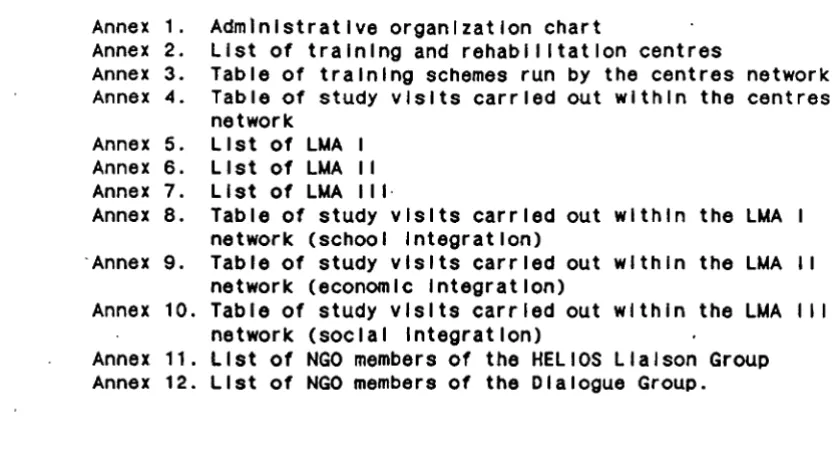
Annex 1. Annex 2. Annex 3.
Administrative organization chart
List of training and rehabilitation centres
Table of training schemes run by the centres network Annex 4. Table of study visits carried out within the centres Annex 5.
Annex Annex Annex
6.
7.
8.
network
List of LMA I List of LMA II LIst of LMA I I I·
Table of study visits carried out within theLMA network (school Integration)
·Annex 9. Table of study visits carried out within theLMA 11 network (economic Integration)
Annex 10. Table of study visits carried out within theLMA I II network (social Integration)
[image:25.564.60.479.81.311.2]I
N
...
I
Ree llil...,.taaiaa: l!mploi (l)
Oraupe de TriYIIil:
Emploi
La.caa Stichting '¥001' Revllidilllie HOENSBROEK ·Pays B•
Bqaipo d'capena HEl.JOS (EEH)
DIRECTION OFJIIERALB: Emploi. Relalianl incblriellca t1t Affaba IOCialea -00 V
J
DIVISION : Action~ aa
raw:ur
des penonnca handieapoei • DO V • C • 4Prop.nmo HEUOS (1) Propmune lntclfldon Scollire (3)
Groupo de Lilbcn Groupo de diaJope ONO
Oroupc de 'l'ravll1: Groupe de Tnvlil: Groupe de 'Travlil:
Mobilitc et TI'IIIWpOrt HANDYNRT lntcJfllioa Scollirc
,
" Panctionl: Oeation aencnJo de Aaaocialion Europoame pour Ia Crealivile
L•Adm.inislrllian et du Budget . . pcnonnc:a ~{EUCRE.\~
Fonctions: Mile en oeuvre de CCI'I.IinCI activita
Equipe d'expena tecJocniquea du JIIOii WMIO HEllOS IClon lea
Crcaaviao et 11port (ECS)
cliftc:tiva de 11 DG V • C • 4
(1) JA L104 cb& 23.04.88. p. 38: Decilioa 8812311CEB dla Ca.c:iJ cb& 11 .,.u 1981poftlllt «UbbiaaDaal d"aal dcuaiano JII'OinllUftO d'8Ciian oammU118111.1i18 •
raveur
des pc:I'IOII1IC:a lulndicapoea (Hcliot) (2) JA L 225 dla 12.08.86. p. 43(3)J.O.C211 daOI.OS.I7.p.1
jp-vl-hl
....
>
:I :I
.,
) (
LIST OF THE NETWORK OF CENTRES AND EXPERIMENTS IN REHABILITATION AND VOCATIONAL TRAINING
8 E L G I U M
Dienst voor Begeleiding en opleiding van Minder-Validen Pasteurlaan 2
9000 GENT
Centre de Readaptation au travail
Route de Dinant 119 4557 ABEE-SCRY (TINLOT)
Experiences de formation professionnelle
F.N.R.S.H.
rue du Meiboom 14 1000 BRUXELLES
Brailleliga - Ligue Braille Beroepsopleidingscentrum Engelandstraat 57
1060 BRUSSEL .
D E N M A R K
SAHVA Handvaerkskolen Borgervaenget 7
2100 COPENHAGEN
Revacentrett Tagensvej 22 2200 COPENHAGEN•
Skive Handelskole Arvikavej 2
7800 SKIVE
G E R M A N Y
Berufsforderungswerk Frankfurt/Main
Huizenerstrasse 60 6368 BAD VILBEL
-24-Neurologisches Rehabilitationszentrum
Godeshohe
Waldstrasse
2-10 5300BONN 2
Hamburger Werkstatt fur Behinderte Gmbh
Meiendorfer Muhlenweg
1192000
HAMBURG
72Niedersachsisches Landeskrankenhaus
Osnabruck
Knollstrasse 31
4500OSNABRUCK
Berufsbildingswerk Worms
Eckenbertstrasse
60Postfach
1326 6520WORMS
15Kinderzentrum Munchen
Heiglhofstrasse
63 8000MuNCHEN
70S P A I N
Centro de Reabilitacion de
Minusvalidos Fisicos
11SAN FERNAND0
11Camino de Gallineras s/no
SAN FERNANDO
(CADIZ)
Centro de PROMI
(Asociacion para la promocion del
minus-valido)
Apartado de Correos, 9
CABRA (CORDOBA)
Centro Ocupacional "JUAN DE AUSTRIA
11c/Arturo Soria,
12 28027MADRID
Centro de Recursos Educativos
para deficientes visuales
IIJOAN AMADES
IICarretera d'Esplugues,
102-106 08034BARCELONA
-25-Institute Valenciano de Audio Fonologia
c/ Juan de Garay 25
.46017 VALENCIA
G R E E C E
National Institution for the
rehabilitation of disabled persons E.I.A.A.
Rue Hassias Agi 9st 131 22 NEA LIOSIA ATHENES
Fondation "THEOTOKOS" Nea Liossia
Attikis
131 22 ATHENS
Psychiatric Hospital of Thessaloniki Konstantinoupoleos 36
564 29 THESSALONIKI
F R A N C E
Centre de la TOUR DE GASSIES
Services de reeducation professionnelle et de readaptation psycho-sociale
Tour de Gassies
33520 BRUGES
Centre de reeducation professionnelle rue des Mouliniers 28
42100 ST. ETIENNE
Centre de reeducation pour aveugles recents
Domaine des Ombrages 78160 MARLY LE ROI
PROMOFAF
Rue Carrier-Belleuse 11
75015 PARIS
-26-Association Nationale pour la formation
professionnelle des adultes (AFPA)
Place de Villiers
1393108
MONTREUIL CEDEX
Centre de reinsertion de Celleneuve
Avenue de Lodeve
139B.P.
302334034
MONTPELLIER CEDEX
I R E L A N D
Rehabilitation In'sti tute
Roslyn Park
Sandymount
DUBLIN 4
FAS
P.O. box
456, 27/33Upper Baggot Street
Dublin
4COPE Foundation
Bonington
Montenotte
CORK
I T A L Y
Centro Formazione Professionale
"DON CALABRIA"
Via Roveggia
41VERONA
ENAIP
Via Marcora
18-20 00153ROMA
Unione rtaliana Ciechi
"CENTRO STUD!
TIR~ENIA"Via Borgognona
3800187
ROMA
.;.27-Centro Comunitario "GESU' RISORTO"
Comunita di Capodarco
Via Lungro 3
00178 ROMA
Fondazione pro Juventute
Don Carlo Gnocchi
Via Capecelatro 66
MILANO
Associazione "NOSTRA FAMIGLIA"
Via Don Luigi Monza
22037 PONTE LAMBRO (COMO)
L U X E M B U R G
Ligue HMC
centre de Readaptation
82 Route d'Arlon B.P.
49GDL-8301
CAPELLEN
N E T H E R L A N 0 S
Revalidatiecentrum "HET ROESSINGH"
Postbus 310
7500
BA ENSCHEDE
Stichting BerC?epsopleiding "WERKENRODE"
Nijmeegsebaan 9
6561
KE
GROESBEEK
PAMEYER Stichting
Baan
so
3011 CC ROTTERDAM
Stichting Nieuwe Werkvormen
Alexander Battalaan 53B
6221 CB MAASTRICHT
PORTUGAL
Centro de Educa9ao e Forma9ao
Profissional Integrada
Rua de Vila Nova 1323
4100 PORTO
Centro de Reabilita9ao
Profissional de Alcoitao
Quinta da Bela Vista-Ranholas
.2710 SINTRA
Centro de Paralisia Cerebral
"CALOUSTE GULBENKIAN"
Av. Rainha D. Amelia
1600
LISBOA
U N I T E D - K I N G 0
0M
Billingham ERC
Leeholme Road
Billingham
IS 23 3TE CLEVELAND
Enham Industries
Enham Alamein
Andover
SP11
6~SHAMPSHIRE
Pengwern Hall
Rhuddlan Nr Rhyl
Clwyd LL18 SUH
NORTH WALES
Queen Alexandra College
Court Oak Road
Harborne
Bl7 9TG
BIRMINGHAM
Court Grange
Abbotskerswell
Nr Newton Abbot
TQ12 SNH DEVON
Scottish Association for
Mental Health (Day Services)
Atlantic House
38 Gardners Crescent
EH3 8DQ EDINBURGH
-29-NE1WORK OF CENTRES AND EXPERIMENTS IN RFRABIUTA TION AND VOCATIONAL TRAINING (RCE) TRAINING SESSIONS 1989
@ = Participation of the outer network
=more than one centre visited in the same study visit
• = more than one centre completed the same study visit togetha
. NmwORK OF CENTRES AND EXPERIMENTs IN REHABIUTA TION
AND
VOCATIONAL '~'RAINING (RCE) TRAINING SESSIONS (111- 30/6/1990)@
=
Participation of the outer network. =
more than one centre visited in the same study visit• =
more than one centre completed the same study visit togethcz-31-NETWORK OF CENTRES AND EXPERIMENTS IN REHABIUTATION AND VOCATIONAL TRAINING (RCE)
STUDY VISITS 1989
@
=
Participation of the outer network=more than one centre visited in the same study visit
• = more than one centre completed the same study visit together
NE1WORK OF CENTRES AND EXPERIMENTS IN REHABIUT A TION AND VOCATIONAL TRAINING (RCE) STUDY VISITS (111- 30/6/1990)
@ = Participation of the outer network
=
more than one centre visited in the same study visit• = more than one centre completed the same study visit together
-33-NETWORK OF INTEGRATION IN SCHOOLS LOCAL MODEL ACTIVITIES (LMA)
RESEAU INTEGRATION SCOLAIRE ACTIVITES MODELES LOCALES (AML)
BELGIUM - BELGIQUE
Mr. R. QUESTIER PMS
Constantin Meunierstraat, 49 B- 3000 LEUVEN
Mr. J.J.DETRAUX CEFES
141, Av. A. Buy! B- 1050 BRUXELLES adresse courrier : CEFES
Avenue F.D. Roosevelt, 50 1050 BRUXELLES
DENMARK - DANEMARK
Mr. Ole HANSEN
Chief school psychologist Skolepsykologisk Radgivning Svinget, 2
DK- 8382 HINNERUP
Tel. Bur: 32/16/23.98.00
Tel. Bur. 32/2/642.32.81
Tel. Bur: 45/86/98.77.55. Tel. pv 45/86/98.79.59 Fax. 45/86/98.57.05
BUNDESREPUBLIC OF GERMANY - REPUBLIQUE FEDERALE D'ALLEMAGNE
Mr. W. KOCH-GOMBERT Schulamt der Stadt Bonn Bottlesplatz,1
D- 5300 BONN Frau POLSTER
Staatliches Schulamt Dezernat Sander Padagogik Herderstrasse 2
D- 7410 REUTLINGEN
-34-Tel. Bur: 49/228/77.42.23 Tel. Pv 49/228/63.46.08 Fax 49/228/77.42.16
SPAIN - ESPAGNE
---Mr. I. GARCIA GETINO
C/ Calvo Sotelo 21 Entresuelo E- 33005 OVIEDO
Mr. A. LOPEZ SACRISTAN Direccion Provincial del MEC Jesus Rivero Meneses, 2 E- 47014 VALLADOLID
GREECE - GRECE
---Mr. Ch. BIRTSAS Dimitriou Rali 46
GR- 15.124 MAROUSI-ATTIKIS Mr. Th. KARYDIAS
Ermou 18
GR- 54.624 THESSALONIKI
FRANCE - FRANCE
---Mr M. DUBERN Centre National
Formation et Recherche de Suresnes - Beaumont
Rue des Landes, 58 F- 92150 SURESNES Mme. M. PALAUQUI Ecole Jules Verne Rue J. Verne, 19
F - 92290 CHATENAY-MALABRY
IRELAND - IRLANDE
Mr. HEGARTY
Irish Life Building Floor 2
18 South Mall· IRL - Cork
c
-35-Tel. Bur: 34/85/25.69.40 Fax 34/85/27.00.32
Tel. Bur: 34/83/34.38.00 Tel. Pv 34/83/47.20.86 Fax. 34/83/35.31.15
Tel. Bur: 30/1/806.85.33. Tel. Pv : 30/1/806.92.45
Tel. Bur: 30/31/27.75.19 30/31/22.51.24 Tel. Pv 30i41/22.44.50 Fax 30/31/93.96.09
Tel. Bur: 33/1/47.72.70.53 Fax 33/1/45.06.39.93
Tel: 33/1/40.91.03.47
Tel: 353/21/27.59.12.
ITALY - ITALIE
Mr G.L. NONNIS
Circolo Borgo Sant'Elia Via del Sole
I- 09126 CAGLIARI SARDAIGNA
Mr G. REST! Administrazione Provinciale di SIENA Assessorato Alla Cultura Piazza Duomo, 9
I- SIENA
LUXEMBURG - LUXEMBOURG
Mr. BLEY Institut pour deficients visuels
9, Rue Pierre Federspiel L- 1512 LUXEMBOURG
THE NETHERLANDS - PAYS-BAS
Mr. Robert F.DEKKER Rode Zand, 18
NL- 3011 AN ROTTERDAM
Mr. Bob LATUHERU
Regionaal Pedagogisch Centrum Noordweg, 495
NL- 4333 KE MIDDELBURG
PORTUGAL - PORTUGAL
Dr. Jorge BARBOSA Rua Gil Vicente, 35 P - 4000 PORTO
Mr. Norberta SANCHES Rua da Junqueira, 307 P - 1300 LISBOA
-36-Tel. Bur: 39/70/49.06.61
Tel. Pv : 39/70/28.78.05
Tel. Bur: 39/577/29.19.12
Fax. 39/577/29.18.93
Tel. Bur: 352/44.54.55 ou 56 Tel. Pv 352/43.23.64
Fax 352/45.74.88
Tel. Bur: 31/10/417.25.81 Tel. Pv 31/1717/19.00
Fax. 31/10/417.21.54.
Tel. Bur: 31/1180/28.851
Fax 31/i180/24.866
Tel: 351/2/48.33.85 49.21.29 Fax: 351/2/32.45.77
(Direccao Regional de Educacao do Norte/Ensino Especial Ao cuidado do Dr. BARBOSA)
GREAT BRITAIN - GRANDE BRETAGNE
Mr D.M. JENKINS
Northumberland County Council Education Department
County Hall
GB- MORPETH - NORTHUMBERLAND NE 61 2EF
Mr. C. WARWICK West Glamorgan Lea County Hall
Oystermouth Road
GB- SWANSEA SAl 3SN WALES
-37-Tel. Bur: 44/670/51.43.43 Fax. 44/670/51.17.07
BELGIUM - BELGIQUE
Mr. J. VOLS
VOCATIONAL TRAINING- EMPLOYMENT LOCAL MODEL ACTIVITIES {LMA)
RESEAU INTEGRATION ECONOMIQUE FORMATION PROFESSIONNELLE - EMPLOI
ACTIVITES MODELES LOCALES (AML)
Intercommunale Maatschappij voor Hulp aan gehandicapten en voor Jeugdbescherming in Limburg Cooperative Vennootschap Stadsomvaart, 9
Tel. Bur: 32/11/22.88.85
Fax. 32/11/22.28.20
B- 3500 HASSELT
Liege 93 District europeen Monsieur CONRADT
Tel: 32/41/41.40.14- ext 223 Fax: 32/41/56.29.49
Rue Simenon, 13 B- 4020 LIEGE
DENMARK - DANEMARK
Ms. L. MIKKELSEN Lysengalle, 1 DK- 8270 HOJBJERG
Mr. B. H0RNING
Silkeborg Tekniske Skole Kejlstrupvej, 87
DK- 8600 SILKEBORG
a
!'attention de Mr. CONRADTTel. Bur: 45/86/27.30.44 Tel. Pv 45/86/21.33.66
Fax. 45/86/27.55.26
Tel. Bur: 45/86/82.47.77 Tel. Pv 45/86/81.31.32
Fax. 45/86/80.34.06
BUNDESREPUBLIK DEUTSCHLAND - REPUBLIQUE FEDERALE D'ALLEMAGNE
Mr. SCHROEDER
Gemeinnutzige Gesellschaft Tel. Bur: 49/511/708.38.36
zur Forderung Korperbehinderter Tel. Pv 49/511/348.07.23
Herrenhauser Kirchweg, 14 Fax 49/511/708.38.12
D - 3000 HANNOVER 1
Mr. E. FISCHER
Berufsbildungswerk St Franziskus Tel. Bur: 49/9443/70.91. 13
Regensburger Strasse 60 Fax 49/9443/70.92.22
D - 8423 ABENSBERG
Dr. FLIEDNER
Projekt Berufliche Ausbildung fur
Lernbehinderte der Volkshochschule Tel. Bur: 49/UH/82. 297
der Stadt Offenburg Tel. Pv 49/781/76.916
Wilhelm-Bauer-Strasse 12 Fax. 49/781/82.515
D - 7600 OFFENBURG
-38-SPAIN - ESPAGNE
Mr. V. MARTINEZ
Actividad Local Modelo de Murcia · C/Greco, 4 Bajo
E- 30071. MURCIA
Mr. A. MORATA
Actividad Local Modelo de Badajoz Ronda del Pilar, 8, 1°
E- 06002 BADAJOZ
GREECE - GRECE
· Mme N. KATSANOU
Hopital Psychiatrique d'ATTIKA Avenue d'Athenes
GR- T.K.12.462 HAIDARI
Mme G. MOLVAER
Centre for Mental Health Ath. Diakov, 35
GR- 26224 PATRAS
FRANCE - FRANCE
Mr. J. LASBLEIS "HANDIPRISE"
Zone Artisanale de Kergoussel F- 56 850 CAUDAN
Melle T. LECOMTE Rue D'Isly, 147 F - 59 100 ROUBAIX
Mr. J.P. COQUARD
Agence Regionale de l'AFPA Place Bossuet, 25
FR- 21 000 DIJON
IRELAND - IRLANDE
Mr. P. LYNCH
APT Tel. Bur: 353/506/412.04 Kilcruttin· Centre
IRL- TULLAMORE, Co. OFFALY
Mr. M. GALLAGHER Eastern Health Board ·James' 8 Street.. ,
IRL- DUBLIN 8
-39-Tel~ Bur:· 34/68/23.27.12 Tel. Pv ·: 34/68/26.42.37
Fax. 34/68/24.36.21
Tel. Bur: 34/24/25.50.12 23.58.96 Tel. Pv 34/24/25.48.02
Fax. 34/24/24.36.77
Tel: Bur: 30/1/581.91.00 Tel: Pv 30/1/771.14.70
Fax. 30/1/724.93.70
Tel: Bur: 30/61/33.66 .•
66
Tel: ·Pv : 30/61/34.09.91Fax: 30/61/32.97.64
(to attention: Mrs.cLAMBROPOULOU and Mrs. MOLVAER)
Tel. Bur: 33/97/76.78.28
Fax 33/97/64.44.64
Tel. Bur: 33/80/30.88.24 Tel. Pv 33/80/30.63.36
Fax. 33/80/30.27.89
Tel. Pv 353/44/4'33 .. 49,
Fax. 353/506/517.60
..
Te1. Bur: 353/1/53.i4.9,4
ITALY - ITALIE
Mme. V, CECCHETTI
Progetto Psichiatrico ENAIP-FSE v'ia Casetta di Campoloniano 22 C I- RIETI
Mme M. NICOLINI
Consorzio Cooperative Integrate Via Lungro
3-I- 00178 ROMA
Mr. 0. DENOTARIIS
Institute dei Ciechi "CAVAZZA" Via Castiglione 72
I- 40124 BOLOGNA
LUXEMBURG - LUXEMBOURG
Mr. J. BERG
Fondation IMC Kraizberg Route de Zoufftgen L- 3598 DUDELANGE
THE NETHERLANDS - PAYS-BAS
Mr. M. KAMP
Spuiboulevard 300
NL- 3311 GR DORDRECHT
Mr. A. Van DIJK
Tel. Bur: 39/6/584.05.03 Tel. Bur: 39/746/22.06.98
39/746/22.06.93
Fax: 39/746/22.06.93
Tel. Bur: 39/6/84.43.91
Fax: 39/6/84.43.92.16
Tel. Bur: 39/51/33.27.64
Fax. 39/51/33.26.09
Tel. Pv 352/51.79.21
Fax: 352/51.77.21
Tel. Bur: 31/78/11.63.95 Tel. Pv 31/1687/27.11
Fax 31/78/11.67.43
Revalidatie Centrum Amsterdam (contact Mr. Smits) Overtoom, 283
NL- 1054 HW AMSTERDAM Tel: 31/20/18.02.02
Fax: 31/20/18.62.28
PORTUGAL - PORTUGAL
Mme A. FARINHA
I.E.F.P, Tel. Bur: 351/1/726.25.36
Av.
Jose Malhoa, 11-7° P- 1000 LISBOAMr. L. PEREIRA PIRES da CONCEICAO I.E.F.P. Tel. Bur: 351/1/726.25.36 Av. Jose Malhoa, 11-7°
P- 1000 LISBOA
-40-Tel. Pv 351/1/218.69.83
Fax 351/1/726.57.82
351/1/726.57.55
Tel. Pv 351/1/988. 11. 90
Fax 351/1/726.57.82
GREAT BRITAIN - GRANDE BRETAGNE
Mr. J. CARLTON
MOBILE ASSESSMENT PROJECT Employment Rehabilitation Unit Felden House
Mill Road NEWTON ABBEY
GB - BT36 7BJ Co. Antrim Ms R. REDFERN
Vocational Rehabilitation and Economic Integration
DATA
Broomfield House Bolling Road
GB - BD4 7BA BRADFORD Mr P. BREEN
OUTSET Units Wandsworth and Hammersmith
1B, Yukon Road BALHAM
GB - SW 12 9PZ LONDON
-41-Tel: 44/232/86.88.28 Fax: 44/232/76.14.35
Tel: 44/274/37.00.19 Fax: 44/274/30.54.45
Tel: 44/1/924.12.60 44/1/673.72.35