Faculty of Health, Engineering and Sciences
ERROR-RESILIENT MULTI-VIEW VIDEO
PLUS DEPTH BASED 3-D VIDEO CODING
A thesis submitted by
Pan Gao, B Eng
for the award of
Doctor of Philosophy
Three Dimensional (3-D) video, by definition, is a collection of signals that can provide depth perception of a 3-D scene. With the development of 3-D display technologies and interactive multimedia systems, 3-D video has attracted signif-icant interest from both industries and academia with a variety of applications. In order to provide desired services in various 3-D video applications, the multi-view video plus depth (MVD) representation, which can facilitate the generation of virtual views, has been determined to be the best format for 3-D video data.
Similar to 2-D video, compressed 3-D video is highly sensitive to transmission errors due to errors propagated from the current frame to the future predicted frames. Moreover, since the virtual views required for auto-stereoscopic displays are rendered from the compressed texture videos and depth maps, transmission errors of the distorted texture videos and depth maps can be further propagated to the virtual views. Besides, the distortions in texture and depth show different effects on the rendering views. Therefore, compared to the reliability of the transmission of the 2-D video, error-resilient texture video and depth map coding are facing major new challenges.
ii
the optimal trade-off between robustness and compression efficiency. In this ap-proach, the texture and depth modes are jointly optimized by minimizing the overall distortion of both the coded and synthesized views subject to a given bit rate. Finally, this study extends the research on the reliable transmission of view synthesis prediction (VSP)-based 3-D video. In order to mitigate the prediction position error caused by packet losses in the depth map, a novel disparity vector correction algorithm is developed, where the corrected disparity vector is calcu-lated from the depth error. To facilitate decoder error concealment, the depth error is recursively estimated at the decoder.
Acknowledgments
First, I would like to express my heartfelt gratitude to Prof. Wei Xiang, my principal supervisor for his endless commitment to directing the research and invaluable guidance. Without his continuous support and encouragement, this thesis would not have been completed.
I am also thankful to Prof. John Billingsley, my associate supervisor, for his instructive discussions and constructive suggestions to my thesis. My sincere thanks also go to Prof. Qiang Peng from Southwest Jiaotong University in China, my first supervisor, for introducing me to the challenging research area of video coding and transmission, and offering me the great opportunity to study abroad. I would like to thank the Chinese Scholarship Council for providing financial support of my study at USQ during these three years. In addition, a special thanks goes to all my friends and research colleagues at USQ, for the stimulating discussions and the countless get-togethers throughout the years. I also thank all the administration staff at the School of Mechanical and Electrical Engineering. Their help made my life in Australia much easier. My thanks also go to Mark Butlin, who helped me to proofread the thesis.
Last, but not least, I would like to convey special thanks to my parents, without their support I would not have been able to reach this far in my studies. I am further greatly indebted to my wife Lijuan Zhang and my little precious son Yihan (George) Gao, who had to bear with me for the many times I had to work late into the night. Thanks for your patience and for your infinite love.
Pan Gao
University of Southern Queensland, Australia
The following publications were produced during the period of candidature:
Journal Papers
[1] P. Gao and W. Xiang, “Disparity vector correction for view synthesis prediction-based 3-D video transmission,” IEEE Trans. Multimedia, vol. 17, no. 8, pp. 1153–1165, Aug. 2015. (USQ Publication Excellence Award 2015)
The work in the paper is presented in Chapter 5.
[2] P. Gao and W. Xiang, “Rate-distortion optimized mode switching for error-resilient multi-view video plus depth based 3-D video coding,”IEEE Trans. Multimedia, vol. 16, no. 7, pp. 1797–1808, Jun. 2014.
The work in the paper is presented in Chapter 4.
[3] P. Gao, Q. Peng, and W. Xiang, “Error-resilient multi-view video coding using Wyner-Ziv techniques,” Multimedia Tools and Applications, vol. 74, no. 17, pp. 7957–7982, Sept. 2015.
The work in the paper is presented in Chapter 3.
[4] W. Xiang, P. Gao, and Q. Peng, “Robust multiview three-dimensional video communications based on distributed video coding,” IEEE Systems Jour-nal, Apr. 2015. (to appear, DOI:10.1109/JSYST.2015.2414662)
vi List of publications
Conference Papers
[1]P. Gaoand W. Xiang “Modeling of packet-loss-induced distortion in 3-D synthesized views,” inProc. IEEE Int. Conf. Visual Communications and Image Processing (VCIP 2015), Dec. 2015, pp. 1–4.
The work in the paper is presented in Chapter 4.
[2]P. Gao, W. Xiang, and L. Zhang, “Transmission distortion modeling for view synthesis prediction based 3-D video streaming,” in Proc. IEEE Int. Conf. Acoustics, Speech, and Signal Processing (ICASSP 2015), Apr. 2015, pp. 1448–
1452.
The work in the paper is presented in Chapter 5.
[3] P. Gao, W. Xiang, J. Billingsley, and Y. Zhang, “Error-resilient multi-view video coding for next generation 3-D video broadcasting,” in Proc. IEEE Int. Conf. Information and Communication Technology Convergence (ICTC),
Jeju Island, South Korea, Oct. 2013, pp. 1022-1026. The work in the paper is presented in Chapter 3.
Other publication
[1] W. Xiang andP. Gao, “Distributed video coding-based robust mobile multi-view 3-D video communications,”IEEE Communications Society (ComSoc) Mul-timedia Communications Technical Committee (MMTC) E-Letter, vol. 9, no. 1,
Abstract i
Acknowledgments iv
List of Publications v
List of Figures x
List of Tables xiii
Acronyms & Abbreviations xv
Chapter 1 Introduction 1
1.1 Motivations . . . 2
1.2 Research Problems . . . 4
1.2.1 Forward Error Correction of Compressed Multi-View Video Signal . . . 5
1.2.2 Prevention of Error Propagation in Multi-View Video Plus Depth Map Coding . . . 6
1.2.3 Elimination of Prediction Position Errors in View Synthesis Prediction . . . 7
1.3 Contributions . . . 9
1.4 Research Methodology . . . 12
1.5 Organization . . . 13
Chapter 2 Background 15 2.1 2-D Video Coding Standards and Techniques . . . 15
2.2 Distributed Video Coding . . . 17
2.3 Multi-view Video Coding . . . 19
2.4 3-D Video Coding . . . 20
2.4.1 Overview of 3D-AVC . . . 21
2.4.2 Overview of 3D-HEVC . . . 23
2.5 Error-Resilient Coding Techniques . . . 27
viii CONTENTS
2.5.2 Error Concealment by Post-Processing . . . 30
2.5.3 Interactive Error Control . . . 32
Chapter 3 Error-Resilient Multi-view Video Coding Using Wyner-Ziv Techniques 35 3.1 Introduction . . . 35
3.2 Related Work . . . 37
3.3 Contributions of This Chapter . . . 39
3.4 Proposed Error-Resilient Scheme Using Embedded WZ Description 40 3.5 Transmission Distortion Model . . . 44
3.5.1 Transmission Distortion of DCT Coefficients in the Key Frames of the Odd Views . . . 46
3.5.2 Transmission Distortion of DCT Coefficients in the Key Frames of the Even Views . . . 47
3.6 Bit Rate Estimation for WZ Coding . . . 48
3.7 Complexity Analysis . . . 52
3.8 Simulation Results and Discussion . . . 54
3.9 Summary . . . 68
Chapter 4 Rate-Distortion Optimized Mode Switching for Error-Resilient Multi-view Video Plus Depth Based 3-D Video Coding 71 4.1 Introduction . . . 71
4.2 Related Work . . . 72
4.3 Contribution of this Chapter . . . 74
4.4 MVD-based 3-D Video Coding Framework and Error Propagation 75 4.5 End-to-End Distortion Estimation for MVD-based 3-D Video Trans-mission . . . 76
4.5.1 Frequency Domain Analysis of the View Synthesis Distor-tion Caused by Depth Error . . . 79
4.5.2 Expected Texture and Depth Distortion Model . . . 81
4.6 Mode Switching Within a Rate-Distortion Framework . . . 85
4.6.1 Lagrange Multiplier Determination for Rate-Constrained Coder . . . 87
4.7 Experimental Results and Discussions . . . 88
4.7.1 Estimation Accuracy of the End-to-End Distortion Model 89 4.7.2 Error-Resilient MVD-based 3-D Video Coding . . . 90
4.7.3 Comparison with the Rate-distortion Optimization Model in 3D-ATM . . . 97
4.7.4 Statistical Results of MB Coding Mode Distribution . . . . 99
4.7.5 Computational Complexity Analysis . . . 101
Chapter 5 Disparity Vector Correction for View Synthesis
Predic-tion Based 3-D Video Transmission 105
5.1 Introduction . . . 105
5.2 Related Work . . . 106
5.3 Contribution of This Chapter . . . 107
5.4 View Synthesis Prediction and Error Propagation . . . 108
5.5 Problem Formulation . . . 111
5.6 Proposed Disparity Vector Correction Algorithm . . . 113
5.6.1 Additional Remarks of the Proposed Scheme . . . 122
5.7 Experimental Results and Discussion . . . 123
5.7.1 Evaluation of the Effects of Slice Partitioning on Coding Efficiency and Error Resilience . . . 124
5.7.2 Verification of Depth Error Estimation . . . 127
5.7.3 Performance Comparison of the Right View . . . 127
5.7.4 Performance Comparison of the Decoder-Side Synthesized View . . . 133
5.7.5 Computational Complexity Analysis . . . 140
5.8 Summary . . . 141
Chapter 6 Conclusion and Future Work 143 6.1 Future Work . . . 145
List of Figures
1.1 Illustration of the effect of error propagation during texture trans-mission. . . 7
1.2 The impact of the depth reconstruction error on the quality of the synthesized view. . . 8
2.1 Typical HEVC video encoder. . . 16
2.2 Conventional pixel-domain and transform-domain DVC architecture. 18
2.3 Sample multi-view video compression structure for GOP length of eight in three view setup. . . 20
2.4 High-level flowchart of the texture encoder in 3D-AVC. . . 22
2.5 Basic encoder structure of 3D-HEVC with view and inter-component prediction. . . 24
2.6 Synthesized view distortion change calculation with respect to a currently tested depth coding mode. . . 26
3.1 Encoding structure for WZ coding embedded multi-view video with the key frames of the odd views protected. . . 41
3.2 WZ-based error resilience multi-view video coding scheme against random packet losses. . . 43
3.3 Block diagram of the WZ encoder. . . 48
3.4 Estimation precision of conditional entropy. . . 50
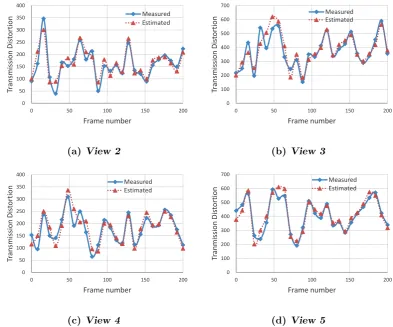
3.5 Comparison between the measured and estimated transmission dis-tortion for the key frames of “Ballroom” with a packet loss rate of 10%. . . 56
3.7 R-D performance of the odd views with a packet loss rate of 10%. Compared to the even views, the odd views directly benefits from various error protection algorithms. . . 62
3.8 Subjective image quality for the 37th frame of view 3 with 10% packet loss. . . 64
3.8 Subjective image quality for the 37th frame of view 3 with 10% packet loss. (con’t) . . . 65
3.9 Distortion estimation performance with packet loss rate mismatch. 66
3.10 Performance for mismatch with an assumed packet loss rate of 10%. 67
3.11 Plots of PSNR versus bit error rate for the bursty errors. . . 68
4.1 A prediction structure for two-view based 3-D video coding. . . . 75
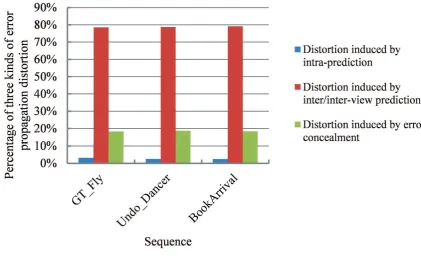
4.2 Comparison of percentage of three kinds of distortion in the chan-nel distortion with 10% packet loss rate. . . 84
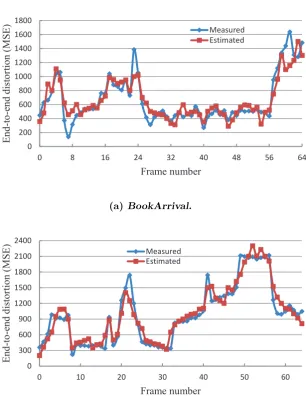
4.3 Frame-by-frame comparison between the measured and estimated end-to-end distortions. . . 91
4.4 Comparison of the rate-distortion curves between the proposed method and the Bruno algorithm with 10% packet loss. . . 94
4.5 Subjective quality comparison for frame 39 of the BookArrival se-quence with 10% packet loss rate. . . 95
4.5 Subjective quality comparison for frame 39 of the BookArrival se-quence with 10% packet loss rate.(con’t) . . . 96
4.6 PSNR comparison of each frame with a packet loss rate of 10%. . 98
4.7 PSNR versus the packet loss rate for the proposed scheme and the VSRDO model in 3D-ATM. . . 100
4.8 Comparison of the distribution of coding modes in the proposed mode switching approach under various packet loss rates. . . 102
5.1 A typical prediction structure for VSP based 3-D video coding (parallel camera setup). . . 110
xii LIST OF FIGURES
5.3 Illustration of the proposed disparity vector correction scheme when decoding the right view. . . 115 5.4 Impacts of slice number on the efficiency of the coding performance
and error resilience. . . 125 5.5 Comparison between the measured and estimated depth map
er-rors at the frame level. . . 128 5.6 PSNR comparison of each frame with a packet loss rate of 10%. . 132 5.7 Subjective quality comparison for frame 45 of the BookArrival
se-quence with the packet loss rate 10%. . . 134 5.7 Subjective quality comparison for frame 45 of the BookArrival
se-quence with the packet loss rate 10% (con’t). . . 135 5.7 Subjective quality comparison for frame 45 of the BookArrival
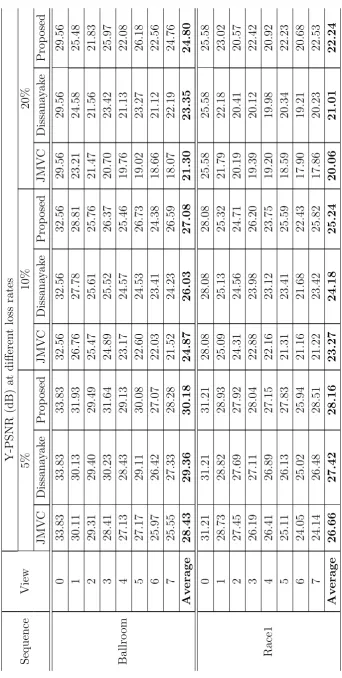
3.1 Average PSNR comparison with a variety of packet loss rates. . . 58
3.2 Bit rate (kbps@30Hz) comparison for WZ encoding with various packet loss rates. . . 61
4.1
Average PSNR comparison between the Bruno algorithm and the proposed method with a variety of packet loss rates. . . 92
4.2
Computational complexity comparison between the proposed method and the original JMVC 8.0. . . 103
5.1
Relative difference eµ (eσ) between the ˆµt (ˆσt2) and ˜µt (˜σt2). . . 119
5.2
Description of MVD test sequences and simulation conditions. . . 123
5.3
PSNR comparison of the proposed algorithm with two different slice size settings (GOP = 30). . . 126
5.4
Correlation coefficient between the estimated and measured depth map errors at the MB level for each video sequence. . . 127
5.5
xiv LIST OF TABLES
5.6
Performance comparison for the texture at the packet loss rate of 10% when both VSP and TDCP are enabled. . . 131 5.7
Average PSNR comparison for the synthesized view video with a variety of packet loss rates. . . 137 5.8
Total bit rate comparison. . . 140 5.9
ADE Actual depth error
ARQ Automatic repeat request AVC Advanced Video Coding
BDPSNR Bjontegaard Delta peak signal-to-noise ratio B-VSP Backward view synthesis prediction
CABAC Context-adaptive binary arithmetic coding CIVEP Consideration of inter-view error propagation DCT Discrete cosine transform
DIBR Depth image-based rendering
D-MVP Depth-based motion vector prediciton DFT Discrete Fourier Transform
DVC Distributed video coding EC Error concealment EDE Estimated depth error FEC Forward error correction FMO Flexible macroblock ordering FVV Free Viewpoint Video
GOP Group of Pictures
HEVC High Efficiency Video Coding
JCT-3V Joint Collaborative Team on 3D Video Coding Extension Development JMVC Joint multi-view video coding
JVDF Joint view depth filtering
LDPCA Low-density parity-check accumulated MAD Mean absolute difference
MPEG Moving Picture Experts Group MSE Mean square error
MTU Maximum transmission unit MVC Multi-view video coding MVD Multi-view video plus depth MVE Motion vector extrapolation MVP Motion vector prediction
PRISM Power-efficient, Robust, hIgh compression Syndrome-based Multimedia coding
PSNR Peak Signal-to-Noise Ratio QP Quantization parameter
ROPE Recursive optimal per-pixel estimate R-D Rate distortion
RPS Reference picture selection SI Side information
SSD Sum of squared difference
SVDC Synthesized view distortion change 3-D Three dimensional
3D-AVC AVC-compatible 3-D video coding 3D-ATM 3D-AVC test model
3D-HEVC HEVC-compatible 3-D video coding 3D-HTM 3D-HEVC test model
3DTV 3-D Television
TDCP Translational disparity compensation prediction VCEG Video Coding Experts Group
VSP View synthesis prediction
VSRDO View synthesis-based rate-distortion optimization VSRS View synthesis reference software
Introduction
With the success of three dimensional (3-D) blockbusters and the advance-ments in stereoscopic display and transmission technologies, 3-D video applica-tions have been gathering momentum in recent years. Current 3-D video tech-nology being introduced to homes is mostly based on stereo systems [1]. These systems use stereo video coding for pictures delivered by two input cameras. Typically, such stereoscopic systems only reproduce these two camera views and require wearing special 3-D glasses, such as anaglyph, polarized, and shutter glasses. In addition, stereoscopic 3-D video systems evoke 3-D perception by binocular parallax [2], in which scene is presented in a fixed perspective defined by two transmitted views, while further manipulations on depth perception re-quire expensive computation with current technologies.
2 Introduction
transmitted [4]. To overcome this disadvantage, the number of viewpoints cap-tured should be limited, bringing a data decrease, but also a worsening of the 3-D effect. Consequently, a strong need to render additional virtual views from the transmitted views arises, in order to support auto-stereoscopic displays, which emit different pictures depending on the position of the observer’s eyes and do not require glasses for viewing.
Generally speaking, the virtual view generation needs to be set in a well-defined environment composed of one or more texture sequences and their cor-responding depth sequences. This setting is usually called multi-view video plus depth (MVD) environment. In a common virtual view rendering setup, by know-ing the camera parameters (extrinsic and intrinsic) and the captured view posi-tions, a virtual intermediate view can be efficiently synthesized by a back projec-tion of the nearest captured reference views to the 3-D scene coordinate, followed by a projection to the virtual view camera location. Since the MVD format enables the 3-D display to generate virtual images for arbitrary views by using the depth information, only a small number of the views needs to be encod-ed and transmittencod-ed [5]. With respect to the stereoscopic counterpart, the depth image-based representation 3-D system generally offers three obvious advantages. Firstly, the depth-based system can adjust the baseline distance of the presented stereo pair, which cannot be achieved easily in stereoscopic 3-D. Secondly, the depth-based system is suitable for glasses-free display, while stereoscopic 3-D sys-tems require glasses to enable depth perception. Finally, the depth-based 3-D video framework exhibits higher coding and transmission efficiency. Therefore, in this study, we focus on the research of the coding and transmission techniques of the emerging multi-view video representation, including the pure multi-view video and MVD based video, and the stereo-paired video for 3-D viewing can be regarded as a special case of multi-view video.
1.1
Motivations
at this stage. Given that the multi-view video signal is obtained from a set of cameras, there usually exists some illumination differences between different views. These illumination differences need to be compensated before inter-view prediction process. Depth maps, which play a key role in the synthesis of vir-tual views, need to be either captured with specialized apparatus or estimated from scene textures using stereo matching. Existing solutions for generating high quality depth maps are either costly or not sufficiently robust. Besides, there is a strong need to achieve efficient storage and robust transmission of this additional information. Typically, a depth map is composed of large homogeneous areas partitioned by sharp edges, with limited texture information. Knowing that the depth maps and textures are statistically different in nature, conventional video coding schemes being targeted for texture video cannot produce coding perfor-mance that is satisfactory for depth maps. Meanwhile, as the synthesized views are the ultimate information for viewing, depth compression may employ entirely different distortion measures for its rate-distortion optimization.
On the other hand, during transmission of MVD-based 3D video, one inherent problem of video and depth transmitted over unreliable channels is that infor-mation may be altered or lost during transmission due to channel noise. The effect of such information loss can be devastating for the transport of compressed video and depth because any damage to the compressed bit stream may lead to objectionable visual distortion at the decoder. These distortions on texture and depth will further result in annoying effects in rendered views. Moreover, as the depth map is used to render virtual views, the depth map error due to packet loss may introduce new types of distortion that are different from that of convention-al 2-D video transmission. Thus, robustness to transmission errors is a cruciconvention-al requirement. In addition, it is also critically important to define an appropriate evaluation procedure to measure 3-D video quality after transmission, as no well-defined process for evaluating the impact of depth coding and rendering results exists [6]. Therefore, in order to deploy a successful MVD-based 3-D system in the near future, there still are many unresolved issues.
represen-4 Introduction
tation [7], in this thesis, we will focus primarily on addressing the problem of reliable or error-resilient transmission of MVD format based 3-D video over the error-prone channels, which has received much attention during the last few years because of the increasing bandwidth in the next generation network and rapid-ly growing demand for visual communication. Because the texture video and depth map are 2-D images, usual 2-D error-resilient algorithms are spontaneous-ly thought of as appropriate for enhancing the robustness of 3-D video. However, since the new types of data format and distortion are introduced, conventional 2-D error-resilient approaches seem unable to efficiently improve the 3-D video streaming quality. The results of our study will also confirm the common idea that 3-D video is not just the extension of 2-D video and that commonly used 2-D video error-resilient algorithms are not sufficient to protect the 3-D video quality. Thus, due to the unique characteristics of MVD-based 3-D video coding and the subtle propagating behaviour of transmission errors, robustly delivering 3-D video is still an elusive open question to date. Considering the demand for high-quality visual content, this study is practically critical to ensure a comfortable, realistic, and immersive 3-D visual experience.
In the next sections, the specific research problems of this project, and the pri-mary contributions in this dissertation are presented. Then, we give a explanation on how to carry out the research work, including data collection, experimental setup, and performance evaluation. Finally, the organization of this thesis is provided at the end of this chapter.
1.2
Research Problems
com-pression efficiency, however the compressed signal is highly vulnerable to losses when transmitted over error-prone channels. A single packet loss may result in video quality degradation in an entire picture or an area of it. Moreover, the use of predictive coding will cause these errors to propagate to subsequent frames, thus significantly impacting on the received video quality. Usually, in multi-view video or MVD-based 3-D video system, both the 2-D video and depth are either independently encoded by common video compression techniques, or encoded by the improved coding framework that exploits the inter-component correlations between texture and depth. So the transmission of 3-D video also suffers from the same problem of transmission errors. Furthermore, as mentioned above, the varying characteristics of the input 3-D videos and the sophisticated data rep-resentation will make the problem much more difficult to solve. In view of this, in this project we will investigate three commonly encountered problems in 3-D video transmission, which are juxtaposed as follows.
1.2.1
Forward Error Correction of Compressed Multi-View
Video Signal
promis-6 Introduction
ing scheme for error-control video coding, which has received increasing research attention. WZ encoding relies on a statistical coding framework rather than the closed-loop prediction used in conventional video coding, and thus successfully avoid the well-known drifting effect in the presence of transmission errors. Be-sides, WZ coding employs the channel coding to correct transmission errors in the side information, hence inheriting a joint source and channel coding framework. Inspired by this, how to use the built-in error resilience of distributed video cod-ing to improve robustness for multi-view video transmission is one of the most important issues to be addressed in this thesis.
1.2.2
Prevention of Error Propagation in Multi-View Video
Plus Depth Map Coding
propagation caused by predictive mismatch is stopped. However, too many intra-coded MBs will significantly degrade the coding efficiency. Therefore, an optimal trade-off needs to be made when selecting the MB coding mode. In general, the trade-off problem can be formalized that, for a given total bit rate, how to deter-mine the coding mode for each texture and depth MB such that the overall view synthesis distortion induced by texture error and depth error at the received side is minimized. Along this line, we will propose a rate-distortion optimized mode switching algorithm for 3-D video coding to strike the balance between the error resilience and compression efficiency.
(a) Decoded texture image without
errors.
(b) Decoded texture image with
chan-nel errors.
Figure 1.1: Illustration of the effect of error propagation during texture
transmis-sion.
1.2.3
Elimination of Prediction Position Errors in View
Synthesis Prediction
re-8 Introduction
constructed error caused by packet losses, the projection of the pixel in the base view will have a geometrical displacement in the virtual view. The impact of the depth reconstruction error on the picture quality of the synthesized virtual view is shown in Figure 1.2, in which the synthesized view is rendered from the erroneous depth images and error-free texture images. It can be clearly observed that the texture regions are projected to the wrong spatial locations in the synthesized image due to the reconstructed depth errors. If the virtual view is further used to predictively encode the dependent view, this geometry error may propagate to the dependent view along the disparity compensated path, and consequently cause the so-called prediction position error for the decoding of the dependen-t view. More precisely, when dependen-the packedependen-t of dependen-the currendependen-t pixel in dependen-the dependendependen-t view is correctly received, the decoder can easily access the disparity vector and residue. However, due to the geometry error in the synthetic reference view, the disparity compensation reference pixel pointed to by the received disparity vector is distinctly from that used at the encoder. Continuing to use these fetched pix-els for disparity compensation will result in a significant predictive mismatch and severely afflict the video quality of the dependent view. In order to effectively mitigate the effect of the prediction position error in the texture video of the dependent view, we will propose a novel disparity vector correction algorithm at the decoder.
(a) Decoded depth image with
chan-nel error.
(b) Rendered image of the virtual
view.
Figure 1.2: The impact of the depth reconstruction error on the quality of the
Motivated by the aforementioned issues, the thesis aims to solve the following detailed problems:
Problem 1: Given two dimensional error propagation in the temporal and intview directions in multi-view video streaming, how can one utilize the er-ror correction capability of distributed video coding to achieve graceful quality degradation of multi-view video?
Problem 2: Given that different coding modes in texture and depth result in different levels of coding efficiency and robustness to packet losses, how can one optimize the selection of the coding modes to significantly improve the error resilience of 3-D video streaming while not sacrificing the coding efficiency too much?
Problem 3: Given that the depth errors caused by packet losses usually lead to geometry error and prediction position error in the VSP structure, how can one dramatically mitigate the adverse effect of the prediction position error at the receiver in a computationally efficient way?
1.3
Contributions
The thesis presents methods for reducing the quality degradation of both the coded views and synthesized views in MVD-based 3-D video transmission. These proposed methods operate in the application layer and involves 3-D video en-coders and/or deen-coders. The goal of the research is to design a systematic er-ror resilience framework for MVD-based 3-D video transmission over Internet or wireless channel. Specifically, the contributions in this project toward the above specific research problems can be summarized as follows:
• Error-Resilient Multi-view Video Coding Using Embedded WZ
10 Introduction
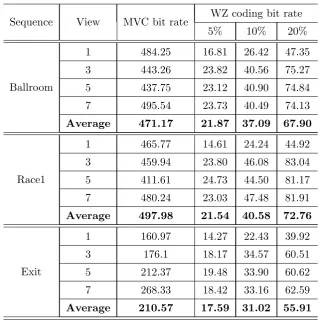
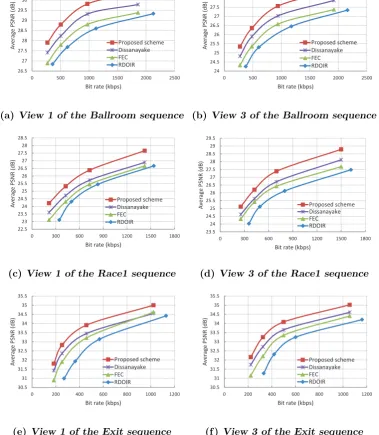
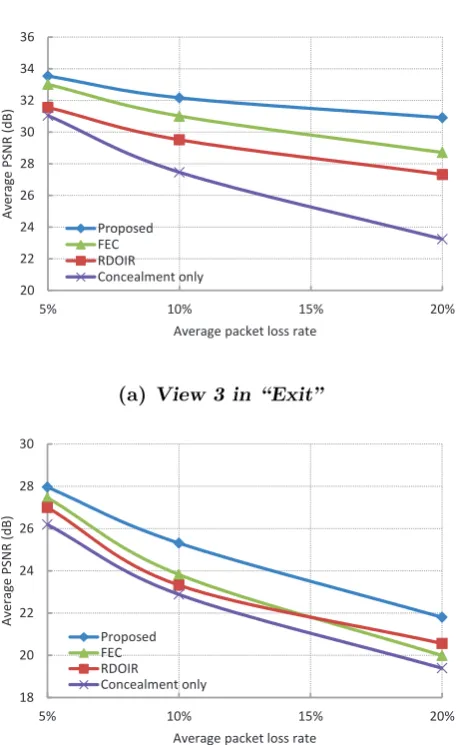
on the study on the characteristics of MVC and the complex propagating behaviour of channel errors, a recursive model to estimate the expected transmission distortion is developed in the transform domain, in which the channel-induced distortion takes into consideration both motion and dis-parity compensation induced inter-frame dependencies. With the proposed model, we propose a rate control strategy for WZ encoding to infer the minimum bit rate so as to correct the SI errors. The WZ bit rate estima-tion method exploits the correlaestima-tion between the original bit-planes and the SI bit-planes as well as the bit-plane interdependency. Based on the rate allocation scheme, the proposed error-resilient scheme can transmit extra WZ bits minimally to protect the compressed multi-view video. Extensive experimental results show that the proposed WZ-embedded scheme outper-forms Reed Solomon based forward error correction method by about 1.1 dB and outperforms the adaptive intra refresh algorithm by approximately 1.6 dB at the packet loss rate of 10%, demonstrating the potential of our proposed error correction algorithm.
• Rate-Distortion-based Optimal Mode Switching for Error-Resilient
be-tween the texture and depth, the optimization of texture coding mode with respect to the depth mode in the lossy environment is achieved through a local exhaustive search. Finally, to adapt the proposed algorithm to the rate or distortion constrained environment, we develop a convex scheme to determine the appropriate Lagrange Multiplier. Experimental results show that the proposed method provides significant improvements in terms of both objective and subjective evaluations, not only on the synthesized views, but the coded views as well.
• Disparity Vector Correction for View Synthesis Prediction-Enhanced
12 Introduction
1.4
Research Methodology
In this section, we mainly describe how data would be collected; how theoretical results would be evaluated by experiments; and how the proposed techniques would be compared with known options in the literature.
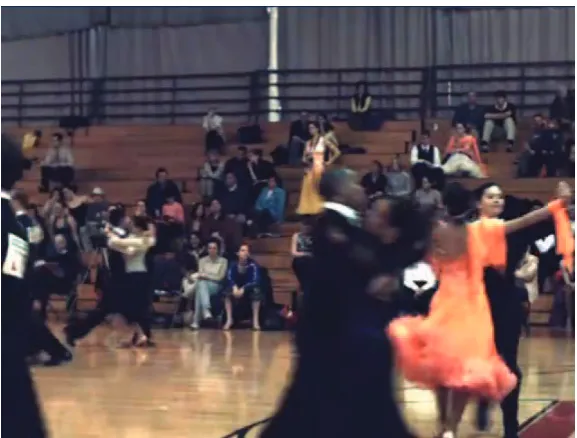
The data we used in this thesis are original YUV multi-view video sequences. For example, the commonly used multi-view video sequences in the literature are: Ballroom, Exist, Race1, BookArrival, Lovebrid1, Newspaper, GT Fly, and Undo Dancer. These sequences are released from different research groups and institutes in the world, and adopted by the JVT/MPEG 3-D audio and visual (3DAV) group [7]. They are available to be downloaded from the public web-site. The first 3 sequences are pure multi-view video sequence, while the remain-ing sequences are multi-view texture sequences along with depth maps. These sequences are selected from different sources and have different spatiotemporal characteristics, which lead to different behaviour of compression algorithms. The detailed descriptions of the test sequences are provided in the corresponding main chapters.
measure the average difference between two rate-distortion curves. On the other hand, we compare the performances using joint rate control and error resilient algorithms. In this scenario, the permissible bit rate for each sequence is usually given, and the related rate control schemes are employed to ensure the output bit rate as close as possible to the target bit rate. For performance evaluation, we only need to do the PSNR comparison.
All the research methods in this thesis are made up of two components: end-to-end distortion estimation and rate-distortion optimization. For decoder-side distortion estimation, we use a divide-and-conquer method to quantify the effects of three individual terms on end-to-end distortion: 1) quantization distortion; 2) error propagation distortion; 3) error concealment distortion. While the quanti-zation distortion is known to the encoder, the error propagation distortion and error concealment distortion depend on the particular channel realization and is unknown to the encoder. To estimate the error propagation distortion, we charac-terize the channel behaviour using the packet loss probability, which is modelled as an independent time-invariant packet erasure channel. To estimate the error concealment distortion, we simulate the error concealment at the encoder and then average the simulated distortions. The spatiotemporal correlation in the input video sequence is characterized by a recursion function introduced in [47]. To improve the performance of the video transmission system, the estimated dis-tortion is incorporated into a rate-disdis-tortion framework based upon Lagrangian optimization. The basic idea of Lagrangian optimization is to introduce a La-grange multiplier for the given constraint, which can thus be relaxed [148]. When the Lagrangian optimization is not able to reach points which are not on the convex hull of the rate-distortion curve, dynamic programming method may be used [149].
1.5
Organization
The dissertation begins with a review of 3-D video coding methods and some error-resilient techniques for video transport over lossy networks in Chapter 2.
de-14 Introduction
scription is analyzed in Chapter 3. Section 3.4 presents the generic framework of the proposed WZ-based scheme. A mathematical transmission distortion model for multi-view video transmission and bit rate estimation for WZ encoding are studied and developed in Sections 3.5 and 3.6, respectively. In Section 3.7, an analysis of the added computational load of our proposed algorithm is presented. Experimental results are presented and discussed in Section 3.8, and Section 3.9 concludes this algorithm.
The rate-distortion-based optimal mode selection algorithm is analyzed in Chapter 4. Section 4.4 describes the typcial encoding prediction structure for texture video and depth map coding. In Section 4.5, an end-to-end distortion estimation model for MVD-based 3-D video transmission is first proposed. Sub-sequently, in Section 4.6, the estimated overall distortion is incorporated into the rate-distortion based mode switching coders. The experimental results are pre-sented and discussed in Section 4.7. Finally, concluding remarks are drawn in Section 4.8.
In Chapter 5, the research is moved to research into robust VSP-based 3-D video transmission. The rest of this chapter is organized as follows. Section 5.4 briefly describes the basic VSP-based encoding prediction structure for the tex-ture video coding with enhanced inter-view prediction. In Section 5.5, we analyse the error propagation behaviour of the VSP-based 3-D video transmission, and define a new prediction position error induced by the depth map errors. Subse-quently, in Section 5.6, a novel disparity vector correction method is proposed accordingly to eliminate the prediction position error. Experimental results are p-resented and discussed in Section 5.7. Finally, we provide the concluding remarks in Section 5.8.
Background
This chapter reviews the recent emerging 3-D video coding methods and stan-dards, as well as the error resilience techniques for video transport over unreliable networks. It starts in Section 2.1 with a brief overview of 2-D video coding s-tandards, i.e., H.264/Advanced Video Coding (AVC) and High Efficiency Video Coding (HEVC), which are the basis for multi-view video and 3-D video coding. Then, distributed video coding is briefly reviewed in Section 2.2, for the benefit of the readers who are not familiar with this unique video coding paradigm. Section 2.3 reviews the multi-view video compression principle. Section 2.4 mainly dis-cusses two most important 3-D video coding techniques and standards, i.e., the AVC-compatible 3-D video coding (3D-AVC) and HEVC-compatible 3-D video coding (HEVC). AVC standard has been recently finalized, whereas 3D-HEVC is currently still under development. Section 2.5 provides a review of the general principles of error resilient coding technique in the video coding communi-ty. Since most key technologies of 3-D video coding are still in progress, there are very few works in the literature reported on error resilient 3-D video coding and transmission at this stage. Therefore, the very specific related works on reliably transmitting 3-D video will be discussed in the corresponding chapters.
2.1
2-D Video Coding Standards and Techniques
16 Background
The ITU-T produced H.261 [14] and H.263 [15], ISO/IEC produced MPEG-1 [MPEG-16], and MPEG-4 Visual [MPEG-17], and the two organizations jointly produced the H.262/MPEG-2 video [18], and H.264/MPEG-4 AVC [19] standards. The two standards that were jointly produced have had a particularly strong impact and have found their way into a wide variety of products that are increasingly preva-lent in our daily lives. Following the same trends, MPEG and VCEG specified recently a new video coding standard, the HEVC standard [20], addressing ultra-high definition applications beside the usual H.264/AVC applications, and bring-ing an approximate 50% rate reduction for the same perceptual quality compared to the H.264/AVC most efficient high profile solution. The technological paradig-m behind the paradig-major advances in all video coparadig-mpression standards is the so-called predictive video coding, which relies on redundancy and irrelevance removal as none contribute to the perceptual quality of the decoded video. While spatial, temporal and statistical redundancies are reduced using spatial transformation, motion compensated temporal prediction, and entropy coding tools, irrelevancy is mainly reduced through the quantization of the transform coefficients.
Intra Prediction Mode Decision
Motion Estimation
Transform & Quantization
Frame Buffer Deblocking and SAO Filter
Entropy Encoding
and Formating Filter Analysis
Inverse Transform & Quantization Rate Control
Motion Compensation
+
+
Motion Information Mode Information
Reconstructed Image Prediction
Residual
QP Input Frame
Prediction and Mode Information
Figure 2.1: Typical HEVC video encoder.
pictures of a sequence or between random access points, inter temporally predic-tive coding modes are typically used for most blocks. The encoding process for inter prediction consists of choosing motion data comprising the selected reference picture and motion vector to be applied for predicting the samples of each block. The encoder and decoder generate identical inter prediction signal by applying motion compensation using the motion vector and mode decision data, which are transmitted as side information. The residual signal of the intra or inter pre-diction, which is the difference between the original block and its prepre-diction, is transformed by a linear spatial transform. The purpose of the transform is to re-duce the spatial correlation between adjacent residual pixels, and to compact the energy of the residual pixels into a few coefficients. The transform coefficients are then scaled, quantized, entropy coded, and transmitted together with the prediction information. The encoder duplicates the decoder processing loop (see yellow-shaded boxes in Figure 2.1 ) such that both will generate identical predic-tions for subsequent data. Therefore, the quantized transformation coefficients are constructed by inverse scaling and are then inverse transformed to duplicate the decoder approximation of the residual signal. The residual is then added to the prediction, and the result of that addition may then be fed into the loop filters to smooth out artifacts induced by block-wise processing and quantization. The final picture representation is stored in a decoded picture buffer to be used for the prediction of subsequent pictures. Since the encoder dictates exactly how each code block is reconstructed, this hybrid video coding paradigm has a computa-tionally expensive video encoder. However, due to the superior performance in compression, this kind of paradigm results in today’s many practical video codec.
2.2
Distributed Video Coding
18 Background
dependencies. Slepian and Wolf proved that no compression efficiency is com-promised in lossless coding by exploiting source correlation at the decoder only. Then Wyner and Ziv extended the Slepian-Wolf theorem to the lossy coding case, which shows that the same rate-distortion performance is also attainable if the source correlation is exploited at the encoder with Gaussian sources [93]. Based on DVC principles, it is well-known that there are two main DVC architectures proposed in the literature, namely, the PRISM (Power-efficient, Robust, hIgh compression Syndrome-based Multimedia coding) architecture [94] and the Stan-ford architecture [95], respectively. In the PRISM architecture, a WZ frame is transformed using a block-wise discrete cosine transform (DCT) and the trans-formed coefficients are quantized with a uniform scalar quantizer. Then a coding mode decision strategy will decide whether a block is coded as a WZ block or as an intra block. The block-based characteristic of PRISM allows for a better local adaption of the coding mode in order to cope with nonstationary statistical prop-erties of video data. However, this block partitioning implies a short block-length which is a limiting factor for efficient channel coding.
DCT Quantizer Turbo Encoder
Turbo
Decoder Reconstruction
Buffer DCT-1
Conventional Intra Encoder
Conventional Intra Decoder
Interpolation /Extrapolation
DCT
WZ Encoder WZ Decoder
Feedback Channel Side Information WZ Frames
Key Frames
Decoded WZ Frames
Decoded Key Frames
Figure 2.2: Conventional pixel-domain and transform-domain DVC architecture.
transform domain version, a DCT is applied prior to quantization. The quantized values are then fed into a punctured turbo coder. The systematic bits are dis-carded and only the parity bits of the turbo coder are properly stored in a buffer. The encoded bit-stream is thus composed of different parts: the H.264/AVC in-tra coded key frame stream, and the WZ stream. The information of the key frame is entirely sent to the decoder, while the parity bits are only partially sent, depending on the decoder requests to the encoder, provided iteratively through a feedback channel. At the decoder, the side information is generated by motion-compensated interpolation or extrapolation of previously decoded frames. And then the side information is used in the turbo decoder, along with the parity bits of the WZ frames, in order to reconstruct the bit planes, and subsequently the decoded video sequence. Since the motion compensation task is shift from the encoder to the decoder, this kind of video coding paradigm has a computationally inexpensive video encoder.
2.3
Multi-view Video Coding
20 Background
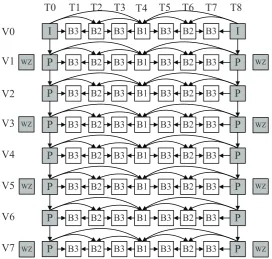
hierarchical levels of the prediction structure. B pictures of B1 to B3 are predicted
from two nearest pictures of the next higher level, and the encoded pictures are employed as reference ones for pictures of the lower level. In the case of B4, it has
the lowest level, so it is not used as a reference frame for the other B pictures. This hierarchical prediction structure has been standardized into an extension of H.264/AVC, which is referred to MVC. Recently, HEVC has been extended to support encoding of multi-view video, namely MV-HEVC [27], similar to the MVC extension of H.264/AVC.
0 I
3 B
2 B
3 B
1 B
3 B
2 B
3 B
0 I
1
B B4 B3 B4 B2 B4 B3 B4 B1
0
P B3 B2 B3 B1 B3 B2 B3 P0
Figure 2.3: Sample multi-view video compression structure for GOP length of eight
in three view setup.
2.4
3-D Video Coding
and MPEG in July 2012, more experts and companies have actively participated in the 3D video coding standardization. As a result, 3D-AVC has been recently finalized, and 3D-HEVC is currently still in progress while drafting this thesis.
2.4.1
Overview of 3D-AVC
A goal of the 3D-AVC development was an MVD coding system that is able to benefit from a wide deployment of H.264/AVC-based video services and from widely available hardware and software implementations of H.264/AVC. The in-tent was to allow only a limited number of changes to low-level processing and at the same time obtain a significant compression improvement compared to MVC-compatible coding. The encoder of 3D-AVC encodes the input MVD data into a bitstream, which consists of a sequence of access units. Each access unit consists of texture components and depth components representing one sampling of MVD data. Since the bitrate required for transmission of texture content is typically larger than the bitrate required for depth maps, a design concept is to utilize depth data for enhanced texture coding. In particular, a depth component can be coded prior to the texture component of the same view and hence used as inter-component prediction reference for the texture component. 3D-AVC also supports joint coding of texture and depth that have different spatial resolutions. Particularly, coding of depth data is supported at full, half and quarter spatial resolution compared to the resolution of the texture data. To enable some en-hanced texture coding tools, the resolution of depth images is normalized to the resolution of luma texture images. Depth image normalization is implemented as in-loop up-sampling with bi-linear interpolation.
2.4.1.1 Depth-based Enhanced Texture Coding Tools
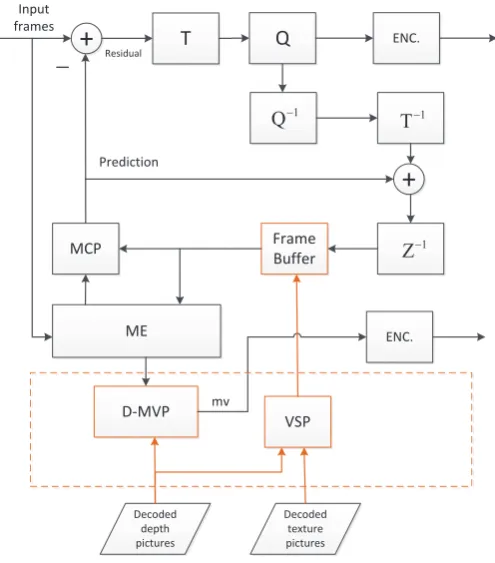
3D-AVC includes two texture coding tools that utilize depth information: view synthesis prediction (VSP) and depth-based motion vector prediction (D-MVP). Figure 2.4 shows a high level flowchart of the texture coding in 3D-AVC with VSP and D-MVP modules marked in yellow colour. VSP is reviewed in the corresponding chapter, while the D-MVP is introduced below.
22 Background
ME
MCP Frame
Buffer
Q
T ENC.
+
—+
1
T
1
Z
VSP D-MVP
Decoded depth pictures
Decoded texture pictures
ENC.
1
Q Input
frames
mv Prediction
[image:40.595.153.401.75.357.2]Residual
Figure 2.4: High-level flowchart of the texture encoder in 3D-AVC.
current block (Cb) consists of three components, a reference index indicating the
reference picture and two spatial components of motion vectors (mvx, mvy). In
order to reduce the required number of bits to encode the motion information, the blocks adjacent to Cb are used to produce a predicted motion vector (mvpx,
mvpy), and the difference between the actual motion information of Cb and mvp
is transmitted. H.264/AVC specifies that components of the predicted motion vector are calculated by a median value of the corresponding motion vector com-ponents of the neighbouring blocks A, B and C. The layout of spatial neighbors (A, B, C) utilized in MVP is depicted in the top-left corner of Cb.
For example, if Cb uses an inter-view reference picture, all neighbouring blocks which do not utilize inter-view prediction are marked as not-available for MVP and are not considered in the median MVP. Furthermore, 3D-AVC introduced a new default candidate vector, when inter-view prediction is used in the original H.264/AVC design: if no motion vector candidates are available from the neigh-bouring blocks, the predicted motion vector is set to the average disparity which is computed by the depth value ofCb.
2.4.1.2 Joint View Depth Filtering
The main idea of joint view depth filtering (JVDF) is that depth map filtering can utilize redundancy of multi-view depth map representation, and depth maps of all available viewpoints are filtered jointly. JVDF attempts to make depth maps of the same time instant consistent across views and hence removes depth estimation and coding errors. A detailed description and simulation results for JVDF can be found in [32], while a brief description of the JVDF algorithm is presented next.
All available depth maps are first warped to a single view m. Since warping results in multiple estimates of a noise-free depth map value in a spatial location (xm, ym), a filtering is carried out for the samples of (xm, ym). It is assumed that
the depth value Zm of view m is relatively accurate and therefore the correctly
projected depth valueZi from other views which describe the same object should
be close in value to Zm. A classification of similarity is defined through a
con-fidence range and a threshold T on the absolute difference between Zi and Zm.
The depth value Zi, for which the absolute difference exceeds threshold T are
excluded from joint filtering, whereas other depth values of location (xm, ym) are
averaged in order to produce a “noise-free” estimate. After that, the produced “noise-free” estimate of the depth value is warped back to corresponding views that participated in joint filtering.
2.4.2
Overview of 3D-HEVC
24 Background
video plus depth with two or more views and associated depth components. The basic structure of the 3D-HEVC encoder is shown in Figure 2.5.
Texture Depth Texture Depth Texture Depth
HEVC conforming video coder
Depth map coder
Video coder for dependent
views
Depth coder for dependent
views
Video coder for dependent
views
Depth coder for dependent
views
multiplexer
View 0 View 1 View 2
Figure 2.5: Basic encoder structure of 3D-HEVC with view and
inter-component prediction.
In order to provide backward compatibility with 2D video service, the base or independent view is coded using a fully HEVC compliant codec. For coding the dependent views and depth dada, modified HEVC codecs are used, which are extended by including additional coding tools and an inter-component prediction technique that employ data from already coded components at the same time index, as indicated by the yellow arrows in Figure 2.5. In order to also support the decoding of video-only data, e.g., pure stereo video suitable for conventional stereo displays, the inter-component prediction can be configured in a way that video pictures can be decoded independently of the depth data. In summary, the HEVC design is extended by the following tools:
• Coding of dependent views using disparity-compensated prediction,
inter-view motion prediction and inter-inter-view residual prediction
• Depth map coding using new intra-coding modes, modified motion com-pensation and motion vector coding, and motion parameter inheritance
• Encoder control for depth-enhanced formats using view synthesis
rendering model.
2.4.2.1 Depth Map Coding
For the coding of depth maps, the same concepts of intra-prediction, motion-compensated prediction, disparity-motion-compensated prediction, and transform coding as for the coding of the video pictures are used. However, in contrast to texture video, depth maps are characterized by sharp edges and large regions with nearly constant values. Therefore, different depth coding methods have been studied, including wavelet coding [33], mesh-based depth coding [34], as well as non-rectangular block partitioning for depth maps, such as wedgelet or platelet coding [35], and edge chain coding [36].
As the motion characteristics for the video and associated depth map in the MVD format is similar, inter-component motion vector prediction has been s-tudied. In [37], a new inter coding mode for depth maps is added in which the partitioning of a block into sub-blocks and associated motion parameters are in-ferred from the co-located block in the associated texture video. Since the motion vectors of the texture signal are given in quarter-sample accuracy, whereas for the depth signal sample-accurate motion vectors are used, the inherited motion vec-tor are quantized to full pixel precision. For each block, based on a rate-disvec-tortion optimized policy, it can be adaptively decided, whether the partitioning and mo-tion informamo-tion is inherited from the co-located region of the texture video, or new motion data is transmitted.
2.4.2.2 View Synthesis Optimization
26 Background
the distorted depth map areas to distorted areas in the synthesized view. Hence, an exact mapping between the distortion of a block of the depth data and an associated distortion in the synthesized view is not possible regarding only the depth data within a currently processed block.
Rendering
Rendering
Rendering
SSD
SSD
+
2
d
1
d
Cont
Con
t
Orig
t
Orig
d
Ref
v
Ref
v
1
v
2
v
1
D
2
D
SVDC —
Figure 2.6: Synthesized view distortion change calculation with respect to a
cur-rently tested depth coding mode.
To resolve this issue, a method that calculates the exact synthesized view dis-tortion change (SVDC) for a particular rendering algorithm was proposed, which computes the change of the overall distortion of the synthesized view depending on the change of the depth data within a depth block while simultaneously consid-ering depth data outside that block. Figure 2.6 illustrates the SVDC calculation. First, for each tested coding mode for the current depth block, two variants of depth data are used: Variantd1 consists of reconstructed depth values for already
coded blocks and uncoded depth values for the remaining blocks, see grey and white blocks in the top of Figure 2.6, respectively. Variant d2 is similar, but for
the current block, the reconstructed depth values from the actual mode under test are used, as shown by the yellow area in the bottom of Figure 2.6. Both depth variants d1 and d2 are further used to synthesize the intermediate views v1 and
v2 with the coded and reconstructed texture data tCon. For the sum of squared
difference (SSD) calculation, also the reference portion vRef is available, which
is synthesized in the initialization phase from uncoded texture and depth data
for depth variant 1 andD2 =SSD(v2, vRef) for depth variant 2 with the current
coding mode under test. Finally, the difference between these values is used as depth distortion measure: SV DC =D2−D1.
2.5
Error-Resilient Coding Techniques
Error resilience techniques can be roughly classified into three categories as sug-gested in [38], [39]: source-level error-resilient video coding, error concealment by post-processing, and interactive error control. Source-level error-resilient video coding refers to those technique in which the transmitter injects a redundancy, often known as parity or repair symbols, to the transmitted data, enabling the receiver to recover the transmitted data when the bitstream is corrupted by trans-mission errors. Error concealment by post processing refers to the estimation of lost picture areas based on the correctly decoded samples as well as any other helpful information. Interactive error control refers to those techniques which require interactions between the source encoder and decoder, so that the encoder can adapt its operations based on the loss conditions detected at the decoder.
Besides, modern video compression formats also have syntax support for error resilience. For example, flexible macroblock ordering (FMO) is an error-resilient tool in H.264/AVC that can avoid loss of large contiguous regions to make error concealment more feasible and effective [40]. Another example is data partitioning [41], which allows decomposition of compressed single-view video into layers of different importance for preferential protection. Furthermore, it is possible to explicitly transmit additional data in various forms to aid error concealment [42].
2.5.1
Source-Level Error Resilient Video Coding
28 Background
under a certain rate constraint. There are many ways to introduce redundancy into the bit stream to limit the distortion caused by packet losses. The com-monly used error-resilient tools are intra macroblock (MB)/picture refresh [43], redundant picture coding [44].
2.5.1.1 Intra MB/Picture Refresh
One way to prevent the effect of error propagation is the insertion of intra-pictures [45]. However, it is costly to code an entire picture by intra-coding, because the size of intra-coded pictures is always much larger than that of inter-coded pictures. In addition to intra-picture coding, robust MB mode selection can be used. They aim at refreshing the most error prone areas as intra-coded macroblocks to avoid drastic channel error accumulation and can be classified into heuristic and rate-distortion optimized intra MB refresh algorithms.
The heuristic intra MB refresh algorithm typically uses a mapping between the packet loss rate and the refresh frequency to determine the number of intra MBs, and then apply intra-coding uniformly across the picture area. One example is to periodically code a certain number of intra MBs per picture in a pre-defined scan order. Another example of the heuristic algorithm is to code a certain number of MBs in intra mode at randomly selected MB locations [46].
Rate-distortion optimized intra refresh algorithms refer to the approach that incorporates the overall expected distortion within the rate-distortion framework in order to automatically choose the number and the placement of the intra-coded MBs. Typically, the objective of rate-distortion optimization is to find the best mode for encoding a block with minimum distortion given the bit rate. This con-strained optimization problem can be converted to a unconcon-strained Lagrangian cost function that linearly combines bit rate budget and end-to-end distortion, and the mode selection of each MB is such that the cost is minimized. The rate-distortion optimized intra update algorithms can be categorized into two categories: optimal per-pixel estimation and model-based MB mode selection methods, which are reviewed in more details below.
this category is the recursive optimal per-pixel estimate (ROPE) algorithm [47], which computes the mean squared error by recursively calculating the first and second moments of each pixel. The original ROPE algorithm operates at integer pixel precision, and therefore it has been extended in [48] and [49] to address cross-correlation terms between pixels for more accurate distortion estimation of fractional-pel motion estimation. Other extensions of the ROPE algorithm in-clude refinement of the distortion estimation of DCT coefficients in the transform domain [50].
Model-based MB intra update algorithms generate and recursively update a block-level distortion map for each frame to approximate end-to-end distor-tion [51]. However, since inter-frame displacements involve sub-block motion vectors, a motion compensated block may inherit errors propagated from mul-tiple blocks in previous frames. Hence, block-based techniques must involve a possibly rough approximation, whose errors may build up to seriously degrade estimation accuracy. Another model-based method for calculating the average expected distortion is to run several decoders, each for different packet loss pat-terns, at the encoder and to average the resulting distortions [52]. Although this decoder-simulation-based mode selection algorithm estimates the expected dis-tortion reasonably accurately when the number of simulations is high enough, the disadvantage is that the computational complexity and storage requirements are impractical for many software and hardware platforms targeting low-delay applications.
2.5.1.2 Redundant Picture Coding
30 Background
Thanks to the flexibility of encoding redundant coded pictures, a number of encoding methods for redundant coded pictures have been proposed. A method for unequal error protection based on redundant coded pictures was proposed in [53]. In this method, the encoder creates a key picture periodically, which is either intra-coded or predicted from the previous key picture. Each picture is protected by coding a respective redundant coded picture as an exact copy of the key picture. Redundant pictures can also be encoded with some quality degradation by using larger quantization parameters than primary pictures, such that fewer bits will be used to represent redundant pictures. The method called systematic lossy error protection (SLEP) developed in [54], belongs to this category. Another method for coding redundant coded pictures using earlier reference pictures than those of the respective primary coded pictures was proposed in [55], in which a scheme for hierarchical placement of redundant coded pictures and their reference pictures is included. The allocation of redundant coded pictures was further developed in [56], which proposed an adaptive rate-distortion optimized algorithm for coding of redundant coded pictures.
2.5.2
Error Concealment by Post-Processing
Decoder error concealment refers to the recovery or estimation of lost informa-tion due to transmission errors. Error concealment algorithms can be generally categorized into spatial and temporal methods. In the spatial error concealment, only the information from the current coded picture or decoded picture is used. Temporal error concealment restores the corrupted blocks by exploiting tempo-ral correlation between successive frames. A brief review of both spatial and temporal error concealment methods is provided below.
2.5.2.1 Spatial Error Concealment
another approach known as maximally smooth recovery [57], a limited number of DCT coefficients are estimated to provide the smoothest connection with the boundary pixels of the spatially adjacent blocks. In general, frequency-domain algorithms usually interpolate only the low-frequency transformation coefficients. In sample-domain concealment, the sample values of a missing block are derived from the sample values of the neighbouring blocks. For example, Salama et al. [58] proposed weighted pixel averaging, in which each pixel value in a MB to be concealed is formed as a weighted sum of the closest boundary pixels of the selected adjacent MBs. Wanget al. proposed a spatial error concealment method by minimizing the first-order derivative-based smoothness measure [59]. To sup-press the induced blurring effect, the second-order derivatives were considered in [60]. Although such a smoothness constraint achieves good results for the flat regions, it may not be satisfied in the areas with high frequency edges. To resolve this issue, an edge-preserving algorithm was proposed to interpolate the missing pixels [61]. In [62], smooth and edge areas were effectively recovered based on selective directional interpolation. In [63], an orientation adaptive interpolation scheme derived from the pixel wise statistical model was proposed. In addition, a spatial error concealment method based on a Markov random field (MRF) was proposed in [64].
2.5.2.2 Temporal Error Concealment
32 Background
field interpolation algorithm [68], a Lagrange interpolation algorithm [69], and a dynamic programming algorithm [70]were proposed for error concealment.
In the aforementioned error concealment algorithms, to conceal the damaged MB, its neighboring MBs need to be correctly received. However, in a practical wireless network or Internet, consecutive packet losses are quite common due to the traffic congestion, and it is possible that all or some of the MBs surrounding a damaged MB are also lost. Thus, all the packets of one frame are very likely to be corrupted by channel errors. In such a scenario, the above mentioned error concealment methods will no longer perform well. An underlying solution to tackle this problem is to use the error concealment for the whole picture loss. A motion vector extrapolation (MVE) has been presented in [71] to combat the whole picture loss. It can extrapolate the motion vectors of the damaged MB from the last received picture and estimate the overlapped areas between the damaged MB and the motion extrapolation one. Based on the MVE method, Chen et al. proposed a pixel-based MVE (PMVE) method by extending the MVE method to the pixel level [72]. In order to solve the inaccurate problem of PMVE, Yan et al. [73] proposed a hybrid MVE (HMVE) method, which uses not only the extrapolated MVs of the pixels but also the extrapolated MVs of the block. To tackle the whole picture loss problem in H.264/SVC, Ji et al. [74] proposed a novel error concealment algorithm by utilizing the motion information of the co-located blocks in the temporally neighbouring previous and subsequent pictures.
2.5.3
Interactive Error Control
from the decoder can reduce the coding gain loss, at the expense of increased complexity.
2.5.3.1 Reference Picture Selection
One way of taking advantage of an available feedback channel is to employ ref-erence picture selection (RPS) [75]. If the encoder learns through a feedback channel about damaged parts of a previously coded frame, it can choose such a reference picture for inter prediction that is known to be correct and available based on the feedback. This requires that the encoder and decoder both store multiple past decoded frames. Information about the reference picture to be used is transmitted in the bitstream. Note that using RPS does not always necessarily bring extra delay in the encoder. The encoder does not have to wait for the arrival of the feedback information about the previous frame to code a current frame. Instead, it can choose to use the frame before the damaged frame as a reference. For example, when encoding the frame n+d, if the information about the dam-aged framen does not arrive at the encoder, the decoder can select framen−1 as the reference frame to code framen+d. In this case, even if there are some errors between n+ 1 to n+d−1, error propagation will be stopped from frame n+d
Error-Resilient Multi-view Video
Coding Using Wyner-Ziv
Techniques
3.1
Introduction
36 Error-Resilient MVC Using WZ coding
as the coding format for 3-D video. As an amendment to H.264/AVC to support certain 3-D applications, MVC was originally designed for compressing multi-view video data. However, MVC can also be used directly in coding multi-multi-view depth data by taking depth sequences as grayscale video.
Although inter-view prediction employed in MVC does improve the coding performance considerably compared to simulcast video coding, the compressed multi-view video signal is extremely sensitive to transmission error with regard to the delivery of 3-D video. In the case of packet-switched networks, packets may be discarded due to buffer overflow at intermediate nodes of the network, or may be considered lost due to long queuing delays. When this kind of pack-et loss happens to the predictive video streaming, a reconstruction error occurs. Further, such transmission errors from the current frame will propagate to the future frames along the motion compensation prediction path, and degrade video quality. As for transmission of multi-view video data, due to the joint design of motion and disparity compensation prediction, the error propagation problem will become more severe. If an error occurs in a frame of one view and cannot be effectively corrected, the transmission error will not only propagate to the subse-quent frames in current view, but also spread to other dependent views through the disparity-compensated inter-view prediction, and thus an abrupt degrada-tion of the total received multi-view video quality. This problem is exacerbated in wireless channels, where packet losses are far more frequent and bursty than in wire-line networks. Therefore, error-resilient multi-view video steaming has become a critically important topic of 3-D video research.
3.2
Related Work
A lot of efforts have been made to protect the quality of video sequences with single view against channel errors. The widely used conventional error resilience mechanisms include automatic repeat request (ARQ) [81], forward error correc-tion (FEC) [82], inserting more intra-coded macro-blocks [83], robust mocorrec-tion estimation [84], redundant slices [85], and so on. However, only a small number of algorithms have been proposed for robust multi-view video transmission.
In the area of stereoscopic video transmission, a rate distortion (R-D) op-timization method for error-resilient stereoscopic video coding with inter-view refreshment was proposed in [86]. Tan et al. [87] introduced an end-to-end R-D model of stereo video that achieved optimal encoder bit rates and unequal error protection rates. In these works, error control was only considered for 3-D video with the left and right views, without regards to the characteristics of multi-view video signals. For transmitting generic multi-view video over packet lossy net-works, Song et al. [88] proposed an efficient concealment algorithm based upon adaptive intra-view and inter-view correlation to provide reliable concealment results. Liu et al. [142] presented an error concealment method that incorpo-rates the redundancy between the inter-views to generate the concealment frame. These two schemes mainly focus on recovering the lost block or frame at the decoder according to the received information, but they may not perform well if the neighbouring blocks or frames are also lost during transmission. Zhou et al. [90] developed a recursive mathematical model to estimate the expected channel-induced distortion considering both temporal and inter-view dependen-cies at both the frame and sequence levels, but do not include any error protection scheme. Dissanayake et al. [91] presented an error-resilient method by incorpo-rating the disparity vectors into MVC so as to generate a redundant data stream.