EFFECTS OF HIGH-INTENSITY TRAINING WITH ONE VERSUS
THREE CHANGES OF DIRECTION ON YOUTH FEMALE
BASKETBALL PLAYERS’ PERFORMANCE
Javier Sanchez-Sanchez
1,2, Manuel Carretero
1,2, Rodrigo Ramirez-Campillo
2,3,
Cristina Petisco
1,2, María Diego
1, Oliver Gonzalo-Skok
2,4, and Fábio Y. Nakamura
2,5,61
Pontifical University of Salamanca, Salamanca, Spain
2
Research Group Planning and Assessment of Training and Athletic Performance,
Pontifical University of Salamanca, Salamanca, Spain
3
Department of Physical Activity Sciences, Research Nucleus in Health,
Physical Activity and Sport, Universidad de Los Lagos, Osorno, Chile
4
San Jorge University, Zaragoza, Spain
5
The College of Healthcare Sciences, James Cook University, Queensland, Australia
6Department of Medicine and Aging Sciences, “G. d’Annunzio” University of Chieti-Pescara
Original scientific paper UDC: 796.015.367: 796.323.2 055.25
Abstract:
To compare the effects of high-intensity interval training (HIT) with one versus three changes of direction (COD) on young (age, 17.2±1.1 years) female basketball players’ performance, six weeks of regular basketball training (control period) was followed by six weeks of high-intensity training added to regular training , two times per week, with a random allocation of athletes to either HIT with one (HIT-COD1; n=6) or three COD (HIT-COD3; n=6). Before and after the control and HIT-COD training periods athletes performed repeated-sprint ability test (RSA), modified agility T-test (MAT), V-cut, triple standing dominant (TS-D) and non-dominant (TS-ND) jump, TS-D and TS-ND with COD tests, and 30-15 Intermittent Fitness Test (30-15IFT). With the exception of a substantial improvement in V-cut in both groups, no substantial changes occurred during the control period. Both HIT-COD training programs improved V-cut, although only HIT-COD3 substantially improved RSA mean time (RSAm), MAT and the final speed reached in 30-15IFT (VIFT). The between-group comparison revealed greater improvements in RSAm and VIFT in COD3 than in HIT-COD1. In conclusion, supplementation of basketball training with HIT-COD drills adds improvements to young female basketball player’s performance, especially when 3 COD are incorporated into HIT.
Key words: team sport, agility, fitness, women, maturation, explosive strength
Introduction
Optimization of strength and conditioning for basketball requires the consideration of a range of physical and physiological traits relevant to com-petition (Torres-Ronda, Ric, Llabres-Torres, de Las Heras, & Schelling, 2016). Basketball is an inter-mittent sport, in which high-intensity neuromus-cular efforts alternate with brief partial-recovery rest periods (Ben Abdelkrim, El Fazaa, & El Ati, 2007). Performance of high-intensity actions such as jumping, accelerating, decelerating, sprinting with change of direction (COD) (Marcelino, et al., 2016) and the ability to repeat these actions during competition are key to success (Torres-Ronda, et al., 2016). To this aim athletes should strive to develop
optimally their sport performance (Marcelino, et al., 2016), targeting adequate levels of aerobic and anaerobic power, strength, and agility (Schelling & Torres-Ronda, 2013).
lactate accumulation) (Dellal, et al., 2010), allow-ing a reduced accumulation durallow-ing effort bouts and faster rate of metabolite clearance during recovery periods (Iaia, et al., 2015).
Basketball competition requires frequent ac-tions involving COD (Marcelino, et al., 2016). In-clusion of COD during HIT (HIT-COD) may allow a greater training specificity (Attene, et al., 2015; Brughelli, Cronin, Levin, & Chaouachi, 2008; Buchheit, Bishop, Haydar, Nakamura, & Ahmai-di, 2010). Moreover, HIT-COD may allow greater performance-related physiological demands (Del-lal, et al., 2010), neuromuscular activation (Hader, et al., 2014), and deceleration-acceleration actions requiring eccentric and concentric muscle efforts (Attene, et al., 2015). However, limited evidence exist regarding how basketball players performance may be affected by HIT-COD with a different num-ber of COD actions (Attene, et al., 2014, 2015, 2016). Although HIT-COD with one COD may be a mini-mum effective dose (Attene, et al., 2015), a greater number of COD would implicate a greater number of acceleration and deceleration efforts, potential-ly inducing greater neuromuscular (Padulo, et al., 2016) and metabolic adaptations (i.e., buffer capac-ity) (Glaister, 2005; Mendez-Villanueva, Hamer, & Bishop, 2008). In fact, a recent study involving fe-male futsal players showed that increasing the num-ber of COD during HIT optimized gains in peak velocity achieved during the incremental test, re-peated-sprint ability and running economy (Teix-eira, et al., 2017). Therefore, the aim of this study was tocompare the effects of HIT-COD with one versus three COD on young female basketball play-ers’ performance, hypothesizing that both training strategies would improve court-based performance, with additional effects when three COD are incor-porated into HIT.
Methods
Subjects and experimental design
Tocompare the effects of HIT-COD with one versus three COD on young female basketball play-ers’ performance, after 6 weeks of regular basket-ball training (control period) athletes were random-ly allocated to either HIT with one (HIT-COD1; n=6) or three COD (HIT-COD3; n=6). HIT-COD sessions were conducted two times per week as an addition to the regular training schedule during a 6-week period. As in previous studies (Ramirez-Campillo, et al., 2013), we devised an experimental design using the same participants as their controls to reduce the bias related to typical inter-individu-al variability responses to training, especiinter-individu-ally ob-served among youth (Moran, et al., 2017a, 2017b, 2017c; Radnor, Lloyd, & Oliver, 2017). This experi-mental design may reduce limitations compared to previous studies that did not consider the inclusion
of a control group (Attene, et al., 2015, 2016 ) and may help to control for differences in total training load and training experience, among other potential confounders that may be more problematic when control and experimental groups are formed with different athletes. In addition, in the current study participants were instructed to keep their training habits, daily routines and nutritional habits the same during the control and experimental periods.
Before and after the control and HIT-COD training periods (i.e., baseline, pre, and post-test, respectively), athletes completed assessment tests of
their repeated-sprint ability (RSA), modified agil
-ity T-test (MAT), V-cut test, triple standing domi-nant (TS-D) and non-domidomi-nant (TS-ND) jump test, D and ND with COD (COD-D and TS-COD-ND, respectively), and the 30-15 Intermittent Fitness Test (30-15IFT).
Initially, 14 young (U19) national league-lev-el athletes volunteered to participate. Two athletes missed ≥90% of HIT-COD training sessions and
were excluded from the final analyses. Thus 12 ath
-letes (age, 17.2±1.1 years; body height, 171.1±6.3 cm; body weight, 64.1±7.9 kg) completed the inter-vention. Athletes had ≥8 years of basketball training experience. During the control and experimental periods, participants regularly trained 90 min/ses-sion four times/week, with an official match every Saturday. From the total training session time, 70% was devoted to technical-tactical drills with offen-sive and defenoffen-sive system games, in addition to in-dividualized technique refinement. Further, 20% of the total time was dedicated to strength and condi-tioning, using small-sided games, plyometric and
specific endurance drills; and 10% to injury preven
-tion, using circuit training with eccentric, core, pro-prioception, and coordination drills. Athletes had ≥2 months of regular training (i.e., no injuries or illness) and a medical clearance to participate in in-tense physical activity. Although athletes had expe-rience with HIT-COD drills, they reported no sys-tematic experience with this type of training. The technical department of the basketball club, ath-letes and their parents/guardians gave their assent and written consent (respectively) after a thorough description of the general purpose of the study, the experimental procedures involved, and all potential
risks and benefits. The study was conducted in ac
-cordance with the Declaration of Helsinki and was approved by the Ethics Committee of the respon-sible department.
Testing procedures
Measurements were completed while athletes
wore their habitual basketball outfits, during regu
caffeine-con-taining beverages 24 h before testing and to be well rested, hydrated and fed before measurements. A standard warm-up was used before testing, includ-ing a 5-minute continuous run, 5-minute dynam-ic stretching, and three submaximal 30-m sprints. Measurements were scheduled in three non-consec-utive days: Monday (TS-D, TS-ND and V-cut tests), Wednesday (TS-COD-D, TS-COD-ND, MAT and RSA tests) and Friday (30-15IFT).
Jumping tests – TS-D, TS-ND, TS-D-COD and TS-ND-COD, followed previous recommen-dations (Maulder & Cronin, 2005; Rosch, et al., 2000), using a triple unipodal horizontal jump with either dominant (TS-D) or non-dominant (TS-ND) leg, with the aim of reaching maximal horizontal distance (m). Valid jumps required that athletes jumped with arms akimbo, maintaining the land-ing position after the third jump for two seconds without losing balance or touching the ground with the free lower limb. Three valid maximal trials were allowed, using the best result for analyses. Three minutes of recovery were allowed between trials. During TS-D-COD and TS-ND-COD testing the same protocol was followed, but athletes had to per-form triple unilateral horizontal jumping in a ~45º zigzag pattern (marked on the floor).
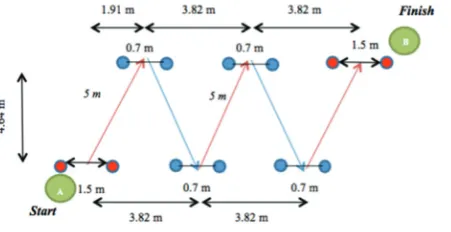
[image:3.595.65.291.648.764.2]V-cut testing followed previous recommenda-tions (Gonzalo-Skok, et al., 2015). Athletes were in-structed to cover as fast as possible a circuit of 25 m with four 45° COD. Athlete’s displacement from one imaginary line to another (delimited by 0.7 m height cones) in the circuit requires that at least one of the foot touch that line before moving to the next (Figure 1). The time needed to complete the test was measured with a double beam photocell tim-ing gates system (Witty, Microgate®, Italy), with gates at the start and finish line. To avoid activation errors, athletes initiated the test 0.5 m behind the first gate. Two valid maximal trials were allowed, using the best result for analyses. Two minutes of recovery were allowed between trials.
Modified agility T testing followed previous recommendations (Sassi, et al., 2009). Athletes per-formed two valid maximal trials of the MAT, with two minutes of recovery between trials. The best performance result was used for analyses. A timing
gate (Witty, Microgate®, Italy) located at the start/ finish line (the same line for this test) was used to record time, while athletes initiated the test 0.5 m behind the gate. The total distance covered was 20 m for each trial.
Repeated sprint ability (RSA) testing includ-ed six 20 m sprints, with 20 s of passive recovery between sprints (Aziz, Mukherjee, Chia, & Teh, 2007). Times were recorded with timing gates (Witty, Microgate®, Italy). Athletes received ver-bal motivation during testing and were verver-bally and visually informed to assume the starting position 0.5 m behind the starting line 6 s before each sprint (Chaouachi, et al., 2010). A countdown of 3 s was then visually provided to athletes with a light panel (Microgate®, Italy). The fastest sprint (RSAb) and the mean time of all sprints (RSAm) were retained for analyses.
The 30-15IFT was applied to assess aerobic ca-pacity following previous instructions (Buchheit, 2008). Athletes run for 30 s interspersed with 15 s of passive recovery. Initial run velocity was set at 8 km/h, increasing by 0.5 km/h after each inter-val. Athletes were encouraged to achieve maximal effort. The test was ended when athletes were un-able to maintain the required running speed. The velocity of the last interval completed (VIFT) was considered for analysis.
HIT-COD training
After 6 weeks of regular basketball training (control period) athletes completed 6 weeks of HIT-COD1 or HIT-COD3, two times per week (on Tuesday and Thursday), in addition to their regular training schedule. According to previous recom-mendation (Attene, et al., 2014, 2015, 2016; Buch-heit & Laursen, 2013a, 2013b; Glaister, 2005; Men-dez-Villanueva, et al., 2008; Padulo, et al., 2016), after a warm-up (5 min low-intensity running, 5 min dynamic stretching, and 5 min skipping), ath-letes completed two sets of a HIT-COD circuit
com-posed of 10 s of running at 90% VIFT and 10 s of
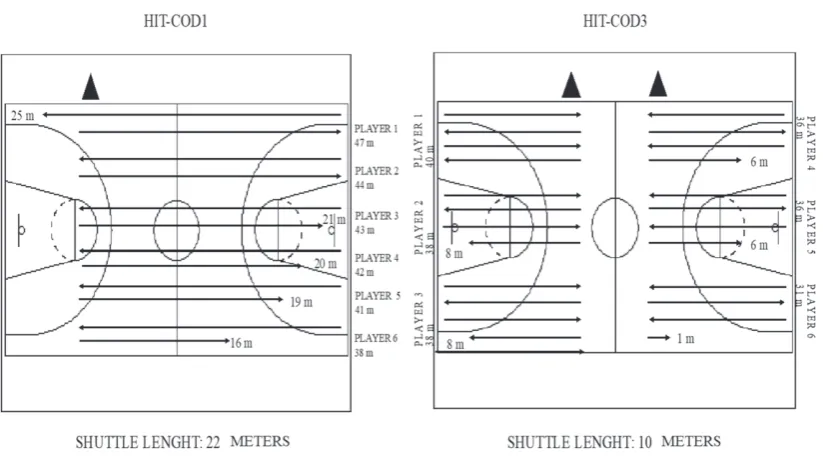
active recovery (walking), repeating this pattern during 6 minutes for each set, with a 3-minute of passive recovery between sets. HIT-COD circuits had one or three 180° COD for the HIT-COD1 and HIT-COD3 groups, respectively (Figure 2). Statistical analysis
Data are presented as mean ± standard devia-tion (SD). All data were first log-transformed to reduce bias arising from non-uniformity error. An ANCOVA was conducted to determine the be-tween-group differences using the pre-test as a co-variate. The standardized difference or effect size (ES, 90% confidence limits [CL]) in the selected variables was calculated using the pooled pre-train-ing SD. Threshold values for Cohen’s ES
ly; >25-75%, possible; >75-95%, likely; >95-99%, very likely; and >99%, most likely (Hopkins, et
al., 2009). If the chance of having beneficial/bet
-ter or detrimental/poorer performances was both >5%, the true difference was assessed as unclear. Otherwise, change was interpreted as the observed chance (Hopkins, et al., 2009).
Results
None of the players were injured during the HIT-COD sessions and positive feelings were re-tics were >0.2 (small), >0.6 (moderate), and >1.2
(large) (Hopkins, Marshall, Batterham, & Hanin, 2009). For within/between-group comparisons, the chances that the differences in performance were better/greater (i.e., greater than the smallest worth-while change, SWC [0.2 multiplied by the between-subject standard deviation, based on the Cohen’s
d principle]), similar or worse/smaller were calcu
-lated. Quantitative chances (QC) of beneficial/bet
-ter, similar/trivial or detrimental/poorer effect were
assessed qualitatively as follows: <1%, almost cer
-tainly not; >1-5%, very unlikely; >5-25%, unlike
[image:4.595.93.505.64.294.2]-Figure 2. High intensity training circuits with one (HIT-COD1) or three (HIT-COD3) changes of direction.
Table 1. Mean changes (with 90% confidence limits) in athletic performance in high-intensity running with 3 (HIT COD3) or 1 change of direction (HIT COD1) groups during the control period
HIT COD3 (n = 6) HIT COD1 (n = 6)
% ES Chances Outcome % ES Chances Outcome
RSAb (s) 2.8 (-2.7; 8.0) 0.32 (-0.30; 0.94) 64/28/8% Unclear 1.3 (-1.6; 4.2) 0.26 (-0.32; 0.85) 58/33/8% Unclear
RSAm (s) 0.5 (-4.4; 5.1) 0.05 (-0.44; 0.54) 28/54/18% Unclear -1.1 (-4.2; 1.9) -0.22 (-0.82; 0.39) 11/36/52% Unclear V-cut (s) 2.4 (-0.4; 5.3) 0.30 (-0.05; 0.66) 71/27/2% Possibly 4.8 (0.9; 8.4) 0.93 (0.18; 1.68) 95/4/1% Likely
MAT (s) 1.8 (-2.0; 5.5) 0.30 (-0.33; 0.94) 62/29/9% Unclear -0.5 (-5.7; 4.5) -0.07 (-0.84; 0.69) 25/37/38% Unclear TS-D (m) -2.0 (-6.1; 2.1) -0.12 (-0.35; 0.12) 2/72/25% Possibly
trivial -3.6 (-6.9; -0.1) -0.36 (-0.72; -0.01) 1/19/80% Likely poorer
TS-ND (m) -0.2 (-3.3; 2.9)2 -0.01 (-0.19; 0.16) 3/93/4% Likely trivial -1.9 (-6.1; 2.5) -0.09 (-0.31; 0.12) 2/80/19% Likely trivial TS-COD-D (m) -22.2 (-30.7; -12.6) -1.44 (-2.10; -0.77) 0/0/99% Very likely
poorer -17.5 (-28.3; -5.2) -0.88 (-1.51; -0.24) 1/3/96% Very likely poorer TS-COD-ND (m) -19.1 (-26.4; -11.0) -1.25 (-1.81; -0.69) 0/0/99% Very likely
poorer -14.7 (-27.2; 0.1) -0.56 (-1.12; 0.00) 2/11/87% Likely poorer
VIFT (km/h) 0.0 (0.0; 0.0) 0.0 (0.0; 0.0) 33/33/33% Unclear -0.9 (-3.2; 1.4) -0.11 (-0.41; 0.18) 4/67/29% Possibly trivial
Note. RSAb and RSAm: best and mean time in the repeated sprint ability test, respectively; MAT: modified agility T test; TS-D and TS-ND: triple standing long jump with dominant and dominant leg, respectively; TS-COD-D and TS-COD-ND: triple standing long jump with change of direction with dominant and non-dominant leg, respectively; VIFT: final velocity in the 30-15 Intermittent Fitness Test; ES: effect size.
[image:4.595.65.535.561.749.2]corded from players and coaches about the inter-vention.
Within-group changes
With the exception of a substantial improve-ment in V-cut in both HIT-COD 3 and HIT-COD1, no other substantial changes were detected during the control period in any group (Table 1). After the HIT-COD training, substantial performance im-provements were found in V-cut in both groups,
while HIT-COD3 also substantially enhanced MAT, RSAm and VIFT (Table 2).
Between-group changes
Improvements in RSAm (4.5% [CL90%: -1.5;
10.9]; QC = 79/17/4%) and VIFT (2.7% [CL90%: 0.0;
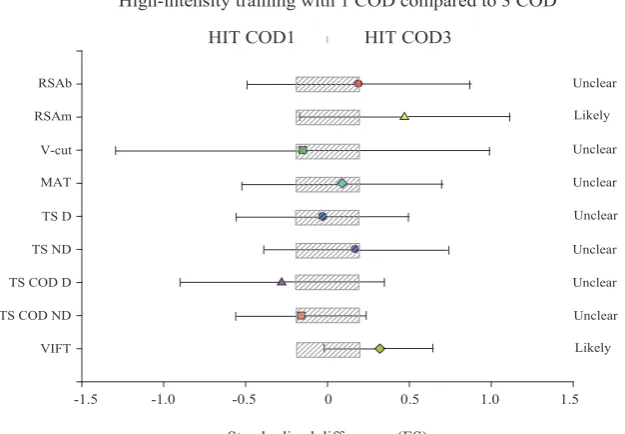
[image:5.595.61.533.94.287.2]5.4]; QC = 76/23/1%) were substantially greater in HIT-COD3 than in HIT-COD1. No substantial dif-ferences (unclear results) were found in the rest of variables (Figure 3).
Table 2. Mean changes (with 90% confidence limits) in athletic performance in high-intensity running with 3 (HIT COD3) or 1 change of direction (HIT COD1) groups after the intervention period
HIT COD3 (n = 6) HIT COD1 (n = 6)
% ES Chances Outcome % ES Chances Outcome
RSAb (s) 2.1 (-3.5; 7.4) 0.20 (-0.33; 0.73) 50/41/10% Unclear 0.4 (-1.3; 2.1) 0.06 (-0.18; 0.31) 15/81/4% Likely trivial RSAm (s) 3.3 (-2.5; 8.8) 0.29 (-0.21; 0.79) 63/31/5% Possibly -1.0 (-2.2; 0.1) -0.15 (-0.31; 0.01) 0/72/28% Possibly trivial V-cut (s) 5.4 (1.4; 9.2) 0.65 (0.17; 1.13) 94/5/1% Likely 6.2 (0.3; 11.8) 2.62 (0.11; 5.12) 95/2/4% Likely MAT (s) 3.1 (2.3; 3.8) 0.39 (0.30; 0.49) 100/0/0% Most Likely 2.5 (-1.4; 6.3) 0.45 (-0.25; 1.14) 75/19/6% Unclear TS-D (m) -3.0 (-10.3; 4.9) -0.15 (-0.54; 0.24) 40/53/6% Unclear -2.6 (-0.1; 5.2) 0.25 (-0.01; 0.51) 1/34/65% Possibly
poorer TS-ND (m) -0.7 (-4.9; 3.7) -0.03 (-0.25; 0.18) 9/87/4% Likely trivial -3.6 (-12.0; 5.5) -0.24 (-0.82; 0.35) 10/36/55% Unclear TS-COD-D (m) -5.7 (-14.2; 3.6) -0.27 (-0.71; 0.17) 4/34/62% Possibly
poorer -1.4 (-5.8; 3.1) -0.15 (-0.63; 0.32) 10/48/42% Unclear TS-COD-ND (m) -3.1 (-8.1; 2.2) -0.20 (-0.55; 0.14) 3/46/50% Possibly
poorer -0.8 (-3.2; 1.6) -0.06 (-0.24; 0.12) 2/89/9% Likely trivial VIFT (km.h-1) 2.3 (1.4; 3.3) 0.22 (0.13; 0.31) 67/33/0% Possibly -0.5 (-3.2; 2.3) -0.06 (-0.44; 0.31) 11/64/25% Unclear
[image:5.595.139.452.493.710.2]Note. RSAb and RSAm: best and mean time in the repeated sprint ability test, respectively; MAT: modified agility T test; TS-D and TS-ND: triple standing long jump with dominant and non-dominant leg, respectively; TS-COD-D and TS-COD-ND: triple standing long jump with change of direction with dominant and non-dominant leg, respectively; VIFT: final velocity in the 30-15 Intermittent Fitness Test; ES: effect size.
Figure 3. Between-group changes in fitness tests.
Standardized differences (ES)
-1.5 -1.0 -0.5 0 0.5 1.0 1.5
RSAb
RSAm
V-cut
MAT
TS D
TS ND
TS COD D
TS COD ND
VIFT
Unclear
Likely
Unclear
Unclear
Unclear
Unclear
Unclear
Unclear
Likely
High-intensity training with 1 COD compared to 3 COD HIT COD1 HIT COD3
Note. RSAb and RSAm: best and mean time in the repeated sprint ability test, respectively; MAT: modified agility T-test; TS-D and TS-ND: triple standing long jump with dominant and non-dominant leg, respectively; TS-COD-D and TS-COD-ND: triple standing long jump with change of direction with dominant and non-dominant leg,
respectively; VIFT: final velocity reached in the 30-15 Intermittent Fitness Test; ES: effect size. HIT-COD3 and HIT-COD1: high intensity training groups with 3 or 1 changes of direction.
Note. RSAb and RSAm: best and mean time in the repeated sprint ability test, respectively; MAT: modified agility T-test; D and TS-ND: triple standing long jump with dominant and non-dominant leg, respectively; TS-COD-D and TS-COD-TS-ND: triple standing long jump with change of direction with dominant and non-dominant leg, respectively; VIFT: final velocity reached in the 30-15 Intermittent
Discussion and conclusions
The aim of this study was tocompare the ef-fects of HIT-COD with one versus three COD on young female basketball players’ performance.
Main findings indicate that both training approach
-es improved V-cut t-est performance, but only HIT-COD3 allowed improvements in MAT, RSAm and VIFT, with greater improvements in the latter two tests compared to HIT-COD1.
RSAm improved only after HIT-COD3. In ad-dition, the improvement was likely greater com-pared to HIT-COD1. Although a previous study ob-served an improvement in RSA in soccer players after a HIT-COD intervention (Shalfawi, Young, Tonnessen, Haugen, & Enoksen, 2013), this is the first study to compare the effects of different COD number during HIT on linear RSA performance. RSA is required in competitive basketball, and is heavily dependent of both metabolic and neuromus-cular factors (Glaister, 2005). These factors may be
improved through HIT, especially if the specific
-ity of training for basketball is maintained through the inclusion of COD (Attene, et al., 2015) to in-crease both metabolic and neuromuscular demands (Dellal, et al., 2010). As RSAm improved without changes in RSAb, improvement may have occurred through fatigue-resistance adaptation modulated by a greater number of COD during HIT-COD3. More COD actions require more acceleration and deceleration efforts, thus eliciting greater stimu-lus to improve neuromuscular (Padulo, et al., 2016; Teixeira, et al., 2017) and metabolic factors relevant to RSA (i.e., buffer capacity) (Glaister, 2005; Men-dez-Villanueva, et al., 2008; Teixeira, et al., 2017). Given the relevance of RSA for basketball (Spencer, Bishop, Dawson, & Goodman, 2005), strength and conditioning professionals should take into consid-eration the inclusion of HIT with several COD as a part of the regular training schedules (Castagna, et al., 2007).
Performance in the V-cut test improved dur-ing both the control and intervention period in both training groups. Previous observations agree with our results, showing that a regular season basketball training improves V-cut test performance (Gonzalo-Skok, et al., 2015). The improvement (i.e., ES) in the V-cut test was greater during the intervention period compared to the control period in the HIT-COD1 than after HIT-COD3, which may be poten-tially related to a greater load induced by small-sided games in the former group (Chaouachi, et al., 2014), although this was not objectively controlled in our intervention. Future studies should aim to control this potentially confounding variable. Re-garding MAT, this athletic performance proxy im-proved only after HIT-COD3. Given the relevance of MAT-related COD ability to basketball perfor-mance (Ben Abdelkrim et al., 2007; Brughelli, et al., 2008), these results may be of practical impor-tance to practitioners, especially considering the
potential of COD ability to improve other perfor-mance traits (Sheppard & Young, 2006) relevant for basketball.
VIFT was improved only after HIT-COD3. In addition, the improvement was likely greater com-pared to the HIT-COD1 group. Although the scar-city of studies (Attene et al., 2014, 2016) in this
area make comparisons difficult, these results par
-tially agree with the results obtained with young female soccer players (Shalfawi, et al., 2013). Al-though HIT alone may have positively affected VIFT (Viano-Santasmarinas, Rey, Carballeira, & Padron-Cabo, 2017) through increases in peripheral oxi-dative capacity (Gibala, et al., 2006) and VO2max (Taylor, et al., 2015), the fact that only HIT-COD3 improved VIFT suggests that the addition of COD may have increased neuromuscular and metabolic adaptations required for VIFT improvements (Tay-lor, et al., 2015), especially considering the stretch-shortening cycle (SSC) needs for both the COD ac-tions and 30-15IFT performance.
Paradoxically, the TS-COD with both the domi-nant and non-domidomi-nant limbs were impaired after the experimental training period in HIT-COD3, whereas this trend was not observed in HIT-COD1. Although no obvious explanation of this finding can be raised, one can speculate that fatigue levels during HIT are higher when 3 COD are performed instead of 1 COD. Thus, even though HIT-COD3 are more exposed to COD maneuvers, performing it with less fatigue can optimize gains in tasks in-volving maximal levels of power output (Ikutomo,
Kasai, & Goto, 2017). This aspect needs to be ad
-dressed in future studies.
Although COD training alone may improve per-formance, due to the nature of basketball, a training program that mimic the multimodal nature of the game may optimize training effectiveness (Padulo, et al., 2016). In this sense, integration of COD into HIT proved to be an effective strategy to improve young female basketball athletes’ performance, in-cluding both COD and RSA performance, which
are considered key physical fitness traits for bas
-ketball. In the current intervention, HIT-COD in-corporated 180° COD actions. Practitioners should
consider specific angles for COD actions depend
-ing on the sport requirements (Attene, et al., 2015). Future studies may compare the effects of a mix-ture of COD angles executed during HIT, consid-ering the multi-angle displacement requirements of some sports. Considering the limitations of this investigation, we also recommend the recruitment of larger sample sizes and the inclusion of a con-trol group during the experimental training period for future studies.
In conclusion, supplementation of basketball
training with HIT-COD drills seems to benefit per
References
Attene, G., Laffaye, G., Chaouachi, A., Pizzolato, F., Migliaccio, G.M., & Padulo, J. (2015). Repeated sprint ability in young basketball players: One vs. two changes of direction (Part 2). Journal of Sports Sciences, 33(15), 1553-1563. doi: 10.1080/02640414.2014.996182
Attene, G., Nikolaidis, P.T., Bragazzi, N.L., Dello Iacono, A., Pizzolato, F., Zagatto, A.M., . . . Padulo, J. (2016). Repeated sprint ability in young basketball players (Part 2): The chronic effects of multidirection and of one change of direction are comparable in terms of physiological and performance responses. Frontiers in Physiology, 7, 262. doi: 10.3389/fphys.2016.00262
Attene, G., Pizzolato, F., Calcagno, G., Ibba, G., Pinna, M., Salernitano, G., & Padulo, J. (2014). Sprint vs. intermittent training in young female basketball players. Journal of Sports Medicine and Physical Fitness, 54(2), 154-161.
Aziz, A.R., Mukherjee, S., Chia, M.Y., & Teh, K.C. (2007). Relationship between measured maximal oxygen uptake
and aerobic endurance performance with running repeated sprint ability in young elite soccer players. Journal
of Sports Medicine and Physical Fitness, 47(4), 401-407.
Ben Abdelkrim, N., El Fazaa, S., & El Ati, J. (2007). Time-motion analysis and physiological data of elite under-19-year-old basketball players during competition. British Journal of Sports Medicine, 41(2), 69-75. doi: 10.1136/ bjsm.2006.032318
Brughelli, M., Cronin, J., Levin, G., & Chaouachi, A. (2008). Understanding change of direction ability in sport: A review of resistance training studies. Sports Medicine, 38(12), 1045-1063. doi: 10.2165/00007256-200838120-00007 Buchheit, M. (2008). The 30-15 intermittent fitness test: Accuracy for individualizing interval training of young
intermittent sport players. Journal of Strength and Conditioning Research, 22(2), 365-374. doi: 10.1519/ JSC.0b013e3181635b2e
Buchheit, M., Bishop, D., Haydar, B., Nakamura, F.Y., & Ahmaidi, S. (2010). Physiological responses to shuttle repeated-sprint running. International Journal of Sports Medicine, 31(6), 402-409. doi: 10.1055/s-0030-1249620 Buchheit, M., & Laursen, P.B. (2013a). High-intensity interval training, solutions to the programming puzzle. Part
II: Anaerobic energy, neuromuscular load and practical applications. Sports Medicine, 43(10), 927-954. doi: 10.1007/s40279-013-0066-5
Buchheit, M., & Laursen, P. B. (2013b). High-intensity interval training, solutions to the programming puzzle: Part I: Cardiopulmonary emphasis. Sports Medicine, 43(5), 313-338. doi: 10.1007/s40279-013-0029-x
Castagna, C., Manzi, V., D’Ottavio, S., Annino, G., Padua, E., & Bishop, D. (2007). Relation between maximal aerobic power and the ability to repeat sprints in young basketball players. Journal of Strength and Conditioning
Research, 21(4), 1172-1176. doi: 10.1519/R-20376.1
Chaouachi, A., Chtara, M., Hammami, R., Chtara, H., Turki, O., & Castagna, C. (2014). Multidirectional sprints and small-sided games training effect on agility and change of direction abilities in youth soccer. Journal of Strength
and Conditioning Research, 28(11), 3121-3127. doi: 10.1519/JSC.0000000000000505
Chaouachi, A., Manzi, V., Wong del, P., Chaalali, A., Laurencelle, L., Chamari, K., & Castagna, C. (2010). Intermittent
endurance and repeated sprint ability in soccer players. Journal of Strength and Conditioning Research, 24(10), 2663-2669. doi: 10.1519/JSC.0b013e3181e347f4
Dellal, A., Keller, D., Carling, C., Chaouachi, A., Wong del, P., & Chamari, K. (2010). Physiologic effects of directional
changes in intermittent exercise in soccer players. Journal of Strength and Conditioning Research, 24(12), 3219-3226. doi: 10.1519/JSC.0b013e3181b94a63
Gibala, M.J., Little, J.P., van Essen, M., Wilkin, G.P., Burgomaster, K.A., Safdar, A., . . .& Tarnopolsky, M.A. (2006).
Short-term sprint interval versus traditional endurance training: Similar initial adaptations in human skeletal muscle and exercise performance. Journal of Physiology, 575(Pt 3), 901-911. doi: 10.1113/jphysiol.2006.112094 Glaister, M. (2005). Multiple sprint work: Physiological responses, mechanisms of fatigue and the influence of aerobic
fitness. Sports Medicine, 35(9), 757-777.
Gonzalo-Skok, O., Tous-Fajardo, J., Suarez-Arrones, L., Arjol-Serrano, J.L., Casajus, J.A., & Mendez-Villanueva, A. (2015). Validity of the V-cut test for young basketball players. International Journal of Sports Medicine, 36(11), 893-899. doi: 10.1055/s-0035-1554635
Hader, K., Mendez-Villanueva, A., Ahmaidi, S., Williams, B.K., & Buchheit, M. (2014). Changes of direction during
high-intensity intermittent runs: Neuromuscular and metabolic responses. BMC Sports Science, Medicine and Rehabilitation, 6(1), 2. doi: 10.1186/2052-1847-6-2
Helgerud, J., Hoydal, K., Wang, E., Karlsen, T., Berg, P., Bjerkaas, M., . . .& Hoff, J. (2007). Aerobic high-intensity
intervals improve VO2max more than moderate training. Medicine and Science in Sports and Exercise, 39(4), 665-671. doi: 10.1249/mss.0b013e3180304570
Hopkins, W.G., Marshall, S.W., Batterham, A.M., & Hanin, J. (2009). Progressive statistics for studies in sports medicine and exercise science. Medicine and Science in Sports and Exercise, 41(1), 3-13. doi: 10.1249/ MSS.0b013e31818cb278
Ikutomo, A., Kasai, N., & Goto, K. (2017). Impact of inserted long rest periods during repeated sprint exercise on
performance adaptation. European Journal of Sport Science, 1-7. doi: 10.1080/17461391.2017.1383515
Laursen, P.B., & Jenkins, D.G. (2002). The scientific basis for high-intensity interval training: Optimising training programmes and maximising performance in highly trained endurance athletes. Sports Medicine, 32(1), 53-73. Marcelino, P.R., Aoki, M.S., Arruda, A., Freitas, C.G., Mendez-Villanueva, A., & Moreira, A. (2016). Does
small-sided-gamesʼ court area influence metabolic, perceptual, and physical performance parameters of young elite
basketball players? Biology of Sport, 33(1), 37-42. doi: 10.5604/20831862.1180174
Maulder, P., & Cronin, J. (2005). Horizontal and vertical assessment: Reliability, symmetry, discriminative and predictive ability. Physical Therapy and Sport, 6, 74-82.
Mendez-Villanueva, A., Hamer, P., & Bishop, D. (2008). Fatigue in repeated-sprint exercise is related to muscle power factors and reduced neuromuscular activity. European Journal of Applied Physiology, 103(4), 411-419. doi: 10.1007/s00421-008-0723-9
Moran, J., Sandercock, G.R., Ramirez-Campillo, R., Meylan, C., Collison, J., & Parry, D.A. (2017a). A meta-analysis
of maturation-related variation in adolescent boy athletesʼ adaptations to short-term resistance training. Journal
of Sports Sciences, 35(11), 1041-1051. doi: 10.1080/02640414.2016.1209306
Moran, J., Sandercock, G.R.H., Ramirez-Campillo, R., Todd, O., Collison, J., & Parry, D.A. (2017b). Maturation-related effect of low-dose plyometric training on performance in youth hockey players. Pediatric Exercise Sciences,
29(2), 194-202. doi: 10.1123/pes.2016-0151
Moran, J.J., Sandercock, G.R., Ramirez-Campillo, R., Meylan, C.M., Collison, J.A., & Parry, D.A. (2017c). Age-related
variation in male youth athletesʼ countermovement jump after plyometric training: A meta-analysis of controlled
trials. Journal of Strength and Conditioning Research, 31(2), 552-565. doi: 10.1519/JSC.0000000000001444 Padulo, J., Bragazzi, N.L., Nikolaidis, P.T., Dello Iacono, A., Attene, G., Pizzolato, F., . . .& Migliaccio, G.M. (2016).
Repeated sprint ability in young basketball players: Multi-direction vs. one-change of direction (Part 1). Frontiers
in Physiology, 7, 133. doi: 10.3389/fphys.2016.00133
Radnor, J.M., Lloyd, R.S., & Oliver, J.L. (2017). Individual response to different forms of resistance training in school-aged boys. Journal of Strength and Conditioning Research, 31(3), 787-797. doi: 10.1519/JSC.0000000000001527 Ramirez-Campillo, R., Andrade, D.C., Campos-Jara, C., Henriquez-Olguin, C., Alvarez-Lepin, C., & Izquierdo, M.
(2013). Regional fat changes induced by localized muscle endurance resistance training. Journal of Strength
and Conditioning Research, 27(8), 2219-2224. doi: 10.1519/JSC.0b013e31827e8681
Rosch, D., Hodgson, R., Peterson, T.L., Graf-Baumann, T., Junge, A., Chomiak, J., & Dvorak, J. (2000). Assessment and evaluation of football performance. American Journal of Sports Medicine, 28(5 Suppl.), S29-39.
Sassi, R.H., Dardouri, W., Yahmed, M.H., Gmada, N., Mahfoudhi, M.E., & Gharbi, Z. (2009). Relative and absolute reliability of a modified agility T-test and its relationship with vertical jump and straight sprint. Journal of
Strength and Conditioning Research, 23(6), 1644-1651. doi: 10.1519/JSC.0b013e3181b425d2
Schelling, X., & Torres-Ronda, L. (2013). Conditioning for basketball: Quality and quantity of training. Strength and Conditioning Journal, 35, 89-94.
Shalfawi, S.A.I., Young, M., Tonnessen, E., Haugen, T., & Enoksen, E. (2013). The effect of combined resisted agility and repeated sprint training vs. strength training on female elite soccer players. Kinesiologia Slovenica, 19, 29-42. Sheppard, J.M., & Young, W.B. (2006). Agility literature review: Classifications, training and testing. Journal of Sports
Sciences, 24(9), 919-932. doi: Doi 10.1080/02640410500457109
Spencer, M., Bishop, D., Dawson, B., & Goodman, C. (2005). Physiological and metabolic responses of repeated-sprint activities: Specific to field-based team sports. Sports Medicine, 35(12), 1025-1044.
Stone, N.M., & Kilding, A.E. (2009). Aerobic conditioning for team sport athletes. Sports Medicine, 39(8), 615-642.
doi: 10.2165/00007256-200939080-00002
Taylor, J., Macpherson, T., Spears, I., & Weston, M. (2015). The effects of repeated-sprint training on field-based fitness measures: A meta-analysis of controlled and non-controlled trials. Sports Medicine, 45(6), 881-891. doi: 10.1007/s40279-015-0324-9
Teixeira, A.S., Arins, F.B., De Lucas, R.D., Carminatti, L.J., Dittrich, N., Nakamura, F.Y., & Guglielmo, L.G.A. (2017). Comparative effects of two interval shuttle-run training modes on physiological and performance adaptations in female professional futsal players. Journal of Strength and Conditioning Research. doi: 10.1519/ JSC.0000000000002186
Correspondence to: Fabio Y. Nakamura, Ph.D.
Department of Medicine and Aging Sciences, “G. d’Annunzio” University of Chieti-Pescara, Via dei Vestini, 31, 66100 Chieti, Italy E-mail: [email protected]
Acknowledgments
Authors are grateful to the Perfumerias Avenida (Salamanca, Spain) for their collaboration in conducting this study. In addition, we thank all the athletes who volunteered to participate in the study and those who collaborated with data collection.
Authors’ contributions
JSS, OGS, RRC and FYN conceived the study design, participated in its design, coordination, helped to draft the man-uscript and carried out the statistical analysis. MC, CP and MD applied the programs and assessments and critically
reviewed the manuscript. All authors have read and approved the final version of the manuscript, and agreed with the
order of presentation of the authors.
Competing interests
The authors declare that they have no conflict of interest. Funding sources
This research did not receive any specific grant from funding agencies in the public, commercial, or not-for-profit sectors.
Viano-Santasmarinas, J., Rey, E., Carballeira, S., & Padron-Cabo, A. (2017). Effects of high-intensity interval training with different interval durations on physical performance in handball players. Journal of Strength
and Conditioning Research. doi: 10.1519/JSC.0000000000001847