Viral dUTPase Activity To Compensate for Low Cellular dUTPase
Activity for Efficient Viral Replication
Akihisa Kato,a,bYoshitaka Hirohata,a,bJun Arii,a,bYasushi Kawaguchia,b
Division of Molecular Virology, Department of Microbiology and Immunology, The Institute of Medical Science, The University of Tokyo, Tokyo, Japana
; Department of Infectious Disease Control, International Research Center for Infectious Diseases, The Institute of Medical Science, The University of Tokyo, Tokyo, Japanb
ABSTRACT
We recently reported that herpes simplex virus 1 (HSV-1) protein kinase Us3 phosphorylated viral dUTPase (vdUTPase) at
ser-ine 187 (Ser-187) to upregulate its enzymatic activity, which promoted HSV-1 replication in human neuroblastoma SK-N-SH
cells but not in human carcinoma HEp-2 cells. In the present study, we showed that endogenous cellular dUTPase activity in
SK-N-SH cells was significantly lower than that in HEp-2 cells and that overexpression of cellular dUTPase in SK-SK-N-SH cells
in-creased the replication of an HSV-1 mutant with an alanine substitution for Ser-187 (S187A) in vdUTPase to the wild-type level.
In addition, we showed that knockdown of cellular dUTPase in HEp-2 cells significantly reduced replication of the mutant
vdUTPase (S187A) virus but not that of wild-type HSV-1. Furthermore, the replacement of Ser-187 in vdUTPase with aspartic
acid, which mimics constitutive phosphorylation, and overexpression of cellular dUTPase restored viral replication to the
wild-type level in cellular dUTPase knockdown HEp-2 cells. These results indicated that sufficient dUTPase activity was required for
efficient HSV-1 replication and supported the hypothesis that Us3 phosphorylation of vdUTPase Ser-187 upregulated vdUTPase
activity in host cells with low cellular dUTPase activity to produce efficient viral replication.virus.
IMPORTANCE
It has long been assumed that dUTPase activity is important for replication of viruses encoding a dUTPase and that the viral
dUTPase (vdUTPase) activity was needed if host cell dUTPase activity was not sufficient for efficient viral replication. In the
present study, we showed that the S187A mutation in HSV-1 vdUTPase, which impaired its enzymatic activity, reduced viral
rep-lication in SK-N-SH cells, which have low endogenous cellular dUTPase activity, and that overexpression of cellular dUTPase
restored viral replication to the wild-type level. We also showed that knockdown of cellular dUTPase in HEp-2 cells, which have
higher dUTPase activity than do SK-N-SH cells, reduced replication of HSV-1 with the vdUTPase mutation but had no effect on
wild-type virus replication. This is the first report, to our knowledge, directly showing that dUTPase activity is critical for
effi-cient viral replication and that vdUTPase compensates for low host cell dUTPase activity to produce effieffi-cient viral replication.
D
NA viruses and a subset of retroviruses are known to encode
homologs of host cell enzymes involved in nucleotide
metab-olism (e.g., thymidine kinase [TK], ribonucleotide reductase,
ura-cil-DNA glycosylase, and/or dUTPase), which are mostly not
es-sential for viral replication in cell cultures (
1–7
). Of these, viral
dUTPase (vdUTPase) is of special interest because it is the
ho-molog most widely encoded by viruses (
3
,
7–9
). dUTPases catalyze
the hydrolysis of dUTP to dUMP and pyrophosphate (
10
,
11
).
Since DNA polymerases are known to readily misincorporate
dUTP into replicating DNA, which causes point mutations and
strand breakage, dUTP hydrolysis by dUTPases is necessary for
accurate DNA replication (
11–14
). dUTPase also plays a role in
providing a substrate for thymidylate synthase, which converts
dUMP to TMP, a major biosynthetic pathway for TTP (
10
,
11
).
dUTPases are present in a wide variety of eukaryotic and
prokary-otic organisms, including mammals, plants,
Drosophila
melano-gaster
, and
Escherichia coli
. This ubiquity suggests the importance
of dUTPase for DNA replication.
vdUTPases are encoded by a number of viruses, including
her-pesviruses, poxviruses, adenoviruses, D-type retroviruses, and
Af-rican swine fever virus (ASFV) (
8
,
9
). It has long been assumed
that dUTPase activity is critical for the replication of viruses
en-coding a dUTPase and that vdUTPase activity compensates for it if
there is not sufficient host cell dUTPase activity for efficient viral
replication, e.g., in resting and differentiated cells, such as neurons
and macrophages, where cellular dUTPase activity has been
sug-gested to be low (
4
,
15
). In support of this hypothesis, it has been
reported that a herpes simplex virus 1 (HSV-1) mutant with a null
mutation in its vdUTPase was less virulent than wild-type virus
and replicated less well in the central nervous system (CNS) in a
mouse model of HSV-1 infection (
16
). Furthermore, replication
of recombinant ASFV and D-type retroviruses with mutations in
each of their vdUTPases was significantly reduced in nondividing
cells
in vitro
, whereas replication in actively dividing cells was only
minimally decreased (
4
,
17–20
). However, experimental evidence
to directly prove this widely accepted hypothesis still has not been
reported, e.g., data that knockdown of cellular dUTPase reduces
the replication of viruses with mutations in vdUTPase and that
Received28 February 2014 Accepted21 April 2014
Published ahead of print23 April 2014
Editor:R. M. Sandri-Goldin
Address correspondence to Yasushi Kawaguchi, [email protected]. Copyright © 2014, American Society for Microbiology. All Rights Reserved.
doi:10.1128/JVI.00603-14
on November 7, 2019 by guest
http://jvi.asm.org/
overexpression of cellular dUTPase compensates for the
reduc-tion in replicareduc-tion of viruses carrying mutareduc-tions in vdUTPase.
Thus, definitive roles for dUTPase activity in viral replication and
for viral dUTPases in compensating for low host cell dUTPase
activity remain to be determined.
We recently reported that the HSV-1 protein kinase Us3
phorylated vdUTPase at serine 187 (Ser-187) and that this
phos-phorylation upregulated the enzymatic activity of vdUTPase in
infected cells (
21
). We also showed that Us3 phosphorylation of
vdUTPase at Ser-187 promoted viral replication in human
neuro-blastoma SK-N-SH cells but not in human carcinoma HEp-2 cells
(
21
) and promoted viral pathogenicity in the CNS of mice but not
at peripheral sites, including the eyes and vagina (
22
). These
ob-servations, together with the hypothetical role of dUTPases
en-coded by the various viruses described above, led us to
hypothe-size that (i) dUTPase activity was critical for efficient HSV-1
replication; (ii) Us3 phosphorylation of vdUTPase at Ser-187
up-regulated its enzymatic activity to compensate for insufficient host
cell dUTPase activity for efficient viral replication, such as in
SK-N-SH cells; and (iii) this phosphorylation played no role in viral
replication in cells with sufficient cellular dUTPase activity, such
as HEp-2 cells. In agreement with this hypothesis, in the present
study, we have shown that the enzymatic activity of cellular
dUTPase in SK-N-SH cells was significantly lower than that in
HEp-2 cells and that overexpression of cellular dUTPase in
SK-N-SH cells restored viral replication of a mutant HSV-1 virus with
an alanine substitution for Ser-187 (S187A) in vdUTPase to the
wild-type level. We have also presented data further supporting
the hypothesis that knockdown of endogenous cellular dUTPase
in infected HEp-2 cells significantly reduced replication of the
mutant virus with vdUTPase (S187A) but had no effect on
repli-cation of wild-type virus. In addition, a phosphomimetic
muta-tion in vdUTPase Ser-187 and overexpression of cellular dUTPase
restored mutant virus replication to the wild-type level in cellular
dUTPase knockdown HEp-2 cells. This is the first report, to our
knowledge, directly showing that dUTPase activity is critical for
efficient viral replication and that virally encoded dUTPase
com-pensates for low cellular dUTPase activity if it is not sufficient for
efficient viral replication.
MATERIALS AND METHODS
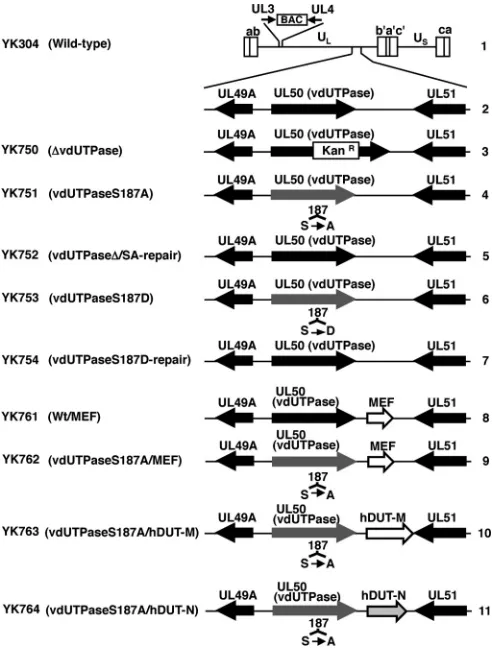
Cells and viruses. Simian kidney epithelial Vero, human carcinoma HEp-2, and human neuroblastoma SK-N-SH cells were described previ-ously (23,24), as was HSV-1 wild-type strain HSV-1(F) (25). Recombi-nant virus strain YK750, with a vdUTPase null mutation (⌬vdUTPase); recombinant virus strain YK751, with a vdUTPase S187A mutation (vdUTPaseS187A); recombinant virus strain YK752, in which the vdUTPase S187A mutation in YK751 was repaired (vdUTPase⌬ /SA-re-pair); recombinant virus strain YK753, with a vdUTPase S187D mutation (vdUTPaseS187D); and recombinant virus strain YK754, in which the vdUTPase S187D mutation in YK753 was repaired (vdUTPaseS187D-repair), were described previously (21) (Fig. 1). YK752 (vdUTPase⌬ /SA-repair) was the repaired virus for both YK750 (⌬vdUTPase) and YK751 (vdUTPaseS187A), based on a sequential construction strategy for recom-binant viruses described previously (21).
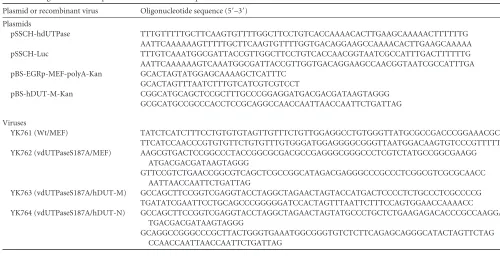
Plasmids.To generate a stable cell line expressing short hairpin RNA (shRNA) against the 3=untranslated region (UTR) of cellular dUTPase mRNA, pSSCH-hdUTPase was constructed, as follows. Oligonucleotides shown inTable 1were annealed and cloned into the BbsI and SalI sites of pmU6 (26). The BamHI-SalI fragment of the resultant plasmid, contain-ing the U6 promoter and the sequence encodcontain-ing shRNA against the 3= UTR of cellular dUTPase mRNA, was cloned into the BamHI and SalI sites
of pSSCH (27), which is a derivative of retrovirus vector pMX containing a hygromycin B resistance gene, to produce pSSCH-hdUTPase. Plasmid pSSCH-Luc, encoding shRNA against firefly luciferase (Luc) mRNA, was constructed by using the same procedure as that used for the construction of pSSCH-hdUTPase, except using oligonucleotides shown inTable 1. To generate a retrovirus vector expressing human dUTPase isoform 2 (hDUT-N), pMX-hDUT-N was constructed by amplifying the hDUT-N open reading frame (ORF) by PCR from cDNA synthesized from total RNA of HEp-2 cells and cloning it into pMxs-puro (28). Total RNA was isolated from HEp-2 cells with a High Pure RNA isolation kit (Roche), and cDNA was synthesized from the isolated RNA with a Transcriptor First Strand cDNA synthesis kit (Roche), according to the manufacturer’s instructions.
pBS-EGRp-MEF-polyA-Kan and pBS-hDUT-M-Kan, used to gener-ate recombinant viruses in the two-step Red-medigener-ated mutagenesis pro-cedures described below, were constructed as follows. To construct pBS-EGRp-MEF-polyA-Kan, the pGEM-MEF domain (28), encoding the I-SceI site, an MEF (Myc epitope–tobacco etch virus [TEV] protease cleavage site–Flag epitope) tag (29) and carrying the kanamycin resistance gene, was amplified by PCR from pGEM-MEF by using primers shown in Table 1and cloned into the SpeI site of pRB5160, which contained the Egr-1 promoter region, a multicloning site, and bidirectional polyadenyl-FIG 1Schematic diagrams of the genome structure of the wild-type and re-combinant HSV-1 strains used in this study. Line 1, wild-type HSV-1(YK304) genome carrying a bacmid (BAC) in the intergenic region between UL3 and UL4; line 2, domain carrying the UL49A, UL50 (vdUTPase), and UL51 open reading frames; lines 3 to 7, recombinant viruses with a mutation in the UL50 (vdUTPase) gene; lines 8 to 11, recombinant viruses in which a foreign gene expression cassette was inserted into the intergenic region between UL50 (vdUTPase) and UL51. MEF represents an MEF tag with myc and Flag epitopes and a TEV protease cleavage site. hDUT-M and hDUT-N represent the mitochondrial and nuclear isoforms of human dUTPase, respectively.
on November 7, 2019 by guest
http://jvi.asm.org/
[image:2.585.298.544.66.390.2]ation signals of the HSV-1 UL21 and UL22 genes (30). pBS-hDUT-M was constructed by amplifying the entire coding sequence of human cellular dUTPase isoform 1 (hDUT-M) by PCR from cDNA synthesized from total RNA of HEp-2 cells, as described above, and cloning it into pBlue-script II KS(⫹) (Stratagene). pBS-hDUT-M-Kan was generated by ampli-fying the domain of pEPkan-S (31) carrying the I-SceI site and the kana-mycin resistance gene by PCR from pEPkan-S using primers shown in Table 1and cloning it into the SphI site of pBS-hDUT-M.
Mutagenesis of viral genomes and generation of recombinant HSV-1.All recombinant HSV-1 strains used in this study were con-structed by the two-step Red-mediated mutagenesis procedure inE. coli
harboring wild-type or mutant HSV-1 genomes, as described previously (31,32). To generate YK761 carrying an expression cassette consisting of the Egr-1 promoter, an MEF tag, and bidirectional polyadenylation sig-nals of the HSV-1 UL21 and UL22 genes (EGRp-MEF-polyA) in the in-tergenic region between the UL50 and UL51 genes (Wt/MEF) (Fig. 1), a two-step Red-mediated mutagenesis procedure was carried out by using the primers listed inTable 1, pBS-EGRp-MEF-polyA-Kan, andE. coli
GS1783 harboring pYEbac102, as described previously (31, 32). pYEbac102 contained a complete HSV-1(F) sequence with the bacterial artificial chromosome (BAC) sequence inserted into the HSV intergenic region between UL3 and UL4 (23). As a result of the two-step Red-medi-ated mutagenesis procedure, anE. coliclone (YEbac761) harboring the mutant HSV-1 BAC (pYEbac761), in which the EGRp-MEF-polyA ex-pression cassette was inserted into the intergenic region between the UL50 and UL51 genes, was obtained. pYEbac761 was isolated from YEbac761, and YK761 (Wt/MEF) was generated by transfection of pYEbac761 into rabbit skin cells, as described previously (31,32). Recombinant virus strain YK762 with an S187A mutation in vdUTPase and the EGRp-MEF-polyA expression cassette (vdUTPaseS187A/MEF) (Fig. 1) was generated by using the same procedure as that used to generate YK761 (Wt/MEF), except using primers listed inTable 1and anE. coliclone (YEbac761) harboring the mutant HSV-1 BAC (pYEbac761). Recombinant virus strain YK763 with an S187A mutation in vdUTPase and an expression cassette consisting of the Egr-1 promoter, the human hDUT-M ORF, and bidirectional polyadenylation signals of the HSV-1 UL21 and UL22 genes (vdUTPaseS187A/hDUT-M) (Fig. 1) was generated by using the same
procedure as that used to generate YK761 (Wt/MEF), except using the primers listed in Table 1, pBS-hDUT-M-Kan, and an E. coli clone (YEbac762) harboring the mutant HSV-1 BAC (pYEbac762). Recombi-nant virus strain YK764 with an S187A mutation in vdUTPase and an expression cassette consisting of the Egr-1 promoter, the human hDUT-N ORF, and bidirectional polyadenylation signals of the HSV-1 UL21 and UL22 genes (vdUTPaseS187A/hDUT-N) (Fig. 1) was generated by using the same procedure as that used to generate YK761 (Wt/MEF), except using the primers listed inTable 1and anE. coliclone (YEbac763) har-boring the mutant HSV-1 BAC (pYEbac763). The genotype of each re-combinant virus was confirmed by sequencing (data not shown).
Antibodies.Rabbit polyclonal antibodies to UL50 and UL51 were described previously (21,33). Mouse monoclonal antibodies to human dUTPase (F6) and-actin (AC15) were purchased from Santa Cruz Bio-technology and Sigma, respectively.
Generation of recombinant retroviruses.Recombinant retroviruses were generated as described previously (34). Briefly, Plat-GP cells, a 293T-derived murine leukemia virus-based packaging cell line, were cotrans-fected with pMDG, encoding the vesicular stomatitis virus envelope G protein (28), and pSSCH-hdUTPase, pSSCH-Luc, or pMX-hDUT-N. Retrovirus-containing supernatants of Plat-GP cells were harvested at 2 days posttransfection.
Establishment of cell lines stably expressing shRNA against cellular dUTPase and firefly luciferase.HEp-2 cells were infected with retrovirus-containing supernatants of Plat-GP cells that had been cotransfected with pMDG (28) and pSSCH-hdUTPase or pSSCH-Luc and selected with 50
g hygromycin B/ml. This led to the isolation of sh-hDUT-HEp-2 and sh-Luc-HEp-2 cells.
[image:3.585.38.538.74.330.2]Establishment of sh-hDUT-HEp-2 cells expressing hDUT-N exoge-nously.sh-hDUT-HEp-2 cells were infected with retrovirus-containing supernatants of Plat-GP cells that had been cotransfected with pMD-G (28) and pMX-hDUT-N and selected with 1g puromycin/ml and 50g hygromycin B/ml. Single colonies of sh-hDUT-HEp-2 cells transduced with pMX-hDUT-N were isolated and screened by immunoblotting with an anti-human dUTPase antibody, which led to the isolation of sh-hDUT-HEp-2/hDUT-N(⫹) cells.
TABLE 1Oligonucleotide sequences for construction of plasmids and recombinant viruses
Plasmid or recombinant virus Oligonucleotide sequence (5=–3=)
Plasmids
pSSCH-hdUTPase TTTGTTTTTGCTTCAAGTGTTTTGGCTTCCTGTCACCAAAACACTTGAAGCAAAAACTTTTTTG
AATTCAAAAAAGTTTTTGCTTCAAGTGTTTTGGTGACAGGAAGCCAAAACACTTGAAGCAAAAA
pSSCH-Luc TTTGTCAAATGGCGATTACCGTTGGCTTCCTGTCACCAACGGTAATCGCCATTTGACTTTTTTG
AATTCAAAAAAGTCAAATGGCGATTACCGTTGGTGACAGGAAGCCAACGGTAATCGCCATTTGA
pBS-EGRp-MEF-polyA-Kan GCACTAGTATGGAGCAAAAGCTCATTTC
GCACTAGTTTAATCTTTGTCATCGTCGTCCT
pBS-hDUT-M-Kan CGGCATGCAGCTCCGCTTTGCCCGGAGGATGACGACGATAAGTAGGG
GCGCATGCCGCCCACCTCCGCAGGCCAACCAATTAACCAATTCTGATTAG
Viruses
YK761 (Wt/MEF) TATCTCATCTTTCCTGTGTGTAGTTGTTTCTGTTGGAGGCCTGTGGGTTATGCGCCGACCCGGAAACGCC
TTCATCCAACCCGTGTGTTCTGTGTTTGTGGGATGGAGGGGCGGGTTAATGGACAAGTGTCCCGTTTTTT
YK762 (vdUTPaseS187A/MEF) AAGCGTGACTCCGGCCCTACCGGCGCGACGCCGAGGGCGGGCCCTCGTCTATGCCGGCGAAGG
ATGACGACGATAAGTAGGG
GTTCCGTCTGAACCGGCGTCAGCTCGCCGGCATAGACGAGGGCCCGCCCTCGGCGTCGCGCAACC AATTAACCAATTCTGATTAG
YK763 (vdUTPaseS187A/hDUT-M) GCCAGCTTCCGGTCGAGGTACCTAGGCTAGAACTAGTACCATGACTCCCCTCTGCCCTCGCCCCG
TGATATCGAATTCCTGCAGCCCGGGGGATCCACTAGTTTAATTCTTTCCAGTGGAACCAAAACC
YK764 (vdUTPaseS187A/hDUT-N) GCCAGCTTCCGGTCGAGGTACCTAGGCTAGAACTAGTATGCCCTGCTCTGAAGAGACACCCGCCAAGGA
TGACGACGATAAGTAGGG
GCAGGCCGGGCCCGCTTACTGGGTGAAATGGCGGGTGTCTCTTCAGAGCAGGGCATACTAGTTCTAG CCAACCAATTAACCAATTCTGATTAG
on November 7, 2019 by guest
http://jvi.asm.org/
Assay for cell viability.The viability of sh-Luc-HEp-2, sh-hDUT-HEp-2, and sh-hDUT-HEp-2/hDUT-N(⫹) cells was determined by using Cell Counting kit 8 (Dojindo) according to the manufacturer’s instruc-tions.
Immunoblotting.Immunoblotting was performed as described pre-viously (30). The amount of protein in immunoblot bands was quanti-tated by using the Dolphin Doc image capture system with Dolphin-1D software (Wealtec).
dUTPase enzyme assay.dUTPase activity was assayed as described previously (16, 21,35), with minor modifications. Briefly, SK-N-SH, HEp-2, sh-Luc-HEp-2, sh-hDUT-HEp-2, and sh-hDUT-HEp-2/hDUT-N(⫹) cells in 6-well plates were harvested and lysed in 200l NP-40 buffer (50 mM Tris-HCl [pH 8.0], 150 mM NaCl, 1.0% Nonidet P-40 [NP-40]). After a brief centrifugation, 0.2l of each supernatant was mixed with 200l of reaction buffer (50 mM Tris-HCl [pH 8.0], 2 mM
-mercaptoethanol, 1 mM MgCl2, 0.1% bovine serum albumin, 2 mM
p-nitrophenylphosphate, 0.24 nM [3H]dUTP [28.8 Ci/mmol;
Perkin-Elmer]). The reaction was allowed to proceed for 30 min at 37°C and then terminated by spotting the reaction mixture onto DE81 circle discs (Whatman). The discs were washed three times for 5 min each with wash-ing solution (1 mM ammonium formate, 4 M formic acid), followed by one wash with 95% ethanol for 3 min. The discs were air dried and assayed for radioactivity by using an LS3801 scintillation counter (Beckman).
Statistical analysis.Differences in the relative amount of hDUT-N, relative dUTPase activity, and relative cell viability were statistically ana-lyzed by using the two-tailed Studentttest. Differences in virus titers were statistically analyzed by using Holm’s sequentially rejective Bonferroni multiple-comparison test.
RESULTS
Endogenous cellular dUTPase activity in SK-N-SH and HEp-2
cells.
To test the hypothesis described above, we first compared
the endogenous cellular dUTPase activity in SK-N-SH cells with
that in HEp-2 cells. The human dUTPase gene encodes both
a nuclear isoform (hDUT-N) and a mitochondrial isoform
(hDUT-M) of dUTPase with isoform-specific transcripts
ex-pressed by using alternative 5
=
exons (
36
,
37
). hDUT-N is the
dominant isoform and is localized predominately in the nucleus,
while hDUT-M is associated mainly with mitochondria (
36
,
37
).
In a denaturing gel, hDUT-M is detected as a band migrating more
slowly than hDUT-N (
36
,
37
). In agreement with a previous
re-port (
36
,
37
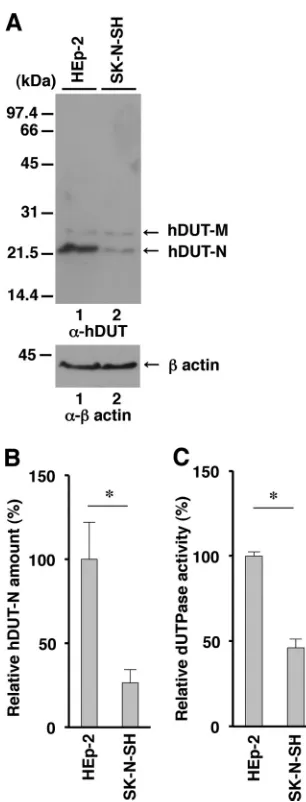
), cellular dUTPase from HEp-2 cells was detected as
two bands in a denaturing gel, with the faster-migrating band (i.e.,
hDUT-N) being the dominant band (
Fig. 2A
). Interestingly, the
amount of protein from SK-N-SH cells in the faster-migrating
band was significantly smaller than that in the band from HEp-2
cells (
Fig. 2A
and
B
). In contrast, the amount of protein from
HEp-2 cells in the slower-migrating band (i.e., hDUT-M) was
similar to that from SK-N-SH cells. Consistent with this result,
endogenous dUTPase activity in SK-N-SH cells was significantly
lower than that in HEp-2 cells (
Fig. 2C
).
Effect of overexpression of cellular dUTPase on replication
of HSV-1 with the vdUTPase S187A mutation.
To investigate the
effect of overexpression of cellular dUTPase on the replication of
HSV-1 with the S187A mutation in vdUTPase, which was
re-ported previously to impair its dUTPase activity (
21
), we
con-structed three recombinant viruses: YK761, carrying the
expres-sion cassette for an MEF tag consisting of myc and Flag epitopes
and a TEV protease cleavage site (
29
) in the intergenic region
between UL50 and UL51 (Wt/MEF); YK762, with an S187A
mutation in vdUTPase and carrying the MEF tag expression
cassette in the intergenic region between UL50 and UL51
(vdUTPaseS187A/MEF); and YK764, with an S187A mutation in
vdUTPase and carrying a cellular hDUT-N expression cassette
(vdUTPaseS187A/hDUT-N) (
Fig. 1
). We used the MEF tag gene
for a control foreign gene, which was unrelated to the hDUT-N
gene. We previously reported that insertion of foreign genes into
the intergenic region between UL50 and UL51 had no effect on
viral replication in cell cultures (
38
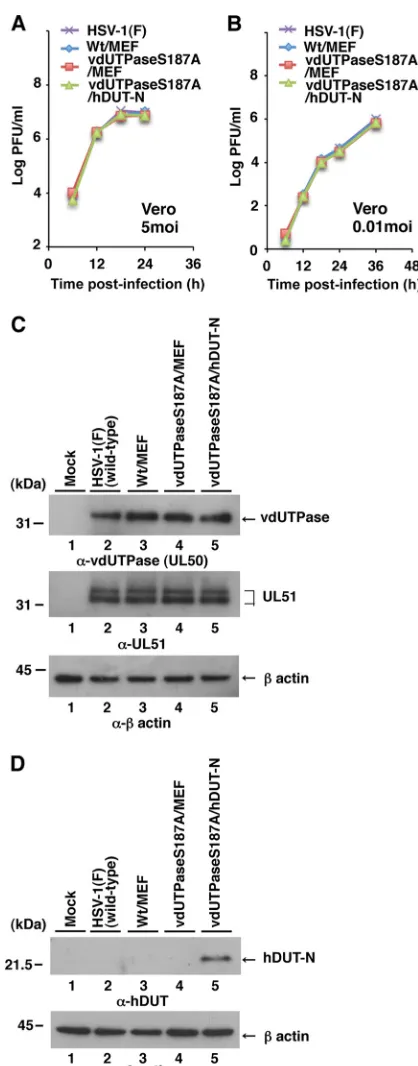
). In agreement with that
re-port, the growth curves of these three recombinant viruses were
almost identical to that of wild-type HSV-1(F) in Vero cells
in-FIG 2Expression and enzymatic activity of endogenous cellular dUTPase in SK-N-SH cells. (A) Expression of cellular dUTPase protein in HEp-2 (lane 1) and SK-N-SH (lane 2) cells analyzed by immunoblotting with anti-cellular dUTPase mouse monoclonal antibody (top) and anti--actin mouse monoclonal antibody (bottom). Molecular mass markers (in kilo-daltons) are shown on the left. (B) Amount of hDUT-N in the SK-N-SH and HEp-2 cells shown in panel A (top) relative to that of-actin shown in panel A (bottom). Each value is the mean⫾standard error from triplicate experiments and is expressed relative to the mean value for HEp-2 cells, which was normalized to 100%. (C) Cellular dUTPase activity in SK-N-SH and HEp-2 cells. Each value is the mean⫾standard error from triplicate experiments and is expressed relative to the mean value for HEp-2 cells, which was normalized to 100%. Asterisks indicate significant differences (*,P⬍0.05) by the two-tailed Studentttest. Data are representative of three independent experiments.on November 7, 2019 by guest
http://jvi.asm.org/
[image:4.585.341.494.62.463.2]fected at multiplicities of infection (MOIs) of 5 and 0.01 (
Fig. 3A
and
B
). Furthermore, insertion of these foreign genes into the
intergenic region between UL50 and UL51 in the three
recom-binant viruses had no effect on the expression of UL50 and
UL51, based on the observation that wild-type HSV-1(F),
YK761 (Wt/MEF), YK762 (vdUTPaseS187A/MEF), and YK764
(vdUTPaseS187A/hDUT-N) produced similar levels of UL50 and
UL51 in infected Vero cells (
Fig. 3C
). Overexpression of hDUT-N
in Vero cells infected with YK764 (vdUTPaseS187A/hDUT-N)
was confirmed by the observation that the anti-human dUTPase
antibody used in this study, which could not react with simian
endogenous dUTPase, did react with hDUT-N in the lysate of
Vero cells infected with YK764 (vdUTPaseS187A/hDUT-N)
(
Fig. 3D
).
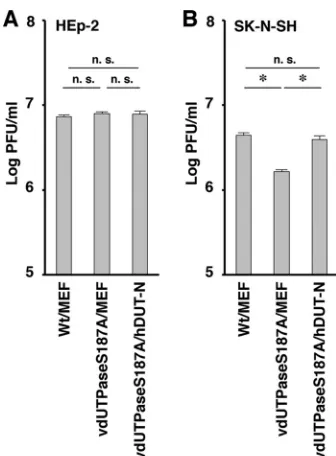
SK-N-SH and HEp-2 cells were then infected with YK761 (Wt/
MEF), YK762 (vdUTPaseS187A/MEF), or YK764 (vdUTPaseS187A/
hDUT-N) at an MOI of 5, and viral titers were assayed at 36 h
postinfection. In agreement with our previous report that an
HSV-1 strain with the vdUTPase S187A mutation replicated less
efficiently than wild-type HSV-1 in SK-N-SH cells (
21
), the
prog-eny virus titer (1.6
⫻
10
6PFU/ml) in SK-N-SH cells infected with
YK762 (vdUTPaseS187A/MEF) was significantly lower than that
(4.2
⫻
10
6PFU/ml) in these cells infected with YK761 (Wt/MEF)
(
Fig. 4B
). In contrast, the progeny virus titer in SK-N-SH cells
infected with YK764 (vdUTPaseS187A/hDUT-N) was similar to
that in these cells infected with YK761 (Wt/MEF) (
Fig. 4B
).
How-ever, the progeny virus titers were similar in HEp-2 cells infected
with YK761 (Wt/MEF), YK762 (vdUTPaseS187A/MEF), or
YK764 (vdUTPaseS187A/hDUT-N) (
Fig. 4A
). These results
indi-cated that overexpression of cellular hDUT-N in SK-N-SH cells
increased viral replication from the lower level caused by the
vdUTPase S187A mutation to the wild-type level.
Effect of endogenous cellular dUTPase knockdown on
repli-cation of HSV-1 with the vdUTPase S187A mutation.
To
inves-tigate the effect of cellular dUTPase knockdown in HEp-2 cells on
replication of YK751 (vdUTPaseS187A), we generated a HEp-2
cell line stably expressing short hairpin RNA (shRNA) against the
3
=
-UTR regions of hDUT-N and hDUT-M mRNAs
(sh-hDUT-HEp-2 cells) and a control cell line expressing shRNA against the
ORF in firefly luciferase mRNA (sh-Luc-HEp-2 cells). In
agree-ment with the results shown in
Fig. 2A
, hDUT-N and hDUT-M
proteins in sh-Luc-HEp-2 cells were detected as two bands in a
denaturing gel, with the faster-migrating band (i.e., hDUT-N)
being the dominant band (
Fig. 5A
). In contrast, both hDUT-N
and hDUT-M proteins were barely detectable in sh-hDUT-HEp-2
cells (
Fig. 5A
). Consistent with this result, endogenous dUTPase
activity in sh-hDUT-HEp-2 cells was significantly lower than
that in sh-Luc-HEp-2 cells (
Fig. 5B
). However, the viability of
sh-hDUT-HEp-2 cells was similar to that of sh-Luc-HEp-2
cells (
Fig. 5C
).
To further investigate the effect of dUTPase knockdown on
viral replication, sh-hDUT-HEp-2 and sh-Luc-HEp-2 cells were
infected with wild-type HSV-1(F); YK750 (
⌬
vdUTPase), a
vdUTPase-null mutant virus; YK751 (vdUTPaseS187A); YK752
(vdUTPase
⌬
/SA-repair), the repaired YK751 virus; YK753
(vdUTPaseS187D), a mutant virus carrying a phosphomimetic
mutation in Ser-187; or YK754 (vdUTPaseS187D-repair), the
re-paired YK753 virus, at an MOI of 5 or 0.01, and viral titers were
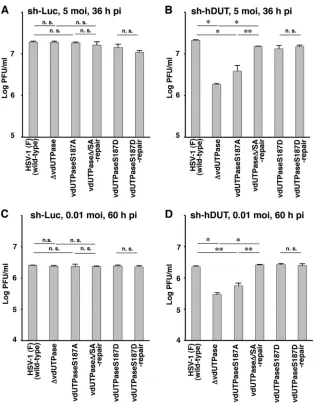
assayed at 36 and 60 h postinfection. As shown in
Fig. 6A
and
C
,
the progeny virus titers of all these mutant viruses were similar to
FIG 3Characterization of the recombinant HSV-1 strains used in this study. (A) Expression of cellular dUTPase in Vero cells analyzed by immunoblotting with anti-cellular dUTPase mouse monoclonal antibody (top) and anti- -actin mouse monoclonal antibody (bottom). (B) Expression of vdUTPase and UL51 in Vero cells analyzed by immunoblotting with anti-vdUTPase rabbit polyclonal antibody (top), anti-UL51 rabbit polyclonal antibody (middle), and anti--actin mouse monoclonal antibody (bottom). Molecular mass markers (in kilodaltons) are shown on the left. (C and D) Vero cells were infected at an MOI of 5 (C) or 0.01 (D) with wild-type strain HSV-1(F), YK761 (Wt/MEF), YK762 (vdUTPaseS187A/MEF), or YK764 (vdUTPaseS187A/ hDUT-N). Total virus from cell culture supernatants and infected cells was harvested at the indicated times and was assayed on Vero cells. Data are rep-resentative of three independent experiments.
on November 7, 2019 by guest
http://jvi.asm.org/
[image:5.585.315.524.61.594.2]that of wild-type HSV-1(F) in sh-Luc-HEp-2 cells, as reported
previously (
21
). In contrast, the titers of the YK750 (
⌬
vdUTPase)
and YK751 (vdUTPaseS187A) viruses in sh-hDUT-HEp-2 cells
were significantly lower than those of repaired virus strain YK752
(vdUTPase
⌬
/SA-repair) and wild-type strain HSV-1(F) (
Fig. 6B
and
D
). Furthermore, the wild-type virus titer was restored in
sh-hDUT-HEp-2 cells infected with YK753 (vdUTPaseS187D)
carrying a phosphomimetic mutation in vdUTPase Ser-187,
which has been reported to mimic constitutive phosphorylation
(
34
,
39
) and increase vdUTPase activity to the wild-type level (
21
)
(
Fig. 6B
and
D
).
To examine whether the phenotype(s) observed in
sh-hDUT-HEp-2 cells was due to an off-target effect(s) of the anti-cellular
dUTPase shRNA, two sets of experiments were performed. First,
we generated sh-hDUT-HEp-2/hDUT-N(
⫹
) cells, in which
cel-lular hDUT-N was expressed exogenously, by transduction of
sh-hDUT-HEp-2 cells with a retrovirus vector expressing hDUT-N.
The levels of hDUT-N expression and cellular dUTPase activity in
sh-hDUT-HEp-2/hDUT-N(
⫹
) cells were comparable to those in
Luc-HEp-2 cells but considerably higher than those in
sh-hDUT-HEp-2 cells (
Fig. 7A
and
B
). In contrast, the viability of
sh-hDUT-HEp-2/hDUT-N(
⫹
) cells was similar to those of
sh-Luc-HEp-2 and sh-hDUT-HEp-2 cells (
Fig. 7C
). Luc-HEp-2,
sh-hDUT-HEp-2, and sh-hDUT-HEp-2/hDUT-N(
⫹
) cells were then
infected with wild-type strain HSV-1(F), YK750 (
⌬
vdUTPase), or
YK751 (vdUTPaseS187A) at an MOI of 5 or 0.01, and viral titers
were assayed at 36 and 60 h postinfection. In agreement with the
results shown in
Fig. 6B
and
D
, the progeny virus titers of YK750
(
⌬
vdUTPase) and YK751 (vdUTPaseS187A) in sh-hDUT-HEp-2
cells were significantly lower than those in sh-Luc-HEp-2 cells
(
Fig. 8B
,
C
,
E
, and
F
). However, the progeny virus yields of YK750
(
⌬
vdUTPase) and YK751 (vdUTPaseS187A) in sh-hDUT-HEp-2/
hDUT-N(
⫹
) cells increased significantly compared to those in
sh-hDUT-HEp-2 cells and were comparable to those in
sh-Luc-HEp-2 cells (
Fig. 8B
,
C
,
E
, and
F
). The virus titers of wild-type
strain HSV-1(F) in Luc-HEp-2, hDUT-HEp-2, and
sh-hDUT-HEp-2/hDUT-N(
⫹
) cells were similar (
Fig. 8A
and
D
).
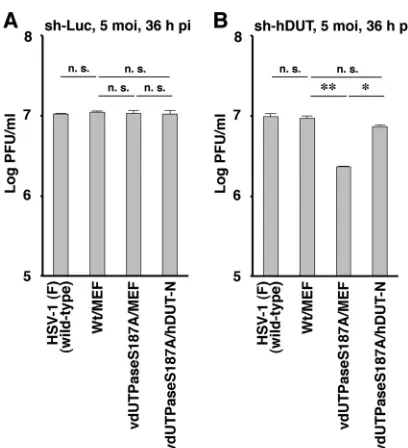
Second, sh-Luc-HEp-2 cells and sh-hDUT-HEp-2 cells were
in-fected with wild-type strain HSV-1(F), YK761 (Wt/MEF), YK762
(vdUTPaseS187A/MEF), or YK764 (vdUTPaseS187A/hDUT-N)
at an MOI of 5, and viral titers were assayed at 36 h postinfection.
Consistent with the results for wild-type strain HSV-1(F), YK751
(vdUTPaseS187A), and YK752 (vdUTPase
⌬
/S187A-repair) (
Fig.
6B
and
8C
), the progeny viral titer in sh-hDUT-HEp-2 cells
in-fected with YK762 (vdUTPaseS187A/MEF) was significantly
lower than the titers in these cells infected with wild-type strain
FIG 4Effect of cellular dUTPase overexpression on HSV-1 replication inSK-N-SH cells. HEp-2 (A) and SK-N-SH (B) cells were infected with YK761 (Wt/MEF), YK762 (vdUTPaseS187A/MEF), or YK764 (vdUTPaseS187A/ hDUT-N) at an MOI of 5. Total virus from cell culture supernatants and infected cells was harvested at 36 h postinfection, and virus titers were assayed on Vero cells. Each value is the mean⫾standard error from six duplicate experiments. Asterisks indicate significant differences (*,P⬍0.0167) by Holm’s sequentially rejective Bonferroni multiple-comparison test. n.s., not significant. Data are representative of three independent experiments.
FIG 5Effect of knockdown of endogenous cellular dUTPase in HEp-2 cells. (A) Expression of cellular dUTPase in sh-Luc-HEp-2 and sh-hDUT-HEp-2 cells analyzed by immunoblotting with anti-cellular dUTPase mouse mono-clonal antibody (top) and anti--actin mouse monoclonal antibody (bottom). Molecular mass markers (in kilodaltons) are shown on the left. (B and C) Relative dUTPase activity (B) and cell viability (C) of Luc-HEp-2 and sh-hDUT-HEp-2 cells. Each value is the mean⫾standard error of data from triplicate experiments and is expressed relative to the mean for sh-Luc-HEp-2 cells, which was normalized to 100%. Asterisks indicate significant differences (*,P⬍0.05) by the two-tailed Studentttest. n.s., not significant. Data are representative of three independent experiments.
on November 7, 2019 by guest
http://jvi.asm.org/
[image:6.585.78.246.63.291.2] [image:6.585.350.492.68.412.2]HSV-1(F) or YK761 (Wt/MEF) (
Fig. 9B
). In contrast, the progeny
viral titer in sh-hDUT-HEp-2 cells infected with YK764
(vdUTPaseS187A/hDUT-N) was similar to those in these cells
in-fected with wild-type HSV-1(F) or YK761 (Wt/MEF) (
Fig. 9B
).
The titers of these viruses in sh-Luc-HEp-2 cells were similar (
Fig.
9A
). These results eliminated the possibility that the reduced
rep-lication of the vdUTPase mutant virus in sh-hDUT-HEp-2 cells
was due to an off-target effect(s) of the shRNA against cellular
dUTPase.
Taken together, these results indicated that the level of
endog-enous cellular dUTPase activity in HEp-2 cells was sufficient for
efficient replication of HSV-1 mutant viruses carrying the null
or S187A mutation in vdUTPase and that phosphorylation of
vdUTPase Ser-187 was required for efficient viral replication in
cells in which endogenous dUTPase activity was low.
DISCUSSION
In the present study, we tested the hypothesis that dUTPase
activity was important for replication of viruses that encode a
vdUTPase and that the vdUTPase was able to compensate if the
endogenous host cell dUTPase activity was not sufficient for
effi-cient viral replication. This hypothesis had been based on
obser-vations that low endogenous cellular dUTPase activity was linked
to low viral replication and to a reduced virulence of viruses with
a mutation in vdUTPase (
4
,
17–20
). In this study, we obtained the
following direct experimental data supporting this hypothesis. (i)
Although the endogenous cellular dUTPase activity in SK-N-SH
cells was significantly lower than that in HEp-2 cells (
Fig. 2B
),
overexpression of cellular dUTPase in SK-N-SH cells restored the
replication of a virus with the vdUTPase S187A mutation, which
was reported previously to prevent Us3 phosphorylation of
FIG 6Effect of endogenous cellular dUTPase knockdown in HEp-2 cells on HSV-1 replication. sh-Luc-HEp-2 (A and C) and sh-hDUT-HEp-2 (B and D) cells were infected with wild-type HSV-1(F), YK750 (⌬vdUTPase), YK751 (vdUTPaseS187A), YK752 (vdUTPase⌬/SA-repair), YK753 (vdUTPaseS187D), or YK754 (vdUTPaseS187D-repair) at an MOI of 5 (A and B) or 0.01 (C and D). Total virus from the cell culture supernatants and infected cells was harvested at 36 h (A and B) and 60 h (C and D) postinfection (pi), and virus titers were assayed on Vero cells. Each value is the mean⫾standard error from quadruplicate experiments. Asterisks indicate a significant difference in the mean (*,P⬍0.0083; **,P⬍0.0167) by Holm’s sequentially rejective Bonferroni multiple-comparison test. n.s., not significant. Data are representative of three independent experiments.on November 7, 2019 by guest
http://jvi.asm.org/
[image:7.585.135.449.63.466.2]vdUTPase Ser-187 and to impair its enzymatic activity (
21
) to the
wild-type virus level (
Fig. 4B
). (ii) Knockdown of cellular
dUTPase in HEp-2 cells, which also caused the downregulation of
its enzymatic activity, significantly reduced the replication of the
vdUTPase S187A mutant virus (
Fig. 6B
and
D
and
9B
). (iii) A
phosphomimetic substitution at vdUTPase Ser-187, which was
reported previously to restore vdUTPase activity to the wild-type
level (
21
), had the wild-type level of viral replication in cellular
dUTPase knockdown HEp-2 cells (
Fig. 6B
and
D
). Collectively,
these results suggested that a particular level of dUTPase activity is
required for efficient HSV-1 replication and that Us3
phosphory-lation of vdUTPase at Ser-187, which was reported previously to
upregulate its enzymatic activity (
21
), is able to compensate for
cellular endogenous dUTPase activity if it is too low for efficient
viral replication. This is the first report, to our knowledge, directly
showing that dUTPase activity is critical for efficient viral
replica-FIG 8Effect of exogenous hDUT-N expression in sh-hDUT-HEp-2 cells on HSV-1 replication. sh-Luc-HEp-2, sh-hDUT-HEp-2, and sh-hDUT/hDUT-N(⫹)-HEp-2 cells were infected with wild-type HSV-1(F) (A and D), YK750 (⌬vdUTPase) (B and E), or YK751 (vdUTPaseS187A) (C and F) at an MOI of 5 (A to C) or 0.01 (D to F). Total virus from the cell culture supernatants and infected cells was harvested at 36 h (A to C) and 60 h (D to F) postinfection, and virus titers were assayed on Vero cells. Each value is the mean⫾standard error from triplicate experiments. Asterisks indicate a significant difference in the mean (*,P⬍0.0167; **,P⬍0.025) by Holm’s sequentially rejective Bonfer-roni multiple-comparison test. n.s., not significant. Data are representative of three independent experiments.
FIG 7Expression of exogenous hDUT-N in hDUT-HEp-2 cells. (A) sh-Luc-HEp-2, sh-hDUT-HEp-2, and sh-hDUT/hDUT-N(⫹)-HEp-2 cells were analyzed by immunoblotting with anti-cellular dUTPase mouse monoclonal antibody (top) and anti--actin mouse monoclonal antibody (bottom). Mo-lecular mass markers (in kilodaltons) are shown on the left. (B and C) Relative dUTPase activity (B) and cell viability (C) of sh-Luc-HEp-2, sh-hDUT-HEp-2, and sh-hDUT/hDUT-N(⫹)-HEp-2 cells. Each value is the mean⫾standard error from triplicate experiments and is expressed relative to the mean for sh-Luc-HEp-2 cells, which was normalized to 100%. Asterisks indicate signif-icant differences (*,P⬍0.05; **,P⬍0.01) by the two-tailed Studentttest. n.s., not significant. Data are representative of three independent experiments.
on November 7, 2019 by guest
http://jvi.asm.org/
[image:8.585.73.258.62.418.2] [image:8.585.331.509.63.607.2]tion and that virally encoded dUTPase compensates for low
cel-lular dUTPase activity if it is not sufficient for efficient viral
repli-cation.
We recently reported that Us3 phosphorylation of vdUTPase
Ser-187 was required for efficient viral replication and virulence in
the CNS of mice after intracranial inoculation, whereas it played
no role in viral replication and pathogenicity in the eyes and
vagi-nas of mice after ocular and vaginal inoculation, respectively (
22
).
Therefore, these results in mice, like those in the present study
with cultured cells, suggested that Us3 phosphorylation of
vdUTPase Ser-187 is required to compensate for low cellular
dUTPase activity to provide sufficient dUTPase for efficient viral
replication in the CNS of mice, since epithelial cells in the eyes and
vagina are actively dividing but most cells in the CNS are not (
40
,
41
). There has been an analogous suggestion for HSV-1
thymi-dine kinase (vTK), another viral homolog of a host cell enzyme
involved in nucleotide metabolism, which has been reported to
compensate for endogenous cellular TK in ganglia
in vivo
,
based on observations that (i) vTK was required for viral
rep-lication in ganglia of mice following ocular inoculation and for
reactivation from latency following ganglionic explant and (ii)
replacement of vTK with human thymidine kinase (hTK) was
able to fulfill the vTK function in the ganglia of mice (
42
). A
similar strategy could be used to investigate the role of Us3
phosphorylation of vdUTPase at Ser-187 in compensating for a
cellular dUTPase activity that was not sufficient for efficient
viral replication and virulence in the CNS of mice. We are now
currently investigating the effect of the overexpression of
cel-lular vdUTPase on viral replication in the CNS and on the
virulence of recombinant viruses carrying the S187A mutation
in vdUTPase in mice following intracranial inoculation.
An important question that remains to be answered is how
dUTPase activity contributes to efficient HSV-1 replication. As
described above, dUTPase is known to prevent misincorporation
of dUTP into replicating DNA, which is necessary for accurate
DNA replication. Therefore, dUTPase activity may function as an
antimutator and may play a role in HSV-1 replication by
increas-ing the fidelity of viral DNA replication. In agreement with this
hypothesis, it has been reported that the mutation frequency of a
feline immunodeficiency virus (FIV) mutant lacking vdUTPase
that was integrated into the DNA of T lymphocytes was
signifi-cantly lower than the mutation frequency of the FIV mutant
inte-grated into primary macrophages, where endogenous cellular
dUTPase activity was lower, and the FIV mutant replicated less
efficiently in primary macrophages than in T lymphocytes (
18
,
43
). In addition, loss of HSV-1 vdUTPase has been reported to
significantly increase the mutation frequency of the viral genome
in NIH 3T3 cells (
44
). However, we note that the loss of HSV-1
vdUTPase had no effect on viral replication in NIH 3T3 cells (
44
),
and therefore, it has not been determined whether the high
mu-tation frequency in the viral genome in cells infected with an
HSV-1 mutant lacking vdUTPase is related to the low level of
replication of the FIV mutant. Further studies are needed to
an-swer this question, and we are currently investigating the effect of
knockdown and overexpression of cellular dUTPase on the
muta-tion frequency in recombinant viruses with the S187A mutamuta-tion in
vdUTPase in cell cultures and/or in the CNS of mice.
ACKNOWLEDGMENTS
We thank Tomoko Ando and Shihoko Koyama for excellent technical assistance.
This study was supported by the Funding Program for Next Genera-tion World-Leading Researchers and grants for scientific research from the Japan Society for the Promotion of Science (JSPS); a contract research fund for the program of the Japan Initiative for Global Research Network on Infectious Diseases (J-GRID); a grant for scientific research on inno-vative areas from the Ministry of Education, Culture, Science, Sports and Technology (MEXT) of Japan; and a grant from the Takeda Science Foun-dation.
REFERENCES
1.Boehmer PE, Lehman IR.1997. Herpes simplex virus DNA replication. Annu. Rev. Biochem. 66:347–384. http://dx.doi.org/10.1146/annurev .biochem.66.1.347.
2.Beaud G.1995. Vaccinia virus DNA replication: a short review. Biochimie 77:774 –779.http://dx.doi.org/10.1016/0300-9084(96)88195-8. 3.Elder JH, Lerner DL, Hasselkus-Light CS, Fontenot DJ, Hunter E,
Luciw PA, Montelaro RC, Phillips TR.1992. Distinct subsets of retrovi-ruses encode dUTPase. J. Virol.66:1791–1794.
4.Payne SL, Elder JH.2001. The role of retroviral dUTPases in replication and virulence. Curr. Protein Pept. Sci.2:381–388.http://dx.doi.org/10 .2174/1389203013381008.
5.Chen R, Wang H, Mansky LM.2002. Roles of uracil-DNA glycosylase and dUTPase in virus replication. J. Gen. Virol.83:2339 –2345.http://vir .sgmjournals.org/content/83/10/2339.long.
6.Lembo D, Brune W.2009. Tinkering with a viral ribonucleotide reduc-tase. Trends Biochem. Sci.34:25–32.http://dx.doi.org/10.1016/j.tibs.2008 .09.008.
7.Basta HA, Cleveland SB, Clinton RA, Dimitrov AG, McClure MA.2009. Evolution of teleost fish retroviruses: characterization of new retroviruses with cellular genes. J. Virol.83:10152–10162.http://dx.doi.org/10.1128 /JVI.02546-08.
8.Baldo AM, McClure MA. 1999. Evolution and horizontal transfer of FIG 9Effect of cellular dUTPase overexpression on HSV-1 replication in
sh-hDUT-HEp-2 cells. sh-Luc-HEp-2 (A) and sh-hDUT-HEp-2 (B) cells were infected with wild-type strain HSV-1(F), YK761 (Wt/MEF), YK762 (vdUTPaseS187A/MEF), or YK764 (vdUTPaseS187A/hDUT-N) at an MOI of 5. The cells were grown and viruses were assayed as described in the legend of Fig. 4. Each value is the mean⫾standard error from triplicate experiments. Asterisks indicate a significant difference in the mean (*,P⬍0.0083; **,P⬍
0.0167) by Holm’s sequentially rejective Bonferroni multiple-comparison test. n.s., not significant. Data are representative of three independent experiments.
on November 7, 2019 by guest
http://jvi.asm.org/
[image:9.585.60.264.62.286.2]dUTPase-encoding genes in viruses and their hosts. J. Virol.73:7710 – 7721.
9.McClure MA.2001. Evolution of the DUT gene: horizontal transfer be-tween host and pathogen in all three domains of life. Curr. Protein Pept. Sci.2:313–324.http://dx.doi.org/10.2174/1389203013381062.
10. Shlomai J, Kornberg A.1978. Deoxyuridine triphosphatase of Esche-richia coli. Purification, properties, and use as a reagent to reduce uracil incorporation into DNA. J. Biol. Chem.253:3305–3312.
11. Vertessy BG, Toth J.2009. Keeping uracil out of DNA: physiological role, structure and catalytic mechanism of dUTPases. Acc. Chem. Res.42:97– 106.http://dx.doi.org/10.1021/ar800114w.
12. Bessman MJ, Lehman IR, Adler J, Zimmerman SB, Simms ES, Korn-berg A.1958. Enzymatic synthesis of deoxyribonucleic acids. III. The incorporation of pyrimidine and purine analogues into deoxyribonucleic acids. Proc. Natl. Acad. Sci. U. S. A.44:633– 640.
13. Sedwick WD, Brown OE, Glickman BW.1986. Deoxyuridine misin-corporation causes site-specific mutational lesions in the lacI gene of Escherichia coli. Mutat. Res.162:7–20.http://dx.doi.org/10.1016/0027 -5107(86)90066-7.
14. Kunz BA, Kohalmi SE.1991. Modulation of mutagenesis by deoxyribo-nucleotide levels. Annu. Rev. Genet. 25:339 –359.http://dx.doi.org/10 .1146/annurev.ge.25.120191.002011.
15. Roizman B, Knipe DM, Whitley RJ.2013. Herpes simplex viruses, p 2501–2601.InKnipe DM, Howley PM, Cohen JI, Griffin DE, Lamb RA, Martin MA, Racaniello VR, Roizman B (ed), Fields virology, 6th ed. Lip-pincott-Williams & Wilkins, Philadelphia, PA.
16. Pyles RB, Sawtell NM, Thompson RL.1992. Herpes simplex virus type 1 dUTPase mutants are attenuated for neurovirulence, neuroinvasiveness, and reactivation from latency. J. Virol.66:6706 – 6713.
17. Threadgill DS, Steagall WK, Flaherty MT, Fuller FJ, Perry ST, Rushlow KE, Le Grice SF, Payne SL.1993. Characterization of equine infectious anemia virus dUTPase: growth properties of a dUTPase-deficient mutant. J. Virol.67:2592–2600.
18. Lerner DL, Wagaman PC, Phillips TR, Prospero-Garcia O, Henriksen SJ, Fox HS, Bloom FE, Elder JH.1995. Increased mutation frequency of feline immunodeficiency virus lacking functional deoxyuridine-triphosphatase. Proc. Natl. Acad. Sci. U. S. A.92:7480 –7484.http://dx.doi .org/10.1073/pnas.92.16.7480.
19. Turelli P, Petursson G, Guiguen F, Mornex JF, Vigne R, Querat G. 1996. Replication properties of dUTPase-deficient mutants of caprine and ovine lentiviruses. J. Virol.70:1213–1217.
20. Oliveros M, Garcia-Escudero R, Alejo A, Vinuela E, Salas ML, Salas J. 1999. African swine fever virus dUTPase is a highly specific enzyme re-quired for efficient replication in swine macrophages. J. Virol.73:8934 – 8943.
21. Kato A, Tsuda S, Liu Z, Kozuka-Hata H, Oyama M, Kawaguchi Y.2014. Herpes simplex virus 1 protein kinase Us3 phosphorylates viral dUTPase and regulates its catalytic activity in infected cells. J. Virol.88:655– 666. http://dx.doi.org/10.1128/JVI.02710-13.
22. Kato A, Shindo K, Maruzuru Y, Kawaguchi Y.2014. Phosphorylation of a herpes simplex virus 1 dUTPase by a viral protein kinase, Us3, dictates viral pathogenicity in the central nervous system but not at the periphery. J. Virol.88:2775–2785.http://dx.doi.org/10.1128/JVI.03300-13. 23. Tanaka M, Kagawa H, Yamanashi Y, Sata T, Kawaguchi Y. 2003.
Construction of an excisable bacterial artificial chromosome containing a full-length infectious clone of herpes simplex virus type 1: viruses recon-stituted from the clone exhibit wild-type properties in vitro and in vivo. J. Virol.77:1382–1391.http://dx.doi.org/10.1128/JVI.77.2.1382-1391.2003. 24. Sugimoto K, Uema M, Sagara H, Tanaka M, Sata T, Hashimoto Y, Kawaguchi Y.2008. Simultaneous tracking of capsid, tegument, and en-velope protein localization in living cells infected with triply fluorescent herpes simplex virus 1. J. Virol.82:5198 –5211.http://dx.doi.org/10.1128 /JVI.02681-07.
25. Ejercito PM, Kieff ED, Roizman B.1968. Characterization of herpes simplex virus strains differing in their effects on social behaviour of in-fected cells. J. Gen. Virol.2:357–364.http://dx.doi.org/10.1099/0022-1317 -2-3-357.
26. Yamamichi N, Yamamichi-Nishina M, Mizutani T, Watanabe H, Mi-noguchi S, Kobayashi N, Kimura S, Ito T, Yahagi N, Ichinose M, Omata M, Iba H.2005. The Brm gene suppressed at the post-transcriptional level in various human cell lines is inducible by transient HDAC inhibitor
treat-ment, which exhibits antioncogenic potential. Oncogene24:5471–5481. http://dx.doi.org/10.1038/sj.onc.1208716.
27. Haraguchi T, Ozaki Y, Iba H.2009. Vectors expressing efficient RNA decoys achieve the long-term suppression of specific microRNA activity in mammalian cells. Nucleic Acids Res.37:e43.http://dx.doi.org/10.1093 /nar/gkp040.
28. Arii J, Goto H, Suenaga T, Oyama M, Kozuka-Hata H, Imai T, Minowa A, Akashi H, Arase H, Kawaoka Y, Kawaguchi Y.2010. Non-muscle myosin IIA is a functional entry receptor for herpes simplex virus-1. Na-ture467:859 – 862.http://dx.doi.org/10.1038/nature09420.
29. Tanaka Y, Kanai F, Ichimura T, Tateishi K, Asaoka Y, Guleng B, Jazag A, Ohta M, Imamura J, Ikenoue T, Ijichi H, Kawabe T, Isobe T, Omata M.2006. The hepatitis B virus X protein enhances AP-1 activation through interaction with Jab1. Oncogene25:633– 642.
30. Kawaguchi Y, Van Sant C, Roizman B.1997. Herpes simplex virus 1 alpha regulatory protein ICP0 interacts with and stabilizes the cell cycle regulator cyclin D3. J. Virol.71:7328 –7336.
31. Kato A, Tanaka M, Yamamoto M, Asai R, Sata T, Nishiyama Y, Kawaguchi Y.2008. Identification of a physiological phosphorylation site of the herpes simplex virus 1-encoded protein kinase Us3 which regulates its optimal catalytic activity in vitro and influences its function in infected cells. J. Virol.82:6172– 6189.http://dx.doi.org/10.1128/JVI.00044-08. 32. Tischer BK, von Einem J, Kaufer B, Osterrieder N.2006. Two-step
red-mediated recombination for versatile high-efficiency markerless DNA manipulation in Escherichia coli. Biotechniques40:191–197.http://dx .doi.org/10.2144/000112096.
33. Nozawa N, Kawaguchi Y, Tanaka M, Kato A, Kato A, Kimura H, Nishiyama Y.2005. Herpes simplex virus type 1 UL51 protein is involved in maturation and egress of virus particles. J. Virol.79:6947– 6956.http: //dx.doi.org/10.1128/JVI.79.11.6947-6956.2005.
34. Kato A, Arii J, Shiratori I, Akashi H, Arase H, Kawaguchi Y.2009. Herpes simplex virus 1 protein kinase Us3 phosphorylates viral envelope glycoprotein B and regulates its expression on the cell surface. J. Virol. 83:250 –261.http://dx.doi.org/10.1128/JVI.01451-08.
35. Williams MV, Cheng Y.1979. Human deoxyuridine triphosphate nucle-otidohydrolase. Purification and characterization of the deoxyuridine triphosphate nucleotidohydrolase from acute lymphocytic leukemia. J. Biol. Chem.254:2897–2901.
36. Ladner RD, McNulty DE, Carr SA, Roberts GD, Caradonna SJ.1996. Characterization of distinct nuclear and mitochondrial forms of human deoxyuridine triphosphate nucleotidohydrolase. J. Biol. Chem.271:7745– 7751.http://dx.doi.org/10.1074/jbc.271.13.7745.
37. Ladner RD, Caradonna SJ.1997. The human dUTPase gene encodes both nuclear and mitochondrial isoforms. Differential expression of the iso-forms and characterization of a cDNA encoding the mitochondrial spe-cies. J. Biol. Chem.272:19072–19080.
38. Morimoto T, Arii J, Akashi H, Kawaguchi Y. 2009. Identification of multiple sites suitable for insertion of foreign genes in herpes simplex virus genomes. Microbiol. Immunol.53:155–161.http://dx.doi.org/10.1111/j .1348-0421.2008.00104.x.
39. Kato A, Liu Z, Minowa A, Imai T, Tanaka M, Sugimoto K, Nishiyama Y, Arii J, Kawaguchi Y.2011. Herpes simplex virus 1 protein kinase Us3 and major tegument protein UL47 reciprocally regulate their subcellular localization in infected cells. J. Virol.85:9599 –9613.http://dx.doi.org/10 .1128/JVI.00845-11.
40. Martin-Belmonte F, Perez-Moreno M.2012. Epithelial cell polarity, stem cells and cancer. Nat. Rev. Cancer12:23–38.http://dx.doi.org/10.1038 /nrc3169.
41. Jakobsson J, Lundberg C.2006. Lentiviral vectors for use in the central nervous system. Mol. Ther. 13:484 – 493. http://dx.doi.org/10.1016/j .ymthe.2005.11.012.
42. Patel R, Harper DR. 1998. Subclinical herpes virus reactivation and latency. Curr. Opin. Infect. Dis. 11:31–35. http://dx.doi.org/10.1097 /00001432-199802000-00008.
43. Wagaman PC, Hasselkus-Light CS, Henson M, Lerner DL, Phillips TR, Elder JH.1993. Molecular cloning and characterization of deoxyuridine triphosphatase from feline immunodeficiency virus (FIV). Virology196: 451– 457.http://dx.doi.org/10.1006/viro.1993.1501.
44. Pyles RB, Thompson RL.1994. Mutations in accessory DNA replicating functions alter the relative mutation frequency of herpes simplex virus type 1 strains in cultured murine cells. J. Virol.68:4514 – 4524.
on November 7, 2019 by guest
http://jvi.asm.org/