IN A CONDENSING MEDIUM
II. THE FWW OF A GAS-PARTICLE MIXTURE DOWNSTREAM OF A NORMAL SHOCK IN A NOZZLE
Thesis by David Clark Wooten
In Partial Fulfillment of the Requirements For the Degree of
Doctor of Philosophy
California Institute of Technology Pasadena, California
1°967
ACKNOWLEDGMENTS
The author wishes to express his deepest gratitude to Profes-sor Frank E .. Marble for his advice, guidance, and encouragement during the course of this work and throughout the course of the author's graduate study.
The excellent work of Mrs. Robert Duffy in preparing the manuscript is appreciated.
Financial assistance to the author in the form of a National Science Foundation Fellowship and fellowships and research assistant-ships from the California Institute of Technology are gratefully
ABSTRACT
I. The attenuation of sound due to particles suspended in a gas was first calculated by Sewell and later by Epstein in their classical works on the propagation of sound in a two-phase medium. In their work, and in more recent works which include calculations of sound dispersion, the calculations were made for systems in which there was no mass transfer between the two phases. In the present work, mass transfer between phases is included in the calculations.
The attenuation and dispersion of sound in a two-phase con-densing medium are calculated as functions of frequency. The medi-um in which th,e sound propagates consists of a gaseous phase, a mixture of inert gas and condensible vapor, which contains conden-sible liquid droplets. The droplets,· which interact with the gaseous phase through the interchange of momentum, energy, and mass
(through evaporation and condensation), are treated from the continu-um viewpoint. Limiting cases, for flow either frozen or in equilibri-um with respect to the various exchange processes, help demonstrate the effects of mass transfer between phases. Included in the calcula-tion is the effect of thermal relaxation within droplets. Pressure re-laxation between the two phases is examined, but is not included as a co.ntributing factor because it is of interest only at much higher fre-quencies than the other relaxation processes. The results for a
and occurs at about one-half the frequency for the case which in-cludes mass transfer, and that the dispersion at low frequencies is about 35 per cent greater. Results for different values of latent heat are compared.
II. In the flow of a gas-particle mixture through a nozzle, a normal shock may exist in the diverging section of the nozzle. In Marble1s calculation for a shock in a constant area duct, the shock was described as a usual gas-dynamic shock followed by a relaxation zone in which the gas and particles return to equilibrium. The thick-ness of this zone, which is the total shock thickness in the
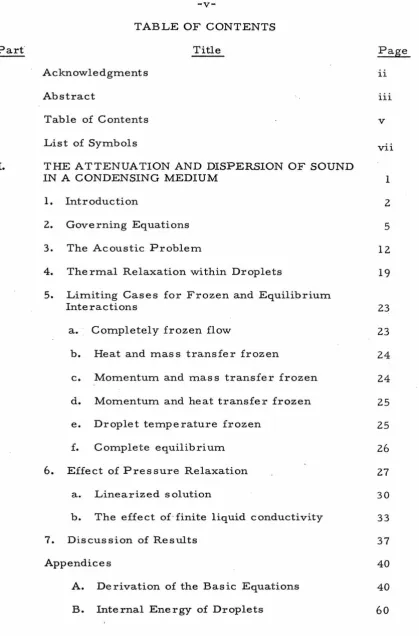
Part"
I.
TABLE OF CONTENTS Title
Acknowledgments Abstract
Table of Contents List of Symbols
THE ATTENUATION AND DISPERSION OF SOUND IN A CONDENSING MEDIUM
1. Introduction
2. Governing Equations 3. The Acoustic Problem
4. Thermal Relaxation within Droplets
5. Limiting Cases for Frozen and Equilibrium Interactions
a. Completely frozen flow
b. Heat and mass transfer frozen
c. Momentum and mass transfer frozen d. Momentum and heat transfer frozen e. Droplet temperature frozen
f. Complete equilibrium
6.
Effect of Pressure Relaxationa. Linearized solution
b. The effect of·finite liquid conductivity 7. Discussion of Results
Appendices
A. Derivation of the Basic Equations B. Internal Energy of Droplets
[image:5.550.67.487.51.688.2]Part Title References
Tables and Illustrations
II. THE FLOW OF A GAS-PARTICLE :MIXTURE
DOWNSTREAM OF A NORMAL SHOCK IN A NOZZLE 1 •. Introduction
2.
Governing Equations 3. Small Slip Solution4 •. Shock Solution
5. Matching of the Inner and Outer Solution
6.
Composite Expansion7 . . Application to a Conical Nozzle
8.
Po'sition of Shock in a Nozzle ReferencesPage
62
64
a A c
c p ' c v c p ' c v e
e p f.
1
F .
=
nf.1 1
F(x)
G(x).
h
k-l
K e(T ) v p
K v L m M n p
LIST OF SYMBOLS speed of sound
nozzle area
specific heat of solid or liquid material specific heats of gas
specific heats of gas and particles in equilibrium internal energy of gas, per unit mass
internal energy of particles per unit mass force exerted upon gas by single particle
force exerted upon gas by particles, per unit volume function defined by equation 2. 35
function defined by equation 2. 36 enthalpy of gas, per unit mass latent heat of vaporization complex wave number thermal conductivity of gas thermal conductivity of liquid
equilibrium vapor mass fraction at d;roplet tempera-ture
vapor mass fraction length of nozzle
mass flow rate in nozzle Mach number
number density of particles or droplets thermodynamic pressure
equilibrium vapor pressure of liquid at liquid
p v Pr q Q R Re s Sc
T
T
p u u pa.
=
2K2a0
w
K
1
a0 2
J3
= (-w-)-1
y
y
0
r\
><.
=
pp/ pA
vAT
AD
µ µvpartial pressure of vapor
Prandtl number of gas
heat transfer rate from a single particle to gas
heat transferred from particles to gas, per unit volume
dimensionless radial coordinate
Reynolds number
=
clc pSchmidt number
temperature of gas
temperature of particles velocity of gas
velocity of particles
attenuation coefficient
dispersion coefficient
specific heat ratio of gas
specific heat ratio of gas and particles in equilibrium average spacing between particles
mass fraction of particles or droplets velocity equilibration length of a particle thermal equilibration length of a particle diffusion equilibration length of a particle
viscosity of gas
£
=p
Pp (J
T
v
TT TD
T.(,
Tp
cp
w
x/A
v stretched x-coordinate density of gaseous phase
density of particulate or liquid phase diameter of particles or droplets
velocity equilibration time of a particle
thermal equilibration time of a particle diffusion equilibration time
thermal relaxation time for liquid drpplet
pressure relaxation time
complex phase factor defined by equation B. 8
I. THE ATTENUATION AND.DISPERSION OF SOUND
·.I
1. INTRODUCTION
The attenuation of sound in two-phase media has received
con-siderable attention since Sewell's1 work in 1910. Sewell calculated
the attenuation due to the viscous interaction between an oscillating
non-conducting gas and rigid, fixed, spherical, and cylindrical
ob-jects. In an appending note he extended his calculation to spherical
particles oscillating with some fixed amplitude, small compared to
the wavelength of the sound waves. This result is not valid for small
particle radii, since as the particle radius tends to zero the particles
tend to oscillate with the fluid, and the viscous attenuation tends to
zero. In 1941 Epstein2 calculated the attenuation due to viscous
1n-teraction with spheres freely suspended in the fluid. Calculations
were made for spheres consisting of a rigid solid, elastic solid, and
a viscous liquid. Oscillation of the spheres was restricted to
ampli-tudes small compared to the particle radius. This work was extended
by Epstein and Carhart3 in 1953 to include thermal dissipation due to
irreversible heat transfer between the two phases. Their theory wa,s
compared to data taken by Knudsen, Wilson, and Anderson 4 for
at-tenuation of sound by water fog in air and was found to give
consistent-ly lower values than the experimental data. More recent experiments
by Zink and Delsasso5 using solid particles show good agreement with
Epstein and
C~rhart's
theory. In 1964 Chow6 was able to show thatthe theory of Epstein and Carhart is valid even for motions of the
spherical particles of large amplitude compared to their radius.
Chow included surface tension in his analysis and showed that it is
signifi-cance for liquid droplets in a gas.
The dispersion of sound in a two-phase medium has received
little attention until recently, when the first measurements of sound
dispersion by solid particles in a gas were ma.de by Zink and
Del-5
sasso . They presented a theory, based upon the alteration of the
effective density and specific heat of the gas due to the presence of
the particles, which agreed with their measurements. A more
com-plete theory by Chu and Chow 7 shows good agreement with the
dis-persion measu+ements of Zink and Delsasso.
The theory developed by Epstein, Epstein and Carhart, and
Chow uses the acoustic potential to calculate the scattering of a plane
wave by a single spherical particle or droplet. The attenuation is
calculated from the increase in entropy due to irreversible transfer
of heat and momentum between the particles and the gas. The
result-ing attenuation due to a sresult-ingle particle is then multiplied by the
num-ber of particles to obtain the total attenuation. Temkin 8 and Temkin
and Dobbins
9
have calculated attenuation and dispersion by a differentmethod in which the state of the gas and the state of the particles are
described by the conservation equations of fluid mechanics. A direct
calculation leads to expressions for attenuation and dispersion as
functions of the sound frequency. Temkin and Dobbins lO also report
experimental data for oleic acid droplets in nitrogen which agrees
very well with their theory, and also agrees with the data taken over
a smaller frequency range by Zink and Delsasso. Temkin and
Dob-bins show that their theory gives attenuations very close to those of
Chu and Chow. The method of calculation used by Temkin and
Dob-bins shows clearly the mechanism of attenuation and dispersion due to
gas-particle interactions. This approach will be use.d here to
cal-culate the attenuation and dispersion of sound in a gas-vapor mixture
2. GOVERNING EQUATIONS
A set of general equations governing the dynamics of a
con-densing medium has been de rived by Marble 11• The. system consists
of two phases, liquid droplets dispersed in a gaseous phase which is
a mixture of vapor and an inert gas. A system in which the gaseous
phase consists of pure vapor is just a special case. The droplet
cloud is treated as a continuum which exchanges mass, momentum~
and energy with the gas phase. The droplet number is assumed
con-served and the droplets are assumed to be all of the same size so
that nucleation, the initial growth of droplets, and coagulation do not
enter the problem. Further, the droplets are assumed sufficiently
disperse so that droplet-droplet interaction may be neglected. The
liquid phase is assumed to have much greater density than the gaseous
phase,and mass per unit volume of the two phases is assumed to be of
the same order, so that the volume fraction occupied by the, droplets
is negligible. The treatment is analogous to that for a gas containing
11 1. d . 1 1 2 ' 13 h . dd. . d
sma so 1 partic es except t at, 1n a 1tion to momentum an
heat transfer between phases, the exchange of mass due to
evapora-tion and condensaevapora-tion is included.
For the acoustic problem, Marble's general equations are
specialized to describe unsteady one-dimensional flow. The gas
phase is treated as an ideal gas mixture which is inviscid.and
non-conducting except in the calculation of the gas-droplet interactions.
Further assumptions and properties of the system will be discussed
as they ari·se.
an
a
~
at ax
+ -
(pu) = µv
(1. 1)where µ is the rate of mass addition to the gas phase due to evapo-v
ration from the droplets. The corresponding equation for the liquid
phase is
ap
a
___'._E
at
+ -
ax
(p u )= -
µ ( 1. 2)p p v
where the subscript p refers to the liquid phase. Non-subscripted
quantities refer to the gas phase. Though on a microscopic scale,
evaporation and condensation occur locally at the droplets, the
quan-tity µ is assumed to be a smooth frmction of x • It is obtained in v
the same way as the other bulk particulate quantities, by averaging
over a unit volume whose dimensions are small compared to the
di-mensions of the problem but large compared to the inter-particulate
distances. For details see Appendix A. Thus, in the continuum
description o~ the flow, local variations on the scale of the particle
dimensions do not enter. The small scale properties enter only in
the calculation of the interaction between phases.
The conservation of momentum for the gas and liquid phases
is written
a
a
2at
(pu)+
ax
(pu ) =- - + µ u +F
aP
ax
v p ( 1. 3)
and
F (1. 4)
where ·F is the force per rmit volume exerted upon the gas phase by
the droplets. The term µ u arises from the addition of momentum v p
to the gas phase by evaporation from the droplets. Since the
I .
surface, it is assumed that the mass is added or removed at the
droplet velocity. Thus, this term appears with u rather than u or
p
some intermediate velocity.
where
Conservation of energy for the gas phase is written
1 2
E=e+-ru
p(~
) ) p( 1. 5)
and where e is the internal energy of the gas at the local bulk
tem-perature of the gas T • The internal energy of the gas at the local
droplet temperature is e(T ) • Heat transfer per unit volume from
p
the droplets to the gas is denoted by Q and Fu is the work done on p
the gas by the droplets. The last term in equation 1. 5 represents the
energy added to the gas phase by evaporation from the droplets. This
energy is added at the droplet surface and is assumed to be added at
the droplet temperature and velocity. Similarly, the energy equa;tion
for the droplets is
where
E p
- Fu - Q - µ (e ( T ) + iu 2
+
h, ) p v p p ""1 2
= e p
+ -u
~ p( 1. 6)
and where ep is the internal energy of the droplets; h-<, is the latent
heat associated with the phase change. It is assumed that a molecule
condensing upon a droplet releases its latent heat to the droplet rather
than to the surrounding gas. Similarly, an evaporating molecule
the liquid to the gaseous phase. Hence, in the phase transition, heat is taken from or added to the droplet and appears only in the energy equation for the liquid phase.
At the liquid surface, the liquid and vapor are assumed to be in equilibrium such that Clau.sius-Clapeyron holds. It can be ex-pressed as
( h..c, h..c, )
=
exp RT - RT0 p
where P and T are the vapor pressure and temperature at some
VO 0
reference state. The equilibrium vapor pressure at the droplet . tern-e
perature P (T ) can be expressed in terms of the equilibrium vapor v p
mass fraction at the droplet temperature Ke(T ) and the local total
v p
gas pressure P. The Clausius-Clapeyron equation can then be written
=
ppo . exp [-~
(~
0 _ 1 )] . . 0 p( 1. 7)
In writing equation 1. 7 in this form, the pressure at the droplet
sur-face is assumed equal to the local bulk pressure. That is, the total pressure is assumed not to vary on the microscopic scale of the
in-dividual droplets. The conditions under which this assumption is val-id are discussed in Section 6. The vapor mass fraction at the drop-let drop-let surface Ke (T ) is related to the bulk vapor mass fraction K
· v p v
by the diffusion p_rocess which determines the mass transfer between phases.
mass of the vapor alone. Written in terms of the vapor mass
frac-tion of the gas, this is
BK 8K
v
+
u __..::!..a t
ox
= -
1 p (1-K )µ v vThe gas phase is assumed to obey the ideal" gas law
( 1. 8)
P
=
pR T • { 1. 9)The interaction between the two phases
F,
Q, and µ are vassumed to obey linear laws and are written
(u -u)
p
F
=
p pQ
=
p cp
,.
v
(T -T) p .
'I" T
{l. 10)
(1. 11)
(1. 12)
The droplets are assumed spherical~ with· the drag given by
Stokes law so that
(1. 13)
where m is the mass of a droplet,
a
the droplet radius, and µ is, theviscosity of the gaseous phase. '!" is the velocity equilibration time;
v
it is the time required for the relative velocity of a single droplet
-1
moving in ~he gas phase to be reduced to e of its initial value.
The thermal equilibration time is
me ,. - __I>
T - 41'Tak (1. 14)
where k is the thermal conductivity of the gas phase and c its
spe-p
cific heat at constant pressure. The diffusion eciuilibration time is
m '!"
=
D 4TrO'pD (1. 15)
where D is the binary diffusion coefficient of the gas-vapor mixture.
In addition to the assumption of spherical droplets of all the same
size, two other assumptions are made in writing the force between
the two phases as given in equations 1. 10 and 1. 13. First, the
drop-let Reynolds number is assumed small so that Stokes drag law is
ap-plicable and second, the evaporation and condensation are assumed to
have no effect on the drag law. Similar assumptions are made in
writing the equations governing heat and mass transfer between
phases.
Equations 1. 1 - 1. 9 are written in terms of the nine dependent
variables:
u u Ke(T )
p v p
.P Pp K v
(1. 16)
T T
p
p
Equations 1. 10-1. 15 give the interaction quantities F, Q, and µ. in v
terms of the dependent variables. In the general problem, the
parti-cle radius appears explicitly in the expressions for the equilibration
times '!" v, 'l"T, and TD, and must be included as one of the
depend-ent variables. An additional differdepend-ential equation for the particle
radius can be obtained from the conservation of mass of the liquid
phase and the cons.ervation of particle number. This equation is not
needed in the acoustic problem,. but is written here for completeness.
ar:
+
uar:
where
and
a
is the particle radius at the reference state.0
With equations 1. 10 - 1. 15 giving the interaction terms,
equa-tions 1. 1 - 1. 9 and 1. 17 form a general description of the unsteady
one-dimensional flow of a condensing medium. This same set of
equations is applicable to a gas-particle flow where the solid
parti-cles are sublimating. The only difference would be that the latent
heat would be the latent heat of sublimation. So the following
consid-eration of the acoustic problem could equally apply to a sublimating
particle-gas flow.
A complete derivation of the general governing equations is
given in Appendix A, which includes a more thorough discussion of
3. ACOUSTIC PROBLEM
The acoustic equations are obtained from the preceding set of
equations in the familiar way, by linearization about an equilibrium
reference state. We assume that the gas and droplets are initially
uniformly at rest and in equilibrium, and that the parameters deviate
from the initial values by only a small amount. The perturbation
ve-locities are assumed small compared to the speed of sound in the
undisturbed gas. Write the dependent variables as perturbations
about the reference state:
u
=
u' ·u=
u' Ke(T )=
K +Ke'(T ·)p p V p VO V p
p
=
Po + p' pp=
+ I K=
K + K' (1. 18)Ppo pp v VO v
T
=
T + T' T=
T + T'0 p 0 p
p
=
p +pr0
In the following, the primes will be dropped with the understanding
that variables written with no prime refer to the perturbation
quanti-ties.
The linearized interaction quantities, from equations 1. l 0
-1. 12, are written
u -u F
=
p ...£..___po 'T'v
Q
=
T -T
p
(1. 19)
(1. 2.0)
(1. 21)
where the equilibration times 'T'v' 'T'T, and 'T'D are constants
equilibration times enters, the perturbed droplet radius does not
ex-plicitly enter the problem. For this reason, equation 1. 17 is
re-dundant. However, once the problem is solved, we could go back
and calculate the perturbed particle radius from equation 1. 17.
The linearized Clausius-Clapeyron equation 1. 7 is
( 1. 22)
and the linearized form of equation 1. 8 for the vapor mass fraction is
oK
v~
=
µv
(1-K )
-vo Po ( 1. 23)
The linearized equations for the gas phase, with the inte
rac-tion terms F and Q substituted from equations 1. 19 and 1. 20 are
~
OU
at+ Po ax
=
µv ( 1. 24)au aP f<.p po
Tt
=
- ax +-0
(u -u)
,. p v
( 1. 25)
aT ap + f<.p c
pocp ox
=
at 'T"T 0 p (T p -T) (1. 26)and
p
__e_
+_I_
p
=
Po T
0 0
(1. 27)
where ·
f(.
=
~
Po
( 1. 28}
and a is the undisturbed speed of sound in the pure gaseous phase. 0
In writing the energy equation 1. 26, th:e enthalpy of the gas mi~tur.e is written as c T and c assumed constant. If c is a function of the
p p p
the zeroth order part of c enters into the problem. p
The linearized equations for the liquid phase are
au
at-
=
8T
~ ___£_
=
c at p
1
- - {u -u)
'1" v 'p
µ T h
- _ l (T -T) - ..:!.. _£ (
.Y.::.!_)
_ t_TT p p 0 x. 'I RT ,o
(1.29)
(1..30)
(1. 31)
The droplet internal energy is written as cT , based upon the as-p
sumption that
a
droplet has uniform temperature. This assumption is valid if the liquid thermal conductivity is much greater than that of thegas. This is often true, as in the case of alkali metal droplets in their
vapor. However, for some systems such as water droplets in air,
the liquid conductivity is of the same order as that of the gas, and the
thermal relaxation within droplets may be significant. This effect
will be calculated in the next section.
The droplet density only appears in equation 1. 29, so it is ·
redundant in the solution. If the equation of state of the gas is used to eliminate the perturbation pressure P, the equations to be solved may be written
T
+ - -
T0
8K µ
atv - (1-K ) ..:!..
=
0 vo Poµv ><. ( e )
-
+
-
K - K (T )=
0 Po 'l"D v v p(I. 32)
(I. 33)
and
~
( _e_)+
au - µv=
0 at p ax p0 0
2 a
au+__£.._
~
(L
+_!_)
_.1L (u -u)= o
at y ax p T 'T p
0 0 v
T
_!_
~
(_!_) _
.Y..:_!_
~
(L) -
~
(
_..E. -
-1:..)
=
o
y at T y at p 'TT T T0 . 0 0 0
au 1
~
+ -
(u -u)=
0 at · ,. pv
T T µ h .
_£_ ~
(_..E.)
+
_ l(_..E. -
_.'.!:.__)
+
__.::!__(.Y..:_!_)
_-l_ .c p 8t T TT T T KP y RT
0 0 . 0 0 0
(1. 35}
(1. 36}
(1. 37}
(1. 38)
(1.39)
Assume that the dependent variables depend upon x and t
through the factor exp i(Kx-wt} for a given angular frequency w where K is the complex wave number written
( 1. 40}
Then from equations 1. 33, 1. 38, and 1. 39, the quantities K , v
u , and -T / T can be written
p p 0
where s
=
c/c p(1-K } µ
VO V
K
-
-
-v
u
=
p
iw
u
1-iW'T" v
Using equations 1. 41 - 1. 43 and 1. 32,' the variables u ,
. ' p
(1.41)
( 1. 42}
( 1. 43)
T /T' , K , ·and Ke(T } can be eliminated from equations 1. 34
-p 0 v v p
iKx givesthefollowingequationsfor u, p/p
0 , T/T0 , and µv/p0 •
iw ....£... + iKu
Po
=
0-iw [1
+
2
]
a
x.
u+
iK __9_1-iWTV y ( ....!. + .T ....£...) p
=
0 0 0{1. 44)
.(1. 45)
-iw[l+ xys J....!.+iK(y-l)u- l1
1-iwTTs T 0
L
"" 0 -1
....::!..
=
0h, /RT ] µ 1-iWT S {y ) p
T
o{ 1. 46)
{l. 47)
For this set of equations to possess a non-trivial solution, the
deter-minant of the coefficients must be zero. The deterdeter-minant is
0
2 a K __9_
y
iw
[1
+
~ys
]l-1WT Ts
-iw
2
a K __9_
y
0
1
iK -1
- iw
~l
+
1 -1WT .-x. ] 0v
-i(y-1 )K {y-1) 1 -. [ h-l/RT . o
J
l-1WT Ts2 1 T (h,/RT ) ~....::!.."" 0
y X 1-iWTTS
0
x:rD [ x(l-K )]
+---
1- . voK VO lWTD
(1. 48)
The upper-left 3X 3 matrix is that
~btained
by Temkin 8 for agas-particle system with no mass transfer between phases. If TD is
special case in which the gas phase consists of vapor only. Expanding
the determinant and setting the result equal to zero gives the
follow-ing equation for the complex wave number K in terms of the
fre-quency
w.
Ka 2
(of)
{
[1
1
+
~
2+
i (~
2)x
~
W'l"J
.
l+w ,.
l+w
,.
·
v
v
( 1. 49)
K1 and K
2 can be determined by setting the real and imaginary parts
of equation 1. 49 equal to zero separately.
Define the attenuation and dispersion coefficients,
respective-ly, as follows
a.
=
2K2a0
w
(1.50) ·and
2
l3
=
(K!a0) - 1 (1.51)The dispersion and attenuation coefficients from equations
1. 49 - 1. 51 are plotted in Figures 1 and 2 for a typical system. The
values for a one- and two-component evaporating system are
com-pared to an equivalent· system in which there is no phase change. In
Figures 3 and 4 the attenuation and dispersion are compared for
dif-ferent values of h-l/RT
0 for a single component system. In the
[image:27.551.61.495.243.701.2]4. THERMAL RELAXATION WITHIN DROPLETS
In writing the linearized energy equation 1. 31 for the liquid phase, the temperature of the droplets was assumed to be uniform over the droplet cross-section. This is not a strictly valid as sump-tion unless the thermal conductivity of the liquid is infinite. Finite liquid conductivity means that there is an additional relaxation
pro-cess which affects the propagation of sound in the medium. The re-laxation processes already considered are the result of finite times required for the transfer of mass, momentum, and heat between the two phases. The additional relaxation process considered here is due to the finite time required to reach thermal equilibrium within a
droplet.
The energy contained in a droplet whose surface temperature varies with time like e -iwt is derived in Appendix B. The result is
mcT 3 ( 1 - <j>c ot <j>)
E: =
<l>z
p s (1. 52)
where
cj> =
-./
iwT .{. ( 1. 53) and2
,.
..{. =
P .i CO'
kt ( 1. 54)
The thermal conduc'tivity of the liquid is k-t, and the surface tempera
-ture of the particle is T • As the liquid conductivity approaches in-s
=
ne pwhere n is the droplet number density. Since nm is just pp , the
specific energy of the droplets can be written
e ·= cT F(cp)
p s (1. 55)
where
3
F(<I>)
=
Z
[
1-cpcotcp] • <I>( 1. 56)
The relaxation time for thermal equilibration of the droplets
is T -l , given by equation 1. 54. The previous relaxation times T ,
v
TT , and TD are usually of the same order,as seen from the
follow-ing relations,
rT/Tv
=
2
3 Pr (1.57)and
rD/rv
=
-Sc 32 ( 1. 58)
where Pr and Sc are the Prandtl number and Schmidt number of the
gas mixture. The Prandtl and Schmidt numbers are of order unity
for mos·t gases so T v , TT , and TD are usually about equal.
How-ever, T -l is given by
(1. 59)
Since the specific heats of the liquid and gas are of the same order
and the Prandtl number of order unity, the thermal relaxation time of
the droplets is significant only if the thermal conductivities of the
liquid and the gas-vapor mixture are of the same order of magnitude.
The relaxation times are shown in Table II for several systems of
times T but for water fog in air and wet water vapor at atmos-v
pheric pres sure, Tl is of the same order as T v In the latter two.
systems the thermal equilibration in droplets is of significance in the
same frequency range as .mass, momentum, and thermal equilibra
-tion between the two phases. This effect
:ls
incorporated into thepre-ceding calculation as follows.
Equations 1. 32 through 1. 38 remain unchanged except that the
droplet surface temperature T replaces the droplet temperature s
T And instead of equation 1. 39, the linearized particle energy
p
equation is written
a
T 1 T T µ 1 hlsF(<j>) -
(~)
+
-
(__£_
- - )
+
~
(~)-
=
0 .(1. 60)8t T TT T T x.p y RT
0 0 0 0 0
A calculation similar to that leading to the determinant 1. 48 gives the
following determinant which must be set equal to zero for a solution to
exist.
0
2 ·
a K __..£.
w
h, /RT
[ 1- 'V 0
J
1-iwT sF
.
T
iw 2 a K~ w 0 1
iK -1
-iw[ 1
+
1 -1w~ T
J
0v
-i{y-l)K .
(1. 61)
+
0
TD x.(1-K )
- - [ l - VO
J
x.K iWT
VO D
the complex phase factor F equal to unity. Recall that F approaches
unity as the liquid thermal conductivity approaches infinity. The
equation obtained by setting this determinant equal to zero is
RT 2
i~(~1)(
h o) (1-iWTTsF)li+ 1-· x.sF F)WT T 'i .C, '\ lW'f Ts
( 1. 62)
The dispersion and attenuation coefficients obtained from equation
1. 62 are plotted in Figures 5 and 6 and compared with the previous
5. LIMITING CASES FOR FROZEN AND EQUILIBRIUM INTERAC-.
TIO NS
The dispersion and attenuation coefficients, calculated from
equation 1. 62, involve four equilibration times, 'Tv, 'T'T, TD, and
'T'
.t'
in a complicated way. The role of each equilibration process ismore clearly demonstrated by considering several limiting cases in
which certain equilibration times go to either zero or infinity.
If a certain equilibration time 'T. is 'zero, the flow is in
equi-1
librium with respect to the ith equilibration process. For example,
if TT is zero, ·the droplets are in thermal equilibrium with the local gas mixture. That is, we see that, by equation 1. 11, for Q to
re-main finite as TT goes to zero we must set Tp
=
T. This isequiv-alent to saying that the heat transfer berween phases occurs at an
finite rate. On the other hand, if an equilibration time becomes
in-finite, the flow is frozen with respect to the corresponding
equilibra-tion process. For example, if 'T' T is infinite, there is no heat
transfer due to conduction between the droplets and the gas. This
does not mean, however, that the droplet temperature remains con;..
stant, since heat is transferred between phases by the evaporation
and condensation processes.
Since each of the four equilibration times may take on any of
the three values, zero, infinity, or finite and non-ze.ro, there are eighty-one possible combinations. The attenuation and dispersion for
some of these limiting cases are of particular interest. They can all
be calculated as limiting cases of equation 1. 62.
setting T v = TT = TD = (X) • The result is
Ka 2
(~)
=
1 (1. 63)This result gives just the frozen speed of sound with no attenuation,
independent of the value of T .(, . Since the re is no he at or mass trans -fer to the droplets, these temperature remains constant and T .(, does
not enter.. In this case, there is no coupling between the two phases, so sound propagates as it would in the gas phase alone.
(b) Heat and mass transfer frozen is obtained l;>y setting
If T remains finite we have v
Ka 2
<T)
= 1+
K1-iWT v
( 1. 64)
Again, the thermal relaxation within droplets characterized by T .(,
does not enter because there is no heat or mass transfer between
phases. If, in addition, T = 0 , the droplets and gas are in kinetic v
equilibrium and equation 1. 64 gives for the speed of sound a 2
(av)
0
l
(1. 65)
=
l+x.'
which is just t?e speed of sound in a gas of density p = p(l+x.) There
. is no attenuation with T = 0 • This shows how the momentum ex-v
change between phases, characterized by '!" , increases the effective v
mass of the gas.
(c) Momentum and mass transfer frozen is a limiting case in
which '!" v = TD= ro. The resulting complex wave number is given ·by
= { 1 + x.Fs - iWT TFs }
If the liquid thermal conductivity is very large compared to that of the
gas such that T:t, ... 0 , then F ... 1. Further, if the droplet and gas
are in thermal equilibrium, that is, TT= 0, then the speed of sound
is given by
1 + x.ys·
1
+
X.s (1. 67)where the attenuation is zero. This is just the speed of sound in a
gas whose specific heat ratio is. y = y( l·hts )/ ( l+x.ys) . Thus, the
thermal interaction between phases changes the eftective specific
heat 'of the gas.
(d) Momentum and heat transfer frozen is ob~ained by setting
T v = TT = ro • The complex wave number is given by
v-1 2
K ..1-.-:..Tl + x.yFsK - Fs[iW'I" -.x(l-K )
VO
Y
VO V VO-1 2 .
K
.Y..:..:.
Tl - F s [ iW'I" - x ( 1-K )vo y D VO
( 1. 68)
If 'I"
.t
= 0 such that F = 1 , and if the gaseous phase is pure vapor sothat K = 1 and 'l"D = 0 , the speed of sound is given by
VO
1
+
_y_
(!£i..)
y-1
,,
2 (1.69)This is the speed of sound in a wet vapor with only mass transfer and
no heat or momentum transfer between phases.
(e) Droplet temperature frozen is the case for 'I" .t = ro . This
may be because either c -+ ro or k.t ... 0 • This implies that the
par-ticle temperature remains constant. The complex wave number is
iWT -x. ( 1-K ) }
/1
X. ) { -(1--K-)+(1-~)(
'
D
V O ) •\:'. +
1-iWT
KY iWTT iWTT KV VO
(1.70)
If we let the mixture be a pure vapor then K = 1 and TD = 0 , the vo
speed of sound becomes zero and the attenuation infinite. Thus, sound will nqt propagate. Since the particle temperature is constant for this case, . the vapor pressure at the surface of the droplets is also constant. This places upon the system the constraint· that the pres-sure be constant so that sound cannot propagate.
(f) Complete equilibrium is obtained if all the equilibration times are zero. If the gaseous phase is pure vapor, the equilibrium sound speed is
2
·a J
equil 2 a
0
=
and the dispersion is zero.
1
"(( l+x.) [l -
~
Tl+
_y_ "(-1 (1. 71)6. EFFECT OF PRESSURE RELAXATION
In writing the general equations, the pressure was assumed
locally uniform. That· is, the pressure at a droplet surface was
as-sumed equal to the local pressure in the gaseous bulk. This i's a
reasonable assumption if the relaxation time for a pressure
differ-ence across a droplet surface is sufficiently small compared to the
other relaxation times. Such a pressure difference arises, for
ex-ample, if the droplets in an elemental volume are heated or ~ooled by
conduction. This causes a change in the vapor pressure at the
drop-let's surface. The pressure disturbance propagates into the gaseous
bulk which alters the state of the gas. This interaction is in general
a continuous process taking place over a finite relaxation time. In
the following,. we will consider the relaxation of a pressure
differen-tial across a liquid surface for the one-dimensional case. We will
assume the initial condition that the equilibrium vapor pressure of
the liquid at the liquid surface is unequal to the pres sure of the vapor
just adjacent to the liquid surface. The governing equations will be
written down and the pressure relaxation time computed from a
line-arized solution. The effect of finite liquid conductivity is considered
in the subsequent section.
Consider a semi-infinite duct of constant cross -sectional area.
The closed end of the duct contains liquid of mass m per unit area,
0
and the remainder of the duct is filled with vapor as shown in Figure
7a. The vapor is assumed an ideal gas and the liquid incompressible.
The origin of the x-coordinate is at the initial location of the liquid
to it are assumed to be in equilibrium for time greater than zero.
Assume that there is initially a pressure discontinuity at the liquid
surface
Define
where
and write the initial conditions as follows.
P(x, o)
=
p2 x>O=
pl x<OT(x, o)
=
T . x>O2
=
Tl x<Ou(x, o) = 0 all x
u. (t)
=
velocity of the liquid interface1
m(t)
=
mass of liquid per unit aream(o)
=
m0
(1.72)
Equating the rate of increase of the mass of the liquid to the
vapor mass flow rate at the liquid surface, we obtain
= -p(x.,t)u(x.,t)
1 1 (1.73)
where x. is the coordinate of the interface. The energy balance at
1
the interface is written
d u. 2
dt (mcT-l)
=
p(x.)u(x.)[~
- l][c T(x.)+h-l +iu (x.)J (1. 74)1 1 U\Xi/ p 1 1
where the liquid is assumed to have infinite thermal conductivity.
Conduction of heat between the two phases is neglected in writing the
energy balance 1. 74. This assumes that the pressure relaxation
takes place before a significant amount of heat is conducted to the
surface. It is equivalent to the assumptl.on that the pressure
relaxa-tion time is small compared to the thermal relaxarelaxa-tion time TT •
Assume that the vapor pressure at the liquid surface is given
by the Clausius -Clapeyron equation
p .t = e
~
(1 - T 1 )P 1 RT1 T.t (1. 75)
where P
.t
is the equilibrium vapor pressure of the liquid at the liquidtemperature T .t . The equations governing the vapor phase are those
of conventional one-dimensional gas dynamics
~
+
~
(pu) 0at ax (1. 76)
au au ap
p
at
+
pu ax = - ax (1.77)1 aP
pat
(1. 78)and
P
=
pRT (1. 79)Assume that the liquid density is much greater than the vapor density
so that u. can be neglected with respect to u and x. can be set equal
1 1
to zero. Equations 1. 73 and 1. 74 can then be written
dm
dt
= -
p(o, t)u(o, t)and
dm dT .t
cT
.t
dt+
med t
=( 1. 80)
(1. 81)
In addition to the equations 1. 7 5 - 1. 81 in terms of the dependent
· variables u , p , P , T , m , P
.t ,
and T.t ,
equilibrium at the liquidsurface requires that
P(o, t)
=
P.t
(o, t) t>
0 • ( 1. 82)If P
2
>
P 1 , and expansion wave propagates into the vapor ascon-denses. This raises the temperature of the liquid which in turn
in-creases the vapor pressure P .t· so that compression waves propagate
into the vapor, following the expansion. This continues until the
va-por pres sure reaches P
2 • The final liquid temperature is not neces-sarily equal to T
2 since the initial vapor state may not lie on the saturation curve. The question of accommodation will not be
consid-14, 15
ered here • Rather, it is assumed that all the vapor impinging
upon the liquid surface condenses. In a finite. system, the pressure
equilibration would be complicated by reflected waves and the final
vapor pressure would be less than P
2 • However, the time required for pressure equilibration in the finite system would be less than that
in the present case.
If P
2
<
P 1 a similar equilibration process occurs, except that the leading wave is a compression which is followed by a series ofexpansion waves as the liquid is cooled by evaporation. The vapor
flow in this case is non-isentropic and, in general, more difficult to
calculate. However, we will limit this discu.ssion to the linearized
flow in which the cases for P
1
<
P 2 and P 1>
P 2 are both covered by the calculation.A calculation very similar to this has been carried out by
16
.
Porter. He treated the reflection of sound from evaporating and
adsorbing surfaces.
(a) Linearized solution. Assume that the initial pressure
discontinuity at the liquid surface is small. Then a perturbation
so-lution to equations 1. 75 - 1. 81 can be obtained. Assume a
Write the liquid vapor pressure and temperature as
p.{, pl+ P.!_
=
pl pl ( 1. 83)
and
( 1. 84)
where P.!_ and T.!_ are perturbation quantities. For the pressure,
temperature, and density of the vapor write
and
p
Pz
=
T TZ
=
_e_
=
Pz
p +P' 2
p2
T +T' 2 T2
Pz+p'
Pz
(1.85)
{ 1. 86)
(1. 87)
From the linearized vapor equatims 1. 76 - 1. 79 we obtain the
familiar expression for the perturbation v~locity
u 1 P'
a2 - ::; p 2 ( 1. 88)
where u is the vapor velocity and a
2 is the speed of sound in the
un-disturbed vapor. We will be concerned with the vapor quantities only
at the liquid surface, so in the following let all primed vapor
quanti-ties refer to values at x
=
0 •With the aid of equation 1. 80, the first order part of equation
( 1. 81) can be written d T.!_
The term cp T
2-cT 1 represents the excess non-latent heat carried into the liquid surface by the condensing vapor. Since c and c are
p
of the same order, ·this term will be neglected in comparison with ht /RT
1 unless T 2 is much greater than T 1 • In the linearized solu-tion we assume T
1 and T 2 nearly equal. With the aid of equation 1. 88, write equation 1. 89 as
From the linearized Clausius-Clapeyron equation
P_(, hl
T_(,
pl
=
RTl Tl and from equation 1. 82,=
p
+P'
2equation 1. 90 can be written
P pa c h 2P
:t
(p
~)
= - ;;,02
~-21
(
~
)(R
*
1)
p
~
This can be integrated directly to give
=
ewhere
-tlT
p(1.90)
(1. 91)
(1. 92
(1.93)
( 1. 94)
(1. 95)
is the pressure relaxation time. For a vapor-droplet system, the pressure relaxation time is
The pressure relaxation time compared to the velocity relaxation
time gives
T 9 c u
I (
h.t. 2~
=
2
(y-l)c a
Re RT )v p 0 0
( 1. 97)
where Re is the Reynolds number of the droplets based upon the
va-por velocity u. Since by assumption Re,...., 1 and c/c ,...., 1 , T
/-r
isp p v
proportional to the perturbation quantity u/a divided by (h, /RT )2 .
0. 'I.I 0
The ratio {ht/RT
0 ) ·is of order 10 for most systems of interest {see
Table I). For the systems tabulated in Table II, T
Ir
is of orderp v
10-2 to 10-4 . So if
r
<<
T , we are justified in neglecting thep v
pressure relaxation in relation to the other relaxation processes.
(b) The effect of finite liquid conductivity upon pressure
re-laxation. In the previous calculation, the liquid thermal conductivity
was assumed infinite. During the pressure relaxation of a droplet of
finite conductivity, the liquid surface is hotter or colder than the
in-terior as condensation or evaporation takes place. If the pressure
equilibration takes place rapidly compared to the time for heat to be
.
conducted from the droplet surface to the interior, the heat is
ef-fectively confined to a thin layer near the surface. This would
effec-tively decrease the mass entering into the equilibration process,
thereby decreasing the pressure equilibration time T
p
amined analytically in the following.
This is
ex-Consider the same one-dimensional system as before, shown
in Figure 7a, subject to the initial conditions 1. 7 2. Assume that the
wall at x
=
-.t is insulated. Then the liquid temperature satisfies thesubject to the end conditions
and
ST'
-l
ax-
(-.t, t)=
0 ' t>
0 (1.99)t
>
0 (I. 100)where the primes stand for perturbation quantities as before. The
right hand side of equation 1. 100 is the linearized heat flux into the
fluid surface due to condensation. From equation 1. 88, the condition
1. 100 can be written
h-l P'
=
-p a --2 -2 " p-2
Using equatiop 1.
91
this becomes8
(Tl
:'\
8x
T 1 (0, t)/x=O, t>O
(1. 101)
Equation 1. 98, subject to the conditions 1. 99 and 1. 101, and the
ini-tial condition
T 1 (x, 0)
=
0.(, -.t ~ x < 0 (1. 102)
can be solved formally in terms of Fourier series 17 . However, this
solution does not give the characteristic time explicitly. The
follow-ing approximate solution by an integral method gives an explicit
ap-proximation for the characteristic pressure relaxation time.
Assume that at any time greater than zero the total heat
constant thickness
o .
From the differential equation l. 98 we write 0P c a
.(, 8t
JT~dx
.,,,
=
(1. 103)-6
where T.!_ is assumed zero at x
=
-o.
Then, from equation 1. 101, 0a
I
c h.t 2P,iCat Tldx
=
-p2a2y:1I(C""".f)Tl(O,t)-6 p 1
Assume the following expansion for T ~ (x, t) :
8T'
T.!_ (x, t)
=
Tt (O, t) + ax.t (0, t) x+
Substitute equation 1. 105 into 1. 104 and use 1. 101 to obtain
8T.!_
a t
(0, t)=
Tt(O, t)
,. >:C
p
(1. 104)
(1. 105)
( l.· 106)
(1. 107)
T >l: is the pressure relaxation time for finite liquid conductivity.
p
Compare ,-
*
with the pressure equilibration time for infinite pthermal conductivity of the liquid T • p
T >:C 6 6
_E...
=
- [l + - ]'T' (] 2~ p
where
(1.108)
(1. 109)
The thermal layer thickness 6 is of the same order or smaller than
the particle radius a , and can always be taken of the order of ~ ,
such that T
*
is less than Tp p From equations 1. 101 and 1. 105, we
7. DISCUSSION OF RESULTS
Temkin and
D~bbins
9 have shown that their theory, whichdoes not include mass transfer, gives values of attenuation very close
to the theory of Epstein and Carhart 3 , and values of dispersion very
7
close to the calculations by Chu and Chow Measurements, reported
by Temkin and Dobbins 10, of the attenuation and dispersion of sound
in a system consisting of oleic acid in a nitrogen carrier gas were in
close agreement with their theory. A comparison between their
re-sults. for a system with no mass-transfer between phases and the
present calculations, which include mass transfer, is shown in
Fig-ures 1 and 2. At low frequencies, (WT
<
O. 5),the dispersioncoeffi-v
cient for the case which includes mass transfer is up to 40 per cent
higher than that in which there is no mass transfer. The effect of
mass transfer is to increase the attenuation by about 20 to 30 per cent
in the middle frequencies, (WT
=
O. 1 to 1. O), and to shift themaxi-v
mum attenuation from a value of WT
=
1 to. about WT ..., 0. 5 ~Conse-v v
quently, in some systems, mass transfer has significant effects upon
the attenuation and dispersion coefficients.
The effects of different values of the latent heat of vaporiza-.
tion, ht , upon the attenuation and dispersion is shown in Figures 3
and 4. Generally, higher values of ht/RT
0 give larger values for
the dispersion coefficient at lower frequencies, and higher attenuation
·in the middle frequencies, as can be seen from the curves. In
Fig-ures 5 and 6, the effect of finite droplet thermal conductivity upon the
dispersion and attenuation is shown for a particular system. For
fre-quencies due to particle conductivity effects, and less change in at-tenuation. For this system, finite particle conductivity does not have a very significant effect.
The attenuation and dispersion have been plotted as functions of W'l"
v The variation of W'l" v may be thought of in two ways. It . may be considered with respect to a variation in the angular frequen-cy w for a given system, that is '!" fixed, or it may be considered
v
as a variation. of '!" for a fixed frequency. Since '!" is a function of
v v
the droplet radius, the latter interpretation may be used, for ex-ample, to determine which particle radius, other conditions being the same, gives the maximum attenuation of sound of a given frequency.
In the first order theory, considered here1 the problem of
droplet collisions, or coagulation, was avoided by assuming all drop-lets to be of the same size. In a second order theory, however, co-agulation must be considered, even for droplets of the same size. The re as on for this is that droplets at different locations along the path of the sound wave have different velocities at any given time.
The order of magnitude of this velocity difference, L:i.u , is given by p
the relation
L:i.u p
au
at
6(1.
110)where.
o
is a measure of the spacing between droplets. Alternately, this relation may be expressed asL:i.u __£.
a (1. 111)
and the quantity
o/"A.
is assumed to be, at most, of the same order.Hence, the velocity difference b.u , which leads to the possibility of
p
coagulation, should be included in a second order theory. Second
order coagulation effects may be an appreciable factor in
experi-mental work where measurements are made over time periods which
include ·many cycles, that is, over· time periods large compared to
APPENDIX A. DERIVATION OF THE BASIC EQUATIONS
Consider a system consisting of liquid droplets dispersed in a mixture of condensible vapor and inert gas. Equations governing the flow of this system are derived in a treatment which largely parallels
11
the work of Marble . Viscous stresses and heat conduction in the gaseous phase are included for generality. The gaseous species are assumed thoroughly mixed and assumed to move together in thermo-dynamic equilibrium so that differential diffusion rates may be ne-glected on a scale large compared to the droplet dimensions and so that one may consider the transport properties of the mixture. The liquid droplets are assumed finely divided so that any volume element we may choose contains many droplets; then the droplets may be treated from the continuum viewpoint which clearly does not hold on a scale comparable to the droplet dimensions .. A necessary condi-tion for this type of treatment is that the scale of the problem be large compared to the droplet dimensions.
On a scale comparable to the droplet dimensions, there are local variations in velocity, temperature, and vapor concentration. It is a major assumption that these microscopic fields depend only upon the local bulk state of the matter and not upon the relatively large scale properties of the gross motion. Further, the droplets are assumed sufficiently separated that the local fields of one droplet do not interact with the fields of another droplet. As a consequence of these assumptions, it is admissible to employ knowledge of the be-havior of isolated droplets in uniform gas fields to calculate the
than the gas density and the mass fraction of the liquid phase is
as-sumed to be at most of order unity so that the volume fraction
occu-pied by the liquid maybe neglected. The ensuing calculations are carried
out assuming that the droplet and gas are two continua, coexisting in
space, and interacting with each other through. the transfer of heat,
mass, and momentum. Further details and consequences of the
as-sumptions will be treated as they arise in the development of the
governing equations.
Separate laws of mass, momentum, and energy conservation
are written for the liquid phase and the gaseous mixt'l.lre. Actually,
separate conservation laws may be written for the two gaseous
spe-cies, but since the gases are thoroughly mixed, this is redundant. In
the derivation of the conservation equations, we consider a collection
of matter bounded by a surface that always consists of the same
ele-ments of matter under consideration. We will frequently calculate
the time rate of change of some property integrated over a volume
which moves with the substance under consideration. Any tensor
quantity Akt in the volume V may be differentiated by time through
writing
I
fJA klfJt
v
dV.+
I
AkluinidSs
(A. l}
where the first term represents the local time derivative and the
second term is the amount convected through the surface S bf the
volume. If A kt is a sufficiently smooth function of xi , the integral
(A. 2)
This is the familiar form for the time rate of change of the quantity
Ak t in a volume moving with the fluid.
The conservation of mass for the gaseous phase requires that
the time rate of change of mass in the volume V be equal to the rate
at which vapor is added to the volume by evaporation from the liquid
droplets. This may be expressed as
(A. 3)
where µ is the mass of vapor per unit volume of gaseous mixture ·
v
evaporating from the droplets and where p and ui refer to the
gase-ous mixture. A net condensation would mean that µ is negative. v
In keeping with the earlier assumptions, µ is considered to be a v
continuous smooth function of x. in spite of the fact that, from a ·
1
microscopic point of view, the phase change is restricted to a
negli-gible fraction of the volume. Since equation A. 3 holds over an
arbi-trary volume, by the familiar argument, it mu.st hold point by point.
Hence we obtain the differential equation
!.e_
+
~
(pu.)=
µ (A. 4)at ax
.
1 v1
which is the continuity equation for the· gaseous phase. This reduces to the usual continuity equation for gas dynamics if the vapor mass
production rate µ vanishes. v
A similar argument is used to obtain the continuity equation
defined as the mass of liquid per unit volume of mixture, and by u .
pl
the velocity vector of the mass motion of the droplet phase. Then, the continuity equation for the droplet cloud is
~a
at + ax. (ppupi)
= -
µv . 1Since µv is the mass evaporation rate from the droplets,
(A. 5)
-µ is the v
mass condensation rate because matter is neither created nor de-strayed, but just transferred from one phase to the other by evapora-tion and condensaevapora-tion. The conservation of total mass may be illus-· trated by adding equations A. 4 and A. 5 to obtain
a
a
at (p+p ) + a - (pu.+p u . )
=
0 •p xi 1 p p1 (A. 6)
This represents the continuity equation for the composite system m which there is no mass production term.
The principle of momentum conservation and its change due to external forces is also applied to the separate phases of the multi-component flow. The momentum vector per unit volume of the gas mixture is pu. , and the time rate of change in the total momentum
1
of the moving region is
(A. 7)
The gaseous phase is acted upon by two distinct sets of forces: (1) those imposed by the motion or presence of the droplets; .and (2) those stresses set up within the gas mixture itself. We
the gas due to the droplets will be denoted by F. • Their nature and
1
origin will be examined later. The internal stresses set up within the gas mixture are assumed to be of the same form as those which would exist in the absence of the liquid phase, since the volume fraction oc-cupied by the liquid phase is assumed negligible. Under these condi-tions, the stresses in the gaseous medium may be written
cr
..
=
lJ
2 auk aui au. .
- 0ij
(P
+
3
µ axk)+
µ(ax.+
a;f)
J 1(A. 8)
The pressure P is the local scalar pressure corresponding to the local temperature and density through the equation of state. Thus, the thermodynamic pressure is defined so long as the gas is in a state where the other thermodynamic quantities are defined. The viscosity coefficient µ is assumed to be that for the gaseous mixture, and due to the small volume fraction occupied by the droplets, the familiar Einstein correction is neglected. For convenience, define the viscous part of the stress tensor as
au. au. 2 a~
T
=
µ(-
1+
--1) - -
µ - Oij ax. ax. 3 axk ij
J 1
so that the complete stress tensor is written
a
..
=lJ P
o
lJ.
.
+
T .lJ . •(A. 9)
(A. 10)
Thus, the forces acting upon the volume of matter under considera-tion are
(A. 11)
forces, equation A. 11. Here, however, there is an additional source of momentum due to the creation of gaseous medium by evaporation of the droplets. In accounting for this process, we assume that, since the phase transition takes place at the surface of a droplet, the mass is added to or subtracted from the gaseous phase at the droplet velocity. Therefore, the momentum added to our region due to va-porization is
I
µ u . dV. v pl (A. 12)
v
Thus, the complete relationship for the change of momentum of the gaseous phase is
(A. 13)
Use equation A. 10 for
a .. ,
and convert the surface integral into alJ
volume integral. Then we make use of the familiar argument to ob-tain the equation of motion of the gas phase
a a aP
aT
i ·at ( pui) + axJ. (puiuj) =Fi - ax.
+a;f-
+µvupi1 J
(A. 14)
A similar argument may be applied to the change in momen-tum of the corresponding collection of liquid droplets. However, since the droplets do not form a continuum in the usual sense,, there is no surface stress associated with the surface bounding the collec-tion of droplets. The only forces which tend to alter the momentum of the droplet collection are those exerted upon the individual drop-lets by the gas flow over them; call this force F. per unit volume.
1
transition taking place at the droplet surfaces. Corresponding to the
assumption made for the similar term occurring in the momentum
consideration of the gas phase, we assume that the condensing mass
carries with it the velocity of the droplet as it condenses and that the
acceleration or retardation of vapor to the droplet velocity makes
it-self felt through the drag of the droplet. Utilizing these assumptions,
an argument similar to that for the gas phase leads to the droplet
momentum equation,
a
a
Ft
(ppupi)+
ox. (ppupiupj)=
J
F . -µ u .
pl v pl (A. 15)
The forces F. and F . on the gas and particle collection,·
1 pl
respectively, are not independent since they result from the
interac-tion between the two phases at the droplet surface. Thus, clearly,
F.
+
F .=
0 ,1 pl (A. 16)
which just states that action and reaction are equal. It is interesting
to note that the sum of the two momentum eq'uations, equations A. 14
and A. 15, are particularly simple. We find that
a
+_a_