Copyright © 1997, American Society for Microbiology
Upregulation of Signalase Processing and Induction of prM-E
Secretion by the Flavivirus NS2B-NS3 Protease:
Roles of Protease Components
VLADIMIR F. YAMSHCHIKOV,1* DENNIS W. TRENT,1ANDRICHARD W. COMPANS2
Division of Viral Products, Center for Biologics Evaluation and Research, Food and Drug Administration, Bethesda, Maryland 20892,1and Department of Microbiology and Immunology,
Emory University School of Medicine, Atlanta, Georgia 303222
Received 21 November 1996/Accepted 4 March 1997
Recently, we have shown that the ability of the flavivirus NS2B-NS3 protease complex to promote efficient signalase processing of the C-prM precursor, as well as secretion of prM and E, does not appear to depend strictly on cleavage of the precursor at its Lys-Arg-Gly dibasic site by the protease. We suggested that the association of the protease with the precursor via NS2B may be sufficient by itself for the above effects. To study the proposed association in more detail, we have developed an assay in which processing at the C-prM dibasic cleavage site is abolished by Lys3Gly conversion. We constructed deletion mutants and chimeras of the West Nile (WN) flavivirus NS2B protein and expressed them in the context of {5*-C3NS3243} containing either wild-type C-prM or its cleavage site mutant. All NS2B variants were able to form active protease complexes. Deletion of the carboxy-terminal cluster of hydrophobic amino acids in NS2B had no apparent effect on the formation of prM and prM-E secretion for the cassettes containing either wild-type or mutated C-prM precursor. Deletion of the amino-terminal hydrophobic cluster in NS2B did not affect prM-E secretion for the cassettes with wild-type C-prM but abrogated prM-E secretion for the cassettes with the mutated dibasic cleavage site in C-prM. Similarly, the NS2B-NS3178 protease of Japanese encephalitis (JE) virus, when substituted for the WN virus NS2B-NS3243protease, was able to promote prM-E secretion for the cassette with the wild-type C-prM precursor but not with the mutated one. Replacement of the deleted amino-terminal hydrophobic cluster in the WN virus NS2B protein with an analogous JE virus sequence restored the ability of the protease to promote prM-E secretion. On the basis of these observations, roles of individual protease components in upregulation of C-prM signalase processing are discussed.
The flavivirus genome consists of an infectious single-stranded RNA molecule of approximately 11,000 nucleotides. The genome is translated into a large polyprotein, which is processed to individual flavivirus proteins by host cell and viral proteases. In the flavivirus polyprotein precursor, structural proteins (C, prM, and E) occupy the amino-terminal one-third of the polyprotein, with the rest of the precursor consisting of nonstructural (NS) proteins. The proteins are arranged in the order C-prM-E-NS1-NS2A-NS2B-NS3-NS4A-NS4B-NS5 (viewed in reference 8). The majority of the nonstructural re-gion in the precursor is processed by the viral protease (3, 15, 28), which functions as an NS2B-NS3 complex (6, 10, 12, 32) and cleaves at NS2A-NS2B-NS3-NS4A and NS4B-NS5 junc-tions.
In contrast, the majority of the structural region is processed by host cell signalases. While the prM-E and E-NS1 junctions appear to be processed cotranslationally (4, 25, 26, 33) both in vitro and in vivo, signalase cleavage of the C-prM precursor occurs less efficiently when assayed in vitro (22, 26). However, no such difference was observed in flavivirus-infected cells (9). It has been shown (19, 34) that signalase processing of the flavivirus C-prM precursor occurs efficiently only in the pres-ence of the viral NS2B-NS3 protease. We have demonstrated (36) that the NS2B-NS3 protease specifically cleaves at the dibasic site in the C-prM precursor, with formation of the virion form of the capsid protein (Cvir) and presumably a prM
precursor containing the signal sequence at its amino terminus.
Cleavage at this site was found to facilitate prM formation, apparently due to an increase in the efficiency of signalase processing of the latter precursor (1, 19, 30). However, it has been reported (37) that upregulation of C-prM signalase cleav-age and secretion of prM and E could be observed even when the dibasic site in the C-prM was disrupted by Lys 3 Gly mutation, which abolished trans cleavage at this site by the protease in vitro (36). As one possible explanation, it was suggested that NS2B plays a specific role in upregulation of C-prM processing (37). An alternative explanation is that while disruption of the dibasic site indeed abolished cleavage by the protease in trans, processing at the mutated site may occur when the protease is presented in cis to the precursor. How-ever, cleavage at some cryptic site or nonspecific degradation of C in the mutated precursor by the protease also cannot be ruled out.
In the present study, we investigated the ability of the pro-tease complex to upregulate C-prM signalase processing and induction of prM and E secretion in trans. We also constructed deletion variants of the West Nile (WN) flavivirus NS2B pro-tein and examined the effects of these deletions on C-prM signalase processing and secretion of prM and E. To address the specificity of these processes in more detail, chimeric cas-settes containing homologous sequences from Japanese en-cephalitis (JE) virus were also studied in the above assays.
MATERIALS AND METHODS
Cells, viruses, and antisera.HeLa T4 cells (20) were used throughout this study as described previously (34). Anti-WN virus hyperimmune mouse ascites fluid was obtained from the American Type Culture Collection (Rockville, Md.),
* Corresponding author.
4364
on November 9, 2019 by guest
http://jvi.asm.org/
and JE virus-specific NS2B and NS3 mouse antisera (17) were supplied by C.-J. Lai (National Institute of Allergy and Infectious Diseases, Bethesda, Md.).
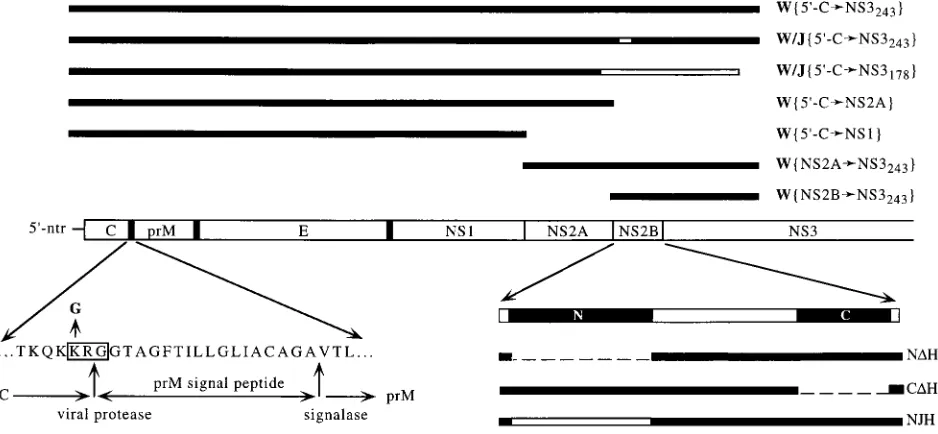
Construction of gene cassettes.DNA manipulations, PCR, and cloning were performed as described previously (21, 37). The gene cassettes used in this study are depicted in Fig. 1.
Construction of W{59-C3NS1} and W{59-C3NS3243} expression cassettes
was described previously (34, 35). The W{59-C3NS2A} cassette was prepared by PCR amplification of the WN virus NS2A gene and building up the
W{59-C3NS1} cassette using the NsiI (at the beginning of NS2A) and SalI (in the polylinker) sites. All cassettes are controlled by the T7 promoter. Previously (37), we had constructed variants of these cassettes containing a mutant form of C, referred to below as C(G2), in which the dibasic cleavage site KR/G located
at the C carboxy terminus in the C-prM precursor was disrupted by a Lys3Gly substitution. This mutation abolished the processing of the C-prM precursor by the viral NS2B-NS3243 protease in vitro (36). Construction of the
W{NS2A3NS3243} cassette which encodes wild-type components of the viral
protease was also described (34).
PCR mutagenesis was used to construct derivatives of the W{59-C3NS3243} and
W{59-C(G2)3NS3243} cassettes carrying variants of NS2B, which are depicted in
Fig. 1. For construction of deletion variants, two DNA fragments corresponding to NS2A-NS2B(part) and NS2B(part)-NS3 regions upstream and downstream from the intended deletion in NS2B were obtained by PCR amplification. After purifica-tion, the fragments were ligated, the ligation products were digested with NsiI (situated at the beginning of the NS2A gene) and BamHI (situated in the amino-terminal part of the NS3 gene), and desired NS2B deletion variants were recovered after cloning into NsiI and BamHI sites of a plasmid carrying the {NS2A3NS3243}
cassette. In the (NDH) variant, amino-terminal residues 2 to 52 of NS2B were removed; the (CDH) variant lacks carboxy-terminal amino acids 94 to 129 of NS2B. The integrity of the open reading frames (ORFs) in the resulting constructs was verified by sequencing. Subsequently, NsiI-BamHI fragments from selected plasmids were used to construct appropriate deletion deriva-tives of the W{59-C3NS3243} and W{59-C(G2)3NS3243} cassettes.
The NS2B-NS3243-encoding fragment was prepared by PCR amplification with
the start and stop codons supplied by primers; it was cloned into the SmaI site of pGEM3 under control of the T7 promoter.
Both WN and JE virus cDNAs feature an Eco47III site at the same position in the end of NS2A gene, which was used for construction of chimeric WN/JE virus cassettes. This site is a part of the Leu-Ala-Leu encoding sequence, which is found in both WN (5) and JE (31) virus polyproteins 27 amino acids (aa) upstream from the NS2A/NS2B cleavage site. A W/J{59-C3NS3178} cassette
(Fig. 1), and its C(G2) counterpart were prepared by joining of the
EcoRI-Eco47III fragment encoding the WN virus part of the cassette with the Eco47III-HindIII fragment encoding the JE virus part of the cassette. In both of these cassettes, C, prM, E, NS1, and most of NS2A are derived from the WN virus, while the carboxy-terminal 24 aa of NS2A, all of NS2B, and the NS3178
protease domain are of JE virus origin; the vector supplied three nonrelated amino acids and a stop codon. In the second pair of chimeric W/J{59-C3NS3243} cassettes
(Fig. 1), only the amino-terminal hydrophobic cluster in WN NS2B (positions 2 to 52 of NS2B) was replaced with that from JE virus NS2B.
Expression, labeling, immunoprecipitation, and gel electrophoresis. Through-out this study, the vaccinia virus T7 polymerase system (14) was used for expres-sion as described previously (37). In vivo labeling and immunoprecipitation were described previously (34), except that in cotransfection experiments, 5mg of a plasmid encoding the {59-C3NS2A} reporter cassette and 2.5mg of a plasmid encoding the NS2B-NS3243protease cassette were used. Unless otherwise
indi-cated, cells were labeled for 1 h with 100mCi of a [35S]Met-Cys mixture
(Am-ersham, Arlington Heights, Ill.), washed twice with phosphate-buffered saline, and chased in the growth medium for 5 h. In general, immunoprecipitated samples were deglycosylated with endo-b-N-acetylglucosaminidase F and re-solved by sodium dodecyl sulfate-polyacrylamide gel electrophoresis (SDS-PAGE) as described previously (37). Dried gels were quantitated with Phospho-rImager and ImageQuant software (Molecular Dynamics), and band intensities were normalized to NS1 as an internal standard (37).
RESULTS
Construction of expression cassettes.The flavivirus protease is a complex of two proteins, NS2B and NS3 (6, 10, 12, 32), which both may contribute to the observed upregulation of C-prM processing by signalases. The function of the NS3 pro-tease domain in this upregulation was studied previously (1, 19, 37). To investigate the role of NS2B in this process, we have constructed several expression cassettes encoding modified NS2B proteins. A hydrophobicity plot of WN virus NS2B re-veals two clusters of hydrophobic amino acids (Fig. 2) sur-rounding the region which is critical for activity of the NS2B-NS3 protease complex (13). Using PCR deletion mutagenesis, we constructed NS2B variants in which either the
amino-ter-FIG. 1. Schematic representation of proteins encoded by expression cassettes used in this study. The 59-terminal half of the WN virus genome, with the amino-terminal half of the encoded polyprotein drawn as an open bar, is presented in the middle. Individual flavivirus proteins are marked, with the vertical bars denoting their boundaries. Hydrophobic regions serving as signal and stop-transfer sequences are represented by the thick vertical bars. In the upper part of the figure, the thick horizontal bars represent the expression cassettes used for expression in the vaccinia virus-T7 polymerase system; open bars represent JE virus-specific sequences in chimeric cassettes. The lower part of the figure demonstrates mutated regions of the expression cassettes above. On the left side, the single-letter amino acid representation of the wild-type WN virus polyprotein sequence at the C-prM junction is shown. The carboxy terminus of C, the amino terminus of prM, and the viral protease and signalase cleavage sites are denoted below the sequence. The dibasic site KRG at the carboxy terminus of C which was disrupted by the Lys3Gly mutation is boxed. On the right side, an exploded view of the NS2B protein is shown. The amino- and carboxy-terminal hydrophobic regions are represented by the solid boxes and labeled N and C, respectively, and the 40-aa conserved domain (see the text for details) is represented by the open box. Dashed lines represent deletions which were introduced into NS2B, and the open bar in the NJH cassette represents the JE virus-specific sequence.
on November 9, 2019 by guest
http://jvi.asm.org/
[image:2.612.73.542.70.287.2]minal or the carboxy-terminal hydrophobic cluster was removed (Fig. 1). We also constructed two chimeric WN/JE virus cassettes. In the first chimeric cassette, designated W/J{59-C3NS3178}, the
entire protease of JE virus was used instead of that of WN virus. To ensure proper formation of the amino terminus of JE virus NS2B, the carboxy-terminal 24 aa of JE virus NS2A (approxi-mately 10% of its length), together with the native JE virus NS2A/ NS2B cleavage site, were also included in this cassette. In the second chimeric cassette, only the amino-terminal hydrophobic cluster in WN virus NS2B was replaced with that from JE virus; the rest of the WN virus protease components were retained.
First, we cloned these NS2B variants as {NS2A3NS3x} cas-settes to verify whether ORFs remained intact and resulting protease complexes (upon transient expression from plasmids) retained protease activity. After such verification, genes encod-ing the protease components were transferred in the context of {59-C3NS3x} cassettes.
In our previous study (37), we used the W{59-C(G2)3NS3243}
cassette in which the dibasic site in the C-prM precursor was
disrupted by a Lys 3Gly mutation. In vitro, this mutation abolished cleavage of the C-prM precursor by the viral pro-tease supplied in trans (36). However, both upregulation of C-prM signalase cleavage and secretion of prM and E were observed upon in vivo expression of the above cassette. As one possible explanation, it was suggested (37) that association of the protease with the C-prM precursor by itself (without cleav-age at the dibasic site) upregulates signalase cleavcleav-age and induces prM-E secretion. To verify this hypothesis and to iden-tify the roles of the protease components, we prepared appro-priate C(G2) counterparts of all the above-mentioned cassettes
(Fig. 1).
On the other hand, prM-E secretion observed for the cas-sette containing the mutated C-prM precursor could be simply explained by the ability of the protease to process the precur-sor either at the disrupted dibasic site or at the upstream RRS site (36) when the protease is present in cis. We have prepared an NS2B-NS3243cassette to determine whether the induction
of secretion for the cassette with mutated C-prM could be observed when the protease is supplied in trans. Since NS2A has been shown to be required for proper processing of NS1 (11), this protein was also included in the reporter cassette, {C3NS2A}.
Effects of NS2B deletions on the activity of the NS2B-NS3243 protease complex. Upon expression of an {NS2A3NS3243
}-encoding cassette, two WN virus-specific proteins, NS2B and NS3243, are readily detected in cell lysates by
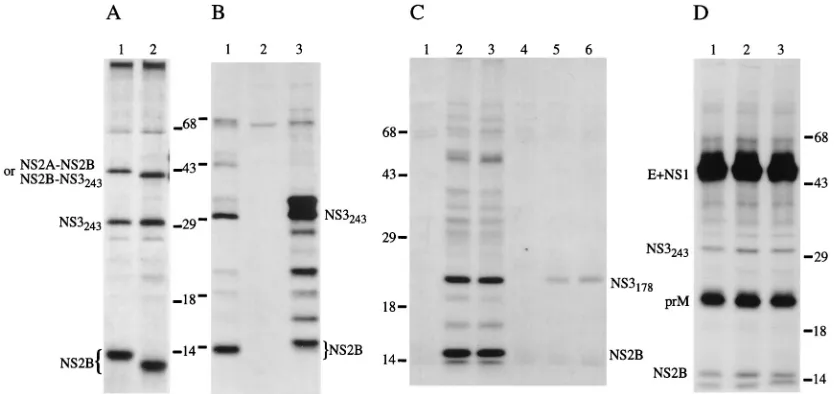
immunoprecipi-tation (32, 34, 36). Both proteins result from self-cleavage of the above precursor, thus indicating formation of the active protease complex (6, 10, 12, 32). A similar assay was success-fully used (13) to show that deletions in hydrophobic regions of NS2B upstream or downstream from the 40-aa hydrophilic domain do not abolish protease activity. Using this assay, we first verified that our modifications in NS2B did not result in inactivation of the protease. As demonstrated in Fig. 3A (lane 2), deletion of the amino-terminal hydrophobic domain had no apparent effect on the activity of the (NDH)NS2B-NS3243
[image:3.612.62.294.70.186.2]pro-FIG. 2. Hydrophobicity profile of WN virus NS2B. The NS2B sequence (5) hydrophobicity was plotted by the method of Kyte and Doolittle (18). Above the plot, amino- and carboxy-terminal hydrophobic regions are shown as solid boxes and marked N and C, respectively. The conserved 40-aa domain (13) is shown as an open box.
FIG. 3. Effect of modifications in NS2B on the formation of the active protease complexes. {NS2A3NS3243} (A and B) or {59-C3NS3x} (C and D) cassettes were expressed with the vaccinia virus-T7 polymerase system, and cells were labeled for 1 h and lysed. Proteins were recovered by immunoprecipitation with WN virus-specific antisera (unless stated otherwise) and resolved by PAGE. Identified proteins are depicted beside the gels; positions of prestained molecular weight (in thousands) markers are also shown. (A) Lanes: 1, wild-type NS2B; 2, (NDH)NS2B-containing cassette. (B) Lanes: 1, wild-type NS2B; 2, vaccinia virus-T7 polymerase-infected and mock-transfected cells; 3, (CDH)NS2B-containing cassette. (C) Lanes: 1 and 4, wild-type W{59-C3NS3243}; 2 and 5, W/J{59-C3NS3178}; 3 and 6, W/J{59-C(G2)NS3178} cas-sette. Proteins were immunoprecipitated with JE virus NS2B-specific (lanes 1 to 3) or NS3-specific (lanes 4 to 6) antisera. (D) Lanes: 1, wild-type W{59-C3NS3243}; 2, W/J{59-C3NS3243}; 3, W/J{59-C(G2)NS3243} cassette.
on November 9, 2019 by guest
http://jvi.asm.org/
[image:3.612.99.517.468.665.2]tease. For comparison, expression of the wild-type protease is shown in lane 1. The only observed difference was an increase in the apparent mobility of the (NDH)NS2B protein (calcu-lated 10 kDa versus 14.4 kDa of wild-type NS2B) and of either the NS2A-(NDH)NS2B or (NDH)NS2B-NS3243precursor(s),
which have similar calculated molecular masses. Both cassettes produce apparently the same NS3243protein (calculated 26.7
kDa), as expected.
In contrast, a shift toward processing at the alternative site(s) in NS2A and/or NS3243is profoundly exhibited by the cassette
containing (CDH)NS2B with the carboxy-terminal hydropho-bic domain deleted (Fig. 3B, lane 3). The deletion removes 36 aa from NS2B; two possible dibasic cleavage sites in the car-boxy-terminal region of NS2A are situated 33 aa (KKG) and 40 aa (KRS) upstream from the NS2A/NS2B junction. Alter-native cleavage in this region of NS2A has been observed for JE and yellow fever (YF) viruses (17, 24). Utilization of either site would result in a protein with approximately the same calculated molecular mass as that for wild-type NS2B. Indeed, among other products, a protein with slightly lower mobility than that of wild-type NS2B can be observed in Fig. 3B (lane 3). Since a product with the same mobility as that of wild-type NS3243was also observed in the immunoprecipitates, we
con-cluded that despite aberrant self-processing, expression of the above cassette results in formation of the active protease.
The correct processing of the JE virus NS2B-NS3178
pro-tease precursor was observed upon expression of the W/J{59-C3NS3178} chimeric cassette after
immunoprecipita-tion of NS2B and NS3178with JE virus NS2B- and NS3-specific
mouse antisera. As demonstrated in Fig. 3C, both JE virus protease-containing cassettes produced correctly processed NS3178, since a polypeptide of the expected size (calculated
molecular mass, 19.4 kDa) was observed (lanes 5 and 6) after immunoprecipitation with the JE virus NS3-specific antiserum. Apparently, the same polypeptide was coprecipitated with NS2B (calculated molecular mass, 14.3 kDa) by the JE virus NS2B-specific antiserum (lanes 2 and 3), indicating that both proteins form a complex (2, 7, 17). Neither WN virus NS2B (lane 1) nor NS3243(lane 4) was immunoprecipitated by the JE
virus-specific antisera.
Formation of the active protease complex containing WN/JE virus chimeric NS2B is demonstrated in Fig. 3D, where NS2B and NS3243proteins of the same size were
immunoprecipi-tated from cell lysates upon expression of either the wild-type W{59-C3NS3243} cassette (lane 1) or both its NS2B
chimeric derivatives (lanes 2 and 3).
From these data, we concluded that expression of all the above constructs results in the formation of active protease complexes. As compared with the wild-type {NS2A3NS3243}
cassette, both (NDH)NS2B- and (CDH)NS2B-containing cas-settes produced correctly processed NS3243, which contains the
active center of the protease (3, 15). The JE virus protease precursor also appeared to function properly in the context of WN virus polyprotein-encoding cassettes, producing correctly processed components of the JE virus protease complex, and replacement of the amino-terminal hydrophobic domain of NS2B with the homologous sequence from JE virus NS2B also had no apparent effect on formation of the active protease.
Effects of deletions in NS2B on C-prM processing and se-cretion of prM-E heterodimers.Recently, Chambers et al. (7) have reported that mutations in hydrophobic regions of NS2B, while having little or no effect on the activity of the resulting protease, appeared to be deleterious for the formation of in-fectious virus. The precise stage at which such mutations block virus replication remains unknown. It has been suggested (37) that NS2B plays a certain role in the upregulation of C-prM
processing by the viral protease. In this study, we were inter-ested in investigating whether these hydrophobic regions might be involved in such upregulation.
To address this question, we modified the W{59 -C3NS3243} and W{59-C(G2)3NS3243} cassettes (37) by
replac-ing the wild-type NS2B gene with its (NDH) variant carrying a deletion of the amino-terminal hydrophobic cluster (Fig. 1), and all four cassettes were expressed in the vaccinia virus-T7 poly-merase system. As seen in Fig. 4A, all cassettes produced significant amounts of prM, E, and NS1 proteins, which were readily detectable in cell lysates by immunoprecipitation. In all cases, expression resulted in the formation of the active pro-tease complexes, as indicated by the presence of NS2B (lanes 2 and 4) or (NDH)NS2B (lanes 6 and 8), and NS3243proteins
in immunoprecipitates. No apparent difference in the forma-tion of intracellular prM, E, and NS1 was observed for all four cassettes. In agreement with the previous report (37), both cassettes with the wild-type NS2B produced secreted prM and E (Fig. 4A, lanes 1 and 3). However, while the (ND H)NS2B-containing cassette with wild-type C-prM also produced se-creted prM and E (lane 5), secretion of these proteins was almost abolished for the cassette containing the mutated C(G2)-prM precursor (lane 7).
Mutations introduced into the carboxy-terminal hydro-phobic cluster of NS2B were also shown (7) to be deleteri-ous for virus replication, since no infectideleteri-ous progeny was recovered. To investigate whether it is also important for upregulation of C-prM processing by the protease, we modified the W{59-C3NS3243} and W{59-C(G2)3NS3243} cassettes (37)
by replacing the wild-type NS2B gene with its (CDH) variant in which this hydrophobic cluster was deleted (Fig. 1). This de-letion did not affect the secretion of prM and E for cassettes containing either wild-type C-prM (Fig. 4B, lanes 1 and 3) or mutated C(G2)prM (lanes 2 and 4).
In the above experiments, a 5-h chase period was required to detect secreted proteins in the media, and comparable amounts of intracellular prM were detected for all four cassettes at the end of the chase. However, as shown in Fig. 4C, efficient for-mation of prM could be observed even after 5-min labeling and chase periods in the presence of either wild-type NS2B-NS3243
(lanes 1 and 2) or (CDH)NS2B-NS3243(lanes 5 and 6)
pro-teases, whereas significantly less prM was detected for both wild-type C-prM- and C(G2)prM-containing cassettes with the
(NDH)NS2B-NS3243protease (lanes 3 and 4).
From the above data, we concluded that the amino-terminal hydrophobic cluster of NS2B, but not its carboxy-terminal one, appears to be important for the upregulation of C-prM signa-lase processing and for the induction of prM-E secretion by the NS2B-NS3243protease.
trans induction of prM and E secretion by the NS2B-NS3243 protease.Previously, it has been shown (36) that disruption of the dibasic cleavage site KR/G at the C-prM junction (25) by Lys 3 Gly mutation completely abolished the processing of this precursor by the viral protease in cell-free assays when the protease was supplied in trans. Disruption of the dibasic cleav-age site, however, did not affect the secretion of prM and E upon expression of the W{59-C(G2)3NS3243} cassette (37).
On the one hand, this would suggest that the ability of the protease to upregulate the signalase processing of C-prM and to induce the secretion of prM and E does not depend on its ability to process the C-prM precursor at the upstream dibasic site. However, on the other hand, the observed secretion might still result from the cleavage at the disrupted dibasic site due to altered specificity of the protease acting in cis. For the YF virus protease, some tolerance to modifications in the dibasic motif has been reported (24). To address this question, we attempted
on November 9, 2019 by guest
http://jvi.asm.org/
to determine whether induction of prM and E secretion de-pends specifically on the presence of the protease in cis. As demonstrated in Fig. 5, secretion of prM and E may be ob-served in cotransfection experiments upon coexpression of the NS2B-NS3243 cassette with {C3NS2A} cassettes containing
either the wild-type C-prM (lane 1) or that with the mutated dibasic site (lane 3). In agreement with previous reports (1, 19, 23, 34), secretion of prM and E was not observed upon expres-sion of either {C3NS2A} cassette without the protease (re-sults not shown). In contrast, proper processing and secretion of NS1 do not require the presence of the protease (4, 7–9, 19, 23, 24, 27, 33, 34) but depend on the presence of downstream NS2A protein (11).
From the data presented above, we conclude that induction of prM and E secretion from the cassette with an uncleavable C-prM precursor at the dibasic site cannot be explained by the altered specificity of the cis-acting protease.
Effects of heterologous and chimeric proteases on C-prM processing and secretion of prM-E heterodimers.The above findings indicate that the ability of the NS2B-NS3243protease
to upregulate the signalase processing of C-prM and induce the secretion of prM and E does not appear to depend on its ability to process the C-prM precursor at the upstream dibasic site. In this study, we were interested in addressing the speci-ficity and roles of individual protease components in this pro-cess.
For this purpose, we used the W/J{59-C3NS3178} cassette
in which the entire WN virus protease was replaced with that of JE virus. Such replacement had no apparent effect on the secretion of prM and E or on the formation of intracellular prM (Fig. 6A, lanes 3 and 4; compare with lanes 1 and 2) for the cassette containing wild-type C-prM. However, the secre-tion of prM and E was greatly reduced for the chimeric cas-sette with the mutated C-prM precursor (lanes 7 and 8), com-pared to the same cassette encoding the homologous protease (lanes 5 and 6), thus apparently resembling the behavior of the (NDH)NS2B-containing cassette. The important role of the amino-terminal hydrophobic cluster of NS2B in upregulation and induction of prM-E secretion was demonstrated above, thus providing one possible explanation. If this domain is in-volved in specific interaction of the protease with the C-prM precursor, heterologous NS2B may fail to provide the neces-sary association. To address this question, we replaced only the amino-terminal domain in WN virus NS2B with that of JE virus NS2B, but the rest of the WN virus protease was retained. While both these viruses belong to the same group and their polyprotein sequences display a high degree of sequence iden-tity (5, 31), there are 14 amino acid differences in the 54-aa amino-terminal hydrophobic domains of their NS2B proteins. As seen in Fig. 6B, such replacement did not affect the ability of the protease to induce the secretion of prM and E for both wild-type and mutated C-prM-containing cassettes, indicating FIG. 4. Effects of deletions in NS2B on upregulation of C-prM signalase processing and secretion of prM-E heterodimers. The NS2B variants were expressed by using the vaccinia virus-T7 polymerase system in the context of the {59-C3NS3243} cassettes containing either wild-type C-prM or C(G2)-prM as described in Materials and Methods. Proteins were recovered by immunoprecipitation with the WN virus-specific antiserum, deglycosylated with PNGase F, and resolved by PAGE. Identified proteins are depicted. (A) Lanes: 1 and 2, W{59-C3NS3243}; 3 and 4, W{59-C(G2)3NS3243}; 5 to 8, the same as in lanes 1 to 4, respectively, but for (ND H)NS2B-containing cassettes. Odd-numbered lanes, medium samples; even-numbered lanes, cell lysate samples. On the graph below, band intensities of prM, E, and NS1 were normalized to amounts of intracellular NS1 for each cassette, and numbers under the graph correspond to the lane numbers on the gel. (B) Lanes: 1, W{59-C3NS3243}; 2, W{59-C(G2)3NS3243}; 3 and 4, the same as in lanes 1 and 2, respectively, but for (CDH)NS2B-containing cassettes. Only medium samples are shown. On the graph below, band intensities of prM, E, and NS1 were normalized to amounts of secreted NS1 for each cassette. (C) Cell lysate samples obtained after 5 min of labeling and 5 min of chase. Lanes: 1 and 2, wild-type NS2B; 3 and 4, (NDH)NS2B; 5 and 6, (CDH)NS2B-containing cassettes. Odd-numbered lanes, wild-type C-prM; even-numbered lanes, C(G2)-prM-containing cassettes. Samples were not deglycosylated; E and NS1 are not resolved (34). On the graph below, band intensities of prM and E plus NS1 were normalized to the total of E plus NS1 for each cassette.
on November 9, 2019 by guest
http://jvi.asm.org/
that involvement of the amino-terminal hydrophobic cluster of NS2B is probably not highly sequence specific.
From the present experiments, we conclude that the JE virus protease is able to process the WN virus C-prM precursor at its dibasic site. With the intact site, such processing results in up-regulation of signalase cleavage and induction of prM and E secretion. However, when cleavage is blocked due to disrup-tion of the dibasic motif, the JE virus protease fails to induce prM and E secretion. Thus, the chimeric cassettes containing the entire JE virus protease appear to resemble the (NDH) NS2B-containing cassettes. However, from the latter experi-ments, we conclude that the NS2B amino-terminal hydropho-bic domain alone cannot provide for the observed specificity of the protease.
DISCUSSION
Previously, it has been shown (19, 34) that both efficient processing of the C-prM precursor by host cell signalases and secretion of the prM and E require the presence of the active viral NS2B-NS3243protease. Subsequently, specific cleavage by
the viral protease at the dibasic site situated at the carboxy terminus of the C protein in the C-prM precursor has been demonstrated in vitro (36). It was observed, however, that disruption of the dibasic site in the C-prM precursor by a Lys 3 Gly mutation had no effect on upregulation of prM formation and did not abolish the secretion of prM and E (37),
even though mutant C-prM was not processed in vitro by the protease supplied in trans (36). This might indicate that both prM upregulation and induction of prM-E secretion constitute a distinct function of the protease and do not appear to be simply the consequence of prior cleavage of C-prM at the dibasic site. However, an alternative explanation cannot be ruled out. It suggests that in cis, in contrary to the trans assays mentioned above, the protease may be less specific and, when expressed as part of the same polyprotein, is able to process C-prM at the modified dibasic site. Indeed, some tolerance for modifications in the dibasic motif was observed for YF virus protease (24). It was of interest to determine if the same effects of upregulation and secretion could be observed for the mu-tated C-prM-containing cassettes with the protease supplied in trans, i.e., by coexpression of the protease components from a separate cassette. In this study, we found that both upregula-tion of prM formaupregula-tion and inducupregula-tion of prM-E secreupregula-tion can be successfully achieved upon cotransfection of {C3NS2A} reporter and {NS2B-NS3243} cassettes, and the protease
com-plex appeared to be equally effective for both wild-type and mutated C-prM-containing cassettes. Since the protease failed to process mutated C-prM in trans (36) but retained its ability to upregulate prM formation and induce prM-E secretion when present either in cis (37) or in trans (this study), neither process seems to depend solely on the above cleavage event. It has been shown, however, that signalase cleavage occurs effi-ciently after treatment of membrane-associated C-prM with trypsin (30), which may result in rather nonspecific degrada-tion of C. Utilizadegrada-tion of the cryptic site(s) or nonspecific deg-radation of C in the presence of the viral protease was not observed in vitro (36). Strictly, this still cannot be ruled out in vivo. However, we consider such nonspecific degradation by the viral protease to be a very unlikely scenario. We suggest that association of the protease complex with the C-prM pre-cursor by itself might be sufficient for upregulation of prM formation and induction of prM-E secretion. Such association may be responsible for the partial escape of prM and E anti-gens in nonvirion form (23) from flavivirus-infected cells (27, 29).
Since the flavivirus protease consists of two proteins (6, 10, 12, 32), we were interested in investigating the role that each component protein plays in the above processes. Earlier (34, 37), we had suggested that NS2B may be responsible for the association of the protease complex with the C-prM precursor. If so, this protein might contain a specific region which is crucial for such an association, and deletion of this region would affect the upregulation and induction of secretion for the cassette containing the uncleavable C-prM precursor. In this regard, the amino- and carboxy-terminal hydrophobic clus-ters in NS2B were of particular interest. It has been reported that while deletions in the amino- or carboxy-terminal hydro-phobic clusters of NS2B did not impair the proteolytic activity of the protease (13), modifications in these regions appeared to be deleterious for the formation of an infectious virus prog-eny (7). We found that the presence or absence of the carboxy-terminal hydrophobic cluster had no effect on the ability of the protease to upregulate prM formation and induce prM-E se-cretion for cassettes containing either wild-type or mutated C-prM. In contrast, deletion of the amino-terminal hydropho-bic cluster nearly abolished prM-E secretion for the cassette with mutated but not wild-type C-prM. These results imply that for the wild-type cassette, as also might occur in flavivirus infection, the effect of the protease on processing of the C-prM region may indeed be a composite result of two distinct mech-anisms: (i) association of the protease complex with the C-prM precursor and (ii) protease cleavage at the dibasic site in the FIG. 5. Upregulation of C-prM signalase cleavage and induction of prM-E
secretion by the NS2B-NS3243protease supplied in trans. W{59-C3NS2A} cas-settes containing either wild-type C-prM (lanes 1 and 2) or C(G2)-prM (lanes 3 and 4) were coexpressed with the NS2B-NS3243protease-encoding cassette, and proteins were recovered by immunoprecipitation with WN virus-specific anti-serum, deglycosylated with PNGase F, and resolved by PAGE. Odd-numbered lanes, medium samples; even-numbered lanes, cell lysate samples. Identified proteins and positions of prestained markers are depicted. The band correspond-ing to NS3243is more clearly visible upon longer exposure; however, this resulted in a lack of resolution of E and NS1 in lanes 2 and 4. On the graph below, band intensities of prM, E, and NS1 were normalized to amounts of intracellular NS1 for each cassette, and numbers under the graph correspond to the lane numbers on the gel.
on November 9, 2019 by guest
http://jvi.asm.org/
precursor. Both of these mechanisms, in the case of wild-type C-prM, may contribute to upregulation of signalase cleavage and induction of prM-E secretion. In the cassettes with the modified dibasic sites, however, cleavage of C-prM by the protease becomes impossible, but association of the protease with the precursor still can effect upregulation of its signalase processing and induction of prM-E secretion. The present data indicate that NS2B indeed plays an important role in both these processes. In contrast to the wild-type and its (CDH) variant, the (NDH)NS2B-containing protease has lost its ability to facilitate prM formation and prM-E secretion for the cas-sette with an uncleavable dibasic site in C-prM. Apparently, either deletion of the amino-terminal hydrophobic domain im-paired the association of the protease with C-prM precursor, or such an association has lost its ability to upregulate signalase cleavage and induce secretion. Thus, in the doubly mutated cassette containing uncleavable C-prM and (NDH)NS2B, both effects are blocked and secretion of prM and E was not ob-served.
Subsequently, we investigated the specificity of such associ-ation of the protease with the C-prM precursor. To address this question, first we replaced the entire WN virus protease with that of JE virus. Both viruses belong to the same serologic group and share extensive amino acid sequence identity, espe-cially for NS3 and NS5 proteins. We have found that while expression of the chimeric W/J{59-C3NS3178} cassette
re-sulted in efficient prM formation and prM-E secretion, the C(G2)-prM counterpart of this cassette failed to produce
se-creted prM and E. Since secretion was observed with the
wild-type dibasic site in C-prM, the JE virus protease was probably capable of cleaving the WN virus C-prM precursor at its dibasic site. However, since no secretion was observed when the dibasic site was rendered uncleavable, the JE virus pro-tease evidently was not capable of proper association with the C-prM precursor. Thus, the JE virus protease expressed in the context of the WN virus reporter cassette had prop-erties resembling the (NDH)NS2B-containing WN virus protease. On the basis of the above results demonstrating the importance of the N-terminal hydrophobic domain in NS2B, we speculated that this domain provides for the ob-served specificity of association of the protease complex with the C-prM precursor. To verify this hypothesis, we prepared a pair of W/J{59-C3NS3243} chimeric cassettes
[containing either wild-type C-prM or C(G2)-prM] in which
only the N-terminal hydrophobic domain in WN virus NS2B was replaced with that from JE virus NS2B. The chimeric cassettes, however, appeared to be almost indistinguishable from the parental W{59-C3NS3243} and W{59-C(G2)3NS3243} WN
[image:7.612.132.483.68.352.2]virus cassettes, since efficient formation of prM and prM-E secretion was again observed for both wild-type and mutated C-prM. Thus, the N-terminal hydrophobic domain does not seem to be solely responsible for the observed specificity of protease association with C-prM. The JE virus protease used in the above experiments included only 178 aa of NS3, which is just enough to incorporate only the protease active center (3, 15). The WN virus protease, however, included 243 amino acids of NS3, thus also incorporating the amino-terminal part FIG. 6. Expression of WN/JE virus chimeric {59-C3NS3x} cassettes. The cassettes containing either wild-type C-prM or C(G2)-prM were expressed in the vaccinia virus-T7 polymerase system, and proteins were recovered by immunoprecipitation with WN virus-specific antiserum, deglycosylated with PNGase F, and resolved by PAGE. Identified proteins and positions of prestained markers are depicted. On the graphs below the gel, band intensities of prM, E, and NS1 were normalized to amounts of intracellular NS1 for each cassette, and numbers under the graphs correspond to the lane numbers on the gels. (A) Lanes: 1 and 2, W{59-C3NS3243}; 3 and 4, W/J{59-C3NS3178}; 5 and 6, W{59-C(G2)3NS3243}; 7 and 8, W/J{59-C(G2)3NS3178}. Odd-numbered lanes, medium samples; even-numbered lanes, cell lysate samples. (B) Lanes: 1 and 2, W{59-C3NS3243}; 3 and 4, W/J{59-C3NS3243}; 5 and 6, W{59-C(G2)3NS3243}; 7 and 8, W/J{59-C(G2)3NS3243}. Odd-numbered lanes,
medium samples; even-numbered lanes, cell lysate samples.
on November 9, 2019 by guest
http://jvi.asm.org/
of the NS3 helicase domain (16), whose contribution to the observed specificity cannot be ruled out.
The results of this study support and further elaborate the model of late events in flavivirus polyprotein processing and virion formation that we proposed previously (34). The appar-ent complexity of C-prM processing suggests that this region might constitute a central point of flavivirus replication. Elu-cidation of its molecular mechanisms may uncover approaches to new generations of safe vaccines.
ACKNOWLEDGMENTS
We thank C.-J. Lai (NIAID, Bethesda, Md.) for JE NS2B- and NS3-specific antisera and B. Falgout (FDA/CBER, Bethesda, Md.) for critical comments.
This study was supported in part by research award VRD/V22/ 181/72 from the World Health Organization.
REFERENCES
1. Amberg, S. M., A. Nestorowicz, D. W. McCourt, and C. M. Rice. 1994. NS2B-3 proteinase-mediated processing in the yellow fever virus structural region: in vitro and in vivo studies. J. Virol. 68:3794–3802.
2. Arias, C. F., F. Preugschat, and J. M. Strauss. 1993. Dengue 2 virus NS2B and NS3 form a stable complex that can cleave NS3 within the helicase domain. Virology 193:888–899.
3. Bazan, J. F., and R. J. Fletterick. 1989. Detection of a trypsin-like serine protease domain in flaviviruses and pestiviruses. Virology 171:637–639. 4. Biedrzycka, A., M. R. Cauchi, A. Bartholomeusz, J. J. Gorman, and P. J.
Wright.1987. Characterization of protease cleavage sites involved in the formation of envelope glycoprotein and three nonstructural proteins of den-gue virus type 2, New Guinea C strain. J. Gen. Virol. 68:1317–1326. 5. Castle, E., U. Leidner, T. Nowak, G. Wengler, and G. Wengler. 1986. Primary
structure of the West Nile flavivirus genome region coding for all nonstruc-tural proteins. Virology 149:10–26.
6. Chambers, T. J., A. Grakoui, and C. M. Rice. 1991. Processing of yellow fever virus nonstructural polyprotein: a catalytically active NS3 proteinase domain and NS2B are required for cleavages at dibasic sites. J. Virol. 65: 6042–6050.
7. Chambers, T. J., A. Nestorowicz, S. M. Amberg, and C. M. Rice. 1993. Mutagenesis of the yellow fever virus NS2B protein: effects on proteolytic processing, NS2B-NS3 complex formation, and viral replication. J. Virol. 67: 6797–6807.
8. Chambers, T. J., C. S. Hahn, R. Galler, and C. M. Rice. 1990. Flavivirus genome organization, expression and replication. Annu. Rev. Microbiol. 44: 649–688.
9. Chambers, T. J., D. W. McCourt, and C. M. Rice. 1990. Production of yellow fever virus proteins in infected cells: identification of discrete polyprotein species and analysis of cleavage kinetics using region-specific polyclonal antisera. Virology 177:159–174.
10. Chambers, T. J., R. C. Weir, A. Grakoui, D. W. McCourt, J. F. Bazan, R. J.
Fletterick, and C. M. Rice.1990. Evidence that the N-terminal domain of nonstructural protein NS3 from yellow fever virus is a serine protease re-sponsible for site-specific cleavages in the viral polyprotein. Proc. Natl. Acad. Sci. USA 87:8898–8902.
11. Falgout, B., R. Chanock, and C.-J. Lai. 1989. Proper processing of dengue virus nonstructural glycoprotein NS1 requires the N-terminal hydrophobic signal sequence and the downstream nonstructural protein NS2a. J. Virol.
63:1852–1860.
12. Falgout, B., M. Pethel, Y.-M. Zhang, and C.-J. Lai. 1991. Both nonstructural protein NS2B and NS3 are required for the proteolytic processing of dengue virus nonstructural proteins. J. Virol. 65:2467–2475.
13. Falgout, B., R. H. Miller, and C.-J. Lai. 1993. Deletion analysis of dengue virus type 4 nonstructural protein NS2B: identification of a domain required for NS2B-NS3 proteinase activity. J. Virol. 67:2034–2042.
14. Fuerst, T. R., E. G. Niles, F. W. Studier, and B. Moss. 1986. Eukaryotic transient-expression system based on recombinant vaccinia virus that syn-thesizes bacteriophage T7 RNA polymerase. Proc. Natl. Acad. Sci. USA 83: 8122–8126.
15. Gorbalenya, A. E., A. P. Donchenko, E. V. Koonin, and V. M. Blinov. 1989. N-terminal domains of putative helicases of flavi- and pestiviruses may be serine proteases. Nucleic Acids Res. 17:3889–3897.
16. Gorbalenya, A. E., E. V. Koonin, A. P. Donchenko, and V. M. Blinov. 1989. Two related superfamilies of putative helicases involved in replication, re-combination, repair and expression of DNA and RNA genomes. Nucleic Acids Res. 17:4713–4729.
17. Jan, L. R., C. S. Yang, D. W. Trent, B. Falgout, and C. J. Lai. 1995. Processing of Japanese encephalitis virus non-structural proteins: NS2B-NS3 complex and heterologous proteases. J. Gen. Virol. 76:573–580.
18. Kyte, J., and R. F. Doolittle. 1982. A method for displaying the hydropathic character of a protein. J. Mol. Biol. 157:105–132.
19. Lobigs, M. 1993. Flavivirus premembrane protein cleavage and spike het-erodimer secretion require the function of the viral proteinase NS3. Proc. Natl. Acad. Sci. USA 90:6218–6222.
20. Maddon, P. J., A. G. Dalgleish, J. S. McDougal, P. R. Clapham, R. A. Weiss,
and R. Axel.1986. The T4 gene encodes the AIDS virus receptor and is expressed in the immune system and the brain. Cell 47:333–348. 21. Maniatis, T., E. F. Fritsch, and J. Sambrook. 1982. Molecular cloning: a
laboratory manual. Cold Spring Harbor Laboratory, Cold Spring Harbor, N.Y.
22. Markoff, L. 1989. In vitro processing of dengue virus structural proteins: cleavage of the pre-membrane protein. J. Virol. 63:3345–3352.
23. Mason, P. W., S. Pincus, M. J. Fournier, T. L. Mason, R. E. Shope, and E.
Paoletti.1991. Japanese encephalitis virus-vaccinia recombinants produce particulate forms of the structural membrane proteins and induce high levels of protection against lethal JEV infection. Virology 180:294–305. 24. Nestorowicz, A., T. J. Chambers, and C. M. Rice. 1994. Mutagenesis of the
yellow fever virus NS2A/2B cleavage site: effects on proteolytic processing, viral replication and evidence for alternative processing of the NS2A protein. Virology 199:114–123.
25. Nowak, T., P. M. Farber, G. Wengler, and G. Wengler. 1989. Analyses of the terminal sequences of West Nile virus structural proteins and of the in vitro translation of these proteins allow the proposal of a complete scheme of the proteolytic cleavages involved in their synthesis. Virology 169:365–376. 26. Ruiz-Linares, A., A. Cahour, P. Despres, M. Girard, and M. Bouloy. 1989.
Processing of yellow fever virus polyprotein: role of cellular proteases in maturation of the structural proteins. J. Virol. 63:4199–4209.
27. Russell, P. K., W. E. Brandt, and J. M. Dalrymple. 1980. Chemical and antigenic structure of flaviviruses, p. 503–529. In R. W. Schlesinger (ed.), The togaviruses. Academic Press, Inc., New York, N.Y.
28. Speight, G., G. Coia, M. D. Parker, and E. G. Westaway. 1988. Gene map-ping and positive identification of the nonstructural proteins NS2A, NS2B, NS3, NS4B, and NS5 of the flavivirus Kunjin and their cleavage sites. J. Gen. Virol. 69:23–34.
29. Stevens, T. M., and R. W. Schlesinger. 1965. Studies on nature of dengue viruses. 1. Correlation of particle density, infectivity, and RNA content of type 2 virus. Virology 27:103–112.
30. Stocks, C. E., and M. Lobigs. 1995. Posttranslational signal peptidase cleav-age at the flavivirus C-prM junction in vitro. J. Virol. 69:8123–8126. 31. Sumiyoshi, H., C. Mori, I. Fuke, K. Morita, S. Kuhara, J. Kondou, Y.
Kukushi, H. Nagamatu, and A. Igarashi.1987. Complete nucleotide se-quence of the Japanese encephalitis virus genome RNA. Virology 161:497– 510.
32. Wengler, G., G. Czaya, P. M. Farber, and J. H. Hegemann. 1991. In vitro synthesis of West Nile virus proteins indicates that the amino-terminal seg-ment of the NS3 protein contains the active center of the protease which cleaves the viral polyprotein after multiple basic amino acids. J. Gen. Virol.
72:851–858.
33. Wright, P. S., M. R. Cauchi, and M. L. Ng. 1989. Definition of the carboxy termini of the three glycoproteins specified by dengue virus type 2. Virology
171:61–67.
34. Yamshchikov, V. F., and R. W. Compans. 1993. Regulation of late events in flavivirus polyprotein processing and maturation. Virology 192:38–51. 35. Yamshchikov, V. F., and R. W. Compans. 1994. Generation of long flavivirus
expression cassettes by in vivo recombination and transient dominant selec-tion. Gene 149:193–201.
36. Yamshchikov, V. F., and R. W. Compans. 1994. Processing of the intracel-lular form of the West Nile virus capsid protein by the viral NS2B-NS3 protease: an in vitro study. J. Virol. 68:5765–5771.
37. Yamshchikov, V. F., and R. W. Compans. 1995. Formation of the flavivirus envelope: role of the viral NS2B-NS3 protease. J. Virol. 69:1995–2003.